𝗙𝗨𝗟𝗟 𝗦𝗧𝗢𝗥𝗬 She Turned My Garage Into Her Private Storage Unit—So I Put Up One Sign and Let the Entire Neighborhood Solve the Problem
𝗙𝗨𝗟𝗟 𝗦𝗧𝗢𝗥𝗬
The lamp was temporary.
The chairs were temporary.
The boxes were temporary.
The cabinet was temporary.
The rug was temporary.
The broken decorative fountain that appeared beside my lawn equipment was apparently extremely temporary.
Weeks passed.
Nothing left.
More arrived.
At first, I tried to stay reasonable.
“Linda, I need you to get those boxes out of the garage.”
“Absolutely.”
“When?”
“Soon.”
“I mean a day.”
She laughed.
“You’re so formal.”
“Tomorrow?”
“I’ll see what I can do.”
Tomorrow came.
Boxes remained.
A week later, I brought it up again.
She was standing beside my driveway talking to another neighbor.
“Linda, I need the garage cleared.”
Her smile tightened.
“Everything?”
“Everything that’s yours.”
She gave a little laugh and looked toward the other woman as though I had told a joke.
“Ethan is very protective of his garage.”
The neighbor smiled awkwardly.
I didn’t.
“Because it’s my garage.”
Linda’s eyes sharpened.
“Nobody said it wasn’t.”
“Then please remove your things.”
“I’ve already told you I’m working on it.”
“You’ve been working on it for weeks.”
Her voice cooled.
“Some of us have more complicated lives than others.”
I stared at her.
“What does that have to do with storing furniture in my house?”
“It’s not your house. It’s the garage.”
That sentence told me everything.
To Linda, my property became less mine whenever she found it convenient.
I took a breath.
“Get the items out.”
She stepped closer.
The friendly neighborhood smile disappeared.
“You’re being unnecessarily hostile.”
“No. I’m asking you to move your things.”
“Do you know how many people in this neighborhood help each other?”
“Then ask one of them.”
Her face flushed.
The other neighbor suddenly found something fascinating on her phone.
Linda lowered her voice.
“You really don’t want to become known as the difficult person on this street.”
There it was.
The first threat.
Soft.
Indirect.
Delivered with a smile.
I looked at her.
“Is that supposed to scare me?”
She shrugged.
“HOAs function on cooperation.”
“My garage isn’t HOA property.”
“Nobody said it was.”
“Then don’t bring the HOA into it.”
Linda’s expression went flat.
“I was making a general observation.”
“Good.”
I pointed toward her house.
“Make another one while you’re carrying your boxes home.”
She left without saying goodbye.
That should have solved the problem.
Instead, Linda escalated.
The following weekend, I opened my garage and found an entire dresser inside.
A full-size dresser.
Six drawers.
Dark wood.
Heavy enough that I knew she couldn’t have moved it alone.
Someone had entered my garage while I was away and physically carried furniture into it.
That was when I realized Linda wasn’t misunderstanding me.
She was testing me.
I went next door.
She answered almost immediately.
Same red dress.
Different earrings.
Same expression of complete innocence.
“Hi, Ethan.”
“You put a dresser in my garage.”
“Oh, yes.”
I stared at her.
“Why?”
“I needed room.”
“In your house?”
“Obviously.”
“So you moved it into mine?”
She laughed.
“Don’t be dramatic. It’s a garage.”
“My garage.”
“For a few days.”
“No.”
Her smile disappeared.
“No?”
“No. Move it today.”
She crossed her arms.
“I have plans.”
“Cancel them.”
Her eyes widened.
“Excuse me?”
“You heard me.”
“Who do you think you’re talking to?”
“My neighbor who’s storing furniture in my garage without permission.”
Linda stepped outside and pulled the door closed behind her.
“Let me explain something to you.”
I almost laughed.
“No. Let me explain something to you.”
Her eyes hardened.
I continued.
“You do not have permission to store anything on my property.”
“I’ve had permission.”
“No, you haven’t.”
“You never stopped me before.”
“I brought your first box back.”
“Then you allowed the rest.”
“That’s not permission.”
“You knew it was there.”
“And repeatedly asked you to remove it.”
She waved her hand dismissively.
“You’re rewriting history.”
I couldn’t believe the arrogance.
“Linda, I have texts.”
That stopped her for half a second.
Then she recovered.
“What texts?”
“The ones where I asked you to pick up your things.”
“I said I would.”
“Exactly.”
She stepped closer.
“Then what’s the problem?”
“The problem is that you didn’t.”
For several seconds, we stared at each other.
Then Linda smiled.
Not warmly.
The kind of smile that said she’d decided I needed to be punished.
“I’ll move everything when I have time.”
“No.”
Her smile vanished again.
“You don’t dictate my schedule.”
“And you don’t dictate what sits in my garage.”
“You are becoming extremely unpleasant.”
“Good.”
I turned to leave.
She called after me.
“You know the HOA has clutter standards.”
I stopped.
Slowly turned around.
“What?”
She folded her arms.
“If you start dragging furniture onto driveways or curbs, the board can cite you.”
For one moment, the audacity was so complete that I almost admired it.
She had filled my garage with her junk.
And now she was warning me that moving it could result in an HOA violation.
“You’ve planned this.”
Her eyebrows lifted.
“Planned what?”
“You think I can’t move your things outside because you’ll report me for clutter.”
“That’s not what I said.”
“That’s exactly what you said.”
Linda smiled.
“I’m simply reminding you that actions have consequences.”
I nodded.
“You’re right.”
Something in my tone made her expression change.
But I walked away before she could ask what I meant.
For the next few weeks, Linda kept adding things.
Not every day.
That would have been too obvious.
One lamp.
Three boxes.
A cabinet.
Another chair.
An old artificial Christmas tree.
She moved slowly enough that each new item felt like one more insult rather than a single dramatic invasion.
I stopped being able to park inside.
Then I lost access to the workbench.
Eventually, I couldn’t reach the shelf holding my drill without stepping over Linda’s boxes.
I tried locking the side door.
She apparently had been entering through the garage door whenever I left it open while doing yard work.
I became paranoid about closing it even when I went inside for thirty seconds.
My own house began changing around her behavior.
That made me furious.
One Saturday afternoon, I was repairing a wooden chair for my sister.
I needed clamps stored on the back shelf.
Linda’s cabinet blocked them.
I tried moving the cabinet.
Too heavy.
I called her.
No answer.
Texted.
I need your cabinet removed today.
No response.
Two hours later:
Busy. Maybe next weekend.
I stared at the message.
Then typed:
No. Today.
She replied immediately.
Please stop harassing me.
I laughed out loud.
Harassing her.
In my garage.
About her furniture.
That night, I sat at the kitchen table and considered my options.
I could pay someone to move everything.
I could drag it onto Linda’s driveway.
I could hire a storage company and send her the bill.
I could call an attorney.
I could spend weeks turning a stupid neighborhood dispute into a legal fight.
None of those options appealed to me.
I didn’t want revenge.
I wanted my garage.
That’s all.
The next morning, I opened the door and saw something new.
More boxes.
Linda had added more overnight.
Something inside me finally snapped.
Not emotionally.
Strategically.
I walked through the garage slowly.
Furniture.
Lamps.
Boxes.
Decorations.
Cabinets.
Old chairs.
Most of it looked like things Linda didn’t actually value enough to keep inside her own house.
She valued my space more than she valued the objects occupying it.
That was the key.
I went to the recycling bin.
Pulled out a large piece of leftover cardboard.
Found a thick black marker in my kitchen drawer.
Then I stood at the workbench, moved one of Linda’s boxes aside, and wrote four words.
Actually, five if you counted the smaller line.
FREE STUFF
PICK UP TODAY
I stared at the sign.
Simple.
No lawyers.
No arguments.
No committee.
No HOA meeting.
I carried it outside.
Placed it near the driveway where passing cars could see it.
Then I opened the garage door completely.
For the first few minutes, nothing happened.
I stood inside with my coffee.
The street was quiet.
A dog barked somewhere.
A lawn mower started two houses down.
I wondered whether the plan was stupid.
Then a sedan slowed.
The driver looked toward the sign.
Stopped.
Backed up.
A man lowered the window.
“Is the furniture really free?”
I looked at Linda’s dresser.
“Yes.”
“All of it?”
“Anything in the garage that’s part of the giveaway.”
His eyes widened.
He parked.
His wife climbed out.
Within two minutes, they were inspecting the dresser.
“Can we take this?”
“Absolutely.”
They opened the drawers.
Checked the sides.
“That’s actually pretty nice.”
“I hope you enjoy it.”
The man looked suspicious.
“Seriously? Free?”
“Free.”
They started loading it.
A second car slowed.
Then a pickup.
The driver of the pickup saw the sign and called out, “You getting rid of stuff?”
“Yes.”
“What about those chairs?”
“Take them.”
Within ten minutes, my driveway looked like an estate sale without prices.
People began calling neighbors.
One woman took two lamps.
A college-aged guy grabbed the small bookcase.
Someone else wanted the rolled rug.
A retired couple took a side table.
The boxes began disappearing.
“What about this one?” a neighbor asked.
“If you want it, take it.”
“What’s inside?”
“I don’t know.”
He opened it.
Holiday decorations.
“Perfect. My wife loves this stuff.”
“Enjoy.”
Cars kept arriving.
Some people knew me.
Others had simply seen the sign.
One woman said, “Linda told me you were antisocial.”
I smiled.
“Take a lamp.”
She laughed.
“I think I will.”
The entire situation became almost absurdly cheerful.
People were helping one another load furniture.
Someone had brought rope.
A teenager carried boxes to an SUV.
A man I had barely spoken to before offered to help move the heavy cabinet.
And with every item that disappeared, I could see more concrete floor.
My concrete floor.
The satisfaction was unbelievable.
Then I heard Linda.
“What the hell are you doing?”
The entire driveway seemed to pause.
She came marching across her lawn in the red lace dress and heels, moving so fast that one heel sank into the grass.
Her face was bright red.
“Stop!”
A man holding one of her lamps froze.
Linda pointed at him.
“Put that down!”
He looked at me.
Then at her.
“Is this yours?”
“Yes!”
I took a sip of coffee.
“It was in my garage.”
Linda turned toward me.
“You.”
I pointed toward the sign.
She read it.
Her eyes widened.
FREE STUFF. PICK UP TODAY.
“You cannot be serious.”
“I wanted the garage cleared.”
“Those are my belongings!”
“Why were they in my garage?”
The question stopped her.
Only for a second.
Then she exploded.
“Because you agreed to store them!”
“No, I didn’t.”
“Yes, you did!”
A woman loading boxes into her SUV slowed down to listen.
I kept my voice calm.
“Linda, I’ve asked you repeatedly to remove your property.”
“You said temporary storage was fine!”
“I never said that.”
“You allowed it!”
“I told you to move it.”
“You can’t just give away someone else’s possessions.”
I gestured toward the garage.
“You left them on my property after I repeatedly told you to remove them.”
Linda turned toward the neighbors.
“Everybody stop taking things!”
Nobody moved for a second.
Then the man holding the lamp asked me quietly, “Can I still take this?”
I looked at Linda.
She looked like she might burst into flames.
I looked back at him.
“Your call.”
He slowly carried the lamp to his truck.
Linda made a sound somewhere between a gasp and a scream.
“You people are stealing!”
One neighbor turned.
“Linda, weren’t these stored in his garage?”
“Temporarily.”
“For months,” I said.
“That is irrelevant.”
“No. That’s the entire point.”
She marched toward me.
“You planned this.”
“Yes.”
Her eyes widened.
I corrected myself.
“I planned to get my garage back.”
“You humiliated me.”
“I asked you privately.”
“You’re trying to turn the neighborhood against me.”
“I put up a sign.”
“You knew exactly what would happen.”
“No, actually.”
I looked around at the increasingly empty garage.
“This worked much better than I expected.”
A few people laughed.
Linda heard them.
That made everything worse.
She spun toward the crowd.
“Anyone who removes my property will be reported.”
Someone asked, “To who?”
“The HOA.”
Another neighbor said, “For taking free stuff?”
“It’s not free!”
I pointed at the sign.
“It is today.”
Linda turned toward me with fury in her eyes.
“I will have you fined.”
“For what?”
“Unauthorized distribution.”
I almost choked on my coffee.
“That’s not a real violation.”
“It will be.”
There it was.
Linda in her purest form.
If reality didn’t support her, she’d simply threaten to rewrite reality.
I smiled.
“Good luck.”
She stepped closer.
“You think this is funny?”
“No.”
I looked into the garage.
A man and his son were carrying out the artificial tree.
“I think it’s efficient.”
Linda rushed past me.
“Stop! Stop touching everything!”
She grabbed one box from a woman’s hands.
The woman let go immediately.
“Okay, Linda.”
Linda hugged the box against her chest.
It contained old Thanksgiving decorations.
She looked frantically around.
Most of the garage was already empty.
The dresser was gone.
The rug was gone.
Four chairs were gone.
The lamps were gone.
Half the boxes had vanished.
The large cabinet remained.
Two men were already studying how to lift it.
“Don’t touch that!” Linda screamed.
They stopped.
One of them shrugged.
“All yours.”
Linda looked at the cabinet.
Then toward her house.
It was too heavy for her to move alone.
She turned toward the HOA security volunteer who had walked over after hearing the commotion.
“You. Help me.”
He looked at the cabinet.
Then at her.
“I’m not really supposed to move personal furniture.”
“I’m on the community committee.”
“I’m aware.”
“Then help.”
He shook his head.
Linda stared at him as though she couldn’t believe anyone had refused.
That was the part I enjoyed most.
Not her losing the furniture.
Her discovering that the title she constantly waved around couldn’t make every person obey.
She pointed at me.
“This isn’t finished.”
I leaned against the garage wall.
“It will be when the cabinet’s gone.”
She stormed home.
Twenty minutes later, she returned with a handcart.
By then, someone else had arrived for the cabinet.
A neighbor named Carlos was backing his SUV toward the driveway.
Linda saw him.
“No!”
Carlos stopped.
“What’s wrong?”
“That’s mine.”
He looked at me.
Then Linda.
“Should I leave it?”
I shrugged.
“It’s the last large thing.”
Linda pushed past us.
She tried to move the cabinet herself.
It barely shifted.
Carlos looked uncomfortable.
“Ma’am, I can help you move it to your house if you want.”
Linda glared at him.
“I don’t need your help.”
She tried again.
Nothing.
Finally, she snapped, “Fine.”
Carlos and another neighbor helped her load the cabinet onto the handcart.
She began rolling it toward her house.
The cabinet wobbled.
She struggled in heels.
Nobody laughed.
Not out loud.
But I saw several smiles.
When she disappeared next door, I looked into the garage.
For the first time in months, I could see almost the entire floor.
My workbench.
My shelves.
My tool chest.
My ladder.
Everything.
I walked inside slowly.
The empty space felt enormous.
A neighbor named Denise stood beside the garage door.
“She really stored all that here?”
“Yep.”
“Without asking?”
“At first she acted like one box didn’t matter.”
Denise looked toward Linda’s house.
“That sounds like her.”
Another neighbor walked over.
“I thought you two had some arrangement.”
“No.”
“She told people you offered storage.”
I laughed.
“Of course she did.”
That detail explained why nobody had questioned the constant flow of furniture into my garage.
Linda had already written the story.
She wasn’t trespassing.
I was helping.
She wasn’t ignoring me.
I had agreed.
That was how she operated.
Create the narrative first.
Then behave as though everyone else was unreasonable for contradicting it.
By late afternoon, the final boxes were gone.
Some Linda rescued.
Most the neighborhood had taken.
The sign remained by the driveway.
FREE STUFF. PICK UP TODAY.
A man walking his dog pointed at it.
“Anything left?”
I looked into the empty garage.
“Not anymore.”
“Good turnout?”
“Excellent.”
He laughed and kept walking.
I carried the cardboard sign inside.
For a few minutes, I simply stood in the garage.
Silence.
That was the strange part.
For months, every time I opened the door, I had felt irritated before I even saw the clutter.
My body expected frustration.
Boxes.
Furniture.
Another conversation with Linda.
Now there was nothing.
Just empty concrete.
My things.
My space.
I pulled the tool chest away from the wall.
Rolled it back into the position I wanted.
Moved the ladder.
Set up the folding table.
By evening, the garage looked better than it had before Linda started using it.
Every shelf had a purpose.
Power tools on one.
Paint supplies on another.
Camping equipment overhead.
My truck could almost fit again.
Almost.
I was tightening a shelf bracket when Linda returned.
I heard her heels before I saw her.
She stopped at the edge of the open garage.
I didn’t look up.
“Close the door.”
“No.”
“This conversation isn’t over.”
“For me it is.”
“You gave away hundreds of dollars’ worth of property.”
“Then you should have stored valuable property somewhere you were authorized to use.”
Linda walked inside.
I put the wrench down.
“Out.”
Her eyes widened.
“Excuse me?”
“You don’t have permission to enter my garage.”
She looked around.
Maybe it was the first time she actually saw the space as mine.
“I want compensation.”
I laughed.
“For what?”
“My furniture.”
“You left it here.”
“Temporarily.”
“Months.”
“You had no right to dispose of it.”
“I told you repeatedly to remove it.”
“You should have given me formal notice.”
“Formal notice?”
“Yes.”
I stared at her.
“You mean like a letter?”
“Exactly.”
“The same kind of letter you people send over grass height?”
Her expression hardened.
“This isn’t about the HOA.”
“You brought the HOA up every time I asked you to move your junk.”
“It wasn’t junk.”
“Then why didn’t you keep it in your house?”
She opened her mouth.
Nothing came out.
There it was again.
The question she couldn’t answer.
Why was her important property inside my garage?
Because she believed my space was less valuable than hers.
Because storing it at my house was easier than dealing with it herself.
Because she assumed I would eventually stop complaining.
I picked up the wrench again.
“We’re finished.”
“No.”
She stepped closer.
“You don’t get to humiliate me and then decide we’re finished.”
I turned.
“Linda, I asked you privately at least six times.”
“That’s irrelevant.”
“No. It isn’t.”
“You made me look ridiculous in front of everyone.”
“You did that yourself.”
She stared at me.
I continued.
“You could have moved your things after the first conversation.”
“I was busy.”
“Second conversation.”
“I had family issues.”
“Third?”
She folded her arms.
“Stop.”
“Fourth?”
“I said stop.”
“Fifth?”
Her face reddened.
“You waited until I finally solved the problem, and now you’re angry because my solution didn’t protect your feelings.”
“You gave away my belongings.”
“I reclaimed my garage.”
Linda’s voice dropped.
“You think because some neighbors laughed today that you’re popular now?”
There it was.
Another threat.
Another attempt to make the situation social instead of simple.
I leaned against the workbench.
“I don’t care whether I’m popular.”
“You should.”
“Why?”
“Because this community remembers things.”
“So do phones.”
Her eyes narrowed.
“What does that mean?”
“It means every text where I told you to remove your property is still saved.”
She froze.
I continued.
“Every time you said temporary.”
Silence.
“Every warning.”
Her jaw tightened.
“So if you want to turn this into an HOA issue, a legal issue, or a neighborhood gossip campaign, go ahead.”
I pointed toward her house.
“But you’re not putting another thing in this garage.”
For several seconds, Linda didn’t speak.
Then she looked around.
The shelves.
The open floor.
My tools.
Her territory was gone.
Whatever strange arrangement she had imagined between us no longer existed.
A few neighbors were still outside.
They had heard enough of the conversation to understand exactly what had happened.
Denise was across the street watering plants.
Carlos was unloading the cabinet he’d helped Linda save.
Two other residents stood near a driveway talking.
Linda knew she had an audience.
Usually that strengthened her.
Not this time.
Because nobody was on her side.
Not after watching her run into my garage demanding strangers return furniture she’d been storing there without permission.
Finally, Linda said, “You’re unbelievable.”
I nodded.
“Good night.”
She stormed away.
I waited until she reached her house.
Then I closed the garage door.
The sound of it hitting the concrete floor was strangely satisfying.
Not dramatic.
Not victorious.
Final.
That evening, I made one more change.
I changed the garage access code.
Linda had never officially been given it, but by then I trusted nothing.
I checked the locks.
Closed the side door.
Then I went inside and ate dinner.
Nobody knocked.
No HOA notice appeared.
No security volunteer arrived.
No angry email came.
For the first time in months, Linda had no move.
Because there was nothing complicated about the issue anymore.
My garage was empty.
Her belongings were gone.
And the entire neighborhood had witnessed why.
The next morning, I walked outside with coffee.
Denise waved.
“Morning.”
“Morning.”
She smiled.
“Garage still yours?”
I laughed.
“So far.”
Carlos walked past a few minutes later.
“That cabinet barely fit in her basement.”
“Sounds like a Linda problem.”
He laughed.
“She complained the whole time.”
“I’m shocked.”
He stopped.
“Just so you know, most people didn’t realize she was doing that without permission.”
“I figured.”
“She told everyone you were helping her store things.”
“That also sounds like Linda.”
Carlos nodded.
“People understand now.”
That mattered more than I expected.
Not because I needed the neighborhood to choose sides.
But because Linda had used public perception as another form of pressure.
She assumed she could behave however she wanted privately, then tell everyone a version where she was generous, cooperative, or misunderstood.
The free sign destroyed that illusion in one afternoon.
Everybody saw the same thing.
Furniture came out of my garage.
Linda claimed it.
I explained she’d stored it there without permission.
Nothing else was necessary.
For the next week, Linda barely looked at me.
If I walked outside, she turned toward her phone.
If we passed near the mailboxes, she suddenly became interested in the HOA bulletin board.
At a neighborhood meeting, she sat three chairs away instead of beside me.
I enjoyed the distance.
Then something unexpected happened.
Another resident approached me.
Her name was Monica.
“Can I ask you something?”
“Sure.”
“Did Linda ever ask before putting things in your garage?”
“No.”
Monica sighed.
“What?”
“She keeps equipment in my shed.”
I stared at her.
“What kind of equipment?”
“Two folding tables. Event decorations. Some HOA signs.”
“Did you agree?”
“At first, one table.”
I started laughing.
Monica did too.
“Exactly.”
She shook her head.
“It became six boxes.”
“Tell her to remove them.”
“I did.”
“And?”
“She said the shed is partly visible from common space, so technically the storage benefits the community.”
I stared at her.
“That’s not even a sentence.”
“I know.”
“You need cardboard?”
Monica burst out laughing.
“I might.”
I didn’t tell her to give anything away.
One neighborhood garage giveaway was enough.
But I did tell her something I’d learned.
“Don’t argue about whether Linda thinks it’s reasonable.”
Monica listened.
“Just tell her the permission is withdrawn. Give her a deadline. Put it in writing.”
She nodded.
“That simple?”
“Should be.”
“What if she threatens fines?”
“Ask her to show the exact rule.”
Monica smiled.
“You’ve changed.”
“How?”
“You used to avoid every HOA conversation.”
I looked toward Linda’s house.
“Linda cured me.”
Within days, Linda removed the items from Monica’s shed.
Apparently one public disaster was enough.
The strange thing was how quickly Linda’s power shrank once people started saying no.
She had seemed enormous when I was dealing with her alone.
Connected.
Confident.
Untouchable.
But most of that authority came from the assumption that challenging her would be more trouble than tolerating her.
Once that assumption disappeared, Linda was just an annoying neighbor in an expensive red dress.
She couldn’t magically fine people for refusing storage.
She couldn’t legally claim every garage and shed as community overflow.
She couldn’t force anyone to surrender private property because it was convenient.
She relied on people being uncomfortable.
On politeness.
On hesitation.
On the social instinct that says maybe we should endure something unreasonable rather than create conflict.
I had done exactly that for months.
The first box should have gone back immediately.
The second should never have crossed my garage threshold.
By the time the dresser arrived, Linda already believed resistance was temporary.
That was my mistake.
Not being generous.
Failing to define where generosity ended.
Months later, I still had the cardboard sign.
I had folded it and placed it on a shelf.
One afternoon, while searching for sandpaper, I found it again.
FREE STUFF. PICK UP TODAY.
The black marker had bled slightly into the cardboard.
I stood there smiling.
That sign hadn’t been clever.
It wasn’t complicated.
It certainly wasn’t sophisticated.
But it had done what weeks of polite conversations couldn’t.
It created urgency.
Linda had treated my deadlines as optional because there was never a consequence for ignoring them.
The sign changed that.
Suddenly, every minute mattered.
And by the time she understood, half the garage had already disappeared into pickup trucks and SUVs.
Do I think Linda deserved to lose everything she stored there?
That’s not even how I think about it.
I didn’t wake up that morning planning revenge.
I wasn’t trying to hurt her.
I wasn’t trying to embarrass her.
I wanted to walk into my own garage without stepping over someone else’s furniture.
That was it.
The chaos came because Linda had spent months believing she could ignore a simple request forever.
She thought ownership didn’t matter if she was confident enough.
She thought temporary could mean indefinitely.
She thought politeness was surrender.
She was wrong.
The garage changed after that.
I installed better shelving.
Hung pegboard over the workbench.
Mounted the bicycles vertically.
Bought proper storage bins.
For the first time, I could find everything.
My drill.
My sockets.
Extension cords.
Garden tools.
I even had enough space to park my truck inside during bad weather.
The first evening I did that, I sat behind the wheel for a second before turning off the engine.
It felt ridiculous to be proud of parking in my own garage.
But after Linda, ordinary things felt like victories.
I stepped out.
Closed the truck door.
Looked around.
No boxes labeled LINDA’S DECOR.
No lamps.
No cabinets.
No mystery furniture.
Just my things.
My space.
My decisions.
Linda never stored anything in my garage again.
Not one box.
Not one chair.
Not even an HOA event sign.
Sometimes she’d walk past while I had the door open.
Her eyes would flick toward the shelves.
Then toward me.
Neither of us said anything.
We didn’t need to.
There was an invisible sign between us now.
Not cardboard.
A boundary.
She understood it.
I understood it.
And unlike every conversation we’d had before, this one required no explanation.
One summer evening, almost a year after the whole mess, several neighbors gathered in my driveway while I worked on an old table.
Carlos stopped beside the garage.
“You know what this place needs?”
“What?”
He pointed toward the shelf.
“The sign.”
I laughed.
“No.”
“Frame it.”
“Absolutely not.”
Denise smiled.
“Put it over the door.”
“You’re all encouraging bad behavior.”
Carlos shook his head.
“Historical artifact.”
I looked toward Linda’s house.
Her SUV wasn’t there.
“Some history belongs in storage.”
Denise laughed.
“Whose storage?”
I stared at her.
Then all three of us started laughing.
That was probably my favorite part of the entire experience.
Not the furniture disappearing.
Not Linda’s face when she saw the sign.
Not even the empty garage.
It was the fact that something which had made me angry for months eventually became a neighborhood joke.
Linda had tried to use the social pressure of Maple Glen against me.
Instead, everybody ended up understanding exactly why I had snapped.
Nobody wanted the clutter back in my garage.
Nobody suggested I should continue being generous.
Nobody volunteered their own garage for Linda either.
Funny how quickly people understood private property when there was a chance their property might be next.
I learned something from the whole ridiculous episode.
Boundaries rarely fail because nobody knows where they are.
They fail because someone keeps testing whether you will enforce them.
Linda knew the garage belonged to me.
She knew I had asked her to remove her belongings.
She knew temporary had expired weeks earlier.
She simply believed my discomfort mattered less than her convenience.
Every box she added was another test.
Would I complain?
Would I insist?
Would I actually do something?
For months, the answer was mostly no.
Then one morning, the answer became a piece of cardboard and a black marker.
The change was almost embarrassingly simple.
And maybe that’s why it worked.
Linda expected a debate.
She expected more texts.
More warnings.
Maybe an argument about HOA rules.
She didn’t expect the problem to become self-solving.
Once the first car stopped, there was nothing for her to negotiate.
By the time she arrived, strangers were already carrying her dresser toward a truck.
The control she had relied on disappeared faster than the furniture.
I still think about her question sometimes.
“Why would you do this?”
At the time, I gave her the simplest answer.
Because it was my garage.
That’s still the answer.
Not because I hated Linda.
Not because I wanted to punish her.
Because ownership has to mean something.
A garage isn’t community property because a pushy neighbor wants storage.
A favor isn’t permanent because someone refuses to stop using it.
And silence isn’t consent simply because an entitled person finds that interpretation useful.
Today, my garage looks exactly the way I wanted it to look when I bought the house.
Tools on the wall.
Workbench clear.
Shelves labeled.
Truck inside when the weather turns bad.
There is even an empty corner near the back.
Sometimes people joke that Linda could probably fit a few boxes there.
She couldn’t.
Not anymore.
Because the most useful thing I put in that garage was never a shelf or cabinet.
It was a boundary.
Linda finally understood it.
The neighborhood understood it.
And one handwritten sign made sure nobody ever confused my kindness with permission again.
𝗧𝗛𝗘 𝗘𝗡𝗗
She Turned My Garage Into Her Private Storage Unit—So I Put Up One Sign and Let the Entire Neighborhood Solve the Problem
I opened my garage door that Saturday morning and just stood there.
For several seconds, I honestly thought I had walked into the wrong garage.
There was a wooden dresser pushed against my workbench.
Three dining chairs were stacked sideways beside the water heater.
Cardboard boxes covered half the floor.
Two lamps leaned against my tool cabinet.
A faded Christmas wreath hung from the handle of my lawn mower.
There was an old cabinet blocking the shelf where I kept paint supplies, and somebody had shoved a rolled rug directly in front of the door leading into my house.
My garage looked less like part of my property and more like the clearance aisle of a thrift store after an earthquake.
And not one thing in front of me belonged to me.
I already knew exactly who had put it there.
Linda.
My neighbor.
The woman who had somehow decided, without asking permission, that the two-car garage attached to my house was apparently available for overflow storage whenever her own house became inconveniently full.
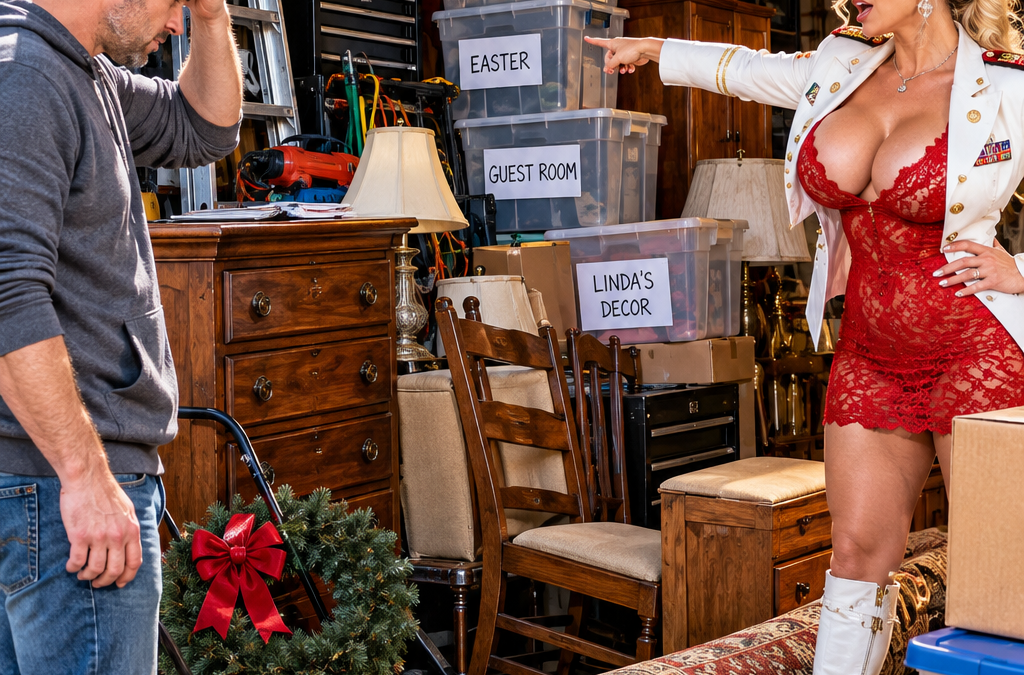
I stood there in sweatpants, coffee in one hand, staring at a stack of plastic storage bins labeled CHRISTMAS, EASTER, GUEST ROOM, and LINDA’S DECOR.
Then I noticed something else.
My own tool chest had been pushed almost completely against the wall.
My ladder had been moved.
My extension cords were buried.
And the folding table I used for weekend projects had been collapsed and wedged behind someone else’s broken bookcase.
That was the moment irritation turned into anger.
Not because the junk was ugly.
Because Linda had rearranged my belongings to make room for hers.
She hadn’t borrowed an empty corner.
She had taken over.
My name is Ethan, and when I bought that house in Maple Glen, I had exactly one major expectation for the garage.
I wanted to use it.
That shouldn’t have been controversial.
I had bought the place after years of renting apartments where every square foot had to perform three different jobs.
My dining table had been my desk.
My bedroom closet had stored camping equipment.
My balcony had functioned as a workshop until the landlord threatened to fine me for using a power drill after six in the evening.
So when I finally bought a modest house with an actual garage, I was probably more excited about that concrete floor than most people would understand.
It wasn’t glamorous.
Bare drywall.
One flickering fluorescent light.
Metal shelves from the previous owner.
A cracked workbench in the back corner.
But it was mine.
I imagined keeping my tools there.
Working on small furniture projects.
Storing holiday decorations without stacking them above my washing machine.
Maybe even parking my truck inside during hail season.
For the first few months, that’s exactly what I did.
Then Linda discovered that my garage had space.
Linda lived next door in a larger house than mine.
She was about forty, attractive, polished, and always dressed as though an ordinary Saturday morning might unexpectedly turn into a cocktail reception.
Her favorite outfit was a fitted red lace dress that she wore with startling frequency, usually paired with high heels and enough perfume to announce her arrival before she reached the door.
Linda was the sort of woman who could make a demand sound like a favor she was doing for you.
She smiled when she invaded your space.
She lowered her voice when she threatened you.
And she had an almost supernatural ability to behave as though anything she wanted was automatically reasonable.
She was also deeply involved with the Maple Glen homeowners association.
Not officially president at the time, but close enough to the board that everybody treated her like she had a title whether she did or not.
She attended every committee meeting.
Organized community events.
Enforced unwritten neighborhood expectations.
And seemed to know exactly which residents were afraid of receiving violation letters.
People called her Karen behind her back.
Never to her face.
Linda enjoyed power too much for jokes to be safe around her.
The first time she put something in my garage, it was almost nothing.
A box.
One cardboard box.
I came home from work and found it near the side wall.
Inside were artificial flowers and seasonal decorations.
I assumed she had forgotten it after helping with a neighborhood event.
That evening, I carried it to her front porch.
Linda opened the door wearing the red lace dress and holding a glass of wine.
“Oh,” she said. “You brought that back?”
“It was in my garage.”
“I know.”
She smiled.
“I just needed somewhere dry for a few days.”
“You could’ve asked.”
She waved one hand.
“Ethan, it was one box.”
“I know. I’m just saying.”
“Of course.”
She took the box.
Then gave me a smile that somehow made me feel ridiculous for bringing it up.
“Thank you for being neighborly.”
I walked home thinking the issue was finished.
It wasn’t.
The next week, two boxes appeared.
Then a lamp.
Then a folding chair.
Every time, Linda had an explanation.
Her basement was being reorganized.
Her guest room needed painting.
The HOA clubhouse was temporarily full.
She had family visiting.
A delivery arrived early.
Everything was temporary.
That word became her favorite.
Temporary.
The lamp was temporary.
The chairs were temporary.
The boxes were temporary.
The cabinet was temporary.
The rug was temporary.
The broken decorative fountain that appeared beside my lawn equipment was apparently extremely temporary.
Weeks passed.
Nothing left.
More arrived.
At first, I tried to stay reasonable.
“Linda, I need you to get those boxes out of the garage.”
“Absolutely.”
“When?”
“Soon.”
“I mean a day.”
She laughed.
“You’re so formal.”
“Tomorrow?”
“I’ll see what I can do.”
Tomorrow came.
Boxes remained.
A week later, I brought it up again.
She was standing beside my driveway talking to another neighbor.
“Linda, I need the garage cleared.”
Her smile tightened.
“Everything?”
“Everything that’s yours.”
She gave a little laugh and looked toward the other woman as though I had told a joke.
“Ethan is very protective of his garage.”
The neighbor smiled awkwardly.
I didn’t.
“Because it’s my garage.”
Linda’s eyes sharpened.
“Nobody said it wasn’t.”
“Then please remove your things.”
“I’ve already told you I’m working on it.”
“You’ve been working on it for weeks.”
Her voice cooled.
“Some of us have more complicated lives than others.”
I stared at her.
“What does that have to do with storing furniture in my house?”
“It’s not your house. It’s the garage.”
That sentence told me everything.
To Linda, my property became less mine whenever she found it convenient.
I took a breath.
“Get the items out.”
She stepped closer.
The friendly neighborhood smile disappeared.
“You’re being unnecessarily hostile.”
“No. I’m asking you to move your things.”
“Do you know how many people in this neighborhood help each other?”
“Then ask one of them.”
Her face flushed.
The other neighbor suddenly found something fascinating on her phone.
Linda lowered her voice.
“You really don’t want to become known as the difficult person on this street.”
There it was.
The first threat.
Soft.
Indirect.
Delivered with a smile.
I looked at her.
“Is that supposed to scare me?”
She shrugged.
“HOAs function on cooperation.”
“My garage isn’t HOA property.”
“Nobody said it was.”
“Then don’t bring the HOA into it.”
Linda’s expression went flat.
“I was making a general observation.”
“Good.”
I pointed toward her house.
“Make another one while you’re carrying your boxes home.”
She left without saying goodbye.
That should have solved the problem.
Instead, Linda escalated.
The following weekend, I opened my garage and found an entire dresser inside.
A full-size dresser.
Six drawers.
Dark wood.
Heavy enough that I knew she couldn’t have moved it alone.
Someone had entered my garage while I was away and physically carried furniture into it.
That was when I realized Linda wasn’t misunderstanding me.
She was testing me.
I went next door.
She answered almost immediately.
Same red dress.
Different earrings.
Same expression of complete innocence.
“Hi, Ethan.”
“You put a dresser in my garage.”
“Oh, yes.”
I stared at her.
“Why?”
“I needed room.”
“In your house?”
“Obviously.”
“So you moved it into mine?”
She laughed.
“Don’t be dramatic. It’s a garage.”
“My garage.”
“For a few days.”
“No.”
Her smile disappeared.
“No?”
“No. Move it today.”
She crossed her arms.
“I have plans.”
“Cancel them.”
Her eyes widened.
“Excuse me?”
“You heard me.”
“Who do you think you’re talking to?”
“My neighbor who’s storing furniture in my garage without permission.”
Linda stepped outside and pulled the door closed behind her.
“Let me explain something to you.”
I almost laughed.
“No. Let me explain something to you.”
Her eyes hardened.
I continued.
“You do not have permission to store anything on my property.”
“I’ve had permission.”
“No, you haven’t.”
“You never stopped me before.”
“I brought your first box back.”
“Then you allowed the rest.”
“That’s not permission.”
“You knew it was there.”
“And repeatedly asked you to remove it.”
She waved her hand dismissively.
“You’re rewriting history.”
I couldn’t believe the arrogance.
“Linda, I have texts.”
That stopped her for half a second.
Then she recovered.
“What texts?”
“The ones where I asked you to pick up your things.”
“I said I would.”
“Exactly.”
She stepped closer.
“Then what’s the problem?”
“The problem is that you didn’t.”
For several seconds, we stared at each other.
Then Linda smiled.
Not warmly.
The kind of smile that said she’d decided I needed to be punished.
“I’ll move everything when I have time.”
“No.”
Her smile vanished again.
“You don’t dictate my schedule.”
“And you don’t dictate what sits in my garage.”
“You are becoming extremely unpleasant.”
“Good.”
I turned to leave.
She called after me.
“You know the HOA has clutter standards.”
I stopped.
Slowly turned around.
“What?”
She folded her arms.
“If you start dragging furniture onto driveways or curbs, the board can cite you.”
For one moment, the audacity was so complete that I almost admired it.
She had filled my garage with her junk.
And now she was warning me that moving it could result in an HOA violation.
“You’ve planned this.”
Her eyebrows lifted.
“Planned what?”
“You think I can’t move your things outside because you’ll report me for clutter.”
“That’s not what I said.”
“That’s exactly what you said.”
Linda smiled.
“I’m simply reminding you that actions have consequences.”
I nodded.
“You’re right.”
Something in my tone made her expression change.
But I walked away before she could ask what I meant.
For the next few weeks, Linda kept adding things.
Not every day.
That would have been too obvious.
One lamp.
Three boxes.
A cabinet.
Another chair.
An old artificial Christmas tree.
She moved slowly enough that each new item felt like one more insult rather than a single dramatic invasion.
I stopped being able to park inside.
Then I lost access to the workbench.
Eventually, I couldn’t reach the shelf holding my drill without stepping over Linda’s boxes.
I tried locking the side door.
She apparently had been entering through the garage door whenever I left it open while doing yard work.
I became paranoid about closing it even when I went inside for thirty seconds.
My own house began changing around her behavior.
That made me furious.
One Saturday afternoon, I was repairing a wooden chair for my sister.
I needed clamps stored on the back shelf.
Linda’s cabinet blocked them.
I tried moving the cabinet.
Too heavy.
I called her.
No answer.
Texted.
I need your cabinet removed today.
No response.
Two hours later:
Busy. Maybe next weekend.
I stared at the message.
Then typed:
No. Today.
She replied immediately.
Please stop harassing me.
I laughed out loud.
Harassing her.
In my garage.
About her furniture.
That night, I sat at the kitchen table and considered my options.
I could pay someone to move everything.
I could drag it onto Linda’s driveway.
I could hire a storage company and send her the bill.
I could call an attorney.
I could spend weeks turning a stupid neighborhood dispute into a legal fight.
None of those options appealed to me.
I didn’t want revenge.
I wanted my garage.
That’s all.
The next morning, I opened the door and saw something new.
More boxes.
Linda had added more overnight.
Something inside me finally snapped.
Not emotionally.
Strategically.
I walked through the garage slowly.
Furniture.
Lamps.
Boxes.
Decorations.
Cabinets.
Old chairs.
Most of it looked like things Linda didn’t actually value enough to keep inside her own house.
She valued my space more than she valued the objects occupying it.
That was the key.
I went to the recycling bin.
Pulled out a large piece of leftover cardboard.
Found a thick black marker in my kitchen drawer.
Then I stood at the workbench, moved one of Linda’s boxes aside, and wrote four words.
Actually, five if you counted the smaller line.
FREE STUFF
PICK UP TODAY
I stared at the sign.
Simple.
No lawyers.
No arguments.
No committee.
No HOA meeting.
I carried it outside.
Placed it near the driveway where passing cars could see it.
Then I opened the garage door completely.
For the first few minutes, nothing happened.
I stood inside with my coffee.
The street was quiet.
A dog barked somewhere.
A lawn mower started two houses down.
I wondered whether the plan was stupid.
Then a sedan slowed.
The driver looked toward the sign.
Stopped.
Backed up.
A man lowered the window.
“Is the furniture really free?”
I looked at Linda’s dresser.
“Yes.”
“All of it?”
“Anything in the garage that’s part of the giveaway.”
His eyes widened.
He parked.
His wife climbed out.
Within two minutes, they were inspecting the dresser.
“Can we take this?”
“Absolutely.”
They opened the drawers.
Checked the sides.
“That’s actually pretty nice.”
“I hope you enjoy it.”
The man looked suspicious.
“Seriously? Free?”
“Free.”
They started loading it.
A second car slowed.
Then a pickup.
The driver of the pickup saw the sign and called out, “You getting rid of stuff?”
“Yes.”
“What about those chairs?”
“Take them.”
Within ten minutes, my driveway looked like an estate sale without prices.
People began calling neighbors.
One woman took two lamps.
A college-aged guy grabbed the small bookcase.
Someone else wanted the rolled rug.
A retired couple took a side table.
The boxes began disappearing.
“What about this one?” a neighbor asked.
“If you want it, take it.”
“What’s inside?”
“I don’t know.”
He opened it.
Holiday decorations.
“Perfect. My wife loves this stuff.”
“Enjoy.”
Cars kept arriving.
Some people knew me.
Others had simply seen the sign.
One woman said, “Linda told me you were antisocial.”
I smiled.
“Take a lamp.”
She laughed.
“I think I will.”
The entire situation became almost absurdly cheerful.
People were helping one another load furniture.
Someone had brought rope.
A teenager carried boxes to an SUV.
A man I had barely spoken to before offered to help move the heavy cabinet.
And with every item that disappeared, I could see more concrete floor.
My concrete floor.
The satisfaction was unbelievable.
Then I heard Linda.
“What the hell are you doing?”
The entire driveway seemed to pause.
She came marching across her lawn in the red lace dress and heels, moving so fast that one heel sank into the grass.
Her face was bright red.
“Stop!”
A man holding one of her lamps froze.
Linda pointed at him.
“Put that down!”
He looked at me.
Then at her.
“Is this yours?”
“Yes!”
I took a sip of coffee.
“It was in my garage.”
Linda turned toward me.
“You.”
I pointed toward the sign.
She read it.
Her eyes widened.
FREE STUFF. PICK UP TODAY.
“You cannot be serious.”
“I wanted the garage cleared.”
“Those are my belongings!”
“Why were they in my garage?”
The question stopped her.
Only for a second.
Then she exploded.
“Because you agreed to store them!”
“No, I didn’t.”
“Yes, you did!”
A woman loading boxes into her SUV slowed down to listen.
I kept my voice calm.
“Linda, I’ve asked you repeatedly to remove your property.”
“You said temporary storage was fine!”
“I never said that.”
“You allowed it!”
“I told you to move it.”
“You can’t just give away someone else’s possessions.”
I gestured toward the garage.
“You left them on my property after I repeatedly told you to remove them.”
Linda turned toward the neighbors.
“Everybody stop taking things!”
Nobody moved for a second.
Then the man holding the lamp asked me quietly, “Can I still take this?”
I looked at Linda.
She looked like she might burst into flames.
I looked back at him.
“Your call.”
He slowly carried the lamp to his truck.
Linda made a sound somewhere between a gasp and a scream.
“You people are stealing!”
One neighbor turned.
“Linda, weren’t these stored in his garage?”
“Temporarily.”
“For months,” I said.
“That is irrelevant.”
“No. That’s the entire point.”
She marched toward me.
“You planned this.”
“Yes.”
Her eyes widened.
I corrected myself.
“I planned to get my garage back.”
“You humiliated me.”
“I asked you privately.”
“You’re trying to turn the neighborhood against me.”
“I put up a sign.”
“You knew exactly what would happen.”
“No, actually.”
I looked around at the increasingly empty garage.
“This worked much better than I expected.”
A few people laughed.
Linda heard them.
That made everything worse.
She spun toward the crowd.
“Anyone who removes my property will be reported.”
Someone asked, “To who?”
“The HOA.”
Another neighbor said, “For taking free stuff?”
“It’s not free!”
I pointed at the sign.
“It is today.”
Linda turned toward me with fury in her eyes.
“I will have you fined.”
“For what?”
“Unauthorized distribution.”
I almost choked on my coffee.
“That’s not a real violation.”
“It will be.”
There it was.
Linda in her purest form.
If reality didn’t support her, she’d simply threaten to rewrite reality.
I smiled.
“Good luck.”
She stepped closer.
“You think this is funny?”
“No.”
I looked into the garage.
A man and his son were carrying out the artificial tree.
“I think it’s efficient.”
Linda rushed past me.
“Stop! Stop touching everything!”
She grabbed one box from a woman’s hands.
The woman let go immediately.
“Okay, Linda.”
Linda hugged the box against her chest.
It contained old Thanksgiving decorations.
She looked frantically around.
Most of the garage was already empty.
The dresser was gone.
The rug was gone.
Four chairs were gone.
The lamps were gone.
Half the boxes had vanished.
The large cabinet remained.
Two men were already studying how to lift it.
“Don’t touch that!” Linda screamed.
They stopped.
One of them shrugged.
“All yours.”
Linda looked at the cabinet.
Then toward her house.
It was too heavy for her to move alone.
She turned toward the HOA security volunteer who had walked over after hearing the commotion.
“You. Help me.”
He looked at the cabinet.
Then at her.
“I’m not really supposed to move personal furniture.”
“I’m on the community committee.”
“I’m aware.”
“Then help.”
He shook his head.
Linda stared at him as though she couldn’t believe anyone had refused.
That was the part I enjoyed most.
Not her losing the furniture.
Her discovering that the title she constantly waved around couldn’t make every person obey.
She pointed at me.
“This isn’t finished.”
I leaned against the garage wall.
“It will be when the cabinet’s gone.”
She stormed home.
Twenty minutes later, she returned with a handcart.
By then, someone else had arrived for the cabinet.
A neighbor named Carlos was backing his SUV toward the driveway.
Linda saw him.
“No!”
Carlos stopped.
“What’s wrong?”
“That’s mine.”
He looked at me.
Then Linda.
“Should I leave it?”
I shrugged.
“It’s the last large thing.”
Linda pushed past us.
She tried to move the cabinet herself.
It barely shifted.
Carlos looked uncomfortable.
“Ma’am, I can help you move it to your house if you want.”
Linda glared at him.
“I don’t need your help.”
She tried again.
Nothing.
Finally, she snapped, “Fine.”
Carlos and another neighbor helped her load the cabinet onto the handcart.
She began rolling it toward her house.
The cabinet wobbled.
She struggled in heels.
Nobody laughed.
Not out loud.
But I saw several smiles.
When she disappeared next door, I looked into the garage.
For the first time in months, I could see almost the entire floor.
My workbench.
My shelves.
My tool chest.
My ladder.
Everything.
I walked inside slowly.
The empty space felt enormous.
A neighbor named Denise stood beside the garage door.
“She really stored all that here?”
“Yep.”
“Without asking?”
“At first she acted like one box didn’t matter.”
Denise looked toward Linda’s house.
“That sounds like her.”
Another neighbor walked over.
“I thought you two had some arrangement.”
“No.”
“She told people you offered storage.”
I laughed.
“Of course she did.”
That detail explained why nobody had questioned the constant flow of furniture into my garage.
Linda had already written the story.
She wasn’t trespassing.
I was helping.
She wasn’t ignoring me.
I had agreed.
That was how she operated.
Create the narrative first.
Then behave as though everyone else was unreasonable for contradicting it.
By late afternoon, the final boxes were gone.
Some Linda rescued.
Most the neighborhood had taken.
The sign remained by the driveway.
FREE STUFF. PICK UP TODAY.
A man walking his dog pointed at it.
“Anything left?”
I looked into the empty garage.
“Not anymore.”
“Good turnout?”
“Excellent.”
He laughed and kept walking.
I carried the cardboard sign inside.
For a few minutes, I simply stood in the garage.
Silence.
That was the strange part.
For months, every time I opened the door, I had felt irritated before I even saw the clutter.
My body expected frustration.
Boxes.
Furniture.
Another conversation with Linda.
Now there was nothing.
Just empty concrete.
My things.
My space.
I pulled the tool chest away from the wall.
Rolled it back into the position I wanted.
Moved the ladder.
Set up the folding table.
By evening, the garage looked better than it had before Linda started using it.
Every shelf had a purpose.
Power tools on one.
Paint supplies on another.
Camping equipment overhead.
My truck could almost fit again.
Almost.
I was tightening a shelf bracket when Linda returned.
I heard her heels before I saw her.
She stopped at the edge of the open garage.
I didn’t look up.
“Close the door.”
“No.”
“This conversation isn’t over.”
“For me it is.”
“You gave away hundreds of dollars’ worth of property.”
“Then you should have stored valuable property somewhere you were authorized to use.”
Linda walked inside.
I put the wrench down.
“Out.”
Her eyes widened.
“Excuse me?”
“You don’t have permission to enter my garage.”
She looked around.
Maybe it was the first time she actually saw the space as mine.
“I want compensation.”
I laughed.
“For what?”
“My furniture.”
“You left it here.”
“Temporarily.”
“Months.”
“You had no right to dispose of it.”
“I told you repeatedly to remove it.”
“You should have given me formal notice.”
“Formal notice?”
“Yes.”
I stared at her.
“You mean like a letter?”
“Exactly.”
“The same kind of letter you people send over grass height?”
Her expression hardened.
“This isn’t about the HOA.”
“You brought the HOA up every time I asked you to move your junk.”
“It wasn’t junk.”
“Then why didn’t you keep it in your house?”
She opened her mouth.
Nothing came out.
There it was again.
The question she couldn’t answer.
Why was her important property inside my garage?
Because she believed my space was less valuable than hers.
Because storing it at my house was easier than dealing with it herself.
Because she assumed I would eventually stop complaining.
I picked up the wrench again.
“We’re finished.”
“No.”
She stepped closer.
“You don’t get to humiliate me and then decide we’re finished.”
I turned.
“Linda, I asked you privately at least six times.”
“That’s irrelevant.”
“No. It isn’t.”
“You made me look ridiculous in front of everyone.”
“You did that yourself.”
She stared at me.
I continued.
“You could have moved your things after the first conversation.”
“I was busy.”
“Second conversation.”
“I had family issues.”
“Third?”
She folded her arms.
“Stop.”
“Fourth?”
“I said stop.”
“Fifth?”
Her face reddened.
“You waited until I finally solved the problem, and now you’re angry because my solution didn’t protect your feelings.”
“You gave away my belongings.”
“I reclaimed my garage.”
Linda’s voice dropped.
“You think because some neighbors laughed today that you’re popular now?”
There it was.
Another threat.
Another attempt to make the situation social instead of simple.
I leaned against the workbench.
“I don’t care whether I’m popular.”
“You should.”
“Why?”
“Because this community remembers things.”
“So do phones.”
Her eyes narrowed.
“What does that mean?”
“It means every text where I told you to remove your property is still saved.”
She froze.
I continued.
“Every time you said temporary.”
Silence.
“Every warning.”
Her jaw tightened.
“So if you want to turn this into an HOA issue, a legal issue, or a neighborhood gossip campaign, go ahead.”
I pointed toward her house.
“But you’re not putting another thing in this garage.”
For several seconds, Linda didn’t speak.
Then she looked around.
The shelves.
The open floor.
My tools.
Her territory was gone.
Whatever strange arrangement she had imagined between us no longer existed.
A few neighbors were still outside.
They had heard enough of the conversation to understand exactly what had happened.
Denise was across the street watering plants.
Carlos was unloading the cabinet he’d helped Linda save.
Two other residents stood near a driveway talking.
Linda knew she had an audience.
Usually that strengthened her.
Not this time.
Because nobody was on her side.
Not after watching her run into my garage demanding strangers return furniture she’d been storing there without permission.
Finally, Linda said, “You’re unbelievable.”
I nodded.
“Good night.”
She stormed away.
I waited until she reached her house.
Then I closed the garage door.
The sound of it hitting the concrete floor was strangely satisfying.
Not dramatic.
Not victorious.
Final.
That evening, I made one more change.
I changed the garage access code.
Linda had never officially been given it, but by then I trusted nothing.
I checked the locks.
Closed the side door.
Then I went inside and ate dinner.
Nobody knocked.
No HOA notice appeared.
No security volunteer arrived.
No angry email came.
For the first time in months, Linda had no move.
Because there was nothing complicated about the issue anymore.
My garage was empty.
Her belongings were gone.
And the entire neighborhood had witnessed why.
The next morning, I walked outside with coffee.
Denise waved.
“Morning.”
“Morning.”
She smiled.
“Garage still yours?”
I laughed.
“So far.”
Carlos walked past a few minutes later.
“That cabinet barely fit in her basement.”
“Sounds like a Linda problem.”
He laughed.
“She complained the whole time.”
“I’m shocked.”
He stopped.
“Just so you know, most people didn’t realize she was doing that without permission.”
“I figured.”
“She told everyone you were helping her store things.”
“That also sounds like Linda.”
Carlos nodded.
“People understand now.”
That mattered more than I expected.
Not because I needed the neighborhood to choose sides.
But because Linda had used public perception as another form of pressure.
She assumed she could behave however she wanted privately, then tell everyone a version where she was generous, cooperative, or misunderstood.
The free sign destroyed that illusion in one afternoon.
Everybody saw the same thing.
Furniture came out of my garage.
Linda claimed it.
I explained she’d stored it there without permission.
Nothing else was necessary.
For the next week, Linda barely looked at me.
If I walked outside, she turned toward her phone.
If we passed near the mailboxes, she suddenly became interested in the HOA bulletin board.
At a neighborhood meeting, she sat three chairs away instead of beside me.
I enjoyed the distance.
Then something unexpected happened.
Another resident approached me.
Her name was Monica.
“Can I ask you something?”
“Sure.”
“Did Linda ever ask before putting things in your garage?”
“No.”
Monica sighed.
“What?”
“She keeps equipment in my shed.”
I stared at her.
“What kind of equipment?”
“Two folding tables. Event decorations. Some HOA signs.”
“Did you agree?”
“At first, one table.”
I started laughing.
Monica did too.
“Exactly.”
She shook her head.
“It became six boxes.”
“Tell her to remove them.”
“I did.”
“And?”
“She said the shed is partly visible from common space, so technically the storage benefits the community.”
I stared at her.
“That’s not even a sentence.”
“I know.”
“You need cardboard?”
Monica burst out laughing.
“I might.”
I didn’t tell her to give anything away.
One neighborhood garage giveaway was enough.
But I did tell her something I’d learned.
“Don’t argue about whether Linda thinks it’s reasonable.”
Monica listened.
“Just tell her the permission is withdrawn. Give her a deadline. Put it in writing.”
She nodded.
“That simple?”
“Should be.”
“What if she threatens fines?”
“Ask her to show the exact rule.”
Monica smiled.
“You’ve changed.”
“How?”
“You used to avoid every HOA conversation.”
I looked toward Linda’s house.
“Linda cured me.”
Within days, Linda removed the items from Monica’s shed.
Apparently one public disaster was enough.
The strange thing was how quickly Linda’s power shrank once people started saying no.
She had seemed enormous when I was dealing with her alone.
Connected.
Confident.
Untouchable.
But most of that authority came from the assumption that challenging her would be more trouble than tolerating her.
Once that assumption disappeared, Linda was just an annoying neighbor in an expensive red dress.
She couldn’t magically fine people for refusing storage.
She couldn’t legally claim every garage and shed as community overflow.
She couldn’t force anyone to surrender private property because it was convenient.
She relied on people being uncomfortable.
On politeness.
On hesitation.
On the social instinct that says maybe we should endure something unreasonable rather than create conflict.
I had done exactly that for months.
The first box should have gone back immediately.
The second should never have crossed my garage threshold.
By the time the dresser arrived, Linda already believed resistance was temporary.
That was my mistake.
Not being generous.
Failing to define where generosity ended.
Months later, I still had the cardboard sign.
I had folded it and placed it on a shelf.
One afternoon, while searching for sandpaper, I found it again.
FREE STUFF. PICK UP TODAY.
The black marker had bled slightly into the cardboard.
I stood there smiling.
That sign hadn’t been clever.
It wasn’t complicated.
It certainly wasn’t sophisticated.
But it had done what weeks of polite conversations couldn’t.
It created urgency.
Linda had treated my deadlines as optional because there was never a consequence for ignoring them.
The sign changed that.
Suddenly, every minute mattered.
And by the time she understood, half the garage had already disappeared into pickup trucks and SUVs.
Do I think Linda deserved to lose everything she stored there?
That’s not even how I think about it.
I didn’t wake up that morning planning revenge.
I wasn’t trying to hurt her.
I wasn’t trying to embarrass her.
I wanted to walk into my own garage without stepping over someone else’s furniture.
That was it.
The chaos came because Linda had spent months believing she could ignore a simple request forever.
She thought ownership didn’t matter if she was confident enough.
She thought temporary could mean indefinitely.
She thought politeness was surrender.
She was wrong.
The garage changed after that.
I installed better shelving.
Hung pegboard over the workbench.
Mounted the bicycles vertically.
Bought proper storage bins.
For the first time, I could find everything.
My drill.
My sockets.
Extension cords.
Garden tools.
I even had enough space to park my truck inside during bad weather.
The first evening I did that, I sat behind the wheel for a second before turning off the engine.
It felt ridiculous to be proud of parking in my own garage.
But after Linda, ordinary things felt like victories.
I stepped out.
Closed the truck door.
Looked around.
No boxes labeled LINDA’S DECOR.
No lamps.
No cabinets.
No mystery furniture.
Just my things.
My space.
My decisions.
Linda never stored anything in my garage again.
Not one box.
Not one chair.
Not even an HOA event sign.
Sometimes she’d walk past while I had the door open.
Her eyes would flick toward the shelves.
Then toward me.
Neither of us said anything.
We didn’t need to.
There was an invisible sign between us now.
Not cardboard.
A boundary.
She understood it.
I understood it.
And unlike every conversation we’d had before, this one required no explanation.
One summer evening, almost a year after the whole mess, several neighbors gathered in my driveway while I worked on an old table.
Carlos stopped beside the garage.
“You know what this place needs?”
“What?”
He pointed toward the shelf.
“The sign.”
I laughed.
“No.”
“Frame it.”
“Absolutely not.”
Denise smiled.
“Put it over the door.”
“You’re all encouraging bad behavior.”
Carlos shook his head.
“Historical artifact.”
I looked toward Linda’s house.
Her SUV wasn’t there.
“Some history belongs in storage.”
Denise laughed.
“Whose storage?”
I stared at her.
Then all three of us started laughing.
That was probably my favorite part of the entire experience.
Not the furniture disappearing.
Not Linda’s face when she saw the sign.
Not even the empty garage.
It was the fact that something which had made me angry for months eventually became a neighborhood joke.
Linda had tried to use the social pressure of Maple Glen against me.
Instead, everybody ended up understanding exactly why I had snapped.
Nobody wanted the clutter back in my garage.
Nobody suggested I should continue being generous.
Nobody volunteered their own garage for Linda either.
Funny how quickly people understood private property when there was a chance their property might be next.
I learned something from the whole ridiculous episode.
Boundaries rarely fail because nobody knows where they are.
They fail because someone keeps testing whether you will enforce them.
Linda knew the garage belonged to me.
She knew I had asked her to remove her belongings.
She knew temporary had expired weeks earlier.
She simply believed my discomfort mattered less than her convenience.
Every box she added was another test.
Would I complain?
Would I insist?
Would I actually do something?
For months, the answer was mostly no.
Then one morning, the answer became a piece of cardboard and a black marker.
The change was almost embarrassingly simple.
And maybe that’s why it worked.
Linda expected a debate.
She expected more texts.
More warnings.
Maybe an argument about HOA rules.
She didn’t expect the problem to become self-solving.
Once the first car stopped, there was nothing for her to negotiate.
By the time she arrived, strangers were already carrying her dresser toward a truck.
The control she had relied on disappeared faster than the furniture.
I still think about her question sometimes.
“Why would you do this?”
At the time, I gave her the simplest answer.
Because it was my garage.
That’s still the answer.
Not because I hated Linda.
Not because I wanted to punish her.
Because ownership has to mean something.
A garage isn’t community property because a pushy neighbor wants storage.
A favor isn’t permanent because someone refuses to stop using it.
And silence isn’t consent simply because an entitled person finds that interpretation useful.
Today, my garage looks exactly the way I wanted it to look when I bought the house.
Tools on the wall.
Workbench clear.
Shelves labeled.
Truck inside when the weather turns bad.
There is even an empty corner near the back.
Sometimes people joke that Linda could probably fit a few boxes there.
She couldn’t.
Not anymore.
Because the most useful thing I put in that garage was never a shelf or cabinet.
It was a boundary.
Linda finally understood it.
The neighborhood understood it.
And one handwritten sign made sure nobody ever confused my kindness with permission again.








