𝗙𝗨𝗟𝗟 𝗦𝗧𝗢𝗥𝗬 One Hour After I Posted a Photo of the HOA President’s Lawn, She Put a Lien on the House Where My Daughter Slept.
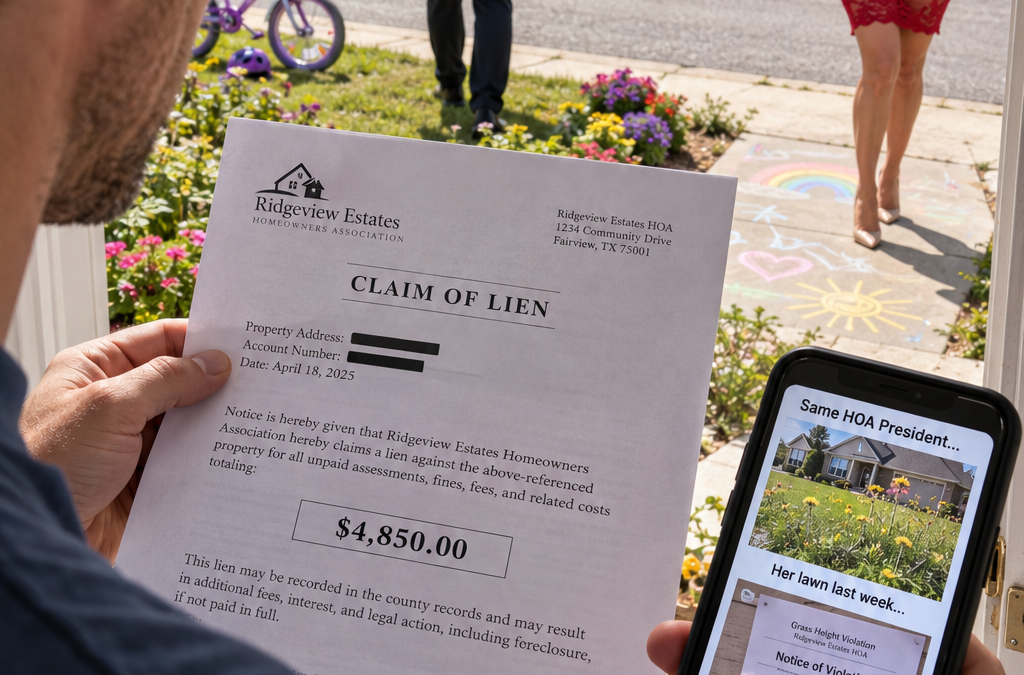
𝗙𝗨𝗟𝗟 𝗦𝗧𝗢𝗥𝗬
That was the moment I stopped thinking of this as a fight over neighborhood rules.
But to understand why, you have to understand how easily I had allowed it to begin.
Three months earlier, Maple Ridge Court had seemed like the kind of Georgia subdivision where nothing truly terrible could happen.
The houses were modest but attractive, with brick fronts, trimmed hedges, and wide driveways where children rode bicycles until their parents called them home for dinner.
Oak trees lined the sidewalks.
Neighbors exchanged Christmas cookies.
On summer evenings, you could hear the low hum of lawn mowers, the occasional barking dog, and somebody’s television drifting through an open window.
It was ordinary.
After everything I’d been through, ordinary was exactly what I wanted.
My name is Scott. I was forty-two years old, a structural engineer, and a father who had learned that peace was more valuable than almost anything money could buy.
My work involved analyzing the things people trusted without thinking about them.
Beams.
Foundations.
Load-bearing walls.
Connections hidden behind drywall.
Most people looked at a building and saw what stood above the ground. I spent my days thinking about what might fail underneath it.
I loved the precision of engineering because numbers didn’t flatter you, intimidate you, or change their meaning depending on who happened to be in charge.
If a foundation was defective, I could identify the problem.
If a design violated code, I could demonstrate why.
And if somebody made a claim, there was usually a way to test it.
I had no idea how badly I would need that mindset when Deborah Whitfield decided to make me her latest project.
My daughter was the center of my life.
I worked long hours, but I tried to protect the small rituals that made a house feel like a family home.
Pancakes on Saturday mornings.
Helping with homework at the kitchen table.
Evening walks through the neighborhood.
Chalk drawings on the driveway.
I had bought our house because it offered something I couldn’t put in a financial spreadsheet.
Stability.
My daughter knew which floorboards creaked.
She knew where the afternoon sunlight fell across her bedroom carpet.
She knew which neighbor kept dog treats in her pocket and which one grew tomatoes behind the garage.
The thought of moving her away from that frightened me more than I ever admitted.
For five years, I had paid my mortgage on time, maintained the house, and stayed out of neighborhood politics.
I wasn’t interested in becoming an HOA board member.
I didn’t attend meetings unless something important appeared on the agenda.
I assumed the association existed to maintain common areas, handle ordinary disputes, and keep property standards reasonably consistent.
That assumption lasted until Deborah Whitfield became personally interested in my lawn.
The first violation arrived on a Thursday.
I had just gotten home from a site inspection outside Atlanta. My boots were dusty, my shoulders ached, and I was looking forward to changing clothes and making dinner.
A white envelope waited in my mailbox.
Inside was a neatly printed citation.
LANDSCAPING VIOLATION: EXCESSIVE TURF HEIGHT.
According to the notice, the grass in my front yard exceeded the maximum permitted height by approximately half an inch.
The penalty was fifty dollars.
Payment was required within ten days.
I stood beside the mailbox and looked at my lawn.
It was green.
It was mowed.
It looked exactly like the lawns on either side of it.
I actually laughed.
“Half an inch?” I muttered.
My daughter was sitting on the porch steps, working on a drawing.
“What happened, Dad?”
“Apparently, our grass is misbehaving.”
She looked up at the lawn.
“How?”
“By growing.”
She giggled.
I paid the fine online that evening.
Fifty dollars wasn’t worth a neighborhood dispute, and I told myself Deborah was probably one of those people who took every rule too seriously.
There were worse things in life than a picky homeowners association.
Two weeks later, I received another violation.
This time it concerned my mailbox.
UNAPPROVED EXTERIOR COLOR.
The notice claimed my mailbox post was the wrong shade of black.
Not the wrong color.
The wrong shade.
I walked outside holding the letter and stared at the post.
It was black.
It had been black when I bought the house.
I hadn’t repainted it, repaired it, or touched it in five years.
I found the original photographs from the real estate listing.
Same mailbox.
Same post.
Same color.
At first, I thought somebody had made a clerical mistake.
Then Deborah appeared.
She was coming down the sidewalk in her familiar red lace dress, high heels clicking against the concrete, a clipboard tucked beneath one arm.
She smiled as she approached.
“Scott! I was hoping to catch you.”
I held up the notice.
“Good timing. I think there’s been a mistake.”
Her eyebrows rose.
“Oh?”
“My mailbox hasn’t changed since I bought the house.”
She glanced at it as though seeing it for the first time.
“Well, that’s unfortunate.”
“What’s unfortunate?”
“That you’ve been out of compliance for so long.”
I stared at her.
“Are you serious?”
She tilted her head.
“Of course.”
“Deborah, it’s a black mailbox.”
“It’s not the approved black.”
I looked from her to the mailbox.
“What’s the approved black?”
“Matte charcoal black.”
“And this?”
“Standard gloss black.”
I touched the post.
It wasn’t particularly glossy.
“Can you show me where the association approved a different shade?”
Her smile thinned.
“You’re new to how we do things, Scott.”
“I’ve lived here five years.”
“Then you’ve had five years to familiarize yourself with our standards.”
She moved closer and lowered her voice.
“Let me explain something. Maple Ridge has a certain reputation. People buy here because we maintain it. That requires cooperation.”
“I cooperate.”
“Then this shouldn’t be difficult.”
I pointed at the post again.
“If you can show me the exact paint requirement, I’ll look at it. But I’m not paying another fine because you think black isn’t black enough.”
For the first time, her expression changed.
It was brief.
A tightening around the mouth.
The kind of reaction you might miss if you weren’t standing three feet away.
“You’re making this harder than it needs to be,” she said.
“No. I’m asking a reasonable question.”
She gave a light laugh.
“Engineers. Always needing everything explained.”
“Usually helps.”
She held my gaze a moment longer.
Then her smile returned.
“Have a lovely evening, Scott.”
She walked away, the clipboard pressed against her hip.
I watched her reach the corner before turning back toward the house.
My daughter was standing inside the front door.
“Was she mad?”
“No,” I said.
I wanted that to be true.
Three days later, I received another fifty-dollar violation.
This time, my trash cans had been placed at the curb one hour before the authorized collection window.
The week after that, a warning arrived concerning the wind chime hanging beside my back porch.
The allegation was excessive noise.
The chime was small, made of aluminum tubes, and had hung there for years.
My daughter had bought it for me with money she saved from chores.
I took it down after the notice.
She watched from the kitchen doorway as I carefully unhooked it.
“Why are you taking that down?”
“Somebody complained.”
“But I gave you that.”
“I know.”
“Do you not like it anymore?”
I turned toward her.
“Of course I like it.”
“Then why can’t we keep it?”
For a moment, I couldn’t think of an answer that didn’t make the world sound uglier than I wanted it to.
“Sometimes grown-ups argue over silly things,” I finally said.
She considered that.
“Then maybe they should stop.”
I almost smiled.
“That’s a pretty good idea.”
I put the wind chime in a kitchen drawer.
I thought complying would end the problem.
Instead, it taught Deborah that she could keep demanding more.
A few days later, another citation arrived.
UNAUTHORIZED DRIVEWAY MARKINGS.
My daughter had drawn chalk flowers, a rainbow, and a large crooked sun near our garage.
The markings were temporary.
One rainstorm would have erased them.
According to Deborah, however, they constituted an aesthetic violation visible from the street.
The fine was seventy-five dollars.
I read the notice while my daughter ate breakfast.
“What’s that one for?” she asked.
I hesitated.
“Nothing you need to worry about.”
She stopped chewing.
“It’s my drawings, isn’t it?”
I looked at her.
She already knew.
“Did I do something wrong?”
That question stayed with me longer than any of the fines.
Because I could explain an HOA dispute to another adult.
I could discuss bylaws, enforcement procedures, selective citations, and architectural standards.
But I couldn’t explain to a child why a woman who was supposed to help maintain the neighborhood had decided her rainbow was unacceptable.
“No,” I told her. “You didn’t do anything wrong.”
“Then why does she keep getting mad at us?”
I pulled out the chair beside her.
“I don’t know yet.”
It was the most truthful answer I could give.
The next morning, I found her outside with the garden hose.
She was washing her drawings off the driveway.
I hurried across the lawn.
“Hey, what are you doing?”
She kept spraying.
“I don’t want you to get another letter.”
I turned off the water.
She looked down, embarrassed.
I crouched beside her.
“Listen to me. You don’t have to erase everything that makes you happy just because somebody complains.”
She glanced toward the street.
“But that lady doesn’t like us.”
I wanted to say she was imagining things.
Instead, I said, “That’s her problem.”
My daughter nodded, but she didn’t draw on the driveway again for weeks.
That was when the whole thing stopped being funny.
I could absorb a fifty-dollar fine.
I could repaint a mailbox.
I could remove a wind chime.
But watching my daughter become afraid of doing something harmless on our own property made me angry in a way I hadn’t felt for years.
I decided to challenge the citations formally.
I wrote a polite email asking the HOA to identify the provisions I had allegedly violated and provide dated photographs of each offense.
I attached pictures of my lawn.
I included the original listing photograph showing the mailbox.
I explained that the driveway chalk was temporary and washable.
I asked whether an appeals procedure existed.
Deborah replied the following morning.
The board has reviewed your concerns and determined that all enforcement actions were appropriate. Continued resistance to compliance may result in additional administrative penalties.
There was no reference to the actual rules.
No photographs.
No explanation of the appeal procedure.
Just a warning.
I sent another message asking when the board had met to review my concerns.
This time, she didn’t respond.
Two days later, another fine arrived.
I began to notice a pattern.
At first, I thought I was looking for connections that weren’t there.
Engineers can be as guilty of that as anyone else. We see a few data points and want to turn them into a neat explanation.
But the dates kept bothering me.
One afternoon, I stopped beside Mrs. Alvarez’s fence to ask how her tomato plants were doing.
Mrs. Alvarez lived two doors down. She was an older woman with silver hair, sharp eyes, and a habit of saying exactly what she thought.
We had always gotten along.
She asked about my daughter, told me her tomatoes were struggling in the heat, and complained that the grocery store had raised the price of nearly everything.
We talked for perhaps fifteen minutes.
The next morning, I received two new violation notices.
One concerned alleged debris near my garage.
The other concerned the placement of my recycling bin.
Both notices described conditions that hadn’t changed in months.
I compared the dates.
Then I compared them with earlier fines.
A notice had followed a conversation with another neighbor Deborah disliked.
Another had appeared after I questioned her interpretation of the mailbox rules.
Now two arrived after I spoke with Mrs. Alvarez.
It might have been coincidence.
Except Mrs. Alvarez didn’t think so.
When I showed her the letters, she barely looked surprised.
“She’s not enforcing rules, honey,” she said. “She’s settling scores.”
We were standing beside her garden, where tomato vines climbed a wire trellis.
“What do you mean?”
She wiped her hands on a towel.
“Deborah likes people to know she can make their lives difficult.”
“That’s one thing. But she can’t just fine people because she doesn’t like them.”
Mrs. Alvarez gave me a tired look.
“Why not? Who’s been stopping her?”
I had no answer.
She leaned against the fence.
“Last year, she came after my family over a fence.”
“What was wrong with it?”
“Six inches.”
“Six inches what?”
“Six inches taller than she said it was allowed to be.”
“Was it?”
“The contractor followed the documents we were given. Deborah suddenly decided they meant something different.”
“What happened?”
“We disputed it. She kept adding penalties. We hired a lawyer, and before we knew it, we were in a lawsuit.”
I looked toward her backyard fence.
It was clean, sturdy, and almost identical to the ones behind several neighboring houses.
“All that over six inches?”
“Not really.”
She lowered her voice.
“My son questioned one of her spending proposals at an HOA meeting. A week later, she inspected our fence.”
I felt a small, cold shift in my stomach.
“Did you win?”
“We settled. It cost us more than replacing the entire fence would have.”
“Why didn’t anyone do something?”
Mrs. Alvarez looked down at her hands.
“Because when you have a mortgage and a family, sometimes the cost of being right gets frightening.”
She glanced toward Deborah’s house.
“Be careful, Scott. That woman doesn’t forget being challenged.”
I went home thinking about those words.
The cost of being right.
That evening, I began building my evidence folder.
I created separate sections for notices, payments, photographs, emails, and relevant HOA rules.
I saved the electronic timestamps from every correspondence.
I photographed my property from the street and the driveway.
I measured the height of the grass and documented the mailbox’s finish.
At work, I routinely prepared engineering reports that could determine whether a building was safe to occupy. I knew how to record observations without exaggerating them.
That was what I intended to do here.
I wasn’t preparing to destroy Deborah.
I was preparing to prove that I had complied with the rules.
And I still believed that if I could show the board clear evidence, reasonable people would correct the mistake.
That belief survived approximately eleven days.
During that period, I wrote to every board member whose contact information I could find.
Most didn’t respond.
One sent a brief message saying all compliance matters had to go through Deborah.
Another told me privately that he preferred not to get involved.
I understood his hesitation.
I had started to feel it myself.
Every time I opened the mailbox, my stomach tightened.
Every time my phone displayed a notification from the HOA, I wondered what new accusation would be waiting.
I stopped talking to neighbors in the front yard because I didn’t want to attract attention.
I checked the driveway before leaving for work, making sure the trash cans were hidden, the grass was neat, and no harmless object had been left where Deborah could photograph it.
My daughter noticed.
One evening, while I was trimming a hedge that had already been trimmed two days earlier, she came outside.
“Dad?”
“Yeah?”
“Are we in trouble?”
I shut off the trimmer.
“Why would you ask that?”
“Because you’re always fixing something now.”
I stared at the hedge.
She was right.
I had become a man inspecting his own home for reasons somebody else might use against him.
“We’re okay,” I said.
She watched me for a moment.
“Do you promise?”
I put the trimmer down and hugged her.
“I promise I’ll take care of us.”
I didn’t know then how difficult that promise would become.
The next letter arrived on a Monday.
Unlike the previous notices, it came by certified mail.
The envelope was thicker.
The language was colder.
And the amount was large enough to make me sit down.
TOTAL OUTSTANDING VIOLATIONS AND ADMINISTRATIVE PENALTIES: $5,000.
Payment was required within thirty days.
Failure to pay could result in the filing of a lien against my home.
I read the notice three times.
Five thousand dollars.
For landscaping, a mailbox, trash cans, a wind chime, driveway chalk, and administrative charges that seemed to multiply whenever I disputed anything.
The original fifty-dollar citation had become a financial threat.
I pulled out my records and reviewed the numbers.
There were repeated assessments, escalating penalties, and collection costs assigned to disputed violations.
Some charges appeared to have been imposed while my appeals were still unanswered.
Others lacked clear descriptions.
I called the number on the notice.
Deborah answered.
“Maple Ridge HOA.”
“This is Scott.”
A pause.
“Yes, Scott?”
“I just received a demand for five thousand dollars.”
“Then you should make arrangements to pay it.”
“These charges don’t make sense.”
“They make perfect sense to the board.”
“Which board members approved them?”
“I’m not required to explain every administrative decision to you.”
“I’m asking because I’ve requested a hearing three times.”
“And I’ve told you the matter has been reviewed.”
“By whom?”
Her voice hardened.
“Scott, you’ve developed a very unfortunate habit of challenging authority.”
“I’m asking for records.”
“You’re questioning the integrity of people who volunteer their time to protect this neighborhood.”
“I’m questioning five thousand dollars in fines.”
“Then perhaps you should have considered the consequences before repeatedly violating community standards.”
I gripped the phone.
“You’re threatening my house over a mailbox.”
“I’m not threatening anything. I’m explaining the enforcement process.”
“Deborah—”
“No, you listen to me.”
Her voice sharpened.
“You live in a community with rules. You don’t get to decide which ones matter. You don’t get to turn every notice into a debate. You can either pay what you owe or allow the association to pursue its remedies.”
I closed my eyes.
“There are limits to what an HOA can do.”
“Then I suggest you hire an attorney and find out where those limits are.”
She hung up.
I remained seated at the kitchen table with the phone against my ear.
For the first time, I was genuinely afraid.
Not irritated.
Not offended.
Afraid.
I knew a lien didn’t mean someone could simply walk up tomorrow and take my house.
But I also knew that recorded claims could create expensive legal problems, and ignoring them could make those problems worse.
I had a mortgage.
I had savings I intended to use for my daughter’s future.
I had obligations that didn’t disappear because an HOA president decided to punish me.
Five thousand dollars was enough to hurt.
A prolonged legal battle could hurt much more.
That night, I walked past my daughter’s bedroom and stopped in the hallway.
Her nightlight cast a soft yellow glow across the carpet.
She was asleep beneath a blanket covered in little stars, one arm wrapped around a stuffed rabbit she had owned for years.
For a long time, I stood there listening to her breathe.
I had seen buildings fail.
I had inspected homes after storms, watched families carry their belongings through damaged front doors, and heard people explain how quickly everything they counted on had disappeared.
I knew that a house was made of ordinary materials.
Concrete.
Wood.
Steel.
Drywall.
But watching my daughter sleep, I understood how much more a home represented.
It was the place where she expected to wake up tomorrow.
The place where she believed the world would still be in order.
The place I had promised to protect.
I returned to the kitchen and opened my laptop.
I was done trying to persuade Deborah to be reasonable.
I needed to understand what gave her power.
And more importantly, what she had been doing with it.
The next morning, I began requesting the association’s financial records.
Not the friendly little budget summary distributed at annual meetings.
I wanted the actual documents.
Bank statements.
Vendor payments.
Contracts.
Board minutes.
Financial reports covering the previous three years.
I submitted a formal records-inspection request under the applicable association rules and Georgia law, copying the HOA’s management contact and the board.
Deborah responded that afternoon.
Your request is unusually broad and appears intended to harass the association.
I replied that I was a homeowner requesting access to records concerning an organization funded by my dues.
She accused me of wasting volunteer resources.
I asked when the documents would be available.
She suggested I withdraw my request and resolve my outstanding violations first.
I declined.
Three days later, an email arrived informing me that because of the volume of material, access would be delayed.
I asked for a firm date.
Another warning followed.
Continued disruptive conduct will be documented.
I saved it.
Then I saved the next one.
And the next.
Every attempt to obtain ordinary information seemed to produce another accusation.
I began to understand something Mrs. Alvarez had been trying to tell me.
Deborah didn’t need to win every argument.
She only needed to make every argument exhausting enough that people eventually stopped having them.
But after several rounds of written requests, records finally became available for inspection.
I cleared an evening, downloaded the electronic reports and copied the permitted documents, then began examining three years of payments.
At first, the figures looked ordinary.
Landscaping.
Insurance.
Lighting.
Common-area maintenance.
Accounting.
Legal fees.
The usual expenses of running a subdivision.
I worked through the spreadsheets the way I would review an engineering calculation.
Line by line.
Description by description.
Vendor by vendor.
Shortly after midnight, one entry made me stop.
WHITFIELD CONSULTING LLC — $18,000.
The payment description read:
LANDSCAPING OVERSIGHT AND COMPLIANCE CONSULTING.
I leaned closer to the screen.
Whitfield.
It wasn’t an uncommon surname.
I knew that.
But something about the name bothered me immediately.
I opened the vendor information.
Then I checked the available business registration records.
The registered name matched.
So did the ownership information.
Whitfield Consulting LLC belonged to Deborah Whitfield.
Our HOA president.
The woman fining me over grass had authorized, or at the very least benefited from, an eighteen-thousand-dollar payment to her own company for landscaping oversight.
I sat motionless.
Then I opened the association’s other documents and searched for the contract.
Nothing.
I searched the meeting minutes for Whitfield Consulting.
Nothing obvious.
I searched for competitive bids, vendor selection, and landscaping oversight.
I couldn’t find any record explaining why the association needed a separate consultant for work already covered by its landscaping maintenance arrangements.
Maybe there was a legitimate explanation.
Maybe the board had approved it properly and the relevant contract was missing from the files.
I understood that a suspicious payment was not automatically proof of theft.
But it raised a question Deborah had never bothered to answer.
Why was HOA money being paid to her private business?
And why was the arrangement so difficult to trace?
I looked at the five-thousand-dollar demand sitting beside my computer.
Suddenly, the fines felt different.
I had thought Deborah wanted obedience because she liked control.
Now I wondered whether control served another purpose.
The next morning, I called Marcus.
Marcus was an old friend from church, a real estate attorney with a calm voice and a habit of listening carefully before saying anything.
He knew me well enough to recognize that I wasn’t prone to exaggeration.
“Scott,” he answered, “everything okay?”
“I need you to look at something.”
“Is it about the HOA?”
“Partly.”
“What does that mean?”
“I found a payment.”
“To whom?”
“Deborah Whitfield’s company.”
He was quiet for a moment.
“How much?”
“Eighteen thousand dollars.”
“What was it for?”
“Landscaping consulting.”
Another pause.
“Send me what you have. And don’t confront her about it.”
I looked toward the stack of notices on my desk.
“Why?”
“Because if this is what it sounds like, she’ll be more dangerous once she realizes you know.”
I sent the files.
That afternoon, Marcus asked me to come to his office.
He had printed several pages and arranged them across his desk.
He looked serious when I walked in.
“Close the door, Scott.”
I did.
He tapped the invoice.
“Where did you get this?”
“Association financial records.”
“And you’re certain the company belongs to Deborah?”
“According to the registration.”
He nodded.
“Do you have the board minutes approving this contract?”
“That’s the problem. I couldn’t find them.”
He leaned back.
“Have you asked for the signed agreement?”
“Yes. I haven’t received it.”
Marcus looked down at the documents again.
Then he said something I hadn’t been prepared to hear.
“Scott, this isn’t just a landscaping dispute anymore.”
I waited.
“This raises a serious concern about embezzlement and misuse of association funds.”
My mouth went dry.
“You’re saying she stole eighteen thousand dollars?”
“I’m saying we have an unexplained payment to a company owned by the president of the organization making that payment. We need to determine who authorized it, whether the service was performed, and whether the board knew about the relationship.”
He pushed the paper toward me.
“And I want you to understand something else.”
“What?”
“Those fines may not be random.”
I looked at him.
“You think she’s retaliating?”
“I think we have enough reason to investigate whether enforcement authority is being used to intimidate homeowners.”
I stared at the invoice.
For weeks, I had been trying to prove that my grass was short enough.
Now an attorney was telling me we might be dealing with financial misconduct.
“Can we stop the lien?” I asked.
“We can challenge the charges and take steps to protect your property. But we need to be disciplined.”
“I’m already being disciplined. I’ve paid fines I didn’t owe. I’ve documented everything. I’ve asked politely. What else does she want?”
Marcus waited until I stopped.
“She wants you to give up.”
The words landed harder than I expected.
He leaned forward.
“Don’t give her that.”
I looked away toward the window.
“What if she goes after my daughter somehow?”
“Has she threatened her?”
“Not directly. But she’s already made her feel like she can’t draw on her own driveway.”
Marcus’s expression softened.
“Then we proceed carefully, and we keep everything documented.”
He placed a hand on the invoices.
“We don’t win this by being louder than Deborah. We win by proving what happened.”
Before I left, he told me to preserve the records exactly as received, avoid public accusations about theft, and let him handle legal correspondence.
Then he asked for one more thing.
“Find out whether other homeowners are willing to support an emergency meeting.”
I thought about Mrs. Alvarez.
And the neighbors who had stopped making eye contact when Deborah walked past.
“And if nobody wants to get involved?”
Marcus met my eyes.
“Then we’ll know how much work we have ahead of us.”
I drove home with the invoice sitting in a folder on the passenger seat.
For the first time in weeks, I felt something besides dread.
Not confidence.
Not yet.
But direction.
I finally knew where to look.
And I had no idea how hard Deborah would fight to keep everyone from looking with me.
The next six weeks taught me how much damage one determined person could do without ever raising a hand.
Marcus and I drafted a formal request for an emergency HOA meeting.
We cited the association’s bylaws, the disputed fines, the apparent conflict of interest involving Whitfield Consulting LLC, and the absence of records showing proper authorization for the eighteen-thousand-dollar payment.
The letter was factual.
It didn’t accuse Deborah of a crime.
It requested answers.
Marcus reviewed every sentence before sending it.
“Give her nothing she can twist,” he told me.
I thought that would protect us.
Deborah twisted it anyway.
Within twenty-four hours, she sent a neighborhood-wide email accusing an unnamed homeowner of conducting a personal campaign against a volunteer board member.
She wrote that certain individuals were attempting to undermine community unity through “misleading financial interpretations.”
She warned that unnecessary legal disputes could increase everyone’s HOA dues.
And she reminded residents that the association had authority to recover enforcement costs from homeowners who refused to comply.
She never mentioned my name.
She didn’t have to.
Two neighbors stopped me while I was checking my mail the next afternoon.
One asked whether I was planning to sue the neighborhood.
The other wanted to know why I was trying to raise everyone’s dues.
“I’m not trying to raise anything,” I told them. “I’m asking where eighteen thousand dollars went.”
The first man frowned.
“Deborah said the board already reviewed the finances.”
“Then she can show us the minutes.”
He looked uncomfortable.
“Look, Scott, I don’t want trouble.”
“Neither do I.”
“Then maybe you should just let the board handle it.”
I nearly laughed.
“The board is what I’m asking questions about.”
He shook his head and walked away.
That evening, Mrs. Alvarez came over carrying a plate of homemade cookies.
She found me standing at the kitchen counter, reading Deborah’s email for the fifth time.
“She’s turning people against you,” she said.
“I noticed.”
“That’s what she did to us.”
I poured her a glass of water.
“How did you get through it?”
She sat down slowly.
“We kept telling ourselves it would end if we were patient.”
“Did it?”
“Eventually. After we paid our lawyer enough money to make me sick.”
She looked at my daughter’s school photograph on the refrigerator.
“You’re fighting for more than your driveway, Scott.”
“I know.”
“No. I don’t think you do.”
I looked at her.
She gestured toward the papers spread across my table.
“Deborah has convinced people that being a good neighbor means never questioning her. If you can make them see the difference, maybe the rest of us can stop being afraid.”
I sat across from her.
“Most of them won’t even talk to me.”
“Then start with the ones who will.”
So I did.
I knocked on doors.
Not with accusations or dramatic speeches.
I asked whether neighbors had received unusual fines, whether they had been allowed to appeal, and whether they knew about payments to a company owned by the HOA president.
The first few conversations went badly.
One woman closed her door as soon as I mentioned Deborah.
A man across the cul-de-sac told me he couldn’t afford to get involved.
Another homeowner admitted that he’d paid three hundred dollars in fines over a landscaping issue he never understood, but he refused to put anything in writing.
“I have a family,” he said quietly.
“So do I.”
He looked past me toward the street.
“Then you understand.”
I did.
That was what made it so frustrating.
Deborah hadn’t convinced everyone she was right.
She had convinced them that opposing her was expensive.
But gradually, the conversations changed.
Mrs. Alvarez shared her experience with a couple who had recently received fines for decorative lights.
That couple knew another homeowner who had been charged for parking a vehicle in his own driveway overnight.
Someone else remembered an architectural approval that Deborah had suddenly reversed after an argument.
Individually, the stories sounded like petty neighborhood disagreements.
Together, they formed a pattern.
And the pattern had the same center.
Deborah.
The first scheduling response came four days after our meeting request.
Deborah claimed that several board members were unavailable.
Marcus asked her to identify the next available date.
She suggested the following month.
He pointed out the emergency meeting provisions in the bylaws.
She said we were misinterpreting them.
He provided the exact language.
She claimed the community center was unavailable.
We checked.
It wasn’t.
She then asserted that the request lacked sufficient homeowner support.
We submitted the required signatures.
She challenged whether two of the signatures were valid.
We obtained written confirmation from those homeowners.
She claimed the matter required additional legal review.
Another week passed.
Every time we removed one obstacle, she placed another in front of us.
Meanwhile, my account continued accumulating charges.
A new administrative fee appeared for processing my records request.
Another charge was added for repeated correspondence.
Marcus disputed both.
Deborah’s attorney responded that the association reserved all available rights.
I began waking up at three in the morning, checking my email in the darkness.
I stopped buying anything that wasn’t essential.
I reviewed my savings, my mortgage balance, and what I could afford if this turned into litigation.
The numbers frightened me.
I had enough money to handle ordinary emergencies.
A broken air conditioner.
A car repair.
A medical deductible.
I had not planned for an HOA president willing to use the neighborhood’s legal machinery against me.
One Friday evening, Marcus called after reviewing the newest statement.
“They’re trying to make the fight more expensive than surrender.”
“I could pay the five thousand,” I admitted.
I hated hearing myself say it.
“But then what?” Marcus asked.
“Maybe the lien threat goes away.”
“Maybe.”
“And I can keep working on the financial issue.”
“You could. But paying the demand won’t necessarily stop new assessments. We need a written resolution.”
I rubbed my forehead.
“Every day this goes on, my daughter sees me worrying.”
“I know.”
“She’s started asking whether we have to move.”
Marcus was quiet.
Then he said, “Scott, I won’t tell you what risk to accept. This is your house. Your family. But don’t confuse paying an unsupported demand with solving the problem.”
After we hung up, I sat at the kitchen table until my daughter appeared in her pajamas.
She carried her stuffed rabbit beneath one arm.
“Are you still working?”
“Just finishing something.”
She climbed into the chair beside me.
“Is it about the neighborhood lady?”
I closed the laptop.
“A little.”
“Did she say we’re bad again?”
The question hit me harder than any legal notice.
“No.”
My daughter looked at the folders.
“Then why do you have so many papers?”
I tried to smile.
“Because your dad likes paperwork.”
“You don’t look like you like it.”
I couldn’t argue.
She rested her chin on the table.
“Are we going to lose our house?”
For a moment, I stopped breathing.
“Who told you that?”
“I heard you talking on the phone.”
I reached for her hand.
“Listen. There are some grown-up things I have to work out, but I’m doing everything I can to keep us right here.”
“Can that lady make us leave?”
“Not just because she wants to.”
“Then why are you scared?”
I looked at her.
Children notice more than we think.
They notice the way a parent checks the mailbox twice.
The way dinner gets quiet when a phone rings.
The way bills remain spread across a table after bedtime.
I didn’t want to lie to her.
“Because sometimes people make problems bigger than they should be,” I said. “And I want to make sure I handle this the right way.”
She squeezed my hand.
“You’re good at fixing things.”
I looked down.
“Buildings, mostly.”
“Maybe you can fix this too.”
She hugged me and went back to bed.
I stayed at the table long after she disappeared down the hallway.
I had spent weeks trying not to show fear.
But there was a difference between protecting my daughter from a problem and teaching her that a bully could take anything if the bully made enough threats.
I couldn’t control what Deborah did.
I could control whether I surrendered without demanding the truth.
The next Monday, I told Marcus we were continuing.
He didn’t congratulate me.
He simply said, “Then we do it properly.”
We sent another formal notice.
This one laid out the meeting delays in chronological order and identified the provisions Deborah had repeatedly ignored.
We also preserved the financial records and provided the relevant documents to the appropriate county investigator for review.
Marcus was careful about that step.
He explained that a questionable vendor payment required investigation, not speculation.
The distinction mattered to me.
I wanted Deborah held responsible for whatever she had actually done.
I didn’t want to become somebody who manufactured accusations because I was angry.
But I also wanted the financial questions answered before the association used another dollar of homeowners’ money to protect her.
A few days later, Deborah finally called me directly.
I was unloading groceries when her name appeared on my phone.
I answered.
“Scott.”
“Deborah.”
“I understand you’ve been talking to quite a few residents.”
“I’ve been asking questions.”
“About me.”
“About the HOA.”
She gave a short laugh.
“Don’t insult my intelligence.”
I set a grocery bag on the counter.
“What do you want?”
“I want this unpleasant situation resolved.”
“Then schedule the meeting.”
“You’re becoming very aggressive.”
“I’m asking for a meeting.”
“You’re spreading rumors about my business.”
“I haven’t accused you of anything. I’ve asked where the records are.”
Her voice became silky.
“Scott, you’re an attractive, successful man. Surely you understand that adults can settle disagreements without turning everything into an ugly public spectacle.”
I said nothing.
She continued.
“I don’t enjoy doing this to you.”
“Doing what?”
“Enforcing the rules.”
“Then stop inventing violations.”
The softness disappeared.
“Be careful.”
“About what?”
“About making statements you can’t prove.”
“I’m being very careful.”
“Are you?”
“Yes. Everything I’ve said comes from the association’s own records.”
There was silence.
Then she said, “You have a daughter, don’t you?”
My grip tightened around the phone.
“What does my daughter have to do with this?”
“Only that families generally prefer stability. Legal disputes can become very disruptive.”
For several seconds, I couldn’t speak.
I knew exactly what she wanted me to hear.
I also knew she had phrased it carefully enough to deny threatening anything.
“Don’t bring my child into this,” I said.
“I’m simply encouraging you to think about your responsibilities.”
“My responsibility is to protect her. Including from people who misuse their authority.”
She exhaled sharply.
“You’re going to regret making this personal.”
“You made it personal when you fined my daughter for drawing a rainbow.”
I ended the call.
Then I immediately wrote down the time and what had been said.
For perhaps ten minutes, I sat alone in the kitchen, fighting the urge to drive straight to Deborah’s house and confront her.
But Marcus had been clear.
No shouting matches.
No threats.
No scenes that could be recast as harassment.
I saved my notes.
Then I called him.
He listened without interrupting.
When I finished, he said, “Don’t speak with her alone again if you can avoid it. Direct further communication through counsel.”
“She mentioned my daughter.”
“I heard you.”
“She knows that’s the one thing that gets to me.”
“Which is why you can’t let her control how you respond.”
I stared through the window at the driveway.
“I don’t know how much longer I can do this.”
“You don’t have to do everything today.”
“She keeps moving the finish line.”
“Then we keep the record of every time she moves it.”
The following week, something happened that would have been almost funny if I hadn’t been so exhausted.
Deborah’s lawn began looking terrible.
For a woman who treated half an inch of grass like a threat to civilization, she had somehow neglected her own front yard.
Dandelions spread across the grass.
Weeds pushed through the flower beds.
A patch near the sidewalk had grown tall enough to be noticeable from several houses away.
Mrs. Alvarez pointed it out one morning.
“Look at the queen’s kingdom,” she said dryly.
I stood beside her fence and followed her gaze.
Deborah’s expensive landscaping was looking distinctly abandoned.
“Maybe she’s been too busy writing my violations.”
Mrs. Alvarez chuckled.
“Funny how nobody’s measured her grass.”
I had to admit it was a remarkable contradiction.
My lawn had been cited when it looked nearly perfect.
Deborah’s was visibly overgrown.
No notice appeared on her door.
No penalty was announced.
No one from the board mentioned it.
The difference wasn’t subtle.
And for the first time, I saw an opportunity to show the neighborhood something that didn’t require a legal explanation.
I took a photograph from the public sidewalk.
Then I retrieved my original fifty-dollar grass citation.
I placed the images side by side.
One showed Deborah’s weeds.
The other showed the notice describing my lawn as unacceptable for exceeding the standard by half an inch.
I considered sending the comparison to Marcus.
But I was tired of whispering.
Tired of neighbors pretending not to see.
Tired of being treated as a troublemaker for asking whether the same rules applied to the person enforcing them.
So I posted the photographs in our neighborhood group.
I wrote a short caption.
Can someone from the HOA explain whether our landscaping standards apply equally to every homeowner? I received a $50 fine for grass allegedly half an inch too tall. This is the current condition of the HOA president’s front yard.
I didn’t call Deborah a thief.
I didn’t mention Whitfield Consulting.
I didn’t insult her appearance or speculate about her personal life.
I asked one question.
Within five minutes, someone reacted with a laughing emoji.
Then another.
A neighbor commented that her property had looked that way for more than a week.
Someone else posted a picture of a violation notice they’d received for a similar issue.
Another resident wrote that the board should enforce its standards consistently.
The responses multiplied.
For the first time since the whole nightmare began, people weren’t whispering to each other behind fences.
They were speaking openly.
Mrs. Alvarez called me.
“Scott, have you seen the group?”
“I’m looking at it now.”
She laughed.
“Well, honey, you finally gave the neighborhood something to talk about besides trash cans.”
I smiled.
It felt good.
A small victory, but a real one.
For sixty-three minutes, I allowed myself to believe the pressure might finally be shifting.
Then came the knock at my door.
And the lien notice.
The same notice that now lay on my kitchen table.
Five thousand dollars, plus costs and interest, formally asserted against the home I had spent years paying for.
I read it again.
This was no longer a distant threat buried at the bottom of a collection letter.
Deborah had taken the next step.
I photographed the envelope, the notice, and the accompanying documents.
Then I called Marcus.
He answered on the second ring.
“Scott?”
“She filed the lien.”
His tone changed immediately.
“Are you certain?”
“I’m looking at the notice.”
“Send it to me.”
I forwarded the pages.
He reviewed them while I waited.
“Don’t pay anything yet,” he said. “We need to verify the filing, challenge the basis for the claim, and address the recorded encumbrance.”
“She did it because of the pictures.”
“The timing certainly matters.”
“An hour, Marcus. I posted them an hour ago.”
“I know. Save the post and the timestamps.”
My voice rose.
“How is she allowed to do this?”
“Having the ability to file a document doesn’t mean the underlying debt is valid.”
“That’s supposed to make me feel better?”
“No. It’s supposed to remind you that a filed claim can be challenged.”
I looked at my daughter’s bicycle through the window.
“She isn’t going to stop.”
Marcus was quiet for a moment.
Then he said, “Neither are we.”
That afternoon, Deborah sent a neighborhood-wide message.
She described my photographs as part of an organized harassment campaign against the HOA president.
She warned residents against circulating “misleading or malicious images.”
She claimed the association was pursuing appropriate enforcement measures against a homeowner who had repeatedly violated community standards.
And she announced that the emergency meeting would finally take place the following week.
I read the message twice.
After six weeks of delays, Deborah had suddenly found a date.
But the email contained another warning.
The association had retained legal counsel to address what she called ongoing harassment of its officers.
I forwarded the message to Marcus.
He called almost immediately.
“She’s coming to the meeting with an attorney,” he said.
“Apparently.”
“Then we should assume she’s preparing to attack your credibility.”
“That’s fine.”
“No, Scott. Don’t underestimate it. She may accuse you of harassment, interfering with board business, or making damaging allegations.”
“I haven’t lied about anything.”
“That helps. But she doesn’t have to prove you’re lying to make the room uncomfortable.”
I sat down.
“What do we do?”
“We prepare.”
For the next several days, my dining room became a temporary legal work area.
Marcus and I organized the financial documents.
We compared dates.
We reviewed the language of the bylaws.
We created a timeline showing Deborah’s fines, my written objections, the request for financial records, the meeting delays, and the lien filed immediately after my photographs appeared online.
Marcus also examined the board minutes that had eventually been produced concerning the Whitfield Consulting payment.
Those minutes claimed the board had voted to approve the consulting contract.
But the documentation raised serious questions.
The supposed approval wasn’t supported by the corresponding records.
The vote details didn’t match the materials we had obtained.
And the signature certifying the minutes belonged to a board officer who had not acknowledged approving the transaction.
Marcus contacted that person through the appropriate channels and requested verification.
When he received the response, he called me.
“Scott, I need you to come over.”
I drove to his office.
He had two documents on his desk.
One was the set of minutes Deborah had produced.
The other was a written statement from the person whose signature appeared on them.
Marcus pointed to the signature line.
“She says she never signed this.”
I looked at him.
“Are you sure?”
“She’s been asked directly. She says there was no vote approving this contract, and that isn’t her signature.”
I stared at the page.
It was one thing to find a suspicious payment.
It was another to discover that the record supposedly authorizing it might have been fabricated.
My stomach tightened.
“Could there be a mistake?”
“That’s why we asked for verification. But the officer’s statement is clear.”
He placed the documents together.
“We have a vendor payment to Deborah’s company, missing contract support, minutes describing a vote that the officer says never happened, and a signature she denies writing.”
I exhaled slowly.
“So now what?”
“Now we make sure the investigator has the documents and an opportunity to speak with the people involved.”
I looked down at the supposed minutes.
For nearly three months, Deborah had treated me like an ignorant homeowner who couldn’t understand the rules.
She had used legal language to make ordinary questions sound dangerous.
She had insisted that her authority was unquestionable.
Now the documents she relied on were creating the most serious questions of all.
Marcus watched me.
“Don’t celebrate yet.”
“I’m not.”
“Good. We still need to get through the meeting.”
I nodded.
Then I asked the question that had been sitting in the back of my mind.
“What if she convinces everyone I’m the problem?”
Marcus folded his hands.
“Then we make sure they have the opportunity to see the evidence for themselves.”
The night before the meeting, I barely slept.
I went over the documents until the words blurred.
I rehearsed what I wanted to say.
Then I discarded half of it.
I imagined Deborah smiling at the room and explaining why I was unstable, vindictive, or dangerous.
I imagined the neighbors who had refused to speak with me sitting silently while she destroyed my reputation.
Worse, I imagined losing.
Not because she was right.
Because she had made people too frightened to oppose her.
At eleven-thirty, I heard footsteps in the hallway.
My daughter appeared holding her stuffed rabbit.
“Why are you still awake?”
“I could ask you the same thing.”
She climbed onto the couch beside me.
“Are you going to that meeting tomorrow?”
“Yes.”
“Is the mean lady going to be there?”
“Probably.”
My daughter leaned against my shoulder.
“Are you scared?”
I considered telling her no.
Instead, I said, “A little.”
She looked up.
“Then why are you going?”
I thought about the countless hours I’d spent trying to avoid conflict.
The money.
The letters.
The wind chime in the drawer.
The chalk pictures washed from the driveway.
Then I looked at her.
“Because something isn’t right, and sometimes you have to stand up for what’s right even when you’re scared.”
She thought about that.
“Like when you tell me to speak up if someone is being mean?”
“Exactly.”
She slipped her hand into mine.
“Then you should go.”
I kissed the top of her head.
“That’s the plan.”
After she returned to bed, I put the documents into a briefcase and left it beside the front door.
I wasn’t sure what would happen the next evening.
But I knew I couldn’t keep letting Deborah write the rules of our lives.
The community center was already crowded when Marcus and I arrived.
Folding chairs filled the main room.
Residents stood in small groups along the walls.
Some were whispering.
Others were staring at their phones, probably rereading the messages Deborah had sent.
I recognized people who had lived on our street for years.
Some nodded at me.
Others quickly looked away.
Mrs. Alvarez sat near the front.
She spotted me and raised one hand.
I walked over.
“How are you holding up?” she asked.
“Ask me when this is over.”
She squeezed my arm.
“Whatever happens, I’m glad you made them have this meeting.”
I thanked her.
Then I looked toward the front of the room.
Deborah was standing beside the association’s meeting table.
She wore her usual red lace dress, fitted closely through the waist and cut low at the neckline. Her blond hair fell neatly over her shoulders, and her makeup was flawless.
She looked relaxed.
Confident.
Almost cheerful.
Beside her stood a man in a dark suit carrying a leather briefcase.
Her attorney.
When she saw me, she smiled.
It was the same smile she’d given me months earlier beside my mailbox.
The one that had once seemed friendly.
Now I recognized it as a warning.
She approached.
“Scott,” she said brightly. “I’m so glad you could make it.”
“I wouldn’t miss it.”
Her eyes moved toward Marcus.
“And you brought legal representation.”
“I brought someone who understands the documents.”
She laughed softly.
“Well, let’s hope he understands how homeowner associations work.”
Marcus extended his hand.
“Marcus. Good evening.”
She shook it.
“I’m sure we’ll have plenty to discuss.”
Her lawyer stepped closer.
“Mrs. Whitfield has endured substantial harassment over the last several weeks. We expect this meeting to remain orderly.”
Marcus met his eyes.
“So do we.”
Deborah turned back to me.
“I hope you’re proud of yourself, Scott. You’ve created quite a spectacle.”
“I asked for a meeting.”
“You publicly mocked me.”
“I posted a photograph of your lawn.”
“With the intention of humiliating me.”
“With the intention of asking why your rules don’t apply to you.”
Her smile vanished.
For a moment, the room around us seemed to go quiet.
Then she leaned closer.
“You should have taken my advice.”
“What advice?”
“To think about your family before making trouble.”
I felt anger rise into my throat.
Marcus moved slightly beside me.
A quiet reminder.
Don’t give her what she wants.
I looked Deborah directly in the eyes.
“My family is why I’m here.”
Then I walked past her.
The meeting began fifteen minutes later.
Deborah took the center seat, adjusted the microphone, and surveyed the room.
“Thank you all for coming,” she began.
Her voice was warm and polished.
“As many of you know, our neighborhood has recently experienced an unfortunate period of conflict.”
She paused.
“I want to remind everyone that serving on this board is a volunteer responsibility. It requires personal sacrifice, patience, and a genuine commitment to preserving the community we all love.”
Several residents nodded.
Deborah continued.
“Unfortunately, one homeowner has chosen to respond to routine enforcement matters with hostility, public ridicule, and accusations against board members.”
She looked directly at me.
“We are here tonight because I believe in transparency. But transparency cannot become an excuse for harassment.”
Her attorney stood.
He introduced himself and explained that the board had concerns about what he called a campaign of intimidation.
Then he began listing allegations against me.
Excessive correspondence.
Repeated challenges to routine decisions.
Disruptive demands for records.
Public dissemination of photographs intended to embarrass the HOA president.
He described my behavior as unreasonable and potentially harmful to the association.
I listened, feeling the muscles in my jaw tighten.
Every time I asked for evidence, they called it harassment.
Every time I disputed a fine, they called it obstruction.
Every time I refused to surrender, they described me as a threat.
Deborah eventually took the microphone again.
Her voice trembled.
“I have tried so hard to work with Scott.”
She pressed a hand against her chest.
“I have been patient. I have been understanding. But there comes a point when a volunteer board member should not be expected to endure personal attacks simply for doing her job.”
I heard someone behind me whisper that the whole situation was ridiculous.
Another person murmured agreement with Deborah.
She dabbed delicately beneath one eye.
“I have always acted in the best interests of Maple Ridge.”
Then she looked at me.
“And I refuse to be bullied.”
Something inside me twisted.
Bullied.
The woman who had threatened my house over a mailbox was accusing me of bullying her.
I wanted to stand up.
I wanted to tell the room about the sleepless nights, the fear in my daughter’s eyes, the thousands of dollars in fines, and the way Deborah had made normal life feel dangerous.
But Marcus touched my sleeve.
“Not yet,” he whispered.
Deborah’s attorney finished speaking.
Then Marcus stood.
He didn’t raise his voice.
He didn’t begin with an insult.
He carried a folder to the front of the room and placed it on the table.
“Thank you,” he said calmly. “I’m Marcus, counsel for Scott. I’d like to address the central questions that brought these homeowners here.”
Deborah folded her arms.
“Please be brief.”
“I’ll be as brief as the facts allow.”
A few people shifted in their chairs.
Marcus opened the folder.
“First, Mr. Scott has challenged a series of fines totaling five thousand dollars, arising from alleged landscaping, mailbox, trash collection, noise, and driveway-marking violations.”
He held up the relevant documents.
“Despite repeated written requests, the association has not provided adequate documentation supporting several of these charges or identifying a fair review process.”
Deborah leaned toward her microphone.
“Those violations were valid.”
Marcus nodded.
“Then their supporting records should be available.”
She opened her mouth.
He continued.
“Second, the association has filed a lien against his property while those charges remain disputed.”
He displayed a copy.
“The notice was delivered shortly after Scott posted photographs comparing the president’s lawn with the landscaping citation issued against him.”
A murmur passed through the room.
Deborah’s lawyer stood.
“The timing of enforcement is irrelevant to the underlying violations.”
“That may be your position,” Marcus said. “We believe the timing is relevant to the question of selective and retaliatory enforcement.”
He placed the notice down.
“But the most serious issue concerns the association’s financial records.”
Deborah sat perfectly still.
I watched the change in her face.
It was subtle at first.
Her shoulders stiffened.
Her fingers tightened around the edge of the table.
Marcus reached into the folder.
“The association’s records identify an eighteen-thousand-dollar payment to Whitfield Consulting LLC.”
The room grew quieter.
He held up the invoice.
“The stated purpose was landscaping oversight and compliance consulting.”
He turned toward Deborah.
“Mrs. Whitfield, do you own Whitfield Consulting LLC?”
Her attorney stood immediately.
“My client is not here to participate in an interrogation.”
Marcus looked at him.
“I’m asking about a vendor paid with association funds.”
Deborah reached for the microphone.
“Yes,” she said sharply. “It’s my company. That information is public.”
Marcus nodded.
“Thank you.”
He placed copies of the invoice on the empty chairs at the ends of each row, where neighbors began passing them along.
Paper rustled through the room.
People leaned over their neighbors’ shoulders.
A man near the back put on his reading glasses.
Mrs. Alvarez studied the document with her lips pressed together.
The silence became uncomfortable.
Not the silence of people politely listening.
The silence of people trying to understand what they were seeing.
Deborah spoke first.
“This is perfectly legitimate.”
Marcus turned toward her.
“Then perhaps you can explain the service.”
She lifted her chin.
“My company provides professional consulting.”
“What work did it perform for the HOA?”
“Landscaping oversight.”
“Specifically?”
“Quality assurance. Vendor coordination. Compliance assessments.”
“Do you have work reports or deliverables documenting those services?”
“My company doesn’t need to justify every internal procedure to a hostile homeowner.”
Marcus paused.
“Mrs. Whitfield, the association paid eighteen thousand dollars. The homeowners are entitled to know what they received.”
Deborah looked toward her attorney.
He began speaking about confidentiality, contractual obligations, and ordinary business practices.
But the room had changed.
People were no longer listening politely.
They were studying the invoice.
An elderly woman in the second row slowly raised her hand.
I recognized her from neighborhood gatherings.
She had lived in Maple Ridge longer than I had.
Deborah seemed relieved to turn away from Marcus.
“Yes, ma’am?”
The woman held up the document.
“Deborah, why does your consulting company get paid what my hip surgery cost?”
A startled laugh broke from somewhere in the back.
The woman didn’t smile.
“I’m serious.”
Deborah blinked.
“Well, professional services have market rates.”
“Eighteen thousand dollars?”
“That amount reflects the scope of the work.”
The woman looked down at the paper again.
“What work?”
Deborah hesitated.
“Landscaping oversight.”
The elderly woman looked around the room.
“Didn’t we already pay a landscaping company?”
Several people nodded.
A man near the aisle raised his hand.
“Yes. We have an annual maintenance contract.”
Another homeowner spoke.
“Then why did we need another eighteen thousand dollars for somebody to oversee it?”
Deborah’s attorney stepped forward.
“Let’s maintain an orderly process.”
But the questions continued.
“Who approved the payment?”
“Was there a bidding process?”
“Why wasn’t this in the annual report?”
“Did the board know it was her company?”
Deborah tapped the microphone.
“Everyone needs to calm down.”
Nobody shouted.
Nobody threatened her.
They simply kept asking questions.
For the first time since I’d known her, Deborah couldn’t make the room obey by sounding disappointed.
Marcus waited until the murmuring settled.
“These are reasonable questions,” he said. “And they lead to the next document.”
He placed a copy of the meeting minutes on the table.
“According to the records produced by the association, the board approved the Whitfield Consulting agreement by vote.”
Deborah seized on that.
“Exactly.”
Her voice regained some of its confidence.
“The board approved the contract. This entire accusation is based on people who don’t understand how organizations operate.”
Marcus looked at her.
“What date was that vote held?”
“It’s in the minutes.”
“Who attended?”
“The board members listed.”
“And you’re certain the vote occurred?”
She gave him an incredulous look.
“Of course it occurred.”
Marcus nodded.
Then he reached into the folder again.
“That’s interesting.”
I felt the entire room tighten around those two words.
He held up another document.
“Because the board officer whose signature appears on those minutes has provided a written statement that no such vote took place.”
Deborah’s expression emptied.
Marcus continued.
“She also states that she did not sign the document certifying the vote.”
A chair scraped against the floor.
Somebody whispered, “What?”
Deborah leaned forward.
“That’s absurd.”
Marcus placed the written statement beside the minutes.
“The signature has been disputed by the person it supposedly belongs to.”
Her attorney was on his feet.
“We object to this characterization.”
Marcus turned toward him.
“Then let’s be precise. We have minutes asserting a board approval. The officer identified on those minutes denies that the vote occurred and denies signing them.”
He looked back at Deborah.
“Can you provide any independent record of the vote?”
Deborah’s mouth opened.
Nothing came out.
“An attendance record?” Marcus asked.
She shook her head slightly.
“A notice of the meeting? Correspondence among board members? A properly documented resolution?”
Her face flushed.
“Those records exist.”
“Where?”
“They’re in the association files.”
“We requested them.”
“Then perhaps you didn’t look carefully enough.”
“We reviewed what was produced.”
Deborah’s voice rose.
“Because you’re looking for something to use against me!”
Marcus remained calm.
“We’re looking for evidence that eighteen thousand dollars was properly authorized.”
She pointed toward me.
“This is all his fault!”
Every head turned.
I felt the familiar weight of her anger.
For three months, she’d made me the explanation for every problem she didn’t want to address.
Now she was doing it again.
“He has harassed me constantly,” she said. “He’s turned neighbors against me. He’s photographed my property. He’s demanded private records. He has made my life miserable!”
I stood.
Marcus glanced at me but didn’t stop me.
My knees felt strangely weak.
I hadn’t planned to speak at that exact moment.
But after listening to Deborah turn the room against me, I couldn’t stay seated another second.
“Deborah,” I said, “I didn’t make that invoice.”
Her face hardened.
“I didn’t create the minutes. I didn’t write your company name on an eighteen-thousand-dollar payment. And I didn’t sign a document that someone now says was forged.”
Her lawyer stepped forward.
“Scott, you need to be careful about making accusations.”
I looked at him.
“I am being careful. I’ve spent three months being careful.”
Then I turned toward the room.
“My first fine was fifty dollars because my grass was supposedly half an inch too tall.”
I held up the original citation.
“I paid it.”
The elderly woman looked at me.
“Why?”
“Because I thought paying fifty dollars was easier than fighting.”
A few people nodded.
“Then came the mailbox.”
I held up that notice.
“The mailbox I’d had for five years.”
I took a breath.
“Then the trash cans. Then the wind chime my daughter gave me. Then the chalk drawings she made on our driveway.”
My throat tightened.
“She washed those drawings off herself because she was afraid I would get another fine.”
Nobody spoke.
I looked down at the papers in my hand.
“That was the moment I realized this wasn’t just about money.”
Deborah shifted in her chair.
I continued.
“I tried to handle this quietly. I asked for the rules. I asked for evidence. I asked for a hearing. Every time I tried to resolve something, another penalty appeared.”
I held up the demand letter.
“Eventually, the association said I owed five thousand dollars.”
Then I lifted the lien notice.
“And now there’s a claim against my home.”
I looked toward Mrs. Alvarez.
She nodded once.
I turned back to the room.
“I have a daughter. She sleeps in that house. She does her homework at our kitchen table. She rides her bike on this street.”
My voice wavered.
“I have spent years trying to give her a safe place to grow up. And I’ve spent the last few months worrying that one woman with a clipboard could destroy it because I wouldn’t stop asking questions.”
The room was still.
I swallowed.
“I don’t want special treatment. I don’t want revenge. I don’t even want to be standing here.”
I looked at Deborah.
“I want the same rules applied to everyone. I want the fines explained. I want the lien removed if it isn’t justified.”
Then I pointed toward the financial documents.
“And I want to know why our neighborhood paid eighteen thousand dollars to the president’s private company when nobody can show us a legitimate vote approving it.”
For the first time all evening, I saw Deborah look genuinely uncertain.
Not insulted.
Not offended.
Uncertain.
She looked toward her attorney.
He whispered something.
She shook her head.
Then she leaned into the microphone.
“This entire meeting is a coordinated attempt to destroy my reputation.”
Her voice trembled, but now the effect was different.
People weren’t leaning forward with sympathy.
They were waiting for an answer.
She gestured at the invoices.
“These payments were entirely legitimate. I have done nothing wrong.”
The elderly woman spoke again.
“Then show us the paperwork, Deborah.”
Deborah glared at her.
“I don’t appreciate being spoken to like a criminal.”
“Then stop treating us like fools.”
A wave of murmurs swept through the room.
Mrs. Alvarez stood.
I had known her for years, but I had never seen her look as determined as she did that evening.
“Last year,” she began, “my family had to spend money on a lawyer because Deborah decided our fence was six inches too tall.”
Deborah rolled her eyes.
“That was a separate compliance matter.”
Mrs. Alvarez didn’t look at her.
“We tried to explain. We showed the paperwork. We asked for a meeting. And every time we challenged her, the costs increased.”
She turned toward the neighbors.
“We were embarrassed. We thought everyone would assume we’d done something wrong.”
Her voice became rough.
“So we kept quiet.”
She looked directly at Deborah.
“And she counted on that.”
A man in the third row stood.
He described fines over his vehicle.
Another neighbor spoke about unexplained charges.
A woman near the back said she’d stopped putting decorations outside because she was afraid of receiving another notice.
The stories weren’t identical.
Some involved legitimate disagreements.
Some may have been ordinary misunderstandings.
But what they shared was unmistakable.
Residents had been afraid to question decisions made in their own names.
Deborah slammed her hand against the table.
“This is outrageous!”
The sharp sound echoed through the community center.
“None of you have any idea how much work I’ve done for this neighborhood!”
A man near the back spoke.
“Then why couldn’t we see the records?”
She stared at him.
“Because people like Scott have made it impossible to run this association!”
Marcus stepped forward.
“Mrs. Whitfield, nobody here is preventing you from producing documentation.”
Her attorney put a hand on her arm.
She pulled away.
“I built this board into something respectable!”
The words came out louder than she intended.
Several people exchanged glances.
Deborah looked around, realizing too late what she’d said.
I watched her face harden.
“You people don’t appreciate anything,” she snapped. “You complain about every little rule, but when your property values go down, you’ll blame me for that too!”
Mrs. Alvarez slowly shook her head.
“Deborah, we’re not asking for gratitude. We’re asking for accountability.”
Deborah opened her mouth to respond.
But Marcus spoke first.
“There’s one more matter the homeowners should understand.”
The room quieted again.
He indicated the disputed minutes.
“Because these documents raise potential questions of financial misconduct and document fraud, the relevant materials have already been provided to county investigators.”
Deborah froze.
Her lawyer turned sharply toward Marcus.
“What did you say?”
Marcus repeated himself.
“The records have been provided for investigation.”
He looked toward the back of the room.
A man who had been sitting quietly near the rear wall stood.
He wore a plain button-down shirt and dark slacks.
He hadn’t spoken during the meeting.
He hadn’t interrupted anyone.
Most of the people in the room probably hadn’t noticed him.
“I’ve been observing tonight,” he said. “I’m a county investigator.”
Deborah’s face went pale.
I felt my heart hammer against my ribs.
We had contacted the investigator before the meeting, but hearing him identify himself in that room changed everything.
Until that moment, Deborah had been able to treat every challenge as a personal disagreement.
Another unhappy homeowner.
Another complaint.
Another argument over association rules.
Now someone outside the neighborhood was examining the financial records.
Someone who didn’t live under Deborah’s authority.
Someone she couldn’t fine for asking questions.
Her attorney immediately requested a private discussion.
Marcus stepped aside.
The investigator explained that the financial matters would be reviewed independently and that additional records and statements might be requested.
He made no public declaration of guilt.
He didn’t announce an arrest.
He didn’t turn the meeting into a courtroom.
But his presence made one thing unmistakable.
This was no longer a problem Deborah could dismiss by sending another violation notice.
The room had gone almost completely silent.
Deborah looked from the investigator to Marcus.
Then she looked at me.
For a second, I saw the same fury I’d seen beside my mailbox months earlier.
Only now it was mixed with fear.
“This is what you wanted,” she whispered.
I didn’t answer.
She took a step toward me.
“You wanted to humiliate me.”
I shook my head.
“I wanted you to stop.”
Her eyes shone.
“You have no idea what you’ve done.”
I thought of my daughter’s chalk drawings disappearing beneath a stream of water.
Of the five-thousand-dollar demand.
Of standing in the hallway at night, wondering how to keep her safe.
“Maybe not,” I said quietly. “But I know what you’ve done to us.”
Deborah stared at me.
Then her attorney guided her back toward the table.
The meeting continued, but the balance of power had changed.
Board members who had remained silent began asking questions of their own.
One wanted to know why the Whitfield Consulting payment had not been clearly disclosed.
Another asked why meeting requests had been delayed for six weeks.
A third wanted an independent review of the association’s finances.
Deborah tried to regain control.
She insisted the accusations were premature.
She argued that the records were being misinterpreted.
She said she had always acted for the good of the neighborhood.
But she could not produce the missing authorization.
She could not explain the disputed signature.
And she could not make the questions disappear.
Eventually, the meeting moved toward the association’s procedures for addressing the leadership crisis.
Marcus made clear that the lien and fines required their own formal resolution, regardless of the financial investigation.
The board members agreed to review the disputed enforcement actions immediately and begin the process necessary for an emergency vote on Deborah’s position.
I sat down beside Mrs. Alvarez.
My hands were trembling again.
Only this time, the feeling was different.
I wasn’t staring at a threat alone in my kitchen.
I was sitting among neighbors who were finally asking the same questions I had been asking for months.
Mrs. Alvarez leaned toward me.
“You did good, honey.”
I shook my head.
“We’re not finished.”
“No,” she said. “But we’re not afraid to start anymore.”
When the meeting ended, people gathered in small groups around the community center.
Some approached me to apologize.
Others asked for copies of the documents.
A few admitted that they’d dismissed my complaints because Deborah had portrayed me as unreasonable.
I accepted their words, but I didn’t feel triumphant.
I was exhausted.
And my house still had a lien attached to it.
Outside, the evening air was warm and heavy.
Marcus stood beside me as people walked toward their cars.
“You okay?” he asked.
“I don’t know.”
“That’s understandable.”
I looked through the community center windows.
Deborah was still inside speaking with her attorney.
Her red lace dress stood out beneath the fluorescent lights.
For months, she’d seemed untouchable.
Now she looked like somebody trying desperately to hold together a story that no longer fit the evidence.
“Do you think we’ll get the lien removed?” I asked.
“I think we have a strong basis to challenge it, and the board now understands it can’t ignore that challenge.”
“That’s not quite a yes.”
Marcus gave me a tired smile.
“Attorneys are careful with promises.”
I nodded.
“How about the financial issue?”
“That investigation will follow the evidence.”
I stared toward the parking lot.
“I just want to go home.”
“Then go home.”
He put a hand on my shoulder.
“Be with your daughter. We’ll handle the next steps.”
When I returned to the house, my daughter was waiting for me.
She had been staying with a trusted neighbor during the meeting.
As soon as I stepped inside, she ran down the hallway and threw her arms around me.
“Did you win?”
I hugged her tightly.
“It’s not quite like that.”
“Did the mean lady yell?”
“A little.”
My daughter pulled back.
“Did you yell?”
“Not really.”
She seemed impressed.
“That’s good.”
I laughed for the first time in days.
Then she asked, “Are we keeping our house?”
I looked at her.
The most important question.
The one that mattered more than every document in my briefcase.
“We’re working on it,” I said. “And tonight, things went better.”
She smiled.
“Then can we have pancakes tomorrow?”
I held her close.
“Absolutely.”
The following week was a blur of calls, notices, and meetings.
The association’s remaining leadership moved quickly after the financial documents became impossible to ignore.
A special emergency vote was arranged under the procedures required by the bylaws.
The necessary notices went out.
Homeowners were given the opportunity to participate.
The proposed action was clear.
Deborah Whitfield was to be removed from the board.
I attended with Marcus, though this time I didn’t need to make a speech.
The homeowners had seen the documents.
They had heard the disputed explanations.
And they had watched Deborah turn legitimate questions into accusations against the people asking them.
When the votes were counted, the decision was unanimous among those voting.
Deborah was removed.
For several seconds, I couldn’t process the announcement.
I had spent so much time bracing for the next attack that I didn’t immediately recognize what it meant to have one major threat taken away.
Mrs. Alvarez covered her mouth.
A man behind me exhaled loudly.
Somebody began clapping.
Then others joined.
It wasn’t a wild celebration.
It sounded more like relief.
The kind that escapes a room after everyone realizes they can finally stop holding their breath.
Deborah stood near the front.
She wore the same red lace dress, but the familiar confidence was gone.
Her attorney leaned toward her and said something I couldn’t hear.
She looked across the room.
Our eyes met.
I expected another accusation.
Another warning.
Something cruel enough to remind me that she still believed I deserved punishment.
Instead, she looked away.
That was the last time I saw her preside over anything in Maple Ridge.
The new leadership immediately began reviewing the enforcement actions issued under Deborah’s administration.
Marcus provided the documentation concerning my case.
The board examined the underlying violations, the procedures used to assess fines, and the lien filed against my home.
The review established that the association could not adequately support the disputed charges or the way they had been imposed.
The five-thousand-dollar demand was withdrawn.
The board authorized the release of the lien and the necessary paperwork was filed to clear the claim against my property.
I didn’t fully relax when Marcus first told me.
I wanted the actual confirmation.
After months of learning how much damage a single document could do, I needed another document showing that the damage had been corrected.
When the recorded release became available, Marcus sent me a copy.
I opened it at the same kitchen table where the lien notice had landed.
For a long time, I simply stared at the page.
My address was there.
The association’s name was there.
And the claim Deborah had used to threaten my home was being formally released.
I lowered the paper.
Then I put my hands over my face.
I hadn’t realized how tightly I’d been holding myself together.
My shoulders shook.
Not because I was sad.
Not even because I was happy.
Because for three months, some part of me had been preparing for disaster.
I had imagined legal fees swallowing my savings.
I had pictured sitting my daughter down and telling her we might have to leave.
I had wondered whether being stubborn would cost us everything.
Now the threat was finally lifting.
A few minutes later, my daughter walked into the kitchen.
She found me sitting there with my face in my hands.
“Dad?”
I looked up.
Her expression changed immediately.
“What’s wrong?”
I shook my head.
“Nothing’s wrong.”
“Are you crying?”
I laughed weakly.
“A little.”
She came closer.
“Why?”
I held out the document.
“Because I got some good news.”
She looked at the paper.
“Is it about our house?”
“Yes.”
She waited.
I swallowed.
“The lien is being removed. We don’t owe those fines.”
Her eyes widened.
“So that lady can’t take our house?”
“Not over those charges.”
She threw her arms around me.
And I held her as tightly as I could.
I didn’t try to explain the legal process.
I didn’t tell her about the months of documentation or the arguments over bylaws.
I just sat there with my daughter in my arms, feeling the weight I’d been carrying begin to disappear.
The association also reviewed other homeowners’ disputed penalties.
Where improper fines had been collected, the new board approved refunds with interest.
I received money back that I’d paid simply to avoid conflict.
Mrs. Alvarez told me that several residents had finally obtained relief from charges they had quietly accepted because they didn’t think challenging the HOA was worth the trouble.
The new board began establishing clearer appeal procedures and financial controls.
Vendor relationships were to be disclosed.
Payments required documented approval.
Meeting minutes would be verified.
Homeowners would have access to records through defined procedures instead of begging the board president for permission.
None of these changes was glamorous.
They were ordinary safeguards.
The kind of safeguards that should have existed all along.
Marcus reminded me that the financial investigation remained separate from the HOA’s internal decisions.
Removing Deborah didn’t determine criminal guilt.
Refunding fines didn’t automatically resolve the missing money.
And the discovery of a disputed signature still required proper examination.
But the county investigation continued.
Statements were taken.
Documents were reviewed.
The financial records were examined alongside the supposed contract authorization and the disputed board minutes.
Within a week, formal charges were filed against Deborah involving embezzlement and document fraud.
I learned about them through Marcus.
I was at work when he called.
I had been reviewing a structural drawing for a commercial renovation.
When I saw his name, my first instinct was still fear.
“Marcus?”
“Scott, the county has filed charges.”
I sat down.
“Against Deborah?”
“Yes.”
He explained what had been filed and reminded me that the legal process would now determine the outcome.
I listened quietly.
After he finished, I looked down at my desk.
Months earlier, I had paid a fifty-dollar grass fine because I didn’t want trouble.
That little decision had led to a mailbox notice.
Then more fines.
Then a five-thousand-dollar demand.
Then a lien.
And finally, an investigation into the woman who had been using the association’s authority as if it belonged to her personally.
I expected to feel satisfaction.
Instead, I felt tired.
“Scott?” Marcus asked.
“I’m here.”
“You okay?”
“Yeah.”
I looked out the office window.
“I think I’m just glad it wasn’t all in my head.”
Marcus was quiet.
Then he said, “It never was.”
For the next several days, Maple Ridge Court felt strange.
Not dramatically different.
The same houses stood beneath the oak trees.
The same sprinklers clicked across the lawns.
Trash trucks still came on their scheduled mornings.
Children still rode bicycles along the sidewalk.
But people behaved differently.
Neighbors stopped to talk without glancing over their shoulders.
Someone put decorative lights back around a porch.
The homeowner who had been afraid to challenge his parking citation began attending association meetings.
Mrs. Alvarez told me she had stopped keeping her fence lawsuit documents on the kitchen counter.
“For the first time in a year,” she said, “I don’t feel like I need them every morning.”
That sentence meant more to me than she probably realized.
Deborah had taught people to organize their lives around avoiding her displeasure.
Now they were slowly learning to stop.
About a month after the emergency meeting, a real estate sign appeared in Deborah’s front yard.
Her house was for sale.
I noticed it while driving home from work.
The front lawn had been cut.
The dandelions were gone.
For a moment, I almost laughed at the irony.
The woman who had fined me over half an inch of grass had finally managed to maintain her own yard.
But when I looked at the house, I didn’t feel the satisfaction I expected.
It was a beautiful property.
Brick exterior.
Tall windows.
A carefully landscaped entryway.
I had passed it countless times without thinking much about the person inside.
Now it represented three months of anxiety I didn’t want to relive.
A few days later, I saw Deborah standing near her driveway speaking to a moving company representative.
She wore her familiar red lace dress, her blond hair shining in the afternoon sun.
Even from across the street, she looked polished.
But her posture was different.
There was no clipboard.
No inspection notice.
No neighbor being lectured about community standards.
She was just a woman standing outside a house that was about to stop being hers.
I didn’t approach her.
We had nothing left to discuss.
I wasn’t interested in another confrontation.
The legal process would continue without my standing in her driveway demanding an apology.
What I wanted was for my daughter to be able to play outside without worrying about who might be watching.
The moving truck arrived later that month.
I happened to be home that afternoon.
I was standing on the porch with a glass of water when the large truck pulled away from Deborah’s house.
Its engine rumbled down the street.
For a brief moment, I watched it pass the mailbox where Deborah had first explained how things supposedly worked in Maple Ridge.
I remembered her smile.
The way she’d tilted her head.
The dismissive little laugh when I asked for the paint standard.
You’re new to how we do things, Scott.
I thought about how much power I’d given that sentence.
How quickly I’d begun questioning myself.
How many ordinary moments I’d sacrificed trying to satisfy someone who had no intention of being satisfied.
The truck turned at the end of the street and disappeared.
Mrs. Alvarez walked over from her house carrying a pitcher of lemonade and two glasses.
She was smiling.
“Well,” she said, “I thought this deserved something.”
I looked at the pitcher.
“Lemonade?”
“I considered champagne, but it’s the middle of the afternoon.”
I laughed.
She set the glasses on the porch table.
We sat down together.
For a while, neither of us said anything.
There was something peaceful about watching the neighborhood continue its ordinary routines.
A dog barked somewhere behind the houses.
A car rolled slowly around the corner.
Wind stirred the leaves of the oak tree beside my driveway.
Mrs. Alvarez poured lemonade.
“How’s your little girl?”
“Good.”
“Drawing again?”
“Not yet.”
She nodded.
“She will.”
I took a sip.
“Hard to believe this all started over grass.”
Mrs. Alvarez gave me a sideways look.
“It didn’t start over grass, honey.”
I smiled faintly.
“No. I guess it didn’t.”
She looked toward Deborah’s empty driveway.
“That woman thought everybody here belonged to her.”
I watched a pair of children ride past on bicycles.
“She made it feel that way.”
“That’s the trouble with bullies,” Mrs. Alvarez said. “They don’t need everyone to believe them. Just enough people to stay quiet.”
I thought about the emergency meeting.
The invoices passing from chair to chair.
The elderly woman’s question.
The board members finally asking for records.
The county investigator standing up in the back.
“They stopped staying quiet,” I said.
Mrs. Alvarez raised her glass.
“About time.”
We drank our lemonade.
A little later, my daughter came outside carrying a bucket of colored sidewalk chalk.
She stopped near the garage.
“Dad?”
“Yeah, sweetheart?”
“Can I draw something?”
I looked at the bucket.
For a split second, my mind returned to the citation.
UNAUTHORIZED DRIVEWAY MARKINGS.
Seventy-five dollars.
The garden hose.
My daughter washing away her own rainbow because she thought she had done something wrong.
I looked back at her.
“Of course you can.”
She hesitated.
“On the driveway?”
“Anywhere on our driveway you want.”
She studied my face.
“Even where people can see?”
The question hurt more than I expected.
I stood and walked down the porch steps.
“Especially where people can see.”
She smiled.
Then she knelt on the concrete and began drawing.
First came a large yellow sun.
Then a blue sky.
Then green grass, purple flowers, and a house with a red roof.
She drew a little girl standing beside a taller figure.
Both were smiling.
I stood behind her, watching the picture take shape.
Mrs. Alvarez joined me.
“What’s this one?” she asked.
My daughter pointed with a piece of pink chalk.
“That’s our house.”
“And who’s that?”
“Me and Dad.”
Mrs. Alvarez smiled.
“It’s beautiful.”
My daughter leaned over and added something near the front door.
I moved closer.
She had written two words in large, uneven letters.
OUR HOME.
I stared at them.
For months, I’d been thinking about our house in legal terms.
Property title.
Association authority.
Assessments.
Lien releases.
Financial liability.
I had forgotten how simply my daughter understood the place.
Our home.
Not an asset for Deborah to threaten.
Not a line on an HOA spreadsheet.
Not something a board president could use to punish me for asking questions.
It was where we belonged.
My daughter looked up.
“Do you like it?”
I crouched beside her.
“I love it.”
She grinned.
“Can I make another one tomorrow?”
I looked toward the quiet street.
No red lace dress.
No clipboard.
No woman standing beside a mailbox looking for something to punish.
“Tomorrow,” I said, “you can draw whatever you want.”
She returned to her picture.
I sat on the porch steps and watched her work.
The legal proceedings against Deborah were not something I celebrated at my daughter’s expense.
I didn’t want my child to grow up believing justice meant enjoying somebody else’s downfall.
I wanted her to understand that people were responsible for their choices, especially when those choices harmed others.
Deborah had made hers.
She had used rules meant to protect a community as tools for intimidation.
She had treated questions as disobedience.
And when the financial records began raising serious concerns, the paperwork she relied on became the evidence that brought independent scrutiny.
The authorities would determine her criminal responsibility.
The association had already corrected the unjust penalties, removed the lien, refunded the money owed to homeowners with interest, and changed the procedures that allowed so much authority to accumulate in one person’s hands.
For my daughter and me, the most important result was much simpler.
We were still home.
That evening, after she finished her drawing and went inside to wash the chalk dust from her hands, I stayed outside a little longer.
The sun was dropping behind the houses.
The street was quiet.
I looked at the driveway where her bright chalk picture covered the concrete.
For three months, I had believed the greatest danger was losing my house.
But Deborah had been taking smaller things from us long before she filed the lien.
Our peace.
Our confidence.
The freedom to talk to our neighbors.
My daughter’s belief that she could draw a rainbow without getting her father in trouble.
Some of those things had taken longer to recover than the money.
I knew I wouldn’t forget the fear of opening the mailbox.
I wouldn’t forget the way my daughter’s voice sounded when she asked whether we had to move.
And I wouldn’t forget the night I sat in Marcus’s office staring at an eighteen-thousand-dollar invoice, realizing that a fight over a mailbox had exposed something far more serious.
But I also wouldn’t forget Mrs. Alvarez standing up in that community center.
Or the elderly woman asking the question everyone else had been afraid to ask.
Or the neighbors passing those invoices from hand to hand until the silence finally broke.
I had spent most of my career studying what kept structures standing.
That experience had taught me that a failure rarely begins with the dramatic moment when something collapses.
Usually, the warnings come first.
A small crack.
A connection under stress.
A load carried by something never designed to support it.
Ignore enough warning signs, and eventually the whole structure becomes vulnerable.
Maple Ridge had been living with those warning signs for years.
A petty fine here.
An unexplained payment there.
A frightened homeowner paying to avoid confrontation.
A board too intimidated to ask questions.
We had all become accustomed to the strain.
Until somebody finally looked beneath the surface.
I went inside and opened the kitchen drawer.
The little wind chime my daughter had given me was still there, wrapped in a dish towel.
I carried it to the back porch and hung it beside the door.
A light breeze moved through the yard.
The aluminum tubes touched, making a soft, familiar sound.
My daughter appeared behind me.
“Dad?”
I turned.
She was smiling.
“You put it back.”
“Yeah.”
“Are we allowed?”
I looked at the chime.
Then at her.
“Yes,” I said. “We are.”
She stepped beside me and listened.
The notes drifted gently through the evening air.
Nobody complained.
Nobody appeared with a clipboard.
And nobody sent a violation notice the next morning.
For the first time in months, I stopped measuring my life by what Deborah might do next.
I had my home.
I had my daughter.
And I had finally learned that keeping the peace doesn’t mean surrendering it to whoever threatens you the loudest.
Justice hadn’t come from screaming at Deborah.
It hadn’t come from humiliating her or inventing some clever revenge.
It came from asking questions she didn’t want answered, preserving records she wanted people to ignore, and refusing to abandon the truth when the cost of pursuing it became frightening.
It came from patience, paperwork, and the courage of ordinary neighbors who eventually decided they had been silent long enough.
And in the end, the woman who had written everything down to control us discovered that the records could speak for themselves.
That night, my daughter slept beneath her little star-covered blanket, her chalk drawing still bright on the driveway outside.
I locked the front door, turned off the lights, and walked down the hallway.
There were no threatening letters waiting on the kitchen table.
No fines to calculate.
No urgent messages from an HOA president demanding that I surrender.
Just the quiet creak of our floorboards and the soft sound of the wind chime outside.
I paused at my daughter’s bedroom door.
She was sleeping peacefully.
I smiled, switched off the hallway light, and went to bed.
For the first time in three months, I didn’t wonder whether we would still be living there next year.
I knew we were home.








