𝗙𝗨𝗟𝗟 𝗦𝗧𝗢𝗥𝗬 On My First Morning as a Federal Judge, Three Courthouse Officers Decided I Belonged in Handcuffs
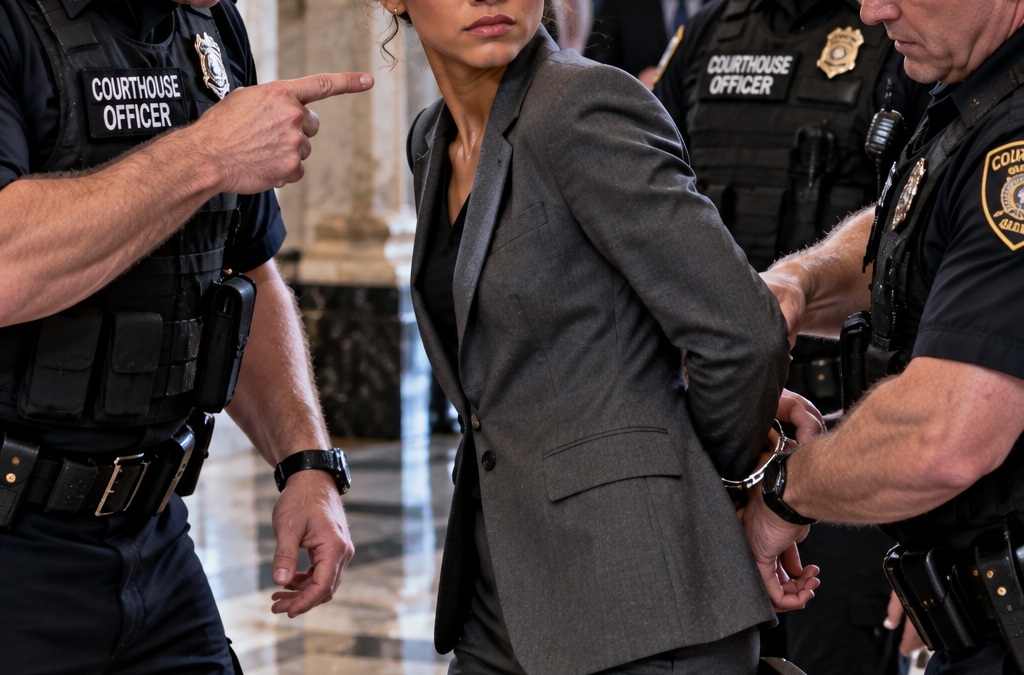
𝗙𝗨𝗟𝗟 𝗦𝗧𝗢𝗥𝗬 .
The lobby was almost empty.
Fluorescent lights buzzed overhead.
The marble floor had been polished so many times that the cracks looked permanent beneath the shine.
The building smelled like floor wax, stale coffee and old paper.
A sign near the front desk said:
ALL VISITORS MUST CHECK IN.
The desk itself was empty.
I looked around.
No clerk.
No guard.
No sign of anyone.
I knew chambers were upstairs on the east side.
I had memorized the floor plan from the PDF the clerk sent me.
So I kept walking.
That decision would later be described in three different official reports.
One called it “entry beyond an unmanned checkpoint.”
Another called it “failure of security staffing.”
The first report written that morning called it trespassing.
At the time, it was simply me walking toward my office.
I had reached the east corridor when I heard footsteps behind me.
Fast.
Purposeful.
“Ma’am.”
I turned.
Three officers were approaching.
The one in front was broad and heavy through the shoulders.
Gray beginning at his temples.
Sergeant stripes.
His nameplate read LAWSON.
To his left walked a younger officer named Collins.
To his right was Whitmore.
They stopped about ten feet away.
Lawson rested one hand on his belt.
“This corridor is restricted.”
“I understand.”
“Authorized personnel only.”
“I’m authorized.”
His eyes moved slowly over me.
Shoes.
Slacks.
Blazer.
Briefcase.
Face.
I had experienced that inspection before.
Anyone who says you can’t feel prejudice before somebody speaks has probably never been studied that way.
“You got ID?”
“Of course.”
I set down the briefcase.
Then I reached into my jacket.
All three officers shifted.
Not dramatically.
But enough.
I slowed my movement.
Two fingers.
Driver’s license.
I held it out.
Lawson took it.
“Harper Foster.”
“Yes.”
He turned the license over.
“This is a driver’s license.”
“Correct.”
“This doesn’t give you access to a restricted courthouse corridor.”
“My courthouse badge hasn’t arrived yet. The clerk’s office has it.”
He looked at me.
“Not my problem.”
He extended the license.
I reached for it.
Then he let it go.
The plastic card struck the marble between us.
The sound was small.
But something about it felt deliberate enough that the entire hallway seemed to shrink around it.
I looked down.
Then back at him.
He smiled faintly.
“I need you to turn around.”
“I’m expected upstairs.”
“Defendants check in at window B.”
“I’m not a defendant.”
“Right.”
Collins laughed softly.
Lawson crossed his arms.
“So what exactly are you doing in a restricted corridor?”
“I already told you. I’ve been assigned here.”
“Assigned?”
He repeated it slowly.
“To what?”
I studied him.
There were several ways I could have answered.
I could have said:
I am Judge Harper Foster.
I could have told him my chambers were room 214.
I could have listed my appointment date.
My Senate confirmation.
The oath.
I didn’t.
Not because I was testing anyone.
That claim came later.
I simply did not believe I should have to recite my résumé to get three trained officers to perform a basic identity check.
“I’ve been assigned to this courthouse.”
Collins leaned toward Lawson.
“Maybe she’s the new janitor.”
Lawson smirked.
“Janitors have badges.”
Collins laughed.
“Maybe she came to clean the toilets and got lost.”
Whitmore stood behind them.
He didn’t laugh.
He also didn’t stop anything.
At that point, I looked directly at him.
He looked away.
I bent to retrieve my driver’s license.
Lawson got there first.
He picked it up.
Then, instead of handing it to me, he flicked it down the corridor.
It slid across the marble and stopped maybe twenty feet away.
Collins pointed.
“Go fetch.”
I straightened.
I didn’t move.
The room inside me became very quiet.
When you prosecute violent men, you learn that anger can be useful only if you control the timing.
I had stood across from defendants who threatened my life in open court.
I had questioned witnesses who lied while smiling.
I knew how to keep my voice level.
“Sergeant, call the clerk’s office.”
Lawson’s smile disappeared.
“What?”
“Call the clerk. One phone call will verify who I am.”
“I don’t take instructions from you.”
“I’m not giving you an instruction. I’m offering the simplest way to resolve this.”
He stepped closer.
“You know what I see?”
I said nothing.
“I see somebody who walked past a security point without checking in.”
“The desk was empty.”
“I see somebody wandering through a restricted corridor without proper credentials.”
“I told you why.”
“And I see somebody who’s about to have a very bad morning.”
I looked at him.
“And I see three officers making a decision they may not be able to take back.”
Collins’s grin disappeared for half a second.
Then he laughed.
“She’s tough.”
Lawson’s jaw hardened.
“That mouth is going to get you into trouble.”
“I am asking you to verify my identity.”
“I said turn around.”
“I have every right to be here.”
He stepped closer again.
We were less than two feet apart.
“You people.”
The words came quietly.
But I heard them.
So did Collins.
His mouth pulled into another grin.
Lawson continued.
“You people always think you’ve got rights.”
There are moments when language removes all ambiguity.
Before that sentence, someone could have constructed explanations.
Security concern.
Procedure.
Miscommunication.
No badge.
Unmanned desk.
After that sentence, there was nothing left to explain.
I looked directly into his eyes.
“You are a courthouse officer speaking to a member of the public.”
His nostrils flared.
“You don’t tell me how to speak.”
“This isn’t your hallway.”
That did it.
He stared at me.
Behind him, Collins laughed.
Lawson turned.
“You hear this?”
Then back to me.
“I’ve been in this building seventeen years.”
His voice grew louder.
“I’ve hauled drunks, dealers, scammers and every kind of garbage out of these halls.”
He pointed toward me.
“They all have that same look.”
“What look?”
“That look like you think you’re different.”
He leaned in.
“You aren’t.”
I could smell coffee on his breath.
“Last chance.”
He pointed behind me.
“Walk out.”
I stayed where I was.
“I’m not going anywhere until someone verifies my identity.”
His hand moved.
Fast.
He grabbed the collar of my blazer.
My body jerked forward.
Then he shoved me sideways.
My shoulder struck the wall first.
My head followed.
There was a burst of white in my vision.
For one second, I couldn’t hear.
Then sound rushed back.
“Don’t you ever talk back to me in my courthouse.”
His courthouse.
I remember that clearly.
Collins grabbed my left arm and twisted it behind me.
Pain shot through my shoulder.
I gasped.
“Stop resisting.”
“I’m not resisting.”
He forced my wrist higher.
My cheek pressed against cold limestone.
A young woman carrying files appeared at the far end of the corridor.
She stopped.
Our eyes met.
For one second.
Then she turned away.
Her heels clicked faster as she disappeared.
That sound stayed with me.
Not because I blamed her.
Fear is real.
People freeze.
People retreat.
But there is something devastating about seeing help choose another direction.
Lawson pressed his forearm across my upper back.
“You know what your problem is?”
I focused on breathing.
“This badge means I decide who walks these halls.”
He tapped the metal on his chest.
“Not you.”
My face was against the wall.
“Let me go.”
Collins laughed near my ear.
“She gives orders now.”
He twisted my arm again.
“You’re hurting me.”
“Then stop resisting.”
“I am not resisting.”
Whitmore came forward.
He pulled handcuffs from his belt.
That was the first moment I became afraid.
Not nervous.
Not angry.
Afraid.
Because up until then I had believed that eventually training would interrupt ego.
Procedure would take over.
Someone would ask the right question.
Someone would call upstairs.
Instead, I heard the metal cuffs open.
The first closed around my right wrist.
Too tight.
Then the left.
Pain immediately cut into the skin.
Lawson stepped back.
“Spread your feet.”
I turned my head enough to look at him.
“This is a mistake.”
“The mistake was you coming in here pretending to be something you’re not.”
He searched my blazer.
Pulled out my phone.
He looked at the screen.
Then tossed it onto my briefcase.
The phone bounced off the leather and hit the wall.
I heard glass crack.
My briefcase had fallen open.
Papers covered the hallway.
Case materials.
Administrative documents.
A folder with a federal seal.
Collins picked one up.
He glanced at it.
Didn’t read it.
Crumpled the corner in his fist.
“Look at this.”
He tossed it down.
“She’s carrying court documents.”
“Probably stole them,” Lawson said.
A man in a suit walked past.
He looked at me.
Then at the officers.
Then at the floor.
He kept walking.
That hurt differently.
Maybe because he looked like an attorney.
Maybe because he understood exactly what handcuffs in a courthouse meant.
Lawson turned me around and pushed my back against the wall.
The cuffs dug into my wrists.
“Here’s what’s going to happen.”
I looked at him.
“You’re going downstairs until we figure out who you are.”
“You could figure that out right now.”
“If you’re lucky, I won’t charge you with trespassing.”
I said nothing.
“If you’re unlucky, you’ll spend the night in county.”
“Are you finished?”
His eye twitched.
“What?”
“Are you finished?”
For several seconds, we stared at each other.
Then he grabbed my upper arm.
“Yeah.”
He smiled.
“I’m finished.”
They took me toward the stairwell.
Dragged is a better word.
Lawson held one arm.
Collins held the other.
My feet hit the edges of the stairs awkwardly because my hands were cuffed behind me.
Whitmore followed.
I could hear keys moving against his belt.
Nobody spoke.
The basement holding room was smaller than I expected.
Metal bench bolted to the wall.
Peeling paint.
Drain in the floor.
One fluorescent light humming overhead.
It smelled like disinfectant and old sweat.
Lawson shoved me toward the bench.
I sat hard.
The cuffs struck metal behind my back.
Pain ran up both wrists.
“You know what’s funny?” Lawson said.
Collins stood in the doorway.
“What?”
“She really thought she was walking into chambers.”
Collins laughed.
“Delusional.”
Lawson looked down at me.
“Just stroll right upstairs like she belongs.”
I leaned my shoulder against the wall.
It was already throbbing.
“Call the clerk.”
He ignored me.
Collins leaned against the doorframe.
“You see this all the time.”
“People watch television,” Lawson said. “Put on a blazer. Carry a briefcase.”
He looked at me.
“Honey, clothes don’t make you somebody.”
My hands were shaking.
That bothered me more than I expected.
Not because I was ashamed of fear.
Because they might see it and enjoy it.
So I pressed my fingers together behind my back.
I had spent fourteen years learning how not to react when someone wanted a reaction.
Lawson crouched in front of me.
“What do we book her for?”
“Trespassing,” Collins said.
“Impersonating court personnel.”
“I never impersonated anyone.”
Lawson smiled.
“You said you were assigned here.”
“I am.”
“That’s impersonation as far as I’m concerned.”
“One phone call.”
“I don’t take orders from people sitting on that bench.”
He pulled out a notepad.
“Name.”
“Harper Foster.”
“Address?”
I gave it to him.
“Occupation?”
I looked at him.
That was my last opportunity to end his ignorance myself.
I could have said it.
Federal judge.
Two words.
But by then, something fundamental had changed.
This was no longer about whether I could prove I was entitled to better treatment.
If I said “judge” and their behavior changed, that would answer the wrong question.
The question was never whether a judge deserved to be treated lawfully.
The question was whether anyone did.
So I said, “You’ll know soon enough.”
Lawson laughed.
He wrote something on the pad.
“Occupation?”
“I’ve given you enough information to verify me.”
Collins pulled out his phone.
Lawson shook his head.
“Don’t bother running her.”
He looked straight at me.
“She’s nobody.”
Nobody.
I thought of my grandmother.
My mother.
My grandfather’s briefcase upstairs.
Fourteen years of cases.
The oath.
Then I realized something almost comforting.
Lawson’s opinion could not erase any of it.
He could call me nobody because he did not know me.
But ignorance did not alter reality.
That principle had always been true in law.
It was true here too.
Whitmore returned with forms.
Lawson began writing.
“Unauthorized entry.”
His pen scratched across the paper.
“Refusal to comply.”
More writing.
“Verbal aggression.”
I stared.
“Suspected impersonation of court personnel.”
“That’s false.”
He didn’t look up.
“It’s my report.”
Collins walked over.
“Add threatening an officer.”
“When did I threaten anyone?”
“You said we’d regret this.”
“That is not a threat.”
Collins grinned.
“Sounds threatening to me.”
Whitmore stood near the wall.
Still silent.
I looked at him.
He shifted.
For the first time, I saw discomfort on his face.
That did not make me feel better.
There is a point where discomfort becomes complicity.
He had crossed it long ago.
Lawson finished the paperwork.
Then checked his watch.
“Six hours.”
Collins raised an eyebrow.
“Six?”
“Let her sit.”
Lawson looked at me.
“Might teach her something.”
He walked toward the door.
I said, “I need water.”
He turned.
“This isn’t a hotel.”
“I have a right to a phone call.”
“Earn it.”
“I want counsel.”
He smiled.
“Sweetheart, you couldn’t afford a lawyer.”
Then the door shut.
The lock turned.
Their footsteps faded.
I heard laughter on the stairs.
Then nothing.
I was alone.
The fluorescent light buzzed.
My shoulder hurt.
My wrists burned.
My cheek throbbed where my head had hit the wall.
I closed my eyes.
Not to cry.
To think.
I knew procedure.
That became my anchor.
Time.
Names.
Exact words.
Positions.
Sequence.
Lawson grabbed collar.
Collins restrained left arm.
Whitmore applied cuffs.
Phone damaged.
Documents scattered.
False booking record initiated.
Denied water.
Denied phone access.
Threat of prolonged detention.
I repeated everything mentally.
Again.
Again.
Again.
Memory becomes evidence only if you preserve it.
Then I thought about the oath.
Two weeks earlier, I had promised to administer justice without respect to persons and to faithfully and impartially discharge every duty under the Constitution and laws of the United States.
At the time, I thought about defendants.
Victims.
Attorneys.
People standing before my bench.
I hadn’t imagined sitting handcuffed in a basement beneath it.
Maybe I should have.
The law is easiest to praise when it is abstract.
The Constitution sounds beautiful in marble halls.
It becomes meaningful when someone has the power to ignore it.
I thought about every defendant I had ever prosecuted who claimed an officer lied.
I thought about how many times juries instinctively trusted the uniform.
How many reports had sounded neat and professional.
Refused to comply.
Resisted.
Aggressive.
Threatening.
Words that could reshape an encounter.
Words Lawson had just written about me.
I had not resisted.
Yet it was already becoming ink.
For the first time in my career, I understood in my body what I had previously understood only intellectually.
A false report could feel like a second assault.
Upstairs, while I sat in that holding room, Patricia Cowell in the clerk’s office finally printed my courthouse badge.
She placed it into a clear sleeve.
JUDGE HARPER FOSTER.
Photograph.
Federal identification.
Everything Lawson had refused to verify.
Then Patricia called Tom Garrett, the senior bailiff assigned to my courtroom.
“The new judge should be here.”
“Judge Foster?”
“She confirmed she’d arrive around seven.”
“I haven’t seen her.”
Patricia checked the time.
“She’s late.”
That apparently concerned her because I was not known for being late.
Garrett went looking.
He entered the east corridor.
The first thing he found was my briefcase.
Open.
The second was my phone.
Cracked.
Then the papers.
He picked up one folder.
Federal seal.
Harper Foster.
He looked at the appointment packet Patricia had given him.
Same name.
Then he heard voices below.
Lawson’s voice.
Garrett took the stairs two at a time.
I heard the basement door slam open.
Lawson’s head snapped toward it.
“What the hell, Tom?”
Garrett didn’t answer.
He looked at me.
His expression changed completely.
I remember that moment more clearly than the reveal itself.
Recognition.
Horror.
Then fear.
Not fear of me.
Fear of what had already happened.
He looked at Lawson.
“What did you do?”
Lawson waved a hand.
“Relax. Trespasser.”
Garrett stared at him.
“Found her wandering upstairs.”
“No credentials,” Collins added.
“Kept claiming she had business in chambers.”
Garrett lifted a manila folder.
His hand was shaking.
“Do you know who this is?”
Lawson frowned.
“Some woman who—”
“Do you know who this is?”
The room went completely silent.
Garrett opened the folder.
Pulled out the appointment letter.
Held it in front of Lawson.
“This is Judge Harper Foster.”
Nothing moved.
“Federal bench.”
Lawson stared at the paper.
“Appointed by the President.”
Collins stopped smiling.
“Confirmed by the Senate.”
Whitmore looked at me.
“Sworn in two weeks ago.”
Garrett’s voice cracked.
“She is the new judge assigned to this courthouse.”
Lawson’s face emptied.
“No.”
Garrett stepped closer.
“She is Your Honor.”
Silence.
I watched Lawson.
He looked at me as though I had changed physically.
I hadn’t.
Same blazer.
Same swollen cheek.
Same skin.
Same woman.
Only his information had changed.
That was the part I would remember longest.
Collins whispered, “No.”
Then again.
“No, no.”
Lawson snapped at him.
“Shut up.”
But his authority was gone.
It disappeared almost instantly.
Garrett came toward me.
“Your Honor.”
His voice shook.
“I am so sorry.”
He reached for his handcuff key.
The right cuff opened.
Then the left.
Blood rushed painfully back into my hands.
Red grooves circled both wrists.
I rubbed them slowly.
Nobody spoke.
I stood.
My legs felt unsteady.
I waited until they weren’t.
Then I straightened my blazer.
Adjusted the collar Lawson had grabbed.
Brushed dust from my slacks.
I walked toward the doorway.
Before leaving, I stopped.
“My briefcase is upstairs.”
Nobody answered.
“My phone is damaged.”
Lawson swallowed.
“The federal case documents your officers scattered remain on the corridor floor.”
Still silence.
“I expect every item returned to chambers within ten minutes.”
“Yes, Your Honor,” Garrett said.
I looked at Lawson.
He couldn’t meet my eyes.
Then I looked at Collins.
Same.
Finally Whitmore.
He looked at the floor.
I went upstairs.
Garrett walked behind me.
As we reached the first floor, Lawson’s radio crackled in the stairwell below.
Dispatch.
“Sergeant Lawson, be advised we have confirmation the new federal judge is arriving this morning. Judge Harper Foster. Please ensure full escort and access to chambers.”
I stopped.
So did Garrett.
The radio went silent.
I looked back toward the stairs.
Nobody said anything.
We kept walking.
My chambers were room 214.
I entered them for the first time at 8:06 a.m.
The office was smaller than I remembered from the tour.
Desk.
Shelves.
Two visitor chairs.
Flag.
A framed copy of the Constitution.
My robe lay across the back of the chair.
Black.
Pressed.
Waiting.
Garrett placed the recovered briefcase on a side table.
He had collected every loose sheet himself.
My cracked phone sat beside it.
“I’m going to get medical.”
“Not yet.”
“Your Honor, your face—”
“I know.”
“Your wrists need photographs.”
“They will get them.”
He nodded.
“I should have been at the entrance.”
“This is not your fault.”
“I knew your badge was delayed.”
“Tom.”
He stopped.
“This is not your fault.”
His eyes filled.
He nodded again.
Then he left.
I closed the door.
For the first time that morning, I was alone somewhere I had chosen to be alone.
I touched the robe.
My fingers shook.
That was when everything hit me.
Not downstairs.
Not against the wall.
Not when the cuffs closed.
Here.
In the quiet.
My knees weakened.
I sat.
I put both hands flat on the desk.
I breathed once.
Twice.
Then I cried.
Not for long.
Maybe a minute.
Maybe less.
I wasn’t ashamed.
People sometimes mistake composure for absence of pain.
They are not the same thing.
I had been frightened.
Humiliated.
Assaulted.
And beneath all of that, I was furious.
The robe hung beside me.
I looked at it.
Then at my wrists.
The robe had never made me a judge.
Neither had Lawson’s ignorance made me less of one.
Seventeen minutes later, Sheriff Warren Coleman arrived.
He had been shown the body-camera footage.
Every second.
Lawson grabbing me.
Collins twisting my arm.
Whitmore applying restraints.
The shove.
The holding room.
The taunts.
The false report.
Everything.
Coleman went directly to the break room.
Lawson was still in uniform.
Collins and Whitmore were with him.
According to the official report, Lawson began with:
“Sheriff, I can explain.”
Coleman answered:
“Stand up.”
Lawson stood.
“Badge.”
Lawson hesitated.
“Now.”
He unclipped it.
Placed it on the table.
“Weapon.”
The sidearm followed.
“You are suspended without pay effective immediately.”
Lawson tried again.
“I didn’t know she was—”
Coleman cut him off.
“You didn’t know?”
Silence.
“That’s your defense?”
He stepped toward Lawson.
“You assaulted a woman in a federal courthouse.”
“She didn’t comply.”
“She asked you to verify her identity.”
“She was in a restricted—”
“You slapped her.”
Lawson stopped.
Coleman’s voice became quieter.
“You handcuffed her.”
No answer.
“You locked her in a holding room.”
Nothing.
“You wrote a report accusing her of conduct you know did not happen.”
Lawson looked down.
“And here’s the part you apparently still don’t understand.”
Coleman pointed toward the door.
“Even if she were exactly who you thought she was, you had no legal right to do what you did.”
That distinction mattered to me.
It mattered more than my title.
Coleman suspended Collins too.
When he reached Whitmore, there was a pause.
Whitmore finally spoke.
“I never touched her.”
“No,” Coleman said.
“You just watched.”
Whitmore’s face tightened.
“Badge.”
“Sheriff—”
“Badge and weapon.”
Whitmore obeyed.
“You had fourteen years of training.”
Coleman looked at him.
“You knew what lawful force looked like.”
Whitmore said nothing.
“You knew what unlawful force looked like too.”
Still nothing.
“And you watched.”
Three badges lay on the break-room table.
Three weapons beside them.
By then, the video had already escaped the building.
Someone had recorded part of the encounter from the hallway.
Forty-three seconds.
Long enough to show Lawson shove me.
Long enough to show the slap.
Long enough to show Collins holding my arm.
Long enough to show Whitmore doing nothing.
Within an hour, sixteen thousand people had seen it.
By lunch, millions.
By evening, my name had become a hashtag.
I hated that.
Not because public attention was unwelcome.
Because viral footage compresses people.
Forty-three seconds turned me into an image.
Black woman.
Courthouse wall.
White officers.
Handcuffs.
People argued over me without knowing anything about me.
Some called me brave.
Some claimed the video lacked context.
Some insisted I must have done something before recording started.
That last part taught me almost as much as Lawson had.
There are people who will invent misconduct for a stranger before accepting evidence of abuse by someone in authority.
The FBI arrived Wednesday.
Civil Rights Division.
Special Agent Dana Mercer.
Special Agent Kyle Bradshaw.
They collected body-camera footage.
Hallway surveillance.
Holding room logs.
Dispatch recordings.
My damaged phone.
The false paperwork.
Photographs of my wrists.
Photographs of my shoulder.
Photographs of my cheek.
Then they asked for personnel files.
That’s when the story changed.
Until that point, everyone had been treating what happened to me as a terrible isolated incident.
One bad morning.
Three officers.
A shocking mistake.
It wasn’t.
Lawson had eleven prior complaints.
Eleven.
A Black teenager detained in the courthouse parking lot while waiting for his mother’s custody hearing.
A Black attorney instructed to use the service entrance.
A courthouse janitor handcuffed after hours even though his shift schedule showed he was supposed to be there.
Citizen complaints.
Use-of-force complaints.
Bias allegations.
All dismissed internally.
Collins had his own history.
A Latino visitor roughed up during a pat-down.
A Black woman ordered to remove her head covering in a way inconsistent with policy.
Complaints closed.
Unfounded.
No discipline.
No independent review.
Whitmore’s record was quieter.
That fit him.
Few direct allegations.
But again and again his name appeared in reports as the second or third officer present.
Watching.
Confirming.
Never intervening.
When investigators showed me the pattern, I sat for a long time without speaking.
Then I asked the question I already knew the answer to.
“Who reviewed these complaints?”
Several supervisors.
Including people still working for the department.
That was when my anger changed direction.
Lawson had assaulted me.
But systems had protected him long before he touched me.
He had learned what he could get away with because eleven complaints had taught him.
Collins had learned laughter was safer than conscience.
Whitmore had learned silence came without consequences.
Until me.
Not because I was more deserving.
Because I happened to be a federal judge.
That reality bothered me deeply.
If I had been the janitor Lawson once handcuffed, would anyone have opened eleven files?
If I had been a public defender with no national attention, would the FBI have arrived Wednesday?
If I had been a woman visiting her son’s hearing, would millions of people have cared?
The law says dignity does not increase with title.
Institutions often behave as though it does.
I could not forget that.
The newspaper investigation broke Friday morning.
Four words covered the front page.
THEY KNEW ALL ALONG.
The story listed the complaints.
Dates.
Names.
Internal findings.
Dismissals.
The county administration went into crisis.
Reporters surrounded the sheriff’s office.
The mayor stopped answering questions.
Civil rights organizations demanded federal intervention.
Former defendants requested review of cases involving Lawson.
Attorneys started pulling old footage.
By Monday, a federal grand jury had convened.
I did not attend.
I refused every invitation to comment.
I also recused myself from every legal matter arising from the incident.
That decision frustrated some people.
One reporter asked whether I wanted Lawson prosecuted to the fullest extent possible.
I said:
“I want the law applied correctly.”
“That’s all?”
“That’s everything.”
The charges came soon afterward.
Deprivation of rights under color of law.
Assault.
Unlawful detention.
False reporting.
Collins faced civil-rights charges, unlawful restraint and participation in the assault.
Whitmore faced charges related to his failure to intervene and participation in the detention.
The trial took place in another federal courthouse.
Another judge presided.
I testified once.
Walking into that courtroom felt stranger than any testimony I had ever given.
I had spent years at counsel tables.
Years questioning witnesses.
Now I sat in the witness chair.
The prosecutor asked me to describe what happened.
I did.
No speeches.
No commentary.
Facts.
I entered the courthouse.
The desk was unattended.
I proceeded toward chambers.
Sergeant Lawson stopped me.
I provided identification.
I requested verification through the clerk’s office.
My identification was thrown.
I was subjected to racial remarks.
Lawson grabbed me.
I was shoved into the wall.
Officer Collins restrained me.
Officer Whitmore applied handcuffs.
I did not resist.
I was taken downstairs.
Denied access to a phone.
Threatened with extended detention.
False charges were written.
At one point, Lawson’s attorney asked:
“Judge Foster, isn’t it true that you could have simply told Sergeant Lawson you were a federal judge?”
I looked at him.
“Yes.”
“So this entire incident could have been avoided.”
The courtroom went very still.
“No.”
He paused.
“No?”
“It could have been avoided if Sergeant Lawson followed the law.”
The attorney shifted.
“But identifying yourself—”
“I identified myself.”
“As a judge?”
“I gave him my full legal name, government identification and the office capable of confirming my authorization.”
I leaned slightly toward the microphone.
“And whether I was a judge is irrelevant to whether he had the right to assault me.”
The attorney stopped.
I continued because the distinction mattered.
“If I had been a defendant, he could not lawfully slap me for speaking.”
“If I had been a janitor, he could not falsify a report.”
“If I had been homeless, he could not deny me basic rights because he disliked my appearance.”
“If I had been guilty of trespassing, he would still have been required to follow lawful procedure.”
I looked directly at the jury.
“My title did not create my rights that morning.”
The defense attorney sat down.
The prosecution played the videos.
Not only the forty-three seconds.
Everything.
Body camera.
Hallway footage.
Basement.
Audio.
The courtroom watched Lawson call me trash.
Watched Collins laugh.
Watched Whitmore fasten the cuffs.
Watched Lawson write things that were demonstrably false.
Then came the dispatch audio.
This was the piece Lawson’s lawyer had hoped wouldn’t matter.
A radio message notifying courthouse security that Judge Harper Foster was expected that morning.
Confirmation from the clerk.
Request for escort and access.
Lawson had received it.
The body camera captured the sound.
His hand reached down.
The volume dropped.
He had heard my name.
Maybe not clearly.
Maybe he had not connected it immediately.
But he had deliberately turned down the radio while holding me.
The prosecutor played it twice.
After that, the defense changed.
Mistake became confusion.
Confusion became stress.
Stress became poor judgment.
Poor judgment became lack of intent.
But the evidence was too complete.
The jury deliberated three hours and forty-one minutes.
Guilty.
When the verdict was read, there was no cheering.
People sometimes imagine justice as celebration.
It rarely feels that simple.
Lawson had a family.
Collins had parents.
Whitmore had people who loved him.
Their guilt did not erase those people.
It also did not erase what they had done.
Justice is difficult precisely because human beings are not only the worst thing they have ever done.
But neither are they exempt from consequences because they are more than that act.
Sentencing came two weeks later.
Lawson entered without a badge.
Without a weapon.
Navy suit.
Tie slightly crooked.
He looked smaller.
The judge sentenced him to eight years in federal prison.
Collins received four.
During his statement to the court, he cried.
“I was following Sergeant Lawson’s lead.”
The judge looked at him.
“Following someone into wrongdoing does not make the wrongdoing disappear.”
Collins lowered his head.
Whitmore pleaded guilty during trial.
He received two years plus supervised release.
His attorney argued that he had never struck me.
The court acknowledged that.
Then addressed the larger issue.
An officer has duties not only regarding what he does.
Sometimes the law also cares about what he knowingly permits.
Whitmore had watched.
He had been trained to know better.
He chose silence.
The sentences did not make me happy.
They made something official.
What happened in that hallway had not been a misunderstanding.
Not a personality conflict.
Not “an unfortunate interaction.”
It had been unlawful.
That mattered.
But the larger investigation mattered more.
Sheriff Coleman resigned.
Forty-six misconduct complaints from the previous fifteen years were reopened.
Twelve produced new disciplinary findings.
Three were referred for potential criminal review.
Several supervisors were removed or reassigned.
The county dismantled the internal-review structure that had allowed officers to investigate officers working under the same leadership.
The state legislature took notice.
Months of hearings followed.
Experts testified about independent oversight.
Use-of-force review.
Complaint preservation.
Body-camera access.
Duty to intervene.
Eventually, lawmakers passed the Courthouse Accountability Act.
It required independent investigation of certain law-enforcement misconduct complaints.
Mandated preservation of body-camera footage.
Established reporting requirements when officers failed to intervene.
The governor signed it four months after the incident.
The ceremony took place in the same courthouse where I had been put in handcuffs.
I was invited.
I declined.
Not out of anger.
I had a docket.
People were waiting.
Someone had a sentencing.
Someone else had a civil hearing.
A family had spent nearly three years waiting for their case to reach trial.
I had work to do.
That mattered more to me than standing behind a politician while cameras flashed.
One year after my first morning in Grayson County, I walked through the same entrance.
Same briefcase.
Same style of flat shoes.
Gray blazer beneath my coat.
My courthouse badge clipped inside my bag.
I rarely displayed it unless necessary.
The security team had changed.
So had the procedures.
A new officer stood by the metal detector.
“Good morning, Judge Foster.”
“Morning.”
I placed my briefcase on the belt.
“You know you don’t have to—”
“I know.”
I sent it through anyway.
Rules become stronger when the people with power participate in them too.
The officer smiled.
“Have a good session.”
“You too.”
I entered the east corridor.
The wall where Lawson shoved me was still there.
Of course it was.
People expected me to feel something every time I passed it.
Some days I did.
Other days it was just stone.
Trauma is strange that way.
It doesn’t always announce itself.
Sometimes the smell of industrial disinfectant could pull me back to the basement.
Sometimes the click of handcuffs during a sentencing made my wrists ache though the bruises had disappeared months earlier.
Sometimes a raised male voice in the hallway made my body tense before my mind understood why.
But I walked the corridor anyway.
Every morning.
Not because walking made me brave.
Because the hallway belonged to the public.
Not Lawson.
Not me.
The public.
Tom Garrett still worked at his desk near chambers.
He stood when I approached.
The first several times, I told him he didn’t have to.
Eventually I stopped.
It mattered to him.
So I let him.
“Morning, Your Honor.”
“Morning, Tom.”
That was our ritual.
Nothing dramatic.
Nothing performative.
Respect should be ordinary.
On my desk sat the photograph of my grandmother.
She had died four months after the incident.
Peacefully.
At home.
The last time we spoke, her voice had been weaker than usual.
She had followed the case reluctantly.
She hated seeing photographs of my bruised face.
One afternoon, she called.
“Harper.”
“Yes, Grandma?”
“You okay?”
“I’m okay.”
“Don’t give me that judge answer.”
I smiled.
“I’m trying.”
“That’s better.”
She was quiet for a moment.
Then she said:
“Don’t you let them make you small.”
“I won’t.”
“You hear me?”
“Yes.”
“Because people will spend your whole life trying to tell you how much room you’re allowed to take up.”
I closed my eyes.
“Grandma—”
“You earned your chair.”
“I know.”
“No.”
Her voice strengthened.
“You existed before that chair.”
I didn’t answer.
“You mattered before anybody called you judge.”
That sentence broke something open inside me.
Because it was exactly what had troubled me since the hallway.
Everyone celebrated the reveal.
They put a federal judge in handcuffs.
The headlines almost always emphasized it.
But I kept thinking about the version of the story where I wasn’t a judge.
What if Lawson had been right about my destination?
What if I had been a defendant?
Would people still be outraged that he shoved me?
What if I had been a janitor without identification?
Would throwing my license down the hallway still be humiliating?
What if I were poor?
Lost?
Confused?
Mentally ill?
Would the slap matter less?
It shouldn’t.
That became one of the most important lessons I carried to the bench.
Titles complicate perception.
A robe creates immediate deference.
The word “judge” can change posture, language, tone.
I see it every day.
People stand.
They call me Your Honor.
Attorneys wait until I finish speaking.
Deputies open doors.
But whenever that deference begins to feel natural, I remember the basement.
I remember sitting on a metal bench while someone told me I could not afford a lawyer.
I remember how quickly authority decided what my silence meant.
That memory changed the way I listened.
One afternoon, about ten months after the incident, a young man appeared before me on a probation violation.
Twenty-three.
Black.
Baggy county uniform.
Public defender beside him.
The probation officer described him as “hostile and uncooperative.”
Old language.
Dangerous language.
I looked at the young man.
“Mr. Daniels, do you want to respond?”
His lawyer started to speak.
I raised a hand gently.
“I asked him.”
The young man looked surprised.
“Yes, ma’am.”
“Your Honor,” his attorney whispered.
The young man corrected himself.
“Yes, Your Honor.”
“What happened?”
He explained that the probation officer had ordered him to sign a document he didn’t understand.
He asked questions.
The officer called his questions argumentative.
The conversation escalated.
I asked for the body-camera footage.
There was a pause.
The prosecutor didn’t have it.
I continued the hearing.
When the footage arrived, it did not completely vindicate him.
He had cursed.
He had raised his voice.
He had behaved poorly.
But he had also been telling the truth about the document.
And the officer’s report omitted significant context.
I handled the violation according to law.
No grand gesture.
No speech.
But afterward, as the young man was escorted away, I thought of Lawson’s report.
Verbal aggression.
Refusal to comply.
Words matter.
Context matters.
Power matters.
The incident in the hallway did not make me a better judge automatically.
Suffering does not automatically create wisdom.
Sometimes it creates anger.
Fear.
Bitterness.
You have to decide what to do with it.
I decided to use mine as friction against certainty.
Whenever a case seemed obvious, I asked one more question.
Whenever an officer’s report used vague language, I wanted specifics.
Whenever somebody was described as difficult, aggressive or noncompliant, I asked what they actually did.
That was not anti-police.
It was pro-evidence.
The best officers who appeared before me understood that.
Some even appreciated it.
Good law enforcement does not need blind trust.
It benefits from scrutiny because scrutiny separates professional work from abuse.
The new security team at Grayson understood that too.
They completed expanded training.
Duty to intervene.
Bias awareness.
De-escalation.
Documentation.
Independent complaint procedures.
Somebody eventually named the program the Foster Protocol.
I hated the name.
I called the county administrator.
“Change it.”
“Judge Foster—”
“I’m serious.”
“It’s already approved.”
“I don’t want my name on training.”
“The legislature specifically referenced your case.”
“Then call it courthouse security reform.”
He laughed nervously.
“I don’t think we can change the statute that easily.”
A month later, I saw the phrase in a newspaper.
FOSTER PROTOCOL IMPLEMENTED STATEWIDE.
I put the paper down.
My grandmother would have loved it.
That was the only reason I stopped complaining.
Lawson served his sentence out of state.
I never contacted him.
He never contacted me.
Collins wrote once.
Three handwritten pages.
The envelope arrived in chambers six months into his sentence.
My clerk asked whether I wanted it screened.
I said no.
Then I put it in a drawer.
I never opened it.
People found that strange when the detail eventually became public.
They assumed I was denying him forgiveness.
Maybe I was.
Maybe not.
Forgiveness is not a court order.
No one is entitled to receive it according to a schedule.
I did not hate Collins.
But I also did not owe him access to me because remorse had become useful after conviction.
The letter remained unopened.
Whitmore completed part of his custodial sentence and later moved away from Grayson County.
Of the three men, I thought about him most.
Lawson was easy to understand.
Power.
Contempt.
Ego.
Collins wanted approval.
He followed cruelty because cruelty made him feel included.
Whitmore was different.
He knew.
I saw it in his face.
He knew almost from the beginning that something was wrong.
He saw Lawson throw my license.
Saw Collins mock me.
Saw the shove.
Saw the handcuffs.
Saw the false report.
Every time, he had another opportunity to say one sentence.
“Enough.”
He never did.
That frightened me more than open cruelty.
Most systems are not sustained entirely by people like Lawson.
There are rarely enough Lawsons.
Bad systems survive because of Whitmores.
People who disapprove quietly.
People who tell themselves they are different because they aren’t the one striking anyone.
People who stand close enough to stop harm and decide silence is safer.
My grandmother understood that.
She grew up in a time when silence had protected many terrible things.
She once told me:
“Baby, sometimes the person holding the door open for injustice thinks they’re innocent because they didn’t walk through first.”
I had been fifteen.
I thought she was speaking metaphorically.
Years later, I watched Whitmore hold an actual basement door.
I understood.
The forty-three-second video still appears sometimes.
Civil-rights seminars.
Law-school classes.
Police academies.
News retrospectives.
I have never watched it.
Not once.
People assume that’s because I can’t.
That’s not quite right.
I don’t need to.
Video cannot show the things I remember most.
The cold wall against my cheek.
The smell of coffee on Lawson’s breath.
The small cracking noise when my phone hit stone.
The pressure in my shoulder.
The exact temperature of the holding room.
The sound of Collins laughing upstairs.
The quiet after they locked the door.
And the strangest detail of all:
The fluorescent light.
It buzzed constantly.
A thin electric sound.
For months afterward, certain lights bothered me.
Nobody would know that from the video.
But there is one moment I choose to remember more than all the others.
After Garrett opened the cuffs, I stood.
My wrists were red.
My shoulder was bruised.
My face hurt.
Three men who had spent the morning reducing me to something beneath them were staring at me as though I had transformed.
I hadn’t.
I was exactly the same woman they met in the hallway.
That realization gave me something back.
They had misjudged me.
But more importantly, they had misunderstood where dignity came from.
It did not come from Garrett’s folder.
It did not arrive when he said “Judge Foster.”
It wasn’t inside my badge.
It wasn’t waiting in room 214.
My dignity had been mine when Lawson dropped my driver’s license.
It was mine with my face against the wall.
It was mine in handcuffs.
It was mine on the basement bench.
They couldn’t remove it.
They could only refuse to recognize it.
Those are not the same thing.
A year after the incident, I sat behind my bench on an ordinary Tuesday morning.
No cameras.
No protesters.
No hashtags.
Just court.
My robe was pressed.
Case files waited in front of me.
The American flag stood behind my left shoulder.
My grandmother’s photograph was in chambers thirty feet away.
The clerk handed me the first matter.
Everyone stood.
I looked across the courtroom.
Defendants.
Lawyers.
Families.
Marshals.
Clerks.
People carrying stories I did not yet know.
Some guilty.
Some innocent.
Some frightened.
Some angry.
Some lying.
Some telling the truth badly.
All human.
“Please be seated.”
The room sat.
I looked at the first defendant.
He couldn’t have been older than twenty.
His hands shook.
I remembered my own hands trembling behind my back in the basement.
I remembered how hard I had worked to hide it.
“Good morning, Mr. Harris.”
He looked up.
“Good morning, Your Honor.”
I opened the file.
Then stopped.
There was one more thing I wanted to do.
I looked toward the gallery.
“Before we begin, I want to remind everyone in this courtroom of something.”
The attorneys looked up.
“This building belongs to the public.”
Silence.
“Not to me.”
I looked toward the deputies.
“Not to law enforcement.”
Toward the lawyers.
“Not to counsel.”
Then back to the defendant.
“The authority exercised here exists under law, and law is strongest when the people entrusted with authority remember that authority has limits.”
Nobody moved.
I hadn’t planned the words.
They came naturally.
“Everyone who enters this courtroom will be treated according to those principles.”
Then I opened the file.
“Counsel, you may proceed.”
And we did.
No applause.
No dramatic moment.
No revenge.
Just the work.
That became my real ending.
Not Lawson’s sentence.
Not the legislation.
Not the viral video.
Not even walking into chambers after Garrett called me Your Honor.
The ending was returning the next morning.
And the morning after that.
Walking the same corridor.
Sitting behind the same bench.
Applying the law carefully enough that what happened to me did not become an excuse for what I did to someone else.
My grandmother had told me never to let them make me small.
For a long time, I thought she meant I should fight.
Sometimes she did.
But eventually I understood something deeper.
Refusing to become small also meant refusing to let one cruel morning shrink my understanding of justice into revenge.
Lawson had believed his badge meant the hallway belonged to him.
I could not respond by believing my robe meant the courtroom belonged to me.
Neither was true.
The badge.
The robe.
The bench.
The courthouse.
They were instruments.
Temporary ones.
The public trusted us with them.
That trust had to mean something.
Every morning when I enter Grayson County Courthouse, I still carry my grandfather’s worn leather briefcase.
The clasp was repaired after Lawson broke it.
You can see the replacement if you look closely.
The new metal is slightly brighter than the old.
I considered replacing the entire briefcase once.
I didn’t.
Some scars should be repaired without being erased.
My wrists healed.
My shoulder healed.
My cheek healed.
The courthouse changed.
The department changed.
The law changed.
I changed too.
But every time I pass the spot where Lawson threw my driver’s license, I remember the woman I was before anyone in that hallway knew my title.
That woman matters to me more than Judge Foster ever will.
Because she was the one who stood there.
She was the one who asked for the law instead of special treatment.
She was the one who endured the basement.
She was the one who stood back up.
And she was already worthy of dignity before anyone upstairs discovered the mistake.
The men who stopped me that morning believed authority gave them the right to decide who belonged.
They were wrong.
A courthouse is not supposed to belong to the people carrying badges.
It is supposed to belong to the people the badges are meant to serve.
That includes the lawyer.
The defendant.
The janitor.
The frightened mother.
The confused teenager.
The person who has committed a crime.
The person who has been falsely accused.
And the Black woman walking down a hallway in a gray blazer carrying an old leather briefcase.
Even before anyone calls her Your Honor.








