𝗙𝗨𝗟𝗟 𝗦𝗧𝗢𝗥𝗬 On Christmas Eve, I Gave a Freezing Stranger the Last Thing My Mother Ever Made for Me
𝗙𝗨𝗟𝗟 𝗦𝗧𝗢𝗥𝗬
A few give money without eye contact, like feeding an animal they’re afraid might mistake kindness for invitation.
I kept saying good morning anyway.
Not because I was better than anybody.
Because Mama raised me that way.
My closest friend out there was Calvin Moore.
Sixty-three.
Army veteran.
Homeless longer than I had been.
He never discussed the details.
I never forced him.
We traded books.
Split food.
Watched each other’s bags.
If I had an extra sandwich, half was his.
If he found two cups of coffee, one found me.
That’s how street friendships work.
Nobody has enough to waste, so what they share means more.
I also talked to God.
Out loud.
People already thought I was crazy for sleeping outside.
I figured I might as well get something useful from the reputation.
“Lord, I’m not asking for much.”
That was my regular prayer.
“A floor.”
Sometimes I’d point upward.
“A floor and a stove.”
That was it.
“Give me those, I’ll handle the rest.”
I still dreamed about a restaurant.
Even then.
Especially then.
Not something fancy.
A small room.
Kitchen big enough to breathe.
Maybe ten tables.
Fifteen if they fit.
Herbs in the window.
My mother’s photograph near the register.
A place where anybody hungry could come inside without somebody first measuring whether they deserved a chair.
Mama had wanted something like that too.
She used to say:
“One day we’re going to cook where everybody eats.”
She never got there.
After Honey’s, I started believing maybe neither would I.
Then Christmas Eve came.
Chicago cold is rude in ordinary winter.
That year it became dangerous.
The weather report said eighteen below with wind chill.
The kind of cold where every breath hurts before you’ve fully inhaled it.
I reached Shepherd’s Gate at three-thirty.
Early on purpose.
Beds always disappeared fast during bad weather.
Dorothy Wilson worked the evening desk.
She’d been there eleven years.
She knew all of us.
Who snored.
Who was sick.
Who needed watching.
Who lied about drinking.
Who pretended not to be hungry.
The moment I saw her face, I knew.
“Brenda.”
I stopped.
“What happened?”
“Pipe burst.”
I looked past her.
“East wing.”
She nodded.
“Thirty beds flooded.”
My chest sank.
“We’re full.”
I stood there holding my backpack.
She reached under the desk.
“I saved you this.”
Styrofoam cup of hot cocoa.
Then two disposable hand warmers.
“Come back at six tomorrow.”
“Dorothy—”
“I’ll hold a spot.”
“What if somebody needs it more?”
She gave me the look.
“Don’t start.”
I smiled.
“You sure?”
“Yes.”
I took the cup.
“Merry Christmas.”
Her eyes filled.
“You too, Brenda.”
Then I walked back outside.
The city was shutting itself away from the cold.
Apartment windows glowed with Christmas lights.
Storefront gates came down.
Cars disappeared.
People carrying bags hurried toward doors.
I walked because standing still hurt more.
Eventually I found the awning outside Sullivan’s Bread Company.
Closed for Christmas.
Metal gate over the windows.
Brick on both sides.
Enough protection from the wind to matter.
I laid cardboard on concrete.
Backpack beneath my head.
Mama’s blanket around me.
Even closed, the bakery still smelled faintly like yeast.
Bread.
Flour.
Warmth that no longer existed.
Calvin had gotten one of the final shelter beds.
I was glad.
Truly.
But it meant that night I was alone.
No one nearby to wake me if I became too cold.
That thought crossed my mind.
I pushed it away.
I had gotten good at pushing dangerous thoughts aside until morning.
I closed my eyes.
Then heard footsteps.
Slow.
Uneven.
Not the rhythm of somebody going home.
I sat up.
A man appeared near the corner.
White.
Early sixties, maybe.
Silver hair badly combed.
Thin coat.
No gloves.
No hat.
One hand dragged along the brick wall like it was holding him upright.
At first, I thought drunk.
Then I noticed the shoes.
Dark leather.
Fine stitching.
Clean soles except for snow.
Expensive.
Even I knew that.
They looked like the shoes businessmen wore into Honey’s before asking whether we had valet parking.
This man was not somebody who lived outside.
He reached the bench across from my little shelter beneath the awning.
Then his legs gave out.
He didn’t sit.
He folded.
Hands grabbed the armrest.
Body lowering.
His face was gray.
Lips almost colorless.
He smelled like whiskey.
His hands were clean.
Nails trimmed.
No gloves.
He stared straight ahead.
Didn’t check the alley.
Didn’t check me.
Didn’t look for police.
That told me as much as the shoes did.
People who have been homeless for a while learn to watch.
He wasn’t watching anything.
He looked empty.
I knew that face.
I had seen it in the reflection of a bus window the morning after I lost my apartment.
Not sadness.
Something beyond sadness.
The moment where a person stops arguing with what happens next.
That frightened me.
Then I noticed his shaking had changed.
Less violent.
Slower.
That was worse.
I looked at my blanket.
Mama’s stitches.
Purple.
Gold.
Cream.
I brought it close to my face.
For a second I could smell cinnamon.
Or memory.
I don’t know.
Then Mama’s voice entered my head as clearly as though she were sitting beside me.
Cold is cold, baby.
Don’t check skin.
Don’t check money.
Just cold.
I cursed under my breath.
“Mama.”
Because even dead, she still knew how to make me do the right thing when I didn’t want to.
I stood.
My knee cracked.
Eight steps across the sidewalk.
I counted without meaning to.
I sat beside him.
Shoulder to shoulder.
He didn’t turn.
I opened the blanket.
My hands hesitated.
That blanket had survived eviction.
Rain.
Shelter floors.
Sidewalks.
Every night I had been afraid I would lose the last physical thing Mama ever gave me.
Then I put it around him.
Pulled it tight.
Tucked the edges beneath his arms.
He looked at me.
Really looked.
“You…”
His voice barely worked.
“You don’t have to do this.”
“Apparently I do.”
“You’re freezing.”
“So are you.”
“This is yours.”
“What I need right now is for you to stop arguing and keep it on.”
His eyes widened slightly.
Then he pulled the blanket closer.
“Thank you.”
“Don’t thank me yet.”
I stood.
“Stay.”
“Where—”
“Coffee.”
He tried to rise.
I pointed at him.
“Don’t.”
I hurried two blocks toward the gas station on Halsted.
My knee hated every step.
Inside, I counted my money.
Three dollars and twelve cents.
Everything.
Large black coffee cost almost all of it.
That money had been breakfast.
I bought the coffee.
No sugar.
No cream.
Just heat.
When I returned, the man was still there.
Good.
His hands shook too badly to hold the cup.
I wrapped both of mine around his fingers.
“Small sips.”
He obeyed.
“Not fast.”
Steam crossed his face.
After a few minutes, the shaking eased.
I sat beside him.
My arms were cold without the blanket.
I tucked my hands beneath my armpits.
For a while, we said nothing.
Then I started talking because silence seemed dangerous for both of us.
“I used to cook.”
He glanced over.
“What?”
“Restaurant.”
He nodded.
“What kind?”
“Soul food.”
“Good?”
“Excellent.”
That got the beginning of a smile.
“Humble.”
“I’ve been homeless five months. Let me keep one thing.”
He laughed.
Barely.
But it was a laugh.
So I told him about Honey’s.
The Sunday crowds.
The pork chops.
The time I dumped an entire container of cayenne into collard greens because somebody bumped my elbow.
“What happened?”
“We served them.”
“You did not.”
“I was not wasting two hotel pans of greens.”
His smile widened.
“People ate them?”
“They suffered.”
He laughed again.
Real this time.
Broken around the edges.
But alive.
Snow started falling.
Small flakes.
Then bigger.
I asked:
“You got family?”
The laugh vanished.
“Not anymore.”
I didn’t push.
After a minute, I said:
“My mama used to cook at four Christmas morning.”
He turned toward me.
“Four?”
“Sometimes earlier.”
“Why?”
“So the rest of us could wake up pretending food appeared by magic.”
I smiled.
“She’d have cinnamon rolls going before sunrise.”
“Apple cobbler.”
“Pork roast.”
“I’d sit on a stool beside her.”
My voice softened.
“She taught me everything.”
He stared at the sidewalk.
“My wife made hot chocolate.”
I waited.
“Every Christmas Eve.”
His mouth twitched.
“From scratch.”
“That sounds nice.”
“It was terrible.”
I looked at him.
He almost laughed.
“Absolutely awful.”
“Then why’d she keep making it?”
“She thought it was good.”
“And you never told her?”
“Of course not.”
We both laughed.
Then his eyes filled.
“She used cayenne.”
“In hot chocolate?”
“And salt.”
“That actually can be good.”
“Not the amount Laura used.”
Laura.
First name he had given me.
He stared into the empty coffee cup.
“Every year I told her it was perfect.”
His voice changed.
“The last Christmas before she got sick…”
He stopped.
I let him.
“We sat beside the window.”
Snow collected on the street.
“She leaned against me.”
He swallowed.
“I remember thinking, this is happiness.”
His face tightened.
“I didn’t know it was the last time.”
The wind moved between buildings.
His voice cracked.
“Her name was Laura.”
I nodded.
“I miss her every day.”
I said nothing.
“I’ve been inside that penthouse alone for two years.”
Penthouse.
I noted the word but didn’t ask.
“Tonight I couldn’t do it.”
He rubbed his face.
“I was drinking.”
“I noticed.”
“I walked outside.”
“No hat.”
“I wasn’t thinking.”
“No kidding.”
A weak smile.
“I kept walking.”
“How far?”
“I don’t know.”
He looked around.
“I don’t even know where I am.”
“South Side.”
He nodded as if that didn’t matter.
“The silence in that house…”
His eyes filled again.
“It was louder than this cold.”
I understood that sentence.
Not because I had a penthouse.
Because grief doesn’t care what kind of walls surround it.
“My mama’s name was Grace.”
He looked at me.
“Four years.”
I rubbed my hands together.
“I still hear her every Christmas.”
“Still smell cinnamon.”
“Still expect her to call me into the kitchen.”
I stared at the snow.
“People leave.”
I swallowed.
“But whatever love they put into things stays.”
For a long time, neither of us said anything.
Then he asked:
“If you could have one thing?”
“One?”
“Anything.”
I didn’t need to think.
“My own restaurant.”
He turned.
“Really?”
“Small.”
I held my hands apart.
“Kitchen.”
“Few tables.”
“Door open to anybody hungry.”
His eyes stayed on me.
“That was your dream?”
“Mama’s first.”
I looked down.
“Then mine.”
“What happened?”
“Life.”
I smiled without humor.
“Dreams need floors.”
He frowned.
“What?”
“A dream without a floor under your feet is just something floating in your head.”
The words surprised me.
Maybe because I had prayed for a floor so many times.
He became very quiet.
Something changed in his face.
Not recognition exactly.
Attention.
He was really listening.
I said:
“Merry Christmas.”
He looked at me.
The words seemed to hurt.
Then soften.
“Merry Christmas, Brenda.”
I hadn’t told him my name.
Maybe I had earlier.
Cold plays games with memory.
We sat more than an hour.
At some point a black SUV moved slowly past the intersection.
I barely noticed.
The man noticed even less.
When the coffee was gone, he looked toward the cardboard beneath the bakery awning.
“That’s where you were sleeping.”
“Still am.”
He stared at me.
“You gave me your blanket.”
“Yes.”
“Your only blanket?”
I shrugged.
He reached inside his coat.
Money clip.
Thick.
He pulled out several hundred-dollar bills.
“Take this.”
I stared.
Then at him.
“Put that away.”
“Please.”
“No.”
“Brenda.”
“I didn’t put the blanket on you for money.”
“I know.”
“Then don’t turn it into a transaction.”
His hand stayed extended.
“You need this more than I do.”
“You flashing that much cash out here means somebody else may decide they need it more than either of us.”
He almost smiled.
I pushed his hand toward his coat.
“Put it away.”
He did.
Five minutes later:
“At least let me get you a hotel.”
“No.”
“One night.”
“No.”
“You could freeze.”
“Maybe.”
“That doesn’t bother you?”
“Of course it bothers me.”
“Then let me—”
“A hotel tonight doesn’t change tomorrow.”
He stopped.
“I wake up warm.”
“Check out at eleven.”
“I’m back on the sidewalk.”
I looked at him.
“A warm night doesn’t fix a cold life.”
His jaw tightened.
He looked away.
I knew that sentence had landed somewhere.
Finally he asked:
“Then what can I do?”
“Go home.”
He stared.
“Seriously.”
“You have a bed?”
“Yes.”
“Use it.”
“A house?”
He gave a small nod.
“Go there.”
I pointed down the street.
“Wake up tomorrow.”
“Make Laura’s terrible hot chocolate.”
His face broke slightly.
“Remember her somewhere warm.”
He looked at me differently then.
Not pity.
That mattered.
Respect.
Maybe I imagined it.
“You are remarkable.”
“I’m tired.”
He smiled.
“Both can be true.”
He checked his phone.
Dead.
When he pulled it from his pocket, something dropped.
A small card.
I picked it up.
Slid it into my backpack without reading.
He didn’t notice.
He stood slowly.
Steadier than before.
Before leaving, he squeezed my hand.
“Brenda.”
“Yes?”
“I won’t forget tonight.”
“Then make it mean something.”
His eyes held mine.
“I will.”
He removed Mama’s blanket.
Folded it carefully.
Placed it on the bench.
Then walked into the snow.
I watched until he disappeared.
Wrapped the blanket around myself again.
Returned to my cardboard.
Twenty minutes later, I heard a vehicle.
Black SUV.
I was half asleep.
A man stepped out.
Dark coat.
Driver maybe.
He approached quietly.
I kept my eyes mostly closed.
I remember him bending near the blanket.
Then leaving.
I assumed he had checked whether the man from the bench was still there.
By morning, I had almost forgotten.
I unfolded the blanket.
Something heavy fell into my lap.
Metal.
A watch.
Silver case.
Dark leather strap.
Beautiful.
The kind of object you know is expensive even if you know nothing about watches.
I turned it over.
Engraving.
Name I couldn’t pronounce correctly.
Patek Philippe.
I stared.
Then checked the blanket as if another explanation might be stitched inside.
Nothing.
At Shepherd’s Gate, Calvin waited with coffee.
“Merry Christmas.”
He handed me a cup.
Then saw my face.
“What?”
I showed him the watch.
He stopped.
“Where did you get that?”
“Found it in my blanket.”
He took one careful look.
Then handed it back immediately.
“Brenda.”
“What?”
“That’s a Patek.”
“I can read.”
“No.”
He lowered his voice.
“You don’t understand.”
“Clearly.”
“Some of those cost more than houses.”
I laughed.
He didn’t.
My laughter stopped.
“You’re serious?”
“Very.”
I shoved it back into my bag.
“He left it accidentally.”
Calvin shook his head.
“Those things don’t accidentally come off.”
Then I remembered the driver.
Maybe.
I reached into my bag.
Pulled out the card.
I had forgotten it entirely.
Gregory Thornton.
Chairman and CEO.
Thornton Capital Partners.
Calvin’s eyebrows rose.
“Hold on.”
He disappeared into the shelter.
Returned with an old newspaper.
Business section.
Front page photograph.
Silver-haired man.
Dark suit.
Confident eyes.
Cutting a ribbon beside city officials.
Headline about a five-hundred-million-dollar mixed-use development.
My stomach tightened.
“That’s him.”
Calvin lowered the newspaper.
“The man from last night?”
“Yes.”
He sat.
“You gave your mama’s blanket to a billionaire.”
“I gave it to a freezing man.”
“Same man.”
“Wasn’t when I found him.”
Calvin looked at me for a long time.
An hour later, Dorothy called me aside.
“Someone phoned asking about you.”
“Who?”
“Wouldn’t say.”
“What did they ask?”
“How long you’ve been here.”
“Work history.”
“Background.”
My chest tightened.
“What number?”
“Downtown office.”
I touched the watch through my backpack.
“I have to return this.”
Calvin nearly shouted.
“No.”
“It isn’t mine.”
“Maybe he gave it.”
“I don’t want a watch worth a house.”
“Sell it.”
“No.”
“Brenda.”
“No.”
The argument ended there.
Three days later, December 28th, I borrowed a sweater from the shelter donation closet.
Pastor Elaine loaned me a navy wool coat.
Too broad in the shoulders.
Warm.
Calvin walked me to the bus.
“You sure?”
“No.”
“That’s comforting.”
I smiled.
“But it’s not my watch.”
The bus carried me north.
Neighborhoods changed through the window.
Corner stores became boutiques.
Brick became glass.
Buildings got taller.
Sidewalks cleaner.
People’s coats more expensive.
Thornton Capital Partners occupied twenty floors of steel and glass off Michigan Avenue.
Brass letters above the entrance.
I stood outside looking up.
Every window seemed worth more than everything I owned.
Then I went inside.
My sneakers squeaked on marble.
The receptionist looked me over.
Quick.
Professional.
Still noticeable.
“I have an appointment.”
“Name?”
“Brenda Adams.”
Her face changed.
“Ms. Adams.”
She stood.
“You’re expected.”
That was new.
“Top floor.”
The elevator ride felt like traveling into another country.
Borrowed coat.
Shelter sweater.
Backpack.
My reflection in polished steel.
Doors opened.
Lake Michigan filled the windows.
Gregory Thornton stood behind a large desk.
Clean-shaven.
Navy suit.
Silver hair combed neatly.
The transformation was so complete I might have doubted myself if not for his eyes.
Same eyes.
He stood immediately.
“Brenda.”
“Mr. Thornton.”
“Gregory.”
“Mr. Thornton.”
He smiled.
“Fair.”
I sat.
Reached into my backpack.
Placed the watch between us.
“You left this.”
He looked at it.
Then me.
“No.”
“No?”
“I left it for you.”
I stared.
He explained that after I walked away, the SUV searching for him had found him several blocks later.
Before getting inside, he had given the watch to his driver and told him to bring it back to the woman beneath the bakery awning.
“That is ridiculous.”
He almost smiled.
“Probably.”
“This is worth more than a house.”
“So I’m told.”
“Take it.”
“I wanted you to have it.”
“No.”
“Brenda—”
“What I gave you was a blanket.”
“A blanket that may have saved my life.”
“Still a blanket.”
He looked at it.
Then said:
“You’re right.”
I paused.
He continued.
“The watch isn’t in the same category.”
“That isn’t what I meant.”
“I know.”
His voice softened.
“Your blanket was worth more.”
That silenced me.
He told me about Laura.
Two years gone.
Cancer.
His grief had not arrived all at once.
At first he kept working.
Then working later.
Then drinking.
Stopped answering friends.
Stopped going to dinner.
Stopped living anywhere except the spaces between meetings.
Christmas Eve had been the breaking point.
He sat alone in the penthouse with Laura’s photograph.
Drank whiskey.
Put on the wrong coat.
Walked.
No destination.
No plan.
His phone died.
He kept moving.
“I didn’t decide to die.”
He looked toward the lake.
“But I stopped caring whether I didn’t.”
That sentence made my chest hurt.
“I wasn’t testing anyone.”
“I figured.”
“I wasn’t pretending.”
“I know.”
“I was lost.”
“Yes.”
He looked at me.
“And you sat down.”
I said nothing.
Then he mentioned the dream.
My restaurant.
The floor.
Laura had criticized the way he used wealth.
“She used to say I built rooftops for people who already had three.”
He smiled faintly.
“She wanted me to do more where people actually needed it.”
His hand rested near the watch.
“That night, when you said a dream without a floor under it is just a dream…”
He swallowed.
“I heard her voice for the first time in two years.”
I didn’t know what to do with that.
So I waited.
Gregory pulled a leather folder from his desk.
Pushed it across.
“Open it.”
I did.
Blueprints.
Commercial kitchen.
Dining room.
Forty seats.
Storefront rendering.
Blank sign.
I touched the page.
“What is this?”
“South Side mixed-use development.”
I recognized the project from the newspaper.
“Ground-floor restaurant space.”
He pointed.
“I want you to open your restaurant there.”
I stared.
“Build-out covered.”
“Equipment.”
“Furniture.”
“Three years rent-free.”
“Fifty thousand dollars operating capital.”
“Business entirely yours.”
I closed the folder.
Pushed it back.
“No.”
Gregory blinked.
“What?”
“No.”
“Brenda—”
“I appreciate what you’re trying to do.”
“Then why—”
“Because I didn’t give you my blanket hoping you owned a building.”
“I know that.”
“If I take a whole restaurant because you feel grateful, every time I stand behind that stove I’ll wonder whether I belong there.”
“You would.”
“Maybe.”
I shook my head.
“But I need to know.”
I looked at Mama’s invisible hands in my memory.
“What you build with your own hands, nobody gets to tell you it was charity.”
Gregory sat back.
For a moment, I worried I had offended him.
Instead, something like respect settled across his face.
“All right.”
I waited.
“No gift.”
“No restaurant.”
“Understood.”
Then he leaned forward.
“What if I offer you work?”
“Work?”
“A job you are qualified to do.”
I listened.
“Thornton Capital has roughly four hundred employees in this building.”
He pointed downward.
“The cafeteria is outsourced.”
“Food terrible?”
His face twisted.
“Criminal.”
That made me laugh.
“I want somebody to take over kitchen operations.”
“New menu.”
“Staff management.”
“Head chef.”
I stopped smiling.
“Salary.”
“Benefits.”
“Health insurance.”
“Employment contract.”
He watched me.
“That isn’t charity.”
“No.”
“It’s work.”
“Yes.”
I thought about Honey’s.
My hands.
My knee.
A real kitchen.
He continued.
“We also have employee housing.”
I narrowed my eyes.
“Not free.”
“Good.”
That surprised him.
“Rent below market.”
“Deducted from wages.”
“Studio on the West Side.”
“You sign the lease.”
“Your responsibility.”
I stayed quiet.
“Third.”
He reopened the folder.
“The restaurant space.”
I looked at it.
“I hold it for eighteen months.”
“If you save.”
“Write a business plan.”
“Secure financing.”
“You can apply to lease it.”
“Preferred local-business rate.”
“But you sign.”
“You fund it.”
“Your risk.”
He pushed the folder toward me again.
This time not as a gift.
As a possibility.
“I’m not giving you a restaurant, Brenda.”
His voice softened.
“I’m giving you a floor.”
My eyes filled immediately.
That embarrassed me.
I looked away.
He had heard me.
That was what mattered.
He wasn’t trying to rescue me.
He was giving me enough stability to use the things I already had.
Skill.
Discipline.
Experience.
Hands.
Dignity.
“That,” I whispered.
Gregory waited.
“That I can accept.”
He nodded.
No dramatic speech.
No handclap.
Just agreement.
Then I asked:
“When?”
“January second.”
“Five days?”
“Problem?”
I laughed.
“I’ve been waiting five months for somebody to hand me an apron.”
I pointed at him.
“Five days is nothing.”
He smiled fully for the first time.
Before leaving, I pushed the watch toward him.
“Take it.”
He looked at it.
“Laura gave me that on our tenth anniversary.”
My hand stopped.
“That changes nothing.”
“It changes something for me.”
“Why?”
“I haven’t worn it since she died.”
He touched the leather strap.
“Leaving it with you felt like letting something meaningful move forward instead of staying locked in a drawer.”
I thought about Mama’s blanket.
Understood more than I wanted to.
Still, I pushed it closer.
“Keep Laura.”
Gregory looked at me.
“I’ve got Grace.”
We sat in silence.
Then he picked up the watch.
Put it back in his pocket.
January second, I stepped into Thornton Capital’s cafeteria kitchen.
First commercial kitchen I’d entered since Honey’s.
Stainless steel.
Six-burner range.
Convection ovens.
Walk-in cooler.
Prep tables.
My hands shook.
Not fear.
Recognition.
I picked up a chef’s knife.
Wrapped my fingers around the handle.
Waited.
My body remembered.
The first week, I kept things conservative.
Soup.
Sandwiches.
Salads.
Roasted chicken.
No experiments.
I learned the staff.
Equipment.
Rush periods.
Storage.
Ordering.
Week two, I made smothered pork chops.
At 11:45, there were twenty people in line.
Noon, forty.
12:15, the line extended past the cafeteria doors.
12:30, down the hallway.
Employees from other floors began appearing.
One woman leaned into the kitchen.
“Miss Adams?”
“Yes?”
“You cooking tomorrow?”
I smiled.
“Depends.”
“On?”
“If y’all behave.”
Word spread.
Within months, people scheduled lunch meetings around what I served.
Gregory came through occasionally.
He never cut the line.
I liked that.
The employee apartment was small.
Fourth floor.
No view.
Kitchen barely large enough for one person.
I loved it.
First night, I locked the door.
Turned the deadbolt.
Click.
I froze.
For five months, that sound had meant being locked out.
Now it meant nobody could enter without me opening it.
I sat on the floor.
Not a chair.
The floor.
My floor.
Then cried until my chest hurt.
Later, I stood in the kitchen.
Turned the faucet.
No drip.
I laughed alone.
Three months in, I enrolled at community college.
Small-business management.
Two nights a week.
I sat in the back.
Notebook.
Pencil.
Accounting.
Inventory.
Food cost.
Payroll.
Business plans.
There were younger students using laptops.
I wrote everything by hand.
Every paycheck, money went into savings.
Not much.
Consistent.
I kept the numbers in a notebook.
On the front I wrote:
GRACE’S TABLE FUND.
Calvin got hired next.
I recommended him for prep.
Gregory’s HR people interviewed him properly.
No favors.
He earned it.
The first morning Calvin showed up with his own apron and employee badge, he stood in my kitchen pretending he had dust in his eye.
“You crying?”
“No.”
“You are.”
“Onions.”
“There are no onions.”
“Then mind your business.”
For the first time in years, Calvin had an address.
Paycheck.
Alarm clock.
A reason to complain about Mondays.
By month eight, the cafeteria had become one of the busiest parts of the building.
Gregory never said:
I told you so.
That was another reason I respected him.
Month nine, I started the business plan.
Twenty pages became twenty-seven.
Menu.
Projected costs.
Rent.
Staffing.
Break-even point.
Inventory.
Marketing.
Cash flow.
I wrote every number myself.
Took it to a bank.
Denied.
I sat in the parking lot with the rejection folder.
For ten minutes, I wanted to throw it away.
Then heard Mama.
Again.
Don’t fight the bread.
Listen.
So I listened.
Their problem wasn’t my dream.
It was the numbers.
I rewrote them.
Reduced first-year staffing.
Adjusted equipment purchases.
Added cafeteria management history.
Built twelve months of income verification.
Went to a second bank.
Thirty-thousand-dollar small-business loan.
Approved.
When they gave me the papers, I read every line.
Signed my own name.
Hand steady.
Month twelve, I applied for the restaurant space.
Same one Gregory had offered to give me.
This time I sat across from a leasing manager who reviewed my financials, credit, business plan, references, and loan approval.
I had never been happier to have somebody judge me properly.
When the lease came out, I signed.
Brenda Adams.
Tenant.
Owner.
Risk.
Mine.
The next six months were exhausting.
I worked days at Thornton.
Restaurant planning evenings.
Contractors.
Permits.
Inspections.
Equipment.
Paint.
Tables.
I couldn’t afford everything in Gregory’s original rendering.
Good.
I didn’t want his restaurant.
I wanted mine.
I found used tables from a closed diner.
Refinished them.
Picked green tile for one wall because Mama loved green.
Calvin argued the chairs didn’t match.
“They’re chairs.”
“They don’t match.”
“They hold people?”
“Yes.”
“Then they’re excellent.”
Pastor Elaine helped organize the opening.
Dorothy left Shepherd’s Gate eventually and agreed to manage front of house.
“You sure?”
She looked offended.
“I’ve managed homeless adults for eleven years.”
She pointed toward the dining room.
“You think hungry customers scare me?”
Fair point.
The sign went up Friday afternoon.
Dark background.
Hand-painted gold and green letters.
GRACE’S TABLE.
Below it:
NO ONE EATS ALONE.
Opening night came in late spring.
Before we opened, Pastor Elaine gathered us.
Calvin.
Dorothy.
Two servers.
Dishwasher.
Me.
She prayed.
I kept my eyes open.
Looked around.
Kitchen.
My kitchen.
Not gifted.
Not rescued.
Built.
The first plate I cooked was smothered pork chops.
Mama’s style.
I placed it at a small window table.
Beside it, her photograph.
Empty chair.
We kept that place set every night.
Not because I believed ghosts ate pork chops.
Because restaurants should remember who taught them what they were for.
Within six months, weekend brunch had a ninety-minute wait.
Local news came.
People asked about Gregory.
I told them the truth.
“He gave me a job.”
“He gave me stable housing through his company.”
“He held a lease opportunity.”
“The rest was mine.”
Some reporters wanted Cinderella.
Homeless woman meets billionaire.
Billionaire changes life.
Cleaner story.
I corrected them.
“No.”
I met a grieving man.
We kept each other alive for one night.
Then he listened when I told him what kind of help I could accept.
That distinction mattered.
I started an apprenticeship for homeless adults.
Not charity positions.
Paid training.
Kitchen skills.
Food safety.
Inventory.
References.
Eight people finished the first year.
Three went into restaurants.
Two hotels.
One catering company.
Calvin stayed with me.
Every Tuesday became Grace Tuesday.
Anybody could eat.
No proof.
No paperwork.
No embarrassing conversation.
If you entered hungry, we fed you.
Some customers complained.
“Won’t people take advantage?”
“Yes.”
I’d say it immediately.
They usually blinked.
“Somebody will.”
“Probably several.”
“But I’m not going to make ten hungry people prove poverty because one person might lie for free cornbread.”
That usually ended it.
Gregory quietly funded Shepherd’s Gate expansion.
Thirty beds restored and more.
New kitchen.
Another wing.
He named it after Laura.
That was right.
I went to the opening.
He stood beside the plaque.
LAURA THORNTON WING.
He touched the letters.
“She would’ve liked you.”
I smiled.
“Laura had bad taste in hot chocolate.”
He laughed so hard he had to look away.
One year after the night we met, Christmas Eve arrived again.
Grace’s Table closed dinner service early.
Then we began packing meals.
Two hundred.
Foil containers.
Smothered pork chops.
Collards.
Cornbread.
Peach cobbler.
Blankets donated by churches and customers.
Hand warmers inside each roll.
We called it Blanket Night.
Calvin loaded the van.
Dorothy organized addresses and corners.
Pastor Elaine brought hot cocoa.
I rode in back with the food.
We went through South Side streets.
Underpasses.
Doorways.
Shelter overflow points.
Every person received a meal.
Blanket.
Warmers.
And eye contact.
That part was mandatory.
I would crouch.
Hand them food.
“Merry Christmas.”
Then:
“You’re not alone tonight.”
Some people smiled.
Some cried.
Some didn’t trust us.
I understood.
One woman grabbed my hand.
Held it.
Thirty seconds.
Then a minute.
Dorothy started to come over.
I shook my head.
Let the woman hold on.
Sometimes touch is the whole meal.
Near the end, I asked Calvin to stop.
Sullivan’s Bread Company.
Same awning.
Same bench.
I got out.
Walked there alone.
Snow fell softly.
Not as cold as the year before.
Still cold enough.
I sat on the bench.
For two minutes.
Remembered Gregory folding into himself.
Whiskey.
Pale lips.
Mama’s blanket leaving my shoulders.
Coffee bought with my last money.
Merry Christmas.
The black SUV.
I thought about how close two lives came to ending differently because one person noticed another.
Then I stood.
Returned to the van.
That night, my apartment was above Grace’s Table.
Two bedrooms.
A kitchen that smelled like garlic, flour, and home.
I opened the closet.
Mama’s blanket sat folded on the top shelf.
I brought it down.
Purple.
Gold.
Cream.
Edges more worn.
Still holding.
I pressed it to my face.
No street smell anymore.
No cardboard.
No frozen concrete.
Flour.
Kitchen.
Maybe cinnamon.
Definitely memory.
I draped it across the end of my bed.
Beside the lamp sat a framed copy of my first Thornton Capital pay stub.
I had written beneath it:
THE DAY I STOOD ON MY OWN FEET AGAIN.
I turned off the light.
For once, Christmas Eve didn’t feel like something I had to survive.
The next morning, Gregory came to Grace’s Table.
No announcement.
No security.
Just Gregory.
He sat at the counter.
I brought coffee.
“Where’s the terrible hot chocolate?”
“I stopped disrespecting Laura’s memory.”
He smiled.
I placed French toast in front of him.
“What’s this?”
“Christmas breakfast.”
“I didn’t order.”
“My restaurant.”
“Very authoritarian.”
“Eat.”
He did.
After a moment, he looked toward Mama’s empty table.
“Grace?”
“Yes.”
He nodded.
Then:
“I almost died that night.”
I leaned against the counter.
“I know.”
“No.”
He looked at me.
“I mean I had reached the point where I didn’t care if the cold finished the decision for me.”
I stayed quiet.
“You didn’t know me.”
“No.”
“You had nothing.”
“Not nothing.”
He glanced at the blanket photograph on the wall.
“Almost nothing.”
I considered arguing.
Didn’t.
“Why?”
He asked.
“Why what?”
“Why give me the blanket?”
I thought about the question.
For a long time, people assumed the answer was because I was extraordinary.
I wasn’t.
I was cold.
Hungry.
Angry at life.
Scared.
But I knew what it felt like to sit somewhere and wonder whether anybody would notice if you stopped getting up.
“I recognized your face.”
He waited.
“I had worn it.”
That was all.
He nodded.
We drank coffee.
Years passed.
Grace’s Table survived.
Then grew.
Not into a chain.
I didn’t want that.
One restaurant was enough work.
We expanded the apprenticeship instead.
More trainees.
Partnerships with kitchens across Chicago.
People coming from shelters, transitional housing, re-entry programs.
We paid them.
That mattered.
I became the woman younger cooks called Miss Brenda even after I told them Brenda was enough.
My knee eventually required surgery.
Health insurance from Thornton had helped me get treatment before I opened the restaurant.
I could stand better.
Not forever.
Enough.
Calvin became kitchen manager.
Dorothy ran the dining room like a military command post.
Pastor Elaine still prayed before special events whether anybody requested prayer or not.
Gregory visited occasionally.
He never invested in Grace’s Table.
Never asked for equity.
Never put his photograph on the wall.
He understood.
One afternoon, a young apprentice named Mia asked:
“You really turned down a free restaurant?”
“Yes.”
She stared at me like I had confessed to throwing away a winning lottery ticket.
“Why?”
“I didn’t want it.”
“That’s crazy.”
“Possibly.”
“I would’ve taken it.”
“Maybe you should have.”
She frowned.
“So you think you were wrong?”
“No.”
I looked at her.
“But what was right for me isn’t a law for everybody.”
That was something I had learned later.
Pride can become another kind of prison if you aren’t careful.
I didn’t refuse Gregory because accepting help was shameful.
I accepted plenty of help.
The coat Pastor Elaine lent me.
Dorothy’s cocoa.
Calvin’s friendship.
Gregory’s job.
Employee housing.
A held lease.
Help wasn’t the problem.
I refused the first offer because it took away the one thing I needed most.
The chance to know I could still build.
There is dignity in receiving.
There is dignity in earning.
Wisdom is knowing which one you need in that moment.
Mia thought about that.
“So if somebody offers me a restaurant…”
“Call me.”
She laughed.
“Then we’ll read the contract.”
Mama would’ve liked that answer.
I used to believe the most important thing Gregory gave me was opportunity.
Maybe it was.
But sometimes I think the deeper gift was that he listened after I said no.
Rich people aren’t always good at hearing no.
Neither are saviors.
He could have insisted.
Explained how foolish I was.
Overridden my dignity with his generosity.
Instead, he changed the offer.
Not smaller.
Better.
A floor.
A stove.
A paycheck.
Health insurance.
A chance.
Then space.
That is how you help someone without turning their life into your story.
And I gave something back too.
Not the blanket.
Something else.
Gregory returned to grief differently after that night.
He began showing up at Laura’s foundation meetings.
Expanded shelter work.
Used projects to include affordable units instead of treating housing as a line item somebody else should solve.
Not because I fixed him.
I didn’t.
People aren’t soup.
You don’t add ingredients and repair them.
He did his own work.
I just sat beside him when he almost stopped.
That’s all.
Sometimes all is enough.
On the fifth anniversary of Grace’s Table, we closed for one evening.
Staff only.
Former apprentices returned.
Calvin made a speech nobody asked for.
Dorothy corrected half of it from her chair.
Pastor Elaine cried.
I stood beneath Mama’s photograph.
Looked around.
Men and women who had once slept in shelters.
People recovering from addiction.
A young mother who had lived in her car.
A veteran.
A former dishwasher now working as sous-chef downtown.
Then Gregory arrived late.
I pointed at him.
“You don’t work here.”
“I was invited.”
“By who?”
Calvin raised his hand.
“Traitor.”
Laughter filled the room.
Gregory handed me a small box.
I frowned.
“We discussed gifts.”
“Open it.”
“If this is another watch—”
“Open it.”
Inside was a wooden plaque.
Not expensive.
Simple.
Engraved with the words Mama used to tell me.
EVERYTHING TALKS IF YOU QUIT BEING LOUDER THAN IT.
I stopped breathing.
“How did you know?”
Gregory looked toward the kitchen.
“You told me.”
“When?”
“On the bench.”
I didn’t remember.
Maybe I had.
That night existed in fragments.
Cold.
Grief.
Coffee.
Some memories frozen sharply.
Others blurred.
My fingers touched the letters.
“Thank you.”
“You’re welcome.”
That plaque went into the kitchen.
Not the dining room.
Where cooks could see it.
Because kitchens are loud.
Pans.
Orders.
Timers.
People shouting.
But the best cooks still listen.
To oil.
To dough.
To each other.
To themselves.
Years later, I still woke sometimes remembering the click of that apartment lock.
The sidewalk.
Garbage bags.
Then I would hear another sound.
The deadbolt on my own apartment.
My key.
My door.
Or the front lock of Grace’s Table turning open before sunrise.
Sounds can change meaning.
So can people.
So can Christmas.
On one Christmas Eve, I had no money.
No home.
No bed.
One blanket.
And I gave it away for an hour because a stranger looked colder than I felt.
That choice did not magically make me deserving of everything that came after.
I had always been deserving of a floor.
Of work.
Of safety.
Of dignity.
Kindness did not purchase those things.
It simply connected two people at the exact moment each was capable of giving the other something important.
Gregory needed somebody to notice he had stopped caring whether he lived.
I needed somebody willing to offer help without taking ownership of what I would become.
We met on a frozen bench.
That was all.
And it was enough.
Every December 24th, we still do Blanket Night.
The numbers grew.
Two hundred meals became three hundred.
Then four.
We coordinate with shelters now.
Street outreach teams.
No cameras.
That’s my rule.
Sometimes reporters ask.
I say no.
People being hungry should not have to become footage before they get dinner.
I still hand out some meals myself.
My knee is older.
So am I.
I move slower.
Nobody complains.
At the end of every route, we stop at Sullivan’s.
I sit on the bench.
Usually two minutes.
One year, Gregory came.
He stood awkwardly on the sidewalk.
“You going to sit?”
He looked at the bench.
“I’m not sure.”
“Scared?”
“Of memories.”
“Fair.”
He sat.
We stayed quiet.
Snow started falling.
After a while, he said:
“Laura would’ve laughed at me.”
“Why?”
“For wearing those shoes in eighteen-below weather.”
I looked down.
He had sensible winter boots now.
“She would’ve been right.”
“She usually was.”
I smiled.
He looked toward the bakery.
“You know what’s strange?”
“What?”
“I remember almost nothing about walking there.”
“Trauma does that.”
“But I remember your blanket.”
I looked at him.
“Every stitch.”
My throat tightened.
“Mama made it.”
“I know.”
“She’d probably be mad I gave it away.”
Gregory shook his head.
“No.”
“You didn’t know Grace.”
“No.”
“But I know what she made.”
I looked at him.
“The blanket?”
“You.”
I had to look away.
Men with billions shouldn’t be allowed to say things like that casually.
We sat until the cold reached through our coats.
Then stood.
No dramatic goodbye.
He went home.
I went upstairs to the apartment above my restaurant.
Mama’s blanket waited on the foot of my bed.
I wrapped it around my shoulders.
Not because I needed it anymore.
Because sometimes you hold the thing that survived with you.
I went into the kitchen.
Put water on for tea.
The apartment smelled faintly of whatever had baked downstairs.
Cinnamon.
Butter.
Yeast.
Home.
I thought about that prayer from the sidewalk.
Lord, I’m not asking for a mansion.
Just a floor and a stove.
I laughed.
He had taken me literally.
I had a floor.
I had a stove.
Everything else, I built from there.
And that was enough.
𝗧𝗛𝗘 𝗘𝗡𝗗
On Christmas Eve, I Gave a Freezing Stranger the Last Thing My Mother Ever Made for Me
The blanket around my shoulders was the last thing my mother had ever made with her own hands, and on the coldest night Chicago had seen in years, it was the only thing standing between me and eighteen degrees below zero.
Then I saw an old man folding into himself on a frozen park bench across the street, and I knew before I even stood up that I was about to give away the one thing I had sworn I would never lose.
My name is Brenda Adams.
I was forty-six years old that Christmas Eve, and five months earlier, I had watched a man change the locks on my apartment while everything I still owned sat at my feet in two black garbage bags.
People think homelessness arrives like an explosion.
Sometimes it does.
Mine happened more quietly.
One loss.
Then another.
Then one bill I couldn’t pay.
One paycheck that never came.
One injury I thought I could work through.
And one morning when a deadbolt clicked behind a door that had been mine for seven years.
Before that, I had been a cook.
Not a celebrity chef.
Not somebody with television shows, restaurant groups, or knives with my name engraved on them.
I was a line cook at Honey’s Kitchen on the South Side.
Twelve years.
Honey’s was small enough that when two people tried passing each other in the kitchen, one of us had to turn sideways.
There were checkered tablecloths in the dining room and a little brass bell over the front door.
Sunday mornings smelled like onions, butter, collard greens, coffee, and whatever somebody had burned because they got distracted talking.
The owner never spent much on decorating.
He didn’t need to.
People came for the food.
And when they came on Sundays, some of them asked one question before agreeing to wait for a table.
“Brenda cooking?”
If the answer was yes, they’d sit.
An hour.
Sometimes two.
My smothered pork chops became the thing people talked about.
I never understood why.
They weren’t complicated.
Season correctly.
Brown the meat slowly.
Don’t rush the onions.
Let the gravy become gravy instead of flour floating in grease.
The rest was patience.
Mama taught me that.
Grace Adams.
My mother.
She never attended culinary school.
Never owned a restaurant.
Never wrote down most of what she knew.
She cooked by sound.
Smell.
Touch.
She could tell when biscuits were ready by the way the kitchen smelled ten seconds before the timer went off.
When I was little, she used to pull a wooden stool beside the counter on Christmas morning and let me stand on it.
I’d cover both hands in flour.
Usually my face too.
She would laugh.
“Brenda, baby, you’re supposed to knead the dough, not fight it.”
“I am kneading.”
“You look angry.”
“I’m not angry.”
“The bread thinks you are.”
Then she’d put her hands over mine.
Slow me down.
“Listen.”
“To what?”
“The dough.”
“Mama, dough don’t talk.”
“Everything talks if you quit being louder than it.”
I rolled my eyes because children are supposed to roll their eyes when their mothers tell them something wise.
Years later, I understood.
Mama wasn’t really teaching me recipes.
She told me that herself once.
I was maybe thirteen.
We were making cornbread dressing.
She said:
“I’m not teaching you food.”
I looked at her.
“What are we doing then?”
“I’m teaching you how to love people with your hands.”
I never forgot it.
Mama died four years before I lost the apartment.
Arthritis had already twisted her fingers by then.
The last winter of her life, she made me a blanket.
Thick wool.
Nothing fancy.
The edges were patched with whatever yarn she had left.
Purple.
Gold.
Cream.
A little red in one corner.
Her stitches weren’t even anymore because her hands hurt.
I told her to stop.
“Mama, you don’t need to finish that.”
She looked offended.
“You trying to tell me what these hands can do?”
“No.”
“Sounded like it.”
“Your fingers hurt.”
“That’s my business.”
Then she kept stitching.
After she died, that blanket became the one possession I guarded like money.
More than money.
Money comes and goes.
People do too.
But when I wrapped that blanket around myself, sometimes I could still smell cinnamon beneath the detergent and wool.
Maybe I imagined it.
Didn’t matter.
It took me home.
That was the life I had before Honey’s Kitchen closed.
A Monday morning.
No warning.
The owner called all fourteen employees into the dining room.
Nobody sat.
He stood beside the register.
Couldn’t look at us.
“The building’s been sold.”
Someone asked:
“What does that mean?”
He swallowed.
“It means we’re closing.”
“When?”
“Today.”
Fourteen employees.
No severance.
No two weeks.
No plan.
Twelve years of my life reduced to a locked door by lunch.
I didn’t panic immediately.
I’m good in kitchens because panic wastes time.
If oil catches fire, you don’t discuss how unfair fire is.
You smother it.
So I treated losing Honey’s the same way.
Temp jobs.
Dishwashing at a hotel.
Warehouse cleaning.
Night janitorial shifts.
Whatever paid.
The problem was my knee.
Years of hard floors had worn it down.
At Honey’s, I could manage.
My body knew that kitchen.
Three steps from stove to prep table.
Two to the sink.
Pivot.
Turn.
Brace.
Muscle memory had built a system around the pain.
Warehouse work was different.
Dragging trash bags.
Mopping concrete.
Lifting crates at four in the morning.
One night my knee buckled under me.
I landed beside an industrial dumpster and couldn’t stand for almost ten minutes.
The supervisor found me.
He wasn’t cruel.
That almost made it harder.
“You can’t do this job if I have to worry about you falling.”
“I won’t fall again.”
He looked at my knee.
“You already did.”
That was my last shift.
Savings disappeared quickly after that.
Then rent went late.
Then later.
I kept telling the landlord I’d catch up.
He kept telling me he understood.
Understanding has a deadline when somebody wants their money.
Three months behind.
Then the morning.
Two garbage bags.
Sidewalk.
Superintendent with new locks.
I stood there watching.
Click.
The sound wasn’t loud.
But I still heard it months later whenever another door closed.
Five months on the street followed.
Sometimes Shepherd’s Gate had a bed.
Sometimes it didn’t.
I learned which church handed out sandwiches without requiring a sermon first.
Which library security guard let me stay until closing even if I nodded off.
Which gas station bathroom could be used without buying anything.
I learned how to fold my clothes inside a backpack so they still looked clean.
I learned people stop looking directly at you once they decide you’re homeless.
Some cross the street.
Others stare just long enough to make sure you’re not following.
A few give money without eye contact, like feeding an animal they’re afraid might mistake kindness for invitation.
I kept saying good morning anyway.
Not because I was better than anybody.
Because Mama raised me that way.
My closest friend out there was Calvin Moore.
Sixty-three.
Army veteran.
Homeless longer than I had been.
He never discussed the details.
I never forced him.
We traded books.
Split food.
Watched each other’s bags.
If I had an extra sandwich, half was his.
If he found two cups of coffee, one found me.
That’s how street friendships work.
Nobody has enough to waste, so what they share means more.
I also talked to God.
Out loud.
People already thought I was crazy for sleeping outside.
I figured I might as well get something useful from the reputation.
“Lord, I’m not asking for much.”
That was my regular prayer.
“A floor.”
Sometimes I’d point upward.
“A floor and a stove.”
That was it.
“Give me those, I’ll handle the rest.”
I still dreamed about a restaurant.
Even then.
Especially then.
Not something fancy.
A small room.
Kitchen big enough to breathe.
Maybe ten tables.
Fifteen if they fit.
Herbs in the window.
My mother’s photograph near the register.
A place where anybody hungry could come inside without somebody first measuring whether they deserved a chair.
Mama had wanted something like that too.
She used to say:
“One day we’re going to cook where everybody eats.”
She never got there.
After Honey’s, I started believing maybe neither would I.
Then Christmas Eve came.
Chicago cold is rude in ordinary winter.
That year it became dangerous.
The weather report said eighteen below with wind chill.
The kind of cold where every breath hurts before you’ve fully inhaled it.
I reached Shepherd’s Gate at three-thirty.
Early on purpose.
Beds always disappeared fast during bad weather.
Dorothy Wilson worked the evening desk.
She’d been there eleven years.
She knew all of us.
Who snored.
Who was sick.
Who needed watching.
Who lied about drinking.
Who pretended not to be hungry.
The moment I saw her face, I knew.
“Brenda.”
I stopped.
“What happened?”
“Pipe burst.”
I looked past her.
“East wing.”
She nodded.
“Thirty beds flooded.”
My chest sank.
“We’re full.”
I stood there holding my backpack.
She reached under the desk.
“I saved you this.”
Styrofoam cup of hot cocoa.
Then two disposable hand warmers.
“Come back at six tomorrow.”
“Dorothy—”
“I’ll hold a spot.”
“What if somebody needs it more?”
She gave me the look.
“Don’t start.”
I smiled.
“You sure?”
“Yes.”
I took the cup.
“Merry Christmas.”
Her eyes filled.
“You too, Brenda.”
Then I walked back outside.
The city was shutting itself away from the cold.
Apartment windows glowed with Christmas lights.
Storefront gates came down.
Cars disappeared.
People carrying bags hurried toward doors.
I walked because standing still hurt more.
Eventually I found the awning outside Sullivan’s Bread Company.
Closed for Christmas.
Metal gate over the windows.
Brick on both sides.
Enough protection from the wind to matter.
I laid cardboard on concrete.
Backpack beneath my head.
Mama’s blanket around me.
Even closed, the bakery still smelled faintly like yeast.
Bread.
Flour.
Warmth that no longer existed.
Calvin had gotten one of the final shelter beds.
I was glad.
Truly.
But it meant that night I was alone.
No one nearby to wake me if I became too cold.
That thought crossed my mind.
I pushed it away.
I had gotten good at pushing dangerous thoughts aside until morning.
I closed my eyes.
Then heard footsteps.
Slow.
Uneven.
Not the rhythm of somebody going home.
I sat up.
A man appeared near the corner.
White.
Early sixties, maybe.
Silver hair badly combed.
Thin coat.
No gloves.
No hat.
One hand dragged along the brick wall like it was holding him upright.
At first, I thought drunk.
Then I noticed the shoes.
Dark leather.
Fine stitching.
Clean soles except for snow.
Expensive.
Even I knew that.
They looked like the shoes businessmen wore into Honey’s before asking whether we had valet parking.
This man was not somebody who lived outside.
He reached the bench across from my little shelter beneath the awning.
Then his legs gave out.
He didn’t sit.
He folded.
Hands grabbed the armrest.
Body lowering.
His face was gray.
Lips almost colorless.
He smelled like whiskey.
His hands were clean.
Nails trimmed.
No gloves.
He stared straight ahead.
Didn’t check the alley.
Didn’t check me.
Didn’t look for police.
That told me as much as the shoes did.
People who have been homeless for a while learn to watch.
He wasn’t watching anything.
He looked empty.
I knew that face.
I had seen it in the reflection of a bus window the morning after I lost my apartment.
Not sadness.
Something beyond sadness.
The moment where a person stops arguing with what happens next.
That frightened me.
Then I noticed his shaking had changed.
Less violent.
Slower.
That was worse.
I looked at my blanket.
Mama’s stitches.
Purple.
Gold.
Cream.
I brought it close to my face.
For a second I could smell cinnamon.
Or memory.
I don’t know.
Then Mama’s voice entered my head as clearly as though she were sitting beside me.
Cold is cold, baby.
Don’t check skin.
Don’t check money.
Just cold.
I cursed under my breath.
“Mama.”
Because even dead, she still knew how to make me do the right thing when I didn’t want to.
I stood.
My knee cracked.
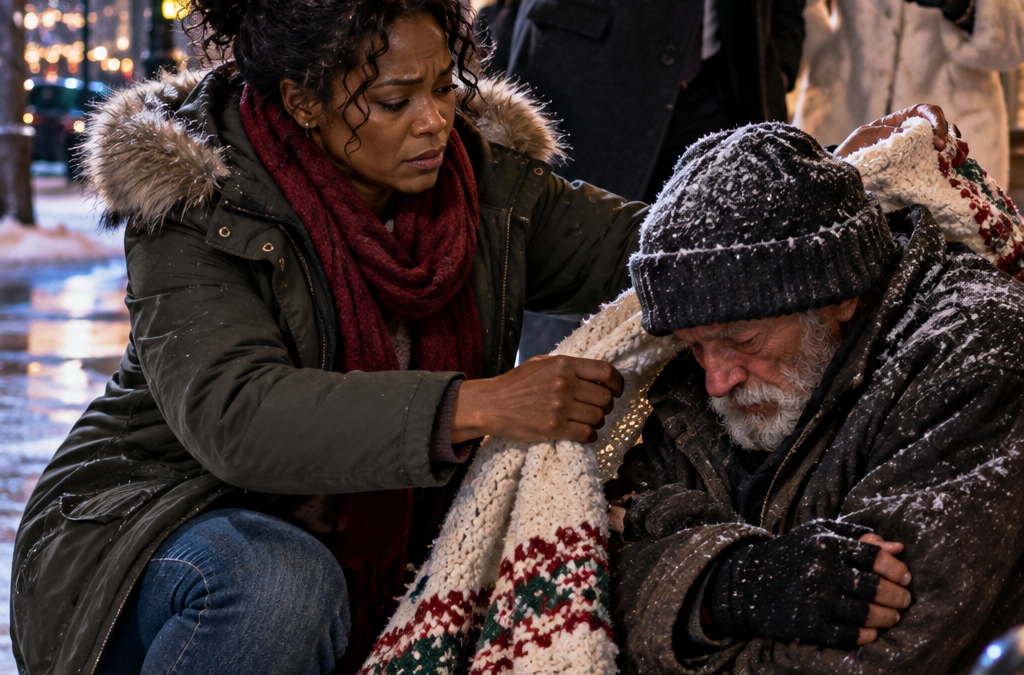
Eight steps across the sidewalk.
I counted without meaning to.
I sat beside him.
Shoulder to shoulder.
He didn’t turn.
I opened the blanket.
My hands hesitated.
That blanket had survived eviction.
Rain.
Shelter floors.
Sidewalks.
Every night I had been afraid I would lose the last physical thing Mama ever gave me.
Then I put it around him.
Pulled it tight.
Tucked the edges beneath his arms.
He looked at me.
Really looked.
“You…”
His voice barely worked.
“You don’t have to do this.”
“Apparently I do.”
“You’re freezing.”
“So are you.”
“This is yours.”
“What I need right now is for you to stop arguing and keep it on.”
His eyes widened slightly.
Then he pulled the blanket closer.
“Thank you.”
“Don’t thank me yet.”
I stood.
“Stay.”
“Where—”
“Coffee.”
He tried to rise.
I pointed at him.
“Don’t.”
I hurried two blocks toward the gas station on Halsted.
My knee hated every step.
Inside, I counted my money.
Three dollars and twelve cents.
Everything.
Large black coffee cost almost all of it.
That money had been breakfast.
I bought the coffee.
No sugar.
No cream.
Just heat.
When I returned, the man was still there.
Good.
His hands shook too badly to hold the cup.
I wrapped both of mine around his fingers.
“Small sips.”
He obeyed.
“Not fast.”
Steam crossed his face.
After a few minutes, the shaking eased.
I sat beside him.
My arms were cold without the blanket.
I tucked my hands beneath my armpits.
For a while, we said nothing.
Then I started talking because silence seemed dangerous for both of us.
“I used to cook.”
He glanced over.
“What?”
“Restaurant.”
He nodded.
“What kind?”
“Soul food.”
“Good?”
“Excellent.”
That got the beginning of a smile.
“Humble.”
“I’ve been homeless five months. Let me keep one thing.”
He laughed.
Barely.
But it was a laugh.
So I told him about Honey’s.
The Sunday crowds.
The pork chops.
The time I dumped an entire container of cayenne into collard greens because somebody bumped my elbow.
“What happened?”
“We served them.”
“You did not.”
“I was not wasting two hotel pans of greens.”
His smile widened.
“People ate them?”
“They suffered.”
He laughed again.
Real this time.
Broken around the edges.
But alive.
Snow started falling.
Small flakes.
Then bigger.
I asked:
“You got family?”
The laugh vanished.
“Not anymore.”
I didn’t push.
After a minute, I said:
“My mama used to cook at four Christmas morning.”
He turned toward me.
“Four?”
“Sometimes earlier.”
“Why?”
“So the rest of us could wake up pretending food appeared by magic.”
I smiled.
“She’d have cinnamon rolls going before sunrise.”
“Apple cobbler.”
“Pork roast.”
“I’d sit on a stool beside her.”
My voice softened.
“She taught me everything.”
He stared at the sidewalk.
“My wife made hot chocolate.”
I waited.
“Every Christmas Eve.”
His mouth twitched.
“From scratch.”
“That sounds nice.”
“It was terrible.”
I looked at him.
He almost laughed.
“Absolutely awful.”
“Then why’d she keep making it?”
“She thought it was good.”
“And you never told her?”
“Of course not.”
We both laughed.
Then his eyes filled.
“She used cayenne.”
“In hot chocolate?”
“And salt.”
“That actually can be good.”
“Not the amount Laura used.”
Laura.
First name he had given me.
He stared into the empty coffee cup.
“Every year I told her it was perfect.”
His voice changed.
“The last Christmas before she got sick…”
He stopped.
I let him.
“We sat beside the window.”
Snow collected on the street.
“She leaned against me.”
He swallowed.
“I remember thinking, this is happiness.”
His face tightened.
“I didn’t know it was the last time.”
The wind moved between buildings.
His voice cracked.
“Her name was Laura.”
I nodded.
“I miss her every day.”
I said nothing.
“I’ve been inside that penthouse alone for two years.”
Penthouse.
I noted the word but didn’t ask.
“Tonight I couldn’t do it.”
He rubbed his face.
“I was drinking.”
“I noticed.”
“I walked outside.”
“No hat.”
“I wasn’t thinking.”
“No kidding.”
A weak smile.
“I kept walking.”
“How far?”
“I don’t know.”
He looked around.
“I don’t even know where I am.”
“South Side.”
He nodded as if that didn’t matter.
“The silence in that house…”
His eyes filled again.
“It was louder than this cold.”
I understood that sentence.
Not because I had a penthouse.
Because grief doesn’t care what kind of walls surround it.
“My mama’s name was Grace.”
He looked at me.
“Four years.”
I rubbed my hands together.
“I still hear her every Christmas.”
“Still smell cinnamon.”
“Still expect her to call me into the kitchen.”
I stared at the snow.
“People leave.”
I swallowed.
“But whatever love they put into things stays.”
For a long time, neither of us said anything.
Then he asked:
“If you could have one thing?”
“One?”
“Anything.”
I didn’t need to think.
“My own restaurant.”
He turned.
“Really?”
“Small.”
I held my hands apart.
“Kitchen.”
“Few tables.”
“Door open to anybody hungry.”
His eyes stayed on me.
“That was your dream?”
“Mama’s first.”
I looked down.
“Then mine.”
“What happened?”
“Life.”
I smiled without humor.
“Dreams need floors.”
He frowned.
“What?”
“A dream without a floor under your feet is just something floating in your head.”
The words surprised me.
Maybe because I had prayed for a floor so many times.
He became very quiet.
Something changed in his face.
Not recognition exactly.
Attention.
He was really listening.
I said:
“Merry Christmas.”
He looked at me.
The words seemed to hurt.
Then soften.
“Merry Christmas, Brenda.”
I hadn’t told him my name.
Maybe I had earlier.
Cold plays games with memory.
We sat more than an hour.
At some point a black SUV moved slowly past the intersection.
I barely noticed.
The man noticed even less.
When the coffee was gone, he looked toward the cardboard beneath the bakery awning.
“That’s where you were sleeping.”
“Still am.”
He stared at me.
“You gave me your blanket.”
“Yes.”
“Your only blanket?”
I shrugged.
He reached inside his coat.
Money clip.
Thick.
He pulled out several hundred-dollar bills.
“Take this.”
I stared.
Then at him.
“Put that away.”
“Please.”
“No.”
“Brenda.”
“I didn’t put the blanket on you for money.”
“I know.”
“Then don’t turn it into a transaction.”
His hand stayed extended.
“You need this more than I do.”
“You flashing that much cash out here means somebody else may decide they need it more than either of us.”
He almost smiled.
I pushed his hand toward his coat.
“Put it away.”
He did.
Five minutes later:
“At least let me get you a hotel.”
“No.”
“One night.”
“No.”
“You could freeze.”
“Maybe.”
“That doesn’t bother you?”
“Of course it bothers me.”
“Then let me—”
“A hotel tonight doesn’t change tomorrow.”
He stopped.
“I wake up warm.”
“Check out at eleven.”
“I’m back on the sidewalk.”
I looked at him.
“A warm night doesn’t fix a cold life.”
His jaw tightened.
He looked away.
I knew that sentence had landed somewhere.
Finally he asked:
“Then what can I do?”
“Go home.”
He stared.
“Seriously.”
“You have a bed?”
“Yes.”
“Use it.”
“A house?”
He gave a small nod.
“Go there.”
I pointed down the street.
“Wake up tomorrow.”
“Make Laura’s terrible hot chocolate.”
His face broke slightly.
“Remember her somewhere warm.”
He looked at me differently then.
Not pity.
That mattered.
Respect.
Maybe I imagined it.
“You are remarkable.”
“I’m tired.”
He smiled.
“Both can be true.”
He checked his phone.
Dead.
When he pulled it from his pocket, something dropped.
A small card.
I picked it up.
Slid it into my backpack without reading.
He didn’t notice.
He stood slowly.
Steadier than before.
Before leaving, he squeezed my hand.
“Brenda.”
“Yes?”
“I won’t forget tonight.”
“Then make it mean something.”
His eyes held mine.
“I will.”
He removed Mama’s blanket.
Folded it carefully.
Placed it on the bench.
Then walked into the snow.
I watched until he disappeared.
Wrapped the blanket around myself again.
Returned to my cardboard.
Twenty minutes later, I heard a vehicle.
Black SUV.
I was half asleep.
A man stepped out.
Dark coat.
Driver maybe.
He approached quietly.
I kept my eyes mostly closed.
I remember him bending near the blanket.
Then leaving.
I assumed he had checked whether the man from the bench was still there.
By morning, I had almost forgotten.
I unfolded the blanket.
Something heavy fell into my lap.
Metal.
A watch.
Silver case.
Dark leather strap.
Beautiful.
The kind of object you know is expensive even if you know nothing about watches.
I turned it over.
Engraving.
Name I couldn’t pronounce correctly.
Patek Philippe.
I stared.
Then checked the blanket as if another explanation might be stitched inside.
Nothing.
At Shepherd’s Gate, Calvin waited with coffee.
“Merry Christmas.”
He handed me a cup.
Then saw my face.
“What?”
I showed him the watch.
He stopped.
“Where did you get that?”
“Found it in my blanket.”
He took one careful look.
Then handed it back immediately.
“Brenda.”
“What?”
“That’s a Patek.”
“I can read.”
“No.”
He lowered his voice.
“You don’t understand.”
“Clearly.”
“Some of those cost more than houses.”
I laughed.
He didn’t.
My laughter stopped.
“You’re serious?”
“Very.”
I shoved it back into my bag.
“He left it accidentally.”
Calvin shook his head.
“Those things don’t accidentally come off.”
Then I remembered the driver.
Maybe.
I reached into my bag.
Pulled out the card.
I had forgotten it entirely.
Gregory Thornton.
Chairman and CEO.
Thornton Capital Partners.
Calvin’s eyebrows rose.
“Hold on.”
He disappeared into the shelter.
Returned with an old newspaper.
Business section.
Front page photograph.
Silver-haired man.
Dark suit.
Confident eyes.
Cutting a ribbon beside city officials.
Headline about a five-hundred-million-dollar mixed-use development.
My stomach tightened.
“That’s him.”
Calvin lowered the newspaper.
“The man from last night?”
“Yes.”
He sat.
“You gave your mama’s blanket to a billionaire.”
“I gave it to a freezing man.”
“Same man.”
“Wasn’t when I found him.”
Calvin looked at me for a long time.
An hour later, Dorothy called me aside.
“Someone phoned asking about you.”
“Who?”
“Wouldn’t say.”
“What did they ask?”
“How long you’ve been here.”
“Work history.”
“Background.”
My chest tightened.
“What number?”
“Downtown office.”
I touched the watch through my backpack.
“I have to return this.”
Calvin nearly shouted.
“No.”
“It isn’t mine.”
“Maybe he gave it.”
“I don’t want a watch worth a house.”
“Sell it.”
“No.”
“Brenda.”
“No.”
The argument ended there.
Three days later, December 28th, I borrowed a sweater from the shelter donation closet.
Pastor Elaine loaned me a navy wool coat.
Too broad in the shoulders.
Warm.
Calvin walked me to the bus.
“You sure?”
“No.”
“That’s comforting.”
I smiled.
“But it’s not my watch.”
The bus carried me north.
Neighborhoods changed through the window.
Corner stores became boutiques.
Brick became glass.
Buildings got taller.
Sidewalks cleaner.
People’s coats more expensive.
Thornton Capital Partners occupied twenty floors of steel and glass off Michigan Avenue.
Brass letters above the entrance.
I stood outside looking up.
Every window seemed worth more than everything I owned.
Then I went inside.
My sneakers squeaked on marble.
The receptionist looked me over.
Quick.
Professional.
Still noticeable.
“I have an appointment.”
“Name?”
“Brenda Adams.”
Her face changed.
“Ms. Adams.”
She stood.
“You’re expected.”
That was new.
“Top floor.”
The elevator ride felt like traveling into another country.
Borrowed coat.
Shelter sweater.
Backpack.
My reflection in polished steel.
Doors opened.
Lake Michigan filled the windows.
Gregory Thornton stood behind a large desk.
Clean-shaven.
Navy suit.
Silver hair combed neatly.
The transformation was so complete I might have doubted myself if not for his eyes.
Same eyes.
He stood immediately.
“Brenda.”
“Mr. Thornton.”
“Gregory.”
“Mr. Thornton.”
He smiled.
“Fair.”
I sat.
Reached into my backpack.
Placed the watch between us.
“You left this.”
He looked at it.
Then me.
“No.”
“No?”
“I left it for you.”
I stared.
He explained that after I walked away, the SUV searching for him had found him several blocks later.
Before getting inside, he had given the watch to his driver and told him to bring it back to the woman beneath the bakery awning.
“That is ridiculous.”
He almost smiled.
“Probably.”
“This is worth more than a house.”
“So I’m told.”
“Take it.”
“I wanted you to have it.”
“No.”
“Brenda—”
“What I gave you was a blanket.”
“A blanket that may have saved my life.”
“Still a blanket.”
He looked at it.
Then said:
“You’re right.”
I paused.
He continued.
“The watch isn’t in the same category.”
“That isn’t what I meant.”
“I know.”
His voice softened.
“Your blanket was worth more.”
That silenced me.
He told me about Laura.
Two years gone.
Cancer.
His grief had not arrived all at once.
At first he kept working.
Then working later.
Then drinking.
Stopped answering friends.
Stopped going to dinner.
Stopped living anywhere except the spaces between meetings.
Christmas Eve had been the breaking point.
He sat alone in the penthouse with Laura’s photograph.
Drank whiskey.
Put on the wrong coat.
Walked.
No destination.
No plan.
His phone died.
He kept moving.
“I didn’t decide to die.”
He looked toward the lake.
“But I stopped caring whether I didn’t.”
That sentence made my chest hurt.
“I wasn’t testing anyone.”
“I figured.”
“I wasn’t pretending.”
“I know.”
“I was lost.”
“Yes.”
He looked at me.
“And you sat down.”
I said nothing.
Then he mentioned the dream.
My restaurant.
The floor.
Laura had criticized the way he used wealth.
“She used to say I built rooftops for people who already had three.”
He smiled faintly.
“She wanted me to do more where people actually needed it.”
His hand rested near the watch.
“That night, when you said a dream without a floor under it is just a dream…”
He swallowed.
“I heard her voice for the first time in two years.”
I didn’t know what to do with that.
So I waited.
Gregory pulled a leather folder from his desk.
Pushed it across.
“Open it.”
I did.
Blueprints.
Commercial kitchen.
Dining room.
Forty seats.
Storefront rendering.
Blank sign.
I touched the page.
“What is this?”
“South Side mixed-use development.”
I recognized the project from the newspaper.
“Ground-floor restaurant space.”
He pointed.
“I want you to open your restaurant there.”
I stared.
“Build-out covered.”
“Equipment.”
“Furniture.”
“Three years rent-free.”
“Fifty thousand dollars operating capital.”
“Business entirely yours.”
I closed the folder.
Pushed it back.
“No.”
Gregory blinked.
“What?”
“No.”
“Brenda—”
“I appreciate what you’re trying to do.”
“Then why—”
“Because I didn’t give you my blanket hoping you owned a building.”
“I know that.”
“If I take a whole restaurant because you feel grateful, every time I stand behind that stove I’ll wonder whether I belong there.”
“You would.”
“Maybe.”
I shook my head.
“But I need to know.”
I looked at Mama’s invisible hands in my memory.
“What you build with your own hands, nobody gets to tell you it was charity.”
Gregory sat back.
For a moment, I worried I had offended him.
Instead, something like respect settled across his face.
“All right.”
I waited.
“No gift.”
“No restaurant.”
“Understood.”
Then he leaned forward.
“What if I offer you work?”
“Work?”
“A job you are qualified to do.”
I listened.
“Thornton Capital has roughly four hundred employees in this building.”
He pointed downward.
“The cafeteria is outsourced.”
“Food terrible?”
His face twisted.
“Criminal.”
That made me laugh.
“I want somebody to take over kitchen operations.”
“New menu.”
“Staff management.”
“Head chef.”
I stopped smiling.
“Salary.”
“Benefits.”
“Health insurance.”
“Employment contract.”
He watched me.
“That isn’t charity.”
“No.”
“It’s work.”
“Yes.”
I thought about Honey’s.
My hands.
My knee.
A real kitchen.
He continued.
“We also have employee housing.”
I narrowed my eyes.
“Not free.”
“Good.”
That surprised him.
“Rent below market.”
“Deducted from wages.”
“Studio on the West Side.”
“You sign the lease.”
“Your responsibility.”
I stayed quiet.
“Third.”
He reopened the folder.
“The restaurant space.”
I looked at it.
“I hold it for eighteen months.”
“If you save.”
“Write a business plan.”
“Secure financing.”
“You can apply to lease it.”
“Preferred local-business rate.”
“But you sign.”
“You fund it.”
“Your risk.”
He pushed the folder toward me again.
This time not as a gift.
As a possibility.
“I’m not giving you a restaurant, Brenda.”
His voice softened.
“I’m giving you a floor.”
My eyes filled immediately.
That embarrassed me.
I looked away.
He had heard me.
That was what mattered.
He wasn’t trying to rescue me.
He was giving me enough stability to use the things I already had.
Skill.
Discipline.
Experience.
Hands.
Dignity.
“That,” I whispered.
Gregory waited.
“That I can accept.”
He nodded.
No dramatic speech.
No handclap.
Just agreement.
Then I asked:
“When?”
“January second.”
“Five days?”
“Problem?”
I laughed.
“I’ve been waiting five months for somebody to hand me an apron.”
I pointed at him.
“Five days is nothing.”
He smiled fully for the first time.
Before leaving, I pushed the watch toward him.
“Take it.”
He looked at it.
“Laura gave me that on our tenth anniversary.”
My hand stopped.
“That changes nothing.”
“It changes something for me.”
“Why?”
“I haven’t worn it since she died.”
He touched the leather strap.
“Leaving it with you felt like letting something meaningful move forward instead of staying locked in a drawer.”
I thought about Mama’s blanket.
Understood more than I wanted to.
Still, I pushed it closer.
“Keep Laura.”
Gregory looked at me.
“I’ve got Grace.”
We sat in silence.
Then he picked up the watch.
Put it back in his pocket.
January second, I stepped into Thornton Capital’s cafeteria kitchen.
First commercial kitchen I’d entered since Honey’s.
Stainless steel.
Six-burner range.
Convection ovens.
Walk-in cooler.
Prep tables.
My hands shook.
Not fear.
Recognition.
I picked up a chef’s knife.
Wrapped my fingers around the handle.
Waited.
My body remembered.
The first week, I kept things conservative.
Soup.
Sandwiches.
Salads.
Roasted chicken.
No experiments.
I learned the staff.
Equipment.
Rush periods.
Storage.
Ordering.
Week two, I made smothered pork chops.
At 11:45, there were twenty people in line.
Noon, forty.
12:15, the line extended past the cafeteria doors.
12:30, down the hallway.
Employees from other floors began appearing.
One woman leaned into the kitchen.
“Miss Adams?”
“Yes?”
“You cooking tomorrow?”
I smiled.
“Depends.”
“On?”
“If y’all behave.”
Word spread.
Within months, people scheduled lunch meetings around what I served.
Gregory came through occasionally.
He never cut the line.
I liked that.
The employee apartment was small.
Fourth floor.
No view.
Kitchen barely large enough for one person.
I loved it.
First night, I locked the door.
Turned the deadbolt.
Click.
I froze.
For five months, that sound had meant being locked out.
Now it meant nobody could enter without me opening it.
I sat on the floor.
Not a chair.
The floor.
My floor.
Then cried until my chest hurt.
Later, I stood in the kitchen.
Turned the faucet.
No drip.
I laughed alone.
Three months in, I enrolled at community college.
Small-business management.
Two nights a week.
I sat in the back.
Notebook.
Pencil.
Accounting.
Inventory.
Food cost.
Payroll.
Business plans.
There were younger students using laptops.
I wrote everything by hand.
Every paycheck, money went into savings.
Not much.
Consistent.
I kept the numbers in a notebook.
On the front I wrote:
GRACE’S TABLE FUND.
Calvin got hired next.
I recommended him for prep.
Gregory’s HR people interviewed him properly.
No favors.
He earned it.
The first morning Calvin showed up with his own apron and employee badge, he stood in my kitchen pretending he had dust in his eye.
“You crying?”
“No.”
“You are.”
“Onions.”
“There are no onions.”
“Then mind your business.”
For the first time in years, Calvin had an address.
Paycheck.
Alarm clock.
A reason to complain about Mondays.
By month eight, the cafeteria had become one of the busiest parts of the building.
Gregory never said:
I told you so.
That was another reason I respected him.
Month nine, I started the business plan.
Twenty pages became twenty-seven.
Menu.
Projected costs.
Rent.
Staffing.
Break-even point.
Inventory.
Marketing.
Cash flow.
I wrote every number myself.
Took it to a bank.
Denied.
I sat in the parking lot with the rejection folder.
For ten minutes, I wanted to throw it away.
Then heard Mama.
Again.
Don’t fight the bread.
Listen.
So I listened.
Their problem wasn’t my dream.
It was the numbers.
I rewrote them.
Reduced first-year staffing.
Adjusted equipment purchases.
Added cafeteria management history.
Built twelve months of income verification.
Went to a second bank.
Thirty-thousand-dollar small-business loan.
Approved.
When they gave me the papers, I read every line.
Signed my own name.
Hand steady.
Month twelve, I applied for the restaurant space.
Same one Gregory had offered to give me.
This time I sat across from a leasing manager who reviewed my financials, credit, business plan, references, and loan approval.
I had never been happier to have somebody judge me properly.
When the lease came out, I signed.
Brenda Adams.
Tenant.
Owner.
Risk.
Mine.
The next six months were exhausting.
I worked days at Thornton.
Restaurant planning evenings.
Contractors.
Permits.
Inspections.
Equipment.
Paint.
Tables.
I couldn’t afford everything in Gregory’s original rendering.
Good.
I didn’t want his restaurant.
I wanted mine.
I found used tables from a closed diner.
Refinished them.
Picked green tile for one wall because Mama loved green.
Calvin argued the chairs didn’t match.
“They’re chairs.”
“They don’t match.”
“They hold people?”
“Yes.”
“Then they’re excellent.”
Pastor Elaine helped organize the opening.
Dorothy left Shepherd’s Gate eventually and agreed to manage front of house.
“You sure?”
She looked offended.
“I’ve managed homeless adults for eleven years.”
She pointed toward the dining room.
“You think hungry customers scare me?”
Fair point.
The sign went up Friday afternoon.
Dark background.
Hand-painted gold and green letters.
GRACE’S TABLE.
Below it:
NO ONE EATS ALONE.
Opening night came in late spring.
Before we opened, Pastor Elaine gathered us.
Calvin.
Dorothy.
Two servers.
Dishwasher.
Me.
She prayed.
I kept my eyes open.
Looked around.
Kitchen.
My kitchen.
Not gifted.
Not rescued.
Built.
The first plate I cooked was smothered pork chops.
Mama’s style.
I placed it at a small window table.
Beside it, her photograph.
Empty chair.
We kept that place set every night.
Not because I believed ghosts ate pork chops.
Because restaurants should remember who taught them what they were for.
Within six months, weekend brunch had a ninety-minute wait.
Local news came.
People asked about Gregory.
I told them the truth.
“He gave me a job.”
“He gave me stable housing through his company.”
“He held a lease opportunity.”
“The rest was mine.”
Some reporters wanted Cinderella.
Homeless woman meets billionaire.
Billionaire changes life.
Cleaner story.
I corrected them.
“No.”
I met a grieving man.
We kept each other alive for one night.
Then he listened when I told him what kind of help I could accept.
That distinction mattered.
I started an apprenticeship for homeless adults.
Not charity positions.
Paid training.
Kitchen skills.
Food safety.
Inventory.
References.
Eight people finished the first year.
Three went into restaurants.
Two hotels.
One catering company.
Calvin stayed with me.
Every Tuesday became Grace Tuesday.
Anybody could eat.
No proof.
No paperwork.
No embarrassing conversation.
If you entered hungry, we fed you.
Some customers complained.
“Won’t people take advantage?”
“Yes.”
I’d say it immediately.
They usually blinked.
“Somebody will.”
“Probably several.”
“But I’m not going to make ten hungry people prove poverty because one person might lie for free cornbread.”
That usually ended it.
Gregory quietly funded Shepherd’s Gate expansion.
Thirty beds restored and more.
New kitchen.
Another wing.
He named it after Laura.
That was right.
I went to the opening.
He stood beside the plaque.
LAURA THORNTON WING.
He touched the letters.
“She would’ve liked you.”
I smiled.
“Laura had bad taste in hot chocolate.”
He laughed so hard he had to look away.
One year after the night we met, Christmas Eve arrived again.
Grace’s Table closed dinner service early.
Then we began packing meals.
Two hundred.
Foil containers.
Smothered pork chops.
Collards.
Cornbread.
Peach cobbler.
Blankets donated by churches and customers.
Hand warmers inside each roll.
We called it Blanket Night.
Calvin loaded the van.
Dorothy organized addresses and corners.
Pastor Elaine brought hot cocoa.
I rode in back with the food.
We went through South Side streets.
Underpasses.
Doorways.
Shelter overflow points.
Every person received a meal.
Blanket.
Warmers.
And eye contact.
That part was mandatory.
I would crouch.
Hand them food.
“Merry Christmas.”
Then:
“You’re not alone tonight.”
Some people smiled.
Some cried.
Some didn’t trust us.
I understood.
One woman grabbed my hand.
Held it.
Thirty seconds.
Then a minute.
Dorothy started to come over.
I shook my head.
Let the woman hold on.
Sometimes touch is the whole meal.
Near the end, I asked Calvin to stop.
Sullivan’s Bread Company.
Same awning.
Same bench.
I got out.
Walked there alone.
Snow fell softly.
Not as cold as the year before.
Still cold enough.
I sat on the bench.
For two minutes.
Remembered Gregory folding into himself.
Whiskey.
Pale lips.
Mama’s blanket leaving my shoulders.
Coffee bought with my last money.
Merry Christmas.
The black SUV.
I thought about how close two lives came to ending differently because one person noticed another.
Then I stood.
Returned to the van.
That night, my apartment was above Grace’s Table.
Two bedrooms.
A kitchen that smelled like garlic, flour, and home.
I opened the closet.
Mama’s blanket sat folded on the top shelf.
I brought it down.
Purple.
Gold.
Cream.
Edges more worn.
Still holding.
I pressed it to my face.
No street smell anymore.
No cardboard.
No frozen concrete.
Flour.
Kitchen.
Maybe cinnamon.
Definitely memory.
I draped it across the end of my bed.
Beside the lamp sat a framed copy of my first Thornton Capital pay stub.
I had written beneath it:
THE DAY I STOOD ON MY OWN FEET AGAIN.
I turned off the light.
For once, Christmas Eve didn’t feel like something I had to survive.
The next morning, Gregory came to Grace’s Table.
No announcement.
No security.
Just Gregory.
He sat at the counter.
I brought coffee.
“Where’s the terrible hot chocolate?”
“I stopped disrespecting Laura’s memory.”
He smiled.
I placed French toast in front of him.
“What’s this?”
“Christmas breakfast.”
“I didn’t order.”
“My restaurant.”
“Very authoritarian.”
“Eat.”
He did.
After a moment, he looked toward Mama’s empty table.
“Grace?”
“Yes.”
He nodded.
Then:
“I almost died that night.”
I leaned against the counter.
“I know.”
“No.”
He looked at me.
“I mean I had reached the point where I didn’t care if the cold finished the decision for me.”
I stayed quiet.
“You didn’t know me.”
“No.”
“You had nothing.”
“Not nothing.”
He glanced at the blanket photograph on the wall.
“Almost nothing.”
I considered arguing.
Didn’t.
“Why?”
He asked.
“Why what?”
“Why give me the blanket?”
I thought about the question.
For a long time, people assumed the answer was because I was extraordinary.
I wasn’t.
I was cold.
Hungry.
Angry at life.
Scared.
But I knew what it felt like to sit somewhere and wonder whether anybody would notice if you stopped getting up.
“I recognized your face.”
He waited.
“I had worn it.”
That was all.
He nodded.
We drank coffee.
Years passed.
Grace’s Table survived.
Then grew.
Not into a chain.
I didn’t want that.
One restaurant was enough work.
We expanded the apprenticeship instead.
More trainees.
Partnerships with kitchens across Chicago.
People coming from shelters, transitional housing, re-entry programs.
We paid them.
That mattered.
I became the woman younger cooks called Miss Brenda even after I told them Brenda was enough.
My knee eventually required surgery.
Health insurance from Thornton had helped me get treatment before I opened the restaurant.
I could stand better.
Not forever.
Enough.
Calvin became kitchen manager.
Dorothy ran the dining room like a military command post.
Pastor Elaine still prayed before special events whether anybody requested prayer or not.
Gregory visited occasionally.
He never invested in Grace’s Table.
Never asked for equity.
Never put his photograph on the wall.
He understood.
One afternoon, a young apprentice named Mia asked:
“You really turned down a free restaurant?”
“Yes.”
She stared at me like I had confessed to throwing away a winning lottery ticket.
“Why?”
“I didn’t want it.”
“That’s crazy.”
“Possibly.”
“I would’ve taken it.”
“Maybe you should have.”
She frowned.
“So you think you were wrong?”
“No.”
I looked at her.
“But what was right for me isn’t a law for everybody.”
That was something I had learned later.
Pride can become another kind of prison if you aren’t careful.
I didn’t refuse Gregory because accepting help was shameful.
I accepted plenty of help.
The coat Pastor Elaine lent me.
Dorothy’s cocoa.
Calvin’s friendship.
Gregory’s job.
Employee housing.
A held lease.
Help wasn’t the problem.
I refused the first offer because it took away the one thing I needed most.
The chance to know I could still build.
There is dignity in receiving.
There is dignity in earning.
Wisdom is knowing which one you need in that moment.
Mia thought about that.
“So if somebody offers me a restaurant…”
“Call me.”
She laughed.
“Then we’ll read the contract.”
Mama would’ve liked that answer.
I used to believe the most important thing Gregory gave me was opportunity.
Maybe it was.
But sometimes I think the deeper gift was that he listened after I said no.
Rich people aren’t always good at hearing no.
Neither are saviors.
He could have insisted.
Explained how foolish I was.
Overridden my dignity with his generosity.
Instead, he changed the offer.
Not smaller.
Better.
A floor.
A stove.
A paycheck.
Health insurance.
A chance.
Then space.
That is how you help someone without turning their life into your story.
And I gave something back too.
Not the blanket.
Something else.
Gregory returned to grief differently after that night.
He began showing up at Laura’s foundation meetings.
Expanded shelter work.
Used projects to include affordable units instead of treating housing as a line item somebody else should solve.
Not because I fixed him.
I didn’t.
People aren’t soup.
You don’t add ingredients and repair them.
He did his own work.
I just sat beside him when he almost stopped.
That’s all.
Sometimes all is enough.
On the fifth anniversary of Grace’s Table, we closed for one evening.
Staff only.
Former apprentices returned.
Calvin made a speech nobody asked for.
Dorothy corrected half of it from her chair.
Pastor Elaine cried.
I stood beneath Mama’s photograph.
Looked around.
Men and women who had once slept in shelters.
People recovering from addiction.
A young mother who had lived in her car.
A veteran.
A former dishwasher now working as sous-chef downtown.
Then Gregory arrived late.
I pointed at him.
“You don’t work here.”
“I was invited.”
“By who?”
Calvin raised his hand.
“Traitor.”
Laughter filled the room.
Gregory handed me a small box.
I frowned.
“We discussed gifts.”
“Open it.”
“If this is another watch—”
“Open it.”
Inside was a wooden plaque.
Not expensive.
Simple.
Engraved with the words Mama used to tell me.
EVERYTHING TALKS IF YOU QUIT BEING LOUDER THAN IT.
I stopped breathing.
“How did you know?”
Gregory looked toward the kitchen.
“You told me.”
“When?”
“On the bench.”
I didn’t remember.
Maybe I had.
That night existed in fragments.
Cold.
Grief.
Coffee.
Some memories frozen sharply.
Others blurred.
My fingers touched the letters.
“Thank you.”
“You’re welcome.”
That plaque went into the kitchen.
Not the dining room.
Where cooks could see it.
Because kitchens are loud.
Pans.
Orders.
Timers.
People shouting.
But the best cooks still listen.
To oil.
To dough.
To each other.
To themselves.
Years later, I still woke sometimes remembering the click of that apartment lock.
The sidewalk.
Garbage bags.
Then I would hear another sound.
The deadbolt on my own apartment.
My key.
My door.
Or the front lock of Grace’s Table turning open before sunrise.
Sounds can change meaning.
So can people.
So can Christmas.
On one Christmas Eve, I had no money.
No home.
No bed.
One blanket.
And I gave it away for an hour because a stranger looked colder than I felt.
That choice did not magically make me deserving of everything that came after.
I had always been deserving of a floor.
Of work.
Of safety.
Of dignity.
Kindness did not purchase those things.
It simply connected two people at the exact moment each was capable of giving the other something important.
Gregory needed somebody to notice he had stopped caring whether he lived.
I needed somebody willing to offer help without taking ownership of what I would become.
We met on a frozen bench.
That was all.
And it was enough.
Every December 24th, we still do Blanket Night.
The numbers grew.
Two hundred meals became three hundred.
Then four.
We coordinate with shelters now.
Street outreach teams.
No cameras.
That’s my rule.
Sometimes reporters ask.
I say no.
People being hungry should not have to become footage before they get dinner.
I still hand out some meals myself.
My knee is older.
So am I.
I move slower.
Nobody complains.
At the end of every route, we stop at Sullivan’s.
I sit on the bench.
Usually two minutes.
One year, Gregory came.
He stood awkwardly on the sidewalk.
“You going to sit?”
He looked at the bench.
“I’m not sure.”
“Scared?”
“Of memories.”
“Fair.”
He sat.
We stayed quiet.
Snow started falling.
After a while, he said:
“Laura would’ve laughed at me.”
“Why?”
“For wearing those shoes in eighteen-below weather.”
I looked down.
He had sensible winter boots now.
“She would’ve been right.”
“She usually was.”
I smiled.
He looked toward the bakery.
“You know what’s strange?”
“What?”
“I remember almost nothing about walking there.”
“Trauma does that.”
“But I remember your blanket.”
I looked at him.
“Every stitch.”
My throat tightened.
“Mama made it.”
“I know.”
“She’d probably be mad I gave it away.”
Gregory shook his head.
“No.”
“You didn’t know Grace.”
“No.”
“But I know what she made.”
I looked at him.
“The blanket?”
“You.”
I had to look away.
Men with billions shouldn’t be allowed to say things like that casually.
We sat until the cold reached through our coats.
Then stood.
No dramatic goodbye.
He went home.
I went upstairs to the apartment above my restaurant.
Mama’s blanket waited on the foot of my bed.
I wrapped it around my shoulders.
Not because I needed it anymore.
Because sometimes you hold the thing that survived with you.
I went into the kitchen.
Put water on for tea.
The apartment smelled faintly of whatever had baked downstairs.
Cinnamon.
Butter.
Yeast.
Home.
I thought about that prayer from the sidewalk.
Lord, I’m not asking for a mansion.
Just a floor and a stove.
I laughed.
He had taken me literally.
I had a floor.
I had a stove.
Everything else, I built from there.
And that was enough.








