𝗙𝗨𝗟𝗟 𝗦𝗧𝗢𝗥𝗬 Nobody Understood Why My 79-Year-Old Grandfather Refused Triple the Value of His House Until I Found What He Had Been Protecting for Fifty-One Years
𝗙𝗨𝗟𝗟 𝗦𝗧𝗢𝗥𝗬
That should have ended it.
A man owns a house.
Someone wants to buy it.
The man doesn’t want to sell.
End of story.
It wasn’t.
The problem was Carol Jennings.
Carol was president of the Hawthorne Ridge Homeowners Association.
Grandpa’s original neighborhood hadn’t been created with much of an HOA, but over the decades, as new streets and larger houses appeared, the association had grown into something far more organized.
Grandpa used to joke that the HOA began with three women collecting twenty dollars for entrance flowers and somehow evolved into a minor government.
Carol loved rules.
Not in the way responsible people love clarity.
She loved leverage.
She carried folders everywhere.
She used phrases like community expectations and collective property interests.
She could make the color of a trash can sound like a moral issue.
One afternoon, she knocked on Grandpa’s door.
I wasn’t there.
He told me about it later.
She arrived carrying a folder and what Grandpa called her “campaign smile.”
“George,” she said, “the board has some concerns.”
He stood in the doorway.
“What concerns?”
“Your property is no longer consistent with evolving neighborhood standards.”
Grandpa looked behind himself into the house.
Then back at her.
“House looks the same to me.”
Carol smiled.
“That’s part of the issue.”
She opened the folder.
Peeling paint.
Lawn edging.
Mailbox compliance.
Exterior maintenance.
Apparently she had photographs.
Grandpa listened.
Then asked:
“What does this have to do with Richard Mercer?”
Carol stopped.
Only for a second.
“I don’t know what you mean.”
“Sure you do.”
“This is HOA business.”
“And he wants my land.”
“The board has no role in private sales.”
Grandpa looked at her.
He had a way of going silent that made people hear themselves more clearly.
Carol started talking again.
“No one is trying to pressure you, George.”
“Good.”
“We simply feel your property is beginning to affect the visual continuity of the street.”
Grandpa nodded once.
Then said:
“This house isn’t for sale.”
Carol’s smile tightened.
“I’m discussing compliance.”
“Not now.”
He started closing the door.
“And not ever.”
Then he shut it.
Within a week, the violation notices began.
One for peeling exterior paint.
That wasn’t completely false.
The west side did need work.
Grandpa had been planning to repaint it in spring.
Then came a notice about the lawn.
“Improperly maintained turf bordering the sidewalk.”
I went over and looked.
The alleged violation was one corner where grass had grown maybe two inches higher around a drainage cover.
Then the mailbox.
Wrong finish.
Wrong height.
Wrong post.
The same mailbox that had stood there for more than thirty years.
Then a hedge.
Then the cracked walkway.
Then a warning about “visible exterior deterioration.”
Each issue was small enough to sound plausible.
Together, they felt like a campaign.
Grandpa refused to say that.
He just dealt with them.
Painted the mailbox.
Trimmed the hedge.
Cut the grass shorter.
He even bought a pressure washer from a neighbor and cleaned the walkway until it looked almost new except for the crack.
The letters kept coming.
Two hundred dollars.
Then five hundred.
Then accumulated penalties.
I learned how serious it had become when I opened his refrigerator one Sunday.
Half a carton of eggs.
Mustard.
A jar of pickles.
Coffee creamer.
That was about it.
“Where’s your food?”
He was sitting at the table sorting mail.
“I have food.”
“You have condiments.”
“I ate lunch.”
“What?”
He didn’t answer.
I looked at the envelopes.
HOA.
Utility bill.
HOA.
Pharmacy.
HOA.
My stomach tightened.
“Are you paying these fines?”
“They’re bills.”
“They’re harassment.”
“They’ll put fees on top if I don’t.”
“You told me the first ones were only two hundred.”
“They went up.”
“How much?”
He folded the letter.
“Enough.”
I reached for it.
He pulled it away.
“Grandpa.”
“Emily.”
“How much?”
He finally handed it over.
I stared.
I don’t remember the exact total now.
I remember the feeling.
Too high.
Far too high for a seventy-nine-year-old man living mostly on pension income.
“You’re paying these?”
“I’m handling it.”
“With what money?”
He looked toward the window.
That told me.
“You’re skipping groceries.”
“No.”
“You are.”
“I have plenty.”
“You have half a dozen eggs.”
“I can buy eggs.”
“Then why haven’t you?”
His jaw tightened.
“Don’t start.”
I sat down across from him.
“Sell to Mercer.”
The words came out harder than I intended.
Grandpa looked at me.
“Emily.”
“I don’t understand this.”
“You don’t have to.”
“They’re going to bleed you dry.”
“I’ll manage.”
“Why?”
No answer.
“Why is this house worth destroying yourself over?”
He looked down at his hands.
That was the first moment I knew something was wrong with my question.
Not because he was angry.
Because he looked hurt.
I softened my voice.
“Grandpa, I’m scared.”
He nodded.
“I know.”
“Then tell me.”
“Some things don’t need telling.”
“What does that mean?”
He looked through the kitchen window toward the backyard.
The oak tree filled most of the view.
Even without leaves in winter, it was massive.
Its trunk was broad enough that I couldn’t wrap my arms halfway around it.
Branches spread over nearly half the yard.
Grandpa sat beneath it almost every morning.
Same wooden chair.
Same coffee mug.
Even in cold weather, he’d sometimes sit there with a coat and hat for ten or fifteen minutes.
I had always thought it was routine.
Old people like routines.
That was how I explained it to myself.
“Is this about Grandma?” I asked.
His face changed.
Very slightly.
Then the wall came back.
“Leave it alone, sweetheart.”
“Grandpa—”
“Please.”
That word stopped me.
George Whitmore rarely said please when telling someone to stop.
So I did.
But the HOA didn’t.
At the next board meeting, Carol turned my grandfather into a public problem.
I attended because he asked me to drive him.
The clubhouse was packed.
Homeowners sat in rows of folding chairs.
A projector showed landscaping plans and budget tables.
Grandpa chose the last row.
I stood near the doorway because there weren’t enough seats.
Carol moved through the agenda.
Pool maintenance.
Street trees.
Architectural requests.
Then community property values.
She changed slides.
A photograph of Grandpa’s house appeared on the screen.
Beside it was a photograph of one of the new luxury houses.
The contrast was deliberate.
Grandpa’s peeling siding.
Old mailbox.
Modest porch.
Then stone, perfect grass, and black windows next door.
Carol said:
“We have to acknowledge that one holdout property is affecting the visual transition of the entire street.”
Holdout.
I felt heat rise in my face.
Grandpa didn’t move.
Carol continued.
“We have worked for months to achieve voluntary compliance.”
A lie.
Or at least a selective truth.
Grandpa had complied with almost everything they asked.
The requests simply multiplied.
“The issue is no longer one mailbox or one strip of lawn.”
Carol gestured toward his house on the screen.
“It is whether one individual homeowner can refuse to participate in the progress every other resident has invested in.”
Someone murmured agreement.
Another person said:
“Exactly.”
I looked at Grandpa.
Hands folded.
Back slightly bent.
He seemed smaller than usual.
Carol kept talking.
Property values.
Neighborhood modernization.
Maintenance standards.
Equity.
Collective responsibility.
Never once did she mention Richard Mercer.
She didn’t have to.
Everyone knew his development depended on Grandpa’s lot.
A man near the front raised his hand.
“George has been offered more than fair value.”
Carol nodded sympathetically.
“Private offers are obviously not board business.”
Obviously.
Then she added:
“But reasonable decisions benefit everyone.”
A few people clapped.
I wanted to stand up.
Grandpa caught my eye.
One slight shake of his head.
No.
So I stood there.
Silent.
Watching people who had known him for decades reduce him to a property obstacle.
Some had borrowed his ladder.
Some had eaten at my grandmother’s kitchen table.
One woman had sent her teenage son to Grandpa every winter because he knew how to repair the boy’s old snowblower.
Now most of them wouldn’t look at him.
When the meeting ended, Grandpa stood slowly.
Carol approached with another folder.
He walked past her.
Outside, I couldn’t hold it anymore.
“Why won’t you tell them?”
He kept walking toward my car.
“Tell them what?”
“Whatever this is.”
I pointed back toward the clubhouse.
“They’re making you look like some selfish old man destroying the neighborhood.”
“That’s their choice.”
“You could stop it.”
He reached the passenger door.
“Grandpa.”
He looked at me.
My voice broke.
“Why won’t you tell them why you can’t sell?”
His expression softened.
Then he reached up and touched my cheek the way he had when I was little.
“Some things aren’t anybody else’s business, sweetheart.”
“Not even when they’re doing this to you?”
“Not even then.”
“Why?”
He looked toward the clubhouse.
“Because grief isn’t evidence.”
I didn’t understand.
He opened the car door.
“And it isn’t for the HOA newsletter.”
That night, I couldn’t sleep.
The certified letter arrived three days later.
I found it on Grandpa’s table.
FINAL NOTICE.
Accumulated fines.
Administrative fees.
Potential lien.
That word changed everything.
Lien.
I knew enough to understand it could become dangerous.
The board might not literally take the house overnight, but a lien could grow.
Legal fees could grow.
Eventually, Grandpa could find himself trapped beneath a debt system designed to exhaust him.
He read the letter once.
Folded it.
Put it back in the envelope.
Then opened a can of soup for dinner.
Something in me snapped.
Not rage.
Decision.
If he wouldn’t tell me, I would find out what I could.
That weekend, I drove to the county records office.
I wasn’t sure what I expected.
Maybe an old easement.
Some deed restriction.
A provision proving the HOA couldn’t do what it was doing.
Anything.
I gave the clerk Grandpa’s address.
“How far back?”
“Original purchase.”
“What year?”
“1974.”
She disappeared.
The folder she returned with was thicker than I expected.
Original deed.
Transfer tax record.
Old property description.
Mortgage release.
Survey.
I sat at a table.
Read everything.
Nothing obvious.
No miracle.
No hidden legal clause making the house untouchable.
Then something slipped from behind the deed.
A folded piece of yellowed paper.
Not an official document.
Handwritten.
I almost put it back.
Then I saw the name.
George.
My grandmother’s handwriting.
I knew it from birthday cards.
Recipes.
The note she’d written inside the children’s Bible she gave me when I was six.
My hands started shaking before I opened it.
The date at the top was two weeks before she died.
I read.
George,
Promise me our tree stays standing.
Promise me you’ll never let them take our home from under it.
I stopped.
Read it again.
Then the rest.
The letter wasn’t long.
That made it worse.
Grandma Eleanor wrote about the house.
The first summer.
The oak.
Their son.
My father had always told me he was an only child.
Technically, he was the only child who grew up.
I knew there had been a baby before him.
I had never heard much.
Families sometimes build quiet rooms around old grief and teach the next generation not to open the door.
My uncle, if that’s what I should call him, had died in infancy.
Grandpa and Grandma buried him.
Decades before I was born.
The letter explained what no one had ever explained to me.
Eleanor had planted the oak tree the week she and Grandpa moved into the house.
That same week, she discovered she was pregnant.
She wrote that George had laughed because the tree and baby would grow together.
The baby didn’t.
Their son lived only a short time.
Eleanor never stopped thinking of the oak as his tree.
Years later, when she became ill, she asked Grandpa to place part of her ashes beneath it.
Beside the son they lost.
The letter ended with the promise.
Keep our tree.
Keep our home.
I sat in that records office with tears falling onto a document fifty-one years old.
Suddenly every morning made sense.
Grandpa wasn’t sitting beneath a tree because he liked shade.
He was sitting with his family.
His wife.
His child.
A marriage.
A loss.
A life no developer could price.
I drove to his house so quickly I barely remember the route.
He wasn’t inside.
I knew where he’d be.
Backyard.
Oak tree.
He sat in the wooden chair.
Coffee in both hands.
The winter sun came through bare branches above him.
I walked across the grass carrying Eleanor’s letter.
He saw it before I spoke.
His face changed.
“Where did you get that?”
“County file.”
He looked down.
For the first time in my entire life, Grandpa seemed afraid of a piece of paper.
I stopped beside him.
“Grandpa.”
He didn’t answer.
“I found Grandma’s note.”
His eyes closed.
I sat beside him on the grass.
“Why didn’t you tell me?”
He stared toward the trunk.
“Didn’t know I had to.”
“You were starving yourself.”
“I’m not starving.”
“Please don’t do that.”
My voice broke.
He looked at me.
“Why didn’t you tell anyone?”
His eyes filled.
I had seen Grandpa cry exactly twice before.
At Grandma’s funeral.
And at my father’s.
This was different.
Quieter.
“Because grief isn’t for the HOA newsletter.”
He repeated the same words.
This time I understood.
He looked toward the oak.
“Your grandmother planted this tree.”
“I read that.”
“First week we moved in.”
He smiled faintly.
“She picked the worst little sapling on the lot.”
“Why?”
“Said it needed somebody.”
That sounded exactly like her.
He continued.
“Then she found out about Daniel.”
I had never heard the baby’s name.
“Daniel?”
“Our first boy.”
His voice changed when he said it.
After all those years.
Still his boy.
“He lived six weeks.”
I reached for his hand.
Grandpa stared at the ground.
“We didn’t know how to survive it.”
No one ever does, I thought.
“People brought casseroles. Said terrible things because they meant well.”
“What kinds of things?”
“‘You’re young. You’ll have another.'”
He laughed once without humor.
“Like children replace children.”
I squeezed his hand.
“Your grandmother came out here every morning.”
He pointed toward the tree.
“Sat on the ground.”
“This spot?”
“Pretty close.”
“Then Dad was born?”
“Three years later.”
Grandpa smiled.
“She loved your father so much it scared her.”
The wind moved through the branches.
“Daniel is buried nearby?”
He shook his head.
“Not exactly.”
He took a long breath.
“We had a family burial plot in the county cemetery. But after Eleanor got sick, she asked me to bring a little soil from Daniel’s grave here.”
He looked at me.
“And when she died, she wanted some of her ashes beneath this oak.”
My throat tightened.
“So they’re both here.”
“Part of them.”
He nodded.
“But that’s not really what I mean when I say they’re here.”
I understood.
The tree had become a place where memory had collected.
Family dinners.
Summer evenings.
Children learning to walk.
Grandma hanging laundry.
My father climbing branches.
Birthdays.
Arguments.
Illness.
Funerals.
Fifty-one years compressed into one patch of earth.
Richard Mercer saw a lot.
Carol saw an outdated house.
Grandpa saw everyone he had loved.
“This isn’t a lawn to me,” he said.
His voice almost disappeared.
“It’s the only place left where my whole family is still together.”
That sentence broke me.
I leaned forward and wrapped my arms around him.
Grandpa was not a man who hugged for long.
That day he did.
He put one hand on the back of my head.
And for several minutes, neither of us said anything.
I could feel him crying against my shoulder.
Not loudly.
Almost apologetically.
Like grief was something he still thought he needed permission to show.
When he pulled away, I wiped my face.
“Let me tell them.”
“No.”
“Grandpa.”
“No.”
“They’re threatening a lien.”
“I know.”
“They are trying to pressure you out.”
“I know.”
“Then why protect them from the truth?”
“I’m not protecting them.”
“Then what?”
He looked at Eleanor’s letter in my hand.
“I’m protecting that.”
I didn’t understand.
He continued.
“Your grandmother didn’t write that for Carol Jennings.”
“No.”
“She wrote it to me.”
“Yes.”
“Daniel wasn’t a talking point.”
“No.”
“I don’t want thirty neighbors deciding whether my grief is enough reason to own my own house.”
That stopped me.
Because he was right.
He shouldn’t need tragedy to justify saying no.
The house was his.
No should have been sufficient.
“Then what do we do?”
He looked tired.
“I pay what I can.”
“No.”
“Emily.”
“No.”
I stood.
“You’re allowed to keep your grief private.”
He watched me.
“But I’m allowed to protect you.”
“What does that mean?”
“I don’t know yet.”
That night, I made the decision without telling him.
I requested time on the next HOA agenda.
Not for George Whitmore.
For Emily Whitmore.
Family representative.
Carol’s response arrived the next morning.
Five minutes.
That was all they would give me.
Fine.
I didn’t need five.
The meeting was scheduled for Thursday.
The lien vote was on the agenda.
FINAL ENFORCEMENT ACTION — WHITMORE PROPERTY.
I read those words until they stopped looking like English.
Grandpa never agreed to speak.
I never asked again.
I brought Eleanor’s letter.
Not the original.
A copy.
I left the original with Grandpa.
I spent two nights writing what I planned to say.
Then tore it up.
The truth didn’t need decorating.
Thursday evening, the clubhouse was full.
More people than before.
Carol sat at the head table.
Richard Mercer was there too.
That surprised me.
Not officially part of the board.
Just sitting near the front like a man attending the final stage of an acquisition.
Grandpa told me he wasn’t coming.
I believed him.
Carol started with routine business.
Then she reached the lien item.
“Before we proceed,” she said, “Ms. Emily Whitmore has requested a brief statement.”
She looked irritated.
Like I was delaying paperwork.
I walked to the podium.
My hands were cold.
The room seemed too bright.
Carol gave me a practiced smile.
“Five minutes.”
“I won’t need them.”
I looked around.
Some of these people had known Grandpa longer than I’d been alive.
Mrs. Hall from across the street.
Mr. Dawson, whose furnace Grandpa had helped fix one winter.
The Bakers, who used to borrow folding chairs from my grandparents for birthday parties.
People who had become afraid to meet his eyes.
I unfolded the letter.
“You’ve called my grandfather stubborn.”
The room quieted.
“Selfish.”
Carol shifted.
“A problem for this neighborhood.”
I looked directly at her.
“You’ve shown photographs of his house next to new houses and talked about him like he’s a defect in the street.”
Richard Mercer folded his arms.
Carol interrupted.
“Ms. Whitmore, the board has never—”
“Please let me finish.”
Something in my voice stopped her.
I continued.
“For months, you’ve asked why he won’t sell.”
I held up the letter.
“He never answered you.”
I swallowed.
“Because he shouldn’t have to.”
A murmur.
I looked toward the back of the room.
And saw Grandpa.
Standing against the wall.
Coat still buttoned.
Hands folded.
He had followed me.
My heart nearly stopped.
He looked at me.
Didn’t nod.
Didn’t shake his head.
Just stood there.
I turned back to the microphone.
“My grandparents bought their house in 1974.”
I read Eleanor’s first sentence.
George, promise me our tree stays standing.
The room changed immediately.
I continued.
The words about moving in.
Planting the oak.
Finding out she was pregnant.
Then Daniel.
My voice caught on his name.
I stopped.
Breathed.
Read the line again.
Their first son.
Six weeks.
The silence in the room became absolute.
No papers moving.
No chairs.
No whispering.
I read the rest.
Eleanor’s request.
The tree.
The house.
Her ashes.
The promise.
When I finished, I lowered the page.
Nobody spoke.
Carol’s folder rested open in front of her.
For the first time since I had known her, she didn’t seem to know what to say.
I looked toward Grandpa.
Every face in the room slowly turned with mine.
He stood at the back.
Small.
Old.
Exhausted.
But upright.
Mrs. Hall covered her mouth.
Someone near the front started crying.
I continued.
“My grandfather didn’t tell you this because he didn’t believe he needed to use the death of his wife and infant son as evidence that he deserved to stay in his own home.”
Several people lowered their eyes.
“He was right.”
I looked at Carol.
“The letter doesn’t make his ownership more legitimate.”
Then at Richard.
“It doesn’t make his no more binding.”
I held up the paper.
“It only explains what all of you were willing to destroy because you couldn’t accept an answer without a reason.”
Richard looked down.
Carol’s face had lost all color.
I stepped away from the microphone.
That was all I planned to say.
Then one of the board members spoke.
“I withdraw my support for the lien.”
Carol turned.
“What?”
A man named Thomas Greene sat two seats down.
He repeated:
“I won’t vote for it.”
Another board member said:
“Neither will I.”
Carol looked around.
“This isn’t about sympathy. We have enforcement standards.”
Mrs. Hall stood from the audience.
“Carol.”
Carol stopped.
Mrs. Hall’s voice shook.
“I’ve lived across from George thirty-seven years.”
She looked at Grandpa.
“He carried my husband into a car when he had his heart attack.”
Grandpa lowered his eyes.
Mrs. Hall turned back to Carol.
“And I stopped waving at him because you told us he was hurting property values.”
No one moved.
“I’m ashamed.”
Then Mr. Dawson stood.
“Me too.”
Another voice.
“Withdraw the fines.”
Another.
“All of them.”
Carol looked toward Richard Mercer.
That told me more than anything she said.
Richard didn’t rescue her.
He gathered his coat.
Then remained seated.
Carol closed the folder.
Slowly.
“The lien motion is withdrawn.”
Nobody applauded.
This wasn’t victory.
It felt more like a room realizing it had nearly done something unforgivable.
Carol stood.
Walked past the board table.
Past me.
Toward Grandpa.
She stopped in front of him.
No folder this time.
No clipboard.
“I’m sorry.”
Grandpa looked at her.
“I didn’t know.”
He nodded once.
“No.”
Carol’s eyes filled.
“I should have.”
Grandpa shook his head.
“You didn’t need to know.”
She looked confused.
He continued.
“You just needed to hear no.”
Carol started crying.
Grandpa didn’t.
He simply touched her arm once.
Then walked toward me.
Richard Mercer withdrew his offer the following week.
Officially, his company said the project plans had changed.
Unofficially, I think he finally understood that pursuing Grandpa’s lot had become something no amount of money could make worth continuing.
He sent one last letter.
No number.
No new offer.
Just a note saying he respected George’s decision and would not contact him again.
Grandpa read it.
Folded it.
Put it in the same drawer where he had kept every other offer.
“Well?” I asked.
“Well what?”
“Do you forgive him?”
Grandpa looked at me like I’d asked whether he planned to join the circus.
“He stopped bothering me.”
“That’s not forgiveness.”
“It’s enough.”
Fair.
The HOA did more than withdraw the lien.
The board rescinded the recent fines.
Then reviewed the sequence that had created them.
Several had been issued outside ordinary enforcement patterns.
Some relied on standards that had never previously been applied to Grandpa’s property.
Carol admitted the board had allowed neighborhood redevelopment pressure to affect enforcement.
That language was painfully formal.
But it mattered.
The apology was placed into meeting minutes.
So was the reversal.
Then something happened Grandpa never asked for.
Residents proposed formally recognizing the oak tree and property as a neighborhood memorial.
Grandpa resisted immediately.
“I don’t want tourists.”
I laughed.
“They’re your neighbors.”
“Same thing when they’re nosy.”
Eventually, he agreed on conditions.
No public access.
No events.
No people wandering into the backyard.
The house remained entirely his private property.
The HOA simply recorded a community policy committing itself not to use aesthetic standards to pressure redevelopment of the lot and to protect the oak from association-driven removal demands.
They also installed a small brass plaque with Grandpa’s permission.
Nothing dramatic.
At the base of the tree.
ELEANOR’S TREE
PLANTED WITH LOVE — 1974
The first time Grandpa saw it, he stood silently.
Then said:
“She would’ve hated this.”
I stared.
“What?”
“The attention.”
I laughed so hard I cried.
“Grandpa.”
“She would’ve.”
“You agreed to it.”
“Temporary weakness.”
He bent down and brushed a leaf off the plaque.
He touched Eleanor’s name.
Then stood.
“Looks nice though.”
Neighbors started coming by.
Not crowds.
One at a time.
Pies.
Coffee.
Flowers.
Mostly apologies.
Grandpa didn’t make people suffer for them.
That was something I admired.
He could have listed names.
Could have repeated comments.
Could have reminded Mrs. Hall she had avoided him at the mailbox.
Could have told Mr. Dawson exactly what he heard him say after the HOA meeting.
He didn’t.
If someone said:
“I’m sorry, George.”
He answered:
“Thank you.”
If they asked whether he needed anything:
“No.”
If they brought pie:
“Leave that.”
Some principles are flexible.
Pie was apparently one of them.
Carol resigned as HOA president several months later.
Not because Grandpa demanded it.
He never did.
She said she had allowed the board to lose perspective and needed to step away.
Before leaving, she visited him one afternoon.
I happened to be there.
She stood on the porch.
No folder.
I noticed that every time now.
“George.”
“Carol.”
She looked nervous.
“I wanted to tell you I’m resigning.”
He nodded.
“I heard.”
“I owe you more than the apology at the meeting.”
He opened the screen door.
“Coffee?”
She looked surprised.
“Okay.”
We sat in the kitchen.
Carol held the mug in both hands.
“I convinced myself I was protecting the neighborhood.”
Grandpa listened.
“Richard’s project would’ve increased values.”
“Probably.”
“I thought you were refusing because you didn’t understand what was being offered.”
Grandpa smiled faintly.
“I’m old, Carol. Not stupid.”
She flushed.
“I know that now.”
“You should’ve known it then.”
“Yes.”
Silence.
Then Carol said:
“When people asked me why you wouldn’t sell, I started saying you were being unreasonable.”
“That was easier.”
She looked at him.
“Easier than what?”
“Accepting that you weren’t going to do what you wanted.”
Carol nodded.
“Yes.”
Grandpa drank his coffee.
Finally she asked:
“Would you ever have sold if the tree could stay?”
That question made me tense.
Grandpa didn’t.
“No.”
“Even then?”
“No.”
“Why?”
He looked around the kitchen.
At the old cabinets.
The window over the sink.
The doorway with pencil marks where my father had been measured as a child.
“This is my home.”
Carol nodded.
That’s when I finally understood something even I had missed.
The tree explained Grandpa’s refusal.
It didn’t create it.
He wasn’t obligated to turn his house into a memorial before people respected his ownership.
He simply wanted to stay.
That should have been sufficient from the first offer.
The tragedy beneath the oak made the neighborhood ashamed.
But their real mistake came before they knew any of it.
They had decided an old man’s no was less important than everyone else’s plans.
That was the part worth remembering.
I started visiting every Sunday.
I had visited before.
Just not consistently.
After everything, Sunday became ours.
Coffee if it was cold.
Lemonade in summer.
Sometimes lunch.
We sat under Eleanor’s oak.
Grandpa told me stories I had never heard.
Not dramatic stories.
The best ones usually aren’t.
Grandma burning their first Thanksgiving turkey.
My father falling out of the oak and lying about it.
Daniel’s tiny knitted blue hat.
Grandma teaching herself to drive in the grocery-store parking lot.
Grandpa sleeping on the couch after an argument he no longer remembered.
Fifty-one years of a marriage and home that, from the street, looked like peeling paint.
One afternoon, I asked him:
“Do you wish Grandma’s letter had stayed hidden?”
He thought for a while.
“No.”
“Really?”
“No.”
“Even after I read it to everyone?”
“You did what you thought you had to.”
“That’s not exactly permission.”
He looked at me.
“You want me to be angry?”
“No.”
“I was.”
My stomach dropped.
“You were?”
“For about three days.”
“Grandpa.”
“You took something private.”
“I know.”
“And made it public.”
“I’m sorry.”
He nodded.
“I know.”
I looked down.
Then he said:
“But you saved the house.”
“I shouldn’t have needed the letter.”
“No.”
He took a slow breath.
“You understand that now.”
“I do.”
“Then we’re all right.”
That was George Whitmore’s version of forgiveness.
Short.
Unadorned.
Complete.
The development went forward without his lot.
Richard redesigned.
New houses rose around Grandpa.
Tall.
Expensive.
Beautiful, honestly.
The street changed anyway.
That was another lesson.
Progress doesn’t always need every piece.
Sometimes plans can bend.
One of the new homes overlooked Grandpa’s backyard.
The owners, a young couple with a little girl, introduced themselves before moving in.
They had heard the story.
Of course they had.
The husband asked:
“Is that the famous oak?”
Grandpa groaned.
“Apparently.”
Their daughter looked up into the branches.
“It’s huge.”
“Older than your dad,” Grandpa told her.
The father laughed.
“Not by much.”
Grandpa allowed the girl to collect acorns.
The next spring, she brought him a small flowerpot.
Inside was one of the acorns.
Sprouted.
She had planted it.
“I made another Eleanor tree.”
Grandpa looked at that little seedling for a long time.
Then turned away.
I saw him wipe his eye.
He claimed pollen.
There wasn’t any.
Years passed.
Grandpa’s house remained the smallest on the street.
The paint eventually got redone.
Not because Carol ordered it.
Because three neighbors showed up one Saturday with ladders.
Grandpa argued.
Lost.
They repainted the whole exterior.
He supplied sandwiches and complained about their brush technique.
The mailbox stayed.
The HOA never mentioned it again.
The brass plaque beneath the oak darkened with weather.
I polished it every spring.
Grandpa told me not to.
I ignored him.
We developed a healthy pattern.
When people asked why he never sold, Grandpa rarely told the whole story.
Sometimes he said:
“Didn’t want to.”
That was enough.
If they pushed:
“My wife liked the place.”
If they already knew about the tree, he might nod toward it.
But he never turned grief into performance.
That was important.
He didn’t become the sad old man with the memorial tree.
He remained George.
Complaining about taxes.
Fixing things nobody asked him to fix.
Falling asleep during baseball games.
Calling every new smartphone “that machine.”
Insisting his doctor was younger every year.
Human.
Not symbolic.
The neighborhood had turned him into a symbol once when they called him a holdout.
I refused to let them do it again by turning him into a saint.
He could be difficult.
He kept expired coupons.
He once refused to replace a toaster even after it started smoking.
He believed any restaurant charging more than three dollars for coffee was committing theft.
He was stubborn.
Carol hadn’t invented that.
She had simply treated stubbornness as permission to erase him.
There is a difference.
The last conversation I ever had with Grandpa beneath the oak happened on a warm October morning.
He was eighty-three then.
Slower.
Thin.
His hands shook around the coffee cup.
Leaves were beginning to fall.
I sat beside him.
He looked up through the branches.
“Tree’s doing all right.”
“Better than you.”
“Rude.”
“Accurate.”
He smiled.
After a while he asked:
“You ever think about what you’ll do with the house?”
My heart tightened.
“Don’t.”
“I’m asking.”
“You’ll be here another twenty years.”
“That would be terrible.”
“Grandpa.”
He touched my hand.
“Listen.”
I did.
“When I’m gone, don’t keep the house because you think you owe me.”
I stared at him.
“What?”
“Sell it if you need to.”
“But Grandma’s letter.”
“Was written to me.”
“The tree.”
“Take care of it if you can.”
“If I sell—”
“Then sell to someone who will.”
I felt tears rising.
“I thought you promised never to let them take the home.”
“I did.”
“And you kept it.”
“Yes.”
He looked toward the house.
“Promises belong to the people who make them.”
That may be the wisest thing he ever said to me.
“Don’t turn mine into your prison.”
I couldn’t speak.
Grandpa leaned back.
“The important thing wasn’t keeping the building forever.”
“What was?”
He looked toward Eleanor’s plaque.
“Not letting somebody else decide when I was finished loving it.”
I cried.
He pretended not to notice.
George Whitmore died peacefully the following winter.
In his own house.
The one everyone had once told him was outdated.
I was with him.
So was my father.
We opened the curtains so he could see the oak.
He couldn’t speak near the end.
But his eyes went toward it.
I held his hand.
After the funeral, I sat under Eleanor’s tree alone.
For the first time in my life, Grandpa’s chair was empty.
I finally understood why he had gone there every morning.
Not because grief lived under the tree.
Love did.
Grief was only what love looked like after people were gone.
The house eventually passed to my father, then into a family trust.
We did not sell immediately.
We weren’t ready.
Later, we found a way to preserve the oak through a recorded tree-protection agreement before any future transfer.
Grandpa would have rolled his eyes at the paperwork.
He would have approved of the result.
The neighborhood still calls it Eleanor’s tree.
The plaque remains.
Children know the story in simplified form.
An old man refused to sell because he loved his wife.
That’s true.
Just incomplete.
The real story is harder.
A developer offered more money than most people could reasonably refuse.
An HOA forgot that community standards don’t give a neighborhood ownership over one man’s life.
Neighbors let money and appearances become more important than kindness.
A granddaughter violated a little of her grandfather’s privacy because she was terrified of losing him.
A room full of adults discovered shame when it was almost too late.
And George Whitmore kept a promise for more than half a century without expecting anyone to applaud.
That is what I remember.
Not the developer.
Not Carol’s folder.
Not the lien threat.
Not even the meeting.
I remember Grandpa sitting beneath that oak.
Every morning.
Coffee in hand.
Silence.
For years, I thought he was alone.
He never was.
Eleanor was there in every branch she had watched grow.
Daniel was there in the grief they had carried together.
My father was there as a boy climbing too high.
I was there in summers when Grandpa pushed me on a swing hanging from one of the lower limbs.
Fifty-one years of family life lived beneath one canopy.
Richard Mercer once looked at that yard and calculated square footage.
Carol looked at it and saw outdated landscaping.
The HOA looked at it and saw a property-value problem.
Grandpa looked at the same place and saw home.
That’s why money never had a chance.
Triple the value.
Five times the value.
It wouldn’t have mattered.
You cannot outbid a memory when the person holding it isn’t trying to sell.
And you should never have to understand someone else’s grief before you respect their no.
That is the part I wish Hawthorne Lane had understood before Eleanor’s letter was ever read.
Grandpa didn’t owe them his pain.
He didn’t owe Richard Mercer an explanation.
He didn’t owe Carol a tragedy powerful enough to justify remaining in a house he already owned.
He said no.
That should have been the end.
Years later, when I visit, the new houses still tower around the little Whitmore home.
Glass.
Stone.
Perfect lawns.
Expensive cars.
And in the middle of all that change sits one old oak tree whose branches spread wider every year.
The plaque at its base is small enough that you could miss it if you weren’t looking.
ELEANOR’S TREE
PLANTED WITH LOVE — 1974
Sometimes I brush away leaves and sit in Grandpa’s old chair.
I don’t stay long.
Just coffee.
Quiet.
The kind of morning he loved.
And when the wind moves through the branches, I think about the promise that nearly broke him financially but carried him emotionally for fifty-one years.
I used to believe Grandpa refused to sell because he couldn’t let go of the past.
I was wrong.
He refused because the past was still part of his present.
Love doesn’t become irrelevant simply because a developer can put a larger number on the land beneath it.
Some houses are just buildings.
Some trees are just trees.
And sometimes a small, peeling house on an ordinary street becomes the last physical place where a man can still sit among everyone he has ever loved.
That was what my grandfather had been protecting.
Not property.
Not stubbornness.
Not pride.
A promise.
And when the entire neighborhood finally understood that, the most remarkable thing wasn’t that George Whitmore had refused to sell.
It was that they had ever believed money should have been enough to make him leave.
𝗧𝗛𝗘 𝗘𝗡𝗗
Nobody Understood Why My 79-Year-Old Grandfather Refused Triple the Value of His House Until I Found What He Had Been Protecting for Fifty-One Years
The HOA spent months calling my grandfather selfish, stubborn, and bad for property values while a developer circled his little house like it was the last obstacle between him and a fortune.
What none of them understood was that every morning, before the neighborhood woke up, my grandfather sat beneath one enormous oak tree in his backyard and kept a promise nobody else even knew existed.
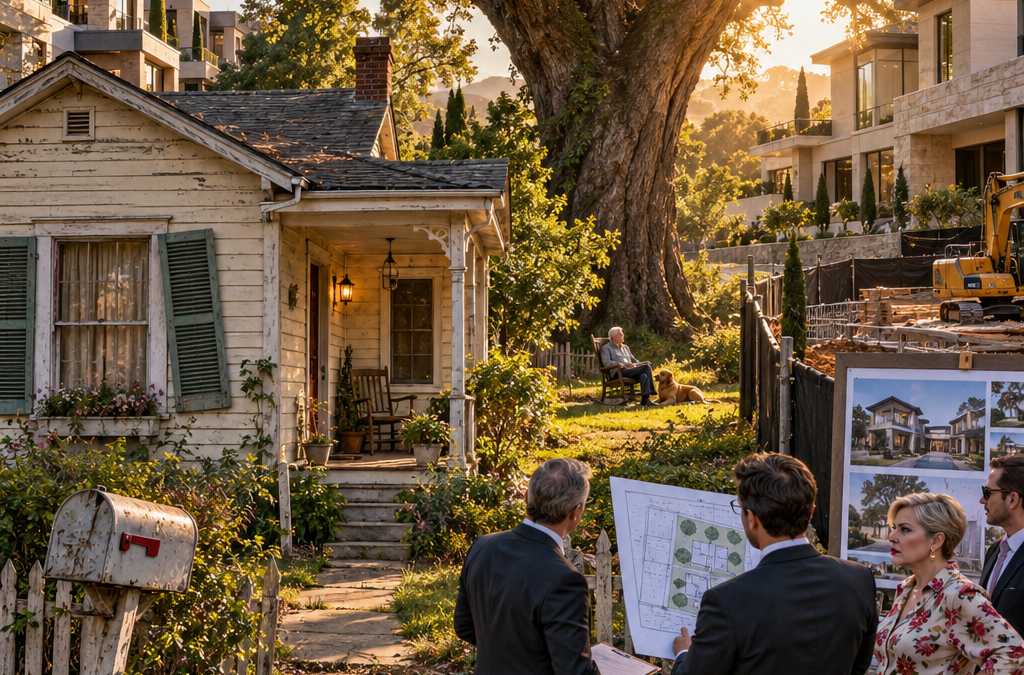
My grandfather, George Whitmore, had lived in the same house for fifty-one years.
By the time everything happened, he was seventy-nine.
The house was older than most of the people criticizing it.
A small single-story place on Hawthorne Lane with faded cream siding, a narrow porch, and a roof that had been replaced twice since he and my grandmother bought it in 1974.
Nothing about it looked impressive anymore.
The paint peeled near the garage.
One shutter hung slightly crooked.
The front walk had a crack running through the middle where tree roots had lifted the concrete.
The mailbox was old-fashioned and leaned a little to the left no matter how many times Grandpa straightened it.
The yard was clean, but it wasn’t professionally landscaped.
Grandpa cut his own grass.
Trimmed his own hedges.
Planted tomatoes every spring.
He believed decorative mulch was something companies invented to sell people wood chips.
Compared with the houses surrounding him, his place looked almost impossibly modest.
That was because Hawthorne Lane had changed.
When my grandparents moved there, the neighborhood consisted of small ranch houses, young trees, swing sets, and families stretching mortgage payments.
By the time I was thirty-two, half of those houses were gone.
Developers had discovered the area.
One house became two.
Small homes disappeared behind dumpsters and excavation fencing.
In their place rose three-story luxury houses with stone facades, black-framed windows, enormous garages, and landscaping crews that seemed to arrive before sunrise.
Property values climbed.
So did taxes.
So did expectations.
Grandpa stayed exactly where he had always been.
That made him noticeable.
His house became the last small house in the center of a street determined to become something larger.
And then Richard Mercer arrived.
Mercer was a developer with the particular kind of confidence that comes from buying enough properties to stop thinking of homes as homes.
To him, they were parcels.
Numbers.
Acquisition opportunities.
Assemblages.
He had already purchased six neighboring properties by the time he became interested in Grandpa’s.
His plan was apparently to combine several lots into a high-end residential project with large homes, private landscaping, and some kind of gated courtyard.
Grandpa’s property sat almost directly in the middle of what he wanted.
At first, Richard was polite.
He called.
Grandpa said no.
He mailed an offer.
Grandpa returned it unsigned.
Then the numbers started rising.
I found out because I stopped by one Sunday and saw an envelope on the kitchen counter.
Mercer Development Group.
Grandpa was making coffee.
“What’s that?”
“Nothing.”
“That looks like an expensive version of nothing.”
He gave me the look he’d been using on me since I was six.
“You’re nosy like your grandmother.”
“I’ll take that as a compliment.”
He slid the envelope into a drawer.
I opened it before he could stop me.
“Emily.”
“Grandpa.”
The number inside made me sit down.
It was more than twice what the house was worth.
Not a little more.
Enough that Grandpa could have bought a comfortable condo outright, put money in savings, traveled, and never worried about maintenance again.
I looked at him.
“This is insane.”
“Language.”
“I’m thirty-two.”
“Still language.”
I held up the letter.
“They’re offering you this much?”
“Apparently.”
“And you said no?”
“Apparently.”
“Grandpa.”
“No.”
“You haven’t even heard what I’m asking.”
“I raised your father. I know the question before you ask it.”
I set the letter down.
“Why?”
He reached for his coffee.
“Because I don’t want to sell.”
“That’s it?”
“That’s enough.”
At the time, I thought he was being stubborn.
Not foolish exactly.
Grandpa had always been stubborn.
It was one of his most reliable qualities.
But I thought emotion was getting in the way of practical reality.
The house needed work.
He was getting older.
His knees bothered him.
The stairs into the basement worried me.
He still insisted on climbing a ladder to clean his own gutters even after I threatened to steal the ladder.
A huge offer seemed like a gift.
He saw it differently.
Richard Mercer saw the same resistance as a negotiating problem.
According to a neighbor, Richard told one of his associates:
“Offer him double again. Everyone has a price.”
They kept increasing it.
Eventually, the number was close to three times market value.
Grandpa still said no.
No counteroffer.
No explanation.
Just no.
That should have ended it.
A man owns a house.
Someone wants to buy it.
The man doesn’t want to sell.
End of story.
It wasn’t.
The problem was Carol Jennings.
Carol was president of the Hawthorne Ridge Homeowners Association.
Grandpa’s original neighborhood hadn’t been created with much of an HOA, but over the decades, as new streets and larger houses appeared, the association had grown into something far more organized.
Grandpa used to joke that the HOA began with three women collecting twenty dollars for entrance flowers and somehow evolved into a minor government.
Carol loved rules.
Not in the way responsible people love clarity.
She loved leverage.
She carried folders everywhere.
She used phrases like community expectations and collective property interests.
She could make the color of a trash can sound like a moral issue.
One afternoon, she knocked on Grandpa’s door.
I wasn’t there.
He told me about it later.
She arrived carrying a folder and what Grandpa called her “campaign smile.”
“George,” she said, “the board has some concerns.”
He stood in the doorway.
“What concerns?”
“Your property is no longer consistent with evolving neighborhood standards.”
Grandpa looked behind himself into the house.
Then back at her.
“House looks the same to me.”
Carol smiled.
“That’s part of the issue.”
She opened the folder.
Peeling paint.
Lawn edging.
Mailbox compliance.
Exterior maintenance.
Apparently she had photographs.
Grandpa listened.
Then asked:
“What does this have to do with Richard Mercer?”
Carol stopped.
Only for a second.
“I don’t know what you mean.”
“Sure you do.”
“This is HOA business.”
“And he wants my land.”
“The board has no role in private sales.”
Grandpa looked at her.
He had a way of going silent that made people hear themselves more clearly.
Carol started talking again.
“No one is trying to pressure you, George.”
“Good.”
“We simply feel your property is beginning to affect the visual continuity of the street.”
Grandpa nodded once.
Then said:
“This house isn’t for sale.”
Carol’s smile tightened.
“I’m discussing compliance.”
“Not now.”
He started closing the door.
“And not ever.”
Then he shut it.
Within a week, the violation notices began.
One for peeling exterior paint.
That wasn’t completely false.
The west side did need work.
Grandpa had been planning to repaint it in spring.
Then came a notice about the lawn.
“Improperly maintained turf bordering the sidewalk.”
I went over and looked.
The alleged violation was one corner where grass had grown maybe two inches higher around a drainage cover.
Then the mailbox.
Wrong finish.
Wrong height.
Wrong post.
The same mailbox that had stood there for more than thirty years.
Then a hedge.
Then the cracked walkway.
Then a warning about “visible exterior deterioration.”
Each issue was small enough to sound plausible.
Together, they felt like a campaign.
Grandpa refused to say that.
He just dealt with them.
Painted the mailbox.
Trimmed the hedge.
Cut the grass shorter.
He even bought a pressure washer from a neighbor and cleaned the walkway until it looked almost new except for the crack.
The letters kept coming.
Two hundred dollars.
Then five hundred.
Then accumulated penalties.
I learned how serious it had become when I opened his refrigerator one Sunday.
Half a carton of eggs.
Mustard.
A jar of pickles.
Coffee creamer.
That was about it.
“Where’s your food?”
He was sitting at the table sorting mail.
“I have food.”
“You have condiments.”
“I ate lunch.”
“What?”
He didn’t answer.
I looked at the envelopes.
HOA.
Utility bill.
HOA.
Pharmacy.
HOA.
My stomach tightened.
“Are you paying these fines?”
“They’re bills.”
“They’re harassment.”
“They’ll put fees on top if I don’t.”
“You told me the first ones were only two hundred.”
“They went up.”
“How much?”
He folded the letter.
“Enough.”
I reached for it.
He pulled it away.
“Grandpa.”
“Emily.”
“How much?”
He finally handed it over.
I stared.
I don’t remember the exact total now.
I remember the feeling.
Too high.
Far too high for a seventy-nine-year-old man living mostly on pension income.
“You’re paying these?”
“I’m handling it.”
“With what money?”
He looked toward the window.
That told me.
“You’re skipping groceries.”
“No.”
“You are.”
“I have plenty.”
“You have half a dozen eggs.”
“I can buy eggs.”
“Then why haven’t you?”
His jaw tightened.
“Don’t start.”
I sat down across from him.
“Sell to Mercer.”
The words came out harder than I intended.
Grandpa looked at me.
“Emily.”
“I don’t understand this.”
“You don’t have to.”
“They’re going to bleed you dry.”
“I’ll manage.”
“Why?”
No answer.
“Why is this house worth destroying yourself over?”
He looked down at his hands.
That was the first moment I knew something was wrong with my question.
Not because he was angry.
Because he looked hurt.
I softened my voice.
“Grandpa, I’m scared.”
He nodded.
“I know.”
“Then tell me.”
“Some things don’t need telling.”
“What does that mean?”
He looked through the kitchen window toward the backyard.
The oak tree filled most of the view.
Even without leaves in winter, it was massive.
Its trunk was broad enough that I couldn’t wrap my arms halfway around it.
Branches spread over nearly half the yard.
Grandpa sat beneath it almost every morning.
Same wooden chair.
Same coffee mug.
Even in cold weather, he’d sometimes sit there with a coat and hat for ten or fifteen minutes.
I had always thought it was routine.
Old people like routines.
That was how I explained it to myself.
“Is this about Grandma?” I asked.
His face changed.
Very slightly.
Then the wall came back.
“Leave it alone, sweetheart.”
“Grandpa—”
“Please.”
That word stopped me.
George Whitmore rarely said please when telling someone to stop.
So I did.
But the HOA didn’t.
At the next board meeting, Carol turned my grandfather into a public problem.
I attended because he asked me to drive him.
The clubhouse was packed.
Homeowners sat in rows of folding chairs.
A projector showed landscaping plans and budget tables.
Grandpa chose the last row.
I stood near the doorway because there weren’t enough seats.
Carol moved through the agenda.
Pool maintenance.
Street trees.
Architectural requests.
Then community property values.
She changed slides.
A photograph of Grandpa’s house appeared on the screen.
Beside it was a photograph of one of the new luxury houses.
The contrast was deliberate.
Grandpa’s peeling siding.
Old mailbox.
Modest porch.
Then stone, perfect grass, and black windows next door.
Carol said:
“We have to acknowledge that one holdout property is affecting the visual transition of the entire street.”
Holdout.
I felt heat rise in my face.
Grandpa didn’t move.
Carol continued.
“We have worked for months to achieve voluntary compliance.”
A lie.
Or at least a selective truth.
Grandpa had complied with almost everything they asked.
The requests simply multiplied.
“The issue is no longer one mailbox or one strip of lawn.”
Carol gestured toward his house on the screen.
“It is whether one individual homeowner can refuse to participate in the progress every other resident has invested in.”
Someone murmured agreement.
Another person said:
“Exactly.”
I looked at Grandpa.
Hands folded.
Back slightly bent.
He seemed smaller than usual.
Carol kept talking.
Property values.
Neighborhood modernization.
Maintenance standards.
Equity.
Collective responsibility.
Never once did she mention Richard Mercer.
She didn’t have to.
Everyone knew his development depended on Grandpa’s lot.
A man near the front raised his hand.
“George has been offered more than fair value.”
Carol nodded sympathetically.
“Private offers are obviously not board business.”
Obviously.
Then she added:
“But reasonable decisions benefit everyone.”
A few people clapped.
I wanted to stand up.
Grandpa caught my eye.
One slight shake of his head.
No.
So I stood there.
Silent.
Watching people who had known him for decades reduce him to a property obstacle.
Some had borrowed his ladder.
Some had eaten at my grandmother’s kitchen table.
One woman had sent her teenage son to Grandpa every winter because he knew how to repair the boy’s old snowblower.
Now most of them wouldn’t look at him.
When the meeting ended, Grandpa stood slowly.
Carol approached with another folder.
He walked past her.
Outside, I couldn’t hold it anymore.
“Why won’t you tell them?”
He kept walking toward my car.
“Tell them what?”
“Whatever this is.”
I pointed back toward the clubhouse.
“They’re making you look like some selfish old man destroying the neighborhood.”
“That’s their choice.”
“You could stop it.”
He reached the passenger door.
“Grandpa.”
He looked at me.
My voice broke.
“Why won’t you tell them why you can’t sell?”
His expression softened.
Then he reached up and touched my cheek the way he had when I was little.
“Some things aren’t anybody else’s business, sweetheart.”
“Not even when they’re doing this to you?”
“Not even then.”
“Why?”
He looked toward the clubhouse.
“Because grief isn’t evidence.”
I didn’t understand.
He opened the car door.
“And it isn’t for the HOA newsletter.”
That night, I couldn’t sleep.
The certified letter arrived three days later.
I found it on Grandpa’s table.
FINAL NOTICE.
Accumulated fines.
Administrative fees.
Potential lien.
That word changed everything.
Lien.
I knew enough to understand it could become dangerous.
The board might not literally take the house overnight, but a lien could grow.
Legal fees could grow.
Eventually, Grandpa could find himself trapped beneath a debt system designed to exhaust him.
He read the letter once.
Folded it.
Put it back in the envelope.
Then opened a can of soup for dinner.
Something in me snapped.
Not rage.
Decision.
If he wouldn’t tell me, I would find out what I could.
That weekend, I drove to the county records office.
I wasn’t sure what I expected.
Maybe an old easement.
Some deed restriction.
A provision proving the HOA couldn’t do what it was doing.
Anything.
I gave the clerk Grandpa’s address.
“How far back?”
“Original purchase.”
“What year?”
“1974.”
She disappeared.
The folder she returned with was thicker than I expected.
Original deed.
Transfer tax record.
Old property description.
Mortgage release.
Survey.
I sat at a table.
Read everything.
Nothing obvious.
No miracle.
No hidden legal clause making the house untouchable.
Then something slipped from behind the deed.
A folded piece of yellowed paper.
Not an official document.
Handwritten.
I almost put it back.
Then I saw the name.
George.
My grandmother’s handwriting.
I knew it from birthday cards.
Recipes.
The note she’d written inside the children’s Bible she gave me when I was six.
My hands started shaking before I opened it.
The date at the top was two weeks before she died.
I read.
George,
Promise me our tree stays standing.
Promise me you’ll never let them take our home from under it.
I stopped.
Read it again.
Then the rest.
The letter wasn’t long.
That made it worse.
Grandma Eleanor wrote about the house.
The first summer.
The oak.
Their son.
My father had always told me he was an only child.
Technically, he was the only child who grew up.
I knew there had been a baby before him.
I had never heard much.
Families sometimes build quiet rooms around old grief and teach the next generation not to open the door.
My uncle, if that’s what I should call him, had died in infancy.
Grandpa and Grandma buried him.
Decades before I was born.
The letter explained what no one had ever explained to me.
Eleanor had planted the oak tree the week she and Grandpa moved into the house.
That same week, she discovered she was pregnant.
She wrote that George had laughed because the tree and baby would grow together.
The baby didn’t.
Their son lived only a short time.
Eleanor never stopped thinking of the oak as his tree.
Years later, when she became ill, she asked Grandpa to place part of her ashes beneath it.
Beside the son they lost.
The letter ended with the promise.
Keep our tree.
Keep our home.
I sat in that records office with tears falling onto a document fifty-one years old.
Suddenly every morning made sense.
Grandpa wasn’t sitting beneath a tree because he liked shade.
He was sitting with his family.
His wife.
His child.
A marriage.
A loss.
A life no developer could price.
I drove to his house so quickly I barely remember the route.
He wasn’t inside.
I knew where he’d be.
Backyard.
Oak tree.
He sat in the wooden chair.
Coffee in both hands.
The winter sun came through bare branches above him.
I walked across the grass carrying Eleanor’s letter.
He saw it before I spoke.
His face changed.
“Where did you get that?”
“County file.”
He looked down.
For the first time in my entire life, Grandpa seemed afraid of a piece of paper.
I stopped beside him.
“Grandpa.”
He didn’t answer.
“I found Grandma’s note.”
His eyes closed.
I sat beside him on the grass.
“Why didn’t you tell me?”
He stared toward the trunk.
“Didn’t know I had to.”
“You were starving yourself.”
“I’m not starving.”
“Please don’t do that.”
My voice broke.
He looked at me.
“Why didn’t you tell anyone?”
His eyes filled.
I had seen Grandpa cry exactly twice before.
At Grandma’s funeral.
And at my father’s.
This was different.
Quieter.
“Because grief isn’t for the HOA newsletter.”
He repeated the same words.
This time I understood.
He looked toward the oak.
“Your grandmother planted this tree.”
“I read that.”
“First week we moved in.”
He smiled faintly.
“She picked the worst little sapling on the lot.”
“Why?”
“Said it needed somebody.”
That sounded exactly like her.
He continued.
“Then she found out about Daniel.”
I had never heard the baby’s name.
“Daniel?”
“Our first boy.”
His voice changed when he said it.
After all those years.
Still his boy.
“He lived six weeks.”
I reached for his hand.
Grandpa stared at the ground.
“We didn’t know how to survive it.”
No one ever does, I thought.
“People brought casseroles. Said terrible things because they meant well.”
“What kinds of things?”
“‘You’re young. You’ll have another.'”
He laughed once without humor.
“Like children replace children.”
I squeezed his hand.
“Your grandmother came out here every morning.”
He pointed toward the tree.
“Sat on the ground.”
“This spot?”
“Pretty close.”
“Then Dad was born?”
“Three years later.”
Grandpa smiled.
“She loved your father so much it scared her.”
The wind moved through the branches.
“Daniel is buried nearby?”
He shook his head.
“Not exactly.”
He took a long breath.
“We had a family burial plot in the county cemetery. But after Eleanor got sick, she asked me to bring a little soil from Daniel’s grave here.”
He looked at me.
“And when she died, she wanted some of her ashes beneath this oak.”
My throat tightened.
“So they’re both here.”
“Part of them.”
He nodded.
“But that’s not really what I mean when I say they’re here.”
I understood.
The tree had become a place where memory had collected.
Family dinners.
Summer evenings.
Children learning to walk.
Grandma hanging laundry.
My father climbing branches.
Birthdays.
Arguments.
Illness.
Funerals.
Fifty-one years compressed into one patch of earth.
Richard Mercer saw a lot.
Carol saw an outdated house.
Grandpa saw everyone he had loved.
“This isn’t a lawn to me,” he said.
His voice almost disappeared.
“It’s the only place left where my whole family is still together.”
That sentence broke me.
I leaned forward and wrapped my arms around him.
Grandpa was not a man who hugged for long.
That day he did.
He put one hand on the back of my head.
And for several minutes, neither of us said anything.
I could feel him crying against my shoulder.
Not loudly.
Almost apologetically.
Like grief was something he still thought he needed permission to show.
When he pulled away, I wiped my face.
“Let me tell them.”
“No.”
“Grandpa.”
“No.”
“They’re threatening a lien.”
“I know.”
“They are trying to pressure you out.”
“I know.”
“Then why protect them from the truth?”
“I’m not protecting them.”
“Then what?”
He looked at Eleanor’s letter in my hand.
“I’m protecting that.”
I didn’t understand.
He continued.
“Your grandmother didn’t write that for Carol Jennings.”
“No.”
“She wrote it to me.”
“Yes.”
“Daniel wasn’t a talking point.”
“No.”
“I don’t want thirty neighbors deciding whether my grief is enough reason to own my own house.”
That stopped me.
Because he was right.
He shouldn’t need tragedy to justify saying no.
The house was his.
No should have been sufficient.
“Then what do we do?”
He looked tired.
“I pay what I can.”
“No.”
“Emily.”
“No.”
I stood.
“You’re allowed to keep your grief private.”
He watched me.
“But I’m allowed to protect you.”
“What does that mean?”
“I don’t know yet.”
That night, I made the decision without telling him.
I requested time on the next HOA agenda.
Not for George Whitmore.
For Emily Whitmore.
Family representative.
Carol’s response arrived the next morning.
Five minutes.
That was all they would give me.
Fine.
I didn’t need five.
The meeting was scheduled for Thursday.
The lien vote was on the agenda.
FINAL ENFORCEMENT ACTION — WHITMORE PROPERTY.
I read those words until they stopped looking like English.
Grandpa never agreed to speak.
I never asked again.
I brought Eleanor’s letter.
Not the original.
A copy.
I left the original with Grandpa.
I spent two nights writing what I planned to say.
Then tore it up.
The truth didn’t need decorating.
Thursday evening, the clubhouse was full.
More people than before.
Carol sat at the head table.
Richard Mercer was there too.
That surprised me.
Not officially part of the board.
Just sitting near the front like a man attending the final stage of an acquisition.
Grandpa told me he wasn’t coming.
I believed him.
Carol started with routine business.
Then she reached the lien item.
“Before we proceed,” she said, “Ms. Emily Whitmore has requested a brief statement.”
She looked irritated.
Like I was delaying paperwork.
I walked to the podium.
My hands were cold.
The room seemed too bright.
Carol gave me a practiced smile.
“Five minutes.”
“I won’t need them.”
I looked around.
Some of these people had known Grandpa longer than I’d been alive.
Mrs. Hall from across the street.
Mr. Dawson, whose furnace Grandpa had helped fix one winter.
The Bakers, who used to borrow folding chairs from my grandparents for birthday parties.
People who had become afraid to meet his eyes.
I unfolded the letter.
“You’ve called my grandfather stubborn.”
The room quieted.
“Selfish.”
Carol shifted.
“A problem for this neighborhood.”
I looked directly at her.
“You’ve shown photographs of his house next to new houses and talked about him like he’s a defect in the street.”
Richard Mercer folded his arms.
Carol interrupted.
“Ms. Whitmore, the board has never—”
“Please let me finish.”
Something in my voice stopped her.
I continued.
“For months, you’ve asked why he won’t sell.”
I held up the letter.
“He never answered you.”
I swallowed.
“Because he shouldn’t have to.”
A murmur.
I looked toward the back of the room.
And saw Grandpa.
Standing against the wall.
Coat still buttoned.
Hands folded.
He had followed me.
My heart nearly stopped.
He looked at me.
Didn’t nod.
Didn’t shake his head.
Just stood there.
I turned back to the microphone.
“My grandparents bought their house in 1974.”
I read Eleanor’s first sentence.
George, promise me our tree stays standing.
The room changed immediately.
I continued.
The words about moving in.
Planting the oak.
Finding out she was pregnant.
Then Daniel.
My voice caught on his name.
I stopped.
Breathed.
Read the line again.
Their first son.
Six weeks.
The silence in the room became absolute.
No papers moving.
No chairs.
No whispering.
I read the rest.
Eleanor’s request.
The tree.
The house.
Her ashes.
The promise.
When I finished, I lowered the page.
Nobody spoke.
Carol’s folder rested open in front of her.
For the first time since I had known her, she didn’t seem to know what to say.
I looked toward Grandpa.
Every face in the room slowly turned with mine.
He stood at the back.
Small.
Old.
Exhausted.
But upright.
Mrs. Hall covered her mouth.
Someone near the front started crying.
I continued.
“My grandfather didn’t tell you this because he didn’t believe he needed to use the death of his wife and infant son as evidence that he deserved to stay in his own home.”
Several people lowered their eyes.
“He was right.”
I looked at Carol.
“The letter doesn’t make his ownership more legitimate.”
Then at Richard.
“It doesn’t make his no more binding.”
I held up the paper.
“It only explains what all of you were willing to destroy because you couldn’t accept an answer without a reason.”
Richard looked down.
Carol’s face had lost all color.
I stepped away from the microphone.
That was all I planned to say.
Then one of the board members spoke.
“I withdraw my support for the lien.”
Carol turned.
“What?”
A man named Thomas Greene sat two seats down.
He repeated:
“I won’t vote for it.”
Another board member said:
“Neither will I.”
Carol looked around.
“This isn’t about sympathy. We have enforcement standards.”
Mrs. Hall stood from the audience.
“Carol.”
Carol stopped.
Mrs. Hall’s voice shook.
“I’ve lived across from George thirty-seven years.”
She looked at Grandpa.
“He carried my husband into a car when he had his heart attack.”
Grandpa lowered his eyes.
Mrs. Hall turned back to Carol.
“And I stopped waving at him because you told us he was hurting property values.”
No one moved.
“I’m ashamed.”
Then Mr. Dawson stood.
“Me too.”
Another voice.
“Withdraw the fines.”
Another.
“All of them.”
Carol looked toward Richard Mercer.
That told me more than anything she said.
Richard didn’t rescue her.
He gathered his coat.
Then remained seated.
Carol closed the folder.
Slowly.
“The lien motion is withdrawn.”
Nobody applauded.
This wasn’t victory.
It felt more like a room realizing it had nearly done something unforgivable.
Carol stood.
Walked past the board table.
Past me.
Toward Grandpa.
She stopped in front of him.
No folder this time.
No clipboard.
“I’m sorry.”
Grandpa looked at her.
“I didn’t know.”
He nodded once.
“No.”
Carol’s eyes filled.
“I should have.”
Grandpa shook his head.
“You didn’t need to know.”
She looked confused.
He continued.
“You just needed to hear no.”
Carol started crying.
Grandpa didn’t.
He simply touched her arm once.
Then walked toward me.
Richard Mercer withdrew his offer the following week.
Officially, his company said the project plans had changed.
Unofficially, I think he finally understood that pursuing Grandpa’s lot had become something no amount of money could make worth continuing.
He sent one last letter.
No number.
No new offer.
Just a note saying he respected George’s decision and would not contact him again.
Grandpa read it.
Folded it.
Put it in the same drawer where he had kept every other offer.
“Well?” I asked.
“Well what?”
“Do you forgive him?”
Grandpa looked at me like I’d asked whether he planned to join the circus.
“He stopped bothering me.”
“That’s not forgiveness.”
“It’s enough.”
Fair.
The HOA did more than withdraw the lien.
The board rescinded the recent fines.
Then reviewed the sequence that had created them.
Several had been issued outside ordinary enforcement patterns.
Some relied on standards that had never previously been applied to Grandpa’s property.
Carol admitted the board had allowed neighborhood redevelopment pressure to affect enforcement.
That language was painfully formal.
But it mattered.
The apology was placed into meeting minutes.
So was the reversal.
Then something happened Grandpa never asked for.
Residents proposed formally recognizing the oak tree and property as a neighborhood memorial.
Grandpa resisted immediately.
“I don’t want tourists.”
I laughed.
“They’re your neighbors.”
“Same thing when they’re nosy.”
Eventually, he agreed on conditions.
No public access.
No events.
No people wandering into the backyard.
The house remained entirely his private property.
The HOA simply recorded a community policy committing itself not to use aesthetic standards to pressure redevelopment of the lot and to protect the oak from association-driven removal demands.
They also installed a small brass plaque with Grandpa’s permission.
Nothing dramatic.
At the base of the tree.
ELEANOR’S TREE
PLANTED WITH LOVE — 1974
The first time Grandpa saw it, he stood silently.
Then said:
“She would’ve hated this.”
I stared.
“What?”
“The attention.”
I laughed so hard I cried.
“Grandpa.”
“She would’ve.”
“You agreed to it.”
“Temporary weakness.”
He bent down and brushed a leaf off the plaque.
He touched Eleanor’s name.
Then stood.
“Looks nice though.”
Neighbors started coming by.
Not crowds.
One at a time.
Pies.
Coffee.
Flowers.
Mostly apologies.
Grandpa didn’t make people suffer for them.
That was something I admired.
He could have listed names.
Could have repeated comments.
Could have reminded Mrs. Hall she had avoided him at the mailbox.
Could have told Mr. Dawson exactly what he heard him say after the HOA meeting.
He didn’t.
If someone said:
“I’m sorry, George.”
He answered:
“Thank you.”
If they asked whether he needed anything:
“No.”
If they brought pie:
“Leave that.”
Some principles are flexible.
Pie was apparently one of them.
Carol resigned as HOA president several months later.
Not because Grandpa demanded it.
He never did.
She said she had allowed the board to lose perspective and needed to step away.
Before leaving, she visited him one afternoon.
I happened to be there.
She stood on the porch.
No folder.
I noticed that every time now.
“George.”
“Carol.”
She looked nervous.
“I wanted to tell you I’m resigning.”
He nodded.
“I heard.”
“I owe you more than the apology at the meeting.”
He opened the screen door.
“Coffee?”
She looked surprised.
“Okay.”
We sat in the kitchen.
Carol held the mug in both hands.
“I convinced myself I was protecting the neighborhood.”
Grandpa listened.
“Richard’s project would’ve increased values.”
“Probably.”
“I thought you were refusing because you didn’t understand what was being offered.”
Grandpa smiled faintly.
“I’m old, Carol. Not stupid.”
She flushed.
“I know that now.”
“You should’ve known it then.”
“Yes.”
Silence.
Then Carol said:
“When people asked me why you wouldn’t sell, I started saying you were being unreasonable.”
“That was easier.”
She looked at him.
“Easier than what?”
“Accepting that you weren’t going to do what you wanted.”
Carol nodded.
“Yes.”
Grandpa drank his coffee.
Finally she asked:
“Would you ever have sold if the tree could stay?”
That question made me tense.
Grandpa didn’t.
“No.”
“Even then?”
“No.”
“Why?”
He looked around the kitchen.
At the old cabinets.
The window over the sink.
The doorway with pencil marks where my father had been measured as a child.
“This is my home.”
Carol nodded.
That’s when I finally understood something even I had missed.
The tree explained Grandpa’s refusal.
It didn’t create it.
He wasn’t obligated to turn his house into a memorial before people respected his ownership.
He simply wanted to stay.
That should have been sufficient from the first offer.
The tragedy beneath the oak made the neighborhood ashamed.
But their real mistake came before they knew any of it.
They had decided an old man’s no was less important than everyone else’s plans.
That was the part worth remembering.
I started visiting every Sunday.
I had visited before.
Just not consistently.
After everything, Sunday became ours.
Coffee if it was cold.
Lemonade in summer.
Sometimes lunch.
We sat under Eleanor’s oak.
Grandpa told me stories I had never heard.
Not dramatic stories.
The best ones usually aren’t.
Grandma burning their first Thanksgiving turkey.
My father falling out of the oak and lying about it.
Daniel’s tiny knitted blue hat.
Grandma teaching herself to drive in the grocery-store parking lot.
Grandpa sleeping on the couch after an argument he no longer remembered.
Fifty-one years of a marriage and home that, from the street, looked like peeling paint.
One afternoon, I asked him:
“Do you wish Grandma’s letter had stayed hidden?”
He thought for a while.
“No.”
“Really?”
“No.”
“Even after I read it to everyone?”
“You did what you thought you had to.”
“That’s not exactly permission.”
He looked at me.
“You want me to be angry?”
“No.”
“I was.”
My stomach dropped.
“You were?”
“For about three days.”
“Grandpa.”
“You took something private.”
“I know.”
“And made it public.”
“I’m sorry.”
He nodded.
“I know.”
I looked down.
Then he said:
“But you saved the house.”
“I shouldn’t have needed the letter.”
“No.”
He took a slow breath.
“You understand that now.”
“I do.”
“Then we’re all right.”
That was George Whitmore’s version of forgiveness.
Short.
Unadorned.
Complete.
The development went forward without his lot.
Richard redesigned.
New houses rose around Grandpa.
Tall.
Expensive.
Beautiful, honestly.
The street changed anyway.
That was another lesson.
Progress doesn’t always need every piece.
Sometimes plans can bend.
One of the new homes overlooked Grandpa’s backyard.
The owners, a young couple with a little girl, introduced themselves before moving in.
They had heard the story.
Of course they had.
The husband asked:
“Is that the famous oak?”
Grandpa groaned.
“Apparently.”
Their daughter looked up into the branches.
“It’s huge.”
“Older than your dad,” Grandpa told her.
The father laughed.
“Not by much.”
Grandpa allowed the girl to collect acorns.
The next spring, she brought him a small flowerpot.
Inside was one of the acorns.
Sprouted.
She had planted it.
“I made another Eleanor tree.”
Grandpa looked at that little seedling for a long time.
Then turned away.
I saw him wipe his eye.
He claimed pollen.
There wasn’t any.
Years passed.
Grandpa’s house remained the smallest on the street.
The paint eventually got redone.
Not because Carol ordered it.
Because three neighbors showed up one Saturday with ladders.
Grandpa argued.
Lost.
They repainted the whole exterior.
He supplied sandwiches and complained about their brush technique.
The mailbox stayed.
The HOA never mentioned it again.
The brass plaque beneath the oak darkened with weather.
I polished it every spring.
Grandpa told me not to.
I ignored him.
We developed a healthy pattern.
When people asked why he never sold, Grandpa rarely told the whole story.
Sometimes he said:
“Didn’t want to.”
That was enough.
If they pushed:
“My wife liked the place.”
If they already knew about the tree, he might nod toward it.
But he never turned grief into performance.
That was important.
He didn’t become the sad old man with the memorial tree.
He remained George.
Complaining about taxes.
Fixing things nobody asked him to fix.
Falling asleep during baseball games.
Calling every new smartphone “that machine.”
Insisting his doctor was younger every year.
Human.
Not symbolic.
The neighborhood had turned him into a symbol once when they called him a holdout.
I refused to let them do it again by turning him into a saint.
He could be difficult.
He kept expired coupons.
He once refused to replace a toaster even after it started smoking.
He believed any restaurant charging more than three dollars for coffee was committing theft.
He was stubborn.
Carol hadn’t invented that.
She had simply treated stubbornness as permission to erase him.
There is a difference.
The last conversation I ever had with Grandpa beneath the oak happened on a warm October morning.
He was eighty-three then.
Slower.
Thin.
His hands shook around the coffee cup.
Leaves were beginning to fall.
I sat beside him.
He looked up through the branches.
“Tree’s doing all right.”
“Better than you.”
“Rude.”
“Accurate.”
He smiled.
After a while he asked:
“You ever think about what you’ll do with the house?”
My heart tightened.
“Don’t.”
“I’m asking.”
“You’ll be here another twenty years.”
“That would be terrible.”
“Grandpa.”
He touched my hand.
“Listen.”
I did.
“When I’m gone, don’t keep the house because you think you owe me.”
I stared at him.
“What?”
“Sell it if you need to.”
“But Grandma’s letter.”
“Was written to me.”
“The tree.”
“Take care of it if you can.”
“If I sell—”
“Then sell to someone who will.”
I felt tears rising.
“I thought you promised never to let them take the home.”
“I did.”
“And you kept it.”
“Yes.”
He looked toward the house.
“Promises belong to the people who make them.”
That may be the wisest thing he ever said to me.
“Don’t turn mine into your prison.”
I couldn’t speak.
Grandpa leaned back.
“The important thing wasn’t keeping the building forever.”
“What was?”
He looked toward Eleanor’s plaque.
“Not letting somebody else decide when I was finished loving it.”
I cried.
He pretended not to notice.
George Whitmore died peacefully the following winter.
In his own house.
The one everyone had once told him was outdated.
I was with him.
So was my father.
We opened the curtains so he could see the oak.
He couldn’t speak near the end.
But his eyes went toward it.
I held his hand.
After the funeral, I sat under Eleanor’s tree alone.
For the first time in my life, Grandpa’s chair was empty.
I finally understood why he had gone there every morning.
Not because grief lived under the tree.
Love did.
Grief was only what love looked like after people were gone.
The house eventually passed to my father, then into a family trust.
We did not sell immediately.
We weren’t ready.
Later, we found a way to preserve the oak through a recorded tree-protection agreement before any future transfer.
Grandpa would have rolled his eyes at the paperwork.
He would have approved of the result.
The neighborhood still calls it Eleanor’s tree.
The plaque remains.
Children know the story in simplified form.
An old man refused to sell because he loved his wife.
That’s true.
Just incomplete.
The real story is harder.
A developer offered more money than most people could reasonably refuse.
An HOA forgot that community standards don’t give a neighborhood ownership over one man’s life.
Neighbors let money and appearances become more important than kindness.
A granddaughter violated a little of her grandfather’s privacy because she was terrified of losing him.
A room full of adults discovered shame when it was almost too late.
And George Whitmore kept a promise for more than half a century without expecting anyone to applaud.
That is what I remember.
Not the developer.
Not Carol’s folder.
Not the lien threat.
Not even the meeting.
I remember Grandpa sitting beneath that oak.
Every morning.
Coffee in hand.
Silence.
For years, I thought he was alone.
He never was.
Eleanor was there in every branch she had watched grow.
Daniel was there in the grief they had carried together.
My father was there as a boy climbing too high.
I was there in summers when Grandpa pushed me on a swing hanging from one of the lower limbs.
Fifty-one years of family life lived beneath one canopy.
Richard Mercer once looked at that yard and calculated square footage.
Carol looked at it and saw outdated landscaping.
The HOA looked at it and saw a property-value problem.
Grandpa looked at the same place and saw home.
That’s why money never had a chance.
Triple the value.
Five times the value.
It wouldn’t have mattered.
You cannot outbid a memory when the person holding it isn’t trying to sell.
And you should never have to understand someone else’s grief before you respect their no.
That is the part I wish Hawthorne Lane had understood before Eleanor’s letter was ever read.
Grandpa didn’t owe them his pain.
He didn’t owe Richard Mercer an explanation.
He didn’t owe Carol a tragedy powerful enough to justify remaining in a house he already owned.
He said no.
That should have been the end.
Years later, when I visit, the new houses still tower around the little Whitmore home.
Glass.
Stone.
Perfect lawns.
Expensive cars.
And in the middle of all that change sits one old oak tree whose branches spread wider every year.
The plaque at its base is small enough that you could miss it if you weren’t looking.
ELEANOR’S TREE
PLANTED WITH LOVE — 1974
Sometimes I brush away leaves and sit in Grandpa’s old chair.
I don’t stay long.
Just coffee.
Quiet.
The kind of morning he loved.
And when the wind moves through the branches, I think about the promise that nearly broke him financially but carried him emotionally for fifty-one years.
I used to believe Grandpa refused to sell because he couldn’t let go of the past.
I was wrong.
He refused because the past was still part of his present.
Love doesn’t become irrelevant simply because a developer can put a larger number on the land beneath it.
Some houses are just buildings.
Some trees are just trees.
And sometimes a small, peeling house on an ordinary street becomes the last physical place where a man can still sit among everyone he has ever loved.
That was what my grandfather had been protecting.
Not property.
Not stubbornness.
Not pride.
A promise.
And when the entire neighborhood finally understood that, the most remarkable thing wasn’t that George Whitmore had refused to sell.
It was that they had ever believed money should have been enough to make him leave.








