𝙍𝙚𝙖𝙙𝙈𝙤𝙧𝙚👉 The Woman I Cleaned For Invited Me to Her Black-Tie Gala as a Joke, Never Realizing Why the Emerald Dress in My Closet Had Been Hidden for Fifteen Years
𝗣𝗔𝗥𝗧 𝟮
Then closed the next door before I reached it.
By the time I understood the campaign was coordinated, my records were being pulled from rotation.
Sponsors disappeared.
My management company dropped me.
Tour dates canceled.
My label accused me of breach.
Lawyers came.
Money vanished.
I fought until fighting cost more than I had.
Then I sold things.
Jewelry.
Property.
Awards I had duplicates of.
Eventually, even the microphone.
That microphone hurt.
A gold-plated Neumann U48 engraved with my initials.
L.H.
I had used it during the biggest years of my career.
Madison Square Garden.
The Grammys.
A benefit concert at the Kennedy Center.
I sold it because the bank did not accept nostalgia as mortgage payment.
The last time I performed publicly was in 1996.
After that, I disappeared.
Not completely.
Nobody disappears completely.
I just became ordinary enough that fame stopped following me.
I moved to Stamford.
Small house.
Two bedrooms.
Used Honda.
For a while, I taught voice privately.
Then students stopped coming.
Their parents wanted current names.
Not somebody they vaguely remembered their mothers playing on cassette.
I worked reception.
Catered.
Did alterations.
Whatever came.
Three years before Victoria Ellsworth’s gala, I started cleaning houses.
People later found that tragic.
I never did.
Work is work.
My mother, Dorothy Harris, cleaned houses for forty-two years.
She raised three children on other people’s dust.
I had no shame in cleaning.
The shame belonged to people who believed cleaning made the person doing it smaller.
At 6:10, I ironed my uniform.
White blouse.
Dark pants.
Gray apron.
Then I clipped my hair back.
My Honda started on the third try.
Gospel music crackled through the speakers.
I sang quietly as I drove.
That old car became my last stage.
No critics.
No executives.
No contracts.
Just me and God and an engine that needed a new timing belt.
Thirty minutes later, I pulled into the staff area behind the Ellsworth estate.
Calling it a house would have been dishonest.
Twelve thousand square feet.
Glass.
Stone.
A circular driveway.
Fountain.
Guesthouse.
Pool.
Formal garden.
Victoria once told somebody the fountain cost sixty thousand dollars.
At the time, my entire house was worth less than twice that.
I walked around back.
Tomas, the groundskeeper, was trimming roses.
He was seventy and had spent twenty-seven years taking care of rich people’s gardens.
“Morning, Miss Lorraine.”
“Morning, Tomas.”
He looked up.
“You singing already?”
“Can’t help it.”
He smiled.
“Don’t.”
“What?”
“Ever stop.”
I laughed.
“Too late for dramatic advice this early.”
“I’m serious.”
“So am I.”
I went inside.
Victoria Ellsworth sat in the west parlor wearing a silk robe that probably cost more than I earned in a month.
Phone pressed to her ear.
Untouched orange juice.
Croissant missing one bite.
She saw me.
Did not say good morning.
“The upstairs guest bathroom still smells strange.”
“Yes, ma’am.”
“Fix it.”
“I’ll check the drain.”
“And don’t touch the paintings in the east hallway.”
“I won’t.”
She went back to her call before I finished.
That was our relationship.
Three years.
I knew the toothpaste she used because I wiped it off her marble sinks.
I knew which wine she preferred because I removed the rings from side tables.
I knew Gregory slept in the guest room whenever they fought because I changed those sheets the next day.
I knew Victoria hated fingerprints on stainless steel.
She knew almost nothing about me.
Not where I lived.
Not whether I had children.
Not what music I liked.
Certainly not who I had once been.
To her, I existed inside a gray apron.
The irony was that her husband worked in the music industry.
Gregory Ellsworth was executive vice president of Pinnacle Artists Management.
Pinnacle was enormous.
Tours.
Record deals.
Brand contracts.
Publishing.
Some of the biggest artists in the world had management agreements connected to that building.
I knew his name before I ever cleaned his house.
I just never told them.
Why would I?
I had spent fifteen years escaping rooms where people looked at me like a former version of myself.
I did not need Gregory calling old contacts.
Did not need sympathy.
Did not want to become a story people told over cocktails.
Do you know who cleans our house?
That Lorraine Harris.
No.
I preferred invisibility.
What I did not know then was that Gregory had his own secrets.
Royalty irregularities.
Artist complaints buried.
Black employees reporting discrimination.
Money skimmed through management accounts.
And above Gregory sat Raymond Carter.
Chairman of Pinnacle.
Singer.
Producer.
Music legend.
My oldest friend.
Raymond and I had grown up fifteen blocks apart in Hartford.
We sang together before either of us knew what a record contract looked like.
Church basements.
Street festivals.
Clubs where they paid in cash and sometimes forgot.
He became famous.
So did I.
When they came for me, Raymond fought.
Publicly.
Privately.
He called executives.
Defended me.
Threatened to leave his own label.
But he wasn’t powerful enough then.
Neither of us was.
Later, when he had power, he tried finding me.
I avoided him.
That part was my fault.
He sent money once through Denise Coleman, my attorney and oldest female friend.
I sent it back.
Raymond tried again.
I called him and said:
“If you love me, stop trying to rescue me.”
He was silent.
Then said:
“I’m not rescuing you.”
“It feels like it.”
“What am I supposed to do?”
“Let me become whoever I’m going to become.”
I had not spoken to him in years by the time I started cleaning Victoria’s house.
I didn’t know Gregory reported directly to him.
And Raymond certainly did not know I scrubbed Gregory’s floors twice a week.
Two weeks before the gala, I was on my knees cleaning baseboards in the hallway.
Victoria sat in the living room with embossed invitations spread across the sofa.
Cream envelopes.
Gold lettering.
Three hundred guests.
Politicians.
Media executives.
Artists.
Business owners.
People whose names appeared in magazines.
My knees hurt.
The toothbrush in my hand was whitening the grout beside the wall.
“Lorraine?”
“Yes, ma’am?”
“Come here.”
I stood carefully.
My back had learned to complain before my mouth did.
I wiped my hands on my apron.
Victoria looked me over.
“I’m hosting my annual charity gala next Saturday.”
“I know.”
She smiled.
“Of course you do.”
She laughed lightly.
“You clean up after it.”
I smiled politely.
“Yes, ma’am.”
“This year will be enormous.”
She held up an invitation.
“Three hundred guests.”
“That’s a lot.”
“Everyone important.”
She said it like a category I obviously existed outside.
Then:
“I want you to come.”
I thought I had misunderstood.
“To clean?”
Victoria laughed.
“No.”
She looked delighted.
“As a guest.”
I stood there.
The word did not fit the room.
“I’m sorry?”
“I think it would be fun.”
There it was.
Fun.
Not kind.
Not nice.
Fun.
My mother spent forty-two years hearing that tone.
Rich women calling her sweetheart while criticizing dust nobody else could see.
People giving her old clothes and expecting gratitude.
Inviting her into rooms only when there was something entertaining about crossing the boundary.
I recognized the sound.
“That’s generous,” I said.
“Oh, nonsense.”
She waved one hand.
“You’ve worked here three years.”
Her smile widened.
“You deserve to see what one of these evenings is like from the other side.”
The other side.
“I wouldn’t want to impose.”
“You won’t.”
Her eyes were bright.
Cold.
“Please.”
I knew then.
Maybe not every detail.
But enough.
She was not inviting me to honor me.
She was inviting me because something about the idea of her cleaning woman surrounded by wealthy people amused her.
My first instinct was no.
Leave.
Protect yourself.
Then I heard my mother.
Not literally.
Memory.
Dorothy Harris never fought clients.
Not once.
If somebody spoke down to her, she lowered her head.
If a woman accused her of breaking something she had never touched, Mama apologized.
If somebody called her girl, she kept working.
I used to get angry.
“Mama, why don’t you say something?”
She would answer:
“Because saying something doesn’t pay your school clothes.”
She survived.
I respected that.
But I also inherited every sentence she swallowed.
Maybe that was why I had spent my music career speaking when people wanted gratitude.
I looked at Victoria.
“All right.”
Her eyebrows lifted.
“I’ll come.”
“Oh, wonderful.”
She clapped once.
“It’ll be a night to remember.”
“I’m sure.”
When I left the room, she reached immediately for her phone.
I didn’t see the messages then.
They came out later.
Her group chat.
I invited the cleaning lady.
I want to see what she wears.
Film it.
This is going to be priceless.
I called Denise that evening.
She answered on the second ring.
“She invited me.”
“To what?”
“The Ellsworth gala.”
Silence.
“As a worker?”
“Guest.”
Longer silence.
“Lorraine.”
“I know.”
“As a guest or as a punchline?”
“Both.”
“Don’t go.”
I leaned against my kitchen counter.
“I think I should.”
“No.”
“Denise.”
“You do not owe that woman a lesson.”
“That’s not why.”
“Then why?”
I looked across the kitchen.
At the closet.
Garment bag behind the door.
I had not opened it in more than fifteen years.
“My mother cleaned houses forty-two years.”
Denise sighed.
“I remember Dorothy.”
“She let people speak to her any kind of way.”
“Because she had children to feed.”
“I know.”
I lowered my voice.
“I’m not judging her.”
“I know.”
“But I’m not doing that.”
“What are you planning?”
I walked toward the closet.
Opened the door.
My fingers touched the garment bag.
“I’m going.”
“No.”
“And I’m wearing my dress.”
Denise went silent.
She knew which one.
“Lorraine.”
“I kept it.”
“I know you kept it.”
“You think that’s a bad idea?”
“I think you are walking into a room full of people who do not deserve access to your history.”
“Maybe.”
“Then why?”
I unzipped the bag halfway.
Emerald beads caught the kitchen light.
“Because the history is mine.”
Saturday arrived too quickly.
I spent the afternoon trying not to think about it.
At six, I showered.
Did my hair myself.
Simple.
Elegant.
Then I removed the garment bag.
The dress had been custom made for my final Madison Square Garden concert.
Emerald silk.
Hand-sewn crystals.
Thousands.
The designer spent seven weeks on it.
When I slid it on, I expected it not to fit.
It did.
Not exactly the same.
Neither was I.
But it closed.
I stood before my bedroom mirror.
For several seconds, I could not breathe.
Memory arrived physically.
Backstage heat.
Hair spray.
Stage manager shouting five minutes.
Thirty thousand people beyond a curtain.
My hands younger.
My face younger.
My entire future still visible.
I touched the beading.
One crystal near the waist had always sat slightly crooked.
Still there.
I put on no diamonds.
Only a gold locket.
My daughter’s photograph inside.
She was grown now.
Living her own life far from the mess of mine.
We loved each other.
From a distance that sometimes hurt.
I looked at myself.
Cleaning woman.
Singer.
Mother.
Daughter.
Survivor.
All true.
“You still here?”
My voice sounded strange in the quiet room.
I looked directly at my reflection.
“You’re still here.”
Then I picked up my keys.
The Ellsworth driveway looked like an auto show.
Bentleys.
Mercedes.
Rolls-Royce.
Black SUVs.
Valets in white gloves.
My Honda coughed as I pulled forward.
One valet approached.
Then stopped.
He looked at the car.
At me.
Back at the car.
“Ma’am, service parking is behind—”
“I’m a guest.”
His face changed.
“Oh.”
I waited.
He recovered.
“Yes, ma’am.”
He opened my door.
I stepped out.
The emerald crystals caught the lights.
Two people near the entrance turned.
Then another.
Not because they recognized me.
The dress commanded attention on its own.
I climbed the marble steps.
The ballroom glittered.
Chandeliers.
Ice sculptures.
Ivory tablecloths.
Crystal.
Orchids.
String quartet.
Waiters moving like choreography.
I stood near the entrance.
My body remembered the electricity of entering a performance space.
That moment before anything happens.
You can still leave.
You can still become whoever the room expects.
Then the lights choose.
Victoria saw me.
She was standing near the bar with two friends.
White gown.
Diamonds.
Champagne.
Her eyes widened.
Then she smiled.
Not pleasantly.
Predator seeing entertainment arrive exactly on schedule.
“Oh my God.”
Her friend turned.
Victoria lowered her glass.
“She actually came.”
She approached.
The women followed.
Victoria stopped three feet from me.
Her eyes moved down.
Shoes.
Dress.
Locket.
Then back to the dress.
She recognized it.
Not me.
That almost made me laugh.
“Where did you get that?”
“Excuse me?”
“The dress.”
“It’s mine.”
Victoria burst out laughing.
“Yours?”
Her friends joined.
“That is supposed to be Lorraine Harris’s Madison Square Garden dress.”
“Yes.”
Victoria looked at them.
“Did you hear her?”
More laughter.
“She says it’s hers.”
She turned back.
“This is a replica.”
“No.”
Her smile sharpened.
“Do you know how famous that dress is?”
“I have some idea.”
“The original is museum quality.”
I said nothing.
She grabbed the fabric near my shoulder.
My entire body went cold.
“Look.”
She rubbed the beadwork between her fingers.
“Cheap.”
I stared at her hand.
“The real one had hand-sewn crystals.”
“So does this.”
She laughed again.
“Sweetheart, please.”
Then she tugged.
Hard.
A thread snapped.
Three small crystals dropped onto the marble.
I heard them.
Tiny sounds.
But to me it was louder than the quartet.
I looked down.
The same dress had survived fifteen years in darkness.
Victoria damaged it in fifteen seconds for amusement.
Her friend Sloan covered her mouth.
Not horrified.
Laughing.
Victoria said:
“You cannot afford the zipper on the original.”
I met her eyes.
“No?”
“No.”
She leaned closer.
“You should be embarrassed.”
I could feel people watching.
“What exactly should embarrass me?”
“Pretending.”
“Pretending what?”
“To be someone you aren’t.”
That sentence landed differently than she intended.
Because for fifteen years, I had been pretending.
Pretending I was only the life left after music.
Pretending the woman on magazine covers had died.
Pretending I no longer missed the stage.
But standing there beneath her chandelier, I suddenly understood something.
I was not pretending tonight.
Victoria was simply too ignorant to recognize the truth.
She turned toward a group nearby.
“Everyone.”
People looked.
“This is Lorraine.”
I waited.
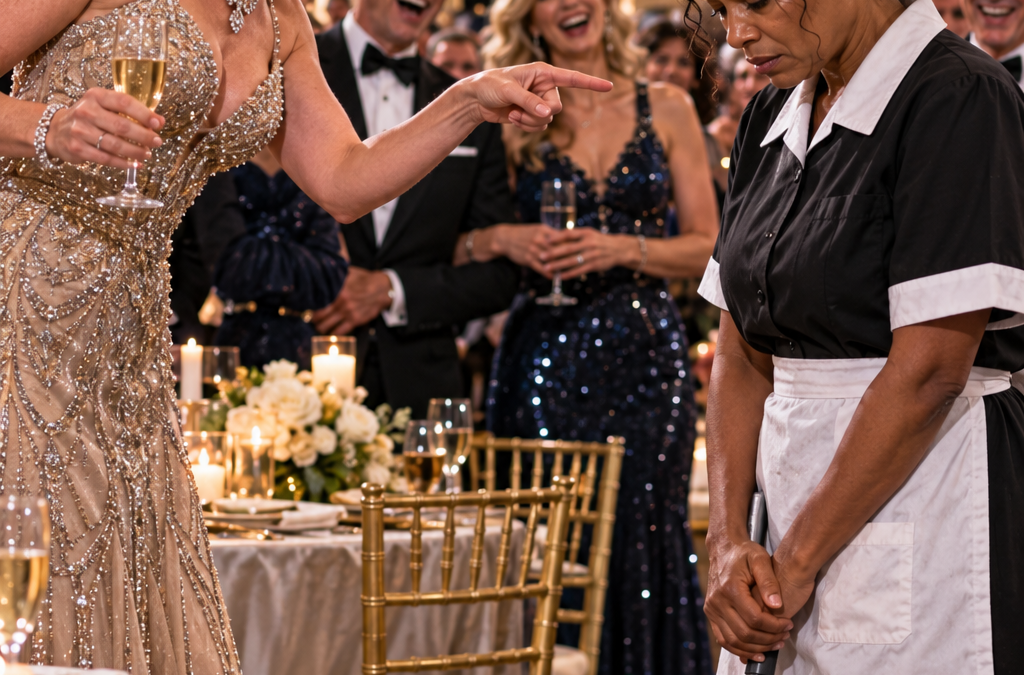
“She cleans my toilets.”
Laughter.
Not everybody.
Enough.
She looped her arm through mine.
I stiffened.
“Come on.”
She began walking me around the room.
Not introducing me.
Displaying me.
“The Hendersons.”
She smiled brightly.
“They practically own half of Connecticut.”
Mrs. Henderson looked at me.
Victoria continued:
“This is my cleaning lady.”
I offered my hand.
“Good evening.”
Mrs. Henderson hesitated before taking it.
Victoria laughed.
“She’s wearing a replica of Lorraine Harris’s dress.”
Mr. Henderson stared.
I watched his face.
Something flickered.
Maybe memory.
Then disappeared.
We moved on.
Group after group.
“My maid.”
“My cleaning woman.”
“She scrubs the floors.”
“Look at the dress.”
People laughed because Victoria was laughing.
That is how cruelty works in wealthy rooms.
People convince themselves participation is politeness.
At one point, Victoria took a champagne glass from a passing tray.
She raised it.
“To transformation.”
Then tilted it deliberately.
Champagne splashed across my shoulder.
Gasps.
“Oh!”
She covered her mouth.
Fake shock.
“So sorry.”
Her friends laughed.
I looked at the liquid running over the emerald fabric.
My hand shook once.
I forced it still.
“Excuse me.”
I took a napkin.
Victoria smiled.
“You know, it’s probably good for the material.”
I dabbed carefully.
The intern standing near us looked horrified.
Young Black woman.
Maybe twenty-three.
Staff badge from one of the sponsoring companies.
She whispered:
“Are you okay?”
Victoria heard.
“Oh, she’s fine.”
I looked at the young woman.
“I’m all right.”
Her eyes said she did not believe me.
Neither did I.
Victoria finally led me to table fourteen.
Behind a pillar.
Near the kitchen entrance.
Plastic cups.
Wilting flowers.
Unbalanced chairs.
Every major guest had crystal.
We had plastic.
My name card had been handwritten.
LORRAINE — HOUSEKEEPING.
Not Harris.
Housekeeping.
I sat.
Victoria leaned down.
“Enjoy your throne.”
I looked up.
“I intend to.”
Something in my tone made her pause.
Only a second.
Then she walked away.
At my table sat a junior intern.
A man whose date apparently never arrived.
Two people from catering administration.
Nobody spoke much.
The young Black intern from earlier eventually sat beside me.
Her name was Briana.
She whispered:
“I’m sorry.”
“For what?”
“This.”
“You didn’t do it.”
“I still hate that nobody is saying anything.”
I studied her.
“You noticed.”
“Yes.”
“That matters.”
“Doesn’t feel like enough.”
“It rarely does.”
Dinner arrived.
My steak was overcooked.
Bread stale.
Nobody refilled our water.
I ate anyway.
Across the room, Victoria filmed me with her phone.
Later I saw the caption.
She’s sitting there like she’s at a funeral.
I can’t breathe.
During the second course, a waiter bumped my chair.
Wine spilled onto my sleeve.
He apologized immediately.
“Ma’am, I’m so sorry.”
“It’s all right.”
Victoria shouted from across the room:
“Looks like the dress got an upgrade!”
Laughter.
My napkin tightened in my hand.
Briana looked ready to cry.
I leaned toward her.
“Don’t.”
“What?”
“Give them your tears.”
Her eyes moved to me.
“I’m not saying don’t feel it.”
I dabbed the stain.
“I’m saying choose who gets to see what belongs to you.”
She nodded.
The lights dimmed after dinner.
Victoria climbed the stage.
Spotlight.
Applause.
“Good evening!”
Three hundred people quieted.
She thanked donors.
Sponsors.
The organizing committee.
Then spoke about underprivileged youth.
Opportunity.
Dignity.
Giving back.
I almost laughed.
There are few things uglier than listening to somebody describe compassion while the person they have spent the evening humiliating sits thirty yards away.
Then Victoria smiled.
“I want to do something special.”
Something in my stomach tightened.
“We have a unique guest tonight.”
I knew.
“Lorraine?”
Spotlight swung.
Hit me.
“Stand up, honey.”
Three hundred faces turned.
I stood.
Victoria smiled down from the stage.
“This is Lorraine.”
Pause.
“She has cleaned our home for three years.”
Scattered applause.
Some guests already looked uncomfortable.
“And I thought, in the spirit of charity, why not let her experience how the other half lives?”
A few people laughed.
Not Briana.
“Lorraine, are you enjoying yourself?”
“Yes.”
My voice carried farther than I expected.
“Thank you.”
“Wonderful.”
Victoria turned.
A velvet-covered pedestal stood onstage.
Glass dome.
Under it—
I stopped breathing.
Gold.
Old metal.
Engraving.
L.H.
My microphone.
The room disappeared.
For a second, all I saw was that microphone.
My thumb remembered its weight before my hand touched it.
I had sold it seventeen years earlier.
An auction house in New York.
I refused to attend.
Denise handled paperwork.
I cried afterward.
Not because it was expensive.
Because it contained a thousand memories nobody else could see.
Sweat from concerts.
My hand shaking before the Grammys.
A tiny dent where I dropped it backstage after finding out Mama had been hospitalized.
I thought it was gone.
Now it sat ten feet away.
A rich woman’s auction item.
Victoria lifted the glass.
“This,” she announced, “is a genuine piece of American music history.”
She picked up the microphone.
“The personal microphone of Lorraine Harris.”
My eyes burned.
“One of the greatest singers of her generation.”
I nearly laughed at the cruelty of hearing Victoria praise me while staring directly at me without recognition.
“Starting bid tonight: one million dollars.”
The crowd murmured.
Phones lifted.
Then Victoria looked at me.
“Lorraine.”
Her smile returned.
“I hear you sing.”
Someone laughed.
“My staff says you hum constantly.”
More laughter.
“Every Tuesday.”
She tilted her head.
“Every Friday.”
“Like some broken radio nobody can switch off.”
Laughter grew.
Briana whispered:
“No.”
Victoria continued.
“I thought we could make this fun.”
She came to the edge of the stage.
“Come up here.”
I stayed still.
“Come on, sweetheart.”
Nobody moved.
She held out the microphone.
“Sing.”
The room murmured.
“If you can actually sing—”
She paused.
“Really sing—”
Her eyes glittered.
“I’ll give you this microphone.”
Someone gasped.
“No auction.”
She waved it.
“One million dollars.”
Then her voice sharpened.
“But if you embarrass yourself…”
She smiled.
“…you leave tonight and never come back into my house.”
A few people laughed nervously.
“Not as a guest.”
Pause.
“Not as a maid.”
She held the microphone against her chest.
“Nothing.”
I heard somebody near the stage say:
“This is cruel.”
Quietly.
Nobody stopped it.
That mattered.
People later claimed they were horrified.
I believe many were.
But horror that never leaves your chair can look very similar to approval.
I looked at the microphone.
My microphone.
Then the stage.
I had spent fifteen years avoiding stages.
Afraid my voice would fail.
Afraid it wouldn’t.
Because if I could still sing, then I had to confront what had been taken.
If I couldn’t, I would lose it twice.
I stepped forward.
Briana whispered:
“You don’t have to.”
I looked at her.
“I know.”
Then I walked.
The crowd parted.
My heels struck marble.
Each step sounded louder.
The dress caught the spotlight.
Green reflections scattered across the floor.
I climbed the stage.
Victoria stood grinning.
She shoved the microphone toward me.
“Make us feel something.”
There were laughs.
I took it.
The moment my fingers wrapped around the handle, the years disappeared.
Not all of them.
The pain stayed.
Age stayed.
Loss stayed.
But beneath everything, muscle memory woke.
My thumb found the dent.
My palm settled into the exact balance.
My shoulders lowered.
I closed my eyes.
Thirty thousand people.
Five Grammys.
Mama backstage.
Raymond laughing.
My daughter asleep in a tour bus bunk.
Every door closing.
Every newspaper lie.
Every silent phone.
Every floor I had scrubbed.
Every time Victoria called me girl.
Everything entered the same breath.
The ballroom went silent.
I began to sing.
I chose “Rise Again.”
My song.
No lyrics need repeating here.
People knew them.
Or once had.
The first note came softly.
Lower than when I was thirty.
Older.
Textured.
But mine.
The microphone carried it through the ballroom.
I heard the acoustic return from the far wall.
My body remembered where to place the sound.
Second phrase.
Then third.
I stopped thinking about Victoria.
That surprised me.
I was not singing to defeat her.
I was singing because the song belonged to me.
For fifteen years I had allowed silence to become a kind of punishment.
No more.
The first verse ended.
Nobody moved.
Then the chorus arrived.
I opened my voice.
Not recklessly.
Years of training do not disappear.
Breath supported.
Jaw released.
Chest open.
The sound filled the room.
I heard somebody gasp.
Someone whispered:
“I know that voice.”
Another:
“Oh my God.”
My eyes remained closed.
The bridge came.
That had always been the dangerous part.
Long climb.
High sustained line.
At thirty-two, I could sing it like steel.
At fifty-eight, I knew better.
Strength was not pretending age had done nothing.
I let the years into it.
The note cracked slightly.
For half a second, shame tried to enter.
Then I heard what the crack contained.
My mother.
Blacklisting.
Bankruptcy.
Cleaning buckets.
Loneliness.
Fifteen silent years.
It was not a flaw.
It was evidence.
I leaned into it.
The sound broke open.
People began standing.
One chair.
Then another.
Then rows.
I opened my eyes.
Victoria was no longer smiling.
Her arms remained crossed.
But her hands gripped her elbows so hard the knuckles were white.
Briana stood at table fourteen crying openly.
A man near the front had both hands over his mouth.
An older woman clutched her husband’s arm.
Somebody near the bar filmed.
I reached the final note.
Held it.
Not for applause.
For myself.
Then released.
Silence.
Absolute.
Three hundred people standing.
Nobody clapped.
Not yet.
They just stared.
Some looked like they had seen a dead woman walk through a wall.
Maybe they had.
Then from the back—
Clap.
Once.
Again.
Slow.
Deliberate.
I knew the rhythm of those hands before I saw the man.
My chest tightened.
Raymond Carter walked through the crowd.
Silver hair now.
Black tuxedo.
Same shoulders.
Same eyes.
Older.
He kept clapping as he approached.
People moved aside.
Whispers followed him.
Raymond Carter.
Chairman of Pinnacle.
Music legend.
He reached the stage.
Climbed.
Stopped in front of me.
For a few seconds, neither of us spoke.
His eyes were wet.
“So.”
His voice barely worked.
“You finally answer one of my invitations?”
I laughed through tears.
“You never invited me here.”
“I should have.”
He looked at the microphone.
Then at me.
“Lord, Lorraine.”
I could not answer.
He turned to the crowd.
Thirty years of authority settled into his posture.
“Most of you know me.”
Nobody moved.
“Some of you think you know what you just saw.”
He pointed toward me.
“You don’t.”
The room became still again.
“Thirty years ago, I stood beside this woman on stages across America.”
Victoria’s face drained.
“We came from nothing.”
Raymond looked at me.
“Church basements.”
“Street festivals.”
“Clubs with broken monitors.”
A small smile.
“We thought success would mean nobody could tell us we didn’t belong again.”
He faced the crowd.
“We were wrong.”
My throat tightened.
“This industry did not destroy Lorraine Harris because she lacked talent.”
His voice hardened.
“It destroyed her because she was Black.”
Silence.
“Because she was successful.”
“Because she owned too much of herself.”
“Because she asked questions.”
“Because men who were comfortable being called genius did not know what to do with a Black woman who expected the same respect.”
Victoria stepped backward.
Raymond continued.
“The woman standing beside me is not a maid you brought here for entertainment.”
He looked directly at Victoria.
“She is not a punchline.”
Victoria’s champagne glass slipped from her hand.
It shattered.
“She is Lorraine Harris.”
Gasps rippled.
“The Lorraine Harris.”
Mrs. Henderson’s hand flew to her mouth.
Raymond pointed toward my dress.
“That is not a replica.”
Victoria looked down.
“That is the original dress from Madison Square Garden.”
My torn shoulder bead caught the light.
“And that microphone?”
Raymond looked at it.
“It belongs in her hand more than anywhere else on Earth.”
Then he said:
“She is my oldest friend.”
His voice broke.
“And you spent an entire evening humiliating her because you believed the woman cleaning your home had no history worth learning.”
Victoria’s knees seemed to weaken.
Raymond faced her fully.
“You chose the wrong woman.”
Pause.
“And the wrong night.”
Applause exploded.
Not polite.
Not charity-gala applause.
Thunder.
People shouted.
Cried.
Stood higher as if they could stand twice.
I remained in the center.
For fifteen years, I had told myself I didn’t need recognition.
Mostly true.
But there is a difference between needing applause and needing reality acknowledged.
The world had rewritten me.
Difficult.
Unstable.
Washed up.
Forgotten.
Now the sound around me felt less like praise than correction.
I cried.
Didn’t hide it.
Victoria stumbled off the stage.
I thought she was leaving.
She wasn’t.
She pushed through guests.
Reached me.
Then dropped to her knees.
White designer gown against marble.
“Lorraine.”
Her voice shook.
“Ms. Harris.”
I looked down.
“I am so sorry.”
Nobody made a sound.
“I didn’t know.”
That sentence.
Of course.
“I swear.”
Tears streaked her makeup.
“If I had known…”
I raised one hand.
She stopped.
“If you had known what?”
Victoria blinked.
“I…”
“What?”
She looked around.
Three hundred witnesses.
I asked again.
“If you had known I was famous?”
She sobbed.
“That’s not what I—”
“If you knew I had Grammys?”
“No.”
“If you knew Raymond Carter loved me?”
Her mouth opened.
Nothing.
“If you knew people in this room might care what happened to me?”
She looked down.
I felt no satisfaction.
Only exhaustion.
“Victoria.”
She looked up.
“You are not sorry because I deserved better.”
“I am.”
“No.”
My voice stayed quiet.
“You are sorry because you discovered I had a name you respected.”
She shook her head.
“If I had been only your cleaning woman…”
I pointed toward the floor.
“…would you be kneeling?”
She could not answer.
“That is the problem.”
She cried harder.
“You invited me here to laugh.”
“I know.”
“You tore my dress.”
“I know.”
“You spilled champagne on me.”
“I’m sorry.”
“You paraded me around this room telling people I cleaned your toilets.”
Her face collapsed.
“You put me under a spotlight because you believed humiliating a poor woman would entertain your friends.”
“I’ll apologize publicly.”
I almost smiled.
“You already made it public.”
Silence.
“You just didn’t think the public would care.”
She lowered her forehead toward the marble.
I stepped away.
I did not touch her.
Forgiveness is not always the first obligation of the injured person.
Sometimes truth needs to remain uncomfortable for a while.
Raymond moved beside me.
But his attention had shifted.
Gregory.
Gregory Ellsworth sat at the VIP table.
Frozen.
Raymond said:
“Gregory.”
Gregory stood.
“Raymond.”
His voice shook.
“Mr. Carter.”
“Sit.”
Gregory sat immediately.
I looked at Raymond.
Something had changed in his face.
This was no longer personal memory.
Business.
Authority.
“I have known about you for eighteen months.”
Gregory’s skin went pale.
“Known about what?”
“Don’t insult me.”
Whispers moved through the room.
Raymond continued.
“The royalty discrepancies.”
Gregory gripped his napkin.
“The complaints from Black employees.”
“Raymond, I can explain—”
“The settlements.”
Gregory stopped.
“The employees transferred after reporting discrimination.”
Silence.
“The artists whose accounting mysteriously changed when they demanded audits.”
Gregory stared.
Raymond’s voice became almost gentle.
That made it worse.
“I built a file.”
Gregory looked physically ill.
“I intended to handle your removal privately.”
Victoria lifted her head from the floor.
Raymond looked toward her.
“Tonight changed that.”
“Her behavior has nothing to do with Pinnacle.”
Gregory spoke too quickly.
“My wife does not represent—”
“You sat here.”
Raymond interrupted.
Gregory stopped.
“You watched her humiliate a woman in front of this room.”
“I didn’t know—”
Raymond laughed without humor.
“There it is again.”
The same excuse.
“I didn’t know who she was.”
Gregory said nothing.
Raymond leaned slightly forward.
“A man who requires somebody to be important before he objects to cruelty is exactly the kind of man who buries employee complaints.”
Nobody moved.
“You are removed as executive vice president of Pinnacle Artists Management effective immediately.”
Gregory stared.
“No.”
Raymond did not blink.
“Yes.”
“You cannot do this here.”
“I just did.”
“My contract—”
“Has misconduct provisions you should have read more carefully.”
Gregory’s face turned red.
“My attorneys—”
“Will speak to ours.”
Raymond’s voice remained controlled.
“Your corporate access is revoked.”
“Accounts connected to the investigation are frozen pending audit.”
“And if the evidence confirms what I already know, law enforcement will receive everything.”
Gregory sat down slowly.
The empire surrounding Victoria and Gregory seemed to collapse without any physical movement.
Same mansion.
Same chandeliers.
Same champagne.
Nothing looked different.
Everything was.
Raymond turned to me.
“Ready?”
“Yes.”
I looked toward Briana.
She still stood beside table fourteen.
I walked to her.
“Thank you.”
Her eyes widened.
“For what?”
“For seeing me.”
“I didn’t do anything.”
“You noticed.”
She shook her head.
“I should have said more.”
“Next time.”
She swallowed.
“Next time.”
I handed the microphone to Raymond.
He looked at it.
“No.”
I frowned.
“It’s yours.”
“The auction—”
“Cancelled.”
“Raymond.”
“It was donated through Pinnacle’s archive.”
He placed it back in my hand.
“It should never have left you.”
I looked at the initials.
L.H.
For years, I had thought losing it represented losing myself.
I understood now that it had only been metal.
Meaning had remained in me.
Still, I held it.
“Thank you.”
I straightened the damaged shoulder of my dress.
Walked through the ballroom.
Nobody laughed.
Some people lowered their eyes.
Others smiled.
Several tried to speak.
I kept moving.
Past Victoria.
Past Gregory.
Past broken glass.
Out the front door.
The night air felt cold and clean.
The valet ran toward me.
“Ms. Harris—”
“Lorraine is fine.”
He opened the Honda door.
I got inside.
Turned the key.
Second try.
Third.
Engine started.
Gospel music crackled through the speakers.
I laughed.
Then cried.
Then drove home.
By morning, the video had millions of views.
I woke to 137 missed calls.
My phone nearly vibrated off the nightstand.
I turned it face down.
Made coffee.
The faucet dripped.
Drip.
Pause.
Drip.
The world was rediscovering Lorraine Harris.
I still had laundry.
By noon, the video was everywhere.
Victoria mocking me.
The challenge.
The first note.
Raymond’s reveal.
Multiple angles.
Close-ups.
Somebody had footage of the champagne.
Somebody else filmed the torn dress.
Then Victoria’s group chat leaked.
I invited the cleaning lady.
Film it.
Priceless.
No misunderstanding possible.
For once, racism and class cruelty had arrived with documentation.
The phrase LORRAINE HARRIS IS BACK began trending.
I hated it.
Back where?
I had never left myself.
But old performances resurfaced.
My Grammy speech.
Madison Square Garden.
Interviews.
Young musicians posted videos saying my records had taught them to sing.
Artists I had never met wrote messages.
Some apologized for believing old rumors.
That part hurt.
Because it reminded me how easily lies had worked.
An investigative journalist named Naen Brooks published a long feature.
She did not focus only on the gala.
She went backward.
Talked to former producers.
Employees.
Musicians.
People who admitted the blacklisting campaign had been real.
Names appeared.
Executives who once called me unstable suddenly refused comment.
Others said:
Different time.
Standards were different.
I hated that phrase too.
Cruelty does not become ethical because it was fashionable.
Pinnacle issued a statement about Gregory.
Removed.
Audit.
Cooperation with authorities.
Then women came forward.
Black women.
Former employees.
One said Gregory told her she should be grateful to have a seat at the table.
Another had been fired after reporting discriminatory promotion practices.
Another described royalty manipulation affecting Black artists.
Raymond had evidence.
They had testimony.
The state opened an investigation.
Gregory hired expensive lawyers.
Money finally had to fight documentation.
Victoria posted an apology video two days after the gala.
I watched once.
Living room.
No makeup.
Soft lighting.
“I take full responsibility.”
Maybe she meant it.
Maybe humiliation had finally taught her something.
But then she said:
“I never intended for anyone to be hurt.”
I turned it off.
Intent is the favorite hiding place of people confronted with consequence.
I didn’t mean.
I didn’t know.
I didn’t realize.
Sometimes what matters is what you chose while believing your victim had no power.
Her charity board removed her.
Sponsors disappeared.
The Ellsworth Foundation dissolved.
Her friends scattered.
One claimed she had always been uncomfortable with Victoria’s behavior.
That woman had laughed louder than anybody.
The mansion went on the market after Gregory and Victoria separated.
I heard about all of it.
I enjoyed none of it.
That confused reporters.
“Do you feel vindicated?”
“No.”
“Why?”
“Because losing everything does not teach somebody humanity automatically.”
“What would?”
“I don’t know.”
“And you don’t want revenge?”
“I wanted the behavior to stop.”
That was true.
I gave one interview.
Naen came to my house.
No studio.
No makeup team.
My kitchen.
Chipped mug.
Faucet.
She sat across from me.
“Why did you go?”
“To the gala?”
“Yes.”
I thought about Mama.
“My mother cleaned houses.”
“For forty-two years?”
“Yes.”
“She endured a lot?”
“Yes.”
“Why?”
“Survival.”
Naen waited.
“I think I spent years believing survival required disappearing.”
I looked at my hands.
“Then Victoria invited me because she thought my invisibility was funny.”
“So you wore the dress.”
“Yes.”
“To show her who you were?”
I shook my head.
“No.”
“Then why?”
“To remind myself.”
That answer surprised even me.
Naen asked about singing.
I looked toward the microphone on my counter.
“I did not sing to prove I was Lorraine Harris.”
“What did you sing for?”
“Because she put my microphone in my hand.”
I smiled faintly.
“And something in me said, enough.”
“Enough what?”
“Enough letting other people decide whether my gift still belonged to me.”
I thought about the crack in the bridge.
“People keep telling me my voice sounded imperfect.”
Naen looked shocked.
“Who?”
“Musicians.”
“Not as criticism.”
“Oh.”
I nodded.
“They say the break made it beautiful.”
“Did it?”
I considered.
“Yes.”
“Why?”
“Because thirty years ago, I would have hidden it.”
I touched my throat.
“That night I let the break exist.”
“And?”
“It sounded like my life.”
The interview spread almost as fast as the performance.
Two weeks later, Raymond called.
I answered.
“Before you say anything—”
“I’m listening.”
“I need somebody.”
“No.”
“You don’t know what I’m asking.”
“If it involves touring, no.”
“It doesn’t.”
“Recording?”
“No.”
“Television?”
“No.”
“Then what?”
“Gregory’s job.”
I laughed.
Long.
“Raymond.”
“I’m serious.”
“I cleaned that man’s house.”
“Exactly.”
“That is not executive experience.”
“You ran your own touring operation when half the men around you were spending money they couldn’t count.”
“That was different.”
“You negotiated publishing rights in 1992 when artists twice your age didn’t understand them.”
“Raymond.”
“You know this industry from both ends now.”
That stopped me.
He continued.
“You know what it feels like when they worship you.”
Silence.
“And what it feels like when they decide you are disposable.”
I sat.
“I need someone I trust.”
“Hire a lawyer.”
“I have twelve.”
“An executive.”
“I have twenty.”
“Then why me?”
His voice softened.
“Because the people being exploited need somebody who remembers what exploitation feels like.”
I looked at Mama’s photograph.
Dorothy Harris.
Cleaning uniform.
Standing beside me after my first Grammy.
She had worn the same inexpensive church dress she owned for ten years.
I remembered executives ignoring her because they assumed she was staff.
Then discovering she was my mother.
Suddenly:
Mrs. Harris.
Can we get you anything?
Different voice.
Same people.
I had spent my whole life watching respect appear after connection to power was revealed.
Victoria was simply the ugliest version.
“I’m not going back onstage.”
“I’m not asking.”
“You promise?”
“I promise.”
I looked at the microphone.
“What exactly would the title be?”
“Executive vice president.”
I laughed again.
“What?”
“I spent three years cleaning the previous executive vice president’s toilets.”
“Then you already know where all his dirt is.”
I laughed so hard I had to put the phone down.
Raymond waited.
When I picked it up:
“You’re terrible.”
“Is that yes?”
I looked at Mama.
“Yes.”
Six months later, I sat on the thirty-second floor of Pinnacle Artists Management.
Manhattan below me.
Glass walls.
Sunlight.
A desk large enough to sleep on.
I wore a black blouse.
No diamonds.
Gold locket.
Mama’s photograph on the desk.
My U48 microphone beside it.
Not trophy.
Reminder.
First week, I ordered an audit.
Every contract involving artists of color.
Every complaint.
Every confidentiality agreement connected to discrimination allegations.
People became nervous.
Good.
Sixteen contracts required renegotiation.
Four were predatory enough that we terminated them completely.
I created the Harris Initiative.
Young Black artists.
Independent legal review.
Financial literacy.
Contract education.
Mental-health support.
A route to report management abuse without reporting directly to the people accused.
The first board meeting was ugly.
One director said:
“Are we overcorrecting because of one unfortunate public incident?”
I looked at him.
“Which incident?”
He shifted.
“The gala.”
“Gregory skimmed royalties before the gala.”
Silence.
“Employees reported discrimination before the gala.”
Another director said:
“But the publicity—”
I raised one hand.
“We are not fixing publicity.”
I leaned forward.
“We are fixing behavior.”
No one argued after that.
Briana came to work for me.
The intern from table fourteen.
She interviewed.
I refused to hire her automatically.
She got annoyed.
“I thought you asked me to apply.”
“I did.”
“Then why three interviews?”
“Because if you get the job, nobody gets to say you got it because you cried at a gala.”
She stared.
Then smiled.
“Fair.”
She got the job.
First morning, she placed a mug on my desk.
WORLD’S BEST BOSS.
I looked at her.
“You have known me professionally for forty-three minutes.”
“I’m optimistic.”
“Dangerous habit.”
She laughed.
Tomas came too.
The Ellsworth estate sold.
He needed work.
Pinnacle needed facilities leadership.
His references were excellent.
Every morning, he brought coffee.
Not because that was his job.
Because we were friends.
“Still singing?” he asked one morning.
“Sometimes.”
“Good.”
Raymond visited once a week.
Sometimes business.
Sometimes music.
We sat listening to records from our youth.
One afternoon, he said:
“One concert.”
“No.”
“Lorraine.”
“No.”
“Madison Square Garden.”
“No.”
“Sold out in five minutes.”
“You already checked?”
He smiled.
“Hypothetically.”
“Raymond.”
“The world would lose its mind.”
I looked at the microphone.
Then at him.
“I already had my encore.”
He became quiet.
“The gala?”
“Yes.”
“That was enough?”
I thought about three hundred people standing.
Not the applause.
The note.
The moment my voice returned to my own body.
“Yes.”
Raymond smiled.
“Then I guess it was.”
People still asked what happened to Victoria.
The mansion sold.
Divorce finalized.
She moved.
Someone photographed her carrying groceries in the rain.
The internet mocked her.
I hated that.
Not for Victoria.
For us.
We claim to condemn cruelty, then celebrate when the target changes.
I never shared the photo.
Never commented.
Eventually people stopped caring.
That might have been the hardest consequence for somebody like Victoria.
Not poverty.
Not smaller rooms.
Irrelevance.
Gregory faced charges.
Fraud.
Embezzlement.
Workplace discrimination claims.
Assets frozen.
His name disappeared from the power lists he had once studied obsessively.
Other entertainment companies began auditing themselves.
Not out of morality.
Fear.
Sometimes fear is the first draft of reform.
Two executives elsewhere resigned.
Complaints resurfaced.
Artists demanded accounting.
Things moved.
Slowly.
Messily.
Better than not moving.
One night, long after everyone left Pinnacle, I sat alone in my office.
Manhattan lights beneath the windows.
Mama’s picture.
Locket.
Microphone.
I picked it up.
Heavy.
Familiar.
For years, I believed my career had been stolen.
In many ways, it had.
Money stolen.
Opportunities.
Time.
Reputation.
But sitting there, I understood something that would have sounded sentimental to the younger me.
They took the stage.
They never took the voice.
I gave them that.
I confused access with ability.
Recognition with existence.
When the radio stopped playing me, I thought the song had stopped.
It hadn’t.
It followed me into the kitchen.
The Honda.
The Ellsworth hallways.
It lived inside every note Victoria found annoying.
She thought I was humming because I had nothing better.
I was humming because music was still where it had always been.
Inside me.
I brought the microphone close.
Not connected to anything.
Closed my eyes.
Hummed.
A small melody.
Nothing anybody would buy.
Nothing anyone recorded.
Just mine.
Weeks later, I visited Mama’s grave in Hartford.
I hadn’t been in months.
I carried no flowers.
She hated cut flowers.
“Dead things pretending to be alive,” she called them.
I brought a small lavender plant.
Set it down.
Sat on the grass.
“Mama.”
Wind moved through trees.
“You were right about work.”
I smiled.
“But wrong about swallowing everything.”
I imagined her getting offended.
“What you mean, girl?”
I laughed.
“You survived so I could argue.”
That felt true.
She had put her head down because somebody had to get us through.
I had the luxury of standing up partly because she had endured.
Different generations carry different responsibilities.
I did not judge her anymore.
I thanked her.
Then I told her about the gala.
The dress.
The microphone.
Raymond.
She would have liked that part.
Especially Victoria not recognizing me.
Mama had a vicious sense of humor when appropriate.
I told her about Pinnacle.
The Harris Initiative.
Briana.
Contracts changing.
At the end, I said:
“I think I’m doing something useful.”
A bird landed near the marker.
Probably coincidence.
I chose to take it as approval.
When I returned to Manhattan, there was a new artist waiting in my office.
Nineteen years old.
Black girl from Alabama.
Voice like smoke and church bells.
Her manager wanted her to sign a contract giving away most of her publishing.
She sat nervously.
“I don’t understand any of this.”
I looked at the agreement.
“Good.”
She frowned.
“Good?”
“You know you don’t understand.”
I took out a pen.
“That means nobody gets to rush you.”
Her manager started:
“We have deadlines—”
I looked at him.
“No.”
He stopped.
I turned back to her.
“Your songs belong to you until you decide otherwise.”
Her eyes widened.
“They said everybody signs something like this.”
“Everybody says many things when they want your signature.”
We spent two hours.
Clause by clause.
When she left, she hugged me.
I stood alone afterward.
That felt bigger than a standing ovation.
Because nobody had done that for me.
Not early enough.
The industry had taught artists to mistake access for generosity.
A seat at the table.
A contract.
A tour.
Be grateful.
Sign here.
Don’t ask.
I knew that language.
So did every person Gregory had exploited.
I could not recover my twenties.
Could not rebuild every opportunity stolen.
But I could stand at a different door now.
That was enough purpose for one life.
A year after the gala, Victoria wrote me.
Handwritten.
No publicist.
No social media.
Four pages.
She did not ask forgiveness.
That surprised me.
She wrote about starting therapy.
About her mother.
About growing up believing status determined safety.
About learning how often she had treated service workers as extensions of rooms instead of people.
She did not excuse herself.
At the bottom:
I understand now that the worst thing I said that night was not any insult. It was “I didn’t know.” I should not have needed to know who you were.
I read that sentence three times.
Then put the letter away.
I did not answer.
Not because I wanted to punish her.
Because change did not need my certification.
If she became better, good.
She could live it.
I was not required to witness the process.
That was freedom too.
The dress was repaired.
The original designer had died.
His daughter restored it.
When she saw the tear, she cried.
“My father loved this dress.”
“So did I.”
She replaced the damaged thread.
Matched the crystals.
The champagne stain came out.
When she finished, she asked:
“Are you going to wear it again?”
I touched the shoulder.
“No.”
“Archive?”
“Maybe.”
“You should preserve it.”
I smiled.
“I think it preserved me.”
Eventually, it went into an exhibit.
Not because it was expensive.
The exhibit was about Black women in American music.
My dress stood behind glass.
A plaque explained Madison Square Garden.
The gala.
My return.
I insisted the cleaning apron be displayed beside it.
The curator objected.
“The apron?”
“Yes.”
“It may confuse the visual narrative.”
“That is the narrative.”
So there they stood.
Emerald dress.
Gray apron.
Same woman.
Visitors took photographs.
Some stared longer at the apron.
Good.
I never wanted people to think the dress represented who I truly was and the apron represented some fall from grace.
Both were work clothes.
One for singing.
One for cleaning.
The cruelty came from people deciding one deserved applause and the other deserved contempt.
Years after the gala, somebody asked Briana what she remembered most.
She could have said the song.
Raymond.
Victoria kneeling.
Instead she said:
“Lorraine thanked me.”
The interviewer asked why that mattered.
Briana answered:
“Because I had done almost nothing.”
I watched the clip.
She continued:
“I thought feeling bad made me good.”
Pause.
“She taught me noticing is only the beginning.”
That made me proud.
Briana became a senior executive eventually.
Brilliant.
Tough.
Impossible to intimidate.
At her promotion dinner, she raised a glass.
“To table fourteen.”
I laughed.
“Nobody else knows what that means.”
“We do.”
That was enough.
Raymond grew older.
So did I.
One evening, we sat in my office after sunset.
He looked at the microphone.
“You know I kept looking for you.”
“I know.”
“You were good at disappearing.”
“I had practice.”
“I was angry.”
“I know.”
“At you.”
I turned.
“That I didn’t know.”
I thought about Victoria.
Same words.
Different meaning.
Raymond said:
“I thought friendship meant I should have been able to find you.”
“It didn’t.”
“I know now.”
He looked at me.
“Why did you really disappear?”
That question deserved honesty.
“Shame.”
He frowned.
“You had nothing to be ashamed of.”
“That doesn’t stop shame.”
I looked toward Manhattan.
“I had been Lorraine Harris.”
“Then suddenly I couldn’t pay my lawyer.”
Silence.
“I didn’t want anybody who remembered me on a stage to see me falling.”
Raymond’s eyes softened.
“You thought I’d see you differently?”
“No.”
I swallowed.
“I thought I would see myself through your eyes.”
He understood.
That was the thing about old friends.
Sometimes they understand the sentence beneath the one you say.
He reached across the desk.
Took my hand.
“I would’ve loved you cleaning houses.”
“I know.”
“Working at Walmart.”
“I know.”
“Selling hot dogs.”
“Raymond.”
“I’m making a point.”
“You’re ruining it.”
He smiled.
Then:
“You were never the stage.”
I looked at him.
“No.”
I smiled.
“Turns out I was the voice.”
He nodded.
Years later, people still circulated the gala video.
New generations discovered it.
They watched the rich woman challenge the maid.
They knew the reveal before they clicked.
That changes the story.
Suspense disappears.
But something else remains.
The moment before I sing.
I watch myself sometimes.
Not often.
In that second, nobody in the room except me knows the truth.
Victoria thinks I am powerless.
Guests think I am trapped.
Raymond has not appeared.
Gregory still has his job.
The world has not corrected anything.
I am standing alone with a microphone.
That is my favorite moment.
Not the note.
Not applause.
Not recognition.
Decision.
I could have walked away.
No shame in that.
I could have handed the microphone back.
No weakness.
But I chose to sing.
Not because I knew I would win.
I did not know Raymond was there.
I did not know the video would spread.
I did not know Victoria’s messages would leak.
I knew only one thing.
The microphone was in my hand.
The song was mine.
My voice still existed.
That had to be enough.
When I teach young artists now, I tell them the same thing.
Do not build your identity from applause.
Applause is rented.
So is criticism.
Charts.
Contracts.
Headlines.
Followers.
All rented.
Skill is different.
Character is different.
What you practice when nobody is listening becomes yours.
For fifteen years, I sang where nobody cared.
Kitchen.
Car.
Hallways.
I thought those years were empty.
They weren’t.
They kept the instrument alive.
The gala did not give me my voice back.
The gala revealed I had never lost it.
That distinction became the ending I needed.
Not Victoria losing everything.
Not Gregory facing charges.
Not me becoming an executive.
Those were consequences.
The ending was quieter.
One morning, years later, I woke before sunrise.
Made coffee.
My apartment had changed by then.
Nicer place.
The faucet did not drip.
Coffee maker worked without sounding terminal.
But I still used the chipped mug.
I stood at the window.
Manhattan slowly turned gray.
And I began to hum.
No audience.
No microphone.
No dress.
Just me.
The first note floated into an empty kitchen.
Then another.
I smiled.
For decades, people had argued about what happened to Lorraine Harris.
Did the industry destroy her?
Did racism bury her?
Did she disappear?
Did she make a comeback?
They were all asking the wrong question.
I had never stopped being Lorraine.
I simply spent fifteen years in rooms where nobody bothered to ask who the woman holding the mop had been before she entered.
Victoria Ellsworth looked at my apron and believed she knew my entire life.
Then she looked at my emerald dress and believed she knew that too.
She was wrong both times.
That became the lesson I carried farther than any song.
Never confuse the role you see someone performing with the totality of who they are.
The person cleaning your floor may once have filled stadiums.
The waiter carrying your plate may be studying engineering.
The woman beside you on the bus may have buried a child that morning.
The man loading your groceries may speak four languages.
Or maybe none of those things are true.
Maybe the cleaning woman is simply a cleaning woman.
That should still be enough.
She should not need Grammys before you call her ma’am.
She should not need a billionaire friend before you stop laughing.
She should not need a legendary name before her humiliation becomes wrong.
That was what Victoria understood too late.
And what I finally understood for myself.
My dignity had never been hidden in the emerald dress.
It was not inside the gold microphone.
It did not return when three hundred people stood.
It had been there on my knees beside Victoria’s baseboards.
In my Honda.
In my small kitchen.
In every morning I got up after the world had decided I was finished.
That woman deserved respect before anyone recognized her.
I wish I had understood that sooner.
But I understand it now.
Some nights, when Pinnacle is empty and the city glows below my office, I still pick up that old U48.
The gold plating has scratches.
My initials are worn.
The dent beneath my thumb remains.
I hold it.
Close my eyes.
And remember the ballroom.
Not Victoria.
Not the laughter.
Not Raymond.
The breath.
That first breath before the first note.
The instant when I stood between fifteen years of silence and whatever came next.
People say the room remembered me when I began to sing.
Maybe.
What mattered was that I remembered myself.








