𝗙𝗨𝗟𝗟 𝗦𝗧𝗢𝗥𝗬 The Billionaire CEO Gave Me 72 Hours to Fix Her $52 Million Ferrari After Deciding a Black Technician Like Me Had No Business Touching It
𝗣𝗔𝗥𝗧 𝟮
Their combined consulting fees exceeded two hundred thousand dollars.
They changed ignition components.
Fuel components.
Spark plugs.
Coils.
Injectors.
They checked timing.
Compression.
Valve clearances.
Fuel delivery.
Wiring.
Nothing solved the problem.
Garrett Nolan took over after they left.
He replaced more parts.
Ran more scans.
Logged more hours.
The Ferrari remained in the lobby, silent behind velvet ropes.
Every morning, I walked past it on my way to the engineering floor.
And every morning, I stopped for three or four seconds.
Nothing dramatic.
I just looked.
The first time Darnell caught me doing it, he grabbed my arm.
“Don’t.”
I turned toward him.
“Don’t what?”
“Look at that car like that.”
“Like what?”
“Like you’re thinking.”
I laughed softly.
He didn’t.
“I’m serious. That Ferrari is her heart. Garrett’s already bleeding over it. You get involved, they’ll bury you.”
I looked at the car again.
The left side of the hood sat almost imperceptibly higher than the right.
Not enough to mean anything by itself.
But it bothered me.
Machines have posture.
People forget that.
A machine under stress carries that stress somewhere.
In vibration.
Alignment.
Heat.
Wear.
Sound.
Sometimes all you need to do is stop trying to make the machine confess in the language you expect.
You listen in the language it chooses.
Something about that Ferrari was speaking.
I just hadn’t heard enough yet.
Garrett gave me my first lesson in Caldwell culture on my third day.
He called me into the parts warehouse.
Rows of shelves stretched almost wall to wall.
Thousands of bolts, seals, gaskets, bearings, brackets, washers, clips, fittings, and specialty components.
He handed me a clipboard.
“Inventory.”
I looked around.
“All of it?”
“All of it.”
“Scanner?”
He smiled.
“No.”
“Computer?”
“No.”
“Spreadsheet?”
“Paper and pencil.”
He started walking away, then turned.
“Should take you about a week. Assuming you can count that high.”
Two engineers near the door laughed.
I finished in two days.
Every component counted.
Every shelf corrected where the previous inventory was wrong.
Every item organized.
Garrett looked through my sheets.
He didn’t thank me.
He dropped the clipboard on the floor.
“Do it again.”
“Why?”
“I don’t trust your count.”
So I did.
The second inventory matched the first exactly.
When I handed it back, Garrett stared at the numbers for nearly a minute.
Then he walked away.
No apology.
No acknowledgment.
Nothing.
The second lesson came five days later.
My car disappeared from the employee lot.
It was a 2006 Honda Civic with a salvage title.
Not pretty.
Not expensive.
But I had rebuilt most of it myself.
The security office told me it had been towed because the vehicle did not match employee records.
I showed them my registration.
My parking authorization.
My badge.
They shrugged.
The towing yard was three miles away.
I walked.
The next morning, the Civic was towed again.
Same explanation.
Same expressionless security guard.
I walked three miles back to work in nearly one-hundred-degree Texas heat.
When I entered Bay Four, sweat had soaked the back of my shirt.
Garrett looked at me.
“Somebody hose down the floor. Charity hire’s leaking.”
Several engineers laughed.
One young technician named Powell looked at the ground.
That bothered me more than the laughter.
Cruel people tell you who they are.
Silent people make you wonder who they might have been if courage cost less.
The third lesson came during my second week.
I was in the break room during lunch reading a company-library manual on Ferrari V12 valvetrain geometry.
Sloan Caldwell entered on her way to the executive elevator.
She saw me.
Then she saw the book.
She stopped.
“What is that?”
“A technical manual, ma’am.”
“I can see that.”
She crossed the room and pulled it from my hands.
“What I don’t understand is why someone like you thinks he can understand it.”
The room went quiet.
Three employees were eating nearby.
Nobody moved.
Sloan held the book between two fingers.
Then she dropped it into the trash.
“Stick to what you’re good at.”
She looked toward the mop closet.
“Mopping.”
Then she left.
The elevator doors closed.
I stood.
Walked to the trash.
Pulled the manual out.
Coffee grounds were stuck to the cover.
I wiped them away with my sleeve, sat back down, found my page, and continued reading.
Darnell came in about ten minutes later.
He stared at the book.
“You really pulled it back out?”
“The book didn’t do anything wrong.”
“I saw what happened.”
“So?”
“So you’ve got to understand where you are.”
“I understand exactly where I am.”
He sat opposite me and lowered his voice.
“Thirteen.”
“What?”
“Thirteen people came through that diversity program before you in three years.”
I waited.
“You know how many are still here?”
“You.”
“Me.”
He leaned closer.
“Everybody else quit or got pushed out. They give you trash assignments. They freeze you out of meetings. They make you feel stupid. They humiliate you until eventually you leave. Then HR writes ‘not a culture fit’ and everybody goes home clean.”
I closed the manual.
“I’m not quitting.”
“That’s what number six said.”
I looked at him.
“And number nine.”
I said nothing.
“And number twelve.”
I opened the book again.
“I’m not them.”
Something in my voice ended the conversation.
What Darnell didn’t know was that I had been underestimated for most of my life.
The faces changed.
The words changed.
The reasons changed.
The pattern didn’t.
Fifteen years earlier, I was thirteen years old in a small house on Sixty-Third Street on Chicago’s South Side.
My mother was serving a seven-year prison sentence.
My father existed only as a name on my birth certificate.
My grandmother Dorothy raised me on Social Security checks, discipline, and a refusal to let circumstances tell me what I was worth.
Every morning, she woke before sunrise.
Breakfast at five-thirty.
School shirt pressed.
Shoes checked.
And before I walked through the front door, she made me repeat the same sentence.
“You are not what they say you are.”
“Yes, ma’am.”
“Say it back.”
“I am not what they say I am.”
Behind our house stood a detached garage that had belonged to my grandfather, Curtis Lawson.
Curtis had served in Korea with the Army, repairing jeeps, generators, transport trucks, and anything else that broke badly enough to strand somebody.
He came home in the 1950s with a Bronze Star, a damaged knee, and a gift in his hands that people talked about for decades.
Chicago repair shops didn’t exactly compete to hire Black mechanics back then.
So Curtis built his own shop behind his house.
One bay.
Old lift.
Used tools.
Twenty dollars a job when he started.
People found him anyway.
Chevrolets.
Fords.
Chryslers.
Diesels.
Motorcycles.
Sometimes a European car came down from the wealthier neighborhoods because somebody had heard about the Black mechanic on the South Side who could diagnose a problem by listening to an engine idle.
Curtis died when I was eight.
Heart attack.
Quick.
No warning.
The garage stayed almost untouched afterward.
When I turned thirteen, I discovered seventeen spiral notebooks on a shelf above his workbench.
Forty years of handwritten mechanical knowledge.
Every engine he opened.
Every failure he diagnosed.
Every unusual sound.
Every repair.
Valve timing.
Compression.
Clearances.
Gear ratios.
Torque patterns.
Vibration notes.
Fuel problems.
Sketches.
Cross-sections.
Measurements written in handwriting so precise it looked machined.
And on the cover of every notebook, he had written the same sentence.
The engine don’t care who’s turning the wrench.
I understood the words immediately.
I didn’t understand the weight of them until years later.
Behind the garage sat a rusted 1971 Mustang engine block half buried beneath weeds.
I dragged it inside.
For two years, I rebuilt it.
No formal teacher.
No expensive equipment.
Just Curtis’s notebooks, library books, borrowed manuals, patience, mistakes, and stubbornness.
I learned that a properly seated connecting rod had a sound.
So did a bearing with too much clearance.
A healthy cylinder had rhythm.
A damaged mount changed how vibration traveled through a block.
Metal spoke.
Not in sentences.
In frequencies.
Resistance.
Heat.
Movement.
By fifteen, I had that Mustang engine running.
Mrs. Tate from down the block heard it.
She showed up the next morning with her Buick.
“Curtis’s grandson?”
“Yes, ma’am.”
“Fix my car.”
I did.
By eighteen, I had rebuilt or repaired forty-three engines.
Cars.
Trucks.
Motorcycles.
Lawn equipment.
A boat motor.
Even an antique tractor somebody hauled in from outside the city.
I taught myself robotics later.
Free university courses.
Used laptop.
Actuators.
Control systems.
Servo motors.
Kinematic chains.
Automation.
I applied to engineering programs.
Two accepted me.
I couldn’t afford to go.
Tuition assistance existed.
Rent still existed too.
Food existed.
My grandmother’s medication existed.
So I stayed.
Worked.
Learned.
Fixed machines.
By twenty-six, I had knowledge nobody could see on my résumé because résumés ask where you learned something, not whether you actually know it.
Caldwell Dynamics interested me because they built the kind of things I loved.
Precision machines.
Robotic systems.
Rare engines.
I knew I would start at the bottom.
I did not expect them to work so hard to keep me there.
Then came the company cocktail party.
Late September.
Two hundred guests.
Investors.
Collectors.
Clients.
Executives.
A string quartet.
Open bar.
The Ferrari in the center of the lobby.
Still broken.
Still beautiful.
Still humiliating Sloan every time someone asked why it didn’t run.
I attended in a white shirt and black vest because management had reassigned several junior technical employees to hospitality duty.
At 8:47 p.m., I was carrying an empty champagne tray when Harlon Foster, a silver-haired investor and board member, stopped beside the Ferrari.
He tapped a finger against the fender.
“Fifty-two million dollars and it just sits there.”
People nearby laughed.
Sloan smiled tightly.
“We’re working on it, Harlon.”
“You’ve been working on it six months.”
More laughter.
“I’ve seen faster progress at the DMV.”
That laugh hurt her.
I could see it.
Her hand tightened around her glass.
Then I walked past the Ferrari.
And like I had done every morning for two weeks, I stopped.
Three seconds.
Maybe four.
I looked toward the engine bay.
Tilted my head.
Vivian Cross, Sloan’s social-media director, noticed.
She laughed.
“Oh my God, Sloan. Your janitor is inspecting the Ferrari.”
Heads turned.
I should have kept walking.
Maybe some part of me knew that.
But I had spent two weeks listening every time Garrett started the engine.
I had watched the chassis.
Seen the hood alignment.
Heard the vibration.
I finally had a theory.
Sloan crossed the lobby.
“What are you looking at?”
“Your car.”
“I can see that.”
She stepped closer.
“What do you think you’re doing?”
“Listening.”
That got another laugh.
Sloan’s face hardened.
“You think you know what’s wrong with it?”
I looked at the Ferrari.
Then back at her.
“Yes, ma’am.”
The laughter became louder.
Garrett pushed through the crowd.
“Go ahead,” he said. “This should be good.”
I pointed toward the rear of the engine.
“Your engine mount is cracked.”
Sloan stared at me.
Then her face twisted.
“Excuse me?”
“Rear left mount. Small fracture. I think that’s where the vibration is coming from.”
She grabbed my collar.
That was when she called me an idiot.
A cockroach.
Asked whether I believed I was smarter than three European engineers.
I told her I could fix it.
She asked how long.
I said seventy-two hours.
And she turned my answer into a joke.
Fix it and she would marry me.
Fail and I would owe her ten times the Ferrari’s value.
Five hundred and twenty million dollars.
She expected fear.
Instead, I accepted.
At six the next morning, I walked into the empty atrium carrying my tool bag.
The Ferrari sat beneath white lights.
I placed the bag on the marble floor.
For a moment, I simply stood there.
Then I pulled out a small brass hammer.
Its head was scratched and dull.
Electrical tape wrapped the handle.
My grandfather had put that tape there decades earlier.
I carried the hammer because it reminded me that knowledge did not become less true because powerful people refused to recognize where it came from.
I walked around the Ferrari twice.
Studied the panel gaps.
Crouched near the rear wheel.
Placed a palm against the body.
Closed my eyes.
At seven-fifteen, employees began arriving.
By seven-thirty, word had spread.
By eight, the mezzanine above the atrium was crowded.
Engineers.
Technicians.
Managers.
Interns.
People who had ignored me for two weeks suddenly had nothing more important to do.
Sloan arrived around eight-twenty and sat inside the glass VIP lounge overlooking the floor.
Vivian had placed a phone on a tripod.
She was live-streaming.
Twelve thousand viewers.
Then twenty thousand.
Then more.
Sloan posted a caption telling millions of followers that her janitor thought he could repair a fifty-two-million-dollar Ferrari.
Garrett stood at the railing.
“This is painful already,” he shouted.
Laughter rolled across the mezzanine.
I opened the hood.
Then I began tapping.
Three light strikes.
Pause.
Listen.
Move.
Three strikes.
Pause.
Listen.
Move again.
The brass hammer was not magic.
Neither was I.
Metal conducts vibration.
Different structures resonate differently depending on density, tension, cracks, looseness, geometry.
Curtis called unexpected secondary resonance a shadow voice.
Notebook Four.
Page Eleven.
A healthy machine speaks clean.
A sick machine has another voice underneath.
Find the shadow.
Find the sickness.
For forty-five minutes, I tapped and listened.
Garrett shouted jokes.
Someone asked whether I needed incense.
Vivian’s livestream captions mocked me.
Sloan drank coffee.
I kept moving.
Then I reached the area near cylinder five.
Tap.
Pause.
Something.
I did it again.
There.
A faint secondary harmonic.
Not inside the cylinder.
Below it.
I put the hammer down.
Pulled out an automotive stethoscope.
Pressed the metal probe against the left rear engine mount.
Moved a few millimeters.
Listened.
Moved again.
Listened.
I felt my heartbeat slow.
There it was.
I looked up.
Darnell stood near the back of the mezzanine.
Our eyes met.
I nodded once.
His expression changed.
At 9:52, an older woman entered the lobby.
I didn’t know who she was.
Not then.
She wore a charcoal blazer, silver-rimmed glasses, and the kind of expression that made security guards reconsider asking questions.
Eleanor Voss.
Sixty-four years old.
Nearly four decades in automotive diagnostics.
Former head of a major American automaker’s diagnostic-engineering division.
One of the people who had helped establish resonance-mapping methods used across the industry.
Now chair of the National Automotive Heritage Council.
Someone had sent her the livestream while she was attending an automotive heritage conference in Austin.
She watched me use the hammer and stethoscope.
Recognized what I was doing.
And came to Caldwell Dynamics personally.
Sloan rushed downstairs when she learned who had entered her building.
“Ms. Voss,” she said. “What an honor. I apologize for this spectacle. Our maintenance worker has apparently decided he’s an engineer.”
Eleanor didn’t look at Sloan.
She watched my hands.
“Your maintenance worker is performing a resonance diagnostic most certified engineers have never learned.”
Sloan’s smile disappeared.
Eleanor finally looked at her.
“I’d be quiet and watch.”
I heard about that exchange later.
At the time, I was still listening.
Finally, I removed the stethoscope and stood.
“The engine is fine.”
Garrett leaned over the railing.
“What?”
“The engine itself is fine.”
His face reddened.
“That’s ridiculous.”
“The valves aren’t the problem. The pistons aren’t the problem. The ignition system isn’t the root problem. Neither is fuel delivery.”
“You don’t know what you’re talking about.”
I pointed toward the left rear mount.
“The bushing is fractured.”
Garrett shook his head.
“We inspected the mounts.”
“You inspected them visually.”
“So?”
“The fracture is too small to see under normal load.”
I took four thin pieces of cigarette paper from my bag.
I positioned one at each mount.
Then I started the Ferrari.
The V12 fired.
Rough idle.
Uneven pulse.
The paper at three mounts barely moved.
The paper at the left rear mount fluttered violently.
The room went quiet.
I let them watch for several seconds.
“Below four thousand RPM, the movement is small enough that the rest of the system masks it.”
I pointed.
“Under higher load, that mount shifts just enough to transmit abnormal lateral vibration through the engine and ignition assembly. That’s the resonance you’ve been chasing.”
Garrett stared at the paper.
I continued.
“Everyone kept trying to repair the person sitting in the chair.”
I tapped the mount.
“The person isn’t broken. The chair is.”
Nobody laughed.
Eleanor stepped closer.
She studied the vibration.
Then she nodded.
Garrett recovered first.
“All right.”
His voice sounded different now.
Less amused.
“Let’s pretend you’re right. Where are you getting a replacement?”
I looked at him.
“That bushing was fabricated in Italy in 1962,” he said. “It hasn’t been produced in decades.”
He smiled again.
“There is no replacement.”
I looked toward the fabrication wing.
“You have a five-axis CNC mill in Bay Twelve.”
His smile faded.
“I’ll make one.”
“You?”
“Yes, sir.”
“You’re going to fabricate a precision mount for a fifty-two-million-dollar Ferrari?”
“Yes.”
Garrett laughed, but it sounded forced.
The crowd followed me to Bay Twelve.
I removed the three surviving original bushings and measured them.
Diameter.
Depth.
Wall thickness.
Internal geometry.
Wear.
Compression.
Thermal considerations.
I recorded everything by hand on graph paper.
The way Curtis had.
Then I selected aircraft-grade aluminum stock and calculated the adjustment required for the material’s different expansion characteristics.
I programmed the mill manually.
Coordinate by coordinate.
Before starting the cut, I added several thousandths of an inch to the final outside dimension.
Garrett saw it.
“Wrong.”
I kept entering numbers.
“That dimension is oversized.”
“Intentionally.”
“It won’t fit.”
“It will after hand fitting.”
“You machine to specification.”
“Not on this component.”
He stepped closer.
“Excuse me?”
“These early racing components were often finished by hand. If I cut it directly to the installed dimension, I lose the interference fit I need. I’d rather remove material carefully than manufacture looseness into a mount that already failed once.”
Eleanor spoke behind us.
“Where did you learn that?”
“My grandfather.”
“Who was he?”
“Curtis Lawson.”
She went still.
“Chicago?”
I turned.
“Yes, ma’am.”
“South Side?”
“Yes.”
She stared at me for several seconds.
“I’ve read about him.”
That hit me harder than anything Sloan had said.
“What?”
“Independent mechanics of the postwar period. There was a monograph years ago. Curtis Lawson was mentioned.”
She looked at the brass hammer near my bag.
“He had a reputation.”
My throat tightened.
“What kind?”
Eleanor smiled slightly.
“The kind earned by people whose work other mechanics talked about when customers weren’t listening.”
For the first time that morning, I had to look away.
My grandfather had been dead almost twenty years.
I had carried his notebooks alone.
His lessons.
His methods.
His sentence.
I knew what he had been to me.
Hearing a woman like Eleanor Voss confirm that the industry had remembered him, even quietly, felt like somebody had opened a door to a room I thought had disappeared forever.
“Yes, ma’am,” I said.
“He was that good.”
The CNC mill began cutting.
Aluminum curled away in thin silver ribbons.
Forty minutes later, the new bushing was in my hand.
I pressed it into the mount.
Then filed it carefully to final fit.
Checked.
Adjusted.
Checked again.
No looseness.
No binding.
I reinstalled the mount.
Torqued every fastener.
Verified each setting twice.
Then I started the engine.
The Ferrari came alive.
Smooth.
The ugly vibration was gone.
I raised the RPM.
Four thousand.
Five.
Six.
No misfire.
No stumble.
The mezzanine erupted.
But I didn’t celebrate.
Something still bothered me.
I could hear it.
Not a misfire.
A difference.
Small.
I killed the throttle and moved toward the exhaust headers.
Cylinder Three felt slightly cooler than Cylinder Four.
I checked again.
Three.
Four.
Three.
The difference was small.
Maybe fifteen degrees.
Most people would never notice by touch.
I had spent half my life touching machines.
I shut the engine down.
Removed the air cleaner.
Inspected the Weber carburetors.
Deep inside the throat feeding Cylinder Three, I found a fragment of gasket material wedged in the fuel jet.
Tiny.
Barely larger than a grain of rice.
I removed it with a fine wire.
Held it up.
“This shouldn’t be here.”
Garrett stepped forward.
“What is it?”
“Intake gasket.”
I looked around the room.
“Probably left during one of the previous repair attempts.”
Silence again.
“It’s restricting fuel flow to Cylinder Three. Under sustained high-speed load, that cylinder would run lean.”
“How serious?” somebody asked.
“Serious enough that I wouldn’t put this car on a track until it’s corrected.”
I cleaned the jet.
Then I balanced all six carburetors.
Quarter-turn adjustments.
Listen.
Adjust.
Listen again.
The separate exhaust pulses gradually became one sound.
Unified.
Clean.
I started the engine one final time.
The V12 roared through the atrium.
Four thousand.
Five.
Six.
Seven.
Eight thousand RPM.
No hesitation.
No metallic complaint.
No broken rhythm.
Only power.
For the first time since I had entered Caldwell Dynamics, nobody was looking through me.
They were looking at me.
Eleanor stepped into the open space beside the Ferrari.
“Three specialists,” she said.
The room quieted.
“Six months of attempted repairs. Hundreds of thousands of dollars spent.”
She looked toward me.
“This technician found the principal fault with a stethoscope, a brass hammer, and disciplined observation.”
She turned toward the mezzanine.
“I have spent thirty-eight years in this industry.”
Then she said something I carried with me afterward.
“I know excellence when I hear it.”
People applauded.
Darnell stood near the back.
Tears were running down his face.
Sloan remained inside the glass lounge.
She did not clap.
She was not finished.
Neither was the challenge.
“A lobby test proves nothing,” she said when she came downstairs.
Her voice was controlled, but I could see panic underneath it.
“I want a full-load track test.”
Eleanor looked at her.
Sloan continued.
“Eight thousand RPM. Full load. Circuit of the Americas. If it survives Turn Twelve, then we’ll talk.”
I understood what she was doing.
The repair had succeeded in front of her employees.
That was bad enough.
But admitting defeat meant accepting that she had publicly humiliated a man whose judgment was better than the experts she trusted.
She needed one more chance for me to fail.
One more place for the story to reverse.
One more excuse to tell herself the world still worked the way she wanted it to.
“All right,” I said.
By two that afternoon, the Ferrari was loaded onto a transporter heading south toward Circuit of the Americas.
Employees followed.
Some left during lunch.
Some took the afternoon off.
By the time we reached the paddock, the livestream audience had passed one million.
Vivian was still filming.
She wasn’t laughing anymore.
Garrett was assigned to drive.
When he climbed behind the wheel, I saw his hands shaking.
He had never pushed the Ferrari hard because the misfire always returned.
Eleanor insisted that I ride in the passenger seat.
“The mechanic who made the repair monitors the machine under load,” she said.
Sloan started to object.
Eleanor cut her off.
“Standard diagnostic procedure.”
That ended it.
I strapped in.
Garrett looked at me.
“You sure?”
It was the first honest question he had ever asked me.
“Yes.”
He started the engine.
The V12 settled into a clean idle.
We rolled from the pit lane.
First gear.
Second.
Third.
Four thousand RPM.
Nothing.
Five.
Smooth.
Turn One rose in front of us.
Garrett braked, turned, accelerated.
Six thousand.
The Ferrari pulled hard.
No stumble.
Through the esses, the chassis moved exactly as it should.
Seven thousand down the straight.
I rested my hand against the transmission tunnel.
Felt the vibration through my palm.
Balanced.
Consistent.
Alive.
Turn Twelve approached.
That was where Sloan believed the car would betray me.
Heavy braking.
Hard load transfer.
Acceleration afterward would push everything I had repaired.
Garrett downshifted.
Turned.
The Ferrari settled.
Then he buried the throttle.
Eight thousand RPM.
The engine screamed.
And held.
No misfire.
No hesitation.
No vibration.
Nothing broke.
Garrett exhaled so hard I could hear him over the engine.
I closed my eyes for one second.
Not because I was afraid.
Because I wanted to listen without anything else interfering.
The sound was perfect.
Five laps.
Every one clean.
Back in the paddock, telemetry confirmed what I already knew.
Power delivery was stable across the entire rev range.
The carburetor balancing had even improved output slightly over the car’s archived baseline.
Eleanor reviewed the data.
Then she pulled a sheet of National Automotive Heritage Council letterhead from her briefcase.
She wrote a statement by hand.
Signed it.
Dated it.
Handed it to Sloan.
“This repair,” she said, “is among the most elegant diagnostic solutions I have witnessed in four decades of engineering.”
She tapped the letter.
“Frame it.”
Sloan held the paper.
Her hand trembled.
More than two million people were watching.
Then she turned toward me.
For the first time since I had met her, there was no audience she could control.
No employee hierarchy.
No job title.
No insult strong enough to change what had happened.
“I said I’d marry you.”
Her voice was quiet.
I studied her for a moment.
“I remember.”
She waited.
I could have humiliated her.
Part of me wanted to.
I thought about the book in the trash.
The towing.
Garrett’s jokes.
Her hand around my collar.
The word cockroach.
All those people laughing.
But I also thought about my grandmother telling me every morning that I was not what other people said I was.
If I turned that moment into revenge, Sloan would still be deciding who I was.
So I shook my head.
“I accept that I won the challenge.”
Her lips parted slightly.
“But I don’t need a wife who offered herself as a punchline.”
The paddock went silent.
“I never needed your ring.”
I looked at her.
“I never needed your money.”
Another pause.
“I needed you to see me.”
Her eyes moved away.
“And now you do.”
I turned.
Darnell walked beside me toward the paddock exit.
Neither of us looked back.
I thought that was the end of my fight with Caldwell Dynamics.
It wasn’t.
That evening, Eleanor Voss called me.
She skipped small talk.
“I want you working with me.”
I sat on the edge of my bed.
“Doing what?”
“The National Automotive Heritage Council evaluates historically significant vehicles across the country. We need a diagnostic specialist.”
“I don’t have a degree.”
“I didn’t ask whether you had a degree.”
I smiled despite myself.
“What’s the catch?”
“There isn’t one.”
Silence.
Then she said, “You showed me a level of mechanical intuition I haven’t seen in a long time. I’m not letting that disappear because somebody’s hiring software doesn’t know what to do with your résumé.”
I looked at Curtis’s brass hammer lying on my nightstand.
“When do you need an answer?”
“I think you already know it.”
She was right.
I accepted the next morning.
Meanwhile, the livestream escaped Sloan’s control.
Clips spread across automotive forums.
Then video platforms.
Then national media.
People watched her laugh at me.
Watched Garrett mock me.
Watched me find the mount.
Watched the track test.
Watched Eleanor’s reaction.
Within three days, my name appeared in publications I had read for years.
Restoration shops called.
Collectors called.
A documentary filmmaker contacted me.
An engineering podcast wanted an interview.
A restoration company in Monterey offered a partnership.
I said yes to Eleanor.
The rest could wait.
Before my last day at Caldwell Dynamics, several engineers approached me privately.
The first was a senior mechanical engineer who had laughed when Garrett joked about my sweating shirt.
He stood beside my workbench and stared at the floor.
“I owe you an apology.”
I waited.
“I knew the mount theory was plausible.”
That surprised me.
“Then why didn’t you say anything?”
His face tightened.
“Garrett would have buried me.”
“So you let him bury me instead?”
He had no answer.
Another engineer wrote me a three-page recommendation letter.
A third admitted he had watched minority technicians disappear from Caldwell for years and convinced himself it wasn’t his responsibility.
“I thought staying out of it meant I wasn’t part of it,” he said.
“It doesn’t.”
“I know that now.”
On my final afternoon, Harlon Foster found me in the parking lot.
The same board member who had teased Sloan about the broken Ferrari at the cocktail party.
He handed me a business card.
“You didn’t just repair a car, son.”
I looked at the card.
“You exposed a culture.”
His expression turned serious.
“And cultures don’t repair themselves.”
“What happens now?”
“The board is asking questions.”
He paused.
“I’d like you available when they do.”
I submitted a formal two-week notice.
No speech.
No victory lap.
No insults.
On my final day, I shook Garrett Nolan’s hand.
He couldn’t look at me.
The investigation began less than a week later.
Sloan’s own livestream became evidence.
Every insult.
Every joke.
Every comment.
Every moment management had believed it was safe to humiliate someone because humiliation had become normal inside the company.
The board hired an outside firm.
What investigators found went far beyond me.
Fourteen employees had been hired through Austin’s Workforce Diversity Initiative over three years.
Thirteen had resigned within six months.
Exit interviews showed the same patterns.
Minority employees excluded from technical meetings.
Denied training.
Given degrading assignments.
Equipment withheld.
Racial remarks tolerated.
Complaints minimized.
HR documentation softened until harassment looked like ordinary turnover.
Darnell had been right.
The paperwork was clean.
The hands were dirty.
Garrett fell first.
Investigators examined his Ferrari repair records and discovered around eighty-five thousand dollars in questionable parts and labor.
Components billed as replaced despite showing no evidence of failure.
Diagnostic work logged without supporting records.
Parts charged to the repair that remained unopened in inventory.
The board terminated him for financial misconduct and falsification of maintenance documentation.
Professional regulators opened a separate inquiry.
Former clients began asking questions about work performed under his supervision.
The man who had spent weeks trying to convince everyone I was unqualified suddenly had to prove his own qualifications under oath and on paper.
Vivian Cross was dismissed the same week.
Her livestream had violated company communications rules, exposed internal operations without authorization, and created enormous legal liability.
The tool she had used to humiliate me had documented the company’s behavior more completely than any complaint ever could.
Sloan was more complicated.
She remained the majority shareholder.
The board could not erase her ownership.
But they could remove her power.
They did.
An independent CEO named Audrey Collins was appointed.
Fifteen years in automotive manufacturing.
Known for taking over damaged organizations.
Sloan kept the title connected to her ownership.
She lost operational control.
Hiring.
Engineering oversight.
Personnel policy.
Client relationships.
Day-to-day management.
All of it moved out of her hands.
Collins introduced blind résumé screening.
Formal anti-retaliation procedures.
Independent review of complaints.
Technical-assignment audits.
Promotion tracking.
Anonymous reporting.
For the first time, people like Darnell had somewhere to go that did not end with the complaint landing back on the desk of the person causing the problem.
The financial consequences arrived quickly.
Two major clients withdrew contracts.
One was a European racing syndicate.
The other was a private collector who had eleven vehicles under Caldwell management.
Both cited reputational concerns.
Three weeks after the track test, Sloan posted a video.
No polished office.
No dramatic lighting.
No corporate background.
She sat in her living room.
Her eyes were red.
She said she had used me as a punchline.
She admitted she had been raised to believe people who looked like me belonged beneath people like her.
She said watching me work had forced her to confront something ugly in herself.
Then she announced a hundred-thousand-dollar donation to a scholarship fund for underprivileged students pursuing mechanical engineering.
Millions of people watched.
I watched once.
Only once.
I did not comment.
I did not praise her.
I did not attack her.
An apology is not a time machine.
It doesn’t put a technical manual back in someone’s hands before you throw it into the trash.
It doesn’t return dignity after you strip it away in front of a room full of people.
It doesn’t erase the employees who left before someone finally had enough evidence to force the company to look at itself.
But an apology can be a beginning if the person making it understands that speaking is the smallest part of changing.
Whether Sloan truly changed was no longer my responsibility.
For most of my life, people had expected me to spend energy proving my humanity to them.
I was finished doing that.
Six months later, I stood on the judging field at Pebble Beach in Monterey, California.
The morning air smelled like salt, cut grass, leather, gasoline, and money.
Rows of historic automobiles stretched across the field.
Machines people had protected for generations.
I wore a clean jacket with the National Automotive Heritage Council emblem on the chest.
Curtis’s brass hammer hung from my belt.
Eleanor had brought me into cases I once would have read about in magazines.
Prewar racing cars.
Rare American prototypes.
European competition engines.
Machines worth more than entire neighborhoods.
The work was demanding.
Perfect for me.
Nobody asked me to sweep before I was allowed to think.
Nobody laughed when I listened.
That morning, I was examining an engine with a stethoscope when I noticed a little girl watching.
Black.
Maybe ten years old.
She stood beside her mother, eyes fixed on my hands.
“Mama,” she whispered, “I want to do that.”
I heard her.
For a moment, I was thirteen again.
Standing in Curtis Lawson’s garage.
Grease beneath my fingernails.
Not enough money.
No father.
My mother gone.
The world already preparing a thousand reasons I should expect less from myself.
I remembered Dorothy at five-thirty in the morning.
You are not what they say you are.
I remembered Curtis’s notebooks.
The engine don’t care who’s turning the wrench.
I took the stethoscope from my ears.
Walked toward the girl.
Then I knelt so we were eye level.
“You want to hear something?”
She looked at her mother.
Her mother nodded.
I held out the stethoscope.
The girl placed the earpieces carefully over her ears.
I guided the probe toward the engine block.
“Right there.”
Her face changed.
She heard it.
The pulse.
The movement.
The mechanical life beneath the polished metal.
“What is that?” she whispered.
“That’s the engine talking.”
Her eyes widened.
“You can hear what’s wrong?”
“Sometimes.”
“How?”
“You listen long enough.”
I looked at the brass hammer hanging from my belt.
“My grandfather taught me.”
She stared at the engine.
I thought about Sloan Caldwell standing in that paddock with Eleanor’s letter in her hand.
Garrett unable to meet my eyes.
Darnell surviving eighteen months by making himself smaller.
Thirteen workers disappearing from Caldwell Dynamics because an entire organization had decided they were easier to replace than respect.
I thought about my grandmother.
Curtis.
The garage.
The Mustang engine.
The Ferrari.
All those years between one broken machine and another.
People like Sloan believed status could change truth.
It couldn’t.
Money could buy a fifty-two-million-dollar Ferrari.
It could fly specialists across oceans.
It could build a glass tower.
It could buy polished floors, private racetracks, expensive tools, famous consultants, and enough authority to make hundreds of employees laugh when the boss laughed.
But money could not make a cracked mount whole.
A title could not correct a bad diagnosis.
A degree could not hear a frequency its owner had stopped listening for.
And prejudice could not negotiate with physics.
The little girl removed the stethoscope.
“I heard it.”
I smiled.
“Good.”
She handed it back.
I watched her walk away with her mother.
Then I returned to the car in front of me.
Placed the probe against the engine.
Closed my eyes.
And listened.
For years, I thought my grandfather’s sentence was only about machines.
I finally understood it was about freedom.
The engine did not care where I came from.
It did not care what school I could not afford.
It did not care that a security guard pointed me toward the back door.
It did not care what Garrett called me.
It did not care what Sloan thought a Black man in stained coveralls was capable of understanding.
It asked only one question.
Could I do the work?
That was a question I had never been afraid to answer.
I pressed the stethoscope more firmly against the block.
Beneath the noise of the crowd, I heard the rhythm I was looking for.
Clean.
Steady.
True.
And for the first time in a very long time, so was I.
𝗧𝗛𝗘 𝗘𝗡𝗗
The Billionaire CEO Gave Me 72 Hours to Fix Her $52 Million Ferrari After Deciding a Black Technician Like Me Had No Business Touching It
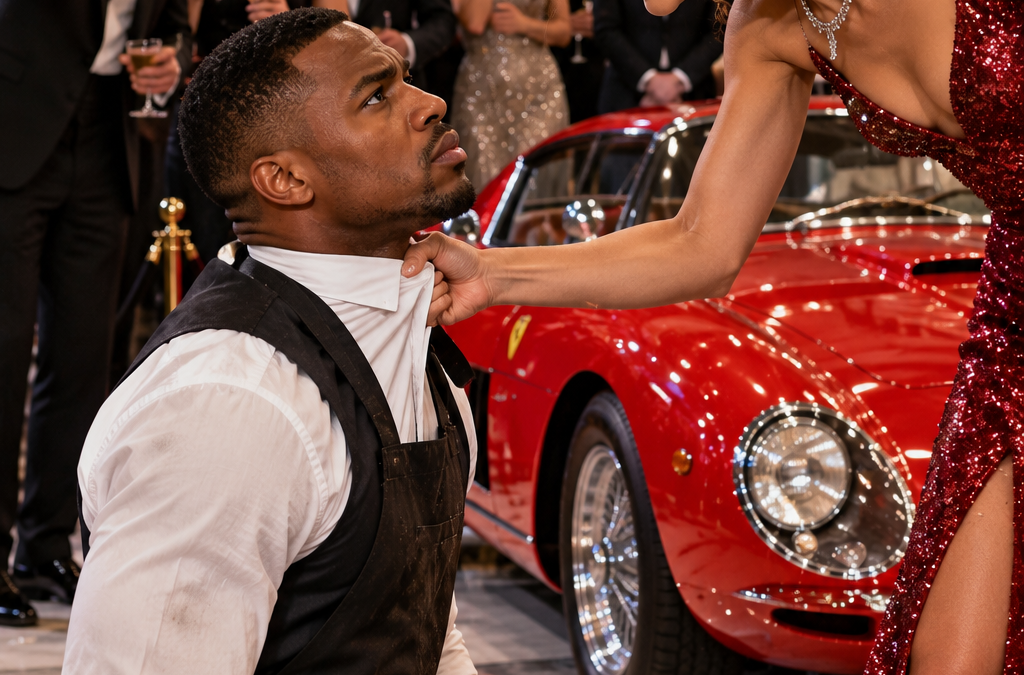
Sloan Caldwell grabbed me by the collar in front of two hundred guests and called me a useless cockroach because I told her the problem three European specialists had missed.
Then she laughed and offered me a choice meant to destroy me either way: fix her fifty-two-million-dollar Ferrari within seventy-two hours and she would marry me, fail and I would owe her ten times the value of the car.
For several seconds, I said nothing.
The lobby of Caldwell Dynamics had gone quiet enough for me to hear the faint hum of the air-conditioning above the glass atrium.
Two hundred investors, engineers, collectors, executives, and employees were watching us.
Some of them were smiling.
Some were already laughing.
A few looked embarrassed for Sloan.
Almost none looked embarrassed for me.
Her fingers were still twisted into the front of my white catering shirt.
I could smell champagne on her breath.
“You understand what I just said?” she asked.
“Yes, ma’am.”
Her eyes narrowed.
“You really think you’re smarter than three Ferrari specialists?”
“No, ma’am.”
That answer surprised her.
I looked past her at the red 1962 Ferrari 250 GTO sitting beneath the atrium lights.
“I think they were looking in the wrong place.”
The laughter stopped for half a second.
Sloan released my collar and gave me a small, cruel smile.
“All right.”
She lifted her champagne glass so the people around us could hear.
“Seventy-two hours. Fix my Ferrari, and I’ll marry you.”
Laughter exploded through the lobby.
She waited for it to settle.
“And if you fail, you pay me ten times the value of the car.”
More laughter.
The Ferrari had cost her fifty-two million dollars.
Ten times that amount was more money than I could have earned in several lifetimes.
Darnell Brooks was standing near the service corridor, staring at me like he wanted to run across the room and physically stop me.
Garrett Nolan, Caldwell Dynamics’ head of engineering, folded his arms and smiled.
He had spent four weeks failing to repair that car.
He already knew what answer he wanted from me.
Walk away.
Lower my eyes.
Remember my place.
I adjusted my collar.
Then I looked directly at Sloan Caldwell.
“I agree.”
The room went silent.
Her smile changed.
Just slightly.
Until that second, I don’t think she believed I would accept.
Neither did most of the people watching.
They saw a Black man in a server’s vest who had been hired as a level-one mechanical technician through a city workforce program.
They saw no college degree.
No Ferrari certification.
No impressive résumé.
No European accent.
No famous last name.
They did not see my grandfather’s garage on Sixty-Third Street in Chicago.
They did not see seventeen spiral notebooks.
They did not see the engine I rebuilt when I was fifteen.
They did not see the thousands of hours I had spent listening to metal.
And most of all, they did not understand something my grandfather had taught me before I was old enough to understand how much of the world would try to convince me otherwise.
The engine didn’t care who was turning the wrench.
I had been at Caldwell Dynamics for two weeks.
That was long enough to understand exactly what kind of company it was.
From the outside, the headquarters looked like a monument to precision.
Twelve acres off the Mopac Expressway in Austin, Texas.
Tinted glass.
Polished steel.
Limestone walls.
Landscaped courtyards.
Security gates.
A reception desk that looked like it belonged in a luxury hotel.
Caldwell Dynamics restored rare European automobiles and manufactured industrial robotic systems for factories across North America.
The company brought in roughly eight hundred million dollars a year and employed around three hundred people.
Sloan Caldwell had inherited it at twenty-eight when her father died of a heart attack during a board meeting.
By thirty-one, she ruled the place like ownership and infallibility were the same thing.
On my first morning, I walked toward the main entrance carrying a small tool bag.
A security guard looked through the glass, saw me, and pointed toward the service entrance.
He never opened the door.
Never asked my name.
Never checked my badge.
He just pointed.
I stood there for a second, then walked around the building.
That told me more about Caldwell Dynamics than the orientation packet ever did.
My official title was Level One Mechanical Technician.
The job description included component preparation, mechanical support, inventory, assembly assistance, and supervised diagnostic work.
What I actually did was clean parts, move equipment, organize hardware, carry toolboxes, sweep work areas, and perform every unpleasant job Garrett Nolan could find.
Darnell Brooks met me beside the loading dock that first morning.
He was a technician too.
Quiet man.
Mid-thirties.
Sharp eyes.
He looked at my new badge, then at my face.
“Keep your eyes low,” he said. “Keep your voice lower.”
I smiled.
“That company policy?”
“That’s survival.”
“How long you been surviving?”
“Eighteen months.”
He leaned closer.
“That’s the record for people like us.”
I looked through the open loading bay toward the building’s central atrium.
From where I stood, I could see the third-floor glass offices.
Sloan Caldwell’s office occupied the center.
It overlooked everything.
“I’m not here to survive,” I said. “I’m here to work.”
Darnell shook his head.
“Brother, around here those are the same thing. You just don’t know it yet.”
In the middle of the main lobby sat the reason I had applied to Caldwell Dynamics in the first place.
A 1962 Ferrari 250 GTO.
Rosso Corsa red.
Chrome wire wheels.
Three-liter V12.
One of thirty-six ever built.
Sloan had paid fifty-two million dollars for it at auction.
The car appeared in company brochures, investor presentations, interviews, advertisements, social-media videos.
It was more than a vehicle to her.
It was proof.
Proof of wealth.
Proof of taste.
Proof that Caldwell Dynamics belonged in rooms where ordinary companies never entered.
And for six months, it had not run correctly.
The problem began as an intermittent misfire.
Above roughly forty-five hundred revolutions per minute, the engine lost power.
Sometimes the failure arrived as hesitation.
Sometimes as a violent stutter.
Sometimes a metallic resonance traveled through the chassis that nobody could identify.
Three European Ferrari specialists had been flown to Austin.
One from Maranello.
One from Germany.
One from London.
Their combined consulting fees exceeded two hundred thousand dollars.
They changed ignition components.
Fuel components.
Spark plugs.
Coils.
Injectors.
They checked timing.
Compression.
Valve clearances.
Fuel delivery.
Wiring.
Nothing solved the problem.
Garrett Nolan took over after they left.
He replaced more parts.
Ran more scans.
Logged more hours.
The Ferrari remained in the lobby, silent behind velvet ropes.
Every morning, I walked past it on my way to the engineering floor.
And every morning, I stopped for three or four seconds.
Nothing dramatic.
I just looked.
The first time Darnell caught me doing it, he grabbed my arm.
“Don’t.”
I turned toward him.
“Don’t what?”
“Look at that car like that.”
“Like what?”
“Like you’re thinking.”
I laughed softly.
He didn’t.
“I’m serious. That Ferrari is her heart. Garrett’s already bleeding over it. You get involved, they’ll bury you.”
I looked at the car again.
The left side of the hood sat almost imperceptibly higher than the right.
Not enough to mean anything by itself.
But it bothered me.
Machines have posture.
People forget that.
A machine under stress carries that stress somewhere.
In vibration.
Alignment.
Heat.
Wear.
Sound.
Sometimes all you need to do is stop trying to make the machine confess in the language you expect.
You listen in the language it chooses.
Something about that Ferrari was speaking.
I just hadn’t heard enough yet.
Garrett gave me my first lesson in Caldwell culture on my third day.
He called me into the parts warehouse.
Rows of shelves stretched almost wall to wall.
Thousands of bolts, seals, gaskets, bearings, brackets, washers, clips, fittings, and specialty components.
He handed me a clipboard.
“Inventory.”
I looked around.
“All of it?”
“All of it.”
“Scanner?”
He smiled.
“No.”
“Computer?”
“No.”
“Spreadsheet?”
“Paper and pencil.”
He started walking away, then turned.
“Should take you about a week. Assuming you can count that high.”
Two engineers near the door laughed.
I finished in two days.
Every component counted.
Every shelf corrected where the previous inventory was wrong.
Every item organized.
Garrett looked through my sheets.
He didn’t thank me.
He dropped the clipboard on the floor.
“Do it again.”
“Why?”
“I don’t trust your count.”
So I did.
The second inventory matched the first exactly.
When I handed it back, Garrett stared at the numbers for nearly a minute.
Then he walked away.
No apology.
No acknowledgment.
Nothing.
The second lesson came five days later.
My car disappeared from the employee lot.
It was a 2006 Honda Civic with a salvage title.
Not pretty.
Not expensive.
But I had rebuilt most of it myself.
The security office told me it had been towed because the vehicle did not match employee records.
I showed them my registration.
My parking authorization.
My badge.
They shrugged.
The towing yard was three miles away.
I walked.
The next morning, the Civic was towed again.
Same explanation.
Same expressionless security guard.
I walked three miles back to work in nearly one-hundred-degree Texas heat.
When I entered Bay Four, sweat had soaked the back of my shirt.
Garrett looked at me.
“Somebody hose down the floor. Charity hire’s leaking.”
Several engineers laughed.
One young technician named Powell looked at the ground.
That bothered me more than the laughter.
Cruel people tell you who they are.
Silent people make you wonder who they might have been if courage cost less.
The third lesson came during my second week.
I was in the break room during lunch reading a company-library manual on Ferrari V12 valvetrain geometry.
Sloan Caldwell entered on her way to the executive elevator.
She saw me.
Then she saw the book.
She stopped.
“What is that?”
“A technical manual, ma’am.”
“I can see that.”
She crossed the room and pulled it from my hands.
“What I don’t understand is why someone like you thinks he can understand it.”
The room went quiet.
Three employees were eating nearby.
Nobody moved.
Sloan held the book between two fingers.
Then she dropped it into the trash.
“Stick to what you’re good at.”
She looked toward the mop closet.
“Mopping.”
Then she left.
The elevator doors closed.
I stood.
Walked to the trash.
Pulled the manual out.
Coffee grounds were stuck to the cover.
I wiped them away with my sleeve, sat back down, found my page, and continued reading.
Darnell came in about ten minutes later.
He stared at the book.
“You really pulled it back out?”
“The book didn’t do anything wrong.”
“I saw what happened.”
“So?”
“So you’ve got to understand where you are.”
“I understand exactly where I am.”
He sat opposite me and lowered his voice.
“Thirteen.”
“What?”
“Thirteen people came through that diversity program before you in three years.”
I waited.
“You know how many are still here?”
“You.”
“Me.”
He leaned closer.
“Everybody else quit or got pushed out. They give you trash assignments. They freeze you out of meetings. They make you feel stupid. They humiliate you until eventually you leave. Then HR writes ‘not a culture fit’ and everybody goes home clean.”
I closed the manual.
“I’m not quitting.”
“That’s what number six said.”
I looked at him.
“And number nine.”
I said nothing.
“And number twelve.”
I opened the book again.
“I’m not them.”
Something in my voice ended the conversation.
What Darnell didn’t know was that I had been underestimated for most of my life.
The faces changed.
The words changed.
The reasons changed.
The pattern didn’t.
Fifteen years earlier, I was thirteen years old in a small house on Sixty-Third Street on Chicago’s South Side.
My mother was serving a seven-year prison sentence.
My father existed only as a name on my birth certificate.
My grandmother Dorothy raised me on Social Security checks, discipline, and a refusal to let circumstances tell me what I was worth.
Every morning, she woke before sunrise.
Breakfast at five-thirty.
School shirt pressed.
Shoes checked.
And before I walked through the front door, she made me repeat the same sentence.
“You are not what they say you are.”
“Yes, ma’am.”
“Say it back.”
“I am not what they say I am.”
Behind our house stood a detached garage that had belonged to my grandfather, Curtis Lawson.
Curtis had served in Korea with the Army, repairing jeeps, generators, transport trucks, and anything else that broke badly enough to strand somebody.
He came home in the 1950s with a Bronze Star, a damaged knee, and a gift in his hands that people talked about for decades.
Chicago repair shops didn’t exactly compete to hire Black mechanics back then.
So Curtis built his own shop behind his house.
One bay.
Old lift.
Used tools.
Twenty dollars a job when he started.
People found him anyway.
Chevrolets.
Fords.
Chryslers.
Diesels.
Motorcycles.
Sometimes a European car came down from the wealthier neighborhoods because somebody had heard about the Black mechanic on the South Side who could diagnose a problem by listening to an engine idle.
Curtis died when I was eight.
Heart attack.
Quick.
No warning.
The garage stayed almost untouched afterward.
When I turned thirteen, I discovered seventeen spiral notebooks on a shelf above his workbench.
Forty years of handwritten mechanical knowledge.
Every engine he opened.
Every failure he diagnosed.
Every unusual sound.
Every repair.
Valve timing.
Compression.
Clearances.
Gear ratios.
Torque patterns.
Vibration notes.
Fuel problems.
Sketches.
Cross-sections.
Measurements written in handwriting so precise it looked machined.
And on the cover of every notebook, he had written the same sentence.
The engine don’t care who’s turning the wrench.
I understood the words immediately.
I didn’t understand the weight of them until years later.
Behind the garage sat a rusted 1971 Mustang engine block half buried beneath weeds.
I dragged it inside.
For two years, I rebuilt it.
No formal teacher.
No expensive equipment.
Just Curtis’s notebooks, library books, borrowed manuals, patience, mistakes, and stubbornness.
I learned that a properly seated connecting rod had a sound.
So did a bearing with too much clearance.
A healthy cylinder had rhythm.
A damaged mount changed how vibration traveled through a block.
Metal spoke.
Not in sentences.
In frequencies.
Resistance.
Heat.
Movement.
By fifteen, I had that Mustang engine running.
Mrs. Tate from down the block heard it.
She showed up the next morning with her Buick.
“Curtis’s grandson?”
“Yes, ma’am.”
“Fix my car.”
I did.
By eighteen, I had rebuilt or repaired forty-three engines.
Cars.
Trucks.
Motorcycles.
Lawn equipment.
A boat motor.
Even an antique tractor somebody hauled in from outside the city.
I taught myself robotics later.
Free university courses.
Used laptop.
Actuators.
Control systems.
Servo motors.
Kinematic chains.
Automation.
I applied to engineering programs.
Two accepted me.
I couldn’t afford to go.
Tuition assistance existed.
Rent still existed too.
Food existed.
My grandmother’s medication existed.
So I stayed.
Worked.
Learned.
Fixed machines.
By twenty-six, I had knowledge nobody could see on my résumé because résumés ask where you learned something, not whether you actually know it.
Caldwell Dynamics interested me because they built the kind of things I loved.
Precision machines.
Robotic systems.
Rare engines.
I knew I would start at the bottom.
I did not expect them to work so hard to keep me there.
Then came the company cocktail party.
Late September.
Two hundred guests.
Investors.
Collectors.
Clients.
Executives.
A string quartet.
Open bar.
The Ferrari in the center of the lobby.
Still broken.
Still beautiful.
Still humiliating Sloan every time someone asked why it didn’t run.
I attended in a white shirt and black vest because management had reassigned several junior technical employees to hospitality duty.
At 8:47 p.m., I was carrying an empty champagne tray when Harlon Foster, a silver-haired investor and board member, stopped beside the Ferrari.
He tapped a finger against the fender.
“Fifty-two million dollars and it just sits there.”
People nearby laughed.
Sloan smiled tightly.
“We’re working on it, Harlon.”
“You’ve been working on it six months.”
More laughter.
“I’ve seen faster progress at the DMV.”
That laugh hurt her.
I could see it.
Her hand tightened around her glass.
Then I walked past the Ferrari.
And like I had done every morning for two weeks, I stopped.
Three seconds.
Maybe four.
I looked toward the engine bay.
Tilted my head.
Vivian Cross, Sloan’s social-media director, noticed.
She laughed.
“Oh my God, Sloan. Your janitor is inspecting the Ferrari.”
Heads turned.
I should have kept walking.
Maybe some part of me knew that.
But I had spent two weeks listening every time Garrett started the engine.
I had watched the chassis.
Seen the hood alignment.
Heard the vibration.
I finally had a theory.
Sloan crossed the lobby.
“What are you looking at?”
“Your car.”
“I can see that.”
She stepped closer.
“What do you think you’re doing?”
“Listening.”
That got another laugh.
Sloan’s face hardened.
“You think you know what’s wrong with it?”
I looked at the Ferrari.
Then back at her.
“Yes, ma’am.”
The laughter became louder.
Garrett pushed through the crowd.
“Go ahead,” he said. “This should be good.”
I pointed toward the rear of the engine.
“Your engine mount is cracked.”
Sloan stared at me.
Then her face twisted.
“Excuse me?”
“Rear left mount. Small fracture. I think that’s where the vibration is coming from.”
She grabbed my collar.
That was when she called me an idiot.
A cockroach.
Asked whether I believed I was smarter than three European engineers.
I told her I could fix it.
She asked how long.
I said seventy-two hours.
And she turned my answer into a joke.
Fix it and she would marry me.
Fail and I would owe her ten times the Ferrari’s value.
Five hundred and twenty million dollars.
She expected fear.
Instead, I accepted.
At six the next morning, I walked into the empty atrium carrying my tool bag.
The Ferrari sat beneath white lights.
I placed the bag on the marble floor.
For a moment, I simply stood there.
Then I pulled out a small brass hammer.
Its head was scratched and dull.
Electrical tape wrapped the handle.
My grandfather had put that tape there decades earlier.
I carried the hammer because it reminded me that knowledge did not become less true because powerful people refused to recognize where it came from.
I walked around the Ferrari twice.
Studied the panel gaps.
Crouched near the rear wheel.
Placed a palm against the body.
Closed my eyes.
At seven-fifteen, employees began arriving.
By seven-thirty, word had spread.
By eight, the mezzanine above the atrium was crowded.
Engineers.
Technicians.
Managers.
Interns.
People who had ignored me for two weeks suddenly had nothing more important to do.
Sloan arrived around eight-twenty and sat inside the glass VIP lounge overlooking the floor.
Vivian had placed a phone on a tripod.
She was live-streaming.
Twelve thousand viewers.
Then twenty thousand.
Then more.
Sloan posted a caption telling millions of followers that her janitor thought he could repair a fifty-two-million-dollar Ferrari.
Garrett stood at the railing.
“This is painful already,” he shouted.
Laughter rolled across the mezzanine.
I opened the hood.
Then I began tapping.
Three light strikes.
Pause.
Listen.
Move.
Three strikes.
Pause.
Listen.
Move again.
The brass hammer was not magic.
Neither was I.
Metal conducts vibration.
Different structures resonate differently depending on density, tension, cracks, looseness, geometry.
Curtis called unexpected secondary resonance a shadow voice.
Notebook Four.
Page Eleven.
A healthy machine speaks clean.
A sick machine has another voice underneath.
Find the shadow.
Find the sickness.
For forty-five minutes, I tapped and listened.
Garrett shouted jokes.
Someone asked whether I needed incense.
Vivian’s livestream captions mocked me.
Sloan drank coffee.
I kept moving.
Then I reached the area near cylinder five.
Tap.
Pause.
Something.
I did it again.
There.
A faint secondary harmonic.
Not inside the cylinder.
Below it.
I put the hammer down.
Pulled out an automotive stethoscope.
Pressed the metal probe against the left rear engine mount.
Moved a few millimeters.
Listened.
Moved again.
Listened.
I felt my heartbeat slow.
There it was.
I looked up.
Darnell stood near the back of the mezzanine.
Our eyes met.
I nodded once.
His expression changed.
At 9:52, an older woman entered the lobby.
I didn’t know who she was.
Not then.
She wore a charcoal blazer, silver-rimmed glasses, and the kind of expression that made security guards reconsider asking questions.
Eleanor Voss.
Sixty-four years old.
Nearly four decades in automotive diagnostics.
Former head of a major American automaker’s diagnostic-engineering division.
One of the people who had helped establish resonance-mapping methods used across the industry.
Now chair of the National Automotive Heritage Council.
Someone had sent her the livestream while she was attending an automotive heritage conference in Austin.
She watched me use the hammer and stethoscope.
Recognized what I was doing.
And came to Caldwell Dynamics personally.
Sloan rushed downstairs when she learned who had entered her building.
“Ms. Voss,” she said. “What an honor. I apologize for this spectacle. Our maintenance worker has apparently decided he’s an engineer.”
Eleanor didn’t look at Sloan.
She watched my hands.
“Your maintenance worker is performing a resonance diagnostic most certified engineers have never learned.”
Sloan’s smile disappeared.
Eleanor finally looked at her.
“I’d be quiet and watch.”
I heard about that exchange later.
At the time, I was still listening.
Finally, I removed the stethoscope and stood.
“The engine is fine.”
Garrett leaned over the railing.
“What?”
“The engine itself is fine.”
His face reddened.
“That’s ridiculous.”
“The valves aren’t the problem. The pistons aren’t the problem. The ignition system isn’t the root problem. Neither is fuel delivery.”
“You don’t know what you’re talking about.”
I pointed toward the left rear mount.
“The bushing is fractured.”
Garrett shook his head.
“We inspected the mounts.”
“You inspected them visually.”
“So?”
“The fracture is too small to see under normal load.”
I took four thin pieces of cigarette paper from my bag.
I positioned one at each mount.
Then I started the Ferrari.
The V12 fired.
Rough idle.
Uneven pulse.
The paper at three mounts barely moved.
The paper at the left rear mount fluttered violently.
The room went quiet.
I let them watch for several seconds.
“Below four thousand RPM, the movement is small enough that the rest of the system masks it.”
I pointed.
“Under higher load, that mount shifts just enough to transmit abnormal lateral vibration through the engine and ignition assembly. That’s the resonance you’ve been chasing.”
Garrett stared at the paper.
I continued.
“Everyone kept trying to repair the person sitting in the chair.”
I tapped the mount.
“The person isn’t broken. The chair is.”
Nobody laughed.
Eleanor stepped closer.
She studied the vibration.
Then she nodded.
Garrett recovered first.
“All right.”
His voice sounded different now.
Less amused.
“Let’s pretend you’re right. Where are you getting a replacement?”
I looked at him.
“That bushing was fabricated in Italy in 1962,” he said. “It hasn’t been produced in decades.”
He smiled again.
“There is no replacement.”
I looked toward the fabrication wing.
“You have a five-axis CNC mill in Bay Twelve.”
His smile faded.
“I’ll make one.”
“You?”
“Yes, sir.”
“You’re going to fabricate a precision mount for a fifty-two-million-dollar Ferrari?”
“Yes.”
Garrett laughed, but it sounded forced.
The crowd followed me to Bay Twelve.
I removed the three surviving original bushings and measured them.
Diameter.
Depth.
Wall thickness.
Internal geometry.
Wear.
Compression.
Thermal considerations.
I recorded everything by hand on graph paper.
The way Curtis had.
Then I selected aircraft-grade aluminum stock and calculated the adjustment required for the material’s different expansion characteristics.
I programmed the mill manually.
Coordinate by coordinate.
Before starting the cut, I added several thousandths of an inch to the final outside dimension.
Garrett saw it.
“Wrong.”
I kept entering numbers.
“That dimension is oversized.”
“Intentionally.”
“It won’t fit.”
“It will after hand fitting.”
“You machine to specification.”
“Not on this component.”
He stepped closer.
“Excuse me?”
“These early racing components were often finished by hand. If I cut it directly to the installed dimension, I lose the interference fit I need. I’d rather remove material carefully than manufacture looseness into a mount that already failed once.”
Eleanor spoke behind us.
“Where did you learn that?”
“My grandfather.”
“Who was he?”
“Curtis Lawson.”
She went still.
“Chicago?”
I turned.
“Yes, ma’am.”
“South Side?”
“Yes.”
She stared at me for several seconds.
“I’ve read about him.”
That hit me harder than anything Sloan had said.
“What?”
“Independent mechanics of the postwar period. There was a monograph years ago. Curtis Lawson was mentioned.”
She looked at the brass hammer near my bag.
“He had a reputation.”
My throat tightened.
“What kind?”
Eleanor smiled slightly.
“The kind earned by people whose work other mechanics talked about when customers weren’t listening.”
For the first time that morning, I had to look away.
My grandfather had been dead almost twenty years.
I had carried his notebooks alone.
His lessons.
His methods.
His sentence.
I knew what he had been to me.
Hearing a woman like Eleanor Voss confirm that the industry had remembered him, even quietly, felt like somebody had opened a door to a room I thought had disappeared forever.
“Yes, ma’am,” I said.
“He was that good.”
The CNC mill began cutting.
Aluminum curled away in thin silver ribbons.
Forty minutes later, the new bushing was in my hand.
I pressed it into the mount.
Then filed it carefully to final fit.
Checked.
Adjusted.
Checked again.
No looseness.
No binding.
I reinstalled the mount.
Torqued every fastener.
Verified each setting twice.
Then I started the engine.
The Ferrari came alive.
Smooth.
The ugly vibration was gone.
I raised the RPM.
Four thousand.
Five.
Six.
No misfire.
No stumble.
The mezzanine erupted.
But I didn’t celebrate.
Something still bothered me.
I could hear it.
Not a misfire.
A difference.
Small.
I killed the throttle and moved toward the exhaust headers.
Cylinder Three felt slightly cooler than Cylinder Four.
I checked again.
Three.
Four.
Three.
The difference was small.
Maybe fifteen degrees.
Most people would never notice by touch.
I had spent half my life touching machines.
I shut the engine down.
Removed the air cleaner.
Inspected the Weber carburetors.
Deep inside the throat feeding Cylinder Three, I found a fragment of gasket material wedged in the fuel jet.
Tiny.
Barely larger than a grain of rice.
I removed it with a fine wire.
Held it up.
“This shouldn’t be here.”
Garrett stepped forward.
“What is it?”
“Intake gasket.”
I looked around the room.
“Probably left during one of the previous repair attempts.”
Silence again.
“It’s restricting fuel flow to Cylinder Three. Under sustained high-speed load, that cylinder would run lean.”
“How serious?” somebody asked.
“Serious enough that I wouldn’t put this car on a track until it’s corrected.”
I cleaned the jet.
Then I balanced all six carburetors.
Quarter-turn adjustments.
Listen.
Adjust.
Listen again.
The separate exhaust pulses gradually became one sound.
Unified.
Clean.
I started the engine one final time.
The V12 roared through the atrium.
Four thousand.
Five.
Six.
Seven.
Eight thousand RPM.
No hesitation.
No metallic complaint.
No broken rhythm.
Only power.
For the first time since I had entered Caldwell Dynamics, nobody was looking through me.
They were looking at me.
Eleanor stepped into the open space beside the Ferrari.
“Three specialists,” she said.
The room quieted.
“Six months of attempted repairs. Hundreds of thousands of dollars spent.”
She looked toward me.
“This technician found the principal fault with a stethoscope, a brass hammer, and disciplined observation.”
She turned toward the mezzanine.
“I have spent thirty-eight years in this industry.”
Then she said something I carried with me afterward.
“I know excellence when I hear it.”
People applauded.
Darnell stood near the back.
Tears were running down his face.
Sloan remained inside the glass lounge.
She did not clap.
She was not finished.
Neither was the challenge.
“A lobby test proves nothing,” she said when she came downstairs.
Her voice was controlled, but I could see panic underneath it.
“I want a full-load track test.”
Eleanor looked at her.
Sloan continued.
“Eight thousand RPM. Full load. Circuit of the Americas. If it survives Turn Twelve, then we’ll talk.”
I understood what she was doing.
The repair had succeeded in front of her employees.
That was bad enough.
But admitting defeat meant accepting that she had publicly humiliated a man whose judgment was better than the experts she trusted.
She needed one more chance for me to fail.
One more place for the story to reverse.
One more excuse to tell herself the world still worked the way she wanted it to.
“All right,” I said.
By two that afternoon, the Ferrari was loaded onto a transporter heading south toward Circuit of the Americas.
Employees followed.
Some left during lunch.
Some took the afternoon off.
By the time we reached the paddock, the livestream audience had passed one million.
Vivian was still filming.
She wasn’t laughing anymore.
Garrett was assigned to drive.
When he climbed behind the wheel, I saw his hands shaking.
He had never pushed the Ferrari hard because the misfire always returned.
Eleanor insisted that I ride in the passenger seat.
“The mechanic who made the repair monitors the machine under load,” she said.
Sloan started to object.
Eleanor cut her off.
“Standard diagnostic procedure.”
That ended it.
I strapped in.
Garrett looked at me.
“You sure?”
It was the first honest question he had ever asked me.
“Yes.”
He started the engine.
The V12 settled into a clean idle.
We rolled from the pit lane.
First gear.
Second.
Third.
Four thousand RPM.
Nothing.
Five.
Smooth.
Turn One rose in front of us.
Garrett braked, turned, accelerated.
Six thousand.
The Ferrari pulled hard.
No stumble.
Through the esses, the chassis moved exactly as it should.
Seven thousand down the straight.
I rested my hand against the transmission tunnel.
Felt the vibration through my palm.
Balanced.
Consistent.
Alive.
Turn Twelve approached.
That was where Sloan believed the car would betray me.
Heavy braking.
Hard load transfer.
Acceleration afterward would push everything I had repaired.
Garrett downshifted.
Turned.
The Ferrari settled.
Then he buried the throttle.
Eight thousand RPM.
The engine screamed.
And held.
No misfire.
No hesitation.
No vibration.
Nothing broke.
Garrett exhaled so hard I could hear him over the engine.
I closed my eyes for one second.
Not because I was afraid.
Because I wanted to listen without anything else interfering.
The sound was perfect.
Five laps.
Every one clean.
Back in the paddock, telemetry confirmed what I already knew.
Power delivery was stable across the entire rev range.
The carburetor balancing had even improved output slightly over the car’s archived baseline.
Eleanor reviewed the data.
Then she pulled a sheet of National Automotive Heritage Council letterhead from her briefcase.
She wrote a statement by hand.
Signed it.
Dated it.
Handed it to Sloan.
“This repair,” she said, “is among the most elegant diagnostic solutions I have witnessed in four decades of engineering.”
She tapped the letter.
“Frame it.”
Sloan held the paper.
Her hand trembled.
More than two million people were watching.
Then she turned toward me.
For the first time since I had met her, there was no audience she could control.
No employee hierarchy.
No job title.
No insult strong enough to change what had happened.
“I said I’d marry you.”
Her voice was quiet.
I studied her for a moment.
“I remember.”
She waited.
I could have humiliated her.
Part of me wanted to.
I thought about the book in the trash.
The towing.
Garrett’s jokes.
Her hand around my collar.
The word cockroach.
All those people laughing.
But I also thought about my grandmother telling me every morning that I was not what other people said I was.
If I turned that moment into revenge, Sloan would still be deciding who I was.
So I shook my head.
“I accept that I won the challenge.”
Her lips parted slightly.
“But I don’t need a wife who offered herself as a punchline.”
The paddock went silent.
“I never needed your ring.”
I looked at her.
“I never needed your money.”
Another pause.
“I needed you to see me.”
Her eyes moved away.
“And now you do.”
I turned.
Darnell walked beside me toward the paddock exit.
Neither of us looked back.
I thought that was the end of my fight with Caldwell Dynamics.
It wasn’t.
That evening, Eleanor Voss called me.
She skipped small talk.
“I want you working with me.”
I sat on the edge of my bed.
“Doing what?”
“The National Automotive Heritage Council evaluates historically significant vehicles across the country. We need a diagnostic specialist.”
“I don’t have a degree.”
“I didn’t ask whether you had a degree.”
I smiled despite myself.
“What’s the catch?”
“There isn’t one.”
Silence.
Then she said, “You showed me a level of mechanical intuition I haven’t seen in a long time. I’m not letting that disappear because somebody’s hiring software doesn’t know what to do with your résumé.”
I looked at Curtis’s brass hammer lying on my nightstand.
“When do you need an answer?”
“I think you already know it.”
She was right.
I accepted the next morning.
Meanwhile, the livestream escaped Sloan’s control.
Clips spread across automotive forums.
Then video platforms.
Then national media.
People watched her laugh at me.
Watched Garrett mock me.
Watched me find the mount.
Watched the track test.
Watched Eleanor’s reaction.
Within three days, my name appeared in publications I had read for years.
Restoration shops called.
Collectors called.
A documentary filmmaker contacted me.
An engineering podcast wanted an interview.
A restoration company in Monterey offered a partnership.
I said yes to Eleanor.
The rest could wait.
Before my last day at Caldwell Dynamics, several engineers approached me privately.
The first was a senior mechanical engineer who had laughed when Garrett joked about my sweating shirt.
He stood beside my workbench and stared at the floor.
“I owe you an apology.”
I waited.
“I knew the mount theory was plausible.”
That surprised me.
“Then why didn’t you say anything?”
His face tightened.
“Garrett would have buried me.”
“So you let him bury me instead?”
He had no answer.
Another engineer wrote me a three-page recommendation letter.
A third admitted he had watched minority technicians disappear from Caldwell for years and convinced himself it wasn’t his responsibility.
“I thought staying out of it meant I wasn’t part of it,” he said.
“It doesn’t.”
“I know that now.”
On my final afternoon, Harlon Foster found me in the parking lot.
The same board member who had teased Sloan about the broken Ferrari at the cocktail party.
He handed me a business card.
“You didn’t just repair a car, son.”
I looked at the card.
“You exposed a culture.”
His expression turned serious.
“And cultures don’t repair themselves.”
“What happens now?”
“The board is asking questions.”
He paused.
“I’d like you available when they do.”
I submitted a formal two-week notice.
No speech.
No victory lap.
No insults.
On my final day, I shook Garrett Nolan’s hand.
He couldn’t look at me.
The investigation began less than a week later.
Sloan’s own livestream became evidence.
Every insult.
Every joke.
Every comment.
Every moment management had believed it was safe to humiliate someone because humiliation had become normal inside the company.
The board hired an outside firm.
What investigators found went far beyond me.
Fourteen employees had been hired through Austin’s Workforce Diversity Initiative over three years.
Thirteen had resigned within six months.
Exit interviews showed the same patterns.
Minority employees excluded from technical meetings.
Denied training.
Given degrading assignments.
Equipment withheld.
Racial remarks tolerated.
Complaints minimized.
HR documentation softened until harassment looked like ordinary turnover.
Darnell had been right.
The paperwork was clean.
The hands were dirty.
Garrett fell first.
Investigators examined his Ferrari repair records and discovered around eighty-five thousand dollars in questionable parts and labor.
Components billed as replaced despite showing no evidence of failure.
Diagnostic work logged without supporting records.
Parts charged to the repair that remained unopened in inventory.
The board terminated him for financial misconduct and falsification of maintenance documentation.
Professional regulators opened a separate inquiry.
Former clients began asking questions about work performed under his supervision.
The man who had spent weeks trying to convince everyone I was unqualified suddenly had to prove his own qualifications under oath and on paper.
Vivian Cross was dismissed the same week.
Her livestream had violated company communications rules, exposed internal operations without authorization, and created enormous legal liability.
The tool she had used to humiliate me had documented the company’s behavior more completely than any complaint ever could.
Sloan was more complicated.
She remained the majority shareholder.
The board could not erase her ownership.
But they could remove her power.
They did.
An independent CEO named Audrey Collins was appointed.
Fifteen years in automotive manufacturing.
Known for taking over damaged organizations.
Sloan kept the title connected to her ownership.
She lost operational control.
Hiring.
Engineering oversight.
Personnel policy.
Client relationships.
Day-to-day management.
All of it moved out of her hands.
Collins introduced blind résumé screening.
Formal anti-retaliation procedures.
Independent review of complaints.
Technical-assignment audits.
Promotion tracking.
Anonymous reporting.
For the first time, people like Darnell had somewhere to go that did not end with the complaint landing back on the desk of the person causing the problem.
The financial consequences arrived quickly.
Two major clients withdrew contracts.
One was a European racing syndicate.
The other was a private collector who had eleven vehicles under Caldwell management.
Both cited reputational concerns.
Three weeks after the track test, Sloan posted a video.
No polished office.
No dramatic lighting.
No corporate background.
She sat in her living room.
Her eyes were red.
She said she had used me as a punchline.
She admitted she had been raised to believe people who looked like me belonged beneath people like her.
She said watching me work had forced her to confront something ugly in herself.
Then she announced a hundred-thousand-dollar donation to a scholarship fund for underprivileged students pursuing mechanical engineering.
Millions of people watched.
I watched once.
Only once.
I did not comment.
I did not praise her.
I did not attack her.
An apology is not a time machine.
It doesn’t put a technical manual back in someone’s hands before you throw it into the trash.
It doesn’t return dignity after you strip it away in front of a room full of people.
It doesn’t erase the employees who left before someone finally had enough evidence to force the company to look at itself.
But an apology can be a beginning if the person making it understands that speaking is the smallest part of changing.
Whether Sloan truly changed was no longer my responsibility.
For most of my life, people had expected me to spend energy proving my humanity to them.
I was finished doing that.
Six months later, I stood on the judging field at Pebble Beach in Monterey, California.
The morning air smelled like salt, cut grass, leather, gasoline, and money.
Rows of historic automobiles stretched across the field.
Machines people had protected for generations.
I wore a clean jacket with the National Automotive Heritage Council emblem on the chest.
Curtis’s brass hammer hung from my belt.
Eleanor had brought me into cases I once would have read about in magazines.
Prewar racing cars.
Rare American prototypes.
European competition engines.
Machines worth more than entire neighborhoods.
The work was demanding.
Perfect for me.
Nobody asked me to sweep before I was allowed to think.
Nobody laughed when I listened.
That morning, I was examining an engine with a stethoscope when I noticed a little girl watching.
Black.
Maybe ten years old.
She stood beside her mother, eyes fixed on my hands.
“Mama,” she whispered, “I want to do that.”
I heard her.
For a moment, I was thirteen again.
Standing in Curtis Lawson’s garage.
Grease beneath my fingernails.
Not enough money.
No father.
My mother gone.
The world already preparing a thousand reasons I should expect less from myself.
I remembered Dorothy at five-thirty in the morning.
You are not what they say you are.
I remembered Curtis’s notebooks.
The engine don’t care who’s turning the wrench.
I took the stethoscope from my ears.
Walked toward the girl.
Then I knelt so we were eye level.
“You want to hear something?”
She looked at her mother.
Her mother nodded.
I held out the stethoscope.
The girl placed the earpieces carefully over her ears.
I guided the probe toward the engine block.
“Right there.”
Her face changed.
She heard it.
The pulse.
The movement.
The mechanical life beneath the polished metal.
“What is that?” she whispered.
“That’s the engine talking.”
Her eyes widened.
“You can hear what’s wrong?”
“Sometimes.”
“How?”
“You listen long enough.”
I looked at the brass hammer hanging from my belt.
“My grandfather taught me.”
She stared at the engine.
I thought about Sloan Caldwell standing in that paddock with Eleanor’s letter in her hand.
Garrett unable to meet my eyes.
Darnell surviving eighteen months by making himself smaller.
Thirteen workers disappearing from Caldwell Dynamics because an entire organization had decided they were easier to replace than respect.
I thought about my grandmother.
Curtis.
The garage.
The Mustang engine.
The Ferrari.
All those years between one broken machine and another.
People like Sloan believed status could change truth.
It couldn’t.
Money could buy a fifty-two-million-dollar Ferrari.
It could fly specialists across oceans.
It could build a glass tower.
It could buy polished floors, private racetracks, expensive tools, famous consultants, and enough authority to make hundreds of employees laugh when the boss laughed.
But money could not make a cracked mount whole.
A title could not correct a bad diagnosis.
A degree could not hear a frequency its owner had stopped listening for.
And prejudice could not negotiate with physics.
The little girl removed the stethoscope.
“I heard it.”
I smiled.
“Good.”
She handed it back.
I watched her walk away with her mother.
Then I returned to the car in front of me.
Placed the probe against the engine.
Closed my eyes.
And listened.
For years, I thought my grandfather’s sentence was only about machines.
I finally understood it was about freedom.
The engine did not care where I came from.
It did not care what school I could not afford.
It did not care that a security guard pointed me toward the back door.
It did not care what Garrett called me.
It did not care what Sloan thought a Black man in stained coveralls was capable of understanding.
It asked only one question.
Could I do the work?
That was a question I had never been afraid to answer.
I pressed the stethoscope more firmly against the block.
Beneath the noise of the crowd, I heard the rhythm I was looking for.
Clean.
Steady.
True.
And for the first time in a very long time, so was I.








