My Retired K9 Hadn’t Worked a Mission in Six Years, but That Afternoon He Gave His Life to Save Mine
𝗣𝗔𝗥𝗧 3
I drank too much after Afghanistan.
Not enough that anyone could easily call me an alcoholic.
That made it worse.
I knew how to hide it.
Two bourbons before bed.
Sometimes three.
Enough to dull dreams.
Never enough to miss work.
Susan knew.
Of course she knew.
One night she found me sitting on the garage floor at three in the morning.
I had woken convinced someone was outside.
I was holding a pistol.
Bare feet.
No shirt.
Sweat running down my chest.
Susan stood in the doorway.
“Daniel.”
I looked at her.
“Put it down.”
I did.
She crossed the garage slowly and sat beside me.
Neither of us spoke.
Eventually she placed her head on my shoulder.
I started crying.
Not because I was sad.
Because I was tired.
That kind of tired goes into bone.
“I don’t know how to come back,” I told her.
“You already came back.”
“No.”
She understood.
She always understood.
Then Susan got sick.
For eighteen months I had something besides myself to fight for.
Appointments.
Chemotherapy.
Meals she barely touched.
Medication schedules.
Insurance calls.
I became useful again.
Then she died.
And usefulness disappeared.
Emily was thirty by then.
Married.
Two children.
She wanted me near her.
I refused.
“I’m fine.”
That sentence ruins more men than bullets ever could.
Three months after Susan died, I received a phone call.
It came from a retired K9 placement coordinator.
“Mr. Mercer?”
“Yes.”
“Were you deployed with K9 Ranger, serial number K-M-seven-two-one?”
I sat up.
“Ranger?”
“Yes, sir.”
“Is he alive?”
A pause.
“Yes.”
I hadn’t asked whether he was available.
I hadn’t asked why they were calling.
I asked if he was alive.
That should tell you everything.
“He’s being medically retired.”
“How old?”
“Almost five.”
“Five?”
“He has enough accumulated injuries and stress markers that command approved early retirement.”
My hand tightened around the phone.
“What happens to him?”
“His most recent handler can’t adopt. We’re contacting prior service members who worked closely with him.”
“I’ll take him.”
“We’ll need to complete—”
“I’ll take him.”
“Mr. Mercer, there is a process.”
“Then start it.”
Six weeks later, I drove four hours to meet him.
The facility had concrete runs and chain-link fencing.
Dogs barking everywhere.
A staff member brought Ranger through a side door.
He was older.
Not old.
Just changed.
A small scar crossed his muzzle.
His coat had darkened.
He looked at me.
Stopped.
I said nothing.
I did not kneel.
Did not call.
For several seconds, Ranger stood completely still.
Then his ears went forward.
His head lowered slightly.
He walked.
Then trotted.
Then ran.
He hit me hard enough that I took a step backward.
His head buried against my stomach.
My hands went around his neck.
I smelled his fur.
Dust.
Dog shampoo.
Something underneath that smelled exactly like Afghanistan even though that was impossible.
My knees gave.
I sat on the concrete.
Ranger pressed against me.
And I cried.
I had not cried at Susan’s funeral.
Not properly.
I had stood.
Shaken hands.
Accepted condolences.
Signed paperwork.
Gone home.
That day, sitting on cold concrete with Ranger trying to climb into my lap, I finally broke.
“I’m sorry.”
Ranger licked my face.
“I’m sorry, buddy.”
I do not know whether I was apologizing for Mike.
Susan.
Myself.
Maybe all of it.
Ranger came home with me.
And somehow, without asking permission, he became the center of the house.
He learned where I slept.
Where I kept his food.
Where sunlight fell on the living room carpet at two in the afternoon.
He also learned my nightmares.
Or remembered them.
The first bad one came maybe ten days after he arrived.
I woke fighting.
Hands up.
Heart racing.
Couldn’t breathe.
For a few seconds, the bedroom wasn’t Virginia.
I saw concrete walls.
Dust.
Mike.
Then weight landed on my legs.
Ranger.
He climbed halfway onto the bed and pressed his chest against my knees.
“Ranger.”
He stared.
My breathing slowed.
I put one hand on his head.
“We’re home.”
After that, he did it every time.
Sometimes before I fully woke.
Susan had been the first person who knew how to bring me back.
Ranger became the second.
Years passed.
My world got smaller.
I stopped drinking.
That should have made Emily happy.
Instead, she found something new to worry about.
“You never go anywhere.”
“I go places.”
“The grocery store doesn’t count.”
“Hardware store.”
“Dad.”
“Diner.”
“You know what I mean.”
We were sitting on my porch.
Ranger lay between us.
Emily watched him struggle to stand.
“Dad…”
I already knew where she was going.
“No.”
“I haven’t said anything.”
“Don’t.”
“He’s getting old.”
“So am I.”
“That isn’t funny.”
“I’m not joking.”
She looked at Ranger.
The white muzzle.
Stiff back legs.
Cloudy eye.
“Dr. Harris said you need to think about what happens when—”
“Stop.”
Emily went silent.
I stood.
Ranger looked between us.
“Dad.”
“I said stop.”
“You can’t pretend forever.”
“I’m not pretending.”
“You are building your whole life around a dog who—”
I turned sharply.
“Don’t.”
She stood too.
“What happens when he isn’t here?”
“He is here.”
“And when he isn’t?”
My chest tightened.
“Enough.”
“Dad, Ranger can’t be the only reason you’re alive.”
The words hit hard.
I stared at her.
“He’s done more for me than most people.”
Emily’s face changed.
I heard it the moment it came out.
Too late.
She picked up her purse.
“I see.”
“Emily.”
“No. It’s okay.”
“That isn’t what I meant.”
“It sounded pretty clear.”
She walked toward her car.
Ranger limped after her.
Emily stopped beside the driveway.
She crouched and wrapped both arms around his neck.
“At least you know how to love people.”
Ranger licked her cheek.
She looked at me once.
Then drove away.
I sat on the porch steps.
Ranger stood in the driveway watching her taillights disappear.
Eventually he came back.
He sat in front of me.
“Don’t.”
He stared.
“You’re supposed to be on my side.”
He lowered his head onto my knee.
I closed my eyes.
“Yeah.”
I rubbed his ears.
“I know.”
Two weeks later, I took him to Dr. Harris.
Ranger hated veterinary offices.
Not because he was afraid.
Because he considered everyone incompetent.
Dr. Harris had treated him for years.
She moved his hind legs.
Checked his hips.
Listened to his heart.
Looked into his eyes.
“Arthritis is progressing.”
“He still walks two miles every morning.”
“Because you walk two miles.”
“He likes it.”
“He likes you.”
I did not answer.
She continued.
“His heart sounds good. Bloodwork is surprisingly strong. But you need to shorten the walks.”
“How much?”
“Half.”
“He’ll hate that.”
“He’ll survive hating you.”
I rubbed Ranger’s head.
“What else?”
She hesitated.
I hated that.
“Say it.”
“He’s eleven, Daniel.”
“I know how old he is.”
“I know.”
“No, you don’t.”
She stopped.
I heard my own anger and hated it.
“Sorry.”
Dr. Harris leaned against the counter.
“You’ve given him a good retirement.”
I looked at Ranger.
“He gave me one.”
She smiled sadly.
“He’s okay today.”
“Today?”
“Yes.”
I looked at her.
She did not need to finish.
On the drive home, Ranger sat in the passenger seat.
He had always preferred the front.
Susan used to complain.
“That dog gets shotgun more than your wife.”
“He outranks you.”
“Excuse me?”
“Operational necessity.”
She would hit my shoulder.
Now the seat belonged permanently to Ranger.
I stopped at a small roadside park.
We walked slowly along the trees.
He fell half a step behind.
That scared me more than I admitted.
For most of his life, Ranger had walked slightly ahead when working.
Then beside me.
Now behind.
Time had finally begun passing him.
“Come on, old man.”
He looked up.
I slowed down.
Pretended I had stopped to examine the trees.
He knew.
Of course he knew.
The following Sunday, Emily called.
I almost let it ring out.
Then answered.
“Hello?”
“Dad.”
“Hey.”
Silence.
“I’m sorry,” she said.
“No.”
“I shouldn’t have said it like that.”
“You were right.”
She went quiet.
I looked across the room.
Ranger was asleep near the window.
“I said something ugly.”
“You were scared.”
“Still ugly.”
Emily sighed.
“The kids miss you.”
“I miss them.”
“Come Sunday.”
I looked at Ranger.
“Maybe.”
“Dad.”
I smiled.
“All right.”
“Really?”
“Really.”
“Lunch.”
“What time?”
“One.”
“And you’re making that chicken?”
“Yes.”
“With the potatoes?”
“Dad.”
“I need specifics.”
She laughed.
I had missed that sound.
“Bring Ranger.”
“He’ll expect his own plate.”
“He always gets one.”
When the call ended, I sat holding the phone.
Something inside me felt different.
Small.
But different.
A door cracked open.
Ranger lifted his head.
“We’re going to Emily’s Sunday.”
Tail thump.
“Don’t act excited. She likes you more than me.”
Another thump.
“Traitor.”
That afternoon was warm for October.
Sunlight came through the red and yellow leaves.
I clipped Ranger’s leash to his collar.
He stood slowly.
“You want the short loop?”
He looked toward the door.
“Long loop?”
His tail moved.
“Dr. Harris says you’re manipulative.”
We left.
Our normal route passed the elementary school, curved around a small park, then crossed Maple Avenue before looping home.
Ranger walked slowly.
I let him.
There had been years when I marched everywhere.
Purpose.
Speed.
Destination.
Old age had taught Ranger something war never taught me.
Sometimes there is value in simply arriving later.
We reached Maple Avenue around four-thirty.
Traffic was moderate.
Two lanes each way.
Crosswalk.
Signal.
We stopped.
Ranger sat beside my left leg.
I rested my hand on his head.
His ears felt warm.
The walk signal changed.
White figure.
I stepped forward.
Ranger didn’t.
The leash tightened.
I looked back.
“Come on.”
He was staring to our right.
Body rigid.
Not old.
Not tired.
Rigid.
The Ranger from Kandahar.
Every muscle locked.
Ears forward.
Eyes fixed.
“Ranger?”
Then I heard the engine.
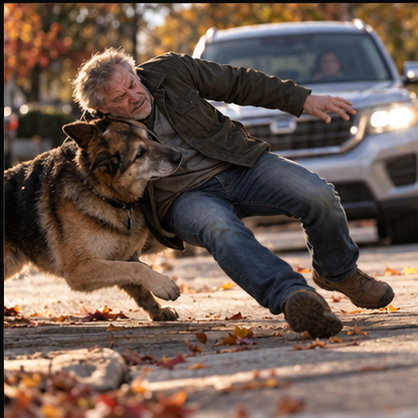
A silver SUV was coming too fast.
Far too fast.
The driver had drifted toward the intersection.
I froze.
People like to imagine that training makes you fast in emergencies.
Sometimes it does.
Sometimes your brain sees death and simply stops.
I saw the windshield.
The driver looking down.
A phone near her hand.
Then her head came up.
Her face changed.
Brakes.
Tires screamed.
I still did not move.
Ranger did.
The old dog who had taken almost five seconds to stand from his bed that morning exploded forward.
He did not run away from the SUV.
He came toward me.
His shoulder hit behind my knees.
Hard.
My legs folded.
He drove through me with every pound he had left.
I fell sideways.
My shoulder struck pavement.
My head bounced once.
Then came the sound.
Not loud the way movies make it.
Heavy.
Solid.
Wrong.
I heard something metal scrape.
People scream.
The SUV stopped half in the intersection.
For a moment, I could not understand what had happened.
My ears rang.
I pushed myself up.
“Ranger?”
No collar.
No nails.
No breathing beside me.
I turned.
He was in the road.
Six or seven feet away.
I remember crawling.
Someone shouted not to move.
I ignored them.
“Ranger.”
Blood marked the pavement.
Not much.
Enough.
His body was twisted in a way I knew was wrong before I reached him.
“No.”
I slid beside him.
“Ranger.”
His eyes moved.
Alive.
He was alive.
I put my hands under his head.
“No, no, no.”
People surrounded us.
Someone called 911.
A woman screamed that she was sorry.
The driver.
I did not look.
“Ranger.”
His chest moved.
Shallow.
Fast.
I knew trauma.
I had treated bodies broken worse than his.
That was the curse.
I knew.
I knew before anyone told me.
I ran my hands over him carefully.
Pelvis.
Ribs.
Abdomen.
Blood.
Internal.
Probably massive.
“Stay still.”
He tried to move.
“No.”
His back legs did not respond.
I felt panic rising.
Military panic is quiet.
Civilian panic is not.
“Somebody call a vet!”
A man crouched nearby.
“Sir, ambulance is coming.”
“I don’t need an ambulance! He needs a vet!”
“They’re coming.”
I bent over Ranger.
“Look at me.”
His eyes found mine.
“That’s it.”
I stroked his face.
“You stay.”
His breathing hitched.
“Stay, Ranger.”
Someone touched my shoulder.
I shoved them away.
“That’s an order.”
The words came out broken.
“Do you hear me?”
His ear moved.
“That’s an order, Sergeant.”
I pressed my forehead against his.
“You never disobeyed me before.”
That was not true.
He had disobeyed me plenty.
The first time he found me in Afghanistan.
The nights I told him to get off the bed.
Every time I told him not to steal bacon.
But right then, I needed the lie.
“You stay.”
His nose touched my hand.
A tiny movement.
I saw Mike.
Twenty years younger.
Grinning beside Ranger.
You owe my dog a steak.
I saw Susan standing in the garage doorway.
Put it down, Daniel.
I saw Ranger running across the concrete toward me the day he retired.
I felt his head pressed against my chest while I cried.
I looked at the old dog on the pavement.
“You already saved me.”
My voice failed.
“You already did enough.”
Ranger blinked.
“You saved me over there.”
Breath.
“You saved me when Mike died.”
Another.
“You saved me when Susan died.”
His body trembled.
“Please.”
For the first time in my life, I begged a dog.
“You don’t have to save me again.”
Sirens.
Too far.
Too late.
Ranger lifted his head maybe half an inch.
I lowered my face.
His tongue touched my wrist.
One weak lick.
Then his head settled into my hands.
His chest rose.
Fell.
Waited.
Rose again.
Smaller.
“No.”
Another breath.
“Ranger.”
Nothing.
“Ranger?”
I pressed my fingers against his chest.
Nothing I could feel.
“No.”
I started compressions.
I knew better.
I did them anyway.
“Come on.”
Press.
“Come on, buddy.”
Press.
“Don’t you do this.”
Press.
“Ranger.”
A paramedic knelt beside me.
“Sir.”
“Not now.”
“Sir…”
“Help him.”
He looked at Ranger.
Then at me.
There are expressions medical people learn because words are cruel.
He had that expression.
“No.”
My hands kept moving.
“Sir.”
“He’s K9.”
“I understand.”
“He survived Afghanistan.”
“I know.”
“He survived Afghanistan.”
The paramedic put a hand on my shoulder.
I stopped.
My hands were shaking.
Ranger’s eyes were partly open.
I closed them.
Then I pulled him into my lap.
I sat in the middle of Maple Avenue holding the dog who had spent his entire life keeping me alive.
And something in me that had survived bombs, funerals, cancer, and twenty years of nightmares finally shattered.
I screamed.
Not words.
Just sound.
A sound I had never made before.
I buried my face in his fur.
“You were supposed to retire.”
The words came between breaths.
“You were supposed to be done.”
People cried around us.
Cars stopped.
Someone put a blanket over my shoulders.
I pushed it off and put it over Ranger instead.
He did not need it.
I knew that.
I did it anyway.
At the emergency veterinary hospital, they confirmed what I already knew.
Multiple internal injuries.
Massive trauma.
He had died before the ambulance arrived.
The veterinarian asked whether I wanted time with him.
I said yes.
She brought me into a small room.
Ranger lay on a padded table.
Clean now.
Someone had wiped the blood from his fur.
His collar sat beside him.
Brown leather.
Worn smooth.
Military tag still attached beneath his civilian name tag.
RANGER
K-M-721
I picked it up.
The tags made the same sound they had made every morning beside my bed.
A soft metallic click.
I put my hand on his head.
Cold had not reached him yet.
“Hey, buddy.”
Nothing.
I swallowed.
“They say you saved me.”
Silence.
“Show-off.”
My mouth tried to smile.
It collapsed.
“I was going to give you chicken Sunday.”
My eyes burned.
“Emily bought extra.”
I took his collar.
Put it around my wrist.
Then sat there until the room became dark outside the window.
Emily found me at home that night.
I did not remember calling her.
Maybe the hospital did.
She opened the door with her key.
I was sitting on the kitchen floor.
Ranger’s bowl was in front of me.
His medication beside it.
One pill still sitting in my palm.
I had taken it from the bottle automatically.
Dinner time.
Joint pill.
Routine.
Then remembered.
Emily stopped.
“Dad.”
I looked at the pill.
“He needs this.”
She covered her mouth.
“No, Dad.”
“He’ll hurt tomorrow without it.”
She came down to the floor.
Slowly.
“Dad.”
I looked at her.
And suddenly I knew.
There was no tomorrow for Ranger.
The pill dropped from my fingers.
“He saved me again.”
Emily sat beside me.
“He saved me again.”
She wrapped both arms around me.
I stared at his empty bowl.
“I don’t know why everybody keeps dying for me.”
Emily pulled back.
“What?”
“Mike.”
My throat tightened.
“Your mom.”
Then I lifted the collar.
“Ranger.”
I looked at her.
“Everybody leaves and I’m still here.”
“Dad…”
“I should’ve seen the car.”
“You couldn’t.”
“He did.”
“That doesn’t make it your fault.”
“I should’ve moved.”
“You froze.”
“I was trained not to freeze.”
“You’re human.”
“He was eleven years old.”
My voice broke.
“He could barely get off the floor this morning.”
Emily was crying now.
“He still got to me.”
I covered my face.
“I made him save me.”
“No.”
“He spent his whole life doing it.”
“No.”
“I should’ve protected him once.”
Emily grabbed my wrists.
“Look at me.”
I resisted.
“Dad.”
I finally looked.
“Ranger did not die because you failed him.”
I shook my head.
“He chose you.”
“That’s worse.”
“No.”
“Yes.”
“He chose you every day.”
I couldn’t answer.
Emily continued.
“He chose to sleep beside your bed.”
Tears ran down her face.
“He chose to follow you around this house.”
She touched the collar.
“He chose to walk beside you.”
I looked away.
“And if Ranger understood one thing in this world, it was protecting the person he loved.”
I whispered, “I didn’t deserve that.”
Emily’s expression hardened.
“Stop.”
I looked at her.
“Mike did not die so you could hate yourself.”
I went still.
“Mom did not spend eighteen months fighting cancer so you could spend the rest of your life waiting to join her.”
My chest tightened.
“And Ranger did not push you out of the path of a car so you could sit on this floor wishing he’d failed.”
That one hurt.
I hated her for saying it.
For about three seconds.
Then I understood.
Emily put her forehead against mine.
“Maybe he wasn’t saving you so you could be alone.”
I closed my eyes.
That night, she stayed.
I slept on the couch.
Or tried.
At 2:17 a.m., I woke from Kandahar.
Gunfire.
Dust.
Mike.
I sat upright.
Sweating.
My feet touched the floor.
And I waited.
One second.
Two.
Three.
No tags.
No nails.
No warm body against my knees.
“Ranger?”
I said it before I remembered.
The house did not answer.
I sat there until sunrise.
That was the first morning in six years no one came to wake me at 5:30.
The funeral happened eight days later.
I had planned to bury Ranger behind the house beneath the maple tree.
Then word spread.
First Dr. Harris called.
Then someone from the old K9 program.
Then Luis Ortega, who had served in Afghanistan with us.
Then people I had not spoken to in fifteen years.
By Saturday morning, my driveway was full.
Veterans.
Police K9 handlers.
Military dog teams.
Neighbors.
Emily.
My grandchildren.
Even Mike Callahan’s younger brother Patrick drove down from Pennsylvania.
We held the service beneath the maple tree.
Ranger’s ashes were inside a plain wooden box.
His collar rested on top.
Someone brought the old K9 unit flag.
Someone else brought a photograph I had never seen.
Mike kneeling beside Ranger in Afghanistan.
Ranger was young.
Tongue out.
Mike laughing.
On the back, in Mike’s handwriting, were four words.
BEST DAMN PARTNER EVER.
My hands shook.
Patrick stood beside me.
“I found it in Mike’s things.”
I looked at him.
“I can’t take this.”
“He would want you to.”
I stared at the picture.
“I should’ve brought Ranger home sooner.”
Patrick shook his head.
“You brought him home when he needed one.”
A former handler spoke.
Then Luis.
Then Patrick.
I was supposed to speak last.
I stood with Ranger’s collar in my hand.
Everyone waited.
For a while, I couldn’t say anything.
Finally I looked down at the wooden box.
“Ranger started his service with Mike.”
My voice almost stopped.
I forced it forward.
“And he finished it with me.”
I swallowed.
“He found explosives.”
“He found wounded soldiers.”
“He found me when I was somewhere I should’ve died.”
I looked at Emily.
“And when I came home and couldn’t figure out how to be here…”
I touched the collar.
“He found me again.”
My grandson Noah was crying.
I knelt beside the box.
“I spent years thinking I was his handler.”
A broken laugh escaped me.
“That was never true.”
I placed the collar beside the photograph.
“He was mine.”
We buried his ashes beneath the maple.
I placed Mike’s photograph inside before the box was lowered.
For the first time in more than twenty years, I imagined the two of them together without feeling angry that I was not there too.
That frightened me.
Then relieved me.
Three months later, I sold the house.
Not immediately.
I needed time.
I kept Ranger’s bowl until moving day.
His bed too.
Emily never pushed.
One afternoon, she came over and found me sitting beside the maple tree.
“You sure?”
“No.”
“That wasn’t my question.”
I looked at her.
She smiled.
“You ready?”
“No.”
“Better answer.”
I moved to an apartment fourteen minutes from Emily’s house.
Two bedrooms.
One for me.
One for grandchildren who almost never slept in it because they preferred my couch.
I started volunteering twice a week at a veterans’ center.
Not counseling.
I wasn’t qualified.
Mostly coffee.
Driving older guys to appointments.
Sitting with men who did not want to talk.
I was good at that.
I understood silence.
A year after Ranger died, Emily and I went back to Maple Avenue.
I had avoided it.
That day, I asked her to drive me.
We parked beside the small grocery store.
Walked toward the crosswalk.
My heart started pounding before I reached it.
I hated that.
Emily stood beside me.
“You don’t have to.”
“Yes.”
Traffic passed.
The pedestrian signal changed.
I did not move.
For a second I saw Ranger again.
Old.
White muzzle.
Clouded eye.
Body becoming young one last time.
I heard the tires.
Felt the impact of his shoulder against my knees.
My breathing changed.
Emily touched my arm.
“Dad?”
“I’m okay.”
The light began counting down.
I stepped into the crosswalk.
Halfway across, I stopped.
Emily looked at me.
On the pavement near the curb was a tiny dark stain.
Probably oil.
Probably nothing.
My mind made it blood.
I closed my eyes.
“Ranger.”
Cars idled.
Wind moved through the trees.
I opened my eyes.
And crossed.
That evening, Noah asked me about the metal tag on my keychain.
I had taken Ranger’s military tag and mounted it beside my keys.
He turned it over.
“Was Ranger a hero?”
I looked at him.
Children ask enormous questions like they are asking what you want for dinner.
“Yes.”
“How many people did he save?”
“I don’t know.”
“Like ten?”
“Maybe.”
“A hundred?”
“Probably not.”
Noah thought.
“He saved you.”
“Yes.”
“How many times?”
I looked toward the window.
“Three.”
“I thought you said twice in the Army.”
“Two were in the Army.”
He frowned.
“What was the third?”
Emily was standing in the kitchen.
She stopped moving.
I looked at my grandson.
“The last one was here.”
His face changed.
“Oh.”
He understood enough.
Not everything.
Enough.
He touched the tag again.
“Do you miss him?”
“Every day.”
“Does it hurt?”
“Yes.”
He waited.
“Does it stop?”
That question nearly undid me.
I looked at Emily.
Then at Noah.
“No.”
His little forehead wrinkled.
I thought about how to explain grief to a nine-year-old.
Then I realized most adults do not understand it either.
“It doesn’t get smaller,” I said.
“What doesn’t?”
“The missing.”
He listened.
“Your life gets bigger around it.”
He seemed to consider that.
“Is your life bigger now?”
I looked around Emily’s kitchen.
Family photographs.
Homework on the table.
Dinner cooking.
My granddaughter laughing somewhere upstairs.
People.
Noise.
Life.
“Yes.”
I said it quietly.
“Yes, it is.”
On the second anniversary of Ranger’s death, I drove back to the old house.
The new owners knew I was coming.
I walked behind the house.
The maple tree had grown.
At its base was the stone Emily had ordered after the funeral.
RANGER
K9 K-M-721
FAITHFUL IN WAR.
FAITHFUL AT HOME.
SERVICE COMPLETE.
I sat on the grass.
For a while, I said nothing.
Then I put one hand against the stone.
“Hey, buddy.”
The leaves moved overhead.
I told him about Emily.
About Noah.
About volunteering.
About the nightmares becoming less frequent.
I told him I still woke sometimes at 5:30 expecting to hear his tags.
I told him I still kept his leash in a box.
I told him I had finally thrown away his arthritis medication.
That had taken six months.
Then I told him something I had never managed to say without feeling guilty.
“I’m glad I lived.”
The words sounded enormous.
I waited for punishment.
None came.
So I said them again.
“I’m glad I lived.”
My eyes filled.
“I wish you had too.”
That was the truth.
Both could exist.
Gratitude did not cancel grief.
Life did not justify his death.
Surviving him did not mean I loved him less.
I leaned forward until my forehead touched the cool stone.
“You were supposed to get old with me.”
My voice cracked.
“You were supposed to become unbearable.”
I laughed through tears.
“You were supposed to steal my food and ignore everything Dr. Harris said.”
The laughter disappeared.
“You were supposed to be there.”
I closed my eyes.
The last image came again.
Ranger in the road.
His breathing slowing.
His tongue touching my wrist.
I still hated that memory.
I always would.
But another memory came after it now.
The first day at the retirement facility.
A younger Ranger seeing me across the concrete.
Running.
Choosing me.
That was the memory I held.
Not the road.
Not the blood.
Not the moment his breathing stopped.
Him running toward me when nobody had ordered him to.
Years earlier, Mike had once told me that dogs did not understand medals.
They did not understand flags.
Rank.
Countries.
Politics.
They understood work.
Trust.
Home.
And people.
I think Ranger understood one more thing.
Purpose.
His entire life, someone had taught him that when danger came, he moved toward it so someone else could go home.
Maybe that was why, even at eleven years old, even with arthritis in his hips and clouds gathering over his eyes, he never hesitated when the SUV came toward me.
He saw danger.
He saw me.
For Ranger, there had never been a choice.
I spent a long time hating that.
Eventually, I understood the only way to honor it was to stop treating the life he saved like a punishment I had been sentenced to carry.
I stood.
My knees hurt.
Age.
Ranger would have been twelve.
Then thirteen.
Then fourteen.
I hated counting years he never got.
Before leaving, I touched his name once more.
“Good boy.”
Those were the last words I had meant to say on the road.
I never got them out.
So I said them there.
“Good boy, Ranger.”
Then I walked back to the car.
My keychain moved in my hand.
A small metal tag tapped against the keys.
K9 K-M-721.
I stopped for a second.
The sound was almost exactly like his collar moving across my bedroom floor at 5:30 in the morning.
For one impossible heartbeat, every part of me expected to turn around and see him walking toward me.
Old legs.
White muzzle.
One cloudy eye.
Tail moving once.
I turned.
There was only the maple tree.
Wind.
Empty grass.
And the stone.
That hurt more than the funeral.
More than the road, almost.
Because grief is cruelest when hope survives for half a second after reason knows better.
I stood there until the feeling passed.
Then I got into the car.
Emily was waiting for me for dinner.
Noah had a baseball game the next morning.
My granddaughter wanted me to help build something for school.
There were people waiting for me now.
A life waiting for me.
Ranger had spent his entire existence being trained to run toward danger so men like me could make it home.
He saved me from an explosive in Afghanistan.
He found me beneath gunfire when I thought I had been left behind.
Years later, when war followed me home inside my own head, he stayed beside my bed until I remembered where I was.
And on an ordinary Virginia afternoon, when his body was old and his service should have been long finished, he saw death coming toward me one final time and spent the last strength he had making sure it took him instead.
For a long time, I thought that was the cruelest thing Ranger ever did to me.
He left me alive.
Eventually, I understood it was his final order.
Live.
Not survive.
Not wait.
Not count the dead.
Live.
So I do.
I go to Emily’s house.
I sit through Noah’s baseball games.
I burn hamburgers with my granddaughter.
I help veterans who wake in dark rooms wondering why they came home when somebody else did not.
I laugh sometimes without immediately feeling guilty afterward.
I still have bad nights.
I still reach toward the floor beside my bed when I wake from them.
And every once in a while, before my mind catches up, I listen for the quiet click of Ranger’s tags in the dark.
It never comes.
That is the part of the story that never gets easier.
There will always be an empty place beside my bed.
There will always be one leash I cannot throw away.
There will always be a road I hate crossing.
There will always be an old German Shepherd I would give almost anything to see walk through my door one more time.
But I keep going.
Because he did.
Because when the car came, Ranger used the last heartbeat of a warrior’s life to push me toward tomorrow.
And after everything he sacrificed to keep me alive, I cannot insult his love by refusing to live the life he died to save.








