𝗙𝗨𝗟𝗟 𝗦𝗧𝗢𝗥𝗬 My Neighbor Was Selling $15 Tickets to My Private Pool, and She Never Asked What My Gate Had Been Recording
𝗙𝗨𝗟𝗟 𝗦𝗧𝗢𝗥𝗬
That explained something, though not enough.
“Congratulations.”
She laughed as if I had made a joke.
“I mostly organize neighborhood events. Holiday mixer, summer picnic, children’s movie nights.”
“Sounds busy.”
“I like bringing people together.”
That sentence also became funny later.
She leaned slightly, looking past the side of my house.
“You bought the pool house.”
“The what?”
“The house with the pool.”
“Oh. Yes.”
“I always thought that backyard was one of the nicest in Crestwood.”
“That’s what sold me.”
“The previous owners were never very social.”
I shrugged.
“Maybe I’ll continue the tradition.”
I meant it lightly.
Margaret’s smile held for half a second too long.
Then she laughed.
“Oh, you’ll come around.”
She left ten minutes later.
I carried the lemonade inside and immediately forgot almost everything she’d said.
That first weekend was chaos.
Boxes everywhere.
Furniture in the wrong rooms.
Internet installation.
A refrigerator that made a strange hum.
I slept on a mattress on the floor because I assembled the bed frame incorrectly and refused to admit defeat until midnight.
But before I finished unpacking, I installed a new lock on the backyard gate.
The side gate opened from the driveway into the pool area.
The existing lock was just a basic latch with a keyed deadbolt.
I wanted something more secure.
Pools make you think differently about gates.
It wasn’t just theft.
A child wandering into the yard could turn into a tragedy.
So I bought a smart gate system with keypad access.
It connected to my phone.
Every unlock created a timestamp.
I could assign temporary codes.
I could revoke access remotely.
I could see whether the gate was open or closed.
It was excessive for one woman living alone.
I liked excessive.
I set a six-digit code and stored it in my password manager.
The only other access method was through my phone’s Bluetooth authentication.
I didn’t give the code to anyone.
Not Margaret.
Not the HOA.
Not the lawn service, because they used the front side of the property.
No one.
For the first two months, living in Crestwood Pines was almost exactly what I had hoped.
Quiet.
Predictable.
Slightly boring.
I worked from my office overlooking the backyard.
In the morning, I swam before logging in.
At lunch, I sometimes sat under the patio umbrella.
On Friday nights, I ordered Thai food and read beside the water until mosquitoes drove me inside.
Margaret waved when she saw me.
She occasionally stopped me in the driveway with neighborhood updates.
Apparently my recycling bin stayed visible for seventeen minutes too long one Monday.
Apparently my wind chimes were “borderline” because the HOA had received complaints about excessive ambient noise.
I asked who complained.
Margaret smiled.
“We don’t discuss individual residents.”
I removed nothing.
No further action came.
I started viewing her as an irritating but harmless feature of suburban life.
Then one Thursday afternoon in August, I walked into the kitchen between meetings and saw a man standing beside my pool.
I stopped.
Actually stopped.
My brain took a second to interpret what I was seeing.
He was maybe thirty.
Red swim trunks.
Flip-flops.
Towel over one shoulder.
He stood with one hand shielding his eyes, looking around as though searching for someone.
For half a second, I wondered whether I knew him and had forgotten.
Then he bent down and touched the water.
I opened the back door.
“Excuse me.”
He turned.
“Oh. Hey.”
“Can I help you?”
He looked confused by the question.
“I’m here for the pool.”
“I can see that.”
He smiled uncertainly.
“Is it not open yet?”
I stared at him.
“Open?”
“The pool.”
“This is my backyard.”
His smile disappeared.
“Oh.”
“Who are you?”
He took a folded piece of paper from his pocket.
“I have a pass.”
“A pass for what?”
He unfolded it.
The page had the Crestwood Pines logo at the top.
Below that, in large blue letters:
COMMUNITY POOL ACCESS
AUTHORIZED GUEST
DATE: AUGUST 17
He handed it to me.
At the bottom was my address.
My stomach tightened.
“Where did you get this?”
“Online.”
“From who?”
“The neighborhood group.”
“What neighborhood group?”
He looked at the paper.
“Crestwood Pines Pool Club.”
I’d never heard of it.
“This isn’t a community pool.”
His face went red.
“I’m sorry. I didn’t know.”
“It’s my private pool.”
“Seriously?”
“Yes.”
He looked toward the gate.
“But the code worked.”
That got my attention.
“What code?”
“The gate code.”
He pulled out his phone.
“There was a code in the instructions.”
“Show me.”
He hesitated.
“I don’t want to get anybody in trouble.”
“You’re standing uninvited in my backyard beside my pool. Someone is already in trouble.”
He handed me the phone.
There it was.
My original six-digit gate code.
The one I had created when I moved in.
The one I had never intentionally shared.
My skin went cold.
“Who posted this?”
He scrolled.
“Margaret Holloway.”
I looked through the fence toward her house.
The man apologized at least four times before leaving.
I believed him.
He didn’t act entitled.
He looked embarrassed.
More importantly, he seemed genuinely convinced that he had paid for legitimate access.
Paid.
I stopped him.
“Wait.”
“You paid for this?”
“Fifteen dollars.”
“To Margaret?”
“Venmo.”
I stared at him.
“You paid my neighbor fifteen dollars to swim in my pool.”
He winced.
“When you say it like that, it sounds bad.”
“It sounds accurate.”
He left.
I locked the gate manually.
Then I walked next door.
Margaret answered wearing a large sun hat and holding a glass of lemonade.
I still remember the lemonade because it irritated me irrationally.
“Claire.”
“Do you know a man named Jason?”
She blinked.
“No.”
“He was just in my pool.”
“Oh.”
“He said he paid for access.”
Margaret frowned.
“Paid who?”
“You.”
Her face showed exactly the amount of surprise a person shows when they have practiced being surprised.
“Me?”
“He had a printed pass with the Crestwood logo and my address.”
She gave a small laugh.
“That sounds like some kind of misunderstanding.”
“He had my gate code.”
Now she paused.
Only slightly.
“I don’t know anything about your gate.”
“He said he got it from a group called Crestwood Pines Pool Club.”
Her eyebrows rose.
“Never heard of it.”
That was so smooth it almost worked.
Almost.
“You’re sure?”
“Of course.”
I looked at her.
She took a sip of lemonade.
“Maybe the previous owners had some arrangement.”
“I bought the house two months ago.”
“Yes.”
“The pass had today’s date.”
Margaret smiled sympathetically.
“Then I would contact the HOA office. Maybe someone is confusing your property with the recreation center.”
“Crestwood Pines doesn’t have a recreation-center pool.”
“No.”
“Which makes that explanation strange.”
Her smile tightened.
“I wish I could help.”
I stood there another few seconds.
Then nodded.
“Okay.”
“Let me know what you find.”
“I will.”
Walking back home, I knew she was lying.
I couldn’t prove it yet.
But I knew.
Her performance had been too clean.
No surprise at the name of the group.
No outrage that someone was using the HOA logo.
No concern that strangers had entered my property.
Just distance.
Careful, immediate distance.
I went inside and changed the gate code.
Then I checked the access logs.
The lock stored thirty days locally.
I expected to see the man from that afternoon.
I did.
But he wasn’t alone.
There were entries I didn’t recognize.
Saturday, 10:12 a.m.
Saturday, 10:19.
Sunday, 9:42.
Sunday, 11:07.
Wednesday, 2:18.
Friday, 4:36.
Dozens.
Some days the same code had unlocked the gate six or seven times.
I stared at the log.
There was no way all those entries were accidental.
Somebody had been using my backyard repeatedly.
Possibly since I moved in.
I thought about all the hours I spent upstairs working.
Headphones on.
Conference calls.
Office door closed.
The pool was around the far side of the house.
People could enter through the side gate without ever crossing a window visible from my desk.
How many strangers had been in my yard while I was discussing budgets ten yards away?
I felt sick.
Three days later, four people arrived.
A couple with two teenage girls.
I saw them through the kitchen window before they got the gate open.
The new code stopped them.
The father tried twice, frowned, and checked his phone.
I went outside.
“Can I help you?”
He looked relieved.
“Yeah. I think the gate code changed.”
“Why do you have my gate code?”
His face changed.
“You’re Claire?”
“Yes.”
The mother looked at her husband.
He looked back at me.
“We bought a family pass.”
I crossed my arms.
“From Margaret Holloway?”
The silence answered.
“How much?”
“Forty dollars.”
“For today?”
“Yes.”
I closed my eyes briefly.
The wife said, “She told us this was the neighborhood pool.”
“It isn’t.”
“Oh my God.”
“I’m sorry, but you need to leave.”
“Of course.”
She looked mortified.
The husband pulled out his phone.
“I can show you the page.”
This time, I was ready.
“Please.”
He opened Facebook.
Private group.
Crestwood Pines Pool Club.
Two hundred seventeen members.
Administrator: Margaret Holloway.
I felt my heartbeat in my throat.
The cover photo was my backyard.
My pool.
My patio furniture.
My oak trees.
The photo had been taken from outside the fence through a narrow gap between boards.
The description read:
PRIVATE CRESTWOOD RESIDENT AMENITY
LIMITED ACCESS
QUIET HOURS ENFORCED
FAMILY-FRIENDLY
DAY PASSES AVAILABLE
I stared at the words.
“Can you scroll?”
The man did.
There were posts.
Lots of posts.
“Beautiful weather tomorrow. Pool window 9–1.”
“Saturday family passes still available.”
“Please remember to bring your own towels.”
“Do not disturb homeowner.”
That one nearly made me laugh.
Do not disturb homeowner.
Margaret had apparently been considerate enough to instruct her paying trespassers not to bother me.
I kept reading.
Directions.
Parking instructions.
“Use side gate.”
“Keep voices moderate.”
“Gate access code in group files.”
Then prices.
$15 individual.
$40 family.
Holiday weekends, $20.
There were comments.
“Had a wonderful time!”
“Kids loved it!”
“Thanks, Margaret!”
“Such a great neighborhood perk.”
A post dated four months earlier showed a screenshot of the pool.
Four months.
I hadn’t even owned the house four months earlier.
Margaret had started planning this before I finished moving in.
The previous owner must have had a different lock, which explained why earlier posts mentioned coordination through direct messages.
Once I installed the keypad, Margaret somehow acquired my code.
I asked the family to send me screenshots.
They did.
I apologized even though I had done nothing wrong.
They apologized even more.
After they left, I spent the rest of the afternoon investigating.
The Facebook group was private, but one of the parents temporarily added me before leaving.
Margaret had built an entire operation.
Not huge.
Not sophisticated.
But deliberate.
Payment instructions through Venmo and PayPal.
Availability calendars.
Rules.
Pricing.
Cancellation policy.
A statement claiming proceeds supported “neighborhood social programming.”
I checked HOA financial disclosures.
No pool club revenue appeared anywhere.
I searched the payment screenshots people had posted as confirmations.
The account was Margaret’s personal account.
I started adding numbers.
At least $2,700 that I could document immediately.
Probably closer to $3,000.
Maybe more.
All earned by selling access to property she did not own.
I sat at my dining table surrounded by screenshots and felt anger changing into something colder.
Fear had come first.
The thought of strangers entering my backyard without my knowledge frightened me.
I had been swimming alone.
Sleeping upstairs.
Walking from the bathroom to the laundry room in a robe.
Living my life believing the fence meant privacy.
Margaret had taken that away.
Then came humiliation.
She had turned my home into an amenity.
As though buying the house somehow made my property available for her community plans.
And then came anger.
Not impulsive anger.
Organized anger.
The kind that makes you create folders.
I saved everything.
Every screenshot.
Every post.
Every payment reference I could see.
Every entry in the gate log.
I exported the access history.
Then I called the HOA board chair, Leonard Willis.
He didn’t answer.
I considered leaving a voicemail.
Instead, I hung up.
I wanted evidence first.
I wanted Margaret to have no room to turn the story into misunderstanding.
I spent Friday night going through the lock settings.
That was when I realized the system had features I had never used.
Scheduled access.
Temporary credentials.
Auto-lock modes.
Exit authentication for secured facilities.
The side gate had an electronic latch on both sides because the original installer had designed it as a controlled pool enclosure.
Normally, interior exit was enabled by a simple push release.
I had never changed that configuration.
I sat at the kitchen counter looking at the control panel.
An idea formed.
Not a wise idea.
Not one I would recommend.
But at that moment, I was furious enough to want Margaret to confront the reality of what she was doing in front of the people she had deceived.
I changed the schedule.
The old code would work from nine until eleven the following morning.
After eleven, access control would switch.
The outside keypad would require a rotating credential.
So would the interior electronic release.
I could override it instantly from my phone.
Nobody would be physically prevented from leaving if there were an emergency because the pool fence also had a code-compliant mechanical emergency release required by safety regulations, hidden behind a marked protective panel.
But anyone casually trying to leave through the normal keypad would discover the code Margaret had sold them no longer worked.
I wasn’t planning to imprison anyone.
I was planning to make the fraud impossible to hide.
At 8:45 Saturday morning, I made coffee.
Then I went upstairs.
My bedroom window gave me a partial view of the pool through the oak branches.
At 9:08, the gate opened.
A young couple entered.
Towels.
Beach bag.
Two coffees.
At 9:17, another group.
A mother.
Three children.
At 9:31, two women carrying folding chairs.
At 9:48, a man arrived with a large cooler.
I counted.
Twelve adults.
Four children by ten-thirty.
They acted exactly like people who believed they were supposed to be there.
That mattered.
They weren’t sneaking.
They weren’t climbing the fence.
They weren’t looking around nervously.
They greeted each other.
Someone put music on at low volume.
The children jumped into the shallow end.
One woman complimented another woman’s swimsuit.
A man opened the cooler and handed out sparkling water.
It looked like a community event.
That was the brilliance and ugliness of Margaret’s scheme.
She had made legitimate-looking paperwork.
She had used the HOA logo.
She had created rules.
She had created schedules.
She had turned trespassing into something that felt authorized.
The people in my backyard weren’t acting like criminals because they didn’t know they were doing anything wrong.
At 10:52, Margaret arrived.
Wide-brimmed hat.
Large sunglasses.
White cover-up.
Canvas tote bag.
She entered using the old code.
Then she lifted one hand.
“Good morning, everyone!”
Several people greeted her by name.
I watched from upstairs.
My anger became almost surreal.
There was my neighbor standing beside my pool welcoming guests she had charged admission.
She spoke with one family.
Checked something on her phone.
Adjusted a chair.
At one point, she moved one of my planters because apparently even while stealing my backyard, she couldn’t resist rearranging it.
At eleven, the schedule changed.
Nothing happened immediately.
Nobody noticed.
At eleven-twenty, one man walked to the gate.
He entered the old code.
Red light.
He tried again.
Red light.
He called back to Margaret.
“Hey, did the code change?”
She walked over.
“What?”
“The gate.”
She typed the number.
Red light.
Her posture changed.
She tried it again.
Then looked toward my house.
A small movement.
Barely visible.
But I saw it.
She knew.
One of the women tried.
“Maybe it’s stuck.”
Margaret pulled at the gate.
Locked.
She pressed the interior release.
Nothing.
Then entered the code again.
Nothing.
By eleven-thirty, several adults were standing nearby.
The children were still swimming.
A man said, “Can’t you open it from your phone?”
Margaret laughed nervously.
“It must be a technical problem.”
“You run this, right?”
“Yes. It’s probably just a connectivity issue.”
That sentence told me everything.
You run this, right?
Yes.
No hesitation.
She had admitted it in front of witnesses.
I saved the camera clip.
At eleven-forty-five, Margaret called me.
I watched my phone vibrate on the windowsill.
I let it stop.
She called again.
I answered.
“Hello?”
“Claire.”
Her voice was tight.
“Yes?”
“There’s a problem with your pool gate.”
I looked down through the window.
“Why are you at my pool gate?”
Silence.
Then: “I’m helping some neighbors.”
“Inside my backyard?”
“It’s a community event.”
I nearly laughed.
“Community event.”
“Yes.”
“At my private pool.”
“Claire, this isn’t the time.”
“I disagree.”
“People need to leave.”
“I’m coming down.”
I ended the call.
I took my coffee with me.
Petty?
Absolutely.
I walked outside slowly.
By then, nearly everyone had gathered near the gate.
Margaret stood in front, face flushed.
I looked around.
“Oh.”
Nobody spoke.
I raised my eyebrows.
“That’s a lot of people.”
One of the men looked embarrassed.
“There’s an issue with the gate.”
“So I heard.”
Margaret stepped toward me.
“Claire, could you unlock it?”
I took a sip of coffee.
“Who are these people?”
She lowered her voice.
“Not here.”
“Why not?”
“Because this is clearly a misunderstanding.”
One woman spoke.
“We paid for pool access.”
Margaret turned sharply.
“Let me handle this.”
I looked at the woman.
“How much did you pay?”
“Fifteen.”
Another man said, “Forty for us.”
He pointed toward his family.
I nodded.
“To Margaret?”
Now everyone was looking at her.
Margaret’s expression hardened.
“Claire.”
I pulled out my phone.
“I think we should clear this up properly.”
“What are you doing?”
“Calling Leonard Willis.”
Her face changed.
The HOA board chair.
“You don’t need to involve Leonard.”
“I think I do.”
“This is a social committee matter.”
“No.”
I looked around my backyard.
“This is a private-property matter.”
The mother with three children stared at Margaret.
“You told us this was HOA-approved.”
“It is.”
I looked at her.
“Really?”
Margaret crossed her arms.
“The social committee has historically coordinated recreational access.”
“To my backyard?”
“The previous owner was cooperative.”
That was new.
“So you admit you’re running the pool group.”
She realized too late what she’d said.
“I coordinate neighborhood activities.”
“Using my pool.”
“Claire, you moved into a community.”
“I bought a house.”
“This attitude is exactly why neighborhoods lose their sense of connection.”
I almost admired the nerve.
“You sold strangers tickets to enter my property.”
“No one here is a stranger. They’re residents and invited guests.”
“I don’t know any of them.”
“That’s because you refuse to participate.”
One of the women looked horrified.
“This isn’t actually a community pool?”
“No.”
I shook my head.
“It has never been a community pool.”
The man with the cooler looked at Margaret.
“You said the HOA leased access.”
“I said access was authorized.”
“By who?”
Margaret didn’t answer.
I opened the gate remotely.
The latch clicked.
“Everyone can leave.”
Several people moved immediately.
I stopped them with one request.
“If you paid Margaret, please send me your receipt before you go. I’m not blaming any of you. I need proof of what happened.”
A woman nodded.
“I will.”
Another said, “Me too.”
Margaret stared at me.
“You cannot collect private payment information.”
I looked at her.
“Watch me.”
Within ten minutes, the yard was empty except for Margaret and me.
She stood by the gate.
Her hat was in one hand now.
Without it, she looked older.
Angrier.
“You embarrassed me intentionally.”
I almost couldn’t believe what I’d heard.
“I embarrassed you.”
“You trapped people in the yard.”
“No one was trapped. The emergency release remained functional. I disabled the access credential long enough to find out who was using my property.”
“You could be liable.”
“And you sold access to my home.”
“I facilitated community use.”
“You took money.”
“It covered administration.”
“Three thousand dollars worth?”
Her face froze.
That number mattered.
“You’ve been investigating me.”
“Yes.”
She stepped closer.
“You need to be very careful, Claire.”
“No. I think that’s your problem now.”
I held up my phone.
“The gate has logs.”
She said nothing.
“Every entry. Date. Time.”
Her lips parted.
“The camera records the gate too.”
Still nothing.
“And I have screenshots from your Facebook group.”
The color drained from her face.
I had never seen Margaret Holloway speechless.
It lasted perhaps three seconds.
Then she recovered.
“The HOA will understand the intent.”
“I’m sure we’ll find out.”
The emergency board meeting was scheduled for seven that evening.
Leonard Willis called it after I sent him eleven screenshots and three payment receipts.
His response had been simple.
“What the hell is this?”
I said, “That’s why I’m calling.”
The clubhouse parking lot was full when I arrived.
Word had traveled.
Apparently discovering that the social committee chair had been charging neighbors to swim in someone else’s backyard qualified as major suburban entertainment.
I brought a laptop.
A folder.
Printed access logs.
Screenshots.
Payment receipts.
Copies of the Facebook posts.
Photos.
The gate-camera clips.
I also brought the original home purchase documents showing the pool was wholly inside my property boundary and subject to no recreational easement.
That last part was unnecessary.
I brought it anyway.
Margaret sat at the front beside the board.
She wore a navy jacket.
Her hair was perfect again.
Her expression was controlled.
She looked like the woman who had brought lemonade to my driveway.
Leonard sat in the center.
He was a retired insurance executive in his sixties.
Quiet man.
Usually looked mildly irritated by HOA meetings even while running them.
That night, he looked furious.
He opened the meeting.
“We are here regarding allegations involving unauthorized access to private property, unauthorized use of association branding, and collection of money by a committee representative.”
Margaret immediately raised her hand.
“I object to the use of the word unauthorized.”
Leonard looked at her.
“This isn’t a courtroom.”
“I understand that, but language matters.”
“Good.”
He leaned forward.
“Then let’s be precise.”
Margaret didn’t like that.
Leonard continued.
“Did you create a Facebook group called Crestwood Pines Pool Club?”
She hesitated.
“I administered a social media group.”
“Yes or no.”
“Yes.”
“Did that group advertise access to Ms. Bennett’s pool?”
“It advertised neighborhood recreation.”
“At her address?”
“Yes.”
“Did Ms. Bennett authorize that?”
Margaret took a breath.
“There was an existing practice under the previous homeowner.”
I spoke for the first time.
“No.”
Margaret turned.
“You weren’t here.”
Leonard raised a hand.
“Claire will speak in a moment.”
Margaret looked forward again.
Leonard continued.
“Did you collect payments?”
“Suggested contributions.”
A voice from the audience said, “You charged me forty bucks.”
Laughter broke out.
Leonard hit the table lightly with his palm.
“Please.”
Then to Margaret:
“Did you collect money?”
“Yes.”
“Into an HOA account?”
Margaret paused.
“No.”
“A committee account?”
“No.”
“Where did it go?”
“My personal payment account for convenience.”
The room changed.
You could feel it.
Leonard looked at the treasurer.
“Was any of that money transferred to the association?”
The treasurer shook her head.
“Not that I can find.”
Margaret’s voice sharpened.
“I paid for supplies.”
“What supplies?” Leonard asked.
“Administrative materials. Printing. Event coordination.”
“Do you have receipts?”
“Not with me.”
“How much did you collect?”
“I don’t have the total.”
I opened my folder.
“I do.”
Every head turned.
Leonard nodded.
“Claire.”
I stood.
My hands were steadier than I expected.
“I bought my home three months ago.”
I looked around the room.
“The pool is private. It’s completely within my fenced property. It is not owned, leased, maintained, insured, or controlled by Crestwood Pines HOA.”
Margaret shifted.
I continued.
“On Thursday, August seventeenth, I found a man I didn’t know standing beside my pool.”
I placed the printed pass on the projector.
The HOA logo appeared on the screen.
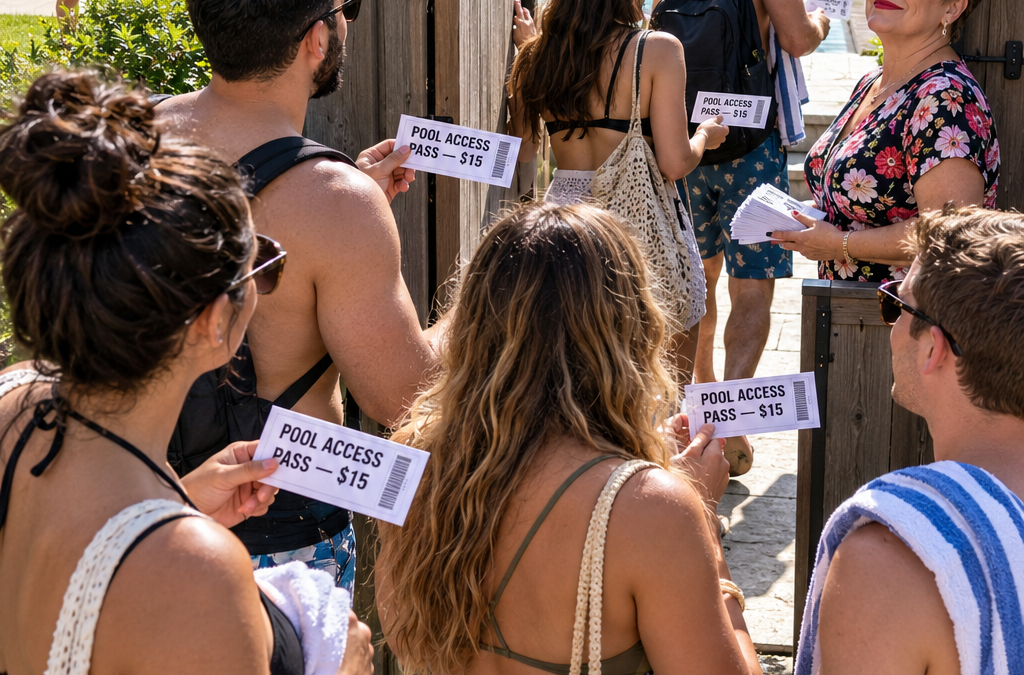
POOL ACCESS PASS.
My address.
Fifteen dollars.
People murmured.
“He told me he had paid Margaret Holloway for access.”
Margaret interrupted.
“Again, those were community contributions.”
I looked at her.
“He paid money. You gave him access.”
Leonard said, “Let her finish.”
I showed the Facebook page.
A photograph of my backyard filled the screen.
Someone behind me whispered, “Wow.”
I zoomed in.
“The photo was taken through my fence without my permission.”
Then the group description.
Community amenity.
Day passes.
Family packages.
Gate instructions.
I displayed the post containing my original gate code.
Leonard leaned forward.
“How did she get your gate code?”
“I don’t know.”
Margaret said quickly, “It was publicly available.”
I turned.
“Where?”
“It was shared.”
“By who?”
“I don’t recall.”
“I never shared it.”
“Then someone else must have.”
“Someone who had access to my private code.”
She looked away.
I changed the slide.
Payment screenshots.
Fifteen dollars.
Forty dollars.
Fifteen.
Forty.
Twenty.
Another fifteen.
“I’ve documented at least twenty-seven hundred dollars.”
The treasurer looked stunned.
Margaret said, “That number is misleading.”
“Then give us the correct number.”
Silence.
“How much did you make?”
“I didn’t profit.”
“How much did you collect?”
“I would need to review records.”
I looked at Leonard.
“Several residents voluntarily sent me receipts today after discovering they had paid to trespass on private property.”
One man in the audience stood.
“I’m one of them.”
Margaret turned.
He held up his phone.
“She told me this was approved.”
Another woman stood.
“Me too.”
Then another.
“I asked specifically whether the homeowner knew.”
The room went quiet.
Leonard looked at Margaret.
“What did you tell her?”
Margaret pressed her lips together.
The woman answered for her.
“She said, ‘It’s handled through the HOA.'”
Leonard stared at Margaret.
“Did you say that?”
“I don’t remember the exact wording.”
The woman laughed bitterly.
“I do.”
I moved to the access log.
Rows of timestamps appeared.
“The smart gate records every code entry.”
Margaret closed her eyes for half a second.
“This is thirty days of access.”
I scrolled.
“Some days six separate entries.”
Then I displayed older cloud-backup data I had recovered after contacting the lock manufacturer.
“These are earlier entries.”
The timeline went back almost to my first week in the house.
I looked at the board.
“I work from home.”
My voice changed there.
Not because I wanted it to.
Because that was the part that still bothered me most.
“I was inside while some of this happened.”
The room became still.
“I was in meetings. I was upstairs. I was living in my house believing my fence meant something.”
I looked at Margaret.
“She was sending strangers through my gate while I was home.”
Margaret finally snapped.
“They weren’t strangers.”
“To me they were.”
“They are your neighbors.”
“I had never met most of them.”
“Maybe if you made an effort to participate—”
Leonard slammed his palm against the table.
“Margaret.”
The room went silent.
He rarely raised his voice.
That made it more effective.
“This is not Claire’s fault because she didn’t attend enough social events.”
Margaret looked stunned.
Leonard leaned back.
“Did she authorize you to operate paid pool access?”
“No.”
The answer was almost too quiet to hear.
“Say that again.”
“No.”
“Did she authorize you to distribute her gate code?”
“No.”
“Did she authorize you to photograph her backyard?”
Margaret hesitated.
“No.”
“Did this board authorize any of it?”
Another pause.
“No.”
Leonard looked at the other board members.
They were staring at Margaret as though they no longer recognized her.
Then she did what people like Margaret often do when the facts stop helping them.
She changed the argument.
“I was trying to build community.”
A few people murmured.
She stood.
“I’ve lived here seventeen years. I have volunteered hundreds of hours. I’ve organized holiday drives, food collections, block parties, children’s events.”
Her voice became emotional.
“This neighborhood used to know what community meant.”
I watched her.
There was truth in some of it.
That almost made it worse.
“I saw a beautiful amenity going unused most of the day. The previous owners had allowed neighbors over.”
I interrupted.
“Allowing friends over isn’t the same as selling tickets after the house changes ownership.”
She looked at me.
“I expected you would eventually understand.”
“Understand what?”
“That living here means sharing.”
“My pool?”
“Within reason.”
“My backyard?”
“You’re twisting this.”
“No.”
I shook my head.
“You are.”
I pointed toward the screen.
“You put a price on something that wasn’t yours.”
The room became quiet again.
“Fifteen dollars for one person.”
I changed the slide.
“Forty for a family.”
Another.
“Twenty on holiday weekends.”
Another.
“You created passes with an HOA logo so people would believe you had authority.”
Margaret’s voice shook.
“I didn’t keep all the money.”
“Then where is it?”
She couldn’t answer.
I didn’t need to raise my voice.
“You came to my house twenty minutes after I moved in.”
She stared at me.
“You told me you liked bringing people together.”
A few people shifted uncomfortably.
“You weren’t welcoming me.”
My throat tightened.
“You were assessing what you could use.”
“That is absurd.”
“Is it?”
I brought up the oldest Facebook post.
It was dated four months earlier.
Before closing.
Before I officially owned the house.
A photograph of the listing photo from the real estate website appeared.
Margaret had written:
Potential summer pool arrangement returning soon. New owner expected in May. More details to follow.
The entire room reacted.
Even Leonard looked shocked.
I turned toward Margaret.
“You planned to continue this before I even moved in.”
Margaret’s face had gone white.
“I was referring to a historic arrangement.”
“With someone who hadn’t bought the house yet.”
No answer.
“You didn’t think you needed permission.”
Silence.
“Because you didn’t think my ownership changed your access.”
That was the truth.
Everything became clear in that moment.
This had never been a misunderstanding.
Margaret had decided the pool belonged, in spirit, to the neighborhood.
The deed was an inconvenience.
The fence was an inconvenience.
I was an inconvenience.
She had known the previous owners.
Maybe they had occasionally invited neighbors.
Maybe Margaret had blurred the line over the years.
Then they sold the house.
I installed a gate.
I didn’t join her social events.
And instead of accepting that access had ended, she simply continued as though I were a temporary obstacle.
Leonard asked the board attorney, a woman named Denise Walker, to speak.
Denise had spent most of the meeting taking notes.
She removed her glasses.
“I want to be very careful about what I say in an open meeting.”
Margaret looked at her.
“But several issues concern me.”
She counted them.
“Unauthorized use of association branding.”
“Representation of private property as an HOA amenity.”
“Possible misrepresentation to residents and guests.”
“Collection of funds outside association financial controls.”
“Potential insurance exposure.”
That last one caused visible panic among the board.
Denise continued.
“If anyone had been injured in Ms. Bennett’s pool after being led to believe the association operated or authorized access, the resulting liability questions could have been substantial.”
Leonard rubbed both hands over his face.
Margaret said, “No one was injured.”
Denise looked at her.
“That is fortunate. It is not a defense.”
Then the mother who had been in my backyard earlier raised her hand.
“My youngest is six.”
Margaret looked toward her.
The woman continued.
“I thought there was HOA insurance. That’s why I felt safe bringing my kids.”
No one spoke.
She looked embarrassed.
“I know I should have asked more questions, but there were passes. Rules. A logo. Everyone talked about it like it was official.”
She turned toward me.
“I’m really sorry, Claire.”
“You don’t owe me an apology.”
I looked at Margaret.
“She does.”
For the first time that evening, Margaret didn’t argue.
The board went into executive session.
I sat in the hallway outside the meeting room with several residents.
People apologized to me.
Some I accepted.
Some weren’t necessary.
Most had truly believed they were paying for legitimate access.
One older man named Frank sat beside me.
“I went twice last month.”
“I know.”
He looked horrified.
“The gate log?”
“Ten twelve on July twenty-second.”
He groaned.
“Jesus.”
I smiled despite myself.
“You’re fine.”
“I brought my brother.”
“I know. Two entries within six minutes.”
He covered his face.
“I’m never leaving my house again.”
That made me laugh.
It was the first time I’d laughed all day.
Twenty-five minutes later, the doors opened.
We went back inside.
Leonard looked exhausted.
Margaret sat at the far end of the table.
She wasn’t looking at anyone.
Leonard read the board’s decisions.
Effective immediately, Margaret Holloway was removed as chair of the social committee.
Unanimous.
She was prohibited from using HOA branding, resident contact lists, or association communication channels without board authorization.
Unanimous.
The HOA would issue written notice to residents that my pool had never been a community amenity.
Unanimous.
The board would conduct a financial review of all social committee activities administered by Margaret during the previous three years.
That one made her look up.
“What?”
Leonard didn’t stop reading.
The association would file a formal incident report documenting unauthorized use of private property and association branding.
Any criminal or civil complaints by residents would be handled independently.
Then came the part I hadn’t expected.
“Ms. Bennett.”
I looked up.
Leonard folded his hands.
“On behalf of the association, I want to apologize.”
The room was quiet.
“There is no excuse for what happened.”
He glanced toward Margaret, then back to me.
“The HOA did not authorize use of your property. But our oversight systems failed badly enough that a committee chair was able to create the appearance that it had.”
He took a breath.
“That is our responsibility.”
I nodded.
“Thank you.”
“We would also like to waive your association dues for the next twelve months.”
I raised my eyebrows.
“You don’t have to do that.”
“We know.”
He gave the faintest smile.
“Consider it an incentive not to move.”
A few people laughed.
Even I did.
Margaret didn’t.
After the meeting, she caught me in the parking lot.
“Claire.”
I stopped.
She stood beneath one of the streetlights.
For once, there was no perfect expression ready.
She looked exhausted.
“You destroyed my reputation.”
I stared at her.
“No.”
“You brought private matters into a public meeting.”
“You sold tickets to my backyard.”
“You could have handled this privately.”
“I tried.”
“You came to my door accusing me.”
“And you lied to my face.”
Her jaw tightened.
“I panicked.”
“You said you had never heard of the group.”
“I knew how you would react.”
“Yes.”
I nodded.
“Because you knew it was wrong.”
She looked away.
For a few seconds, neither of us spoke.
Then she said, “People liked it.”
“What?”
“The pool club.”
She looked at me again.
“People liked it. Families met each other. Kids played together. Neighbors who had never spoken became friends.”
I believed her.
That was the strangest part.
I believed that some good things had happened in my backyard.
But good outcomes don’t erase theft.
“Margaret, you could have asked me.”
“You would have said no.”
“Probably.”
“There.”
She spread her hands.
“Exactly.”
I almost laughed.
“You hear yourself, right?”
Her expression hardened.
“What was I supposed to do?”
“Accept no.”
That landed.
She stared at me.
I continued.
“You don’t get to decide someone else’s boundary is unreasonable just because it inconveniences your plans.”
“I was trying to help this neighborhood.”
“Then use your own house.”
Silence.
“Sell tickets to your own living room.”
She flinched.
“Put strangers in your backyard.”
I stepped closer.
“Give out your gate code.”
Her face changed.
“If you’re not comfortable doing that, maybe now you understand.”
For once, Margaret had nothing to say.
She walked away.
Over the following week, the story spread throughout Crestwood Pines.
I learned more than I wanted to know.
Margaret had been pushing boundaries for years.
Nothing as serious as the pool.
But enough that people had stories.
She had once collected money for new entrance landscaping without formal board approval, then hired her cousin’s company.
She had relocated decorative planters from one cul-de-sac to another because she thought the first street “already had enough visual interest.”
She had organized a holiday decorating competition and entered her own house.
She won.
Twice.
Leonard privately told me he had been suspicious of her since what he called “the flower-bed incident.”
I never got a complete explanation.
Honestly, I didn’t want one.
Three residents who had paid Margaret filed fraud complaints.
I wasn’t involved in those.
The HOA provided documentation when requested.
Margaret refunded several people voluntarily.
The remaining money became part of a larger dispute between her and residents who claimed she had misrepresented where their payments went.
I considered suing.
My attorney said I had options.
Trespass.
Potential privacy claims.
Possible damages related to unauthorized commercial use.
But after several weeks, I decided I didn’t want a year of my life consumed by Margaret Holloway.
I wanted my backyard back.
That mattered more.
I replaced the lock entirely.
New system.
Unique credentials.
Camera.
Motion alerts.
No shared code.
I added frosted privacy strips over the narrow fence gaps.
Then I hired a pool company to inspect everything.
Water quality.
Equipment.
Deck.
Safety.
I had no idea what dozens of strangers had brought into the yard over those months, and thinking about it made me uncomfortable.
For a while, I stopped swimming.
That surprised me.
The pool had been the reason I bought the house.
Yet every time I stepped outside, I imagined people I didn’t know sitting in my chairs.
Opening my gate.
Watching my windows.
It no longer felt private.
One evening, I sat at the edge with my feet in the water.
The sun was going down behind the oak trees.
I realized Margaret had taken something more valuable than admission fees.
She had taken my sense of safety.
I hated that.
So I decided I wasn’t going to let her keep it.
The next morning, I got up early.
Made coffee.
Changed into my swimsuit.
Went outside.
No phone.
No laptop.
No security-feed checking.
I unlocked the gate myself.
Then locked it again.
I walked to the deep end and jumped in.
The water was cold.
I surfaced laughing.
No reason.
Just relief.
I swam twenty laps.
Then floated on my back beneath the oak branches.
For the first time since discovering the group, the pool felt like mine again.
Four months after the HOA meeting, a moving truck appeared beside Margaret’s house.
I watched from my kitchen window.
Not because I was spying.
At least that’s what I told myself.
Boxes.
Furniture.
Workers.
By evening, half the house was empty.
She never came over.
No apology.
No farewell.
No lemonade.
A week later, the FOR SALE sign went up.
I felt less satisfaction than I expected.
Mostly relief.
The house sold to a young couple with a toddler.
Their names were Maya and Daniel.
On their second day, Maya knocked on my door.
I opened it cautiously.
She smiled.
“Hi. We’re next door.”
“I know. I’m Claire.”
“Maya.”
She held a plate covered in foil.
“We made too many cookies.”
I stared at the plate.
Something about neighborly food deliveries made me suspicious now.
Then I laughed.
“Sorry.”
“What?”
“Nothing.”
I accepted the cookies.
She looked toward the side yard.
“Oh, before I forget. The realtor said there was some weird story about your pool?”
I closed my eyes.
“Of course she did.”
Maya laughed nervously.
“We don’t need details. I just wanted to make sure our son doesn’t wander anywhere he shouldn’t.”
That one sentence told me everything I needed to know about her.
“Thank you.”
I showed her the property line.
Explained the gate.
Told her if a ball ever went over the fence, just text me.
She nodded.
“No problem.”
Then she hesitated.
“So the tickets were real?”
I laughed.
“Unfortunately.”
She covered her mouth.
“Oh my God.”
“Welcome to Crestwood Pines.”
Within six months, the pool story had become neighborhood folklore.
New residents heard versions of it.
Some exaggerated.
According to one version, I had trapped forty people inside for six hours.
Not true.
Another claimed Margaret had earned twenty thousand dollars.
Also not true.
One teenager told a friend that police had rappelled into the yard.
Definitely not true.
I stopped correcting people unless the details became ridiculous.
My gate became famous.
One December evening, Leonard came by during the neighborhood holiday walk.
He pointed toward it.
“Still logging?”
“Every second.”
“Margaret-proof?”
“Nothing is Margaret-proof.”
He laughed.
“Fair.”
The HOA changed too.
Committee chairs could no longer independently collect money.
Any event involving private property required written owner permission.
Use of the HOA logo on tickets or promotional materials required approval.
It was almost funny seeing rules created for situations nobody imagined would ever need rules.
But that’s often how rules are born.
Someone does something so unbelievable that everyone afterward has to write down that you’re not allowed to do it.
My favorite new policy was only one sentence:
No privately owned residential amenity shall be represented as an association amenity without written authorization from the legal property owner.
I kept a copy.
Not because I needed it.
Because it made me laugh.
A year after everything happened, I hosted a small barbecue.
My choice.
Eight people.
Neighbors I actually knew.
Maya and Daniel.
Leonard and his wife.
Frank, who still apologized every time he saw the pool.
A couple from across the street.
At one point, Frank stood beside the water holding a beer.
“Feels weird being here legally.”
I laughed.
“You want me to print you a pass?”
“Absolutely not.”
Maya pointed toward the gate.
“Is that the famous one?”
“The very same.”
Daniel walked over.
“So this thing actually records everybody?”
“Every entry.”
He looked impressed.
“That’s terrifying.”
“Only if you’re selling tickets.”
We all laughed.
And that was the difference.
Those people were there because I had invited them.
Such a small distinction.
Permission.
But permission is everything.
Margaret had never understood that.
Or maybe she had understood it perfectly and simply believed her intentions mattered more than my answer.
That was what bothered me most when I thought about her.
Not the money.
Not even the Facebook group.
It was the certainty.
The belief that because she thought an idea was good for the community, she didn’t need the consent of the person who actually owned the property.
There are people who don’t see boundaries as boundaries.
They see them as negotiations they haven’t won yet.
A fence is a suggestion.
A locked gate is an inconvenience.
A no is an invitation to find another way.
Margaret lived that way.
For years, people let her.
Maybe because arguing was exhausting.
Maybe because most of what she did seemed too small to justify a fight.
A flower bed.
A committee.
A holiday event.
A mailbox.
Then one day she looked through a fence, saw someone else’s pool, and decided the neighborhood deserved it more than the homeowner deserved privacy.
That’s how entitlement grows.
Rarely all at once.
It grows through little victories nobody challenges.
One afternoon, months after she moved away, I found one of the old passes while cleaning my office.
POOL ACCESS PASS.
Fifteen dollars.
My address.
The Crestwood Pines logo.
I stood there holding it for a long time.
Then I went outside.
The gate clicked behind me.
My pool was still.
No strangers.
No towels.
No printed schedules.
Just late-afternoon sunlight on the water.
I sat beside it and looked at the pass.
For a second, I considered throwing it away.
Instead, I put it in a small frame.
It’s still on a shelf in my office.
People ask why.
Because it reminds me of something I learned the hard way.
Owning a home isn’t just having your name on a deed.
It’s having the right to decide who enters.
Who stays.
Who gets invited.
Who doesn’t.
It’s having the right to close a gate without explaining yourself.
It’s having the right to enjoy what you’ve worked for without someone deciding your privacy is selfish.
I spent three years saving for that house.
Margaret spent a few minutes creating a Facebook group.
She thought that was enough to turn what I had earned into something she could sell.
It wasn’t.
Sometimes I still get a notification from the gate.
Usually a package delivery.
Occasionally Maya’s son accidentally throws a ball over the fence and she texts first.
Once Leonard tried the keypad as a joke.
The camera caught him grinning while he typed six random numbers.
I sent him a message.
Nice try. Admission is $15.
He replied:
Family package?
I wrote:
$40. No refunds.
Some stories become funny once enough time passes.
This one did.
Mostly.
But every now and then, I’ll remember that first man standing beside the pool.
Towel over his shoulder.
Ticket in his hand.
Confused because I was telling him he wasn’t supposed to be there.
He hadn’t climbed the fence.
He hadn’t broken anything.
He had simply trusted a woman who looked official.
She had given him a logo.
A pass.
A code.
A price.
That was enough to convince him my backyard wasn’t really mine.
That idea stayed with me.
Authority often looks more convincing than it is.
A printed ticket can look official.
A committee title can sound powerful.
A neighborhood logo can make a lie feel legitimate.
But none of those things change ownership.
None of them create consent.
And none of them erase a boundary just because someone thinks it would be more convenient if the boundary weren’t there.
The gate is still standing.
New lock.
New camera.
Same fence.
And every time it clicks shut behind me, I hear something different than I did before.
Not fear.
Not suspicion.
Something much simpler.
Mine.








