𝗙𝗨𝗟𝗟 𝗦𝗧𝗢𝗥𝗬 My Neighbor Called 911 to Shut Down My Wedding and Told Police We Didn’t Belong on Our Own Land
𝗙𝗨𝗟𝗟 𝗦𝗧𝗢𝗥𝗬
I had built a career on understanding how small procedural mistakes become weapons in the wrong hands.
So I left none.
Across the valley, Victoria Caldwell stood on her balcony.
I did not see her.
Not yet.
But she saw us.
Her estate sat on the opposite rise, a large white colonial house behind iron gates.
She and her husband Bradley had lived there for more than two decades.
Two years before my wedding, they had tried to purchase Ridgemont.
Bradley wanted condos.
Golf course.
Private roads.
Gates.
Victoria had once told a county planner that the area needed to be “protected from changing demographics.”
The planner had remembered the wording.
So had I.
A preservation trust I established eventually bought Ridgemont instead.
I never dealt with Victoria directly.
I did not need to.
But apparently she had never accepted losing the land.
From what Ruth, her housekeeper, later told investigators, Victoria stood on the balcony that morning with binoculars.
She watched guests arrive.
One Black family after another.
Then she said something Ruth would never forget.
“They’re like black rats trying to gnaw everything away.”
Ruth froze.
Victoria continued watching.
“Animals in suits are still animals.”
Then she called 911.
Her first call lasted a little over two minutes.
She described an “illegal gathering.”
Hundreds of people.
Suspicious cars.
Bags.
Boxes.
She said she was afraid.
The dispatcher asked whether she had actually witnessed a crime.
Victoria said we were trespassing.
On my property.
She repeated the word three times.
Trespassing.
She implied drugs.
Gang activity.
Weapons.
Nothing specific enough to prove.
Everything specific enough to frighten someone listening.
Two patrol cars were dispatched.
They reached our front gate twelve minutes later.
James Atwell met them.
Officer Dale Swanson got out first.
His partner, Officer Rita Coleman, followed.
Rita looked across the vineyard and immediately understood what she was seeing.
A wedding.
White chairs.
Flowers.
String quartet.
Formal clothes.
Children.
Swanson saw the same things.
He simply interpreted them differently.
Atwell greeted them.
“Afternoon, officers.”
Swanson did not respond in kind.
“We received a report of an illegal gathering.”
Atwell had the documents ready.
He handed them over.
“Private wedding. Property owner is the groom. County permits, variance, alcohol licensing, insurance, deed.”
Swanson flipped through them.
According to Atwell, he barely read anything.
“Who organized this?”
“The groom.”
Swanson looked past him.
At the guests.
At us.
“I need to verify that.”
Atwell pointed at the paperwork.
“You just did.”
Swanson’s expression hardened.
“Step aside.”
Rita spoke quietly.
“Dale, the permits are valid.”
He ignored her.
Then dispatch received Victoria’s second call.
This time, she had upgraded her story.
She claimed to see a rifle.
A long black object.
She said someone had carried it from the parking area.
What she had seen was an umbrella.
One of my groomsmen, Derek Williams, had brought a black umbrella because the forecast showed a chance of rain and he was worried Denise’s hair might get ruined.
That umbrella became a weapon the moment Victoria needed it to.
Swanson changed when the report came through.
Atwell saw it.
Rita saw it.
His hand moved closer to his holster.
“There’s a weapon report.”
Atwell shook his head.
“There are no firearms permitted on this property except licensed security.”
“We’re going in.”
“You’ve seen every document.”
“Move.”
“Officer—”
Swanson stepped closer.
“Move, or I arrest you for obstruction.”
Atwell stepped aside.
He later told me it was one of the hardest decisions of his career.
But he understood something most people do not.
There are moments when resisting an officer who has already convinced himself that resistance proves guilt can create exactly the crisis he claims to be preventing.
So he let them pass.
At the altar, I knew none of this.
Pastor Raymond Davis had just opened his Bible.
He had baptized me.
Buried my father.
Counseled Denise and me before the wedding.
The quartet started the processional.
Then Denise appeared.
Everything else disappeared.
She stood at the far end of the aisle in white lace.
Her brother Gerald beside her.
Her veil lifted in the wind.
She looked at me.
I forgot how to breathe.
Cole whispered beside me.
“Still not nervous?”
“Shut up.”
Then people began turning their heads.
I saw the uniforms.
Two officers walking across the grass.
The music continued for a few seconds.
Then the musicians noticed too.
The sound faltered.
Denise slowed.
Swanson walked directly toward the altar.
He did not wait.
Did not ask Atwell.
Did not signal quietly.
He stepped into the ceremony.
“Sir, I’m going to need you to pause this.”
Pastor Davis looked at him.
“We are in the middle of a wedding.”
“We received reports of criminal activity.”
The quartet stopped.
That silence is something I still remember.
A child whispered.
A chair creaked.
The breeze moved through the vines.
Pastor Davis closed his Bible halfway.
“Officer, this is a sacred ceremony.”
“I’m conducting an investigation. Step aside.”
I turned toward Swanson.
“Can I help you?”
He looked at me.
Up.
Down.
Tuxedo.
Cufflinks.
Everything.
“Are you the event coordinator?”
A murmur went through the guests.
I felt Cole beside me stiffen.
“I’m the groom.”
Swanson showed no embarrassment.
“Then I need identification and proof you’re authorized to be on this property.”
That sentence landed somewhere deep in me.
Not because I had never heard its relatives before.
I had.
At sixteen, walking home from the library.
At twenty-two, entering a building where I interned.
At thirty, parking my own car near a government office.
Explain yourself.
Prove you belong.
Prove the thing you own is yours.
Prove your presence is legitimate.
I looked at Swanson’s right hand.
Close to his gun.
Then I looked at my mother.
She was watching me from the first row.
I moved slowly.
Very slowly.
Pulled out my wallet.
Removed my driver’s license.
Handed it over.
Swanson held it up.
“Dispatch, run Aaron Underwood.”
He spelled my last name incorrectly.
“Check for warrants.”
At my wedding.
On my land.
My mother’s hands started trembling.
I saw it immediately.
She hid them beneath her purse.
But I knew that tremor.
My father had once been stopped because an officer thought his car looked “too expensive for the area.”
I had been stopped walking home as a teenager.
Mama had spent a lifetime learning that even ordinary moments could turn dangerous when authority met assumption.
And now, while wearing the dress she had chosen months earlier for her son’s wedding, that old fear returned.
Derek stepped forward.
“Officer, he owns this land.”
Swanson pointed at him.
“Step back.”
“You’re disrupting a lawful—”
“Step back now or be detained.”
Derek’s fists tightened.
I looked at him.
One small shake of my head.
He stepped back.
Rita moved closer to Swanson.
“Dale, permits are valid. There’s no active violation.”
“I’ll decide that.”
Then, before dispatch even returned my name, he started searching.
He walked to the reception tables.
Lifted cloths.
Opened coolers.
Moved serving containers.
He walked toward the main house.
I followed.
“Officer.”
He ignored me.
“You do not have a warrant.”
“Active threat report.”
“There is no threat.”
He entered the bridal suite.
Denise’s robe still hung from the door.
Her perfume was still in the room.
Her mother’s handwritten note was folded beside the mirror.
He opened a closet.
Moved curtains.
Pulled a drawer.
Something inside me changed.
“Officer Swanson.”
He turned.
“My name’s Aaron.”
I stepped closer.
“You have no warrant. I have not consented to this search.”
“Sit down.”
“No.”
His eyes sharpened.
“Let me do my job.”
“You’re not doing your job.”
For one second, I thought that might be where everything broke.
His jaw moved.
Mine probably did too.
Then he turned away.
Back outside, the wedding sat suspended.
Children who had been laughing minutes earlier now stayed near their parents.
The flower girl was crying.
Denise was still standing in the aisle.
Her bouquet had begun to bend beneath her grip.
Then Victoria Caldwell walked onto my property.
No invitation.
No permission.
She crossed the lawn like she had finally been summoned to a stage she believed belonged to her.
She approached Swanson.
“Thank God you’re here.”
Her voice carried.
“I’ve been watching these people all morning.”
These people.
Every Black person there heard it.
She gestured toward our guests.
“They clearly don’t belong here.”
My bride heard it.
My mother heard it.
Governor Anderson heard it.
Judges.
Veterans.
Teachers.
Children.
“This was a respectable estate before they got their hands on it,” Victoria continued. “I don’t know how they got the money. Frankly, I don’t want to know.”
I saw Denise’s bouquet begin to break.
Petals dropped onto the grass.
Mama stood.
Slowly.
Her voice was quiet.
“Ma’am.”
Victoria ignored her.
Mama took another breath.
“This is my son’s wedding day.”
Victoria continued talking to Swanson.
“I want them removed.”
Mama’s face changed.
Not surprise.
Recognition.
The kind that hurts more.
She had asked for basic humanity and been treated as though she had not spoken at all.
That was the moment I stopped hoping the situation would resolve itself.
I looked at Denise.
Tears were running down her cheeks.
Not the tears I had imagined seeing when she reached the altar.
Wrong tears.
Wrong reason.
I looked at Mama.
At Walter Brown, retired Marine, sitting three rows back.
At the little girl crying.
At two hundred people whose only offense was attending a wedding.
Then I took out my phone.
Stepped away.
Dialed from memory.
When the call connected, I said four words.
“It’s Aaron. Come now.”
I hung up.
Nobody around me noticed.
Swanson was too busy ordering the DJ equipment shut down.
Victoria was calling a television station.
Yes.
She wanted cameras.
She told them police were investigating a “large Black gathering.”
Possible drugs.
Possible weapons.
She wanted the world to watch.
Swanson turned toward our guests.
“Nobody leaves.”
I stared at him.
He continued.
“I need identification from everyone present.”
Rita stepped forward.
“Dale.”
He ignored her.
Two hundred people.
On private property.
No warrant.
No probable cause.
He started row by row.
Walter Brown was first.
“Stand up.”
Walter did.
“Empty your pockets.”
Walter looked at Swanson.
He had served twenty-four years in the Marines.
Two combat tours.
Silver Star.
But that day none of that mattered to Swanson because Swanson did not know it.
Maybe that was the point.
Walter reached into his jacket.
Placed everything on the chair.
Wallet.
Handkerchief.
Peppermint.
A photograph of his late wife on their wedding day.
Swanson opened the wallet.
Flipped through it.
Returned it without apology.
Walter looked toward me.
I will never forget his face.
Not angry.
Tired.
Rita finally confronted Swanson directly.
“Call the sergeant.”
“I’ve got it.”
“No. You don’t.”
He stared at her.
“This looks like a lawsuit.”
“Go stand by the car.”
“I’m not leaving.”
“Then stay out of my way.”
She stepped back.
But she remained.
She watched.
She remembered.
Eleven minutes passed.
Eleven minutes can be nothing.
That day, it felt like an hour.
Then tires moved over gravel.
People turned.
Three black SUVs came through the vineyard road.
No sirens.
No flashing lights.
They stopped near the gate.
Doors opened.
Nathan Ellis stepped out first.
Deputy Director of the Virginia State Bureau of Investigation.
Four agents with him.
Then Sheriff Terrence Whitfield stepped from the third SUV.
Whitfield was invited to the wedding.
He was late because he had stopped for a gift.
He later showed me the bottle of Virginia wine still wrapped in gold paper on his passenger seat.
Atwell moved aside.
For the first time since police arrived, his shoulders dropped.
Swanson straightened.
Sheriff Whitfield walked directly toward him.
“Deputy Swanson.”
“Sheriff.”
Swanson tried to sound normal.
“We received a call concerning possible weapons and unlawful—”
Whitfield interrupted.
“Do you know who this man is?”
Swanson looked at me.
“He says he’s the groom.”
Whitfield’s expression hardened.
“He says he’s the groom.”
He repeated it slowly.
Then he looked across the wedding.
“This is Aaron Underwood.”
Swanson waited.
“The Attorney General of the Commonwealth of Virginia.”
Silence.
Real silence.
Swanson blinked.
Whitfield continued.
“The chief law enforcement officer of this state.”
I watched the color leave Swanson’s face.
Victoria lowered her phone.
For the first time all afternoon, neither of them seemed certain.
Whitfield stepped closer to Swanson.
“You entered his property.”
Swanson swallowed.
“Sheriff, I was responding—”
“You searched his home?”
“We had a weapon report.”
“Where is the weapon?”
No answer.
“Where?”
“Nothing was located.”
“You detained these people?”
Swanson said nothing.
Whitfield looked at him with something beyond anger.
Then I stepped forward.
“Sheriff.”
He turned to me.
“I’ll handle my part.”
I looked at Swanson.
I did not raise my voice.
“Officer, you entered private property without a warrant.”
He stared at me.
“You searched my house.”
No answer.
“My bridal suite.”
His jaw tightened.
“You stopped two hundred people from leaving.”
I looked toward Walter.
“You searched a retired Marine in front of his family.”
Then Mama.
“You made my mother stand in front of a stranger and ask for basic respect at her son’s wedding.”
I turned toward Victoria.
“And all of it started because the woman next door saw Black people on land she thought we shouldn’t own.”
Victoria found her voice.
“That is not what happened.”
I looked at her.
“You called twice.”
“I was concerned.”
“You fabricated a weapon.”
“I saw something black and long.”
“An umbrella.”
“How was I supposed to know?”
“You weren’t.”
I let that settle.
“You were supposed to tell the truth.”
She lifted her chin.
“I’m calling my attorney.”
“You should.”
Then I looked at Ellis.
He understood.
“Officer Swanson,” Ellis said, “you are relieved of duty pending investigation. Badge and sidearm.”
Swanson looked at me.
Then Whitfield.
Then Rita.
His hands started shaking.
He removed the badge.
Then his weapon.
Handed both over.
Victoria stepped backward.
Whitfield turned toward her.
“Mrs. Caldwell, you need to leave the property.”
“This is absurd.”
“You are trespassing.”
“I was invited over by the police.”
“No, ma’am.”
“I called the police.”
“That isn’t an invitation from the property owner.”
She looked at me.
“You can’t do this.”
I answered quietly.
“Yes, I can.”
She pointed at me.
“You people think because you have titles—”
She stopped.
Too late.
Everyone heard it.
Whitfield moved between us.
“Mrs. Caldwell.”
“I know the governor.”
Whitfield almost smiled.
“Governor Anderson is sitting in row four.”
She turned.
Philip Anderson stood slowly.
He looked at her.
Nothing more.
Victoria’s face collapsed.
She was escorted toward the patrol car.
She protested the entire way.
Taxpayer.
Homeowner.
Rights.
Neighborhood safety.
The same words over and over.
Swanson was being led toward another vehicle when he stopped.
He turned back.
“Mr. Attorney General.”
I waited.
“I was responding to a call.”
“I know.”
“I didn’t know who you were.”
That sentence mattered more than he understood.
I walked toward him.
“You didn’t need to know.”
He looked confused.
“You didn’t need to know my job.”
I pointed toward the wedding.
“You didn’t need to know Walter served twenty-four years.”
Then Mama.
“You didn’t need to know my mother taught school for forty years.”
I looked at Denise.
“You didn’t need to know anything about any of us.”
Swanson’s eyes dropped.
“If I had been a plumber, you would have done exactly what you did.”
He said nothing.
“If I had been a truck driver.”
Nothing.
“A teacher.”
Nothing.
“The difference is that nobody would have come.”
His face changed.
“No SUVs.”
I pointed toward Ellis.
“No bureau director.”
Then Whitfield.
“No sheriff.”
I looked at him.
“That is the problem.”
His shoulders fell.
“Not that you failed to recognize me.”
I looked across my guests.
“You failed to recognize them.”
The agents took him away.
Then I walked back to Denise.
She was still standing where everything had stopped.
Her bouquet was ruined.
Her makeup was streaked.
She looked at me.
“We’re still getting married.”
She laughed through tears.
“Are we?”
“Yes.”
“After all that?”
“I did not spend four years rebuilding this vineyard for Victoria Caldwell to cancel my wedding.”
That laugh was different.
Real.
I took her hands.
“Come marry me.”
Pastor Davis returned to the altar.
He opened the Bible.
Looked at all of us.
Then said, “If anyone else has an objection, I strongly recommend you keep it to yourself.”
Laughter broke across the vineyard.
Deep.
Relieved.
People cried while laughing.
Even Judge Wallace in the second row smiled.
The quartet lifted their instruments again.
The processional restarted.
Denise walked toward me.
This time she reached the altar.
When it came time for my vows, I thought I knew what I was going to say.
Then I looked at Mama holding my father’s photograph against her chest.
My plan disappeared.
“I promise to protect what we build together.”
My voice cracked.
Denise squeezed my hands.
“With patience.”
I breathed.
“With grace.”
I looked at her.
“And without backing down.”
She smiled.
We finished the ceremony.
When Pastor Davis pronounced us husband and wife, the vineyard erupted.
Two hundred people stood.
Cheered.
Clapped.
Children ran between the chairs.
The quartet played something bright.
The sun was still above the ridge.
The flowers were still standing.
The food was still warm.
The wedding belonged to us again.
Monday morning, I went back to work.
My first official act was to remove myself from every investigation connected to what had happened.
I signed the recusal.
Handed the case to my deputy.
“Run it clean.”
He nodded.
“No favors.”
“I know.”
“No shortcuts.”
“I know.”
“And nothing done because it was me.”
He looked at me.
“You understand that if anything, this is going to be harder because it was you.”
“Good.”
I wanted no one to say I had used my office for revenge.
They did not need me anyway.
The evidence was overwhelming.
Swanson’s body camera recorded everything.
The permits.
Atwell explaining them.
Rita confirming them.
The unauthorized entry.
The search.
The demands for identification.
Walter emptying his pockets.
The bridal suite.
The moment Whitfield arrived.
More than forty guests submitted sworn statements.
Attorneys.
Judges.
Veterans.
The governor.
Every statement matched.
Then investigators obtained Victoria’s 911 calls.
Her language told its own story.
“Those people.”
“Don’t belong.”
“Suspicious.”
“Trespassing.”
Then the second call.
A rifle that did not exist.
The Civil Rights Division classified it as a deliberate false report.
By Wednesday, a reporter named Cassandra Blake had enough for a full investigative piece.
She worked for Channel 9.
I knew her reputation.
Smart.
Patient.
Difficult to intimidate.
Her segment aired Wednesday night.
A Wedding, a Lie, and the Attorney General Next Door.
Within hours, it spread nationally.
Then guest videos emerged.
Victoria crossing the lawn.
Her saying, “These people don’t belong here.”
Mama speaking to her and being ignored.
Walter emptying his pockets.
The flower girl crying.
Swanson ordering guests not to leave.
Millions of people watched.
Victoria had wanted cameras.
She got them.
Then people started looking at her history.
Three earlier police calls involving Black residents.
A family at a park.
A Black-owned food truck.
A teenager playing basketball.
Emails to the neighborhood association complaining about affordable housing bringing “the wrong element.”
It was not one bad afternoon.
It was a pattern.
Bradley Caldwell’s real estate business started losing clients.
Major contracts disappeared.
Partners issued public statements.
Their name became radioactive.
Victoria was eventually charged with two counts of filing false police reports and criminal trespass.
Prosecutors also pursued enhanced penalties based on racial motivation.
Her attorney described her as a frightened homeowner concerned about neighborhood safety.
Then prosecutors played her own calls.
They played the videos.
They displayed the emails.
Forty-three witnesses gave statements.
Mama testified.
I did not attend that day.
She asked me not to.
“I can do this myself,” she said.
I believed her.
She later told me the courtroom went silent when she described standing at her son’s wedding and asking Victoria, politely, to let us have that day.
“She acted like I wasn’t there,” Mama said from the witness stand.
That was all.
No speech.
No performance.
Just the truth.
The jury found Victoria guilty.
She received jail time, much of the sentence suspended, hundreds of hours of community service, a large fine, mandatory bias education, and a permanent order keeping her away from Ridgemont and my family.
Swanson’s case was separate.
Unlawful search.
Unlawful detention.
Abuse of authority.
His law enforcement certification was permanently revoked.
He would never carry a badge again.
Rita Coleman was not charged.
The investigation specifically noted that she had challenged Swanson, attempted de-escalation, and refused to participate in the worst conduct.
When I met her months later, she did not accept praise easily.
“I should’ve stopped him sooner.”
“You tried.”
“Not enough.”
“You were one person.”
“So was he.”
That answer stayed with me.
Four months after the wedding, she was promoted.
She began leading community-policing training.
At her first session with new recruits, she told them about Walter.
About the little flower girl.
About the moment she realized Swanson was no longer investigating anything.
He was exercising power.
“I spoke once,” she told them. “Then I backed off.”
She paused.
“Don’t be me.”
A recruit later repeated the line to a reporter.
“Be louder.”
The wedding also changed state law.
Legislators introduced what eventually became the Underwood-Collins Fair Reporting Act.
It increased penalties for knowingly false, racially motivated emergency reports, especially when they targeted people engaged in lawful activity on their own property.
Governor Anderson signed it that December.
Denise and I stood behind him.
Mama sat in front holding my father’s photograph.
After signing, Philip handed me the pen.
I gave it directly to Mama.
She looked at me.
“Why me?”
“Because Dad worked three jobs.”
She closed her fingers around it.
Six months after the wedding, Ridgemont was green again.
The vines had survived winter.
Spring returned stronger than I expected.
We replaced the temporary floral arch with stone.
Denise and I had our names carved into the top along with the wedding date.
Then something unexpected happened.
Couples started calling.
Black couples.
Interracial couples.
Veterans.
Teachers.
People who had seen what happened and wanted to marry at the place where a ceremony had been interrupted and completed anyway.
Within months, the waiting list stretched more than a year.
Denise laughed when I showed her.
“We accidentally opened a wedding venue.”
“I think Lorraine opened a wedding venue. We just own the dirt.”
We kept our lives as ordinary as possible.
I went back to work.
Denise returned to the hospital.
She was a pediatric surgeon, which meant she spent her days doing things I considered impossible and then came home complaining that I loaded the dishwasher incorrectly.
Every night we ate together when our schedules allowed it.
No television sometimes.
Phones away.
Normal on purpose.
Mama built a garden on the eastern side of Ridgemont.
Lavender.
Rosemary.
Jasmine climbing along the stone wall.
She called it the Patience Garden.
One Saturday I found her kneeling in the dirt with Dad’s photograph resting against a rock.
“Why patience?” I asked.
She pulled a weed.
“Because patience is the only reason any of us are still standing.”
I sat beside her.
“You know patience and tolerating disrespect aren’t the same thing.”
She looked at me.
“Who raised you?”
“You.”
“Then why are you explaining my own lessons back to me?”
I laughed.
Victoria served her sentence quietly.
No public apology ever came.
When she was released, the Caldwell estate went on the market.
It sold quickly.
To a Black family from Richmond.
Three children.
Golden retriever.
When Mama heard, she laughed for almost a full minute.
Bradley Caldwell filed for divorce before the closing.
I never spoke to either of them again.
I did not need to.
That spring, Ridgemont produced its first commercial wine.
Small batch.
Red.
Aged in barrels I had worked on myself during the winter.
Denise designed the label.
Two silhouettes beneath a stone arch.
Vines on both sides.
We called it Patience.
It sold out in eleven days.
I agreed to one interview.
One.
Cassandra Blake came to the vineyard.
We sat on the porch overlooking the rows.
Late afternoon.
No cameras at first.
She wanted to talk before recording.
Eventually she asked me the question everyone expected to be simple.
“What was the hardest part?”
I did not have to think.
“My mother’s face.”
She waited.
I looked across the vines.
“I have seen anger.”
I said.
“I have seen people threaten me.”
I rubbed my thumb across the edge of the porch chair.
“But watching my mother stand up in her Sunday clothes and ask a stranger to respect her son’s wedding…”
I stopped.
“That was different.”
Cassandra asked why.
“Because she had done everything this country tells people to do.”
I looked at her.
“Worked.”
“Raised a family.”
“Taught children.”
“Paid taxes.”
“Followed rules.”
“Asked politely.”
“And none of it protected her from being treated like she was invisible.”
Cassandra was quiet.
Then she asked me whether knowing who I was had changed the outcome.
“Yes.”
I answered immediately.
“That’s the part people keep celebrating that I wish they wouldn’t.”
She frowned.
“What do you mean?”
“They love the reveal.”
“The Attorney General.”
“The SUVs.”
“The sheriff.”
“Swanson’s face.”
I shook my head.
“That’s not the victory.”
“What is?”
I looked down the vineyard.
“It shouldn’t have taken any of that.”
The wind moved through the vines.
“If I had been a teacher, everything before those SUVs would have happened exactly the same.”
I paused.
“If I had been a plumber.”
“A truck driver.”
“A mechanic.”
“A man who spent his whole life repairing roofs.”
“Same wedding.”
“Same land.”
“Same permits.”
“Same mother.”
“Same bride.”
“Same neighbor.”
“Same police call.”
Cassandra nodded slowly.
“But the ending?”
“That’s the problem.”
I looked at her.
“The ending might have been different.”
The words sat between us.
“No Deputy Director Ellis.”
“No Sheriff Whitfield suddenly realizing something had gone terribly wrong.”
“No one afraid that abusing me could end their career.”
I thought about Swanson.
“He said he didn’t know who I was.”
I shook my head.
“He still didn’t understand.”
Cassandra asked what he should have understood.
“That he shouldn’t have needed to know.”
I looked toward the stone arch where Denise and I had finally finished our vows.
“Justice that only becomes careful when it recognizes power isn’t justice.”
I paused.
“It’s fear of consequences.”
That became the final line of the interview they aired.
But it was not the final thing I thought about.
Months later, Denise and I attended a wedding at Ridgemont.
Not ours.
A young couple from Charlottesville.
Teacher and electrician.
No politicians.
No judges.
No security convoy.
Just family.
I stood far behind the ceremony near the vines.
Denise slipped her hand into mine.
The bride walked toward the altar.
Music played.
Children whispered.
Nobody interrupted.
Nobody asked who owned the land.
Nobody demanded identification.
Nobody searched anything.
The couple reached each other.
The pastor began.
Denise leaned against me.
“You okay?”
“Yeah.”
“You’re doing the face.”
“What face?”
“The attorney general face.”
“I don’t have one.”
“You absolutely do.”
I smiled.
Then I looked toward Mama.
She was seated beneath the oak tree.
Dad’s photograph was no longer in her hands.
She had finally begun leaving it at home sometimes.
I considered that progress.
The ceremony continued.
No sirens.
No shouting.
No humiliation.
Ordinary.
I realized then that ordinary had become the thing I valued most.
Not revenge.
Not punishment.
Not seeing Victoria convicted.
Not watching Swanson lose his badge.
Those things mattered.
Accountability mattered.
But none of them could restore the hour that had been taken from Denise.
They could not remove the fear from Mama’s memory.
They could not make the flower girl forget men with guns silencing a wedding.
The best outcome was not dramatic.
It was a teacher and an electrician standing beneath our stone arch without anyone questioning whether they belonged there.
Denise squeezed my hand.
The couple kissed.
People stood and cheered.
I watched them and thought about the four words I had said into my phone.
It’s Aaron. Come now.
Those words brought power to Ridgemont.
They protected us.
They changed everything.
And I remained grateful that I had been able to make that call.
But I will never mistake having access to power for justice.
Because somewhere else, on some other road, at some other wedding, front porch, traffic stop, grocery store, or neighborhood gate, there will be someone who cannot make that call.
No governor in row four.
No sheriff on the guest list.
No state agents three SUVs away.
Just a person saying, quietly and truthfully:
I belong here.
That should be enough.
My name should never have been what saved our wedding.
My office should never have been what made Swanson lower his hand.
My title should never have been what forced Victoria Caldwell’s lies to matter.
I was the Attorney General that afternoon.
But before I was any of that, I was a son standing beside his mother.
A man waiting for his bride.
A property owner standing on his own land.
A human being.
And that should have been the only qualification anyone needed.
𝗧𝗛𝗘 𝗘𝗡𝗗
My Neighbor Called 911 to Shut Down My Wedding and Told Police We Didn’t Belong on Our Own Land
Victoria Caldwell watched two hundred Black guests gather beneath the oak trees of my vineyard and decided our celebration looked enough like a crime to justify calling the police. By the time an officer put his hand near his gun and demanded that I prove I had the right to stand at my own altar, my bride was frozen halfway down the aisle, my mother was trembling in the front row, and I knew our wedding had become something none of us would ever forget.
The morning I married Denise should have begun and ended with her.
That was what I had told myself when I woke before sunrise at Ridgemont.
No politics.
No office.
No press.
No titles.
No cases.
No phone calls unless the vineyard was on fire.
Just Denise.
Just family.
Just the piece of Virginia land I had spent four years restoring because I wanted one place in my life where history did not feel like something other people had written for us.
The sun came over the Blue Ridge just after seven.
It turned the vineyard gold.
Rows of vines stretched down the hills in clean green lines, their leaves moving softly in the September wind. White chairs had been arranged across the lawn the night before. Two hundred of them.
At the end of the aisle stood an arch made from old stone and white roses.
Tiny glass lanterns hung from the ivy.
A string quartet was setting up beneath the oak near the eastern field.
That tree had been there longer than anyone alive could remember.
My grandfather had once told me that trees remember who stands beneath them.
I did not believe that literally.
But that morning, looking out across Ridgemont, I wanted to.
The vineyard had belonged to a Black farming family generations earlier.
Then debt came.
Then developers.
Then neglect.
By the time I bought it, much of the old fencing had collapsed, weeds had swallowed entire sections of vineyard, and one stone wall had fallen almost flat into the earth.
People told me rebuilding it was a bad investment.
I was not trying to make an investment.
I was trying to return something.
For four years, I spent weekends out there with work gloves on.
Rebuilding fence.
Resetting stone.
Planting vines.
Clearing drainage ditches.
Learning the difference between soil that was exhausted and soil that was simply waiting.
My father would have loved the place.
That thought came to me often.
Especially that morning.
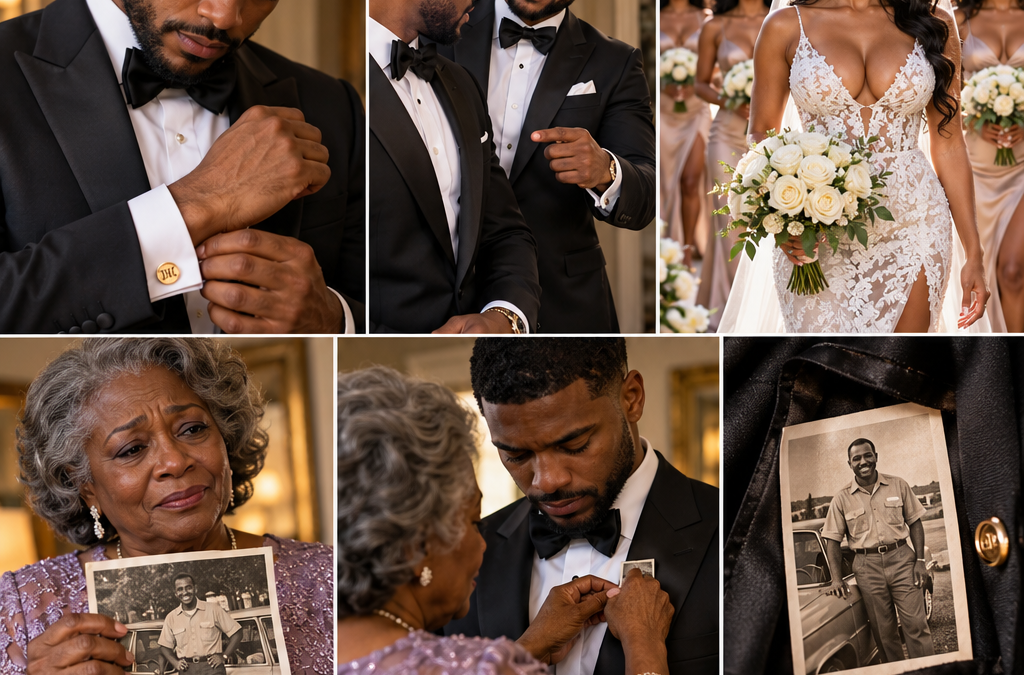
I stood in front of the mirror in the upstairs bedroom wearing a black tuxedo that fit better than anything I normally wore to work.
My best man, Cole Anderson, leaned against the door.
“You nervous?”
I was fastening one cufflink.
Gold.
Simple.
My father’s initials engraved into it.
“No.”
Cole laughed.
“Liar.”
“I’m not nervous.”
“You’re adjusting the same cufflink for the fourth time.”
I looked down.
He was right.
“I’m making sure it’s secure.”
“You prosecute state corruption for a living and this is what finally scares you.”
I looked at him in the mirror.
“Denise doesn’t scare me.”
“The wedding does.”
“The wedding is fine.”
He grinned.
“Keep saying it.”
Cole had known me since we were twelve.
Same neighborhood.
Same public school.
Same streets where adults told us to dream while making sure we understood exactly how far they thought boys like us were allowed to go.
He became a federal prosecutor.
I took a different road.
But that morning, neither of us cared about any of it.
My mother opened the door without knocking.
At seventy-one, Evelyn Moore still entered every room like it belonged partly to her.
She had spent forty years teaching children.
Thousands of them.
She had corrected essays in red ink at our kitchen table until midnight.
She had attended parent conferences for students whose own parents would not come.
She had spent her life giving children dignity before they knew how much they would need it.
That morning, her hands shook.
She was holding an old photograph.
My father.
He was standing beside our first family car, smiling like the car was a Cadillac even though it had needed a screwdriver to start.
“Come here,” she said.
I did.
She tucked the photograph inside my jacket.
Right over my heart.
“Your daddy worked three jobs so you could stand in rooms he never got invited into.”
Her voice cracked.
My father had been a janitor.
Morning shift at an office building.
Evenings at a school.
Weekend overnight work when he could get it.
He cleaned law offices years before I ever entered one as an attorney.
He emptied trash cans beneath framed degrees while saving money for mine.
“He’d be proud of you,” Mama said.
I hugged her.
Her lavender perfume pulled me backward thirty years.
Home.
Church.
Sunday mornings.
Safety.
“He’s here,” I said.
She pressed her cheek to mine.
“I know.”
Then she pulled away and fixed my lapel.
“Now go marry that girl before she realizes she can do better.”
Cole laughed.
“I’ve been telling him that for years.”
Mama pointed at him.
“You’re next.”
His smile disappeared.
We laughed.
Outside, Ridgemont was filling with people.
Judges sat beside mechanics.
Doctors beside teachers.
Veterans beside old neighbors from the block where I grew up.
A retired four-star general shared a row with Mr. Ellis, the barber who had cut my hair from age six until law school.
Governor Philip Anderson sat with his wife in row four.
He had no visible security detail.
He had asked me specifically whether I wanted state protection present.
I told him no.
“It’s a wedding, Phil.”
He had laughed.
“Fine. For one day, I’m just Philip.”
That was exactly what I wanted.
No titles.
No hierarchy.
Just people.
My cousin Lorraine handled the food.
Brisket sliders.
Honey-glazed cornbread.
Greens.
Peach cobbler.
Sweet tea in mason jars.
Children ran between the vines while their parents pretended to disapprove.
James Atwell, who had served twenty-two years with the state police before retiring, ran security.
Not because I expected trouble.
Because my job required caution.
We had permits.
Alcohol license.
Noise variance.
Insurance.
Property documentation.
Emergency plan.
Everything filed weeks earlier.
Everything approved.
I had built a career on understanding how small procedural mistakes become weapons in the wrong hands.
So I left none.
Across the valley, Victoria Caldwell stood on her balcony.
I did not see her.
Not yet.
But she saw us.
Her estate sat on the opposite rise, a large white colonial house behind iron gates.
She and her husband Bradley had lived there for more than two decades.
Two years before my wedding, they had tried to purchase Ridgemont.
Bradley wanted condos.
Golf course.
Private roads.
Gates.
Victoria had once told a county planner that the area needed to be “protected from changing demographics.”
The planner had remembered the wording.
So had I.
A preservation trust I established eventually bought Ridgemont instead.
I never dealt with Victoria directly.
I did not need to.
But apparently she had never accepted losing the land.
From what Ruth, her housekeeper, later told investigators, Victoria stood on the balcony that morning with binoculars.
She watched guests arrive.
One Black family after another.
Then she said something Ruth would never forget.
“They’re like black rats trying to gnaw everything away.”
Ruth froze.
Victoria continued watching.
“Animals in suits are still animals.”
Then she called 911.
Her first call lasted a little over two minutes.
She described an “illegal gathering.”
Hundreds of people.
Suspicious cars.
Bags.
Boxes.
She said she was afraid.
The dispatcher asked whether she had actually witnessed a crime.
Victoria said we were trespassing.
On my property.
She repeated the word three times.
Trespassing.
She implied drugs.
Gang activity.
Weapons.
Nothing specific enough to prove.
Everything specific enough to frighten someone listening.
Two patrol cars were dispatched.
They reached our front gate twelve minutes later.
James Atwell met them.
Officer Dale Swanson got out first.
His partner, Officer Rita Coleman, followed.
Rita looked across the vineyard and immediately understood what she was seeing.
A wedding.
White chairs.
Flowers.
String quartet.
Formal clothes.
Children.
Swanson saw the same things.
He simply interpreted them differently.
Atwell greeted them.
“Afternoon, officers.”
Swanson did not respond in kind.
“We received a report of an illegal gathering.”
Atwell had the documents ready.
He handed them over.
“Private wedding. Property owner is the groom. County permits, variance, alcohol licensing, insurance, deed.”
Swanson flipped through them.
According to Atwell, he barely read anything.
“Who organized this?”
“The groom.”
Swanson looked past him.
At the guests.
At us.
“I need to verify that.”
Atwell pointed at the paperwork.
“You just did.”
Swanson’s expression hardened.
“Step aside.”
Rita spoke quietly.
“Dale, the permits are valid.”
He ignored her.
Then dispatch received Victoria’s second call.
This time, she had upgraded her story.
She claimed to see a rifle.
A long black object.
She said someone had carried it from the parking area.
What she had seen was an umbrella.
One of my groomsmen, Derek Williams, had brought a black umbrella because the forecast showed a chance of rain and he was worried Denise’s hair might get ruined.
That umbrella became a weapon the moment Victoria needed it to.
Swanson changed when the report came through.
Atwell saw it.
Rita saw it.
His hand moved closer to his holster.
“There’s a weapon report.”
Atwell shook his head.
“There are no firearms permitted on this property except licensed security.”
“We’re going in.”
“You’ve seen every document.”
“Move.”
“Officer—”
Swanson stepped closer.
“Move, or I arrest you for obstruction.”
Atwell stepped aside.
He later told me it was one of the hardest decisions of his career.
But he understood something most people do not.
There are moments when resisting an officer who has already convinced himself that resistance proves guilt can create exactly the crisis he claims to be preventing.
So he let them pass.
At the altar, I knew none of this.
Pastor Raymond Davis had just opened his Bible.
He had baptized me.
Buried my father.
Counseled Denise and me before the wedding.
The quartet started the processional.
Then Denise appeared.
Everything else disappeared.
She stood at the far end of the aisle in white lace.
Her brother Gerald beside her.
Her veil lifted in the wind.
She looked at me.
I forgot how to breathe.
Cole whispered beside me.
“Still not nervous?”
“Shut up.”
Then people began turning their heads.
I saw the uniforms.
Two officers walking across the grass.
The music continued for a few seconds.
Then the musicians noticed too.
The sound faltered.
Denise slowed.
Swanson walked directly toward the altar.
He did not wait.
Did not ask Atwell.
Did not signal quietly.
He stepped into the ceremony.
“Sir, I’m going to need you to pause this.”
Pastor Davis looked at him.
“We are in the middle of a wedding.”
“We received reports of criminal activity.”
The quartet stopped.
That silence is something I still remember.
A child whispered.
A chair creaked.
The breeze moved through the vines.
Pastor Davis closed his Bible halfway.
“Officer, this is a sacred ceremony.”
“I’m conducting an investigation. Step aside.”
I turned toward Swanson.
“Can I help you?”
He looked at me.
Up.
Down.
Tuxedo.
Cufflinks.
Everything.
“Are you the event coordinator?”
A murmur went through the guests.
I felt Cole beside me stiffen.
“I’m the groom.”
Swanson showed no embarrassment.
“Then I need identification and proof you’re authorized to be on this property.”
That sentence landed somewhere deep in me.
Not because I had never heard its relatives before.
I had.
At sixteen, walking home from the library.
At twenty-two, entering a building where I interned.
At thirty, parking my own car near a government office.
Explain yourself.
Prove you belong.
Prove the thing you own is yours.
Prove your presence is legitimate.
I looked at Swanson’s right hand.
Close to his gun.
Then I looked at my mother.
She was watching me from the first row.
I moved slowly.
Very slowly.
Pulled out my wallet.
Removed my driver’s license.
Handed it over.
Swanson held it up.
“Dispatch, run Aaron Underwood.”
He spelled my last name incorrectly.
“Check for warrants.”
At my wedding.
On my land.
My mother’s hands started trembling.
I saw it immediately.
She hid them beneath her purse.
But I knew that tremor.
My father had once been stopped because an officer thought his car looked “too expensive for the area.”
I had been stopped walking home as a teenager.
Mama had spent a lifetime learning that even ordinary moments could turn dangerous when authority met assumption.
And now, while wearing the dress she had chosen months earlier for her son’s wedding, that old fear returned.
Derek stepped forward.
“Officer, he owns this land.”
Swanson pointed at him.
“Step back.”
“You’re disrupting a lawful—”
“Step back now or be detained.”
Derek’s fists tightened.
I looked at him.
One small shake of my head.
He stepped back.
Rita moved closer to Swanson.
“Dale, permits are valid. There’s no active violation.”
“I’ll decide that.”
Then, before dispatch even returned my name, he started searching.
He walked to the reception tables.
Lifted cloths.
Opened coolers.
Moved serving containers.
He walked toward the main house.
I followed.
“Officer.”
He ignored me.
“You do not have a warrant.”
“Active threat report.”
“There is no threat.”
He entered the bridal suite.
Denise’s robe still hung from the door.
Her perfume was still in the room.
Her mother’s handwritten note was folded beside the mirror.
He opened a closet.
Moved curtains.
Pulled a drawer.
Something inside me changed.
“Officer Swanson.”
He turned.
“My name’s Aaron.”
I stepped closer.
“You have no warrant. I have not consented to this search.”
“Sit down.”
“No.”
His eyes sharpened.
“Let me do my job.”
“You’re not doing your job.”
For one second, I thought that might be where everything broke.
His jaw moved.
Mine probably did too.
Then he turned away.
Back outside, the wedding sat suspended.
Children who had been laughing minutes earlier now stayed near their parents.
The flower girl was crying.
Denise was still standing in the aisle.
Her bouquet had begun to bend beneath her grip.
Then Victoria Caldwell walked onto my property.
No invitation.
No permission.
She crossed the lawn like she had finally been summoned to a stage she believed belonged to her.
She approached Swanson.
“Thank God you’re here.”
Her voice carried.
“I’ve been watching these people all morning.”
These people.
Every Black person there heard it.
She gestured toward our guests.
“They clearly don’t belong here.”
My bride heard it.
My mother heard it.
Governor Anderson heard it.
Judges.
Veterans.
Teachers.
Children.
“This was a respectable estate before they got their hands on it,” Victoria continued. “I don’t know how they got the money. Frankly, I don’t want to know.”
I saw Denise’s bouquet begin to break.
Petals dropped onto the grass.
Mama stood.
Slowly.
Her voice was quiet.
“Ma’am.”
Victoria ignored her.
Mama took another breath.
“This is my son’s wedding day.”
Victoria continued talking to Swanson.
“I want them removed.”
Mama’s face changed.
Not surprise.
Recognition.
The kind that hurts more.
She had asked for basic humanity and been treated as though she had not spoken at all.
That was the moment I stopped hoping the situation would resolve itself.
I looked at Denise.
Tears were running down her cheeks.
Not the tears I had imagined seeing when she reached the altar.
Wrong tears.
Wrong reason.
I looked at Mama.
At Walter Brown, retired Marine, sitting three rows back.
At the little girl crying.
At two hundred people whose only offense was attending a wedding.
Then I took out my phone.
Stepped away.
Dialed from memory.
When the call connected, I said four words.
“It’s Aaron. Come now.”
I hung up.
Nobody around me noticed.
Swanson was too busy ordering the DJ equipment shut down.
Victoria was calling a television station.
Yes.
She wanted cameras.
She told them police were investigating a “large Black gathering.”
Possible drugs.
Possible weapons.
She wanted the world to watch.
Swanson turned toward our guests.
“Nobody leaves.”
I stared at him.
He continued.
“I need identification from everyone present.”
Rita stepped forward.
“Dale.”
He ignored her.
Two hundred people.
On private property.
No warrant.
No probable cause.
He started row by row.
Walter Brown was first.
“Stand up.”
Walter did.
“Empty your pockets.”
Walter looked at Swanson.
He had served twenty-four years in the Marines.
Two combat tours.
Silver Star.
But that day none of that mattered to Swanson because Swanson did not know it.
Maybe that was the point.
Walter reached into his jacket.
Placed everything on the chair.
Wallet.
Handkerchief.
Peppermint.
A photograph of his late wife on their wedding day.
Swanson opened the wallet.
Flipped through it.
Returned it without apology.
Walter looked toward me.
I will never forget his face.
Not angry.
Tired.
Rita finally confronted Swanson directly.
“Call the sergeant.”
“I’ve got it.”
“No. You don’t.”
He stared at her.
“This looks like a lawsuit.”
“Go stand by the car.”
“I’m not leaving.”
“Then stay out of my way.”
She stepped back.
But she remained.
She watched.
She remembered.
Eleven minutes passed.
Eleven minutes can be nothing.
That day, it felt like an hour.
Then tires moved over gravel.
People turned.
Three black SUVs came through the vineyard road.
No sirens.
No flashing lights.
They stopped near the gate.
Doors opened.
Nathan Ellis stepped out first.
Deputy Director of the Virginia State Bureau of Investigation.
Four agents with him.
Then Sheriff Terrence Whitfield stepped from the third SUV.
Whitfield was invited to the wedding.
He was late because he had stopped for a gift.
He later showed me the bottle of Virginia wine still wrapped in gold paper on his passenger seat.
Atwell moved aside.
For the first time since police arrived, his shoulders dropped.
Swanson straightened.
Sheriff Whitfield walked directly toward him.
“Deputy Swanson.”
“Sheriff.”
Swanson tried to sound normal.
“We received a call concerning possible weapons and unlawful—”
Whitfield interrupted.
“Do you know who this man is?”
Swanson looked at me.
“He says he’s the groom.”
Whitfield’s expression hardened.
“He says he’s the groom.”
He repeated it slowly.
Then he looked across the wedding.
“This is Aaron Underwood.”
Swanson waited.
“The Attorney General of the Commonwealth of Virginia.”
Silence.
Real silence.
Swanson blinked.
Whitfield continued.
“The chief law enforcement officer of this state.”
I watched the color leave Swanson’s face.
Victoria lowered her phone.
For the first time all afternoon, neither of them seemed certain.
Whitfield stepped closer to Swanson.
“You entered his property.”
Swanson swallowed.
“Sheriff, I was responding—”
“You searched his home?”
“We had a weapon report.”
“Where is the weapon?”
No answer.
“Where?”
“Nothing was located.”
“You detained these people?”
Swanson said nothing.
Whitfield looked at him with something beyond anger.
Then I stepped forward.
“Sheriff.”
He turned to me.
“I’ll handle my part.”
I looked at Swanson.
I did not raise my voice.
“Officer, you entered private property without a warrant.”
He stared at me.
“You searched my house.”
No answer.
“My bridal suite.”
His jaw tightened.
“You stopped two hundred people from leaving.”
I looked toward Walter.
“You searched a retired Marine in front of his family.”
Then Mama.
“You made my mother stand in front of a stranger and ask for basic respect at her son’s wedding.”
I turned toward Victoria.
“And all of it started because the woman next door saw Black people on land she thought we shouldn’t own.”
Victoria found her voice.
“That is not what happened.”
I looked at her.
“You called twice.”
“I was concerned.”
“You fabricated a weapon.”
“I saw something black and long.”
“An umbrella.”
“How was I supposed to know?”
“You weren’t.”
I let that settle.
“You were supposed to tell the truth.”
She lifted her chin.
“I’m calling my attorney.”
“You should.”
Then I looked at Ellis.
He understood.
“Officer Swanson,” Ellis said, “you are relieved of duty pending investigation. Badge and sidearm.”
Swanson looked at me.
Then Whitfield.
Then Rita.
His hands started shaking.
He removed the badge.
Then his weapon.
Handed both over.
Victoria stepped backward.
Whitfield turned toward her.
“Mrs. Caldwell, you need to leave the property.”
“This is absurd.”
“You are trespassing.”
“I was invited over by the police.”
“No, ma’am.”
“I called the police.”
“That isn’t an invitation from the property owner.”
She looked at me.
“You can’t do this.”
I answered quietly.
“Yes, I can.”
She pointed at me.
“You people think because you have titles—”
She stopped.
Too late.
Everyone heard it.
Whitfield moved between us.
“Mrs. Caldwell.”
“I know the governor.”
Whitfield almost smiled.
“Governor Anderson is sitting in row four.”
She turned.
Philip Anderson stood slowly.
He looked at her.
Nothing more.
Victoria’s face collapsed.
She was escorted toward the patrol car.
She protested the entire way.
Taxpayer.
Homeowner.
Rights.
Neighborhood safety.
The same words over and over.
Swanson was being led toward another vehicle when he stopped.
He turned back.
“Mr. Attorney General.”
I waited.
“I was responding to a call.”
“I know.”
“I didn’t know who you were.”
That sentence mattered more than he understood.
I walked toward him.
“You didn’t need to know.”
He looked confused.
“You didn’t need to know my job.”
I pointed toward the wedding.
“You didn’t need to know Walter served twenty-four years.”
Then Mama.
“You didn’t need to know my mother taught school for forty years.”
I looked at Denise.
“You didn’t need to know anything about any of us.”
Swanson’s eyes dropped.
“If I had been a plumber, you would have done exactly what you did.”
He said nothing.
“If I had been a truck driver.”
Nothing.
“A teacher.”
Nothing.
“The difference is that nobody would have come.”
His face changed.
“No SUVs.”
I pointed toward Ellis.
“No bureau director.”
Then Whitfield.
“No sheriff.”
I looked at him.
“That is the problem.”
His shoulders fell.
“Not that you failed to recognize me.”
I looked across my guests.
“You failed to recognize them.”
The agents took him away.
Then I walked back to Denise.
She was still standing where everything had stopped.
Her bouquet was ruined.
Her makeup was streaked.
She looked at me.
“We’re still getting married.”
She laughed through tears.
“Are we?”
“Yes.”
“After all that?”
“I did not spend four years rebuilding this vineyard for Victoria Caldwell to cancel my wedding.”
That laugh was different.
Real.
I took her hands.
“Come marry me.”
Pastor Davis returned to the altar.
He opened the Bible.
Looked at all of us.
Then said, “If anyone else has an objection, I strongly recommend you keep it to yourself.”
Laughter broke across the vineyard.
Deep.
Relieved.
People cried while laughing.
Even Judge Wallace in the second row smiled.
The quartet lifted their instruments again.
The processional restarted.
Denise walked toward me.
This time she reached the altar.
When it came time for my vows, I thought I knew what I was going to say.
Then I looked at Mama holding my father’s photograph against her chest.
My plan disappeared.
“I promise to protect what we build together.”
My voice cracked.
Denise squeezed my hands.
“With patience.”
I breathed.
“With grace.”
I looked at her.
“And without backing down.”
She smiled.
We finished the ceremony.
When Pastor Davis pronounced us husband and wife, the vineyard erupted.
Two hundred people stood.
Cheered.
Clapped.
Children ran between the chairs.
The quartet played something bright.
The sun was still above the ridge.
The flowers were still standing.
The food was still warm.
The wedding belonged to us again.
Monday morning, I went back to work.
My first official act was to remove myself from every investigation connected to what had happened.
I signed the recusal.
Handed the case to my deputy.
“Run it clean.”
He nodded.
“No favors.”
“I know.”
“No shortcuts.”
“I know.”
“And nothing done because it was me.”
He looked at me.
“You understand that if anything, this is going to be harder because it was you.”
“Good.”
I wanted no one to say I had used my office for revenge.
They did not need me anyway.
The evidence was overwhelming.
Swanson’s body camera recorded everything.
The permits.
Atwell explaining them.
Rita confirming them.
The unauthorized entry.
The search.
The demands for identification.
Walter emptying his pockets.
The bridal suite.
The moment Whitfield arrived.
More than forty guests submitted sworn statements.
Attorneys.
Judges.
Veterans.
The governor.
Every statement matched.
Then investigators obtained Victoria’s 911 calls.
Her language told its own story.
“Those people.”
“Don’t belong.”
“Suspicious.”
“Trespassing.”
Then the second call.
A rifle that did not exist.
The Civil Rights Division classified it as a deliberate false report.
By Wednesday, a reporter named Cassandra Blake had enough for a full investigative piece.
She worked for Channel 9.
I knew her reputation.
Smart.
Patient.
Difficult to intimidate.
Her segment aired Wednesday night.
A Wedding, a Lie, and the Attorney General Next Door.
Within hours, it spread nationally.
Then guest videos emerged.
Victoria crossing the lawn.
Her saying, “These people don’t belong here.”
Mama speaking to her and being ignored.
Walter emptying his pockets.
The flower girl crying.
Swanson ordering guests not to leave.
Millions of people watched.
Victoria had wanted cameras.
She got them.
Then people started looking at her history.
Three earlier police calls involving Black residents.
A family at a park.
A Black-owned food truck.
A teenager playing basketball.
Emails to the neighborhood association complaining about affordable housing bringing “the wrong element.”
It was not one bad afternoon.
It was a pattern.
Bradley Caldwell’s real estate business started losing clients.
Major contracts disappeared.
Partners issued public statements.
Their name became radioactive.
Victoria was eventually charged with two counts of filing false police reports and criminal trespass.
Prosecutors also pursued enhanced penalties based on racial motivation.
Her attorney described her as a frightened homeowner concerned about neighborhood safety.
Then prosecutors played her own calls.
They played the videos.
They displayed the emails.
Forty-three witnesses gave statements.
Mama testified.
I did not attend that day.
She asked me not to.
“I can do this myself,” she said.
I believed her.
She later told me the courtroom went silent when she described standing at her son’s wedding and asking Victoria, politely, to let us have that day.
“She acted like I wasn’t there,” Mama said from the witness stand.
That was all.
No speech.
No performance.
Just the truth.
The jury found Victoria guilty.
She received jail time, much of the sentence suspended, hundreds of hours of community service, a large fine, mandatory bias education, and a permanent order keeping her away from Ridgemont and my family.
Swanson’s case was separate.
Unlawful search.
Unlawful detention.
Abuse of authority.
His law enforcement certification was permanently revoked.
He would never carry a badge again.
Rita Coleman was not charged.
The investigation specifically noted that she had challenged Swanson, attempted de-escalation, and refused to participate in the worst conduct.
When I met her months later, she did not accept praise easily.
“I should’ve stopped him sooner.”
“You tried.”
“Not enough.”
“You were one person.”
“So was he.”
That answer stayed with me.
Four months after the wedding, she was promoted.
She began leading community-policing training.
At her first session with new recruits, she told them about Walter.
About the little flower girl.
About the moment she realized Swanson was no longer investigating anything.
He was exercising power.
“I spoke once,” she told them. “Then I backed off.”
She paused.
“Don’t be me.”
A recruit later repeated the line to a reporter.
“Be louder.”
The wedding also changed state law.
Legislators introduced what eventually became the Underwood-Collins Fair Reporting Act.
It increased penalties for knowingly false, racially motivated emergency reports, especially when they targeted people engaged in lawful activity on their own property.
Governor Anderson signed it that December.
Denise and I stood behind him.
Mama sat in front holding my father’s photograph.
After signing, Philip handed me the pen.
I gave it directly to Mama.
She looked at me.
“Why me?”
“Because Dad worked three jobs.”
She closed her fingers around it.
Six months after the wedding, Ridgemont was green again.
The vines had survived winter.
Spring returned stronger than I expected.
We replaced the temporary floral arch with stone.
Denise and I had our names carved into the top along with the wedding date.
Then something unexpected happened.
Couples started calling.
Black couples.
Interracial couples.
Veterans.
Teachers.
People who had seen what happened and wanted to marry at the place where a ceremony had been interrupted and completed anyway.
Within months, the waiting list stretched more than a year.
Denise laughed when I showed her.
“We accidentally opened a wedding venue.”
“I think Lorraine opened a wedding venue. We just own the dirt.”
We kept our lives as ordinary as possible.
I went back to work.
Denise returned to the hospital.
She was a pediatric surgeon, which meant she spent her days doing things I considered impossible and then came home complaining that I loaded the dishwasher incorrectly.
Every night we ate together when our schedules allowed it.
No television sometimes.
Phones away.
Normal on purpose.
Mama built a garden on the eastern side of Ridgemont.
Lavender.
Rosemary.
Jasmine climbing along the stone wall.
She called it the Patience Garden.
One Saturday I found her kneeling in the dirt with Dad’s photograph resting against a rock.
“Why patience?” I asked.
She pulled a weed.
“Because patience is the only reason any of us are still standing.”
I sat beside her.
“You know patience and tolerating disrespect aren’t the same thing.”
She looked at me.
“Who raised you?”
“You.”
“Then why are you explaining my own lessons back to me?”
I laughed.
Victoria served her sentence quietly.
No public apology ever came.
When she was released, the Caldwell estate went on the market.
It sold quickly.
To a Black family from Richmond.
Three children.
Golden retriever.
When Mama heard, she laughed for almost a full minute.
Bradley Caldwell filed for divorce before the closing.
I never spoke to either of them again.
I did not need to.
That spring, Ridgemont produced its first commercial wine.
Small batch.
Red.
Aged in barrels I had worked on myself during the winter.
Denise designed the label.
Two silhouettes beneath a stone arch.
Vines on both sides.
We called it Patience.
It sold out in eleven days.
I agreed to one interview.
One.
Cassandra Blake came to the vineyard.
We sat on the porch overlooking the rows.
Late afternoon.
No cameras at first.
She wanted to talk before recording.
Eventually she asked me the question everyone expected to be simple.
“What was the hardest part?”
I did not have to think.
“My mother’s face.”
She waited.
I looked across the vines.
“I have seen anger.”
I said.
“I have seen people threaten me.”
I rubbed my thumb across the edge of the porch chair.
“But watching my mother stand up in her Sunday clothes and ask a stranger to respect her son’s wedding…”
I stopped.
“That was different.”
Cassandra asked why.
“Because she had done everything this country tells people to do.”
I looked at her.
“Worked.”
“Raised a family.”
“Taught children.”
“Paid taxes.”
“Followed rules.”
“Asked politely.”
“And none of it protected her from being treated like she was invisible.”
Cassandra was quiet.
Then she asked me whether knowing who I was had changed the outcome.
“Yes.”
I answered immediately.
“That’s the part people keep celebrating that I wish they wouldn’t.”
She frowned.
“What do you mean?”
“They love the reveal.”
“The Attorney General.”
“The SUVs.”
“The sheriff.”
“Swanson’s face.”
I shook my head.
“That’s not the victory.”
“What is?”
I looked down the vineyard.
“It shouldn’t have taken any of that.”
The wind moved through the vines.
“If I had been a teacher, everything before those SUVs would have happened exactly the same.”
I paused.
“If I had been a plumber.”
“A truck driver.”
“A mechanic.”
“A man who spent his whole life repairing roofs.”
“Same wedding.”
“Same land.”
“Same permits.”
“Same mother.”
“Same bride.”
“Same neighbor.”
“Same police call.”
Cassandra nodded slowly.
“But the ending?”
“That’s the problem.”
I looked at her.
“The ending might have been different.”
The words sat between us.
“No Deputy Director Ellis.”
“No Sheriff Whitfield suddenly realizing something had gone terribly wrong.”
“No one afraid that abusing me could end their career.”
I thought about Swanson.
“He said he didn’t know who I was.”
I shook my head.
“He still didn’t understand.”
Cassandra asked what he should have understood.
“That he shouldn’t have needed to know.”
I looked toward the stone arch where Denise and I had finally finished our vows.
“Justice that only becomes careful when it recognizes power isn’t justice.”
I paused.
“It’s fear of consequences.”
That became the final line of the interview they aired.
But it was not the final thing I thought about.
Months later, Denise and I attended a wedding at Ridgemont.
Not ours.
A young couple from Charlottesville.
Teacher and electrician.
No politicians.
No judges.
No security convoy.
Just family.
I stood far behind the ceremony near the vines.
Denise slipped her hand into mine.
The bride walked toward the altar.
Music played.
Children whispered.
Nobody interrupted.
Nobody asked who owned the land.
Nobody demanded identification.
Nobody searched anything.
The couple reached each other.
The pastor began.
Denise leaned against me.
“You okay?”
“Yeah.”
“You’re doing the face.”
“What face?”
“The attorney general face.”
“I don’t have one.”
“You absolutely do.”
I smiled.
Then I looked toward Mama.
She was seated beneath the oak tree.
Dad’s photograph was no longer in her hands.
She had finally begun leaving it at home sometimes.
I considered that progress.
The ceremony continued.
No sirens.
No shouting.
No humiliation.
Ordinary.
I realized then that ordinary had become the thing I valued most.
Not revenge.
Not punishment.
Not seeing Victoria convicted.
Not watching Swanson lose his badge.
Those things mattered.
Accountability mattered.
But none of them could restore the hour that had been taken from Denise.
They could not remove the fear from Mama’s memory.
They could not make the flower girl forget men with guns silencing a wedding.
The best outcome was not dramatic.
It was a teacher and an electrician standing beneath our stone arch without anyone questioning whether they belonged there.
Denise squeezed my hand.
The couple kissed.
People stood and cheered.
I watched them and thought about the four words I had said into my phone.
It’s Aaron. Come now.
Those words brought power to Ridgemont.
They protected us.
They changed everything.
And I remained grateful that I had been able to make that call.
But I will never mistake having access to power for justice.
Because somewhere else, on some other road, at some other wedding, front porch, traffic stop, grocery store, or neighborhood gate, there will be someone who cannot make that call.
No governor in row four.
No sheriff on the guest list.
No state agents three SUVs away.
Just a person saying, quietly and truthfully:
I belong here.
That should be enough.
My name should never have been what saved our wedding.
My office should never have been what made Swanson lower his hand.
My title should never have been what forced Victoria Caldwell’s lies to matter.
I was the Attorney General that afternoon.
But before I was any of that, I was a son standing beside his mother.
A man waiting for his bride.
A property owner standing on his own land.
A human being.
And that should have been the only qualification anyone needed.








