𝗙𝗨𝗟𝗟 𝗦𝗧𝗢𝗥𝗬 My Neighbor Called 911 Because a Black Man Was Grilling in His Own Backyard—Then the Police Walked Through My Gate
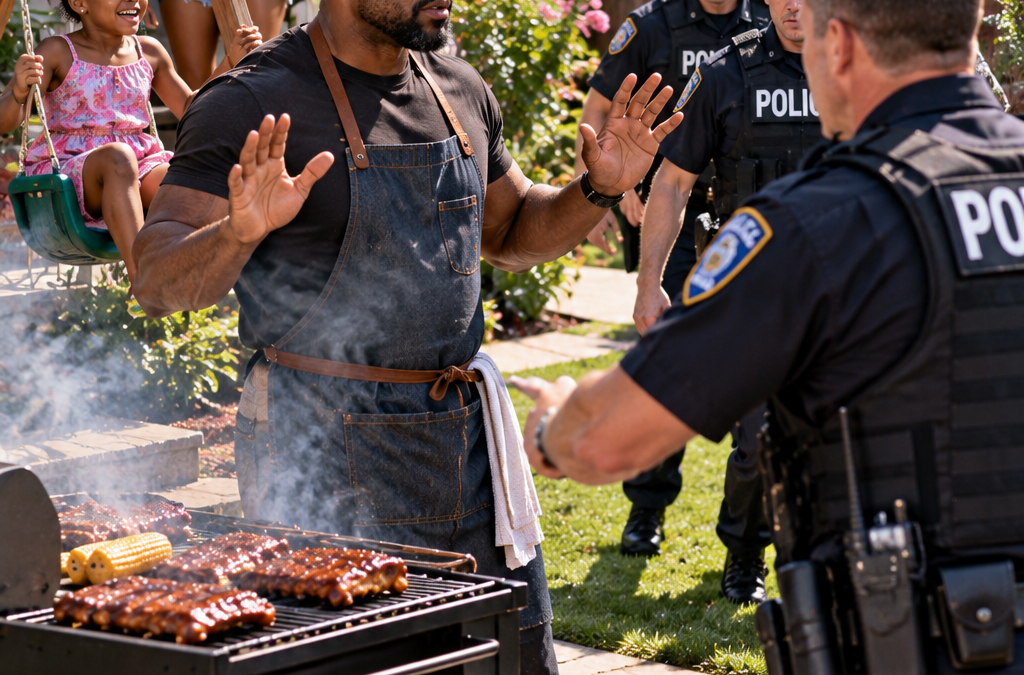
𝗙𝗨𝗟𝗟 𝗦𝗧𝗢𝗥𝗬
I stared at them.
“They’re painting my fence.”
The officer asked for paperwork.
Marcus handed him the signed work order.
My address.
My signature.
Date.
Company information.
The officers checked it and left.
Across the fence, Patricia stood on her porch with her arms folded.
Watching.
No apology.
Not a word.
March.
Our son Elijah drove down from Washington for the weekend.
He arrived around nine at night, still wearing the navy suit he’d had on at his law firm.
He opened his trunk.
Porch light next door snapped on.
Patricia’s voice cut through the darkness.
“Hey!”
Elijah turned.
“What are you doing there?”
He lifted a garment bag.
“Excuse me?”
“I’m calling the police.”
Elijah froze.
One hand held the garment bag.
The other held a bottle of wine he’d brought for his mother.
“Ma’am, I’m visiting my parents.”
“Prove it.”
That was when Denise heard the yelling.
She came outside.
“Elijah?”
“Hey, Mom.”
She walked straight down the driveway and hugged him.
Patricia watched.
Then her front door slammed.
No apology.
Not a word.
April hurt worse.
Maya was eight.
Our granddaughter had braids, a gap-toothed smile, and the kind of energy that made adults tired just watching her.
She was bouncing a rubber ball in our front yard.
It rolled across the property line into Patricia’s grass.
Maya ran after it.
Patricia’s front door flew open.
“Get off my property!”
Maya stopped.
“Sorry.”
“Don’t you dare step on my grass.”
She pointed toward our house.
“Tell your people to teach you some manners.”
Maya burst into tears.
She ran home without the ball.
I found her crying beside Denise.
I walked next door.
Calmly.
That word matters.
I was calm because men who look like me learn early that other people are sometimes permitted anger we are not.
I knocked.
Patricia opened the door three inches.
“What?”
“Patricia, Maya is eight years old.”
She stared at me.
“Her ball rolled onto your lawn.”
“Then teach her not to trespass.”
“I’d appreciate it if you didn’t speak to my granddaughter that way.”
“I have nothing to say to you.”
The door closed in my face.
I stood there longer than I should have.
My fists were closed.
Then I opened them.
Walked home.
May brought paperwork.
A formal HOA complaint.
Chronic noise.
Improperly parked vehicles.
Property-value concerns.
I almost laughed when I read it.
The HOA investigated.
Nothing.
No violations.
No noise citations.
No parking problems.
No basis for a single claim.
The board president called Patricia personally.
Gerald heard what she said because she’d later repeated it to someone else.
“You’ll regret it when this street turns into a slum.”
By early June, Denise and I had stopped pretending Patricia’s behavior was misunderstanding.
Then Denise noticed the camera.
Mounted high on Patricia’s house.
I was seasoning chicken at the kitchen counter when she came inside.
“Malcolm.”
Something in her voice made me look up.
She led me outside.
“See that?”
I followed her finger.
Security camera.
The lens wasn’t pointed toward Patricia’s driveway.
Not her porch.
Not the street.
It pointed directly into our backyard.
“She’s watching us,” Denise said.
I stared at that black lens.
A small thing.
Maybe six inches across.
It felt larger.
I imagined Maya playing beneath it.
Denise gardening.
Me sitting with coffee before sunrise.
Our private life being viewed from a house whose owner had already called police on workers because of their skin.
Denise folded her arms.
“Say something.”
I looked at her.
“To Patricia?”
“No. To me.”
I breathed slowly.
“I won’t give her that much power.”
“What does that mean?”
“It means she doesn’t get to decide whether we enjoy our own backyard.”
Denise looked unconvinced.
I touched her shoulder.
“I mean it.”
I looked toward the grill.
“Saturday is still Saturday.”
And that was how we reached the morning everything broke open.
After my coffee, I started the dry rub.
Brown sugar.
Smoked paprika.
Garlic powder.
Black pepper.
Salt.
A touch of cayenne.
I had spent years adjusting the ratio and refused to tell Gerald exactly what it was.
Around noon, the charcoal turned white.
I set the first rack of ribs on the grate.
The meat hissed.
Smoke rose.
Sweet.
Heavy.
Perfect.
Denise came outside with lemonade.
She set the pitcher on the table.
Ice cubes clicked against the glass.
She kissed my cheek.
“Smells like heaven.”
“That’s because you married exceptionally well.”
“That must be it.”
At twelve, Maya and her cousins arrived.
Car doors.
Running feet.
Screen door slamming.
Voices everywhere.
Maya flew toward the swing set.
Her braids streamed behind her.
The sound of her laughing filled the yard.
Gerald was sitting on his porch two houses down.
He raised his coffee mug.
“Smells real good over there, Malcolm!”
I pointed my tongs toward him.
“You angling for an invitation?”
“I’ve been your friend fourteen years.”
“Bring your own chair, old man.”
Gerald laughed.
For eleven more minutes, that afternoon was exactly what a Saturday should have been.
Then I heard the siren.
Far away at first.
A low mechanical wail.
I didn’t pay much attention.
Charlotte was a city.
Sirens belonged to someone every day.
Then the sound grew louder.
Turned onto our street.
Stopped.
Inside the house, Denise was refilling the lemonade.
Later she told me blue and red light flashed across the kitchen wall.
Her hand stopped in midair.
She didn’t need to look.
She already knew.
Two officers stepped from the patrol car.
Officer Brian Tate.
Young.
White.
Straight-backed.
His hand rested near his belt before he had even reached the sidewalk.
Officer Sandra Hollands followed.
Biracial woman.
Mid-thirties.
Quieter.
Observant.
Patricia reached them before they reached my driveway.
Of course she did.
She must have been waiting.
“Thank God you’re here.”
I could hear her from the backyard.
She sounded breathless.
Frightened.
A performance.
“He’s been out there over an hour burning things.”
I looked at the ribs.
The charcoal.
Smoke drifting lazily upward.
“The smoke is unbearable,” she continued. “I don’t feel safe. I’m a woman living alone.”
Tate asked, “Can you describe the individual?”
Patricia answered immediately.
“Black male. Large build. Backyard.”
Then came the lie that told me this was more than another complaint.
“I’ve never seen him before. I don’t think he lives there.”
Six months.
She had lived beside me six months.
Called police on my painters.
Yelled at my son.
Made my granddaughter cry.
Filed an HOA complaint naming our family.
Installed a camera toward my backyard.
And now she had never seen me.
Hollands glanced toward the mailbox.
INGRAM.
White letters.
Clear as day.
She said nothing.
Patricia pointed.
“Through the gate. Hurry.”
I heard the latch.
Then two uniformed officers entered my backyard.
Without knocking on my front door.
Without asking permission.
Without announcing themselves from outside the fence.
They simply walked in.
I was turning a rack of ribs when I saw them between my roses and the swing set.
Maya stopped laughing.
I set the tongs down.
Tate spoke first.
“Sir. We received a complaint about a disturbance.”
“What disturbance?”
“Do you live here?”
I looked at him.
“Fourteen years.”
“Can I see some identification?”
There are questions that sound different depending on where you’re standing.
Had he asked me on the sidewalk after some confusion?
Maybe.
But I was standing beside my grill.
My patio.
My roses.
My grandchildren.
He had entered through my gate based on a caller who claimed not to know me.
“Am I being detained?”
Tate hesitated.
“We need to verify who you are.”
“Am I suspected of committing a crime?”
His hand shifted slightly on his belt.
“We got a call.”
“That wasn’t my question.”
The charcoal popped.
Maya swung once.
Slowly.
The chains creaked.
Hollands looked from the grill to the lemonade to the children.
Her eyes told me she understood.
But understanding without action is a quiet thing.
Too quiet.
From the front sidewalk, Patricia shouted.
“See? He won’t show ID. That tells you everything.”
Denise came through the back door.
Her phone was in her hand.
“Officers.”
Tate looked toward her.
“This is our home.”
She pointed toward me.
“That’s my husband.”
She gestured toward the front.
“Our name is on the mailbox. It’s on the deed. It’s on every utility bill in that house.”
Tate looked uncomfortable.
“Ma’am, we’re just trying to clear up a call.”
“Then clear it.”
I looked at Denise.
She looked back.
Thirty years.
There are conversations a marriage eventually learns to conduct without sound.
I knew what she was telling me.
End this.
Protect the children.
Not because I was wrong.
Because sometimes proving you’re right carries a price the people around you have to pay too.
I went inside.
Retrieved my wallet.
Returned.
Handed Tate my driver’s license.
He read it.
MALCOLM INGRAM.
The address matched.
The photograph matched.
Everything matched.
That should have ended it.
Then Patricia said, “That could be fake.”
I turned my head.
She had walked onto my front lawn now.
“Maybe he’s renting. Maybe he’s squatting.”
Gerald stood up on his porch.
Patricia continued.
“I want you to search the property.”
Tate looked at her.
“Ma’am—”
“I’ve smelled chemicals from that backyard.”
That word changed everything.
Chemicals.
Not ribs.
Not charcoal.
Chemicals.
“Something’s wrong in that house.”
My body went still.
My grandchildren were twenty yards away.
She had just turned a barbecue into an accusation of criminal activity.
Gerald shouted from two houses down.
“Patricia, what the hell are you talking about?”
She ignored him.
“Those are ribs!” he yelled. “Not a meth lab. Malcolm has lived here longer than you have.”
“Mind your business, Gerald!”
Hollands leaned toward Tate.
“The ID matches, Brian.”
Quiet.
Almost a whisper.
“Everything checks.”
Patricia heard enough to realize she was losing control.
“Are you going to do your jobs or not?”
Her voice cracked.
“If something happens to me tonight, it’s on both of you.”
Tate handed me my license.
His fingers were stiff.
“Sir, would you mind if we just took a quick look around?”
“No.”
One word.
He blinked.
“Sir—”
“I’ve shown you identification. My wife has confirmed I live here. My neighbor has confirmed it. You have no warrant, no probable cause, and I do not consent to a search.”
Patricia shouted, “He’s hiding something.”
I picked up my tongs.
“An innocent person would let them look!”
I returned to the grill.
“I’m done answering questions.”
I flipped a rib.
“You’re welcome to leave the way you entered.”
Tate looked toward the gate.
For one second, I believed it was over.
Then he reached for his radio.
“Dispatch, requesting supervisor at Maplerest Lane.”
My stomach sank.
He continued.
“We have an uncooperative resident.”
Uncooperative.
That word.
I had identified myself.
Answered his questions.
Shown my license.
Yet the moment I exercised a constitutional right, I became uncooperative.
Denise pressed record.
Six minutes later, another patrol car arrived.
Neighborhood curtains moved.
Dogs barked.
Kids disappeared from sidewalks.
Sergeant Dale Whitmore stepped from the car.
Large man.
Broad shoulders.
Aviator sunglasses resting on his forehead.
He adjusted his duty belt before walking toward the house.
Not because anything had shifted.
Because he wanted everyone to notice what was on it.
Patricia met him.
Her performance had changed.
Less panic now.
More strategy.
“Sergeant, thank you.”
He listened.
“The man back there has been hostile.”
I almost laughed.
“He refuses to cooperate.”
She kept going.
“He won’t allow your officers to search.”
Correct.
“I know he’s hiding something.”
Incorrect.
“I’ve lived beside these people six months and something has never been right about that house.”
These people.
Whitmore nodded.
Then walked through my gate.
No knock.
No request.
No glance at the mailbox.
He entered my property already believing the story someone else had written for him.
I was at the grill.
He stopped less than two feet away.
“All right. What’s the problem here, big guy?”
Big guy.
I turned.
“There’s no problem.”
“Doesn’t sound that way.”
“I provided identification. It matches this address. My wife confirmed I live here. My neighbor confirmed it. Your officers have verified there is no disturbance.”
Whitmore tilted his head.
“That’s not really your call, is it?”
I stared at him.
“I’ve got a report of suspicious activity and possible chemicals.”
“There are no chemicals.”
I pointed at the grill.
“That’s barbecue.”
“That’s what you say.”
“No. That’s what your eyes say.”
His expression changed.
Only slightly.
“The complainant says something different.”
“The complainant has been harassing my family for six months.”
“I’ve got a duty to investigate.”
“You have a duty to follow the Constitution.”
The smile disappeared.
“And you need either probable cause, a warrant, or my consent to search this house.”
Whitmore stepped closer.
His chest was inches from mine.
“You don’t get to tell me what I need.”
His right hand rested beside his weapon.
I heard one of the swing chains squeak behind me.
Then stop.
The yard felt colder.
Denise’s voice came from the porch.
“I’m recording this.”
Whitmore turned slowly.
“Ma’am, put the phone down.”
“No.”
“I said put it down and go inside.”
“And I said no.”
Her voice never shook.
“I’m legally recording law enforcement on my own property.”
For a moment, Whitmore stared at my wife as though he could intimidate her into disappearing.
He had chosen the wrong woman.
After fifteen years of standing over operating tables while children’s lives depended on her hands, Denise was not easily rattled.
He turned back to me.
“Here’s what’s going to happen.”
I waited.
“I’m conducting a welfare check inside the home.”
“No.”
He frowned.
“It’s within my authority.”
“No, it isn’t.”
His face reddened.
“A lawful emergency welfare entry requires reasonable grounds to believe someone inside is in immediate danger.”
He stepped closer.
“You keep talking like a lawyer.”
I said nothing.
“You’re going to start getting treated like a problem.”
That was the first direct threat.
Not legal.
Not procedural.
Personal.
“I suggest you move away from the door.”
I was standing near my own back porch.
“If you don’t, I can arrest you for obstruction.”
Patricia’s voice came from beyond the fence.
“Just go inside! I guarantee you’ll find something. People like them always have something to hide.”
Gerald shouted.
“Enough!”
Whitmore ignored him.
I did not.
People like them.
My children.
My wife.
My grandchildren.
Me.
Then I looked toward the second-floor window.
And everything else disappeared.
Maya was standing behind the glass.
Her little hand pressed flat against it.
She wasn’t waving.
Her eyes were wide.
Wet.
Her lower lip trembled.
Two cousins stood beside her.
The youngest was crying without sound.
Arms wrapped around himself.
That broke something inside me.
Not control.
Something underneath control.
For most of my adult life, I had believed I understood what dignity cost.
I had watched men arrive in court wearing handcuffs while prosecutors called them defendants and families called them sons.
I had listened to police officers explain split-second decisions.
I had listened to victims describe fear.
I had listened to attorneys argue where constitutional authority began and ended.
But none of those cases had my granddaughter’s face pressed against the glass.
None had her watching men with guns threaten her grandfather beside a grill.
I looked back at Whitmore.
“My grandchildren are watching.”
He said nothing.
“My granddaughter is eight.”
Nothing.
“She’s standing upstairs with her hand against that window because she thinks you’re about to arrest me in my own backyard.”
Whitmore didn’t look.
Not once.
I pointed.
“Look at her.”
He refused.
“Sergeant.”
His jaw tightened.
“Is this really how you want this to go?”
His answer came flat.
“I don’t make the rules. I enforce them.”
That sentence almost made me lose my temper.
Almost.
“No,” I said quietly. “You are choosing how to enforce them.”
Patricia shouted again.
“For God’s sake, just arrest him!”
Maya flinched behind the glass.
“I have never felt safe with that man living next door to me!”
Whitmore reached for his radio.
“Dispatch, I need an additional unit.”
His thumb pressed the button.
“Non-compliant individual. Possible escalation.”
At that exact moment, my phone rang.
I nearly ignored it.
Then I saw the name.
Clare.
My court clerk.
Only a handful of people in Charlotte would have recognized why her call mattered.
I answered.
“Yes, Clare.”
Her voice was fast but controlled.
“Judge, I’m sorry to interrupt. You need to know your neighbor two houses down is streaming this live.”
My eyes moved toward Gerald.
He stood at the edge of his driveway.
Phone raised.
“How long?”
“Almost from the beginning.”
“How many watching?”
“Just passed six thousand. It’s climbing fast.”
I breathed.
“Has chambers saved the stream?”
“Already done.”
“Thank you.”
“Judge—”
“I’m all right.”
“Are you sure?”
I looked toward Maya.
“No.”
I paused.
“But I will handle it.”
I ended the call.
Slid my phone into my pocket.
Then faced Sergeant Dale Whitmore.
For almost twenty-five minutes, I had deliberately not used my title.
Not because I was hiding it.
Because it shouldn’t have mattered.
But the situation had moved past inconvenience.
Past humiliation.
Three armed officers were in my yard.
A fourth unit was coming.
My grandchildren were terrified.
And a sergeant was constructing legal excuses to enter my home.
“Sergeant Whitmore.”
Something in my voice made him stop.
“My name is Malcolm Ingram.”
He stared.
“I am the presiding judge of the United States District Court for the Western District of North Carolina.”
Silence.
Absolute.
Tate’s hand dropped away from his belt.
Whitmore blinked.
Hollands closed her eyes for half a second.
Patricia stopped breathing loudly enough for me to notice the absence.
I continued.
“I just received a phone call from my court clerk.”
I turned slightly toward Gerald.
“She informed me that this entire interaction has been broadcast live.”
Gerald raised his phone a little higher.
“As of two minutes ago, more than six thousand people were watching.”
Whitmore’s face drained.
Not gradually.
Instantly.
The swagger disappeared first.
Then the irritation.
What remained was calculation.
“Judge Ingram—”
I raised one hand.
“No.”
He stopped.
“For the last twenty-five minutes, you did not know I was a judge.”
I stepped forward once.
“You entered my property without asking permission.”
He opened his mouth.
“You attempted to create justification for a warrantless search after identification had already resolved the complaint.”
Silence.
“You used physical proximity and your hand near your weapon to intimidate me.”
His hand moved away from his belt.
“You ordered my wife to stop lawfully recording.”
Denise kept her phone steady.
“You threatened to arrest me for standing in front of my own back door.”
Tate stared at the grass.
“And you called for additional armed officers while describing me as potentially hostile because I refused an unlawful search.”
I let the list settle.
Then I said what mattered.
“I’ve served on the federal bench nineteen years.”
Whitmore swallowed.
“I’ve presided over hundreds of cases involving unlawful searches, excessive force, civil-rights violations, and government misconduct.”
I looked directly into his eyes.
“I know what happened here.”
Then I turned toward Patricia.
She looked smaller now.
Not because she had changed.
Because consequences had finally entered the yard.
“Mrs. Caldwell.”
Her lips parted.
“Filing a false police report is a criminal offense.”
“I didn’t lie.”
“You told 911 you’d never seen me.”
“I—”
“You have lived next door six months.”
She looked toward the officers.
“You said you believed I was setting a house on fire.”
“There was smoke.”
“From ribs.”
“I smelled something.”
“You told them chemicals.”
“I was scared.”
“No.”
My voice sharpened for the first time.
“You weren’t trying to be safe.”
Her eyes widened.
“You were trying to use law enforcement to remove a Black family from a neighborhood you decided we didn’t belong in.”
“That’s ridiculous.”
“Is it?”
I pointed toward her house.
“January. You called my wife a housekeeper.”
Her face twitched.
“February. You called police on two licensed painters because they were Black men working behind my house.”
“That wasn’t—”
“March. You threatened my son while he unloaded luggage from his parents’ driveway.”
“He looked suspicious.”
“He was carrying a garment bag and a bottle of wine.”
I continued.
“April. You screamed at my eight-year-old granddaughter because her rubber ball crossed onto your grass.”
Patricia looked around as if searching for someone to rescue her.
“May. You filed a baseless HOA complaint saying my family lowers property values.”
Gerald’s camera remained steady.
“June. You installed a camera aimed directly into my backyard.”
Her chin began trembling.
“And today you called 911.”
I took one more breath.
“You lied.”
“I didn’t know you were a judge.”
There it was.
The sentence that made everything plain.
I stared at her.
“Why should that matter?”
She had no answer.
“If I were a mechanic, would your call become true?”
Silence.
“If I worked at a warehouse?”
Nothing.
“If I were unemployed?”
Nothing.
“If I had rented this house yesterday?”
Her face tightened.
“Would that make it acceptable to lie about me?”
“No.”
“Then my title has nothing to do with your conduct.”
She stepped backward.
“I was only protecting myself.”
“From what?”
She looked at the grill.
The children.
Denise.
Me.
She could not name a threat because there had never been one.
“This is the last time, Patricia.”
Her eyes lifted to mine.
“The last time you weaponize someone else’s authority against my family.”
Behind me, Whitmore finally spoke.
His voice sounded nothing like the voice that had called me big guy.
“Judge Ingram, we were responding to a call.”
I faced him.
“That explains your arrival.”
He nodded quickly.
“Exactly.”
“It does not explain your conduct after you arrived.”
His mouth closed.
“We followed protocol.”
“No.”
“Sir—”
“Protocol does not authorize you to search a home because a neighbor insists there must be chemicals.”
Whitmore shifted.
“Protocol does not allow you to ignore verified identification.”
I pointed toward the porch.
“Protocol does not authorize you to invent a welfare check because a homeowner refuses consent.”
He looked toward Tate.
“And protocol does not turn standing at your own door into obstruction.”
Hollands stepped forward.
She touched her body camera.
Checked the indicator.
Then looked at Tate.
“We need to document exactly what happened.”
Tate nodded.
“Everything.”
“Everything,” she repeated.
That was when Officer Brian Tate approached me.
He stopped several feet away.
“Sir.”
I waited.
“I owe you an apology.”
Behind him, Whitmore’s jaw tightened.
Tate continued anyway.
“I should have ended the call when your ID matched.”
I watched him.
“I should have cleared the scene.”
“Yes.”
“I didn’t.”
“No.”
“And I’m sorry.”
I believed he was sorry.
That didn’t make what happened disappear.
“You should have stopped it.”
“I know.”
I looked toward Maya’s window.
“The next man standing in a backyard like this might not be a federal judge.”
Tate followed my gaze.
“He may not know constitutional law.”
I looked back at him.
“He may not have a wife who knows when to start recording.”
Denise lowered her phone slightly.
“He may not have a neighbor willing to broadcast what’s happening.”
Gerald gave a grim nod.
“He might only have himself.”
Tate’s face tightened.
“What happens to him?”
No answer.
“You need to think about that.”
He lowered his head.
On the sidewalk, Patricia started moving toward her house.
Gerald stepped to the edge of his driveway.
Not blocking her.
Just close enough to be heard.
“Six months, Patricia.”
She stopped.
“Six months you’ve lived here.”
“Gerald, don’t.”
“You called police on Malcolm’s workers.”
She turned.
“Called code enforcement.”
“Stop filming me.”
“Yelled at his son.”
“I said stop.”
“Made that little girl cry.”
Her face reddened.
“Filed that HOA nonsense.”
“Gerald!”
“Put a camera on their backyard.”
He lowered the phone just enough to see her directly.
“And not once did you walk next door and introduce yourself like a human being.”
Patricia snapped.
“I don’t owe anyone an explanation.”
The live stream caught every syllable.
“I have a right to feel safe in my own home.”
Gerald looked around.
“Safe from what?”
She pointed vaguely toward my property.
“If none of you can see what’s happening to this neighborhood, you’re blind.”
Denise stepped down from the porch.
Patricia saw her and stopped talking.
Denise didn’t sound angry.
That made her words heavier.
“My granddaughter is upstairs.”
Patricia looked away.
“She’s eight years old.”
Denise’s voice tightened.
“She watched armed police officers threaten to arrest her grandfather because you called 911 over barbecue smoke.”
Nobody moved.
“She’s sitting on the floor now.”
I looked up.
Maya was no longer at the window.
Denise continued.
“She doesn’t understand probable cause.”
Her eyes stayed on Patricia.
“She doesn’t understand warrants.”
A breath.
“She just knows she’s scared.”
Patricia said nothing.
“She’s eight.”
Even Whitmore looked down.
I took out my phone.
Dialed a number I knew from memory.
Two rings.
“Chief Bennett.”
“Chief, Malcolm Ingram.”
His voice changed immediately.
“Judge?”
“I believe you’ll want to review the body-camera footage from Maplerest Lane.”
A pause.
“What’s happening?”
“Before the evening news does.”
Another pause.
“I’m on it.”
I ended the call.
Within an hour, the administrative machinery had started moving.
Sergeant Whitmore was placed on leave pending investigation.
Tate was reassigned to desk duty.
The 911 audio was preserved.
Body-camera files were flagged.
Reports were ordered before anyone involved had time to rewrite memory into something more comfortable.
But none of that mattered to me in the first hour.
My granddaughter did.
When the patrol cars finally left, I went upstairs.
Maya was sitting on the floor beside the bed.
Her knees pulled against her chest.
Denise sat beside her.
I stopped in the doorway.
“Maya?”
She looked up.
Then ran to me.
I knelt before she reached me.
She wrapped both arms around my neck.
“Grandpa.”
“I’m here.”
“Are they coming back?”
That question tore through me.
“No, baby.”
“Did you do something bad?”
I closed my eyes.
“No.”
“Then why were they mad?”
How do you explain racial bias to an eight-year-old without stealing something from her childhood?
I held her.
“Sometimes grown-ups make bad assumptions.”
“What does that mean?”
“It means they decide something about someone before they know the truth.”
She pulled back.
“Because you’re Black?”
Denise and I looked at each other.
Children understand more than adults like to admit.
“Partly.”
Maya looked toward the window.
“I don’t like that lady.”
“I know.”
“Do you?”
I almost smiled.
“No.”
That made her giggle faintly.
Then she became serious.
“Was she lying?”
“Yes.”
“Why?”
“I don’t know.”
That was partly true.
I understood prejudice.
I understood entitlement.
I understood fear used as camouflage for control.
But I did not know what combination of those things lived inside Patricia Caldwell.
And I didn’t want my granddaughter carrying Patricia’s ugliness any further than necessary.
“You didn’t do anything wrong,” I told Maya.
She looked at the grill through the window.
“Are the ribs ruined?”
For the first time that afternoon, I laughed.
“Probably.”
She smiled.
“Can we make more?”
“Absolutely.”
Sunday morning, my phone began vibrating before seven.
By breakfast, Gerald’s livestream had passed three hundred thousand views.
By noon, more than a million.
People clipped the moment Whitmore threatened me.
The moment Patricia said “people like them.”
The moment I identified myself.
But one question dominated nearly every discussion.
What if he wasn’t a judge?
I couldn’t escape it because it was the same question I had asked Tate.
Local reporter Natalie Dawson aired the first major television report.
It opened with Patricia’s 911 call.
Her voice.
“There’s a Black man in the yard.”
Then the video cut to our backyard.
The grill.
Roses.
Swing set.
My grandchildren.
Then a photograph of me in my judicial robe.
The contrast was almost too clean.
By Monday, national outlets had the story.
Headlines everywhere.
Federal Judge Confronted by Police While Grilling at Home.
Woman Calls 911 on Black Federal Judge at His Own House.
Someone created a hashtag.
LET MALCOLM GRILL.
I hated it at first.
Then Gerald showed up wearing a homemade shirt with the words printed across his chest.
I stared at him.
“You paid money for that?”
“Twenty-two dollars.”
“You were robbed.”
“It has your face on the back.”
“Take it off.”
He laughed until he nearly dropped his beer.
The humor helped.
Beneath the internet spectacle, the real investigation was much less amusing.
Internal affairs retrieved Whitmore’s body-camera footage.
Every second.
They documented his warrantless entry onto private property.
His refusal to reconsider after my identification was confirmed.
His attempted invention of a welfare-check justification.
His physical intimidation.
His order for Denise to stop recording.
His threat of arrest.
His call for backup.
Then investigators opened his personnel file.
Six previous complaints.
Three from Black residents.
One involved a teenage boy stopped for a broken taillight and pinned against a hood.
Another involved a Black woman ordered to empty her purse on a sidewalk while her children watched.
Another involved a warrantless entry into a residence while the homeowner was at work.
None had produced meaningful discipline.
No suspension.
No significant reprimand.
No intervention that changed his behavior.
Reading those reports angered me more than what happened in my yard.
Because I had survived Whitmore with a federal judgeship behind my name.
Those people had faced the same man without that protection.
That was the real scandal.
Patricia’s history was worse than I expected.
The district attorney subpoenaed her call records.
Not just Charlotte.
Her previous address in South Carolina.
Sixteen police calls over four years.
Thirteen targeted Black or Latino neighbors.
Black family birthday party.
Excessive noise.
Latino man washing a car.
Suspicious person.
Black teenager walking a dog.
Possible stolen animal.
Black neighbor carrying boxes.
Possible burglary.
Not one resulted in criminal charges against the people she reported.
Not one.
A pattern that clear stops being coincidence.
The district attorney charged Patricia with filing a false report and an additional intimidation-related offense based on the documented racial pattern.
Her lawyer sought a quiet plea agreement.
The district attorney refused.
The case went to trial.
I did not look forward to testifying.
People assumed judges enjoy courtrooms.
We don’t.
We understand exactly how unforgiving they are.
Four days.
The jury heard Patricia’s 911 call.
Watched Gerald’s livestream.
Saw the officers’ body-camera footage.
Gerald testified about the previous six months.
Denise testified about Elijah.
About Maya.
The HOA complaint entered evidence.
So did photographs showing Patricia’s security camera pointed toward our backyard.
Then I took the witness stand.
For the first time in nearly two decades, I sat where witnesses sat instead of behind the bench.
It was humbling.
Patricia sat at counsel table.
She barely looked at me.
Her lawyer tried to frame her conduct as fear.
“Judge Ingram, would you agree that Mrs. Caldwell lived alone?”
“Yes.”
“And people living alone may reasonably have heightened security concerns?”
“Possibly.”
“So when she saw smoke coming from your yard—”
“She had lived beside us six months.”
He paused.
“That wasn’t my question.”
“It is relevant to the premise of yours.”
The judge looked at me.
I stopped.
Old habits.
Her lawyer tried again.
“She saw smoke.”
“Yes.”
“She did not know its source.”
“She had a camera pointed into my backyard.”
The prosecutor objected to the form of the question.
The judge sustained.
The defense attorney changed direction.
“Isn’t it possible Mrs. Caldwell genuinely feared for her safety?”
“Anything is possible.”
“Then you cannot know what she felt.”
“No.”
He smiled slightly.
“But I know what she said.”
The smile disappeared.
“She said she had never seen me.”
I looked toward the jury.
“That was false.”
“She said I did not live there.”
False.
“She reported fire.”
False.
“She described chemicals.”
False.
“And her prior conduct showed those statements were not isolated.”
Her lawyer sat down soon afterward.
The jury deliberated three hours.
Guilty.
Both counts.
At sentencing, another judge said something I remembered word for word.
“This court will not treat the weaponization of law enforcement against communities of color as a neighborly misunderstanding.”
The courtroom became completely still.
“This was not a mistake.”
He looked toward Patricia.
“It was a pattern.”
Then he said, “Patterns have consequences.”
Patricia received eighteen months of supervised probation.
Two hundred fifty hours of community service with organizations serving communities of color.
A fine.
And a permanent restraining order prohibiting contact with my family.
She said nothing.
Not to me.
Not to Denise.
Not to Maya.
No apology.
Sergeant Dale Whitmore was fired after internal affairs completed its investigation.
The police union appealed.
The appeal failed.
His name was entered into the statewide misconduct database.
Tate received a formal reprimand.
He completed extended training on constitutional policing and implicit bias.
Three months later, he circulated a department-wide memo.
He acknowledged his failure.
Not Patricia’s.
Not Whitmore’s.
His.
He wrote that junior officers had a responsibility to intervene even when misconduct came from someone above them.
I respected that.
Not because it erased what he’d done.
Because accountability begins when someone stops describing failure as something that happened around them and admits the part they played.
Chief Harold Bennett announced a department review.
Suspicious-person calls became a major focus.
Dispatchers were instructed to ask callers for specific, articulable criminal behavior instead of accepting vague descriptions like “doesn’t belong” or “looks suspicious.”
The city council later formalized parts of the policy in what newspapers started calling the Ingram Resolution.
I disliked having my name attached to it.
But I supported the substance.
If a caller could not articulate actual criminal conduct, officers would not automatically be dispatched as though discomfort itself were probable cause.
I declined television appearances.
Turned down national interviews.
Rejected an invitation to write an opinion column.
I issued four sentences.
That was enough.
What happened to me happens to Black Americans every day in parks, stores, parking lots, and their own neighborhoods. The difference in my case was that I held a title that forced immediate accountability. No citizen should need professional credentials to receive constitutional treatment. Justice cannot depend upon discovering that the victim is important.
Three weeks later, another Saturday came.
I woke early.
Coffee.
Same mug.
Same porch.
For the first time since the incident, the security camera next door was gone.
Only two small mounting holes remained in Patricia’s siding.
A FOR SALE sign stood in her yard.
She had left nine days after the verdict.
No farewell.
No forwarding address that I knew.
No apology.
I started the charcoal around eleven.
Same dry rub.
Brown sugar.
Smoked paprika.
Garlic.
Cayenne.
Denise carried lemonade outside.
I looked at the pitcher.
“You made enough this time?”
“For everybody except Gerald.”
“Good.”
She smiled.
Maya arrived before noon.
She came running through the gate.
No hesitation.
That mattered to me.
For several days after the police encounter, she had refused to play near the front yard.
Every siren made her look toward the window.
But children, when given safety, are remarkably determined to reclaim joy.
She ran to the swing set.
Braids bouncing.
Her cousins followed.
Soon the yard was loud again.
Exactly as it should have been.
I was checking the ribs when Gerald appeared at the side gate.
Six-pack in one hand.
Folding chair under the other arm.
He lifted both eyebrows.
“Am I getting the invitation this time?”
I looked at him.
“Depends.”
“On?”
“Did you bring that ridiculous shirt?”
He opened his jacket.
LET MALCOLM GRILL.
I groaned.
Gerald laughed.
“Sit down, old man.”
He unfolded his chair beside the grill.
I handed him a beer.
We tapped cans together.
For a while, neither of us spoke.
That is one of the privileges of old friendship.
Silence doesn’t require repair.
Denise moved around the patio setting out plates.
She was humming.
I hadn’t heard her hum in months.
That hit me harder than I expected.
She caught me watching.
“What?”
“Nothing.”
“You’re staring.”
“I like you.”
“After thirty years?”
“Still evaluating.”
She rolled her eyes.
Maya ran past us laughing.
Her cousin chased her with a water pistol.
No police.
No cameras.
No strangers entering through my gate.
Just home.
A car stopped outside Patricia’s former house.
A young Black couple stepped out.
Early thirties.
Holding hands.
A realtor greeted them.
They walked toward the porch.
The husband paused.
Looked down the street.
Then toward our backyard where Maya and the other children were running.
He smiled.
I couldn’t hear his first words.
Then the breeze carried the end of his sentence.
“…really welcoming.”
Denise heard it too.
She reached across the patio table.
Found my hand.
Squeezed.
I squeezed back.
Neither of us said anything.
I looked toward the FOR SALE sign.
At the empty place where Patricia’s camera had been.
At the roses moving in the breeze.
At the patio stones I had laid years earlier.
At Maya laughing beneath the swing set.
Then I looked down at the ribs.
Gerald leaned over.
“You burning those?”
I pushed him back with my elbow.
“Watch yourself.”
“I’m serious.”
“I happen to be the best pitmaster in Charlotte.”
He laughed.
“Now you’re abusing judicial authority.”
I pointed the tongs at him.
“Leave my property.”
“You’d miss me.”
“Eventually.”
The laughter came easily.
That surprised me.
For weeks, I had carried something heavy in my chest.
A pressure.
The knowledge that peace could be interrupted by one phone call.
That credentials, decades of work, homeownership, good neighbors, a clean record, all the markers people claim should protect you from suspicion had not stopped Patricia from reducing me to two words.
Black male.
I had spent most of my career believing law was strongest when applied without reference to who stood before it.
That Saturday taught me the darker version of the same lesson.
Bias is most dangerous when authority acts before asking whether the story it has been given is true.
I thought about Officer Tate.
About his apology.
About Whitmore.
About the complaints buried in his file.
About Patricia’s sixteen calls.
I thought about the question millions of strangers had asked online.
What if Malcolm wasn’t a judge?
I knew the answer people wanted.
Something dramatic.
Maybe arrest.
Maybe violence.
Maybe charges that took months to dismiss.
But the most truthful answer was simpler.
I don’t know.
That’s what frightened me.
I had known the law.
I knew exactly when I could refuse.
Exactly what words mattered.
Exactly what authority the officers did and didn’t have.
I had a wife willing to record.
A neighbor willing to intervene.
A court clerk monitoring what unfolded.
A police chief who answered when I called.
Remove any one of those things and the afternoon changes.
Remove all of them and I become one more man trying to explain afterward that he was only grilling ribs.
That knowledge stayed with me.
It still does.
Maya ran over while I was thinking.
“Grandpa.”
“What?”
“Can I have one?”
“They aren’t done.”
“They look done.”
“They aren’t.”
“How do you know?”
“Because I’m the chef.”
She studied the grill.
“Grandma says you’re not a chef.”
I looked toward Denise.
She immediately became very interested in arranging napkins.
“Your grandmother has been removed from the inheritance.”
Maya giggled.
“When can I have one?”
“Twenty minutes.”
“Ten.”
“This isn’t a negotiation.”
“Fifteen.”
I stared at her.
She stared back.
I had spent nineteen years on the federal bench.
My granddaughter beat me in six seconds.
“Fine.”
She ran away.
Gerald shook his head.
“Some judge.”
“Be quiet.”
The sunlight dropped lower over the houses.
Gold across the roofs.
Charcoal smoke curled into the warm air.
A sprinkler clicked somewhere down the street.
Someone’s dog barked.
Normal sounds.
Beautiful because they were normal.
I turned the ribs.
Same yard.
Same grill.
Same family.
The only thing missing was fear.
And I realized then that this was the ending I wanted.
Not Patricia’s conviction.
Not Whitmore losing his badge.
Not headlines.
Not a resolution carrying my name.
This.
My granddaughter running through the grass without looking toward the street every time a car slowed.
My wife humming while pouring lemonade.
Gerald stealing one of my beers.
Ribs smoking on the grill without anyone turning the smoke into evidence.
Home becoming home again.
I looked toward the young couple touring Patricia’s former house.
The woman was standing in the backyard now.
She saw Denise.
Raised one hand.
Denise waved back.
A simple gesture.
No assumptions.
No interrogation.
No suspicion.
Just one neighbor greeting another.
I smiled.
Gerald noticed.
“What?”
“Nothing.”
“You’re doing that judge thing.”
“What judge thing?”
“Thinking forty paragraphs and saying one sentence.”
I laughed.
Then I looked at the grill.
“Best ribs in Charlotte.”
Gerald took a drink.
“That’s your sentence?”
“That’s my ruling.”
And for once, nobody appealed.
𝗧𝗛𝗘 𝗘𝗡𝗗
My Neighbor Called 911 Because a Black Man Was Grilling in His Own Backyard—Then the Police Walked Through My Gate
The first officer entered my backyard without knocking while my ribs were still smoking on the grill and my eight-year-old granddaughter was laughing on the swing set. Twenty-five minutes later, three armed officers were threatening to arrest me in front of my family because the woman next door had decided that a Black man standing on his own patio had to be dangerous.
At 6:15 that Saturday morning, none of that had happened yet.
The sun hadn’t fully cleared the roofs along Maplerest Lane, and I was standing barefoot in my kitchen pouring coffee into a chipped mug that said WORLD’S OKAYEST GRANDPA.
Denise bought it for me as a joke.
I had used it every Saturday for six years.
Old habits mattered to me.
After twenty years of waking before dawn, my body no longer understood the concept of sleeping late. Even on weekends, even after a difficult week, some invisible clock inside me opened my eyes before sunrise and told me the day had begun.
The house was quiet.
Denise was still asleep.
Our grandchildren weren’t coming until noon.
I carried my coffee through the kitchen, opened the back door, and stepped onto the porch.
Fourteen years.
That was how long Denise and I had lived in that house.
Fourteen years of birthdays, arguments, Christmas mornings, broken appliances, scraped knees, Sunday dinners, and evenings when we sat beneath the porch light without saying much because thirty years of marriage had taught us that silence could be companionship instead of emptiness.
I had laid every stone in the patio myself.
It took me three summers.
Denise had wanted to hire someone.
“You have a job,” she reminded me.
“I have weekends.”
“You have knees too.”
“I have excellent knees.”
“You complain every time you stand up.”
“That’s not complaining. That’s commentary.”
She let me build it.
I built the brick grill station too.
The first version leaned badly enough that Gerald Eastwood, our neighbor two doors down, stood beside it one afternoon drinking a beer and said, “Malcolm, I’m pretty sure your grill is trying to leave.”
I rebuilt it the following spring.
The rose bushes along the fence were for Denise.
Years earlier, while we were walking through a garden center, she’d paused beside a display and said, almost absentmindedly, “I love that smell.”
That was all.
She probably forgot saying it.
I didn’t.
Now roses ran nearly the whole fence line.
Maplerest Lane was a quiet upper-middle-class street in Charlotte.
Trimmed hedges.
Wide driveways.
Craftsman houses mixed with brick colonials.
People waved while getting the mail.
Kids rode bicycles in loose packs on summer evenings.
Nobody locked their car during neighborhood cookouts.
Most of our neighbors were white.
The Ingrams were one of three Black families on the block.
That had never mattered much to me.
I didn’t move there to prove anything.
I moved there because Denise liked the kitchen windows and I liked the backyard.
Gerald had lived two doors down almost as long as we had.
White man.
Pushing seventy.
Retired electrical contractor.
He borrowed my lawn mower almost every spring because his refused to start.
I borrowed his ladder every autumn because mine was too short to reach the gutters.
We argued about football and agreed about whiskey.
It was simple.
Then Patricia Caldwell moved into the house next door.
And within six months, simple became something I barely remembered.
Her first encounter with Denise happened during Patricia’s second week on the street.
January.
Cold enough that Denise wore a long coat while walking our dog.
She saw Patricia at the driveway.
Being Denise, she smiled.
“Hi. I’m Denise. We’re next door.”
Patricia looked her over from shoes to hair.
Slow.
Deliberate.
Then she said, “You’re the housekeeper over there.”
Denise thought she’d misunderstood.
“I’m sorry?”
“The housekeeper.”
“No.”
Denise pointed toward our house.
“I’m the homeowner.”
Patricia stared at her for another second.
Then walked inside.
No apology.
No embarrassment.
Nothing.
When Denise told me that evening, I stopped cutting onions.
“She said what?”
“It’s fine.”
“No.”
“Malcolm.”
“You are a pediatric surgeon who has spent fifteen years saving children’s lives, and this woman meets you once and decides you’re cleaning my kitchen?”
Denise leaned against the counter.
“You know this isn’t the first time somebody’s assumed something about me.”
“I know.”
“Then don’t give her more space in this house than she deserves.”
That was Denise.
She had a way of refusing to let other people’s ugliness take up rent-free space in her mind.
I tried to learn from her.
Then February came.
I hired two painters to refinish the backyard fence.
Both Black.
Both licensed.
Both insured.
They had been working less than an hour when a patrol car arrived.
The officers walked around the side of my house and asked the men what they were doing.
One painter, Marcus, looked toward me.
I came outside.
“Can I help you?”
“We received a report of two suspicious males damaging property.”
I stared at them.
“They’re painting my fence.”
The officer asked for paperwork.
Marcus handed him the signed work order.
My address.
My signature.
Date.
Company information.
The officers checked it and left.
Across the fence, Patricia stood on her porch with her arms folded.
Watching.
No apology.
Not a word.
March.
Our son Elijah drove down from Washington for the weekend.
He arrived around nine at night, still wearing the navy suit he’d had on at his law firm.
He opened his trunk.
Porch light next door snapped on.
Patricia’s voice cut through the darkness.
“Hey!”
Elijah turned.
“What are you doing there?”
He lifted a garment bag.
“Excuse me?”
“I’m calling the police.”
Elijah froze.
One hand held the garment bag.
The other held a bottle of wine he’d brought for his mother.
“Ma’am, I’m visiting my parents.”
“Prove it.”
That was when Denise heard the yelling.
She came outside.
“Elijah?”
“Hey, Mom.”
She walked straight down the driveway and hugged him.
Patricia watched.
Then her front door slammed.
No apology.
Not a word.
April hurt worse.
Maya was eight.
Our granddaughter had braids, a gap-toothed smile, and the kind of energy that made adults tired just watching her.
She was bouncing a rubber ball in our front yard.
It rolled across the property line into Patricia’s grass.
Maya ran after it.
Patricia’s front door flew open.
“Get off my property!”
Maya stopped.
“Sorry.”
“Don’t you dare step on my grass.”
She pointed toward our house.
“Tell your people to teach you some manners.”
Maya burst into tears.
She ran home without the ball.
I found her crying beside Denise.
I walked next door.
Calmly.
That word matters.
I was calm because men who look like me learn early that other people are sometimes permitted anger we are not.
I knocked.
Patricia opened the door three inches.
“What?”
“Patricia, Maya is eight years old.”
She stared at me.
“Her ball rolled onto your lawn.”
“Then teach her not to trespass.”
“I’d appreciate it if you didn’t speak to my granddaughter that way.”
“I have nothing to say to you.”
The door closed in my face.
I stood there longer than I should have.
My fists were closed.
Then I opened them.
Walked home.
May brought paperwork.
A formal HOA complaint.
Chronic noise.
Improperly parked vehicles.
Property-value concerns.
I almost laughed when I read it.
The HOA investigated.
Nothing.
No violations.
No noise citations.
No parking problems.
No basis for a single claim.
The board president called Patricia personally.
Gerald heard what she said because she’d later repeated it to someone else.
“You’ll regret it when this street turns into a slum.”
By early June, Denise and I had stopped pretending Patricia’s behavior was misunderstanding.
Then Denise noticed the camera.
Mounted high on Patricia’s house.
I was seasoning chicken at the kitchen counter when she came inside.
“Malcolm.”
Something in her voice made me look up.
She led me outside.
“See that?”
I followed her finger.
Security camera.
The lens wasn’t pointed toward Patricia’s driveway.
Not her porch.
Not the street.
It pointed directly into our backyard.
“She’s watching us,” Denise said.
I stared at that black lens.
A small thing.
Maybe six inches across.
It felt larger.
I imagined Maya playing beneath it.
Denise gardening.
Me sitting with coffee before sunrise.
Our private life being viewed from a house whose owner had already called police on workers because of their skin.
Denise folded her arms.
“Say something.”
I looked at her.
“To Patricia?”
“No. To me.”
I breathed slowly.
“I won’t give her that much power.”
“What does that mean?”
“It means she doesn’t get to decide whether we enjoy our own backyard.”
Denise looked unconvinced.
I touched her shoulder.
“I mean it.”
I looked toward the grill.
“Saturday is still Saturday.”
And that was how we reached the morning everything broke open.
After my coffee, I started the dry rub.
Brown sugar.
Smoked paprika.
Garlic powder.
Black pepper.
Salt.
A touch of cayenne.
I had spent years adjusting the ratio and refused to tell Gerald exactly what it was.
Around noon, the charcoal turned white.
I set the first rack of ribs on the grate.
The meat hissed.
Smoke rose.
Sweet.
Heavy.
Perfect.
Denise came outside with lemonade.
She set the pitcher on the table.
Ice cubes clicked against the glass.
She kissed my cheek.
“Smells like heaven.”
“That’s because you married exceptionally well.”
“That must be it.”
At twelve, Maya and her cousins arrived.
Car doors.
Running feet.
Screen door slamming.
Voices everywhere.
Maya flew toward the swing set.
Her braids streamed behind her.
The sound of her laughing filled the yard.
Gerald was sitting on his porch two houses down.
He raised his coffee mug.
“Smells real good over there, Malcolm!”
I pointed my tongs toward him.
“You angling for an invitation?”
“I’ve been your friend fourteen years.”
“Bring your own chair, old man.”
Gerald laughed.
For eleven more minutes, that afternoon was exactly what a Saturday should have been.
Then I heard the siren.
Far away at first.
A low mechanical wail.
I didn’t pay much attention.
Charlotte was a city.
Sirens belonged to someone every day.
Then the sound grew louder.
Turned onto our street.
Stopped.
Inside the house, Denise was refilling the lemonade.
Later she told me blue and red light flashed across the kitchen wall.
Her hand stopped in midair.
She didn’t need to look.
She already knew.
Two officers stepped from the patrol car.
Officer Brian Tate.
Young.
White.
Straight-backed.
His hand rested near his belt before he had even reached the sidewalk.
Officer Sandra Hollands followed.
Biracial woman.
Mid-thirties.
Quieter.
Observant.
Patricia reached them before they reached my driveway.
Of course she did.
She must have been waiting.
“Thank God you’re here.”
I could hear her from the backyard.
She sounded breathless.
Frightened.
A performance.
“He’s been out there over an hour burning things.”
I looked at the ribs.
The charcoal.
Smoke drifting lazily upward.
“The smoke is unbearable,” she continued. “I don’t feel safe. I’m a woman living alone.”
Tate asked, “Can you describe the individual?”
Patricia answered immediately.
“Black male. Large build. Backyard.”
Then came the lie that told me this was more than another complaint.
“I’ve never seen him before. I don’t think he lives there.”
Six months.
She had lived beside me six months.
Called police on my painters.
Yelled at my son.
Made my granddaughter cry.
Filed an HOA complaint naming our family.
Installed a camera toward my backyard.
And now she had never seen me.
Hollands glanced toward the mailbox.
INGRAM.
White letters.
Clear as day.
She said nothing.
Patricia pointed.
“Through the gate. Hurry.”
I heard the latch.
Then two uniformed officers entered my backyard.
Without knocking on my front door.
Without asking permission.
Without announcing themselves from outside the fence.
They simply walked in.
I was turning a rack of ribs when I saw them between my roses and the swing set.
Maya stopped laughing.
I set the tongs down.
Tate spoke first.
“Sir. We received a complaint about a disturbance.”
“What disturbance?”
“Do you live here?”
I looked at him.
“Fourteen years.”
“Can I see some identification?”
There are questions that sound different depending on where you’re standing.
Had he asked me on the sidewalk after some confusion?
Maybe.
But I was standing beside my grill.
My patio.
My roses.
My grandchildren.
He had entered through my gate based on a caller who claimed not to know me.
“Am I being detained?”
Tate hesitated.
“We need to verify who you are.”
“Am I suspected of committing a crime?”
His hand shifted slightly on his belt.
“We got a call.”
“That wasn’t my question.”
The charcoal popped.
Maya swung once.
Slowly.
The chains creaked.
Hollands looked from the grill to the lemonade to the children.
Her eyes told me she understood.
But understanding without action is a quiet thing.
Too quiet.
From the front sidewalk, Patricia shouted.
“See? He won’t show ID. That tells you everything.”
Denise came through the back door.
Her phone was in her hand.
“Officers.”
Tate looked toward her.
“This is our home.”
She pointed toward me.
“That’s my husband.”
She gestured toward the front.
“Our name is on the mailbox. It’s on the deed. It’s on every utility bill in that house.”
Tate looked uncomfortable.
“Ma’am, we’re just trying to clear up a call.”
“Then clear it.”
I looked at Denise.
She looked back.
Thirty years.
There are conversations a marriage eventually learns to conduct without sound.
I knew what she was telling me.
End this.
Protect the children.
Not because I was wrong.
Because sometimes proving you’re right carries a price the people around you have to pay too.
I went inside.
Retrieved my wallet.
Returned.
Handed Tate my driver’s license.
He read it.
MALCOLM INGRAM.
The address matched.
The photograph matched.
Everything matched.
That should have ended it.
Then Patricia said, “That could be fake.”
I turned my head.
She had walked onto my front lawn now.
“Maybe he’s renting. Maybe he’s squatting.”
Gerald stood up on his porch.
Patricia continued.
“I want you to search the property.”
Tate looked at her.
“Ma’am—”
“I’ve smelled chemicals from that backyard.”
That word changed everything.
Chemicals.
Not ribs.
Not charcoal.
Chemicals.
“Something’s wrong in that house.”
My body went still.
My grandchildren were twenty yards away.
She had just turned a barbecue into an accusation of criminal activity.
Gerald shouted from two houses down.
“Patricia, what the hell are you talking about?”
She ignored him.
“Those are ribs!” he yelled. “Not a meth lab. Malcolm has lived here longer than you have.”
“Mind your business, Gerald!”
Hollands leaned toward Tate.
“The ID matches, Brian.”
Quiet.
Almost a whisper.
“Everything checks.”
Patricia heard enough to realize she was losing control.
“Are you going to do your jobs or not?”
Her voice cracked.
“If something happens to me tonight, it’s on both of you.”
Tate handed me my license.
His fingers were stiff.
“Sir, would you mind if we just took a quick look around?”
“No.”
One word.
He blinked.
“Sir—”
“I’ve shown you identification. My wife has confirmed I live here. My neighbor has confirmed it. You have no warrant, no probable cause, and I do not consent to a search.”
Patricia shouted, “He’s hiding something.”
I picked up my tongs.
“An innocent person would let them look!”
I returned to the grill.
“I’m done answering questions.”
I flipped a rib.
“You’re welcome to leave the way you entered.”
Tate looked toward the gate.
For one second, I believed it was over.
Then he reached for his radio.
“Dispatch, requesting supervisor at Maplerest Lane.”
My stomach sank.
He continued.
“We have an uncooperative resident.”
Uncooperative.
That word.
I had identified myself.
Answered his questions.
Shown my license.
Yet the moment I exercised a constitutional right, I became uncooperative.
Denise pressed record.
Six minutes later, another patrol car arrived.
Neighborhood curtains moved.
Dogs barked.
Kids disappeared from sidewalks.
Sergeant Dale Whitmore stepped from the car.
Large man.
Broad shoulders.
Aviator sunglasses resting on his forehead.
He adjusted his duty belt before walking toward the house.
Not because anything had shifted.
Because he wanted everyone to notice what was on it.
Patricia met him.
Her performance had changed.
Less panic now.
More strategy.
“Sergeant, thank you.”
He listened.
“The man back there has been hostile.”
I almost laughed.
“He refuses to cooperate.”
She kept going.
“He won’t allow your officers to search.”
Correct.
“I know he’s hiding something.”
Incorrect.
“I’ve lived beside these people six months and something has never been right about that house.”
These people.
Whitmore nodded.
Then walked through my gate.
No knock.
No request.
No glance at the mailbox.
He entered my property already believing the story someone else had written for him.
I was at the grill.
He stopped less than two feet away.
“All right. What’s the problem here, big guy?”
Big guy.
I turned.
“There’s no problem.”
“Doesn’t sound that way.”
“I provided identification. It matches this address. My wife confirmed I live here. My neighbor confirmed it. Your officers have verified there is no disturbance.”
Whitmore tilted his head.
“That’s not really your call, is it?”
I stared at him.
“I’ve got a report of suspicious activity and possible chemicals.”
“There are no chemicals.”
I pointed at the grill.
“That’s barbecue.”
“That’s what you say.”
“No. That’s what your eyes say.”
His expression changed.
Only slightly.
“The complainant says something different.”
“The complainant has been harassing my family for six months.”
“I’ve got a duty to investigate.”
“You have a duty to follow the Constitution.”
The smile disappeared.
“And you need either probable cause, a warrant, or my consent to search this house.”
Whitmore stepped closer.
His chest was inches from mine.
“You don’t get to tell me what I need.”
His right hand rested beside his weapon.
I heard one of the swing chains squeak behind me.
Then stop.
The yard felt colder.
Denise’s voice came from the porch.
“I’m recording this.”
Whitmore turned slowly.
“Ma’am, put the phone down.”
“No.”
“I said put it down and go inside.”
“And I said no.”
Her voice never shook.
“I’m legally recording law enforcement on my own property.”
For a moment, Whitmore stared at my wife as though he could intimidate her into disappearing.
He had chosen the wrong woman.
After fifteen years of standing over operating tables while children’s lives depended on her hands, Denise was not easily rattled.
He turned back to me.
“Here’s what’s going to happen.”
I waited.
“I’m conducting a welfare check inside the home.”
“No.”
He frowned.
“It’s within my authority.”
“No, it isn’t.”
His face reddened.
“A lawful emergency welfare entry requires reasonable grounds to believe someone inside is in immediate danger.”
He stepped closer.
“You keep talking like a lawyer.”
I said nothing.
“You’re going to start getting treated like a problem.”
That was the first direct threat.
Not legal.
Not procedural.
Personal.
“I suggest you move away from the door.”
I was standing near my own back porch.
“If you don’t, I can arrest you for obstruction.”
Patricia’s voice came from beyond the fence.
“Just go inside! I guarantee you’ll find something. People like them always have something to hide.”
Gerald shouted.
“Enough!”
Whitmore ignored him.
I did not.
People like them.
My children.
My wife.
My grandchildren.
Me.
Then I looked toward the second-floor window.
And everything else disappeared.
Maya was standing behind the glass.
Her little hand pressed flat against it.
She wasn’t waving.
Her eyes were wide.
Wet.
Her lower lip trembled.
Two cousins stood beside her.
The youngest was crying without sound.
Arms wrapped around himself.
That broke something inside me.
Not control.
Something underneath control.
For most of my adult life, I had believed I understood what dignity cost.
I had watched men arrive in court wearing handcuffs while prosecutors called them defendants and families called them sons.
I had listened to police officers explain split-second decisions.
I had listened to victims describe fear.
I had listened to attorneys argue where constitutional authority began and ended.
But none of those cases had my granddaughter’s face pressed against the glass.
None had her watching men with guns threaten her grandfather beside a grill.
I looked back at Whitmore.
“My grandchildren are watching.”
He said nothing.
“My granddaughter is eight.”
Nothing.
“She’s standing upstairs with her hand against that window because she thinks you’re about to arrest me in my own backyard.”
Whitmore didn’t look.
Not once.
I pointed.
“Look at her.”
He refused.
“Sergeant.”
His jaw tightened.
“Is this really how you want this to go?”
His answer came flat.
“I don’t make the rules. I enforce them.”
That sentence almost made me lose my temper.
Almost.
“No,” I said quietly. “You are choosing how to enforce them.”
Patricia shouted again.
“For God’s sake, just arrest him!”
Maya flinched behind the glass.
“I have never felt safe with that man living next door to me!”
Whitmore reached for his radio.
“Dispatch, I need an additional unit.”
His thumb pressed the button.
“Non-compliant individual. Possible escalation.”
At that exact moment, my phone rang.
I nearly ignored it.
Then I saw the name.
Clare.
My court clerk.
Only a handful of people in Charlotte would have recognized why her call mattered.
I answered.
“Yes, Clare.”
Her voice was fast but controlled.
“Judge, I’m sorry to interrupt. You need to know your neighbor two houses down is streaming this live.”
My eyes moved toward Gerald.
He stood at the edge of his driveway.
Phone raised.
“How long?”
“Almost from the beginning.”
“How many watching?”
“Just passed six thousand. It’s climbing fast.”
I breathed.
“Has chambers saved the stream?”
“Already done.”
“Thank you.”
“Judge—”
“I’m all right.”
“Are you sure?”
I looked toward Maya.
“No.”
I paused.
“But I will handle it.”
I ended the call.
Slid my phone into my pocket.
Then faced Sergeant Dale Whitmore.
For almost twenty-five minutes, I had deliberately not used my title.
Not because I was hiding it.
Because it shouldn’t have mattered.
But the situation had moved past inconvenience.
Past humiliation.
Three armed officers were in my yard.
A fourth unit was coming.
My grandchildren were terrified.
And a sergeant was constructing legal excuses to enter my home.
“Sergeant Whitmore.”
Something in my voice made him stop.
“My name is Malcolm Ingram.”
He stared.
“I am the presiding judge of the United States District Court for the Western District of North Carolina.”
Silence.
Absolute.
Tate’s hand dropped away from his belt.
Whitmore blinked.
Hollands closed her eyes for half a second.
Patricia stopped breathing loudly enough for me to notice the absence.
I continued.
“I just received a phone call from my court clerk.”
I turned slightly toward Gerald.
“She informed me that this entire interaction has been broadcast live.”
Gerald raised his phone a little higher.
“As of two minutes ago, more than six thousand people were watching.”
Whitmore’s face drained.
Not gradually.
Instantly.
The swagger disappeared first.
Then the irritation.
What remained was calculation.
“Judge Ingram—”
I raised one hand.
“No.”
He stopped.
“For the last twenty-five minutes, you did not know I was a judge.”
I stepped forward once.
“You entered my property without asking permission.”
He opened his mouth.
“You attempted to create justification for a warrantless search after identification had already resolved the complaint.”
Silence.
“You used physical proximity and your hand near your weapon to intimidate me.”
His hand moved away from his belt.
“You ordered my wife to stop lawfully recording.”
Denise kept her phone steady.
“You threatened to arrest me for standing in front of my own back door.”
Tate stared at the grass.
“And you called for additional armed officers while describing me as potentially hostile because I refused an unlawful search.”
I let the list settle.
Then I said what mattered.
“I’ve served on the federal bench nineteen years.”
Whitmore swallowed.
“I’ve presided over hundreds of cases involving unlawful searches, excessive force, civil-rights violations, and government misconduct.”
I looked directly into his eyes.
“I know what happened here.”
Then I turned toward Patricia.
She looked smaller now.
Not because she had changed.
Because consequences had finally entered the yard.
“Mrs. Caldwell.”
Her lips parted.
“Filing a false police report is a criminal offense.”
“I didn’t lie.”
“You told 911 you’d never seen me.”
“I—”
“You have lived next door six months.”
She looked toward the officers.
“You said you believed I was setting a house on fire.”
“There was smoke.”
“From ribs.”
“I smelled something.”
“You told them chemicals.”
“I was scared.”
“No.”
My voice sharpened for the first time.
“You weren’t trying to be safe.”
Her eyes widened.
“You were trying to use law enforcement to remove a Black family from a neighborhood you decided we didn’t belong in.”
“That’s ridiculous.”
“Is it?”
I pointed toward her house.
“January. You called my wife a housekeeper.”
Her face twitched.
“February. You called police on two licensed painters because they were Black men working behind my house.”
“That wasn’t—”
“March. You threatened my son while he unloaded luggage from his parents’ driveway.”
“He looked suspicious.”
“He was carrying a garment bag and a bottle of wine.”
I continued.
“April. You screamed at my eight-year-old granddaughter because her rubber ball crossed onto your grass.”
Patricia looked around as if searching for someone to rescue her.
“May. You filed a baseless HOA complaint saying my family lowers property values.”
Gerald’s camera remained steady.
“June. You installed a camera aimed directly into my backyard.”
Her chin began trembling.
“And today you called 911.”
I took one more breath.
“You lied.”
“I didn’t know you were a judge.”
There it was.
The sentence that made everything plain.
I stared at her.
“Why should that matter?”
She had no answer.
“If I were a mechanic, would your call become true?”
Silence.
“If I worked at a warehouse?”
Nothing.
“If I were unemployed?”
Nothing.
“If I had rented this house yesterday?”
Her face tightened.
“Would that make it acceptable to lie about me?”
“No.”
“Then my title has nothing to do with your conduct.”
She stepped backward.
“I was only protecting myself.”
“From what?”
She looked at the grill.
The children.
Denise.
Me.
She could not name a threat because there had never been one.
“This is the last time, Patricia.”
Her eyes lifted to mine.
“The last time you weaponize someone else’s authority against my family.”
Behind me, Whitmore finally spoke.
His voice sounded nothing like the voice that had called me big guy.
“Judge Ingram, we were responding to a call.”
I faced him.
“That explains your arrival.”
He nodded quickly.
“Exactly.”
“It does not explain your conduct after you arrived.”
His mouth closed.
“We followed protocol.”
“No.”
“Sir—”
“Protocol does not authorize you to search a home because a neighbor insists there must be chemicals.”
Whitmore shifted.
“Protocol does not allow you to ignore verified identification.”
I pointed toward the porch.
“Protocol does not authorize you to invent a welfare check because a homeowner refuses consent.”
He looked toward Tate.
“And protocol does not turn standing at your own door into obstruction.”
Hollands stepped forward.
She touched her body camera.
Checked the indicator.
Then looked at Tate.
“We need to document exactly what happened.”
Tate nodded.
“Everything.”
“Everything,” she repeated.
That was when Officer Brian Tate approached me.
He stopped several feet away.
“Sir.”
I waited.
“I owe you an apology.”
Behind him, Whitmore’s jaw tightened.
Tate continued anyway.
“I should have ended the call when your ID matched.”
I watched him.
“I should have cleared the scene.”
“Yes.”
“I didn’t.”
“No.”
“And I’m sorry.”
I believed he was sorry.
That didn’t make what happened disappear.
“You should have stopped it.”
“I know.”
I looked toward Maya’s window.
“The next man standing in a backyard like this might not be a federal judge.”
Tate followed my gaze.
“He may not know constitutional law.”
I looked back at him.
“He may not have a wife who knows when to start recording.”
Denise lowered her phone slightly.
“He may not have a neighbor willing to broadcast what’s happening.”
Gerald gave a grim nod.
“He might only have himself.”
Tate’s face tightened.
“What happens to him?”
No answer.
“You need to think about that.”
He lowered his head.
On the sidewalk, Patricia started moving toward her house.
Gerald stepped to the edge of his driveway.
Not blocking her.
Just close enough to be heard.
“Six months, Patricia.”
She stopped.
“Six months you’ve lived here.”
“Gerald, don’t.”
“You called police on Malcolm’s workers.”
She turned.
“Called code enforcement.”
“Stop filming me.”
“Yelled at his son.”
“I said stop.”
“Made that little girl cry.”
Her face reddened.
“Filed that HOA nonsense.”
“Gerald!”
“Put a camera on their backyard.”
He lowered the phone just enough to see her directly.
“And not once did you walk next door and introduce yourself like a human being.”
Patricia snapped.
“I don’t owe anyone an explanation.”
The live stream caught every syllable.
“I have a right to feel safe in my own home.”
Gerald looked around.
“Safe from what?”
She pointed vaguely toward my property.
“If none of you can see what’s happening to this neighborhood, you’re blind.”
Denise stepped down from the porch.
Patricia saw her and stopped talking.
Denise didn’t sound angry.
That made her words heavier.
“My granddaughter is upstairs.”
Patricia looked away.
“She’s eight years old.”
Denise’s voice tightened.
“She watched armed police officers threaten to arrest her grandfather because you called 911 over barbecue smoke.”
Nobody moved.
“She’s sitting on the floor now.”
I looked up.
Maya was no longer at the window.
Denise continued.
“She doesn’t understand probable cause.”
Her eyes stayed on Patricia.
“She doesn’t understand warrants.”
A breath.
“She just knows she’s scared.”
Patricia said nothing.
“She’s eight.”
Even Whitmore looked down.
I took out my phone.
Dialed a number I knew from memory.
Two rings.
“Chief Bennett.”
“Chief, Malcolm Ingram.”
His voice changed immediately.
“Judge?”
“I believe you’ll want to review the body-camera footage from Maplerest Lane.”
A pause.
“What’s happening?”
“Before the evening news does.”
Another pause.
“I’m on it.”
I ended the call.
Within an hour, the administrative machinery had started moving.
Sergeant Whitmore was placed on leave pending investigation.
Tate was reassigned to desk duty.
The 911 audio was preserved.
Body-camera files were flagged.
Reports were ordered before anyone involved had time to rewrite memory into something more comfortable.
But none of that mattered to me in the first hour.
My granddaughter did.
When the patrol cars finally left, I went upstairs.
Maya was sitting on the floor beside the bed.
Her knees pulled against her chest.
Denise sat beside her.
I stopped in the doorway.
“Maya?”
She looked up.
Then ran to me.
I knelt before she reached me.
She wrapped both arms around my neck.
“Grandpa.”
“I’m here.”
“Are they coming back?”
That question tore through me.
“No, baby.”
“Did you do something bad?”
I closed my eyes.
“No.”
“Then why were they mad?”
How do you explain racial bias to an eight-year-old without stealing something from her childhood?
I held her.
“Sometimes grown-ups make bad assumptions.”
“What does that mean?”
“It means they decide something about someone before they know the truth.”
She pulled back.
“Because you’re Black?”
Denise and I looked at each other.
Children understand more than adults like to admit.
“Partly.”
Maya looked toward the window.
“I don’t like that lady.”
“I know.”
“Do you?”
I almost smiled.
“No.”
That made her giggle faintly.
Then she became serious.
“Was she lying?”
“Yes.”
“Why?”
“I don’t know.”
That was partly true.
I understood prejudice.
I understood entitlement.
I understood fear used as camouflage for control.
But I did not know what combination of those things lived inside Patricia Caldwell.
And I didn’t want my granddaughter carrying Patricia’s ugliness any further than necessary.
“You didn’t do anything wrong,” I told Maya.
She looked at the grill through the window.
“Are the ribs ruined?”
For the first time that afternoon, I laughed.
“Probably.”
She smiled.
“Can we make more?”
“Absolutely.”
Sunday morning, my phone began vibrating before seven.
By breakfast, Gerald’s livestream had passed three hundred thousand views.
By noon, more than a million.
People clipped the moment Whitmore threatened me.
The moment Patricia said “people like them.”
The moment I identified myself.
But one question dominated nearly every discussion.
What if he wasn’t a judge?
I couldn’t escape it because it was the same question I had asked Tate.
Local reporter Natalie Dawson aired the first major television report.
It opened with Patricia’s 911 call.
Her voice.
“There’s a Black man in the yard.”
Then the video cut to our backyard.
The grill.
Roses.
Swing set.
My grandchildren.
Then a photograph of me in my judicial robe.
The contrast was almost too clean.
By Monday, national outlets had the story.
Headlines everywhere.
Federal Judge Confronted by Police While Grilling at Home.
Woman Calls 911 on Black Federal Judge at His Own House.
Someone created a hashtag.
LET MALCOLM GRILL.
I hated it at first.
Then Gerald showed up wearing a homemade shirt with the words printed across his chest.
I stared at him.
“You paid money for that?”
“Twenty-two dollars.”
“You were robbed.”
“It has your face on the back.”
“Take it off.”
He laughed until he nearly dropped his beer.
The humor helped.
Beneath the internet spectacle, the real investigation was much less amusing.
Internal affairs retrieved Whitmore’s body-camera footage.
Every second.
They documented his warrantless entry onto private property.
His refusal to reconsider after my identification was confirmed.
His attempted invention of a welfare-check justification.
His physical intimidation.
His order for Denise to stop recording.
His threat of arrest.
His call for backup.
Then investigators opened his personnel file.
Six previous complaints.
Three from Black residents.
One involved a teenage boy stopped for a broken taillight and pinned against a hood.
Another involved a Black woman ordered to empty her purse on a sidewalk while her children watched.
Another involved a warrantless entry into a residence while the homeowner was at work.
None had produced meaningful discipline.
No suspension.
No significant reprimand.
No intervention that changed his behavior.
Reading those reports angered me more than what happened in my yard.
Because I had survived Whitmore with a federal judgeship behind my name.
Those people had faced the same man without that protection.
That was the real scandal.
Patricia’s history was worse than I expected.
The district attorney subpoenaed her call records.
Not just Charlotte.
Her previous address in South Carolina.
Sixteen police calls over four years.
Thirteen targeted Black or Latino neighbors.
Black family birthday party.
Excessive noise.
Latino man washing a car.
Suspicious person.
Black teenager walking a dog.
Possible stolen animal.
Black neighbor carrying boxes.
Possible burglary.
Not one resulted in criminal charges against the people she reported.
Not one.
A pattern that clear stops being coincidence.
The district attorney charged Patricia with filing a false report and an additional intimidation-related offense based on the documented racial pattern.
Her lawyer sought a quiet plea agreement.
The district attorney refused.
The case went to trial.
I did not look forward to testifying.
People assumed judges enjoy courtrooms.
We don’t.
We understand exactly how unforgiving they are.
Four days.
The jury heard Patricia’s 911 call.
Watched Gerald’s livestream.
Saw the officers’ body-camera footage.
Gerald testified about the previous six months.
Denise testified about Elijah.
About Maya.
The HOA complaint entered evidence.
So did photographs showing Patricia’s security camera pointed toward our backyard.
Then I took the witness stand.
For the first time in nearly two decades, I sat where witnesses sat instead of behind the bench.
It was humbling.
Patricia sat at counsel table.
She barely looked at me.
Her lawyer tried to frame her conduct as fear.
“Judge Ingram, would you agree that Mrs. Caldwell lived alone?”
“Yes.”
“And people living alone may reasonably have heightened security concerns?”
“Possibly.”
“So when she saw smoke coming from your yard—”
“She had lived beside us six months.”
He paused.
“That wasn’t my question.”
“It is relevant to the premise of yours.”
The judge looked at me.
I stopped.
Old habits.
Her lawyer tried again.
“She saw smoke.”
“Yes.”
“She did not know its source.”
“She had a camera pointed into my backyard.”
The prosecutor objected to the form of the question.
The judge sustained.
The defense attorney changed direction.
“Isn’t it possible Mrs. Caldwell genuinely feared for her safety?”
“Anything is possible.”
“Then you cannot know what she felt.”
“No.”
He smiled slightly.
“But I know what she said.”
The smile disappeared.
“She said she had never seen me.”
I looked toward the jury.
“That was false.”
“She said I did not live there.”
False.
“She reported fire.”
False.
“She described chemicals.”
False.
“And her prior conduct showed those statements were not isolated.”
Her lawyer sat down soon afterward.
The jury deliberated three hours.
Guilty.
Both counts.
At sentencing, another judge said something I remembered word for word.
“This court will not treat the weaponization of law enforcement against communities of color as a neighborly misunderstanding.”
The courtroom became completely still.
“This was not a mistake.”
He looked toward Patricia.
“It was a pattern.”
Then he said, “Patterns have consequences.”
Patricia received eighteen months of supervised probation.
Two hundred fifty hours of community service with organizations serving communities of color.
A fine.
And a permanent restraining order prohibiting contact with my family.
She said nothing.
Not to me.
Not to Denise.
Not to Maya.
No apology.
Sergeant Dale Whitmore was fired after internal affairs completed its investigation.
The police union appealed.
The appeal failed.
His name was entered into the statewide misconduct database.
Tate received a formal reprimand.
He completed extended training on constitutional policing and implicit bias.
Three months later, he circulated a department-wide memo.
He acknowledged his failure.
Not Patricia’s.
Not Whitmore’s.
His.
He wrote that junior officers had a responsibility to intervene even when misconduct came from someone above them.
I respected that.
Not because it erased what he’d done.
Because accountability begins when someone stops describing failure as something that happened around them and admits the part they played.
Chief Harold Bennett announced a department review.
Suspicious-person calls became a major focus.
Dispatchers were instructed to ask callers for specific, articulable criminal behavior instead of accepting vague descriptions like “doesn’t belong” or “looks suspicious.”
The city council later formalized parts of the policy in what newspapers started calling the Ingram Resolution.
I disliked having my name attached to it.
But I supported the substance.
If a caller could not articulate actual criminal conduct, officers would not automatically be dispatched as though discomfort itself were probable cause.
I declined television appearances.
Turned down national interviews.
Rejected an invitation to write an opinion column.
I issued four sentences.
That was enough.
What happened to me happens to Black Americans every day in parks, stores, parking lots, and their own neighborhoods. The difference in my case was that I held a title that forced immediate accountability. No citizen should need professional credentials to receive constitutional treatment. Justice cannot depend upon discovering that the victim is important.
Three weeks later, another Saturday came.
I woke early.
Coffee.
Same mug.
Same porch.
For the first time since the incident, the security camera next door was gone.
Only two small mounting holes remained in Patricia’s siding.
A FOR SALE sign stood in her yard.
She had left nine days after the verdict.
No farewell.
No forwarding address that I knew.
No apology.
I started the charcoal around eleven.
Same dry rub.
Brown sugar.
Smoked paprika.
Garlic.
Cayenne.
Denise carried lemonade outside.
I looked at the pitcher.
“You made enough this time?”
“For everybody except Gerald.”
“Good.”
She smiled.
Maya arrived before noon.
She came running through the gate.
No hesitation.
That mattered to me.
For several days after the police encounter, she had refused to play near the front yard.
Every siren made her look toward the window.
But children, when given safety, are remarkably determined to reclaim joy.
She ran to the swing set.
Braids bouncing.
Her cousins followed.
Soon the yard was loud again.
Exactly as it should have been.
I was checking the ribs when Gerald appeared at the side gate.
Six-pack in one hand.
Folding chair under the other arm.
He lifted both eyebrows.
“Am I getting the invitation this time?”
I looked at him.
“Depends.”
“On?”
“Did you bring that ridiculous shirt?”
He opened his jacket.
LET MALCOLM GRILL.
I groaned.
Gerald laughed.
“Sit down, old man.”
He unfolded his chair beside the grill.
I handed him a beer.
We tapped cans together.
For a while, neither of us spoke.
That is one of the privileges of old friendship.
Silence doesn’t require repair.
Denise moved around the patio setting out plates.
She was humming.
I hadn’t heard her hum in months.
That hit me harder than I expected.
She caught me watching.
“What?”
“Nothing.”
“You’re staring.”
“I like you.”
“After thirty years?”
“Still evaluating.”
She rolled her eyes.
Maya ran past us laughing.
Her cousin chased her with a water pistol.
No police.
No cameras.
No strangers entering through my gate.
Just home.
A car stopped outside Patricia’s former house.
A young Black couple stepped out.
Early thirties.
Holding hands.
A realtor greeted them.
They walked toward the porch.
The husband paused.
Looked down the street.
Then toward our backyard where Maya and the other children were running.
He smiled.
I couldn’t hear his first words.
Then the breeze carried the end of his sentence.
“…really welcoming.”
Denise heard it too.
She reached across the patio table.
Found my hand.
Squeezed.
I squeezed back.
Neither of us said anything.
I looked toward the FOR SALE sign.
At the empty place where Patricia’s camera had been.
At the roses moving in the breeze.
At the patio stones I had laid years earlier.
At Maya laughing beneath the swing set.
Then I looked down at the ribs.
Gerald leaned over.
“You burning those?”
I pushed him back with my elbow.
“Watch yourself.”
“I’m serious.”
“I happen to be the best pitmaster in Charlotte.”
He laughed.
“Now you’re abusing judicial authority.”
I pointed the tongs at him.
“Leave my property.”
“You’d miss me.”
“Eventually.”
The laughter came easily.
That surprised me.
For weeks, I had carried something heavy in my chest.
A pressure.
The knowledge that peace could be interrupted by one phone call.
That credentials, decades of work, homeownership, good neighbors, a clean record, all the markers people claim should protect you from suspicion had not stopped Patricia from reducing me to two words.
Black male.
I had spent most of my career believing law was strongest when applied without reference to who stood before it.
That Saturday taught me the darker version of the same lesson.
Bias is most dangerous when authority acts before asking whether the story it has been given is true.
I thought about Officer Tate.
About his apology.
About Whitmore.
About the complaints buried in his file.
About Patricia’s sixteen calls.
I thought about the question millions of strangers had asked online.
What if Malcolm wasn’t a judge?
I knew the answer people wanted.
Something dramatic.
Maybe arrest.
Maybe violence.
Maybe charges that took months to dismiss.
But the most truthful answer was simpler.
I don’t know.
That’s what frightened me.
I had known the law.
I knew exactly when I could refuse.
Exactly what words mattered.
Exactly what authority the officers did and didn’t have.
I had a wife willing to record.
A neighbor willing to intervene.
A court clerk monitoring what unfolded.
A police chief who answered when I called.
Remove any one of those things and the afternoon changes.
Remove all of them and I become one more man trying to explain afterward that he was only grilling ribs.
That knowledge stayed with me.
It still does.
Maya ran over while I was thinking.
“Grandpa.”
“What?”
“Can I have one?”
“They aren’t done.”
“They look done.”
“They aren’t.”
“How do you know?”
“Because I’m the chef.”
She studied the grill.
“Grandma says you’re not a chef.”
I looked toward Denise.
She immediately became very interested in arranging napkins.
“Your grandmother has been removed from the inheritance.”
Maya giggled.
“When can I have one?”
“Twenty minutes.”
“Ten.”
“This isn’t a negotiation.”
“Fifteen.”
I stared at her.
She stared back.
I had spent nineteen years on the federal bench.
My granddaughter beat me in six seconds.
“Fine.”
She ran away.
Gerald shook his head.
“Some judge.”
“Be quiet.”
The sunlight dropped lower over the houses.
Gold across the roofs.
Charcoal smoke curled into the warm air.
A sprinkler clicked somewhere down the street.
Someone’s dog barked.
Normal sounds.
Beautiful because they were normal.
I turned the ribs.
Same yard.
Same grill.
Same family.
The only thing missing was fear.
And I realized then that this was the ending I wanted.
Not Patricia’s conviction.
Not Whitmore losing his badge.
Not headlines.
Not a resolution carrying my name.
This.
My granddaughter running through the grass without looking toward the street every time a car slowed.
My wife humming while pouring lemonade.
Gerald stealing one of my beers.
Ribs smoking on the grill without anyone turning the smoke into evidence.
Home becoming home again.
I looked toward the young couple touring Patricia’s former house.
The woman was standing in the backyard now.
She saw Denise.
Raised one hand.
Denise waved back.
A simple gesture.
No assumptions.
No interrogation.
No suspicion.
Just one neighbor greeting another.
I smiled.
Gerald noticed.
“What?”
“Nothing.”
“You’re doing that judge thing.”
“What judge thing?”
“Thinking forty paragraphs and saying one sentence.”
I laughed.
Then I looked at the grill.
“Best ribs in Charlotte.”
Gerald took a drink.
“That’s your sentence?”
“That’s my ruling.”
And for once, nobody appealed.








