𝗙𝗨𝗟𝗟 𝗦𝗧𝗢𝗥𝗬 My Husband’s Billionaire Father Put a 32-Page Contract in Front of Me and Told 300 Guests Exactly What He Thought I Was Worth
𝗙𝗨𝗟𝗟 𝗦𝗧𝗢𝗥𝗬
The day I graduated, he hugged me so tightly I almost lost my cap.
“You did it your way.”
“I told you I would.”
“Yes, baby girl.”
He smiled.
“You always do.”
That night, I drove my dented Civic to Gerald Anderson’s Greenwich estate.
The house was larger than Mercy General’s emergency wing.
Iron gates.
Long driveway.
Stone façade lit from below.
Valets moving between Bentleys, Mercedes, Porsches, and black SUVs.
I almost laughed when a valet saw my Honda and hesitated.
“Gala?”
“Yes.”
He recovered quickly.
“Of course, ma’am.”
I handed him the key.
Tyler was waiting near the entrance.
Black tuxedo.
No smile.
He kissed me.
“You look incredible.”
“You look terrified.”
“I’m fine.”
“You’re a terrible liar.”
He looked toward the ballroom.
“Ignore him.”
“That’s your plan?”
“Yes.”
“Strong strategy.”
“It’s all I’ve got.”
I took his hand.
“Then let’s go.”
The Anderson Capital gala was everything Gerald loved about the world.
Three hundred guests selected not because he liked them but because their names meant something.
Senators.
Defense executives.
Hedge-fund managers.
Corporate attorneys.
Lobbyists.
Old-money families.
A string quartet played beside a marble staircase.
White orchids covered the tables.
Champagne moved through the room on silver trays.
Gerald stood near the center greeting everyone according to rank.
I noticed it almost immediately.
Two-handed handshake for someone powerful.
One hand for somebody useful.
A nod for somebody lower.
Nothing for staff.
Victoria Anderson floated from group to group in a cream gown.
Beautiful.
Controlled.
Her smile looked professionally installed.
Then Gerald saw me.
His bourbon stopped halfway to his mouth.
Victoria saw his face.
She touched his arm.
Even from across the room, I read her lips.
“Gerald, not here.”
He was already walking.
Tyler felt me tense.
His hand moved to the small of my back.
“Dad.”
Gerald kept coming.
“Before you say anything—”
“I told you.”
His voice was low.
Calm.
That made it worse.
“She was not welcome tonight.”
“She’s my wife.”
Three hundred conversations began dying around us.
“I gave you one instruction.”
Gerald looked at me.
“And you defied me in my own home.”
Tyler stepped slightly forward.
“She has every right to be here.”
“Right?”
Gerald almost smiled.
“She has no rights in this house.”
His voice grew louder.
“No rights in this family.”
He turned toward me.
“No rights in this room.”
I looked directly at him.
“Good evening, Mr. Anderson.”
He stared at my dress.
“Nice.”
I knew what was coming before he said it.
“Who paid for it?”
I felt Tyler move beside me.
“Dad.”
Gerald ignored him.
“Because I know you didn’t.”
I kept my voice steady.
“I’m not here to argue.”
“On a nurse’s salary?”
He smiled.
“Public hospital, isn’t it?”
“Yes.”
“Aren’t we noble.”
Tyler stepped forward.
“Enough.”
Gerald raised one finger.
“No.”
Then looked at me again.
“This event is for people of a certain caliber.”
Around us, heads turned.
Phones lowered.
Waiters slowed.
“People with education.”
I almost laughed.
“People with breeding.”
There it was.
“And people with something to contribute.”
I felt my nails press into my palms.
“You walk in here as though you belong among them.”
“She does.”
Tyler’s voice cracked with anger.
Gerald looked at his son.
Then back at me.
“She belongs in the Bronx.”
He raised one finger.
“In a welfare line.”
Another.
“Anywhere on this planet except beside my son in front of people who matter.”
The quartet stopped playing.
Not dramatically.
The musicians simply realized nobody was listening anymore.
Three hundred people watched.
Nobody spoke.
I saw discomfort everywhere.
A woman in diamonds whispered to her husband.
Two executives near the bar stared at their drinks.
A senator found something fascinating on his phone.
Nobody stepped forward.
Powerful people become surprisingly fragile when doing the right thing might make dinner awkward.
Gerald reached inside his jacket.
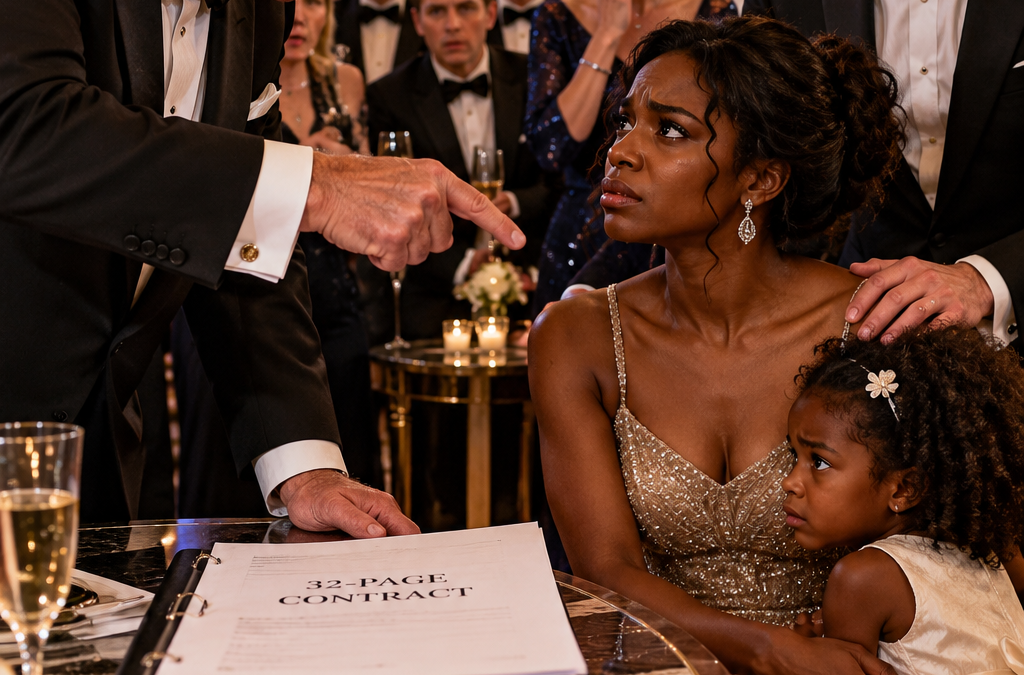
Pulled out a thick folded document.
Cream paper.
He placed it on a cocktail table.
“Since neither of you understands subtlety, I had my attorneys prepare this.”
Tyler stared.
“What is that?”
“Protection.”
Gerald tapped the cover.
“Thirty-two pages.”
I read the title.
POSTNUPTIAL AGREEMENT.
Something in my stomach went cold.
Gerald looked at me.
“It confirms that Patrice Shaw—”
He paused.
“Whatever that name was before she latched onto you—”
Tyler’s jaw tightened.
“Dad.”
“—waives all claims against Anderson family property.”
Gerald began counting.
“Trusts.”
Tap.
“Accounts.”
Tap.
“Real estate.”
Tap.
“Business interests.”
Tap.
“Every dollar generated by this family before or during the marriage.”
I didn’t touch the agreement.
“I’ve never asked for your money.”
“That’s what people without money always say before lawyers arrive.”
Then he turned a page.
“And any child from a previous relationship receives absolutely nothing.”
I looked at him.
The entire room disappeared for one second.
“You’re talking about Zoey.”
He did not hesitate.
“I’m protecting Anderson assets.”
“Her name is Zoey.”
“And she is not an Anderson.”
Tyler snatched the document.
His eyes moved quickly.
Then faster.
His face changed.
“What the hell is this?”
Gerald folded his hands.
“Read.”
“There’s a clause requiring Patrice to get your written permission to attend family events.”
“Yes.”
Tyler stared at him.
“Christmas?”
“Yes.”
“Birthdays?”
“Yes.”
“Funerals?”
“If necessary.”
Tyler turned another page.
“If she’s deemed publicly embarrassing, the marriage can be annulled with zero compensation.”
“Correct.”
“Who determines publicly embarrassing?”
Gerald’s expression did not change.
“I do.”
Tyler lowered the papers.
“This isn’t a contract.”
His hands shook.
“It’s a cage.”
“It’s a choice.”
Gerald leaned toward us.
“She signs tonight.”
I looked at him.
“She sits at a back table.”
His eyes met mine.
“She eats quietly.”
A few guests shifted.
“She keeps her mouth shut.”
His smile was almost polite.
“And everyone survives the evening.”
I felt something strange inside me then.
Not humiliation anymore.
Clarity.
Gerald truly believed everything had a price.
Silence.
Family.
Loyalty.
People.
He was not insulting me impulsively.
He was conducting a transaction.
Tyler shook his head.
“We’re leaving.”
Gerald lowered his voice.
“You think I’m bluffing?”
Tyler stopped.
“I called the bank earlier.”
My husband stared at him.
“One phone call.”
Gerald smiled.
“Your accounts freeze.”
Then he raised his voice so the ballroom could hear.
“And if she refuses to sign, you lose everything.”
People began moving closer.
Not helping.
Listening.
“The trust.”
Gerald’s voice became almost theatrical.
“Eight hundred million dollars.”
A whisper ran through the room.
“Your vice-president position.”
Another pause.
“The apartment.”
“The cars.”
“Every account.”
“Your inheritance.”
“Your future.”
Then:
“Your name.”
Tyler’s face had gone pale.
Gerald turned toward the crowd.
“My son has chosen to marry a broke, uneducated Black woman from public housing who has nothing to offer this family except embarrassment.”
The sentence entered me slowly.
Broke.
Uneducated.
Black.
Public housing.
Each fact turned into an accusation.
Some false.
Some true.
All treated as proof of inferiority.
Nobody spoke.
I looked at those three hundred people.
People who chaired foundations.
Sat on boards.
Published statements every January about equality.
Paid consultants to write diversity reports.
And not one person said:
Stop.
My hands trembled.
I pressed them against my dress.
I would not cry.
Not because tears were weakness.
I cried plenty.
At the hospital.
At home.
Sometimes in my car after losing a child we could not save.
But Gerald wanted tears.
He wanted evidence that he had reduced me.
He would not get them.
“Mr. Anderson.”
My voice sounded calmer than I felt.
He looked at me.
“I graduated magna cum laude from Columbia School of Nursing.”
The room listened.
“I have worked pediatric critical care for six years.”
I thought of the toddler from that morning.
“I pay my own bills.”
I looked at Tyler.
“I have never taken a dollar from your family.”
Then back at Gerald.
“I have never asked you for anything.”
He smirked.
“I came tonight because my husband asked me to stand beside him.”
My voice tightened.
“I did not come here to be humiliated.”
Gerald’s smile widened.
“And yet here you are being humiliated.”
A few nervous laughs escaped from somewhere behind him.
That sound hurt more than the insults.
Not because it was loud.
Because somebody had made a choice to participate.
Tyler looked toward the laughter.
Then at the contract.
He tore it in half.
The sound cut through the room.
Gerald stopped smiling.
Tyler tore the pages again.
Dropped them.
“We’re done.”
Gerald stared.
“What did you say?”
“I said we’re done.”
Tyler’s voice steadied.
“She isn’t signing.”
He pointed toward the floor.
“I’m not signing.”
Then toward Gerald.
“And I’m done pretending you’re anything other than what you are.”
Gerald’s face darkened.
“You’re choosing her over everything I built?”
Tyler looked at me.
Then at his father.
“I’m choosing decency over you.”
For the first time that evening, someone in the room inhaled sharply enough for me to hear it.
Gerald nodded.
Slowly.
“If that is your decision.”
“It is.”
“Then hear mine.”
His voice turned cold.
“As of this moment, you are no longer my son.”
My chest tightened.
Tyler did not move.
“You are removed from the family trust.”
Silence.
“Terminated from Anderson Capital effective immediately.”
Another beat.
“You will vacate the apartment by the end of the week.”
Victoria stood beside the staircase.
Motionless.
Gerald continued.
“You will never enter this house again.”
Tyler’s breathing became shallow.
“I will forget I ever had a son.”
Then Gerald looked at me.
“Take him.”
His contempt returned.
“You wanted him?”
He gestured toward Tyler.
“Now you have him.”
Pause.
“With nothing.”
I took Tyler’s hand.
He gripped mine.
Not because I needed support.
Because he did.
We turned.
Started toward the doors.
Gerald called behind us.
“You’ll be back.”
Tyler kept walking.
“When the money disappears and she shows you what she really is, you’ll crawl back.”
No response.
“Everyone does.”
We were three steps from the ballroom exit when two security men moved into our path.
They were built like walls.
Dark suits.
Blank faces.
I stopped.
Tyler turned.
Gerald’s voice came from behind us.
“Nobody leaves until I’m finished.”
Something inside me finally became afraid.
Not of Gerald.
Of what Tyler might do.
I felt his body change beside me.
Shoulders.
Jaw.
Hand releasing mine.
I touched his arm.
“Don’t.”
He looked at me.
“Not here.”
His eyes were burning.
I shook my head slightly.
Please.
He understood.
Gerald approached.
“You think this is symbolic?”
He pulled out his phone.
“One call.”
He dialed.
Held Tyler’s gaze.
“Richard Fitzgerald.”
Pause.
“Freeze Tyler Anderson’s access to every trust-linked account.”
Tyler’s face went still.
“Yes. Immediately.”
Gerald hung up.
“There.”
He smiled.
“Now you actually have nothing.”
Then he looked at me.
“No apartment.”
“No car.”
“No cards.”
He leaned closer.
“No money for gas in that little Honda.”
I almost smiled at that.
The Civic was mine.
Purchased before my marriage.
Paid off.
But Gerald had never bothered to learn anything about me that did not fit the story he needed.
He raised his champagne glass.
“I’d like to propose a toast.”
Nobody knew what to do.
A few people lifted glasses reflexively.
“To my former son.”
His smile widened.
“And his beautiful bride.”
The word beautiful sounded disgusting in his mouth.
“May they enjoy their new life in poverty.”
He looked at me.
“I hear the Bronx is lovely this time of year.”
Nobody drank.
That mattered.
But nobody lowered their glasses either.
They remained suspended in the air.
Cowardice pretending to be neutrality.
Near the bar stood Harold Whitfield, Gerald’s general counsel.
He was staring at his phone.
His face had gone pale.
He looked at me.
Then toward the entrance.
Then back to the phone.
He knew something.
I did not yet know what.
Gerald picked up the torn postnuptial agreement.
Held the pieces before the room.
“My son just destroyed his future for this.”
His shoe came down on the paper.
“That’s what this marriage is worth.”
He twisted his heel.
“Less than the contract written to protect us from it.”
Victoria finally moved.
She crossed the ballroom.
For one foolish second, I hoped she would stop him.
Instead, she stood beside him.
“Tyler.”
Her voice was soft.
“Your father is doing this because he loves you.”
Tyler stared at his mother.
“One day you’ll understand.”
Something changed in my husband’s face.
Not rage.
Something sadder.
“You stood there.”
Victoria blinked.
“You stood there while he said all of that.”
“Tyler—”
“About my wife.”
His voice broke.
“About Zoey.”
Victoria’s expression tightened.
“You didn’t say one word.”
“Family requires sacrifice.”
Tyler shook his head.
“No.”
His eyes filled.
“Sometimes the sacrifice is your soul.”
He turned.
The security guards looked toward Gerald.
Gerald gave a dismissive gesture.
“Let them go.”
We walked into the foyer.
The ballroom doors closed behind us.
The quiet was immediate.
Crystal wall sconces.
Persian rug.
A huge oil portrait of Gerald above the staircase.
I leaned against the wall.
Only then did my body begin shaking.
Not delicately.
My hands trembled so hard I had to press them against my stomach.
Tyler looked at me.
“Patrice.”
“I’m okay.”
“No, you’re not.”
“No.”
I closed my eyes.
“I’m not.”
He stood beside me.
Then:
“I’m sorry.”
I opened my eyes.
His face was broken.
“I’m so sorry.”
“Tyler.”
“I thought if they met you.”
I shook my head.
“If they actually saw you—”
“They saw me.”
He stopped.
“That’s the problem.”
I wiped beneath one eye before the tear could fall.
“They looked at me and saw exactly what they had already decided was there.”
Tyler pressed his forehead to the wall.
“He did it.”
“Yes.”
“He actually cut me off.”
I reached for him.
“I have nothing.”
“You have me.”
He looked over.
“And I have you.”
I took his hand.
“And we have Zoey.”
His mouth tightened.
“That is not nothing.”
He nodded.
Then asked quietly:
“Should we call your father?”
My hand moved instinctively toward the dog tag beneath my dress.
C. S.
My entire adult life, I had refused to use that name as a weapon.
I could have told Gerald the first time we met.
Could have watched his entire attitude transform.
Could have laid my father’s business card beside Gerald’s fifty-thousand-dollar check.
I hadn’t.
Because then I would never know whether Gerald respected Patrice or Cornelius Shaw’s daughter.
That question had been answered.
Painfully.
Completely.
But this was no longer about proving independence.
He had humiliated my daughter.
Threatened my husband.
Used money as a weapon.
Publicly degraded me because he believed no one powerful would object.
Three hundred people had watched.
Something larger than pride was involved now.
“I’ll call him.”
My fingers shook as I dialed.
One ring.
Two.
Then the voice I had heard every week of my life.
“Hey, baby girl.”
“Dad.”
That was all I managed.
One word.
My voice cracked.
Cornelius became immediately serious.
“I know.”
I frowned.
“What?”
“Tyler called me twenty minutes ago.”
I looked at my husband.
He gave a small guilty nod.
“I’m already here.”
“What do you mean here?”
“In the driveway.”
I almost laughed.
“What?”
“I’ve been sitting outside deciding whether to come in politely or come in like a four-star general.”
A broken sound escaped me.
Half laugh.
Half sob.
“What did you decide?”
His voice became quiet.
“I’m coming in as your father.”
Pause.
“That’s worse.”
The call ended.
I looked at Tyler.
“You called him?”
“When my father brought out the contract.”
“You didn’t tell me.”
“You had enough happening.”
Before I could answer, I heard a car door outside.
Then footsteps.
Measured.
Unhurried.
The doorbell rang.
I opened the door.
My father stood there.
Cornelius Shaw was sixty.
Six foot three.
Silver hair cut short.
Charcoal suit.
American flag pin.
No military uniform.
No entourage.
Two security officers remained near the Escalade, but Dad came inside alone.
He looked at me.
Everything else disappeared from his face.
He cupped my cheeks.
“You okay, baby girl?”
I nodded.
Lied.
He kissed my forehead.
Then looked at Tyler.
My husband straightened.
Dad extended his hand.
“You did the right thing.”
Tyler swallowed.
Dad held his grip.
“I’m proud of you, son.”
Tyler’s eyes filled.
He could not answer.
Dad released him.
Adjusted his jacket.
Touched the flag pin.
Then looked at the ballroom doors.
“Which one is he?”
Tyler almost laughed despite everything.
“You can’t miss him.”
Dad nodded.
“Let’s correct this.”
He pushed both doors open.
Every conversation stopped.
My father entered first.
I walked behind him with Tyler.
Gerald was near the bar.
Fresh bourbon.
Talking to a hedge-fund manager.
He glanced toward the doors.
His expression changed so fast it almost didn’t look human.
Recognition.
He knew Dad.
Not through me.
From his own world.
Two years earlier, Gerald had waited nearly an hour at a Pentagon procurement gala to introduce himself to General Cornelius Shaw.
He had also called Shaw-Northfield’s offices repeatedly when Anderson Capital needed a contract extension.
My father’s company held billions in defense contracts.
Contracts Gerald needed.
Gerald’s glass lowered.
The room separated for Dad without anyone asking.
People know authority.
Real authority is often quieter than performance.
Dad stopped directly in front of Gerald.
“Gerald.”
No greeting.
No smile.
Gerald swallowed.
“General Shaw.”
“We’ve met.”
“Yes.”
“Twice.”
Dad’s voice was calm.
“Once at a Pentagon gala.”
Gerald’s eyes flicked toward me.
“Once after your office called mine three times requesting an extension.”
Gerald’s hand began trembling.
Behind him, Harold Whitfield closed his eyes.
Dad continued.
“My daughter.”
Gerald looked at me.
“The woman you called ghetto trash.”
Nobody moved.
“The woman you called filth.”
My father’s voice never rose.
“The woman you ordered removed from your home.”
Pause.
“Is Patrice Elaine Shaw.”
Gerald’s face lost color.
“My only child.”
Dad turned slightly toward me.
“A magna cum laude graduate of Columbia.”
Then back.
“A pediatric critical-care nurse.”
His jaw tightened.
“A woman who has saved more lives with those hands than most people in this room will affect in their entire lives.”
My eyes burned.
Dad continued.
“She chose not to use my name.”
Gerald stared.
“She refused my money.”
A few guests looked at me differently.
I hated that.
Even in that moment.
My father must have known, because he added:
“And before any person in this room makes the same mistake Gerald did, understand something.”
He turned toward the guests.
“She did not become worthy when you learned who her father was.”
Silence.
“She was worthy when you believed she was a nurse from the Bronx with no money.”
That sentence stayed with me.
Dad looked at Gerald again.
“She earned everything.”
He reached into his jacket.
Placed a business card on the bar.
Gerald did not need to read it.
But he did.
CORNELIUS A. SHAW
CHAIRMAN
SHAW-NORTHFIELD INDUSTRIES
Gerald’s knees softened.
He gripped the bar.
The business relationship between Shaw-Northfield and Anderson Capital represented an enormous portion of Gerald’s annual revenue.
Forty percent, I learned later.
Billions of dollars.
Gerald’s bourbon glass slipped.
Hit the marble.
Shattered.
Nobody moved.
“General.”
His voice sounded smaller.
“This has been a terrible misunderstanding.”
Dad stared.
“You had no idea.”
Gerald nodded quickly.
“Exactly.”
Dad tilted his head.
“No idea she was someone’s daughter?”
Gerald froze.
“Or no idea anyone you consider important would object to the way you treat people you consider beneath you?”
Nothing.
Gerald tried again.
“Family emotions ran high.”
“You drafted thirty-two pages this morning.”
Dad’s voice sharpened slightly.
“You positioned security at your doors.”
Gerald looked toward them.
“You froze your son’s accounts.”
Dad stepped closer.
“That is not emotion.”
Pause.
“That is planning.”
Gerald extended his hand.
“Cornelius.”
Dad looked at it.
Did not take it.
“Surely we can discuss this privately.”
“No.”
“There is no reason for this to affect business.”
Dad’s eyes hardened.
“You are correct about one thing.”
Gerald waited.
“We have a long business history.”
Hope flickered.
“And unless I hear something very different from what I have heard tonight, that history ends here.”
Gerald dropped his hand.
Victoria stepped beside him.
“General Shaw.”
Dad looked at her.
“Perhaps after everyone has had time to cool down—”
“Mrs. Anderson.”
She stopped.
“I watched you stand beside the staircase while your husband degraded my daughter.”
Victoria’s face went blank.
“I watched your son choose his wife while you chose silence.”
He shook his head.
“Do not lecture me about cooler heads.”
Then Dad took out his phone.
Dialed.
“Andrew.”
The entire ballroom listened.
“Full review of every Shaw-Northfield contract involving Anderson Capital.”
Gerald closed his eyes.
“Subcontracts too.”
Pause.
“Every clause. Every renewal.”
Another pause.
“Board briefing Monday at nine.”
He hung up.
Then looked at Gerald.
“Forty-eight hours.”
“For what?”
“To resign.”
Gerald stared.
“Public apology.”
Dad continued.
“A real one.”
Then:
“You personally step away from every Shaw-Northfield contract.”
Gerald’s face tightened.
“If I don’t?”
“My lawyers proceed.”
Dad paused.
“They don’t lose.”
Gerald lowered himself into the nearest chair.
For the first time all night, he seemed old.
Not powerful.
Not terrifying.
Just a sixty-two-year-old man sitting inside the consequences of himself.
Harold Whitfield quietly picked up his briefcase.
Walked away from Gerald.
Positioned himself near Tyler.
“Tyler.”
My husband looked at him.
“We should talk Monday.”
Tyler nodded.
Across the room, Dorothy Mitchell stood.
Gerald’s older sister.
She had been crying most of the night.
She came toward me.
Took my hands.
“I’m sorry.”
I looked at her.
“I should have said something.”
Her voice broke.
“Tonight.”
She swallowed.
“Years ago.”
I believed her regret.
It did not erase silence.
But remorse matters when it becomes action.
“Thank you, Dorothy.”
Dad put one arm around me.
Tyler took my other hand.
We walked out together.
Behind us, three hundred phones came out.
That was the strange thing.
When I needed someone to intervene, almost nobody moved.
When the drama became safe to repeat, everyone suddenly had something to do.
By midnight, the gala was everywhere.
Someone had recorded Gerald.
Clear audio.
Every word.
Ghetto trash.
Filth.
Broke.
Public housing.
His son disowned.
The threat.
The bank call.
The clip spread faster than anything I had ever seen.
By two in the morning, millions of people had watched it.
I did not.
I was sitting on Brenda’s couch with Zoey asleep against my side.
Tyler sat on the floor near my knees.
His phone kept buzzing.
He finally switched it off.
Zoey had woken when we picked her up.
She knew something happened.
Children always do.
“Did Grandpa Gerald get mad?”
Tyler looked at me.
I answered.
“Yes.”
“At me?”
“No.”
“Mom?”
“Not exactly.”
She frowned.
“That means yes.”
I smiled weakly.
“He said some very unkind things.”
Zoey considered this.
“Did Grandpa Cornelius yell at him?”
Tyler almost laughed.
“No.”
“That’s worse.”
I stared at her.
“What?”
She shrugged.
“When Grandpa Cornelius gets quiet, people get scared.”
She was absolutely right.
The next morning, headlines had already turned my worst night into a national argument.
Anderson Capital CEO caught in racist tirade.
Billionaire disowns son over Black wife.
Defense contractor connection threatens Anderson empire.
I wanted none of it.
Reporters found Mercy General.
My apartment.
Brenda’s neighborhood.
Dad’s office.
Tyler received hundreds of messages.
Some supportive.
Some vicious.
Some from people who had been silent inside the ballroom.
That bothered him.
One message came from a senator.
You showed great courage.
Tyler read it twice.
“He was standing twenty feet away.”
I looked up.
“What?”
“The senator.”
He held the phone.
“He watched everything.”
I nodded.
“He says I showed courage.”
Tyler laughed bitterly.
“He couldn’t say one sentence.”
“People like courage better after it’s over.”
He looked at me.
“That should bother me less than it does.”
“No.”
“It shouldn’t.”
Monday morning, I went back to work.
Six a.m.
Scrubs.
Hair tied back.
Coffee.
I had slept maybe three hours.
When I entered the pediatric ward, every head turned.
One nurse hugged me.
Another said:
“You didn’t have to come.”
“Yes, I did.”
A reporter called the nurses’ station before seven.
The charge nurse asked what I wanted her to say.
I took the phone.
“This is Patrice.”
Questions began immediately.
“Mrs. Anderson, can you comment on—”
“My patients need me.”
“Can you tell us—”
“That hasn’t changed.”
I hung up.
Seven words.
They became a headline.
I hated that too.
But at least they were mine.
While I was checking IV medication for a nine-year-old recovering from surgery, Anderson Capital was beginning to collapse.
An investigative journalist named Nathan Brooks had been researching the company’s employment practices for months.
Gerald’s recorded tirade opened doors.
Former Black employees came forward.
One woman had been passed over for promotion three times despite the strongest performance reviews in her division.
Another remembered Gerald referring to diversity programs as “window dressing.”
Internal emails surfaced.
“Cultural fit.”
A phrase written innocently enough until patterns revealed what it meant.
An older discrimination lawsuit resurfaced.
The company had settled it quietly.
Now the silence around it broke.
Stock fell fourteen percent Monday.
Then more.
Investors began pulling money.
Not because everyone had suddenly developed principles.
Dad said it best.
“Markets don’t grow consciences.”
He was eating breakfast with Zoey when he said it.
“They calculate risk.”
Zoey looked up from her cereal.
“What’s risk?”
“Your mother when somebody insults you.”
I stared at him.
“Dad.”
He smiled.
Tyler didn’t.
He was still processing the fact that his father’s company might die.
That surprised some people.
They expected him to enjoy it.
He didn’t.
Anderson Capital had been his life too.
His colleagues.
Employees.
Projects he believed in.
A company is rarely identical to the person controlling it.
Tyler understood that.
By Tuesday, the board called an emergency meeting.
Gerald resisted resigning.
Of course.
Men who build identity around control rarely recognize the moment control has already left.
The board demanded his resignation.
He called directors.
Threatened.
Negotiated.
Reminded them who had built the company.
Nobody wanted to drown beside him.
Shaw-Northfield froze contract renewals.
Other defense clients followed.
Billions placed under review.
The company’s foundation cracked.
Victoria finally told Gerald what nobody else could make him accept.
“If you don’t resign, we lose everything.”
He resigned Thursday.
His public apology was televised.
Navy suit.
American flag pin.
Tyler noticed the pin.
“So now he wants to look like your dad.”
I watched Gerald read.
“I deeply regret the hurtful and inappropriate remarks…”
His eyes rarely left the teleprompter.
“…my words do not reflect the values…”
I turned off the television.
Tyler looked at me.
“Don’t you want to hear it?”
“No.”
“Why?”
“Because he isn’t talking to me.”
I put down the remote.
“He’s talking to shareholders.”
That was the end of Gerald’s apology as far as I was concerned.
The EEOC opened an investigation.
Six former employees filed a class-action lawsuit.
Allegations stretched back years.
Discrimination in promotion.
Pay.
Hiring.
Workplace culture.
The damages demanded were staggering.
Eighty-five million dollars.
Three corporate boards removed Gerald.
Nonprofits asked him to step aside.
Country clubs began reviewing his membership.
America has an interesting relationship with morality.
People tolerate cruelty for years when it is private.
Once it threatens reputation, everybody discovers standards at the same time.
I tried not to become consumed by it.
I had Zoey.
Patients.
A marriage.
And Tyler was grieving.
That part received almost no public attention.
The story framed him as the courageous son who walked away from eight hundred million dollars.
True.
But courage has an afterlife.
He woke up sometimes reaching for a phone that no longer worked.
Not because he missed luxury.
Because his whole identity had been engineered inside Gerald’s world.
Anderson schools.
Anderson company.
Anderson apartment.
Anderson expectations.
One morning he stood in our kitchen wearing sweatpants and said:
“I don’t know who I am without him.”
I was packing Zoey’s lunch.
I stopped.
“You’re Tyler.”
“That sounds stupid.”
“It sounds obvious.”
He sat.
“My first internship was his company.”
“I know.”
“My apartment was his.”
“I know.”
“My position was his.”
“Yes.”
“Every room I walked into…”
He rubbed his face.
“They knew whose son I was.”
I sat beside him.
“And?”
“I don’t know if I earned any of it.”
That hurt.
Because I understood better than anyone.
I took his hand.
“Then earn the next thing.”
He looked at me.
“What if I can’t?”
“You can.”
“How do you know?”
“Because you walked away.”
I squeezed his fingers.
“You did the one thing your father never prepared you to do.”
“What?”
“Choose without knowing what it would cost.”
He cried then.
Quietly.
I held him.
A week later, Anderson Capital’s board asked Tyler to become interim CEO.
He stared at the email for ten minutes.
“No.”
I looked up.
“What?”
“They think this is because of you.”
“Probably.”
“I’m not taking a pity appointment.”
“Then ask them why.”
He did.
The board laid out the conditions.
Independent employment audit.
New compliance systems.
Diversity reforms.
Minority business incubator.
They wanted someone who understood the company but represented a clean break from Gerald.
Tyler agreed on one condition.
I would have no role in the appointment.
No Shaw-Northfield pressure.
No request from my father.
No involvement from me.
He wanted the vote to stand on his record.
I understood.
It was the same reason I had driven my Civic to Gerald’s mansion without telling anybody who Dad was.
The board voted.
Tyler accepted.
His first week, he worked sixteen-hour days.
Not glamorous ones.
Meetings with employees Gerald had ignored.
Lawyers.
Compliance staff.
Former workers.
He listened.
That mattered.
The lawsuit eventually settled for sixty-two million dollars.
A massive number.
Gerald’s personal fortune took a brutal hit through the stock collapse, legal expenses, and restructuring.
The EEOC consent decree required independent monitoring and years of reporting.
The company changed because it had to.
But over time, some changes became more than punishment.
Carolyn Edwards became Anderson Capital’s first Black executive vice president.
She had been rejected twice for advancement under Gerald.
When Tyler introduced her at a leadership meeting, she said:
“I don’t need anyone to apologize for hiring me late.”
Then she looked around the room.
“I need you to stop being late next time.”
Tyler repeated that line for months.
Anderson Capital launched the minority business incubator.
Twelve Black-owned startups received funding in the first year.
Some people accused Tyler of overcorrecting.
He ignored them.
“If correcting discrimination looks excessive to you,” he told one board member, “you may be more comfortable with the discrimination than the correction.”
That sounded like my husband again.
The company recovered.
Eighteen months later, its stock surpassed the highest point it had reached under Gerald.
A reporter asked Tyler:
“What changed?”
He answered:
“The leadership.”
Then added:
“Everything else was already here.”
I loved him for that.
He never pretended he had rebuilt the company alone.
He simply stopped suffocating the people who could.
My father created the Grace Shaw Foundation shortly after the gala.
Ten-million-dollar endowment.
Scholarships for single mothers pursuing healthcare and law.
He named it after Mom.
When he told me, I cried harder than I did during the gala.
“You should have asked.”
He frowned.
“Would you have said yes?”
“No.”
“Exactly.”
I helped design the scholarship application.
Quietly.
No interviews.
No photographs.
On the website, my name appeared only as advisory board member.
That was enough.
Dad retired from Shaw-Northfield the following spring.
Officially because it was time.
Unofficially because Zoey had discovered that retired grandfathers were easier to schedule.
Every Tuesday, he picked her up from school.
Ice cream afterward.
Same shop.
He told her stories about Grace.
Not about court victories.
Not first.
He told her that Grandma Grace once burned a Thanksgiving turkey so badly the fire department came.
He told her she danced in the kitchen barefoot.
Then he told her about the cases.
Voting rights.
Housing discrimination.
Employment lawsuits.
He wanted Zoey to understand that strength was not something invented at the gala.
It was family history.
Tyler and I renewed our vows that October.
Not because our marriage needed repairing.
Because we wanted one ceremony that belonged to us.
Thirty guests.
Garden in Westchester.
No ballroom.
No press.
No business deals.
Dad walked me down the aisle.
Dorothy Mitchell was the only Anderson relative invited.
She arrived early carrying a stuffed elephant for Zoey and a handwritten letter for me.
I read it alone before the ceremony.
She wrote about silence.
Not Gerald’s.
Hers.
She told me she had watched him become cruel over decades and kept convincing herself it was not her place to intervene.
She wrote:
I thought silence kept peace. I understand now that it only protected the person causing harm.
I folded the letter.
Kept it.
Dorothy never gave me a dramatic apology again.
She simply showed up.
Every month.
Birthday gifts.
Lunch.
School performances.
A relationship built from repetition instead of speeches.
That was more meaningful.
Zoey served as flower girl.
Halfway down the aisle, she stopped.
Turned toward our guests.
And announced:
“My Grandpa Cornelius is a general and my mom saves kids.”
Everyone laughed.
Dad looked like he might cry.
I crouched when she reached me.
“You were supposed to throw petals.”
“I did.”
She pointed behind her.
She had indeed created an aggressive trail of flowers.
“Continue.”
“Yes, ma’am.”
She finished her assignment.
Tyler and I said our vows again.
This time there was no trust.
No inheritance.
No Anderson mansion behind us.
Just him.
Me.
Zoey.
People who had chosen to be there.
That was enough.
Gerald’s life became smaller.
I know people expected that part of the story to satisfy me.
It didn’t.
He moved out of Greenwich.
His wealth fell dramatically.
Victoria divorced him four months after the gala.
In her deposition, she admitted he had used racial slurs privately for years.
She claimed she remained silent because she depended financially on him.
I believed some of that.
I also remembered her standing beside him.
Silence may have reasons.
It still has consequences.
She moved to Palm Beach.
Never spoke publicly again.
Gerald was ordered to complete twelve diversity-education sessions.
Someone eventually photographed him in the back row of a community-college classroom wearing a visitor badge.
The internet celebrated.
I felt nothing.
Maybe that disappointed people.
They wanted revenge.
A man humiliated.
Reduced.
Made to feel what I felt.
But I had spent my professional life caring for children.
Pain does not become good because the person suffering once caused pain.
Consequences mattered.
Accountability mattered.
I did not need cruelty.
I needed distance.
Gerald never contacted me.
He did not contact Zoey.
He did not speak to Tyler for more than a year.
That was probably the greatest punishment he experienced.
Not the lost mansion.
Not the money.
His son stopped needing him.
Eight months after the gala, Mercy General promoted me to head pediatric nurse.
My supervisor called me into her office.
I sat.
She smiled.
“This is overdue.”
“How overdue?”
“About two years.”
I laughed.
“Why now?”
She looked embarrassed.
“The position finally opened.”
“That’s a diplomatic answer.”
“Do you want the job or not?”
“Yes.”
“Good.”
Then she pointed at me.
“And before you ask, your father had nothing to do with it.”
I smiled.
“I wasn’t going to ask.”
“You absolutely were.”
She knew me too well.
Tyler and I bought a house in Westchester.
Four bedrooms.
Small backyard.
Swing set.
Modest by Anderson standards.
Ridiculous compared with the Bronx apartment where I spent part of my childhood.
Perfect for us.
The first night, we ate pizza sitting on moving boxes.
Zoey ran from room to room deciding where everything belonged.
Tyler looked around.
“This is ours.”
“Yes.”
“No trust.”
“No.”
“No company apartment.”
“No.”
He smiled.
“I like it.”
“So do I.”
He leaned against me.
For a long time, we sat there listening to Zoey argue with herself about whether her stuffed animals needed their own room.
Sometimes happiness is not dramatic.
Sometimes it is pizza on cardboard in a house nobody can take away with a phone call.
Dad eventually reinstated Shaw-Northfield’s business relationship with Anderson Capital.
Not under the old terms.
Annual diversity audits.
Compliance provisions.
Transparency requirements.
Tyler agreed without negotiation.
When the new contract was signed, Dad invited us to dinner.
I arrived late from the hospital.
He put a plate in front of me.
“You look tired.”
“Children keep refusing to schedule illness around business dinners.”
“Inconsiderate.”
“Extremely.”
After dinner, Dad and Tyler went onto the porch.
I watched them through the window.
They had developed something neither expected.
Not exactly father and son.
Something adjacent.
Respect.
Dad never tried to replace what Tyler lost.
He didn’t need to.
Tyler didn’t need another patriarch.
He needed older men who could care about him without owning him.
That distinction mattered.
Later, Dad sat beside me.
“You still wear it.”
He touched the dog tag.
“Yes.”
“Why hide it?”
I smiled.
“I’m not hiding it.”
“You tuck it under everything.”
“So it doesn’t catch on patients.”
He looked skeptical.
“Dad.”
“All right.”
We were quiet.
Then he asked:
“Do you regret not telling them sooner?”
I knew exactly what he meant.
Gerald.
His family.
My identity.
“No.”
“Not even after all that?”
“No.”
Dad nodded.
“Why?”
“Because now I know.”
“Know what?”
“What Tyler chose.”
I looked toward the porch.
“He chose me before he knew you were coming.”
Dad smiled.
“Yes.”
“And Gerald showed me exactly who he was before he knew you were watching.”
Dad’s expression became serious.
“That part bothers me.”
“Why?”
“Because people keep telling the story as though Gerald’s mistake was insulting my daughter.”
I knew.
“He didn’t know who you were.”
I nodded.
“He knew enough.”
Dad looked at me.
“You were his son’s wife.”
“Yes.”
“A nurse.”
“Yes.”
“A mother.”
“Yes.”
“A human being.”
I swallowed.
“That should have been enough.”
Exactly.
That became the part of the gala story I cared about most.
Not the reveal.
The reveal made good headlines.
Billionaire insults secret heiress.
Racist CEO discovers daughter-in-law’s powerful father.
Those headlines missed everything.
I was never a secret heiress.
I wasn’t waiting to inherit Dad’s empire.
I did not enter that ballroom carrying a hidden trump card.
I was Patrice.
That was the point.
The woman Gerald believed he could degrade without consequence deserved dignity before Cornelius Shaw crossed the driveway.
If Dad had been a retired bus driver, Gerald would still have been wrong.
If I had never attended Columbia, Gerald would still have been wrong.
If I actually had grown up in public housing and worked for minimum wage, Gerald would still have been wrong.
The truth about my father did not increase my worth.
It only increased Gerald’s fear.
Those are different things.
I thought about that whenever strangers recognized me.
It happened for months.
Grocery stores.
Hospital corridors.
Airport.
“Are you Patrice Shaw?”
Sometimes.
“Were you the woman at that gala?”
I learned to smile politely.
“Yes.”
Then:
“Your dad destroyed that guy.”
I hated that.
Dad did not destroy Gerald.
Gerald had spent years constructing the structure that collapsed around him.
Dad simply stopped supporting one wall.
The former employees who spoke out mattered.
The investigators mattered.
The board mattered.
The recordings mattered.
Gerald’s own conduct mattered most.
Consequences are not revenge when they come from truth.
One afternoon, almost two years after the gala, a nursing student named Alisha asked to speak with me privately.
She was Black.
Twenty-two.
Brilliant.
Quiet.
She closed my office door.
“My boyfriend’s family doesn’t like me.”
I leaned back.
“Why?”
“You know why.”
I did.
“What does he do?”
“He tells me to ignore them.”
I said nothing.
“They make jokes.”
“What kind?”
She looked down.
I waited.
“Race.”
My jaw tightened.
“Money.”
Another pause.
“They say I’m using him.”
“Are you?”
Her eyes snapped up.
“No.”
“Then why are you trying to prove it to them?”
She looked confused.
I continued.
“The question is not whether his family approves.”
“What is it?”
“What does he do when they disrespect you?”
She looked at the floor again.
“Nothing.”
There it was.
I thought about Tyler tearing the contract.
Eight hundred million dollars on one side.
My hand in his on the other.
“Love isn’t only what somebody says to you privately.”
Alisha listened.
“It’s what they’re willing to protect publicly.”
Her eyes filled.
I did not tell her to leave him.
That decision had to be hers.
But when she left my office, she stood straighter.
I hoped that mattered.
Years passed.
The gala became one of those stories people referenced as if it happened to characters rather than us.
Gerald Anderson became a case study in corporate-governance seminars.
Tyler became a symbol of reform.
Dad became the general who walked into a ballroom and ended a billionaire.
I became the nurse who secretly came from power.
All those versions were incomplete.
The real story was smaller.
A husband decided he would rather lose money than watch his wife be degraded.
A woman learned that refusing help and refusing love are not the same thing.
A father arrived because his daughter finally called.
A room full of influential people discovered that silence can expose character almost as clearly as cruelty.
And a little girl eventually got a swing set.
That was my favorite ending.
One Tuesday evening, Dad brought Zoey home from ice cream.
She was older then.
Smart enough to know most of the story.
She found me folding laundry.
“Mom?”
“Yes?”
“Why didn’t you tell Grandpa Gerald who Grandpa Cornelius was?”
I stopped folding.
Because children eventually find the exact question adults spend years avoiding.
“I wanted him to know me.”
“He did know you.”
“Not really.”
She sat on the bed.
“Would he have been nice if he knew?”
I thought about lying.
Didn’t.
“Yes.”
She frowned.
“That’s worse.”
I smiled sadly.
“Yes.”
“Because then he’d only be nice because Grandpa’s important?”
“Yes.”
Zoey thought.
“Are you important?”
“To some people.”
“No.”
She rolled her eyes.
“I mean important like Grandpa.”
I laughed.
“I’m important to my patients.”
“That doesn’t count.”
“It absolutely counts.”
She sighed dramatically.
I sat beside her.
“Listen.”
She did.
“People will sometimes treat you differently because of what they think you have.”
“Money?”
“Money.”
“Jobs?”
“Yes.”
“Grandpas?”
I smiled.
“Apparently.”
She leaned into me.
“But none of those things decide what you’re worth.”
“I know.”
“You say that now.”
I kissed her forehead.
“Remember it when somebody important makes you forget.”
She nodded.
Then asked:
“Did Grandpa Gerald ever say sorry?”
“No.”
“Never?”
“No.”
She considered that.
“Good.”
I looked at her.
“Why good?”
“Because if he lied, it would be worse.”
I laughed.
Maybe she was right.
A forced apology is often just another performance.
Gerald’s life eventually disappeared from headlines.
Anderson Capital stabilized.
Tyler stopped being introduced mainly as Gerald’s son.
That meant more to him than he admitted.
One night, after an industry dinner, he came home smiling.
“What?”
“Nothing.”
“That face is not nothing.”
He loosened his tie.
“Someone introduced me as Tyler Anderson, CEO of Anderson Capital.”
“Yes?”
“Nothing else.”
I waited.
“No ‘son of founder Gerald Anderson.’”
I smiled.
“Congratulations.”
He laughed.
“That’s ridiculous.”
“No.”
I kissed him.
“It isn’t.”
He had finally earned the next thing.
On the anniversary of the gala, we never commemorated it.
No dinner.
No speeches.
Most years we forgot.
Then one evening, maybe five years later, we happened to drive past the old Greenwich exit.
Zoey was asleep in the back seat.
Tyler noticed the sign.
Neither of us spoke for a minute.
Then he said:
“You know what I remember most?”
“What?”
“The paper.”
“The postnup?”
“The sound.”
He tightened his hands on the steering wheel.
“When I tore it.”
I nodded.
“I remember thinking my life was over.”
“Was it?”
He looked at me.
“No.”
A small smile.
“It started.”
I reached across the console.
Took his hand.
That was how I eventually came to understand what Gerald had offered him.
It was not eight hundred million dollars versus poverty.
It was ownership versus freedom.
Gerald believed money gave him the right to determine who his son loved.
Where he lived.
Who attended Christmas.
Whether Zoey counted as family.
Whether I had permission to enter a room.
When Tyler tore the contract, he did not throw away his future.
He took possession of it.
The money simply made the choice visible.
I wish I could say everybody who watched us that night became braver.
They didn’t.
Some apologized.
Some never did.
Harold Whitfield resigned quietly and moved to another law firm.
The junior associate who mouthed “I’m sorry” eventually wrote to me.
She said that moment haunted her.
She had wanted to intervene.
Feared losing her job.
I wrote back once.
I did not tell her she was a coward.
Life is more complicated than that.
I told her:
Next time, decide in advance what you are willing to risk.
Because moral courage is difficult to invent after the room has already turned hostile.
Dorothy learned.
Maybe Victoria did too.
I never knew.
Gerald?
I hoped the diversity classes gave him something more than humiliation.
Not for his sake.
For anyone who still had to encounter him.
Dad once asked if I wanted Gerald to meet Zoey again.
“No.”
He nodded.
No lecture.
No suggestion of forgiveness.
Some boundaries do not need anger to remain firm.
Maybe someday Zoey would choose differently.
That would be hers.
By then, she knew where she came from.
Grace Shaw.
Cornelius Shaw.
Me.
Tyler.
All imperfect.
All carrying different forms of strength.
The dog tag still hangs around my neck.
C. S.
I stopped tucking it away so carefully after the gala.
Not because I wanted people to recognize the initials.
Because I finally understood that independence did not require erasing the people who loved me.
Dad’s name could be part of me without becoming all of me.
That was something I had been too stubborn to accept.
My mother would have understood immediately.
She usually did.
Sometimes I imagine telling her the whole story.
Gerald.
The contract.
Tyler.
Dad walking into the ballroom.
The company collapse.
The foundation with her name.
I know exactly where she would interrupt.
“You let that man talk about Zoey like that?”
“Mom, that isn’t the point.”
“That is absolutely the point.”
Then she would ask whether Tyler stood up for me.
I would tell her he tore the agreement.
Walked away.
Lost everything he believed belonged to him.
She would nod once.
Then:
“Keep that one.”
I did.
In the end, that is what stayed with me.
Not Gerald’s face when he recognized Dad.
Not the broken bourbon glass.
Not the headlines.
Not the billions.
Tyler’s hand.
Locked around mine while his father listed everything he would lose.
The room waiting.
The contract between us.
Eight hundred million dollars on one side.
A life with me on the other.
And he tore the paper.
People like Gerald think worth can be measured because money is the only language they trust.
They believe a person with less wealth must want more.
That a woman without a famous last name must be trying to acquire one.
That love becomes irrational when it costs something.
They are wrong.
The greatest gift Tyler ever gave me was not choosing me over eight hundred million dollars.
It was making clear that, to him, there had never been a comparison.
Years later, when people still occasionally asked how it felt to watch Gerald Anderson lose his empire, I gave them the answer I had eventually learned was true.
“I didn’t need him to lose.”
They usually looked disappointed.
“What did you need?”
I thought about the ballroom.
Three hundred silent people.
The torn paper.
Dad at the door.
Zoey asleep later against my chest.
“I needed to leave knowing my husband would leave with me.”
That was all.
Everything after was consequence.
The marriage was the choice.
And when I look back now, I don’t remember myself as the woman Gerald Anderson humiliated.
I remember the moment after.
When I walked toward the door with my back straight.
When I believed Tyler and I might genuinely be starting over with almost nothing.
When I had no idea Dad was already in the driveway.
That was the moment that told me who I was.
Not Cornelius Shaw’s daughter.
Not Anderson Capital’s daughter-in-law.
Not the woman everyone later decided had been secretly powerful all along.
Just Patrice.
Nurse.
Mother.
Wife.
A woman wearing a navy dress, holding the hand of a man who had chosen her freely.
And even before those ballroom doors opened again, that had already been enough.








