𝗙𝗨𝗟𝗟 𝗦𝗧𝗢𝗥𝗬 My HOA President Threatened to Take My House Over Three Bags of Rotting Grass That Appeared on My Lawn While I Slept
𝗙𝗨𝗟𝗟 𝗦𝗧𝗢𝗥𝗬
Then I felt ridiculous for taking out a ruler.
I was a grown man measuring grass in my own front yard because a stranger with a clipboard had decided it was a quarter-inch too tall.
I paid the fine.
I told myself it wasn’t worth fighting.
The second notice concerned wind chimes.
I had hung a small set beneath the front porch roof.
They were metal, no longer than my hand, and made a faint sound when the breeze moved through the entrance.
Karen classified them as an unauthorized exterior ornament that created a potential noise disturbance.
Another fine.
I took the chimes down.
Paid the charge.
And tried to forget it.
The third notice arrived a month later.
This one concerned my mailbox post.
UNAPPROVED EXTERIOR INSTALLATION.
I read the letter at the kitchen counter, then walked outside.
My mailbox was mounted on a black wooden post.
The same type of post used by nearly every house on the street.
The same height.
The same finish.
The same general design.
I looked across the road.
My neighbor’s mailbox was practically identical.
No violation notice hung from his door.
I walked down the sidewalk and compared them.
If anything, my post was straighter.
That evening, I found Rosa Martinez tending flowers outside her house.
Rosa was in her sixties, with short gray hair, sharp brown eyes, and a habit of speaking carefully whenever she discussed the HOA.
She had lived in Maple Ridge almost fifteen years.
“Rosa,” I said, “can I ask you something?”
She looked up.
“Of course.”
“Did the HOA ever approve your mailbox?”
She glanced toward the post.
“Years ago.”
“Did you need a special application?”
“No. It came with the house.”
I pointed toward mine.
“Does mine look different?”
She studied both.
“Not to me.”
I handed her the citation.
She read it.
Her expression changed.
“Oh, Parker.”
“What?”
She folded the letter and gave it back.
“You should ask about that at the next meeting.”
“I plan to.”
She looked toward the end of the street, where Karen’s white SUV was slowly making its evening inspection round.
Then she lowered her voice.
“Just be careful how you ask.”
I laughed.
“Why? Is he going to fine me for speaking?”
Rosa didn’t laugh.
And that was the moment I should have realized how serious the problem might become.
The next HOA board meeting was held inside the community clubhouse.
The building wasn’t large, but Karen had decorated the meeting room as though he were presiding over a corporation.
A polished wooden table stood at the front.
Behind it hung a Maple Ridge Estates banner.
The association’s governing documents were displayed in a thick binder beside Karen’s microphone.
He sat at the center wearing a perfectly fitted navy suit, a pale-blue shirt, and a silver tie clip.
His hair shone beneath the ceiling lights.
When the homeowner comment period began, I raised my hand.
“Mr. Whitfield, I’d like to ask about my mailbox violation.”
He recognized me immediately.
“Ah. Our newest resident.”
Several people turned.
I stood.
“My mailbox post is identical to the one across the street, but I received a fine and my neighbor didn’t.”
Karen smiled.
“Every property is evaluated individually.”
“I understand. I’m asking what distinguishes the two installations.”
He leaned back.
“Your post wasn’t properly approved.”
“The post was already there when I bought the property.”
“Ownership changes don’t automatically exempt new residents from association review.”
I frowned.
“Did the previous owner have approval?”
“I don’t have that information in front of me.”
“Then how was the violation determined?”
His smile tightened.
“By inspection.”
I took out two photographs.
“These show both posts. They’re the same design.”
Karen didn’t look at them.
Instead, he adjusted his cuffs and said something I would remember for months.
“Rules apply differently to newcomers, Parker.”
The room became quiet.
I stared at him.
“Excuse me?”
“Longstanding homeowners have established compliance histories. New residents need to demonstrate their willingness to follow community expectations.”
I felt my face warm.
“That’s not what the covenant says.”
His smile vanished.
“The board determines how enforcement is administered.”
“Then the board is applying different standards to the same condition.”
He leaned toward the microphone.
“Your disagreement has been noted.”
“I’d like an explanation.”
“You’ve received one.”
“Not a legitimate one.”
Several homeowners shifted in their seats.
Karen’s jaw tightened.
“Mr. Parker, this meeting isn’t a platform for you to challenge every decision you dislike.”
“My name is Parker, and I’m asking why the rules don’t apply equally.”
He stared at me.
For several seconds, nobody spoke.
Then he said, “I suggest you take time to understand how this community operates before questioning its leadership.”
I looked around the room.
Nobody met my eyes.
Not the board secretary.
Not the treasurer.
Not the homeowners sitting behind me.
Rosa sat near the back, her hands clasped tightly in her lap.
I gathered my photographs.
“All right,” I said.
Karen smiled as though he had won.
I sat down.
But something had changed.
I had come to that meeting believing the mailbox citation was a mistake.
I left knowing Karen considered unfair treatment a perfectly acceptable enforcement tool.
And once he’d established that I was willing to question him, the fines became more frequent.
A warning for placing trash cans at the curb one hour before the approved collection window.
A citation for a small ceramic garden gnome beside my flower bed.
An assessment for an allegedly noncompliant decorative planter.
Each notice referred to community aesthetics, property values, or board discretion.
Each carried Karen’s signature.
I paid some of the smaller charges.
Disputed others.
And watched the balance grow.
The gnome was what finally pushed me toward open resistance.
It was a ridiculous little statue, no more than fourteen inches tall.
Red hat.
Blue jacket.
White beard.
A cheerful expression.
My younger niece had given it to me as a housewarming present.
I’d placed it beside the front flower bed because it made me smile whenever I came home.
Karen called it aesthetically noncompliant.
I looked at the letter for almost five minutes.
Then I walked outside, crouched beside the gnome, and stared at its painted face.
“Apparently,” I told it, “you’re a danger to property values.”
The gnome continued smiling.
I wished I could have done the same.
That evening, Rosa came across the street carrying a container of homemade soup.
She looked toward the garden.
“Another letter?”
I nodded.
“Garden ornament.”
She sighed.
“He’s escalating.”
I took the soup from her.
“Over a gnome?”
“Not the gnome.”
She looked toward Karen’s end of the neighborhood.
“You embarrassed him at the meeting.”
I frowned.
“I asked a question.”
“To Karen, that’s the same thing.”
We stood quietly.
Then she said something that made my stomach tighten.
“He’s done this before.”
I turned toward her.
“What?”
“There was another homeowner a few years ago. He challenged some landscaping fines. Karen kept adding new violations. Eventually, the man got tired of fighting and sold his house.”
I stared at her.
“You’re saying Karen forced him out?”
“I’m saying he kept the pressure on until the man decided leaving was easier.”
She glanced over her shoulder.
Then lowered her voice.
“He doesn’t stop until he owns your house—or until you fight back smarter than he expects.”
I felt a chill.
“Owns my house?”
“Maybe not literally. But he wants control. And he knows how to make people frightened of losing what they have.”
I looked toward my porch.
The windows.
The driveway.
The little garden I had planted the weekend after moving in.
For the first time, I considered how much damage a determined HOA president could cause even without a valid legal claim.
Not because he could instantly seize a house.
Because he could threaten liens, generate disputes, demand hearings, and force a homeowner to spend time and money defending against charges that should never have existed.
I had savings.
But not unlimited savings.
I had a mortgage.
I had repair costs.
And I’d taken on the house with the assumption that my monthly expenses would remain manageable.
A prolonged legal dispute could undo years of careful planning.
I looked back at Rosa.
“What happened to the other homeowner?”
“He left.”
“And Karen?”
She gave me a sad smile.
“Karen stayed.”
That night, I opened a new folder on my laptop.
I named it MAPLE RIDGE HOA.
Then I gathered every citation I’d received.
Every email.
Every payment confirmation.
Every photograph.
Every section of the governing documents cited in the notices.
I organized them by date.
I created a spreadsheet recording the alleged violation, the amount charged, the rule referenced, and my response.
I took photographs of my property from several angles.
Then I printed the relevant covenant provisions and highlighted the language Karen appeared to be stretching.
I wasn’t preparing for a war.
Not yet.
I was preparing to defend myself if the situation became worse.
Two weeks later, it did.
The certified letter arrived on a Thursday afternoon.
I had just returned from work.
The envelope was thick.
The language was formal.
And the threat was unmistakable.
The association claimed I had accumulated unpaid fines and administrative charges that were now being escalated toward a lien against my property.
I read the notice standing in the kitchen.
Then I sat down.
My hands were shaking.
A lien.
Over a trash-can schedule, a mailbox post, grass height, and a ceramic garden gnome.
I stared at the balance.
It wasn’t large enough to justify the panic I felt when I first opened the letter.
But the principle wasn’t the amount.
It was the threat that the association might place a legal claim against the house I’d spent years saving to purchase.
I knew a lien didn’t mean Karen could simply walk into my home and take possession.
But I also knew an unresolved claim could affect refinancing, selling, and the clean title I’d worked so hard to obtain.
I had planned to refinance once the improvements were complete.
I needed money for the bathroom renovation and repairs to the rear fence.
Now I was being told that a man with a clipboard might interfere with those plans because he disliked a lawn ornament.
I looked toward the window.
The little gnome stood beside my flower bed.
The late-afternoon sun illuminated its ridiculous red hat.
I almost laughed.
Then I thought about years of savings tied up in the property, and the laughter disappeared.
For the first time, I wondered whether Rosa had been right.
Maybe Karen wasn’t merely trying to collect fines.
Maybe he wanted me frightened enough to sell.
I could have removed the gnome.
Paid everything.
Stopped asking questions.
Maybe the notices would have ended.
But I kept remembering Karen’s words.
Rules apply differently to newcomers.
That wasn’t a promise that compliance would protect me.
It was a declaration that he believed he could decide which residents deserved fair treatment.
I folded the letter.
Placed it in my folder.
And decided I would no longer pay disputed charges simply to keep Karen quiet.
I didn’t know it yet, but he had already found another way to make my property look noncompliant.
The next morning, I opened the front door and smelled something sour.
Not the ordinary smell of cut grass.
Something damp and rotten.
I stepped onto the porch.
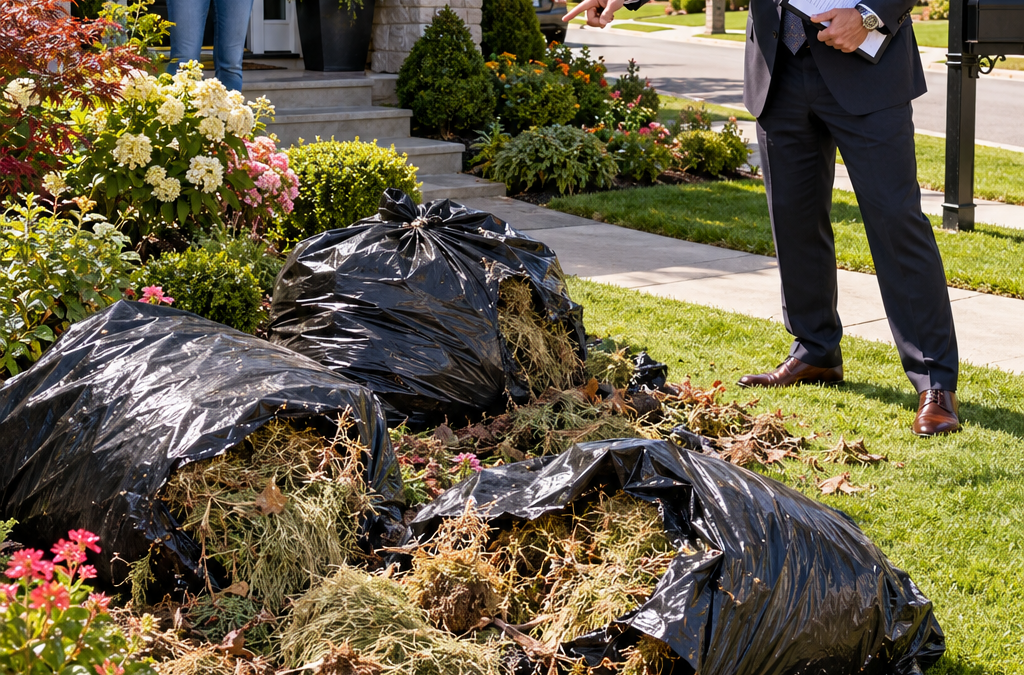
Three black garbage bags lay across my flower beds.
One had split open.
Dark, wet grass clippings spilled over the mulch and onto the lawn.
The other two sagged against the plants, leaking brown moisture into the soil.
For several seconds, I stood completely still.
Then I walked down the steps.
I had spent the previous weekend planting flowers in that bed.
New salvia.
A row of marigolds.
Two small shrubs.
Now one shrub was bent sideways beneath a garbage bag, and several flowers had been crushed into the mud.
I felt anger surge through me.
Someone had entered my yard at night and dumped rotting yard waste across the one part of the property I had just finished improving.
I looked toward the street.
Everything was quiet.
The neighboring houses stood beneath the early morning sky.
Nobody was outside.
Then I remembered the security camera.
I’d installed a cheap model above the front porch a few days earlier after receiving the lien threat.
I hadn’t even tested all its settings.
But I knew it recorded motion during the night.
I went inside.
Opened the app.
And began scrolling through the overnight clips.
At 1:58 a.m., headlights passed slowly across the front of the house.
At 2:01, a figure appeared near the sidewalk.
The image was grainy.
The porch light didn’t illuminate the entire lawn.
But I could see someone carrying a heavy black bag.
The figure crossed the grass.
Stopped near my flower bed.
And dropped the bag.
Then returned with another.
Then a third.
I leaned closer to the screen.
The person moved with a familiar, stiff-backed stride.
He paused before each trip, turning his head toward the neighboring houses as though checking whether anyone was watching.
Then he stepped briefly into the edge of the porch light.
I froze.
The slicked-back hair.
The expensive jacket.
The unmistakable posture.
Hoa Karen Whitfield.
I played the footage again.
Then once more.
My heart was pounding.
The man who had fined me for a quarter-inch of grass had dumped three bags of rotting grass clippings across my lawn.
And considering the timing, the location, and his history of manufactured complaints, I had little doubt he intended to use the mess against me.
I sat back.
For one strange moment, the situation seemed too absurd to be real.
I almost laughed.
Then I looked at the certified lien warning lying beside my laptop.
The threat to my house was real.
The damaged flowers were real.
And the video showed a man who had spent months demanding compliance apparently committing the very kind of violation he used to punish others.
I felt the urge to storm across the neighborhood and confront him immediately.
Instead, I picked up my phone.
And called the one person I trusted to tell me what to do before anger made the situation worse.
Her name was Allison Reed.
We had been friends since college, back when neither of us had money and both of us believed adulthood would somehow involve fewer complications than it actually did.
Allison had become a property attorney.
I had become a homeowner.
Until that morning, I’d assumed her job was more stressful than mine.
She answered on the fourth ring.
“Parker? You’re calling early.”
“I need legal advice.”
She paused.
“That doesn’t sound good.”
“My HOA president has been threatening a lien over landscaping violations.”
“All right.”
“And last night he dumped three bags of rotten grass on my flower beds.”
There was a moment of silence.
Then she said, “He did what?”
I told her everything.
The mailbox fine.
The board meeting.
The escalating notices.
The lien warning.
And the security footage showing Karen carrying garbage bags across my yard at two in the morning.
Allison listened without interrupting.
When I finished, she asked, “How clear is the recording?”
“Clear enough to recognize him. But the camera isn’t expensive.”
“Does it show him carrying the bags onto your property?”
“Yes.”
“Does it show where he puts them?”
“Yes.”
“Have you preserved the original video?”
“Not yet.”
“Do that first.”
I looked toward the window.
The bags were still lying across the flower bed.
“What about the trash?”
“Photograph it before moving anything. Take wide shots showing the property, then close-ups of the bags and the damage.”
I reached for a pen.
She continued.
“Preserve the camera file. Write down when you discovered the waste. Keep the notice threatening the lien. And don’t confront him without witnesses or reliable documentation.”
I looked at my keys.
“I was thinking about returning the bags.”
She hesitated.
“Parker, don’t do anything that gives him a legitimate complaint against you.”
“I don’t want to dump them somewhere else. I just want him to know I have proof.”
“Then handle it carefully. Don’t threaten him. Don’t enter his house or damage his property. And don’t get into a shouting match on his porch.”
I took a breath.
“He’s going to pretend he doesn’t know anything about it.”
“Probably.”
“Then how do I make him stop?”
Allison’s voice became firm.
“You stop letting him control the evidence. Right now he has a stack of notices making you look like the problem. You need a record showing what actually happened.”
I looked at the screen again.
Karen’s shadow moved across the lawn.
Three bags.
Three trips.
A pause to check whether anyone was watching.
“What if he calls the sheriff?”
“Then you cooperate, show what you’ve preserved, and let the facts speak. Don’t give him the confrontation he wants.”
I sat quietly.
Finally, Allison asked, “Are you safe?”
The question caught me off guard.
I looked toward the front door.
“I think so.”
“Then keep it that way.”
After we hung up, I downloaded the original footage.
I saved it in two separate locations.
Then I photographed the bags where they had been dumped.
The crushed flowers.
The stained mulch.
The wet clippings spreading across the grass.
I recorded the date, time, and weather conditions.
Then I printed the latest HOA notice.
I had barely finished when an email arrived from the association’s compliance address.
I opened it.
The subject line read:
EXTERIOR SANITATION CONCERN — IMMEDIATE ATTENTION REQUIRED
My stomach tightened.
The message referred to an unsightly accumulation of yard waste visible from the street.
It instructed me to correct the condition promptly and warned that failure to comply could result in further enforcement charges.
Karen’s signature appeared at the bottom.
I stared at the screen.
The email had been sent shortly after nine.
He hadn’t even waited until the afternoon.
A man had carried trash onto my property at two in the morning and then used his position to warn me about the condition he’d created.
I forwarded the email to Allison.
Her reply came almost immediately.
Preserve this too. Do not respond angrily.
I looked toward the flower bed.
Then toward Karen’s house farther down the street.
For weeks, I’d been defending myself against allegations that were exaggerated, inconsistently applied, or unsupported by the rules.
This was different.
This was deliberate.
I realized that Karen had stopped waiting for me to break the rules.
He had decided to create the violation himself.
I called Allison again.
“I got another notice.”
“For the bags?”
“Yes.”
There was a pause.
Then she asked, “When was it issued?”
I told her.
“Keep that message,” she said. “The timing matters.”
I looked at the three black bags through the window.
“I’m going to clean up the yard.”
“That’s reasonable.”
“And I want to return the bags to him.”
Allison sighed.
“I know you do.”
“Not throw them. Not threaten him. Just return them and ask him to stop.”
She was quiet for a moment.
“Then I’m coming with you.”
I frowned.
“You don’t have to.”
“I know. But I want an independent record of the interaction.”
I looked at the clock.
“Eight tomorrow morning?”
“Eight,” she said. “And Parker?”
“Yeah?”
“Remember why you’re doing this. You’re not trying to win an argument on his doorstep. You’re protecting your home.”
That afternoon, I carefully collected the waste, using gloves and keeping the damaged flower-bed debris separate so I could document the condition.
The bags went into the trunk of my car on a protective liner.
I cleaned the mulch as thoroughly as I could.
One of the shrubs might recover.
Several flowers wouldn’t.
I stood looking at the damage.
It wasn’t expensive compared with the house.
But it hurt.
I’d planted those flowers myself.
I’d spent an entire Saturday kneeling in the dirt, arranging them beneath the front windows because I wanted the place to look welcoming.
Karen had looked at that small effort and decided it was something he could destroy to make a point.
That night, I barely slept.
I kept checking the camera.
I checked the locks twice.
Every vehicle passing the house made me look toward the window.
At one point, I caught myself wondering whether I should move.
The thought frightened me.
Not because moving would be impossible.
Because I’d spent years saving for this house, and I was beginning to imagine surrendering it to escape a man whose greatest weapon was making ordinary life exhausting.
I thought about Rosa’s warning.
He doesn’t stop until he owns your house—or until you fight back smarter than he expects.
I didn’t know whether I was fighting smart.
But I knew I couldn’t keep paying and hoping he would stop.
At seven-thirty the following morning, Allison arrived.
She parked a short distance from Karen’s property, on the public street where her dashboard camera had a clear view of the front entrance.
I called her.
“You can see the porch?”
“Yes.”
“Camera working?”
“Recording.”
I looked toward the three bags in my trunk.
“All right.”
“Parker?”
“Yeah?”
“Be calm.”
I exhaled.
“I’ll try.”
“Don’t try. Decide.”
I almost smiled.
“Still giving orders after all these years.”
“Only when you need them.”
I ended the call.
Then I drove the short distance to Karen’s house.
His property was the largest on our street.
Two stories.
Stone accents.
A broad driveway.
Perfect landscaping.
A decorative fountain stood near the front entrance.
His white SUV was parked beneath the garage overhang, its paint gleaming in the morning light.
Not a blade of grass seemed out of place.
I stopped at the curb.
Opened the trunk.
Then carried the three closed bags to his front porch.
I placed them carefully beside the entrance, clear of the doorway and walkway.
I pressed the doorbell.
A few seconds passed.
Then the door opened.
Karen appeared wearing a white silk robe, slippers, and an expression of immediate irritation.
His hair was still slicked back, although less perfectly than usual.
He stared at me.
“Parker?”
“Good morning.”
He looked down at the bags.
Then back at me.
“What on earth is this?”
I kept my voice calm.
“I believe these belong to you.”
His face changed.
Only for half a second.
The color drained slightly from his cheeks.
His eyes moved toward the bags.
Then toward the street.
Then he recovered.
“What kind of disgusting stunt is this?”
I looked at him.
“Three bags of rotting grass clippings were dumped on my lawn yesterday morning.”
He folded his arms.
“And what does that have to do with me?”
“I have video showing you carrying them onto my property.”
His expression hardened.
“That’s an outrageous accusation.”
“I preserved the footage.”
Karen stared at me.
Then his eyes narrowed.
“Are you recording this conversation?”
I gestured toward my phone, which was held openly.
“Yes.”
He took a step forward.
“You have no right to come to my house and harass me.”
“I’m returning the bags that appeared on my property.”
“You’re trespassing.”
I glanced at the public sidewalk behind me.
“I’m standing at your front entrance after ringing the doorbell. I’m leaving now.”
Karen raised his voice.
“Don’t you dare walk away from me!”
I stopped.
He pointed toward the bags.
“Remove that garbage immediately.”
I looked at him.
“It came from my yard after someone dumped it there overnight.”
“I don’t care where it came from!”
For a moment, the words hung between us.
Then Karen seemed to realize what he’d said.
His jaw tightened.
“You’re going to be fined for this,” he announced.
I nodded.
“Please put any allegation in writing.”
His eyes widened.
“You think you’re clever?”
“No.”
“You’re trying to humiliate the president of this association.”
I looked at him.
“I’d rather be home fixing my flower beds.”
He stepped closer.
“I can double your fines. I can bring this before an emergency board meeting. And I can call the sheriff right now.”
I felt my pulse quicken.
But I remembered Allison’s voice.
Don’t give him the confrontation he wants.
I took a slow breath.
“You’re free to contact the proper authorities.”
Karen stared at me.
“I’ll have you charged with harassment.”
“I understand.”
“And I’ll make sure every homeowner knows what you’ve done.”
I nodded.
“Thank you for your time, Mr. Whitfield.”
Then I turned and walked down the path.
Behind me, he shouted my name.
I didn’t turn around.
I got into my car.
Closed the door.
And sat gripping the steering wheel.
My hands were shaking.
I hadn’t shouted.
I hadn’t threatened him.
But facing him on his own porch had been harder than I expected.
I checked my phone.
Allison had sent a message.
I have the exchange on video. Come back to my car.
I drove around the corner and stopped beside her.
She lowered her window.
“How do you feel?”
“Like I just walked into a storm.”
“Did you threaten him?”
“No.”
“Touch him?”
“No.”
“Damage anything?”
“No.”
She nodded.
“Good.”
I looked toward Karen’s street.
“He says he’s calling the sheriff.”
“Then we’ll preserve the footage and respond to any legitimate inquiry.”
I leaned back.
“Do you think he’ll stop?”
Allison looked at me for a long moment.
“No.”
The answer was so direct it hurt.
“Then what now?”
“We stop treating this as an isolated dispute between you and Karen.”
I frowned.
“What does that mean?”
“It means other homeowners need accurate information about what’s happening. Not rumors. Not accusations. Evidence.”
I thought about the neighborhood group chat.
Almost every resident used it.
People posted reminders about trash collection, missing pets, community events, and maintenance notices.
Karen occasionally used it to lecture residents about compliance.
“What if I post the video?”
Allison considered the question.
“Only the relevant, unedited footage. Be accurate. Don’t claim more than it shows. And preserve the originals separately.”
I nodded.
She continued.
“People can judge what they see. But don’t turn it into a personal attack.”
I looked toward the road.
“He’s already made it personal.”
“Then don’t become him.”
That evening, I sat at my kitchen table and prepared the post.
I included two videos.
The first showed the figure carrying three garbage bags across my lawn at approximately two in the morning.
The second showed my calm exchange with Karen while returning the bags.
I wrote a short explanation stating that I’d received an HOA sanitation warning after the bags appeared and that I was asking the board to review the incident and the evidence.
I didn’t call Karen a criminal.
I didn’t threaten him.
I didn’t tell anyone to harass him.
I posted the footage.
Then I set my phone facedown.
For about ten minutes, nothing happened.
Then it vibrated.
A neighbor had replied.
Wait. Is that the HOA president?
Another message appeared.
Why was he on your property at two in the morning?
Then another.
I have questions about a fine he issued against me last year.
Within half an hour, the group chat was moving faster than I could read.
People began sharing their own experiences.
A homeowner had been fined for placing trash cans at the curb too early, even though a board member regularly left his bins outside overnight without consequence.
Another had received a warning about a decorative planter that looked nearly identical to one outside Karen’s house.
A couple had been threatened with escalating charges after questioning a landscaping assessment.
Rosa sent me a private message.
You weren’t the only one.
I stared at the screen.
Then a second message arrived.
At least six families have dealt with this. Some of us were too scared to speak up.
I felt a chill.
I’d suspected Karen was targeting me because I challenged him.
Now residents were describing a much longer pattern.
One man posted photographs of a citation he’d received after questioning board spending.
Another shared correspondence showing that a fine had been waived for someone close to Karen despite the same condition being cited against him.
Then someone uploaded older board meeting minutes.
I opened the file.
The highlighted section concerned a special expenditure for driveway repairs.
I read it once.
Then again.
The HOA had approved funding connected to improvements at Karen’s property.
Not a public sidewalk.
Not a neighborhood entrance.
His private driveway.
I stared at the record.
The motion had been pushed through under language describing infrastructure maintenance and neighborhood appearance.
There was no clear explanation of why association reserves should pay for work benefiting the president’s private property.
I looked at the date.
The approval had occurred long before I bought my house.
Karen’s behavior suddenly seemed bigger than selective enforcement.
The fines might not be the only way he used the HOA for personal benefit.
I messaged Allison.
You need to see what people are posting.
Her reply came quickly.
Save copies. We need to verify the underlying records.
I looked back at the chat.
A new message had appeared from a resident whose name I didn’t recognize.
I’m a retired accountant. I’ve reviewed association financials professionally. If the board will provide the records, I’ll examine them without charging anyone.
The person asked that their identity remain private while the initial review was underway.
Within minutes, several homeowners offered to help obtain the statements.
A few volunteered to compare old violation notices.
Others offered copies of payment receipts.
For months, I had felt alone.
Now, for the first time, the problem was no longer just my lawn, my mailbox, or my house.
It was the entire neighborhood asking what had been happening behind the president’s polished smile.
And Karen was about to discover that silencing one homeowner was much easier than silencing a street full of them.
The next morning, my phone rang before seven.
Karen.
I watched his name flash across the screen.
I let it go to voicemail.
A minute later, a message arrived.
Remove those videos immediately. You are spreading defamatory accusations about association leadership.
I saved it.
Then another message appeared.
Failure to comply will be treated as further harassment and may result in additional enforcement.
I saved that too.
By eight, the HOA had emailed a formal demand that I remove the videos from the neighborhood group.
The letter accused me of undermining community harmony, damaging the president’s reputation, and encouraging hostility toward association officials.
It also reminded me that my existing fines remained unpaid.
I stared at the screen.
Even after being recorded carrying trash onto my property, Karen’s first response was to threaten another penalty.
I forwarded everything to Allison.
She called me ten minutes later.
“Don’t delete the evidence.”
“I wasn’t planning to.”
“Don’t argue with him either.”
I looked toward the window.
“What about the lien?”
“Has the association sent anything new?”
“Not yet.”
“Then keep watching for formal notices. We’re going to challenge the charges through the proper process.”
I rubbed my forehead.
“Allison, what if he files something against the house before the board gets involved?”
“We’ll address it. But understand that a threat doesn’t automatically make a lien valid.”
“I know.”
She hesitated.
“You’re worried about losing the house.”
I swallowed.
“Yes.”
For a moment, neither of us spoke.
Then she said, “That’s why we’re going to be precise.”
I looked at the folder lying on my kitchen table.
Every notice.
Every payment.
Every photograph.
The security footage.
The latest threat.
All of it represented weeks of stress and a growing financial risk I had never imagined when I bought the house.
“All right,” I said.
“Good. Now tell me about the financial records your neighbors found.”
I explained the driveway expenditure.
The retired accountant.
The growing number of residents reporting questionable fines.
Allison listened carefully.
Then she said, “We need the association’s actual financial statements, supporting invoices, and records of board approval. An unusual expenditure isn’t proof of theft by itself.”
“I understand.”
“But it’s absolutely worth examining.”
That afternoon, several homeowners submitted a formal request for an independent HOA audit and a special board hearing.
I helped organize the documentation.
Rosa gathered statements from residents who had experienced inconsistent enforcement.
Allison reviewed the relevant procedures.
The retired accountant began examining the financial information residents were entitled to obtain.
And I continued preserving everything involving Karen’s threats.
For two days, the neighborhood group chat remained active.
Then Karen posted a statement.
It was written in the language he always used when trying to make personal control sound like public service.
He described the controversy as a campaign of misinformation led by disgruntled homeowners.
He insisted his leadership had protected property values.
He warned that spreading false allegations could expose residents to legal consequences.
And he claimed that certain individuals were attempting to destabilize the association for personal gain.
He never explained why he had been on my lawn at two in the morning.
He never explained the grass clippings.
He never addressed the special driveway funding.
Instead, he demanded that everyone stop discussing the matter until the board had reviewed it.
I looked at the post.
Then at the replies.
For the first time, residents weren’t automatically accepting his explanation.
One homeowner asked whether Karen could identify the rule authorizing the use of association reserves for his driveway.
Another requested the invoices supporting the expenditure.
A third asked why enforcement appeared to differ between homeowners.
Karen didn’t answer.
He deleted several comments.
That made things worse.
People began saving screenshots of the deleted messages.
Then Rosa called me.
“Parker, are you home?”
“Yes.”
“Can I come over?”
“Of course.”
She arrived ten minutes later, carrying a folder.
I invited her into the kitchen.
She sat down and placed the folder between us.
For a moment, she simply looked at it.
“These are my old violation notices.”
I opened the first page.
A landscaping fine.
Then a warning concerning a planter.
Then another assessment.
All issued within weeks of a board meeting where Rosa had questioned an increase in maintenance charges.
“I paid all of them,” she said quietly.
I looked up.
“Why?”
She gave a tired smile.
“Because I was frightened.”
I didn’t answer.
She continued.
“My husband and I bought this house when we thought we’d spend the rest of our lives here. After he died, I didn’t want to risk anything that might affect the home.”
Her voice grew softer.
“Karen knew that.”
I felt my chest tighten.
“He threatened you?”
“Not directly. Not the way people imagine threats.”
She looked toward the window.
“He would remind me that the association had enforcement powers. That unpaid charges could become serious. That defending myself would cost money.”
She folded her hands.
“Eventually, I stopped attending meetings.”
I looked at the folder.
For months, I’d thought of Karen as an obnoxious bully obsessed with control.
But sitting across from Rosa, I saw what that control had actually cost people.
It wasn’t only money.
It was confidence.
Peace.
The feeling that their home belonged to them.
Rosa looked at me.
“I don’t want him doing this to anyone else.”
I nodded.
“Neither do I.”
Then she pushed the folder closer.
“You can use these.”
I hesitated.
“Are you sure?”
She took a breath.
“Yes.”
It was the first time I’d heard her say the word without fear.
The following week, the retired accountant completed the initial financial review.
I received a call from Allison that evening.
“Parker, we found something significant.”
I sat down.
“What?”
“The landscaping consultation expenses.”
I remembered the accounting line items mentioned in the group chat.
“What about them?”
“Payments totaling several thousand dollars were made to an outside company for landscaping advice and related services.”
“Was the work done?”
“That’s one of the questions. The supporting invoices don’t adequately explain the services.”
I frowned.
“Who’s the company?”
Allison paused.
“A business owned by Karen’s brother-in-law.”
I stared at the wall.
“You’re kidding.”
“No.”
“His brother-in-law?”
“Yes.”
I leaned back.
For several seconds, I couldn’t speak.
Then Allison continued.
“The relationship wasn’t properly disclosed in the documents we’ve reviewed. We also have concerns about the approval process.”
I thought about Karen’s driveway.
The special funding.
The fines.
The repeated threats.
The more we examined the association’s records, the more his decisions appeared connected to people and businesses close to him.
“Does that prove embezzlement?” I asked.
“Not by itself. But the financial discrepancies, related-party payments, and missing support justify a full independent audit.”
I rubbed my forehead.
“What happens now?”
“We present the findings to the board and request formal action.”
I looked toward the driveway.
My little ceramic gnome was sitting beside the flower bed I’d repaired after removing the grass clippings.
Its red hat had been chipped during the cleanup.
I had considered throwing it away.
Instead, I’d washed it, touched up the paint, and returned it to the garden.
It seemed absurd that such a small object had become part of something so serious.
“Karen isn’t going to accept this,” I said.
“No,” Allison replied. “I don’t expect him to.”
I took a breath.
“Then we make sure the records are ready.”
The emergency meeting was scheduled for the following Thursday.
By then, residents had compiled a substantial file.
The original video from my security camera.
The recording from Karen’s porch.
The violation notices.
The inconsistent enforcement examples.
The driveway funding minutes.
The landscaping invoices.
The accountant’s preliminary findings.
And the formal request for a complete independent audit.
Karen responded with one final threat.
The HOA office sent me a letter stating that enforcement concerning my property would continue unless I satisfied the outstanding charges.
The association was also considering additional action related to the allegedly improper disposal of yard waste.
I stared at the letter.
The garbage bags again.
He was still trying to fine me for the grass he’d carried onto my lawn.
I called Allison.
“He’s doing it again.”
She read the letter.
Then she said, “Bring it to the meeting.”
I let out a bitter laugh.
“He knows we have the video.”
“Yes.”
“Then why keep threatening me?”
“Because admitting he’s wrong would mean acknowledging the conduct. He’s choosing to continue defending it.”
I looked down.
The house was quiet.
For a moment, I wanted to stop.
I wanted to pay whatever balance he claimed and never attend another HOA meeting.
I wanted to come home from work, sit on my porch, and think about anything except violations and account statements.
Then I remembered Rosa.
I remembered the other families who had quietly paid fines.
And I thought about what would happen if the evidence disappeared into another board file while Karen remained president.
I closed the letter.
“I’ll bring it.”
On Thursday evening, I walked toward the clubhouse with Allison beside me.
The parking lot was full.
Cars lined both sides of the road.
People stood near the entrance holding folders, notebooks, and printed records.
I’d never seen Maple Ridge residents gather like that.
The air felt tense.
Not loud.
Not chaotic.
Just full of people who had finally decided they wanted answers.
Rosa approached me near the door.
She looked nervous.
“You ready?”
I gave her a small smile.
“Not really.”
She nodded.
“Me neither.”
Then she touched my shoulder.
“But I’m staying.”
We entered together.
The clubhouse was packed wall to wall.
Every chair was occupied.
People stood along the back and near the windows.
Several residents had brought their own documentation.
The board members sat behind the long table.
Karen stood at the podium.
He wore a perfectly tailored charcoal suit, a bright white shirt, and a pale-gold tie that matched his expensive watch.
His black hair was slicked backward.
His beard was immaculate.
From a distance, he looked composed.
But when he saw me enter with Allison and Rosa, his expression tightened.
He knew why we were there.
The meeting began.
Karen welcomed everyone in a voice so smooth and practiced it almost sounded friendly.
He thanked residents for their concern.
He spoke about transparency.
Community harmony.
Responsible leadership.
Then he addressed what he called “recent misunderstandings.”
“Unfortunately,” he said, “certain homeowners have chosen to spread misleading information about the association’s enforcement practices.”
Several people shifted in their chairs.
Karen continued.
“Some residents have taken routine administrative decisions and attempted to portray them as personal attacks.”
I sat quietly.
He looked directly at me.
“Others have staged confrontations and distributed selectively edited recordings to damage the reputation of this board.”
My jaw tightened.
Allison placed a hand lightly on my arm.
“Let him finish,” she whispered.
Karen went on.
He described the grass-clipping incident as a misunderstanding.
He suggested that the driveway repairs were part of legitimate neighborhood maintenance.
He referred to the landscaping payments as necessary professional services.
And he repeatedly insisted that all expenditures had been made in the community’s best interests.
For almost ten minutes, he spoke without acknowledging a single specific document.
Then he smiled.
“I trust that clarifies the situation.”
Nobody applauded.
A man near the back raised his hand.
“Then why won’t you release the invoices?”
Karen’s smile tightened.
“We’ve provided the appropriate documentation.”
“Not all of it.”
Another homeowner stood.
“Why did association money pay for work on your driveway?”
Karen adjusted his cuffs.
“That repair benefited the neighborhood’s appearance.”
A woman near the front spoke.
“And why is your brother-in-law getting landscaping contracts?”
Karen’s expression hardened.
“I won’t allow this meeting to become a platform for personal accusations.”
Allison stood.
“Mr. Whitfield, the homeowners have formally requested a review of the financial records and enforcement practices.”
He looked at her.
“And you are?”
“Allison Reed. I’m an attorney assisting Mr. Parker with his property dispute.”
Karen smiled coldly.
“Of course.”
She continued.
“We’ve brought the supporting documents, including the original video files and the financial information reviewed by a retired accountant.”
Karen’s face tightened.
“You have no authority to conduct a private investigation into this association.”
“The homeowners have the right to examine the information the association is required to disclose.”
He leaned toward the microphone.
“The chair has not recognized you.”
One board member, a quiet man who had barely spoken during previous meetings, interrupted.
“I’d like to hear the evidence.”
Karen turned.
“What?”
The board member looked around the table.
“We’ve received serious allegations. I think we should review the documents before making any decision.”
Another member nodded.
“So do I.”
For a moment, Karen appeared unable to believe anyone on his board had contradicted him publicly.
Then he gave a stiff smile.
“Very well.”
Allison looked toward me.
I stood.
My legs felt heavy.
I carried my laptop to the projector.
For a moment, I stared at the blank screen.
I thought about the first $75 grass-height fine.
The wind chimes.
The mailbox.
The garden gnome.
The certified lien warning.
I thought about the morning I’d opened my front door and found three bags of rotten grass crushed into my flowers.
Then I looked toward Karen.
He stood with his hands folded, his expression rigid.
I connected the laptop.
The projector lit up.
The first frame showed my front lawn at night.
The timestamp appeared in the corner.
2:01 a.m.
The room became quiet.
Headlights moved across the screen.
A figure appeared carrying a black garbage bag.
He crossed the lawn.
Looked toward the neighboring houses.
Then dropped the bag across the flower bed.
Nobody spoke.
The figure returned.
A second bag.
Then a third.
He stepped closer to the porch light.
His face became visible.
Someone gasped.
Another resident whispered, “That’s Karen.”
I let the footage continue.
The screen showed him turning toward the street, checking both directions, and walking away.
I stopped the recording.
For several seconds, the entire room was silent.
Then the whispers began.
Karen stepped forward.
“That footage proves nothing.”
I looked at him.
“It shows you carrying the bags onto my lawn.”
He pointed at the screen.
“You don’t know what happened before that recording!”
I nodded.
“Then explain it.”
His mouth tightened.
“You’ve taken this completely out of context.”
I opened the second video.
The projector showed his front porch.
Three garbage bags sat beside the entrance.
Karen appeared in his robe.
His voice came through the speakers.
“What kind of disgusting stunt is this?”
Then mine.
“I believe these belong to you.”
The recording continued.
Karen denied knowing anything about the bags.
Threatened to double my fines.
Threatened to call the sheriff.
And announced that he would raise harassment charges at the next meeting.
I stopped the recording.
Someone at the back began laughing.
Not quietly.
He laughed so hard that he bent forward and covered his face.
A few people joined him.
Others looked furious.
One woman shook her head.
“He’s been fining us for yard waste while dumping it on people’s lawns?”
Rosa stood.
“That’s what he did.”
Karen slammed his hand on the podium.
“ORDER!”
The room quieted slightly.
He pointed at me.
“This homeowner has been harassing me for weeks!”
I took a breath.
“I asked why my mailbox was fined when my neighbor’s wasn’t.”
Karen’s face reddened.
“You’ve been disruptive from the beginning.”
I looked around the room.
“Then he issued more violations. When I disputed them, he threatened a lien against my house.”
I pointed toward the screen.
“And after he dumped those bags on my lawn, the association sent me a sanitation warning.”
Several residents reacted angrily.
I looked directly at Karen.
“You created the condition and then tried to fine me for it.”
His jaw tightened.
“That’s a lie.”
I gestured toward the projector.
“Then tell us what the video shows.”
For the first time, he had no immediate answer.
Allison stepped forward.
“We also need to discuss the association’s financial records.”
The laughter stopped.
She displayed the old board minutes authorizing special funding for driveway repairs at Karen’s property.
Then the financial records.
Then the payments made to the landscaping consultation company owned by his brother-in-law.
The retired accountant stood near the front.
He had agreed to explain his review directly to the board.
He was an older man with silver hair, a calm voice, and the careful manner of someone who had spent decades making sure numbers matched the documents behind them.
He didn’t accuse Karen of a crime.
Instead, he pointed to the entries.
“These expenditures require explanation.”
He identified missing supporting details.
The absence of clear documentation for certain services.
The related-party relationship.
The questions surrounding the private driveway funding.
He showed how several transactions had been categorized as community maintenance even though their apparent beneficiaries were closely connected to the president.
The room grew increasingly quiet.
A board member leaned forward.
“Mr. Whitfield, were these payments approved after disclosure of your family relationship with the vendor?”
Karen stared at him.
“The company provides professional services.”
“That isn’t what I asked.”
Karen adjusted his tie.
“I’ve always acted in the association’s interests.”
The board member looked down at the records.
“Then why wasn’t the relationship documented?”
Silence.
Another board member spoke.
“Was the driveway work on your private property?”
Karen’s face reddened.
“It affected neighborhood aesthetics.”
“Was it your driveway?”
His eyes narrowed.
“Yes.”
The board member looked at the others.
“Then we need a complete audit.”
Karen stepped away from the podium.
“You’re making a terrible mistake.”
I watched him.
He was no longer talking about the gnome.
The grass.
The mailbox.
Or the supposed danger of homeowners questioning the rules.
He was trying to prevent the board from examining where its money had gone.
Allison placed the compiled records on the table.
“We’re requesting an independent audit and formal review of the enforcement actions associated with these complaints.”
Rosa stood beside me.
Her hands were trembling.
“I want my fines reviewed too.”
Another homeowner stood.
“So do I.”
Then another.
“And mine.”
Within moments, several residents were on their feet.
Karen looked around the room.
For years, he had been able to isolate one person at a time.
He could call someone disruptive.
Threaten another fine.
Suggest that a homeowner who questioned the board might face legal consequences.
Now the same people were standing together.
And the records were sitting in front of everyone.
Karen raised his voice.
“You’re all being manipulated!”
Nobody moved.
He pointed toward me.
“This man came into our neighborhood six months ago and has caused nothing but trouble!”
I looked at him.
“I wanted to live in my house.”
He scoffed.
“Then you should have followed the rules.”
“I did.”
“You challenged my authority.”
I took a step forward.
“Because your authority doesn’t make you right.”
Karen’s eyes widened.
For a moment, he looked as though he might come around the podium.
Instead, he stood rigidly, gripping its edge.
I continued.
“I bought a starter home. I planted flowers. I put a small gnome beside my mailbox. I tried to keep my lawn neat.”
My voice tightened.
“And you turned all of that into a reason to threaten my property.”
The room was silent.
“You sent me a letter saying unpaid charges could become a lien. I sat at my kitchen table wondering whether I had made the worst financial decision of my life.”
I glanced toward Rosa.
“And I wasn’t the only one.”
Several homeowners lowered their eyes.
I looked back at Karen.
“You could have answered the first question I asked you. You could have explained the mailbox rule. You could have treated newcomers the same as everyone else.”
His jaw tightened.
“But you decided that questioning you deserved punishment.”
For several seconds, I couldn’t speak.
Then I pointed toward the financial records.
“And now we’re learning that the same person who threatened homeowners over tiny violations approved payments that benefited his own family and property.”
Karen’s expression collapsed into fury.
“You have no idea how hard I’ve worked for this community!”
I took a breath.
“Then let the audit show it.”
He stared at me.
His mouth opened.
Then closed.
The chairman pro tempore, one of the board members who had finally spoken up, called for a vote under the association’s applicable procedures.
The motion was to remove Karen from the presidency, suspend his discretionary HOA privileges pending further review, preserve the relevant records, and authorize an independent financial audit.
The board members voted.
One after another.
Yes.
Yes.
Yes.
Karen stood motionless.
The final vote was unanimous.
For a moment, nobody seemed to breathe.
Then the board secretary announced the decision.
Hoa Karen Whitfield was no longer president of the Maple Ridge Estates Homeowners Association.
His authority to direct enforcement actions was terminated.
The financial records would be preserved and independently examined.
The disputed findings would be referred to law enforcement for appropriate review.
Karen stared at the board.
“You can’t do this.”
The acting chair looked at him.
“The board has voted.”
Karen turned toward the residents.
“This is an outrage!”
Nobody answered.
He pointed at me.
“You think you’ve won?”
I felt my hands shaking.
Not because I wanted to fight him.
Because six months of pressure were finally beginning to lift.
I looked directly at him.
“I think the neighborhood deserves to know where its money went.”
His face darkened.
Then he gathered his leather folder, shoved the laminated rulebook beneath his arm, and walked toward the exit.
For once, nobody moved out of his way because he demanded it.
People simply stood back and watched him leave.
The clubhouse doors closed behind him.
For several seconds, the room remained quiet.
Then Rosa stepped toward me.
She wrapped both arms around my shoulders.
I nearly dropped the coffee mug I’d been holding.
“You did it,” she whispered.
I shook my head.
“We did.”
She held on tighter.
I felt her shoulders trembling.
Then I realized she was crying.
Not loudly.
Just quietly, with the relief of someone who had spent years being afraid and had finally been given permission to stop.
I closed my eyes.
For the first time since moving into Maple Ridge, I thought my home might actually be safe.
The weeks that followed were less dramatic, but more important.
The independent audit proceeded.
The reviewers examined the association’s reserve accounts, expenditure approvals, vendor payments, and records of the special driveway funding.
The landscaping consultation charges required substantial explanation.
The relationship between Karen and the vendor owned by his brother-in-law received particular scrutiny.
The audit also identified enough concerning transactions and missing support for the board to refer its findings to the appropriate authorities.
The county attorney’s office subsequently opened an investigation into possible embezzlement of association funds.
I learned about the investigation several weeks after the emergency meeting.
I was standing in my kitchen when Allison called.
“The referral is being reviewed formally,” she told me.
I looked out toward the garden.
“So they’re investigating Karen?”
“Yes. The county attorney’s office has opened an investigation into the financial discrepancies.”
I exhaled.
“Does that mean he’ll be charged?”
“Not necessarily. An investigation isn’t a conviction, and we shouldn’t assume the outcome.”
I nodded.
“I understand.”
“But it does mean the concerns are being taken seriously.”
I looked toward the stack of documents on the counter.
For months, Karen had threatened homeowners as though consequences were something reserved for people who disagreed with him.
Now the financial decisions he’d made were being examined by people who didn’t answer to his authority.
The criminal investigation would take its own course.
I didn’t need to control it.
I didn’t want to.
What I wanted was my house back.
Not physically.
I’d never moved out.
But for months, I’d lived there with a constant feeling that something was waiting to go wrong.
Every email notification made me tense.
Every HOA envelope made my stomach drop.
Every time I saw a white SUV approaching, I wondered what Karen had decided to punish that day.
I wanted that fear gone.
And slowly, it began to disappear.
The new board reviewed the disputed fines.
My grass-height citation was reconsidered.
So were the wind-chime, mailbox, trash-can, planter, and garden-gnome notices.
The charges that could not be supported under the rules and proper enforcement procedures were withdrawn.
The association refunded the money I’d paid toward the invalid fines.
The threatened lien was formally dismissed from the enforcement process, and any resulting claim against my property was cleared.
I received written confirmation.
I read the letter twice.
Then I placed it beside my mortgage documents.
For a long moment, I sat at the kitchen table looking at the paper.
It wasn’t an enormous check.
It wasn’t a dramatic victory.
But the letter meant that Karen’s unsupported penalties would no longer follow my house.
I could continue with my refinancing plans.
I could make the repairs I’d budgeted for.
And I could stop treating every morning as the beginning of another legal argument.
The board also changed its procedures.
Substantial enforcement charges required documented review.
Homeowners received clearer opportunities to challenge citations.
The association adopted stronger conflict-of-interest disclosure requirements and independent financial oversight.
The new board began reviewing complaints from other residents who had experienced inconsistent enforcement.
Rosa received confirmation that several of her old penalties were being reconsidered.
Other homeowners were allowed to present documentation without being dismissed as troublemakers.
The neighborhood didn’t become perfect overnight.
People still disagreed about grass height.
Someone still complained about a car parked too close to a driveway.
And there were still residents who thought garden decorations should be regulated more strictly.
But the atmosphere changed.
People asked questions openly.
The board answered them.
And nobody treated the president’s personal preferences as if they were automatically binding law.
One Saturday morning, I was outside repairing the flower bed when Rosa walked over.
She looked at the little gnome beside my mailbox.
Its red hat had been repainted.
Its blue jacket looked brighter.
I’d even repaired the small chip along its beard.
She smiled.
“You kept him.”
I looked at the statue.
“After everything he’s been through? Of course.”
She laughed.
Then she looked toward the street.
“Feels different now, doesn’t it?”
I nodded.
“It does.”
She stood beside me for a moment.
Then her expression softened.
“I almost sold my house last year.”
I turned.
“You never told me that.”
She shook her head.
“I was tired of being afraid.”
I looked toward her porch.
The flowers were blooming again.
“And now?”
She smiled.
“Now I’m planting roses.”
I laughed quietly.
“Good.”
She touched my arm.
“Thank you, Parker.”
I shook my head.
“You were the one who warned me.”
“And you were the one who listened.”
We stood there in the morning sunlight, looking at two ordinary houses on an ordinary street.
Nothing about the scene looked important.
But I understood what it meant.
Rosa had been afraid to challenge a violation notice.
I’d been afraid a lien might damage the first home I’d ever owned.
Several other families had quietly paid penalties because resisting seemed more dangerous than surrendering.
Now people were beginning to feel comfortable in their own homes again.
That mattered more than Karen’s embarrassment at the emergency meeting.
I finished repairing the flower bed that afternoon.
I replaced the crushed marigolds.
Added fresh mulch.
Straightened the small shrub that had been bent beneath the garbage bags.
Then I moved the garden gnome to a more visible spot beside the mailbox.
Exactly where Karen had disliked it.
I stepped back.
The little statue looked ridiculous.
Red hat.
White beard.
Permanent smile.
A cheap housewarming gift that had somehow survived becoming part of a neighborhood-wide dispute.
I laughed.
Then I sat on the porch steps.
For the first time in six months, I wasn’t waiting for somebody to tell me what I’d done wrong.
I thought about the morning the garbage bags appeared.
The terrible smell.
The ruined flowers.
The security footage.
The moment I recognized Karen’s walk.
Then I remembered standing on his porch while he threatened to double my fines.
I remembered how badly my hands shook afterward.
And I understood something I hadn’t appreciated at the time.
I hadn’t defeated Karen by humiliating him.
The video mattered because it established what happened.
The financial records mattered because they revealed questions the board couldn’t responsibly ignore.
The neighbors mattered because one frightened homeowner could be dismissed, but a documented pattern deserved examination.
Allison mattered because she’d kept me from turning anger into a mistake.
And Rosa mattered because she had been brave enough to tell me the truth before anyone else was willing to speak.
Karen had believed power meant making people afraid to challenge him.
For a long time, it worked.
He controlled the meetings.
He controlled the enforcement notices.
He controlled which complaints were heard and which were dismissed.
He seemed to believe that if he presented every decision confidently enough, nobody would examine the evidence behind it.
But authority didn’t make his actions right.
A polished suit didn’t make an accusation true.
A laminated handbook didn’t give him ownership of somebody else’s property.
And being president of a homeowners association didn’t entitle him to treat the neighborhood’s reserve funds like a private account.
In the end, what changed Maple Ridge wasn’t a louder argument.
It was documentation.
Dates.
Video.
Invoices.
Meeting minutes.
Financial statements.
And homeowners willing to stop accepting explanations that didn’t match the facts.
The county investigation into Karen’s financial conduct continued separately, and I made peace with the fact that I couldn’t decide its eventual outcome.
My own dispute, however, was resolved.
The fines were withdrawn.
The money was returned.
The lien threat was gone.
Karen no longer controlled the association.
And the new board had begun correcting the procedures that had allowed him to intimidate residents for so long.
That evening, I carried a cup of coffee onto the porch.
The sun was sinking behind the houses.
A few children were riding bicycles along the sidewalk.
Someone farther down the street was mowing a lawn.
The air smelled of freshly cut grass.
For a moment, I laughed at the irony.
Six months earlier, the smell of grass clippings wouldn’t have meant anything to me.
Now it reminded me of three black garbage bags, a two-in-the-morning camera recording, and the strangest battle I’d ever fought over a place to call home.
I looked toward my mailbox.
The little gnome stood beneath it, smiling at the street.
My lawn was neat.
My flower beds were repaired.
My trash cans were stored where the handbook required.
And the house behind me was still mine.
I took a sip of coffee.
Then leaned back in my chair.
I had bought Maple Ridge because I wanted a peaceful starter home.
For months, Hoa Karen Whitfield had made me wonder whether I’d chosen the worst neighborhood in the county.
But now, as the last sunlight touched the front windows and the street settled into evening, I finally felt what I’d hoped to feel on the day I received my keys.
Home.
Not a battlefield.
Not a property Karen could threaten whenever I questioned him.
Just my home.
I looked at the little red-hatted gnome one last time.
Then I smiled.
And for the first time in a very long while, I exhaled without wondering what the HOA president would do next.








