𝗙𝗨𝗟𝗟 𝗦𝗧𝗢𝗥𝗬 My HOA President Threatened to Take My Home Over Twelve Garden Gnomes, but His Most Terrifying Move Came After Midnight
𝗙𝗨𝗟𝗟 𝗦𝗧𝗢𝗥𝗬
The sidewalks were clean.
The lawns were tidy.
There were flower beds near the entrance and a small shared park where families gathered on weekends.
Even the HOA initially seemed reasonable.
The monthly assessments covered common-area landscaping, insurance, lighting, and maintenance.
I’d read the documents before purchasing.
There were restrictions, certainly, but nothing that seemed impossible.
I had no intention of creating problems.
I wanted to work, raise my daughter, pay the mortgage, and come home to peace.
Then I met Karen Wexler.
The first time I saw him, he was standing beside the community entrance wearing a navy cardigan with glittering metallic trim, perfectly pressed trousers, and polished leather loafers.
He carried a large clipboard.
A measuring tape hung from his belt.
He was inspecting the height of the decorative hedges as if preparing evidence for a criminal trial.
I slowed my car while passing him.
He looked up.
His eyes moved across my aging Honda, then toward the new-resident sticker on the windshield.
He lifted one hand.
I assumed he was waving.
I waved back.
He didn’t smile.
He pointed toward the curb, apparently irritated that I’d slowed near the entrance.
I drove home thinking the encounter was strange.
Three days later, I found the first violation notice attached to my trash bin.
IMPROPER CONTAINER PLACEMENT — $50
According to the letter, the bin had extended four inches beyond the designated property line on collection day.
Four inches.
I stood in my driveway holding the paper.
Then I looked at the bin.
It was beside the garage.
The sanitation truck had already come and gone.
I couldn’t even determine where the alleged four-inch discrepancy had occurred.
I called the HOA office.
A woman answered and confirmed that Karen had personally documented the violation.
“Can I see the photograph?” I asked.
“You’ll have to request it from the president.”
“Is there a warning period?”
“Not for repeat placement violations.”
“This was my first notice.”
She hesitated.
“Then you’ll need to discuss that with Mr. Wexler.”
I sighed.
I had just finished three consecutive night shifts.
Fifty dollars felt irritating, but I didn’t have the energy to fight.
I paid it.
That was my first mistake.
Two weeks later, Karen came for the garden gnomes.
I was asleep after a twelve-hour shift when someone started knocking on the front door.
Sophie was at school.
I’d been asleep for barely three hours.
The knocking continued until I pulled on a sweatshirt and went downstairs.
Karen stood on the porch.
His hair was immaculate, his gold watch gleamed, and he wore a pale blue shirt beneath a dark cardigan threaded with tiny metallic flecks.
A clipboard rested under one arm.
“Mrs. Doyle.”
I blinked against the sunlight.
“Harper is fine.”
He looked past me toward the flower bed.
“We need to discuss your exterior decorations.”
I followed his gaze.
The gnomes stood beneath the windows, their little painted faces turned toward the street.
“What about them?”
“They’re unauthorized lawn ornaments.”
I stared at him.
“They’re garden gnomes.”
“I’m aware.”
“Then what exactly is the problem?”
He opened the clipboard.
“Maple Ridge restricts unapproved decorative objects visible from common areas.”
I glanced toward the house across the street.
A large stone frog sat beside its mailbox.
Two doors down, someone had a decorative windmill and a metal flamingo.
I pointed toward them.
“Those are allowed?”
Karen didn’t look.
“We’re discussing your property.”
“Are those decorations approved?”
His expression tightened.
“Mrs. Doyle, I don’t appreciate deflection.”
“I’m asking whether the rule applies equally.”
He raised his chin.
“Your collection is excessive.”
I looked at the twelve little figures.
“They belonged to my father.”
“That’s unfortunate, but personal sentiment doesn’t supersede community standards.”
I felt something tighten behind my ribs.
“My father died last year.”
For an instant, I hoped the words might change his tone.
They didn’t.
He glanced at his watch.
“You have seventy-two hours to remove all twelve ornaments.”
I stared at him.
“And if I don’t?”
“Daily fines will begin.”
“How much?”
“At the rate established under the enforcement schedule.”
“Can you show me where twelve garden gnomes violate the rules?”
He pointed to a paragraph on his clipboard.
It prohibited certain unapproved exterior decorations.
There was no specific limit on gnomes.
No reference to the size of a collection.
No explanation of why my father’s figures were prohibited while other decorative objects remained throughout the neighborhood.
I looked at Karen.
“Could I apply for approval?”
“You could have applied before placing them.”
“Can I apply now?”
He smiled thinly.
“Compliance must occur first.”
I understood what he meant.
Remove them.
Then ask whether I might be permitted to put them back.
I was exhausted, and my head was beginning to ache.
I nodded.
“I’ll take care of it.”
Karen looked satisfied.
“Good. We appreciate cooperative residents.”
He turned and walked down the steps.
I stood in the doorway watching him leave.
Then I closed the door and leaned against it.
The house was silent.
Outside, twelve ceramic figures stood in the flower bed.
I suddenly felt foolish for caring so much.
They were gnomes.
Painted clay.
Cheap decorations.
But they were also the last ordinary objects my father had touched with joy.
That afternoon, I carried out two cardboard boxes.
I wrapped each figure in newspaper.
The fishing gnome.
The wheelbarrow gnome.
The one with the broken nose.
Then the yellow raincoat.
When I picked it up, I remembered Dad sitting in the garden with Sophie on his knee, explaining that every good house needed a little protection.
I started crying.
I tried to stop, but grief doesn’t always arrive at convenient times.
By the time Sophie came home, the flower bed was empty.
She noticed immediately.
“Mom?”
I was washing dishes.
“Yeah, honey?”
“Where’s Grandpa’s garden?”
I looked toward the window.
Then back at her.
“The HOA says we can’t keep the gnomes outside right now.”
She stared at me.
“Why?”
“They have rules about decorations.”
“But Grandpa gave them to us.”
“I know.”
“Did they break something?”
“No.”
“Are they dangerous?”
I shook my head.
She looked toward the empty flower bed.
Then she asked a question that hurt more than anything Karen had said.
“Does that man not like Grandpa?”
I crouched beside her.
“No, sweetheart. He didn’t know Grandpa.”
“Then why does he want his things gone?”
I didn’t have an answer.
I hugged her.
She cried into my shoulder.
That evening, I carried the boxes into the garage.
I placed them on the highest shelf where nothing could knock them over.
Then I stood there for a long time, looking at the cardboard.
I told myself I was being sensible.
Fighting the HOA over garden gnomes could cost more than simply storing them.
I had a mortgage.
A daughter.
A demanding job.
I couldn’t spend every spare hour battling one controlling neighbor.
I thought compliance would bring peace.
Instead, Karen seemed to interpret it as permission to continue.
The next notice involved my porch light.
Then a flowerpot near the steps.
Then the height of a shrub that hadn’t grown enough to justify the measurement Karen claimed.
Every violation arrived on official-looking letterhead.
Every letter referenced community standards.
And every time I requested clarification, Karen responded as though asking questions was a personal insult.
Then I began noticing something else.
The rules didn’t apply equally.
Across the cul-de-sac lived the Henderson family.
Mr. Henderson played golf with Karen’s husband every Sunday.
Their front lawn was often overgrown.
Their shrubs extended into the sidewalk.
They left decorative equipment near the garage for days.
Yet I never saw a violation notice on their door.
One Saturday, I was trimming the edges of my own lawn when Karen’s black SUV rolled past.
He slowed near my house.
Lowered the window.
And pointed toward the flower bed.
“Those shrubs need attention, Harper.”
I looked down.
They were freshly trimmed.
“I cut them yesterday.”
“They’re uneven.”
I glanced toward the Hendersons’ property.
Their grass was noticeably taller.
I pointed.
“What about that lawn?”
Karen followed my gesture.
His expression changed.
“That’s not your concern.”
“Are they receiving violations too?”
His voice became cold.
“Don’t interfere with other residents’ privacy.”
I stared at him.
“But you’re standing here criticizing my shrubs.”
“Because you continue to struggle with our standards.”
He raised the window and drove away.
I stood beside the hedge with the trimmer in my hand.
That was the first time I seriously considered that Karen wasn’t simply obsessive.
He was selective.
He enforced rules against some people while ignoring identical conditions at houses belonging to his friends.
I started asking neighbors questions.
Quietly.
Carefully.
I learned that the Patels had been fined for displaying an American flag that complied with applicable protections and community rules.
Mrs. Ruiz, an elderly woman who used a wheelchair, had received repeated notices about the ramp leading to her front door.
A renter down the street had been threatened over a temporary moving container even though another homeowner had kept one in his driveway for weeks.
The pattern was unmistakable.
Karen targeted people least likely to challenge him.
Renters who didn’t want trouble with landlords.
Retirees living on fixed incomes.
Families struggling with work and childcare.
Single mothers like me.
People who couldn’t easily afford an attorney.
And people who were too exhausted to spend their evenings arguing over administrative paperwork.
Meanwhile, his friends received warnings instead of fines, exceptions instead of enforcement, and friendly conversations instead of threatening letters.
I began photographing violations around the neighborhood from places where I was lawfully allowed to stand.
I recorded dates.
I saved newsletters and meeting minutes.
I compared the published standards with the letters I’d received.
Then I prepared a formal complaint.
It was four pages long.
I described the uneven enforcement, attached photographs, and requested an independent review.
I didn’t accuse Karen of stealing.
I didn’t call him names.
I didn’t demand his resignation.
I simply asked the board to explain why the same standards appeared to be applied differently to different households.
I sent it by certified mail.
I kept the delivery confirmation.
Two days later, I received another fine.
IMPROPER COMPLAINT FORMATTING — $150
I stared at the notice.
Then I laughed.
Not because it was funny.
Because it was so outrageous that laughter seemed safer than screaming.
I called the HOA office.
“You’re fining me for the format of a complaint?”
The woman on the phone sounded uncomfortable.
“That’s what the notice says.”
“Where is that rule?”
“You’ll have to speak with Mr. Wexler.”
“Can I speak with another board member?”
There was a pause.
“Mr. Wexler handles enforcement concerns.”
I closed my eyes.
Of course he did.
Karen had designed a system where every complaint about Karen went back to Karen.
That evening, I added the notice to my binder.
The folder was becoming thick enough that I could barely close it.
And still the letters came.
A week later, Karen escalated.
I came home from a night shift and found an envelope wedged into the screen door.
Inside was a statement showing $4,200 in accumulated fines and enforcement charges.
The accompanying letter threatened lien proceedings and possible foreclosure remedies if the balance wasn’t addressed within thirty days.
I stood in the kitchen reading it.
My hands began to shake.
Four thousand two hundred dollars.
My monthly mortgage payment was a little over a thousand.
Four thousand two hundred dollars represented months of saving, grocery money, school expenses, and emergencies I couldn’t predict.
I worked in an emergency department.
I knew how quickly one unexpected event could destroy a family’s finances.
A broken leg.
A car accident.
A hospital bill.
A lost job.
I had spent years trying to give Sophie a stable home so those things wouldn’t leave us stranded.
Now I was being threatened with a claim against the very house Dad had helped me buy.
Over garden decorations, trash bins, and complaints about rules Karen refused to apply fairly.
I sat down at the kitchen table.
The letter trembled in my hands.
I looked toward the hallway, where Sophie had left her school backpack.
I imagined telling her we might have to move.
I imagined packing Dad’s gnomes again.
I imagined putting our furniture into storage while I searched for another apartment we could afford.
The thought made my stomach turn.
That night, after Sophie went to bed, I sat on the living room floor surrounded by paperwork.
I’d survived chaotic emergency-room shifts.
I’d watched doctors perform procedures while alarms screamed.
I’d comforted families receiving news no one should ever have to hear.
I knew what it meant to remain functional while frightened.
So I approached the HOA problem the same way I approached a difficult shift.
Assess.
Document.
Prioritize.
Act.
I built a case file.
Not a handful of angry notes.
A complete chronology.
Every letter.
Every fine.
Every photograph.
Every relevant rule.
Every payment.
Every threatening message.
I placed the documents in date order and created a spreadsheet showing how Karen’s penalties had escalated after I filed my complaint.
The pattern was obvious.
Before the complaint, small fines.
After the complaint, larger fines.
Then threats against my property.
I sat back and looked at the timeline.
This wasn’t ordinary enforcement.
It looked like retaliation.
The next morning, I knocked on Mr. Okafor’s door.
He answered wearing a cardigan and reading glasses.
“Harper?”
I held up the binder.
“I need advice.”
He looked at the folder.
Then at my face.
“Come inside.”
His house smelled of coffee and furniture polish.
Bookshelves covered one wall of the living room.
He sat at the dining table while I explained the fines, the unequal treatment, and the threatened lien.
He listened without interrupting.
When I finished, he opened the binder.
He studied the notices.
Then the payment records.
Then the timing of Karen’s enforcement actions.
His expression grew serious.
“Harper, have you requested the association’s financial records?”
I shook my head.
“Not yet.”
“Do that.”
“Why?”
“Because anyone who behaves this aggressively about controlling information deserves careful scrutiny.”
I looked at him.
“You think something else is happening?”
He folded his hands.
“I don’t know. But I know what patterns of dishonest accounting can look like.”
He glanced toward the binder.
“And I know that people who invent authority sometimes do so because they’re afraid of what proper oversight might reveal.”
I thought about Karen’s response to my complaint.
The fine for improper formatting.
The refusal to identify another board member.
The escalating charges.
“What should I request?”
Mr. Okafor smiled faintly.
“Let’s make a list.”
We spent the next hour reviewing the governing documents and the records homeowners were entitled to examine under applicable law.
The following day, I submitted a formal request for financial statements, reserve-fund records, meeting minutes, and supporting documents for recent special assessments.
I also requested the enforcement ledger and records supporting the fines against me.
Karen did not respond.
A week passed.
Then another.
Eventually, I received a short email.
“The documents are under review.”
I asked when the review would be completed.
No answer.
I followed up.
Another delay.
A third request produced a warning that excessive demands for records could interfere with association business.
I stared at the screen.
Karen could send a violation notice within hours of seeing a trash bin slightly out of place.
But when I asked where the neighborhood’s money was going, he suddenly needed weeks.
Meanwhile, the fines became absurd.
One morning, I received a citation for parking a commercial vehicle overnight.
I didn’t own a commercial vehicle.
My aging Honda was parked in the driveway.
I photographed it from every angle.
Then I disputed the fine.
Three days later, another notice arrived.
UNAPPROVED SWIMMING POOL EQUIPMENT
I stood in the backyard looking at the grass.
There was no swimming pool.
There had never been a swimming pool.
Sophie came outside.
“Mom, what are you doing?”
I looked at the letter.
“Apparently, we’re hiding a swimming pool.”
She frowned.
“Where?”
“That’s what I’m trying to figure out.”
She laughed.
I wanted to laugh with her.
But I couldn’t.
Karen wasn’t making mistakes anymore.
He was issuing fines for objects that did not exist.
And he was doing it while refusing to release financial records.
Something was badly wrong.
One evening, Mr. Okafor called me over.
He had a stack of papers on his dining table.
“Sit down, Harper.”
His voice was different.
I felt my stomach tighten.
“What happened?”
He pointed toward the documents.
“Some residents gave me copies of the financial statements they received before Karen began delaying access.”
I leaned forward.
“Okay.”
“I’ve been comparing the reserve account summaries with the payment schedules.”
He placed one page beside another.
“Look here.”
I studied the figures.
Several transfers went to a landscaping company.
The company name appeared repeatedly.
WEXLER GROUNDS MANAGEMENT LLC
I frowned.
“Isn’t that the landscaping contractor?”
“That’s what the HOA records say.”
“What’s wrong with it?”
Mr. Okafor turned another page.
“I checked the public business registration.”
The company had been organized under Karen’s former surname.
Its listed contact information connected back to an address associated with his family.
I stared at the paperwork.
“Karen owns the landscaping company?”
“The registration suggests he’s connected to it. We need the full financial records to establish precisely how the payments were handled.”
He pointed toward the transfers.
“But the amounts are troubling.”
Some were labeled emergency landscaping repairs.
Others carried descriptions such as storm recovery, irrigation replacement, and urgent common-area restoration.
The same company received money again and again.
I recognized the assessments.
I’d paid several of them.
Everyone had.
Karen had told residents the association needed additional funds to handle unexpected community expenses.
Three years of emergency charges.
Three years of residents paying because he said the work was necessary.
Mr. Okafor leaned back.
“I’ve reviewed financial fraud cases for more than thirty years.”
I swallowed.
“And?”
His expression was grave.
“Harper, this has the hallmarks of embezzlement.”
The word seemed to change the air in the room.
I looked down at the statements.
The transfers.
The company registration.
The repeated emergency assessments.
I remembered Karen standing in front of the HOA board, speaking about responsibility and protecting property values.
I remembered the way he’d threatened Mrs. Ruiz over her wheelchair ramp.
The way he’d fined the Patels over their flag.
The way he’d threatened to put a lien against my home.
And now I was looking at evidence suggesting he had been moving association money into a business connected to himself.
I felt sick.
“How much?”
Mr. Okafor hesitated.
“We don’t have enough records to calculate the full amount yet.”
“An estimate?”
He looked at the papers.
“Potentially much more than the four thousand dollars he’s demanding from you.”
I sat back.
For a moment, I couldn’t speak.
Then I remembered Karen’s photographs from social media.
Cabo San Lucas.
Expensive resorts.
Champagne beside swimming pools.
Smiling beneath the sun while homeowners back in Maple Ridge were being told the reserve fund needed another emergency contribution.
I’d seen the photographs before.
At the time, I thought he was simply wealthy.
Now I wondered how much of that lifestyle had been paid for by people who could barely afford their ordinary expenses.
“That money belongs to the neighborhood,” I whispered.
Mr. Okafor nodded.
“Yes.”
“And he’s been threatening people over fines while transferring money to his own company?”
“That’s what we need investigators to determine.”
I looked at him.
“What do we do?”
He folded the papers carefully.
“We stop treating this as a private disagreement between you and Karen.”
I nodded.
“And we get professional legal help before he destroys evidence or makes another move against your house.”
That night, I sat beside Sophie’s bed long after she’d fallen asleep.
Her hair was spread across the pillow.
One hand rested beneath her cheek.
On the bedside table stood a photograph of her with my father.
Dad was kneeling beside the garden gnomes, laughing while Sophie put a tiny hat on his head.
I looked at the photograph until my eyes burned.
I’d spent months telling myself I needed to protect my daughter by avoiding conflict.
Pay the fine.
Remove the decorations.
Keep quiet.
Don’t give Karen another reason to come after us.
But every time I backed down, he demanded more.
And now there was a threatened lien against our home, while evidence suggested he might be stealing money from the very people he claimed to protect.
I realized something that night.
Silence wasn’t keeping Sophie safe.
It was teaching Karen that I would surrender anything if he frightened me enough.
I couldn’t do that anymore.
The following afternoon, I met with Mr. Okafor and several neighbors.
The Patels came first.
Mr. Patel brought the flag violation notices and the relevant governing documents.
His wife carried photographs showing their flag displayed properly beside the front porch.
“We followed the rules,” she said. “Karen kept telling us we were disrespecting the community.”
I studied the letters.
The language was almost identical to the notices I’d received.
Then Mrs. Ruiz arrived.
She moved slowly with her wheelchair, assisted by her adult son.
She was seventy-six and had lived in Maple Ridge for almost fifteen years.
Karen had threatened liens over the wheelchair ramp installed after her hip surgery.
She placed the notices on Mr. Okafor’s table.
“I just wanted to get into my house safely.”
Her voice trembled.
“My son checked the county requirements. We hired a licensed contractor. But Karen said the ramp damaged the neighborhood’s appearance.”
I looked at the elderly woman sitting in front of me.
Her hands rested on the wheels of her chair.
She seemed embarrassed to be speaking.
“I paid the first fines,” she whispered. “I was scared they’d take my house.”
My throat tightened.
“How much did you pay?”
She looked down.
“More than I could afford.”
Nobody spoke for several seconds.
Then Mr. Okafor opened another folder.
“We’re going to document every one of these cases.”
He looked around the table.
“Dates. Payments. Communications. The specific rules involved. We don’t exaggerate anything. We don’t guess. We prove what we can.”
The Patels nodded.
Mrs. Ruiz wiped her eyes.
I opened my binder.
For the first time, it didn’t feel like evidence of my own failure to manage a difficult neighbor.
It felt like part of something larger.
We weren’t just defending one house.
We were trying to protect an entire neighborhood from a man who had learned to weaponize its rules.
Karen discovered our efforts sooner than I’d hoped.
One evening, I stopped at the community mailboxes after returning from the grocery store.
The sun was setting.
Sophie was at home finishing her homework.
I was sorting through advertisements and utility bills when I heard footsteps behind me.
“Harper.”
I turned.
Karen stood a few feet away.
He wore an expensive cream-colored jacket and dark trousers.
His gold watch glinted beneath his sleeve.
He was smiling.
But there was nothing friendly about it.
“I hear you’ve been busy.”
I kept my voice calm.
“I have.”
“Meeting with residents.”
“Yes.”
“Requesting financial information.”
“Homeowners are entitled to ask how their money is spent.”
His smile tightened.
“You’re becoming a problem.”
I closed the mailbox.
“I’m asking questions.”
“You’re encouraging people to challenge legitimate authority.”
I looked at him.
“Then legitimate authority shouldn’t have trouble answering.”
His expression changed.
He stepped closer.
“Let me give you some advice.”
I felt my stomach tighten.
“Go ahead.”
“Stop digging.”
I stared at him.
He lowered his voice.
“You have enough difficulties already.”
I thought about the threatened lien.
The false pool violation.
The notices arriving faster than I could answer them.
“What does that mean?”
He smiled.
“I understand you’ve been looking into a condo rental application.”
My blood went cold.
I had submitted a preliminary application for a small condo across town.
Not because I wanted to move.
Because Karen’s foreclosure threats frightened me enough that I’d begun researching somewhere Sophie and I could go if we lost the house.
Almost nobody knew.
I’d told only the rental office and one close friend from the hospital.
Karen watched my face.
Then he said, “I know people on that association’s board.”
I couldn’t speak.
He leaned closer.
“Keep digging, and I’ll make sure your little application never clears review.”
For a moment, all the noise around us disappeared.
I could hear my own heartbeat.
This wasn’t a fine.
It wasn’t a misunderstanding.
He was threatening to interfere with the place I might need if he succeeded in forcing me out of my home.
He was threatening the last safety net I’d tried to create for my daughter.
I wanted to tell him he was monstrous.
I wanted to scream.
Instead, I looked directly at him.
“Are you threatening my housing application?”
His smile disappeared.
“I’m advising you to think carefully.”
“Because I’m asking for financial records?”
“Because you’re creating unnecessary problems.”
I reached into my pocket and activated the recording function on my phone, where lawful to preserve the conversation.
I didn’t wave it in his face.
I simply kept my voice steady.
“Karen, I want you to repeat what you just said.”
His eyes narrowed.
“I don’t repeat myself.”
“Then I’ll make sure I remember it.”
He looked toward the street.
For the first time, he seemed uncertain.
Then he straightened his jacket.
“You would be wise to mind your own business.”
He walked away.
I stood beside the mailboxes for a long time.
My hands were shaking so badly I could barely put the letters into my bag.
I’d worked emergency shifts during storms, car accidents, and nights when the hospital was so crowded that every room felt like a battlefield.
But I had never felt as helpless as I did standing beside those mailboxes.
Because Karen wasn’t threatening me with something distant.
He was threatening my daughter.
Our home.
Our future.
And he was doing it while smiling.
That night, I called Mr. Okafor.
“I think we need the lawyer now.”
He didn’t ask me to explain twice.
“Yes, Harper,” he said. “We do.”
The attorney we hired was named Adrian Bell.
He specialized in property litigation, homeowners association disputes, and financial misconduct involving community organizations.
His office was in a brick building near the county courthouse.
I arrived with Mr. Okafor, the Patels, and two thick binders filled with notices, bank records, photographs, and financial statements.
Adrian was a serious-looking man in his forties who wore simple shirtsleeves and asked questions with the precision of someone who disliked wasted words.
He listened while I explained everything.
The garden gnomes.
The trash-bin citation.
The selective enforcement.
The threatened lien.
The fake pool violation.
Then I told him about Karen confronting me at the mailboxes.
Adrian stopped writing.
“He threatened your rental application?”
I nodded.
“He said he knew people on the condo association’s board.”
“Do you have a record of that conversation?”
“Yes.”
I handed him my notes and the recording.
He examined the file information.
Then he looked toward Mr. Okafor.
“And you’ve reviewed the financial discrepancies?”
Mr. Okafor nodded.
“Preliminarily. We’re missing several records, but the transfers and business ownership information raise serious concerns.”
Adrian leaned back.
For several seconds, he said nothing.
Then he looked directly at me.
“Harper, this is no longer a dispute about garden decorations.”
I swallowed.
“What is it?”
He placed one hand on the binders.
“This is a potential lawsuit involving selective enforcement, improper assessments, retaliation, and possibly fraudulent financial activity.”
The room became quiet.
Adrian continued.
“The financial allegations need independent investigation. We shouldn’t make accusations we can’t prove. But there’s enough here to justify immediate legal action and preservation of the records.”
I nodded.
“What about my house?”
“That’s our first priority.”
He pulled the lien threat closer.
“We’re going to seek emergency relief against improper collection action while we challenge these assessments.”
I felt my shoulders loosen slightly.
“And Karen?”
“We’ll communicate through counsel. I don’t want you arguing with him alone anymore.”
I looked down at the table.
“He’s been making my life miserable for months.”
Adrian’s expression softened.
“I can see that.”
For the first time, I felt someone outside Maple Ridge understood that the issue wasn’t the money alone.
It was the relentless pressure.
Karen had made my home feel unsafe without ever stepping through the front door.
He’d turned ordinary paperwork into something I feared.
And now he was threatening to interfere with my ability to find another place to live.
Adrian filed an emergency request seeking to halt the threatened lien enforcement and preserve the status quo while the court reviewed the disputed assessments.
He also prepared formal demands for the missing HOA records.
The suspected financial misconduct was referred to the appropriate investigative authorities, accompanied by the documents Mr. Okafor had analyzed.
We took great care to separate evidence from suspicion.
There were transactions that required explanation.
Companies with concerning ownership connections.
Repeated emergency assessments.
And a pattern of enforcement that seemed designed to discourage questions.
But we wanted investigators to establish exactly what had happened.
Not rumors.
Not guesses.
Proof.
Meanwhile, the injunction request brought immediate attention to my case.
Karen could no longer pretend the matter was just another landscaping complaint.
There were attorneys involved.
Court filings.
Financial records.
And multiple homeowners willing to give statements.
He responded with a furious letter accusing us of attempting to destabilize Maple Ridge.
Adrian read it once.
Then placed it in the file.
“Does that worry you?” I asked.
“No.”
“Why?”
“Because it doesn’t answer a single substantive question.”
I almost smiled.
After months of Karen making me feel powerless, it was strangely comforting to see someone treat his threats as ordinary pieces of paper requiring evidence.
The next major development came from an unexpected direction.
Local reporter Wesley Cho contacted Adrian after receiving information about the HOA dispute.
Wesley worked for a regional television station.
He had covered consumer fraud, landlord disputes, and financial misconduct involving community organizations.
At first, I didn’t want to speak publicly.
I already felt exposed.
My daughter attended school near people who might know Karen.
I worked at a hospital where coworkers occasionally recognized stories from the local news.
And I worried that publicity would make Karen angrier.
But Adrian explained the possible benefits and risks.
We would not reveal private financial information unnecessarily.
We would not make unsupported criminal accusations.
And I would not be required to answer anything I wasn’t comfortable discussing.
I agreed to a recorded interview.
Wesley arrived at my house with a small camera crew on a Wednesday afternoon.
He was younger than I’d expected, polite, and unusually patient.
He didn’t begin by asking me about fraud.
He asked about my father.
“Why did you put the garden gnomes in your yard?”
I looked toward the empty flower bed.
“Because they belonged to my dad.”
“Can you tell me about him?”
I hesitated.
Then I told Wesley about the flea markets, the family trips, and the yellow raincoat gnome Sophie had placed beside the front steps.
I told him how we’d packed them away after Karen threatened daily fines.
Wesley listened.
Then he asked, “How did the dispute reach four thousand two hundred dollars?”
I took out the notices.
I explained the original violations, the complaint, the increased assessments, and the lien threat.
I showed him the citations for a commercial vehicle I didn’t own and a swimming pool that didn’t exist.
He examined the papers.
“Your house doesn’t have a pool?”
“No.”
“Never had one?”
“Not while I’ve owned it.”
He looked at the backyard.
Then back at the citation.
“That’s difficult to explain.”
I gave a tired smile.
“That’s what I’ve been saying.”
We discussed the financial questions carefully.
Mr. Okafor explained that certain HOA payments had gone to a landscaping business connected through public records to Karen’s former surname.
He emphasized that a proper audit would be necessary to determine the full amount and purpose of those transfers.
Wesley requested an interview with Karen.
Karen initially agreed to provide a statement.
Then canceled.
Then refused an on-camera interview.
By Thursday evening, the story aired.
The headline described an HOA president accused of financial misconduct and targeting vulnerable residents through disputed fines.
My face appeared on the television.
So did the empty flower bed.
The reporter displayed copies of the violation notices and explained the questions surrounding the association’s reserve funds.
Mrs. Ruiz spoke about her wheelchair ramp.
The Patels spoke about their flag.
Mr. Okafor described the unusual financial transfers.
And the broadcast ended by explaining that investigators had been given the records for review.
I watched from my living room with Sophie beside me.
She was quiet for a long time.
Then she looked up.
“Mom?”
“Yeah?”
“Does this mean Grandpa’s gnomes can come back?”
I put my arm around her.
“I hope so.”
She leaned against me.
“Good.”
The next morning, the Maple Ridge community Facebook group was overflowing.
Homeowners posted their experiences.
Some shared years of unexplained assessments.
Others uploaded notices that contained incorrect dates or accusations they said were impossible.
Former residents began commenting.
People who’d moved away described feeling bullied out of their homes.
The Patels received messages of support.
Neighbors offered to help Mrs. Ruiz maintain her ramp.
And for the first time, the HOA board began facing direct questions about Karen’s authority over enforcement and finances.
The exposure was enormous.
I expected Karen to respond immediately.
He didn’t.
He canceled a scheduled neighborhood inspection.
He stopped attending informal HOA gatherings.
He stopped answering messages in the community group.
His black luxury SUV remained parked inside his garage.
For four days, Karen was almost invisible.
People began speculating that he was frightened.
Some thought he had hired a lawyer and was finally following legal advice.
Others believed he was preparing to resign.
I wanted to believe the worst had passed.
But something about the silence unsettled me.
Karen had never responded to resistance by withdrawing.
Every time someone questioned him, he escalated.
A complaint became a fine.
A disputed fine became a lien threat.
A records request became intimidation.
Now he’d been exposed on television, and he had simply disappeared.
I told Adrian about my concern.
He advised me to preserve messages, avoid direct confrontation, and call law enforcement if Karen threatened us.
I also spoke with Mr. Okafor.
“Maybe he’ll leave us alone now,” I said.
He looked doubtful.
“Maybe.”
“You don’t sound convinced.”
He folded his hands.
“People who use control to protect secrets don’t always react rationally when they lose it.”
I didn’t like hearing that.
But I knew he was right.
The following Friday, I had a rare evening off.
Sophie and I ate homemade pizza in the living room and watched a movie.
She fell asleep before the credits.
I carried her blanket upstairs, tucked her into bed, and returned to clean the kitchen.
At eleven forty-five, the house was quiet.
I checked the front door.
Turned off the downstairs lights.
And went upstairs.
I remember thinking that I might finally sleep through the night without dreaming about foreclosure notices.
I was wrong.
Just before midnight, my phone rang.
The caller was Dana Miller, a woman who lived near the entrance to our cul-de-sac.
I answered quietly.
“Hello?”
Her voice came through in a frightened rush.
“Harper, get away from your front windows!”
I froze.
“What?”
“There’s a truck coming down the street. Something’s wrong!”
I heard an engine outside.
A large engine.
Far louder than any vehicle that normally came into our cul-de-sac at that hour.
Then came the sound of metal scraping.
A horn.
Someone shouting.
I ran toward the upstairs window.
A commercial box truck was moving along the street.
Its headlights swung wildly across the houses.
For one second, I thought the driver was lost.
Then the truck turned toward my property.
I felt my stomach drop.
It jumped the curb.
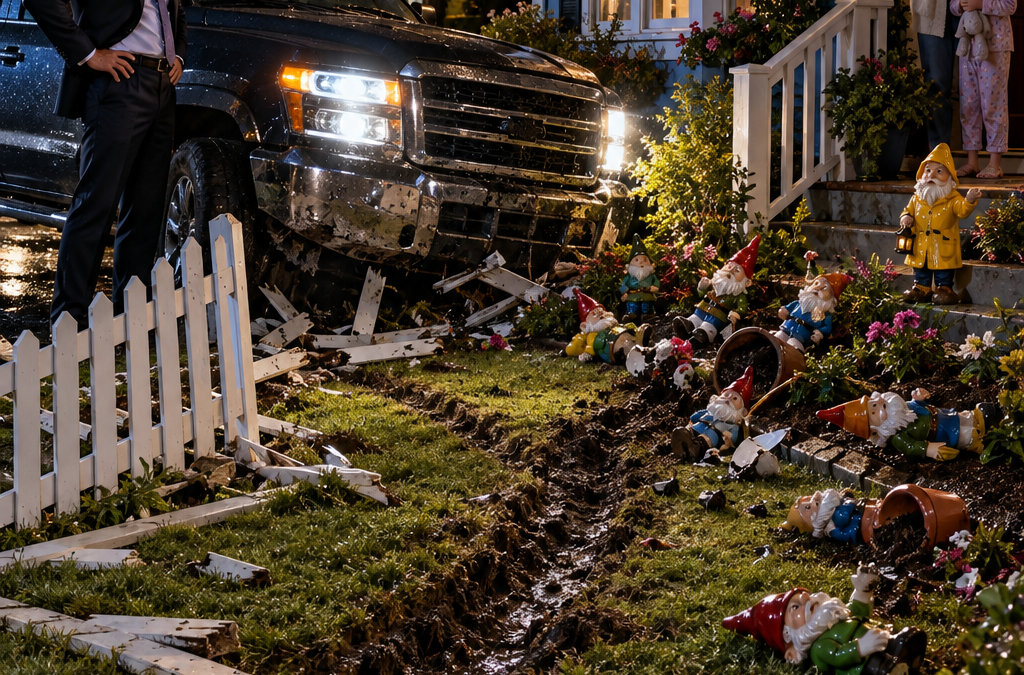
The front bumper struck my white picket fence.
Wood cracked.
A section of fencing folded beneath the wheels.
The truck continued forward and smashed into my mailbox post.
The mailbox disappeared under the bumper.
I screamed.
“Sophie!”
The engine roared.
The truck stopped.
Then reversed.
I stared through the window.
The driver wasn’t trying to escape the damaged fence.
The truck was backing into the street to line up again.
My blood turned cold.
I ran to Sophie’s bedroom.
She was already awake.
“Mom, what’s happening?”
I grabbed her hand.
“Come with me.”
Another crash shook the front of the house.
I pulled Sophie away from the windows and hurried toward the back hallway.
“Stay here,” I told her. “Away from the glass.”
She was crying.
“Mom, I’m scared.”
“I know, baby. I’m right here.”
I took out my phone and called 911.
I gave the dispatcher our address.
I told her a commercial truck had driven through my front fence and appeared to be attacking the property deliberately.
She asked whether anyone was injured.
“Not yet. My daughter is inside with me.”
“Stay away from the front of the house.”
I heard the engine again.
A terrible grinding sound.
Then another impact.
The walls trembled.
Sophie screamed.
I held her against me.
Through the side window, I could see the truck’s headlights sweeping across the front yard.
The driver had backed up and surged forward again.
The damaged fence was now scattered across the grass.
The mailbox was crushed beyond recognition.
I looked toward the windshield.
The streetlamp illuminated the cab.
And I saw a flash of glittering metallic fabric.
My breath stopped.
Karen.
He was behind the wheel.
His carefully styled hair was disheveled, his face was flushed, and the sequined trim of his cardigan caught the light whenever he moved.
His mouth was open.
He was shouting.
I couldn’t hear every word through the engine.
But I heard enough.
“My neighborhood!”
Then something about taking back control.
I stared in disbelief.
For months, he’d threatened my home through letters, fines, and legal paperwork.
Now he was trying to destroy part of it with a truck.
I told the dispatcher who I believed was driving.
“Karen Wexler. He’s the HOA president. He’s the man who’s been threatening me.”
The dispatcher instructed me not to approach him.
I stayed with Sophie.
Outside, neighbors began emerging from their houses.
I could hear shouting.
Someone yelled for the driver to stop.
Phones were raised.
People were recording.
Karen reversed again.
This time, instead of driving toward my house, he swung the truck back into the street.
He clipped a trash bin.
Plastic shattered beneath the wheels.
The truck fishtailed.
Then accelerated toward the far end of the cul-de-sac.
For a moment, I thought he might crash into another house.
The vehicle swerved around a parked car.
Its horn blared.
I heard more shouting.
Then distant sirens.
Real sirens.
Getting closer.
I held Sophie so tightly she complained that I was hurting her shoulder.
I loosened my grip.
“I’m sorry, sweetheart.”
She looked up at me.
“Is he coming back?”
I didn’t know.
That was the worst part.
I didn’t know whether Karen would return.
Whether he’d try to drive through the house.
Whether he’d hurt somebody standing in the street.
All I could do was stay away from the windows and wait.
The police reached Maple Ridge within minutes.
Red and blue lights flashed across the rooftops.
One patrol cruiser approached from the entrance.
Another moved toward the far intersection.
Karen had been circling toward the community exit.
He apparently thought he could still get away.
But a cruiser blocked the road.
I heard tires squeal.
Then a tremendous thud as the truck braked and rocked sideways.
The engine continued idling.
Its horn blared continuously.
For several seconds, the entire neighborhood seemed suspended in the noise.
Then an officer shouted.
“Driver! Turn off the engine!”
The horn continued.
“Step out of the vehicle!”
I moved cautiously toward a side window, keeping Sophie behind the interior wall.
The truck sat diagonally across the street.
A patrol cruiser blocked its path.
Two officers stood at a safe distance with their attention fixed on the cab.
Karen was still behind the wheel.
One officer repeated the command.
“Step out of the truck now!”
The driver’s door opened.
Karen appeared.
He was holding something.
For one absurd instant, I thought it might be a weapon.
Then I recognized the shape.
His clipboard.
The same clipboard he’d carried while issuing fines over garden ornaments and trash bins.
Even now, with a stolen truck blocking the street and police ordering him out, he’d reached for the object that symbolized his authority.
An officer shouted for him to put it down.
Karen hesitated.
Then dropped it.
The clipboard struck the pavement.
Papers scattered into the street.
“Hands where I can see them!”
Karen raised his hands.
He climbed down slowly.
His face was wet with sweat and tears.
He was talking rapidly.
I couldn’t hear everything.
But I heard him say he was protecting Maple Ridge.
That the residents had betrayed him.
That nobody appreciated what he’d done.
The officer ordered him to turn around.
Karen resisted verbally.
Then his shoulders sagged.
He began sobbing.
The handcuffs closed around his wrists beneath the streetlight.
I stood watching through the window.
For three months, I’d been afraid of that man.
Afraid of his letters.
His threats.
His connections.
His ability to turn ordinary rules into punishment.
Now he stood beside a damaged delivery truck with his hands cuffed behind him, no longer able to command anyone.
The image didn’t feel satisfying.
It felt unreal.
I looked down at Sophie.
She was trembling.
I knelt beside her.
“He’s not coming back tonight.”
She wrapped her arms around my neck.
“Promise?”
I wanted to promise.
Instead, I held her.
“The police have him, sweetheart. We’re safe right now.”
Outside, officers began securing the scene.
Neighbors gathered behind the police perimeter.
Some were crying.
Others looked furious.
A few still held their phones up, recording the aftermath.
Someone had brought blankets for the families standing outside.
When an officer eventually came to our door, I opened it with shaking hands.
He looked at me.
“Harper Doyle?”
“Yes.”
“Are you and your daughter injured?”
“No.”
“Can you tell me what happened?”
I looked past him toward the destroyed fence.
My mailbox was gone.
Wooden boards were scattered across the yard.
Deep tire tracks cut through the grass.
I took a breath.
Then I told him everything.
The first impact.
The truck reversing.
The second impact.
The driver.
The shouting.
The fear that he’d drive into the house.
The officer listened carefully.
Then he asked whether I knew the man.
“Yes.”
I swallowed.
“He’s our HOA president.”
The officer’s expression tightened.
“You’re certain?”
“Yes.”
I looked toward the patrol vehicles.
“His name is Karen Wexler.”
The officer wrote it down.
I told him about the ongoing legal dispute and the threats.
He asked for the relevant records.
I said I had them.
He nodded.
“We’ll need a formal statement and any video you have.”
I looked toward the security camera above the porch.
It had recorded the entire front yard.
For the first time that night, I felt grateful I’d installed it.
“Everything should be on camera,” I said.
The officer nodded.
“Good.”
Then he told me something I hadn’t known.
The truck had been reported stolen.
A delivery driver had stopped two streets away to complete a late scheduled delivery.
While he was outside the vehicle, someone had entered the cab and driven away.
The driver had called police almost immediately.
I felt sick.
Karen hadn’t rented a truck.
He hadn’t borrowed one.
He’d taken a commercial vehicle that didn’t belong to him and driven it into a residential neighborhood.
Then he’d used it against my home.
The driver was later identified as Trevor Mills.
He’d been working a late delivery route when his truck disappeared.
He stood near one of the patrol vehicles that night, visibly shaken.
I saw him from a distance.
He kept looking toward the damaged truck.
I wondered what it must have felt like to watch someone steal the vehicle he depended on for work.
The same man who had tried to take my home had now put another person’s livelihood at risk.
It wasn’t just cruelty.
It was recklessness spreading outward to anyone unfortunate enough to cross his path.
I gave my statement.
The officers collected the security footage.
Several neighbors supplied their recordings.
The physical evidence was everywhere.
Broken fence boards.
Crushed mailbox metal.
Tire marks.
Damaged landscaping.
And a commercial truck that had nearly become a weapon against an occupied house.
When the officers finally allowed me into the front yard, I stood beside the shattered mailbox post.
I thought about the first fifty-dollar fine.
Four inches of trash-bin placement.
That was how all of this had started.
Karen had spent months treating small deviations from his rules as threats to the neighborhood.
Now he’d driven a stolen truck through my property.
I looked down at the broken mailbox.
The irony was so cruel that I almost laughed.
Instead, I started crying.
Mr. Okafor appeared beside me.
He rested one hand gently on my shoulder.
“Harper.”
I shook my head.
“I can’t believe he did this.”
He looked toward the police vehicles.
“I know.”
“My daughter was inside.”
His expression hardened.
“I know.”
I looked at the house.
The little blue home Dad had helped me buy.
The one I’d fought so hard to protect.
The windows were intact.
The structure appeared undamaged.
But the yard looked like a wrecking site.
I swallowed.
“What if he’d gone farther?”
Mr. Okafor didn’t answer immediately.
Then he said, “He didn’t. And you’re both alive.”
I nodded.
I knew he was trying to help.
But my hands wouldn’t stop trembling.
At the hospital, I knew fear could linger long after the immediate danger ended.
I had seen patients survive terrible accidents, then shake uncontrollably once someone told them they were safe.
Now I understood that feeling in a way I never wanted to.
I couldn’t stop imagining the truck coming through the living room.
Sophie sitting on the couch.
The windows exploding.
Everything happening too quickly for me to reach her.
Mr. Okafor stayed until the police finished collecting the evidence.
Then he walked us inside.
He checked the doors.
Made sure Sophie had water.
And sat with us until I could breathe normally again.
I barely slept.
Every time a vehicle passed outside, I sat up.
Every engine sounded too loud.
Every headlight sweeping across the bedroom wall made my heart race.
Sophie crawled into my bed just after three.
I held her until morning.
The next day, Wesley Cho called.
He’d heard about the incident.
I told him I wasn’t ready to speak on camera.
He understood.
Then he said quietly, “Harper, the records you and your neighbors preserved may be extremely important now.”
I looked toward the damaged yard.
“I know.”
The criminal investigation moved quickly.
The truck theft was documented through the delivery driver’s report and surrounding evidence.
The dangerous driving and damage to my property were captured on multiple cameras.
And the financial allegations involving the HOA were already under review.
Within a week, investigators had received the additional records from our attorney and the association.
The evidence was no longer scattered among a few frightened homeowners.
It was organized.
Cross-referenced.
Supported by witnesses.
And connected to a man whose conduct had just turned a private dispute into a public criminal investigation.
Further review of the HOA accounts uncovered transactions totaling more than two hundred thousand dollars over approximately three years that investigators linked to fraudulent assessments and improper transfers.
The shell landscaping business was central to the allegations.
Its ownership records, invoices, and bank activity connected it to Karen.
Money collected from Maple Ridge homeowners for emergency maintenance and reserve contributions had been routed through transactions investigators alleged were part of his personal enrichment scheme.
My four-thousand-dollar dispute was only one small piece of a much larger system.
The prosecutor eventually filed charges connected to motor vehicle theft, reckless endangerment, property damage, and embezzlement of HOA funds.
Additional allegations concerned falsified financial and enforcement documents.
Karen retained an attorney.
He denied several aspects of the financial allegations at first.
But the evidence was extensive.
Bank records.
Business filings.
Emails.
Board documents.
Witness statements.
And the security footage showing him behind the wheel of the stolen truck.
The HOA board finally acted.
Emergency meetings were held.
Karen was removed from his leadership position under the association’s governing procedures.
His access to the association’s accounts and enforcement systems was revoked.
The remaining directors appointed independent professionals to review the finances and preserve the records.
The board also suspended the collection of disputed fines issued under Karen’s unauthorized enforcement practices.
For the first time in months, the letters stopped.
No new landscaping citations.
No invented pool violations.
No threats about improper complaint formatting.
My mailbox was lying in pieces beside the garage, but at least nothing inside it could frighten me.
The legal process continued for months.
Our attorney pursued the civil action challenging Karen’s fines and the threatened lien.
The court reviewed the association’s governing documents, the enforcement records, and the evidence that penalties had been imposed without valid authorization.
The resulting orders invalidated the fines issued through Karen’s improper enforcement scheme.
That included the $4,200 claimed against my house.
The threatened lien was withdrawn.
My account was corrected.
And the money I’d paid under the invalid assessments became part of the restitution and repayment process.
The Patels’ flag penalties were reversed.
Mrs. Ruiz’s wheelchair ramp received the formal recognition and approval it should have had without months of intimidation.
The board adopted new procedures requiring documented votes, independent financial review, and consistent enforcement of legitimate rules.
It wasn’t instantaneous.
There were attorneys.
Auditors.
Court filings.
Insurance questions.
And arguments over how to repair the damage done to the association’s finances.
But the direction was finally different.
Instead of one man issuing orders, the people responsible for the neighborhood were being required to explain their decisions.
Trevor Mills, the delivery driver, also pursued legal remedies for the losses caused by the theft and damage to his truck.
His claim led to a substantial settlement through the relevant civil and insurance proceedings.
Later, I heard that he had used the money to purchase a new commercial truck outright.
I remember smiling when Mr. Okafor told me.
Trevor hadn’t asked to become part of our HOA disaster.
He’d simply been working.
And Karen’s recklessness had nearly cost him his livelihood.
Knowing that he was able to get back on the road mattered to me.
My own property damage was repaired.
The fence was rebuilt.
The mailbox was replaced.
The tire tracks disappeared beneath fresh grass.
For weeks, Sophie refused to play in the front yard.
I never pushed her.
I understood why.
Sometimes she’d stand at the window and look toward the street.
Then she’d ask whether the truck man was coming back.
I would sit beside her.
Explain what the police and courts had done.
And remind her that we had people looking out for us.
Eventually, she started playing outside again.
At first, only in the backyard.
Then on the porch.
Finally, one sunny Saturday, she carried a cardboard box from the garage into the front yard.
I was trimming the lavender when I saw her.
“Sophie?”
She looked up.
“Can we put Grandpa’s gnomes back?”
I stopped working.
For a moment, I couldn’t answer.
The box was the same one I’d packed three months earlier.
The same newspaper wrapped around the little figures.
The same red hat poking through the top.
I walked toward her.
“Are you sure?”
She nodded.
“They belong here.”
I looked toward the empty flower bed.
Then I smiled.
“Yes, sweetheart.”
We unpacked them together.
One by one.
The fishing gnome.
The wheelbarrow gnome.
The one with the chipped blue coat.
The tiny figure holding a lantern.
Sophie arranged them carefully beneath the front windows.
When she reached the yellow raincoat gnome, she paused.
“Grandpa’s favorite.”
I nodded.
“He loved that one.”
She placed it nearest the porch steps.
Then she sat back on her heels.
“There.”
I looked at the twelve little faces.
After everything that had happened, the sight made my chest tighten.
They were only ceramic decorations.
But they represented something Karen had tried very hard to take from us.
The right to live in our own home without being frightened over harmless things.
Sophie looked up.
“Do you think Grandpa can see them?”
I put my arm around her.
“I think he’d be happy they’re back.”
She smiled.
Then she leaned against me.
We sat together in the grass for a long time.
The afternoon sun warmed the porch.
The rebuilt fence stood straight.
Our new mailbox waited beside the driveway.
And the gnomes returned to their posts as if they’d never left.
Maple Ridge changed too.
The association held a new election.
This time, homeowners attended in numbers nobody remembered seeing before.
Candidates were questioned about transparency, spending, enforcement procedures, and accountability.
The residents eventually elected a qualified accountant as the new HOA president.
Her name was Evelyn Carter.
She wasn’t particularly dramatic.
She didn’t patrol lawns with a clipboard.
She didn’t issue speeches about personal authority.
At her first meeting, she presented a clear financial report and explained how residents could review the association’s records.
Then she said something I would never forget.
“The HOA is an organization owned collectively by its members. It is not anybody’s private kingdom.”
The room applauded.
I looked toward Mr. Okafor.
He smiled faintly.
“That’s a promising start.”
The new board continued rebuilding trust.
Not everyone agreed about every rule.
Some homeowners wanted stricter landscaping standards.
Others wanted fewer restrictions.
People argued about budgets, maintenance schedules, and community events.
But the arguments happened openly.
Minutes were recorded.
Financial statements were available.
Board decisions required proper authorization.
And no resident was supposed to face retaliation simply for asking a question.
Mrs. Ruiz began coming to meetings again.
She rolled into the clubhouse through the ramp that had once been the subject of Karen’s threats.
The Patels kept their flag flying year-round.
Several former residents contacted the association about improper fines they’d paid in previous years.
The board worked with attorneys and auditors to identify the affected accounts.
There was still a great deal of damage to repair.
But the neighborhood finally seemed willing to do it.
Karen’s criminal proceedings took longer.
The embezzlement allegations involved several years of transactions, shell-company records, and witness statements.
Eventually, the case moved toward sentencing after the relevant charges were resolved through the court process.
When I last received an update, Karen was awaiting sentencing.
I didn’t attend every hearing.
I didn’t need to.
For months, his actions had dominated my life.
I had no desire to make him the center of it forever.
I wanted to return to being Harper Doyle.
A nurse.
A mother.
A homeowner.
A woman who could spend an afternoon tending her garden without wondering whether somebody was preparing another fraudulent fine.
Still, I never forgot the night of the truck.
Sometimes I’d stand beside the rebuilt mailbox and remember the engine.
The headlights.
The first crash.
Sophie crying upstairs.
The second impact.
Karen stepping out of the cab with his ridiculous clipboard.
And the red and blue lights filling our cul-de-sac.
I remembered how frightened I’d been.
How powerless I’d felt when the fines first arrived.
How many nights I’d spent wondering whether fighting Karen would make everything worse.
And I remembered that it had become worse.
Much worse.
But the evidence we’d gathered had survived every attempt to intimidate us.
The binder of receipts.
The financial records.
Mr. Okafor’s analysis.
The statements from the Patels and Mrs. Ruiz.
The court filings.
The news report.
And finally, the camera footage from the night Karen lost control.
I often thought about how easily things might have been different.
If I’d simply paid every fine.
If I’d never questioned the fabricated violations.
If Mr. Okafor hadn’t reviewed the financial records.
If the neighbors had continued to suffer alone.
Maybe Karen would still be president.
Maybe he would still be collecting fraudulent assessments.
Maybe another family would be packing boxes because they couldn’t afford to fight him.
I couldn’t know.
But I knew what had happened when we finally refused to be silent.
The power he’d built around himself began to collapse.
Not because one person shouted louder than he did.
Because ordinary people kept records and stood together.
One evening, several months after the fence was repaired, I sat on the porch watching Sophie play.
She had arranged the garden gnomes into what she called a neighborhood council.
The fishing gnome was apparently in charge of parks.
The wheelbarrow gnome handled roads.
And the yellow raincoat gnome was president.
I laughed.
“Is he a good president?”
Sophie nodded seriously.
“The best.”
“Why?”
“Because he doesn’t tell everybody what to do.”
I smiled.
“That’s a good start.”
She continued arranging the figures.
Then she looked up.
“Mom?”
“Yeah?”
“Are we going to stay here?”
The question caught me off guard.
I looked at the little blue house.
The repaired fence.
The lavender growing beside the steps.
The mailbox standing straight again.
I remembered Dad telling me to buy a place where Sophie and I could build a life.
I remembered the day we’d received the keys.
And the months when Karen had made me afraid we’d lose everything.
I went down the steps and sat beside her.
“Yes, sweetheart.”
She studied my face.
“Really?”
I put my arm around her.
“Really.”
She smiled.
Then she returned to her gnomes.
I sat there watching her.
For the first time since moving to Maple Ridge, I believed my own answer without hesitation.
The following morning, I walked to the mailbox just after sunrise.
The neighborhood was quiet.
Birds moved through the trees.
A sprinkler clicked somewhere down the street.
The air smelled of damp grass and fresh coffee drifting from an open kitchen window.
I opened the mailbox.
Inside was a utility bill, a grocery advertisement, and a handwritten invitation to the neighborhood’s next community picnic.
No violation notice.
No lien threat.
No accusation about decorations.
I looked at the invitation and smiled.
Then I turned toward the house.
The twelve gnomes stood beneath the windows.
Their painted hats caught the morning sunlight.
The yellow raincoat figure stood closest to the porch, exactly where Sophie had placed it.
I thought about Dad.
About the way he’d laughed whenever someone called his collection ridiculous.
About how he’d always insisted that home should be somewhere people felt safe enough to be themselves.
Karen Wexler had spent years making our neighborhood afraid.
He targeted people he thought wouldn’t fight back.
He exploited rules that were supposed to protect the community.
He threatened my home.
He threatened my ability to find another one.
And when his financial scheme began unraveling, he became reckless enough to steal a truck and drive it into my yard.
But the consequences of his actions finally caught up with him.
The financial records exposed the missing money.
The courts invalidated his improper fines.
The HOA removed him from power.
And the man who once treated Maple Ridge as his personal kingdom was now awaiting sentencing.
I looked down at the little yellow raincoat gnome.
Then toward my rebuilt mailbox.
For months, opening that mailbox had been something I dreaded.
Every envelope felt like another threat.
Another accusation.
Another attempt to make me surrender something I’d worked hard to protect.
Now I could open it without fear.
I walked back toward the porch, holding the invitation in my hand.
Sophie appeared at the front door.
“Mom, are we having pancakes?”
I smiled.
“Absolutely.”
She looked past me toward the garden.
“Are Grandpa’s gnomes still there?”
I glanced at the flower bed.
“All twelve.”
She grinned.
“Good.”
I followed her inside.
Behind me, the morning sunlight spread across the little blue house.
The rebuilt fence stood undamaged.
The mailbox was upright.
And the garden gnomes watched over the yard like twelve tiny witnesses to everything we’d survived.
I had moved to Maple Ridge because I wanted to give my daughter a home.
Karen tried to turn that home into something I was afraid to lose every single day.
In the end, he lost the power he’d abused, while Sophie and I kept the one thing that had mattered from the beginning.
Our home.








