𝗙𝗨𝗟𝗟 𝗦𝗧𝗢𝗥𝗬 My HOA President Threatened to Put a Lien on My Home Over a Six A.M. Sprinkler, but His Real Reason Was Far More Personal
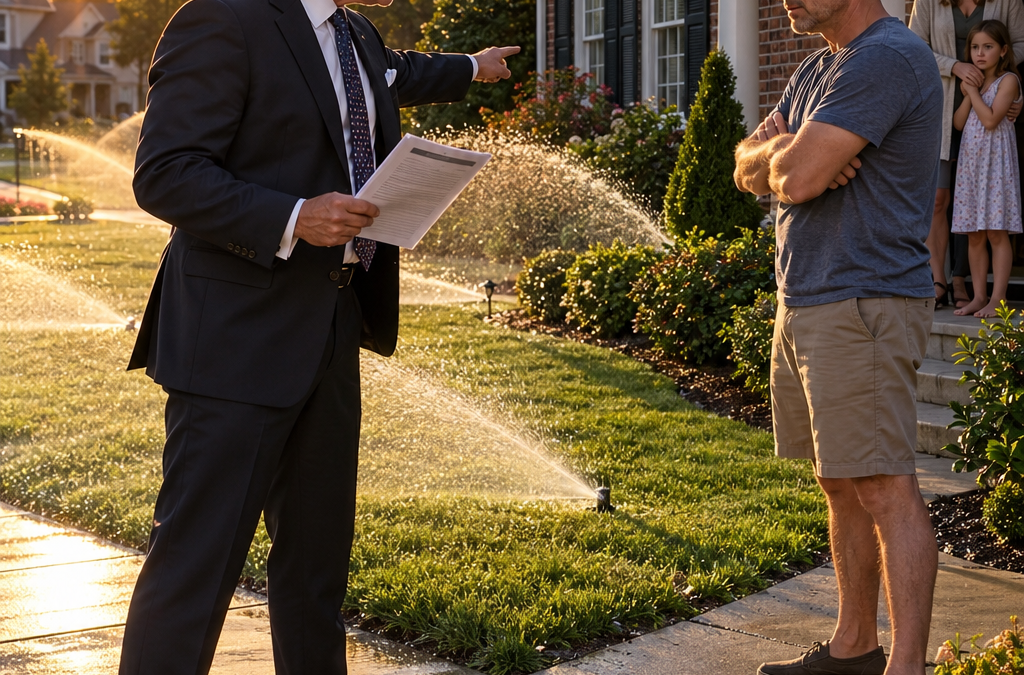
𝗙𝗨𝗟𝗟 𝗦𝗧𝗢𝗥𝗬
He chuckled politely.
“Of course. But residential appearance requires a different level of attention.”
He opened a leather portfolio and handed me a business card.
“Evergreen Premier Landscaping. Highly recommended.”
I looked at it.
The printed name was Darren Thornwell.
Same surname.
I glanced up.
“Related?”
“My cousin.”
Reginald smiled.
“Darren understands this community’s standards better than anyone. Several board members use his company.”
I studied the card.
The service package on the back listed a monthly price that was nearly three times what I had budgeted for ordinary lawn care.
“Appreciate it,” I said. “But I’m going to handle the yard myself.”
His smile held.
For a second.
Then it became noticeably thinner.
“You’re certain?”
“Yes.”
“Some homeowners underestimate the expectations here.”
“I read the covenants before closing.”
That changed his expression.
Not dramatically.
Just enough for me to notice.
“Well,” he said, adjusting his cuff, “I suppose we’ll see how things go.”
He walked away.
I didn’t think much about it.
People were allowed to recommend their relatives’ businesses.
I wasn’t obligated to hire them.
That seemed like the end of the conversation.
Looking back, it was the moment Reginald decided I would become a problem.
And he was the kind of man who believed problems were supposed to be punished.
My first official violation arrived several weeks later.
It concerned my sprinkler system.
I had installed a simple automatic timer to water the lawn at six each morning before leaving for work.
The system ran for about twelve minutes.
The sprinkler heads were standard residential equipment, producing a soft rhythmic clicking as they rotated and a faint hiss as water spread over the grass.
Nothing unusual.
Nothing loud.
My next-door neighbor, Patrick Collins, ran almost the same system at exactly the same time.
In fact, he had recommended the model.
One Monday afternoon, I found a white envelope in the mailbox.
The top read:
WILLOW CREEK ESTATES HOMEOWNERS ASSOCIATION — FORMAL VIOLATION NOTICE
Below that was a paragraph accusing me of operating irrigation equipment in a manner that created excessive water-related noise during restricted early-morning hours.
I read it twice.
Then I checked the attached compliance instruction.
It demanded that I stop operating the sprinkler system before eight in the morning.
The notice warned that future violations could result in monetary penalties.
I stood in the kitchen staring at the paper.
Erin walked in carrying a grocery bag.
“What’s that?”
“Apparently our sprinklers are too loud.”
She looked confused.
“What?”
I handed her the notice.
She read it.
Then looked at me.
“Is this serious?”
“Apparently.”
She glanced toward the backyard.
“I can’t even hear those things from our bedroom.”
“Neither can I.”
She handed the letter back.
“Maybe someone complained?”
“Maybe.”
I looked through the kitchen window at Patrick’s property.
His sprinkler system was running at that exact moment.
I could barely hear it through the glass.
I found my copy of the HOA bylaws and architectural rules.
I searched for sprinkler restrictions.
Noise regulations.
Irrigation schedules.
Early-morning disturbances.
There were reasonable provisions concerning property maintenance, nuisance conditions, and preventing runoff onto neighboring lots.
But nothing specifically prohibiting sprinklers at six in the morning.
Nothing describing excessive water noise.
And nothing establishing the eight o’clock restriction cited in the letter.
I assumed there was another policy document I hadn’t received.
So I called the HOA office.
The secretary, Denise Harper, answered.
“Willow Creek Estates. How may I help you?”
“I’m calling about a sprinkler violation.”
She asked for my address.
I gave it.
There was a pause.
“Yes, Mr. Grady. I see the notice.”
“Can you tell me which section of the governing documents prohibits sprinkler operation before eight?”
She hesitated.
“That would be a community noise standard.”
“Which standard?”
“An internal enforcement guideline.”
“Can I get a copy?”
Another pause.
“I’ll have to ask Mr. Thornwell.”
“All right.”
I waited for the document.
It never came.
Instead, the following week, a second envelope arrived.
This one demanded one hundred and fifty dollars.
EXCESSIVE WATER NOISE — FIRST OFFENSE.
I stared at the notice.
One hundred and fifty dollars.
Because water moved through a residential sprinkler at six in the morning.
I called again.
Denise apologized and said the violation had been approved by the president.
I requested a hearing.
She told me the next available compliance review wouldn’t take place for several weeks.
Meanwhile, the payment deadline remained in effect.
I was annoyed, but I didn’t want our first year in the neighborhood consumed by a ridiculous fight.
So I paid.
I moved the sprinkler timer to eight-thirty.
And I thought the matter was finished.
It wasn’t.
Two weeks later, a new notice appeared.
REPEAT OFFENSE — $300.
I read the letter standing beside my mailbox.
The alleged violation date was a Wednesday morning.
The same Wednesday I’d left the sprinklers turned off because heavy rain had been forecast.
I went into the garage and checked the timer history.
The schedule had been disabled.
I had photographs of the wet lawn taken that morning because I’d been inspecting drainage near the back fence.
But the notice claimed the sprinkler system had been operating at six.
I called the HOA office.
Denise sounded uncomfortable.
“Mr. Grady, I understand your frustration.”
“The system was off.”
“The complaint was entered as a repeat violation.”
“By whom?”
“I can’t disclose resident complaints.”
“Was anyone physically at my house?”
She hesitated.
“I’m not sure.”
“Then what evidence supports the fine?”
“I can ask Mr. Thornwell.”
I closed my eyes.
“Please do.”
I appealed again.
No response.
The payment deadline approached.
Erin and I sat at the kitchen table with our household budget spread between us.
Four hundred and fifty dollars in sprinkler fines.
Money we had intended to spend repairing the backyard fence.
Money that would have covered several weeks of groceries.
Erin looked tired.
“Should we just pay this one too?”
I stared at the notice.
“It wasn’t even running.”
“I know.”
“There’s no rule.”
“I know that too.”
She took my hand.
“But we finally have a house, Wilson. I don’t want them making our lives miserable over a sprinkler.”
I looked around the kitchen.
The new paint.
The curtains she’d chosen.
Sophie’s school drawings attached to the refrigerator.
Everything we’d worked for.
I hated the idea of surrendering.
But I hated the idea of dragging my family into an endless dispute more.
So I paid the second fine.
I convinced myself that compliance would solve the problem.
I was wrong.
The next month brought a warning about the sprinkler heads supposedly spraying too close to the sidewalk.
Then a notice alleging improper lawn maintenance near the mailbox.
Then a complaint about moisture crossing the property line.
Every time I corrected one issue, another appeared.
I adjusted the sprinklers.
Changed the watering days.
Replaced two spray heads.
Repositioned a section of hose.
Photographed the lawn after irrigation.
I even stopped using the automatic system for a while and watered by hand.
Nothing satisfied Reginald.
Every notice arrived on immaculate HOA letterhead.
Every accusation used formal language.
And every demand ended with a warning about further enforcement.
Meanwhile, Patrick continued watering his lawn at six in the morning.
No notices.
No fines.
No threats.
One Saturday, I stood beside the fence watching his sprinklers rotate.
He noticed me.
“Something wrong?”
I pointed toward the water.
“You still running these at six?”
“Every morning.”
“Ever get a complaint?”
He laughed.
“About sprinklers?”
“Yes.”
“No. Why?”
I showed him the first violation.
He read it.
Then frowned.
“Water noise?”
“Apparently.”
He stared at me.
“Wilson, mine are louder than yours.”
“I know.”
He handed the letter back.
“That’s ridiculous.”
I looked toward the HOA president’s house farther down the street.
“Starting to think it’s personal.”
Patrick followed my gaze.
“With Thornwell? Wouldn’t surprise me.”
He leaned against the fence.
“That man once threatened to fine me because my garage door was open too long while I was cleaning it.”
“What happened?”
“I told him I’d close it when I finished.”
“And?”
“He sent me a warning.”
I shook my head.
Patrick became serious.
“Be careful with him, Wilson. He doesn’t like being told no.”
I looked down at the notice.
That much I already knew.
But I still didn’t understand why he had chosen me.
The answer came on a rainy Thursday morning.
I had stopped by the HOA office to submit another written request for the sprinkler policy.
Denise Harper was alone behind the reception desk.
She was in her early sixties, wore reading glasses on a chain, and always seemed to be juggling more paperwork than one person could reasonably handle.
She offered me coffee.
I accepted.
We stood near the office kitchenette while rain tapped against the windows.
I asked whether she’d found the written rule.
She sighed.
“Mr. Grady, I’ve looked through the current policy binder.”
“And?”
“I haven’t found the exact language they’re citing.”
I stared at her.
“Then why am I being fined?”
She shifted uncomfortably.
“Reginald handles the compliance decisions.”
“Who filed the original complaint?”
She looked toward the closed office door.
Then lowered her voice.
“Honestly? He did.”
I froze.
“Reginald?”
She nodded.
“There wasn’t a resident complaint. He entered it himself.”
I set down my coffee.
“Why?”
She hesitated.
Then said something that explained almost everything.
“He was angry you didn’t hire Darren.”
I stared at her.
“His cousin?”
She nodded again.
“He told the maintenance committee you’d declined the recommended landscaping service. Said you were going to be difficult about community standards.”
For a moment, I couldn’t speak.
I remembered the business card.
The expensive landscaping package.
Reginald’s smile fading when I declined.
And then the violation notices.
I looked at Denise.
“You’re telling me this started because I wouldn’t hire his cousin?”
She seemed to regret saying anything.
“Please don’t tell him I told you.”
I shook my head.
“I won’t put you in the middle of it.”
She looked down at her coffee.
“I don’t like what’s happening here, Wilson.”
I waited.
She continued.
“Some of the policies aren’t being handled the way they used to be.”
“What does that mean?”
She shook her head.
“I shouldn’t say more without checking the records.”
I didn’t press her.
But when I left the office, I no longer believed I was dealing with overzealous enforcement.
I believed I was dealing with retaliation.
And that changed how I handled everything.
I stopped throwing away envelopes.
I saved every email.
Every notice.
Every payment receipt.
Every date.
Every photograph.
I downloaded my irrigation timer’s operating history and kept records of the mornings the system had been disabled.
I compared Patrick’s schedule with mine.
I requested copies of the governing documents again.
And I wrote down every conversation with HOA personnel as soon as it ended.
I wasn’t trying to win a shouting match.
I was building a timeline.
Reginald had spent months using paperwork to intimidate me.
I decided I would answer him with better paperwork.
Three weeks later, a certified envelope arrived.
I signed for it on a Friday afternoon.
The return address was the HOA’s management office.
Inside was a notice announcing the association’s intention to pursue a lien against my home if the alleged outstanding penalties and enforcement charges were not resolved.
I read the letter once.
Then again.
My stomach dropped.
The original sprinkler fines had already been paid.
Now the association was claiming additional balances based on disputed administrative assessments and subsequent violations.
The figures were small compared with the value of the house.
But the threatened consequence was not.
A lien.
Against the home Erin and I had spent fifteen years saving to buy.
I stood beside the kitchen counter holding the letter.
Erin walked in.
She saw my expression.
“What happened?”
I handed it to her.
She read the first page.
Then looked up.
“Are they serious?”
“Apparently.”
“Over the sprinklers?”
“Over whatever they keep deciding I owe them.”
Her face went pale.
“Can they do that?”
I swallowed.
“I don’t know if they have the legal basis. But we can’t ignore this.”
She looked toward the living room, where Sophie was doing homework.
“Wilson, this is our house.”
“I know.”
“We worked too hard for this.”
I stepped closer and held her.
For several seconds, neither of us spoke.
I could feel her breathing against my chest.
Then she whispered, “What if we can’t stop them?”
That was the first time I truly felt afraid.
Not irritated.
Not offended.
Afraid.
Because Reginald wasn’t simply trying to control my lawn anymore.
He was using the possibility of a legal claim against our home to force me into obedience.
I looked over Erin’s shoulder toward Sophie’s schoolbag hanging beside the kitchen door.
I thought about the little yellow bedroom upstairs.
The vegetable garden.
The family photographs.
The mortgage payments.
The years we had gone without things we wanted so we could finally own something permanent.
I wasn’t going to let a fabricated sprinkler rule put all of that at risk.
I picked up my phone.
And I called a real estate attorney.
Her name was Evelyn Carter.
She practiced real estate and association law out of a small office on the second floor of a brick building downtown.
When I called, her assistant asked me to explain the dispute briefly.
I said, “The homeowners association is threatening a lien against my house because my sprinkler system allegedly makes too much noise.”
There was a pause.
Then she asked, “Is that the entire basis for the claimed debt?”
“That and a collection of other violations that seem to appear whenever I question the first one.”
She scheduled an appointment for Monday.
I spent the weekend organizing everything.
Erin helped me separate the correspondence into chronological order.
Sophie wandered into the dining room while we were working.
She looked at the papers spread across the table.
“Are we in trouble?”
I looked up.
“No, sweetheart.”
She glanced at Erin.
“Then why does Mommy look sad?”
Erin quickly smiled.
“We’re just dealing with some house paperwork.”
Sophie thought about that.
“Is it because of the sprinkler man?”
I felt something tighten in my throat.
“The sprinkler man?”
“That man who keeps coming by and looking at our yard. He told Mrs. Collins our grass was wrong.”
I stared at her.
She continued.
“He makes Daddy mad.”
Erin reached for her hand.
“Why don’t you go finish your reading?”
Sophie hesitated.
“Are we moving again?”
The question stopped me cold.
We had moved three times during her childhood, always searching for a place we could afford and finally call our own.
She’d hated leaving friends behind.
She’d cried when we packed her room the last time.
And now she was standing in our dining room, looking at HOA violation notices, wondering whether we would lose the house she loved.
I pushed back my chair.
“Come here.”
She walked toward me.
I lifted her onto my lap.
“We’re not planning to move.”
“Promise?”
I looked at Erin.
Her eyes were wet.
I wanted to promise.
More than anything.
But I had spent my life learning that promises meant little unless you were prepared to do the work required to keep them.
So I held my daughter and said, “I’m going to do everything I can to protect our home.”
She wrapped her arms around my neck.
That night, after Sophie went to bed, I returned to the paperwork.
Every page felt heavier.
Until then, I had been defending a principle.
Now I was defending the peace my daughter believed we’d finally found.
On Monday morning, Evelyn listened to my story without interrupting.
She examined the fines.
The photographs.
The sprinkler logs.
The lien notice.
Then she looked up.
“Get me the official bylaws.”
I opened my folder.
“Already have them.”
“All of them?”
“The declaration, amendments I received at closing, bylaws, and published rules.”
She held out her hand.
“Let’s start there.”
For nearly an hour, she read.
She marked several passages with yellow tabs and compared the claimed violations with the governing language.
Occasionally, she asked a question.
“Was the sprinkler running on the date of the second fine?”
“No. I have the controller history.”
“Was the first complaint made by an adjoining homeowner?”
“The secretary told me the president filed it himself.”
“Do you have that in writing?”
“No. Just my notes from the conversation.”
She nodded.
“We’ll treat that as information requiring verification.”
Then she returned to the rules.
When she finished, she leaned back.
“Wilson, I can’t find the restriction they’re citing.”
I felt my pulse quicken.
“Neither could I.”
“The governing documents contain general nuisance provisions, but nothing specifically prohibiting ordinary sprinkler operation at six in the morning or establishing these particular fines.”
“So he made it up?”
“At minimum, the association hasn’t identified an enforceable rule supporting these notices.”
She looked at the payment receipts.
“And if the restriction was invented or the penalties deliberately imposed without authority, that raises much more serious issues.”
I stared at her.
“Like what?”
“Potential misrepresentation, improper collection practices, and possibly fraud, depending on what the evidence establishes.”
For the first time since the first letter arrived, I felt something loosen inside my chest.
Not relief exactly.
But the sense that someone qualified had finally looked at the same records and recognized what I’d been seeing.
Evelyn turned toward the lien notice.
“This doesn’t establish that the association has a valid lien. It threatens to pursue one. We need to determine what amounts, if any, could lawfully support such action.”
I nodded.
“What do we do?”
“First, we formally dispute the charges and demand that the association identify the legal basis for each assessment. We’ll seek confirmation that it won’t record a lien while those charges are contested.”
“And if Thornwell refuses?”
“We pursue the remedies available under state law.”
She placed her pen on the desk.
“But I want something else.”
“What?”
“Three years of HOA financial records.”
I frowned.
“Why?”
“Because selective enforcement and questionable assessments may be symptoms of a larger governance problem.”
I thought about Denise’s warning.
Some of the policies aren’t being handled the way they used to be.
Evelyn continued.
“We should examine how the association approved these policies, how fines were collected, who authorized expenditures, and whether the financial records support the board’s explanations.”
“Can we request all that?”
“As a member, you have statutory and governing-document inspection rights, subject to the applicable limits. We’ll make a properly scoped request.”
I looked at the folders.
“Thornwell won’t like that.”
Evelyn gave me a measured smile.
“He doesn’t have to like it.”
The formal requests went out that afternoon.
One letter challenged the fines and threatened lien.
The other requested three years of association financial records, including budgets, expenditure approvals, relevant contracts, invoices, and accounting summaries.
Copies went to the management company and board.
I thought Reginald might finally reconsider.
Instead, he escalated.
Four days later, I received a notice ordering me to attend a special compliance hearing.
The letter accused me of repeated violations, failure to cooperate with association enforcement, and behavior inconsistent with community standards.
I showed it to Evelyn.
She read it once.
Then put it down.
“Interesting timing.”
“He’s retaliating.”
“That’s one possible interpretation. We’ll document the sequence.”
I rubbed my forehead.
“Do I have to attend?”
“I recommend we respond formally and attend with representation if the procedure allows. I don’t want him later claiming you refused an opportunity to be heard.”
The hearing was held the following Thursday in the Willow Creek clubhouse.
Reginald sat at the head of a long conference table wearing a dark blue suit and a silver tie.
His cousin Darren was standing near the back wall.
That surprised me.
Darren wasn’t a board member.
As far as I knew, he was simply the owner of the landscaping company Reginald had tried to sell me on.
I noticed the two men exchange a glance when Evelyn and I entered.
Reginald smiled.
“Mr. Grady. You’ve brought an attorney.”
Evelyn placed her briefcase on the table.
“I’m here to assist my client with the disputed enforcement matter.”
Reginald leaned back.
“I hope this means he’s finally prepared to comply.”
Evelyn opened the governing documents.
“We’re prepared to discuss the legal basis for the alleged violations.”
His smile faded.
“That’s already been explained.”
“Then please identify the provision prohibiting six o’clock residential irrigation.”
He glanced toward the other board members.
“The association’s noise standards.”
Evelyn slid the rulebook forward.
“Which section?”
He looked at it.
“General nuisance restrictions.”
“Have there been any findings establishing that Mr. Grady’s system constitutes a nuisance under that provision?”
Reginald’s jaw tightened.
“Multiple complaints.”
“Who made them?”
“Confidential resident sources.”
Evelyn nodded.
“Has the association preserved the underlying complaints?”
“We maintain our records properly.”
“Then we’d like them produced through the applicable process.”
Reginald leaned forward.
“This is becoming unnecessarily adversarial.”
I couldn’t help myself.
“You fined me four hundred and fifty dollars for watering grass.”
His eyes flashed.
“Mr. Grady, you will speak when recognized.”
Evelyn rested a hand on my folder.
I fell silent.
Reginald straightened.
“The board will not tolerate residents using legal technicalities to avoid community responsibilities.”
Evelyn looked directly at him.
“Determining whether a restriction exists is not a technicality.”
One board member shifted uncomfortably.
Another began studying the rulebook.
Reginald noticed.
His voice sharpened.
“The fines remain valid. And unless the outstanding assessments are satisfied, collection will proceed.”
Evelyn closed her folder.
“Then we’ll seek appropriate judicial relief.”
He laughed.
“Over sprinkler noise?”
She stood.
“Over the enforcement of charges without an identified lawful basis and the threat of a property lien.”
Reginald’s expression went cold.
“You people are trying to destroy the association.”
I stood beside her.
“No, Reginald. I came here to find out why my sprinklers are being treated differently from everybody else’s.”
He pointed at me.
“You are the most difficult homeowner I’ve ever dealt with.”
I looked toward Darren.
Then back at him.
“All because I wouldn’t hire your cousin?”
The room went completely still.
Darren straightened against the wall.
Reginald’s face turned red.
“That accusation is outrageous.”
“I didn’t make an accusation. I asked a question.”
“You’re implying corruption.”
“Then explain why my neighbor uses the same sprinkler schedule without a single violation.”
He leaned forward.
“Because he understands the standards of this community.”
I stared at him.
Patrick had never hired Darren’s company.
But Patrick had lived there for years and knew most board members personally.
Reginald could intimidate a relatively new homeowner more easily than someone with longstanding relationships.
That much was becoming obvious.
Evelyn gathered our papers.
“We’ll await the records.”
Reginald gave a thin smile.
“You may find that excessive demands for association documents are more complicated than you imagine.”
He wanted that to sound threatening.
To me, it sounded like a man preparing excuses.
And he had plenty.
For six weeks, Reginald stalled.
The first response claimed that the records were being reorganized.
The second said the association’s accountant was unavailable.
The third insisted certain documents were confidential without identifying a specific legal basis for withholding the requested material.
A fourth response offered us a review appointment, then canceled it the afternoon before we were supposed to attend.
Every delay arrived on official letterhead.
Every explanation sounded reasonable until compared with the previous one.
Evelyn sent follow-up requests.
She identified the missing categories.
She set out the applicable inspection requirements.
And she warned that continued refusal could require court intervention.
Reginald responded by sending another notice to my house.
This time, he accused me of creating unnecessary administrative expenses for the association.
The notice claimed that my record requests were placing an unreasonable burden on community resources.
I read it standing in my kitchen.
Then I laughed.
Not because it was funny.
Because I had reached the point where the absurdity was almost unbearable.
Erin looked up from the sink.
“What now?”
“Apparently asking to see the financial records is another violation of community harmony.”
She dried her hands.
“Can he fine you for asking questions?”
“Evelyn says he can’t just invent penalties whenever he’s annoyed.”
Erin leaned against the counter.
“He’s going to keep doing this, isn’t he?”
I looked toward the window.
Reginald’s black SUV was parked outside a house across the street.
He stood beside it talking to one of his preferred landscaping workers.
“I think he’s more determined than ever.”
She folded her arms.
“Wilson, I don’t want you to spend the rest of your life fighting this man.”
“Neither do I.”
“Then how does it end?”
I looked at the growing stack of correspondence.
“With the records.”
I hoped I was right.
During those six weeks, the pressure began affecting our daily lives.
Sophie stopped asking whether she could run through the sprinklers.
She had heard enough conversations about fines to believe water itself was somehow forbidden.
One evening, she came downstairs holding a drawing of our backyard.
In the picture, she’d drawn our house, the maple tree, and a bright yellow sun.
But the grass was brown.
“Why didn’t you make it green?” Erin asked.
Sophie shrugged.
“Because Daddy can’t water it.”
I looked away before she could see my expression.
I had spent months trying to keep the HOA dispute separate from her childhood.
But Reginald had turned something as simple as watering a lawn into a source of anxiety inside our house.
That was when my anger became something colder.
More focused.
I stopped imagining arguments I’d like to win.
I concentrated on the evidence.
At the end of the sixth week, the association finally produced a packet of financial records.
I picked it up from Evelyn’s office.
The envelope was thick enough to make me hopeful.
That hope lasted about ten minutes.
Nearly half the requested material was missing.
Several monthly statements had been omitted.
Some invoice sequences contained unexplained gaps.
Certain expenditure approvals were referenced but not provided.
The budget summaries didn’t reconcile cleanly with the supporting transaction lists.
And several large payments lacked the documentation necessary to determine what services had actually been performed.
I spent an entire Saturday organizing the packet.
By evening, my dining room looked like an accounting office.
I had spreadsheets open on my laptop.
Invoices arranged by date.
Banking summaries in separate stacks.
And a notebook filled with questions.
Erin brought me a sandwich.
“Find anything?”
“Not enough yet.”
She looked at the papers.
“There’s a lot missing.”
“Yes.”
“Is that normal?”
“Some information can be legitimately withheld or redacted. But these gaps need explanations.”
I pointed to a page.
“This summary says one amount was spent. The listed payments don’t add up to it.”
She frowned.
“Could it be an accounting mistake?”
“Absolutely.”
I turned another page.
“But if it is, there should be records explaining the difference.”
She looked at me.
“Do you think he’s stealing money?”
I shook my head.
“I don’t know. And I’m not going to say that until somebody can prove it.”
The distinction mattered.
Reginald had spent months making accusations without evidence.
I refused to fight him by doing the same thing.
Evelyn agreed.
When we met on Monday, she studied the packet carefully.
“This production is incomplete.”
“I counted twenty-seven missing documents referenced elsewhere.”
She nodded.
“I’ve identified several additional gaps.”
Then she examined the accounting summaries.
“There are expenditures here that require verification.”
“Anything serious?”
“Potentially.”
She marked a line.
“Let’s start by requesting the underlying invoice and board approval for this payment.”
I leaned closer.
The entry read:
LANDSCAPING CONSULTANT — $18,000.
I stared at it.
Eighteen thousand dollars.
A single payment.
The vendor information appeared on the accompanying transaction summary.
Evergreen Premier Landscaping.
My stomach tightened.
“Darren.”
Evelyn looked up.
“Who?”
“Reginald’s cousin.”
She studied the name.
“You’re certain?”
“He gave me the business card the week I moved in.”
I reached into my folder and removed it.
The card was slightly bent, but the company name and Darren Thornwell’s details were clearly printed.
Evelyn compared it with the transaction.
Then she leaned back.
“Now we need the contract.”
I looked at the entry again.
Eighteen thousand dollars.
While ordinary homeowners were being fined for sprinkler noise.
While my family was being threatened with a lien.
While Reginald claimed he couldn’t produce records because the association was overwhelmed.
His cousin’s company had received a substantial payment categorized only as landscaping consulting.
I looked at Evelyn.
“Does that prove what I think it proves?”
“No.”
I waited.
She continued.
“It proves that association funds were paid to a company owned by someone you identify as the president’s relative. We still need to establish the purpose, authorization, services performed, disclosure of the relationship, and whether the payment was legitimate.”
I nodded.
“But it’s significant.”
“Yes, Wilson. Very.”
We requested the contract.
The invoice.
The competitive bidding records, if any.
The board minutes approving the expenditure.
And any conflict-of-interest disclosures involving Reginald.
The HOA didn’t produce them.
Instead, Reginald sent a letter accusing me of harassing the board through excessive demands.
By then, several other residents had started asking questions.
Patrick wanted to know why the landscaping budget had increased despite the common areas looking no different.
Mrs. Dalton, a retired accountant who lived near the clubhouse, had noticed unexplained administrative charges in the annual statements.
Another homeowner questioned why the association repeatedly hired Evergreen Premier Landscaping without providing ordinary procurement information.
Reginald responded the way he always did.
He called the questions disruptive.
He insisted the board had everything under control.
And he warned residents against spreading unfounded accusations.
But for the first time, his warnings didn’t end the conversations.
They made people more suspicious.
The first visible crack in his authority came during a Saturday community standards inspection.
I was trimming weeds along my driveway when I heard Reginald speaking loudly near the common garden.
He stood with three board members beside a row of decorative shrubs, delivering one of his familiar lectures about maintaining Willow Creek’s appearance.
Darren stood nearby holding a landscaping folder.
Reginald was pointing toward a flower bed.
“Standards exist for a reason,” he declared. “Without strong leadership, property values decline, residents become careless, and the entire community suffers.”
I kept working.
Then I heard a sharp clatter.
A gasp.
And a distinctly unpresidential grunt.
I turned.
Reginald had stepped backward while gesturing and caught his polished shoe on a ceramic garden gnome positioned beside the flower bed.
He stumbled.
His arms flew outward.
The leather portfolio slipped from beneath his elbow.
For one ridiculous moment, he seemed suspended between dignity and disaster.
Then he landed on one knee in the mulch.
His expensive trousers collected dirt.
His watch struck the edge of a planter.
The gnome rolled sideways, its painted red hat pointing toward the sky.
Nobody moved.
Darren bent down immediately.
“Reginald, are you all right?”
Reginald grabbed his arm.
“Of course I’m all right!”
One board member pressed his lips together.
Another turned away, shoulders trembling.
Patrick, standing beside his mailbox, made a noise that sounded suspiciously like a cough.
I lowered my head.
I wasn’t going to laugh at someone being injured.
Fortunately, Reginald got up without apparent injury.
He brushed mulch from his trousers and glared at the gnome as though it had violated a landscaping ordinance.
“Who authorized this thing to be placed here?”
That was too much for Patrick.
He turned around and walked into his garage, laughing loudly enough that I could hear him from across the street.
I didn’t join him.
But I couldn’t help smiling.
Reginald looked toward me.
His expression darkened.
For a moment, I thought he’d come over and accuse me of orchestrating the gnome.
Instead, he straightened his jacket and marched toward his SUV.
The board members followed.
The episode was ridiculous.
Almost childish.
Yet it revealed something important.
Reginald’s authority depended heavily on the illusion that he could never look foolish.
He had built a reputation around expensive clothes, polished speeches, and absolute certainty.
And now even people who normally nodded along with his demands were struggling not to laugh.
His grip on the neighborhood was weakening.
The financial records were weakening it faster.
Evelyn and I continued reviewing the landscaping payment.
The association eventually supplied an invoice describing broad consulting services, but the document lacked the detail normally necessary to verify the work.
There were references to site assessments and landscape planning.
No corresponding deliverables were included in the production.
The board minutes we had received did not clearly establish approval of that particular expenditure.
And no conflict-of-interest disclosure had been provided.
I remembered Reginald pressuring me to hire Darren during my first week.
Then filing the sprinkler complaint after I refused.
The connection felt obvious.
But Evelyn kept insisting on the distinction between suspicion and proof.
“We have evidence of a related-party payment and serious documentation gaps,” she said. “We don’t yet have every fact needed to determine whether the money was misappropriated.”
“Then how do we get the rest?”
“Through formal proceedings and the authorities empowered to investigate.”
She placed the eighteen-thousand-dollar entry beside the record request history.
“We’re past the point where another informal letter is likely to solve this.”
I felt my pulse quicken.
“What do you recommend?”
“We file the appropriate civil action to challenge the disputed charges and lien threat, seek necessary records and relief, and submit the financial concerns to the relevant state authorities.”
I looked at the invoice.
“And Reginald?”
“He’ll be notified through the proper process.”
I sat back.
For months, Reginald had been able to turn every disagreement into a private contest of authority.
He controlled the meetings.
The notices.
The compliance letters.
The collection threats.
But he couldn’t control an independent review simply by raising his voice.
I looked at Evelyn.
“Do it.”
The complaint and civil filings went out the following week.
We challenged the unauthorized penalties and requested protection against the threatened lien based on those disputed charges.
We also sought the records necessary to examine the association’s governance and expenditures.
The financial concerns were referred to the relevant state oversight and investigative authorities.
We supplied the available documents.
The incomplete financial production.
The unexplained payment to Evergreen Premier Landscaping.
The records requests.
And the correspondence showing how the HOA had responded.
I also preserved every original notice and payment receipt.
Once the papers were filed, I expected Reginald to communicate through lawyers.
That would have been the reasonable thing.
I had forgotten how much he hated losing control.
Saturday morning began with a leaking garden hose.
It was one of those ordinary household problems that should have required ten minutes and nothing more.
The brass fitting near the outdoor spigot had developed a crack. Every time I turned on the hose, water sprayed around the connection instead of flowing cleanly through the line.
I’d noticed it earlier that week.
Normally, I would have replaced the fitting immediately.
But between work, HOA documents, and attorney meetings, I’d been putting off small repairs around the house.
That morning, I decided to fix it.
Erin was inside making breakfast.
Sophie was at the kitchen table working on a school project.
The weather was beautiful.
Blue sky.
Cool air.
Sunlight catching the dew on the grass.
For the first time in weeks, I felt almost normal.
I shut off the outdoor valve, disconnected the hose, and examined the fitting.
The brass had corroded near the threads.
A section of the coupling was visibly cracked.
I found a replacement part in my toolbox and brought out a wrench.
The job should have been simple.
I had just reconnected the hose to test the repair when I heard tires turning sharply into my driveway.
I looked up.
A black luxury SUV stopped behind my truck.
Reginald Thornwell climbed out.
He wasn’t carrying a leather portfolio this time.
He carried a thick envelope.
His hair was immaculate.
His cream-colored silk shirt looked expensive enough to pay one of my HOA fines.
He wore charcoal trousers, polished leather shoes, and a jacket folded over one arm.
A decorative pearl-colored necklace rested against his collar, the kind of fashionable accessory he occasionally wore when he wanted to look particularly distinguished.
But his expression was nothing like the polished face he presented at meetings.
His cheeks were flushed.
His mouth was tight.
And he was walking toward me fast enough that I immediately put down the wrench.
“Wilson!”
I straightened.
“Good morning, Reginald.”
“Don’t give me that.”
He marched across the driveway.
“What exactly do you think you’re doing?”
I looked at the hose.
“Fixing a fitting.”
“Don’t insult my intelligence.”
He stopped a few feet away.
“I received notice of your ridiculous complaint.”
I nodded.
“Then you know the matter is being handled formally.”
His eyes flashed.
“You’ve accused this association of financial misconduct.”
“I submitted documents for independent review.”
“You’ve involved state officials!”
“The records raised questions that needed answers.”
He stepped closer.
“You have absolutely no idea what you’ve done.”
I looked toward the house.
The kitchen curtains moved slightly.
Erin had noticed the commotion.
I lowered my voice.
“Reginald, this isn’t a conversation we’re having in my driveway. Contact Evelyn.”
His face reddened.
“You think hiding behind an attorney makes you untouchable?”
“No.”
“You’ve been spreading lies about my family.”
“I haven’t made public accusations against Darren.”
He laughed bitterly.
“You requested records about his company. You questioned legitimate payments. You’ve turned people against this board.”
“If the payments are legitimate, the supporting records should establish that.”
He stared at me.
Then shook his head.
“You’re destroying the reputation of this entire community.”
I thought about the letters.
The fines.
The lien threat.
The missing records.
The eighteen-thousand-dollar payment.
All the fear he’d brought into my house because I declined to hire his cousin.
I took a slow breath.
“Reginald, I didn’t create those documents.”
“You manipulated them.”
“I didn’t approve the payments.”
“You don’t understand what it takes to run an association!”
His voice was rising.
Across the street, Patrick opened his garage.
Farther down, Mrs. Dalton stepped onto her porch.
Reginald noticed them.
That seemed to make him angrier.
He moved closer until we were only a few feet apart.
“Withdraw the complaint.”
I stared at him.
“No.”
His face tightened.
“What?”
“I’m not withdrawing anything because you come here and demand it.”
“You have forty-eight hours.”
“Or what?”
He stepped forward.
“Or I will make sure every homeowner in Willow Creek understands exactly who’s responsible for destroying this neighborhood.”
I felt something cold settle inside me.
For eleven months, his threats had been wrapped in official language.
Violation.
Assessment.
Compliance.
Enforcement.
Now he had come to my driveway without even pretending there was a rule behind his anger.
I said, “You need to leave.”
He glanced toward the garden hose.
“Still watering your precious lawn, I see.”
“I’m repairing the connection.”
He laughed.
“After everything you’ve done, you still insist on provoking me with this equipment.”
I looked down at the hose.
“It’s a garden hose, Reginald.”
“That’s where this started, isn’t it?”
“Yes. Because you invented a sprinkler violation.”
His eyes widened.
“Watch your mouth.”
“No. I’ve spent months watching everything I say while you threaten my home. I’m done pretending this is normal.”
He stepped forward again.
“You’re an ungrateful, arrogant little man who thinks he can challenge anyone he wants.”
I glanced toward the house.
Erin was standing at the kitchen window.
Sophie appeared behind her.
I wanted them away from the confrontation.
“Get off my property,” I said.
Reginald’s jaw tightened.
“Not until you agree to withdraw that complaint.”
“Then you’re wasting your time.”
I bent to pick up the hose and move it away from the driveway.
That was when he grabbed it.
His hand closed around the section near the fitting.
“What are you doing?” I demanded.
“Taking away the source of this entire ridiculous dispute!”
He yanked.
I held the hose to keep it from snapping back against the siding.
“Reginald, let go.”
He pulled harder.
The fitting was still under test pressure from the outdoor spigot.
I had opened the valve only moments earlier and was checking the connection before shutting it down again.
The old coupling had already been weakened by corrosion.
And now a furious fifty-year-old man in a silk shirt was pulling against it with both hands.
“Let go of the hose,” I said again.
He looked directly into my face.
“Make me.”
He twisted his wrist and jerked the line toward him.
The fitting failed.
There was a sharp metallic crack.
Then the connection separated.
Water erupted.
Not a small spray.
Not a gentle leak.
A concentrated blast of cold water struck Reginald directly across the chest and face.
He screamed.
His grip tightened instinctively.
The loose hose whipped sideways, sending water across his shirt, neck, and hair.
He stumbled backward.
The spray followed the movement of the hose in his hands.
His perfectly styled hair collapsed against his forehead.
His cream silk shirt darkened instantly.
Water ran down his face.
His necklace twisted sideways beneath his collar.
His expensive trousers clung to his legs.
For three astonishing seconds, the man who had spent eleven months telling me how to maintain my property stood in my driveway being drenched by the very equipment he’d tried to seize.
I stepped back immediately.
Then reached for the outdoor valve and shut off the water.
The spray died.
Silence fell over the driveway.
Reginald stood motionless.
Water dripped from his chin.
His hair hung in dark strands over his forehead.
His shirt was almost transparent with moisture.
His polished shoes squelched against the concrete.
For a moment, he looked as though he couldn’t believe what had happened.
Then he looked at me.
“You did that on purpose.”
I stared at him.
“You grabbed the hose.”
“You attacked me!”
I looked toward the broken fitting.
Then toward his hands.
“You pulled on a damaged connection after I told you to let go.”
His mouth opened.
No words came out.
Across the street, I heard a laugh.
Patrick.
He was standing beside his garage, one hand over his mouth.
Mrs. Dalton had turned away, her shoulders shaking.
Another neighbor emerged from a nearby house.
Then someone else began laughing.
The sound spread along the street.
I didn’t join them.
I was still too shaken by how quickly the confrontation had become physical.
But there was something undeniably absurd about seeing Reginald Thornwell, the most appearance-obsessed man in Willow Creek, standing in a puddle with water dripping from his designer clothes.
He looked toward Patrick.
“What’s so funny?”
Patrick struggled to speak.
“You—”
He stopped and laughed again.
Reginald’s face reddened beneath the dripping hair.
“This is assault!”
I shook my head.
“No. It was an accident caused by you grabbing the hose.”
He pointed a trembling finger at me.
“You’ll regret this.”
Then he looked toward the neighbors.
Every one of them was watching.
His expression changed.
For the first time, I saw something beneath the anger.
Humiliation.
Not because he’d been injured.
He appeared physically unharmed.
But because the image he had spent years carefully maintaining had collapsed in public.
He couldn’t control the scene.
Couldn’t intimidate the witnesses into looking away.
Couldn’t make the water vanish from his clothes.
And couldn’t deny that he’d been the one who grabbed the hose.
Erin opened the front door.
“Wilson, are you okay?”
I turned.
“I’m fine. Stay inside with Sophie.”
Reginald looked toward her.
“Your husband deliberately sprayed me!”
Erin glanced at the broken fitting.
Then at him.
“Why were you holding our garden hose?”
He stared at her.
That question seemed to offend him more than anything else.
He straightened as much as his soaked clothes allowed.
“This entire family is going to regret this.”
I stepped between him and the porch.
“Leave.”
His eyes flashed.
“You don’t give me orders.”
“On my property, yes, I do.”
He looked around.
Nobody moved to support him.
Nobody came forward to accuse me.
Patrick stood with his arms folded.
Mrs. Dalton watched from her porch.
Several other neighbors had seen the incident unfold.
Reginald looked toward his SUV.
Then back at me.
For one last moment, I thought he might try to grab the hose again.
Instead, he turned sharply.
His wet shoes made an embarrassing squeaking sound as he crossed the driveway.
He climbed into the driver’s seat, slammed the door, and started the engine.
Before driving away, he lowered the window.
Water was still dripping from his hair.
“This isn’t over!”
I looked at him.
“Then have your attorney contact mine.”
He drove off.
The black SUV disappeared around the corner.
And the street erupted into laughter again.
I stayed where I was.
My hands were shaking.
I looked down at the broken fitting.
The brass threads had separated.
The hose lay across the driveway in a shallow puddle.
What Reginald had intended as another act of intimidation had turned into the most humiliating moment of his presidency.
But I knew better than to assume embarrassment would make him surrender.
I photographed the damaged fitting.
The hose.
The water on the driveway.
And the location where the confrontation had occurred.
Then I wrote down the time.
Patrick approached.
“Wilson.”
I looked up.
He was still smiling.
“That was the funniest thing I’ve seen in fifteen years.”
I shook my head.
“I didn’t plan it.”
“I know.”
He grew serious.
“I saw him grab the hose. I heard you tell him to let go.”
Mrs. Dalton crossed the street.
“So did I.”
She looked toward the puddle.
“That man was completely out of control.”
I thanked them both.
Then I went inside.
Sophie was standing near the kitchen doorway.
She looked worried.
“Daddy, was that Mr. Thornwell?”
“Yes.”
“Why was he yelling?”
I knelt in front of her.
“He was angry about some paperwork.”
She frowned.
“Why was he all wet?”
I almost smiled.
“He grabbed a hose that was being repaired, and the connection broke.”
She thought about that.
Then asked, “Is he okay?”
The question caught me off guard.
After everything Reginald had done to our family, my daughter was still concerned that he might have been hurt.
I touched her shoulder.
“He seemed okay.”
She nodded.
Then looked toward the front door.
“I hope he doesn’t come back.”
I pulled her into a hug.
“So do I.”
That afternoon, I called Evelyn and explained exactly what happened.
She listened without interrupting.
When I finished, she asked whether anyone had been injured.
“Not that I know of.”
“Did you intentionally spray him?”
“No. He grabbed the hose while I was repairing the connection.”
“Witnesses?”
“Several.”
“Photographs?”
“Yes.”
“Good. Preserve the fitting.”
I looked toward the garage.
“Already did.”
She paused.
“Wilson, I suspect Mr. Thornwell is going to describe this differently.”
“I know.”
“Then we document it now.”
We prepared a written account and preserved the available evidence.
Patrick confirmed that he had seen Reginald grab the hose.
Mrs. Dalton provided her account.
Another neighbor had captured part of the confrontation on a driveway camera.
The recording showed Reginald approaching, arguing, reaching toward the hose, and pulling it before the connection failed.
It wasn’t a perfect recording.
But it supported the sequence we’d described.
Reginald attempted to portray the incident as deliberate harassment.
His account didn’t survive comparison with the witness statements and video.
And by then, his problems were much larger than a wet shirt.
The investigation into Willow Creek’s records was moving forward.
State authorities reviewed the complaints concerning unauthorized enforcement, financial documentation, and the related-party landscaping payment.
The association’s records were requested through formal channels.
Board members were questioned.
The financial activity involving Evergreen Premier Landscaping received particular scrutiny.
The eighteen-thousand-dollar payment was no longer an unexplained line in a spreadsheet.
Investigators were examining whether it had been properly authorized, whether the claimed services had been performed, and whether association funds had been diverted for private benefit.
Two weeks after the hose incident, the state housing oversight office issued a formal enforcement action.
Under the applicable state procedures, Reginald’s authority to act on the association’s behalf was temporarily suspended while the allegations were addressed.
The enforcement findings identified serious unauthorized rule-enforcement practices and substantial concerns about the association’s financial administration.
The suspected misuse of funds was referred for criminal investigation.
I read the notice sitting at my kitchen table.
For a long time, I didn’t move.
Eleven months.
Eleven months of letters.
Fines.
Threats.
Arguments.
sleepless nights.
Eleven months of watching Erin become anxious whenever the mail arrived.
Eleven months of seeing Sophie worry about whether we would lose the home she’d finally started calling permanent.
And now the man who had created that fear no longer had authority to keep issuing demands in the HOA’s name.
I called Erin into the kitchen.
She read the notice.
Then sat down slowly.
“Does this mean it’s finally ending?”
I looked at her.
“I think we’re closer than we’ve ever been.”
She reached for my hand.
For a moment, neither of us spoke.
Then she began crying.
Not loudly.
Not dramatically.
Just the quiet tears of someone who had held herself together for too long.
I moved beside her and wrapped my arms around her shoulders.
“I’m sorry,” I whispered.
She shook her head.
“For what?”
“For bringing all of this into our lives.”
She looked up.
“You didn’t bring it here, Wilson.”
I closed my eyes.
She continued.
“You tried to make it stop. You kept trying to do the right thing.”
I held her tighter.
For the first time in nearly a year, I let myself feel how much the fight had cost us.
The civil case moved toward resolution after the enforcement findings and document review.
The HOA agreed to withdraw the unsupported sprinkler violations and related penalties.
The threatened lien was formally abandoned, with confirmation that no valid lien based on those disputed charges remained against my property.
The four hundred and fifty dollars I’d originally paid was refunded in full.
Additional disputed assessments were canceled.
I received written confirmation that my account had been corrected.
I read that letter three times.
Not because I couldn’t understand it.
Because I’d spent so long receiving official-looking threats that a letter finally acknowledging the charges were invalid seemed almost impossible to believe.
There was no declaration that every association rule was meaningless.
No suggestion that homeowners were free to ignore lawful restrictions.
The resolution was narrower and more important.
The HOA couldn’t invent a sprinkler violation, impose arbitrary penalties, and threaten a homeowner’s property without legitimate authority.
The governing documents mattered.
Proper notice mattered.
Evidence mattered.
And association officers were accountable for the decisions they made.
Reginald resigned before the next scheduled HOA meeting.
His resignation was brief.
It cited personal circumstances and the need to allow the community to move forward.
He did not attend the meeting where the board announced it.
Linda and the other directors had to explain the transition to residents who were already demanding independent financial oversight.
Darren’s landscaping company was removed from the association’s preferred-vendor arrangement pending the review.
The remaining board agreed to cooperate with the financial investigation and commission an independent audit.
The suspected fraud remained under investigation.
I didn’t pretend that an accusation was the same as a conviction.
Reginald and anyone else involved were entitled to due process.
But the evidence had become serious enough that investigators, not the HOA president, would decide what happened next.
By the time the next association elections approached, Reginald had moved away from Willow Creek.
His black SUV disappeared from the driveway of the large house near the clubhouse.
The decorative landscaping around his property was left to ordinary maintenance crews.
There was no grand farewell.
No public celebration.
No dramatic final confrontation.
One week, his house was occupied.
The next, moving trucks arrived.
And then the man who had once treated the neighborhood like his private kingdom was gone.
The association elected new directors.
Several residents who had never attended meetings before volunteered to participate.
Patrick joined a committee reviewing maintenance contracts.
Mrs. Dalton helped examine the annual budget.
Denise Harper remained at the office, but under clearer procedures requiring proper documentation of compliance decisions.
The new board adopted a written process for reviewing alleged violations.
Residents could request the applicable rule.
Enforcement notices had to identify the governing authority.
Financial transactions above specified thresholds required documented approval and appropriate conflict-of-interest review.
No president could simply invent a rule because a homeowner declined to hire a relative.
The changes weren’t glamorous.
They didn’t make exciting neighborhood gossip.
But they were exactly what Willow Creek needed.
Clear records.
Accountability.
Independent review.
And fewer opportunities for one person to use an HOA title as a weapon.
The first morning after the new board confirmed the sprinkler violations had been removed, I woke at five forty-five.
The sky outside was still dark.
Erin was asleep beside me.
For a moment, I lay there listening to the quiet house.
Then I went downstairs.
Made coffee.
Opened the back door.
And stepped onto the porch.
The lawn was damp with dew.
The maple tree stood against a pale gray sky.
Birds were beginning to stir in the hedges.
The garden hose was coiled neatly beside the outdoor spigot.
I had replaced the cracked fitting with a new one.
Nothing expensive.
Just a simple brass connector installed properly.
I looked at it for a moment.
Then I walked to the irrigation controller.
The new board had confirmed that normal residential irrigation was permitted under the applicable rules, subject to ordinary water-use requirements.
There was no enforceable six o’clock sprinkler-noise prohibition.
I checked the schedule.
Then I turned on the system.
The sprinkler heads rose from the lawn.
Water spread across the grass in thin, glittering arcs.
The familiar clicking sound moved slowly from one side of the yard to the other.
I stood there holding my coffee.
For several minutes, nothing happened.
No black SUV appeared.
No clipboard.
No violation notice.
No man in a tailored suit marching up my driveway to tell me I was ruining the neighborhood.
Just water moving over grass.
It was such a small thing.
And yet I felt an unexpected tightness in my throat.
Eleven months earlier, I’d believed my biggest responsibility as a new homeowner would be keeping the lawn healthy and paying the mortgage on time.
Instead, I’d spent nearly a year defending my family against a campaign of selective enforcement.
The fight had begun with a sprinkler.
Then it became fines.
Then threats against our home.
Then a confrontation over financial records.
And finally an investigation into the association’s leadership.
I thought about the eighteen-thousand-dollar landscaping payment.
The missing financial documents.
The way Reginald had pretended ordinary questions were attacks on his authority.
He had wanted the power to decide who was compliant and who wasn’t.
Who deserved a fine.
Who deserved forgiveness.
Who could question a board decision.
And who was supposed to remain silent.
But what he couldn’t tolerate was a homeowner who demanded proof.
I looked at the water crossing the lawn.
Reginald had mistaken my willingness to cooperate for weakness.
When I paid the first fine, he assumed I’d pay the next.
When I changed my sprinkler schedule, he assumed I’d accept another restriction.
When I requested the bylaws, he assumed he could frighten me with collection threats.
And when I challenged the financial records, he believed one more personal confrontation would force me to back down.
He was wrong every time.
Not because I was stronger than he was.
Not because I had more money.
Not because I knew people in authority.
But because the records eventually contradicted the story he’d been telling.
The sprinkler rule didn’t exist as he claimed.
The fines lacked the necessary support.
The threatened lien couldn’t survive proper scrutiny.
And the financial records contained questions too serious to dismiss with another HOA warning.
The strangest part was that I had never wanted a war.
I wanted to mow my lawn.
Water the grass.
Repair my fence.
Help Erin with the garden.
Watch Sophie grow up in the house we’d worked so hard to buy.
Those were the things I thought about while standing on the porch that morning.
Not Reginald’s humiliation.
Not the video of him getting soaked.
Not the laughter of the neighbors.
Those things had become part of Willow Creek’s history, and I suspected people would tell the story for years.
But the part that mattered most to me had happened quietly.
The lien threat was gone.
The fines were refunded.
The association’s authority had been brought back within its lawful limits.
My family’s home was secure.
And the people responsible for examining the suspected financial misconduct were doing their jobs.
Behind me, the kitchen door opened.
Erin stepped onto the porch wearing an old sweatshirt.
She looked toward the sprinklers.
Then at me.
“You’re running them at six again?”
I smiled.
“Completely within the rules.”
She walked over and rested her head against my shoulder.
For a while, we watched the water move across the lawn.
Then she laughed softly.
“What?”
She looked toward the outdoor spigot.
“Remember when Reginald grabbed the hose?”
I shook my head.
“Hard to forget.”
“I don’t think I’ve ever seen anyone look so offended by water.”
I laughed.
A real laugh.
The kind I hadn’t managed for months.
She squeezed my arm.
“Promise me one thing.”
“What’s that?”
“Next time somebody recommends a landscaping company, at least take the business card.”
I looked at her.
“Then what?”
“Throw it away after they leave.”
I laughed again.
She smiled and went back inside.
A few minutes later, Sophie appeared at the door.
She was still wearing her pajamas.
She looked toward the yard.
“Daddy?”
“Yeah, sweetheart?”
“Are the sprinklers allowed now?”
I turned toward her.
“They always should have been, as long as we followed the real rules.”
She considered that.
Then smiled.
“Can I run through them later?”
I looked at the sun beginning to rise above the neighboring rooftops.
“After breakfast.”
She grinned and disappeared into the house.
I stood on the porch a little longer.
The water pressure remained steady.
The new hose fitting held.
The sprinkler heads turned quietly.
And all along Willow Creek Estates, ordinary families were beginning another ordinary day.
That was what I’d wanted from the beginning.
A peaceful place to live.
Not a battlefield controlled by a man whose authority depended on frightening everyone around him.
I took one last sip of coffee and watched the sunlight catch the water.
Reginald Thornwell had spent eleven months trying to convince me that the strongest force in our neighborhood was the homeowners association.
He’d brought official-looking letters.
Invented violations.
Escalating fines.
Threats against our house.
And finally his own fury into my driveway.
But none of those things had been stronger than a properly documented record.
In the end, his attempt to control one homeowner exposed serious questions about the way he’d controlled an entire association.
He had demanded obedience.
I had demanded evidence.
And when the evidence finally received independent scrutiny, he was the one who could no longer defend his position.
The memory of him standing in my driveway, soaked from his expensive collar to his polished shoes, would probably always make me smile.
But the real victory wasn’t the broken hose.
It was the morning I could stand on my own porch, listen to my sprinklers running, and know that nobody could threaten my family with invented rules simply because I’d refused to bow to him.
For the first time in eleven months, Willow Creek felt like the home we’d believed we were buying.
And the sound of water moving across my lawn was just that again.
Water.
Nothing more.
Nothing less.








