𝗙𝗨𝗟𝗟 𝗦𝗧𝗢𝗥𝗬 My HOA President Hated My Restored ’67 Mustang, but I Never Expected What She Would Do in My Driveway
𝗙𝗨𝗟𝗟 𝗦𝗧𝗢𝗥𝗬
Something that carried a little of my father’s history and a lot of my own effort.
The restoration became an obsession.
I rebuilt the engine.
Replaced damaged suspension components.
Rewired the electrical system.
Restored the interior.
Tracked down trim pieces from salvage yards across several states.
Then came the paint.
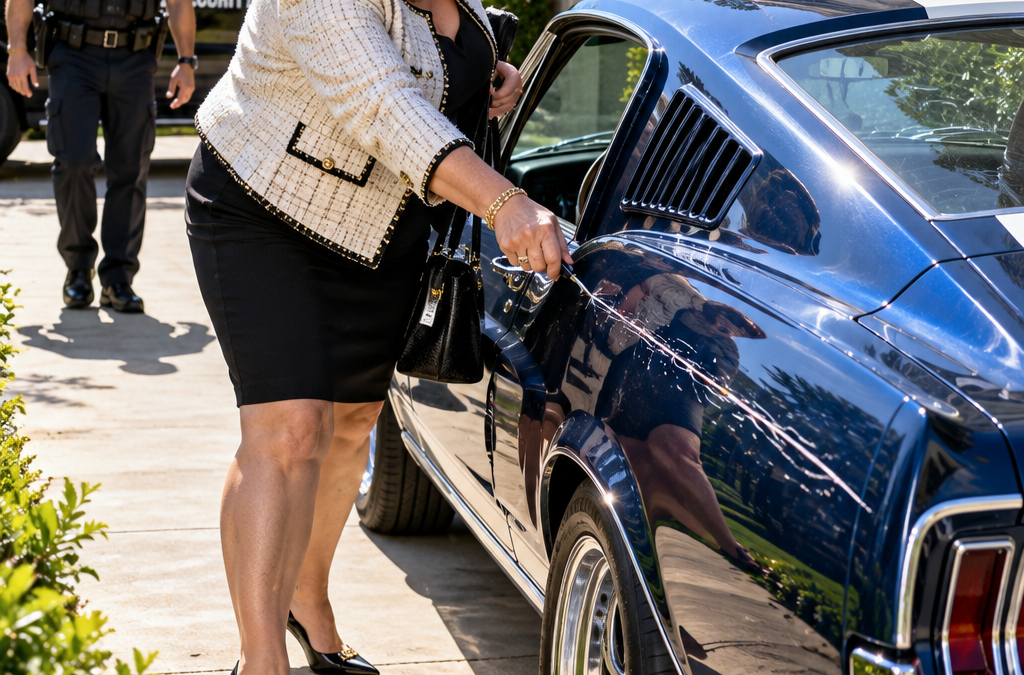
I chose a deep midnight-blue finish with subtle silver ghost stripes that appeared only when sunlight struck the body at the right angle.
It was expensive.
More expensive than I had originally planned.
But after years of work, I wanted the finish to be perfect.
When the body shop finally rolled the completed Mustang into the sunlight, I stood staring at it for several minutes.
The paint looked almost black in the shade.
Then the sun touched the curves of the hood, and the blue came alive.
It was beautiful.
I remember calling my father and sending him a photograph.
He replied with four words.
You did it, son.
I kept that message.
So when I bought my house in Maple Ridge Estates, I made sure the property had room for the car.
I checked the community restrictions before closing.
I read the parking provisions.
The garage rules.
The driveway requirements.
There were restrictions on abandoned vehicles, commercial trucks, trailers, and cars stored in visibly inoperable condition.
My Mustang didn’t fall into any of those categories.
It was registered.
Insured.
Fully operational.
Beautifully maintained.
I didn’t imagine anyone would have a problem with it.
On moving day, I parked the Mustang in the driveway while the moving truck unloaded furniture.
Several neighbors stopped to admire it.
A man named Peterson, who lived two doors down, leaned against his fence and smiled.
“That’s a sixty-seven, isn’t it?”
“Yes, sir.”
“You restore it yourself?”
“Most of it.”
He whistled.
“That’s a beautiful machine.”
I grinned.
“Thanks.”
That was the kind of neighborhood interaction I’d hoped for.
A conversation about cars.
A friendly introduction.
Maybe somebody asking where I’d bought the houseplants.
Then Deborah Whitfield arrived.
She came down the sidewalk carrying a leather folder and wearing a cream-colored cardigan over a pale blouse.
Her hair was cut into a neat, expensive-looking bob.
Oversized sunglasses rested above her forehead.
Her lipstick was bright red.
She walked with the kind of confidence that made people move aside before she reached them.
“You must be Mr. Collins.”
I turned.
“That’s me.”
She smiled.
“Deborah Whitfield. HOA president.”
I shook her hand.
“Nice to meet you.”
“Welcome to Maple Ridge Estates.”
“Thank you. I’m looking forward to living here.”
She glanced at the house.
Then at the moving boxes.
Then at my Mustang.
Her smile faded slightly.
“Is that your vehicle?”
I followed her gaze.
“Yes.”
“A classic?”
“Nineteen sixty-seven Mustang.”
“I see.”
She slowly walked toward it.
For a moment, I assumed she wanted a closer look.
Instead, she examined the paint with an expression I would later learn to recognize.
Disapproval.
“That’s a rather unusual color.”
I smiled.
“Custom finish. Midnight blue with silver detailing.”
She tilted her head.
“It doesn’t really match our aesthetic guidelines.”
I laughed.
I honestly thought she was joking.
“It’s a car.”
She looked at me.
“Yes.”
“Not a house.”
Her smile tightened.
“Everything visible from the street contributes to the neighborhood’s appearance.”
I glanced toward Peterson’s driveway.
His pickup had a faded red hood and a dented tailgate.
Nobody seemed bothered by that.
I looked back at Deborah.
“I reviewed the vehicle rules before buying. Didn’t see anything about paint color.”
She adjusted the folder beneath her arm.
“The board has discretion over matters affecting visual consistency.”
I nodded politely.
“Well, the car’s registered and runs perfectly. It won’t be sitting here in pieces.”
Her eyes moved over the Mustang again.
“We’ll see.”
Two words.
Quietly spoken.
But there was something in the way she said them that made me uncomfortable.
She wished me a pleasant afternoon and walked away.
I watched her disappear down the sidewalk.
Peterson came over a few minutes later.
“Meet Deborah?”
I laughed.
“Sure did.”
He smiled without much humor.
“Then you’ve had your official welcome.”
I thought he was joking.
Two days later, the first violation notice appeared on my front door.
It was printed on Maple Ridge Estates letterhead.
Violation: Nonstandard Vehicle Color Visible From Street.
Fine: $150.
I read it twice.
Then walked outside and looked at the Mustang.
The morning sun was shining across the hood.
The ghost stripes were barely visible.
I looked back at the notice.
One hundred and fifty dollars.
For the color of my car.
I laughed.
Not because it was funny.
Because it was so ridiculous I couldn’t imagine someone being serious.
I went inside, opened my closing documents, and pulled out the HOA governing rules.
I read the vehicle section.
Then the architectural standards.
Then the enforcement provisions.
Nothing.
There was no rule prohibiting a midnight-blue car.
No rule requiring vehicles to match house colors.
No clause giving the president personal authority to reject custom automotive paint.
I photographed every relevant page.
Then emailed the management office.
I asked for the specific provision supporting the violation.
The response came the following afternoon.
The citation was issued under the president’s discretionary aesthetic authority.
I stared at the screen.
Discretionary aesthetic authority.
That phrase sounded official.
But I couldn’t find it anywhere in the governing documents.
I replied politely.
I requested the board resolution establishing that authority.
Nobody sent one.
Instead, another notice arrived.
This time it concerned my trash cans.
Apparently, I had left them near the curb one hour past the permitted collection window.
I checked my security camera.
The sanitation truck had been late that morning.
I brought the bins back shortly after collection.
Yet I received another fine.
I looked down the street.
Peterson’s cans were still sitting near his driveway.
Several houses had bins visible from the road.
None of those neighbors seemed to be receiving notices.
At first, I told myself not to turn an annoying situation into a conspiracy.
Maybe somebody had complained specifically about my house.
Maybe the HOA had a new enforcement contractor.
Maybe Deborah was simply overzealous.
Then a third citation arrived.
And a fourth.
One concerned the Mustang being visible from the sidewalk.
Another described the driveway’s appearance as inconsistent with community standards.
One warned that repeated noncompliance could result in escalating administrative penalties.
I read the letters at my kitchen table.
Every one bore Deborah’s signature or authorization.
I began noticing that enforcement seemed remarkably selective.
Peterson’s fence sagged toward the sidewalk.
Another neighbor had a faded mailbox.
A house across the street had decorative lights hanging well beyond the holiday season.
I didn’t care about any of those things.
People had lives.
Houses required maintenance.
Sometimes a fence stayed crooked until somebody found time to repair it.
That was normal.
What bothered me was that Deborah treated my perfectly maintained car like a threat to the entire subdivision while apparently ignoring comparable issues elsewhere.
I wasn’t asking her to punish my neighbors.
I wanted her to stop inventing reasons to punish me.
By the end of my first month, I had received more violation notices than ordinary mail.
The fines began accumulating.
One hundred fifty dollars.
Another administrative penalty.
A repeat-violation charge.
A processing fee.
Then another.
I stopped treating the envelopes as minor annoyances.
I bought a binder.
Every notice went inside.
Every envelope.
Every email.
Every photograph.
I created a spreadsheet listing the date, alleged violation, amount, and rule Deborah claimed to be enforcing.
I compared the entries against the governing documents.
The discrepancies were obvious.
But I wanted the board to address them.
So I attended my first HOA meeting.
The Maple Ridge clubhouse stood near the main gate.
It had polished stone floors, expensive furniture, and a large conference room overlooking a landscaped courtyard.
About thirty residents attended that evening.
Deborah sat at the head of the table.
A wooden gavel rested beside her folder.
I remember staring at it.
A gavel.
At a homeowners association meeting.
I wondered whether she had purchased it herself.
The meeting began with routine business.
Landscaping expenses.
Gate maintenance.
A report about security patrols.
Then Deborah invited questions.
I raised my hand.
She saw me.
Her expression changed before she spoke.
“Mr. Collins.”
“Good evening.”
“You have a question?”
“Yes. I’d like clarification on the vehicle color regulations.”
Several people turned toward me.
Deborah folded her hands.
“What specifically?”
“I’ve been fined for the color of my Mustang. I reviewed the declaration and bylaws, but I couldn’t find that rule.”
She adjusted her glasses.
“The board has discretion over aesthetic matters.”
“Can you show me where that authority is defined?”
Her mouth tightened.
“The standards are established.”
“Then they should be available.”
I kept my voice calm.
“I brought the documents from my closing packet. There’s no restriction on passenger-car paint colors.”
Deborah picked up the gavel.
“Mr. Collins, this is not a courtroom.”
“I understand.”
“Then stop interrogating the board.”
A few residents shifted uncomfortably.
I looked toward the other directors.
“I’m asking a straightforward question. Was the vehicle color rule formally adopted?”
Deborah struck the gavel.
The sound cracked through the room.
“The board has discretion.”
I paused.
“Was there a vote?”
She hit the gavel again.
“This discussion is closed.”
My face grew hot.
Not because I’d been shouting.
Because I’d been treated like a child in front of my neighbors for asking a question every homeowner should have been allowed to ask.
I looked around the room.
Nobody spoke.
A few people kept their eyes on their papers.
Others looked toward Deborah.
I realized something important.
They were afraid of her.
Not physically afraid.
Afraid of becoming the next person receiving violation notices.
So I closed my folder.
“Thank you. I’ll submit my request in writing.”
Deborah gave a tight smile.
“That would be appropriate.”
I sat down.
The meeting moved on.
But the way she had struck that gavel stayed with me.
She hadn’t answered my question.
She had silenced it.
The following morning, I found a certified letter in my mailbox.
The envelope bore the HOA’s legal letterhead.
I opened it in the kitchen.
My eyes went immediately to the total.
$2,400.
Two thousand four hundred dollars in accumulated fines, administrative charges, and processing fees.
The letter threatened a lien against my home if I failed to pay.
I read it again.
My mortgage was current.
My HOA assessments were paid.
I had receipts.
I hadn’t paid the disputed fines because the association had never established that most of them were legitimate.
But the letter made no distinction.
It described the entire amount as collectible debt.
Then warned that legal enforcement could follow.
I set the paper down.
My hands were shaking.
I’d worked too hard to buy that house.
Years of saving.
Months of searching.
A down payment that had drained most of my available cash.
And now the HOA president was threatening to place a lien on it because she disliked the paint on my Mustang.
I sat at the kitchen table for almost an hour.
I wanted to call Deborah and scream.
Instead, I checked the payment records again.
Everything legitimate was current.
I printed the confirmations.
Then I photographed the certified letter and added it to the binder.
That afternoon, I went outside to check the mailbox again.
A woman approached from the house next door.
I had seen her several times.
Her name was Rosa.
She was in her early sixties, with short silver hair and a habit of tending her flower beds early in the morning.
We’d exchanged greetings.
Nothing more.
She looked toward my house.
Then lowered her voice.
“Collins, can I talk to you?”
“Of course.”
She glanced down the street.
“Not here.”
That caught my attention.
I followed her onto her porch.
She closed the screen door behind us.
For several seconds, she studied my face.
“Deborah’s going after you.”
I felt my stomach tighten.
“You know about the fines?”
Rosa nodded.
“People talk.”
“Then you know they’re ridiculous.”
She sighed.
“They’re worse than ridiculous.”
I waited.
She looked toward the street again.
“She did this to the Alvarez family last year.”
I frowned.
“The family that moved out?”
Rosa nodded.
“They didn’t want to leave.”
I remembered seeing the empty house during my first visit to Maple Ridge.
A moving truck had been parked outside.
Two children stood near the front steps.
Their mother was crying.
At the time, I assumed they were simply sad about moving.
Rosa’s voice grew quieter.
“Deborah kept fining them. First the fence. Then their mailbox. Then parking. The amounts kept growing. Eventually there were collection notices and threats against the house.”
I stared at her.
“What happened?”
“They lost the place.”
I felt cold.
“Over HOA fines?”
“That’s how it started.”
Rosa looked directly at me.
“And it looked exactly like what she’s doing to you.”
I didn’t know what to say.
She reached into her sweater pocket.
Then held out a small flash drive.
“Take this.”
I looked at it.
“What’s on it?”
“Board records.”
“What kind of records?”
“Unedited meeting minutes and copies of recordings.”
I stared.
Rosa continued.
“I used to help with administrative records. Deborah began controlling what got circulated after meetings.”
“What do you mean?”
“The board would discuss something. Members would raise objections. Sometimes a proposed rule wouldn’t pass.”
She paused.
“Then the version sent to residents would make it sound like the board had approved it.”
I looked down at the flash drive.
“Are you serious?”
Rosa nodded.
“I kept copies before she started deleting the recordings.”
My pulse quickened.
“Why didn’t you report this?”
Her eyes filled with something that looked like shame.
“I tried asking questions.”
She looked toward the house where the Alvarez family had lived.
“Then I saw what happened to them.”
I understood.
She was frightened.
Deborah had controlled that neighborhood for eleven years.
Residents who challenged her suddenly received violations.
People learned to keep quiet.
Rosa placed the flash drive in my hand.
“Your car isn’t the problem, Collins.”
I looked at her.
“Then what is?”
She took a breath.
“You refused to obey her.”
I went home immediately.
I plugged the drive into my laptop and opened the first folder.
Meeting recordings.
Draft minutes.
Final minutes.
Enforcement proposals.
Financial summaries.
I began comparing them.
At first, the differences seemed small.
A sentence shortened.
A disagreement omitted.
A motion summarized vaguely.
Then I found something that made me sit up.
A meeting from several months before I moved in.
The board had discussed expanding aesthetic enforcement.
Deborah proposed giving the president authority to cite vehicles for nonstandard colors and appearances.
Several members objected.
One asked whether such a restriction was permitted under the existing governing documents.
Another worried it would be impossible to enforce consistently.
The proposal never received the approval required to become a binding rule.
But in the final summary sent to residents, the objection had disappeared.
The policy was described as an established enforcement standard.
I stared at the screen.
The same supposed standard Deborah had used to fine my Mustang.
I opened another recording.
Processing fees.
Deborah had proposed adding an administrative charge to every fine.
The discussion showed disagreement about the amount and who would receive the money.
Yet later account summaries treated the fee as routine.
I opened the associated financial reports.
There were entries I couldn’t explain.
Fees listed separately from ordinary association assessments.
Charges directed through an administrative processing arrangement.
The records didn’t yet prove where the money ended up.
But they showed that Deborah had been presenting disputed measures as approved policy.
I sat back.
My heart hammered.
Until that moment, I had believed she was abusing her position because she disliked me.
Now I saw evidence that the problem was larger.
She appeared to be inventing enforcement authority.
Turning it into fines.
And attaching charges that benefited an arrangement residents hadn’t properly approved.
The Alvarez family had lost their home after a similar campaign.
I looked at the lien threat on my desk.
It was no longer just an ugly letter.
It was a warning about where this could end.
I called Rosa.
“Where did you get these recordings?”
“From the board’s original records when I still had access.”
“Do you have the full files?”
“Yes.”
“Can you confirm they’re authentic?”
“I can explain exactly when they were made and how I saved them.”
I let out a long breath.
“Thank you.”
She was silent.
Then she said, “Be careful.”
I looked toward the window.
My Mustang sat beneath the driveway light.
“I will.”
That night, I barely slept.
I kept returning to one thought.
Proof mattered.
But evidence of manipulated meeting minutes might not stop Deborah from continuing to threaten me.
She could claim misunderstanding.
Blame administrative mistakes.
Insist the board had delegated authority informally.
I needed to preserve everything.
So I bought a parking-mode dash camera for the Mustang.
I installed it carefully, with the camera covering the driveway approach and the car’s exterior.
It recorded while the car was parked.
I also adjusted my existing home security camera to capture the driveway from another angle.
Both covered my own property.
I tested them.
Checked the timestamps.
Reviewed the recordings.
Made sure the storage function worked.
I told myself I was being paranoid.
I hoped I was.
Two weeks passed.
The fines kept coming.
Deborah issued another administrative notice concerning the Mustang.
I responded in writing.
I requested the rule.
The board vote.
The adopted fine schedule.
The legal basis for attaching enforcement charges to my property.
I also disputed the lien threat and demanded an accurate account ledger.
No adequate response arrived.
Instead, Deborah sent a notice of an emergency property inspection.
The inspection was scheduled for a weekday morning.
A time when I would ordinarily be at work.
I read the letter twice.
Then called the management office.
“Why is this an emergency inspection?”
The clerk hesitated.
“The president authorized it.”
“For what emergency?”
“Vehicle compliance.”
I stared at the phone.
“A car’s paint color is an emergency?”
“I’m sorry, Mr. Collins. I don’t have additional information.”
I asked whether I needed to be present.
She said no.
Deborah would conduct the inspection from areas the association claimed were accessible for exterior review.
I looked toward the driveway.
Something about the timing bothered me.
Deborah knew my usual work schedule.
She had mentioned it casually during an earlier confrontation.
She knew when my car was generally parked.
And now she wanted to inspect the property while she believed I would be away.
I decided to take a personal day.
I didn’t tell Deborah.
I didn’t announce it to anyone at the clubhouse.
I simply stayed home.
That morning, I made coffee and sat in the living room.
The blinds were mostly closed.
The Mustang stood in the driveway, clean and polished.
Sunlight moved slowly across the midnight-blue paint.
I checked the security cameras.
Both were recording.
At 9:17, a white SUV came down Maple Ridge Lane.
Deborah’s vehicle.
I set down my coffee.
She parked near the curb.
Stepped out.
Adjusted her cardigan.
Then looked toward my front windows.
I remained still.
She walked up the driveway.
Alone.
No board member.
No management employee.
No inspection assistant.
Just Deborah with her leather folder.
She circled the Mustang once.
I watched through the blinds.
She examined the hood.
Looked toward the street.
Then moved along the driver’s side.
She glanced behind her.
Once.
Twice.
I felt something tighten in my stomach.
She put the folder beneath her arm.
Reached into her cardigan pocket.
And pulled out a small metal key.
I stared.
For half a second, my brain refused to understand what I was seeing.
Then she placed the key against the rear quarter panel.
And pulled.
Slowly.
Deliberately.
The metal scraped along the custom paint.
From the rear quarter panel toward the door.
A long, ugly line appeared across the dark-blue finish.
I stopped breathing.
Five years.
Five years of rebuilding.
Five years of saving.
Five years of working extra hours to pay for that finish.
And Deborah Whitfield was destroying it because she couldn’t make me pay fines for a rule that didn’t exist.
I stood.
My chair scraped the floor.
The movement startled me back into the room.
I grabbed my phone.
Then I heard a vehicle outside.
A small white security SUV rounded the corner.
Maple Ridge Security Patrol.
Officer Reyes stepped out.
Reyes wasn’t a sworn police officer. He worked for the private security company contracted by the HOA.
He was soft-spoken, professional, and usually waved when he passed my house.
He wore a body camera during patrols.
That morning, it was recording.
Deborah didn’t notice him immediately.
She was still beside my Mustang.
Reyes stopped.
His expression changed.
“Ma’am.”
Deborah turned.
The key was still in her hand.
“Step away from the vehicle.”
Her face went pale.
She jerked backward so quickly that the key slipped from her fingers.
It struck the pavement.
I heard the tiny metallic sound through the open window.
Reyes looked down.
Then at the scratch.
Then at Deborah.
“What are you doing?”
She blinked.
“Conducting an inspection.”
Reyes remained still.
“With a key?”
Deborah glanced at the pavement.
Then recovered slightly.
“I was checking for compliance issues.”
He looked at the damaged paint.
“Ma’am, I just watched you drag that key along the car.”
Her mouth opened.
Closed.
Then she said something so absurd that I almost thought I’d misheard her.
“I was testing the paint durability.”
Reyes stared at her.
“Testing the paint?”
“Yes.”
“By scratching it?”
Deborah’s expression hardened.
“You don’t understand the association’s inspection procedures.”
Reyes glanced toward the Mustang again.
Then reached for his radio.
I could hear the disbelief in his voice as he reported an apparent act of vehicle vandalism.
Even under the circumstances, he let out a brief, incredulous laugh.
Not because the damage was funny.
Because Deborah’s explanation was so ridiculous.
I opened the front door.
Stepped onto the porch.
And saw the full scratch for the first time.
It ran nearly six feet along the side of my Mustang.
A jagged silver-white line cutting through the custom finish.
My stomach twisted.
I walked down the steps.
Deborah turned toward me.
Her face changed again.
First surprise.
Then anger.
“What are you doing home?”
I stared at her.
Of all the things she could have said, that was her first question.
“I live here.”
She looked toward the open front door.
Then at my phone.
I was recording.
“Put that away,” she snapped.
“No.”
Her eyes widened.
I stopped several feet from the Mustang.
“You’ve been fining me for rules that don’t exist.”
Several nearby residents had begun coming outside.
Peterson stood on his porch.
A woman across the street stepped onto her driveway.
Rosa appeared near her front steps.
Deborah glanced toward them.
I continued.
“You’ve threatened a lien against my home over fabricated violations.”
She lifted her chin.
“Mr. Collins, you are making accusations you cannot support.”
I pointed toward the scratch.
“And now you’ve damaged my car.”
Her face flushed.
“I was performing an authorized inspection.”
Reyes spoke calmly.
“Ma’am, I witnessed you scratching the vehicle.”
Deborah turned on him.
“You work for this association.”
He nodded.
“My company is contracted by the association.”
“Then you should understand that the president has enforcement authority.”
Reyes looked toward the car.
“Not authority to damage someone’s property.”
For a second, nobody spoke.
Deborah’s mouth tightened.
Her carefully maintained expression began to crack.
I looked directly at her.
“Why?”
She stared.
“Why would you do this?”
“Your vehicle is a continuing violation.”
“Show me the rule.”
She took a step closer.
“You have spent months undermining my authority.”
I felt my anger rise.
“I asked for documentation.”
“You embarrassed me in front of the board.”
“Because you wouldn’t answer the question.”
Her hands tightened.
I pointed toward the Mustang again.
“Did you really think damaging my car would make me move out?”
Her eyes narrowed.
Then she leaned toward me and hissed, “You have no idea what I’m capable of.”
The words hung in the air.
I looked at my phone.
Still recording.
Reyes looked toward his body camera.
Also recording.
Deborah seemed to realize what had happened only after she spoke.
Her expression changed.
She stepped back.
“I didn’t mean—”
“You meant it,” I said.
Reyes moved slightly between us.
“Let’s keep everybody separated.”
He radioed for police assistance.
Deborah immediately began protesting.
She claimed the incident had been misunderstood.
She insisted she had inspection authority.
She argued that the car violated community standards.
But none of those claims explained the key lying beside my rear tire.
Or the six-foot scratch.
Or the footage.
When Charlotte-area law enforcement officers arrived, Reyes described what he had witnessed.
I provided my account.
I showed them the damage.
The dash camera recording.
The home security footage.
My phone video.
One officer photographed the scratch.
Another documented the key.
Deborah stood near her SUV, speaking rapidly into her phone.
Her expression had shifted from anger to something closer to panic.
She kept saying the same thing.
“This is a misunderstanding.”
But the video was clear.
There was no accidental brush against the vehicle.
No inspection tool slipping.
No innocent mistake.
She had approached my car alone.
Looked around.
Removed a key.
And dragged it across the paint.
I watched an officer replay the footage.
Then I had to look away.
Seeing it a second time hurt worse.
The damage wasn’t imaginary anymore.
It wasn’t a threat.
It was real.
I thought about my father standing beside me the day the restoration was finished.
His hand on the hood.
His proud smile.
The years of work.
Then I looked at Deborah.
She had done this because she couldn’t tolerate being questioned.
The responding officers took statements and initiated a vandalism investigation.
Deborah was not allowed to dismiss the event as an HOA matter.
It was damage to private property.
And the evidence would be reviewed through the criminal process.
I stood in the driveway as the officers finished.
My neighbors watched from a distance.
Some looked shocked.
Others seemed almost relieved.
Rosa approached after Deborah was escorted away from the immediate scene.
She stared at the Mustang.
“Oh, Collins.”
I nodded.
She looked at the scratch.
Then at me.
“I’m so sorry.”
For a moment, I couldn’t speak.
Then I said, “At least this time everybody saw it.”
Rosa’s eyes filled.
“That’s what she’s always been afraid of.”
I looked toward the street.
Deborah’s SUV stood beside the curb.
Her leather folder remained on the passenger seat.
For months, that folder had seemed like a symbol of everything she controlled.
Now it was just a folder.
Paper couldn’t explain away the video.
That afternoon, I sat at my kitchen table with the incident report information, my HOA binder, and a photograph of the scratch.
I felt exhausted.
But for the first time since moving in, I also felt certain.
Deborah had crossed a line that couldn’t be concealed behind invented rules or a gavel.
I called an attorney.
Her name was Angela Brooks.
She specialized in property disputes, HOA litigation, and civil claims involving fraudulent enforcement.
I explained the situation.
She listened carefully.
Then asked me to send everything.
The governing documents.
The violation notices.
The lien threat.
Rosa’s meeting records.
The video footage.
The police report information.
The photographs.
And my payment history.
Two days later, I sat across from Angela in her office.
She examined the papers without interrupting.
At first, she focused on the vehicle-color citation.
Then the repeated fines.
Then the processing charges.
Then the recorded board discussions.
She looked up.
“You’ve been documenting this carefully.”
I nodded.
“Deborah never answered a question without threatening me.”
Angela examined the lien letter.
“Your regular assessments are current?”
“Every one.”
“And the claimed balance is based primarily on these disputed fines and added charges?”
“Yes.”
She studied the unedited minutes.
Then the final board summaries.
Her expression tightened.
“These don’t match.”
“I know.”
She read further.
Then looked at the video of Deborah scratching the car.
She watched it once.
Then again.
When she finished, she placed her pen on the table.
“The vandalism evidence is unusually direct.”
I nodded.
“Reyes saw it happen.”
“And the body-camera recording should provide independent corroboration.”
She looked toward the binder.
“But the HOA records concern me even more.”
I leaned forward.
“Why?”
“Because they suggest an enforcement process built on rules the board may never have adopted.”
I felt my stomach tighten.
“Rosa thinks Deborah has been doing it for years.”
Angela nodded.
“Then we need to examine the financial records.”
“Can we?”
“Through appropriate records requests and litigation discovery, yes.”
I watched her.
She continued.
“We’re going to challenge the fines and lien threats. We’ll also pursue the claims supported by the evidence concerning improper enforcement, financial misconduct, and the damage to your car.”
I looked down at my hands.
“Do you think they’ll listen?”
Angela’s expression remained calm.
“A court will examine documents and evidence. Deborah’s title doesn’t make her claims automatically valid.”
I let out a long breath.
For months, I’d felt as though Deborah was the law inside Maple Ridge.
She issued notices.
Controlled meetings.
Silenced questions.
Threatened homeowners.
Now I had an attorney explaining that she was subject to the same legal requirements as everyone else.
I hadn’t realized how badly I needed to hear that.
Angela moved quickly.
She sent formal demands challenging the disputed charges.
She sought the applicable board resolutions, enforcement records, and financial documentation.
She demanded that the association preserve meeting recordings, account ledgers, and communications relating to the fines.
She also challenged the threatened lien and warned against using unsupported assessments as the basis for collection proceedings.
The HOA’s attorney responded defensively.
Deborah denied fabricating rules.
She described the discrepancy between meeting recordings and minutes as administrative confusion.
She insisted the processing fees were standard.
But Angela kept asking the same questions.
Who approved the rules?
When were they adopted?
Where were the records?
Who received the processing fees?
The answers grew increasingly inconsistent.
Then came the financial discovery.
Angela obtained records through the litigation process.
Bank statements.
Internal account ledgers.
Payment histories.
Processing-fee transfers.
Board financial reports.
A forensic accountant began reviewing them.
I remember the day Angela called.
“Collins, I need you to come in.”
Her voice was different.
Serious.
I felt my stomach tighten.
“Did something happen?”
“We’ve found something in the financial records.”
I left work early.
When I arrived, Angela had several documents spread across her conference table.
The forensic accountant sat beside her.
He introduced himself and explained the findings.
Over multiple years, the HOA had collected significant sums through enforcement and processing charges.
Some fees were properly recorded.
Others were not.
A series of transfers directed money away from the association’s ordinary accounts.
The destination was a private account connected to Deborah Whitfield.
The amount identified at that stage was approximately forty thousand dollars.
I stared.
“Forty thousand?”
Angela nodded.
“About that amount in transfers the accountant has traced so far.”
I leaned back.
“From fines?”
“From processing and enforcement-related fees, according to the available records.”
I looked at the documents.
Dates.
Amounts.
Transfer descriptions.
Account references.
Forty thousand dollars.
Residents had been paying money they believed was going toward HOA enforcement.
And Deborah had allegedly been directing a substantial portion into an account tied to herself.
My hands went cold.
“This isn’t just me.”
Angela shook her head.
“No.”
The Alvarez family came up next.
Their records showed the same pattern of questionable violations and charges.
Then the Petersons.
Then six other households.
Some had paid disputed fines to avoid collection threats.
Some had been pressured into compliance with rules they couldn’t verify.
Others had accumulated charges that threatened their finances or property.
The financial evidence turned individual complaints into a much larger case.
Angela explained that several homeowners were preparing coordinated civil claims, including a proposed class action where legally appropriate.
I sat silently.
For months, I’d felt like the only person fighting Deborah.
Now I was learning that an entire neighborhood had been living under the same pressure.
I thought about the HOA meeting.
The people looking down at their papers.
The silence after Deborah struck her gavel.
Suddenly, that silence made sense.
They weren’t indifferent.
They were afraid.
Angela looked at me.
“Your records helped connect the pattern.”
I shook my head.
“Rosa’s flash drive did that.”
“Both mattered.”
I looked toward the window.
“What happens now?”
“We pursue the civil claims, notify the appropriate authorities about the financial findings, and demand that the association stop relying on the fabricated enforcement process.”
I nodded.
“And Deborah?”
Angela chose her words carefully.
“Criminal charging decisions belong to prosecutors. But the evidence warrants investigation.”
For the first time, I understood the real scale of what had happened.
Deborah hadn’t merely been harassing me because she disliked my Mustang.
She had apparently built a system that turned personal control into money.
Invented violations.
Processing charges.
Threats.
A board too intimidated or too compliant to challenge her.
And residents who had learned that paying was easier than fighting.
My Mustang had made me visible.
My refusal had made me inconvenient.
And her anger had pushed her into an act so blatant that the evidence couldn’t be buried.
The story spread through Maple Ridge quickly.
At first, Deborah tried to control it.
She circulated statements claiming the car incident was being misrepresented.
She said the HOA was facing a coordinated attack from disgruntled homeowners.
She accused critics of undermining community standards.
But residents had begun comparing their own documents.
The neighborhood Facebook group, once filled with posts about lost dogs and landscaping recommendations, became a place where people shared their experiences.
A man posted a notice for an unapproved mailbox color.
Another shared a fine for a decorative flag.
Someone uploaded a charge for excessive driveway clutter that turned out to be a child’s bicycle.
Several residents compared processing fees.
The amounts were inconsistent.
The claimed rules were missing.
The notices carried Deborah’s authorization.
People who had remained quiet for years began speaking.
Rosa helped organize the records.
The Petersons joined the coordinated legal action.
Members of the Alvarez family provided documents from the period before they moved.
More households came forward.
The board could no longer pretend the problem involved one disgruntled Mustang owner.
An emergency HOA meeting was scheduled.
I arrived early.
The clubhouse parking lot was nearly full.
Residents crowded the entrance.
People stood holding folders and printed account statements.
I saw neighbors who had barely spoken to me before.
Several nodded.
One man shook my hand.
“Thank you for not backing down.”
I didn’t know what to say.
I hadn’t set out to expose an HOA financial scandal.
I’d simply wanted to park my car in my own driveway.
Rosa approached.
“Ready?”
I looked toward the clubhouse.
“As I’ll ever be.”
She squeezed my shoulder.
“You’re not alone.”
We walked inside.
Deborah sat at the head of the conference table.
She wore a tailored dark blazer.
Her hair was perfectly styled.
Her makeup immaculate.
The gavel lay beside her hand.
For a moment, she looked exactly as she had during my first board meeting.
Confident.
Controlled.
Certain that the room belonged to her.
Then she looked up and saw how many residents had arrived.
Her expression changed.
The meeting began.
Deborah attempted to move through the agenda quickly.
She described the allegations against the association as exaggerated.
She insisted the board had acted responsibly.
She said legal matters should not be discussed publicly.
Then a resident stood.
“Why were we fined under rules the board never approved?”
Deborah struck the gavel.
“Please follow the meeting procedure.”
Another resident stood.
“Where did the processing fees go?”
Her face tightened.
“Those matters are being reviewed.”
Peterson rose from his chair.
“Were you putting association money into a private account?”
The room erupted.
Deborah slammed the gavel.
“Order!”
Nobody stopped.
She struck it again.
“I said order!”
Rosa stood near the front.
Her voice was clear.
“We have the original meeting records.”
The room quieted.
Deborah stared.
Rosa continued.
“We know which rules were proposed. We know which ones were rejected. We know what was changed in the final minutes.”
Deborah’s face reddened.
“Those records were confidential.”
Rosa shook her head.
“They were association governance records. And the residents have a right to know what was actually approved.”
I watched Deborah.
For the first time, she looked trapped.
Not by a person shouting louder than she could.
By evidence she couldn’t easily dismiss.
One board member stood.
He looked exhausted.
“I move that Deborah Whitmore be removed from the presidency effective immediately.”
The room became still.
Deborah stared at him.
“You cannot be serious.”
He didn’t look away.
“I am.”
Another director seconded the motion.
Deborah grabbed the gavel.
“This meeting is out of order!”
The board member continued.
“The association needs independent leadership while these matters are investigated.”
Deborah looked around the table.
“I have served this community for eleven years.”
Nobody answered.
She pointed toward the residents.
“You have no idea how much work I’ve done to keep this neighborhood respectable.”
I felt my jaw tighten.
Eleven years of authority.
Eleven years of residents being afraid to ask questions.
Eleven years of a woman treating community rules as her personal weapons.
The vote proceeded under the board’s removal procedure.
Every eligible director voted to remove her from the office of president.
Unanimously.
Deborah stared at the table.
The gavel remained in her hand.
Then one of the directors spoke quietly.
“Deborah, you’re no longer presiding.”
She looked up.
“Excuse me?”
“Please give me the gavel.”
For a moment, she didn’t move.
Then she placed it on the table.
The sound was small.
Barely noticeable.
But it felt larger than every angry blow she had struck during the previous months.
The board announced further steps to address her remaining board status and the independent investigation.
Residents began applauding.
Some stood.
Others simply sat with their heads lowered.
Rosa wiped tears from her eyes.
I watched Deborah gather her folder.
She wouldn’t look at me.
She walked out through the side door.
And for the first time since I’d moved into Maple Ridge, the clubhouse felt like a place belonging to the residents rather than one person.
The criminal case continued separately.
The vandalism investigation was supported by unusually clear evidence.
My parking-mode dash camera showed Deborah approaching the Mustang.
My home security camera provided another angle.
Reyes’s body camera captured the act and immediate confrontation.
The photographs documented the damage.
The key had been identified.
My statement matched the recordings.
Deborah’s explanation about testing paint durability was included in the investigation.
So was her threat.
“You have no idea what I’m capable of.”
Every time I heard that sentence during the legal proceedings, I felt the same cold sensation I’d experienced in the driveway.
She had said it because she believed intimidation still worked.
She hadn’t realized that two cameras were preserving every word.
When the vandalism case reached court, Deborah’s attorney challenged aspects of the evidence and tried to minimize the incident.
He described it as a misunderstanding arising from a heated property dispute.
But the video showed a deliberate act.
There was nothing ambiguous about the movement of her hand.
Nothing accidental about the long scratch.
Nothing resembling an authorized HOA inspection.
I testified about the restoration.
The cost.
The damage.
And the events leading up to the incident.
I described how I’d spent five years bringing the car back to life.
How much of the work I’d completed myself.
How carefully the paint had been applied.
Then I explained what I saw through the blinds.
Deborah looked straight ahead while I spoke.
I tried not to look at her.
I focused on answering the questions.
The judge reviewed the evidence.
The vandalism allegations were substantiated, and the criminal proceedings produced a finding against Deborah for the damage to my car.
Meanwhile, the financial investigation had progressed.
Prosecutors had reviewed the transfers identified by the forensic accountant.
Additional felony charges related to alleged embezzlement and misuse of HOA funds were brought through the appropriate criminal process.
Those matters remained subject to their own proceedings.
The criminal court imposed release conditions that restricted Deborah from returning to HOA property or contacting relevant witnesses except as legally permitted.
I remember leaving the courthouse after one of those hearings and realizing how different everything felt.
Months earlier, Deborah had threatened my home with a lien.
Now she was the person facing court-imposed restrictions.
She had spent eleven years telling homeowners that rules were absolute.
Yet she had apparently believed those same rules didn’t apply to her.
I didn’t celebrate the sight of her facing criminal charges.
It was too serious for that.
But I felt relief.
She could no longer show up in my driveway with a clipboard and threaten me into silence.
The civil case took longer.
HOA records had to be audited.
Improper charges identified.
Individual homeowners’ payments reconciled.
The association had to determine which fines were legally supportable and which had been imposed without proper authority.
The financial review uncovered more inconsistencies.
Residents who had paid fabricated or unauthorized charges became entitled to seek refunds and related relief.
The Alvarez family participated in the effort to obtain compensation for what had happened to them.
The Petersons challenged their own questionable charges.
The six other households whose records had revealed similar practices pursued their claims.
The litigation became a coordinated attempt to repair years of improper enforcement.
I learned that correcting financial misconduct wasn’t as simple as exposing it.
Money had been moved.
Accounts had to be traced.
Insurance coverage examined.
Liability allocated.
Individual losses calculated.
The association itself had to be stabilized because residents still needed the gates maintained, landscaping completed, security contracted, and ordinary community services funded.
I didn’t want Maple Ridge destroyed.
I lived there.
My neighbors lived there.
The problem had never been the existence of an HOA.
It was the way Deborah had turned its authority into a personal weapon.
The new leadership began rebuilding trust.
Meetings were recorded and preserved under clearer procedures.
Fine schedules were reviewed against the governing documents and applicable law.
Residents received more transparent account information.
Processing fees were scrutinized.
The board established limits on unilateral enforcement decisions.
Nobody was allowed to invent an aesthetic standard simply because they disliked a particular homeowner.
There were still rules.
Grass still needed mowing.
Trash bins still had designated storage areas.
Common property still required maintenance.
But those rules had to be legitimate.
Documented.
Consistently enforced.
And open to challenge through proper procedures.
That was all I’d asked for from the beginning.
Eventually, the civil litigation reached a settlement covering the damage to my Mustang, my legal costs, and the improper HOA charges.
Every fabricated lien claim against my property was cleared.
The disputed fines were reversed.
My account was corrected.
The settlement funded the repairs to my car, with enough to have the damaged panels refinished professionally rather than patched.
When the restoration shop called to say the Mustang was ready, I drove over before work.
I was nervous.
I knew it was ridiculous.
A car was a car.
The damage could be repaired.
But I had spent months looking at that six-foot scratch.
Every time I saw it, I remembered Deborah standing in my driveway.
I remembered her face.
The key.
The threat.
The fear that my home and everything I’d worked for could be taken because I refused to obey someone abusing her authority.
The shop manager led me into the service bay.
The Mustang stood beneath bright overhead lights.
I stopped.
The paint was beautiful.
Deep midnight blue.
Smooth.
Reflective.
The silver ghost stripes moved beneath the clear coat as I changed position.
I walked slowly along the driver’s side.
The scratch was gone.
Not hidden beneath touch-up paint.
Gone.
The damaged area had been refinished and blended with the rest of the body.
I crouched beside the rear quarter panel.
Ran my eyes along the curve.
Then stood.
The manager smiled.
“What do you think?”
I swallowed.
“Better than before.”
He nodded.
“That’s what we were aiming for.”
I walked around the car again.
Then opened the driver’s door.
The familiar interior smelled of leather and clean upholstery.
I sat behind the wheel.
Placed my hands on it.
And remembered the first time the engine started after the rebuild.
My father had stood beside me.
We had both laughed when the engine finally caught.
That memory returned so clearly that my eyes burned.
I started the Mustang.
The V8 came to life with a deep, steady rumble.
I smiled.
For the first time in months, the sound brought nothing but happiness.
I drove home with the windows cracked slightly, listening to the engine.
The sun was low when I turned through the gates of Maple Ridge.
I passed the clubhouse.
The landscaped entrance.
The streets Deborah once patrolled as though she owned every driveway.
Then I turned onto my road.
Peterson was outside checking his mailbox.
He looked up when he heard the Mustang.
His face broke into a grin.
“There she is!”
I laughed.
“Back where she belongs.”
He walked over as I parked.
He examined the paint.
“Good Lord. They did a beautiful job.”
“They did.”
He leaned closer.
“You can’t even tell.”
I looked along the side.
“No.”
He straightened.
“Good.”
Then his expression became serious.
“I’m glad you stuck with it.”
I nodded.
“Me too.”
We stood there for a moment.
Then Peterson glanced toward his house.
“My wife wants you to come over for dinner sometime. She says we owe you one.”
I shook my head.
“You don’t owe me anything.”
He looked at me.
“Maybe not. But you helped a lot of people.”
I didn’t know what to say.
I’d spent months believing I was fighting alone.
Now I was beginning to understand how many people had been waiting for somebody to challenge the system that frightened them.
A few days later, the court’s decision in the vandalism matter became final.
The related financial criminal charges remained part of Deborah’s larger legal reckoning, and the civil judgments and settlement obligations continued to affect her financially.
That evening, Rosa knocked on my door.
I opened it.
She stood on the porch holding a casserole dish covered in aluminum foil.
“Thought you might not feel like cooking.”
I laughed.
“You didn’t have to do that.”
“I know.”
She walked past me into the kitchen.
I followed.
“What’s in it?”
“Chicken, rice, vegetables, and enough cheese to make your doctor complain.”
I laughed again.
She set the dish on the counter.
Then looked toward the driveway.
The Mustang was parked outside.
The evening sunlight made the blue paint glow.
Rosa smiled.
“Looks beautiful.”
“Thanks.”
She stood quietly for a moment.
Then said, “You know, I nearly threw that flash drive away.”
I turned.
“What?”
She nodded.
“After the Alvarez family moved. I thought keeping those records would only make me angry.”
I stared at her.
“Why didn’t you?”
She looked toward the window.
“I kept thinking somebody might need them someday.”
My throat tightened.
“I’m glad you did.”
She gave a small smile.
“So am I.”
We sat at the kitchen table while the casserole warmed.
She told me about the first Maple Ridge meetings after Deborah’s removal.
People were asking questions again.
Real questions.
About budgets.
About landscaping contracts.
About financial reserves.
About how violations were documented.
The new board didn’t always agree.
Meetings occasionally ran long.
Residents argued about ordinary things.
Gate repairs.
Parking.
Lawn maintenance.
But nobody was afraid to raise a hand.
Rosa looked at me.
“The whole place feels different.”
I nodded.
“It does.”
She smiled.
“Like everybody’s been holding their breath for eleven years.”
That description stayed with me.
A neighborhood full of homeowners had spent years living under a woman who could turn any disagreement into a fine.
She had controlled the meetings.
Controlled enforcement.
Controlled access to records.
And allegedly used that power to extract money.
People had adapted by remaining quiet.
By paying questionable charges.
By avoiding confrontation.
By pretending not to notice.
Now the pressure was gone.
And the neighborhood was learning how to breathe again.
I still think about the Alvarez family.
Of everyone affected, they were among the people I wish I could have helped sooner.
They had lost their home before I moved into Maple Ridge.
By the time I learned their story, the damage had already happened.
Their experience became important evidence in the coordinated legal claims.
The settlement and related proceedings provided a path toward financial compensation and correction of the improper charges.
But no payment could erase the memory of packing their belongings under pressure.
No refund could return the exact months they’d lost.
No court filing could make their children forget leaving the neighborhood in tears.
That was why I stopped thinking of Deborah’s conduct as petty tyranny.
Petty tyranny is an annoying letter about a mailbox.
This was something more serious.
It was an abuse of authority that had real consequences for people’s homes, money, and sense of security.
Deborah had used the appearance of official power to make ordinary residents feel helpless.
She had assumed nobody would take the time to compare meeting recordings with final minutes.
Nobody would ask where the processing fees went.
Nobody would challenge the lien threats.
And nobody would risk becoming her next target.
She was wrong.
Rosa had kept the files.
I had kept the notices.
Reyes had done his job.
The cameras had recorded the truth.
Angela had followed the money.
Other homeowners had come forward with evidence.
And the legal process had finally forced Deborah to answer questions she had spent years silencing with a gavel.
Several months after the ordeal, I was washing the Mustang in my driveway when Peterson came over.
He looked at the car.
Then toward the clubhouse.
“You ever think about moving?”
I paused.
“After all this?”
“Yeah.”
I rinsed the sponge.
For a moment, I considered the question seriously.
There had been nights when I wanted nothing more than to sell the house and leave.
Nights when I wondered why I’d worked so hard to buy property in a neighborhood where somebody could threaten my ownership because she disliked my car.
But things had changed.
The board was different.
The records were open to proper scrutiny.
The false charges were gone.
My neighbors had become people I knew rather than strangers I passed on the street.
And the Mustang looked better than ever.
I shook my head.
“No.”
Peterson smiled.
“Good.”
I looked around.
The street was quiet.
Children were riding bicycles near the corner.
Rosa was tending flowers beside her porch.
A delivery truck stopped farther down the road.
The sun moved across the polished hood of my car.
Nothing about the moment was dramatic.
And that was exactly why I wanted to stay.
I hadn’t bought the house to fight somebody.
I’d bought it because I wanted a place to live.
A driveway for the Mustang.
A garage where I could work on engines.
Neighbors I could wave to.
Peace.
Deborah had tried to turn that ordinary dream into a contest over her authority.
She had lost.
I dried the hood with a clean microfiber towel.
Peterson watched.
“Still can’t believe she scratched it herself.”
I glanced at him.
“Neither can I.”
He shook his head.
“All because she didn’t like the color.”
I thought about that.
Then I said, “I don’t think it was ever really about the color.”
Peterson looked at me.
I continued.
“The first time she told me the Mustang didn’t belong here, I asked her to show me the rule.”
He nodded.
“She couldn’t.”
“Exactly.”
I leaned against the driveway wall.
“She was used to people accepting whatever she said. I didn’t. That’s what made her angry.”
Peterson looked toward the clubhouse.
“And the fines?”
“A way to punish people and make money while doing it.”
He sighed.
“Eleven years.”
I nodded.
“Eleven years.”
We stood quietly.
Then he walked back toward his house.
I finished drying the Mustang.
The sunlight had shifted.
The ghost stripes appeared along the hood, subtle and silver against the blue.
I stepped back and looked at the car.
I thought about the day I found it abandoned behind the repair shop.
Rusted.
Broken.
Forgotten.
Most people had seen junk.
I had seen potential.
It took years to bring that car back.
And when Deborah damaged it, part of what hurt was the feeling that she had treated those years of work as meaningless.
As though the car was simply an object she could destroy to make a point.
But the damage had been repaired.
The person responsible had been held accountable.
And the car remained what it had always been.
Something I had built with my own hands.
I opened the driver’s door and sat behind the wheel.
The interior smelled faintly of leather.
The dashboard lights glowed when I turned the key.
The engine started immediately.
I listened to its familiar rumble.
Then I remembered Deborah standing beside the driveway on the morning of the inspection.
Her cardigan.
Her key.
Her confident expression.
The way she had looked over her shoulder to make sure nobody was watching.
She had believed that if there were no witnesses, she could do whatever she wanted.
That had been the central mistake behind everything.
She believed authority meant she didn’t have to answer questions.
She believed residents would accept rules they couldn’t verify.
She believed a gavel could end any disagreement.
She believed processing fees could disappear into private accounts without anyone connecting the numbers.
And on the morning she approached my Mustang, she believed the absence of an audience meant the absence of accountability.
But the evidence existed.
In the HOA records.
In the financial transfers.
In the witness statements.
And in the cameras watching my driveway.
The truth didn’t depend on whether Deborah wanted anyone to hear it.
I sat behind the wheel for a moment longer.
Then turned off the engine.
Outside, the neighborhood was quiet.
The same gates stood at the entrance.
The same brick houses lined the streets.
The same clubhouse stood beside the landscaped courtyard.
But the people running Maple Ridge no longer treated homeowners as subjects who had to earn permission to enjoy their own property.
And I no longer felt anxious when I opened my mailbox.
The threat of fraudulent liens had been removed from my property.
The settlement had paid for the Mustang’s restoration.
The homeowners affected by the manufactured violations were pursuing the compensation they deserved.
Deborah had lost her presidency, faced a vandalism judgment, and was confronting serious felony financial charges supported by the investigation.
The civil liabilities would continue long after the neighborhood stopped talking about her.
I didn’t need to watch every hearing.
I didn’t need to follow every development.
The important part was already clear.
She had been forced to answer for actions she once believed nobody could challenge.
I stepped out of the Mustang and closed the door.
The evening sun reflected off the deep-blue finish.
I walked toward the front porch.
Before going inside, I looked back one more time.
The car was parked exactly where Deborah had first told me it didn’t belong.
My own driveway.
My own home.
A fully restored 1967 Mustang that violated no legitimate rule simply by being painted the color I loved.
I smiled.
Three months earlier, I’d believed Maple Ridge Estates would be the beginning of a quieter chapter of my life.
Instead, it became the place where I learned how quickly someone with a little authority could try to turn another person’s independence into a punishable offense.
But I also learned something I hadn’t fully understood before.
You don’t defeat that kind of power by becoming as cruel as the person using it.
You defeat it by refusing to surrender the facts.
By keeping records.
By asking for the actual rules.
By preserving evidence.
By finding people willing to tell the truth.
And by making sure authority remains accountable to the people it is supposed to serve.
Deborah Whitfield spent eleven years making Maple Ridge afraid of her.
She could silence a meeting.
Invent a violation.
Threaten a homeowner.
Or use her position to make a person feel that resistance would only make things worse.
But she couldn’t erase what the cameras saw.
She couldn’t make the missing board approvals appear.
She couldn’t explain away forty thousand dollars in suspicious transfers by banging her gavel.
And she couldn’t turn deliberate vandalism into legitimate HOA enforcement.
The six-foot scratch that was supposed to intimidate me became the evidence that exposed her.
My Mustang survived.
My home survived.
And the neighborhood finally began recovering from the woman who had treated it like her private kingdom.
I went inside and placed my keys on the kitchen counter.
Through the front window, I could still see the Mustang sitting beneath the fading sunlight.
The paint gleamed.
The silver stripes caught the light.
There wasn’t a scratch along the side.
For the first time since moving to Maple Ridge, I looked out at my driveway without wondering what Deborah might do next.
All I saw was the car I’d rebuilt, parked in front of the home I’d earned.
And that was exactly where it belonged.








