𝙍𝙚𝙖𝙙𝙈𝙤𝙧𝙚👉 My Grandpa’s Neighbor Kept Breaking Into His Backyard—So He Gave Her One Warning She Couldn’t Ignore
𝗣𝗔𝗥𝗧 𝟮
Grandpa looked upward.
At the sun.
Then at her.
“The shadow?”
“It falls into my yard.”
“Yes.”
“It reduces my sunlight.”
Grandpa stared at the thirty-year-old apple tree.
Then looked at Karen.
“You want me to move the sun?”
She became furious.
He swears he wasn’t joking.
I believe him.
That was Grandpa.
Literal.
Calm.
Sometimes accidentally devastating.
Karen also started mentioning connections.
“My cousin is a lawyer in Almaty.”
Or:
“I know people at the akimat.”
For people unfamiliar with Kazakhstan, the akimat is essentially the local municipal administration.
She dropped these comments casually.
Never exactly threatening.
Just enough to imply that resisting her might become complicated.
Grandpa had heard versions of that behavior his entire life.
He ignored it.
Every concession he made only encouraged her.
Move the compost?
She complained about the workshop.
Reduce workshop vibration?
She complained about chickens.
Move chickens?
She complained about sunflowers.
Trim plants?
She complained about the apple tree.
It became obvious she didn’t want one problem solved.
She wanted Grandpa to accept that she had authority over his property.
He never did.
Then she crossed the fence.
The first time Grandpa caught her inside his yard, he almost thought he had misunderstood what he was seeing.
He had been out buying supplies.
When he returned, Karen was standing near the rear garden.
Inside his property.
Several meters beyond the fence.
She was walking slowly between plants, looking down as though inspecting something.
Grandpa set his bag down.
“What are you doing?”
Karen turned.
Not startled.
Not embarrassed.
That was the strange part.
She behaved as though he had interrupted her.
“Checking the plants.”
“Why?”
“To make sure nothing is growing onto my property.”
Grandpa looked toward the fence.
Then back at her.
“You can see the fence from your side.”
Karen folded her arms.
“I need to check properly.”
“No.”
She blinked.
“What?”
“Do not come into my yard without asking.”
“I am only inspecting the boundary.”
“It is still my yard.”
“You’re being dramatic.”
Grandpa opened the gate.
“Please leave.”
Karen muttered something under her breath and walked out.
He assumed that would end it.
It didn’t.
Over the next few months, she entered his property again.
And again.
And again.
Sometimes Grandpa caught her.
Sometimes neighbors saw her.
Sometimes he found signs afterward.
A moved flowerpot.
A gate that wasn’t positioned how he’d left it.
Footprints near the workshop.
At first, Grandpa wondered whether she genuinely misunderstood.
Then he installed a simple lock.
That should have eliminated accidental entry.
Instead, she continued getting inside.
Whether she manipulated the lock, climbed the fence, or entered somewhere else changed depending on the day.
One neighbor eventually told Grandpa:
“I saw her climb over.”
This woman was in her forties.
Well dressed.
Apparently climbing a metal fence because an elderly neighbor wouldn’t give her permission to inspect his tomatoes.
The situation moved from annoying to bizarre.
Grandpa found her once beside the workshop.
She was looking through a window.
“What do you need?”
Karen spun around.
“Nothing.”
“Then why are you looking inside?”
“I thought I saw something unsafe.”
“This is my workshop.”
“It could affect neighboring properties.”
“No.”
Grandpa pointed toward the gate.
“Leave.”
She did.
Another week, he found her with a tape measure.
She was measuring along the rear fence.
That was when the real motive finally appeared.
Grandpa walked toward her.
“What are you measuring?”
Karen didn’t stop.
“The property.”
“Why?”
“Because this fence is wrong.”
Grandpa waited.
Karen pulled the tape farther.
“This section belongs to me.”
Grandpa thought he had misheard.
“What?”
“The fence is on my land.”
He stared at the fence he had personally installed roughly two decades earlier.
“No.”
“Yes.”
“No.”
Karen stood.
“When I purchased my house, I was told the property extended farther.”
“Who told you?”
“My real estate agent.”
“Show me the survey.”
She waved one hand dismissively.
“I don’t need paperwork.”
Grandpa almost smiled.
That sentence coming from someone claiming land was incredible.
“You need paperwork very much.”
“Everyone around here knows the real boundary.”
Grandpa looked toward the neighboring houses.
“No one knows this because it is not true.”
“You’ve been using my land for years.”
“I owned this land before you moved here.”
“Which doesn’t mean your fence is correct.”
“Then go to the land office.”
Karen stepped closer.
She was wearing that white military-style jacket that day, gold buttons flashing in the sun.
“My cousin is an attorney.”
“Good.”
Grandpa nodded.
“Ask him where land records are kept.”
That made her furious.
“You think because you’re old you can bully me.”
I laughed for several minutes when Grandpa told me that sentence.
He is the least theatrical person I know.
Karen was standing illegally inside his garden claiming part of his property, and somehow he was bullying her.
Grandpa told her:
“If you believe the boundary is wrong, use the legal process.”
“I know what belongs to me.”
“Then prove it.”
She couldn’t.
From that day forward, the trespassing intensified.
Karen started acting as if repetition could create ownership.
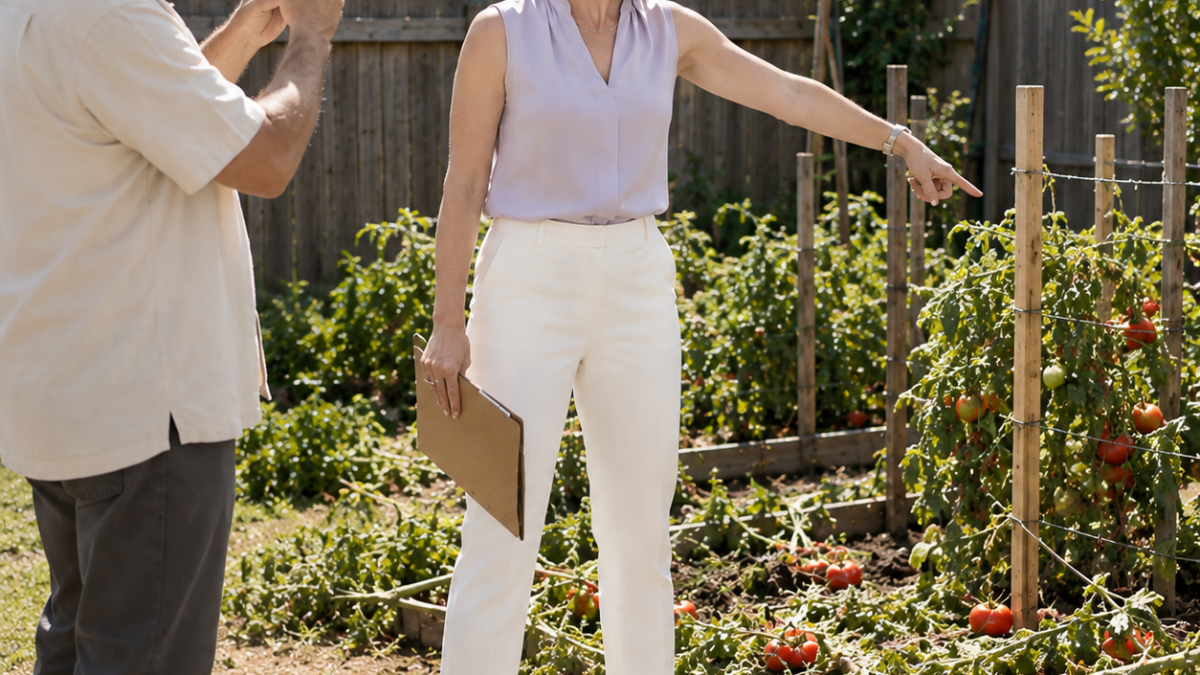
She came into Grandpa’s yard carrying a clipboard.
Actually a clipboard.
She walked along the fence, writing notes.
Grandpa found her.
“What are you doing?”
“Documenting violations.”
“Of what?”
“My property rights.”
“You have no property here.”
“That will be determined.”
“By who?”
Karen didn’t answer.
Another time, she brought a friend.
The two women stood near Grandpa’s garden discussing where Karen claimed her land should extend.
Karen pointed.
“From there.”
The friend nodded.
“Probably.”
Grandpa walked outside.
“You two finished?”
Karen turned.
“We’re discussing my property.”
“You’re standing on mine.”
The friend suddenly looked uncomfortable.
Karen didn’t.
She pointed at several garden tools near the fence.
“These need moving.”
“No.”
“They’re on my land.”
“No.”
She picked up a rake.
Grandpa took it from her.
“Do not touch my things.”
“I have every right.”
“No.”
Again that simple word.
No.
Karen hated it more every time.
Eventually, she began moving equipment while Grandpa wasn’t around.
Small things.
A bucket.
Garden tools.
Wooden stakes.
She would toss them farther into the yard and later claim they had been on her side.
Then she attacked the tomatoes.
That was the moment Grandpa stopped believing patience would solve anything.
It happened in the afternoon.
He had eaten lunch and fallen asleep in a chair.
Normal Grandpa nap.
At some point, noise from the garden woke him.
Wood scraping.
Something falling.
He walked outside.
Karen was several meters inside his property.
She had pulled three tomato stakes out of the ground.
The plants they had supported were lying partially collapsed in the soil.
Some stems bent.
One broken.
Grandpa loved those tomatoes.
He grew them from seed.
Started them indoors.
Transferred them carefully.
Protected them during cold nights.
Karen stood there holding his wooden stakes.
He stopped.
“What are you doing?”
She turned.
“These structures are on my property.”
They were approximately four meters inside his fence.
Even under her imaginary boundary claim, the statement was absurd.
Grandpa walked closer.
“Put them down.”
“You should have moved them after I warned you.”
“Put them down.”
His voice never rose.
Karen must have heard something different in it because she actually paused.
Then she dropped the stakes.
“They shouldn’t be here.”
“This is my garden.”
“No, this section—”
“Leave.”
“You need to—”
“Leave now.”
Karen stared at him.
Then walked toward the fence.
Before climbing back over, she said:
“You’re going to regret being difficult.”
Grandpa repaired what he could.
One plant survived.
Another never fully recovered.
He didn’t call police that afternoon.
Some family members thought he should have.
I probably would have.
But Grandpa wanted more than a single argument.
He wanted certainty.
He wanted proof.
Most importantly, he wanted to remove Karen’s favorite weapon:
Ambiguity.
So he started preparing.
Quietly.
The first thing he did was go to the land office.
He requested a fresh certified copy of his ownership records.
Then he paid for an updated boundary verification.
A licensed engineer came out.
Measured.
Checked reference points.
Reviewed historic documents.
Verified coordinates.
Karen watched from her yard.
She apparently tried asking the engineer questions.
He told her politely that his client was Grandpa.
When the work was finished, the result was even better than Grandpa expected.
His fence was not encroaching on Karen.
It sat roughly one and a half meters inside Grandpa’s legal boundary.
That meant Karen had actually been enjoying extra buffer space all along.
Grandpa could legally have moved the fence closer toward her house.
He didn’t.
Not yet.
He obtained certified copies of everything.
One set stayed at home.
Another went to my uncle in Almaty.
A third was submitted with the local municipal administration so the updated verification existed in official records.
Grandpa wanted no future claim that documents had suddenly appeared.
Then he installed cameras.
That’s where I got involved.
I visited one weekend and helped set up two basic security cameras.
Nothing fancy.
One covered the rear fence.
One covered the side entrance Karen sometimes used.
Motion recording.
Date and time stamp.
Cloud backup plus local storage.
Grandpa barely understood the app.
I configured it so he only needed one button.
“If it flashes red?”
“Recording.”
“And green?”
“Connected.”
“What if it is blue?”
“Don’t touch anything.”
He nodded seriously.
It worked.
Within weeks, we had footage of Karen approaching the fence.
Looking around.
Entering.
Walking around the garden.
Enough that if she denied the behavior, there would be no argument.
Grandpa still wasn’t done.
He started researching electric fences.
When he told me, I thought he was joking.
“Electric?”
“Yes.”
“For animals?”
“For one animal.”
I laughed.
He didn’t.
Then he smiled slightly.
That’s when I knew he was serious.
Grandpa talked to farmers outside town who used electric fencing around livestock.
He researched local rules.
Security applications.
Voltage limitations.
Warning requirements.
Installation standards.
He even consulted someone familiar with electrical systems because, despite his mechanical confidence, Grandpa does not gamble with electricity.
The legal requirements were straightforward.
A properly designed pulse fence could be used so long as the energizer stayed within regulated safety parameters and warning signs were clearly visible.
It couldn’t be some improvised lethal system.
Grandpa had no interest in hurting anyone.
He wanted deterrence.
Something that delivered a sharp, unpleasant pulse.
Enough that touching it once created immediate respect for boundaries.
He bought a commercial energizer designed for perimeter and agricultural fencing.
Installed proper grounding.
Insulators.
Protected wiring.
Weatherproof connections.
Everything neat.
Everything deliberate.
That was Grandpa’s style.
If he had been building a fence for a government inspection, he couldn’t have made it cleaner.
The electrified wire ran along the upper section of his existing metal fence.
Then came the signs.
Four bright yellow warning signs.
Large black letters.
WARNING — ELECTRIC FENCE — DO NOT TOUCH.
One near each likely approach point.
Another centered where Karen usually crossed.
You could not reasonably touch that fence without seeing at least one warning.
Grandpa even photographed every sign after installation.
Date stamped.
Then he tested the fence.
On himself.
I still don’t approve of that part.
He called me that evening.
“How’d installation go?”
“Works.”
“How do you know?”
Pause.
“Grandpa.”
“It works.”
“You touched it?”
“I needed to test.”
“You own a multimeter.”
“This was more direct.”
“Did it hurt?”
Another pause.
“Enough.”
That was all I got.
I asked whether he was absolutely certain everything complied with regulations.
“Yes.”
“Signs?”
“Four.”
“Visible?”
“You could see them from space.”
“Cameras?”
“Recording.”
“And you’re sure you want this?”
Grandpa laughed softly.
“I asked nicely.”
That was the end of the conversation.
Karen noticed the fence almost immediately.
She did not appreciate it.
Instead of treating four warning signs as a sign to stay away, she marched around to Grandpa’s front gate and started shouting.
Grandpa was drinking tea on the porch.
Karen walked toward him wearing one of her white military-style outfits and carrying her phone.
“What have you done?”
Grandpa looked at her.
“Fence.”
“You electrified it!”
“Yes.”
“You cannot do that.”
“I can.”
“It is illegal.”
“No.”
“You are threatening me.”
“No.”
“You put electricity where I could touch it.”
Grandpa took a sip of tea.
“Don’t touch it.”
Karen’s face reddened.
“I am calling police.”
“Okay.”
“You think this is funny?”
“No.”
“This proves you’re unstable.”
Grandpa looked at the warning sign visible from where they stood.
“The fence is on my land. Signs are clear. Do not touch it.”
Karen started listing reasons he was supposedly dangerous.
Grandpa listened.
When she ran out of breath, he said:
“Are you finished?”
She called him several names in Russian.
Then stormed away.
For about a week, the fence achieved its purpose without physical demonstration.
The cameras showed Karen pacing along her side.
Looking at the signs.
Looking at the wire.
Several times, she approached.
Then stopped.
I thought maybe she had finally understood.
Grandpa was less optimistic.
“She wants to prove it isn’t real.”
“How do you know?”
“She looks at it like a person looks at ice before stepping.”
He was right.
The moment arrived on a Saturday.
I happened to be there.
That made everything much better.
I had come over to help Grandpa with plumbing under his kitchen sink.
Technically, helping meant I handed him tools while he ignored most of my suggestions.
Late morning, we heard voices outside.
Loud ones.
Grandpa straightened.
“That will be her.”
We walked toward the backyard.
Karen stood on her side of the fence.
Beside her was a man around my age.
Her adult son.
I’d never met him before.
He was dressed casually.
Normal.
He looked like someone who had been dragged into a family dispute and already regretted agreeing.
Karen was pointing at the fence.
“Look at this!”
Her son looked.
“It’s an electric fence.”
“Illegal.”
He looked at the warning sign.
“There are signs.”
“That doesn’t matter.”
Karen noticed Grandpa.
Her voice got louder.
“Here he is.”
Grandpa stopped several meters away.
Karen addressed her son while pointing toward him.
“This man has been harassing me for months.”
The son looked at Grandpa.
Grandpa said nothing.
“He stole part of my property.”
Still nothing.
“I told him to move the fence.”
Her son looked at the fence line.
“Did you get a survey?”
Karen ignored the question.
“He knows exactly what he’s doing.”
Her son repeated:
“Did you get the property surveyed?”
“I don’t need some corrupt survey.”
That answer told the son more than anything Grandpa could have said.
His expression changed.
Karen started explaining how Grandpa had electrified the fence specifically to attack her.
Her son looked increasingly uncomfortable.
“There are warnings.”
“They’re fake.”
I almost laughed.
Karen pointed dramatically.
“You think this silly sign is going to scare me?”
Grandpa crossed his arms.
“No.”
His answer confused her.
“No?”
“No.”
Karen looked at the fence.
Then at Grandpa.
“You’re trying to intimidate people.”
Grandpa remained silent.
Her son said:
“Mom, just don’t touch it.”
That was the worst possible thing he could have said.
Because Karen heard it as a challenge.
“I know how these things work.”
“Then don’t touch it.”
“It’s probably not even connected.”
She looked at Grandpa.
He said nothing.
That silence drove her crazy.
If he had warned her again, maybe she could have framed herself as brave.
Instead, he had already provided four giant warnings.
No need for five.
Karen turned to her son.
“He’s bluffing.”
Then she reached out.
Not carefully.
Not one finger.
She grabbed the top rail with her full hand.
Everything happened instantly.
The fence energizer discharged its pulse.
Karen made a sound I will remember for the rest of my life.
Not a movie scream.
More like:
“YAAH!”
Her entire upper body jerked.
Her hand flew away from the metal.
She stumbled backward.
One heel caught in the dirt.
And Karen dropped straight onto her backside.
For roughly five seconds, nobody spoke.
Her son stared at her.
I bit the inside of my cheek so hard trying not to laugh that I actually tasted blood.
Grandpa didn’t move.
Arms still crossed.
Expression unchanged.
Karen sat in the dirt.
Her beautiful white skirt now had a brown smear across the back.
Her carefully styled hair had fallen partly loose.
She looked at her hand.
Then at the fence.
Then at Grandpa.
Shock transformed into rage.
“You assaulted me!”
Grandpa looked at the fence.
Then at her.
“No.”
“You ELECTROCUTED me!”
“You touched the electric fence.”
“You set this trap!”
“The signs say electric.”
“You knew I would touch it!”
Grandpa finally shrugged.
“I hoped you would read.”
I had to look away.
Her son actually covered his mouth.
I couldn’t tell whether he was hiding laughter or embarrassment.
Karen climbed up.
Her hand was red where she had gripped the rail.
Nothing serious.
Exactly the kind of temporary reaction the safe pulse was designed to create.
But she behaved as if Grandpa had struck her with lightning.
“I’m calling the police!”
Grandpa nodded.
“Good.”
That response seemed to confuse her.
“What?”
“Call.”
She did.
While waiting, Karen paced around dramatically.
She photographed the fence.
The signs.
Her hand.
Grandpa.
Me.
At one point she tried telling her son not to speak to us.
He looked exhausted.
I whispered to Grandpa:
“You sure everything is legal?”
“Yes.”
“Documents?”
“Inside.”
“Camera?”
He pointed.
Recording.
I smiled.
Of course.
Grandpa had prepared for exactly this.
When police arrived, Karen gave them the performance of her life.
Two officers came.
Before either had finished stepping away from their vehicle, Karen was already approaching.
“That man attacked me!”
One officer looked toward Grandpa.
Grandpa stood calmly near his gate.
The officer asked:
“How?”
Karen held up her hand.
“He electrified the fence.”
The officer looked.
Bright yellow sign.
Then another.
Then another.
“He made it dangerous on purpose.”
One officer approached the fence carefully.
“Is this energized?”
Grandpa nodded.
“Yes.”
“What system?”
Grandpa produced the documentation.
Installation information.
Energizer specifications.
Regulatory guidance he’d printed.
The officer read.
Karen kept interrupting.
“He knew I would touch it.”
The second officer asked:
“Why did you touch it?”
“Because it shouldn’t be there.”
“But the sign says electric.”
“It is my land!”
Grandpa reached into his folder.
Here came the good part.
Certified survey.
Updated boundary confirmation.
Registration records.
He handed everything over.
The officer reviewed them.
Then looked toward Karen.
“Do you have documents showing this is your property?”
“My agent told me.”
“Documents?”
“My cousin is a lawyer.”
“That wasn’t the question.”
Karen pointed.
“His fence is on my side.”
The officer looked at the survey again.
“No.”
“Yes.”
“According to this, the legal boundary is actually farther toward your property.”
Karen froze.
“What?”
Grandpa said quietly:
“The fence is one and a half meters inside my land.”
The officer pointed toward the documents.
“That appears correct.”
Karen’s son closed his eyes.
I almost felt sorry for him.
Almost.
Karen started talking about corruption.
Old records.
Incorrect boundaries.
Grandpa handed the officer confirmation from the municipal land office.
Recent.
Certified.
Recorded.
Then I showed them the camera footage.
Not only Karen grabbing the fence.
The earlier recordings too.
Trespassing.
Walking through the garden.
Looking inside the workshop.
Entering through the rear.
One clip showed her moving tools.
Another showed her crossing while Grandpa wasn’t home.
The officer’s attitude changed.
He looked at Karen.
“Have you entered this property without permission?”
“No.”
I showed another clip.
Karen crossing.
Date visible.
The officer looked back at her.
“That’s you.”
“I was checking my boundary.”
“So yes.”
“I had a right.”
“The documents say you did not.”
“I didn’t know.”
Grandpa spoke for the first time in several minutes.
“I told her many times.”
Another clip.
Karen inside the garden.
Then another.
The tomato incident.
There she was.
Pulling stakes.
Plants falling.
The police watched.
Karen’s face lost color.
The officer turned toward Grandpa.
“Do you want to file a formal complaint?”
Karen exploded.
“Against ME?”
The officer raised his voice slightly.
“Ma’am, stop.”
She actually stopped.
Grandpa thought for a moment.
Then said:
“Not today.”
I was surprised.
So was Karen.
The officer looked at him.
“You’re sure?”
Grandpa nodded.
“I want it recorded. If she enters again, then yes.”
The officer understood.
He turned to Karen.
“You are being formally warned.”
Karen started speaking.
He stopped her.
“Listen.”
She closed her mouth.
“You are not to enter his property.”
“But—”
“Do not enter.”
Silence.
“Do not climb the fence.”
Nothing.
“Do not move his belongings.”
Karen stared at the ground.
“Do not interfere with the fence.”
The officer gestured toward the warning signs.
“This installation appears to be properly marked. You touched it after seeing multiple warnings.”
Karen muttered:
“It should be illegal.”
“If you believe it violates regulations, you can file an administrative complaint. You cannot trespass because you disagree.”
Then:
“If we receive another documented complaint of you entering this property, you may face formal trespassing charges.”
That finally reached her.
Not the electricity.
Not the surveys.
Charges.
Karen went silent.
The officers remained another few minutes.
One talked privately with Grandpa.
Another spoke to Karen’s son.
Eventually they left.
Karen glared at Grandpa.
I expected one final speech.
She didn’t give one.
Her son put a hand near her elbow.
“Mom.”
She jerked away.
Then stormed toward her house.
Her white outfit still covered in dirt.
Grandpa watched her leave.
Then turned toward me.
“Plumbing.”
I stared.
“That’s it?”
“Sink still leaks.”
I started laughing.
He walked inside.
That evening, the story had already begun spreading.
Small towns don’t need social media.
They have grandmothers.
Neighbors had seen police cars.
Several had heard Karen yelling.
Someone had witnessed her sitting in the dirt.
By Monday, half the street knew.
By Wednesday, everybody knew.
But what destroyed Karen wasn’t gossip.
It was history.
She had spent months trying to recruit neighbors into her property claim.
She had told people Grandpa’s fence was wrong.
That he had stolen land.
That she had legal connections.
Several neighbors had rejected her story because they had lived there longer than she had.
One older couple directly across the street had seen Grandpa’s fence standing there years before Karen arrived.
They also witnessed her climb it.
More than once.
Another neighbor said Karen had approached him and asked:
“Don’t you remember the old property line being farther back?”
He told her:
“No.”
She pushed.
“You must remember.”
He said:
“I remember that fence before you lived here.”
She stopped asking him.
After the police warning, those neighbors started talking openly.
Not maliciously.
Just correcting the story.
Karen had spent months saying:
Grandpa stole my land.
Now people said:
No, the updated survey proves he didn’t.
Karen claimed:
He built an illegal electric trap.
People said:
There were four warning signs.
Karen claimed:
He attacked her.
People said:
She grabbed the fence herself.
Karen claimed:
She never trespassed.
People had seen her.
And cameras had recorded her.
Her credibility collapsed.
I think that hurt her more than the shock.
Karen’s power had always come from performance.
Beautiful clothes.
Confident voice.
References to lawyers and officials.
Acting as if certainty itself proved ownership.
Once neighbors stopped believing the performance, there was nothing underneath it.
She became the woman who tried to claim an old man’s backyard, ignored giant warning signs, grabbed an electric fence, and then called police only to discover she was the one facing a trespassing warning.
Kids on the street apparently started calling the fence “Karen’s teacher.”
Grandpa hated that nickname.
I thought it was excellent.
For about three months, nothing happened.
Karen stayed on her side.
The cameras showed no trespassing.
The garden recovered.
Grandpa replanted the damaged tomato area.
The fence remained electrified.
Signs remained visible.
Once in a while Karen would stand in her backyard looking toward Grandpa’s property.
But she never touched the fence again.
Amazing how quickly one can learn when the lesson has enough voltage.
The biggest change was Grandpa stopped making concessions.
He moved the compost back where it had originally been.
Still completely on his side.
The chickens stayed where they were.
He used his workshop normally.
Didn’t intentionally create extra noise.
Didn’t retaliate.
He simply stopped arranging his life around Karen’s complaints.
One afternoon, I asked:
“Why did you ever move everything for her?”
Grandpa shrugged.
“Being neighborly costs little.”
“And now?”
“Now it costs too much.”
That answer stuck with me.
Kindness and surrender aren’t the same thing.
Grandpa had been kind.
Karen interpreted kindness as weakness.
Every compromise taught her the wrong lesson.
If she complained, Grandpa moved something.
So she complained again.
And again.
Until eventually she believed she could move the property line itself.
Grandpa’s mistake wasn’t being kind.
It was assuming Karen recognized kindness as voluntary.
She didn’t.
She saw every concession as confirmation of authority.
The electric fence ended that misunderstanding permanently.
About three months after the police incident, Karen put her house up for sale.
Grandpa called me.
“She is moving.”
“How do you know?”
“Sign.”
“You sound disappointed.”
“No.”
“Happy?”
“No.”
“What are you?”
“Quiet.”
Classic Grandpa.
I visited the following weekend.
Sure enough, FOR SALE sign.
Karen’s yard looked unusually tidy.
No white military-style outfit.
No dramatic confrontation.
She barely appeared outside.
Potential buyers came through.
I wondered whether anyone told them about the electrified boundary.
Probably.
Hard to miss the yellow signs.
One afternoon, I saw Karen near the back fence while showing the property to a couple.
She pointed toward Grandpa’s yard.
I couldn’t hear what she said.
Grandpa was watering tomatoes.
The prospective buyer glanced at the warning sign.
Then at Karen.
Then at Grandpa.
Grandpa waved.
They waved back.
Karen didn’t.
Her house eventually sold.
Moving day arrived quietly.
Truck.
Boxes.
Furniture.
Her adult son returned to help.
He saw me.
We exchanged nods.
Then, to my surprise, he came over.
“Your grandfather home?”
“Workshop.”
He hesitated.
“I want to say something.”
“Okay.”
“My mother gets… fixed on things.”
“That is one way to describe it.”
He almost smiled.
“I told her to stop.”
“I believe you.”
“That day with the fence…”
“Yes?”
“I told her not to touch it.”
“I remember.”
He rubbed his face.
“I still don’t understand why she touched it.”
I laughed.
“Neither do I.”
Then he became serious.
“I’m sorry about the garden.”
That surprised me.
“You didn’t do it.”
“I know. Still.”
Grandpa walked out.
The son repeated the apology directly.
Grandpa listened.
Then simply said:
“Thank you.”
No speech.
No demand.
The son offered his hand.
Grandpa shook it.
Then Karen called from across the yard.
Her son looked embarrassed.
“I should go.”
Grandpa nodded.
That was the last interaction our family had with them.
The moving truck left later that afternoon.
Karen’s SUV followed.
She never looked toward Grandpa’s house.
Once the new neighbors arrived, Grandpa deactivated the fence temporarily and introduced himself.
Normal people.
Young couple.
A little daughter.
They asked about the electric wire.
Grandpa told them the truth.
Not the dramatic version.
“Previous neighbor kept climbing over.”
The husband stared.
“Why?”
“She thought my yard was hers.”
“Was it?”
“No.”
The husband laughed.
Then stopped when he realized Grandpa wasn’t joking.
Grandpa showed them the survey.
Not because he expected trouble.
Because clear boundaries prevent trouble.
The new neighbors had no issue.
They eventually installed a small shed.
Grandpa helped reinforce the base.
Their daughter gets apples from his tree.
They bring food during holidays.
Normal neighbor relationship.
Exactly what he wanted all along.
He eventually stopped energizing the fence constantly.
The wire remains.
The signs remain.
The cameras remain.
The energizer can be switched on whenever needed.
Grandpa calls that “insurance.”
A year after everything happened, I asked whether he regretted it.
“The fence?”
“Yes.”
“No.”
“What about not pressing charges sooner?”
He thought.
“Maybe.”
“Why didn’t you?”
“Because I wanted her to stop, not suffer.”
That’s Grandpa.
I probably would have pressed charges after the tomatoes.
He saw it differently.
Punishment wasn’t the goal.
Boundary was.
He wanted Karen outside his property.
The fence accomplished that.
The police warning made it official.
The neighborhood embarrassment was her own creation.
The sale of her house was her decision.
Grandpa never demanded she leave.
Never harassed her.
Never damaged her property.
Never touched her.
He built a legal fence.
Put up legal warnings.
Documented his land.
Then waited.
Karen did everything else herself.
That is what makes the story so satisfying to me.
She kept assuming Grandpa’s silence meant weakness.
That was her fundamental mistake.
Quiet men are not necessarily passive.
Sometimes they are simply patient.
Grandpa spent decades fixing machines.
Mechanical problems teach a particular mindset.
Don’t attack everything with force.
Diagnose.
Understand where the failure is.
Use the correct tool.
Karen was a boundary problem.
Talking didn’t work.
Documents didn’t work.
A lock didn’t work.
So Grandpa installed something she physically could not ignore.
Not dangerous.
Not hidden.
Not illegal.
Just uncomfortable enough to make the abstract concept of private property suddenly very tangible.
I sometimes joke that Grandpa gave her an accelerated course in land law.
Theory:
Certified property survey.
Practical exam:
Electric fence.
She passed the second part after one attempt.
Grandpa doesn’t think that’s funny.
Or at least pretends not to.
One summer evening, years later, we were sitting on his porch drinking tea.
The new neighbor’s daughter was laughing somewhere behind the fence.
Grandpa’s chickens were making noise.
The workshop door stood open.
The old apple tree cast a shadow partly into the neighboring yard.
Exactly the shadow Karen once complained about.
I looked at it.
“You know the apple tree is still stealing their sunlight.”
Grandpa looked toward the tree.
Then toward me.
“Police haven’t come.”
I laughed.
He took another drink.
The thing about people like Karen is that they often depend on normal people being more uncomfortable with conflict than they are.
Grandpa did not want a fight.
Karen sensed that.
She believed it gave her leverage.
If she complained long enough, he’d move the compost.
Correct.
Then the chickens.
Correct.
Then tools.
Maybe.
Then plants.
Maybe.
Then the fence.
No.
When Grandpa finally stopped accommodating her, Karen couldn’t process it.
Her worldview required him to either surrender or become the villain.
So she chose villain.
Crazy old man.
Dangerous fence.
Stolen property.
Harassment.
Everything except:
Maybe I am wrong.
That possibility never seemed available to her.
Even when the survey contradicted her.
Even when neighbors contradicted her.
Even when four warning signs contradicted her.
Even when her own son told her not to touch the fence.
She needed reality to bend.
Reality declined.
Grandpa told me something else that evening.
“When somebody believes only themselves, you don’t have conversation anymore.”
“What do you have?”
“Distance.”
I understood.
The fence wasn’t revenge in Grandpa’s mind.
It was distance.
A physical boundary after verbal boundaries failed.
People online might call it pro revenge.
Grandpa would call it maintenance.
The same way he’d fix a leaking pump.
Identify problem.
Repair system.
Test.
Move on.
That’s probably why he never gloated.
The day after Karen shocked herself, Grandpa went right back to tomatoes.
No victory party.
No phone calls bragging.
He didn’t retell the story unless someone asked.
When neighbors laughed, he usually shrugged.
When I teased him, he changed the subject.
He wasn’t interested in humiliating Karen.
She had done that part perfectly well without assistance.
Years later, the security cameras still work.
I upgraded one of them because the original finally failed.
While I was installing the replacement, Grandpa stood nearby.
“Better than old one?”
“Much.”
“Can see at night?”
“Yes.”
“Telephone alert?”
“Yes.”
“Too complicated.”
“You asked.”
“I asked if camera works.”
I configured everything.
Then pointed toward the old fence.
“Want me to connect alerts to the energizer too?”
Grandpa gave me a look.
I laughed.
“Joking.”
“Bad joke.”
“Still funny.”
He walked away.
The yellow warning signs have faded from years of sun.
The letters are still readable.
WARNING — ELECTRIC FENCE.
DO NOT TOUCH.
I’ve offered to replace them.
Grandpa says they are fine.
Maybe he likes the history.
Maybe he likes that anyone approaching the fence understands immediately where his land ends.
That boundary is no longer negotiable.
The strangest irony is that Grandpa’s survey showed he could legally move the fence about one and a half meters toward the neighbor’s property.
He never did.
I asked why.
“Because I don’t need it.”
“But it’s yours.”
“Yes.”
“Karen wanted several meters.”
“She wanted what was not hers.”
“And you don’t want what is yours?”
Grandpa looked at me like I was overcomplicating something obvious.
“I already have enough.”
That’s the difference.
Karen looked at land and thought:
Could I take more?
Grandpa looked at land he legally owned and thought:
Do I need more?
He didn’t.
That’s why her claim was never really about land.
It was about entitlement.
The few extra meters weren’t necessary.
She wasn’t building anything.
She had no project blocked by the fence.
She simply believed she deserved control.
And once Grandpa refused, the refusal became personal.
People like that sometimes care less about what they receive than about proving they can make someone give it.
Grandpa finally made giving impossible.
The fence was real.
The documents were real.
The cameras were real.
The consequences were real.
Karen’s imagined ownership was the only thing that wasn’t.
My favorite part of the story still isn’t the shock.
Though I admit watching her sit in the dirt after confidently grabbing the fence is a memory I will carry forever.
My favorite part is what Grandpa said before any of that happened.
I told her to stop.
I showed her the documents.
She doesn’t listen to words.
Maybe she will listen to electricity.
I thought it was funny then.
Now I think it summarizes his entire personality.
He wasn’t angry.
He wasn’t plotting pain.
He had simply exhausted the polite tools.
So he changed tools.
That’s what mechanics do.
Today, Grandpa is older.
Slower.
Still stubborn.
He spends less time in the workshop because his hands aren’t as steady as they once were.
But he still grows tomatoes.
Still keeps a few chickens.
Still repairs things neighbors bring over.
The new family behind him sometimes asks for help.
He helps.
No resentment.
No suspicion.
He didn’t let one terrible neighbor change how he treats good ones.
I think that’s important.
Revenge can easily turn someone bitter.
Grandpa never became bitter.
He just became clearer about boundaries.
Help someone who respects you.
Be patient with misunderstandings.
Compromise when compromise is mutual.
But when someone mistakes kindness for surrender, stop feeding the mistake.
Karen received months of patience.
She responded by escalating.
She trespassed.
Lied about ownership.
Moved tools.
Pulled plants.
Ignored locks.
Ignored surveys.
Ignored warnings.
Ignored signs.
Then she grabbed the fence.
At some point, responsibility belongs to the person making choices.
Grandpa didn’t force her hand onto the metal.
He didn’t hide the wire.
He didn’t trick her.
He didn’t invite her over.
He put four yellow signs in plain sight.
Her own son warned her.
She touched it anyway because proving Grandpa wrong mattered more to her than common sense.
The fence merely answered.
Sometimes I think she probably still tells the story differently.
Maybe wherever she lives now, Grandpa is the villain.
The crazy old mechanic who electrocuted her.
Maybe she leaves out the months of trespassing.
The property survey.
The tomato plants.
The warning signs.
People tend to edit stories until they can live inside them comfortably.
That’s fine.
Grandpa still has the documents.
The cameras had the video.
The police had the report.
Truth doesn’t require Karen’s approval.
And Grandpa still has his garden.
That is what mattered.
The tomatoes grow where they always grew.
The workshop stands where it always stood.
The chickens make noise in the morning.
The apple tree still throws its thirty-year-old shadow over whichever side of the fence the sun chooses.
And Grandpa still drinks tea on the porch as if nothing extraordinary ever happened.
If you asked him for advice about dealing with a neighbor like Karen, he probably wouldn’t tell you to electrify anything.
He’d tell you to check the law.
Document your boundary.
Give fair warning.
Keep evidence.
Stay calm.
Then do whatever you’re legally entitled to do to protect your property.
The electricity was just the punctuation.
Karen thought she was bullying a quiet old man who didn’t like confrontation.
She was right about one part.
Grandpa didn’t like confrontation.
What she failed to understand was that avoiding confrontation and surrendering are two completely different things.
He spent almost eighty years learning that difference.
Karen learned it in about one second.
𝗧𝗛𝗘 𝗘𝗡𝗗
My Grandpa’s Neighbor Kept Breaking Into His Backyard—So He Gave Her One Warning She Couldn’t Ignore
My grandfather spent more than fifty years quietly tending the same piece of land, never bothering anyone and rarely raising his voice.
Then a new neighbor decided part of his backyard belonged to her, started climbing his fence whenever he wasn’t home, and eventually ripped his tomato plants out of the ground.
Grandpa warned her with words.
When she refused to listen, he decided to let the fence do the talking.
This is my grandfather’s story.
He doesn’t use Reddit.
Honestly, I’m not sure he completely understands what Reddit is.
He owns a smartphone because my uncle insisted he replace the ancient button phone he’d carried forever, but Grandpa uses it for exactly three things.
Calling family.
Checking the weather.
And watching videos about tractors, machinery, and occasionally very questionable home repairs performed by men who appear to have no fear of electricity.
He can rebuild a diesel engine, fabricate a replacement part for agricultural equipment, repair a water pump with materials most people would call scrap, and somehow get another ten years out of machinery everybody else would have thrown away.
Ask him to connect to Wi-Fi, though, and suddenly the man who repaired Soviet-era tractors with half the correct tools needs assistance.
When I told him people online might enjoy this story, he shrugged.
“If it makes them laugh, good.”
That is basically Grandpa’s philosophy toward most things.
He’s in his late seventies now and lives in a small town outside Almaty, Kazakhstan.
The town isn’t especially remarkable.
Quiet streets.
Older homes mixed with newer ones.
Low fences.
Vegetable gardens.
Fruit trees.
People who have known one another for decades.
The kind of place where someone might spend three days complaining about another person’s dog and then show up the following weekend to help repair that person’s roof.
Grandpa has lived there for more than fifty years.
Longer than some of the neighboring houses have existed.
His property originally belonged to family, and the boundaries were established long before the surrounding neighborhood filled in.
After Kazakhstan became independent and property registration systems changed, Grandpa went through the bureaucracy required to update everything.
He did it properly.
Certified documents.
Survey plans.
Registered ownership.
Boundary maps.
Every piece of paper an older man who had survived Soviet paperwork knew never to throw away.
That eventually mattered a lot.
His house is modest.
Single story.
Thick walls.
A porch where he drinks tea even when the weather is colder than I consider reasonable.
Behind it is a large yard.
To Grandpa, the yard is almost more important than the house.
One section is vegetables.
Tomatoes.
Cucumbers.
Onions.
Peppers.
Herbs.
Potatoes.
Whatever else he decides needs growing that year.
He treats those plants with more patience than most people show their relatives.
Another section holds a few chickens.
Nothing resembling a commercial farm.
Just enough birds to provide eggs and occasionally convince Grandpa that buying eggs from a store is some kind of moral failure.
There are several fruit trees.
Apples.
Plums.
One enormous old apple tree that was already mature when I was a child.
Near the back sits Grandpa’s workshop.
That building is his kingdom.
Metal shelves filled with parts.
Hand tools older than my parents.
A drill press.
A welder.
A grinder.
Containers labeled in handwriting only Grandpa understands.
Pieces of metal that look completely useless until six months later when Grandpa pulls one out and says:
“I knew I kept that for something.”
He spent most of his working life repairing agricultural machinery.
Back during the Soviet years, he worked around collective farms.
After independence, he ran a small repair business.
Farmers from nearby villages brought him tractors, pumps, generators, harvesters, anything mechanical enough to fail.
He rarely advertised.
He didn’t need to.
People knew.
The man could listen to an engine for thirty seconds and tell you which bearing was dying.
He was also incredibly calm.
That is probably the most important thing to understand about him.
Grandpa does not like confrontation.
Not because he is afraid of it.
He simply thinks most arguments are inefficient.
He once told me when I was a teenager:
“Never argue with a fool in public. They already practice more than you.”
At the time, I thought he was joking.
Now I’m not sure.
His normal response to someone becoming emotional is to become quieter.
If someone raises their voice, Grandpa lowers his.
If someone threatens him, he asks a practical question.
If somebody tries to impress him with status, Grandpa usually looks bored.
He spent too many years dealing with Soviet foremen, bureaucrats, inspectors, farm managers, shortages, broken machinery, and the complete economic chaos of the 1990s to be intimidated by a loud neighbor.
That neighbor arrived about four years before everything finally exploded.
She bought the house directly behind Grandpa’s property.
Their yards shared a rear boundary.
Grandpa had installed a metal fence there around twenty years earlier.
Nothing fancy.
Steel posts.
Metal sections.
Strong enough to keep animals contained and mark the boundary.
When Karen first moved in, she seemed normal.
For the purposes of this story, I’m calling her Karen because using her real name adds nothing and because I have rarely seen anyone embody that personality type so completely.
She was somewhere in her early forties.
Attractive.
Very polished compared with most people on Grandpa’s street.
Long dark-blond hair.
Expensive-looking makeup.
A dramatic hourglass figure with an unusually full chest.
She liked fitted clothing that made sure everyone noticed when she arrived.
For reasons I still don’t understand, one of her favorite outfits was a tight white military-style jacket with shiny gold buttons, narrow waist, deep neckline, matching skirt, and high boots.
Not an actual military uniform.
Just theatrical enough to suggest she wanted people to assume she had authority before she even opened her mouth.
She drove a newer SUV.
She spoke loudly.
And she had a habit of mentioning important people she supposedly knew.
At first, none of that mattered.
She came over shortly after moving in carrying bread.
That’s common neighborly behavior.
Grandpa welcomed her.
Offered tea.
Told her that if she ever needed help with the house, she could ask.
He meant it.
Grandpa has repaired half the neighborhood’s plumbing, tools, lawn equipment, and vehicles over the years.
If Karen had behaved normally, he probably would have helped her for the rest of his life.
Instead, she made generosity feel like an invitation to control him.
The first complaints started within a few months.
One afternoon, she leaned over the fence while Grandpa was working in the garden.
“Your plants attract insects.”
Grandpa looked at the vegetables.
“They are plants.”
“There are too many insects on my side.”
“Then you also have plants.”
She didn’t appreciate that.
Another day:
“Those sunflowers are too tall.”
Grandpa looked at them.
“They are sunflowers.”
“They block my view.”
“Of what?”
Karen pointed vaguely toward Grandpa’s yard.
That confused him.
Her view was mostly his garden.
If the sunflowers blocked it, that seemed like a benefit for everyone.
Still, Grandpa trimmed some growth near the fence.
Not because she had authority.
Because he wanted peace.
Then she complained about the workshop.
The grinder was too loud.
The drill vibrated.
The smell of oil was contaminating her air.
For context, Grandpa might work in that shop for an hour or two during daylight.
He wasn’t running an industrial factory at midnight.
Nobody else had complained in decades.
Still, Grandpa placed rubber padding under some equipment.
Then moved certain work farther from the rear wall.
Karen complained about the chickens.
“They wake me.”
Grandpa looked genuinely confused.
“They wake themselves.”
“They make noise too early.”
“They are chickens.”
“You should move them.”
Grandpa did.
Not far.
Just farther from her fence.
A few weeks later, she complained about the compost.
“It’s attracting rats.”
Grandpa inspected it carefully.
No rats.
He keeps his compost properly.
Still, he moved the pile.
Then came my favorite complaint.
The apple tree.
Karen cornered Grandpa near the fence one afternoon.
“That tree is causing problems.”
“What problems?”
“The shadow.”
Grandpa looked upward.
At the sun.
Then at her.
“The shadow?”
“It falls into my yard.”
“Yes.”
“It reduces my sunlight.”
Grandpa stared at the thirty-year-old apple tree.
Then looked at Karen.
“You want me to move the sun?”
She became furious.
He swears he wasn’t joking.
I believe him.
That was Grandpa.
Literal.
Calm.
Sometimes accidentally devastating.
Karen also started mentioning connections.
“My cousin is a lawyer in Almaty.”
Or:
“I know people at the akimat.”
For people unfamiliar with Kazakhstan, the akimat is essentially the local municipal administration.
She dropped these comments casually.
Never exactly threatening.
Just enough to imply that resisting her might become complicated.
Grandpa had heard versions of that behavior his entire life.
He ignored it.
Every concession he made only encouraged her.
Move the compost?
She complained about the workshop.
Reduce workshop vibration?
She complained about chickens.
Move chickens?
She complained about sunflowers.
Trim plants?
She complained about the apple tree.
It became obvious she didn’t want one problem solved.
She wanted Grandpa to accept that she had authority over his property.
He never did.
Then she crossed the fence.
The first time Grandpa caught her inside his yard, he almost thought he had misunderstood what he was seeing.
He had been out buying supplies.
When he returned, Karen was standing near the rear garden.
Inside his property.
Several meters beyond the fence.
She was walking slowly between plants, looking down as though inspecting something.
Grandpa set his bag down.
“What are you doing?”
Karen turned.
Not startled.
Not embarrassed.
That was the strange part.
She behaved as though he had interrupted her.
“Checking the plants.”
“Why?”
“To make sure nothing is growing onto my property.”
Grandpa looked toward the fence.
Then back at her.
“You can see the fence from your side.”
Karen folded her arms.
“I need to check properly.”
“No.”
She blinked.
“What?”
“Do not come into my yard without asking.”
“I am only inspecting the boundary.”
“It is still my yard.”
“You’re being dramatic.”
Grandpa opened the gate.
“Please leave.”
Karen muttered something under her breath and walked out.
He assumed that would end it.
It didn’t.
Over the next few months, she entered his property again.
And again.
And again.
Sometimes Grandpa caught her.
Sometimes neighbors saw her.
Sometimes he found signs afterward.
A moved flowerpot.
A gate that wasn’t positioned how he’d left it.
Footprints near the workshop.
At first, Grandpa wondered whether she genuinely misunderstood.
Then he installed a simple lock.
That should have eliminated accidental entry.
Instead, she continued getting inside.
Whether she manipulated the lock, climbed the fence, or entered somewhere else changed depending on the day.
One neighbor eventually told Grandpa:
“I saw her climb over.”
This woman was in her forties.
Well dressed.
Apparently climbing a metal fence because an elderly neighbor wouldn’t give her permission to inspect his tomatoes.
The situation moved from annoying to bizarre.
Grandpa found her once beside the workshop.
She was looking through a window.
“What do you need?”
Karen spun around.
“Nothing.”
“Then why are you looking inside?”
“I thought I saw something unsafe.”
“This is my workshop.”
“It could affect neighboring properties.”
“No.”
Grandpa pointed toward the gate.
“Leave.”
She did.
Another week, he found her with a tape measure.
She was measuring along the rear fence.
That was when the real motive finally appeared.
Grandpa walked toward her.
“What are you measuring?”
Karen didn’t stop.
“The property.”
“Why?”
“Because this fence is wrong.”
Grandpa waited.
Karen pulled the tape farther.
“This section belongs to me.”
Grandpa thought he had misheard.
“What?”
“The fence is on my land.”
He stared at the fence he had personally installed roughly two decades earlier.
“No.”
“Yes.”
“No.”
Karen stood.
“When I purchased my house, I was told the property extended farther.”
“Who told you?”
“My real estate agent.”
“Show me the survey.”
She waved one hand dismissively.
“I don’t need paperwork.”
Grandpa almost smiled.
That sentence coming from someone claiming land was incredible.
“You need paperwork very much.”
“Everyone around here knows the real boundary.”
Grandpa looked toward the neighboring houses.
“No one knows this because it is not true.”
“You’ve been using my land for years.”
“I owned this land before you moved here.”
“Which doesn’t mean your fence is correct.”
“Then go to the land office.”
Karen stepped closer.
She was wearing that white military-style jacket that day, gold buttons flashing in the sun.
“My cousin is an attorney.”
“Good.”
Grandpa nodded.
“Ask him where land records are kept.”
That made her furious.
“You think because you’re old you can bully me.”
I laughed for several minutes when Grandpa told me that sentence.
He is the least theatrical person I know.
Karen was standing illegally inside his garden claiming part of his property, and somehow he was bullying her.
Grandpa told her:
“If you believe the boundary is wrong, use the legal process.”
“I know what belongs to me.”
“Then prove it.”
She couldn’t.
From that day forward, the trespassing intensified.
Karen started acting as if repetition could create ownership.
She came into Grandpa’s yard carrying a clipboard.
Actually a clipboard.
She walked along the fence, writing notes.
Grandpa found her.
“What are you doing?”
“Documenting violations.”
“Of what?”
“My property rights.”
“You have no property here.”
“That will be determined.”
“By who?”
Karen didn’t answer.
Another time, she brought a friend.
The two women stood near Grandpa’s garden discussing where Karen claimed her land should extend.
Karen pointed.
“From there.”
The friend nodded.
“Probably.”
Grandpa walked outside.
“You two finished?”
Karen turned.
“We’re discussing my property.”
“You’re standing on mine.”
The friend suddenly looked uncomfortable.
Karen didn’t.
She pointed at several garden tools near the fence.
“These need moving.”
“No.”
“They’re on my land.”
“No.”
She picked up a rake.
Grandpa took it from her.
“Do not touch my things.”
“I have every right.”
“No.”
Again that simple word.
No.
Karen hated it more every time.
Eventually, she began moving equipment while Grandpa wasn’t around.
Small things.
A bucket.
Garden tools.
Wooden stakes.
She would toss them farther into the yard and later claim they had been on her side.
Then she attacked the tomatoes.
That was the moment Grandpa stopped believing patience would solve anything.
It happened in the afternoon.
He had eaten lunch and fallen asleep in a chair.
Normal Grandpa nap.
At some point, noise from the garden woke him.
Wood scraping.
Something falling.
He walked outside.
Karen was several meters inside his property.
She had pulled three tomato stakes out of the ground.
The plants they had supported were lying partially collapsed in the soil.
Some stems bent.
One broken.
Grandpa loved those tomatoes.
He grew them from seed.
Started them indoors.
Transferred them carefully.
Protected them during cold nights.
Karen stood there holding his wooden stakes.
He stopped.
“What are you doing?”
She turned.
“These structures are on my property.”
They were approximately four meters inside his fence.
Even under her imaginary boundary claim, the statement was absurd.
Grandpa walked closer.
“Put them down.”
“You should have moved them after I warned you.”
“Put them down.”
His voice never rose.
Karen must have heard something different in it because she actually paused.
Then she dropped the stakes.
“They shouldn’t be here.”
“This is my garden.”
“No, this section—”
“Leave.”
“You need to—”
“Leave now.”
Karen stared at him.
Then walked toward the fence.
Before climbing back over, she said:
“You’re going to regret being difficult.”
Grandpa repaired what he could.
One plant survived.
Another never fully recovered.
He didn’t call police that afternoon.
Some family members thought he should have.
I probably would have.
But Grandpa wanted more than a single argument.
He wanted certainty.
He wanted proof.
Most importantly, he wanted to remove Karen’s favorite weapon:
Ambiguity.
So he started preparing.
Quietly.
The first thing he did was go to the land office.
He requested a fresh certified copy of his ownership records.
Then he paid for an updated boundary verification.
A licensed engineer came out.
Measured.
Checked reference points.
Reviewed historic documents.
Verified coordinates.
Karen watched from her yard.
She apparently tried asking the engineer questions.
He told her politely that his client was Grandpa.
When the work was finished, the result was even better than Grandpa expected.
His fence was not encroaching on Karen.
It sat roughly one and a half meters inside Grandpa’s legal boundary.
That meant Karen had actually been enjoying extra buffer space all along.
Grandpa could legally have moved the fence closer toward her house.
He didn’t.
Not yet.
He obtained certified copies of everything.
One set stayed at home.
Another went to my uncle in Almaty.
A third was submitted with the local municipal administration so the updated verification existed in official records.
Grandpa wanted no future claim that documents had suddenly appeared.
Then he installed cameras.
That’s where I got involved.
I visited one weekend and helped set up two basic security cameras.
Nothing fancy.
One covered the rear fence.
One covered the side entrance Karen sometimes used.
Motion recording.
Date and time stamp.
Cloud backup plus local storage.
Grandpa barely understood the app.
I configured it so he only needed one button.
“If it flashes red?”
“Recording.”
“And green?”
“Connected.”
“What if it is blue?”
“Don’t touch anything.”
He nodded seriously.
It worked.
Within weeks, we had footage of Karen approaching the fence.
Looking around.
Entering.
Walking around the garden.
Enough that if she denied the behavior, there would be no argument.
Grandpa still wasn’t done.
He started researching electric fences.
When he told me, I thought he was joking.
“Electric?”
“Yes.”
“For animals?”
“For one animal.”
I laughed.
He didn’t.
Then he smiled slightly.
That’s when I knew he was serious.
Grandpa talked to farmers outside town who used electric fencing around livestock.
He researched local rules.
Security applications.
Voltage limitations.
Warning requirements.
Installation standards.
He even consulted someone familiar with electrical systems because, despite his mechanical confidence, Grandpa does not gamble with electricity.
The legal requirements were straightforward.
A properly designed pulse fence could be used so long as the energizer stayed within regulated safety parameters and warning signs were clearly visible.
It couldn’t be some improvised lethal system.
Grandpa had no interest in hurting anyone.
He wanted deterrence.
Something that delivered a sharp, unpleasant pulse.
Enough that touching it once created immediate respect for boundaries.
He bought a commercial energizer designed for perimeter and agricultural fencing.
Installed proper grounding.
Insulators.
Protected wiring.
Weatherproof connections.
Everything neat.
Everything deliberate.
That was Grandpa’s style.
If he had been building a fence for a government inspection, he couldn’t have made it cleaner.
The electrified wire ran along the upper section of his existing metal fence.
Then came the signs.
Four bright yellow warning signs.
Large black letters.
WARNING — ELECTRIC FENCE — DO NOT TOUCH.
One near each likely approach point.
Another centered where Karen usually crossed.
You could not reasonably touch that fence without seeing at least one warning.
Grandpa even photographed every sign after installation.
Date stamped.
Then he tested the fence.
On himself.
I still don’t approve of that part.
He called me that evening.
“How’d installation go?”
“Works.”
“How do you know?”
Pause.
“Grandpa.”
“It works.”
“You touched it?”
“I needed to test.”
“You own a multimeter.”
“This was more direct.”
“Did it hurt?”
Another pause.
“Enough.”
That was all I got.
I asked whether he was absolutely certain everything complied with regulations.
“Yes.”
“Signs?”
“Four.”
“Visible?”
“You could see them from space.”
“Cameras?”
“Recording.”
“And you’re sure you want this?”
Grandpa laughed softly.
“I asked nicely.”
That was the end of the conversation.
Karen noticed the fence almost immediately.
She did not appreciate it.
Instead of treating four warning signs as a sign to stay away, she marched around to Grandpa’s front gate and started shouting.
Grandpa was drinking tea on the porch.
Karen walked toward him wearing one of her white military-style outfits and carrying her phone.
“What have you done?”
Grandpa looked at her.
“Fence.”
“You electrified it!”
“Yes.”
“You cannot do that.”
“I can.”
“It is illegal.”
“No.”
“You are threatening me.”
“No.”
“You put electricity where I could touch it.”
Grandpa took a sip of tea.
“Don’t touch it.”
Karen’s face reddened.
“I am calling police.”
“Okay.”
“You think this is funny?”
“No.”
“This proves you’re unstable.”
Grandpa looked at the warning sign visible from where they stood.
“The fence is on my land. Signs are clear. Do not touch it.”
Karen started listing reasons he was supposedly dangerous.
Grandpa listened.
When she ran out of breath, he said:
“Are you finished?”
She called him several names in Russian.
Then stormed away.
For about a week, the fence achieved its purpose without physical demonstration.
The cameras showed Karen pacing along her side.
Looking at the signs.
Looking at the wire.
Several times, she approached.
Then stopped.
I thought maybe she had finally understood.
Grandpa was less optimistic.
“She wants to prove it isn’t real.”
“How do you know?”
“She looks at it like a person looks at ice before stepping.”
He was right.
The moment arrived on a Saturday.
I happened to be there.
That made everything much better.
I had come over to help Grandpa with plumbing under his kitchen sink.
Technically, helping meant I handed him tools while he ignored most of my suggestions.
Late morning, we heard voices outside.
Loud ones.
Grandpa straightened.
“That will be her.”
We walked toward the backyard.
Karen stood on her side of the fence.
Beside her was a man around my age.
Her adult son.
I’d never met him before.
He was dressed casually.
Normal.
He looked like someone who had been dragged into a family dispute and already regretted agreeing.
Karen was pointing at the fence.
“Look at this!”
Her son looked.
“It’s an electric fence.”
“Illegal.”
He looked at the warning sign.
“There are signs.”
“That doesn’t matter.”
Karen noticed Grandpa.
Her voice got louder.
“Here he is.”
Grandpa stopped several meters away.
Karen addressed her son while pointing toward him.
“This man has been harassing me for months.”
The son looked at Grandpa.
Grandpa said nothing.
“He stole part of my property.”
Still nothing.
“I told him to move the fence.”
Her son looked at the fence line.
“Did you get a survey?”
Karen ignored the question.
“He knows exactly what he’s doing.”
Her son repeated:
“Did you get the property surveyed?”
“I don’t need some corrupt survey.”
That answer told the son more than anything Grandpa could have said.
His expression changed.
Karen started explaining how Grandpa had electrified the fence specifically to attack her.
Her son looked increasingly uncomfortable.
“There are warnings.”
“They’re fake.”
I almost laughed.
Karen pointed dramatically.
“You think this silly sign is going to scare me?”
Grandpa crossed his arms.
“No.”
His answer confused her.
“No?”
“No.”
Karen looked at the fence.
Then at Grandpa.
“You’re trying to intimidate people.”
Grandpa remained silent.
Her son said:
“Mom, just don’t touch it.”
That was the worst possible thing he could have said.
Because Karen heard it as a challenge.
“I know how these things work.”
“Then don’t touch it.”
“It’s probably not even connected.”
She looked at Grandpa.
He said nothing.
That silence drove her crazy.
If he had warned her again, maybe she could have framed herself as brave.
Instead, he had already provided four giant warnings.
No need for five.
Karen turned to her son.
“He’s bluffing.”
Then she reached out.
Not carefully.
Not one finger.
She grabbed the top rail with her full hand.
Everything happened instantly.
The fence energizer discharged its pulse.
Karen made a sound I will remember for the rest of my life.
Not a movie scream.
More like:
“YAAH!”
Her entire upper body jerked.
Her hand flew away from the metal.
She stumbled backward.
One heel caught in the dirt.
And Karen dropped straight onto her backside.
For roughly five seconds, nobody spoke.
Her son stared at her.
I bit the inside of my cheek so hard trying not to laugh that I actually tasted blood.
Grandpa didn’t move.
Arms still crossed.
Expression unchanged.
Karen sat in the dirt.
Her beautiful white skirt now had a brown smear across the back.
Her carefully styled hair had fallen partly loose.
She looked at her hand.
Then at the fence.
Then at Grandpa.
Shock transformed into rage.
“You assaulted me!”
Grandpa looked at the fence.
Then at her.
“No.”
“You ELECTROCUTED me!”
“You touched the electric fence.”
“You set this trap!”
“The signs say electric.”
“You knew I would touch it!”
Grandpa finally shrugged.
“I hoped you would read.”
I had to look away.
Her son actually covered his mouth.
I couldn’t tell whether he was hiding laughter or embarrassment.
Karen climbed up.
Her hand was red where she had gripped the rail.
Nothing serious.
Exactly the kind of temporary reaction the safe pulse was designed to create.
But she behaved as if Grandpa had struck her with lightning.
“I’m calling the police!”
Grandpa nodded.
“Good.”
That response seemed to confuse her.
“What?”
“Call.”
She did.
While waiting, Karen paced around dramatically.
She photographed the fence.
The signs.
Her hand.
Grandpa.
Me.
At one point she tried telling her son not to speak to us.
He looked exhausted.
I whispered to Grandpa:
“You sure everything is legal?”
“Yes.”
“Documents?”
“Inside.”
“Camera?”
He pointed.
Recording.
I smiled.
Of course.
Grandpa had prepared for exactly this.
When police arrived, Karen gave them the performance of her life.
Two officers came.
Before either had finished stepping away from their vehicle, Karen was already approaching.
“That man attacked me!”
One officer looked toward Grandpa.
Grandpa stood calmly near his gate.
The officer asked:
“How?”
Karen held up her hand.
“He electrified the fence.”
The officer looked.
Bright yellow sign.
Then another.
Then another.
“He made it dangerous on purpose.”
One officer approached the fence carefully.
“Is this energized?”
Grandpa nodded.
“Yes.”
“What system?”
Grandpa produced the documentation.
Installation information.
Energizer specifications.
Regulatory guidance he’d printed.
The officer read.
Karen kept interrupting.
“He knew I would touch it.”
The second officer asked:
“Why did you touch it?”
“Because it shouldn’t be there.”
“But the sign says electric.”
“It is my land!”
Grandpa reached into his folder.
Here came the good part.
Certified survey.
Updated boundary confirmation.
Registration records.
He handed everything over.
The officer reviewed them.
Then looked toward Karen.
“Do you have documents showing this is your property?”
“My agent told me.”
“Documents?”
“My cousin is a lawyer.”
“That wasn’t the question.”
Karen pointed.
“His fence is on my side.”
The officer looked at the survey again.
“No.”
“Yes.”
“According to this, the legal boundary is actually farther toward your property.”
Karen froze.
“What?”
Grandpa said quietly:
“The fence is one and a half meters inside my land.”
The officer pointed toward the documents.
“That appears correct.”
Karen’s son closed his eyes.
I almost felt sorry for him.
Almost.
Karen started talking about corruption.
Old records.
Incorrect boundaries.
Grandpa handed the officer confirmation from the municipal land office.
Recent.
Certified.
Recorded.
Then I showed them the camera footage.
Not only Karen grabbing the fence.
The earlier recordings too.
Trespassing.
Walking through the garden.
Looking inside the workshop.
Entering through the rear.
One clip showed her moving tools.
Another showed her crossing while Grandpa wasn’t home.
The officer’s attitude changed.
He looked at Karen.
“Have you entered this property without permission?”
“No.”
I showed another clip.
Karen crossing.
Date visible.
The officer looked back at her.
“That’s you.”
“I was checking my boundary.”
“So yes.”
“I had a right.”
“The documents say you did not.”
“I didn’t know.”
Grandpa spoke for the first time in several minutes.
“I told her many times.”
Another clip.
Karen inside the garden.
Then another.
The tomato incident.
There she was.
Pulling stakes.
Plants falling.
The police watched.
Karen’s face lost color.
The officer turned toward Grandpa.
“Do you want to file a formal complaint?”
Karen exploded.
“Against ME?”
The officer raised his voice slightly.
“Ma’am, stop.”
She actually stopped.
Grandpa thought for a moment.
Then said:
“Not today.”
I was surprised.
So was Karen.
The officer looked at him.
“You’re sure?”
Grandpa nodded.
“I want it recorded. If she enters again, then yes.”
The officer understood.
He turned to Karen.
“You are being formally warned.”
Karen started speaking.
He stopped her.
“Listen.”
She closed her mouth.
“You are not to enter his property.”
“But—”
“Do not enter.”
Silence.
“Do not climb the fence.”
Nothing.
“Do not move his belongings.”
Karen stared at the ground.
“Do not interfere with the fence.”
The officer gestured toward the warning signs.
“This installation appears to be properly marked. You touched it after seeing multiple warnings.”
Karen muttered:
“It should be illegal.”
“If you believe it violates regulations, you can file an administrative complaint. You cannot trespass because you disagree.”
Then:
“If we receive another documented complaint of you entering this property, you may face formal trespassing charges.”
That finally reached her.
Not the electricity.
Not the surveys.
Charges.
Karen went silent.
The officers remained another few minutes.
One talked privately with Grandpa.
Another spoke to Karen’s son.
Eventually they left.
Karen glared at Grandpa.
I expected one final speech.
She didn’t give one.
Her son put a hand near her elbow.
“Mom.”
She jerked away.
Then stormed toward her house.
Her white outfit still covered in dirt.
Grandpa watched her leave.
Then turned toward me.
“Plumbing.”
I stared.
“That’s it?”
“Sink still leaks.”
I started laughing.
He walked inside.
That evening, the story had already begun spreading.
Small towns don’t need social media.
They have grandmothers.
Neighbors had seen police cars.
Several had heard Karen yelling.
Someone had witnessed her sitting in the dirt.
By Monday, half the street knew.
By Wednesday, everybody knew.
But what destroyed Karen wasn’t gossip.
It was history.
She had spent months trying to recruit neighbors into her property claim.
She had told people Grandpa’s fence was wrong.
That he had stolen land.
That she had legal connections.
Several neighbors had rejected her story because they had lived there longer than she had.
One older couple directly across the street had seen Grandpa’s fence standing there years before Karen arrived.
They also witnessed her climb it.
More than once.
Another neighbor said Karen had approached him and asked:
“Don’t you remember the old property line being farther back?”
He told her:
“No.”
She pushed.
“You must remember.”
He said:
“I remember that fence before you lived here.”
She stopped asking him.
After the police warning, those neighbors started talking openly.
Not maliciously.
Just correcting the story.
Karen had spent months saying:
Grandpa stole my land.
Now people said:
No, the updated survey proves he didn’t.
Karen claimed:
He built an illegal electric trap.
People said:
There were four warning signs.
Karen claimed:
He attacked her.
People said:
She grabbed the fence herself.
Karen claimed:
She never trespassed.
People had seen her.
And cameras had recorded her.
Her credibility collapsed.
I think that hurt her more than the shock.
Karen’s power had always come from performance.
Beautiful clothes.
Confident voice.
References to lawyers and officials.
Acting as if certainty itself proved ownership.
Once neighbors stopped believing the performance, there was nothing underneath it.
She became the woman who tried to claim an old man’s backyard, ignored giant warning signs, grabbed an electric fence, and then called police only to discover she was the one facing a trespassing warning.
Kids on the street apparently started calling the fence “Karen’s teacher.”
Grandpa hated that nickname.
I thought it was excellent.
For about three months, nothing happened.
Karen stayed on her side.
The cameras showed no trespassing.
The garden recovered.
Grandpa replanted the damaged tomato area.
The fence remained electrified.
Signs remained visible.
Once in a while Karen would stand in her backyard looking toward Grandpa’s property.
But she never touched the fence again.
Amazing how quickly one can learn when the lesson has enough voltage.
The biggest change was Grandpa stopped making concessions.
He moved the compost back where it had originally been.
Still completely on his side.
The chickens stayed where they were.
He used his workshop normally.
Didn’t intentionally create extra noise.
Didn’t retaliate.
He simply stopped arranging his life around Karen’s complaints.
One afternoon, I asked:
“Why did you ever move everything for her?”
Grandpa shrugged.
“Being neighborly costs little.”
“And now?”
“Now it costs too much.”
That answer stuck with me.
Kindness and surrender aren’t the same thing.
Grandpa had been kind.
Karen interpreted kindness as weakness.
Every compromise taught her the wrong lesson.
If she complained, Grandpa moved something.
So she complained again.
And again.
Until eventually she believed she could move the property line itself.
Grandpa’s mistake wasn’t being kind.
It was assuming Karen recognized kindness as voluntary.
She didn’t.
She saw every concession as confirmation of authority.
The electric fence ended that misunderstanding permanently.
About three months after the police incident, Karen put her house up for sale.
Grandpa called me.
“She is moving.”
“How do you know?”
“Sign.”
“You sound disappointed.”
“No.”
“Happy?”
“No.”
“What are you?”
“Quiet.”
Classic Grandpa.
I visited the following weekend.
Sure enough, FOR SALE sign.
Karen’s yard looked unusually tidy.
No white military-style outfit.
No dramatic confrontation.
She barely appeared outside.
Potential buyers came through.
I wondered whether anyone told them about the electrified boundary.
Probably.
Hard to miss the yellow signs.
One afternoon, I saw Karen near the back fence while showing the property to a couple.
She pointed toward Grandpa’s yard.
I couldn’t hear what she said.
Grandpa was watering tomatoes.
The prospective buyer glanced at the warning sign.
Then at Karen.
Then at Grandpa.
Grandpa waved.
They waved back.
Karen didn’t.
Her house eventually sold.
Moving day arrived quietly.
Truck.
Boxes.
Furniture.
Her adult son returned to help.
He saw me.
We exchanged nods.
Then, to my surprise, he came over.
“Your grandfather home?”
“Workshop.”
He hesitated.
“I want to say something.”
“Okay.”
“My mother gets… fixed on things.”
“That is one way to describe it.”
He almost smiled.
“I told her to stop.”
“I believe you.”
“That day with the fence…”
“Yes?”
“I told her not to touch it.”
“I remember.”
He rubbed his face.
“I still don’t understand why she touched it.”
I laughed.
“Neither do I.”
Then he became serious.
“I’m sorry about the garden.”
That surprised me.
“You didn’t do it.”
“I know. Still.”
Grandpa walked out.
The son repeated the apology directly.
Grandpa listened.
Then simply said:
“Thank you.”
No speech.
No demand.
The son offered his hand.
Grandpa shook it.
Then Karen called from across the yard.
Her son looked embarrassed.
“I should go.”
Grandpa nodded.
That was the last interaction our family had with them.
The moving truck left later that afternoon.
Karen’s SUV followed.
She never looked toward Grandpa’s house.
Once the new neighbors arrived, Grandpa deactivated the fence temporarily and introduced himself.
Normal people.
Young couple.
A little daughter.
They asked about the electric wire.
Grandpa told them the truth.
Not the dramatic version.
“Previous neighbor kept climbing over.”
The husband stared.
“Why?”
“She thought my yard was hers.”
“Was it?”
“No.”
The husband laughed.
Then stopped when he realized Grandpa wasn’t joking.
Grandpa showed them the survey.
Not because he expected trouble.
Because clear boundaries prevent trouble.
The new neighbors had no issue.
They eventually installed a small shed.
Grandpa helped reinforce the base.
Their daughter gets apples from his tree.
They bring food during holidays.
Normal neighbor relationship.
Exactly what he wanted all along.
He eventually stopped energizing the fence constantly.
The wire remains.
The signs remain.
The cameras remain.
The energizer can be switched on whenever needed.
Grandpa calls that “insurance.”
A year after everything happened, I asked whether he regretted it.
“The fence?”
“Yes.”
“No.”
“What about not pressing charges sooner?”
He thought.
“Maybe.”
“Why didn’t you?”
“Because I wanted her to stop, not suffer.”
That’s Grandpa.
I probably would have pressed charges after the tomatoes.
He saw it differently.
Punishment wasn’t the goal.
Boundary was.
He wanted Karen outside his property.
The fence accomplished that.
The police warning made it official.
The neighborhood embarrassment was her own creation.
The sale of her house was her decision.
Grandpa never demanded she leave.
Never harassed her.
Never damaged her property.
Never touched her.
He built a legal fence.
Put up legal warnings.
Documented his land.
Then waited.
Karen did everything else herself.
That is what makes the story so satisfying to me.
She kept assuming Grandpa’s silence meant weakness.
That was her fundamental mistake.
Quiet men are not necessarily passive.
Sometimes they are simply patient.
Grandpa spent decades fixing machines.
Mechanical problems teach a particular mindset.
Don’t attack everything with force.
Diagnose.
Understand where the failure is.
Use the correct tool.
Karen was a boundary problem.
Talking didn’t work.
Documents didn’t work.
A lock didn’t work.
So Grandpa installed something she physically could not ignore.
Not dangerous.
Not hidden.
Not illegal.
Just uncomfortable enough to make the abstract concept of private property suddenly very tangible.
I sometimes joke that Grandpa gave her an accelerated course in land law.
Theory:
Certified property survey.
Practical exam:
Electric fence.
She passed the second part after one attempt.
Grandpa doesn’t think that’s funny.
Or at least pretends not to.
One summer evening, years later, we were sitting on his porch drinking tea.
The new neighbor’s daughter was laughing somewhere behind the fence.
Grandpa’s chickens were making noise.
The workshop door stood open.
The old apple tree cast a shadow partly into the neighboring yard.
Exactly the shadow Karen once complained about.
I looked at it.
“You know the apple tree is still stealing their sunlight.”
Grandpa looked toward the tree.
Then toward me.
“Police haven’t come.”
I laughed.
He took another drink.
The thing about people like Karen is that they often depend on normal people being more uncomfortable with conflict than they are.
Grandpa did not want a fight.
Karen sensed that.
She believed it gave her leverage.
If she complained long enough, he’d move the compost.
Correct.
Then the chickens.
Correct.
Then tools.
Maybe.
Then plants.
Maybe.
Then the fence.
No.
When Grandpa finally stopped accommodating her, Karen couldn’t process it.
Her worldview required him to either surrender or become the villain.
So she chose villain.
Crazy old man.
Dangerous fence.
Stolen property.
Harassment.
Everything except:
Maybe I am wrong.
That possibility never seemed available to her.
Even when the survey contradicted her.
Even when neighbors contradicted her.
Even when four warning signs contradicted her.
Even when her own son told her not to touch the fence.
She needed reality to bend.
Reality declined.
Grandpa told me something else that evening.
“When somebody believes only themselves, you don’t have conversation anymore.”
“What do you have?”
“Distance.”
I understood.
The fence wasn’t revenge in Grandpa’s mind.
It was distance.
A physical boundary after verbal boundaries failed.
People online might call it pro revenge.
Grandpa would call it maintenance.
The same way he’d fix a leaking pump.
Identify problem.
Repair system.
Test.
Move on.
That’s probably why he never gloated.
The day after Karen shocked herself, Grandpa went right back to tomatoes.
No victory party.
No phone calls bragging.
He didn’t retell the story unless someone asked.
When neighbors laughed, he usually shrugged.
When I teased him, he changed the subject.
He wasn’t interested in humiliating Karen.
She had done that part perfectly well without assistance.
Years later, the security cameras still work.
I upgraded one of them because the original finally failed.
While I was installing the replacement, Grandpa stood nearby.
“Better than old one?”
“Much.”
“Can see at night?”
“Yes.”
“Telephone alert?”
“Yes.”
“Too complicated.”
“You asked.”
“I asked if camera works.”
I configured everything.
Then pointed toward the old fence.
“Want me to connect alerts to the energizer too?”
Grandpa gave me a look.
I laughed.
“Joking.”
“Bad joke.”
“Still funny.”
He walked away.
The yellow warning signs have faded from years of sun.
The letters are still readable.
WARNING — ELECTRIC FENCE.
DO NOT TOUCH.
I’ve offered to replace them.
Grandpa says they are fine.
Maybe he likes the history.
Maybe he likes that anyone approaching the fence understands immediately where his land ends.
That boundary is no longer negotiable.
The strangest irony is that Grandpa’s survey showed he could legally move the fence about one and a half meters toward the neighbor’s property.
He never did.
I asked why.
“Because I don’t need it.”
“But it’s yours.”
“Yes.”
“Karen wanted several meters.”
“She wanted what was not hers.”
“And you don’t want what is yours?”
Grandpa looked at me like I was overcomplicating something obvious.
“I already have enough.”
That’s the difference.
Karen looked at land and thought:
Could I take more?
Grandpa looked at land he legally owned and thought:
Do I need more?
He didn’t.
That’s why her claim was never really about land.
It was about entitlement.
The few extra meters weren’t necessary.
She wasn’t building anything.
She had no project blocked by the fence.
She simply believed she deserved control.
And once Grandpa refused, the refusal became personal.
People like that sometimes care less about what they receive than about proving they can make someone give it.
Grandpa finally made giving impossible.
The fence was real.
The documents were real.
The cameras were real.
The consequences were real.
Karen’s imagined ownership was the only thing that wasn’t.
My favorite part of the story still isn’t the shock.
Though I admit watching her sit in the dirt after confidently grabbing the fence is a memory I will carry forever.
My favorite part is what Grandpa said before any of that happened.
I told her to stop.
I showed her the documents.
She doesn’t listen to words.
Maybe she will listen to electricity.
I thought it was funny then.
Now I think it summarizes his entire personality.
He wasn’t angry.
He wasn’t plotting pain.
He had simply exhausted the polite tools.
So he changed tools.
That’s what mechanics do.
Today, Grandpa is older.
Slower.
Still stubborn.
He spends less time in the workshop because his hands aren’t as steady as they once were.
But he still grows tomatoes.
Still keeps a few chickens.
Still repairs things neighbors bring over.
The new family behind him sometimes asks for help.
He helps.
No resentment.
No suspicion.
He didn’t let one terrible neighbor change how he treats good ones.
I think that’s important.
Revenge can easily turn someone bitter.
Grandpa never became bitter.
He just became clearer about boundaries.
Help someone who respects you.
Be patient with misunderstandings.
Compromise when compromise is mutual.
But when someone mistakes kindness for surrender, stop feeding the mistake.
Karen received months of patience.
She responded by escalating.
She trespassed.
Lied about ownership.
Moved tools.
Pulled plants.
Ignored locks.
Ignored surveys.
Ignored warnings.
Ignored signs.
Then she grabbed the fence.
At some point, responsibility belongs to the person making choices.
Grandpa didn’t force her hand onto the metal.
He didn’t hide the wire.
He didn’t trick her.
He didn’t invite her over.
He put four yellow signs in plain sight.
Her own son warned her.
She touched it anyway because proving Grandpa wrong mattered more to her than common sense.
The fence merely answered.
Sometimes I think she probably still tells the story differently.
Maybe wherever she lives now, Grandpa is the villain.
The crazy old mechanic who electrocuted her.
Maybe she leaves out the months of trespassing.
The property survey.
The tomato plants.
The warning signs.
People tend to edit stories until they can live inside them comfortably.
That’s fine.
Grandpa still has the documents.
The cameras had the video.
The police had the report.
Truth doesn’t require Karen’s approval.
And Grandpa still has his garden.
That is what mattered.
The tomatoes grow where they always grew.
The workshop stands where it always stood.
The chickens make noise in the morning.
The apple tree still throws its thirty-year-old shadow over whichever side of the fence the sun chooses.
And Grandpa still drinks tea on the porch as if nothing extraordinary ever happened.
If you asked him for advice about dealing with a neighbor like Karen, he probably wouldn’t tell you to electrify anything.
He’d tell you to check the law.
Document your boundary.
Give fair warning.
Keep evidence.
Stay calm.
Then do whatever you’re legally entitled to do to protect your property.
The electricity was just the punctuation.
Karen thought she was bullying a quiet old man who didn’t like confrontation.
She was right about one part.
Grandpa didn’t like confrontation.
What she failed to understand was that avoiding confrontation and surrendering are two completely different things.
He spent almost eighty years learning that difference.
Karen learned it in about one second.