𝗙𝗨𝗟𝗟 𝗦𝗧𝗢𝗥𝗬 My Ex-Wife Raised a Champagne Glass and Told Forty People Exactly What She Thought I Was Worth
𝗙𝗨𝗟𝗟 𝗦𝗧𝗢𝗥𝗬
She smiled.
That smile was real.
I still believe that.
Whatever happened later, I don’t think everything between us was fake.
Maybe that made what came afterward harder.
Six months after we met, we got married at the courthouse.
Thursday morning.
No family.
No photographers.
No ballroom.
I wore my cleanest button-down shirt.
Caroline wore a simple white sundress.
When the clerk pronounced us husband and wife, she squeezed my hand so hard I laughed.
That afternoon, I moved into her penthouse.
I carried one duffel bag, a cardboard box of books, my grandfather’s photograph, and two pairs of work boots.
I put the boots by the front door.
Next to them sat six pairs of Caroline’s designer heels.
She looked at the arrangement and laughed.
“Those boots are destroying the aesthetic.”
“I can move them.”
She kissed me.
“I’m kidding.”
I thought I had married a woman who was finally choosing her own life.
Three days later, her father called.
I was in the kitchen when I heard Caroline answer from the bedroom.
There was silence.
Then her voice rose.
“Dad, I’m thirty-one years old.”
Another silence.
“No. You don’t get to decide this.”
I stayed where I was.
Then I heard something that made me stop.
“You married a Black mechanic.”
Howard’s voice was loud enough to carry through the phone.
“A mechanic, Caroline. Do you understand what people are saying about this family?”
I stared down at the countertop.
Caroline lowered her voice.
“This is my life.”
“Then live it without my money.”
The call ended minutes later.
She came into the kitchen pale.
“What happened?”
She sat down.
“He froze my trust fund.”
I waited.
“He’s cutting off funding for the boutiques. My cards. Everything.”
“I’m sorry.”
She looked at me.
For a moment I thought she might blame me.
Instead she reached for my hand.
“I knew he’d be angry.”
“You didn’t know he’d do this.”
“No.”
“We’ll figure it out.”
She gave me a small smile.
“We?”
“We’re married.”
I believed those words settled the matter.
They didn’t.
Her father was only the beginning.
Her closest friend, Stephanie Keller, stopped answering messages.
Women Caroline had known since college removed her from group chats.
Invitations disappeared.
Her name vanished from the guest list of charity dinners and gallery openings she had attended for years.
Nobody said the reason openly.
They didn’t have to.
One afternoon, Caroline drove to Stephanie’s house.
She came home almost two hours later and stood inside the front door without taking off her coat.
“What happened?”
She dropped her purse.
“She was home.”
“Stephanie?”
Caroline nodded.
“I could see her through the glass. She saw me standing there.”
“She didn’t answer?”
“She turned around.”
That night I made dinner.
Pasta.
Nothing special.
I put two glasses of water on the table.
When Caroline walked into the kitchen, she stared at them.
Not at me.
At the glasses.
Something in her face changed.
A few months earlier, she would have laughed at the meal and sat beside me.
That night, she walked into the bedroom and closed the door.
The resentment didn’t arrive all at once.
It came in small sentences.
“Do you have to wear that shirt?”
Then:
“Your hands still smell like grease.”
Then:
“Could you shower before coming home?”
I started keeping clean clothes at the garage.
I scrubbed my hands so hard at night that the skin around my knuckles cracked.
I told myself she was under pressure.
Her family had rejected her.
Her friends had abandoned her.
She had lost the financial cushion she had never imagined living without.
I wanted to be patient.
But patience doesn’t stop contempt once contempt finds a home.
One evening I was making pasta when she sat at the kitchen island scrolling through photographs on her phone.
Ski trips.
Yachts.
Restaurants.
Women holding champagne under chandeliers.
The life she used to have.
“I gave up everything for you.”
I turned down the stove.
“For me?”
“Yes.”
“I didn’t ask you to give anything up.”
“That’s easy for you to say.”
She put her phone down.
“You didn’t lose anything.”
I looked at her.
“You think this has been easy for me?”
She laughed.
“What did you lose, Lincoln?”
“My wife.”
Her face stiffened.
I regretted saying it immediately.
Not because it wasn’t true.
Because I could see that she understood exactly what I meant.
“You have no idea what it feels like to fall this far,” she said.
“Fall?”
“Don’t.”
“No. Say it.”
Her jaw tightened.
“This life.”
I looked around the penthouse.
The marble counters.
The city view.
The wine refrigerator.
The furniture that cost more than my truck.
“This is falling?”
“You know what I mean.”
“I’m not sure I do.”
She stood.
“You’re satisfied with nothing.”
“I’m satisfied with honest.”
“That’s because honest is all you can afford.”
I turned off the burner.
She looked at me and smiled without warmth.
“Your best life, Lincoln, is other people’s rock bottom.”
I remember that sentence more clearly than I remember almost anything else from our marriage.
Not because it was the cruelest thing she eventually said.
It wasn’t.
But it was the first time I understood that she had begun to despise me.
After that, she stopped hiding it.
At a neighborhood barbecue, she introduced me to a wealthy couple from her old social circle.
“This is Lincoln,” she said.
She smiled.
“He fixes other people’s cars for a living.”
Then she tilted her head.
“Charming, isn’t it?”
The woman gave me a tight smile.
Her husband asked Caroline a question and turned his body away from me.
I stood there holding a paper plate.
For twenty minutes Caroline moved through the yard laughing, talking, becoming someone I barely recognized.
On the drive home, I finally spoke.
“You embarrassed me.”
She kept scrolling.
“I introduced you.”
“You introduced me like I was dirt on your shoe.”
“If the shoe fits.”
I tightened my hands on the steering wheel.
“Caroline.”
“What?”
I looked at her.
She didn’t look back.
I said nothing else.
On our six-month anniversary, I closed the garage early.
I bought steak.
Asparagus.
A small chocolate cake.
I found candles in one of the kitchen drawers and set the dining table as well as a mechanic who had never cared about table settings could manage.
Then I waited.
Eight o’clock.
Nine.
Ten.
At eleven-thirty, I blew out the candles.
The steak had gone cold.
The wax had run down the holders.
The cake remained untouched.
Caroline came home after midnight.
She saw the table.
She saw me.
She said nothing.
She walked into the bedroom and closed the door.
I cleaned the kitchen alone.
Three weeks later, an envelope arrived.
The Ashford family charity gala.
One invitation.
Caroline Ashford.
Not Caroline Brooks.
Not Mr. and Mrs. Lincoln Brooks.
Just her maiden name.
She stood in the kitchen holding it.
“You going?”
“I don’t know.”
I already knew.
The night of the gala, she wore an emerald gown.
I hadn’t seen it before.
She told me she was meeting a friend.
I watched her fasten an earring in the mirror.
“You look beautiful.”
She paused.
For one second, I saw the woman from the garage.
Then she looked away.
“Don’t wait up.”
Bradley Garrison entered our marriage that night.
I didn’t know it yet.
He was forty-two, wealthy, polished, connected, the CEO of a real estate investment company and an old friend of Howard Ashford.
Everything I wasn’t.
Caroline began coming home late.
Then later.
Her phone stayed face down.
She bought perfume.
New dresses.
Started smiling at messages she never shared.
I noticed.
Of course I noticed.
But I had spent months trying to hold together something she had already decided to leave.
One morning, while she was in the shower, her phone buzzed.
I was reaching for my watch.
The screen lit up.
A contact saved as B.
Last night was incredible. Can’t stop thinking about you.
Red hearts followed the sentence.
I stood there staring at the phone.
The shower ran behind the bathroom door.
I could have confronted her.
I could have thrown the phone.
I could have shouted.
Instead, I set it exactly where I found it.
That night I stayed late at the garage.
After Earl Sutton left, I turned off most of the lights and sat beneath my grandfather’s photograph.
Earl had worked beside me for years.
He was fifty-five, permanently tired-looking, and one of the few people alive who could tell I was hurting before I said a word.
He had paused at the door.
“You locking up?”
“Eventually.”
He looked at me.
“You need company?”
“No.”
“All right.”
He didn’t ask anything else.
After he left, I sat alone.
The garage smelled like metal, rubber, and motor oil.
The smell Caroline said embarrassed her.
I looked up at Grandpa.
“A man’s worth isn’t in his wallet.”
I said it quietly.
For the first time in my life, the words didn’t comfort me.
Two weeks later, Caroline stopped pretending.
She posted a picture with Bradley at a rooftop restaurant.
His arm around her.
Her head on his shoulder.
The caption said:
Some things are worth waiting for.
We were still married.
The people who had abandoned her returned immediately.
Stephanie posted a heart.
Others followed.
So happy for you.
You deserve this.
Finally.
Not one person asked about me.
That told me more than the photograph.
In their world, my marriage to Caroline had never been legitimate enough to require mourning.
I was an embarrassment she was correcting.
A month later, the process server arrived at the garage.
I was under a Silverado replacing a brake line.
“Lincoln Brooks?”
I slid out.
“That’s me.”
He handed me an envelope.
“I’m sorry.”
Forty pages.
Divorce petition.
Caroline hadn’t told me.
Earl found me sitting on my workbench twenty minutes later.
“You okay?”
I looked at the papers.
“She’s divorcing me.”
He set down his wrench.
There are people who talk when they don’t know what to say.
Earl wasn’t one of them.
He simply stood near me.
“I knew it was coming,” I said.
“I just thought she’d have enough respect to tell me.”
I read every page.
The penthouse belonged to Caroline.
The Mercedes belonged to Caroline.
The furniture.
Artwork.
Everything.
My own savings were about eight thousand dollars.
Her lawyers even argued that some of that should be applied to shared legal and administrative expenses.
I called three attorneys.
Two required retainers I couldn’t afford.
The third listened to me for half an hour and finally said:
“Mr. Brooks, I don’t want to take money you don’t have. Based on what you’ve described, there isn’t much here to fight over.”
So I represented myself.
The courthouse was colder than I expected.
Caroline sat across from me with three attorneys.
Bradley sat behind her.
That hurt more than it should have.
Not because I wanted her back.
Because he looked comfortable sitting in a seat that had once been mine.
The judge reviewed the settlement.
Then looked at me.
“Mr. Brooks, is there anything you wish to contest?”
I stood.
Caroline watched me.
I could have told the courtroom everything.
The humiliation.
The affair.
The contempt.
The nights she came home smelling like another man’s cologne.
But none of that would change whose name was on the paperwork.
“No, Your Honor.”
The judge signed.
Just like that, my marriage ended.
I walked into the hallway carrying one duffel bag.
Three shirts.
Two pairs of jeans.
My phone.
Grandpa’s photograph.
Caroline caught my arm near the elevator.
“Lincoln.”
I stopped.
She leaned closer.
“I told you from the beginning.”
Her voice was almost gentle.
That somehow made it worse.
“You were never on my level.”
I looked at her hand gripping my sleeve.
Then at her face.
There was a time I would have done anything to make that woman smile.
I pulled my arm away.
“No,” I said.
“You’re right.”
She blinked.
I stepped into the elevator.
The doors closed before she could answer.
That night, Caroline threw a party.
I learned the details later.
Forty people.
Champagne.
Flowers.
A jazz trio.
Bradley at her side.
She called it a fresh start celebration.
At some point, someone began recording.
Caroline raised her glass.
She talked about how relieved she was.
Then she talked about me.
“I can’t believe I lived with a Black man like him for a whole year.”
People laughed.
She kept going.
“A dirt-poor mechanic.”
More laughter.
“He came with nothing.”
Then the sentence that followed me for weeks.
“He left with nothing.”
The room erupted.
I wasn’t there.
I was sitting in Earl’s pickup truck outside the garage.
When I told him I had nowhere to sleep, he handed me his keys.
“Take the truck.”
“I can’t.”
“Yes, you can.”
“Earl—”
“Stay as long as you need.”
“I’ll pay—”
“If you finish that sentence, I’m going to hit you with a torque wrench.”
I laughed despite myself.
“Thank you.”
“I said don’t.”
So that became home.
The first night, I had a blanket, two sandwiches, and Grandpa’s photograph propped against the dashboard.
Then I made the mistake of checking my phone.
Someone had tagged me.
I pressed play.
Caroline appeared on the screen holding a champagne glass.
I listened.
Her voice.
The laughter.
Bradley beside her.
I watched once.
Then again.
The second time was worse because I already knew when everyone would laugh.
I turned the phone off.
For a while I stared through the windshield.
The photograph on the dashboard caught the orange light from the parking lot.
I couldn’t read Grandpa’s handwriting in the darkness.
I didn’t need to.
I knew it by heart.
I pulled the blanket over myself.
I didn’t sleep much.
At six the next morning, I opened the garage.
That became my life.
Thirty days.
Thirty nights in the truck.
I showered at a cheap gym twice a week and washed up in the garage sink the rest.
Lunch was sandwiches.
Dinner was noodles.
Sometimes Earl’s wife sent food.
Earl would put the container on my bench without saying anything.
“Your wife made this?”
“No idea what you’re talking about.”
“There are mashed potatoes.”
“Could have appeared naturally.”
I smiled.
“I’ll wash the container.”
“That would be wise.”
I worked twelve-hour days.
Sometimes fourteen.
Brakes.
Oil changes.
Engines.
Transmissions.
Whatever came in.
The viral video kept spreading.
Customers saw it.
Some pretended they hadn’t.
Some said things they thought would help.
Most didn’t.
Mrs. Patterson had been bringing her Honda to us for eleven years.
One afternoon, she came to collect it and stood at the counter studying my face.
“You sleeping?”
“Yes, ma’am.”
“That was a lie.”
I smiled.
“I’ve had worse weeks.”
She squeezed my hand.
“I always knew she didn’t deserve you.”
I looked down.
“That doesn’t make me feel better.”
“I know.”
That was the kindest answer anyone gave me.
On day twenty-nine, I stopped at the grocery store.
Bread.
Soap.
Instant noodles.
A few other things.
The total was just over six dollars.
I paid with a ten.
Walking toward the exit, I passed the lottery counter.
I stopped.
My grandfather bought one ticket every Friday for most of his life.
One ticket.
Never more.
He never won.
Whenever I asked why he kept doing it, he would tap his shirt pocket.
“You never know, son. God has a funny way of showing up.”
I always thought it was nonsense.
That night, maybe because I missed him, I bought one.
Mega Millions.
Jackpot: $750 million.
The ticket cost two dollars.
I folded it into my shirt pocket the way Grandpa used to.
I forgot about it until later that night.
I was back in Earl’s truck when the drawing results came up.
I pulled out the ticket.
First number.
Match.
I smiled.
Second.
Match.
My smile disappeared.
Third.
Match.
I sat forward.
Fourth.
Match.
“No.”
Fifth.
Match.
My hands started shaking.
Then the Mega Ball.
Match.
I stared at the screen.
Then the ticket.
Then the screen again.
I checked every number three times.
Four.
Five.
My hands were shaking so badly I had to put the phone down.
For several minutes I didn’t move.
The parking lot was silent.
A moth circled the streetlight.
Somewhere down the road, a truck passed.
I held a small piece of printed paper between two fingers.
Worth seven hundred and fifty million dollars.
And I started crying.
Not laughing.
Crying.
I thought about my grandfather.
The garage.
The courtroom.
Caroline.
The party video.
The blanket.
The sink where I washed my face every morning.
Everything collided at once.
I called Earl.
He answered half asleep.
“Lincoln?”
“I need you to come here.”
“What happened?”
“Just come.”
“Are you hurt?”
“No.”
“Did somebody break in?”
“No.”
“Then why—”
“Earl.”
He went quiet.
“I need you here.”
He arrived twelve minutes later wearing sweatpants and a T-shirt.
“What the hell happened?”
I handed him the ticket.
Then my phone.
He checked the numbers.
His face changed.
He checked again.
Then he looked at me.
“No.”
I nodded.
“No.”
“I think so.”
He grabbed the ticket again.
“Oh my God.”
Then Earl Sutton, the toughest old mechanic I knew, pulled me into a hug.
We stood in that dark parking lot crying like children.
Thirty days earlier, I had walked out of a courthouse with everything I owned in one bag.
Now neither of us could understand the number on my phone.
The news broke Saturday.
At first, my name wasn’t public.
Then someone connected the store where the ticket was sold with the neighborhood.
By noon, local television stations were reporting that an Atlanta mechanic had won the $750 million jackpot.
That alone would have been enough.
Then somebody found Caroline’s video.
They placed the two stories together.
The clip exploded.
I refused to watch it again.
Everyone else apparently did.
Millions of people.
Then tens of millions.
My phone filled with messages.
Reporters.
Old classmates.
People who hadn’t spoken to me in fifteen years.
Numbers I didn’t recognize.
And Caroline.
She called several times.
I didn’t answer.
Then came the message.
Lincoln, we need to talk. I made a terrible mistake. I still care about you. Please call me.
I read it while sitting in the garage beside Earl.
He watched me.
“You answering?”
“No.”
“Good.”
I turned the phone facedown.
Winning that money did not make me feel powerful.
At least not at first.
It made me afraid.
Seven hundred and fifty million dollars is too large a number to understand when you have spent your life counting twenty-dollar bills before buying groceries.
The lottery officials connected me with financial advisers.
Attorneys.
Accountants.
Security people.
For the first time in my life, men wearing thousand-dollar suits spoke to me as though every sentence I said mattered.
I found that deeply uncomfortable.
Then Caroline filed a lawsuit.
She wanted half.
Her attorney argued that because the ticket was purchased so soon after our divorce, the prize somehow belonged partly to her.
Three hundred seventy-five million dollars.
My new attorneys explained the issue to me.
“The decree was final thirty days before the ticket was purchased.”
“So?”
“So she has almost no case.”
“Almost?”
One attorney smiled.
“Lawyers don’t like saying zero.”
The hearing was short.
Caroline sat across the courtroom again.
This time our positions had changed.
I had counsel.
She looked tired.
Bradley wasn’t there.
The judge reviewed the dates.
Divorce finalized.
Ticket purchased thirty days later.
Money used for the ticket earned after the divorce.
The claim was denied.
Dismissed.
Caroline was ordered to cover my legal fees.
Outside, reporters shouted questions.
I kept walking.
Caroline didn’t.
She tried again.
Her second lawsuit claimed I had somehow concealed my future financial potential while we were married.
When my attorney read that paragraph aloud in his office, I stared at him.
“What does that even mean?”
“It means they are trying everything.”
“But I didn’t know I was going to win.”
“We know.”
“The ticket didn’t even exist.”
“We know.”
The judge knew too.
Dismissed.
Then came a third filing.
Fraudulent inducement of marriage.
Even one of Caroline’s own attorneys refused to sign it and withdrew.
Another lawyer filed it.
The judge dismissed that claim as well and warned that further frivolous litigation could result in sanctions.
I wanted to feel victorious.
I didn’t.
Every filing made the story bigger.
Every headline replayed Caroline’s party video.
Every replay made people hate her more.
At first, I thought I would enjoy that.
I didn’t.
I knew what humiliation felt like.
Watching it happen to someone who had humiliated me didn’t heal anything.
Bradley disappeared quickly.
Photos vanished from his social media accounts.
Calls went unanswered.
A lawyer sent Caroline a message saying he wished to end all personal contact.
The people who had welcomed her back vanished too.
Again.
Only this time, there was nowhere else for her to go.
Her boutiques suffered.
Customers stopped coming.
Vendors pulled out.
Employees left.
Within weeks, the first store closed.
Then another.
Then the last one.
Her father released a statement distancing the family from her conduct.
Two sentences.
No affection.
No defense.
Just corporate language.
The penthouse eventually went into foreclosure.
I heard she sold handbags.
Jewelry.
Shoes.
Everything that once seemed so important.
Then she moved into a small apartment on the south side.
Six blocks from my garage.
When someone told me, I sat quietly for a while.
Earl leaned against the workbench.
“You feel sorry for her?”
“I don’t know.”
“That’s allowed.”
“She didn’t feel sorry for me.”
“No.”
I looked toward Grandpa’s photograph.
“But I know what it feels like to lose everything.”
Earl nodded.
“That’s why you’re different.”
Money gave me choices I had never had.
People expected me to choose luxury.
I bought a house instead.
Three bedrooms.
A front porch.
Small yard.
Big kitchen.
Nothing enormous.
The first thing I hung was Grandpa’s photograph.
Right above the fireplace.
Then I bought something much more expensive.
The buildings surrounding Brooks Auto Repair.
I expanded the property.
Not for myself.
For the people who had been told the same things Caroline once told me.
That their work was small.
That their hands made them inferior.
That a mechanic, welder, electrician, plumber, or HVAC technician somehow mattered less than somebody sitting in an office.
I started the Brooks Foundation with fifty million dollars.
Then I turned Grandpa’s garage into the Carter Brooks Vocational Center.
The morning the new sign went up, I stood across the street beside Earl.
CARTER BROOKS VOCATIONAL CENTER.
His name.
In black letters.
Above the building he had started with four hundred dollars.
Earl looked at me.
“You okay?”
I wiped my eyes.
“Yeah.”
“You’re crying.”
“Dust.”
“Sure.”
The center offered training in automotive repair, electrical work, welding, plumbing, and HVAC.
Free enrollment.
No prerequisites.
We created grants for people starting small businesses.
We paid for tools.
Licensing fees.
Work boots.
Transportation.
Child care for students who needed it.
I knew exactly how small a problem could become a wall when you had no money.
Two hundred dollars for equipment might as well be twenty thousand when you were sleeping in a truck.
Earl got a new truck too.
A Ford F-150.
Midnight blue.
Fully loaded.
I parked it outside the shop and left the keys on his workbench.
There was a note attached.
Thank you for the blanket.
He came into my office holding the note.
“No.”
“Yes.”
“Take it back.”
“No.”
“My truck runs.”
“Barely.”
“I don’t need this.”
“I know.”
He stared at me.
“That’s why you’re getting it.”
For once, Earl had nothing to say.
Later, I found him sitting behind the wheel.
He stayed there almost twenty minutes before driving home.
Reporters kept asking what the money had changed.
My house?
Yes.
My bank account?
Obviously.
My stress about medical bills and retirement?
Absolutely.
But me?
I hoped not.
During my first television interview, the reporter asked:
“What does it feel like to go from having nothing to having seven hundred and fifty million dollars?”
I thought about the wording.
“Having nothing?”
She hesitated.
“I mean financially.”
“That’s different.”
She nodded.
“So what does it feel like?”
“The money gave me options.”
“And what about Caroline?”
I knew the question was coming.
“Are you angry?”
“I was.”
“Not anymore?”
I looked down at my hands.
There was grease beneath one thumbnail.
I had spent the morning helping a student diagnose a fuel-pressure problem.
“Anger is expensive,” I said.
The reporter waited.
“I spent too much of my life being broke to waste money on something that doesn’t buy me anything.”
That line followed me almost as widely as Caroline’s video did.
I regretted that sometimes.
People wanted everything to be poetic.
Simple.
The cruel ex-wife.
The poor mechanic.
The jackpot.
Karma.
That wasn’t how it felt from inside my skin.
Winning didn’t erase what happened.
It didn’t change the night I waited beside those anniversary candles.
It didn’t erase Caroline laughing at my hands.
It didn’t erase sleeping in Earl’s truck.
And her losses didn’t make those memories disappear.
A year after the drawing, I still woke around six.
Most mornings I drove to the center.
I could have hired people to run everything.
I did hire people.
Good people.
But I still liked the garage.
I liked the sound of tools.
The smell of oil.
The moment when a student who had struggled for hours finally understood why an engine wouldn’t start.
In our first year, more than two hundred students completed training.
Most found full-time work.
Some started businesses.
Three opened their own garages.
We made a hallway wall for graduation photographs.
Every student got one.
Work clothes.
Certificate.
Usually a smile that looked half proud and half shocked.
I hung many of the frames myself.
Grandpa’s photograph remained at the end of the hallway.
One afternoon, a reporter from the Atlanta Journal-Constitution came to interview me.
She set a recorder beside my lunch.
Ham sandwich.
Old habits.
“You could be anywhere in the world,” she said.
“Why are you still working here?”
I looked around.
A student in Bay Two was fighting with a seized bolt.
Another was learning to weld in the fabrication room.
Earl was explaining, with far too much enthusiasm, why somebody had chosen the wrong socket.
“My grandfather built this place,” I said.
“He taught me that work isn’t only about earning money. Sometimes it’s how you prove to yourself that you can create something useful. I don’t want to lose that.”
She made a note.
Then she asked the question every reporter eventually asked.
“If Caroline were sitting here right now, what would you say?”
I looked at my hands.
For months, I had imagined versions of that conversation.
Sometimes I was angry.
Sometimes calm.
Sometimes I told her exactly how badly she had hurt me.
Sometimes she apologized.
Sometimes I walked away.
But eventually I understood something.
There was nothing left to say.
“I already said it.”
The reporter looked confused.
“When?”
“The day of the divorce.”
“What did you say?”
“Almost nothing.”
She waited.
I smiled slightly.
“That was the point.”
After she left, I returned to the training floor.
A nineteen-year-old student named James was working on an old carburetor.
He had grown up bouncing between relatives.
No father.
No money.
No clear plan before he found the center.
That afternoon, frustration had gotten the better of him.
He dropped a wrench onto the bench.
“I’m never going to get this.”
I pulled up a stool.
“You said that yesterday.”
“I was right yesterday too.”
“No, yesterday you learned what doesn’t work.”
“That sounds like something old people say.”
“I am old people now.”
He laughed.
I pointed at the carburetor.
“Show me where you’re stuck.”
He began explaining.
I listened.
Then I put the wrench back in his hand.
“Try again.”
He did.
Ten minutes later, the engine started.
James jumped back.
“No way.”
I laughed.
“You did it.”
His face changed.
That expression.
I knew it.
Not pride exactly.
Something deeper.
The realization that maybe you weren’t what people had told you.
That maybe your hands could build something.
That maybe being underestimated did not make you small.
James stared at the engine.
“I actually fixed it.”
“Yes.”
He looked at me.
“Mr. Brooks?”
“Yeah?”
“Did you ever think you were going to end up doing this?”
I glanced through the open bay door.
Sunlight stretched across the pavement.
Cars moved along the road.
Across the building, Grandpa’s name stood above the entrance.
“No.”
He frowned.
“Really?”
“Not even close.”
“What did you think you were going to do?”
I thought about Caroline.
About the courthouse.
About Earl’s truck.
About the lottery ticket folded in my hand.
About money so large it had once seemed like the ending to my story.
It wasn’t.
This was.
“I thought I’d fix cars.”
James smiled.
“That’s it?”
“That was enough.”
He looked around the center.
“And this?”
I followed his eyes.
Students working.
Teachers explaining.
Machines running.
Photographs lining the hallway.
People building lives nobody could take from them.
“This,” I said, “is what happened when enough stopped meaning small.”
He nodded as though he understood.
Maybe he did.
A few weeks later, I saw Caroline for the first time since the lawsuits.
It happened outside a grocery store.
I had stopped after work.
She was walking toward the entrance carrying a reusable bag.
For a moment, neither of us moved.
She looked different.
Not ruined.
Not broken.
Just ordinary.
No designer dress.
No sunglasses.
No circle of people around her.
She looked at me.
“Lincoln.”
“Caroline.”
Her eyes dropped toward my hands.
I still had grease on them.
She gave a small, sad laugh.
“You still work on cars.”
“Yes.”
“After everything.”
“Especially after everything.”
She looked toward the parking lot.
“I saw the center.”
I waited.
“My apartment isn’t far.”
“I heard.”
“You named it after your grandfather.”
“Yes.”
Silence settled between us.
Cars passed behind me.
A shopping cart rattled across the pavement.
Finally she said:
“I was cruel to you.”
I didn’t answer.
“I’ve thought about what I would say if I ever saw you.”
“You don’t have to say anything.”
“I do.”
Her eyes filled.
“I blamed you for everything I lost. My father. My friends. My old life. I convinced myself you had dragged me down.”
I listened.
“The truth is, nobody dragged me anywhere.”
She swallowed.
“I chose you. Then I was too weak to live with the consequences of choosing you.”
I looked at her.
That was the first honest thing she had said to me in a long time.
“I’m sorry,” she said.
Not dramatically.
Not loudly.
Just two words in a grocery-store parking lot.
I thought an apology would feel bigger.
For months I had imagined it as a kind of justice.
Instead, it felt quiet.
Almost gentle.
“I believe you,” I said.
Her expression changed.
“Do you forgive me?”
I considered the question.
“I don’t hate you.”
“That’s not what I asked.”
“I know.”
She looked down.
I could have hurt her then.
One sentence would have done it.
I knew where every weak place was.
I had earned that knowledge.
But Grandpa had taught me something she never understood.
A man’s character wasn’t what he did when he finally had enough power to hurt somebody back.
So I said:
“I hope you build something better from here.”
Tears slipped down her cheeks.
“Is that forgiveness?”
“Maybe it’s the beginning of it.”
She nodded.
I walked toward my truck.
“Lincoln?”
I turned.
“For what it’s worth…”
She struggled to finish.
“You were never nothing.”
I looked at her for a long moment.
Then I smiled.
“I know.”
That was the difference.
Once, I had needed her to know my value.
Now I didn’t.
I drove back to the center before going home.
It was after closing, but the hallway lights were still on.
I walked past the photographs.
Two hundred fourteen graduates from our first year.
Each frame contained a person who had arrived carrying some version of the same fear.
Not good enough.
Not educated enough.
Not connected enough.
Not wealthy enough.
Not worth enough.
At the end of the hallway hung Grandpa’s photograph.
The Mustang.
His hand on the hood.
That faded sentence.
A man’s worth isn’t in his wallet, son. It’s in his hands and his word.
For most of my life, I had thought Grandpa meant money didn’t matter.
I understood now that he meant something harder.
Money mattered.
Status mattered.
Power mattered.
They could open doors.
They could protect you.
They could give you choices.
But they could not tell you who you were.
Caroline had millions when she met me and still didn’t know herself.
I had slept in a borrowed truck with less than four dollars in my pocket and somehow remained Lincoln Brooks.
The jackpot didn’t create my worth.
Her cruelty hadn’t destroyed it.
The courthouse couldn’t take it.
The internet couldn’t give it back.
It had been mine the whole time.
I reached up and straightened Grandpa’s frame.
From the training floor came the faint metallic click of a tool somebody had forgotten to put away.
I smiled.
Then I turned off the hallway lights, locked the front door, and stepped outside.
Above me, the sign caught the last orange light of sunset.
Carter Brooks Vocational Center.
Tomorrow morning, students would arrive before eight.
Earl would complain about somebody misplacing his tools.
James would probably argue with another carburetor.
I would drink bad coffee and eat the same sandwich I had eaten before anybody knew my name.
And somewhere in that building, someone who had spent years being told they were nothing would discover they could build something.
That was more than enough.
For the first time in a very long time, so was I.
𝗧𝗛𝗘 𝗘𝗡𝗗
My Ex-Wife Raised a Champagne Glass and Told Forty People Exactly What She Thought I Was Worth
Thirty days before I held a lottery ticket worth three-quarters of a billion dollars, I was sleeping in the front seat of another man’s pickup truck with everything I owned stuffed into a duffel bag behind me.
The strangest part wasn’t how quickly my life changed after that—it was realizing that the people who had called me worthless had never understood what value meant in the first place.
My grandfather used to tell me that a man’s worth wasn’t in his wallet.
It was in his hands and his word.
For most of my life, I believed him without ever having to prove it.
Then I married Caroline Ashford.
I was thirty-four when she drove into my garage on a Tuesday afternoon in March.
Brooks Auto Repair sat on the south side of Atlanta between a tire warehouse and an old brick building that had changed businesses so many times I’d stopped paying attention to the sign out front. My grandfather, Carter Brooks, had opened the place in 1971 with four hundred dollars, a rusted toolbox, and more confidence than money.
By the time it came to me, the building was old enough to have its own moods.
The garage door stuck when it rained.
The office air conditioner rattled every August.
There was a crack in the concrete floor near Bay Two that had been there since I was a teenager.
I loved every inch of it.
Above my main workbench hung a photograph of my grandfather standing next to a 1968 Ford Mustang he had rebuilt almost entirely from scrap.
He was smiling in the picture, one hand resting on the hood.
Underneath, written in faded black ink, were the words he had repeated to me since I was old enough to hold a wrench.
A man’s worth isn’t in his wallet, son. It’s in his hands and his word.
I read that sentence nearly every morning.
Not because I needed inspiration.
It had simply become part of my routine.
Open the garage.
Turn on the lights.
Start the compressor.
Look at Grandpa.
Get to work.
I lived six blocks away in a one-bedroom apartment.
My pickup had more than two hundred thousand miles on it.
My lunch was usually a ham sandwich wrapped in foil.
I didn’t own a suit.
I had never taken a vacation that required an airplane.
But my bills were paid, my customers trusted me, and when somebody brought me a car that wouldn’t run, I usually sent it back running better than it had in years.
That was enough for me.
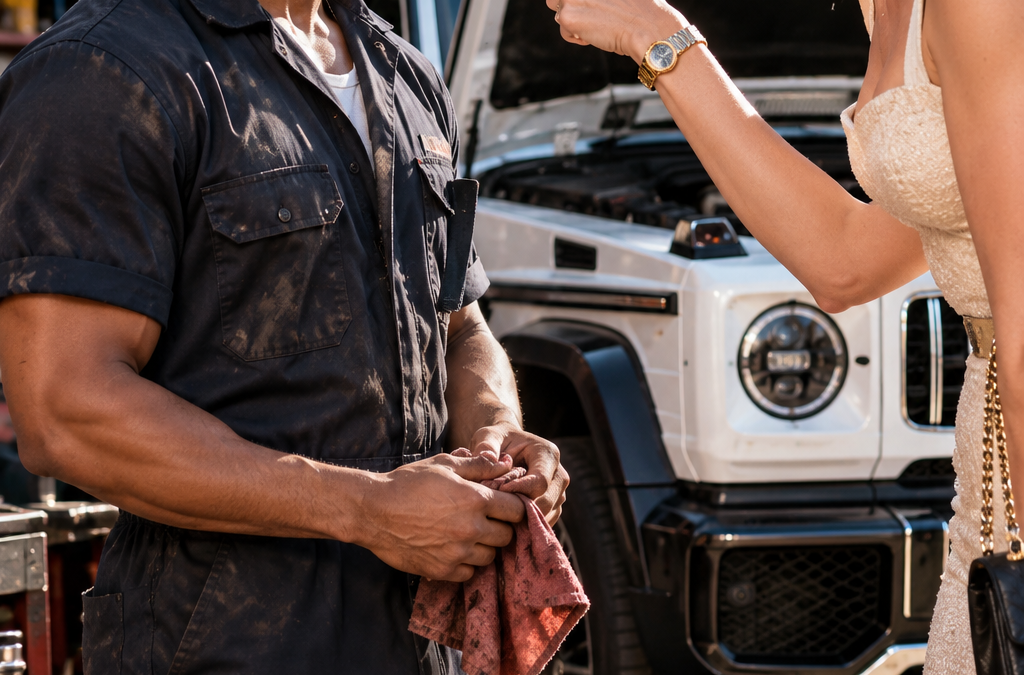
Then the white Mercedes G-Wagon came limping into the lot.
It was the kind of vehicle that looked absurd parked beside two rusted pickups and a fifteen-year-old Honda waiting for a transmission.
The engine sputtered once.
Then died.
The driver’s door opened.
Caroline stepped out wearing oversized sunglasses, a cream-colored dress, and heels that had absolutely no business being anywhere near an auto shop.
She looked around as if she had accidentally driven into another country.
“Please tell me somebody here can fix this.”
I wiped my hands on a shop rag.
“That depends on what’s wrong with it.”
She lowered her sunglasses.
For a second she just looked at me.
Not frightened.
Not rude.
Curious.
“You’re the mechanic?”
“One of them.”
“You own the place?”
“That too.”
She glanced at the sign.
“Brooks.”
“That would be me.”
I opened the hood.
Forty minutes later, I had diagnosed a failed fuel pump relay, replaced it, and started the engine.
She looked surprised.
“That’s it?”
“That’s it.”
“How much?”
“Eighty-five.”
She stared at me.
“Eighty-five dollars?”
“Yes, ma’am.”
She opened a leather wallet and handed me two hundred-dollar bills.
I peeled off eighty-five and handed the rest back.
“Keep it.”
“I charged you what the job was worth.”
“I’m giving you a tip.”
“I know.”
She waited.
I waited.
Finally she took the money.
“You’re strange.”
“I’ve been called worse.”
That made her laugh.
She came back the next day.
Her Mercedes was running perfectly.
She said she wanted to make sure the warning light hadn’t returned.
It hadn’t.
The next day she came back with coffee.
The day after that she sat on the stool beside the counter and asked me how an engine turned gasoline into motion.
I explained it.
Halfway through, I realized she wasn’t listening to the answer.
She was watching me.
Caroline grew up in a world I understood mostly from television.
Her father, Howard Ashford, founded Ashford Holdings, one of the largest real estate development companies in the Southeast.
She had attended private schools.
Private clubs.
Private parties.
She had three fashion boutiques that her father had financed for her.
A penthouse in Buckhead.
A bank account containing more money than I expected to earn in twenty years.
She had never changed a tire.
Never carried groceries more than a few feet.
Never worried whether her debit card would clear.
And she hated almost everything about her life.
At least that was what she told me.
“My whole life has already been planned,” she said one evening after I closed the garage.
We were sitting on two folding chairs outside Bay Three, eating takeout from a paper bag.
“My father picks the right people. My mother picks the right events. My friends date the right men and marry the right families. Nobody ever asks what I want.”
“What do you want?”
She stared at me.
“No one asks me that.”
“I just did.”
She smiled.
That smile was real.
I still believe that.
Whatever happened later, I don’t think everything between us was fake.
Maybe that made what came afterward harder.
Six months after we met, we got married at the courthouse.
Thursday morning.
No family.
No photographers.
No ballroom.
I wore my cleanest button-down shirt.
Caroline wore a simple white sundress.
When the clerk pronounced us husband and wife, she squeezed my hand so hard I laughed.
That afternoon, I moved into her penthouse.
I carried one duffel bag, a cardboard box of books, my grandfather’s photograph, and two pairs of work boots.
I put the boots by the front door.
Next to them sat six pairs of Caroline’s designer heels.
She looked at the arrangement and laughed.
“Those boots are destroying the aesthetic.”
“I can move them.”
She kissed me.
“I’m kidding.”
I thought I had married a woman who was finally choosing her own life.
Three days later, her father called.
I was in the kitchen when I heard Caroline answer from the bedroom.
There was silence.
Then her voice rose.
“Dad, I’m thirty-one years old.”
Another silence.
“No. You don’t get to decide this.”
I stayed where I was.
Then I heard something that made me stop.
“You married a Black mechanic.”
Howard’s voice was loud enough to carry through the phone.
“A mechanic, Caroline. Do you understand what people are saying about this family?”
I stared down at the countertop.
Caroline lowered her voice.
“This is my life.”
“Then live it without my money.”
The call ended minutes later.
She came into the kitchen pale.
“What happened?”
She sat down.
“He froze my trust fund.”
I waited.
“He’s cutting off funding for the boutiques. My cards. Everything.”
“I’m sorry.”
She looked at me.
For a moment I thought she might blame me.
Instead she reached for my hand.
“I knew he’d be angry.”
“You didn’t know he’d do this.”
“No.”
“We’ll figure it out.”
She gave me a small smile.
“We?”
“We’re married.”
I believed those words settled the matter.
They didn’t.
Her father was only the beginning.
Her closest friend, Stephanie Keller, stopped answering messages.
Women Caroline had known since college removed her from group chats.
Invitations disappeared.
Her name vanished from the guest list of charity dinners and gallery openings she had attended for years.
Nobody said the reason openly.
They didn’t have to.
One afternoon, Caroline drove to Stephanie’s house.
She came home almost two hours later and stood inside the front door without taking off her coat.
“What happened?”
She dropped her purse.
“She was home.”
“Stephanie?”
Caroline nodded.
“I could see her through the glass. She saw me standing there.”
“She didn’t answer?”
“She turned around.”
That night I made dinner.
Pasta.
Nothing special.
I put two glasses of water on the table.
When Caroline walked into the kitchen, she stared at them.
Not at me.
At the glasses.
Something in her face changed.
A few months earlier, she would have laughed at the meal and sat beside me.
That night, she walked into the bedroom and closed the door.
The resentment didn’t arrive all at once.
It came in small sentences.
“Do you have to wear that shirt?”
Then:
“Your hands still smell like grease.”
Then:
“Could you shower before coming home?”
I started keeping clean clothes at the garage.
I scrubbed my hands so hard at night that the skin around my knuckles cracked.
I told myself she was under pressure.
Her family had rejected her.
Her friends had abandoned her.
She had lost the financial cushion she had never imagined living without.
I wanted to be patient.
But patience doesn’t stop contempt once contempt finds a home.
One evening I was making pasta when she sat at the kitchen island scrolling through photographs on her phone.
Ski trips.
Yachts.
Restaurants.
Women holding champagne under chandeliers.
The life she used to have.
“I gave up everything for you.”
I turned down the stove.
“For me?”
“Yes.”
“I didn’t ask you to give anything up.”
“That’s easy for you to say.”
She put her phone down.
“You didn’t lose anything.”
I looked at her.
“You think this has been easy for me?”
She laughed.
“What did you lose, Lincoln?”
“My wife.”
Her face stiffened.
I regretted saying it immediately.
Not because it wasn’t true.
Because I could see that she understood exactly what I meant.
“You have no idea what it feels like to fall this far,” she said.
“Fall?”
“Don’t.”
“No. Say it.”
Her jaw tightened.
“This life.”
I looked around the penthouse.
The marble counters.
The city view.
The wine refrigerator.
The furniture that cost more than my truck.
“This is falling?”
“You know what I mean.”
“I’m not sure I do.”
She stood.
“You’re satisfied with nothing.”
“I’m satisfied with honest.”
“That’s because honest is all you can afford.”
I turned off the burner.
She looked at me and smiled without warmth.
“Your best life, Lincoln, is other people’s rock bottom.”
I remember that sentence more clearly than I remember almost anything else from our marriage.
Not because it was the cruelest thing she eventually said.
It wasn’t.
But it was the first time I understood that she had begun to despise me.
After that, she stopped hiding it.
At a neighborhood barbecue, she introduced me to a wealthy couple from her old social circle.
“This is Lincoln,” she said.
She smiled.
“He fixes other people’s cars for a living.”
Then she tilted her head.
“Charming, isn’t it?”
The woman gave me a tight smile.
Her husband asked Caroline a question and turned his body away from me.
I stood there holding a paper plate.
For twenty minutes Caroline moved through the yard laughing, talking, becoming someone I barely recognized.
On the drive home, I finally spoke.
“You embarrassed me.”
She kept scrolling.
“I introduced you.”
“You introduced me like I was dirt on your shoe.”
“If the shoe fits.”
I tightened my hands on the steering wheel.
“Caroline.”
“What?”
I looked at her.
She didn’t look back.
I said nothing else.
On our six-month anniversary, I closed the garage early.
I bought steak.
Asparagus.
A small chocolate cake.
I found candles in one of the kitchen drawers and set the dining table as well as a mechanic who had never cared about table settings could manage.
Then I waited.
Eight o’clock.
Nine.
Ten.
At eleven-thirty, I blew out the candles.
The steak had gone cold.
The wax had run down the holders.
The cake remained untouched.
Caroline came home after midnight.
She saw the table.
She saw me.
She said nothing.
She walked into the bedroom and closed the door.
I cleaned the kitchen alone.
Three weeks later, an envelope arrived.
The Ashford family charity gala.
One invitation.
Caroline Ashford.
Not Caroline Brooks.
Not Mr. and Mrs. Lincoln Brooks.
Just her maiden name.
She stood in the kitchen holding it.
“You going?”
“I don’t know.”
I already knew.
The night of the gala, she wore an emerald gown.
I hadn’t seen it before.
She told me she was meeting a friend.
I watched her fasten an earring in the mirror.
“You look beautiful.”
She paused.
For one second, I saw the woman from the garage.
Then she looked away.
“Don’t wait up.”
Bradley Garrison entered our marriage that night.
I didn’t know it yet.
He was forty-two, wealthy, polished, connected, the CEO of a real estate investment company and an old friend of Howard Ashford.
Everything I wasn’t.
Caroline began coming home late.
Then later.
Her phone stayed face down.
She bought perfume.
New dresses.
Started smiling at messages she never shared.
I noticed.
Of course I noticed.
But I had spent months trying to hold together something she had already decided to leave.
One morning, while she was in the shower, her phone buzzed.
I was reaching for my watch.
The screen lit up.
A contact saved as B.
Last night was incredible. Can’t stop thinking about you.
Red hearts followed the sentence.
I stood there staring at the phone.
The shower ran behind the bathroom door.
I could have confronted her.
I could have thrown the phone.
I could have shouted.
Instead, I set it exactly where I found it.
That night I stayed late at the garage.
After Earl Sutton left, I turned off most of the lights and sat beneath my grandfather’s photograph.
Earl had worked beside me for years.
He was fifty-five, permanently tired-looking, and one of the few people alive who could tell I was hurting before I said a word.
He had paused at the door.
“You locking up?”
“Eventually.”
He looked at me.
“You need company?”
“No.”
“All right.”
He didn’t ask anything else.
After he left, I sat alone.
The garage smelled like metal, rubber, and motor oil.
The smell Caroline said embarrassed her.
I looked up at Grandpa.
“A man’s worth isn’t in his wallet.”
I said it quietly.
For the first time in my life, the words didn’t comfort me.
Two weeks later, Caroline stopped pretending.
She posted a picture with Bradley at a rooftop restaurant.
His arm around her.
Her head on his shoulder.
The caption said:
Some things are worth waiting for.
We were still married.
The people who had abandoned her returned immediately.
Stephanie posted a heart.
Others followed.
So happy for you.
You deserve this.
Finally.
Not one person asked about me.
That told me more than the photograph.
In their world, my marriage to Caroline had never been legitimate enough to require mourning.
I was an embarrassment she was correcting.
A month later, the process server arrived at the garage.
I was under a Silverado replacing a brake line.
“Lincoln Brooks?”
I slid out.
“That’s me.”
He handed me an envelope.
“I’m sorry.”
Forty pages.
Divorce petition.
Caroline hadn’t told me.
Earl found me sitting on my workbench twenty minutes later.
“You okay?”
I looked at the papers.
“She’s divorcing me.”
He set down his wrench.
There are people who talk when they don’t know what to say.
Earl wasn’t one of them.
He simply stood near me.
“I knew it was coming,” I said.
“I just thought she’d have enough respect to tell me.”
I read every page.
The penthouse belonged to Caroline.
The Mercedes belonged to Caroline.
The furniture.
Artwork.
Everything.
My own savings were about eight thousand dollars.
Her lawyers even argued that some of that should be applied to shared legal and administrative expenses.
I called three attorneys.
Two required retainers I couldn’t afford.
The third listened to me for half an hour and finally said:
“Mr. Brooks, I don’t want to take money you don’t have. Based on what you’ve described, there isn’t much here to fight over.”
So I represented myself.
The courthouse was colder than I expected.
Caroline sat across from me with three attorneys.
Bradley sat behind her.
That hurt more than it should have.
Not because I wanted her back.
Because he looked comfortable sitting in a seat that had once been mine.
The judge reviewed the settlement.
Then looked at me.
“Mr. Brooks, is there anything you wish to contest?”
I stood.
Caroline watched me.
I could have told the courtroom everything.
The humiliation.
The affair.
The contempt.
The nights she came home smelling like another man’s cologne.
But none of that would change whose name was on the paperwork.
“No, Your Honor.”
The judge signed.
Just like that, my marriage ended.
I walked into the hallway carrying one duffel bag.
Three shirts.
Two pairs of jeans.
My phone.
Grandpa’s photograph.
Caroline caught my arm near the elevator.
“Lincoln.”
I stopped.
She leaned closer.
“I told you from the beginning.”
Her voice was almost gentle.
That somehow made it worse.
“You were never on my level.”
I looked at her hand gripping my sleeve.
Then at her face.
There was a time I would have done anything to make that woman smile.
I pulled my arm away.
“No,” I said.
“You’re right.”
She blinked.
I stepped into the elevator.
The doors closed before she could answer.
That night, Caroline threw a party.
I learned the details later.
Forty people.
Champagne.
Flowers.
A jazz trio.
Bradley at her side.
She called it a fresh start celebration.
At some point, someone began recording.
Caroline raised her glass.
She talked about how relieved she was.
Then she talked about me.
“I can’t believe I lived with a Black man like him for a whole year.”
People laughed.
She kept going.
“A dirt-poor mechanic.”
More laughter.
“He came with nothing.”
Then the sentence that followed me for weeks.
“He left with nothing.”
The room erupted.
I wasn’t there.
I was sitting in Earl’s pickup truck outside the garage.
When I told him I had nowhere to sleep, he handed me his keys.
“Take the truck.”
“I can’t.”
“Yes, you can.”
“Earl—”
“Stay as long as you need.”
“I’ll pay—”
“If you finish that sentence, I’m going to hit you with a torque wrench.”
I laughed despite myself.
“Thank you.”
“I said don’t.”
So that became home.
The first night, I had a blanket, two sandwiches, and Grandpa’s photograph propped against the dashboard.
Then I made the mistake of checking my phone.
Someone had tagged me.
I pressed play.
Caroline appeared on the screen holding a champagne glass.
I listened.
Her voice.
The laughter.
Bradley beside her.
I watched once.
Then again.
The second time was worse because I already knew when everyone would laugh.
I turned the phone off.
For a while I stared through the windshield.
The photograph on the dashboard caught the orange light from the parking lot.
I couldn’t read Grandpa’s handwriting in the darkness.
I didn’t need to.
I knew it by heart.
I pulled the blanket over myself.
I didn’t sleep much.
At six the next morning, I opened the garage.
That became my life.
Thirty days.
Thirty nights in the truck.
I showered at a cheap gym twice a week and washed up in the garage sink the rest.
Lunch was sandwiches.
Dinner was noodles.
Sometimes Earl’s wife sent food.
Earl would put the container on my bench without saying anything.
“Your wife made this?”
“No idea what you’re talking about.”
“There are mashed potatoes.”
“Could have appeared naturally.”
I smiled.
“I’ll wash the container.”
“That would be wise.”
I worked twelve-hour days.
Sometimes fourteen.
Brakes.
Oil changes.
Engines.
Transmissions.
Whatever came in.
The viral video kept spreading.
Customers saw it.
Some pretended they hadn’t.
Some said things they thought would help.
Most didn’t.
Mrs. Patterson had been bringing her Honda to us for eleven years.
One afternoon, she came to collect it and stood at the counter studying my face.
“You sleeping?”
“Yes, ma’am.”
“That was a lie.”
I smiled.
“I’ve had worse weeks.”
She squeezed my hand.
“I always knew she didn’t deserve you.”
I looked down.
“That doesn’t make me feel better.”
“I know.”
That was the kindest answer anyone gave me.
On day twenty-nine, I stopped at the grocery store.
Bread.
Soap.
Instant noodles.
A few other things.
The total was just over six dollars.
I paid with a ten.
Walking toward the exit, I passed the lottery counter.
I stopped.
My grandfather bought one ticket every Friday for most of his life.
One ticket.
Never more.
He never won.
Whenever I asked why he kept doing it, he would tap his shirt pocket.
“You never know, son. God has a funny way of showing up.”
I always thought it was nonsense.
That night, maybe because I missed him, I bought one.
Mega Millions.
Jackpot: $750 million.
The ticket cost two dollars.
I folded it into my shirt pocket the way Grandpa used to.
I forgot about it until later that night.
I was back in Earl’s truck when the drawing results came up.
I pulled out the ticket.
First number.
Match.
I smiled.
Second.
Match.
My smile disappeared.
Third.
Match.
I sat forward.
Fourth.
Match.
“No.”
Fifth.
Match.
My hands started shaking.
Then the Mega Ball.
Match.
I stared at the screen.
Then the ticket.
Then the screen again.
I checked every number three times.
Four.
Five.
My hands were shaking so badly I had to put the phone down.
For several minutes I didn’t move.
The parking lot was silent.
A moth circled the streetlight.
Somewhere down the road, a truck passed.
I held a small piece of printed paper between two fingers.
Worth seven hundred and fifty million dollars.
And I started crying.
Not laughing.
Crying.
I thought about my grandfather.
The garage.
The courtroom.
Caroline.
The party video.
The blanket.
The sink where I washed my face every morning.
Everything collided at once.
I called Earl.
He answered half asleep.
“Lincoln?”
“I need you to come here.”
“What happened?”
“Just come.”
“Are you hurt?”
“No.”
“Did somebody break in?”
“No.”
“Then why—”
“Earl.”
He went quiet.
“I need you here.”
He arrived twelve minutes later wearing sweatpants and a T-shirt.
“What the hell happened?”
I handed him the ticket.
Then my phone.
He checked the numbers.
His face changed.
He checked again.
Then he looked at me.
“No.”
I nodded.
“No.”
“I think so.”
He grabbed the ticket again.
“Oh my God.”
Then Earl Sutton, the toughest old mechanic I knew, pulled me into a hug.
We stood in that dark parking lot crying like children.
Thirty days earlier, I had walked out of a courthouse with everything I owned in one bag.
Now neither of us could understand the number on my phone.
The news broke Saturday.
At first, my name wasn’t public.
Then someone connected the store where the ticket was sold with the neighborhood.
By noon, local television stations were reporting that an Atlanta mechanic had won the $750 million jackpot.
That alone would have been enough.
Then somebody found Caroline’s video.
They placed the two stories together.
The clip exploded.
I refused to watch it again.
Everyone else apparently did.
Millions of people.
Then tens of millions.
My phone filled with messages.
Reporters.
Old classmates.
People who hadn’t spoken to me in fifteen years.
Numbers I didn’t recognize.
And Caroline.
She called several times.
I didn’t answer.
Then came the message.
Lincoln, we need to talk. I made a terrible mistake. I still care about you. Please call me.
I read it while sitting in the garage beside Earl.
He watched me.
“You answering?”
“No.”
“Good.”
I turned the phone facedown.
Winning that money did not make me feel powerful.
At least not at first.
It made me afraid.
Seven hundred and fifty million dollars is too large a number to understand when you have spent your life counting twenty-dollar bills before buying groceries.
The lottery officials connected me with financial advisers.
Attorneys.
Accountants.
Security people.
For the first time in my life, men wearing thousand-dollar suits spoke to me as though every sentence I said mattered.
I found that deeply uncomfortable.
Then Caroline filed a lawsuit.
She wanted half.
Her attorney argued that because the ticket was purchased so soon after our divorce, the prize somehow belonged partly to her.
Three hundred seventy-five million dollars.
My new attorneys explained the issue to me.
“The decree was final thirty days before the ticket was purchased.”
“So?”
“So she has almost no case.”
“Almost?”
One attorney smiled.
“Lawyers don’t like saying zero.”
The hearing was short.
Caroline sat across the courtroom again.
This time our positions had changed.
I had counsel.
She looked tired.
Bradley wasn’t there.
The judge reviewed the dates.
Divorce finalized.
Ticket purchased thirty days later.
Money used for the ticket earned after the divorce.
The claim was denied.
Dismissed.
Caroline was ordered to cover my legal fees.
Outside, reporters shouted questions.
I kept walking.
Caroline didn’t.
She tried again.
Her second lawsuit claimed I had somehow concealed my future financial potential while we were married.
When my attorney read that paragraph aloud in his office, I stared at him.
“What does that even mean?”
“It means they are trying everything.”
“But I didn’t know I was going to win.”
“We know.”
“The ticket didn’t even exist.”
“We know.”
The judge knew too.
Dismissed.
Then came a third filing.
Fraudulent inducement of marriage.
Even one of Caroline’s own attorneys refused to sign it and withdrew.
Another lawyer filed it.
The judge dismissed that claim as well and warned that further frivolous litigation could result in sanctions.
I wanted to feel victorious.
I didn’t.
Every filing made the story bigger.
Every headline replayed Caroline’s party video.
Every replay made people hate her more.
At first, I thought I would enjoy that.
I didn’t.
I knew what humiliation felt like.
Watching it happen to someone who had humiliated me didn’t heal anything.
Bradley disappeared quickly.
Photos vanished from his social media accounts.
Calls went unanswered.
A lawyer sent Caroline a message saying he wished to end all personal contact.
The people who had welcomed her back vanished too.
Again.
Only this time, there was nowhere else for her to go.
Her boutiques suffered.
Customers stopped coming.
Vendors pulled out.
Employees left.
Within weeks, the first store closed.
Then another.
Then the last one.
Her father released a statement distancing the family from her conduct.
Two sentences.
No affection.
No defense.
Just corporate language.
The penthouse eventually went into foreclosure.
I heard she sold handbags.
Jewelry.
Shoes.
Everything that once seemed so important.
Then she moved into a small apartment on the south side.
Six blocks from my garage.
When someone told me, I sat quietly for a while.
Earl leaned against the workbench.
“You feel sorry for her?”
“I don’t know.”
“That’s allowed.”
“She didn’t feel sorry for me.”
“No.”
I looked toward Grandpa’s photograph.
“But I know what it feels like to lose everything.”
Earl nodded.
“That’s why you’re different.”
Money gave me choices I had never had.
People expected me to choose luxury.
I bought a house instead.
Three bedrooms.
A front porch.
Small yard.
Big kitchen.
Nothing enormous.
The first thing I hung was Grandpa’s photograph.
Right above the fireplace.
Then I bought something much more expensive.
The buildings surrounding Brooks Auto Repair.
I expanded the property.
Not for myself.
For the people who had been told the same things Caroline once told me.
That their work was small.
That their hands made them inferior.
That a mechanic, welder, electrician, plumber, or HVAC technician somehow mattered less than somebody sitting in an office.
I started the Brooks Foundation with fifty million dollars.
Then I turned Grandpa’s garage into the Carter Brooks Vocational Center.
The morning the new sign went up, I stood across the street beside Earl.
CARTER BROOKS VOCATIONAL CENTER.
His name.
In black letters.
Above the building he had started with four hundred dollars.
Earl looked at me.
“You okay?”
I wiped my eyes.
“Yeah.”
“You’re crying.”
“Dust.”
“Sure.”
The center offered training in automotive repair, electrical work, welding, plumbing, and HVAC.
Free enrollment.
No prerequisites.
We created grants for people starting small businesses.
We paid for tools.
Licensing fees.
Work boots.
Transportation.
Child care for students who needed it.
I knew exactly how small a problem could become a wall when you had no money.
Two hundred dollars for equipment might as well be twenty thousand when you were sleeping in a truck.
Earl got a new truck too.
A Ford F-150.
Midnight blue.
Fully loaded.
I parked it outside the shop and left the keys on his workbench.
There was a note attached.
Thank you for the blanket.
He came into my office holding the note.
“No.”
“Yes.”
“Take it back.”
“No.”
“My truck runs.”
“Barely.”
“I don’t need this.”
“I know.”
He stared at me.
“That’s why you’re getting it.”
For once, Earl had nothing to say.
Later, I found him sitting behind the wheel.
He stayed there almost twenty minutes before driving home.
Reporters kept asking what the money had changed.
My house?
Yes.
My bank account?
Obviously.
My stress about medical bills and retirement?
Absolutely.
But me?
I hoped not.
During my first television interview, the reporter asked:
“What does it feel like to go from having nothing to having seven hundred and fifty million dollars?”
I thought about the wording.
“Having nothing?”
She hesitated.
“I mean financially.”
“That’s different.”
She nodded.
“So what does it feel like?”
“The money gave me options.”
“And what about Caroline?”
I knew the question was coming.
“Are you angry?”
“I was.”
“Not anymore?”
I looked down at my hands.
There was grease beneath one thumbnail.
I had spent the morning helping a student diagnose a fuel-pressure problem.
“Anger is expensive,” I said.
The reporter waited.
“I spent too much of my life being broke to waste money on something that doesn’t buy me anything.”
That line followed me almost as widely as Caroline’s video did.
I regretted that sometimes.
People wanted everything to be poetic.
Simple.
The cruel ex-wife.
The poor mechanic.
The jackpot.
Karma.
That wasn’t how it felt from inside my skin.
Winning didn’t erase what happened.
It didn’t change the night I waited beside those anniversary candles.
It didn’t erase Caroline laughing at my hands.
It didn’t erase sleeping in Earl’s truck.
And her losses didn’t make those memories disappear.
A year after the drawing, I still woke around six.
Most mornings I drove to the center.
I could have hired people to run everything.
I did hire people.
Good people.
But I still liked the garage.
I liked the sound of tools.
The smell of oil.
The moment when a student who had struggled for hours finally understood why an engine wouldn’t start.
In our first year, more than two hundred students completed training.
Most found full-time work.
Some started businesses.
Three opened their own garages.
We made a hallway wall for graduation photographs.
Every student got one.
Work clothes.
Certificate.
Usually a smile that looked half proud and half shocked.
I hung many of the frames myself.
Grandpa’s photograph remained at the end of the hallway.
One afternoon, a reporter from the Atlanta Journal-Constitution came to interview me.
She set a recorder beside my lunch.
Ham sandwich.
Old habits.
“You could be anywhere in the world,” she said.
“Why are you still working here?”
I looked around.
A student in Bay Two was fighting with a seized bolt.
Another was learning to weld in the fabrication room.
Earl was explaining, with far too much enthusiasm, why somebody had chosen the wrong socket.
“My grandfather built this place,” I said.
“He taught me that work isn’t only about earning money. Sometimes it’s how you prove to yourself that you can create something useful. I don’t want to lose that.”
She made a note.
Then she asked the question every reporter eventually asked.
“If Caroline were sitting here right now, what would you say?”
I looked at my hands.
For months, I had imagined versions of that conversation.
Sometimes I was angry.
Sometimes calm.
Sometimes I told her exactly how badly she had hurt me.
Sometimes she apologized.
Sometimes I walked away.
But eventually I understood something.
There was nothing left to say.
“I already said it.”
The reporter looked confused.
“When?”
“The day of the divorce.”
“What did you say?”
“Almost nothing.”
She waited.
I smiled slightly.
“That was the point.”
After she left, I returned to the training floor.
A nineteen-year-old student named James was working on an old carburetor.
He had grown up bouncing between relatives.
No father.
No money.
No clear plan before he found the center.
That afternoon, frustration had gotten the better of him.
He dropped a wrench onto the bench.
“I’m never going to get this.”
I pulled up a stool.
“You said that yesterday.”
“I was right yesterday too.”
“No, yesterday you learned what doesn’t work.”
“That sounds like something old people say.”
“I am old people now.”
He laughed.
I pointed at the carburetor.
“Show me where you’re stuck.”
He began explaining.
I listened.
Then I put the wrench back in his hand.
“Try again.”
He did.
Ten minutes later, the engine started.
James jumped back.
“No way.”
I laughed.
“You did it.”
His face changed.
That expression.
I knew it.
Not pride exactly.
Something deeper.
The realization that maybe you weren’t what people had told you.
That maybe your hands could build something.
That maybe being underestimated did not make you small.
James stared at the engine.
“I actually fixed it.”
“Yes.”
He looked at me.
“Mr. Brooks?”
“Yeah?”
“Did you ever think you were going to end up doing this?”
I glanced through the open bay door.
Sunlight stretched across the pavement.
Cars moved along the road.
Across the building, Grandpa’s name stood above the entrance.
“No.”
He frowned.
“Really?”
“Not even close.”
“What did you think you were going to do?”
I thought about Caroline.
About the courthouse.
About Earl’s truck.
About the lottery ticket folded in my hand.
About money so large it had once seemed like the ending to my story.
It wasn’t.
This was.
“I thought I’d fix cars.”
James smiled.
“That’s it?”
“That was enough.”
He looked around the center.
“And this?”
I followed his eyes.
Students working.
Teachers explaining.
Machines running.
Photographs lining the hallway.
People building lives nobody could take from them.
“This,” I said, “is what happened when enough stopped meaning small.”
He nodded as though he understood.
Maybe he did.
A few weeks later, I saw Caroline for the first time since the lawsuits.
It happened outside a grocery store.
I had stopped after work.
She was walking toward the entrance carrying a reusable bag.
For a moment, neither of us moved.
She looked different.
Not ruined.
Not broken.
Just ordinary.
No designer dress.
No sunglasses.
No circle of people around her.
She looked at me.
“Lincoln.”
“Caroline.”
Her eyes dropped toward my hands.
I still had grease on them.
She gave a small, sad laugh.
“You still work on cars.”
“Yes.”
“After everything.”
“Especially after everything.”
She looked toward the parking lot.
“I saw the center.”
I waited.
“My apartment isn’t far.”
“I heard.”
“You named it after your grandfather.”
“Yes.”
Silence settled between us.
Cars passed behind me.
A shopping cart rattled across the pavement.
Finally she said:
“I was cruel to you.”
I didn’t answer.
“I’ve thought about what I would say if I ever saw you.”
“You don’t have to say anything.”
“I do.”
Her eyes filled.
“I blamed you for everything I lost. My father. My friends. My old life. I convinced myself you had dragged me down.”
I listened.
“The truth is, nobody dragged me anywhere.”
She swallowed.
“I chose you. Then I was too weak to live with the consequences of choosing you.”
I looked at her.
That was the first honest thing she had said to me in a long time.
“I’m sorry,” she said.
Not dramatically.
Not loudly.
Just two words in a grocery-store parking lot.
I thought an apology would feel bigger.
For months I had imagined it as a kind of justice.
Instead, it felt quiet.
Almost gentle.
“I believe you,” I said.
Her expression changed.
“Do you forgive me?”
I considered the question.
“I don’t hate you.”
“That’s not what I asked.”
“I know.”
She looked down.
I could have hurt her then.
One sentence would have done it.
I knew where every weak place was.
I had earned that knowledge.
But Grandpa had taught me something she never understood.
A man’s character wasn’t what he did when he finally had enough power to hurt somebody back.
So I said:
“I hope you build something better from here.”
Tears slipped down her cheeks.
“Is that forgiveness?”
“Maybe it’s the beginning of it.”
She nodded.
I walked toward my truck.
“Lincoln?”
I turned.
“For what it’s worth…”
She struggled to finish.
“You were never nothing.”
I looked at her for a long moment.
Then I smiled.
“I know.”
That was the difference.
Once, I had needed her to know my value.
Now I didn’t.
I drove back to the center before going home.
It was after closing, but the hallway lights were still on.
I walked past the photographs.
Two hundred fourteen graduates from our first year.
Each frame contained a person who had arrived carrying some version of the same fear.
Not good enough.
Not educated enough.
Not connected enough.
Not wealthy enough.
Not worth enough.
At the end of the hallway hung Grandpa’s photograph.
The Mustang.
His hand on the hood.
That faded sentence.
A man’s worth isn’t in his wallet, son. It’s in his hands and his word.
For most of my life, I had thought Grandpa meant money didn’t matter.
I understood now that he meant something harder.
Money mattered.
Status mattered.
Power mattered.
They could open doors.
They could protect you.
They could give you choices.
But they could not tell you who you were.
Caroline had millions when she met me and still didn’t know herself.
I had slept in a borrowed truck with less than four dollars in my pocket and somehow remained Lincoln Brooks.
The jackpot didn’t create my worth.
Her cruelty hadn’t destroyed it.
The courthouse couldn’t take it.
The internet couldn’t give it back.
It had been mine the whole time.
I reached up and straightened Grandpa’s frame.
From the training floor came the faint metallic click of a tool somebody had forgotten to put away.
I smiled.
Then I turned off the hallway lights, locked the front door, and stepped outside.
Above me, the sign caught the last orange light of sunset.
Carter Brooks Vocational Center.
Tomorrow morning, students would arrive before eight.
Earl would complain about somebody misplacing his tools.
James would probably argue with another carburetor.
I would drink bad coffee and eat the same sandwich I had eaten before anybody knew my name.
And somewhere in that building, someone who had spent years being told they were nothing would discover they could build something.
That was more than enough.
For the first time in a very long time, so was I.








