𝗙𝗨𝗟𝗟 𝗦𝗧𝗢𝗥𝗬 My Dying Police Dog Was Waiting for Someone I Couldn’t Bring Myself to Call
The instructor folded his arms.
“With Rex, it might.”
Our first six weeks together were a disaster.
He understood every command.
He simply didn’t believe I had earned the right to give them.
During obedience training, he would sit perfectly for thirty seconds, then stand up and wander away as if he had remembered an appointment.
During scent exercises, he’d locate the hidden object, stare at it, and wait for me to catch up.
Once, during an obstacle course, he climbed onto the highest platform, looked down at me, and refused to move until I climbed halfway up to retrieve him.
My fellow officers found it hilarious.
My training supervisor did not.
“Turner,” Sergeant Bill Haskins told me one afternoon, “you’re supposed to be handling the dog. The dog isn’t supposed to be handling you.”
I was frustrated enough to consider asking for another assignment.
Then something happened that changed us.
During a nighttime tracking exercise, I slipped on a muddy embankment and landed badly.
My left ankle folded beneath me.
The pain was immediate.
I tried to stand but couldn’t put weight on the foot.
Our instructor was almost half a mile away, and my radio had fallen several feet downhill.
Rex had been following a scent trail ahead of me.
I called him once.
“Rex! Here!”
He stopped.
Then he turned and came running.
Instead of continuing the exercise, he planted himself beside me.
“Go find Bill,” I told him, pointing toward the training area.
He refused.
I gave the command again.
Nothing.
He simply pushed his muzzle beneath my hand and stayed.
I was angry at first.
Then, sitting alone in the cold mud, I realized what he was doing.
He wasn’t confused.
He wasn’t being stubborn.
He had decided that whatever we’d been chasing wasn’t more important than the person lying injured beside him.
Eventually, the instructor found us.
Rex didn’t leave until two men helped me stand.
That night, I sat on the floor of my kitchen with my ankle wrapped in ice while Rex lay beside me.
My daughter, Maddie, who was seven, sat cross-legged in front of him.
She was completely fascinated.
“Does he know you’re a police officer?” she asked.
“I think so.”
“Does he know he’s a police officer?”
“Pretty sure he thinks he’s the chief.”
She giggled.
Rex rested his head in her lap.
Then she asked a question I never forgot.
“Daddy, does he love you?”
I looked at him.
He watched me quietly.
“We’re still figuring each other out,” I said.
Maddie stroked his ears.
“Well, I think he does.”
She was right.
It just took me longer to understand.
Rex became my partner in the fullest sense of the word.
I learned that he hated thunderstorms but wasn’t frightened by gunfire.
He could detect a hidden person in a building full of distracting smells, yet he could somehow fail to notice a treat sitting directly in front of his nose if he was concentrating on something else.
He loved tennis balls, hated baths, and had an embarrassing weakness for scrambled eggs.
He didn’t like strangers touching his head without permission.
He adored children.
And he had an uncanny ability to recognize when someone was frightened.
Our first major search involved a four-year-old girl named Amelia Brooks.
She disappeared from a family picnic near a wooded park just before sunset.
By the time we arrived, nearly eighty volunteers were searching the trails.
Her mother was hysterical.
Her father stood beside the family car staring at a tiny pink sneaker he’d found near the playground.
I remember kneeling in front of him.
“Sir, I need something your daughter wore today.”
He handed me her small blue sweater.
His hands were shaking.
“Please,” he whispered. “She’s afraid of the dark.”
I took the sweater.
“I know.”
He gripped my arm.
“She doesn’t know how to swim. There’s a creek out there.”
I looked toward the trees.
The temperature was dropping fast.
Rex sniffed the sweater once, then again.
I gave him the command.
“Find her.”
He went straight toward the woods.
For forty minutes, we followed him through brush, across fallen trees, and down a narrow trail that disappeared into a drainage area.
Twice, other searchers shouted that they’d found something.
Twice, Rex ignored them.
Then he stopped.
His ears rose.
He turned sharply toward the creek.
I followed him down a slippery bank and found Amelia sitting beneath an overturned tree, soaked to the waist and shivering.
She had apparently slipped into the creek and crawled out on the opposite side.
When she saw me, she began crying.
“I want my mommy.”
I pulled off my jacket.
“We’re going to get you home, sweetheart.”
Rex approached slowly.
Amelia stared at him.
“Is he a wolf?”
“No,” I said. “He’s my partner.”
“Will he bite me?”
“Not unless you’re hiding a whole bag of bacon.”
That made her smile.
Then Rex did something I’d never trained him to do.
He lay down beside her.
Amelia reached out and buried her small fingers in his thick fur.
She stopped shaking quite so hard.
I radioed our location while she kept one hand wrapped around Rex’s collar.
When her parents arrived, her mother dropped to her knees and gathered Amelia into her arms.
Her father hugged me, then crouched in front of Rex.
“Thank you,” he whispered.
Rex licked his chin.
The man began crying.
I stood there watching them, feeling something change inside me.
Police work teaches you to measure results in arrests, reports, and cases closed.
Rex taught me to measure them differently.
Sometimes success was a child going home to her parents.
Sometimes it was the sound of a mother sobbing with relief.
Sometimes it was a frightened little girl holding on to a dog’s collar because he made the world feel safe again.
Over the following years, there were more searches.
A missing elderly man with dementia who had wandered into a freezing field.
A teenager who disappeared after an argument with his parents and was found sleeping in an abandoned hunting cabin.
A burglary suspect who hid inside a drainage tunnel and surrendered the moment Rex announced his presence.
There were long nights, dangerous arrests, and mornings when exhaustion made the patrol car feel like the only place I could sleep.
Through all of it, Rex stayed beside me.
He wasn’t perfect.
Neither was I.
But we learned to trust each other completely.
And then came the night we almost lost Officer Daniel Foster.
The night that would connect the three of us for the rest of our lives.
Daniel was twenty-six when he joined our department.
He had the kind of confidence that young officers often mistake for experience.
He was eager, hardworking, and brave.
Sometimes too brave.
He volunteered for difficult calls, chased leads long after his shift ended, and had a habit of rushing toward trouble before checking whether backup was close enough.
I liked him.
I also worried about him.
One afternoon, after he nearly entered an unsecured building alone, I pulled him aside.
“You’ve got good instincts,” I told him. “But instincts don’t replace judgment.”
He grinned.
“Yes, sir.”
“Don’t ‘sir’ me. I’m serious.”
His smile faded slightly.
“I’m trying to prove I belong here.”
“You already belong here.”
He looked away.
I continued.
“You want to prove something? Learn to come home at the end of your shift.”
He nodded.
I thought he’d understood.
Three weeks later, a winter storm moved through our county.
Freezing rain covered the roads, and the temperature dropped below twenty degrees before midnight.
Around 11:40 p.m., Daniel responded to a report of suspicious activity at an abandoned industrial complex near the river.
A stolen pickup had been spotted behind one of the old warehouses.
Several units were already responding, but Daniel was closest.
He arrived first.
That was the beginning of the trouble.
Two suspects fled the property as he pulled up.
One ran toward a wooded access road.
The other disappeared behind the warehouse.
Daniel pursued the second man on foot.
According to his final radio transmission, he was moving toward the loading docks.
Then the radio went silent.
At first, dispatch assumed he’d lost reception inside the industrial buildings.
Two minutes passed.
Then five.
By the time ten minutes had gone by, every available officer in the area was searching for him.
I was at a gas station with Rex when the emergency call came through.
“Officer missing, possible shots fired. Last known location, Riverside Industrial Park.”
I dropped my coffee.
It hit the pavement and burst open beside my boots.
Rex heard the change in my breathing before I said anything.
He stood immediately inside the patrol vehicle.
I climbed behind the wheel.
“Hold on, buddy.”
The drive took nine minutes.
I remember every one of them.
The windshield wipers scraped against freezing rain.
Dispatch kept repeating Daniel’s call sign.
No answer.
I knew that industrial complex.
The buildings had been abandoned for years. Broken glass covered the walkways, rusted machinery filled the warehouses, and a network of drainage channels ran beneath the property toward the river.
It was the kind of place where a wounded man could disappear a hundred feet from safety.
When I arrived, red and blue lights flashed across the empty loading docks.
Officers were searching the buildings.
One suspect had been detained near the access road.
The other was still missing.
And Daniel hadn’t been found.
Sergeant Haskins met me beside the patrol cars.
“We heard what might’ve been a gunshot,” he said. “Nobody’s seen Foster since.”
I looked toward the warehouse.
“Where’d he go?”
“East loading dock. Radio cut out near the service road.”
“Have you found blood?”
“Not yet.”
I opened Rex’s door.
He jumped down and immediately began scanning the area.
I clipped his tracking line to his harness.
“Let’s find our boy,” I whispered.
I took a glove from Daniel’s patrol car.
Rex sniffed it carefully.
Then he lowered his head.
For the next several minutes, everything became the sound of freezing rain, my boots striking wet concrete, and Rex pulling against the line.
He followed the route Daniel had taken behind the warehouse.
Near a loading dock, he stopped.
Sniffed.
Circled.
Then moved toward a narrow strip of weeds beside a concrete drainage channel.
I aimed my flashlight at the ground.
A small dark stain marked the pavement.
I knelt and touched it with a gloved finger.
Blood.
My chest tightened.
“Rex,” I said, “find him.”
He moved faster.
We followed the channel toward the river, passing broken fencing and piles of rusted equipment.
The darkness seemed to swallow the light from my flashlight.
Suddenly, Rex stopped so hard that the line pulled tight.
He stared into a thicket beside the drainage channel.
Then he began barking.
Not the sharp, excited bark he used during training.
This was urgent.
Desperate.
I pushed through the weeds.
“Daniel!”
Nothing.
“Foster! Call out!”
Rex barked again.
I swept my flashlight downward.
There, beneath a collapsed section of chain-link fencing, was a narrow concrete runoff culvert.
Water rushed through it toward the river.
I saw a boot.
Then a hand.
And finally, a face so pale that for one terrible second I thought we were too late.
“Daniel!”
He was lying partly inside the culvert, his lower body submerged in icy water.
Blood covered his right leg.
His radio lay smashed beside him.
He must have been wounded near the loading dock, fallen down the embankment, and dragged himself toward the culvert to get out of sight.
I slid down the bank.
Rex came with me.
Daniel’s eyes fluttered open.
“Turner?”
“I’m here.”
He tried to move.
I grabbed his shoulder.
“Don’t. Stay still.”
He looked past me.
His lips trembled.
“Rex?”
The dog pushed forward and pressed his muzzle against Daniel’s cheek.
Daniel gave the faintest smile.
“Hey, partner,” he whispered. “I’m right here.”
Those words would stay with me for years.
I tore open Daniel’s pants leg.
The wound was high in his thigh, and the blood loss was severe.
I immediately called for medical assistance, gave dispatch our position, and pulled a tourniquet from my vest.
Daniel tried to speak.
“Don’t talk,” I told him.
He swallowed.
“I messed up.”
“Save it.”
“I should’ve waited.”
“Daniel, look at me.”
His eyes struggled to focus.
“You’re not dying out here. You understand?”
He didn’t answer.
I tightened the tourniquet.
Daniel screamed.
Rex flinched but stayed beside him.
The water in the drainage channel was rising from the storm.
I needed to get Daniel farther out of it, but moving him alone was difficult, and the slippery concrete offered almost no traction.
Rex stood near Daniel’s shoulders, his paws braced against the edge of the culvert.
As I pulled Daniel toward firmer ground, Rex caught the loose fabric of his jacket and held on.
It wasn’t something I’d commanded.
He was doing what he could.
Together, inch by inch, we got Daniel onto the narrow bank above the rushing water.
A jagged piece of metal cut across Rex’s shoulder during the effort.
I saw blood darkening his fur.
“Rex, back!”
He ignored me.
For the first time in years, my perfectly trained partner refused a direct command.
He wouldn’t leave Daniel.
I pressed my hands against the wound dressing and listened to the sirens approaching.
Daniel’s breathing grew weaker.
“Mike,” he whispered.
“Stay with me.”
“Tell my mom…”
“No.”
His eyes closed.
“Daniel!”
I shook his shoulder.
“Open your eyes!”
Nothing.
Then Rex shoved his nose beneath Daniel’s hand.
He whined.
It was a strange, broken sound I’d never heard him make before.
Daniel’s fingers moved.
Barely.
But they moved.
Rex pushed closer.
“Hey,” Daniel murmured.
I leaned toward him.
“What?”
His eyes opened just enough to find the dog.
“Good boy.”
Then he lost consciousness.
I kept talking until the paramedics reached us.
I don’t remember everything I said.
I remember begging.
I remember promising Daniel that he was going to see another sunrise.
I remember Rex standing over him while freezing rain coated his fur.
And I remember the moment the paramedics lifted Daniel onto the stretcher.
Rex tried to follow.
I caught his harness.
“Easy, partner. We’ve got him.”
He fought the line once.
Then he stood trembling beside me, watching the ambulance disappear into the night.
Only after it was gone did I notice how badly he was bleeding.
The cut on his shoulder was deep enough to require stitches.
He also had bruising along his ribs from striking the edge of the culvert.
I knelt in front of him.
“You stubborn idiot,” I whispered.
He licked my face.
I wrapped my arms around his neck.
And there, in the freezing rain, surrounded by flashing police lights, I began to cry.
Daniel survived.
The surgeons operated for nearly five hours.
He had lost so much blood that the doctors told his family another twenty minutes might have been fatal.
The bullet had damaged a major blood vessel in his leg. The freezing water had pushed his body temperature dangerously low. By the time the ambulance reached the hospital, his condition was critical.
But he survived.
When I received the news, I was sitting on the floor of an emergency veterinary clinic, waiting for someone to finish stitching Rex’s shoulder.
I covered my face with both hands.
The veterinarian came out a few minutes later.
“Your dog is going to be fine,” she said.
I looked up.
She smiled.
“He needs rest, antibiotics, and some time off. But he’ll recover.”
I laughed, although tears were still running down my face.
“Good luck explaining time off to him.”
She glanced through the window at Rex.
He was sitting upright on the examination table, watching the door.
“Something tells me he won’t appreciate the suggestion.”
Three days later, Daniel woke up in the hospital.
I visited him that afternoon.
Rex wasn’t allowed inside the intensive care unit, so I left him with another officer downstairs.
Daniel looked terrible.
His face was swollen, his skin pale, and tubes ran beneath his blanket.
But when he saw me, he smiled.
“Hey, Turner.”
“You’re an expensive way to get attention, Foster.”
He tried to laugh and immediately winced.
I pulled up a chair.
For a moment, neither of us spoke.
Then he asked, “How’s Rex?”
“He’s fine. Twenty-three stitches and a very bad attitude.”
Daniel’s expression changed.
“He got hurt?”
“Cut his shoulder helping us get you out.”
Daniel looked down at his hands.
“I’m sorry.”
“Don’t start.”
“He shouldn’t have been there.”
“Neither should you.”
He closed his eyes.
I leaned forward.
“Listen to me. You made a mistake going in alone. We both know that. But you’re alive, and that’s what matters right now.”
Daniel shook his head.
“You don’t understand.”
“Then explain it.”
His voice dropped.
“I remember falling. I remember being cold. I tried to crawl, but my leg wouldn’t work. I kept thinking somebody would come.”
He swallowed.
“Then I couldn’t hear the radios anymore.”
I waited.
“I thought I was going to die there.”
I had seen Daniel frightened before.
But I’d never heard him admit it.
“I thought about my mom,” he continued. “And my little sister. I kept thinking they’d find me in the morning, and I’d never get to tell them I was sorry.”
He turned toward the window.
“Then I heard barking.”
My throat tightened.
“I couldn’t tell where it was coming from. I thought maybe I was imagining it.”
He rubbed a hand over his face.
“But I knew that bark.”
He looked at me.
“I knew it was Rex.”
I nodded.
“He found you.”
Daniel stared at the ceiling.
“When he touched my face, I knew I wasn’t alone anymore.”
Neither of us spoke for a long moment.
Then Daniel began crying.
Quietly at first.
Then with the helplessness of a man who had held himself together through something terrifying and finally couldn’t do it anymore.
I stood and placed a hand on his shoulder.
“He brought you home, kid.”
Daniel nodded.
“I know.”
“That’s what he does.”
Daniel wiped his eyes.
“Can I see him?”
“You kidding? He’s been waiting for you.”
Two weeks later, Daniel left the hospital in a wheelchair.
We arranged a small gathering outside the station.
Rex was still recovering and wore a protective vest over his bandaged shoulder.
The moment he saw Daniel, his ears lifted.
Daniel leaned forward in his wheelchair.
“Hey, partner.”
Rex broke into a run.
I barely managed to keep hold of the leash.
He reached Daniel and pressed his head against his chest.
Daniel wrapped both arms around him.
For several seconds, he couldn’t speak.
Then he buried his face in Rex’s fur.
“Hey, partner,” he whispered again. “I’m right here.”
The officers standing around us went silent.
Somebody turned away.
Somebody else sniffed.
I pretended I had something in my eye.
That afternoon, Daniel gave Rex a small blue rubber ball.
It was ordinary, the kind you could buy at any pet store.
But Daniel had written something on the side in permanent marker.
For the partner who came back for me.
Rex destroyed the ball within a month.
Daniel was horrified when I told him.
“That was supposed to be special!”
“It was special,” I said. “That’s why he loved chewing on it.”
We laughed.
And for a while, everything seemed all right.
But trauma doesn’t always end when a person leaves the hospital.
Daniel returned to the department after months of rehabilitation, though his injury prevented him from resuming full patrol duties immediately.
At first, he visited Rex often.
He brought treats.
He helped with training exercises when his physical therapist cleared him.
Sometimes he’d sit on the floor of the K9 unit and talk to Rex as though they were old friends sharing stories nobody else could understand.
Then something began to change.
Daniel grew quieter.
He avoided the industrial park where he’d been injured.
He stopped attending department gatherings.
When someone mentioned the rescue, he became uncomfortable.
The local newspaper had run a story about Rex finding a wounded officer.
The headline called him a hero.
There was a photograph of Daniel kneeling beside Rex outside the station, his hand resting on the dog’s neck.
People praised them everywhere they went.
Daniel hated it.
One afternoon, he came into the K9 office and found me filling out paperwork.
“Mike, can I ask you something?”
“Sure.”
“Do you ever think about what would’ve happened if Rex hadn’t found me?”
I looked up.
“Sometimes.”
He sat down.
“I do. Every night.”
I put my pen aside.
“Daniel—”
“I don’t just think about dying. I think about what you both risked because I didn’t wait for backup.”
I leaned back.
He stared at the floor.
“Rex got hurt because of me.”
“Rex got hurt doing his job.”
“He could’ve died.”
“So could I. So could anybody who went looking for you.”
“That’s what I mean.”
I understood his guilt.
But I was beginning to resent the way he turned our decision to rescue him into something shameful.
“Daniel, you need to stop treating yourself like a debt nobody can repay.”
He looked up sharply.
“You don’t get it.”
“Then help me get it.”
He stood.
“I shouldn’t have needed saving.”
There it was.
The thing he’d been carrying since that night.
I spoke more firmly than I intended.
“Everybody needs saving sometimes.”
He shook his head.
“Not because they were stupid.”
“You made a mistake. You’re alive to learn from it.”
Daniel’s jaw tightened.
He looked toward Rex, who was sleeping beneath my desk.
“I wish I could explain it to him.”
“You don’t have to.”
“How do you know?”
“Because he isn’t sitting there keeping score.”
Daniel didn’t answer.
A month later, he requested a transfer.
He moved to another division nearly two hours away, where he could work investigative assignments that accommodated his recovery.
I congratulated him.
I meant it.
But after he left, the calls became less frequent.
Then they stopped.
For years, I told myself he was busy.
Eventually, I stopped making excuses.
Rex had risked his life for him.
Daniel had once promised he’d never forget that.
And yet there were holidays when we didn’t receive so much as a message.
At first, I was disappointed.
Then I was angry.
Nora told me I was being unfair.
“He’s dealing with things you can’t see,” she said one night.
“I know what happened to him. I was there.”
“That doesn’t mean you know what happens inside his head when he’s alone.”
I didn’t have an answer.
She sat beside me on the couch.
“Mike, you can’t demand that somebody show gratitude in the way you expect.”
“I’m not demanding anything.”
She raised an eyebrow.
I looked away.
“All right. Maybe I am.”
Rex lay asleep between our feet.
Nora reached down and scratched his ears.
“He loves Daniel whether Daniel visits or not.”
I watched the old scar running beneath Rex’s shoulder fur.
“I know.”
“Maybe you should try that.”
I didn’t.
At least not immediately.
Some disappointments become habits if you carry them long enough.
And I carried that one for years.
Meanwhile, Rex and I kept working.
He helped find a missing boy during a snowstorm.
He located an elderly woman who had fallen behind her house and lain hidden beneath thick weeds for hours.
He assisted investigators searching for evidence in a kidnapping case.
He tracked a fleeing suspect into the woods and prevented what might otherwise have become an armed confrontation.
He received commendations, photographs, plaques, and more dog treats than any veterinarian would have approved.
But the years were catching up with him.
The first sign was small.
During a training exercise, Rex hesitated before jumping over a low barrier.
He cleared it.
But when he landed, his back legs buckled slightly.
He recovered immediately and looked at me as though nothing had happened.
I pretended not to notice.
A week later, he struggled climbing into the patrol vehicle.
Then he began taking longer to recover after extended searches.
I arranged an examination.
The veterinarian found arthritis and the early signs of age-related degeneration.
Nothing unusual for a working German Shepherd who had spent years running, jumping, and working long shifts.
But the recommendation was clear.
His workload needed to decrease.
I agreed.
Then came the conversation I had been dreading.
Our K9 supervisor called me into his office.
“Mike, we’ve got to talk about Rex.”
I knew what was coming.
“He’s still working.”
“Nobody’s questioning that.”
“He passed his last evaluation.”
“Yes, he did.”
I folded my arms.
“Then what’s the problem?”
The supervisor sighed.
“He’s thirteen years old.”
“He doesn’t know that.”
“But we do.”
I looked away.
He continued.
“You’ve given this department eleven incredible years with that dog. He’s earned the right to stop before his body gives out.”
I stared at the framed photographs on the wall.
There was one of Rex standing beside a patrol car after his first major search.
Another showed him receiving a commendation from the county sheriff.
In both pictures, he looked almost invincible.
“I don’t know if he’ll understand,” I admitted.
The supervisor’s voice softened.
“He won’t. But that’s why he has you.”
Rex officially retired six weeks later.
The department held a ceremony outside headquarters.
There were officers from neighboring agencies, former coworkers, local officials, and several families whose loved ones Rex had helped find.
Amelia Brooks came, too.
She wasn’t four anymore.
She was a teenager wearing a blue dress, carrying a small bouquet of flowers.
I recognized her mother immediately.
Amelia approached Rex carefully.
“Do you think he remembers me?”
I looked at the young woman standing in front of us.
The last time Rex had seen her, she was a frightened little girl shivering beside a creek.
“I don’t know,” I said.
She knelt.
“Hi, Rex.”
He leaned forward and sniffed her hand.
Then he pressed his head against her chest.
Amelia burst into tears.
Her mother covered her mouth.
I stood there blinking rapidly.
When it was time for the ceremony, the sheriff read a list of Rex’s accomplishments.
Eleven years of service.
Hundreds of deployments.
Dozens of successful searches.
Numerous commendations.
Several documented lifesaving rescues.
People applauded.
Rex sat beside me, looking mildly annoyed that nobody was throwing his tennis ball.
Then they asked me to speak.
I’d prepared three pages.
I managed four sentences.
“This dog has been my partner for eleven years,” I began. “He’s protected strangers, comforted frightened children, and brought people home when everyone else was running out of hope.”
I looked down.
Rex watched me.
“He never asked who deserved help. He just went where he was needed.”
My voice broke.
I folded the speech.
“I’m proud of him. And I’m grateful he gets to come home with me.”
That was all I could say.
The crowd stood and applauded.
I removed Rex’s police harness and replaced it with a simple blue collar.
He looked confused.
For the first time in eleven years, we left the station together without an assignment waiting.
I opened the rear door of my personal SUV.
Rex climbed inside slowly.
He looked at me through the gap between the seats.
“That’s it, partner,” I said. “You’re retired.”
He tilted his head.
I smiled through tears.
“No more bad guys. No more midnight calls. No more chasing idiots through the woods.”
He barked once.
“Yeah,” I said. “I know. You’re going to miss it.”
I was wrong about that.
Rex missed certain parts of police work.
He still became excited whenever he heard sirens.
He still watched strangers carefully.
He still stood beside the front door when I reached for my keys.
But he discovered that retirement had advantages.
He could sleep wherever he wanted.
He could spend entire afternoons lying beneath the oak tree in our backyard.
He could steal food from unsuspecting family members.
And he could finally enjoy the kind of ordinary life he’d spent eleven years protecting for other people.
Nora bought him a giant orthopedic bed.
He refused to use it for the first week.
Instead, he slept directly beside my side of our bed, where he’d always slept when he wasn’t working.
Maddie, now a young woman preparing for college, insisted on taking photographs of him wearing ridiculous holiday bandanas.
He tolerated them with profound disappointment.
One Christmas, she put a small pair of reindeer antlers on his head.
He stood completely still while she took the picture.
Then he walked over to me, removed the antlers with one paw, and dropped them at my feet.
I laughed so hard I had to sit down.
For the first time in years, our family had Rex without the constant fear of receiving a phone call about an injured police dog.
We took him on slow morning walks.
We drove to the lake.
We visited the park where he’d found Amelia.
Sometimes we simply sat on the porch together.
I began to notice things I’d overlooked when we were working.
The way his ears moved when the wind rustled through the trees.
The way he positioned himself between Maddie and the street whenever she washed her car.
The way he waited until Nora sat down after dinner before resting his head on her knee.
He had spent most of his life protecting us.
Now we had the privilege of making him comfortable.
I wanted those years to last forever.
Of course, they didn’t.
It started with a limp.
Rex had developed arthritis, so at first we assumed he’d overdone it on one of our walks.
He was slower getting up in the mornings.
He sometimes hesitated before stepping onto the porch.
I took him to Dr. Ramirez.
She examined him carefully, ordered imaging, and recommended additional testing.
I expected another adjustment to his medication.
Instead, she asked me to sit down.
I knew from her expression that something was wrong.
“Michael,” she said, “we’ve found a mass near his lower spine.”
I stared at her.
“What kind of mass?”
“We need further testing to confirm it.”
“Can you remove it?”
She hesitated.
“That depends on what it is and how far it’s progressed.”
I looked through the examination-room window.
Rex was lying on a blanket with his chin resting on his paws.
He looked tired.
But when he saw me, his tail moved.
“He’s still eating,” I said.
“I know.”
“He still wants to go outside.”
“I know.”
“He was chasing his ball last month.”
Dr. Ramirez pulled her chair closer.
“Mike, we’re going to get the clearest answers we can. And we’re going to make sure he isn’t suffering unnecessarily.”
The test results came back several days later.
Cancer.
Aggressive.
Already advanced.
The specialists explained our options, including treatments that might slow the disease. But surgery carried serious risks, and even with aggressive treatment, the prognosis was poor.
Rex was nearly fifteen.
His joints were damaged from years of service.
And the disease had spread beyond the original mass.
I asked every question I could think of.
What if we tried radiation?
What if we took him to a specialist in another state?
What if we changed his medication?
What if we did everything?
Dr. Ramirez answered each question patiently.
Then she asked one of her own.
“What does Rex enjoy most?”
I frowned.
“What?”
“What makes him happy now?”
I looked toward him.
“Being with us.”
She nodded.
“Then that’s what we should protect for as long as we can.”
I drove home in silence.
That evening, Nora found me sitting beside Rex’s bed.
I had the test results spread across the coffee table.
She looked at them.
Then at me.
“What did the doctor say?”
I couldn’t answer.
She sat down.
“Michael?”
I shook my head.
Her face crumpled.
“Oh, no.”
I pulled her close.
For a long time, we stayed that way.
Rex lifted his head and pushed his nose between us.
Even then, he seemed determined to fix whatever was hurting his people.
We decided to focus on his comfort.
We followed the veterinary team’s guidance, kept him under close care, and measured every decision by the quality of life it gave him.
Maddie came home from college whenever she could.
Nora worked from the dining-room table so Rex wouldn’t have to be alone.
I rearranged my days around his medications and appointments.
We celebrated small things.
The morning he ate his entire breakfast.
The afternoon he carried his favorite ball across the yard.
The evening he managed to climb onto his bed without help.
We stopped counting how many months he might have left.
Instead, we counted the good moments still available to him.
One afternoon, I took him to the backyard.
The grass was warm beneath our feet.
He walked slowly toward the oak tree and lowered himself into the shade.
I sat beside him.
For nearly an hour, neither of us moved.
Then he raised his head.
Across the street, a police cruiser passed with its emergency lights flashing.
No siren.
Just lights.
Rex’s ears stood straight up.
His body shifted as though he were preparing to run.
I put a hand on his shoulder.
“Easy, partner.”
He watched the cruiser disappear.
Then he looked at me.
I could almost hear the question.
Are we going?
I swallowed.
“No, buddy. Not this time.”
He rested his head against my leg.
I stayed there until sunset.
And I understood something I had spent my career avoiding.
Loyalty wasn’t always about running toward danger.
Sometimes it meant sitting still with someone you loved while time took away the things neither of you could control.
As autumn approached, Rex’s condition worsened.
He lost weight.
His appetite became unpredictable.
Some mornings, he seemed almost like his old self.
Other days, he could barely make it across the room.
I learned to help him stand by supporting his hindquarters with a padded sling.
I learned the difference between ordinary fatigue and the sharp, frightened look he sometimes gave me when his body wouldn’t cooperate.
He hated needing help.
That hurt me more than I expected.
A dog who had once pulled me out of dangerous situations now depended on me to help him reach his water bowl.
One evening, his back legs gave out as he tried to follow me into the kitchen.
He fell hard enough to frighten himself.
I was beside him immediately.
“Easy. Easy, Rex.”
He struggled to get up.
His paws scraped against the floor.
He tried again.
And again.
“Stop, buddy. I’ve got you.”
But he kept trying.
I could see the panic building in his eyes.
I slid an arm beneath his chest and held him.
“Rex. Look at me.”
He froze.
I pressed my forehead against his.
“You don’t have to prove anything anymore.”
His breathing slowed.
I kissed the top of his head.
“You’ve done enough.”
That night, I carried him to his bed.
It was the first time I truly understood that our remaining time might be very short.
Three weeks later, he collapsed beside the fireplace.
He never stood again.
The first day, I told myself he was tired.
The second day, I told myself the medication needed more time.
By the third day, I had run out of lies.
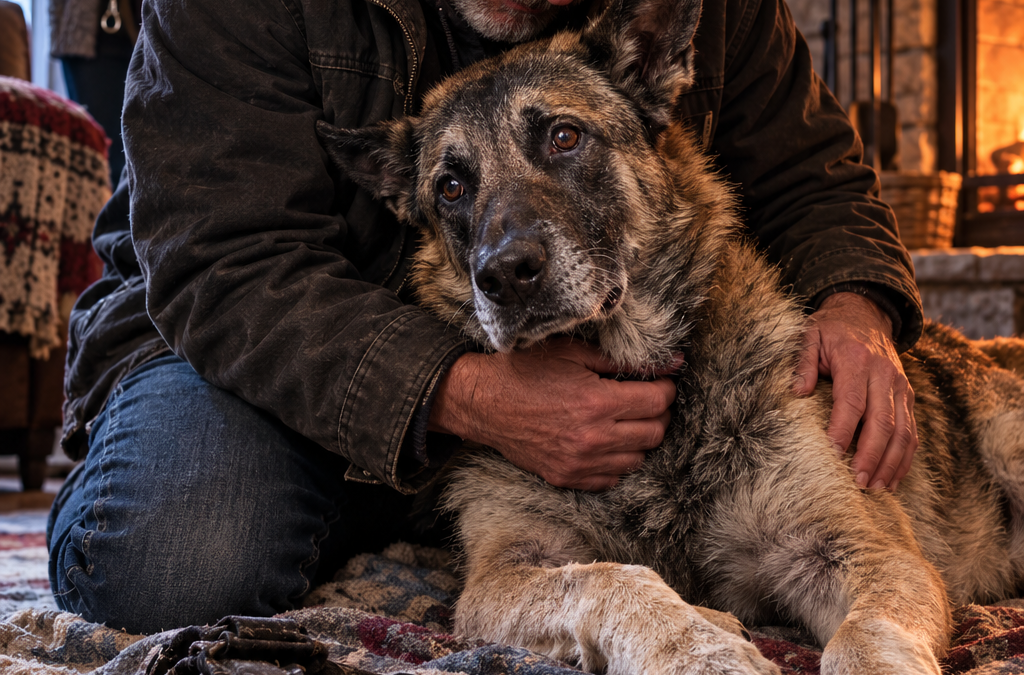
Rex lay on his favorite blanket beside the fireplace. We had placed soft pads beneath him and kept water close enough that he wouldn’t have to struggle to reach it.
Dr. Ramirez had examined him at home.
She had adjusted his pain medication and helped us understand what signs of distress to watch for.
We followed her instructions carefully.
But his strength kept slipping away.
He ate almost nothing.
He drank only when we held the bowl near his mouth.
Sometimes he seemed to sleep deeply.
Other times, he stared toward the front door for hours.
That was what haunted me most.
The staring.
Rex had always watched doors.
At the police station, he watched for the next call.
At home, he watched for family members returning.
During investigations, he watched exits while I interviewed witnesses.
A door meant somebody might arrive.
Something might happen.
Somebody might need him.
Now he watched the front door with the same quiet attention, even though he barely had the strength to lift his head.
On the second evening, Maddie drove home from college.
She walked through the front door carrying an overnight bag.
Rex heard her voice.
His ears lifted.
But he couldn’t stand to greet her.
Maddie dropped the bag and hurried across the living room.
“Rex?”
She knelt beside him.
“Hey, old man.”
He moved his tail once.
She laughed through her tears.
“There you are.”
Then she bent over him, wrapped her arms around his neck, and cried into his fur.
I stood in the kitchen watching.
I remembered the little girl who had once asked whether Rex loved me.
Now she was twenty-one, and the dog she’d grown up with was dying.
That night, Maddie slept on the living-room floor beside him.
Nora brought her extra blankets.
I told her she could sleep upstairs.
She shook her head.
“He slept outside my bedroom when I was scared of thunderstorms,” she said. “I’m not leaving him alone now.”
I couldn’t argue.
At midnight, I came downstairs and found her awake, stroking the gray fur beneath his chin.
“Dad?”
“Yeah?”
“Do you think he knows?”
I sat beside her.
“Knows what?”
“That he’s dying.”
I looked at Rex.
His breathing was slow and uneven.
“I don’t know, sweetheart.”
She swallowed.
“Do you think he’s scared?”
The question struck harder than anything else she’d said.
For years, Rex had been the brave one.
The dog who walked into darkness.
The dog who found people when hope was disappearing.
The dog who stayed beside frightened strangers until help arrived.
Now my daughter was asking whether he was frightened, and I couldn’t give her the answer she needed.
“I think,” I said carefully, “he knows we’re here.”
Maddie nodded.
“That’s something.”
I reached over and rested my hand against his side.
“Yeah,” I whispered. “It is.”
At two in the morning, Maddie finally fell asleep.
Nora went upstairs to rest.
I stayed.
The house was silent except for the refrigerator humming in the kitchen and the slow rhythm of Rex’s breathing.
I began talking to him.
At first, I told him ordinary things.
That the lawn needed mowing.
That Maddie was doing well in school.
That Nora had bought another ridiculous throw pillow for the couch.
Then I started remembering.
The rainy night we’d spent searching for a missing boy.
The day he’d stolen an entire sandwich from Sergeant Haskins.
The time he’d jumped into a muddy pond during a department picnic and shaken himself dry beside the sheriff.
I laughed at that memory.
Then I started crying.
I couldn’t stop.
“I’m sorry, buddy.”
Rex opened his eyes.
I took his paw in my hand.
“I’m sorry I can’t fix this.”
His paw was warm.
I remembered how many times those paws had carried him toward danger without hesitation.
How many miles they’d covered.
How many people they’d helped bring home.
I bent my head.
“You saved so many people, Rex.”
My voice cracked.
“And I can’t save you.”
I sat there for a long time, holding his paw.
Then I noticed something beneath his blanket.
A small blue rubber ball.
Not the original one Daniel had given him. That ball had been destroyed years earlier.
But it was the same kind.
After Rex retired, I’d bought several because he still loved their familiar texture.
He couldn’t chase them anymore.
He simply liked having one nearby.
I picked it up.
And suddenly, I thought of Daniel.
I hadn’t spoken to him in nearly four years.
I knew he’d been promoted. I’d heard he was doing well professionally. Occasionally, mutual friends mentioned his name.
But we’d drifted so far apart that calling him now seemed almost impossible.
I looked at Rex.
“Remember Daniel?”
His ears twitched.
It might have been coincidence.
It might have been the sound of my voice.
But I felt a strange ache in my chest.
“Yeah,” I whispered. “The kid from the river.”
I stroked his head.
“He turned out all right, you know.”
Rex looked toward the door.
For a moment, I considered reaching for my phone.
Then I remembered the unanswered calls.
The missed visits.
The years of silence.
I told myself Daniel had moved on.
I told myself there was no reason to trouble him.
And beneath those excuses was something uglier.
I was still hurt.
I didn’t want to admit that the young officer Rex had nearly died saving had become a stranger.
So I put the phone away.
And I stayed beside my dog.
The following morning, Dr. Ramirez called.
After listening to my description of Rex’s condition, she became quiet.
“Michael, I think we need to talk about his quality of life.”
I closed my eyes.
“I know.”
“He’s been through a great deal.”
“I know.”
“I don’t want him to reach a point where we’re asking him to endure suffering just because saying goodbye is unbearable for us.”
That sentence almost made me angry.
Not because it was cruel.
Because it was true.
I looked down at Rex.
He was awake, watching me.
For eleven years, I’d trusted him to make decisions in situations where lives depended on us.
Now he was trusting me to make the most painful decision of my own life.
“Can we bring him in this afternoon?” I asked.
“Of course.”
My voice trembled.
“Will you give us time with him?”
“As much as you need.”
I thanked her.
Then I hung up and sat beside Rex.
“Looks like we’re taking a ride, partner.”
He moved his tail.
Just once.
It was enough to break my heart.
Before we left, Nora asked whether I wanted to bring anything special.
I looked toward the closet where I’d kept Rex’s old equipment.
His harness hung beside a faded photograph of us standing in front of our patrol vehicle.
I took it down.
For years, that harness had meant work.
Danger.
Responsibility.
Now it meant something else.
It meant the life we’d shared.
I carried it to the SUV and placed it beside his bed.
Then I went back inside and lifted him into my arms.
I had carried Rex before.
After injuries.
After surgery.
Once, after he’d worn himself out playing in the snow with Maddie.
But I’d never carried him like this.
He rested his head against my chest.
And for a terrible moment, I remembered the first day we’d met, when he’d placed one paw on my foot and decided I was worth following.
I kissed the top of his head.
“All right, buddy.”
Then I carried him outside.
The drive to the clinic felt endless.
Nora sat beside me.
Maddie followed in her own car.
At one red light, I looked back at Rex.
His eyes were open.
He was watching the passing trees.
I wondered what he remembered.
Did he remember the training yard?
The missing children?
The patrol car?
The cold river?
Or was he simply looking at the world the way dogs do, without thinking about yesterday or tomorrow?
I wanted to believe he remembered the good things.
I wanted to believe his life had been more than work.
More than danger.
More than sacrifice.
I wanted him to know he’d been loved.
Not because he was a police dog.
Not because he’d saved lives.
But because he was Rex.
My stubborn, loyal, ridiculous best friend.
When we arrived, Dr. Ramirez was waiting outside.
She saw me carrying him and immediately stepped forward.
“Let me help you.”
“I’ve got him.”
She nodded.
We walked inside together.
The clinic staff had prepared a quiet room at the end of the hallway.
There was a large blanket on the floor, a low couch, and a window overlooking a small garden.
A bowl of water stood near the blanket.
Someone had placed a vase of yellow flowers on the table.
I nearly lost control when I saw them.
Such a small kindness.
Such an ordinary thing.
And somehow it made everything real.
I lowered Rex onto the blanket.
He sighed.
Maddie sat beside him immediately.
Nora took his front paw.
I knelt near his head.
Dr. Ramirez examined him carefully.
She listened to his heart.
Checked his breathing.
Gently tested his response to touch.
When she finished, she sat down on the floor with us.
She didn’t hide behind medical language.
“Michael,” she said softly, “he’s very tired.”
I nodded.
“His body is shutting down. We can keep him comfortable for a little while, but we can’t reverse what’s happening.”
I looked at Rex.
He was watching me.
“Is he in pain?”
“His medications have helped, but his disease is causing increasing distress. I’m concerned that waiting longer will make things harder for him.”
I swallowed.
“Then we shouldn’t wait.”
Nora began crying.
Maddie pressed her face against Rex’s neck.
Dr. Ramirez gave us a moment.
Then she explained the process.
First, medication to help him relax and fall into a deep, peaceful sleep.
Afterward, when we were ready, the final medication.
She assured us we could stay with him the entire time.
I nodded through tears.
“He’s never liked being left alone.”
She placed a hand on my shoulder.
“Then he won’t be.”
I bent over Rex.
“Hey, buddy.”
His eyes followed my face.
“You hear that?”
My throat tightened.
“Nobody’s leaving you.”
He made a soft sound.
I stroked his cheek.
“You did good, partner.”
I tried to say more.
I wanted to thank him for every night he’d watched my back.
For every frightened person he’d found.
For every morning he’d greeted us at the door.
For every moment he’d made our family whole.
But the words wouldn’t come.
So I rested my forehead against his.
And cried.
We sat like that for several minutes.
Then somebody knocked gently on the door.
Dr. Ramirez looked up.
A veterinary technician opened it slightly.
“I’m sorry to interrupt.”
The doctor rose.
“Is something wrong?”
“There’s a gentleman here asking for Officer Turner.”
I wiped my face.
“Who?”
The technician hesitated.
“He says his name is Daniel Foster.”
My heart stopped.
For a moment, I thought I’d misheard.
“Daniel?”
She nodded.
“He said he worked with you.”
I turned toward Nora.
She was looking at the floor.
“Nora?”
She wiped her cheeks.
“I called him.”
I stared at her.
“When?”
“Last night.”
“You what?”
Her voice trembled.
“I knew you wanted to.”
I looked at Rex.
Then back at my wife.
“You had no right—”
“Michael.”
There was no anger in her voice.
Only exhaustion and grief.
“Please. Not today.”
I opened my mouth.
Then closed it.
She reached for my hand.
“I didn’t call him for you.”
I looked at her.
“I called him for Rex.”
The room fell silent.
Then, from the hallway, I heard a voice.
A voice I hadn’t heard in years.
Older now.
A little rougher.
But unmistakable.
“Mike?”
I turned.
Daniel Foster stood in the doorway.
He was no longer the frightened young officer I’d pulled from a freezing drainage channel.
His hair had begun to gray at the temples.
There were deeper lines around his eyes.
He wore a dark blue button-down shirt and held his car keys tightly in one hand.
He looked at me.
Then at the blanket on the floor.
His face changed.
“Oh, God.”
He stepped inside.
“Is that Rex?”
I couldn’t speak.
Daniel approached slowly.
Then he stopped several feet away.
He looked down at the dog who had once found him in the dark.
And his eyes filled with tears.
“Hey, partner.”
Rex’s ears moved.
At first, I barely noticed.
Then his head lifted.
Only an inch.
But it lifted.
Daniel froze.
He swallowed hard.
“It’s me, buddy.”
Rex turned his head.
His eyes fixed on Daniel.
Not on me.
Not on Nora.
On Daniel.
Something changed in his expression.
For three days, my dog had barely moved.
He’d been unable to stand.
He’d struggled just to lift his head.
But now his ears rose.
His breathing quickened.
And his tail began moving against the blanket.
Once.
Twice.
Then again.
Daniel dropped to his knees.
“Hey, partner,” he whispered.
His voice broke.
“I’m right here.”
Those words.
The same words he’d spoken in the freezing drainage channel all those years earlier.
Rex made a sound I hadn’t heard in months.
A low, trembling whine.
Then he planted his front paws against the blanket.
I leaned forward.
“Rex?”
He pushed.
His front legs shook violently.
I reached to steady him, afraid he’d hurt himself.
But he kept trying.
Maddie gasped.
“Dad…”
Rex lifted his chest from the floor.
His hind legs trembled beneath him.
For one impossible moment, he seemed caught between the strength his body had lost and the determination that had always defined him.
“Easy, buddy,” I whispered.
Daniel moved closer.
Tears streamed down his face.
“Rex, it’s okay.”
But Rex didn’t stop.
He shifted his weight.
Braced his front legs.
And slowly, painfully, rose.
He stood.
My fourteen-year-old German Shepherd, who had not stood in three days, was standing in the middle of that veterinary room.
His legs shook.
His body swayed.
But he was standing.
Maddie covered her mouth.
Nora began sobbing.
Dr. Ramirez stepped forward, stunned, ready to support him if he fell.
And Daniel sat frozen on his knees.
“Rex?”
The dog took one unsteady step.
Then another.
Toward Daniel.
I moved beside him, supporting his weight beneath his chest.
He took one final step.
Then his legs gave way.
Daniel caught him before he hit the floor.
He gathered Rex into his arms.
And Rex rested his head against Daniel’s chest.
Exactly as he had done outside the police station after the rescue.
Daniel buried his face in the dog’s fur.
“Oh, buddy.”
His shoulders shook.
“Oh, Rex.”
The room dissolved into tears.
I had seen men cry after losing partners.
I’d seen parents cry when missing children came home.
I’d seen officers break down after surviving things no human being should ever experience.
But I had never heard a sound like the one Daniel made as he held Rex.
It was grief.
And love.
And shame.
And gratitude.
All breaking out of him at once.
“I’m sorry,” he whispered.
Rex pressed his nose against Daniel’s neck.
“I’m so sorry I stayed away.”
Daniel tightened his arms around him.
“You saved my life, and I couldn’t even come see you.”
I knelt beside them.
“Daniel.”
He shook his head.
“No, Mike. I need to say this.”
I went quiet.
He looked at Rex.
“I spent years thinking about that night. Every time somebody mentioned your name, I remembered how close I came to dying.”
His voice trembled.
“And every time I remembered, I felt ashamed.”
He swallowed hard.
“I told myself I’d visit when I got better. When I stopped having nightmares. When I could talk about what happened without feeling like a coward.”
He looked up at me.
“But the longer I waited, the harder it became.”
I felt my anger returning.
Then disappearing.
Because suddenly I understood.
Daniel hadn’t stayed away because he’d forgotten Rex.
He’d stayed away because he couldn’t forget.
“I thought you didn’t care,” I admitted.
He shook his head.
“I cared too much. And I handled it badly.”
He looked back at Rex.
“After my transfer, I got married. I have a little boy now. He’s six.”
He wiped his face.
“His name is Noah.”
I nodded.
“I heard.”
Daniel smiled sadly.
“He loves dogs. I’ve told him about Rex a hundred times.”
He looked at me.
“Do you know what he calls him?”
I shook my head.
“My dad’s guardian angel.”
My chest tightened.
Daniel rested his forehead against Rex’s.
“I wouldn’t have a wife or a little boy if it weren’t for you.”
Rex’s tail moved weakly.
Daniel laughed through his tears.
“Yeah. I know.”
He stroked the old dog’s ears.
“I know you don’t care about any of that.”
Then he whispered the words that finally broke me.
“You just wanted your friend to come home.”
I covered my face.
For years, I’d carried resentment toward Daniel.
I’d counted the calls he hadn’t made.
The birthdays he’d missed.
The retirement ceremony he hadn’t attended.
But as I watched him holding Rex, I realized I’d been measuring the wrong thing.
Daniel had survived.
He’d built a life.
He’d found happiness after something that might have destroyed him.
And whether I’d acknowledged it or not, that was exactly what Rex had worked to protect.
Dr. Ramirez knelt beside us.
Her eyes were wet.
“Michael,” she said gently, “that was an extraordinary effort for him.”
I looked at Rex.
He was lying quietly in Daniel’s arms.
His breathing was shallow again.
The brief burst of strength was fading.
The doctor continued.
“Sometimes animals can rally when something deeply familiar stimulates them. But it doesn’t change what’s happening medically.”
I nodded.
“I understand.”
She touched Rex’s shoulder.
“He needs to rest now.”
Daniel looked terrified.
“Did I hurt him by making him stand?”
“No,” she said softly. “You didn’t make him do anything. He wanted to reach you. We helped him do that as safely as we could.”
Daniel looked down at Rex.
“You stubborn old dog.”
I laughed weakly.
“Some things never change.”
We moved Rex gently back onto the blanket.
This time, Daniel sat beside me.
Nora took Rex’s paw again.
Maddie leaned against my shoulder.
For several minutes, nobody spoke.
There was nothing left to explain.
The room felt impossibly still.
Then Daniel reached into his pocket.
“I brought something.”
He opened his hand.
Inside was a small, worn photograph.
The picture showed him sitting in his wheelchair outside the police station, his arms wrapped around Rex.
The photograph had been folded and unfolded so many times that a white crease ran through the center.
“I’ve carried this since the day I left the hospital,” Daniel said.
He handed it to me.
I looked at the young officer in the wheelchair.
At Rex pressing his head into Daniel’s chest.
At the way Daniel was smiling despite everything he’d endured.
On the back, written in faded blue ink, were five words.
He came back for me.
I couldn’t speak.
Daniel took a trembling breath.
“I kept meaning to tell you how much he meant to me.”
I looked at him.
“You just did.”
He nodded.
Then he reached down and stroked Rex’s head.
“Thank you, buddy.”
Rex’s eyes opened slightly.
Daniel leaned closer.
“Thank you for finding me.”
The dog’s breathing slowed.
Daniel’s voice cracked.
“Thank you for not giving up.”
I placed my hand against Rex’s chest.
For eleven years, I’d listened to that heartbeat after dangerous calls.
Sometimes fast.
Sometimes steady.
Sometimes pounding with excitement after a successful search.
Now it felt fragile beneath my fingers.
I turned to Dr. Ramirez.
“He’s ready.”
She studied my face.
“Are you sure?”
I looked at the family gathered around him.
At Nora.
At Maddie.
At Daniel.
Then I looked at Rex.
He was exhausted.
His eyes were half-closed.
The familiar voice had brought him one last moment of recognition, but his body had nothing more to give.
I bent close.
“Yeah,” I whispered. “I’m sure.”
The doctor prepared the first medication.
She explained again what would happen.
I barely heard her.
I was watching Rex.
I wanted to remember everything.
The color of his eyes.
The white fur around his muzzle.
The scar beneath his shoulder.
The way one ear tilted slightly farther forward than the other.
The weight of his head against my hand.
I had spent so much of my life trying to protect him from danger.
Now the only thing left I could protect him from was unnecessary suffering.
Dr. Ramirez administered the sedative.
Within minutes, Rex relaxed.
His breathing became slower and more peaceful.
The tension in his muscles disappeared.
Maddie kissed his forehead.
“Goodnight, Rex.”
Nora whispered something I couldn’t hear.
Daniel kept one hand resting against the dog’s shoulder.
I lay down beside him.
For a moment, I wasn’t a former police officer.
I wasn’t a K9 handler.
I wasn’t a man who had spent years pretending he could handle anything.
I was just somebody losing his best friend.
I pressed my forehead against Rex’s.
“Listen to me, partner.”
My voice shook.
“You did your job.”
I swallowed.
“You brought everybody home.”
A tear fell onto his fur.
“Now it’s time for you to rest.”
Dr. Ramirez waited until I nodded.
Then she administered the final medication.
I kept my hand against Rex’s chest.
I felt his heartbeat slowing.
I kept talking.
“Good boy.”
His breathing became softer.
“That’s my boy.”
Another breath.
Then stillness.
I waited.
Hoping.
Dreading.
Dr. Ramirez listened carefully with her stethoscope.
Then she placed it aside.
Her eyes met mine.
“He’s gone, Michael.”
For several seconds, I couldn’t understand the words.
Rex had always been there.
At my side.
Behind me.
Waiting at home.
Sleeping beside my bed.
Watching doors.
He had been such a constant part of my life that the idea of a world without him seemed impossible.
I stroked his ears.
“Okay,” I whispered.
But it wasn’t okay.
Not yet.
I kissed his forehead.
And for the first time in nearly fifteen years, I touched my partner and knew he would never lift his head again.
Maddie began sobbing.
Nora held her.
Daniel sat beside us, his hand still resting on Rex’s shoulder.
The doctor quietly left the room, giving us privacy.
No one rushed us.
No one told us to be strong.
We simply stayed with him.
After a while, Daniel spoke.
“Mike?”
I looked up.
“I’m sorry I wasn’t there for his retirement.”
I nodded.
“I know.”
“I’m sorry I let so much time pass.”
I took a breath.
“Me too.”
He wiped his eyes.
“Do you think he remembered me?”
I looked at Rex.
At the body that had somehow found enough strength for one last effort when Daniel walked through the door.
Then I looked back at him.
“Daniel, I don’t think he ever forgot you.”
Daniel covered his face.
And we cried together.
When we finally left the clinic, the late-afternoon sun was breaking through the clouds.
It was one of those beautiful autumn days that seem almost offensive when your world has fallen apart.
Birds were singing.
Cars moved along the road.
Somewhere nearby, children were laughing.
Life continued as though nothing had happened.
I carried Rex’s old harness to the truck.
For the first time, the bed in the back was empty.
I stood there holding the harness against my chest.
I couldn’t make myself close the door.
Daniel came outside a few minutes later.
He stood beside me.
For a while, neither of us spoke.
Then he said, “He was the best partner I ever had.”
I looked at him.
“You weren’t even assigned to him.”
Daniel smiled sadly.
“Doesn’t matter.”
I thought about that.
Then I nodded.
“No. I guess it doesn’t.”
He hesitated.
“Would it be all right if I stayed in touch?”
I looked at the man standing beside me.
The man Rex had pulled back from the edge of death.
The man who had spent years carrying guilt I hadn’t understood.
For a moment, I thought about all the time we’d lost.
Then I thought about what Rex would have done.
He would have recognized his friend.
He would have moved toward him.
He wouldn’t have wasted a second counting how long he’d been gone.
I extended my hand.
“I’d like that.”
Daniel shook it.
Then he pulled me into a hug.
And there, in the parking lot of a veterinary clinic, two grown men who had spent years avoiding their grief finally stopped pretending they didn’t need each other.
Rex came home three days later in a small wooden urn.
Maddie chose it.
Nora placed it on the mantel beside his photograph and the commendation he’d received after saving Daniel.
I hung his police harness beneath the shelf.
For a long time, I couldn’t look at that corner of the room without crying.
The house felt wrong.
There was no sound of nails clicking against the hardwood floor.
No heavy sigh coming from beneath the dinner table.
No gentle push against my hand when I’d been sitting too long.
I kept stepping around the place where his bed had been.
I still reached for his leash on the hook beside the door.
One morning, I opened the refrigerator and automatically looked down, expecting him to appear.
The space beside my feet was empty.
I closed the refrigerator without taking anything out.
Then I sat on the kitchen floor and cried.
Grief doesn’t always arrive in dramatic moments.
Sometimes it waits beside an empty food bowl.
Sometimes it hides inside a familiar routine.
Sometimes it comes when you realize you have walked through your front door and nobody is waiting to greet you.
Nora understood.
She never told me to move on.
She never suggested getting another dog.
She simply sat beside me when the sadness became too much.
Maddie called almost every night.
Sometimes she talked about college.
Sometimes she told me a funny story.
Sometimes she just said, “I miss him, Dad.”
And I would answer, “Me too, sweetheart.”
A week after Rex died, a package arrived from Daniel.
Inside was a framed copy of the photograph he’d carried for years.
There was also a handwritten letter.
I sat at the kitchen table and read it slowly.
Mike,
I’ve tried to write this a dozen times, and I still don’t know how to say everything.
For years, I thought surviving that night meant I owed Rex something impossible. I thought I had to become a better officer, a better man, somebody worthy of what he did for me.
Every time I failed at something, I felt like I was wasting the life he’d helped give me.
So I stayed away.
I couldn’t face the dog who’d saved me because I didn’t know how to accept that I had deserved saving.
When Nora called, I almost didn’t come. Not because I didn’t care, but because I was afraid of facing you and Rex after all those years.
My wife told me something I’ll never forget.
She said, “Daniel, that dog didn’t save your life so you could spend the rest of it hiding.”
She was right.
Seeing Rex again was one of the hardest moments of my life. It was also one of the greatest gifts I’ve ever received.
I don’t know why he found the strength to stand when he heard me. Maybe he remembered the river. Maybe he remembered my voice. Maybe he was simply happy to see an old friend.
Whatever the reason, I’ll never forget it.
You told me once that Rex wasn’t keeping score.
I finally believe you.
Thank you for sharing him with me.
Thank you for bringing me home.
Your friend,
Daniel
I read the letter twice.
Then I took it into the living room and sat beneath Rex’s photograph.
I stared at the picture of him wearing his police harness.
For years, I’d thought his greatest achievement was saving lives.
But sitting there with Daniel’s letter in my hands, I began to understand that the lives he touched kept changing long after the rescues were over.
The little girl he found near the creek had grown into a young woman who still remembered the warmth of his fur.
The elderly people he’d located had been given more time with their families.
The officers he’d protected had gone home to spouses and children.
And Daniel had been given the chance to become a husband and father.
Rex hadn’t simply saved people from dying.
He’d helped give them futures.
I looked down at the letter.
Then at the old harness hanging beneath the mantel.
“Not bad, partner,” I whispered.
“Not bad at all.”
A month later, Daniel visited our house.
He brought his wife, Emily, and their six-year-old son, Noah.
The little boy stood shyly on our porch holding a drawing.
It showed a large German Shepherd wearing a police vest.
Beside the dog was a man in a blue uniform.
Above them, in uneven letters, Noah had written:
THANK YOU, REX.
Daniel knelt beside his son.
“Go ahead, buddy.”
Noah looked up at me.
“My dad says your dog saved him.”
I crouched down.
“He sure did.”
The boy thought for a moment.
“Was Rex scared?”
I remembered the freezing rain.
The rushing water.
The darkness beneath the warehouse.
The blood on Daniel’s uniform.
I remembered Rex refusing to leave.
“Maybe,” I said.
Noah frowned.
“But he went anyway?”
I nodded.
“Yeah. He went anyway.”
The little boy looked at his drawing.
“That means he was brave.”
I felt my eyes fill.
“That’s exactly what it means.”
He handed me the picture.
“Can you put this where Rex can see it?”
I looked toward the mantel.
My throat tightened.
“Absolutely.”
That afternoon, we sat on the back porch.
Daniel told stories about his son.
Emily talked with Nora and Maddie.
For the first time in years, our home felt full of ordinary conversation again.
Daniel and I eventually walked into the backyard.
We stopped beneath the oak tree where Rex had spent so many afternoons sleeping.
The grass was beginning to turn brown.
A breeze moved through the branches.
Daniel looked at the ground.
“Do you ever think about getting another dog?”
“Sometimes.”
“You will?”
“Maybe someday.”
He nodded.
Then he looked at me.
“But not to replace him?”
I smiled sadly.
“Nobody could replace Rex.”
Daniel looked toward the house.
“No,” he said. “Nobody could.”
A year later, on the anniversary of Rex’s death, Daniel returned.
This time, he brought Noah and a small bunch of yellow flowers.
We placed them beside the oak tree.
Maddie had made a simple memorial plaque.
It wasn’t elaborate.
Just a dark wooden marker set near the place where Rex used to sleep.
It read:
REX
Faithful Partner. Loyal Friend.
Eleven Years of Service.
Forever Home.
After everyone went inside, I stayed beneath the tree.
The afternoon sun filtered through the leaves.
For the first time in a long while, I could remember Rex without feeling as though the memory might crush me.
I thought about our first meeting.
The paw he’d placed on my boot.
The nights we’d spent working together.
The children he’d found.
The people he’d protected.
I remembered his retirement ceremony and the way he’d looked at me when I told him he was finished working.
And finally, I remembered that last afternoon in the veterinary clinic.
Daniel’s voice.
Rex lifting his head.
The sudden movement of his tail.
The way he’d struggled to stand.
The three steps that had brought him back to an old friend.
For a long time, I’d wondered how a dog so weak could find the strength to do something that seemed impossible.
I still didn’t know.
Maybe it was the sound of a voice connected to one of the most important moments of his life.
Maybe it was recognition.
Maybe it was the last brief spark of the determined spirit that had carried him through eleven years of service.
I didn’t need to explain it anymore.
I was simply grateful I’d been there to see it.
I sat beneath the oak tree and rested my hand against the wooden plaque.
“Hey, partner.”
The wind moved softly through the grass.
I smiled.
“You remember that kid from the river?”
I glanced toward the house, where Daniel was helping Noah carry a plate of cookies onto the porch.
“He’s doing good.”
My voice trembled.
“He’s got a family now. A little boy who thinks you’re the greatest dog who ever lived.”
I wiped my eyes.
“He’s not wrong.”
For a moment, I sat in silence.
Then I looked toward the sky.
“I wish you could’ve stayed longer.”
The words came out quietly.
They were words I’d been carrying since the day we lost him.
I took a slow breath.
“But I’m glad you got to rest.”
Behind me, the screen door opened.
Nora stepped onto the porch.
“Michael? You coming inside?”
I turned.
“In a minute.”
She smiled gently and went back in.
I looked down at the plaque one last time.
For eleven years, Rex had waited for me to give him the next command.
Find him.
Stay.
Come.
Home.
On his final day, he had heard a familiar voice and gathered the last of his strength to reach the man he’d once saved.
And when he’d finished, when that final reunion was over, he’d trusted me enough to let him go.
That was the part I would carry for the rest of my life.
Not the medals.
Not the commendations.
Not even the extraordinary moment when he’d stood again.
It was the trust.
The simple, absolute trust of a dog who had given me everything he had and believed I would do right by him when he had nothing left.
I stood slowly.
My knees ached.
My eyes were wet.
But for the first time since losing him, I didn’t feel guilty about walking away from that tree.
Rex wasn’t waiting for another assignment.
He wasn’t listening for my footsteps.
He wasn’t lying somewhere frightened or alone.
He had been surrounded by the people who loved him, and he’d left this world with familiar hands resting against his fur.
I touched the top of the wooden plaque.
“Good boy, Rex.”
Then I turned toward the house.
Daniel was standing on the porch with Noah beside him.
The little boy was laughing at something Maddie had said.
Daniel looked up and raised a hand.
I raised mine in return.
And as I walked back toward my family, I understood that my partner had completed one final rescue.
He had brought an old friend back into our lives.
He had helped two stubborn men forgive each other.
And he’d reminded me that love doesn’t stop mattering when the one who gave it is gone.
Rex had spent eleven years bringing people home.
In the end, surrounded by the people he had protected, my brave old partner had finally come home himself.








