𝗙𝗨𝗟𝗟 𝗦𝗧𝗢𝗥𝗬 My Dying K9 Wouldn’t Stop Staring Into the Blizzard, and I Was Terrified to Follow Him
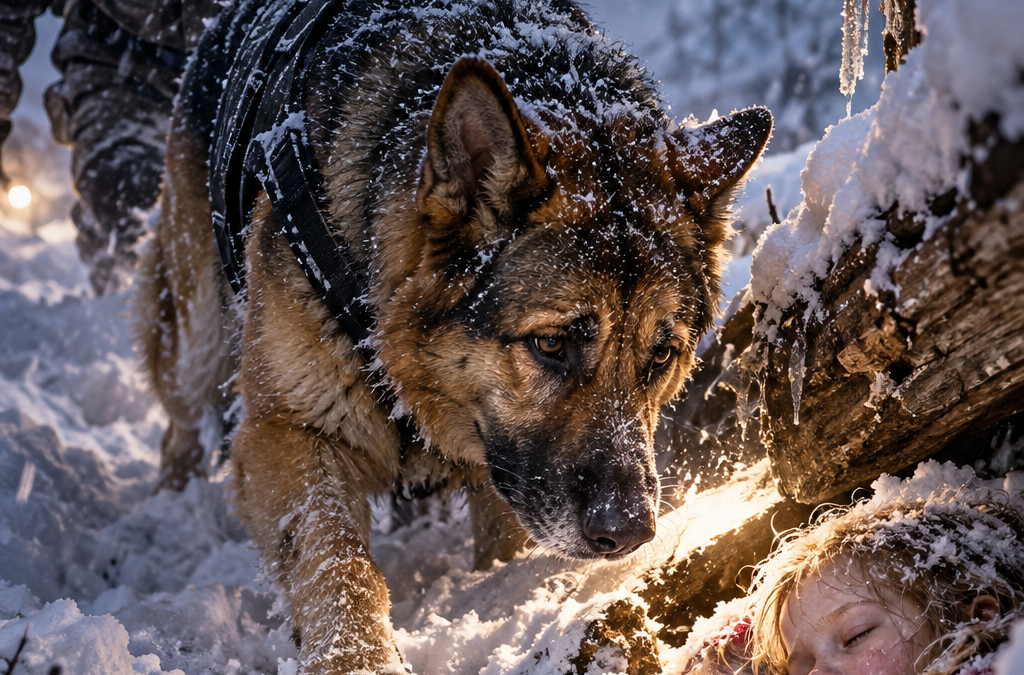
𝗙𝗨𝗟𝗟 𝗦𝗧𝗢𝗥𝗬
I tried to answer.
Nothing came out.
Emma began shaking her head.
“No.”
She backed away from us.
“No, Daddy. He’s not old enough.”
I reached for her, but she ran past me toward Atlas.
She wrapped both arms around his neck and pressed her face into his fur.
“You can’t,” she whispered.
Atlas stood still.
“You promised.”
I didn’t understand what she meant until later.
That night, after Leah put Emma to bed, I found a small notebook lying open on the kitchen table.
It was Emma’s handwriting practice book.
On the last page, she had written a sentence over and over.
Atlas will always find me.
Atlas will always find me.
Atlas will always find me.
I sat down and stared at those words.
Then I remembered.
Two summers earlier, during a family camping trip, Emma had become separated from us for less than ten minutes.
She had followed a butterfly beyond the trail while Leah and I were packing our things.
Atlas found her almost immediately, sitting behind a fallen log and crying.
When I carried her back to camp, she asked whether Atlas could always find her.
I told her that was what he had been trained to do.
“But what if it’s dark?” she asked.
“He’ll use his nose.”
“What if it’s raining?”
“He’ll keep looking.”
“What if I’m really, really far away?”
I had kissed her forehead.
“Then we’ll just have to look harder.”
She glanced at Atlas.
“And he won’t give up?”
I smiled.
“Not that dog.”
Apparently, she had turned those words into a promise.
One she believed could never be broken.
After his diagnosis, we retired Atlas completely.
The sheriff arranged for his official retirement ceremony at the station.
A dozen deputies gathered in the briefing room, along with a few people Atlas had helped over the years.
There were photographs, a plaque, and a folded department flag.
Sheriff Thomas Bradley, my longtime friend, spoke about Atlas’s service.
He called him courageous.
Reliable.
One of the finest tracking dogs the county had ever seen.
Then he looked at me.
“But more importantly, Atlas reminded us that a badge isn’t the only thing that makes someone a protector. It’s the willingness to stand between danger and another living soul.”
I couldn’t speak when they handed me his retirement plaque.
Atlas sat at my side, thinner than he had been a month earlier, but still alert whenever he heard his name.
Several deputies bent down to scratch his ears.
One of them, a younger officer named Evan Miller, tried to hide how upset he was.
“He still looks ready to work,” Evan said.
I managed a small smile.
“Don’t let him hear you say that.”
Evan looked at the dog.
“Wish he could stay forever.”
I nodded.
“So do I.”
At home, Atlas’s world became smaller.
The veterinarian prescribed medication to manage his discomfort.
We replaced his old dog bed with a thick orthopedic mattress beside the fireplace.
I carried him up the porch steps when his legs were weak.
Some mornings, he seemed almost like himself.
He would lift his head when I picked up my truck keys.
His ears would rise whenever he heard the radio on my belt.
Sometimes he even reached toward the leash hanging near the door.
But the good moments never lasted long.
He tired easily.
He ate less.
His coat lost its shine.
And at night, I sometimes woke to hear him struggling to find a comfortable position.
I began sleeping on the couch so he wouldn’t have to be alone.
Once, shortly after midnight, I found myself kneeling beside him with both hands buried in his fur.
“I’m sorry,” I whispered.
Atlas lifted his eyes.
“You carried me through everything, buddy. I should be able to do more than this.”
He nudged my wrist.
I stayed there until morning.
Emma handled his illness differently.
She refused to treat him as though he were already gone.
Every morning, she placed his water bowl close enough that he wouldn’t have to stand.
She brought him his favorite toys.
She read him books about brave animals.
She even persuaded Leah to help her make a little blue blanket decorated with yellow stars.
When I asked why it needed so many stars, Emma gave me a serious look.
“Because he found lots of people, Daddy. Every star is someone who got to go home.”
I watched her carefully sew one uneven yellow star onto the fabric.
She pricked her finger, cried for thirty seconds, and insisted on finishing.
Later, I found her sitting beside Atlas, whispering into his ear.
“I know you’re tired,” she said. “But you don’t have to be brave every minute.”
I turned away before she noticed me listening.
I wish I had remembered those words sooner.
The storm arrived on a Thursday.
Weather reports had warned us for days that a powerful system was moving into northern Vermont.
Heavy snow.
Dangerous wind.
Whiteout conditions.
Temperatures falling below zero overnight.
Schools closed early.
Road crews began treating major routes before noon.
By four o’clock, snow was already piling against our front steps.
I had been called into the sheriff’s office that morning to help coordinate emergency coverage.
Because Atlas needed constant attention, I had transferred to administrative duties after his retirement, but storms still meant long hours for everyone.
Sheriff Bradley sent me home shortly after three.
“Get your family settled,” he said. “We’ll call if we need you.”
I stopped at the grocery store for milk, soup, batteries, and Emma’s favorite hot chocolate.
When I pulled into our driveway, I could barely see the mailbox.
Our house sat on six wooded acres outside the small town of Blackwater.
Behind it, the property sloped toward a narrow ravine.
Beyond the ravine were several hundred acres of conservation land, abandoned logging tracks, and an old drainage system left from a mill that had closed decades earlier.
I knew those woods well.
In summer, they were beautiful.
In winter, especially during a storm, they could become a maze of identical white trees and hidden drops.
I had warned Emma countless times never to go beyond the back fence without an adult.
She always nodded.
And until that night, she had always listened.
When I came inside, the house smelled of chicken soup and cinnamon.
Leah was cooking dinner.
Emma sat on the floor beside Atlas, tying a yellow ribbon around his favorite rubber duck.
It was an ugly orange toy she had bought for him at a yard sale when she was four.
One eye was missing.
Its squeaker barely worked.
Atlas had never cared for toys in his working years, but for some reason, he tolerated that ridiculous duck.
Emma called it Captain Quack.
She looked up when I entered.
“Daddy, can dogs have birthdays more than once a year?”
I hung my coat.
“Why?”
“Because Atlas missed his last birthday when he was at the doctor.”
“That’s not exactly how birthdays work.”
She considered that.
“Then can he have an extra one?”
I glanced at Leah.
She smiled sadly.
“I don’t see why not.”
Emma brightened.
“Good. Tomorrow we’re having a birthday party.”
“Tomorrow might be a little snowy.”
“Then we’ll have it inside.”
She turned toward Atlas.
“You hear that? Cake.”
His tail moved once against the rug.
It was a small movement.
But Emma celebrated as though he’d performed a miracle.
By six o’clock, the wind was rattling the windows.
At six-thirty, the power flickered twice.
I brought firewood into the living room and checked the backup generator in the detached garage.
Leah filled pitchers with water.
Emma helped carry blankets downstairs.
It should have been an ordinary winter evening.
One of those nights a family remembers fondly years later, when the weather outside makes the warmth indoors feel especially precious.
At 6:47 p.m., the power went out.
The house fell silent except for the wind.
Emma shrieked in surprise.
Then she laughed.
“Now it’s like camping!”
Leah lit two battery lanterns.
I pulled on my boots.
“Generator time.”
Emma followed me toward the mudroom.
“Can I help?”
“Not outside. You stay in here with Mom.”
“But I want to.”
“Emma.”
She stopped.
I rarely used that tone with her.
“The weather’s getting dangerous. I mean it. Stay inside.”
She looked disappointed.
“Okay.”
I crouched and kissed her forehead.
“Five minutes. Then hot chocolate.”
“With marshmallows?”
“Extra marshmallows.”
She smiled.
“Deal.”
Those were the last ordinary words I heard my daughter speak that night.
I went out through the side door into the garage.
The wind hit me so hard I had to brace against the wall.
Snow swept across the driveway in thick, blinding curtains.
Starting the generator took longer than expected.
The first pull failed.
The second caught briefly before the engine sputtered out.
I checked the fuel valve, waited, and tried again.
Meanwhile, inside the house, Leah was moving supplies from the kitchen to the living room.
Atlas lay beside the fireplace.
Emma had been sitting on the floor with him.
At some point, the wind must have lifted the latch on the small screen enclosure outside the back porch.
That’s what we pieced together later.
Captain Quack had been left on the porch after Emma briefly took it outside that afternoon for a pretend birthday photograph.
She noticed it through the glass.
Her little orange duck.
Atlas’s favorite toy.
The one thing she wanted him to have at his birthday party.
She told Leah she was going to get it.
Leah, carrying a lantern toward the bathroom, thought Emma meant the toy basket beside the couch.
“Just a minute, honey,” she called.
But Emma had already put on her boots.
She grabbed her purple coat and stepped onto the covered porch.
The wind caught the screen door.
It slammed against the railing.
Emma saw the orange duck lying near the steps.
She reached for it.
A sudden gust sent the toy bouncing across the snow.
It tumbled past the porch.
Past the bird feeder.
Toward the back fence.
Emma followed.
She would later tell me she never intended to leave the yard.
She just didn’t want Atlas to wake up on his birthday without his favorite toy.
By the time she reached the fence, the wind had blown the duck beneath a gap near the gate.
Emma squeezed through.
She took several more steps.
And then the world disappeared.
Snow filled her eyes.
The house lights were out.
The porch vanished behind a wall of white.
She turned around, but everything looked the same.
She called for me.
The wind swallowed her voice.
She started walking in what she thought was the direction of the house.
Instead, she moved toward the ravine.
I was still in the garage when the generator finally started.
The porch light blinked on.
I went inside, stamping snow from my boots.
“Hot chocolate delivery service is officially back in business.”
Leah stood near the kitchen counter.
“Where’s Emma?”
I glanced toward the living room.
“With Atlas.”
“She’s not.”
I smiled at first.
“Probably hiding. She told me this morning she wanted to scare me.”
We searched the downstairs rooms.
Then her bedroom.
Then the basement.
I called her name.
No answer.
Leah found the back door slightly open.
A thin line of snow had blown across the mudroom floor.
Her face changed.
“Daniel.”
I looked at the door.
Then at the empty hook where Emma’s purple coat should have been.
My stomach dropped.
I stepped onto the porch.
“Emma!”
The wind tore the name from my mouth.
I grabbed a flashlight.
There were small footprints near the back steps.
They led toward the fence.
Some were already filling with snow.
“EMMA!”
I ran.
Leah called after me, but I barely heard her.
The footprints disappeared near the gate.
Beyond it, the snow was untouched except for long, wind-carved ridges.
I swept the flashlight across the tree line.
Nothing.
I climbed over the fence.
“EMMA! IT’S DADDY!”
The woods answered with the groan of bending branches.
I ran perhaps two hundred yards before I realized I had lost sight of our house.
My flashlight illuminated nothing beyond the nearest trees.
And I knew immediately how dangerous that was.
I’d spent years teaching people not to do exactly what I was doing.
But knowing what to do and remembering it when your child is missing are two very different things.
I pulled out my radio.
“Dispatch, this is Deputy Mercer. I need immediate assistance at my residence. Missing child. Female, eight years old. Last seen approximately ten minutes ago.”
The dispatcher recognized my voice.
“Daniel?”
“It’s Emma.”
There was a pause.
Then her tone became professional.
“Copy. Units are responding. Can you confirm clothing?”
“Purple winter coat. Pink hat. Brown boots. Blond hair.”
“Do you have a direction of travel?”
I looked around at the darkness.
“No.”
The word nearly broke me.
“No, I don’t.”
I ran back toward the house to meet the first deputies and organize a search before the storm erased everything.
Leah was standing on the porch when I returned.
Her face was white.
“Did you find her?”
I shook my head.
She made a sound I had never heard from her before.
It was small and raw, as though someone had reached inside her chest and pulled something loose.
I held her shoulders.
“Listen to me. They’re coming. We’re going to find her.”
“She doesn’t have gloves, Daniel.”
I looked down.
Leah was holding Emma’s pink mittens.
They had been lying beside the back door.
“She went out without them.”
I stared at those tiny pieces of wool.
I knew what exposed fingers could mean in that temperature.
I knew how quickly a child could lose body heat.
I knew all the statistics that officers learn and parents pray they’ll never need.
But I forced myself to speak steadily.
“We’re going to find her.”
Leah gripped my jacket.
“You have to.”
The first patrol vehicle arrived at 7:09 p.m.
Sheriff Bradley came himself.
He took one look at my face and began issuing orders.
Within thirty minutes, our yard had become an emergency command post.
Deputies searched the immediate woods.
Firefighters brought thermal imaging equipment.
Neighbors arrived with snowmobiles, flashlights, and extra winter clothing.
The volunteer rescue team established search grids using the last known location.
A K9 unit from the adjoining county was called in.
I wanted to lead every team.
Bradley refused.
“Daniel, you’re too close to this.”
“She’s my daughter.”
“I know.”
“Then get out of my way.”
He stepped in front of me.
“You’re going to help us, but you are not running blindly into a blizzard. You know better.”
I grabbed the front of his jacket.
For one terrible second, I almost hit him.
He didn’t move.
“Dan,” he said quietly, “I need you thinking. Emma needs you thinking.”
I released him.
My hands shook.
He placed a map on the hood of his truck.
“Show me everywhere she might have gone.”
I marked the fence line.
The old logging path.
The creek crossing.
The drainage ravine.
My finger stopped near the abandoned mill overflow channel.
“Here,” I said. “The terrain drops sharply.”
Bradley studied the map.
“We’ll cover it.”
He pointed toward a search leader.
“Priority area. Put a team on that ravine.”
I should have felt reassured.
Instead, I imagined my daughter somewhere beneath those trees, trying to call for me while the snow covered her tracks.
At 8:15, the first tracking dog arrived.
A young black Labrador named Nox.
His handler, Officer Sarah Ellis, was one of the best in the region.
I handed her Emma’s pillowcase.
Nox sniffed it carefully.
Then Sarah led him toward the back fence.
For a moment, the dog moved with purpose.
My heart surged.
He followed the line of the gate, turned toward the trees, and worked across a shallow depression.
Then the wind shifted violently.
Nox lifted his head.
He circled.
Searched again.
And again.
After twenty minutes, Sarah brought him back.
“I’m sorry,” she said. “The conditions are terrible. The scent is dispersing.”
“Try again.”
“We will.”
“Please.”
She looked at me with genuine pain.
“We’re not stopping.”
They tried different approaches.
The dog showed interest in several areas, but nothing developed into a reliable trail.
Searchers found broken branches.
A child’s boot print near the fence.
Then nothing.
At 9:30, the sheriff’s department received reports of fallen trees blocking two county roads.
The storm intensified.
Wind gusts rattled the emergency vehicles.
Snowmobile teams were forced to slow almost to walking speed.
One volunteer slipped into a drainage ditch and injured his knee.
The weather was beginning to endanger the searchers themselves.
At 10:12, Bradley quietly told me the rescue teams would need to rotate back to shelter.
“We’ll keep teams out,” he promised. “But we have to do this safely.”
I stared at him.
“She’s eight.”
“I know.”
“She weighs fifty-two pounds.”
He said nothing.
“She can’t stay warm out there.”
“Daniel.”
“She gets cold sitting in our living room with a blanket over her legs.”
My voice cracked.
“She can’t even sleep without a night-light.”
Bradley looked away.
And suddenly I understood something I had never understood during all my years wearing a badge.
When you’re searching for someone else’s child, you can tell yourself to stay calm.
You can focus on maps, weather patterns, terrain, and probability.
But when it’s your own child, every minute feels like a door closing.
And you would tear the entire world apart with your bare hands if you thought she might be waiting on the other side.
At 10:40, I went inside to get Leah.
She was sitting on the living room floor beside Atlas.
Emma’s photograph rested in her lap.
Atlas had placed his head against her knee.
Leah looked up.
“Anything?”
I shook my head.
She pressed the photograph against her chest.
“I should have heard the door.”
“Don’t.”
“I was right there.”
“Leah.”
“She told me she wanted his duck. I thought she meant—”
Her voice stopped.
I knelt beside her.
“We couldn’t have known.”
“She was trying to do something nice for him.”
I swallowed.
Atlas raised his head at the sound of Emma’s name.
Leah stroked his ears.
“He keeps looking for her.”
I followed her gaze.
Atlas was watching the hallway.
When I said Emma’s name again, he tried to sit up.
His front legs trembled.
I placed my hand on his shoulder.
“No, buddy. Stay down.”
He settled reluctantly.
Leah wiped her cheeks.
“I wish he were still healthy.”
So did I.
More than anything.
In another year, another life, I would have strapped his harness on the moment Emma disappeared.
He would have taken one smell of her blanket and gone to work.
I could practically see him moving through the snow, nose low, ears alert, following invisible information no human could comprehend.
But that Atlas was gone.
The dog in front of me had a failing body and a tumor that could bleed catastrophically if he exerted himself.
Dr. Hayes had warned us to avoid strenuous activity.
She had told me that even an ordinary walk might be too much.
I couldn’t ask him to search through deep snow in a blizzard.
It would be cruel.
It might kill him.
And yet, as I sat beside Leah, I noticed something strange.
Atlas wasn’t sleeping.
He had been resting almost constantly for days, but now his eyes moved toward every sound outside.
He lifted his nose whenever someone opened the front door.
His ears twitched at distant voices.
The old working dog was still there.
Trapped inside a body that was slowly failing him.
I leaned close.
“I know, buddy,” I whispered. “I wish you could help too.”
His tail shifted once.
I walked into the kitchen to speak with Bradley over the radio.
A search team had reached the eastern ravine and reported no sign of Emma.
The helicopter was still grounded.
Road conditions were deteriorating.
I stared at the family calendar on the refrigerator.
Tomorrow’s date had a crooked purple circle around it.
Inside, Emma had written:
ATLAS BIRTHDAY PARTY!
My knees suddenly felt weak.
I gripped the counter.
“Please,” I whispered.
I wasn’t sure who I was talking to.
God.
The storm.
The empty kitchen.
“Please don’t take her.”
Then I heard the claws.
Three scrapes against the hardwood.
A thump.
I turned.
Atlas was standing.
He staggered once, then steadied himself against the couch.
His attention was fixed on the back door.
“Atlas?”
He took a step.
Another.
His legs shook violently.
I approached slowly.
“Buddy, lie down.”
He ignored me.
I touched his chest.
His heart was pounding.
He moved toward the door again.
At first, I thought he needed to go outside.
Then he stopped, looked directly at me, and placed one paw against my knee.
My breath caught.
I knew that gesture.
During his working years, Atlas had used it when he recognized a search command and was ready to follow a scent.
I had taught him to perform it as a silent confirmation when we worked close to nervous victims.
I hadn’t asked him to do it.
Yet there it was.
The same deliberate touch.
The same focused eyes.
He was asking to work.
I sat back on my heels.
“No.”
Atlas stared at me.
“You’re sick, buddy.”
He touched my knee again.
I felt tears burn behind my eyes.
“I can’t lose you too.”
He made a low sound.
Then he pressed his nose against Emma’s purple scarf lying on the bench beside the door.
He inhaled deeply.
His ears lifted.
And despite the weakness in his legs, his entire expression changed.
I had seen that look thousands of times.
It was the moment he stopped being a family pet and became a search dog.
Purpose had returned to his eyes.
Leah appeared in the hallway.
“Daniel?”
I turned toward her.
“He’s trying to track.”
She looked at Atlas.
Then at me.
“Is that possible?”
“I don’t know.”
“Would it hurt him?”
I couldn’t lie.
“Yes.”
She stood motionless.
Atlas nudged the scarf again.
Leah covered her mouth.
I looked down at the dog who had given me nearly every strong year of his life.
His breathing was already difficult.
His legs were trembling.
I knew what might happen if I asked him to push beyond those limits.
He could collapse in the snow.
He could hemorrhage.
He might never come home.
I closed my eyes.
Then I heard Emma’s voice in my memory.
He won’t give up?
Not that dog.
I opened my eyes.
“Atlas,” I whispered, “if we do this, I need you to tell me when you’ve had enough.”
He stared at me.
Of course, he couldn’t make that promise.
Dogs never know how to tell us they’ve given everything.
They just keep giving.
I stood, pulled his old working harness from the closet, and called Bradley.
“I need you at the house.”
He answered immediately.
“I’m two minutes away. What’s wrong?”
“I’m taking Atlas out.”
Silence.
Then, “Daniel, don’t.”
“He wants to track.”
“Atlas can barely walk.”
“I know.”
“You’re going to kill him.”
The words landed like a punch.
I looked down.
Atlas was still standing by the door.
Waiting.
“Maybe,” I whispered.
Bradley’s voice softened.
“Dan…”
“I know what the vet said. I’m not going to force him into the woods. But he’s showing me a search indication. If there’s a chance he can identify a direction, I have to let him try.”
Bradley didn’t answer.
I continued.
“I’ve watched that dog find people when no one else could. I’m not saying he can do it tonight. I’m saying he’s asking.”
Bradley exhaled.
“Don’t leave until I get there.”
I ended the call.
Then I knelt in front of Atlas.
For nine years, putting on his harness had been a ritual.
He would stand proudly, ears forward, tail moving with restrained excitement.
I would fasten the straps, check his collar, and say the same words.
“Ready to work, partner?”
That night, it took nearly a minute to get the harness over his shoulders.
His body had become so thin that the straps hung loose.
I tightened them gently.
Atlas flinched when the lower strap brushed his abdomen.
I stopped immediately.
“Sorry, buddy.”
I adjusted the harness to keep pressure away from his swollen belly.
Then I clipped on his long tracking lead.
Leah knelt beside us.
Her hands trembled as she straightened the harness.
“Please bring him home,” she whispered.
I looked at her.
She knew I couldn’t promise that.
She leaned forward and kissed Atlas between his ears.
“And bring our baby home too.”
Bradley arrived at 11:51.
He stepped through the door, saw Atlas standing beside me, and stopped.
For a moment, the sheriff disappeared.
All I saw was the man who had watched this dog grow from an unruly young Shepherd into a decorated K9 officer.
“Well, I’ll be damned,” he whispered.
Atlas gave a faint wag of his tail.
Bradley crouched.
“Hey, old soldier.”
He looked into Atlas’s eyes.
Then he stood.
“All right. We’re doing this carefully.”
He called two rescue volunteers and a medic to accompany us.
No one was to separate from the group.
We would carry emergency blankets, radios, a sled, and a thermal kit.
We would maintain contact with the command post.
If Atlas showed signs of distress, we would stop.
I agreed to everything.
Then I opened the back door.
The storm rushed into the house.
Atlas stepped forward.
The first few yards were agonizing to watch.
He moved slowly, each paw sinking into powder that nearly reached his chest.
I supported part of his weight with the harness.
He stopped twice, breathing heavily.
Bradley stayed close.
“Dan, this is too much.”
I was beginning to think he was right.
Then Atlas reached the back gate.
He lowered his nose to the snow.
Moved left.
Circled.
Paused.
He lifted his head into the wind.
And for the first time that night, he pulled against the lead.
My heart lurched.
“He’s got something.”
Bradley raised his radio.
“Command, this is Sheriff Bradley. K9 Atlas is showing interest at the Mercer rear fence. We’re proceeding slowly into the west woods.”
Atlas passed through the gate.
Then he turned sharply right.
Not toward the main trail.
Not toward the open clearing where searchers had spent hours looking.
Toward a narrow line of evergreens behind the old stone wall.
I hesitated.
“That way?”
Atlas pulled again.
I followed.
The first hundred yards took nearly fifteen minutes.
The snow was deep enough that two rescuers had to break a path ahead of us.
Atlas moved with his nose alternating between the snow and the wind.
I recognized the behavior.
He wasn’t following a clean ground track.
The storm had scattered too much of Emma’s scent for that.
Instead, he appeared to be working pockets of airborne scent carried through the terrain.
Twice, he lost whatever he had detected.
Twice, he circled until he found it again.
I didn’t dare speak.
My entire world had narrowed to the line stretching between my hand and his harness.
At one point, Atlas stopped near a fallen birch tree.
He sniffed the trunk.
Then he moved toward a gap beneath its branches.
I shone my flashlight into the snow.
Something pink was caught on a broken limb.
I stepped closer.
My stomach turned.
A tiny piece of knitted fabric.
Pink yarn.
I pulled it free.
It was a tassel from Emma’s hat.
I knew because Leah had made that hat herself, and one tassel had been hanging loose for weeks.
“Bradley!”
He came toward me.
I held up the yarn.
“That’s hers.”
He took it carefully.
“Are you certain?”
“Absolutely.”
Bradley immediately radioed the discovery.
Search teams were redirected toward our location.
For the first time in hours, we had physical evidence showing where Emma had traveled.
And it had been found because Atlas led us there.
I bent down beside him.
“Good boy.”
His tail moved weakly.
“That’s it, buddy. Good boy.”
Then he tried to walk again.
The next stretch was worse.
The ground sloped downward through dense trees.
Wind pushed snow into our faces.
Atlas’s breathing grew harsher.
I could feel his strength fading through the harness.
He stumbled.
I caught him before he fell.
“Easy.”
He tried to rise.
I helped him.
After another twenty yards, his legs buckled again.
This time, he went down on his side.
My heart stopped.
“Atlas!”
I dropped beside him.
His chest rose and fell rapidly.
Snow gathered on his coat.
I brushed it away with shaking hands.
“Hey. Look at me.”
He opened his eyes.
But he didn’t move.
Bradley knelt beside us.
“Daniel, we have to stop.”
I looked at my dog.
His body was trembling uncontrollably.
His breathing had become shallow.
I could see how much pain every movement cost him.
For one horrible moment, I hated myself.
I had done this.
I had brought a dying animal into the worst storm of the year because I couldn’t accept that my daughter might be beyond my reach.
I had asked my loyal old partner to pay for my desperation with whatever life he had left.
“I’m sorry,” I whispered into his fur.
Atlas’s ears twitched.
“I’m sorry, buddy. You don’t have to do this.”
I reached for the harness buckle.
“You’re done. I’m taking you home.”
His head moved.
Slowly.
Painfully.
He caught my wrist with his mouth.
Not hard enough to hurt.
Just enough to stop me.
I froze.
He released my wrist, stretched his neck toward the ravine, and gave a faint whine.
Bradley looked at me.
Neither of us spoke.
Atlas struggled to lift his head.
I supported him under the chest.
He pointed his nose downhill.
Then he looked back at me.
I had spent my career learning how to read that dog.
I knew the difference between curiosity and alarm.
Between uncertainty and recognition.
Between a dog who was searching and a dog who believed he had found something.
And in that moment, I knew he wasn’t simply wandering.
There was something down there.
Something important enough that he was trying to stand despite his failing body.
I looked toward the ravine.
The slope vanished into darkness.
A search team had already checked part of the area from the opposite ridge.
They had seen no footprints.
No clothing.
No sign of movement.
But the lower channel had been difficult to approach because of ice and fallen timber.
I turned to Bradley.
“Get the others down there.”
He nodded.
Then he saw my expression.
“Dan?”
“Take the lead.”
He stared at me.
“I’m going to carry Atlas.”
I lifted my dog into my arms.
He had once weighed nearly ninety pounds.
Now he felt terribly light.
His head rested against my shoulder.
I wrapped my coat around him as best I could.
“We’re not done yet,” I whispered.
The rescuers moved ahead.
I followed as quickly as the slope allowed.
Snow slipped beneath my boots.
Branches scratched my face.
The cold burned my lungs.
Atlas occasionally lifted his head and turned it toward the darkness.
Whenever I drifted too far left, he became restless.
When I corrected course, he settled.
I couldn’t explain it.
I only knew I had trusted his instincts for nine years.
And I wasn’t going to stop now.
We reached the bottom of the ravine shortly after midnight.
A narrow frozen creek ran between high, snow-covered banks.
Beyond it stood the remains of an old concrete drainage culvert.
It had once carried runoff beneath a logging road.
Years of erosion had exposed part of the structure.
A fallen tree lay across its upper edge.
Snow had drifted over the entrance, almost completely hiding it.
I had walked past that place many times.
But never in weather like this.
And I had forgotten how deep the channel became after heavy snow.
Atlas lifted his head.
His ears moved.
Then he began struggling in my arms.
“Easy, buddy.”
He pushed against my chest.
I lowered him carefully onto the snow.
He couldn’t stand without support.
But he turned toward the culvert.
His nose worked rapidly.
He tried to move forward.
The long lead tightened.
And suddenly he made a sound I had not heard from him all night.
One sharp bark.
It echoed between the ravine walls.
Then another.
I stopped breathing.
Atlas hadn’t barked during the entire search.
Not once.
He was trained to give a sustained alert when he located a missing person.
But he was too weak to do that now.
Instead, he raised one paw and struck the frozen ground.
Once.
Twice.
Three times.
Then he collapsed against my leg.
I dropped to my knees.
“Bradley!”
The sheriff turned.
“What?”
I pointed toward the culvert.
“She’s there.”
He looked at the snow-covered opening.
“We don’t know that.”
“That’s his alert.”
“Dan—”
“THAT’S HIS ALERT!”
My voice cracked across the ravine.
Bradley stared at Atlas.
Then he lifted his radio.
“All units, possible location. West ravine, old mill drainage culvert. We need rescue equipment and medical support immediately.”
Two volunteers began clearing snow from the entrance.
I dropped beside them.
My hands were numb inside my gloves.
I dug anyway.
Snow.
Ice.
Frozen branches.
Pieces of debris.
The opening slowly emerged.
It was barely two feet high.
The interior disappeared into darkness.
I shone my flashlight inside.
“Emma!”
Nothing.
“EMMA! BABY, IT’S DADDY!”
The silence that followed was unbearable.
One rescuer looked at me.
“We need to stabilize the debris before anyone goes in.”
I barely heard him.
I leaned closer.
“Emma, if you can hear me, make a noise!”
A gust of wind moved through the trees.
I waited.
My heart hammered.
Then I heard something.
A faint metallic sound.
Tap.
Tap.
I froze.
“Quiet!”
Everyone stopped moving.
I lowered my ear toward the opening.
A long silence followed.
Then—
Tap.
Tap.
Tap.
It came from deeper inside the culvert.
My flashlight beam shook.
“EMMA?”
A tiny voice answered.
“Daddy?”
For one second, I couldn’t move.
I couldn’t breathe.
I couldn’t even understand what I had heard.
Then the sound came again.
“Daddy… I’m cold.”
I broke.
“EMMA!”
I lunged toward the entrance.
Bradley caught my shoulder.
“Daniel, wait!”
“She’s in there!”
“I know. We’re getting her out.”
“LET ME GO!”
He held me.
“Listen to me. That opening is unstable. If it collapses, you’ll both be trapped.”
I wanted to shove him aside.
I wanted to crawl through every inch of that frozen pipe until my hands were bloody.
But somewhere beneath the panic, I heard the truth in his voice.
So I forced myself to stop.
The rescuers cleared snow from the entrance while one of them checked the concrete and fallen branches overhead.
A smaller firefighter named Rachel volunteered to crawl inside.
She removed her bulky outer pack, secured a safety line, and eased into the opening with a helmet light.
“Emma?” she called. “My name’s Rachel. Your dad is right outside.”
A weak voice answered.
“Where’s Atlas?”
I covered my mouth.
Rachel glanced back.
“He’s here too, sweetheart.”
There was a pause.
Then Emma whispered, “I knew he’d come.”
I lowered my head.
The snow beneath me blurred.
Rachel moved farther into the culvert.
A minute later, her voice came through the radio.
“I have the child.”
I looked up.
“She’s conscious. Very cold. Her left ankle appears injured. She’s wedged behind a buildup of branches, but I can reach her.”
“Can you get her out?” Bradley asked.
“Working on it.”
Those next few minutes were the longest of my life.
Rachel spoke gently to Emma while the rescuers cleared the last dangerous pieces of debris.
I kept talking into the opening.
“Baby, I’m right here.”
“I’m sorry, Daddy.”
“No. No, sweetheart.”
“I didn’t mean to go so far.”
“I know.”
“I couldn’t see the house.”
“You’re okay. We’re here.”
“I tried to call you.”
My throat tightened.
“I know, baby.”
“I thought you forgot me.”
The words nearly destroyed me.
I pressed my forehead against the frozen concrete.
“Never,” I whispered. “I would never forget you.”
Deep inside the culvert, Emma began crying.
I could hear the small, exhausted sobs echo through the pipe.
“I got scared.”
“I know.”
“I wanted Atlas’s duck.”
I closed my eyes.
“Oh, sweetheart.”
“The wind took it.”
I looked toward Atlas.
He was lying on a rescue blanket beside Bradley, barely moving.
“He knows you love him, baby. You didn’t have to get his toy.”
Emma didn’t answer.
Then Rachel’s voice came through the radio again.
“We’re moving.”
I stepped back.
A rescue worker pulled carefully on the safety line.
Rachel emerged first.
Then she guided a small shape wrapped in a thermal blanket toward the opening.
I saw purple fabric.
Blond hair.
A tiny hand.
And suddenly my daughter was in front of me.
Her lips were pale.
Her cheeks were red from the cold.
Ice clung to her eyelashes.
One boot was missing.
But her eyes were open.
“Daddy?”
I dropped to my knees and gathered her against me.
For a moment, I couldn’t speak.
I held her so tightly that Rachel gently touched my shoulder.
“Sir, we need to assess her.”
I nodded without letting go.
Emma’s fingers curled around my jacket.
“I knew you would come,” she whispered.
I buried my face in her hair.
“I’m here.”
Then she asked the question that I would remember for the rest of my life.
“Did Atlas find me?”
I looked over my shoulder.
Bradley was kneeling beside my dog.
Atlas lay in the snow, his head resting against the sheriff’s knee.
His eyes were half-closed.
His breathing was slow and uneven.
“Yes, baby,” I whispered.
“He found you.”
Emma tried to turn.
“I want him.”
The medic began checking her temperature and circulation.
“We need to get her warm immediately.”
I knew he was right.
Emma’s body was dangerously cold.
Her fingers were stiff.
She was shivering, but weakly.
We couldn’t delay.
Yet she kept looking toward Atlas.
“Please, Daddy. I have to tell him.”
I glanced at the medic.
He hesitated.
Then he nodded.
“Just a moment.”
Bradley carried Atlas closer.
He laid the dog beside us on the rescue blanket.
I supported Emma as she reached out one trembling hand.
Her fingers touched Atlas’s ear.
“Hi, brother,” she whispered.
Atlas opened his eyes.
His nose moved toward her.
With an effort that made my chest ache, he lifted his head and touched her hand.
Emma began crying.
“I’m sorry I made you come outside.”
Atlas gave a faint breath.
“I didn’t mean to.”
His tail moved once.
Just once.
Against the blanket.
Emma leaned closer.
“You found me.”
Then, in the smallest voice imaginable, she said, “You’re still my hero.”
Atlas closed his eyes.
His head settled back onto the blanket.
For a terrifying second, I thought he had died.
I placed my hand against his chest.
There was still a heartbeat.
Weak.
But there.
“Daniel,” Bradley said, “we need to move.”
I nodded.
We carried Emma out of the ravine first.
A medic and two rescuers placed her on a sled designed for wilderness evacuation.
They wrapped her in insulating blankets and secured her carefully.
I walked beside her as the team pulled her toward the waiting ambulance.
She kept reaching for my hand.
I never let go for more than a few seconds.
Behind us, Bradley and another firefighter carried Atlas.
I could hear their boots crunching through the snow.
Every few steps, I looked back.
My dog lay motionless in their arms.
I had imagined finding Emma a thousand times during those terrible hours.
I had imagined carrying her home.
I had imagined hearing her laugh again.
I had even imagined telling Atlas we had done it.
But I had never imagined that bringing my daughter out of those woods might mean carrying my oldest friend toward the end of his life.
When we reached the command post, Leah was waiting beside the ambulance.
Someone had told her they had found Emma alive.
She ran toward us before the sled stopped.
“Emma!”
Our daughter lifted her arms.
“Mommy!”
Leah fell to her knees in the snow.
The sound she made when she held Emma was something I will never forget.
It was relief so powerful it almost resembled grief.
She pressed kisses against Emma’s forehead, cheeks, and icy fingers.
“My baby. My sweet baby.”
Emma began crying again.
“I’m sorry.”
Leah shook her head.
“You’re home. That’s all that matters.”
The medics loaded Emma into the ambulance.
Her temperature was low, and they were concerned about hypothermia and possible frostbite.
Leah climbed in beside her.
I stood outside for one second, torn in half.
My daughter was alive.
My dog was dying.
Leah saw my face through the open ambulance door.
“Go with Atlas,” she said.
I stared at her.
“What?”
“Emma has me.”
“But—”
She reached out and touched my cheek.
“Daniel, go.”
Her eyes filled.
“He shouldn’t be alone.”
I could barely nod.
The ambulance doors closed.
Red lights flashed across the snow.
Then my wife and daughter disappeared down the driveway toward the hospital.
I turned.
Bradley was waiting beside his truck.
Atlas lay across the back seat on a thick blanket.
I climbed in next to him.
The sheriff drove.
Neither of us spoke for several minutes.
I kept one hand against Atlas’s chest, feeling each fragile heartbeat beneath his fur.
His breathing was shallow.
His eyes remained closed.
“Come on, buddy,” I whispered. “Stay with me.”
Bradley glanced into the rearview mirror.
“I called Dr. Hayes. She’s meeting us at the clinic.”
I nodded.
“Thank you.”
He hesitated.
“Dan.”
“Yeah?”
“What he did tonight…”
His voice trailed off.
I looked down at Atlas.
“I know.”
Bradley swallowed.
“I’ve seen a lot of incredible dogs. But I’ve never seen anything like that.”
I didn’t answer.
There were no words large enough.
We reached the veterinary clinic shortly after two in the morning.
Dr. Hayes was waiting at the entrance with a technician.
They carried Atlas inside.
I followed so closely that I nearly collided with the examination table.
Dr. Hayes checked his gums, heart rate, breathing, and abdomen.
She performed an emergency ultrasound.
Then she asked the technician to step out.
I knew what that meant.
Doctors had looked at me that way before.
I hated that I recognized it.
“Daniel,” she began gently, “Atlas is in very serious condition.”
I stared at the floor.
“Is the tumor bleeding?”
“There appears to be internal bleeding, yes. And his body is severely exhausted.”
I closed my eyes.
She continued carefully.
“His cancer was already advanced. The exertion tonight placed enormous stress on him.”
I swallowed.
“Can you stabilize him?”
“We can provide supportive care and pain relief. There are interventions we could discuss, but they would be difficult for him, and they wouldn’t change the underlying disease.”
I looked at Atlas lying on the table.
He had spent nearly his entire life obeying me.
Even when he was afraid.
Even when he was injured.
Even when I asked him to enter places no sensible creature would willingly go.
And tonight, when I had told him he was done, he had refused to stop.
“He found her,” I whispered.
Dr. Hayes looked up.
“Your daughter?”
I nodded.
“She was missing in the storm.”
Her expression changed.
“Daniel…”
“Everyone searched. We couldn’t find her. And Atlas got out of bed.”
I struggled to breathe.
“He led us to this old drainage pipe. She was inside. He knew she was there.”
Dr. Hayes sat beside me.
For a moment, she said nothing.
Then she reached across the table and stroked his head.
“That sounds like Atlas.”
I laughed once.
A terrible, broken sound.
“He saved her.”
“I know.”
“And I might have killed him asking him to do it.”
Dr. Hayes turned toward me.
“Daniel, his illness was already taking his life. We can’t know exactly how much the search changed his remaining time.”
“I watched him fall. I kept going.”
“You carried him when he couldn’t walk. You stopped when he was struggling. And you got him here.”
I stared at my hands.
They were still scratched and swollen from digging through ice.
“He trusted me.”
“He did.”
“I should have protected him.”
Her voice softened.
“You’re protecting him now by thinking about what he needs, not just what you want.”
That was when I finally broke down.
Not the controlled tears I’d been fighting all evening.
Not the silent trembling I’d hidden from Leah.
I bent over the examination table, wrapped my arms around Atlas, and sobbed against his neck.
“I’m sorry, boy.”
His ear moved.
“I’m so sorry.”
I felt his nose brush my wrist.
The smallest movement.
But enough to remind me he was still there.
I stayed with him while Dr. Hayes administered medication to ease his pain and help him rest.
She kept him warm.
Monitored his breathing.
Watched for signs of worsening bleeding.
At four in the morning, she pulled up a chair beside me.
“Daniel, I need to be frank with you.”
I looked at her.
“He’s not going to recover enough to have a comfortable life again.”
I had known.
Somewhere inside, I had known from the moment he collapsed in the ravine.
But hearing it made the truth impossible to avoid.
“How long?”
She looked toward Atlas.
“His condition may deteriorate very quickly. I don’t want him to experience a crisis or severe pain.”
I nodded slowly.
“Can I take him home?”
She studied me.
“Possibly, if he remains stable enough for the trip and we make a plan for his comfort. But we need to be realistic about what happens next.”
“I know.”
“Daniel…”
I looked up.
“I just want him to see Emma one more time.”
Her eyes softened.
“Let me examine him again in a little while.”
I spent the next two hours sitting beside the table.
At six, Leah called from the hospital.
Emma was improving.
The doctors were treating her for moderate hypothermia and a sprained ankle.
She had some frostnip on her fingers but no major tissue damage.
They wanted to observe her for several more hours, but they expected her to recover.
I leaned forward, resting my forehead against Atlas’s shoulder.
“Did you hear that?” I whispered.
His eyes opened slightly.
“She’s going to be okay.”
He breathed out slowly.
“Because of you.”
Leah’s voice came through the phone.
“How is he?”
I couldn’t answer immediately.
“Daniel?”
“He’s very sick.”
There was silence.
Then Leah asked, “Is he coming home?”
I looked at Atlas.
“I hope so.”
Emma came on the phone a moment later.
“Daddy?”
“Hey, sweetheart.”
“Is Atlas there?”
“Right beside me.”
“Can I talk to him?”
I put the phone near his ear.
“Go ahead.”
There was a rustle.
Then Emma’s voice, small but clear.
“Hi, Atlas.”
One of his ears moved.
“It’s me.”
He opened his eyes.
I watched his nose twitch.
“Mommy says we’re okay,” she continued. “And I didn’t lose my other boot. They found it in the ambulance.”
I covered my mouth.
She had been gone for hours in a deadly blizzard.
She had almost frozen to death.
And she was worried about a boot.
Children have a way of reminding you that the world hasn’t entirely collapsed.
Emma paused.
“Are you coming home, brother?”
Atlas looked toward the phone.
Then he lowered his head.
I couldn’t speak.
Emma waited.
“Daddy?”
“I’m here.”
“Can you tell him something?”
“Anything.”
She took a breath.
“Tell him he doesn’t have to find anybody else.”
My eyes filled.
“Okay.”
“Tell him I made it home.”
I pressed the phone closer.
“You hear that, old man?” I whispered. “Your girl’s safe.”
Emma spoke again.
“And tell him he can sleep now.”
I closed my eyes.
“I will, sweetheart.”
Dr. Hayes reexamined Atlas shortly after seven.
His condition remained grave, but he was calm and comfortable with the medication.
She agreed that a careful trip home was possible.
She explained the risks.
She made sure I understood we might have very little time.
And she arranged to come to our house later that day so we could make a compassionate decision without putting Atlas through another difficult journey.
I signed the discharge paperwork with a hand that barely worked.
Then I lifted my dog into the truck.
For years, Atlas had jumped into that vehicle with effortless strength.
He knew every sound it made.
Every turn near our station.
Every routine.
This time, I carried him.
His head rested against my chest.
“One more ride, partner,” I whispered.
The storm had finally passed.
Morning sunlight spilled across the snow.
The trees glittered beneath a layer of ice.
Road crews were clearing the last drifts.
And for the first time since the evening before, the world looked peaceful.
I drove slowly.
At the corner near our house, I passed the old elementary school.
A row of colorful drawings hung in the windows.
One was a yellow sun.
Another was a house beneath a rainbow.
I thought of Emma making plans for Atlas’s birthday.
Cake.
Balloons.
A ridiculous orange duck.
My chest tightened.
He had given us one more day with her.
I wondered how I was supposed to say goodbye to him in return.
When we reached home, I carried Atlas into the living room.
Leah had arranged his bed beside the fireplace before leaving for the hospital.
His blue blanket lay across it.
The one Emma had decorated with yellow stars.
I lowered him gently onto the mattress.
He sighed.
I sat beside him.
For a long time, I simply watched his breathing.
There was no radio.
No command.
No emergency waiting outside.
Just my old dog and the quiet house.
I thought about everything we had survived together.
His first day at the training academy, when he stole my glove and refused to return it.
The winter he found a missing teenager beneath a collapsed snow shelter.
The time he dragged me backward by my coat when a wooden staircase began to give way during a search.
The day Emma was born.
The afternoons when he lay on the lawn while she covered him with flower petals and declared him the king of the backyard.
I thought about the years I had spent believing Atlas would always be there.
And I realized that my mistake had never been loving him too much.
It had been assuming love could somehow make time stop.
At 10:30 that morning, Emma came home.
Leah carried her through the front door, although Emma insisted she could walk with the boot the hospital had provided for her sprained ankle.
Her cheeks had regained their color.
Her hair was tangled.
She wore a hospital-issued pair of thick socks and one of Leah’s oversized sweaters.
When she saw me, she held out her arms.
I lifted her carefully.
She wrapped herself around my neck.
I stood there holding my daughter in the hallway, breathing in the familiar smell of her hair.
For hours, I had imagined never doing this again.
Now I couldn’t convince my arms to let go.
“Daddy?”
“Yeah, baby?”
“You’re squeezing me.”
I laughed through tears.
“Sorry.”
She hugged me tighter.
“It’s okay.”
Then she leaned back.
“Where’s Atlas?”
I carried her into the living room.
He was resting beside the fireplace.
Emma went quiet.
She had seen him weak before.
But not like this.
She slipped from my arms and approached slowly.
“Atlas?”
His eyes opened.
When he saw her, his ears lifted slightly.
His tail moved against the blanket.
Emma knelt beside him.
She didn’t throw her arms around him as she normally would.
She simply placed one small hand against his cheek.
“Hi.”
Atlas lifted his nose toward her.
She smiled.
A trembling, watery smile.
“I came back.”
He touched her fingers with his nose.
Emma looked over her shoulder at me.
“He knows.”
I nodded.
“Yeah, sweetheart. He knows.”
She stayed beside him all morning.
Leah brought soup.
Emma took a few bites, then returned to Atlas.
She told him about the ambulance.
About the kind firefighter named Rachel.
About the doctor who gave her a stuffed polar bear for being brave.
Then she described what had happened in the woods.
“I thought I was going toward our house,” she whispered.
Atlas lay quietly.
“But everything was white, and the wind was so loud.”
She traced one finger along the edge of his ear.
“I fell down the hill. My foot got stuck, and I couldn’t walk right after that.”
I sat nearby, listening.
It was the first time she had told us the whole story.
“I saw the pipe. I thought maybe I could hide from the snow.”
She swallowed.
“But then the branches fell in front, and I couldn’t get back out.”
Leah covered her mouth.
Emma continued.
“I tried to yell, but nobody came. So I took my boot off and hit the pipe with it.”
I remembered those faint metallic sounds.
Tap.
Tap.
Tap.
The sounds that had told us she was alive.
“I got really sleepy,” she said.
My heart tightened.
“I thought maybe I should close my eyes, but I remembered Daddy said not to go to sleep if you get too cold outside.”
I nodded.
I had taught her that during a winter safety lesson.
“I tried to stay awake.”
She looked at Atlas.
“Then I heard barking.”
The room went still.
I leaned forward.
“What did you hear, baby?”
“Two barks.”
I swallowed.
“And I knew it was him.”
Atlas’s ears moved.
Emma smiled faintly.
“He sounds different from other dogs.”
She leaned toward him.
“So I started hitting the pipe again.”
I closed my eyes.
We had almost missed her.
The culvert had been hidden by snow.
The rescue teams had searched the surrounding woods, but nobody had known she was trapped beneath the old road.
If Atlas hadn’t turned toward the ravine…
If he hadn’t recognized the scent…
If he hadn’t kept directing us even after he could no longer walk…
I couldn’t finish the thought.
Emma rested her forehead against his.
“Thank you, brother.”
Atlas breathed softly against her hair.
For the first time since his diagnosis, I understood that his life hadn’t been measured by the number of years he lived.
It had been measured by the people who got to keep living because he was there.
Around noon, Dr. Hayes arrived.
She examined Atlas while Emma sat beside me.
Leah remained near the fireplace.
The doctor’s expression told me what I needed to know before she said anything.
Atlas was fading.
His circulation was weak.
His breathing had become more difficult.
The internal bleeding was worsening.
Dr. Hayes explained that his body was shutting down and that allowing him to continue struggling could mean unnecessary suffering.
Emma listened carefully.
Then she asked, “Can you give him medicine to make him better?”
Dr. Hayes crouched beside her.
“I wish I could, sweetheart.”
“Why can’t you?”
“Because his sickness is very serious. His body has been fighting it for a long time.”
Emma looked at Atlas.
“But he found me.”
“I know.”
“If he could do that, why can’t he get better?”
The doctor was quiet for a moment.
Then she said, “Sometimes being brave doesn’t mean your body can keep going. Atlas did something extraordinary because he loves you. But he’s very tired now.”
Emma stared at the floor.
“Will he hurt?”
“That’s what we’re trying to prevent.”
I reached for her hand.
“Sweetheart, the kindest thing we can do is make sure Atlas doesn’t have to suffer.”
Her eyes filled.
“Does that mean…”
I nodded.
Her lower lip began trembling.
“No.”
She moved closer to Atlas.
“No, Daddy. We just got home.”
I wrapped an arm around her.
“I know.”
“He can’t go yet.”
The words came faster.
“We haven’t had his birthday. I made decorations. And he didn’t get his cake.”
I pulled her onto my lap.
She began sobbing against my chest.
“Please, Daddy.”
I had no answer that could make it better.
I wanted to promise her another week.
Another month.
Another summer.
I wanted to tell her we could fix him if we found the right medicine or the right doctor.
But I had spent weeks bargaining with a reality that didn’t care how much we loved him.
And now my daughter was asking me to do what I had been unable to do for myself.
Accept that he was leaving.
I held her until her crying quieted.
Then I said, “Emma, do you remember what you told Atlas when he first got sick?”
She sniffled.
“What?”
“You said he didn’t have to be brave every minute.”
She looked toward him.
I continued softly.
“He’s been brave for us his whole life.”
Her eyes filled again.
“And now?”
“Now we get to be brave for him.”
She looked at Dr. Hayes.
“Will he know we’re here?”
“Yes, sweetheart. He can hear you and feel you beside him.”
Emma wiped her face.
“Then I want to stay.”
Dr. Hayes looked toward Leah and me.
We nodded.
“Of course,” she said.
The doctor stepped into the kitchen to give us a little time together.
Leah sat on the floor beside Atlas.
I pulled his blanket over him.
Emma disappeared into her bedroom.
A few minutes later, she returned carrying a small paper bag.
“I made these for his party.”
Inside were paper stars, blue ribbons, and a cardboard birthday crown.
On the front of the crown, in purple marker, she had written:
BEST DOG IN THE WORLD.
She set the crown beside Atlas rather than trying to put it on his head.
Then she took out a folded piece of paper.
It was a birthday card.
The front showed a drawing of Atlas standing in a field of yellow flowers.
Emma opened it.
“Can I read it?”
I nodded.
Her voice shook.
“Dear Atlas. Happy birthday. Thank you for sleeping by my bed when I was scared. Thank you for letting me hug you when I was little. Thank you for finding people who were lost.”
She paused.
Her hands trembled around the paper.
Then she continued.
“Thank you for finding me when I was the most lost.”
Leah began crying silently.
Emma swallowed.
“I hope when you go to heaven, there are lots of treats and soft beds and nobody makes you work because you’re tired.”
She looked down at him.
“And if you miss me, you can look for the brightest star because I’ll look at the same one.”
My vision blurred.
She carefully placed the card beside his front paw.
Then she looked at me.
“Daddy?”
“Yes?”
“Can I give him Captain Quack?”
I stared at her.
I had forgotten about the toy.
We had never found it.
“Sweetheart, I think Captain Quack is still out in the woods.”
She shook her head.
“I know.”
Her face crumpled.
“That’s why I went outside.”
I gathered her into my arms.
“I’m so sorry,” she whispered.
I kissed her hair.
“Emma, listen to me.”
She looked up.
“You are more important than any toy in the world.”
“I know.”
“And Atlas would never want you to get hurt trying to bring him a present.”
She looked toward him.
“I just wanted him to be happy.”
“He was happy because he had you.”
For a moment, she said nothing.
Then she slipped from my lap and went to the toy basket.
She found a small yellow tennis ball.
It had been one of Atlas’s first toys when he came home from training.
She placed it beside his paw.
“He can have this one instead.”
Atlas’s nose moved toward it.
Emma smiled through her tears.
“He remembers.”
I reached down and touched the worn tennis ball.
I remembered too.
I remembered a young dog with boundless energy.
A new partner who had looked at me as though life were a wonderful problem waiting to be solved.
I remembered throwing that ball across the yard until my arm ached.
And suddenly I wanted one more ordinary afternoon.
One more game of fetch.
One more walk through the woods.
One more chance to call his name and watch him come running.
But there was no more time.
Dr. Hayes returned to the living room.
She explained the process quietly.
She would first make Atlas deeply relaxed and sleepy so he would feel no fear or pain.
Then, when we were ready, she would give the final medication.
She told us we could take as long as we needed.
I looked at Leah.
She nodded through tears.
We arranged ourselves around Atlas’s bed.
Leah sat beside his shoulders.
Emma curled against his side, careful not to put pressure on his abdomen.
I knelt near his head, one hand resting against his chest.
His old K9 badge lay beside the birthday card.
I had brought it from the drawer where I kept his retirement things.
For years, I had clipped that badge to his working harness.
Now I placed it gently on the blanket.
“Hey, partner,” I whispered.
Atlas opened his eyes.
I leaned closer.
“You did good.”
His ears moved.
“You did so good.”
My voice shook.
“You found her.”
I looked toward Emma.
She pressed a kiss into his fur.
“Thank you, Atlas.”
I swallowed hard.
Then I said the words I had spoken to him thousands of times after a successful search.
“Good work, partner. Mission complete.”
Atlas looked at me.
For one brief moment, his eyes seemed as clear as they had been when he was young.
I don’t know whether he understood the words.
But I know he recognized my voice.
I know he felt my hand.
And I know that when Emma pressed her cheek against his head, he turned his nose toward her.
Dr. Hayes administered the first medication.
Atlas relaxed gradually.
His breathing eased.
His body settled against the blanket.
Emma stroked the fur beneath his ear.
“You’re my best friend,” she whispered.
Leah placed her hand over mine.
We stayed like that for several minutes.
Then Emma looked up.
“Daddy?”
“Yes, baby?”
“Is he scared?”
I shook my head.
“No.”
“How do you know?”
I looked down at the dog who had trusted me through every dangerous moment of his life.
“Because we’re all here.”
Emma nodded.
Then she leaned close to Atlas’s ear.
“You can sleep now, brother.”
Her voice broke.
“You don’t have to find me anymore.”
Dr. Hayes waited until we were ready.
I rested my forehead against Atlas’s.
I wanted to say something important.
Something worthy of nine years of partnership and eleven years of unconditional love.
But all I could manage was a whisper.
“Thank you for bringing my little girl home.”
The doctor administered the final medication.
I kept my hand against his chest.
His breathing slowed.
One breath.
Then another.
A final, gentle exhale.
And my old partner was gone.
For several seconds, none of us moved.
The fireplace crackled softly.
Snow slid from the roof outside.
Emma kept stroking his ear.
Then she asked, “Daddy?”
I looked at her.
“Did he make it?”
I knew what she meant.
Not whether his body had survived.
Whether he had reached that peaceful place children imagine when someone they love dies.
I brushed a tear from her cheek.
“I think he did, sweetheart.”
She nodded.
Then she rested her head against his.
And we stayed beside him until she was ready to let go.
We buried Atlas three days later.
By then, the entire county knew what had happened.
The sheriff’s department had released a short statement about Emma’s rescue.
Someone from the search team had told a reporter about Atlas.
The story spread quickly.
People left flowers at the station.
Children sent drawings.
Former officers called to share memories of working with him.
The fisherman he had saved during the spring flood drove nearly four hours to attend the memorial.
So did the family of the elderly woman Atlas had located years earlier.
But the tribute that affected me most came from a retired firefighter named Henry Walsh.
He approached me after the service carrying a small photograph.
It showed Atlas standing beside a young boy outside a hospital.
“I don’t expect you to remember us,” Henry said.
I studied the picture.
Then I recognized the boy.
His grandson, Caleb.
Eight years earlier, Caleb had wandered away from a campground during a thunderstorm.
Atlas found him beneath a fallen tree near a creek.
Henry’s eyes filled.
“My grandson graduates from high school this spring.”
I looked up.
“He does?”
Henry nodded.
“He wants to be a veterinarian.”
He smiled sadly.
“Because of your dog.”
I stared at the photograph.
All those years, I had thought of Atlas’s rescues as completed assignments.
Reports.
Case numbers.
Successful searches.
I had never fully considered what happened afterward.
Children grew up.
Families celebrated birthdays.
People fell in love.
Grandparents attended graduations.
Lives continued because Atlas had found them.
Henry placed the photograph in my hand.
“I thought you should know.”
I couldn’t speak.
I just held his hand for a moment.
Atlas was buried beneath the old maple tree behind our house.
It was the same tree Emma had climbed with my help the previous summer.
We chose that place because Atlas had loved lying in its shade while she played.
Bradley and several deputies carried his small wooden casket.
His retired working harness rested on top.
The sheriff read a brief tribute.
Then the department gave Atlas one final radio call.
The dispatcher spoke through a portable radio.
“K9-17, this is county dispatch.”
A pause.
“K9-17, do you copy?”
Silence.
I stood with Leah’s hand in mine.
Emma pressed close to my side.
The dispatcher called again.
“K9-17, final call.”
The silence that followed was so complete that I could hear the wind moving through the bare branches.
Then the dispatcher said, her voice trembling, “K9-17, thank you for your years of faithful service. Your duty is complete. Your final assignment is finished. Rest easy, Atlas. We’ll take it from here.”
I had heard final calls before.
For fallen officers.
For colleagues whose years of service had ended too soon.
But hearing my dog’s call sign spoken for the last time brought me to my knees.
Emma wrapped her arms around my neck.
I held her tightly.
And together, we cried.
After the ceremony, everyone slowly went home.
The patrol cars disappeared down the driveway.
The flowers remained beneath the maple tree.
A small brass plaque marked Atlas’s resting place.
It read:
ATLAS
K9-17
FAITHFUL PARTNER. FEARLESS PROTECTOR. BELOVED FAMILY.
HIS COURAGE BROUGHT OTHERS HOME.
Emma stood beside the plaque for a long time.
Then she reached into her coat pocket.
She pulled out one small yellow paper star.
I watched as she carefully placed it beneath the flowers.
“What’s that one for?” I asked.
She looked up.
“The last person he found.”
I swallowed.
“Who was that?”
She pointed at herself.
“Me.”
Then she looked toward the house.
“But I think he found you too, Daddy.”
I stared at her.
“What do you mean?”
She slipped her hand into mine.
“You were really sad when he got sick. And when I went missing, you looked scared all the time.”
I didn’t answer.
She squeezed my fingers.
“Atlas helped you smile again when I came home.”
I looked down at the little girl who had nearly died trying to save a toy for her dying dog.
And I realized she was right.
Atlas had brought my daughter home.
But he had also forced me to understand something I had resisted since the day of his diagnosis.
I couldn’t protect everyone from death.
I couldn’t bargain with time.
I couldn’t keep the things I loved forever.
But I could be present while I had them.
I could stop treating every ordinary day as though another one were guaranteed.
And I could remember that love isn’t measured only by how long someone stays.
Sometimes it’s measured by what they leave behind.
Winter slowly gave way to spring.
The snow melted from the woods.
The creek behind our property began running again.
The old ravine filled with the sound of birds and moving water.
I went back to the culvert once, accompanied by Bradley and two county maintenance workers.
The county had already marked the site as hazardous and closed the damaged access points.
They installed additional barriers and warning signs so no other child could wander into the drainage channel.
Standing there in daylight, I could hardly believe how close Emma had come to dying.
The pipe looked smaller than I remembered.
The ravine seemed deeper.
I stood near the spot where Atlas had given his final alert.
I could still picture him there.
Trembling.
Exhausted.
His paw striking the frozen ground.
Three times.
I closed my eyes.
Then I whispered, “You were right, partner.”
The wind moved through the trees.
For a moment, I imagined hearing the faint jingle of his collar.
I opened my eyes.
There was nothing there.
Only the quiet woods.
And a memory I would carry for the rest of my life.
Emma recovered physically.
Her ankle healed.
The feeling returned to her fingers.
The nightmares took longer.
For several weeks, she woke crying whenever the wind rattled her bedroom window.
She insisted on keeping the hallway light on.
Sometimes she asked whether the snow could come inside and take her away again.
Leah and I worked with a counselor who helped her process what had happened.
We never scolded her for going outside that night.
She already understood how dangerous her decision had been.
What she needed was reassurance that one mistake didn’t make her unworthy of love.
I sat beside her bed whenever she woke frightened.
Sometimes she asked me to tell her stories about Atlas.
The funny ones.
The time he stole a hamburger from Bradley during a barbecue.
The afternoon he jumped into the lake to retrieve a stick and came back carrying someone’s lost sandal.
The morning Emma dressed him in a princess cape and announced that he was the royal bodyguard.
She laughed at those stories.
And each time she laughed, I felt something inside me healing.
One evening in April, Emma asked whether we would ever get another dog.
I considered the question.
“Maybe someday.”
She nodded.
“But not another Atlas.”
I shook my head.
“No, sweetheart.”
She looked relieved.
“Good.”
Then she thought for a moment.
“Because nobody could be him.”
I smiled.
“That’s right.”
She pulled her blanket up beneath her chin.
“But another dog might need us.”
I studied her.
She had been through something no child should ever experience.
She had lost her best friend.
Yet somehow, she still understood that loving again wouldn’t erase what came before.
“Yeah,” I whispered. “Another dog might.”
Summer arrived.
The grass grew thick beneath the maple tree.
Emma started third grade in the fall.
She became more careful outdoors, but she didn’t lose her curiosity or her love of animals.
She volunteered with Leah at a local shelter, helping prepare food and blankets for abandoned dogs.
I returned to regular duty at the sheriff’s office, though I never requested another K9 assignment.
Not because I couldn’t love another working dog.
But because I knew my partnership with Atlas had been something I couldn’t replace.
Instead, I helped train younger handlers.
I told them about tracking.
About terrain.
About trusting an animal’s senses while recognizing its physical limits.
And about the responsibility of knowing when to stop.
Whenever they asked what made Atlas exceptional, I never mentioned his awards first.
I told them about his patience with a little girl.
His ability to settle beside frightened people.
His determination to keep searching.
And the way he had spent his final strength trying to lead us to someone who needed help.
I also told them he had been a dog, not a machine.
That his courage didn’t erase his pain.
That we owed working animals more than applause when their service ended.
We owed them comfort.
Dignity.
And the right to rest.
One year after the blizzard, on the anniversary of Emma’s rescue, the sheriff’s department held a small gathering at our house.
No reporters.
No speeches.
Just the people who had been there that night.
Bradley brought hot chocolate.
Sarah Ellis brought Nox, the Labrador who had helped search for Emma.
The firefighter Rachel came with her husband.
And Dr. Hayes arrived carrying a small framed photograph.
It was a picture taken during Atlas’s retirement ceremony.
He stood beside me in his harness, head raised proudly, one ear slightly bent.
On the back, Dr. Hayes had written:
He gave everything he had, and he was loved for everything he was.
I placed it on the mantel.
Emma climbed onto the couch beside me.
She wore the same pink winter hat she had worn that terrible night.
Leah had repaired the missing tassel.
For a while, we sat together listening to the adults talk.
Then Emma slipped her hand into mine.
“Daddy?”
“Yeah?”
“Do you think Atlas knew he was dying?”
I considered my answer carefully.
“I don’t know, sweetheart. Dogs don’t understand time the way people do.”
She nodded.
“But I think he knew he was tired.”
“I think so too.”
She looked toward the mantel.
“And he still came for me.”
My throat tightened.
“Yes.”
She stared at his photograph.
“Why?”
I could have given her a dozen explanations.
Training.
Instinct.
Scent recognition.
Years of conditioning.
The extraordinary ability of dogs to identify human odor under difficult conditions.
All of those things were part of the truth.
But none of them fully explained the old dog who had struggled out of his bed, refusing to give up when his body was failing.
So I gave her the simplest answer I knew.
“Because you were his family.”
She leaned against me.
“Even when he was sick?”
“Especially then.”
We sat quietly for a while.
Outside, the first snowflakes of the season began drifting past the windows.
Emma watched them fall.
Then she said, “I’m not scared of snow anymore.”
I looked at her.
“You’re not?”
She shook her head.
“I’m still careful. But I’m not scared.”
“Why?”
She smiled faintly.
“Because now I know people will come looking for me.”
I wrapped my arm around her shoulders.
“Always.”
She rested her head against my chest.
For a moment, she was small again.
The little girl who had once fallen asleep beside a huge German Shepherd on our couch.
The child who believed her best friend could find her anywhere in the world.
I looked at Atlas’s photograph.
I thought of the old dog standing in our living room, his legs shaking, his eyes fixed on the storm.
I thought of his paw against my knee.
The silent request to work one last time.
I remembered carrying him through the woods and begging him to hold on.
And I remembered the sound of Emma’s tiny voice calling, “Daddy?” from inside that frozen pipe.
For months, I had struggled with the guilt of taking Atlas into the storm.
Part of me wondered whether he might have lived another few days if I had left him beside the fire.
Whether he might have enjoyed his birthday party.
Whether Emma might have had a little more time with him.
I still don’t know.
I never will.
But I know what happened because I trusted him.
My daughter grew older.
She learned to ride a bicycle without training wheels.
She made new friends.
She lost her first tooth.
She danced at the school talent show.
She climbed trees, scraped her knees, and laughed so hard at dinner that milk came out of her nose.
She lived all those ordinary moments that had nearly been stolen from us.
And every one of them was a gift I could trace back to the footprints of an old dog in the snow.
That night, after our guests left, Emma asked to go outside.
I helped her into her coat.
Leah joined us.
Together, we walked to the maple tree.
The snow was light.
Nothing like the terrible storm a year earlier.
Emma knelt beside Atlas’s plaque.
She placed a new yellow star beneath it.
Then she pulled something from her pocket.
A small orange rubber duck.
I stared.
It was the same ridiculous toy.
One eye missing.
Faded ribbon around its neck.
Captain Quack.
“Where did you get that?”
Emma looked up.
“Mr. Bradley found it when they were clearing the old fence in spring.”
I remembered the sheriff mentioning that he had recovered a few small things while inspecting the property.
I hadn’t realized one was Atlas’s toy.
Emma held it carefully.
“He gave it to Mommy.”
I looked toward Leah.
She smiled through tears.
“We were waiting until today.”
Emma placed the duck beside the plaque.
“There,” she whispered.
“Now you have your birthday present.”
I crouched beside her.
She touched the cold brass letters of his name.
Then she smiled.
“Happy birthday, Atlas.”
A breeze moved through the bare branches.
Snow settled gently onto the flowers.
I placed my hand against the earth beside the plaque.
For a moment, I could almost feel the familiar warmth of his head beneath my palm.
Almost hear the soft breath he used to make when Emma rested against him.
Almost see that one bent ear turn toward my voice.
I looked at the stars above us.
Then I leaned close to the small brass plaque.
“Rest easy, partner,” I whispered.
“Your little girl made it home.”
And for the first time since we buried him, I didn’t ask for one more day.
I simply thanked him for the ones he had given us.








