𝗙𝗨𝗟𝗟 𝗦𝗧𝗢𝗥𝗬 My Dying K9 Kept Staring at the Empty Passenger Seat, and I Was Afraid to Learn Why
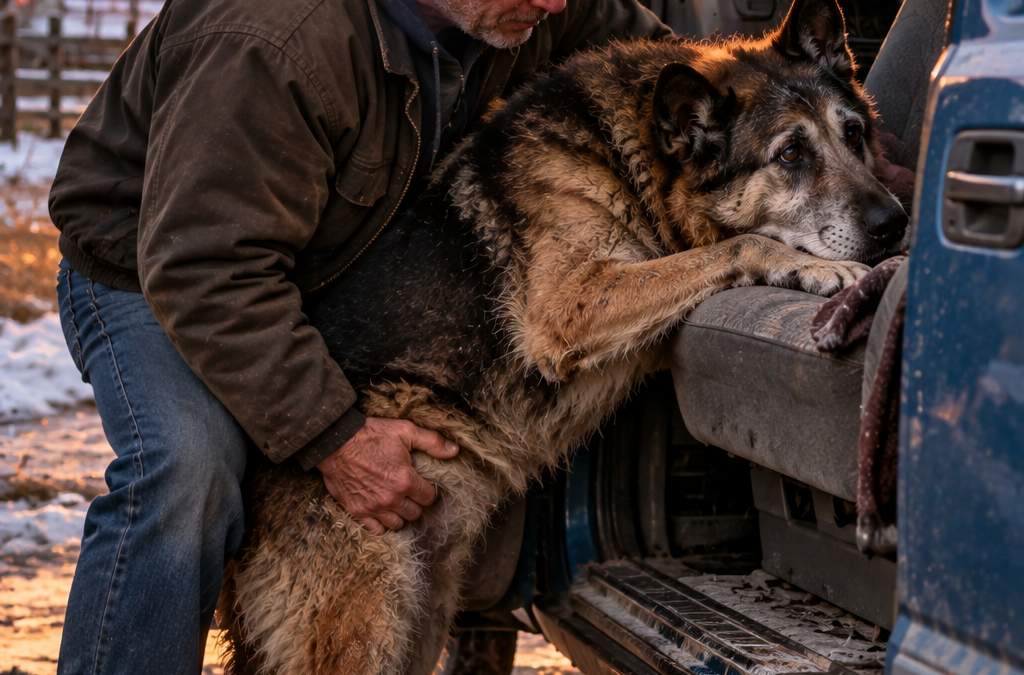
𝗙𝗨𝗟𝗟 𝗦𝗧𝗢𝗥𝗬
I would follow.
She’d kiss his forehead.
Then look at me.
“Oh, hello, Rick. Didn’t see you there.”
That joke lasted ten years.
And for ten years, I pretended it bothered me.
It didn’t.
Watching Susan love Jake made me love both of them more.
During those years, our lives followed a predictable rhythm.
Jake and I left for work.
We spent long hours on patrol.
We searched when the calls came.
Then we returned home.
Susan would make dinner, and Jake would lie beneath the table, hopeful that somebody had forgotten the household rule about feeding him scraps.
Sometimes we told stories.
Sometimes we watched old movies.
Sometimes we sat on the porch while rain moved across the valley.
Looking back, those ordinary evenings were among the happiest of my life.
I just didn’t know it at the time.
I thought happiness was something dramatic.
A promotion.
A successful rescue.
A difficult case finally resolved.
But now, at sixty-eight, I understand that happiness often looks like a tired dog asleep near your feet while the woman you love reads a book beside you.
The trouble is, you rarely appreciate how extraordinary an ordinary moment is until it becomes a memory.
Jake earned four departmental commendations during his working career.
He assisted in dozens of missing-person searches.
He helped locate a frightened child in an abandoned factory.
He found an elderly woman who had wandered into the woods during freezing rain.
And he once detected the scent of a badly injured accident victim who had been thrown down an embankment, hidden from the road by thick brush.
I kept the certificates in a glass cabinet in my den.
Susan called it Jake’s trophy case.
I called it unnecessary.
But secretly, I polished the glass whenever we had visitors.
I was proud of him.
Not because he’d earned awards.
Because I knew what those awards represented.
Every commendation meant that on some terrible day, when somebody was frightened or alone, Jake had done something to make the outcome better.
But there was one search I thought about more than all the others.
One I never fully understood until the afternoon I took him back to the park.
It happened eight years before our final ride.
It was early November, cold enough for frost to cover the grass each morning but not quite cold enough for snow.
A forty-seven-year-old man named Daniel Ortiz had disappeared after leaving his workplace.
Daniel managed a small hardware store in the neighboring town of Millbrook.
He was married.
Had a teenage daughter.
And was known locally as the kind of man who helped elderly customers carry purchases to their cars without waiting to be asked.
That afternoon, Daniel had left the store shortly before closing because he wasn’t feeling well.
He had diabetes and had been struggling with unstable blood sugar levels.
His wife expected him home by five.
When he didn’t arrive, she called his phone.
No answer.
At six, she called again.
At seven, she contacted the police.
His truck was eventually found near a small municipal park on the edge of town.
The driver’s door was closed.
His keys were missing.
There was no visible sign of violence.
But Daniel was gone.
The initial assumption was that he’d gone walking and become disoriented.
That theory worried us.
The temperature was dropping toward freezing, and several drainage channels cut through the wooded area behind the park.
Some were steep.
Others were almost invisible beneath fallen leaves.
A person who stumbled into one could disappear from the view of anyone walking along the main trails.
By nine that evening, the search had expanded.
Volunteers checked nearby streets.
Officers contacted hospitals.
Firefighters searched the creek banks.
Jake and I arrived shortly after ten.
I remember Daniel’s wife, Marisol, standing beside a patrol car with her daughter.
The girl was about sixteen.
She wore an oversized gray sweatshirt and held her mother’s hand so tightly that their knuckles had turned white.
Marisol approached me as I prepared Jake’s harness.
“Are you the dog handler?”
I nodded.
“Officer Hayes. This is Jake.”
She looked at my dog.
“Can he find my husband?”
I had heard that question many times.
I never answered it lightly.
“We’re going to give him the best opportunity we can.”
Her expression crumpled.
“He wouldn’t just leave us.”
“I understand.”
“He promised he’d be home for dinner.”
I swallowed.
“We’re going to keep looking.”
Her daughter stepped forward.
“His name is Daniel.”
I nodded.
“Okay.”
“He calls me every day after school.”
Her voice trembled.
“Even when he’s busy, he calls.”
She began crying.
I wanted to say something reassuring.
Something certain.
But police work had taught me how dangerous false promises could be.
So I told her the only thing I knew was true.
“We haven’t stopped searching.”
She looked at Jake.
“Does he know Daddy’s missing?”
I knelt beside my partner.
“Not yet.”
Then I held out Daniel’s jacket, which his wife had brought from home.
“But we’re going to ask him to help.”
Jake sniffed the jacket carefully.
He lowered his nose.
Worked along the fabric.
Then lifted his head.
I gave the command.
“Find him.”
Jake moved toward the edge of the parking lot.
We followed.
At first, he tracked along a narrow walking path.
Then he turned toward a wooded section near the creek.
The ground was covered with damp leaves.
The air smelled of cold water and decaying vegetation.
Jake moved steadily.
After several minutes, he stopped.
Raised his nose.
Then turned away from the main path.
I looked toward the steep ground ahead.
“Easy, partner.”
He pulled.
We followed him into the trees.
The trail narrowed.
Branches scratched my jacket.
We crossed a shallow drainage ditch and climbed toward an old concrete culvert.
Then Jake suddenly stopped.
His entire body became still.
I recognized the indication.
“He’s close.”
A deputy behind me raised his flashlight.
I swept mine through the brush.
Nothing.
Jake pulled toward a steep embankment.
I followed carefully.
Then he gave his alert.
Three sharp barks.
I looked down.
A dark shape lay beneath a fallen tree.
At first, I thought it was a discarded coat.
Then the shape moved.
“Police!” I shouted. “Can you hear me?”
A weak voice answered.
“Help.”
We scrambled down the embankment.
Daniel was lying on his side.
His ankle appeared badly injured.
His clothes were soaked.
He was confused and trembling uncontrollably.
His body temperature was dangerously low, and his blood sugar had fallen severely.
We began emergency treatment and called for medical personnel.
Jake stayed beside him.
Daniel opened his eyes and stared at the enormous dog.
“Am I… in trouble?”
I almost laughed.
“No, sir.”
He looked frightened.
“Why’s there a police dog?”
“Because you were missing.”
Daniel blinked.
He seemed to struggle with the information.
Then he whispered, “My wife.”
I nodded.
“We found you. We’re getting you home.”
Tears ran down his cheeks.
“My daughter…”
“She’s waiting.”
He tried to speak again.
His voice broke.
Jake lowered his head.
Daniel reached toward him with a shaking hand.
His fingers touched Jake’s cheek.
“Good dog,” he whispered.
Jake remained perfectly still.
For almost twenty minutes, while we waited for the rescue team to secure Daniel and move him out of the ravine, Jake stayed beside him.
He didn’t pace.
Didn’t become distracted.
Didn’t leave to investigate the surrounding woods.
He simply stood there, watching the man he’d found.
At one point, Daniel began shaking violently from the cold.
He seemed frightened.
I knelt beside him.
“Daniel, listen to me. Help is almost here.”
He turned his face toward Jake.
“What’s his name?”
“Jake.”
Daniel gave a weak smile.
“Jake.”
My dog’s ears lifted at the sound of his name.
Daniel touched his forehead again.
“You found me.”
I nodded.
“He sure did.”
Daniel looked at him for a long moment.
Then he whispered, “I owe you my life, buddy.”
I remembered those words.
At the time, they were simply part of another rescue.
A successful search.
A man found alive.
A family reunited.
We completed the paperwork.
The department issued a commendation.
Susan placed the certificate in Jake’s cabinet.
And life moved on.
I never saw Daniel again.
At least, not for eight years.
I knew he’d survived.
A hospital representative later confirmed that his condition had stabilized.
His family sent a thank-you card to the station.
Then other calls came.
Other people went missing.
Other families waited for us beside patrol cars.
And the search became one more entry in a thick binder of reports.
I had no idea what happened to Daniel after he returned home.
I never considered how many ordinary days Jake had given him.
Not until the afternoon our truck pulled into that little park again.
Five years before that afternoon, Jake and I retired within three months of each other.
He was ten.
I was sixty-three.
Neither of us was particularly enthusiastic about the arrangement.
The department held a ceremony for him in the station parking lot.
Several officers attended.
Susan brought a homemade cake.
The police chief gave a speech about Jake’s courage, loyalty, and outstanding service.
Then he handed me a plaque.
Jake sat beside my leg, looking more interested in the pigeons on the roof than in anything the chief was saying.
When the applause ended, I knelt and removed his working harness.
For ten years, that harness had meant something.
When it went on, Jake knew we were working.
When it came off, he knew we could relax.
I ran my hand along its worn edges.
Then I looked at him.
“That’s it, partner.”
His ears lifted.
“No more night shifts.”
His tail moved.
“No more running through the woods.”
He tilted his head.
I smiled.
“You’re officially unemployed.”
He licked my chin.
Everybody laughed.
But when I climbed into my truck and drove him home, I felt something unexpected.
Grief.
Not because anything terrible had happened.
Because something beautiful had ended.
For ten years, Jake had been the center of my professional life.
Every shift began with checking his equipment.
Every search depended on his abilities.
Every difficult decision involved thinking about his safety as well as my own.
Suddenly, all of that was over.
I didn’t know what to do with the silence.
Neither did Jake.
For the first few weeks, he waited beside the closet where I kept his old harness.
Whenever he heard my keys, he hurried toward the door.
Sometimes he stood beside the truck, staring expectantly at the passenger side.
During police service, he’d ridden safely in a secured K9 compartment in the rear of our patrol vehicle.
But our personal pickup was different.
After retirement, I fitted the passenger area with a proper restraint and a cushioned platform so he could travel comfortably on our short outings.
The first time I let him climb into that seat, he sat upright and stared through the windshield as though he’d been promoted.
Susan laughed when she saw him.
“Well, look at that. He finally outranks you.”
I glanced at Jake.
He sat with his ears forward and his chest puffed out.
“Don’t encourage him.”
She leaned through the window.
“Where are you boys going?”
I shrugged.
“Just driving.”
“Where?”
“Nowhere special.”
She smiled.
“Those are usually the best trips.”
She was right.
For five years, Jake rode beside me whenever his health allowed.
To the hardware store.
To the feed shop.
To the small lake outside town.
Sometimes we drove through Millbrook, following the same streets we’d patrolled for a decade.
Other times we simply went out to look at the changing seasons.
Jake loved watching the world through the window.
He recognized familiar turns.
He lifted his ears near the park.
He watched children playing outside the elementary school.
And whenever we approached our street on the way home, he’d begin shifting in his seat as though preparing for the important work of inspecting the kitchen.
Those drives became the best part of our retirement.
Susan sometimes came along.
She’d sit in the back seat and complain that she’d lost her place to a dog.
“Forty-one years of marriage,” she’d say, “and now I’m second choice.”
I’d glance at Jake.
“Technically, he’s my partner.”
She’d laugh.
“I hope he can cook.”
The three of us grew older together.
Susan retired from the library.
I began doing small repairs around the house.
Jake slowed down.
His muzzle turned gray.
His hearing faded.
His hips became stiff.
But when I picked up the truck keys, his tail still moved.
Even when he couldn’t run.
Even when he needed help stepping down from the porch.
Even when the walks became shorter.
He still wanted to ride.
And I was happy to take him.
Then, in late September, he began losing weight.
At first, I thought he was becoming picky about his food.
He had always been a difficult eater during hot weather.
But the summer had passed.
The mornings were cool.
And Jake was leaving half his breakfast untouched.
Then came the weakness.
One afternoon, while walking across the kitchen, his hind legs suddenly buckled.
He fell against the cabinet.
I caught him before he struck the floor.
“Hey! Easy, buddy.”
He looked up at me, confused.
I helped him stand.
His legs shook.
Something inside me went cold.
We took him to Dr. Emily Warren, the veterinarian who had cared for him since his retirement.
She examined him.
Ordered bloodwork.
Performed an ultrasound.
And eventually asked Susan and me to sit down.
I knew what was coming.
I’d heard that gentle, careful tone from doctors before.
The kind they use when they know the next few sentences will change your life.
Dr. Warren showed us the images.
There was a large mass on Jake’s spleen.
Further examination suggested the cancer had already spread.
She suspected hemangiosarcoma, an aggressive disease that could cause internal bleeding.
Surgery was technically possible, but given Jake’s age, weakness, and the extent of the suspected disease, it was unlikely to offer much meaningful time.
We discussed the options.
Treatment.
Risks.
Comfort care.
What might happen if the tumor began bleeding more severely.
Then I asked how long he had.
Dr. Warren looked toward Jake.
He was lying beside my chair with his muzzle resting against my shoe.
“I can’t predict precisely,” she said. “But given what we’re seeing, I would prepare for weeks rather than months.”
Susan took my hand.
I stared at the floor.
“Weeks?”
“I’m sorry, Richard.”
I looked down at Jake.
He opened one eye.
His tail moved once.
I wanted to argue.
I wanted to demand another test, another doctor, another explanation.
I had spent thirty-four years dealing with problems.
When something went wrong, I looked for a solution.
When someone was missing, I organized a search.
When a road became dangerous, I called for assistance.
When an investigation stalled, I kept working.
But there was no investigation that could uncover a cure.
No rescue team that could pull Jake out of his own failing body.
For the first time in our partnership, I couldn’t protect him.
I leaned forward and rested my hand against his chest.
“I’m sorry, buddy.”
His nose moved toward my wrist.
I began crying.
Susan put her arm around my shoulders.
Dr. Warren waited quietly.
Afterward, she helped us establish a plan to keep Jake comfortable.
Medication to manage his symptoms.
Soft food.
A warm place to rest.
Careful monitoring.
And strict instructions to avoid strenuous activity.
We were to watch for weakness, pale gums, collapse, or changes in breathing that might signal an emergency.
She also explained that if his discomfort could no longer be controlled, we would need to consider a peaceful goodbye before he suffered a crisis.
I nodded through tears.
I understood.
I just wasn’t ready.
During the next three weeks, Jake’s world became smaller.
At first, he still walked out to the porch.
Then only to the grass beside the steps.
Eventually, I began carrying him outside whenever he was too weak to manage on his own.
He spent most days on his orthopedic bed near the living room window.
Susan placed his water bowl within easy reach.
I sat beside him every morning.
Sometimes I read the newspaper aloud.
Sometimes I told him stories from our working days.
Mostly, I just watched him breathe.
I became frightened of every cough.
Every long sleep.
Every moment when he didn’t respond immediately to my touch.
At night, I sometimes woke and went downstairs simply to place my hand against his ribs.
I needed to feel his heartbeat.
To know he was still there.
And through all of it, Jake kept staring at the truck.
Every morning, as soon as I opened the curtains, he’d lift his head toward the driveway.
If he was strong enough, he’d stand.
Walk to the window.
And watch the empty passenger seat.
At first, I tried distracting him.
I brought him toys.
Treats.
His favorite blanket.
I sat on the floor and scratched his ears.
But his attention always returned to the same place.
The old blue Ford.
One afternoon, Susan found me standing beside him.
Jake was staring through the glass.
I had my hand on his back.
She watched us for a moment.
Then she said, “He misses the rides.”
I nodded.
“I know.”
“Could you take him around the block?”
I shook my head.
“He’s too weak.”
She looked at me.
“Would sitting in the truck be worse than walking to the bathroom?”
I didn’t answer.
She moved closer.
“Rick, I know you’re scared.”
I looked at her.
“He’s dying, Sue.”
Her eyes filled.
“I know.”
“I don’t want to do anything that takes time away from him.”
She placed her hand over mine.
“Then call Emily. Ask what he can handle.”
I looked toward Jake.
His tail moved as a truck passed on the road.
Susan continued gently.
“You’re trying so hard to keep him alive that you’re afraid to let him enjoy anything.”
The words hurt.
Because they were true.
I had become so focused on counting his remaining days that I’d forgotten those days still belonged to him.
I called Dr. Warren that evening.
I explained how Jake kept watching the truck.
How much he’d loved our drives.
How I wanted to give him one more outing but was afraid the excitement might exhaust him.
She listened carefully.
Then she said, “If he’s stable, comfortable, and doesn’t have to exert himself, a short, quiet car ride may be reasonable. But I’d like to assess him first.”
We brought Jake to the clinic the following morning.
Dr. Warren checked his heart rate, breathing, gums, and general condition.
He was weak.
But there was no evidence of an active bleeding emergency at that moment.
She looked at me.
“Keep it short. Keep him secured and comfortable. No long walks, no getting in and out repeatedly, and bring him home if he becomes distressed or exhausted.”
I nodded.
“Of course.”
She touched my arm.
“And Richard?”
“Yes?”
“Don’t use the drive as a test of how much strength he has left.”
I looked at her.
“Just let him enjoy it.”
I carried those words home.
The next morning, I woke early.
The sky was clear.
Late-autumn sunlight spread across the driveway.
The temperature was cool but mild for November.
I stood at the kitchen window with a cup of coffee.
Jake was lying near the fireplace.
He opened his eyes when I entered.
I set down the cup.
Walked to the hook beside the door.
And lifted my truck keys.
The faint metallic jingle made him raise his head.
I turned.
“Hey, partner.”
His ears lifted.
I smiled.
“Want to go for a ride?”
His tail began moving.
Not strongly.
Not like the younger dog who used to thump it against the floor.
But enough.
Enough to make my chest tighten.
I crouched and took his face between my hands.
“One last patrol, old man.”
He pressed his nose against my cheek.
And I knew that whatever happened afterward, I was going to give him that afternoon.
Susan helped me prepare the truck.
We placed his thick blanket over the cushioned platform.
I checked the restraint.
Made sure he would have room to rest without sliding.
Packed water, medication, clean towels, and the emergency information Dr. Warren had given us.
Susan stood beside the passenger door while I carefully lifted Jake into place.
He was much lighter than he used to be.
That frightened me.
There had been a time when lifting him would have strained my back.
Now his ribs felt sharp beneath his coat.
I settled him gently.
Fastened his restraint.
Then stepped back.
Jake looked through the windshield.
His ears rose.
And his tail began moving against the seat.
Susan covered her mouth.
“Oh, Rick.”
I looked at her.
She was crying.
I walked around the truck and held her for a moment.
“He remembers.”
She nodded.
“Of course he does.”
Then she kissed my cheek.
“Bring my boys home.”
I smiled.
“Always.”
Before I closed the driver’s door, I looked at Jake.
He was sitting upright, his gray muzzle lifted, watching the road ahead.
For one brief moment, he looked like the dog who had spent ten years riding into uncertainty beside me.
I climbed behind the wheel.
Started the engine.
And whispered the words I hadn’t spoken in five years.
“All right, K9-14.”
Jake turned toward me.
“Let’s go on patrol.”
His tail moved.
And we pulled out of the driveway.
The first part of the drive took us through Oak Street, where the old brick houses stood close together beneath enormous maple trees.
Jake watched everything.
The bicycles leaning against fences.
The people walking dogs.
The school crossing guard waving children across the road.
I drove slowly.
Every turn carried a memory.
At the corner of Oak and Pine, I pointed toward a two-story yellow house.
“Remember that place, buddy?”
Jake glanced at the window.
“Mrs. Henderson.”
I smiled.
“You found her grandson there.”
Eight years earlier, a six-year-old boy named Tyler had disappeared from his backyard.
His grandmother had been watching him while his parents worked.
When she looked outside, the gate was open.
Tyler was gone.
The family searched the street.
Neighbors checked garages.
Police began looking for him.
Jake and I arrived forty minutes later.
He took the scent from Tyler’s baseball cap and led us through three adjoining yards toward a small wooded creek.
We found the boy beneath an old pedestrian bridge.
He’d chased a frog, slipped into the water, and become frightened when he couldn’t climb back up the bank.
He was wet.
Cold.
And crying for his grandmother.
Jake approached carefully.
The boy grabbed his collar and refused to let go.
I had to carry Tyler back toward the house with one arm while holding Jake’s leash with the other.
When Mrs. Henderson saw us, she ran down the sidewalk so quickly I thought she’d fall.
She hugged Tyler.
Then hugged me.
Then knelt and kissed Jake on the forehead.
For years afterward, she sent our K9 unit homemade cookies every Christmas.
I glanced at the yellow house.
A young family now lived there.
There were toy trucks scattered across the porch.
A little girl stood near the front steps holding a stuffed rabbit.
Jake watched her as we passed.
I swallowed.
“That boy’s probably in high school now.”
My voice trembled.
“You gave him a chance to grow up.”
Jake rested his head near the window.
I continued driving.
A few blocks later, we passed Miller’s Hardware.
The original owner had retired years earlier, and the sign had been replaced.
But the building was familiar.
I remembered a winter afternoon when a shop employee suffered a medical emergency in the storage warehouse.
Nobody could find him.
His phone was ringing somewhere among rows of shelving, but the enormous building echoed so badly that the sound was impossible to locate.
Jake led us directly to the man, unconscious behind stacked boxes.
The paramedics later told us another hour might have changed the outcome.
I looked toward the storefront.
“Remember Mr. Miller?”
Jake’s ears moved at the sound of my voice.
“Used to give you biscuits even though I told him not to.”
I smiled.
“You liked him better than me.”
The dog blinked slowly.
We continued along Main Street.
The bakery had new owners.
The old movie theater had become a community center.
A vacant lot where we’d once searched for a missing teenager was now a small apartment building.
I recognized a few faces.
Most people didn’t recognize me.
That was the strange thing about retirement.
For decades, I’d driven those streets in uniform.
People waved because they knew the patrol car.
They called me Officer Hayes.
They asked about Jake.
Then one day, I stopped wearing the badge.
I became another old man driving an old truck.
And the world continued without me.
I had struggled with that in the beginning.
I’d missed the purpose.
The sense of being needed.
The belief that my work mattered.
But sitting beside Jake that afternoon, passing the places where we’d helped people, I began to recognize something I’d overlooked.
The work had not disappeared when we retired.
Its consequences were still living all around us.
Children we’d found had grown older.
Families we’d helped had continued building their lives.
People who’d once been frightened were now going to work, buying groceries, walking their dogs, and raising children.
We had contributed to those ordinary days.
And those days were continuing even after nobody remembered our names.
At the far end of Main Street, I turned toward a familiar neighborhood.
Small houses lined both sides of the road.
A playground stood near the elementary school.
Jake lifted his head.
I noticed his breathing had become faster.
I immediately slowed.
“Easy, buddy.”
I reached over and touched his shoulder.
He looked at me.
“Doing okay?”
His tail moved faintly.
I checked his gums and watched his breathing while stopped safely near the curb.
He seemed comfortable, but tired.
I considered turning home.
Then Jake looked through the windshield toward the road ahead.
His ears lifted.
And I remembered where we were.
The turn toward Riverside Park was less than two blocks away.
I smiled sadly.
“Want to see the park?”
He pressed his nose against my hand.
I took a slow breath.
“All right. Just for a few minutes.”
I turned toward the park entrance.
The trees were nearly bare.
A few families walked along the paved path.
Two elderly men sat on a bench near the duck pond.
A woman pushed a stroller beneath the maple trees.
Everything looked peaceful.
Ordinary.
I parked near the entrance, where Jake could see the open lawn and the walking path without leaving his seat.
I turned off the engine.
For a moment, neither of us moved.
Then I looked at him.
“Remember this place?”
He stared through the window.
His breathing slowed.
The little municipal park had changed since our working days.
There was a new playground.
Fresh benches.
A community garden beside the old maintenance building.
But the line of trees behind the pond remained.
So did the narrow path leading toward the wooded ravine.
I glanced in that direction.
And the memory of Daniel Ortiz came back to me.
The man we’d found beneath a fallen tree eight years earlier.
I wondered what had become of him.
Whether he still lived in Millbrook.
Whether his daughter had finished school.
Whether he ever thought about the dog who found him.
Then Jake shifted.
His head lifted suddenly.
His ears moved forward.
He was looking toward a man walking along the path.
The man wore a dark green jacket and carried a small bag of gardening tools.
His hair was mostly gray.
He walked with a slight limp.
I thought nothing of it at first.
Then Jake made a sound I hadn’t heard from him in months.
A low, eager whine.
I turned toward him.
“What’s wrong, buddy?”
He leaned toward the passenger window.
His tail began moving.
I followed his gaze.
The man was approaching a bench near the park entrance.
He stopped when he noticed the truck.
Looked toward Jake.
Then toward me.
For several seconds, he stood completely still.
The gardening bag slipped from his hand.
And he whispered something I couldn’t hear through the glass.
I rolled down my window.
The man took a step forward.
His face had gone pale.
“Officer Hayes?”
I stared at him.
Something about his voice was familiar.
But I couldn’t place it.
He approached the truck slowly.
“Richard Hayes?”
I nodded.
“Yes?”
His eyes moved toward the passenger seat.
He saw Jake.
And suddenly, tears filled his eyes.
“Oh, my God.”
He raised one hand to his mouth.
“Jake?”
My heart began pounding.
I looked at the man more carefully.
The gray hair.
The slight limp.
The shape of his face.
And then I knew.
“Daniel?”
He nodded.
Tears spilled down his cheeks.
“Yeah.”
He came closer.
“It’s me.”
I opened the driver’s door and stepped out.
Daniel stood beside the truck, staring at Jake.
For a moment, neither of us spoke.
Then he looked at me.
“I haven’t seen you in eight years.”
I nodded.
“I know.”
His voice trembled.
“I’ve thought about you both so many times.”
He looked through the open passenger window.
Jake leaned toward him.
Daniel slowly offered his hand.
“Hey, buddy.”
Jake sniffed his fingers.
Then something remarkable happened.
My old dog lifted his head.
His tail began moving.
And he pressed his muzzle against Daniel’s hand.
Daniel’s face crumpled.
He began crying.
“You remember me?”
I stood beside the truck, unable to speak.
I couldn’t know exactly what Jake recognized after eight years.
Perhaps it was Daniel’s scent.
Perhaps his voice.
Perhaps some familiar association that even age and illness hadn’t erased.
But I knew my dog.
I knew the difference between polite interest and recognition.
And I hadn’t seen that expression on his face in a very long time.
Daniel stroked Jake’s gray muzzle.
“Hey, old friend.”
His voice broke.
“You found me again.”
Daniel continued stroking Jake’s face.
My dog leaned toward him, accepting the attention with the quiet dignity he’d always shown people after a successful search.
But I could see the effort it cost him.
His breathing was becoming heavier.
His head trembled slightly.
I rested my hand against his shoulder.
“Easy, buddy.”
Daniel looked at me.
“Is he sick?”
I swallowed.
“Yeah.”
He studied Jake’s thin body, the gray fur around his eyes, and the way he rested against the support beneath him.
“How bad?”
I looked toward my old partner.
Then back at Daniel.
“He’s dying.”
Daniel stopped moving.
For several seconds, he said nothing.
Then he looked down at Jake.
“Oh, buddy.”
His voice broke.
“I’m so sorry.”
I nodded.
“He’s had a good life.”
Daniel gently stroked the fur beneath Jake’s ear.
“Yeah.”
He swallowed.
“A really good one.”
Then he looked at me.
“Can I show you something?”
I nodded.
He reached into his jacket pocket and took out his phone.
His hands trembled slightly as he unlocked it.
He scrolled through several photographs.
Then he held the screen toward me.
It showed a young woman in a white wedding dress, standing beside a gray-haired man wearing a dark suit.
The man was Daniel.
He looked healthier than he had on the night we found him.
His face was full.
His smile was enormous.
And the young woman beside him looked so happy that I couldn’t help smiling too.
“That’s my daughter, Isabel,” he said.
I studied the photograph.
“She was the girl waiting beside the patrol car that night.”
Daniel nodded.
“She got married three years ago.”
He looked down at the picture.
“I walked her down the aisle.”
His voice trembled.
“I almost didn’t get to do that.”
I looked toward Jake.
Daniel continued.
“She asked me to dance with her at the reception. I told her I was too old and my ankle hurt.”
He laughed quietly.
“She said she didn’t care.”
A tear ran down his cheek.
“So I danced.”
He changed the photograph.
This one showed a toddler sitting on his shoulders.
The little boy held a bright yellow toy airplane.
“That’s my grandson, Mateo.”
I smiled.
“How old?”
“Two and a half.”
Daniel’s expression softened.
“He calls me Grandpa Danny.”
He looked toward Jake.
“And every Saturday, I take him to feed the ducks right over there.”
He pointed toward the pond.
I followed his gesture.
A few children were standing beside the water, laughing as ducks hurried toward them.
Daniel continued.
“Last month, he learned how to say ‘I love you.'”
He smiled through tears.
“Now he says it about twenty times a day because he knows it makes everybody happy.”
I looked down.
My throat was tightening.
Daniel slipped his phone into his pocket.
“After you found me, I spent almost a week in the hospital.”
I nodded.
“I remember hearing that.”
“The doctors told me my blood sugar had fallen dangerously low. I was hypothermic, dehydrated, and my ankle was broken.”
He touched the old injury through his trousers.
“They said another night out there could have killed me.”
I stared at him.
Daniel looked toward Jake.
“For a long time, I thought about that night whenever the weather turned cold.”
He paused.
“I used to wake up thinking I was still lying beneath that tree.”
I knew that feeling.
I’d heard similar stories from other people we’d rescued.
Sometimes surviving danger was only the beginning of learning to live with it.
Daniel continued.
“I went to counseling. My wife helped me. My daughter practically watched me every minute for the first year.”
He smiled faintly.
“She even called to make sure I ate lunch.”
I laughed quietly.
“Sounds like a good daughter.”
“The best.”
He looked at Jake.
“But there was something I couldn’t stop thinking about.”
I waited.
“That night, I remember hearing somebody tell me help was coming.”
He looked at me.
“I remember your voice.”
My chest tightened.
“And I remember this dog’s face.”
Jake lifted his nose toward Daniel’s hand.
Daniel brushed his thumb across the old dog’s forehead.
“I remember being so cold that I couldn’t stop shaking.”
He swallowed.
“And he just stood there beside me.”
I nodded.
“He didn’t want to leave.”
Daniel looked up.
“Do you know what I kept thinking about after I got home?”
I shook my head.
“Not the medals. Not the rescue report. Not even the hospital.”
He looked toward the pond.
“I kept thinking about how I almost missed the rest of my life.”
His eyes filled again.
“I almost missed my daughter’s graduation.”
He paused.
“Her wedding.”
Another pause.
“The day Mateo was born.”
He looked at me.
“My wife and I celebrated our twenty-fifth anniversary last spring. We went to a little restaurant and argued about whether the music was too loud.”
He laughed through tears.
“That was a good night.”
I smiled.
Then Daniel said something that I would carry for the rest of my life.
“Your dog didn’t just save me that night, Officer Hayes.”
He rested his hand against Jake’s neck.
“He gave me all those days afterward.”
I couldn’t speak.
Daniel looked directly at me.
“Eight more Christmas mornings. Eight more birthdays. Thousands of dinners with my wife. Ordinary days when nothing special happened.”
His voice broke.
“And every one of them mattered.”
I stared at Jake.
My old partner had closed his eyes.
His muzzle rested against the edge of the open window.
Daniel continued quietly.
“I never got to thank him properly.”
I shook my head.
“You thanked us that night.”
“Not enough.”
He looked down.
“How do you thank someone for giving you years?”
I had no answer.
For thirty-four years, I’d been trained to think in terms of assignments.
An emergency occurred.
We responded.
We found a solution when we could.
The report was completed.
The case was closed.
Then we moved on.
Even with Jake, I’d measured our success through outcomes.
A missing person found.
A suspect apprehended.
A dangerous situation resolved.
I’d kept every certificate he earned.
Every photograph from the department ceremonies.
Every little plaque with his name engraved in polished metal.
But I’d rarely considered what happened after the rescue reports were filed.
Daniel was standing in front of me now, alive because Jake had found him in the cold eight years earlier.
His daughter had gotten married.
His grandson had been born.
His wife had enjoyed eight more years with the man she loved.
And somewhere in that chain of ordinary events was a German Shepherd who had followed a faint human scent through wet leaves and refused to stop until he found someone who needed help.
I looked down at Jake.
He was resting quietly.
His tail moved faintly when Daniel touched his shoulder.
The tears came before I could stop them.
I covered my face.
Daniel placed a hand on my back.
For a while, neither of us said anything.
Then I whispered, “I’ve been so afraid.”
Daniel waited.
“Ever since the doctor told me he was dying, I’ve been sitting beside him watching every breath.”
My voice trembled.
“I keep thinking about the things he won’t get to do anymore.”
I looked toward the truck.
“No more rides.”
I swallowed.
“No more mornings waiting for me to pick up the keys.”
Daniel’s eyes filled.
“No more walks through the neighborhood.”
I rested my hand against Jake’s shoulder.
“I’ve been looking at everything that’s ending.”
Daniel looked toward his photographs.
Then he said gently, “Maybe today you needed to see what didn’t end.”
I stared at him.
He continued.
“His work is still out here.”
He pointed toward the park.
“In people like me.”
I looked toward the walking path.
A young mother pushed a stroller beneath the trees.
Two children chased each other across the grass.
An elderly couple sat holding hands on a bench.
None of them knew Jake.
None of them knew what he’d done.
And yet I suddenly understood.
A life didn’t have to be remembered by everyone to have mattered.
The good it created could continue quietly, far beyond the moment anybody stopped paying attention.
Daniel reached into his wallet and removed a folded photograph.
It was old and worn along the edges.
He handed it to me.
The picture showed Jake and me outside the police station, taken shortly after Daniel’s rescue.
I recognized the photograph immediately.
It had appeared in the local newspaper.
Jake was wearing his working harness.
I was standing beside him, looking tired and uncomfortable in front of the camera.
“Where did you get this?”
Daniel smiled.
“The newspaper ran it after the search.”
He looked toward Jake.
“I cut it out and kept it.”
I turned the photograph over.
On the back, in faded blue ink, were four words.
Because they came back.
I felt another wave of emotion.
Daniel continued.
“Whenever I start taking things for granted, I look at that picture.”
I stared at the words.
Then I tried to hand it back.
He shook his head.
“Keep it.”
“Daniel…”
“Please.”
He looked at Jake.
“I think you need it now more than I do.”
I held the photograph carefully.
Then I reached out and shook his hand.
“Thank you.”
Daniel smiled through tears.
“No, Officer Hayes.”
He leaned toward the passenger window.
“Thank you, Jake.”
My old dog lifted his head.
Daniel brought his face closer.
“Thank you for finding me.”
Jake pressed his nose against Daniel’s fingers.
The man began crying again.
Then he whispered, “You can rest now, old friend.”
We stayed at the park only a few more minutes.
Jake was becoming tired.
His breathing was heavier than when we’d arrived, and I knew it was time to go home.
Daniel helped me make sure the harness remained comfortable before I closed the passenger door.
Then he stepped back.
“Will you be okay?” he asked.
I looked at Jake.
He was resting against his blanket.
I nodded slowly.
“Yeah.”
For the first time in weeks, I believed it.
Daniel placed his hand on the doorframe.
“Tell your wife I said hello.”
“I will.”
“And Richard?”
I looked at him.
“Yes?”
“If there’s anything I can do…”
I smiled faintly.
“You’ve already done something.”
He looked confused.
I lifted the old photograph.
“You reminded me who my dog is.”
Daniel’s eyes filled.
Then he stepped back and watched us leave.
As I pulled out of the parking lot, I glanced toward the passenger seat.
Jake was lying comfortably, his head resting near the window.
His eyes were half-closed.
I reached over at a red light and touched his shoulder.
“Good work, partner.”
His tail moved once.
I smiled.
“Good work.”
The drive home took twenty minutes.
I didn’t turn on the radio.
Didn’t answer my phone.
Didn’t try to fill the silence with conversation.
I simply drove the familiar roads with my old partner beside me.
We passed the school.
The hardware store.
The bakery.
The yellow house on Oak Street.
The same streets we’d traveled for years.
But they looked different now.
Not because anything had changed.
Because I had.
I no longer saw only the places where we’d worked.
I saw the lives that had continued afterward.
The people who had gone home.
The children who had grown older.
The families who had been given another dinner together.
I looked at Jake.
He was sleeping.
And something inside me finally became quiet.
When we reached the house, Susan was waiting on the porch.
She came down the steps as soon as I parked.
“How’d it go?”
I opened my door.
For a moment, I couldn’t answer.
Then I held up the photograph Daniel had given me.
Susan looked at it.
“What’s that?”
I swallowed.
“Remember Daniel Ortiz?”
She frowned.
“The man Jake found in the woods?”
I nodded.
“We saw him.”
Her eyes widened.
“Today?”
“At Riverside Park.”
She looked toward the passenger seat.
Then back at me.
I told her everything.
About Daniel recognizing Jake.
About his daughter.
His grandson.
The photographs.
The ordinary days he’d been given.
By the time I finished, Susan was crying.
She leaned against me.
“Oh, Rick.”
I wrapped my arms around her.
“I’ve been so afraid of losing him that I forgot how much he gave us.”
She looked toward Jake.
Then she whispered, “I don’t think he forgot.”
I shook my head.
“No.”
We carefully lifted him from the truck and carried him inside.
Susan placed fresh blankets on his bed.
I brought water.
Jake drank a little.
Then he settled with a deep, tired sigh.
For the first time in three weeks, he didn’t look toward the window.
He didn’t try to stand when a vehicle passed outside.
He simply rested.
I sat beside him.
Susan brought my old K9 photo album from the den.
Together, we looked through the pictures.
Jake as a young dog.
Jake beside the patrol car.
Jake standing proudly at his retirement ceremony.
Jake sleeping beneath the Christmas tree with an enormous red bow around his neck.
Some photographs made us laugh.
Others made us cry.
But we kept turning the pages.
And for the first time since his diagnosis, I found myself talking about Jake’s life without constantly thinking about his death.
That evening, Susan made dinner.
I ate at the small table near the living room so I could stay beside him.
Afterward, I placed Daniel’s photograph next to Jake’s retirement plaque.
I stood there studying them.
One represented the recognition his department had given him.
The other represented the life his work had helped preserve.
Both mattered.
But only one had made me understand what ten years of service really meant.
Jake lived six more days.
Six quiet, precious days.
His strength faded steadily.
He stopped eating regular meals.
His breathing became more difficult.
He spent most of his time resting near the fireplace.
But the restlessness he’d shown before our drive was gone.
I didn’t know whether that meant he’d found what he wanted or whether he was simply too tired to keep looking.
I chose not to invent an answer.
Instead, I sat with him.
I brushed his coat.
Held water for him when he wanted it.
Helped him outside when he was able.
And told him stories about the people he’d found.
Sometimes I spoke of the missing boy beneath the bridge.
Sometimes the injured warehouse worker.
Sometimes Daniel Ortiz.
And each time, I ended by telling Jake how grateful I was.
On the fifth evening, Susan came into the living room carrying a small package.
“Daniel dropped this off earlier,” she said.
I looked up.
“What?”
“He left it on the porch with a note.”
She handed it to me.
Inside was a framed photograph.
Daniel stood beside his wife, daughter, son-in-law, and young grandson.
They were gathered around a dining table.
There was a cake in the center.
Everyone was smiling.
On the back, Daniel had written:
Officer Hayes, you and Jake gave me more than a second chance. You gave me the years that made this family possible. I hope this helps you remember that his work is still living on.
I stared at the photograph.
Then I held it beside Jake.
“Look at that, buddy.”
He opened his eyes.
I smiled through tears.
“That’s Daniel’s family.”
His nose moved faintly.
“All because you found him.”
I placed the photograph on the small table beside his bed.
Then I leaned forward.
“That was a good day’s work, wasn’t it?”
His tail moved once.
I laughed through my tears.
“Yeah.”
I kissed his forehead.
“It sure was.”
The next morning, Jake couldn’t stand.
His gums were pale.
His breathing had become shallow and difficult.
I called Dr. Warren immediately.
She arrived within an hour.
After examining him, she sat beside me.
Her expression told me what I already knew.
“Richard, Jake’s condition has deteriorated significantly.”
I nodded.
She continued gently.
“I believe he’s experiencing another serious bleeding episode. We can attempt emergency intervention, but given his advanced cancer and weakness, I don’t think it would restore a comfortable quality of life.”
I looked down at Jake.
His eyes were half-open.
He was exhausted.
I stroked the fur behind his ear.
“He’s hurting.”
Dr. Warren nodded.
“He’s uncomfortable, and I’m concerned that he may deteriorate very quickly.”
I closed my eyes.
For months, I’d been terrified of this conversation.
Now that it had arrived, I felt something unexpected beneath the pain.
Clarity.
Jake had spent his life going toward frightened people.
Toward danger.
Toward the places others couldn’t reach.
He had never been allowed to decide when an assignment ended.
That responsibility had always belonged to me.
And now I had one final responsibility.
To recognize when he’d done enough.
I looked at Dr. Warren.
“Can we let him go here?”
She nodded.
“Of course.”
“On his bed?”
“Yes.”
I looked toward Susan.
Tears were streaming down her face.
She came to sit beside us.
Then she placed her hand over mine.
“He’s ready, Rick.”
I swallowed.
“I know.”
Dr. Warren prepared the medication.
She explained what would happen.
First, Jake would receive medication to help him relax into a deep, peaceful sleep.
Then, when we were ready, she would administer the final medication.
There would be no more fear or discomfort.
I listened carefully.
Then I nodded.
Susan knelt beside Jake.
She held his face between her hands.
“There’s my handsome officer,” she whispered.
Jake’s eyes moved toward her.
She began crying.
“Did you take care of my husband?”
I covered my mouth.
Those were the words she’d spoken to him almost every evening during his working years.
The words that had welcomed him home after countless difficult shifts.
Jake’s tail moved faintly.
Susan smiled through tears.
“I know you did.”
She kissed his forehead.
“Thank you, sweetheart.”
Then she moved beside me.
I leaned over my old partner.
For ten years, he’d waited for my commands.
He’d watched my hands.
Listened to my voice.
Followed me into places where neither of us could know what might happen.
Now there was only one thing left for me to say.
I placed my hand against his chest.
“Hey, partner.”
His eyes opened.
I smiled through tears.
“Remember the truck?”
His ears moved faintly.
“The old blue Ford?”
I swallowed.
“You always loved that seat.”
I brushed the gray fur along his muzzle.
“And you always knew the way home.”
My voice began trembling.
I looked toward the framed photograph of Daniel’s family.
Then toward Jake’s retirement plaque.
For the first time, the awards didn’t seem important.
Not compared with the warm, living memories they represented.
I touched his forehead.
“You did so much good, buddy.”
A tear fell onto his blanket.
“More than I ever understood.”
Jake breathed softly.
I leaned closer.
“Thank you for every mile.”
I paused.
“Every search.”
My throat tightened.
“Every person you brought home.”
I looked into his tired eyes.
“And thank you for coming home to me.”
Dr. Warren gave the first medication.
Jake relaxed gradually.
His breathing eased.
His body settled into the mattress.
Susan held my hand.
I kept my other hand against his shoulder.
When his eyes began to close, I whispered the words I’d spoken at the end of almost every shift.
“All done, partner.”
My voice broke.
“Time to go home.”
Dr. Warren waited until we were ready.
Then she administered the final medication.
I felt Jake take one slow breath.
Then another.
A quiet exhale.
And my partner was gone.
For several seconds, I couldn’t move.
My hand remained against his chest.
I waited for another breath.
A movement.
A familiar thump of his tail.
But the room was still.
Susan wrapped her arms around me.
I leaned into her and began crying.
I cried for the young dog who’d stolen my glove.
For the powerful K9 who’d followed scents through rain and darkness.
For the old companion who had ridden beside me through five years of retirement.
And for the little gray face that would never appear at the window again.
I held him until I was ready to let go.
Before Dr. Warren took him, I kissed his forehead.
Then I whispered, “Good work, K9-14.”
My voice collapsed.
“Your watch is over.”
We buried Jake beneath the maple tree beside our driveway.
It was the same tree he’d rested under after summer walks.
The same place where he used to watch me wash the truck.
Several retired officers attended the small memorial.
Frank Dawson came.
Sergeant Mercer came.
Dr. Warren sent flowers.
Daniel Ortiz arrived with his wife, daughter, and young grandson.
I hadn’t expected them.
When I saw Daniel standing near the tree, I walked toward him.
He took my hand.
“I’m sorry, Richard.”
I nodded.
“Thank you for coming.”
He looked at Jake’s grave.
Then at the little boy holding his wife’s hand.
“This is Mateo.”
The toddler looked up at me.
He was carrying a small toy police car.
Daniel crouched beside him.
“Remember what Grandpa told you about the brave dog?”
Mateo nodded.
Daniel pointed toward the stone.
“That’s where Jake is resting.”
The little boy studied the grave.
Then carefully placed his toy police car beside the flowers.
I covered my mouth.
Daniel looked toward me.
“He wanted to bring him something.”
I knelt beside the child.
“Thank you, Mateo.”
He smiled shyly.
Then returned to his grandfather.
I watched Daniel lift him into his arms.
And something inside me settled.
Not because losing Jake hurt less.
It didn’t.
But because I could see, standing right in front of me, that the good my dog had done wasn’t buried beneath that tree.
It was living.
Breathing.
Growing.
It was in a grandfather holding a little boy.
A daughter standing beside her father.
A wife who’d been given eight more years with her husband.
And in countless other people whose faces I could no longer remember but whose lives had continued because Jake had been there when they needed him.
After the memorial, I went into my den.
I opened the glass cabinet.
Inside were Jake’s awards.
Four commendations.
A retirement plaque.
Several framed certificates.
A photograph from our last day at the station.
I took them down one by one.
Not because I no longer valued them.
Because I wanted to make room.
On the center shelf, I placed the photograph of Daniel’s family.
Beside it, I placed the old newspaper clipping he’d kept in his wallet for eight years.
Then I added a small photograph Susan had taken on our final ride.
Jake was sitting in the passenger seat.
His gray muzzle lifted toward the windshield.
His eyes half-closed in the sunlight.
He looked old.
Tired.
But peaceful.
I stood there for a long time.
Then Susan entered the room.
She slipped her arm through mine.
“Looks different.”
I nodded.
“Yeah.”
She studied the photographs.
“Better?”
I smiled faintly.
“Much.”
She leaned her head against my shoulder.
And for the first time since Jake died, I didn’t feel the need to turn away from the pictures.
A month later, I drove through Millbrook again.
Alone.
The passenger seat was empty.
I had cleaned the blankets.
Removed the support platform.
Put away the water bowl and emergency supplies.
But I couldn’t bring myself to remove the little brass tag hanging from the dashboard.
K9-14.
JAKE.
It moved slightly whenever the truck turned.
For the first few miles, I couldn’t stop looking toward the empty seat.
I expected to see his ears.
His broad shoulders.
His familiar profile watching the passing streets.
Instead, there was nothing.
I passed Mrs. Henderson’s yellow house.
Miller’s Hardware.
The old movie theater.
Then I turned toward Riverside Park.
I parked beneath the trees.
For a while, I sat with the engine off.
A little boy ran across the grass.
An elderly woman fed ducks near the pond.
Two teenagers rode bicycles along the path.
And near the community garden, I saw Daniel working beside his grandson.
The toddler was holding a small watering can.
Daniel knelt beside him, helping him water a row of flowers.
The sight made my eyes fill.
I stepped out of the truck.
Cold air brushed my face.
I looked toward the passenger seat one last time.
Then I closed the door.
As I walked toward the park, I understood something I hadn’t known during all those years in uniform.
We tend to measure service by the dramatic moments.
The rescues.
The danger.
The awards.
The times somebody almost died and didn’t.
But the true value of saving a life is often found afterward.
In the ordinary afternoons.
The birthday cakes.
The school graduations.
The small hands held by grandparents.
The conversations around dinner tables.
The people who get to keep loving one another because somebody was there when it mattered.
Jake had been a police dog for ten years.
A retired companion for five.
And my best friend through all of them.
I had thought his final ride was going to be a journey through everything we’d lost.
Instead, it showed me everything that remained.
I reached the park bench near the pond.
Sat down.
And watched Daniel laughing with his grandson.
For a moment, I imagined Jake sitting beside me.
His ears raised.
His tail moving gently against the grass.
Waiting for me to tell him he’d done well.
I looked toward the open sky.
“Good work, partner,” I whispered.
My eyes filled.
“You brought them all home.”
Then I smiled through my tears.
“And you got me home too.”
I sat there until the afternoon sunlight began fading behind the trees.
When I finally stood, I looked back toward the park.
Daniel lifted his hand and waved.
I waved back.
Then I walked to my truck.
The passenger seat was still empty.
I knew it always would be.
But I no longer saw only the absence.
I saw ten years of early mornings, rain-soaked searches, and roads traveled together.
I saw five years of retirement rides, small adventures, and familiar turns toward home.
And I saw all the people whose lives had gone on because my old partner had refused to stop looking for them.
I climbed behind the wheel.
The brass tag moved gently beneath the dashboard.
I touched it.
Then, out of habit, I glanced toward the passenger seat.
“Ready, buddy?”
There was no answering wag of a tail.
No lifted ears.
No warm nose against my hand.
Only the quiet truck and the fading afternoon light.
I started the engine.
And for the first time, I understood that the empty seat beside me wasn’t proof that Jake had left nothing behind.
It was the place where I’d been fortunate enough to sit beside a life that had changed so many others.
I pulled onto the road.
Headed toward the house where Susan was waiting.
And whispered the words I’d said to Jake after every completed patrol.
“All done, partner.”
I smiled.
“Let’s go home.”








