𝗙𝗨𝗟𝗟 𝗦𝗧𝗢𝗥𝗬 My Boss Crumpled My Blueprint, Called Me a Filthy Janitor, and Told Me to Stay in My Lane—He Had No Idea Who Was About to See My Work
𝗣𝗔𝗥𝗧 𝟮
People laughed.
Not everyone.
But enough.
For three days, I walked past my drawing surrounded by jokes.
The worst part wasn’t Garrett.
It was everyone else.
Architects.
Designers.
People educated enough to recognize the drawing wasn’t nonsense.
People who had supposedly chosen careers centered on creativity.
They saw mockery.
They saw me.
They kept walking.
On the second day, I reached for the sheet.
“Don’t.”
Garrett stood behind me holding coffee.
I lowered my hand.
“That stays.”
“It’s mine.”
“It’s on company property.”
“I drew it during my break.”
He smiled.
“Your break?”
“Yes.”
“You have a schedule.”
“I know.”
“Your schedule says clean.”
He sipped coffee.
“Not create.”
I looked at him.
“You understand?”
“Yes.”
He leaned slightly closer.
“People like you should be grateful to enter a building like this at all.”
My chest tightened.
“Don’t push your luck.”
He left.
I stood there another few seconds.
Then continued working.
That evening, a junior architect stopped in front of the board.
I was cleaning nearby.
He didn’t know I could see him.
He studied the drawing.
Really studied it.
His expression changed.
He traced the airflow arrows with his eyes.
Read the dimensions.
Looked around.
Then left.
He didn’t remove it.
Didn’t say anything.
That hurt too.
Recognition without courage is often useless.
The following week, Garrett called a department meeting.
Forty-two people.
South Bank.
Another rejected proposal.
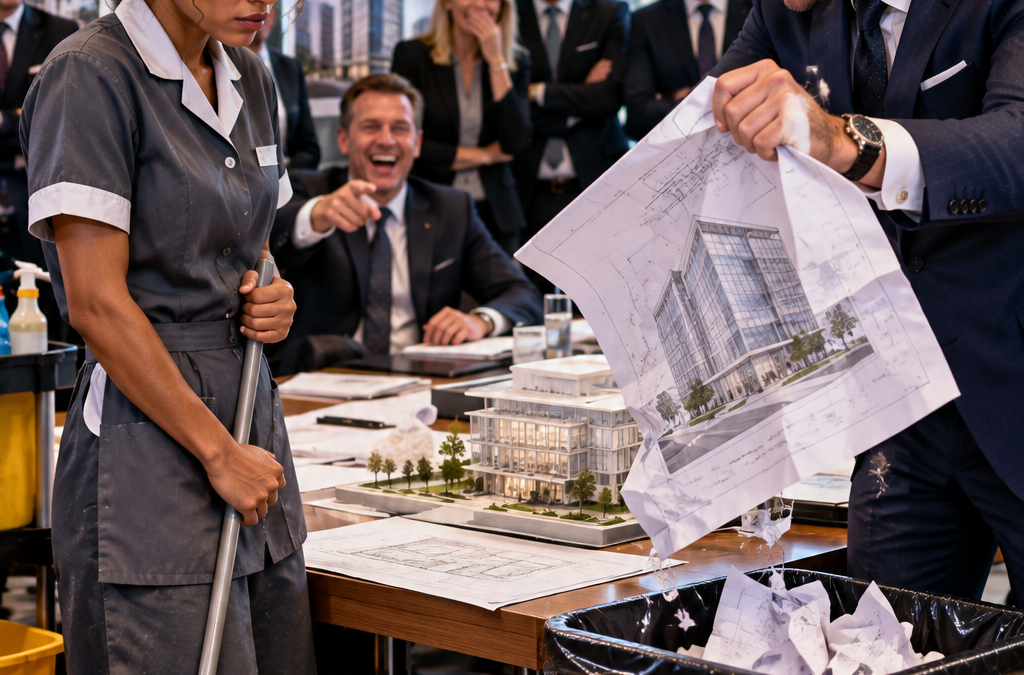
He stood beneath the projector ripping through slides.
“Generic.”
Click.
“Lazy.”
Click.
“Unbuildable.”
Click.
“If this is what four months produces, some of you should consider different careers.”
Then he stopped.
A smile appeared.
He reached behind the podium.
My drawing.
“And now.”
He held it up.
“Our grand finale.”
Laughter had already started in a few corners.
“I present the work of our resident genius.”
He looked directly at me.
“The janitor.”
More laughter.
I was standing at the back with my cleaning cart.
“The woman cleaning your toilets produced this.”
He turned the sheet.
“And frankly, it’s about the same quality as everything else you’ve been giving me.”
The room erupted.
Some genuinely laughed.
Others performed laughter because Garrett was laughing.
He looked at me.
“Maybe I should fire the lot of you and let her run the department.”
He paused.
“At least she’s cheaper.”
My fingers tightened around the cart handle.
I kept my eyes down.
He wanted a reaction.
He didn’t get one.
After the meeting, the drawing disappeared.
I found it in the trash.
Crumpled.
Black marker across the center.
STAY IN YOUR LANE.
I took it home.
That night, Tasha went to sleep around ten.
I sat at our kitchen table.
The paper lay in front of me.
I smoothed it.
Flattened the corners.
The marker had bled slightly through the fibers.
Stay in your lane.
I opened the leather portfolio I kept beneath my bed.
Dozens of drawings.
Years of them.
Floor plans.
Sections.
Structural concepts.
Community spaces.
Transit integration.
Facade studies.
Rainwater systems.
Things I created knowing nobody might ever build them.
My Howard diploma hung on the wall.
Marcus’s photograph beside it.
I remembered the last architecture firm where I had worked professionally.
Lawrence Peton & Associates.
I had been twenty-six.
Young.
Hungry.
Newly licensed.
Lawrence Peton was forty-eight.
Award-winning.
Charismatic.
The kind of architect students quoted.
I believed him when he said he saw something special in my work.
For eighteen months, I worked on a mixed-use housing concept.
The design was mine.
Not every detail.
Architecture is collaborative.
But the core concept.
Structural approach.
Circulation.
Facade system.
Mine.
Three weeks before the client presentation, Lawrence asked for my files.
“Standard review.”
I gave them to him.
On presentation day, my name disappeared.
His appeared.
I confronted him privately.
He smiled.
“You’re on my team.”
“That doesn’t make it yours.”
“Everything produced here belongs to the firm.”
“The concept predates this project.”
“Careful.”
“About what?”
“You’re talented, Denise.”
He leaned back.
“But you’re becoming difficult.”
Two weeks later, I was fired.
Insubordination.
Poor teamwork.
Resistance to supervision.
Difficult to manage.
I applied to three firms.
Three promising interviews.
Three rejections.
At the third, a woman in HR took pity on me.
Off the record, she said:
“Peton’s telling people you’re unstable.”
That was enough.
Architecture is a smaller world than outsiders understand.
One respected man’s warning can close doors you never know existed.
I worked drafting jobs.
Then administrative jobs.
Then Marcus died.
Single mother.
Bills.
Tasha.
Eventually, survival became more urgent than professional pride.
The architecture license expired.
I stopped renewing it.
The portfolio went under my bed.
Stay in your lane.
I looked at those words for an hour.
Then at Marcus.
Show me what you drew.
I picked up my pencil.
“They can tear the paper,” I whispered.
“They can’t tear what I know.”
I drew until sunrise.
Eleanor Hayes came to find me two weeks later.
Thursday.
8:05 p.m.
Eleventh floor.
Almost everyone had gone.
I was vacuuming.
“Denise.”
I shut off the machine.
For a second, I wondered who she meant.
Nobody in architecture had ever called me by name.
“Yes, ma’am?”
She stepped inside.
Closed the glass door.
“That drawing.”
My stomach tightened.
“The one Garrett put on the corkboard.”
I waited.
“It was a passive stack ventilation system.”
I stared.
“Thermal chimneys.”
She continued.
“Low-level intake. Convective exhaust.”
Still nothing from me.
“I’ve seen a comparable arrangement in maybe three published papers in the last decade.”
She sat on the edge of a drafting table.
“You didn’t learn that cleaning this office.”
I kept one hand on the vacuum.
“Where did you study?”
I considered lying.
Something in her face stopped me.
“Howard.”
“Architecture?”
“Yes.”
“Degree?”
“Bachelor and Master of Architecture.”
Her expression didn’t change.
That meant something to me.
No dramatic surprise.
No, you’re kidding.
She simply nodded.
“Year?”
“2010.”
“Were you licensed?”
“Yes.”
“Were?”
“Expired.”
“Why?”
I almost ended the conversation.
Then she asked the right question.
“Did someone make sure you couldn’t stay in the profession?”
I looked at her.
She understood before I explained.
That made me trust her just enough.
“Lawrence Peton.”
Eleanor’s face went still.
“You worked for Peton?”
“Yes.”
“What happened?”
“He took my work.”
She inhaled quietly.
I noticed.
Then told her the rest.
The credit.
The confrontation.
The termination.
The calls.
Three firms.
Three rejections.
Marcus.
Tasha.
Everything except the details I still couldn’t speak about without becoming angry.
Eleanor listened.
No interruptions.
When I finished, she asked:
“Do you still have work?”
I hesitated.
Then reached into my cart.
The leather portfolio was there because I had brought it that morning to reorganize during lunch.
I placed it on the drafting table.
Opened it.
Five sheets.
Only five.
If she laughed, I could close it quickly.
She didn’t laugh.
She leaned over them.
The first was a site plan for South Bank.
Green corridors.
Pedestrian spine.
Transit access.
The second showed modular housing.
The third integrated rainwater capture.
The fourth used community gardens as both landscape and social infrastructure.
The fifth tied everything together through passive energy design.
Eleanor stood silently for almost three minutes.
Then:
“Denise.”
“Yes?”
“This isn’t sketching.”
I said nothing.
“This is a complete design thesis.”
“It’s just something I work on.”
“No.”
She looked at me.
“This is the answer to a ten-million-dollar problem forty architects haven’t solved.”
Fear moved through me immediately.
“No.”
“I’m serious.”
“I can’t.”
“You haven’t heard what I’m asking.”
“I know.”
“Then say it.”
“You want me to present it.”
“Yes.”
“No.”
“Why?”
“Because I have a daughter.”
“So?”
“Because this job feeds her.”
Eleanor’s expression softened slightly.
“I was worth more at my last job too.”
That silenced her.
“I stepped forward once.”
My voice shook despite my effort.
“A man with more power took my designs, took my name off them and made sure three firms believed I was impossible to work with.”
I closed the portfolio.
“I won’t risk Tasha’s food because somebody suddenly thinks my drawings are interesting.”
Eleanor nodded.
No argument.
Then she asked:
“May I photograph two?”
I stared.
“For what?”
“Insurance.”
“Against?”
“People.”
That answer I understood.
I let her photograph the site plan and ventilation section.
She handed the portfolio back.
“Nothing happens without you saying yes.”
“Thank you.”
She left.
I thought that ended it.
It didn’t.
South Bank kept collapsing.
Two weeks before the deadline, Victor Brennan’s review team sent Crestline another rejection.
I saw the printed email later.
THE DESIGN LACKS CONNECTION TO THE COMMUNITY IT CLAIMS TO SERVE.
NO INNOVATION.
NO VISION.
NO REASON TO CONTINUE.
Garrett exploded.
Emergency meeting.
Forty-two people.
He paced.
“Four months.”
He slapped the table.
“Twenty-six professionals.”
Another slap.
“And a client has just told us we have no vision.”
Nobody looked up.
“If we lose this contract, people lose jobs.”
A junior architect shifted.
“And I promise you my job will not be the first.”
That was Garrett.
Failure always traveled downward.
Morale collapsed.
Two architects updated résumés.
One senior designer requested transfer.
Everyone knew South Bank was dying.
Eleanor went upstairs.
She walked into CEO Preston Collins’s office.
I wasn’t there.
She told me later.
She placed two photographs on his desk.
Mine.
Preston studied them.
He was sixty-one.
Quiet.
More thoughtful than Garrett.
He had co-founded Crestline with two partners decades earlier.
He stared at my passive-ventilation system.
“Who drew this?”
Eleanor said:
“An outside designer.”
Not a complete lie.
Not the whole truth.
Preston looked at the site plan.
“Different perspective.”
“Yes.”
“This could cut mechanical demand.”
“Significantly.”
“How significantly?”
“Possibly thirty percent or more.”
He looked at her.
“Bring me everything.”
Garrett saw her entering Preston’s office.
That was the beginning of his panic.
He started asking questions.
Who was Eleanor working with?
Was there an outside consultant?
Had anyone seen new South Bank material?
Three days later, he overheard two junior architects in a stairwell.
“The mystery designer is in the building.”
Garrett realized.
Around the same time, Eleanor approached me in a ninth-floor bathroom while I was mopping.
“Preston has seen your work.”
I stopped.
“No.”
“He doesn’t know it’s yours.”
“You said nothing would happen without me.”
“He saw two photographs.”
“Eleanor.”
“He wants the full package.”
“I can’t.”
“Brennan gave them one last pitch.”
“No.”
“Friday.”
I gripped the mop.
“I told you.”
“I know.”
“I lost architecture once.”
“I know.”
“I won’t lose the job feeding Tasha.”
Eleanor stood silently.
Then said:
“Your daughter will grow up either way.”
I looked at her.
“The question is what she’ll see when she looks at her mother.”
I hated her for that sentence.
For maybe five minutes.
Then I went home.
Tasha was doing homework.
A tuition notice from her school was stuck to the refrigerator.
$1,400 due in three weeks.
I stared at it.
Security.
Food.
Rent.
The gray uniform.
All real.
Then I looked at Marcus.
Show me what you drew.
I waited until Tasha slept.
Opened the portfolio.
Worked until four.
Three new sheets.
Full elevations.
Material schedule.
Community-integration diagram.
The strongest work I had done in years.
When I gave them to Eleanor, my hands shook.
She took them upstairs.
Preston studied everything.
Forty minutes.
Then called Brennan.
“Give us one more meeting.”
Friday.
10:00 a.m.
Victor Brennan arrived with three senior members of his development team.
I was in the service hall.
Dark blazer borrowed from Eleanor.
White blouse.
Black pants.
My leather portfolio in both hands.
No cleaning uniform.
I felt naked without it.
That surprised me.
For eight months, the uniform had humiliated me.
Now it had become armor.
People knew what role I played when I wore it.
The blazer created expectations.
I heard Preston beginning the presentation through the conference room door.
Site plan.
Green corridors.
Modular construction.
Brennan asked questions.
At first, Eleanor answered.
Then one of his engineers asked:
“What airflow rate are you projecting through the residential thermal stacks during peak summer humidity?”
Silence.
Eleanor knew the concept.
Not that number.
That was my cue.
My hand touched the door.
I froze.
Fourteen years.
Peton.
Rejections.
Garrett.
Stay in your lane.
Tasha.
Marcus.
My own reflection appeared faintly in the glass.
I opened the door.
Conversation stopped.
Garrett saw me first.
His face changed.
Preston stood.
“This is the designer.”
Nobody spoke.
I walked to the front.
Set down the portfolio.
Then answered the unanswered question.
“Airflow is calculated per square meter and adjusted for Atlanta’s summer humidity profile.”
Brennan’s engineer looked up.
I continued.
“Thermal chimney stacks sit at fifteen-degree offsets to improve convective draw while reducing direct solar gain on the intake corridors.”
He asked:
“Expected air changes?”
I answered.
Another question.
Modular frame tolerance.
I answered.
Another.
Rainwater capture.
Another.
Transit ratio.
Another.
Community green-space allocation.
For the first time in fourteen years, architecture came out of me without being hidden behind a kitchen table.
I stopped hearing the room.
Stopped seeing Garrett.
I saw the building.
That’s what architecture had always been for me.
Not lines.
Not software.
A structure already existing somewhere in the mind.
You simply explain it until everyone else can see it.
I picked up a marker.
Drew a building section on the whiteboard.
No ruler.
Years of practice.
Load path.
Drainage.
Thermal stack.
Shading.
Brennan raised a hand.
His team stopped asking questions.
He looked at me.
“Where did you train?”
“Howard University.”
“Architecture?”
“Yes.”
“When?”
“Class of 2010.”
I paused.
“And about fourteen years on the backs of paper other people threw away.”
Nobody laughed.
Garrett leaned forward.
“With respect.”
I knew that tone.
Whenever Garrett said with respect, he was preparing to show none.
“Mr. Brennan, Denise Walker is a member of our cleaning staff.”
Brennan’s expression remained neutral.
“She does not hold an active architectural license.”
Garrett looked toward Preston.
“These designs were neither authorized nor reviewed through firm standards.”
I could feel the room turning cautious.
“Presenting unlicensed work to a client exposes Crestline to liability.”
Eleanor reached beneath her folder.
She pulled out my crumpled drawing.
Flattened now.
Black words still visible.
STAY IN YOUR LANE.
She placed it on the table.
“This is the design Garrett used to humiliate Denise in front of forty-two employees.”
Garrett’s jaw tightened.
Eleanor smoothed the page.
“This is the thermal chimney system Mr. Brennan’s team just spent twenty minutes discussing.”
Brennan looked at Garrett.
Garrett immediately changed direction.
“Actually, that raises another issue.”
He turned toward Preston.
“Ownership.”
My stomach tightened.
“These drawings were produced on Crestline property using Crestline materials.”
He held up his phone.
“Employment agreements generally assign work product to the firm.”
Preston hesitated.
That was enough for Garrett to keep pushing.
“She used our discarded printouts.”
“Our facilities.”
“Our design floors.”
“We should involve counsel.”
Brennan’s team exchanged looks.
Preston said slowly:
“He may have a point.”
“No.”
My voice cut through the room.
Everyone turned.
I opened the leather portfolio fully.
Not five sheets.
Everything.
I placed the first drawing on the table.
Then another.
Another.
Another.
Soon the entire conference table disappeared beneath fourteen years of my work.
“These were created at home.”
I pointed to the bottom corner.
“Dates.”
Another.
“Initials.”
Another.
“Paper I purchased.”
Another.
“My pencils.”
Another.
“My apartment.”
Another.
“After my daughter went to sleep.”
Garrett stared.
“The sketches on recycled sheets were thumbnails.”
I placed my complete elevations beside them.
“The actual design package existed before Crestline saw any finished version.”
I reached deeper into the portfolio.
Howard transcript.
My old architecture license.
Expired.
License number still visible.
Letter from Professor Harold Whitmore.
I placed them side by side.
“I carried these for fourteen years.”
My voice wavered.
I hated that.
Then decided not to.
“Not because I expected anyone to ask.”
I looked at Garrett.
“But because after enough people tell you that the professional life you remember wasn’t real, sometimes you need evidence for yourself.”
Silence.
Garrett glanced at my transcript.
Then smiled.
Different smile.
He had found another weapon.
“This is very moving.”
My stomach dropped.
“But credibility matters too.”
He picked up his phone.
“Isn’t it true you once worked for Lawrence Peton?”
My fingers went cold.
Eleanor sat straighter.
Garrett continued.
“Peton & Associates.”
“Yes.”
“And you were terminated.”
“Yes.”
“For insubordination.”
I stared at him.
“That’s what the file says.”
He scrolled.
“Difficult to manage.”
My hands began trembling.
“Resistance to team structure.”
The room blurred slightly.
“Unsuitable for collaborative professional work.”
There it was.
Fourteen-year-old poison.
Still potent.
Garrett looked at Brennan.
“I think our client deserves to know the professional history of the person claiming authorship.”
My palms pressed against the table.
“That isn’t what happened.”
“It’s in the employment record.”
“The record is false.”
Garrett lifted his eyebrows.
“Convenient.”
Eleanor stood.
“Garrett.”
He looked over.
“I know exactly what Lawrence Peton did.”
Everything stopped.
She opened a thin folder.
Pulled out a page.
“Seven years ago, I sat on an internal review panel connected to an American Institute of Architects ethics inquiry.”
Garrett’s smile disappeared.
“Peton had been accused of taking junior designers’ work.”
My breathing slowed.
“Two complaints.”
She looked at me.
“One Black woman.”
Then another page.
“One Latino designer.”
She set the documents down.
“Same pattern.”
Brennan leaned closer.
“Work appropriated.”
“Credit removed.”
“Employee objects.”
“Employee terminated.”
“Negative professional assessment distributed afterward.”
Garrett stared.
Eleanor looked directly at him.
“The complaints were suppressed.”
“How do you have that?”
“I kept my copy.”
“You weren’t authorized—”
“Neither was Lawrence Peton authorized to destroy careers.”
Garrett stopped.
Eleanor touched the page.
“One of the women named in that review is Denise Walker.”
I closed my eyes briefly.
Fourteen years.
For fourteen years, I had carried the lie alone.
Now someone else said the truth in a room full of witnesses.
Not sympathy.
Evidence.
Victor Brennan had been watching everything.
Finally, he spoke.
“Mr. Collins.”
Preston turned.
“I came here looking for a firm capable of designing housing for people who have been overlooked.”
He looked toward the South Bank plans.
“People working two jobs.”
His eyes moved to me.
“Single parents.”
Then to Garrett.
“Families living in buildings designed by professionals who never asked what high utility costs actually do to a household.”
Nobody moved.
“I wanted somebody who understands that.”
He picked up one of my drawings.
“Not academically.”
Another.
“Personally.”
Then he looked at me.
“I believe I found that person.”
My eyes burned.
Brennan turned to Preston.
“The question isn’t whether Ms. Walker’s design is good.”
He placed the sheet down.
“It’s extraordinary.”
Garrett shifted.
“The question is whether Crestline deserves to put its name beside hers.”
That sentence landed harder than anything Garrett had ever said to me.
Preston looked across the table.
My work.
The old license.
The Howard transcript.
Stay in your lane.
He saw all of it.
Then he stood.
“Ms. Walker.”
I looked up.
“I owe you an apology.”
Garrett stared at him.
“This firm owes you an apology.”
I said nothing.
“I can’t repair fourteen years.”
“No.”
He nodded.
“But I can stop repeating the mistake.”
Preston looked at Brennan.
Then back at me.
“I would like you to join the South Bank team.”
Garrett crossed his arms.
“As a consultant?”
Preston didn’t even look at him.
“No.”
Garrett frowned.
“Facilities liaison?”
Preston turned now.
“Lead designer.”
Nobody breathed.
I stared.
Preston continued.
“Subject to reinstatement of her licensing credentials, which Crestline will support immediately.”
My fingers curled around the edge of the table.
“Lead designer.”
“Yes.”
Brennan nodded once.
“My condition as well.”
Preston looked at him.
“If Crestline receives this contract, Denise Walker leads design.”
“Non-negotiable.”
Garrett stood.
“Preston, this is reckless.”
Preston looked at him.
“I think we’ve heard enough from you.”
Garrett’s face reddened.
“I’ve protected this firm’s standards for six years.”
“You humiliated the person who just rescued the largest proposal we’ve pursued in three.”
“She isn’t licensed.”
“Her license can be reinstated.”
“She hasn’t practiced professionally in fourteen years.”
Brennan answered before Preston could.
“She just outperformed everyone in this room.”
Garrett looked around.
Nobody met his eyes.
He buttoned his jacket.
Turned.
Walked out.
The door clicked shut.
Almost no one watched.
I stood there.
Lead designer.
The words felt too large.
Preston extended his hand.
I looked at it.
Then shook.
“I accept.”
My voice barely made it out.
But it did.
After the others left, Brennan stayed.
He picked up the passive-cooling section.
“This.”
He tapped the thermal system.
“Do you know what this could save in operating costs?”
“Depending on final materials, approximately thirty to thirty-five percent in cooling load across the typical unit.”
He smiled.
“Thirty-five.”
“Yes.”
“That sold me.”
He signed a letter of intent before leaving.
$10.2 million.
South Bank Renewal Project.
Condition:
Denise Walker, lead designer.
I read the line three times.
Preston walked me to the eleventh floor.
Same studio.
Same windows.
Same drafting tables.
Eight months earlier, I cleaned them.
Now people stepped aside as we passed.
Some looked ashamed.
Some curious.
Some suddenly friendly.
I noticed all of it.
Preston stopped at an empty office.
“This can be yours.”
I walked inside.
Glass wall.
Drafting desk.
City view.
He hesitated.
“I should have known.”
I looked at him.
“How?”
He struggled.
“I should have seen.”
“Yes.”
That answer surprised him.
I didn’t soften it.
“You walked past me too.”
He nodded.
“I did.”
“You saw a uniform.”
“Yes.”
“So did everybody.”
He breathed out.
“I’m sorry.”
I looked around.
“I believe you.”
Not forgiveness.
Not yet.
Just acknowledgment.
Ten minutes later, Eleanor found me.
My portfolio was open on the drafting table.
Sunlight reached it.
For fourteen years, I had protected those drawings from dust, spills, moving boxes and disappointment.
Now they were lying openly beneath glass windows on Crestline’s design floor.
Eleanor leaned against the door.
“You were ready the whole time.”
I smiled faintly.
“You just needed somebody to open the door.”
I looked at her.
“No.”
Her eyebrows lifted.
“I needed somebody to stop locking it.”
She nodded.
“Fair.”
Then she squeezed my shoulder.
No speeches.
She left.
That evening, I came home before six.
Tasha was at the kitchen table.
She looked up.
Then at my clothes.
“Why are you wearing a blazer?”
I sat across from her.
She closed her math book.
“Mom?”
“I need to tell you something.”
“What?”
“About architecture.”
She watched me carefully.
I told her everything.
Not every detail about Peton.
Enough.
Howard.
My license.
The designs.
Garrett.
The meeting.
South Bank.
By the end, Tasha was crying.
So was I.
She wiped her face.
Then said:
“Are you an architect again?”
I laughed through tears.
“I think so.”
Her eyes moved toward the leather portfolio beside me.
“Can I see?”
Marcus used to say that.
Show me what you drew.
I opened the portfolio between us.
For the first time in fourteen years, I didn’t draw alone.
The next six months changed almost everything.
My license reinstatement took eleven weeks.
Crestline’s legal team handled the paperwork.
Continuing education.
State board review.
Professional references.
Verification of prior experience.
When the new certificate arrived, I stood beside the mailbox holding the envelope.
Tasha came outside.
“Open it.”
“I know what it says.”
“Open it anyway.”
I did.
DENISE WALKER.
REGISTERED ARCHITECT.
I ran my thumb over the print.
Tasha hugged me from behind.
“You’re crying.”
“No.”
“You absolutely are.”
“Go inside.”
She laughed.
I framed the certificate.
Hung it beside my Howard diploma.
Then moved Marcus’s photograph between them.
South Bank moved quickly.
Modular frames rose from red Georgia soil.
The first time I stood on the construction site wearing a hard hat with LEAD DESIGNER beneath my name, I had to walk away for a minute.
Not because I was overwhelmed by status.
Because I could see lines from my kitchen table becoming steel.
A structural column exactly where my pencil had put it.
A thermal chimney rising above a roofline.
Drainage channel.
Garden corridor.
Real.
Architecture is one of the few professions where your thoughts can become places strangers will inhabit.
That responsibility never stopped frightening me.
Eight architects reported to me.
I made one rule on the first day.
“Nobody presents another person’s work without their name attached.”
One junior architect smiled.
Nobody else knew why I said it.
Eleanor did.
Garrett’s future was quieter.
Preston ordered a formal review.
Once one person spoke, others followed.
Junior architects.
Former employees.
People who had watched him take credit.
People he threatened.
People whose grievances disappeared.
The pattern was familiar.
Three written statements.
Two older complaints never escalated properly.
Management intimidation.
Retaliation.
Credit appropriation.
Preston did not publicly fire him.
Instead, Garrett was reassigned to Savannah.
Smaller office.
Smaller team.
No major client authority.
Officially lateral.
In reality, a demotion.
He accepted.
On his last day in Atlanta, I saw him packing.
I was walking toward a design review.
He looked through the glass at me.
For a second, we held each other’s eyes.
He looked toward the framed drawing visible on my office wall.
Stay in your lane.
I had flattened the original and framed it.
Not because Garrett deserved space on my wall.
Because I needed to remember the difference between somebody’s opinion and reality.
He walked away.
No apology.
I didn’t need one.
Lawrence Peton faced consequences too.
Eleanor reopened what she knew.
Her documentation went back to professional bodies.
Others joined.
Old complaints became harder to dismiss once patterns were connected.
His name quietly disappeared from two industry boards.
No spectacular downfall.
No cameras.
Just doors that had protected him beginning to close.
That felt appropriate.
The world loves dramatic punishment.
Professional accountability is often quieter.
I was invited to speak at Howard the following spring.
Architecture commencement.
I almost declined.
Then Tasha said:
“You have to go.”
“Why?”
“Because somebody there might be you.”
I went.
Standing backstage, I could smell drafting paper.
Coffee.
Old auditorium fabric.
Memories everywhere.
I looked at rows of graduating students.
Young.
Hopeful.
Terrified.
I did not tell them success always rewards talent.
That would have been a lie.
I did not tell them if they work hard enough somebody will discover them.
Another lie.
I told them:
“Document your work.”
The room quieted.
“Keep your sketches.”
“Save drafts.”
“Put dates on everything.”
“Know the contracts you sign.”
“Learn the business protecting your creativity.”
Then:
“And never confuse being overlooked with being empty.”
I paused.
“There may be years when nobody asks what you know.”
I thought of Crestline.
“Know it anyway.”
Applause came later.
The part I remember was one student in the front row writing those words down.
Months later, a national architecture journal featured South Bank.
They called it one of the decade’s most innovative affordable-housing concepts.
Photographs showed the green corridors.
Thermal chimneys.
Gardens.
Modular units.
Children on walkways.
Families in shaded courtyards.
Nobody in the article called me a former janitor.
I was grateful.
I did not want my cleaning job to become the most interesting thing about the architecture.
I wasn’t ashamed of cleaning.
There is dignity in honest work.
But I hated the implication that being a janitor made architectural intelligence surprising.
People asked:
“How could someone like you end up cleaning offices?”
Someone like me.
I learned to answer:
“The same way anyone ends up somewhere life didn’t originally plan.”
Death.
Money.
Bias.
Responsibility.
A child.
Closed doors.
One bad man with the right contacts.
There was no mystery.
The mystery was why everyone believed job title and capacity were the same thing.
The woman mopping Crestline’s floors was never less intelligent than the woman later leading South Bank.
Nothing magical happened in that conference room.
I did not acquire talent when Victor Brennan believed me.
Preston’s apology did not give me skill.
Eleanor did not create my ability.
They recognized something that already existed.
That’s different.
One evening, six months into construction, I stayed late on the eleventh floor.
The office was almost empty.
I heard a vacuum.
A new cleaner named Marisol worked near the elevators.
I watched her for a minute.
Not because she reminded me of myself.
Because I was suddenly aware how easily I could become everybody who once walked past me.
I went out.
“Evening.”
She shut off the vacuum.
“Good evening, Ms. Walker.”
“You know my name?”
She smiled nervously.
“Everyone does.”
I almost laughed.
“What’s yours?”
“Marisol.”
“Nice to meet you.”
“You too.”
I returned to my office.
Small moment.
Ordinary.
But I thought about it all night.
Power changes the angle from which you see invisibility.
Once people begin opening doors for you, it becomes dangerously easy to forget the years when they didn’t.
I promised myself I wouldn’t.
Not perfectly.
Nobody keeps promises perfectly.
But deliberately.
South Bank opened eighteen months later.
The ceremony was held in the central courtyard.
Children ran between planters before anyone officially cut the ribbon.
That was my favorite part.
The mayor spoke.
Preston spoke.
Brennan spoke.
I barely heard them.
I watched residents.
An older woman tested a bench beneath one of the shade structures.
A father pushed a stroller along the pedestrian corridor.
Two boys leaned over a rain garden.
People were using what had once existed only in pencil.
When my turn came, I stepped to the microphone.
Tasha sat in front.
Sixteen now.
Marcus’s photograph was in my purse.
I had brought it without telling anyone.
I looked at the buildings.
“I drew the first version of this ventilation system on the back of a discarded office printout.”
People smiled.
“I don’t say that because the paper matters.”
I looked toward the residential wings.
“I say it because ideas do not care what surface they’re born on.”
The crowd quieted.
“They don’t care about your title.”
A breeze moved through the courtyard.
“Or your office.”
“Or your salary.”
I saw Eleanor.
“Good ideas only ask whether someone will build them.”
I stepped away.
That was enough.
Afterward, Tasha found me.
“Mom.”
“Yes?”
“I want to show you something.”
She pulled a folded paper from her bag.
A rough building sketch.
Teenage lines.
Imperfect.
But thoughtful.
I smiled.
“What’s this?”
“School project.”
“You drew it?”
“Yes.”
She watched my face.
“Well?”
For one second, Marcus was beside us.
Show me what you drew.
I opened the sheet wider.
“Show me how it works.”
Her smile nearly broke me.
Years later, people still ask about the framed Stay in Your Lane drawing in my office.
Junior designers notice it immediately.
Black marker.
Wrinkles.
Old humiliation pressed behind clean glass.
I always give roughly the same answer.
“Someone told me this was worthless.”
They look closer.
“I keep it because the people who tear things down are not automatically the people who know how to build.”
Sometimes they ask whether I hate Garrett.
I don’t.
Hate requires attention I no longer want to give him.
What Garrett did mattered.
But I refuse to make him the central character in the story of my work.
My architecture existed before his ridicule.
It survived during it.
It continued after him.
That’s the part I protect.
People also like to say Garrett lost because he underestimated me.
That’s only partly true.
He lost because he was certain.
Certain a cleaner could not understand architecture.
Certain education had a visible uniform.
Certain talent arrived with a job title.
Certain a Black woman entering through the service door could have nothing to teach people using the front entrance.
Certainty made him incurious.
And incurious people become dangerous when given power.
He saw my drawing before Brennan did.
He had the same evidence.
Lines.
Dimensions.
Calculations.
Garrett saw something worthy of mockery because he had already decided who made it.
Eleanor saw architecture because she looked at the work before deciding what my uniform meant.
That difference is everything.
At Crestline, I eventually became design director for community development.
Not immediately.
Years later.
By then, South Bank had won awards.
More importantly, utility costs in the development came in below projections.
Resident satisfaction was high.
The community garden expanded.
A local school started using one multipurpose space for evening tutoring.
Those details mattered more than awards.
Architecture is not successful because photographs look beautiful.
It is successful when ordinary Tuesday afternoons work better for the people living inside it.
I kept one habit from cleaning.
Early mornings.
I still arrived before most staff.
Not 5:45 anymore.
Usually 6:30.
Coffee.
Quiet studio.
I liked buildings before meetings entered them.
Sometimes I walked past the recycling bins.
Stacks of one-sided paper.
I thought about taking some.
Eventually, I placed a bin beside our drafting area.
REUSE FOR SKETCHING.
No rule about who could take it.
No permission needed.
One morning, I found a floor-plan idea on the back of an old agenda.
No name.
Good concept.
I pinned it to the board.
Not as a joke.
Underneath, I wrote:
WHO DREW THIS? COME FIND ME.
A twenty-two-year-old receptionist appeared in my doorway that afternoon.
Nervous.
“Ms. Walker?”
“Denise.”
“I drew that.”
I smiled.
“Sit down.”
She did.
I turned the sketch toward her.
“Show me what you were thinking.”
As she explained, I wondered how many Garretts in how many buildings had never asked that question.
Show me.
What are you thinking?
What do you know?
Why did you draw it this way?
People talk about hidden talent as though talent intentionally hides.
Often it doesn’t.
It is ignored.
Dismissed.
Interrupted.
Priced out.
Locked outside.
Sometimes talent is working another job because rent is real.
Sometimes it stopped applying because rejection became expensive.
Sometimes it is raising a child.
Caring for a parent.
Driving a bus.
Stocking shelves.
Cleaning bathrooms.
That doesn’t make everyone secretly a genius.
That’s not my point.
My point is simpler.
You cannot know what a person is capable of if you never become curious enough to ask.
The gray uniform told Crestline what job I was performing.
It never told them everything I could do.
Those are different questions.
Eight months after South Bank opened, Preston visited my office.
He looked at the Stay in Your Lane frame.
“You still keep that thing.”
“Yes.”
“You know, every time I see it, I feel ashamed.”
“Good.”
He laughed.
“I deserved that.”
He sat.
“I’ve thought about something.”
“What?”
“If Brennan hadn’t come.”
I waited.
“If there hadn’t been a ten-million-dollar contract.”
His face became serious.
“Would we have changed?”
I didn’t answer immediately.
“Probably not.”
He nodded.
“I think you’re right.”
“That’s the problem.”
“Yes.”
He looked through my office wall at the design floor.
“We were willing to notice talent when it became profitable.”
I appreciated that he could say it.
“Most organizations are.”
“So how do you prevent that?”
“You don’t completely.”
He waited.
“You build systems that give people routes besides luck.”
That conversation led to a new internal design program.
Any employee.
Any department.
Could submit ideas for review.
Facilities.
Administrative staff.
Interns.
Architects.
Anonymous if desired.
Most submissions were ordinary.
Some were impractical.
A few were excellent.
That was fine.
The point wasn’t that every janitor secretly possessed a ten-million-dollar design.
The point was that nobody’s idea should be rejected because of the uniform on the person carrying it.
Eleanor retired two years later.
At her farewell dinner, she insisted on no speeches.
We ignored her.
When my turn came, I looked at her.
“You photographed two drawings.”
She rolled her eyes.
“Denise.”
“Two.”
People laughed.
“You didn’t save me.”
The room quieted.
“You didn’t create my career.”
Eleanor’s eyes filled.
“You did something smaller.”
I smiled.
“You looked.”
That broke her.
She cried.
So did I.
Sometimes the smallest act is the one everything else requires.
Eleanor looked.
Then she spoke.
Years earlier, Marcus had looked too.
Tasha looked.
Professor Whitmore looked.
Eventually Preston looked.
Brennan looked.
Garrett looked at the same evidence and saw only someone he needed to push back down.
The difference was never the drawing.
It was the person doing the looking.
I still think about the morning Garrett crumpled one of my sketches and threw it against my chest.
I can remember exactly how the paper hit the gray uniform.
Light.
Almost nothing.
“Pick it up.”
I bent down.
“Yes, sir.”
He thought that moment proved something about me.
That I knew my place.
That I accepted his judgment.
That I was small enough to control.
He misunderstood what kneeling meant.
I was only picking up my work.
I was taking it home.
I was keeping the evidence.
He believed he had ended the story because he possessed the authority to humiliate me in a hallway.
He didn’t understand that my life had already survived worse men than him.
Peton had taken my credit.
Grief had taken Marcus.
Bills had taken years.
Fear had taken confidence.
But none of them took the part of me that could look at an empty page and see structure.
No one could.
That belonged to me.
On the day the South Bank community center opened, I brought Marcus’s photograph.
I waited until everyone left.
Then I stood alone in the main hall.
Three stories.
Library downstairs.
Workshop rooms above.
Rooftop garden.
Tasha beside me.
I held the photograph toward the room.
Stupid, maybe.
But grief makes its own rituals.
“See?”
I whispered.
Tasha heard.
She didn’t laugh.
She slipped her hand into mine.
We stood there together.
For years, I had measured my life by what had been taken.
Career.
Credit.
Husband.
Time.
That day, I measured something different.
What remained.
Knowledge.
Work.
My daughter.
The ability to begin again.
People talk about second chances as though the second chance arrives from outside.
A person notices you.
A company hires you.
A client believes.
Those things matter.
But my second chance began earlier.
Long before Eleanor spoke my name.
It began the night I found Stay in Your Lane written across my drawing.
I could have pushed the portfolio beneath my bed.
I almost did.
Instead, I sharpened a pencil.
That was the real beginning.
Everything afterward needed other people.
But that part belonged only to me.
I kept drawing when nobody was watching.
I kept learning when nobody was paying.
I kept building buildings on paper when the world had decided my hands were useful only for cleaning the rooms where real architects worked.
So when the door finally opened, I had something to carry through it.
Not potential.
Work.
Years of it.
Proof.
That’s why the leather portfolio still sits in my office.
Not because I need anyone to believe who I used to be.
Because I remember the woman who carried it before anyone believed who she could become.
She wore gray.
Entered through the service door.
Smelled like bleach some mornings.
Counted every grocery dollar.
Stayed up too late.
Raised a daughter.
Missed her husband.
And kept a pencil in her pocket.
I owe her everything.
The day Garrett humiliated me in front of the department, he thought he was reminding me of my place.
He was wrong about one thing.
I already knew exactly where I belonged.
I just needed to stop allowing men like him to define the route I was permitted to take to get there.








