𝗙𝗨𝗟𝗟 𝗦𝗧𝗢𝗥𝗬 I Thought Everyone Had Forgotten My Retired K9 Until the Morning of His Final Goodbye
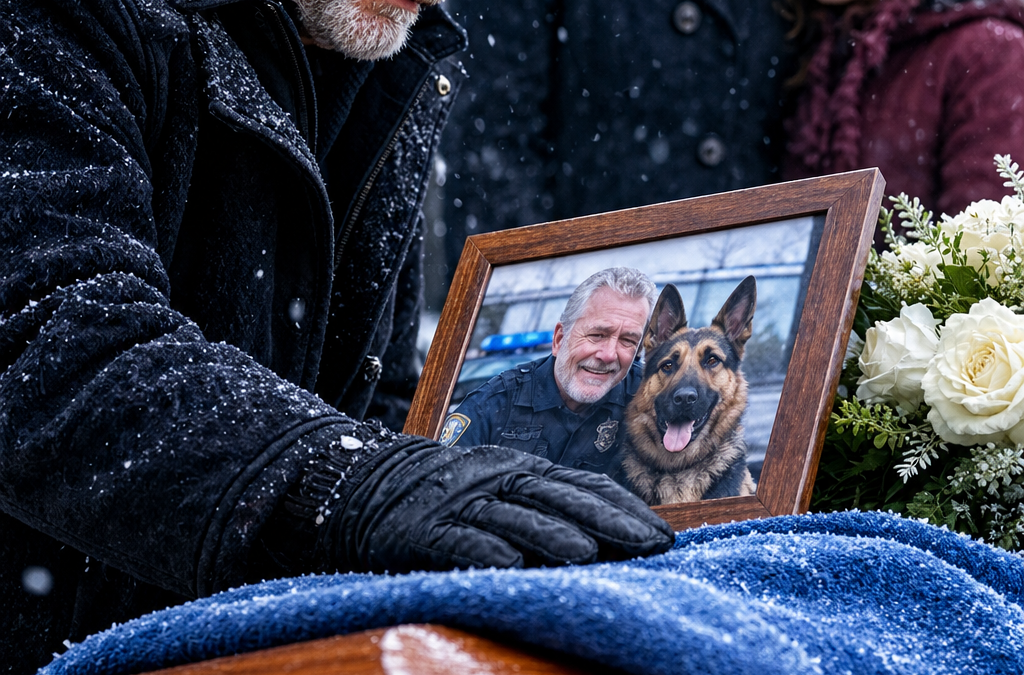
𝗙𝗨𝗟𝗟 𝗦𝗧𝗢𝗥𝗬
I looked at the paramedic.
He nodded.
So Atlas rode in the ambulance.
He sat on the floor beside the stretcher, resting his head against Ruby’s blanket.
Her mother met us at the hospital.
When she saw her daughter, she made a sound I still cannot describe.
She dropped to her knees.
Ruby reached toward her.
And in the middle of that reunion, Atlas quietly backed away, sat beside my leg, and waited.
He didn’t need praise.
He didn’t need a camera.
He had done what he was trained to do.
We went home around two in the morning.
Margaret was waiting in the kitchen.
She had seen the story on the local news.
She wrapped her arms around me before I could take off my coat.
“Are you okay?”
I nodded.
Then she looked at Atlas.
“My beautiful boy.”
She knelt, took his face in her hands, and kissed the space between his ears.
He closed his eyes.
For a moment, he looked less like a police dog and more like a child who had finally come home.
That night, I found Margaret sitting beside his bed long after midnight.
She was crying quietly.
I asked her what was wrong.
She shook her head.
“Nothing.”
“Margaret.”
She looked up.
“Somewhere tonight, a mother gets to hold her little girl because of him.”
I sat down beside her.
For a long time, neither of us spoke.
I thought about Ruby.
About the concrete pipe.
About that tiny mitten moving in the dark.
Then Margaret whispered something I would remember for the rest of my life.
“Daniel, don’t ever let anyone tell you he’s just a dog.”
I promised her I wouldn’t.
I wish I could say I kept every promise I made to my wife.
I didn’t.
I missed birthdays.
I missed anniversaries.
I missed Emily’s college graduation because a violent suspect barricaded himself inside a house and our unit was called to assist.
The situation lasted fourteen hours.
By the time I returned home, Emily’s graduation dress was hanging over a chair.
The flowers I’d ordered were still sitting on the kitchen table.
She had already gone back to her apartment.
Margaret was washing dishes.
“You should call her,” she said.
“I will.”
“Tonight, Daniel.”
“I’m exhausted.”
She turned off the faucet.
“She’s been waiting for you all day.”
I looked down.
“I couldn’t leave.”
“I know.”
“Then why are you angry?”
Margaret dried her hands slowly.
“Because there’s always a good reason, Daniel. And somehow, the people who love you are always the ones expected to understand.”
That sentence hurt more than any reprimand I ever received from a commanding officer.
Because she was right.
I loved my family.
But somewhere along the way, I had confused being needed with being present.
Atlas never made that mistake.
When Emily visited, he greeted her like she had never left.
He didn’t care how long she’d been gone.
He didn’t keep track of missed holidays or unanswered phone calls.
He only knew she was home.
Sometimes I think dogs understand forgiveness better than human beings ever will.
In 2016, Atlas saved another life.
That call came during a violent summer thunderstorm.
A small chemical storage facility outside Millbrook caught fire after lightning struck a transformer.
The building had partially collapsed.
Firefighters were searching for a missing maintenance worker when a secondary explosion forced the crews back.
One firefighter, Captain Benjamin Walsh, was reported missing.
The incident commander asked whether Atlas could help locate him from outside the unstable structure.
It wasn’t a normal assignment for a patrol K9.
But Atlas had extensive human-scent training, and the chief knew he could sometimes locate someone where human searchers could not.
We stayed behind the safety perimeter while rescue specialists assessed the building.
Atlas began working the wind near a row of shattered loading doors.
He became intensely interested in a collapsed loading platform.
He pulled toward it.
Then he barked.
Again.
And again.
I radioed the rescue team.
“Possible human scent beneath the rear platform.”
A firefighter approached.
“Are you sure?”
I looked at Atlas.
He was still barking at the same location.
“No,” I said. “But he is.”
Thermal equipment was brought in.
Crews discovered a narrow void beneath the fallen platform.
Inside it was Benjamin Walsh.
He had suffered a broken leg and severe smoke inhalation.
His radio had been crushed.
He had been unconscious when the first rescue team passed nearby.
The firefighters spent nearly an hour cutting through the wreckage.
Atlas waited behind the perimeter with me.
He refused water.
He refused to lie down.
Every few minutes, he lifted his head toward the building.
When they finally carried Walsh out, Atlas stood.
His tail moved once.
Then he turned toward our patrol vehicle.
The work was finished.
Three weeks later, Benjamin Walsh visited the police station.
He arrived on crutches, carrying a small paper bag.
Inside was a thick leather collar.
A silver plate on the front read:
ATLAS — ALWAYS ON WATCH
Walsh knelt awkwardly beside my dog.
“I’ve got two daughters,” he said.
His voice broke.
“One’s eight. One’s eleven.”
Atlas sniffed his hand.
“I was supposed to take them camping that weekend.”
Walsh stopped speaking.
I looked away to give him privacy.
Then he rested his forehead briefly against Atlas’s head.
“Thank you for letting me keep that promise.”
For years afterward, he sent Atlas a Christmas card.
Every single year.
Sometimes the cards included photographs of his daughters.
First days of school.
Soccer games.
Graduations.
Ordinary moments.
The kind that rarely make the news.
The kind that mean everything.
I kept those cards in a kitchen drawer.
I still have them.
People often asked me about Atlas’s most dangerous assignments.
They wanted to hear about armed suspects, pursuits, and dramatic arrests.
Those were the stories that made headlines.
But when I thought about him at night, I thought about the little girl in the drainage pipe and the firefighter beneath the loading platform.
I thought about what it meant to return someone to a family.
That was the part of our job I was proudest of.
Of course, there were darker days.
There had to be.
Police work is not a collection of happy endings.
Sometimes you arrive too late.
Sometimes you do everything correctly and still lose someone.
Sometimes the thing you carry home is not a memory you want.
Atlas carried those days with me.
One night, after we had spent hours searching for a missing elderly man who was eventually found deceased, I sat in the patrol vehicle behind the station.
I couldn’t make myself start the engine.
The man’s wife had been waiting at the command post.
I kept seeing her face when the supervisor approached.
Atlas sat in the back.
After a while, he gave a quiet whine.
I opened the partition.
He pushed his head between the seats.
I rested my forehead against his.
“I’m tired, buddy.”
He licked my cheek.
I don’t know whether he understood grief.
I don’t know whether dogs understand the kind of regret that keeps a person awake.
But he knew something was wrong.
And he stayed with me until I could drive home.
Margaret used to say that Atlas was the only partner I’d ever had who never asked me to explain myself.
She was right about that, too.
Then came the year everything changed.
Margaret was fifty-nine when the doctors discovered the cancer.
By the time they found it, it had already spread.
She underwent treatment.
There were good weeks and terrible weeks.
There were mornings when she insisted on making breakfast and evenings when she couldn’t walk from the bedroom to the bathroom without help.
I tried to take leave.
I did take leave.
But after decades of responding to emergencies, I discovered that I had no idea what to do when the emergency was inside my own home.
There was no perimeter to establish.
No suspect to arrest.
No radio call that would bring the right people running.
I couldn’t protect her.
I couldn’t fix what was happening.
Atlas had been trained to remain alert and responsive.
But around Margaret, he became impossibly gentle.
He walked slowly beside her.
He waited while she rested.
He stopped jumping onto the couch because he seemed to understand that sudden movement hurt her.
Sometimes he lay beside the bed for hours without moving.
When the pain was bad, Margaret would reach down and touch his ears.
“Good boy,” she whispered.
Those were sometimes the only words she spoke all afternoon.
One evening, near the end, she asked me to bring Atlas onto the bed.
I hesitated.
“He’ll hurt you.”
“No, he won’t.”
I helped him climb up.
He moved carefully, placing himself beside her legs.
Margaret smiled.
“There you are.”
She stroked his head.
Then she looked at me.
“Promise me something.”
I leaned closer.
“Anything.”
“When he’s old, when he can’t do the things he used to do, don’t make him feel like he’s useless.”
My throat tightened.
“Margaret—”
“Listen to me.”
I nodded.
“He’ll give you everything he’s got. When he has nothing left to give, just love him.”
I held her hand.
“I promise.”
She died eleven days later.
Atlas searched for her.
That’s one of the things nobody tells you about losing someone when you have a dog.
He went from room to room.
He checked her side of the bed.
He waited beside the front door whenever a car entered the driveway.
For weeks, he carried one of her slippers around the house.
The slipper smelled like her.
I couldn’t bear to take it away.
I sometimes came home from work and found him sleeping with it between his front paws.
One night, I sat on the bedroom floor and cried harder than I had at her funeral.
Atlas came over, lowered himself beside me, and pressed his body against my chest.
I held him until my arms went numb.
After Margaret died, the house became a place filled with things I couldn’t touch.
Her coffee mug.
Her sewing basket.
The yellow raincoat hanging near the back door.
I left everything where it was.
I told myself I was preserving her memory.
The truth was simpler.
Moving anything felt like admitting she wasn’t coming back.
Atlas kept me moving.
He needed breakfast.
He needed walks.
He needed his medication after an old shoulder injury flared up.
He needed someone to open the back door in the morning.
There were days when I got out of bed only because he was standing beside it, staring at me with those patient brown eyes.
I didn’t know how to live without Margaret.
But Atlas knew how to live through the next hour.
Then the hour after that.
He taught me to follow.
By the time Atlas retired, he had served almost ten years.
His muzzle had turned gray.
His hips were stiff.
He no longer leaped into the patrol vehicle the way he once had.
The decision came after our final dangerous call together.
It was a cold evening in November.
A man suspected of a violent armed robbery had fled into an abandoned motel near the interstate.
An officer had been wounded during the pursuit.
The suspect was believed to be carrying a handgun.
We established a perimeter around the building.
Atlas and I were part of the search team.
Officer Leah Bennett was immediately behind me.
Leah had joined the department six years earlier.
She was smart, brave, and sometimes too willing to take risks.
Atlas adored her.
She brought him treats when she thought I wasn’t looking.
That night, the motel smelled of mildew, broken plaster, and stale cigarette smoke.
Most of the rooms had been stripped.
Doors hung loose.
The hallway lights no longer worked.
We moved carefully, clearing areas as directed.
Near the end of the second-floor corridor, Atlas stopped.
His ears rose.
His body went rigid.
I felt the change through the leash.
He was alerting toward a storage room.
I raised my fist.
The team stopped.
Leah leaned toward me.
“What is it?”
I whispered, “He’s got something.”
We repositioned behind cover.
Before we could issue another command, the storage-room door moved.
A gunshot cracked through the hallway.
Plaster exploded from the wall beside Leah.
Someone shouted.
Another shot followed.
I pulled back behind the corner as the team returned fire.
Atlas lunged forward when the suspect suddenly rushed into the corridor.
In those chaotic seconds, he intercepted the man as officers struggled to get control of the weapon.
The gun discharged again.
Atlas yelped.
It was a sound I had never heard from him.
High.
Sharp.
Terrified.
My blood turned cold.
The suspect was taken into custody within moments.
But I barely saw it.
Atlas collapsed against my legs.
There was blood spreading across his shoulder.
I fell to my knees.
“No. No, no, no.”
His breathing was fast.
His eyes searched my face.
I pressed my hand against the wound.
“Stay with me, buddy.”
Leah was beside us.
Her face had gone white.
“Daniel, I need to—”
“Get the medical kit!”
She ran.
Atlas tried to lift his head.
I held him gently.
“Don’t move.”
He gave a weak whine.
I remember saying the same words over and over.
“You’re okay. You’re okay. I’ve got you.”
I don’t know whether I was talking to him or to myself.
The emergency veterinarian found that the bullet had passed through the soft tissue of his shoulder without striking a major artery or bone.
He would survive.
But the doctor warned me that his age and existing joint problems made returning to full duty increasingly risky.
I already knew.
I had known for months.
I’d just been too stubborn to admit it.
Two days later, Leah came to the veterinary hospital.
She stood in the doorway holding a bag of dog treats.
Atlas lifted his head.
His tail thumped softly against the blanket.
Leah covered her mouth.
Then she sat beside him and began to cry.
“He got between me and that man,” she whispered.
I nodded.
“He did.”
“I didn’t even see him coming out.”
I couldn’t answer.
She stroked Atlas’s cheek.
“He saved my life.”
For a long time, the room was quiet.
Then Leah looked at me.
“You have to let him retire, Daniel.”
I turned toward the window.
“I know.”
“He can’t keep doing this.”
I watched Atlas resting beneath the hospital blanket.
For almost ten years, he’d gone wherever I asked him to go.
Into forests.
Into abandoned buildings.
Into storms.
Into places where frightened people waited for help and dangerous people waited for us.
He had never once refused.
Now it was my turn to make a difficult decision for him.
Atlas’s retirement ceremony took place six weeks later.
The department presented him with a plaque and a ceremonial collar.
There were photographs.
There was a cake decorated with his badge number.
The chief made a speech about loyalty and courage.
Atlas ate an entire hamburger.
Everyone laughed.
I smiled for the cameras.
But when we got home, I parked the patrol vehicle in the driveway and opened the back door.
Atlas started to climb out.
Then he paused.
For ten years, that vehicle had meant work.
Purpose.
Another call.
Another chance to do something important.
I unclipped his leash.
“Come on, buddy.”
He looked at me.
“You’re home now.”
He stepped onto the driveway.
I closed the door.
And for reasons I still cannot fully explain, I began to cry.
I retired the following spring.
After nearly three decades, I placed my badge on the captain’s desk, shook a few hands, and walked away.
People congratulated me.
They talked about fishing trips and sleeping late.
They asked what I planned to do with all my free time.
I gave the usual answers.
But nobody warned me about the silence.
For twenty-eight years, my life had been measured in radio calls, shift changes, court dates, and emergencies.
Now the phone rarely rang.
The department changed leadership.
New officers arrived.
Old friends moved away.
Some retired.
Others died.
My name gradually disappeared from the schedules and email chains.
That was natural.
I understood it.
At least, I thought I did.
Atlas and I developed our own routine.
Every morning at seven, we walked down the gravel road behind my house.
We stopped near the old bridge and watched the creek.
Then we returned home.
He ate breakfast.
I drank coffee.
Sometimes I read the newspaper aloud to him.
Sometimes we sat in silence.
I bought an old pickup truck with a bench seat because his hips made climbing into my larger vehicle difficult.
On good days, we drove to the lake.
I’d open the passenger window just enough for him to smell the air.
He would sit beside me with his nose lifted, taking in every scent the wind carried.
People at the grocery store sometimes recognized him.
“Is that Atlas?”
I’d smile.
“Sure is.”
They’d crouch beside the truck.
“Hey, buddy. Remember me?”
He usually did.
He’d wag his tail or press his head into a familiar hand.
But those encounters became less frequent.
Time was moving on.
The town was changing.
And Atlas was growing old.
The first time he couldn’t make it up the back steps, I pretended not to notice.
He stood at the bottom, looking embarrassed.
I waited.
“Come on, buddy.”
He tried again.
His back legs slipped.
I rushed down and caught him.
He leaned against me, breathing heavily.
I helped him inside.
That afternoon, I built a wooden ramp.
I sanded the boards until there wasn’t a splinter left.
I covered it with rubber strips so his paws wouldn’t slide.
When he tried it for the first time, he walked halfway up and stopped.
I stood beside him.
“That’s it. Take your time.”
He continued.
When he reached the top, I praised him as though he’d just won a national competition.
“Good boy! That’s my boy!”
He wagged his tail.
I laughed.
Then I went into the garage and cried where he couldn’t see me.
Aging is cruel in ways death is not.
Death comes once.
Aging takes little pieces.
The ability to run.
The strength to jump.
The confidence to climb stairs.
The joy of waking up without pain.
With Atlas, I watched those pieces disappear one at a time.
And every loss reminded me that I was running out of time.
In the final year, he developed chronic kidney disease.
There were medications.
Special food.
Frequent veterinary appointments.
We managed it for a while.
He still enjoyed short walks.
He still lifted his head when I said, “Let’s go for a ride.”
He still slept beside my chair.
But winter made everything harder.
In January, he stopped eating his breakfast.
At first, I thought he was simply being stubborn.
I warmed the food.
I added chicken.
I sat on the floor beside him.
“Come on, Atlas. Just a little.”
He sniffed the bowl and turned away.
I took him to our veterinarian, Dr. Miriam Chen.
She had treated him for years.
She knew every scar.
Every old injury.
Every ridiculous story about his appetite.
She examined him gently and ordered tests.
When she returned, her expression told me what I didn’t want to hear.
His kidneys were failing.
There were complications involving his heart.
Treatment might buy him a little time, but it would not reverse what was happening.
I stared at the floor.
“How long?”
She hesitated.
“Daniel, I can’t give you an exact number.”
“Days?”
“Possibly.”
“Weeks?”
“Maybe.”
I rubbed my hands together.
“What can we do?”
“We can keep him comfortable.”
“That’s not what I asked.”
She sat across from me.
“I know.”
I looked toward the examination table.
Atlas was lying on his side.
His tail moved when he heard my voice.
“He survived a gunshot,” I said.
Dr. Chen nodded.
“He did.”
“He worked through snowstorms. He found people nobody else could find.”
“I know.”
“He doesn’t give up.”
Her eyes filled.
“Daniel, sometimes loving them means knowing when they need us to stop asking them to fight.”
I hated those words.
I hated how gentle she was when she said them.
I hated that she was right.
I took Atlas home.
Over the next two weeks, I slept on the living room floor beside him.
I moved his bed near the fireplace.
I covered him with Margaret’s blue blanket.
I played old country records because he had always seemed to relax when music filled the house.
I told him stories.
Stories he already knew.
Stories about our first day together.
About Ruby.
About Captain Walsh.
About the time he stole an entire Thanksgiving turkey from the kitchen counter and Margaret blamed me for leaving it within reach.
I laughed at that memory.
Then I cried.
Sometimes I woke in the middle of the night and placed my hand against his chest just to make sure he was still breathing.
One evening, Emily called.
We had never completely repaired the distance that developed during her teenage years.
We spoke on holidays.
We exchanged photographs.
She sent birthday cards.
I sent money to Sophie for Christmas.
But there were long stretches when neither of us knew how to begin a real conversation.
That night, I answered on the third ring.
“Hi, sweetheart.”
“Hi, Dad.”
She hesitated.
“How’s Atlas?”
I looked at him sleeping beside the fireplace.
“Not good.”
There was silence.
“How bad?”
I swallowed.
“Pretty bad.”
Emily’s voice changed.
“I’ll come tomorrow.”
“You don’t have to drive all that way.”
“Dad.”
“What?”
“Stop telling me what I don’t have to do.”
I closed my eyes.
She continued.
“I love him, too.”
The next afternoon, she arrived with Sophie.
Sophie came through the front door carrying a stuffed dog and a small paper bag.
“Grandpa!”
I hugged her.
Then she hurried into the living room.
“Atlas!”
He lifted his head.
His tail moved.
Sophie dropped to her knees beside him.
“I brought you something.”
She pulled a homemade medal from the paper bag.
It was a cardboard star covered in silver glitter.
Blue ribbon hung from the top.
Across the center, in crooked purple letters, she had written:
BEST DOG IN THE WHOLE WORLD
I watched her place it gently beside his collar.
“Because you’re a hero,” she whispered.
Atlas licked her hand.
Sophie giggled.
For a moment, he looked young again.
That evening, Emily found me in the kitchen.
I was standing at the sink, staring at a plate I had already washed.
She leaned against the doorway.
“Dad.”
I didn’t turn.
“Yeah?”
“How are you doing?”
“Fine.”
She waited.
Then she said, “You don’t have to do that with me anymore.”
I set the plate down.
“Do what?”
“Pretend.”
I looked at her.
She was thirty-nine years old.
A mother.
A teacher.
A woman with a life of her own.
But for an instant, I saw the seventeen-year-old girl who used to wait by the window for my patrol car.
“I don’t know what I’m going to do without him,” I admitted.
Emily’s expression softened.
“Then don’t think about that yet.”
“I lost your mother. I lost the job. And now—”
My voice broke.
She stepped forward.
“Dad.”
I shook my head.
“I don’t know how much more I’m supposed to lose.”
She wrapped her arms around me.
It had been years since she hugged me that way.
Not a polite greeting.
Not a quick embrace at Christmas.
She held me as though I were someone who needed holding.
And I did.
Atlas died on a Tuesday morning in February.
The night before, he could barely stand.
He refused water.
His breathing became uneven.
I called Dr. Chen.
She came to the house before sunrise.
Emily had stayed the night.
Sophie was asleep upstairs.
We gathered in the living room beside the fireplace.
Atlas lay on his blue blanket.
I held his head in my lap.
Dr. Chen explained everything quietly.
She gave me time.
All the time I needed.
But there was no amount of time that could have made it easier.
I stroked the white fur around his muzzle.
“Hey, buddy.”
His eyes moved toward mine.
“You remember our first day?”
His breathing was shallow.
“You didn’t like me much.”
Emily sat beside us, crying silently.
I tried to smile.
“You thought I was an idiot.”
Atlas blinked.
“Turns out you were right about most things.”
I leaned closer.
“I need you to do something for me.”
My voice shook.
“I need you to rest now.”
He let out a small breath.
“No more work.”
I pressed my forehead against his.
“No more pain.”
Dr. Chen placed a hand on my shoulder.
I nodded.
I held Atlas through his final moments.
He left this world the same way he had lived in it.
Trusting me.
That was the part that nearly destroyed me.
For years, I had trusted him with my life.
In the end, he trusted me with his.
Afterward, I stayed on the floor for almost an hour.
I couldn’t move.
His body was still warm.
My hand rested against his neck.
I kept expecting him to breathe.
To lift his head.
To look at me as though we had another call to answer.
Eventually, Emily knelt beside me.
“Dad.”
I shook my head.
“I know.”
She waited.
“I know he’s gone.”
But knowing and accepting are two different things.
I wanted to bury Atlas beside the willow tree at Greenfield Memorial Gardens, a small cemetery with a section dedicated to companion animals and retired service dogs.
Margaret and I used to walk near that tree years earlier.
She had once told me it was the prettiest spot in town.
I couldn’t bury Atlas beside her because the cemetery where Margaret rested didn’t permit animal burials.
But Greenfield was peaceful.
The willow stood on a small rise overlooking the creek.
It felt like somewhere he would have liked.
I arranged a modest service for Friday morning.
Twelve chairs.
A wooden casket.
A photograph.
A small American flag beside the grave.
I asked Emily to read a few words.
I called the department.
The person who answered didn’t recognize my name.
“Detective Mercer?” she repeated.
“Retired Officer Mercer,” I corrected gently. “Former K9 unit.”
“Oh. Yes, sir. How can I help?”
I explained that Atlas had died.
There was a pause.
“I’m sorry to hear that.”
“Thank you.”
“Would you like me to pass along a message?”
I looked at the framed photograph above my desk.
“If you could. He served ten years. I thought some of the people who knew him might want to come.”
“Of course.”
I gave her the details.
Then I sent emails to old colleagues.
Some addresses bounced back.
Some messages went unanswered.
I left voicemails.
I called the retired officers’ association.
I even contacted Leah.
She answered while I was standing in the garage.
“Daniel?”
“Hey, Leah.”
“It’s been a while.”
“Yeah.”
I cleared my throat.
“Atlas passed away.”
Silence.
Then I heard her inhale sharply.
“Oh, Daniel.”
“He went Tuesday.”
“Oh, no.”
I told her about the service.
Friday.
Ten in the morning.
Greenfield Memorial Gardens.
Near the willow tree.
For a few seconds, she didn’t speak.
Then she said, “I’ll see what I can do.”
I tried not to feel hurt.
“I understand you’re busy.”
“Daniel—”
“No, really. I know how it is.”
She started to say something else.
But a voice called her name in the background.
“I have to go,” she said quickly. “I’m so sorry.”
The call ended.
I stared at the phone.
For years, I’d told myself Atlas was more than an employee.
More than equipment.
More than a dog assigned a number.
But suddenly I wondered whether those words had meant the same thing to anyone else.
I knew people had lives.
Children.
Work.
Problems of their own.
I knew a Friday morning wasn’t convenient.
Still, it hurt.
Not because I wanted attention.
Because I wanted him remembered.
The night before the service, I polished Atlas’s old collar.
I cleaned the silver badge.
I placed his favorite tennis ball inside the casket.
Then I found Margaret’s sewing kit in the bedroom closet.
Inside was a small embroidered patch she had made years earlier.
It showed a black-and-tan German Shepherd beneath the words:
MY BRAVE BOY
I sat on the edge of the bed holding it.
I could almost hear her voice.
When he has nothing left to give, just love him.
I placed the patch beside the collar.
Then I turned off the light.
I didn’t sleep.
And now, standing in the cemetery, I watched the empty chairs disappear beneath falling snow.
It was 10:07.
Seven minutes after the service should have begun.
The cemetery caretaker, a quiet man named Mr. Peterson, approached.
“Mr. Mercer?”
I turned.
“Yes?”
“We can wait a little longer if you’d like.”
I looked toward the road.
There was no one.
No patrol vehicles.
No familiar officers.
No one at all.
I felt something collapse inside me.
“Maybe another five minutes.”
“Of course.”
He walked away.
Emily came beside me.
“Dad, it doesn’t mean they didn’t care.”
I stared at the chairs.
“I know.”
“People get busy.”
“I know.”
“They remember him.”
I looked at her.
“Do they?”
She didn’t answer immediately.
That was when I said something I had been holding inside for three days.
“He gave them everything.”
My voice was barely above a whisper.
“Ten years, Emily. Ten years of going into places nobody wanted to go.”
She touched my arm.
“He saved officers. He found missing children. He got hurt doing his job.”
“I know, Dad.”
“He was there every time they called.”
The words started coming faster.
“Every storm. Every night. Every Christmas. Every time the radio went off, he got in that car.”
My chest tightened.
“And now he gets one morning.”
I looked at the empty chairs.
“One morning. That’s all I asked.”
Emily’s eyes filled.
I turned away.
I didn’t want her to see me crying again.
I stepped closer to the casket and rested my hand on the polished wood.
“I’m sorry, buddy.”
The wind moved through the willow branches.
Snow collected on the photograph.
“I’m sorry they forgot.”
And then I heard it.
At first, I thought it was the wind.
A distant, rising sound from somewhere beyond the cemetery.
Then it came again.
A siren.
One long, unmistakable wail.
I lifted my head.
Emily turned toward the road.
Mr. Peterson stopped walking.
For a moment, nobody moved.
Then another siren sounded.
And another.
Not the chaotic overlapping noise of an emergency response.
Something controlled.
Deliberate.
Coming closer.
I looked toward the entrance.
A black police SUV appeared around the bend.
Its red and blue lights flashed through the falling snow.
Behind it came another.
Then a marked patrol car.
Then another.
And another.
My heart began pounding.
The vehicles moved slowly, tires crunching over the snow-covered road.
They entered the cemetery one by one.
Millbrook Police.
County Sheriff’s Office.
State Police.
The neighboring township’s K9 unit.
A fire department command vehicle.
An ambulance.
More patrol cars followed.
Some were new models I didn’t recognize.
Others were familiar enough to make my chest ache.
The sirens fell silent as the procession entered the grounds.
Only the emergency lights remained, washing the white snow in red and blue.
I stared.
I couldn’t understand what I was seeing.
Emily covered her mouth.
“Oh, Dad.”
The first vehicle stopped near the gravesite.
The driver’s door opened.
Officer Leah Bennett stepped out.
She was wearing her dress uniform.
Behind her came Chief Robert Harlan, a man I had worked with for nearly twenty years.
Then Captain Benjamin Walsh emerged from a fire department vehicle.
He was older now.
His hair had gone almost completely white.
But I recognized him immediately.
More doors opened.
Officers stepped into the snow.
Some wore uniforms.
Others wore dark coats over civilian clothes.
Several carried K9 memorial ribbons.
One officer held a folded blue flag.
Another carried a framed photograph.
They began walking toward me.
I tried to speak.
Nothing came out.
Leah reached me first.
Her eyes were red.
“I’m sorry we’re late.”
I looked past her at the road.
Cars were still arriving.
“What is this?”
She swallowed.
“Daniel, we weren’t going to let him leave without us.”
I shook my head.
“I thought—”
My voice failed.
Leah took my hand.
“I know what you thought.”
I looked at her.
“I called. I sent messages. Nobody answered.”
A tear ran down her cheek.
“I should have told you what we were doing. I wanted it to be a surprise, but I never meant to hurt you.”
She glanced at the procession.
“Once word got around, everyone wanted to come. We arranged to meet at the station and drive in together. Then the county road was closed because of an accident, and we lost another fifteen minutes.”
She wiped her face.
“I’m sorry, Daniel.”
I tried to breathe.
Behind her, more officers approached.
Some I hadn’t seen in years.
A dispatcher who had retired to Florida.
A former sergeant who now walked with a cane.
Two young officers who had been academy recruits when Atlas was nearing retirement.
Then I saw something that made my knees weaken.
A line of K9 handlers walked forward with their dogs.
Six German Shepherds.
Two Belgian Malinois.
Each dog wore a dark ceremonial harness.
Each handler carried the leash in the left hand.
They stopped a respectful distance from Atlas’s casket.
At one quiet command, all eight dogs sat.
Their ears rose.
Their eyes watched the officers.
I pressed my hand against my mouth.
Chief Harlan stepped forward.
He removed his hat.
“Daniel.”
I looked at him.
“Chief.”
He held out his hand.
I shook it automatically.
His grip tightened.
“We’re here for Atlas.”
I nodded, unable to speak.
Harlan looked toward the casket.
“And we’re here for you.”
The cemetery, which had been painfully empty only minutes earlier, began filling with people.
The twelve folding chairs weren’t enough.
Not even close.
Officers stood behind them.
Firefighters lined the path.
Neighbors gathered near the gate.
I saw a group of civilians walking carefully through the snow.
One young woman carried white roses.
An older woman walked beside her, holding her arm.
I didn’t recognize them at first.
Then the young woman smiled through tears.
“Officer Mercer?”
I stared at her.
She was nineteen, maybe twenty.
Dark hair.
Brown eyes.
A small scar above one eyebrow.
Something about her voice caught at my memory.
“Yes?”
She stepped closer.
“I’m Ruby Diaz.”
For a moment, the cemetery disappeared.
I saw a dark concrete pipe.
A tiny pink mitten.
A frightened child whispering that she was cold.
“Ruby?”
She nodded.
I could barely believe it.
The little girl who had almost frozen to death in the woods was standing in front of me.
Alive.
Grown.
Beautiful.
Her mother stood beside her.
Elena Diaz.
I remembered her terrified face at the search command post.
Now she was crying again, but the fear was gone.
Ruby held out the roses.
“I wanted to bring these for Atlas.”
I took them with shaking hands.
“Look at you.”
She laughed softly.
“Yeah. I grew up.”
I tried to smile.
“You sure did.”
She looked toward the casket.
“My mom told me what happened.”
“I’m glad you came.”
She wiped her cheek.
“How could I not?”
Then she reached into her coat pocket and pulled out a small photograph.
It showed a six-year-old girl sitting in a hospital bed.
A German Shepherd rested his head against her blanket.
Ruby smiled through tears.
“I’ve carried this picture in my wallet for years.”
She handed it to me.
On the back, written in a child’s uneven handwriting, were the words:
ATLAS FOUND ME.
I turned the photograph over.
My vision blurred.
Ruby continued.
“After he found me, I had nightmares for a long time. I was scared of snow. I was scared of the dark.”
She looked toward Atlas.
“But whenever I got frightened, my mom reminded me about the dog who came looking for me.”
Elena placed a hand on her daughter’s shoulder.
Ruby took a breath.
“I’m studying nursing now. I want to work with kids.”
I looked at her.
“That’s wonderful.”
She shook her head.
“No. It’s because of him. Because when I was little and thought nobody knew where I was, he found me.”
Her voice broke.
“I just wanted him to know I never forgot.”
I held the photograph against my chest.
For years, I had remembered Ruby as a small child in a concrete pipe.
Now she was standing before me with a future.
A future Atlas had helped protect.
Before I could find the words to thank her, another voice called my name.
“Mercer.”
I turned.
Benjamin Walsh was approaching.
He wasn’t carrying crutches anymore.
His gait was steady, although a slight stiffness remained in one leg.
He stopped beside the casket and looked down.
“Well, old friend,” he said quietly. “You finally get to rest.”
He placed a hand on the wood.
Then he turned to me.
“Daniel, I need to introduce you to somebody.”
Two young women stepped forward.
One wore a dark blue winter coat.
The other had a scarf wrapped around her neck.
Walsh placed a hand on each of their shoulders.
“My daughters. Hannah and Grace.”
I remembered them from the Christmas cards.
The little girls in soccer uniforms.
The smiling faces beside birthday cakes.
Now they were grown.
Hannah reached out and shook my hand.
“It’s an honor to meet you.”
I shook my head.
“The honor’s mine.”
Grace looked at the casket.
“Dad told us about Atlas our whole lives.”
Walsh cleared his throat.
“Probably more often than they wanted to hear.”
“No,” Grace said.
She smiled at her father.
“Never.”
Then she turned back to me.
“When I graduated from college, Dad was there. When Hannah got married, he walked her down the aisle. When I needed someone to teach me how to drive, he was there for that, too.”
Her eyes filled.
“We got all those things because your dog found him.”
I looked at Walsh.
He was crying openly now.
“I’ve spent ten years trying to figure out how to repay him,” he said.
I shook my head.
“You don’t owe him anything.”
Walsh gave a sad smile.
“That’s where you’re wrong.”
He placed a small wooden box beside the casket.
Inside was a fire department challenge coin.
On its face was a firefighter’s helmet.
On the back, a German Shepherd had been engraved beneath the words:
FOR THE LIFE YOU GAVE BACK.
I covered my eyes.
I had spent three days wondering whether Atlas’s service had mattered.
And now the people he had helped were standing in front of me, carrying proof that it had.
But the procession wasn’t finished.
Leah approached again.
“Daniel, there’s someone else.”
She guided a man through the crowd.
He was tall, broad-shouldered, and in his early thirties.
I vaguely recognized his face.
Then I saw the small scar across his jaw.
“Officer Nolan Price?”
He smiled.
“Detective now, sir.”
I remembered Nolan as a nervous young patrolman.
Years earlier, he’d been assigned to assist us during a nighttime search for an armed domestic-violence suspect.
We located the suspect hiding near an abandoned barn.
Atlas alerted before Nolan stepped around a blind corner.
His warning prevented Nolan from walking directly into the suspect’s line of fire.
I had almost forgotten that night.
Nolan clearly hadn’t.
He shook my hand.
“Sir, I’ve wanted to tell you something for a long time.”
I nodded.
“Go ahead.”
He looked toward the casket.
“After that call, I went home and told my wife I was thinking about quitting.”
I blinked.
“Really?”
He nodded.
“I had a newborn son. I was scared. More scared than I wanted to admit.”
He paused.
“I kept thinking about how close I came to not going home.”
I remembered that feeling.
Every officer knows it.
Some nights it follows you all the way to your front door.
Nolan continued.
“Then I thought about Atlas. About how he caught something we missed and kept us from making a fatal mistake.”
He looked at me.
“I realized being brave didn’t mean pretending I wasn’t afraid. It meant being careful, trusting my team, and doing the job the right way.”
His voice grew stronger.
“I stayed. I trained. I became a better officer.”
He reached into his coat and pulled out a photograph.
It showed him standing beside a teenage boy.
“My son is fourteen now.”
I studied the picture.
Then Nolan smiled through tears.
“His middle name is Atlas.”
I looked up.
I couldn’t speak.
Nolan nodded toward the casket.
“I wanted you to know that there’s a boy walking around this world carrying your partner’s name.”
Something inside me gave way.
Not a dramatic collapse.
Not a sudden loss of control.
Just the quiet breaking of a wall I had spent years building around myself.
I lowered my head.
And I cried.
I cried for Atlas.
For Margaret.
For every cold night and dangerous call.
For the little girl in the drainage pipe.
For the firefighter beneath the wreckage.
For the young officer who got to raise his son.
I cried because I had spent so much of my life measuring its value by what I had lost.
And suddenly I was surrounded by everything that had survived.
Leah stood beside me without speaking.
Eventually, I wiped my face.
“How many people are here?”
She looked around.
“More than a hundred, I think.”
I stared at her.
“A hundred?”
She nodded.
“Once we contacted the old K9 unit, people started reaching out. Then the firefighters heard. And the dispatchers. And the families.”
She smiled sadly.
“We thought about keeping it small, but nobody wanted to stay home.”
I looked at the line of vehicles stretching toward the cemetery gate.
“All these people came for him?”
Leah placed her hand on the casket.
“They came because of him.”
Chief Harlan approached the front of the gathering.
He waited until everyone had settled.
The snow continued falling, but the wind had eased.
The emergency lights were switched off.
The K9 handlers stood in a line.
The firefighters removed their hats.
Harlan looked toward me.
“Daniel, would you mind if we said a few words?”
I shook my head.
“Please.”
He stepped forward.
For a moment, he seemed to struggle with his notes.
Then he folded the paper and put it away.
“I had a speech prepared,” he began. “But after seeing everyone here, I think I should just tell the truth.”
He looked toward Atlas.
“Most departments keep records of a K9’s work. Arrests. Searches. Certifications. Training hours.”
Several officers nodded.
“Atlas had an impressive record. Over his career, he assisted in hundreds of calls, located missing people, helped officers apprehend dangerous suspects, and served with courage under difficult conditions.”
Harlan paused.
“But that’s not why we’re here.”
He looked toward Ruby.
“Records tell us what happened.”
Then toward Walsh.
“People tell us what it meant.”
His voice deepened.
“Atlas didn’t know how important he was. He didn’t know what a citation was. He didn’t care about recognition. He never asked whether the person he was searching for was rich or poor, important or forgotten.”
He glanced at me.
“He knew his handler. He knew his duty. And he followed his training with a kind of loyalty most of us spend our entire lives trying to understand.”
A breeze lifted the corner of the blue blanket beneath the casket lid.
Harlan looked down.
“For ten years, Atlas served this community. And after those ten years, he went home with the man who loved him.”
The chief removed his glasses.
“Officer Mercer, your partner’s final assignment is complete.”
He paused.
“Thank you for bringing him home.”
I bowed my head.
Around me, I heard quiet sobbing.
Then Leah stepped forward.
She carried a small leather folder.
“I’d like to say something, too.”
She looked at me.
“Daniel, you know how I felt about Atlas.”
I nodded.
She smiled faintly.
“I used to bring him treats. You used to pretend you didn’t notice.”
A few people laughed.
Her expression grew serious.
“I was there the night he was shot.”
The crowd became still.
“I’ve replayed that hallway in my mind more times than I can count.”
She looked toward the casket.
“I remember the gunfire. I remember the dust. And I remember seeing Atlas on the floor.”
Her voice caught.
“For a long time afterward, I felt guilty. I wondered whether he would have been hurt if I’d moved differently, reacted faster, seen the danger sooner.”
She drew a shaky breath.
“Daniel told me something at the hospital. He said Atlas wasn’t thinking about whether I deserved saving. He was doing the work he had been trained to do, protecting the people beside him.”
She looked toward me.
“I have a daughter now. Her name is Madison. She’s four.”
I hadn’t known that.
Leah smiled through tears.
“Every night, I read her a story before bed. And on her bedroom wall, there’s a picture of Atlas.”
She opened the folder.
Inside was a drawing made by a child.
A large black-and-tan dog stood beneath a bright yellow sun.
Beside it were three stick figures holding hands.
At the top, in uneven letters, were the words:
THANK YOU FOR MY MOMMY.
Leah handed it to me.
I stared at the picture.
My fingers trembled.
She continued.
“Madison doesn’t understand everything that happened that night. She’s too young.”
A tear slid down her cheek.
“But someday she will. And when she does, she’ll know that a brave dog helped make sure her mother came home.”
I pressed the drawing against my coat.
Leah straightened.
“Atlas, I owe you more than I can say.”
Then she placed two fingers against the badge on her chest.
“Rest easy, partner.”
One by one, the uniformed officers saluted.
I had seen countless police funerals.
I had stood in formation for officers who died in the line of duty.
I had watched grieving families receive folded flags and listen to final radio calls.
But nothing prepared me for the sight of dozens of men and women standing silently in the snow, saluting the little wooden casket of a dog whose greatest reward had always been hearing the words good boy.
The honor guard approached.
Two officers carried a blue memorial flag bearing the insignia of the Millbrook K9 unit.
They folded it carefully.
Chief Harlan brought it to me.
He held it with both hands.
“Officer Mercer, on behalf of the department, thank you for the years of service you and Atlas gave this community.”
I took the flag.
It was heavier than I expected.
Or perhaps my arms were simply shaking.
“Thank you,” I whispered.
Harlan placed a hand on my shoulder.
“He was one of ours, Daniel. He always will be.”
I looked across the gathering.
And that’s when I noticed a man standing near the back.
He wore an old brown coat.
His shoulders were stooped.
A cane rested against his right leg.
For a moment, I couldn’t place him.
Then he removed his hat.
“Walter?”
He smiled.
Walter Briggs.
The trainer who had introduced me to Atlas more than a decade earlier.
I hadn’t seen him in almost five years.
He was older.
Much older.
But those eyes were unmistakable.
I moved through the crowd toward him.
“Walter.”
He held out his arms.
We embraced.
He patted my back.
“Easy, Mercer. These old bones aren’t what they used to be.”
I laughed through tears.
“What are you doing here?”
He looked offended.
“What kind of question is that?”
I shook my head.
“I didn’t know anyone had contacted you.”
“Leah called.”
He glanced toward the casket.
“Told me our boy was gone.”
His smile disappeared.
For several seconds, he watched the snow settling around the grave.
Then he said, “You remember the first day you met him?”
I laughed softly.
“He hated me.”
Walter shook his head.
“No, he didn’t.”
“He turned his back on me.”
“He was waiting.”
“For what?”
Walter looked directly at me.
“For you to become the man he needed.”
I swallowed.
He continued.
“That dog could have worked with any number of handlers. Smartest shepherd I’d seen in years. But he needed somebody patient enough to let him think.”
Walter placed his hand on my shoulder.
“You gave him that.”
I looked down.
“And he gave me everything.”
Walter nodded.
“That’s how the good partnerships work.”
We stood quietly for a moment.
Then he said something that stayed with me.
“You know, Daniel, there are two kinds of service dogs.”
I glanced at him.
“Yeah?”
“The ones who do their job because they’re trained to do it. And the rare ones who make everybody around them want to become better at theirs.”
He looked toward the line of officers.
“That dog was the second kind.”
I followed his gaze.
Young handlers stood beside dogs that had never met Atlas.
But their trainers had.
Their supervisors had.
Some of the people who taught them had learned their trade by watching us work.
Walter smiled.
“Look around, son. His work didn’t stop when he retired.”
I looked.
Really looked.
A young officer was helping an elderly woman through the snow.
A firefighter had given his coat to someone who was shivering.
Ruby stood beside Leah, speaking quietly.
Benjamin Walsh had one arm around each of his daughters.
People who might never otherwise have met were gathered together because of one dog.
And I understood what Walter meant.
Atlas’s life had reached farther than I ever knew.
The cemetery caretaker approached gently.
“Mr. Mercer, whenever you’re ready.”
The words made my stomach tighten.
Whenever you’re ready.
I knew those words.
I’d heard them from funeral directors.
Doctors.
Nurses.
People whose job required them to help families through the moments nobody can ever truly prepare for.
I looked at Atlas’s casket.
I wasn’t ready.
I would never be ready.
But the time had come.
I carried the white roses Ruby had brought to the graveside.
The casket had been placed above a carefully prepared grave beneath the willow tree.
Two officers stood ready to lower it.
Emily came beside me.
Sophie held her mother’s hand.
I looked down at my granddaughter.
Her eyes were red.
“Grandpa?”
“Yes, sweetheart?”
“Can I give Atlas his medal?”
I swallowed.
“Of course.”
She stepped forward with the cardboard star she’d made.
The glitter had begun to come loose along the edges.
She placed it carefully on top of the casket.
Then she kissed her fingertips and touched the wood.
“Goodbye, Atlas.”
Her voice trembled.
“Thank you for taking care of Grandpa.”
I turned away.
I couldn’t stop crying.
Emily put her arm around me.
For years, I had believed that my duty was to be strong for everyone else.
To be the one who had answers.
The one who held people together.
But standing at that graveside, with my daughter’s arm around my shoulders, I finally understood that being loved sometimes means letting someone see you fall apart.
I took a folded piece of paper from my coat pocket.
I’d written it the night before.
Three paragraphs.
I’d read them so many times that morning the paper had become soft at the creases.
My hands shook as I unfolded it.
I looked at the crowd.
“I wasn’t planning on speaking to so many people.”
A few people smiled.
“I thought there might be twelve of us.”
My voice broke.
“Truth is, about ten minutes ago, I thought there might only be three.”
I looked down.
“I’m sorry. I’m not very good at this.”
Leah shook her head.
“Take your time, Daniel.”
I breathed slowly.
Then I began.
“When I first met Atlas, I thought my job was to train him.”
I smiled faintly.
“I was wrong about that.”
A few people laughed.
“He taught me patience. He taught me trust. He taught me that courage isn’t the absence of fear.”
I looked toward Ruby.
“And he taught me that sometimes the most important thing you can do is keep searching when everyone else is running out of hope.”
I paused.
“He spent ten years working beside me. And when I retired, I thought our important days were over.”
I glanced at the casket.
“But I was wrong again.”
My throat tightened.
“After my wife died, there were mornings when I couldn’t find a reason to get out of bed.”
The gathering grew completely silent.
“I didn’t want to talk. I didn’t want visitors. I didn’t want to hear anybody tell me that things would get better.”
I looked toward Emily.
“I pushed away people who loved me.”
She was crying.
“But Atlas never left.”
I swallowed.
“He woke me up every morning. He made me go outside. He sat with me through nights I thought would never end.”
I pressed the paper against my chest.
“People have been thanking him today for saving their lives.”
I nodded toward the casket.
“And he deserves every word.”
My voice dropped.
“But there’s one life nobody knew he saved.”
I struggled to breathe.
“Mine.”
Emily covered her mouth.
“He saved me after Margaret died. Not with a heroic rescue. Not by chasing down a criminal or finding me in the woods.”
I wiped my eyes.
“He saved me by staying.”
The wind moved softly through the willow branches.
“He stayed when I was angry. He stayed when I was lonely. He stayed when I didn’t know who I was without my badge.”
I looked at the wooden box.
“And every day, he reminded me that somebody still needed me to come home.”
The last sentence came out as a whisper.
“So, buddy, I hope you knew.”
I stopped.
My eyes filled again.
“I hope you knew that I needed you just as much as you needed me.”
For several seconds, I couldn’t continue.
Nobody rushed me.
Nobody looked away impatiently.
They waited.
The same way Atlas always had.
Finally, I folded the paper.
“That’s all I’ve got.”
I stepped forward and placed my old police badge beside his collar.
It was the badge I’d carried for most of my career.
The edges were worn.
The metal had lost some of its shine.
I had kept it in my desk since retirement.
Now it belonged somewhere else.
“One last shift together,” I whispered.
The officers lowered the casket slowly.
I watched every inch.
Part of me wanted to shout for them to stop.
To open it.
To give me one more minute.
To let me touch his ears again.
But I had already been given more years with Atlas than I ever could have expected.
The least I could do now was let him rest.
When the casket reached the bottom, I picked up a small handful of earth.
My fingers trembled.
I dropped it gently into the grave.
The sound was almost nothing.
A soft patter against wood.
Yet it seemed louder than every siren I’d heard that morning.
“Goodbye, partner.”
The K9 handlers stood at attention.
One of the dogs gave a quiet whine.
Its handler rested a reassuring hand on its neck.
Then an officer with a portable radio stepped forward.
Chief Harlan nodded.
The officer pressed the transmit button.
A short burst of static broke the silence.
“Millbrook Dispatch, this is K9 Memorial Detail.”
A woman’s voice answered.
“Go ahead, Memorial Detail.”
The officer swallowed.
“Requesting final end-of-watch acknowledgment for retired K9 Atlas, badge K-17.”
The radio went quiet.
Then the dispatcher spoke.
“K9 Atlas, badge K-17.”
A pause.
“After ten years of faithful service to the citizens of Millbrook, your duty is complete.”
Her voice wavered.
“Your courage will be remembered. Your loyalty will never be forgotten.”
I closed my eyes.
“Rest easy, Atlas. We have the watch from here.”
Static whispered through the radio.
Then silence.
I had spent my career listening to police radio traffic.
Addresses.
Descriptions.
Emergency requests.
Calls for backup.
But those words were the hardest transmission I’d ever heard.
Because for the first time, there would be no answer from the dog who had spent his life beside me.
No movement in the back seat.
No eager bark.
No familiar tug on the leash.
Atlas’s final call had ended.
And this time, I had to walk away alone.
At least, that was what I thought.
As the service concluded, people began approaching me.
Not all at once.
Quietly.
Respectfully.
A retired dispatcher told me how Atlas once helped locate a disoriented elderly woman who had wandered away from a nursing home.
A former paramedic remembered the time he refused to leave the side of an injured officer until help arrived.
A woman I didn’t recognize introduced herself as the sister of a missing teenager Atlas had helped locate years earlier.
She showed me a photograph of her brother at his wedding.
“He has three children now,” she said.
I looked at the smiling family in the picture.
“That’s wonderful.”
She nodded.
“He still talks about the dog who found him.”
Another man approached holding a worn brown envelope.
Inside were newspaper clippings.
Some were yellowed with age.
One showed Atlas beside a sheriff’s vehicle after a successful search.
Another pictured him receiving his retirement plaque.
The man explained that his late father had served as a volunteer firefighter and had collected stories about the K9 unit.
“He always said that dog had more heart than half the people in town,” he told me.
I laughed.
“Your father sounds like a smart man.”
“He was.”
He handed me the envelope.
“I figured these belonged with you.”
By the time the crowd began to thin, I was holding photographs, letters, drawings, and small gifts.
I had arrived at the cemetery believing the world had forgotten Atlas.
I was leaving with more memories of him than I could carry.
Then Emily touched my arm.
“Dad, can we talk?”
I looked at her.
“Of course.”
She led me a few steps away, beneath the bare branches of another tree.
Sophie was standing with Leah, showing her the stuffed dog she’d brought from home.
Emily watched them for a moment.
Then she turned toward me.
“I was angry with you for a long time.”
I felt my chest tighten.
“I know.”
“Growing up, I thought the department always came first.”
I looked down.
“Sometimes it did.”
She nodded.
“I know you were helping people. I know you did important things. But when I was little, I didn’t understand why strangers got so much of you and we got whatever was left.”
I closed my eyes.
“Emily, I’m sorry.”
She looked surprised.
Maybe because I had spent years defending myself.
Explaining.
Justifying.
Reminding her how hard I worked.
But standing there beside Atlas’s grave, I had no desire to win another argument.
“I missed things I can’t give back,” I continued.
Her eyes filled.
“I should have been there more.”
She wiped her cheek.
“Dad, I didn’t come here to make you feel guilty.”
“I know.”
“I just need you to understand something.”
I nodded.
She took a breath.
“When Mom died, I was terrified I was going to lose you, too.”
I stared at her.
“I know you were grieving. But you stopped calling. You stopped visiting. You kept saying you were fine.”
Her voice shook.
“Sometimes Sophie would ask why Grandpa didn’t come to see her, and I didn’t know what to say.”
I felt the words like a physical blow.
I had spent so much time thinking about the family I’d lost that I’d neglected the family still reaching for me.
“I’m sorry,” I whispered again.
Emily stepped closer.
“I don’t want another ten years of that.”
I shook my head.
“Neither do I.”
She looked at Atlas’s grave.
“Do you remember what Mom used to say about him?”
I smiled sadly.
“Which thing? She said a lot.”
Emily laughed through tears.
“She said he was the only member of the family smart enough to make everybody come home.”
I laughed.
A real laugh.
The first one I’d managed in days.
“She did say that.”
Emily took my hand.
“Maybe he still is.”
I looked toward the gathering.
Toward Leah.
Toward Sophie.
Toward the officers standing beside their dogs.
Then I looked at my daughter.
“I’d like to come visit next weekend.”
She smiled.
“I’d like that.”
“And maybe I could take Sophie fishing when the weather gets better.”
Her smile widened.
“She’d love it.”
I squeezed her hand.
“I’m not very good at starting over.”
“Neither am I, Dad.”
She hugged me.
“But we can learn.”
For the first time since Atlas died, I felt something beneath the grief that wasn’t pain.
Not happiness.
Not yet.
Something smaller.
Hope.
Before leaving the cemetery, I walked back to his grave one last time.
The headstone hadn’t been installed yet.
Only a small temporary marker stood beneath the willow tree.
It bore his name and the dates of his life.
I knelt carefully.
My knees protested.
I placed my hand against the frozen earth.
“Well, buddy,” I whispered. “You sure pulled one over on me.”
The wind stirred the branches.
I looked toward the road where the last few patrol cars were preparing to leave.
“All these people.”
I shook my head.
“I had no idea.”
For years, I’d believed that a life was measured by the work a person completed.
The number of cases closed.
The awards earned.
The sacrifices made.
But Atlas had never known any of those things.
He had simply done his best with every day he was given.
And somehow, that had been enough to change lives far beyond our own.
I stayed beside the grave until the cold began seeping through my coat.
Then I stood.
“Rest now.”
I touched the marker.
“I’ll be back.”
In the weeks that followed, something unexpected happened.
People kept writing.
The first letter came from Ruby.
She included a photograph of herself in her nursing-school uniform.
On the back she wrote:
I used to think heroes were people who never got scared. Atlas taught me that heroes are the ones who come looking when someone else is afraid.
I placed the photograph beside his old collar.
Then came a letter from Benjamin Walsh.
He enclosed the family portrait taken at Grace’s college graduation.
There were four smiling faces.
A father.
A mother.
Two daughters.
On the bottom, Walsh had written:
Every ordinary day is extraordinary when you know how close you came to losing it.
I read that sentence several times.
Then I placed the picture on the mantel.
Leah visited one Saturday afternoon with her daughter, Madison.
The little girl wore pink boots and carried a stuffed German Shepherd.
She looked around my living room.
“Where’s Atlas?”
Leah knelt beside her.
“Remember what Mommy told you?”
Madison nodded slowly.
“He went to heaven.”
“That’s right.”
The little girl looked at me.
“Does he know I love him?”
My throat tightened.
I crouched carefully.
“I think he does.”
She studied my face.
“Can dogs hear us from heaven?”
I smiled through tears.
“I hope so.”
She looked thoughtful.
Then she held the stuffed dog against her chest.
“Good. Because I said thank you last night.”
Leah covered her eyes.
I looked away.
Not because I was ashamed of crying anymore.
But because there are moments so tender that looking directly at them feels almost unbearable.
A month after the funeral, Chief Harlan called.
He told me the department had decided to establish an annual K9 service award in Atlas’s name.
It would recognize a handler and dog whose work had shown exceptional courage, compassion, or commitment to public safety.
I listened quietly.
“Daniel, we’d like you to present the first one.”
I stared at the photograph above my desk.
Atlas beside the patrol vehicle.
Ears raised.
Eyes alert.
Still watching.
“I’d be honored,” I said.
There was another pause.
Then Harlan added, “We’re also putting a memorial photograph in the station lobby. We thought you’d want to see it before we install it.”
I agreed to come.
The next morning, I drove to the police station for the first time since my retirement.
The building looked the same.
The parking lot had been resurfaced.
The sign was new.
But the familiar sound of radio traffic greeted me when I walked through the doors.
Leah met me in the lobby.
“Ready?”
I nodded.
She led me down the hall.
Several officers were gathered near a large covered frame.
Chief Harlan stood beside it.
When everyone was ready, he removed the cloth.
Beneath it was a photograph of Atlas.
Not a formal portrait.
Not a picture of him standing beside a patrol vehicle.
It was a photograph taken years earlier, after a community demonstration.
A little boy had approached us and asked whether he could pet Atlas.
I remembered telling him to hold out his hand.
Atlas had lowered his head and gently pressed his nose against the child’s fingers.
Someone had captured that moment.
In the photograph, the boy was smiling with his whole face.
Atlas stood calmly beside him.
My hand rested on the dog’s shoulder.
Below the picture was a bronze plaque.
It read:
K9 ATLAS — BADGE K-17
FAITHFUL PARTNER. FEARLESS PROTECTOR. FOREVER REMEMBERED.
And beneath that:
A LIFE OF SERVICE IS MEASURED NOT ONLY BY DUTY PERFORMED, BUT BY THE LIVES MADE BETTER BECAUSE OF IT.
I stood there for a long time.
Leah came beside me.
“Do you like it?”
I nodded.
“Yeah.”
My voice cracked.
“I really do.”
She smiled.
“We chose that picture because we wanted people to see who he really was.”
I looked at the little boy in the photograph.
A child who trusted the dog kneeling in front of him.
A dog who knew how to be fierce when danger came and gentle when someone needed comfort.
“He would have liked that kid,” I whispered.
Leah laughed softly.
“He did.”
On my way out, I passed two young officers walking toward the locker room.
One stopped beside the photograph.
“That’s Atlas?”
The other nodded.
“Yeah. The old K9 everybody talks about.”
I paused.
The first officer studied the picture.
“Wish I’d gotten to work with him.”
His partner smiled.
“Me too.”
I continued toward the door.
For the first time, the words the old K9 didn’t hurt.
Because I realized something.
People who had never met Atlas were learning his name.
His story wasn’t ending.
It was being passed along.
Spring arrived slowly that year.
The snow melted from the fields.
The creek behind my house began running high.
Birds returned to the fence posts.
And the house, though still painfully quiet, started feeling less like a place where I was waiting for something else to disappear.
Emily called more often.
Sometimes just to talk.
Sometimes to ask whether I’d eaten.
Sometimes because Sophie wanted to tell me about school.
I visited them on weekends.
I went to Sophie’s soccer games.
I helped Emily repair a broken porch step.
I learned how to sit at a family dinner without checking my phone every few minutes.
It was strange at first.
I was learning a different kind of responsibility.
Not the kind that arrived with flashing lights.
The kind that asked you to be there on an ordinary Tuesday.
I wasn’t perfect.
Some days, grief still swallowed me whole.
Sometimes I woke before dawn, convinced I’d heard Atlas moving across the bedroom floor.
Sometimes I reached for his leash out of habit.
Once, while cleaning the garage, I found his old food bowl behind a shelf.
I sat on the concrete floor and cried for twenty minutes.
But I no longer tried to hide every tear.
And I no longer believed that being alone was the same as being forgotten.
In April, I received a call from Ruby.
She was volunteering at a children’s hospital as part of her nursing program.
The hospital was developing a program involving certified therapy dogs to help frightened young patients.
She wondered whether I might come speak about Atlas.
I almost said no.
Public speaking had never been my favorite thing.
And talking about him still hurt.
But then Ruby said, “There’s a little boy here who won’t talk to anyone after a serious accident. He loves dogs. I thought maybe hearing about Atlas would help.”
I closed my eyes.
For a moment, I imagined Margaret standing in the kitchen.
He’ll give you everything he’s got.
I looked at Atlas’s photograph.
“Tell me when you need me.”
Two weeks later, I stood in a hospital activity room holding a folder of photographs.
Six children sat with their parents.
Ruby stood beside me.
I told them about Atlas.
About the stubborn young dog who refused to follow me down the wrong trail.
About the little girl he found in a drainage pipe.
About the firefighter beneath the collapsed platform.
I showed them his collar.
His training certificates.
His ridiculous photograph wearing a paper birthday hat.
The children laughed.
One little boy raised his hand.
“Was he brave?”
I smiled.
“Very.”
“Was he ever scared?”
I thought about that.
Then I nodded.
“I’m sure he was.”
The boy frowned.
“Then how was he brave?”
I knelt so we were eye to eye.
“Being brave doesn’t mean you’re never scared. It means you keep trying to do the right thing even when you’re afraid.”
He studied me.
Then he nodded.
“Okay.”
After the presentation, a small boy in a wheelchair approached.
He didn’t speak.
He only pointed toward the photograph of Atlas lying beside Margaret’s feet.
I held it closer.
“That’s him at home.”
The boy touched the corner of the picture.
His mother stood behind him, crying quietly.
“He doesn’t talk much since the accident,” she whispered.
I nodded.
“That’s okay.”
I sat in the chair beside him.
For several minutes, we looked through the photographs together.
No questions.
No pressure.
Just pictures of an old dog.
When we reached the one showing Atlas wearing his cardboard medal from Sophie, the boy smiled.
Then, so quietly I almost missed it, he said, “Good dog.”
His mother covered her mouth.
I looked at the photograph.
“Yeah,” I whispered.
“He really was.”
Driving home that afternoon, I realized Atlas was still helping people.
Not because he was alive.
Not because he could track someone through the woods or alert beside a dangerous building.
But because the story of his life could still give somebody courage.
I pulled over near the old bridge.
The same place we used to stop during our morning walks.
I opened the truck window.
Fresh spring air filled the cab.
For a moment, I imagined him sitting beside me.
Nose lifted.
Ears forward.
Taking in the world.
“Still working, huh, buddy?”
I smiled through tears.
“That’s my boy.”
By May, Atlas’s permanent headstone had been installed.
Emily and Sophie came with me to see it.
The cemetery looked different without snow.
Grass covered the hillside.
The willow had grown long green branches that moved gently in the breeze.
The temporary marker was gone.
In its place stood a small polished granite stone.
A photograph of Atlas had been engraved into the surface.
Beneath it were his name and service dates.
I’d chosen the words myself.
K9 ATLAS
MY PARTNER IN DUTY. MY COMPANION IN LIFE. MY HERO IN EVERY MOMENT BETWEEN.
At the bottom, in smaller letters, were the words:
GOOD BOY. YOUR WATCH IS OVER.
Sophie placed a fresh tennis ball beside the headstone.
Emily set down white flowers.
I stood quietly.
Then Sophie took my hand.
“Grandpa?”
“Yeah?”
“Do you think Atlas misses us?”
I looked at the photograph.
The familiar ears.
The proud expression.
The eyes that had watched over me for so many years.
“I think love doesn’t just stop because somebody’s gone.”
She considered that.
“Like Grandma?”
I nodded.
“Like Grandma.”
She squeezed my hand.
“Then maybe they’re together.”
I swallowed.
“Maybe they are.”
She looked toward the sky.
“Grandma could throw the ball for him.”
I laughed softly.
“She’d probably feed him too many treats.”
Sophie giggled.
Then she grew thoughtful.
“Do you think he would remember her?”
I looked at the headstone.
I remembered the slipper he carried after Margaret died.
The way he waited at the door.
The way he searched every room for someone he loved.
“Oh, sweetheart,” I said.
“He’d remember.”
We stayed for a while.
Emily and Sophie eventually walked toward the car, giving me a few minutes alone.
I knelt beside the grave.
The spring breeze moved through the grass.
I rested my hand on the stone.
“I’ve been doing okay,” I told him.
It felt strange to say the words aloud.
“I still miss you every day.”
A bird called from the willow branches.
“I finally fixed that loose board on the porch. The one you always tripped over.”
I smiled.
“And Sophie’s got a soccer game Saturday. I’m going.”
My voice softened.
“You’d like that.”
I looked toward the cemetery entrance.
I remembered the morning of his funeral.
The empty chairs.
The snow.
The terrible certainty that nobody was coming.
I remembered how alone I had felt beside his casket.
How afraid I’d been that the world had moved on without remembering what he’d done.
Then I remembered the sirens.
The headlights.
The long procession of patrol cars.
The men and women stepping out into the snow.
Ruby holding white roses.
Benjamin Walsh with his grown daughters.
Leah holding a child’s drawing.
And a hundred people who had come because a dog had touched their lives.
I’d spent my career believing that saving someone meant pulling them out of immediate danger.
Atlas had taught me there were other ways.
Sometimes saving someone meant finding them before the cold took them.
Sometimes it meant warning them before they walked into danger.
Sometimes it meant giving a frightened child one gentle moment.
And sometimes it meant lying beside a brokenhearted old man night after night until he found the strength to live again.
I rested both hands on the headstone.
“You know what, buddy?”
My throat tightened.
“I thought I was taking care of you all those years.”
I shook my head.
“But you were taking care of me, too.”
The tears came again.
They probably always would.
I had stopped being ashamed of that.
For ten years, Atlas had followed me into dangerous places without hesitation.
For the years after that, he followed me into a much quieter darkness.
And when I lost my way, he stayed close until I found it again.
Now it was my turn to keep going.
To love the people who were still here.
To answer the phone when my daughter called.
To show up when my granddaughter needed me.
To remember that the most meaningful parts of life are often the ones nobody thinks to photograph.
I stood slowly.
My knees ached.
My back protested.
I looked down one last time.
“Thank you for every mile.”
The wind moved through the willow.
“Every night.”
I smiled through tears.
“Every time you brought somebody home.”
Then I placed two fingers against the engraved photograph.
“And thank you for bringing me home, too.”
Behind me, I heard Sophie’s voice.
“Grandpa! Are you coming?”
I turned.
She stood beside the car, waving.
Emily waited next to her.
Two people I loved.
Two people who loved me.
Two people who were still here.
I looked back at Atlas’s grave.
For a moment, I could almost feel the familiar pressure of his shoulder against my leg.
The gentle insistence that it was time to move.
That we had somewhere to be.
That life was waiting.
I smiled.
“Yeah, buddy,” I whispered.
“I know.”
Then I turned and walked toward my family.
I didn’t hear any sirens that day.
I didn’t need to.
Because I had finally understood what those sirens on that snowy morning had really meant.
They weren’t just a farewell to a retired police dog.
They were the sound of a hundred lives answering back.
The sound of promises kept, families reunited, children grown, and ordinary tomorrows that might never have happened without him.
The sound of a community remembering what one loyal heart had given.
And whenever I think of Atlas now, I no longer picture the little casket beneath the willow tree.
I picture him on the first morning we worked together.
Young.
Strong.
Ears raised.
Eyes bright.
Standing at the end of his leash, waiting for me to catch up.
I imagine him turning toward me one last time, his tail moving slowly, as though asking whether I’m ready.
And in my heart, I give him the same answer I gave him thousands of times before.
“Go on, Atlas.”
“Good boy.”
“You’re free.”
And for the rest of my life, whenever I hear a distant siren, I will remember that the bravest partner I ever had never wore a badge on his chest.
He wore his on a collar.
He walked on four paws.
And he left this world having given me something no badge, medal, or ceremony ever could.
He taught me that a life doesn’t have to last forever to leave love that does.








