𝗙𝗨𝗟𝗟 𝗦𝗧𝗢𝗥𝗬 I Returned to My Mansion After Weeks Away and Found a Stranger Living Inside While the HOA President Threatened to Have Me Arrested
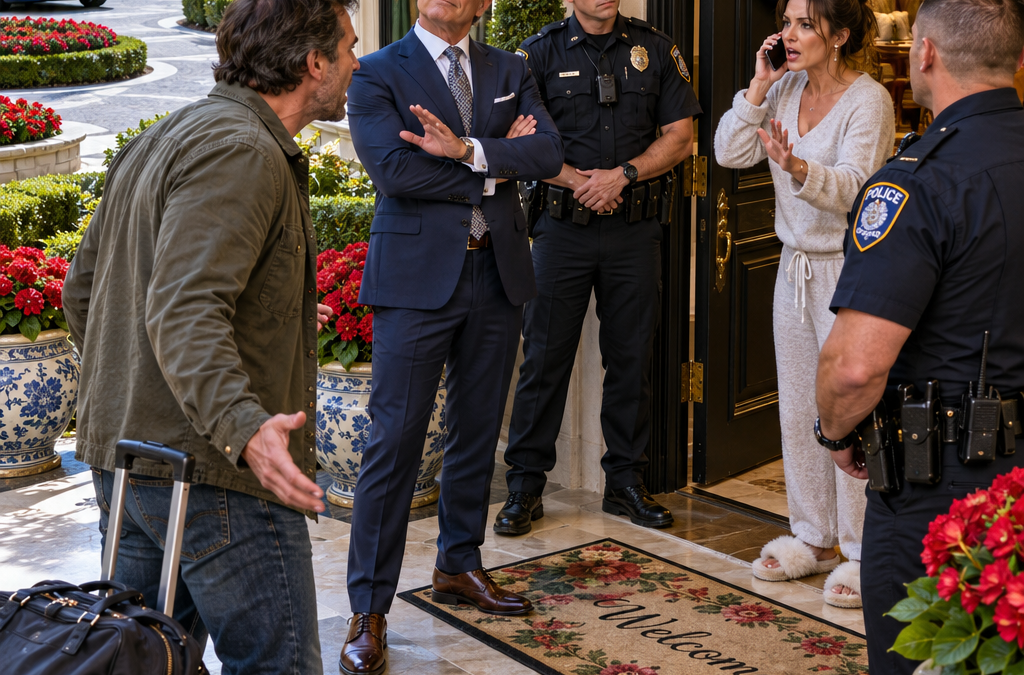
𝗙𝗨𝗟𝗟 𝗦𝗧𝗢𝗥𝗬
The grounds had been inspected.
The irrigation system was working.
The exterior lighting had been checked.
Nothing unusual had been reported.
I looked toward the house again.
Someone was moving behind the upstairs curtains.
A shadow crossed the window.
Then disappeared.
My chest tightened.
This wasn’t a contractor stopping by to inspect the landscaping.
Someone was inside.
I stepped out of the car.
The air was warm and still.
My shoes clicked against the stone driveway as I walked toward the front entrance.
I didn’t shout.
I didn’t run.
I didn’t even take out my keys immediately.
I wanted to understand what was happening before I did something that might make the situation worse.
Halfway up the front steps, I noticed another detail.
The small bronze sculpture that normally stood beside the entrance had been moved.
It was a simple abstract piece I’d purchased during a trip to Santa Fe.
I’d placed it there because it reminded me of my father.
Now it was sitting awkwardly beside one of the new flower pots.
That made the entire situation feel personal.
Someone hadn’t simply entered my home.
Someone had begun rearranging it.
I reached the front door.
Before I could knock, movement appeared behind the glass.
A woman stepped into view.
She looked to be in her late thirties, with shoulder-length brown hair and a pale pink blouse.
She held a coffee mug in one hand.
For a moment, we simply stared at each other through the glass.
Then her expression changed.
She looked alarmed.
Not guilty.
Not surprised.
Alarmed.
As though I were the intruder.
She lowered the mug.
“Can I help you?”
Her voice came through the glass.
I looked at her.
“Yes. Who are you?”
She frowned.
“Excuse me?”
“Who are you, and what are you doing in this house?”
Her eyes narrowed.
“Who are you?”
I almost laughed.
But there was nothing funny about the situation.
“I’m Michael Harrison.”
She stared at me.
The name meant something to her.
I saw it in the brief hesitation before she answered.
But she recovered quickly.
“Okay?”
“This is my house.”
Her expression hardened.
“No, it isn’t.”
For a second, I couldn’t speak.
I looked past her into the foyer.
The chandelier was the same.
The marble floor was the same.
But there was a narrow wooden table against the wall that I had never seen before.
A decorative bowl sat on top of it.
Someone had placed a framed photograph beside the staircase.
Not one of mine.
I looked back at the woman.
“Ma’am, I own this property. I’ve been away on business.”
She gave a short, nervous laugh.
“I don’t know what you’re talking about.”
“I’m asking you to open the door so we can clear this up.”
She immediately stepped backward.
“No.”
I raised both hands.
“All right.”
“You need to leave.”
I stared at her.
“Leave?”
“Yes.”
“From my own front steps?”
She reached for her phone.
“I don’t know who you are, and you’re making me uncomfortable.”
I took a slow breath.
“Then let’s call someone who can verify the ownership.”
She lifted her chin.
“I’m calling the police.”
I looked at her for several seconds.
Then I stepped backward.
“Go ahead.”
She seemed surprised.
Perhaps she’d expected me to become angry.
Perhaps she’d expected me to pound on the door.
But I had no intention of forcing my way into a house occupied by a woman who was now threatening to report me as a trespasser.
Even if that house belonged to me.
Especially then.
I understood how quickly a confrontation could become dangerous once someone started making accusations.
I walked down the steps and stopped near the edge of the driveway.
The woman watched me through the glass.
Then she lifted the phone to her ear.
I couldn’t hear every word.
But I heard enough.
“There’s a man outside.”
A pause.
“No, I don’t know him.”
Another pause.
“He’s claiming this is his house.”
She glanced toward me.
“Yes, he’s still here.”
Then she said something that made my blood run cold.
“I’m afraid he’s going to try to get inside.”
I stood motionless.
I hadn’t touched the door.
I hadn’t threatened her.
I hadn’t raised my voice.
Yet she was describing me to law enforcement as someone who might break into the property.
My property.
I turned away before my anger could show.
Then I walked back toward my car.
The driveway suddenly felt enormous.
I could hear birds moving through the oak trees.
A landscaper’s leaf blower hummed somewhere beyond the neighboring hedge.
Everything around me sounded ordinary.
But the reality of what was happening had begun settling into my chest.
A stranger was living in my home.
She had changed the furnishings.
She had unfamiliar vehicles parked in my driveway.
And now she was using the police to keep me outside.
I sat on the low stone wall beside the front garden.
Then I opened my phone again.
I didn’t call a friend.
I didn’t call my business manager.
I didn’t start posting angry messages.
I opened the folder containing my property documents and made sure each file was available without needing an internet connection.
The deed.
The purchase agreement.
The tax records.
The maintenance invoices.
The insurance information.
I also found the last photograph I’d taken of the front entrance before leaving.
The ivory curtains were clearly visible.
So was the original welcome mat.
The flower pots weren’t there.
Neither was the wreath.
I saved the photograph in a separate folder.
Then I took several pictures of the house as it looked now.
I photographed the unfamiliar vehicles.
The license plates.
The new decorations.
The altered windows.
I didn’t know what the police would need.
But I wasn’t going to rely on memory if the situation became more complicated.
While I was photographing the entrance, the front door opened.
The woman stepped onto the porch.
She had changed her expression completely.
She now looked offended.
“Why are you taking pictures?”
“Because this is my property.”
“I told you the police are coming.”
“I heard you.”
“You need to stop photographing me.”
“I’m documenting the condition of my house and the vehicles in my driveway.”
She crossed her arms.
“You really don’t know when to stop, do you?”
I lowered my phone.
“What’s your name?”
She hesitated.
“Rebecca.”
“Rebecca what?”
“That’s none of your business.”
“It is when you’re living inside my home.”
Her cheeks reddened.
“I’m authorized to be here.”
That was the first time she’d said anything about authorization.
I looked at her carefully.
“Authorized by whom?”
She glanced toward the street.
“People connected to the neighborhood.”
“Which people?”
“The homeowners association.”
I stared at her.
“Our HOA?”
“Yes.”
I looked toward the stone entrance gate.
The neighborhood was governed by Willowcrest Residential Association, a particularly strict HOA that seemed to consider every decorative shrub a matter of public policy.
I’d had minor disagreements with the board before.
A notice about the color of my exterior security cameras.
A complaint about a delivery truck remaining in my driveway too long.
An argument over whether a temporary contractor’s dumpster had been visible from the street.
Nothing serious.
Nothing that suggested the association believed it could authorize strangers to live inside privately owned homes.
“Rebecca,” I said, “the HOA doesn’t own this house.”
She gave me a tight smile.
“Maybe you should take that up with them.”
I felt a slow, cold anger spreading through me.
“That’s exactly what I intend to do.”
She looked away.
Then she said, “I’m not discussing this with you anymore.”
She walked inside.
The door closed.
I heard the lock engage.
I sat back down.
It had been less than twenty minutes since I arrived.
And already the situation had become more disturbing than anything I could have imagined.
If Rebecca was lying about the HOA, I wanted to know why.
If someone on the board had actually told her she could occupy my mansion, I wanted to know what made that person believe they had the right.
And if she’d somehow gained access through a maintenance arrangement, I needed to understand how my home’s security had been compromised.
Then another thought struck me.
My study.
There were personal files inside.
Business records.
Old family photographs.
Legal documents.
A collection of letters from my father that I kept in the lower drawer of my desk.
Things that could not simply be replaced with an insurance payment.
My pulse quickened.
I wanted to run up the steps, unlock the door, and check every room.
But I stayed where I was.
The woman had already called the police.
Any attempt to force entry now could turn the confrontation into something much worse.
I looked at the house again.
For eleven years, those walls had meant privacy.
Now I was sitting outside wondering what a stranger had done to the things inside them.
I heard the police before I saw them.
Two patrol cars entered through the front gate and moved slowly up the driveway.
The first stopped near the fountain.
The second parked behind my vehicle.
Their lights flashed briefly against the windows before switching off.
Three officers stepped out.
Two men and a woman.
The older male officer looked around the property before approaching.
His name badge read DANIELS.
The female officer remained near the second cruiser for a moment, looking toward the front entrance.
The third officer watched the driveway.
I stood.
“Afternoon, officers.”
Officer Daniels nodded.
“Good afternoon. Are you Michael?”
“Yes.”
He glanced toward the house.
“We received a call about an unknown individual attempting to enter the residence.”
I took a breath.
“That would be me.”
He studied my expression.
“Can you explain?”
“I own the house.”
He paused.
“All right.”
“I’ve been away on business for twenty-six days. When I returned, I found two unfamiliar vehicles in my driveway, different curtains, and a woman living inside who refuses to let me enter.”
Daniels looked toward the front door.
“Have you been inside since returning?”
“No.”
“Did you attempt to force the door?”
“No.”
“Any threats or physical contact?”
“None.”
He nodded.
“Okay. Let’s speak with everyone and find out what’s happening.”
Before he could ask another question, the front door opened.
Rebecca came outside.
She had clearly been waiting for the police.
Her posture was straight.
Her expression was carefully distressed.
“Officers, thank goodness.”
She walked quickly down the steps.
“That man has been standing outside my house insisting he owns it.”
Daniels raised one hand.
“Ma’am, let’s slow down.”
Rebecca pointed toward me.
“I don’t know him. I’ve never seen him before today.”
I looked at her.
Less than ten minutes earlier, she had acknowledged my name and claimed HOA authorization.
Now she was telling the police she’d never seen me and had no reason to believe I belonged there.
Daniels glanced between us.
“Ma’am, what’s your name?”
“Rebecca.”
“Rebecca, how long have you been staying at this address?”
She hesitated.
“A few weeks.”
“Do you own the property?”
She looked briefly toward the house.
“I’m living here.”
“That’s not what I asked.”
Her expression tightened.
“I have permission.”
“Permission from whom?”
“The neighborhood association.”
Daniels nodded slowly.
“Do you have documentation?”
Rebecca crossed her arms.
“I was told I could stay here.”
“By who?”
“Someone connected to the HOA.”
Daniels didn’t respond immediately.
He turned toward me.
“Sir, can I see your identification?”
“Of course.”
I removed my driver’s license from my wallet and handed it to him.
He examined it.
“Michael Harrison.”
“Yes.”
He looked at the address.
Then toward the mansion.
“This is your registered residence?”
“Yes.”
“Do you have proof of ownership available?”
I lifted my phone.
“I have the recorded deed, purchase records, and tax documents.”
“Let’s take a look.”
I opened the files.
Daniels studied the deed carefully.
He checked the address.
The parcel identification.
My full legal name.
Then he compared the information with my driver’s license.
The female officer, whose name was Ramirez, joined him.
She reviewed the digital records as well.
For several moments, nobody spoke.
Rebecca stood near the steps with her arms folded.
Her confident expression began to change.
Daniels looked up.
“These records identify you as the property owner.”
“Correct.”
“And you say you have not authorized anyone to stay here?”
“Absolutely not.”
Rebecca stepped forward.
“That doesn’t mean he can just show up and throw me out.”
I looked at her.
“Rebecca, I didn’t even know you existed until twenty minutes ago.”
Her cheeks reddened.
Daniels raised one hand.
“Everyone, please let me ask the questions.”
He turned toward Rebecca.
“Do you have a lease?”
“No.”
“A written occupancy agreement?”
“Not exactly.”
“Any document showing the property owner authorized you to stay?”
She hesitated.
“I was helping maintain the house.”
I stared at her.
“Maintain it?”
She looked at Daniels.
“The owner was away. The neighborhood needed someone to make sure the property was being looked after.”
I almost spoke.
Then stopped myself.
Because the more Rebecca explained, the stranger her story became.
Daniels looked toward the house.
“Who arranged that?”
Rebecca swallowed.
“The HOA.”
“Which representative?”
She hesitated again.
“I don’t remember his exact title.”
I felt my anger rise.
She remembered enough to claim permission.
But not enough to identify the person supposedly giving it.
Ramirez turned toward me.
“Mr. Harrison, did you hire a house sitter or property caretaker?”
“No.”
“Any family member authorized to let someone stay?”
“No.”
“Any property manager who might have arranged temporary occupancy?”
“Absolutely not.”
I looked toward the front door.
“I have an exterior maintenance company. They inspect the grounds, irrigation, and security equipment. They don’t live here, and they have no authority to let anyone else live here.”
Daniels nodded.
Then he asked something I hadn’t expected.
“Do you have your original house keys?”
I reached into my pocket.
“Yes.”
I removed the key ring.
The front-door key hung beside the garage access key and a small brass tag.
I’d carried that ring for years.
I held it out.
Daniels examined it.
“Have you ever surrendered possession of these keys to Rebecca?”
“No.”
“Have you given the HOA permission to distribute copies?”
“No.”
Rebecca looked away.
The officer returned the keys.
Then he turned toward her.
“How did you get access to the house?”
She looked toward the garden.
“I was given a way to enter.”
“By who?”
“Someone from maintenance.”
“Name?”
“I don’t remember.”
Daniels studied her.
“Rebecca, I need you to be specific.”
Her voice became defensive.
“Why are you treating me like I’ve done something wrong? I’ve been taking care of this property.”
I looked toward the new flower pots.
“And apparently redecorating it.”
She glared at me.
Daniels stepped between us slightly.
“Mr. Harrison, please.”
I nodded.
“You’re right.”
I took a slow breath.
My pulse was pounding.
The longer this continued, the more difficult it became to remain calm.
But I knew the documents were on my side.
The officers were asking questions.
And every answer Rebecca gave seemed to make her situation worse.
Daniels looked toward the house.
“Let’s establish a few basic facts.”
He turned to me.
“How long have you owned this residence?”
“Eleven years.”
“Did you purchase it directly?”
“Yes.”
“Do you have the purchase documents?”
“I do.”
“Have you maintained the property during your absence?”
“Yes. My exterior maintenance company conducts regular inspections.”
“And when did you last leave?”
“Twenty-six days ago.”
He made a note.
Then he looked at Rebecca.
“How long have you been staying here?”
She hesitated.
“About three weeks.”
I felt my stomach tighten.
Three weeks.
That meant she’d moved in only a few days after I left.
Not after months of vacancy.
Not after anyone could reasonably believe the property had been abandoned.
Just days.
Daniels noticed my expression.
“Mr. Harrison?”
I looked at him.
“She moved in almost immediately after I left.”
Rebecca crossed her arms.
“I was told the house would be empty.”
The words came out before she seemed to realize what she’d admitted.
Ramirez looked at her.
“Who told you that?”
Rebecca went quiet.
Daniels waited.
“Rebecca?”
She swallowed.
“I don’t want to get anyone in trouble.”
The officer’s tone remained even.
“We need to understand how you came to occupy this property.”
She looked toward the front door.
Then toward the driveway.
Finally, she said, “Someone connected to the neighborhood told me the owner was away and that the place needed looking after.”
I stared at her.
She had known the owner was away.
She had entered anyway.
And now she was trying to describe living inside my house as a form of maintenance.
Daniels turned toward me.
“Mr. Harrison, I want to ask you some questions about the interior.”
“Go ahead.”
“Can you describe the main living room?”
I almost laughed.
Not because it was funny.
Because the question was so simple compared with what I was feeling.
“The front entrance opens into a two-story foyer with cream marble flooring. There’s a staircase on the left and a hallway leading toward the formal dining room.”
Daniels nodded.
I continued.
“The living room is straight ahead. It has a limestone fireplace on the north wall, two gray sofas facing each other, and a large abstract painting above the mantel.”
I paused.
“The painting has a narrow black frame. There’s a small scratch on the lower right corner because the installer dropped it when I first moved in.”
Ramirez made a note.
“And the kitchen?”
“Through the western hallway. White cabinets, dark granite countertops, and a copper range hood. The center island has three pendant lights. The middle one hangs slightly lower than the others.”
Daniels looked toward Rebecca.
“Does that sound accurate?”
She shifted.
“Mostly.”
“Mostly?”
“He’s probably seen pictures online.”
I stared at her.
“Pictures online?”
Rebecca lifted her chin.
“This is a large house. There are probably real estate photographs somewhere.”
That was a fair possibility in the abstract.
But I hadn’t finished.
I looked toward Daniels.
“Would you like details that weren’t in the listing?”
He nodded.
“Go ahead.”
“There’s a hidden storage compartment behind the left panel in the study. It was built during the renovation. The lower drawer of my desk has a false bottom where I keep family letters and older records.”
Rebecca looked at me sharply.
I continued.
“The upstairs master bathroom has a small crack in the marble beside the second sink. I never replaced the tile because the crack doesn’t affect anything.”
Ramirez looked at Rebecca.
“Can you confirm those details?”
Rebecca hesitated.
“I haven’t gone into every room.”
I felt a fresh wave of anger.
She had claimed to be maintaining the mansion.
Living there for weeks.
Yet she was suddenly unsure about the layout.
Daniels looked toward me.
“Any identifying personal possessions?”
“Photographs in the upstairs hallway. My father’s military service portrait. A picture of my mother standing in front of our first house. My college graduation photograph.”
I swallowed.
“And a framed picture of my grandparents on the small table near the library.”
Those weren’t simply decorations.
They were pieces of my life.
Hearing myself describe them to officers while a stranger stood on my porch made the entire situation feel unreal.
Ramirez nodded.
“Thank you.”
Then she glanced toward the open front door.
Several envelopes were visible on the decorative table in the foyer.
She pointed.
“Whose mail is that?”
Rebecca turned.
For the first time, I saw genuine panic cross her face.
The envelopes were stacked beside the unfamiliar wooden bowl.
Daniels asked Rebecca whether the officers could examine the visible addressee information without disturbing anything else.
She hesitated, then agreed.
Ramirez stepped just inside the doorway.
She looked at the top envelope.
Then the next.
“Michael Harrison,” she read.
My name.
My address.
My mail.
There was a thick envelope from my insurance company.
A utility statement.
A business correspondence envelope.
All addressed to me.
Ramirez looked toward Rebecca.
“Have you been collecting this mail?”
Rebecca nodded reluctantly.
“I brought it inside so it wouldn’t pile up.”
“Did the owner authorize you to handle it?”
“No, but I was helping.”
I felt something tighten painfully in my chest.
Those envelopes contained information about my finances and property.
I had no idea whether Rebecca had opened anything.
I had no idea whether she had moved documents from my study.
I had no idea what she’d touched.
For eleven years, I’d treated the mansion as the one place where I didn’t have to worry about who had access to my life.
Now I couldn’t even be certain my mail had remained private.
Daniels turned toward Rebecca.
“You understand why we need a clear explanation of your authority to occupy this property?”
She looked down.
“I’m not a criminal.”
“No one is making that determination right now,” he replied. “We’re trying to establish the facts.”
Rebecca looked toward me.
Then she said something that changed the entire direction of the conversation.
“Ask Mr. Mercer.”
I looked up.
“What?”
She folded her arms.
“David Mercer. He’s on the HOA board. He knows about the arrangement.”
I recognized the name immediately.
David Mercer was the association’s treasurer.
A quiet man in his late fifties who lived near the western end of Willowcrest.
I’d spoken with him at two neighborhood meetings.
He was organized, reserved, and rarely interested in the dramatic arguments that sometimes consumed the HOA.
As far as I knew, he had no role in managing private residences.
Daniels made a note.
“David Mercer?”
Rebecca nodded quickly.
“Yes.”
“And he authorized you to stay?”
“He knew I was helping with the house.”
“Did he give you permission?”
She hesitated.
“He told me arrangements could be made.”
I looked at Daniels.
“Officer, I know David Mercer. He has no authority to give someone possession of my home.”
Daniels nodded.
“Then we’ll speak with him.”
Rebecca’s expression changed.
She looked toward the street.
Then back at the officers.
“Is that really necessary?”
Daniels studied her.
“You identified him as the person connected to your authorization.”
“I said he knew about it.”
“Then we’ll ask him.”
She opened her mouth.
Then closed it.
The officers stepped aside to make the call.
I remained near the driveway.
For the first time since arriving, I felt a faint possibility that the situation might finally become understandable.
Someone had used the HOA’s name.
Someone had entered my home.
And Rebecca had now identified a specific board member who could confirm or deny her story.
I looked toward the mansion.
Through the open door, I could see the unfamiliar table in the foyer.
Behind it, my staircase rose toward the upper floor.
The house looked exactly like home.
And nothing like home.
I wondered how many nights Rebecca had slept there.
Whether she’d used my kitchen.
Whether she’d opened my closets.
Whether she’d invited anyone else inside.
The second vehicle bothered me.
The silver SUV.
Who did it belong to?
Was someone else staying there?
I glanced toward Daniels.
He was speaking quietly on the phone.
Ramirez remained near Rebecca.
The third officer was checking information from the patrol car.
Everything was calm.
Professional.
Controlled.
But inside, I felt as though my entire life had been opened and rearranged without my consent.
Then I heard another engine.
A black luxury SUV entered the driveway.
It moved slowly past the police vehicles and stopped near the fountain.
The door opened.
A man stepped out.
He was about fifty, with carefully styled silver-black hair, a tailored navy suit, a white shirt, and a dark burgundy tie.
His shoes were polished to a mirror finish.
An expensive watch flashed beneath his cuff.
Even before he introduced himself, I recognized him.
Preston Whitcomb.
President of the Willowcrest Residential Association.
Whitcomb was the kind of man who could turn a discussion about lawn maintenance into a lecture on respect for authority.
He spoke slowly when he wanted someone to feel foolish.
He dressed as though every HOA meeting were a corporate board presentation.
And he treated the neighborhood’s rules like personal commandments.
He wasn’t physically threatening.
He didn’t need to be.
He used his title, reputation, and connections to make people feel that disagreeing with him was dangerous.
Another HOA representative, association secretary Elaine Porter, stepped out from the passenger side.
Whitcomb surveyed the police cars.
Then the house.
Then me.
His expression hardened.
“Michael.”
“Preston.”
He looked toward Rebecca.
Then back at me.
“What on earth is going on here?”
I took a breath.
“I came home and found a stranger living in my house.”
Whitcomb glanced at the officers.
“That’s a serious accusation.”
“It’s also what happened.”
He adjusted his cuffs.
“Let’s not jump to conclusions.”
I stared at him.
“Preston, I’m standing outside my own mansion while a woman I’ve never met claims the HOA gave her permission to live here.”
He looked sharply toward Rebecca.
“Who told you that?”
Rebecca seemed suddenly relieved to see him.
“Mr. Whitcomb, thank goodness. This man has been harassing me since he arrived.”
I felt my jaw tighten.
Whitcomb looked at me.
“Michael, why didn’t you contact the association before creating a disturbance?”
For a moment, I couldn’t believe what I’d heard.
“Creating a disturbance?”
“Police cars at a private residence are not exactly good for community confidence.”
I looked toward the officers.
Then back at him.
“Rebecca called them.”
Whitcomb hesitated.
Rebecca looked away.
I continued.
“I didn’t call the police. I didn’t force the door. I didn’t threaten anyone. I came home.”
Whitcomb adjusted his jacket.
“Regardless, there are procedures for handling occupancy disagreements.”
“Occupancy disagreements?”
“Yes.”
“Preston, a stranger moved into my mansion while I was out of town.”
His voice hardened.
“Lower your tone.”
I stared at him.
There it was.
The same authoritarian certainty I remembered from association meetings.
He wasn’t listening.
He was managing.
Or trying to.
“Don’t tell me to lower my tone while I’m standing outside my own home.”
Whitcomb stepped closer.
“You’re speaking to the president of this association.”
I looked at him steadily.
“And you’re standing on property I own.”
His face reddened.
“Do you understand how serious it is to accuse another resident of unlawful occupancy?”
“Do you understand how serious it is for the HOA to be named as the source of permission to occupy my home?”
He looked toward Rebecca.
For the first time, uncertainty crossed his face.
Then he recovered.
“We’ll establish what happened.”
“That’s what the officers are doing.”
Whitcomb’s expression tightened.
He clearly disliked being reminded that his authority was not the highest one present.
He turned toward Daniels.
“Officer, Preston Whitcomb. HOA president. I oversee this community.”
Daniels nodded.
“Good afternoon.”
Whitcomb gestured toward the house.
“I’d prefer we resolve this with minimal disruption. We have standards here, and public confrontations aren’t helpful.”
Daniels looked at him.
“We’re reviewing an ownership and occupancy complaint.”
“Of course. But I would appreciate being kept informed before any action is taken.”
Daniels remained calm.
“We’ll speak with the relevant parties as appropriate.”
Whitcomb’s smile became strained.
He wasn’t used to receiving answers that didn’t promise compliance.
Then Daniels’s phone conversation ended.
He walked back toward us.
Rebecca immediately straightened.
The officer looked at her.
“Rebecca, we spoke with David Mercer.”
She swallowed.
“Okay.”
“He confirms he’s on the HOA board.”
“Yes.”
“But he says he never authorized you to live at this property.”
Rebecca’s face went pale.
For several seconds, she said nothing.
Daniels continued.
“He also says he has no knowledge of any board approval for you to occupy the residence.”
Whitcomb turned toward her.
“What?”
Rebecca looked between the officers.
“That’s not exactly what happened.”
Daniels remained patient.
“Then explain what happened.”
She looked toward the house.
“I was told the place needed maintenance.”
“By whom?”
“Someone connected to the neighborhood.”
“Who?”
She hesitated.
“I don’t remember.”
Whitcomb’s face reddened.
“Rebecca, did you tell these officers the HOA authorized you to live here?”
She looked at him.
“I said I was helping look after the property.”
“Did you tell them the board approved it?”
She didn’t answer.
Whitcomb took a step closer.
“Rebecca.”
Daniels raised one hand.
“Mr. Whitcomb, please let her answer without pressure.”
Whitcomb stopped.
His jaw was tight.
Rebecca stared at the driveway.
Then she said quietly, “I thought there was an arrangement.”
I felt my stomach twist.
“An arrangement with whom?”
She didn’t look at me.
Daniels asked the same question.
Rebecca remained silent.
Then Elaine Porter, the HOA secretary, spoke.
“Mr. Harrison never submitted an occupancy authorization to the association.”
Everyone turned toward her.
She held a tablet against her chest.
“I checked our records on the way here. There’s no approved caretaker arrangement for this address.”
Whitcomb looked sharply at her.
“Elaine, we should discuss internal records privately.”
She shook her head.
“Preston, she’s claiming we authorized her to live in somebody else’s house.”
The words cut through the tension.
Whitcomb fell silent.
Elaine continued.
“We don’t own the residence. We don’t lease it. We don’t manage its occupancy. We have no authority to give anyone permission to stay here.”
I looked at her.
For the first time since arriving, someone from the HOA had said exactly what should have been obvious from the beginning.
Whitcomb adjusted his tie.
“Of course the association doesn’t own private residences.”
I stared at him.
“Then why were you lecturing me about an occupancy disagreement?”
His eyes narrowed.
“Michael, this isn’t the time.”
“Actually, Preston, this is exactly the time.”
The officers watched us carefully.
I kept my voice controlled.
“You arrived and immediately treated me like the problem. You asked why I hadn’t contacted the HOA before creating a disturbance.”
Whitcomb opened his mouth.
I continued.
“I’d been gone twenty-six days. I came home. There were strangers’ cars in my driveway, someone had changed my curtains, and a woman I’d never met was living in my house.”
I pointed toward the front entrance.
“She called the police on me.”
Whitcomb looked uncomfortable.
“And your first response was to tell me to lower my voice because you’re the HOA president.”
He said nothing.
I stepped closer.
“This association doesn’t get to decide who lives in my house.”
Whitcomb’s jaw tightened.
“I never said it did.”
“Then stop acting like your title matters more than my deed.”
For several seconds, we stared at each other.
Then Daniels stepped forward.
“Everyone, let’s focus on resolving the occupancy situation safely.”
I nodded.
“Of course.”
Whitcomb looked away.
The officer turned toward Rebecca.
“We need to understand how you entered this property.”
Rebecca’s eyes filled with tears.
For a moment, I felt the uncomfortable pull of sympathy.
She looked frightened.
But I reminded myself of the facts.
She had moved into a stranger’s home.
Changed the furnishings.
Handled the owner’s mail.
And called the police when he returned.
Her fear didn’t erase what she’d done.
Daniels continued.
“You told us the HOA authorized your presence. The board member you identified denies that. The association secretary confirms there’s no recorded authorization.”
Rebecca wiped her eyes.
“I wasn’t trying to hurt anyone.”
“Then tell us what happened.”
She looked at the house.
Finally, her shoulders sagged.
“I knew the place was empty.”
My stomach tightened.
“How?”
She hesitated.
“I heard the owner was traveling.”
“From whom?” Ramirez asked.
Rebecca shook her head.
“People talk.”
Daniels remained silent.
After a few seconds, Rebecca continued.
“There was a maintenance access arrangement. I was told the place needed checking.”
Elaine frowned.
“What maintenance arrangement?”
Rebecca looked uncomfortable.
“I got access through a key that was kept for service work.”
I felt a cold sensation move through my chest.
A service key.
I knew the exterior maintenance company had controlled access for limited work.
But that access was never supposed to become permission to occupy the house.
Daniels asked her to clarify where the key had come from.
Her explanation became hesitant and fragmented.
She referred to an old service lockbox and someone who had told her the property was vacant.
She couldn’t identify a person with authority from me.
She couldn’t produce a lease.
She couldn’t produce a written agreement.
And she couldn’t explain why a caretaker needed to replace curtains, bring in furniture, and occupy the bedrooms.
Ramirez asked her directly.
“Did Mr. Harrison give you permission to live here?”
Rebecca shook her head.
“No.”
The admission was quiet.
But I heard every word.
Daniels wrote something in his notebook.
Then he turned toward me.
“Mr. Harrison, do you recognize this access arrangement?”
I took a slow breath.
“My maintenance contractors have had limited access for exterior work and emergencies. I never authorized them to let anyone occupy the property.”
He nodded.
“Do you know whether the service key was copied or improperly shared?”
“No. That’s something I’ll need to investigate.”
“Understood.”
Whitcomb stood beside Elaine, looking increasingly uncomfortable.
The story he’d tried to manage had become a matter of concrete facts.
Rebecca had entered without my consent.
The HOA representative she’d named had denied granting permission.
The association itself had no record of authorizing her presence.
My identification matched the deed.
My purchase and tax documents matched the address.
And the keys in my pocket had never been surrendered.
There was no longer any reasonable basis for treating me as an unknown man trying to invade someone else’s home.
But there was still a practical problem.
Rebecca had been living there for weeks.
Her belongings were inside.
Her vehicles were in my driveway.
And I still couldn’t enter my own house.
Daniels looked toward her.
“Rebecca, do you understand that Mr. Harrison is the documented owner and says he never authorized your occupancy?”
She nodded reluctantly.
“Yes.”
“Do you have any independent legal basis for remaining here?”
She shook her head.
“I don’t have paperwork.”
The officer paused.
“All right. We need to handle the next steps appropriately. We’re not going to create a physical confrontation.”
I nodded.
I knew this was important.
Property disputes could become complicated when someone had occupied a residence for an extended period.
I wasn’t asking the officers to ignore legal procedures.
I simply wanted my home back.
Daniels spoke with Rebecca for several minutes.
He explained that the officers would document the circumstances and that any criminal or civil issues would have to be handled according to the applicable law.
Then he asked whether she would agree to leave voluntarily rather than continue claiming permission she couldn’t support.
Rebecca looked toward the house.
Tears ran down her face.
“Where am I supposed to go?”
I felt a sharp ache behind my ribs.
I didn’t know her circumstances.
Maybe she had nowhere stable to stay.
Maybe someone had misled her.
Maybe she’d seen an opportunity and taken it.
I couldn’t know all of that from the driveway.
But I knew one thing.
Her problems didn’t give her the right to make my home hers.
Daniels spoke calmly.
“We can allow you a reasonable opportunity to collect your personal belongings while the situation is documented and everyone remains separated.”
Rebecca nodded slowly.
“Okay.”
I exhaled.
For the first time that afternoon, I felt the possibility of getting my house back.
But I still didn’t move toward the entrance.
I waited.
Ramirez asked Rebecca to identify any other people staying there.
Rebecca said no one else was currently inside.
The silver SUV belonged to someone who had helped her move belongings.
That person was contacted to collect the vehicle and assist her.
The officers completed the appropriate checks to confirm nobody was being overlooked.
No one shouted.
No one was dragged out.
No one attempted to turn the property into a scene for the neighbors.
The officers maintained control of the situation while Rebecca collected what belonged to her.
I remained outside.
I had been waiting nearly two hours to enter my own house.
Now another thirty minutes passed.
Then another.
I watched through the open doorway as Rebecca carried bags and boxes toward the driveway.
A rolling suitcase.
Two cardboard boxes.
A laundry basket filled with clothes.
Several framed photographs.
A small decorative lamp.
I recognized none of it.
Each trip made me more aware of how thoroughly she’d settled into my home.
This hadn’t been a quick visit.
She had moved in.
She had unpacked.
She had decorated.
She had made herself comfortable enough to challenge the real owner when he returned.
Whitcomb remained near his SUV.
Elaine stood a few feet away, speaking quietly on the phone.
Eventually, Whitcomb approached me.
“Michael.”
I looked at him.
“What?”
He hesitated.
“I want you to understand that the association was unaware of this arrangement.”
“Then why did Rebecca think she could use your name?”
“That’s something we’ll need to determine.”
I studied his face.
For once, he wasn’t giving orders.
He was carefully choosing words.
“Your board has access to my contact information,” I said.
“Of course.”
“My phone number. My email. My emergency contact information.”
“Yes.”
“So if someone approached the association claiming they needed to enter my home, why didn’t anyone call me?”
Whitcomb adjusted his cuffs.
“We’re still establishing whether anyone was approached.”
“Then establish it.”
His jaw tightened.
I continued.
“Because this isn’t a landscaping violation, Preston. Someone occupied my house for weeks.”
He looked toward the entrance.
“I understand.”
“I’m not sure you do.”
He looked back.
“Michael—”
“No. Listen.”
My voice was quiet.
But I could feel the anger beneath it.
“I’ve spent eleven years paying for this property. Maintaining it. Securing it. Keeping it in good condition. I left for twenty-six days to handle business.”
I looked toward the mansion.
“And I came back to a stranger standing behind my own front door telling the police I didn’t belong there.”
Whitcomb said nothing.
“Then you arrived and treated me as though I needed your permission to object.”
His expression changed.
“I was trying to keep the situation from escalating.”
“By telling the owner to lower his voice?”
He looked away.
For several seconds, neither of us spoke.
Then Elaine approached.
“Mr. Harrison.”
I turned.
She looked genuinely distressed.
“I want to apologize for how this has been handled.”
Whitcomb glanced at her.
She continued anyway.
“The HOA has no authority to assign your residence to anyone. Our records do not show permission being granted, and we will cooperate with the officers and any appropriate follow-up.”
I nodded.
“Thank you.”
She looked toward the house.
“I can’t imagine what it feels like to come home to this.”
I swallowed.
“Neither could I. Until today.”
Whitcomb stood beside her in silence.
The woman who had lived inside my home was still carrying boxes through the front door.
The officers were documenting the process.
And the HOA president, who had arrived ready to lecture me about community standards, now seemed unable to find a single rule that could make this situation acceptable.
That was the moment I realized how different the truth looked once authority was stripped of its performance.
Whitcomb had a title.
Rebecca had a story.
I had a deed.
And the officers had taken the time to establish what the evidence actually supported.
The process wasn’t finished yet.
But the balance had changed.
About forty minutes later, Rebecca carried out her final suitcase.
Her eyes were red.
She looked exhausted.
She paused near the foot of the steps.
For a moment, I thought she might walk directly to her car.
Instead, she turned toward me.
“Michael.”
I looked at her.
She hesitated.
“I’m sorry.”
I didn’t answer immediately.
Her voice was barely above a whisper.
“I shouldn’t have stayed here.”
I watched her carefully.
“You shouldn’t have entered without permission.”
She lowered her eyes.
“I know.”
I thought about asking why she’d chosen my house.
Why she’d moved in so quickly after I left.
Why she’d changed the curtains.
Why she’d handled my mail.
Why she’d called the police and accused me of being a stranger.
But there was no answer she could give that would restore the feeling I’d had when I drove away twenty-six days earlier.
I looked toward the front door.
“Did you take anything that belonged to me?”
She shook her head.
“No.”
“Did you open my personal files?”
“No.”
I didn’t know whether to believe her.
That uncertainty hurt more than I expected.
I nodded once.
“The officers will document everything. If I find anything missing or damaged, I’ll address it through the proper process.”
She looked up.
“Okay.”
Then she walked toward the blue sedan.
The silver SUV was moved shortly afterward.
The driveway slowly emptied.
For the first time since I’d arrived, the two unfamiliar vehicles were no longer blocking the view of my front entrance.
The house looked larger without them.
Quieter.
But I still didn’t feel completely safe.
Officer Daniels approached.
“Mr. Harrison.”
I turned.
“Yes?”
“Rebecca has voluntarily left the residence, and we’ve documented the information provided by both parties. The remaining legal questions, if any, will be handled through the appropriate channels.”
I nodded.
“Thank you.”
He looked toward the house.
“I recommend documenting the interior condition before making major changes, and contacting your insurer or attorney if you discover missing property or damage.”
“I intend to.”
“You should also review how access was obtained.”
“I will.”
He handed me the incident information.
I looked at the reference number.
A simple string of digits.
A record of one of the strangest afternoons of my life.
Daniels extended his hand.
“You handled a difficult situation calmly.”
I shook it.
“I didn’t feel calm.”
He gave a small nod.
“Most people wouldn’t.”
Then he stepped aside.
For the first time in nearly three hours, I walked toward my front door knowing no one was going to stop me.
I climbed the steps slowly.
The unfamiliar flower pots stood on either side.
The wreath still hung on the door.
I took out my original key.
For a moment, I simply held it.
The brass was worn at the edges.
I’d carried it on the same ring for years.
I slipped it into the lock.
It turned.
The familiar mechanical click made something tighten in my throat.
I pushed the door open.
And stepped inside.
The smell hit me first.
Not dirt.
Not mold.
Not anything obviously unpleasant.
Perfume.
Scented candles.
A floral air freshener.
My house had always smelled faintly of wood polish, clean linen, and the cedar panels in the study.
Now it smelled like someone else’s home.
I stood in the foyer.
The marble floor was the same.
The chandelier was the same.
The staircase curved upward exactly as it always had.
But almost everything else felt wrong.
The unfamiliar table stood against the wall.
The decorative bowl contained keys and small personal objects that apparently belonged to Rebecca.
The photographs on the table had been removed during her departure, leaving pale rectangles where they had rested.
My bronze sculpture was no longer in its original location.
The ivory curtains had been replaced.
The new dark green ones made the rooms feel heavier.
Smaller.
I heard footsteps behind me.
Officer Ramirez remained near the entrance long enough to complete the final documentation.
I looked toward the living room.
One of my gray sofas had been moved against the wall.
A white armchair I didn’t recognize sat beside the fireplace.
The coffee table had been replaced with a round glass one.
A large decorative mirror hung where my abstract painting had been.
For several seconds, I couldn’t speak.
The home I’d built over eleven years had been rearranged in less than a month.
I walked toward the fireplace.
My painting was gone from the mantel wall.
I turned slowly.
Then I saw it leaning against the far wall behind a tall decorative plant.
My chest tightened.
I approached carefully.
The frame was intact.
The old scratch remained at the lower corner.
I touched the edge.
It wasn’t just a painting.
I’d bought it during a trip with my father, shortly before he died.
He’d hated abstract art.
He had stood in the gallery staring at it for several minutes before asking whether the artist had run out of ideas halfway through.
I’d laughed so hard that the gallery owner looked offended.
I bought it partly because I liked it.
Mostly because I knew the story would make me smile every time I saw it.
Now it had been removed from the wall of my own living room to make space for a stranger’s mirror.
I felt a sudden pressure behind my eyes.
Anger.
Grief.
Violation.
All of it at once.
I took out my phone and photographed the room.
Then the painting.
Then the furniture.
I photographed every visible change before touching anything.
I moved through the dining room.
The kitchen.
The library.
The upstairs hallway.
The guest bedrooms.
Each room carried evidence that someone had been living there.
A different tablecloth.
Unfamiliar bedding.
Decorations I hadn’t purchased.
Kitchen utensils moved to new drawers.
Several of my possessions placed in storage boxes.
Nothing about it felt temporary.
Rebecca hadn’t behaved like someone performing maintenance.
She had behaved like someone settling into a house she expected to keep.
The master bedroom was the hardest room to enter.
I stood at the doorway for several seconds before walking inside.
The bedspread had been changed.
The pillows were arranged differently.
A small lamp sat on the nightstand.
My own bedside clock had been moved.
I stared at the bed.
The room suddenly felt exposed in a way I couldn’t explain.
A stranger had slept there.
Opened the drawers.
Used the bathroom.
Moved through a space that I had always considered entirely private.
I took photographs.
Then I stepped back into the hallway.
I needed a moment before going into the study.
That room contained the things I cared about most.
The business files were important.
But the family records mattered more.
I walked downstairs.
The study door was closed.
I turned the handle.
Inside, the room looked almost normal.
The desk was where I’d left it.
The bookshelves were untouched.
The leather chair sat behind the desk.
For the first time that afternoon, I felt something loosen in my chest.
Then I noticed the desk drawers.
One was slightly open.
I approached.
Inside were the folders I remembered.
Business correspondence.
Property records.
Old photographs.
The lower drawer was closed.
I unlocked it.
Lifted the false bottom.
The letters from my father were still there.
I stood motionless, holding the first envelope.
His handwriting was unmistakable.
I’d kept those letters for years.
Some were written when I was away at college.
Others came during the early days of my business career.
He had never been especially comfortable expressing emotion face-to-face.
But in letters, he could be surprisingly open.
I sat slowly in the chair.
For a few seconds, I forgot about the officers.
The HOA.
Rebecca.
The unfamiliar furniture.
I looked at the handwriting.
Then I folded the letter and returned it to the drawer.
I wasn’t ready to read it.
I was simply grateful it was still there.
I continued photographing the study.
Then I returned to the foyer.
The police had completed their checks and were preparing to leave.
Elaine Porter stood near the entrance, looking uncomfortable.
Whitcomb remained several steps behind her.
I looked at the HOA president.
He glanced around the foyer.
For the first time, I saw something resembling embarrassment cross his face.
He had spent years enforcing community rules about landscaping, parking, and architectural details.
Yet he was now standing inside a home that a stranger had occupied without the owner’s permission.
And no rule in his thick HOA handbook had prevented it.
“Michael,” he began.
I looked at him.
“What?”
He hesitated.
“The association will cooperate with whatever review is necessary.”
I nodded.
“It should.”
He glanced toward the unfamiliar table.
“We’ll also examine whether any maintenance access procedures need revision.”
“Good.”
His expression tightened slightly.
“I hope you understand that we weren’t aware of this situation.”
I looked around the foyer.
“Preston, I don’t need another speech about what the association intended.”
He stopped.
“I need to know how someone entered my house, why the HOA’s name was used, and whether any security arrangements were compromised.”
He nodded stiffly.
“Understood.”
I looked toward Elaine.
“Please have the association preserve any relevant communications, access records, and maintenance information.”
She nodded immediately.
“We will.”
I turned back to Whitcomb.
“And from now on, if anyone associated with the HOA believes something needs to be done inside my property, they contact me directly. Nobody gets permission from a board member to live here. Nobody enters my residence without lawful authority or my consent.”
Whitcomb looked offended for a moment.
Then he seemed to reconsider.
“Agreed.”
I stepped toward the front door.
The conversation was over.
Whitcomb looked at me for several seconds.
Then he walked outside.
Elaine followed him.
I watched them return to the black SUV.
There were no grand apologies.
No dramatic confrontation.
No threats.
Just the quiet discomfort of two association representatives who had arrived expecting to manage a neighborhood complaint and discovered something far more serious.
The officers left shortly afterward.
The driveway emptied.
Their engines faded beyond the gate.
Then the property became still.
I stood alone in the foyer.
The front door remained open.
Warm evening air moved through the entrance.
For the first time since arriving home, there was no one demanding that I explain myself.
No one calling me a stranger.
No one threatening the police.
No one telling me the HOA needed to be consulted before I could enter.
It was my house again.
At least legally.
Emotionally, I wasn’t there yet.
I closed the door.
Then leaned against it.
My shoulders felt heavy.
I had spent weeks making decisions in conference rooms, negotiating contracts, and dealing with people who wanted something from me.
I had flown home believing I was finally returning to the one place where I didn’t have to negotiate my right to exist.
Instead, I’d spent an afternoon proving that I belonged in my own house.
The exhaustion settled over me all at once.
I walked into the living room and sat on the edge of the sofa.
The unfamiliar scent still lingered.
The curtains were still wrong.
The furniture was still out of place.
I looked toward the empty wall above the fireplace.
For a moment, I wanted to rip everything down.
Throw out the strange decorations.
Drag the furniture back into place.
Erase every sign that Rebecca had been there.
But I stopped myself.
I needed a complete record.
The insurance company might require photographs.
An attorney might need to review the incident.
If something was missing, I wanted to know exactly what had changed.
So I stood again.
And continued documenting the house.
By early evening, I had photographs of every room.
The kitchen drawers.
The closets.
The storage areas.
The garage.
The guest bedrooms.
The study.
The front entrance.
The vehicles had already been photographed before they left.
I made a written list of anything that appeared moved, replaced, or missing.
I didn’t assume theft simply because an object wasn’t where I remembered leaving it.
But I didn’t ignore the possibility either.
I separated confirmed facts from questions.
What I knew.
What I needed to check.
What required professional help.
It was the same discipline I used in business when a problem became complicated.
Except this wasn’t a commercial transaction.
It was my home.
That night, I contacted a locksmith and arranged for the exterior locks to be changed as soon as practical.
I also contacted the security company that managed the alarm and gate system.
I explained what had happened.
The technician asked several questions.
Were there signs of forced entry?
Had any access codes been shared?
Were any service credentials still active?
Did I know whether the interior alarm had been armed when I left?
I answered what I could.
Then I asked for a complete access audit.
Every key code.
Every temporary credential.
Every service entry method.
Everything.
I also requested that any compromised credentials be disabled and that the system be reviewed for unauthorized changes.
The technician agreed.
When the call ended, I looked toward the front gate.
For years, I’d assumed the combination of cameras, locks, and professional maintenance arrangements was enough.
Now I understood that every access system was only as reliable as the people responsible for controlling it.
A locked door didn’t help if someone improperly obtained a key.
A security code didn’t protect anything if it was shared carelessly.
And a gated community didn’t guarantee that everyone inside respected private ownership.
The following morning, the locksmith arrived.
I watched him remove the front-door hardware.
Small metal pieces were laid carefully on a cloth.
New cylinders were installed.
The side entrances were rekeyed.
The garage access was checked.
I kept the old hardware until I was satisfied it was no longer needed for documentation.
Then the security technician arrived.
We reviewed the gate system.
The service access procedures.
The alarm settings.
The camera coverage.
He explained several improvements that would reduce the risk of unauthorized entry in the future.
I approved the changes.
Temporary access credentials would be issued only for specific jobs.
Service entry methods would be reviewed and monitored.
No contractor would receive broader access than necessary.
And any future maintenance visit would require an authorization process I could verify.
It felt strange spending an entire morning repairing security at a mansion I’d owned for eleven years.
But the work helped.
Each new lock.
Each reviewed credential.
Each corrected access procedure.
They were small steps toward making the property feel like mine again.
Later that afternoon, I met with my attorney.
I gave her the incident number.
The photographs.
The ownership documents.
The notes I’d made.
The information about the claimed HOA authorization.
And the statements Rebecca had made in front of the officers.
My attorney reviewed everything carefully.
Then she looked at me.
“Do you want to pursue every available remedy?”
I considered the question.
I thought about Rebecca’s frightened expression.
Her claim that she was helping.
The way she’d called the police.
The weeks she’d spent inside my home.
The uncertainty about what she’d touched.
“I want the situation documented,” I said.
“It is.”
“I want any losses or damages addressed properly.”
“Understood.”
“And I want the access failure investigated.”
She nodded.
“What about Rebecca?”
I looked toward the window.
For a moment, I didn’t answer.
Then I said, “I’m not interested in punishing someone just to feel powerful.”
My attorney watched me.
“But I’m also not going to pretend this was harmless.”
“That’s reasonable.”
“I want the facts established. If something was stolen, damaged, or improperly accessed, I want it handled through the proper process.”
She nodded.
“And the HOA?”
“I want written confirmation that nobody on the board had authority to permit this, and I want their records preserved.”
My attorney made a note.
“I’ll prepare the appropriate correspondence.”
When I left her office, the afternoon sun was already low.
I drove home slowly.
The gate opened as I approached.
The driveway was empty.
No unfamiliar sedan.
No silver SUV.
No police cars.
Just my own vehicle moving between the oak trees toward the mansion.
I stopped near the fountain.
For a moment, I sat behind the wheel and looked at the house.
The flower pots had been moved aside.
The wreath was gone.
The original black welcome mat had been found in a storage closet and returned to the entrance.
The new curtains were still hanging, but I’d already arranged to have my original ones cleaned and reinstalled.
I climbed out.
The air smelled of cut grass.
Somewhere beyond the neighboring hedge, a sprinkler was running.
I walked toward the front door.
No stranger appeared behind the glass.
No one demanded to know who I was.
I took out my new key.
Unlocked the door.
And went inside.
The living room was still partly rearranged.
The abstract painting leaned safely against the wall.
But the unfamiliar armchair had been removed.
The glass coffee table was gone.
The room was beginning to look familiar again.
I stood in front of the fireplace.
Then lifted the painting carefully.
It was heavier than I remembered.
I carried it back toward the mantel wall and set it in place with help from the mounting hardware already there.
The narrow black frame settled against the wall.
I stepped back.
The scratch on the lower corner was still visible.
I smiled faintly.
My father would have made another joke about the painting.
Then he probably would have told me that buying expensive security equipment meant very little if I didn’t know who controlled the keys.
He would have been right.
The following days were filled with practical work.
Furniture was returned.
Curtains were replaced.
Rooms were cleaned.
Access codes were updated.
I reviewed the inventory of personal property.
Where something was missing from its usual place, I checked storage before drawing conclusions.
Several items had been boxed and moved rather than taken.
A few decorations had been stored in unusual places.
The house had been altered, but much of what mattered most was still there.
The family photographs were returned to their original positions.
My father’s letters remained in the study.
The files I checked appeared intact, though I continued taking appropriate precautions with sensitive information.
I also received written confirmation from the HOA that it had no record of authorizing Rebecca to occupy my home and that its representatives had no authority to grant possession of a privately owned residence.
Elaine Porter sent the correspondence.
It was formal.
Carefully worded.
But clear.
The association would review its procedures for responding to requests involving vacant or temporarily unoccupied homes.
It would also cooperate with any appropriate investigation into how Rebecca had used the HOA’s name.
Whitcomb’s signature appeared at the bottom.
I looked at it for several seconds.
Then placed the letter in my property file.
It wasn’t a personal apology.
I doubted Preston Whitcomb enjoyed apologizing.
But it established something important.
The HOA could not claim it had the right to assign occupants to my mansion.
And there was now a written record acknowledging that boundary.
Weeks earlier, I might have considered such a letter unnecessary.
Now it felt essential.
I had learned that assumptions could be dangerous when confident people began treating them as authority.
Rebecca had claimed the HOA permitted her to stay.
Whitcomb had initially behaved as though the association could manage the dispute before hearing the facts.
But the moment the officers examined the ownership documents and contacted the board member Rebecca identified, the entire story began falling apart.
Evidence mattered.
Names mattered.
Recorded documents mattered.
And so did staying calm long enough for those facts to be examined.
About a week after the incident, I encountered David Mercer near the neighborhood entrance.
He was checking his mailbox when I drove past.
He raised one hand.
I stopped.
He approached the driver’s window.
“Michael.”
“David.”
He looked embarrassed.
“I wanted to speak with you.”
“All right.”
He cleared his throat.
“When the officer called me, I couldn’t believe what I was hearing.”
I studied him.
“Rebecca used your name.”
“I know.”
“Had you ever met her?”
He hesitated.
“I may have spoken with her at a community event. I honestly don’t remember a conversation that could have been interpreted as permission to occupy your home.”
I nodded.
“She said you knew about an arrangement.”
David shook his head.
“I never authorized anything like that. I wouldn’t have had the authority even if she’d asked.”
“That’s what the officer said you told him.”
“It’s true.”
He looked toward the mansion in the distance.
“I’ve lived in this neighborhood for fifteen years. I’ve never seen anything like this.”
“Neither have I.”
He shifted uncomfortably.
“Are you doing all right?”
I considered the question.
“Better.”
He nodded slowly.
“I’m glad.”
Then he added, “I heard Preston gave you a hard time when he arrived.”
I gave a tired smile.
“That would be one way of putting it.”
David sighed.
“Preston has a habit of treating every situation like he needs to be in charge before he understands it.”
I looked toward the neighborhood gate.
“That habit can become dangerous.”
David nodded.
“You’re right.”
For a moment, we stood quietly.
Then he extended his hand.
“I’m sorry my name was dragged into it.”
I shook his hand.
“I appreciate you answering the officer’s questions.”
“Of course.”
I drove away feeling unexpectedly relieved.
Not because David had told me anything new.
But because every independent account continued pointing toward the same conclusion.
Rebecca had no authorization from me.
The HOA had no right to give her occupancy.
And the person she’d identified as the source of permission denied granting it.
The truth had become clearer with each step.
Still, the emotional damage took longer to repair.
For several nights, I woke at the smallest sound.
A branch moving against a window.
The house settling.
The air-conditioning switching on.
I would lie in bed listening, wondering whether someone had entered again.
Once, I got up at two in the morning and walked through every room.
I checked the doors.
The garage.
The study.
The kitchen.
Then I returned to bed feeling foolish.
But I couldn’t forget the sight of Rebecca standing behind my front door.
Or the way she’d looked at me as though I were a stranger.
For years, I’d believed that ownership meant being able to return home whenever I wanted.
That the front gate, the deed, and the keys were enough.
Now I understood that security was more than a legal document.
It was the confidence that the place waiting for you would still be yours when you arrived.
Rebecca had taken that confidence from me for a while.
The police and the records had helped restore my access.
But the feeling of safety had to return gradually.
One evening, nearly two weeks after the incident, I sat alone in the living room.
The original curtains had been reinstalled.
The gray sofas faced each other.
The coffee table stood where it belonged.
The painting hung above the fireplace.
The room looked exactly as it had before my trip.
Almost.
I could still see the places where someone else’s choices had interrupted mine.
A faint mark on the wall.
A small indentation in the carpet.
The memory of unfamiliar photographs beside the staircase.
But the longer I sat there, the less power those details seemed to have.
I thought about how differently the afternoon could have unfolded.
I could have forced the door.
I could have shouted.
I could have threatened Rebecca.
I could have treated the arrival of the officers as another opportunity to fight.
Any of those choices might have made a bad situation worse.
Instead, I’d stepped back.
Waited.
Shown identification.
Provided ownership records.
Answered questions.
And allowed the officers to investigate without turning the confrontation into something dangerous.
That didn’t mean I had been passive.
I had defended my property.
I had challenged Rebecca’s claims.
I had refused to let Whitcomb transform the matter into an HOA authority dispute.
And I’d demanded that the facts be documented.
But I’d done those things without losing control.
There was a difference between being calm and surrendering.
I understood that more clearly now.
The following Saturday, I woke early.
There were no business meetings.
No flights.
No calls that couldn’t wait.
I made coffee in my own kitchen.
The cabinets were back in order.
My mugs were where I expected them to be.
The copper range hood caught the morning sunlight.
Even the middle pendant light still hung slightly lower than the others.
I smiled when I noticed it.
That tiny imperfection had helped me explain the house to the officers.
I’d considered fixing it several times over the years.
Now I thought I might leave it alone.
I carried my coffee toward the back terrace.
The doors opened onto a wide stone patio overlooking the garden.
Beyond it, the lawn stretched toward a line of mature trees.
The property was quiet.
No police cars.
No unfamiliar vehicles.
No stranger behind the glass.
Just morning light moving across the grass.
I sat down.
For several minutes, I did nothing.
I watched a bird land on the edge of the fountain.
I listened to the leaves moving in the wind.
And I felt something I hadn’t felt since returning from my business trip.
Home.
Not the legal concept.
Not the address written on a deed.
The feeling.
The sense that I could sit somewhere without needing to explain why I belonged there.
I thought about the afternoon I’d first driven up the driveway and seen the unfamiliar cars.
How quickly confusion had become anger.
How anger had turned into fear when Rebecca called the police.
How Whitcomb had arrived in his expensive SUV and immediately tried to dominate a situation he didn’t understand.
And how the entire confrontation changed when the officers stopped listening to assumptions and started checking evidence.
My identification matched the deed.
The tax records matched the address.
My original keys still worked.
The interior details matched what I described.
The mail carried my name.
The HOA board member denied granting permission.
And Rebecca could not produce a legitimate authorization from the owner.
Each fact mattered.
No single dramatic speech had solved the problem.
No threat had restored my home.
The truth had emerged through patient questions and documents that could be checked.
I looked toward the house.
It was the same mansion I’d purchased eleven years earlier.
The same place where I’d celebrated business successes and spent quiet evenings grieving people I’d lost.
The same study where I kept my father’s letters.
The same kitchen where I made coffee when I couldn’t sleep.
The same rooms I’d spent years turning into a place that felt like my own.
Rebecca had occupied those rooms for several weeks.
She had moved furniture.
Changed decorations.
Handled mail.
And tried to convince the police that I was the stranger.
But she hadn’t changed the deed.
She hadn’t changed the ownership records.
And she hadn’t changed the simple truth that the house belonged to me.
The HOA president had tried to insert his authority into the dispute.
But a neighborhood association could enforce legitimate community rules without acquiring the power to decide who lived inside privately owned homes.
That distinction was important.
A title wasn’t a deed.
An assumption wasn’t permission.
And temporary access wasn’t authorization to take possession.
I finished my coffee.
Then carried the mug inside.
The house smelled familiar again.
Clean linen.
Wood polish.
Coffee.
No perfume.
No unfamiliar candles.
No stranger’s belongings.
As I crossed the foyer, I stopped beside the front door.
I looked at the lock.
The new hardware was simple.
Unremarkable.
Nothing about it announced what had happened.
But I knew the difference.
The access arrangements had been reviewed.
The security system had been updated.
The relevant documents had been preserved.
The officers had recorded the incident.
And the HOA had formally acknowledged that it had no authority to authorize anyone to occupy my residence.
I wasn’t interested in revenge against Rebecca.
I wasn’t interested in humiliating Preston Whitcomb.
I wanted the truth documented, any actual wrongdoing or losses handled properly, and the security failure corrected.
Most of all, I wanted to stop thinking about the day I came home and found someone else’s life arranged inside my walls.
That afternoon, I drove out to run a few errands.
As I passed the neighborhood entrance, the iron gate opened automatically.
I glanced at the sign displaying the HOA’s name.
For years, I’d hardly noticed it.
Now it reminded me of something.
Organizations could have rules.
Presidents could have titles.
Residents could make claims.
But none of those things could replace the legal authority required to enter and occupy another person’s home.
When I returned an hour later, I drove through the gate and followed the familiar curve of the driveway.
The front windows reflected the late afternoon sun.
The ivory curtains hung exactly where they belonged.
The original welcome mat rested beside the door.
There was one vehicle in the driveway.
Mine.
I parked.
Stepped out.
And walked toward the house.
No one appeared behind the glass.
No one reached for a phone.
No one demanded that I identify myself.
I put my key into the lock.
Turned it.
And opened the door.
The foyer was quiet.
My family photographs stood where I’d left them.
The living room beyond looked familiar.
The house was exactly what it should have been.
Mine.
I stepped inside and closed the door behind me.
For a moment, I stood there listening to the silence.
Then I smiled.
Twenty-six days away had turned into one of the most frightening homecomings of my life.
But the records I’d kept, the decision not to escalate, and the willingness of the officers to examine the evidence had brought the situation to a lawful resolution.
Rebecca was gone.
The unfamiliar vehicles were gone.
The HOA’s supposed authorization had been exposed as unsupported.
And the mansion had returned to the person whose name had been on the deed all along.
I walked toward the living room.
The afternoon sunlight stretched across the marble floor.
Above the fireplace, my father’s painting hung in its familiar place, the tiny scratch still visible on the lower corner.
I stopped to look at it.
Then I laughed softly.
After all those years of running businesses and negotiating complicated deals, I’d never imagined the most important paperwork I’d need would be the deed proving I had the right to walk through my own front door.
But that was exactly what had happened.
And standing there, surrounded by the quiet I’d been looking forward to for nearly four weeks, I understood something I wouldn’t forget.
A home isn’t just a building you purchase.
It’s the one place where your privacy, memories, and sense of belonging should be respected.
Someone had tried to make me a stranger in that place.
The truth had brought me back inside.
And this time, when I turned off the lights that evening, locked the door, and walked upstairs to my bedroom, I finally knew that the house waiting around me was mine again.








