𝗙𝗨𝗟𝗟 𝗦𝗧𝗢𝗥𝗬 I Interrupted a Billionaire’s Wedding to Tell Him His Bride Was Poisoning His Daughter
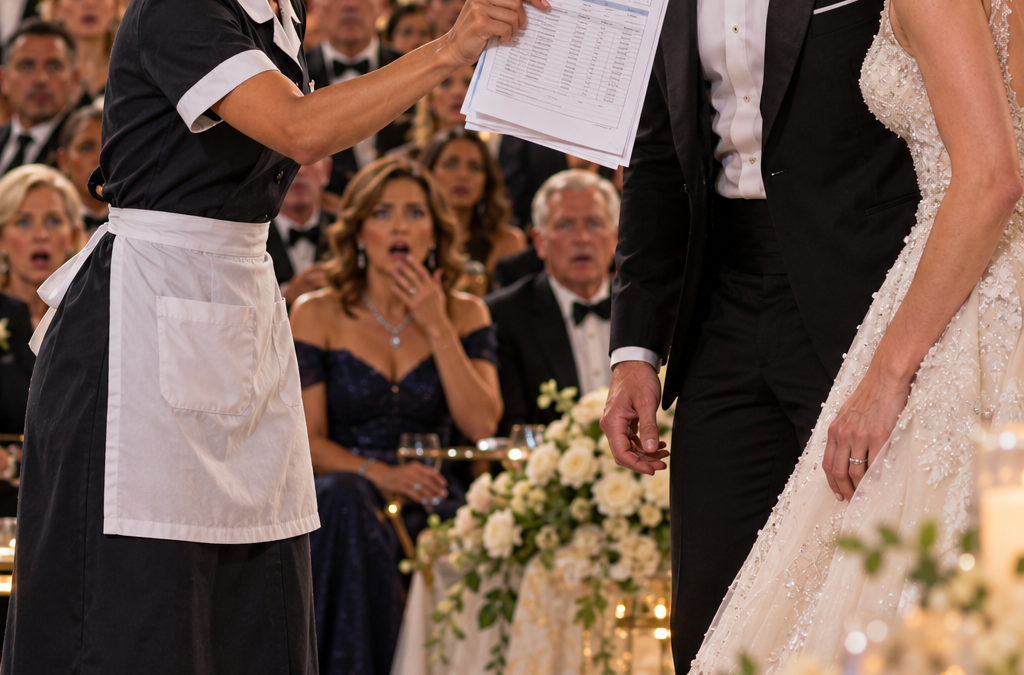
𝗣𝗔𝗥𝗧 𝟮
The Cole estate didn’t look like a house.
It looked like a place governments held meetings.
The driveway alone seemed longer than the block where Danny and I lived.
The front doors were solid oak.
Fresh flowers in the entrance hall.
Real paintings.
Furniture nobody sat on.
A man named Mr. Whitfield managed the household.
He wore a dark suit and spoke as though every word cost money.
He handed me a laminated list.
Laundry schedule.
Kitchen protocol.
Cleaning rotation.
Guest procedures.
Then he tapped one section.
“Miss Cole.”
I looked down.
Lily Cole.
Age eighteen.
“Her meals go upstairs.”
“All meals?”
“Yes.”
“She doesn’t eat with her father?”
“Not recently.”
“How long?”
“Four months.”
He kept walking.
“Knock twice. Place the tray outside. Do not engage unless she speaks first.”
I stopped.
“Why?”
Mr. Whitfield turned.
“Miss Cole has been through considerable trauma.”
I had read about Harrison’s wife.
Eleanor Cole.
Breast cancer.
Dead two years earlier.
“Doctors?”
“Many.”
“Therapists?”
“Many.”
“And they all said leave her alone?”
His mouth tightened.
“Mrs. Brooks, your responsibility is household maintenance.”
Message received.
I followed.
That afternoon, I carried soup and toast upstairs.
Lily’s room sat at the end of a long hall overlooking a garden.
I knocked twice.
No answer.
“Miss Cole?”
Nothing.
I put the tray down.
Two hours later, the soup was cold.
Toast untouched.
The next morning, same thing.
I added chamomile tea.
Then, before leaving, I tore a corner from my notepad.
Hi Lily.
My name is Yvette.
I’m new here.
You don’t know me, but I hope today hurts a little less than yesterday.
I folded it beneath the spoon.
When I returned, the food was untouched.
The note was gone.
That mattered.
The next day, I left another.
Danny had drawn a picture at school.
Three stick people in front of a yellow house with a crooked chimney.
He had made me five copies because he believed adults collected his art like museums.
I added one to the tray.
That evening, the plate was empty.
The picture was gone.
On day four, I knocked.
The door opened three inches.
A pale face appeared.
Dark hair.
Thin shoulders.
Eyes that looked older than eighteen.
“Hi.”
She stared at me.
“I’m Yvette.”
“I know.”
Her voice was barely there.
I smiled.
“Good. Saves introductions.”
Nothing.
I lowered the tray.
“You don’t have to talk.”
She watched.
“I’ll just leave this here.”
I turned.
“Miss Yvette?”
I looked back.
“Thank your son.”
“For?”
“The picture.”
“I will.”
Door closed.
That was our beginning.
People expect breakthroughs to look dramatic.
They usually don’t.
Sometimes healing is a door opening three inches.
Sometimes it is half a sandwich disappearing from a plate.
Sometimes it is one sentence.
By the end of the week, Lily began standing in the doorway while I worked.
Week two, she followed me downstairs.
She sat at the kitchen counter while I chopped vegetables.
Never said much.
I didn’t ask much.
People who are hurting get tired of being examined.
One afternoon, she held a mug between both palms and said:
“My mom made French toast.”
I kept stirring soup.
“Yeah?”
“Every Sunday.”
“Cinnamon?”
“Extra.”
“Powdered sugar?”
She nodded.
“Way too much.”
I smiled.
“My son would approve.”
The following Sunday, I arrived early.
French toast.
Extra cinnamon.
Powdered sugar in a little bowl.
Lily ate three pieces.
Mr. Whitfield stood in the doorway pretending he had come to inspect the silverware.
I saw him smile before he turned away.
Harrison noticed too.
One evening he found Lily sitting downstairs.
He stopped as though afraid sudden movement might send her back upstairs.
“Hey.”
Lily looked up.
“Hi, Dad.”
I watched Harrison’s face.
People think rich men are protected from helplessness.
They aren’t.
Money can buy doctors.
Hospitals.
Therapists.
It cannot force a grieving child to return to herself.
Harrison sat across from Lily.
“What are you eating?”
“Yvette made cookies.”
“I can see that.”
“They’re bad.”
I turned.
“They are not bad.”
Lily smiled.
Small.
Harrison stared at that smile.
His eyes filled so quickly he had to look down.
Afterward he found me in the pantry.
“Thank you.”
“For cookies?”
“For whatever you’re doing.”
“I’m not doing anything special.”
“Yes, you are.”
I shook my head.
“She’s doing it.”
That was true.
Lily was coming back.
Slowly.
Then Victoria Ashford arrived.
Black Mercedes.
Red-bottom heels.
Perfume that entered rooms before she did.
She was beautiful in a way that looked expensive.
Perfect hair.
Perfect teeth.
Perfect posture.
She came to dinner one Tuesday.
Harrison introduced her.
“This is Victoria.”
Lily looked across the table.
Victoria smiled.
“So this is the famous Lily.”
Lily lowered her eyes.
“You’re quieter than your father described.”
Harrison touched Victoria’s hand.
“She’s had a difficult year.”
“Of course.”
Victoria’s gaze shifted toward me.
Her smile disappeared.
“And who is this?”
“Yvette.”
Harrison brightened.
“She’s been wonderful for Lily.”
Victoria studied me slowly.
Shoes.
Uniform.
Face.
Hands.
“I see.”
The words contained something I had heard my whole life.
Not an insult.
A category.
Household help.
Invisible.
She turned to Harrison.
“Darling, Lily needs professional support.”
“She has professionals.”
“I mean proper care.”
I said nothing.
That night, Lily reached for a bread roll.
Victoria’s fingers tightened around her wineglass.
Tiny movement.
Almost nothing.
I noticed.
Within a week, Victoria was spending most nights at the estate.
Two weeks later, practically living there.
She rearranged the kitchen.
Dismissed the evening cook.
Changed suppliers.
Changed meal schedules.
Then she began making Lily’s nighttime tea herself.
“My mother’s sleep blend,” she said.
“Chamomile. Lavender. Valerian.”
Harrison looked relieved.
“You’re good with her.”
Victoria kissed his cheek.
“I want us to be a family.”
I was washing dishes.
Lily was standing beside me.
I felt her go still.
Over the next weeks, she changed.
At first I blamed grief.
Everybody did.
Her hands started shaking.
Then she began forgetting.
She would walk into the kitchen, stop, and stare around.
“What was I doing?”
“You wanted water.”
“Oh.”
One afternoon, she started telling me something about her mother.
Halfway through, her face emptied.
“Lily?”
She blinked.
“What?”
“You were talking.”
“About what?”
I put down the towel.
She looked terrified.
“I don’t know.”
I took her hand.
Cold.
Too cold.
“Something is wrong with me.”
“Have you told your father?”
“He says the doctor says grief does things.”
“What do you think?”
“I think…”
Her eyes filled.
“I think I’m disappearing.”
That word stayed with me.
Because I had seen her disappearing when I first arrived.
Then she had started coming back.
This was different.
It was physical.
Chemical.
Wrong.
I went to Harrison.
He was in his study.
“Sir?”
“Yes?”
“Can we talk about Lily?”
Concern appeared immediately.
“What happened?”
“She’s worse.”
He sighed.
“The doctor warned us there would be setbacks.”
“This doesn’t feel like a setback.”
“What do you mean?”
“She was getting clearer.”
I hesitated.
“Before Victoria moved in.”
His expression changed.
Not anger.
Defense.
“Yvette.”
“I’m not accusing anybody.”
“Victoria has been helping.”
“I know.”
“She loves Lily.”
I heard certainty he needed more than certainty he possessed.
“She’s going to be my wife.”
I nodded.
“That’s wonderful, sir.”
“But?”
“Nothing.”
“Say it.”
I chose my words carefully.
“Lily was eating. Talking. Coming downstairs. Now she can barely remember breakfast.”
He leaned back.
“Her doctors know.”
“Okay.”
“Victoria monitors everything.”
That sentence made something in me tighten.
“Right.”
Harrison’s tone softened.
“Yvette, I appreciate that you care about her.”
“I do.”
“But let’s not create problems where there aren’t any.”
I nodded.
“Yes, sir.”
Then went back to the kitchen.
Washed dishes.
Said nothing.
For two days.
On the third night, I stayed late.
Told Mr. Whitfield I wanted to finish laundry.
At 11:14, I heard footsteps.
I was walking toward the pantry when the kitchen light came on.
Victoria entered.
I stayed in the dark hallway.
She opened a cabinet.
Not the tea cabinet.
One behind the cereal boxes.
She reached behind two boxes.
Pulled out a small brown bottle.
No label.
My heart started pounding.
She unscrewed it.
Tapped white powder into Lily’s tea.
Stirred.
Returned the bottle.
Closed the cabinet.
Then carried the cup upstairs.
Humming.
I stood there long after she was gone.
There are moments when the mind tries to protect you from what your eyes already understood.
Maybe medicine.
Maybe prescribed.
Maybe something harmless.
But if it was harmless, why hidden?
Why unlabeled?
Why behind cereal?
I went home after midnight.
Danny was asleep.
I sat on the mattress.
Stared at the ceiling.
Victoria’s hand.
White powder.
Tea.
Lily shaking.
Lily forgetting.
I could call police.
What would I say?
I saw a wealthy woman put unknown powder in tea.
They would ask for evidence.
I had none.
Victoria would deny it.
Bottle disappears.
I lose my job.
Danny loses everything attached to my job.
I hated myself for thinking about that.
But people with money like to imagine morality happens without arithmetic.
It doesn’t.
Rent was due in nine days.
Our food was low.
Danny needed shoes.
Speaking up had a price.
Silence had one too.
I looked at my son.
Six years old.
Sleeping because he trusted me to make good decisions.
By three in the morning, I knew what I had to do.
Proof.
The next night, I arrived early.
At 11:08, I hid beside the basement door.
Phone open.
Camera ready.
My hands shook.
Victoria entered.
Same cabinet.
Brown bottle.
White powder.
Tea.
I recorded.
Twenty-three seconds.
Then my phone storage filled.
A warning appeared.
I touched the screen.
Electronic chirp.
Victoria froze.
“Hello?”
My heart slammed so hard I thought she would hear it.
I flattened myself against the wall.
Silence.
Victoria waited.
Then picked up the tea.
Walked upstairs.
I didn’t move for two minutes.
My legs felt weak.
But I had the video.
More importantly, I got the tea.
The next morning, Lily left the cup on her tray.
Before Victoria returned for it, I poured part of the remaining liquid into a clean glass jar.
I replaced it with plain tea.
Different bus.
Free clinic on Eighth Avenue.
The nurse at reception looked confused.
“You want us to test tea?”
“Yes.”
“For what?”
“I don’t know.”
“Ma’am—”
“Please.”
I put the jar down.
“It’s for an eighteen-year-old girl.”
The nurse looked at me.
“She’s losing her memory.”
That changed something.
“She shakes. She can barely walk some mornings. I saw somebody put powder in this.”
The nurse stared at the jar.
Then at me.
“I’ll speak to the doctor.”
Forty minutes later, they took the sample.
“Forty-eight hours.”
I went to work.
Two days passed.
Longest two days of my life.
The call came during lunch.
“Ms. Brooks?”
“Yes.”
“Dr. Lawson’s office.”
I gripped my sandwich.
“The sample tested positive for a benzodiazepine.”
I stood slowly.
“Which one?”
“Flunitrazepam.”
I knew enough to understand it wasn’t chamomile.
“How much?”
“Significant concentration.”
“What would repeated exposure do?”
A pause.
“Memory loss.”
My knees weakened.
“Confusion.”
I sat.
“Motor impairment.”
My eyes closed.
“Sedation. Cognitive decline.”
“Could it cause shaking?”
“Yes.”
“Could someone look like they were having a psychological breakdown?”
“Yes.”
I covered my mouth.
“Ms. Brooks, you need to contact law enforcement.”
“I understand.”
I hung up.
For several minutes, I sat alone in Harrison Cole’s kitchen.
A house worth more than I could comprehend.
Security cameras.
Staff.
Doctors.
Money.
All of it.
And an eighteen-year-old girl was being poisoned in the middle of it because everyone trusted the right clothes more than the wrong person’s instincts.
The wedding was twelve days away.
I knew immediately that waiting twelve days was impossible.
So I began intercepting the tea.
Every night.
Victoria prepared it.
I found a reason to handle the tray.
Laundry.
Towels.
Dishes.
I dumped the drugged tea.
Made clean tea.
Same cup.
Same temperature.
Same appearance.
At first I expected Victoria to notice.
She didn’t.
Or she thought the deterioration took time.
Within four days, Lily improved.
The shaking eased.
On day five she remembered breakfast.
Day six she came downstairs.
Day seven she laughed.
Danny had come with me after school because my childcare arrangement fell through.
He sat at the counter drawing.
Lily watched him.
“What is that?”
“A spaceship.”
“It looks like a potato.”
Danny looked offended.
“It’s going to Mars.”
Lily laughed.
Not a small smile.
A real laugh.
I turned away so she wouldn’t see me cry.
Later she touched my arm.
“Miss Yvette?”
“Yes?”
“I feel…”
She searched for the word.
“Clear.”
My stomach knotted.
“That’s good.”
“Like fog is leaving.”
I smiled.
“Then let it leave.”
Eight days before the wedding, I called my sister.
Told her everything.
She was silent for almost a minute.
“You’re going to what?”
“Tell Harrison.”
“Now?”
“I tried.”
“No, I mean before the wedding.”
“I need witnesses.”
“Yvette, call police.”
“I have evidence, but not enough to stop her hiding everything.”
“Then get a lawyer.”
“With what money?”
“Anything except standing up at a billionaire’s wedding accusing his bride of poisoning his kid.”
I looked at Danny sleeping.
“People will think you’re crazy.”
“I know.”
“You’ll lose the job.”
“I know.”
“What happens to Danny?”
There it was.
The question I had been avoiding.
“Yvette.”
“I don’t know.”
“You finally have benefits.”
“I know.”
“You finally have money coming in.”
“I know.”
“You can’t save everybody.”
I looked at the video on my phone.
Victoria’s hand.
White powder.
“You’re right.”
Silence.
“Then don’t do this.”
“I can’t save everybody.”
I looked at Danny.
“But I can save her.”
My sister sighed.
“What happens when Danny asks why you destroyed his life for a rich girl?”
That hurt.
“He won’t.”
“How do you know?”
“Because I’ll tell him the truth.”
I swallowed.
“I’ll tell him his mother saw someone being hurt and refused to pretend she didn’t.”
No answer.
I continued.
“If I teach him that paying rent matters more than protecting someone when you know they’re in danger, what am I raising?”
My sister started crying.
“So you’re doing it.”
“Yes.”
“Then send me the video.”
“Why?”
“In case they take your phone.”
That was smart.
I sent everything.
Video.
Lab result.
Notes.
Dates.
Then I waited.
Wedding morning arrived.
I ironed my uniform.
Polished my cracked shoes.
Couldn’t afford replacements.
Three hundred guests filled the Cole estate garden.
White roses.
Champagne.
Silk canopy.
String quartet.
Men in suits I recognized from television.
Women wearing jewelry that could have paid for our building.
Victoria wore a wedding gown that cost twelve thousand dollars.
I knew because another housekeeper mentioned it.
Twelve thousand.
I thought about Danny doing homework by candlelight.
Money has strange ways of sitting beside injustice without noticing.
I stood near the service entrance.
Phone in one hand.
Manila envelope in the other.
Lab report.
Video.
Timeline.
My courage had felt stronger the night before.
Now it felt thin.
I thought about leaving.
I could still leave.
Harrison would marry her.
I would keep the job.
Maybe police later.
Maybe anonymous tip.
Maybe someone else would fix it.
Then I saw Lily.
Front row.
Blue dress.
Still too thin.
Hands folded.
She looked at me.
Our eyes met.
Four months earlier, everyone had treated her grief like a room no one was allowed to enter.
I had entered.
Now I was the only person who knew why she had almost vanished again.
I stepped into the aisle.
The quartet stopped.
People turned.
My legs shook.
“Mr. Cole.”
Harrison looked at me.
“Yvette?”
I took another step.
“Your bride is poisoning your daughter.”
Silence.
Absolute.
Victoria spun.
“What did you say?”
Three hundred faces.
I could feel them.
I forced myself to look at Harrison.
“Lily’s tea.”
Victoria laughed once.
Sharp.
“Have you lost your mind?”
“She puts drugs in it every night.”
“You disgusting liar.”
Security moved.
Victoria pointed.
“Get her out.”
Two guards approached.
I held up the envelope.
“I have proof.”
A guest began filming.
Victoria’s face twisted.
“She’s jealous.”
I almost laughed.
Of what?
“She’s a maid, Harrison. A pathetic maid looking for money.”
That word.
Maid.
She said it as if the job itself invalidated truth.
One guard touched my arm.
Harrison finally spoke.
“Stop.”
Everyone froze.
He looked at me.
“Let her speak.”
Victoria grabbed him.
“Harrison—”
“Let her speak.”
I walked forward.
My hands were shaking so badly the paper rattled.
I gave him the lab report.
He read.
Once.
Then again.
His face changed.
“Flunitrazepam?”
“Yes.”
“How did you—”
“I saw her.”
Victoria shouted:
“No.”
I pulled out the phone.
“I recorded her.”
Victoria lunged toward me.
Security stopped her.
“That’s edited!”
“Twenty-three seconds.”
I looked at Harrison.
“Four months of symptoms.”
Lily stood.
Her face had gone pale.
“Dad.”
Harrison turned.
I continued.
“I replaced the tea for the last eight nights.”
Victoria stopped struggling.
That was when I knew.
Not suspicion.
Knowledge.
“And Lily improved.”
Harrison looked toward his daughter.
Then his physician seated in the second row.
“Dr. Whitmore.”
The doctor stood.
“Test her.”
Victoria laughed desperately.
“This is insane.”
“Test Lily.”
“Harrison, we’re getting married.”
He didn’t look at her.
“Now.”
The doctor took Lily inside.
Fourteen minutes.
I know because I watched the clock through the glass doors.
Victoria paced.
Guests whispered.
Phones recorded.
Harrison stood motionless.
I was beginning to feel sick.
Maybe the test would be negative.
Maybe I had ruined everything.
Maybe I had misunderstood.
Then the doors opened.
Dr. Whitmore stepped outside.
His face was enough.
Harrison said:
“Well?”
“Flunitrazepam.”
Nobody breathed.
“Elevated level.”
Victoria stepped backward.
The doctor continued.
“Consistent with repeated administration.”
Harrison looked at his bride.
She ran.
Six steps.
Security caught her.
She screamed.
At Harrison.
At me.
Called me filthy.
Called me a liar.
Called me things I had heard before from people who needed me to be less human so they could justify what they were doing.
Police arrived.
The wedding ended.
No vows.
No kiss.
No champagne toast.
Victoria left in a cruiser.
I stood near the service entrance.
Exactly where I had started.
Then I picked up my bag.
I was done.
At the gate, Harrison caught me.
“Yvette.”
I stopped.
“Where are you going?”
“Home.”
“You don’t have to leave.”
I looked at him.
“My job here is finished.”
His face crumpled.
“Thank you.”
I nodded.
“Go to Lily.”
He did.
I caught the bus.
Danny was waiting.
By the time I reached our apartment, the wedding video was already online.
Millions watched it.
I did not.
Danny sat at the counter doing spelling words.
My phone wouldn’t stop ringing.
“Mama?”
“Yes?”
“Why does your phone keep making noise?”
“People calling.”
“Why?”
I looked at him.
“Something happened at work.”
“Bad?”
I thought about Lily’s clear eyes.
“No.”
Then:
“Hard.”
He nodded like those were completely different categories.
Maybe they are.
Investigators uncovered the rest quickly.
Victoria Ashford wasn’t Victoria Ashford.
Her real name was Katherine Mercer.
Three wealthy husbands.
One hospitalized after unexplained chronic poisoning.
Another estate drained after marriage.
Different names.
Different cities.
Same pattern.
Lily wasn’t merely inconvenient.
She was worth three hundred forty million dollars through trusts tied to her mother.
The plan was simple.
Drug her slowly.
Make her appear mentally incompetent.
Marry Harrison.
Gain legal standing inside the family.
Eventually pursue control over Lily’s trust and care.
It was colder than anything I had imagined.
I had thought Victoria hated Lily.
Hatred would almost have been more human.
She had been reducing an eighteen-year-old girl to paperwork.
Four days after the wedding, Harrison’s lawyer called.
“Mr. Cole would like to meet.”
My stomach dropped.
“Why?”
“He’ll explain.”
“Am I being sued?”
“No.”
“Am I fired?”
A pause.
“No.”
The next morning, I ironed the same uniform.
Danny watched.
“Why are you wearing work clothes if you don’t work there?”
“Because I don’t own meeting-with-billionaires clothes.”
He considered that.
“Wear the blue shirt.”
“It has bleach on it.”
“So?”
He had me there.
I still wore the uniform.
The elevator opened on the forty-second floor of Harrison’s company.
Glass.
Steel.
City spread beneath me.
A receptionist took me past framed magazine covers.
Harrison shaking hands with senators.
Harrison opening hospitals.
Harrison beneath headlines about billion-dollar developments.
But she didn’t take me to his office.
She opened a small reading room.
Lily sat on the floor.
When she saw me, she stood.
Her eyes were clear.
She walked across the room.
Then hugged me.
Not polite.
Not careful.
She threw her arms around me.
“Thank you.”
I held her.
“You’re okay.”
“I feel like myself.”
I closed my eyes.
“That’s all I wanted.”
Harrison sat in a chair by the window.
He watched us.
Then stood.
“Please sit.”
My instinct was immediate.
Straighten uniform.
Hands together.
Employee posture.
He noticed.
“Yvette.”
I looked up.
“You don’t work for me right now.”
I almost smiled.
“That sounds like firing.”
“No.”
For the first time, Harrison smiled too.
He picked up a framed photograph.
Eleanor.
His late wife.
I had seen photographs at the estate.
Never closely.
In this one, she was young.
Standing in a kitchen.
Simple dress.
Black woman.
I stared.
Harrison said:
“She grew up in Bed-Stuy.”
I looked at him.
“Her mother cleaned offices.”
He traced the silver frame.
“Her father drove a city bus.”
I sat still.
“She worked from fourteen.”
Then:
“When I met her, she was a housekeeper at a Midtown hotel.”
That surprised me.
“I asked her for coffee while she was cleaning my room.”
Lily smiled faintly.
“She said no.”
Harrison looked toward his daughter.
“Three times.”
Lily nodded.
I laughed despite myself.
“That sounds about right.”
“Everyone told me she wanted money.”
His expression softened.
“My family.”
“Business partners.”
“Friends.”
“They said I would embarrass myself marrying a housekeeper.”
I looked at Eleanor’s photograph.
“She built our foundation.”
Harrison continued.
“She made me understand most of what I thought I knew about people was inherited nonsense.”
His eyes filled.
“She made this family worth having.”
Then he looked at me.
“When Victoria spoke about you…”
His jaw tightened.
“When she said household help as though it meant less human…”
He looked away.
“I should have recognized it.”
I said nothing.
“Eleanor heard those things.”
He continued.
“Not exactly the same words.”
“But the same meaning.”
Lily held my hand.
Harrison said:
“I was lonely.”
His voice dropped.
“That isn’t an excuse.”
“No.”
He looked at me.
“I wanted somebody to fill a space that cannot be filled.”
He nodded toward Eleanor’s photograph.
“Victoria knew exactly what to say.”
“She knew what I wanted to hear.”
Then:
“And I ignored what I should have seen.”
Lily spoke.
“Miss Yvette saw.”
Harrison nodded.
“I know.”
“She was the only one.”
I squeezed her hand.
“That’s not true.”
“It is.”
“Your doctors—”
“Followed symptoms.”
“Your father—”
“Trusted the doctors.”
She looked at me.
“Everyone followed rules.”
Her voice became stronger.
“Knock twice.”
“Leave the tray.”
“Don’t engage.”
She swallowed.
“You stayed.”
That hurt in the best way.
Harrison opened a folder.
“There’s something else.”
I immediately said:
“Sir, I don’t want money.”
He held up a hand.
“Listen first.”
I waited.
“Danny.”
My body tightened.
“What about him?”
“Full scholarship.”
I stared.
“Whitmore Academy.”
I knew the school.
Children of senators.
Executives.
Old families.
“Kindergarten through twelfth grade.”
I shook my head.
“Tuition.”
“Books.”
“Meals.”
“Uniforms.”
“Everything.”
I couldn’t speak.
“Second.”
He opened another document.
“Two-bedroom apartment on West Seventy-Third.”
I stared at him.
“Foundation-owned.”
“No rent.”
My throat closed.
“Third.”
He continued before I could object.
“Director of household operations.”
I blinked.
“At the estate?”
“Yes.”
“Why?”
“Because you did more to protect my home than anybody I paid to manage it.”
Salary.
Health insurance.
Retirement.
Paid leave.
I looked at Lily.
She was smiling.
“And fourth.”
Harrison slid a page across.
“The Eleanor Cole Foundation.”
He explained.
Legal aid.
Job training.
Emergency housing.
Support for women working domestic jobs.
Then he mentioned an equity interest in the foundation’s investment endowment.
I pushed the paper back.
“No.”
Harrison stopped.
“No?”
“I didn’t save Lily to become rich.”
“I know.”
“I didn’t stand at that wedding because I expected any of this.”
“I know.”
“I was scared my son might lose his home because I opened my mouth.”
My voice broke.
“I did it anyway because that girl was being destroyed while everybody with more money, more education, and more authority than me kept explaining why it was probably normal.”
Tears came.
I wiped them angrily.
“If it had been Danny…”
I couldn’t finish.
Harrison waited.
“If it had been my child, I’d pray somebody would speak.”
Harrison looked at Eleanor’s photograph.
Then he smiled sadly.
“She said something almost identical.”
“Who?”
“Eleanor.”
I looked at the photograph.
“When I proposed, I tried to solve everything with money.”
He laughed quietly.
“House.”
“Car.”
“Whatever she wanted.”
“She told me her dignity wasn’t for sale.”
His eyes returned to me.
“She said if I wanted to marry her, I had to understand she was not being rescued.”
That sentence landed.
Not being rescued.
I thought about what accepting Harrison’s offer would look like from the outside.
Poor maid saves billionaire’s daughter.
Billionaire changes maid’s life.
Easy story.
Clean story.
Wrong story.
Lily leaned toward me.
“Take it for Danny.”
I looked at her.
“And take the foundation role for people like you.”
“What does that mean?”
“Women who work inside rich people’s houses.”
She looked down.
“People everybody sees but nobody listens to.”
I thought about Mrs. Callaway.
The restaurant.
Buses.
Women at staffing agencies.
Nannies.
Cleaners.
Care workers.
People who witness everything.
Hear arguments.
See bruises.
Notice children changing.
Know when elderly people are being mistreated.
But speaking could cost rent.
Food.
Immigration status.
Health insurance.
Everything.
“Okay.”
Harrison leaned forward.
“Okay?”
“I have a condition.”
He almost laughed.
“Of course you do.”
“The foundation expands.”
“How?”
“A program for domestic workers who see abuse or wrongdoing.”
He listened.
“Legal help.”
“Emergency pay.”
“Temporary housing if they lose jobs.”
“Protection if employers retaliate.”
“People who can preserve evidence properly.”
“Someone answering the phone before they decide silence is safer.”
Harrison nodded.
“Done.”
“No.”
He frowned.
“Don’t say done like money solves it.”
Lily smiled.
I continued.
“We build it correctly.”
“Then we build it correctly.”
“Independent lawyers.”
“Yes.”
“No employer gets to shut down a complaint because they donate to the foundation.”
“Agreed.”
“No name on it that belongs to you.”
He smiled.
“Agreed.”
Lily said:
“Second Voice.”
We both looked at her.
“What?”
“The program.”
She sat straighter.
“Second Voice.”
“Why?”
“Because sometimes the first person who says something gets ignored.”
Her eyes moved to me.
“Then somebody else has to stand beside them.”
I repeated it.
“Second Voice.”
Harrison nodded.
“That’s the name.”
Two weeks later, Danny walked through the gates of Whitmore Academy.
New shoes.
New backpack.
Uniform.
He stopped.
Turned.
“Mom?”
“Yes?”
“Is this really my school?”
I knelt.
Straightened his collar.
“It is.”
“Are we rich?”
I laughed.
“No.”
He looked disappointed.
“We have a kitchen with a faucet that doesn’t drip.”
His face lit up.
“Oh.”
“Exactly.”
He hugged me.
Then ran inside.
I watched until he disappeared.
Same thing I had done every morning at his old school.
Some things money shouldn’t change.
The Second Voice Program opened six months later.
I chose a small office above a laundromat three blocks from the clinic where Lily’s tea had been tested.
Harrison wanted somewhere larger.
I refused.
“This is where I knew someone would listen.”
So we stayed.
Two rooms.
Secondhand chairs.
Fresh paint.
Lawyers in rotating shifts.
A hotline.
On the door:
YOU SPOKE UP. WE’LL STAND WITH YOU.
Fourteen women came the first week.
Sixty-three by the end of the month.
Some cases were workplace abuse.
Some wage theft.
Some violence.
Some involved children.
Some elderly clients.
One nanny had photographs but had been too frightened to contact police because her employer controlled her housing.
Another housekeeper had been threatened after witnessing domestic abuse.
We built emergency funds.
Legal representation.
Temporary housing.
Evidence-preservation training.
Translation services.
Nobody had to prove courage before receiving help.
Fear was not disqualification.
I understood fear.
Lily improved.
Slowly.
Recovery wasn’t a movie.
Her body had been exposed for months.
Some days she was clear.
Some days exhausted.
Memory returned unevenly.
She started therapy with someone new.
Someone Victoria had never selected.
She resumed school.
Then piano.
The first time I heard her play after everything, I stood outside the room.
She stopped halfway through.
Started again.
Stopped.
Then cried.
I entered.
“Want me to leave?”
She shook her head.
“I used to know this.”
“You still do.”
“No.”
She hit the wrong key.
“I can hear what it should be.”
“So can I.”
She laughed through tears.
“You don’t know piano.”
“Exactly.”
She played again.
I stayed.
Months later she spoke publicly about what happened.
I didn’t attend the first event.
I was working.
Someone sent me the video.
Lily stood on a stage.
Healthy enough that strangers might not understand how close she had come to being erased.
She said:
“I knew something was wrong.”
Then:
“But everyone around me had reasons not to believe me.”
That line hurt.
She continued.
“Doctors saw grief.”
“My father saw grief.”
“Staff saw grief.”
“Victoria made sure everybody saw grief.”
Then she said my name.
“Yvette Brooks noticed change.”
Noticed.
That word mattered.
“She paid attention.”
The audience stood.
I turned off the video.
Sat in my office.
Cried alone.
Not because of applause.
Because Lily had found her voice.
Harrison changed too.
He restructured labor policies across properties tied to his companies.
Better wages.
Health benefits.
Independent reporting systems.
Second Voice access.
Other companies copied parts of it.
I appreciated that.
But I reminded him often:
“Don’t turn basic decency into branding.”
He would sigh.
“You enjoy correcting billionaires.”
“I enjoy correcting you.”
“Difference?”
“Large.”
Danny adjusted to school faster than I expected.
Children do that.
Adults spend years thinking doors are locked.
Children walk through once opened.
He struggled at first with the other kids.
Not academics.
Money.
One boy asked why his mother didn’t have a driver.
Danny said:
“She knows how to take the bus.”
Apparently that ended the conversation.
He finished his first semester third in his class.
His teacher sent a note.
Danny is kind, focused, and unusually attentive to classmates who are excluded.
He told me his mother taught him doing the right thing matters more than doing the easy thing.
I read that sentence at our new kitchen table.
The faucet was silent.
I read it again.
Then pinned it to the refrigerator.
Next to the old yellow-house drawing.
Katherine Mercer—Victoria—went to prison.
I attended sentencing with Lily.
Not because I needed to watch her punished.
Because Lily asked me to sit beside her.
The courtroom gallery included domestic workers from Second Voice.
Housekeepers.
Nannies.
Caregivers.
Some wore small microphone pins representing the program.
When Katherine entered, she looked at us once.
Then away.
No apology.
No remorse I could see.
The sentence mattered less to me than what happened beside me.
Lily did not shake.
She sat upright.
Her hand rested on mine.
When court ended, she whispered:
“Can we go get French toast?”
I smiled.
“Extra cinnamon?”
“Obviously.”
A year after the wedding, Second Voice had moved.
Entire floor.
Real offices.
Training rooms.
Hotline staff.
Case managers.
Lawyers.
Emergency housing coordinators.
I fought the move.
Then admitted we had outgrown the laundromat.
We kept the original sign.
YOU SPOKE UP. WE’LL STAND WITH YOU.
During orientation for new advocates, I always told them the same thing.
“I’m not brave.”
People would look confused.
Some had seen the wedding video.
Some expected a speech about courage.
“I was terrified.”
I told them about Danny.
Rent.
Shoes.
My job.
“Every instinct told me staying quiet would protect my child.”
Then:
“And I nearly believed it.”
I looked around the room.
“You are not here to tell people they should have spoken sooner.”
That became our first rule.
“You are not here to ask why they stayed.”
Second rule.
“You are not here to turn them into heroes.”
Third.
“You are here to make sure telling the truth does not destroy the rest of their life.”
That was Second Voice.
Not courage training.
Consequence protection.
One afternoon, I finished orientation and walked toward the elevator.
The doors opened.
Danny stood inside.
Older.
Backpack over one shoulder.
Grinning.
“Mom.”
“What are you doing here?”
“I got an A.”
“Congratulations.”
“You don’t even know on what.”
“Still counts.”
“My essay.”
“What essay?”
“About you.”
I groaned.
“Why do people keep writing about me?”
“Because you’re interesting.”
“False.”
He handed me the paper.
The elevator doors opened in the lobby.
Lily stood there.
She carried a rolled canvas.
“This is for you.”
I looked between them.
“Why is everybody giving me things?”
“Take it.”
I unrolled the canvas.
Painting.
Kitchen counter.
Two people.
One standing.
One thin figure sitting.
French toast between them.
Powdered sugar.
Sunlight through a window.
At the bottom:
For the woman who stayed when everyone else followed instructions.
My vision blurred.
“Lily.”
“I know.”
She smiled.
“You hate dramatic things.”
“Correct.”
“Too bad.”
I hugged her.
Behind her stood Harrison.
He held Eleanor’s photograph.
The silver frame.
He placed it beside the painting.
For a moment, I looked from one woman to the other.
Eleanor.
Lily.
Two lives I had entered only because I needed a paycheck.
Then Danny wrapped his arms around my waist.
I looked down.
This child had once done homework by candlelight.
Now he was complaining because the cafeteria served grilled salmon twice in one week.
Life is ridiculous.
Harrison watched us.
“Yvette?”
“Yes?”
“Do you ever think about what would’ve happened if you hadn’t spoken?”
I didn’t like the question.
But I answered.
“Yes.”
“Often?”
“Less now.”
He nodded.
“I think about it every day.”
“You shouldn’t.”
“How can I not?”
“You saw what you wanted to see.”
His face tightened.
“That doesn’t excuse me.”
“No.”
I looked at him.
“But guilt can become another kind of selfishness if all you do is stare at it.”
He absorbed that.
“What should I do?”
I pointed around the lobby.
“This.”
Second Voice staff moved through the building.
Phones.
Meetings.
Women arriving for appointments.
“Make the next person safer.”
Harrison nodded.
That was enough.
That evening, Danny and I went home.
Our apartment was warm.
Two bedrooms.
Working stove.
Silent faucet.
He dropped his backpack in the hallway.
“Pick that up.”
“I will.”
“Now.”
“Five minutes.”
“You attend an expensive school and somehow learned worse listening skills.”
He laughed.
I began dinner.
Then stopped.
For a second, I saw the old apartment.
Mattress.
Candle.
Taped shoe.
Dripping faucet.
I had spent years believing stability would arrive if I worked hard enough and kept my head down.
Sometimes it does.
Sometimes keeping your head down is exactly what allows the wrong thing to continue.
That was the part I wanted Danny to understand when he became old enough.
Not that his mother had been fearless.
I wasn’t.
Not that speaking always works.
It doesn’t.
Not that good people are always rewarded.
They aren’t.
I wanted him to understand something less comfortable.
There are moments when doing the right thing can threaten everything you are trying to protect.
Rent.
Job.
Reputation.
Safety.
And nobody can make that choice for you.
The night before the wedding, I genuinely believed I might destroy our lives.
I still walked into that aisle.
Not because Lily was rich.
Not because Harrison was powerful.
Not because I expected anyone to believe a maid over a bride.
Because Lily was somebody’s child.
That was enough.
Years later, women still ask me how I knew.
I didn’t.
I suspected.
Then I watched.
Then I gathered evidence.
Then I tested.
Attention came before courage.
That’s what people miss when they tell the story.
They focus on the wedding.
The dramatic moment.
Three hundred guests.
The accusation.
But courage usually begins much earlier.
It begins when you notice the untouched tray.
When you listen to the girl nobody wants to engage.
When you recognize that recovery has reversed.
When you stay in the hallway ten seconds longer.
When you ask why.
When everyone else has decided there is no question.
I wasn’t the smartest person in that house.
I wasn’t the richest.
I didn’t have a medical degree.
Or law degree.
Or title.
I was the person paying attention.
Sometimes that is enough to save a life.
One Tuesday evening, long after Katherine went to prison, I stayed late at Second Voice.
Most staff had left.
A new case sat on my desk.
Domestic worker.
Employer threatening deportation.
No safe housing.
Two children.
I read the intake form.
At the bottom, under the question:
Why are you seeking help now?
She had written:
Because I finally found somewhere I think they might believe me.
I sat back.
That sentence carried me all the way to the wedding again.
Standing in cracked shoes.
Envelope shaking in my hand.
Three hundred people waiting to decide whether I was credible enough to protect a girl they had failed to see.
I picked up the phone.
Called the on-call attorney.
“We need emergency housing tonight.”
The attorney asked:
“How urgent?”
I looked at the sentence again.
“Urgent enough that she finally asked.”
Within an hour, arrangements were made.
I shut down my computer.
Walking toward the elevator, I passed the original Second Voice sign.
YOU SPOKE UP. WE’LL STAND WITH YOU.
I touched the edge.
That was the promise I wished somebody had been able to make me before I stepped into Harrison Cole’s wedding.
Not:
Be brave.
Not:
Tell the truth and everything will work out.
Just:
If you speak, you will not fall alone.
The elevator opened.
I stepped inside.
My shoes clicked against the floor.
Good shoes now.
Black leather.
Funny thing was, I had chosen a pair that looked almost exactly like the cracked ones I wore at the wedding.
Same shape.
Same style.
Just stronger.
Maybe that meant something.
Maybe not.
Downstairs, Danny was waiting.
He had gotten taller.
Almost to my shoulder.
“You’re late.”
“So are you.”
“I was waiting for you.”
“Exactly.”
He rolled his eyes.
Outside, New York moved around us.
Taxis.
Buses.
People carrying groceries.
Workers going home.
Women in uniforms.
Men in suits.
People nobody noticed.
People everybody noticed.
Danny reached for my hand.
I took his.
We started walking.
After half a block, he said:
“Mom?”
“Yeah?”
“Remember when our faucet used to drip?”
I smiled.
“Yes.”
“I kind of miss it.”
I stopped.
“What?”
“The sound.”
“You used to complain.”
“I was six.”
“You said you wanted to buy me a house just to get rid of it.”
He laughed.
“I know.”
I squeezed his hand.
“I don’t miss it.”
“Not even a little?”
“No.”
He smiled.
“Fair.”
We kept walking.
I thought about Lily.
Eleanor.
Harrison.
The women upstairs.
The life I almost protected myself out of.
And I understood something I hadn’t known when I stood in that wedding aisle.
Speaking up had not made me powerful.
I had always possessed power.
Not Harrison’s kind.
Not money.
Not buildings.
Not people who moved when I entered a room.
Mine was smaller.
More ordinary.
The power to notice.
The power to care when caring was inconvenient.
The power to say what I saw when silence would have been safer.
For years, I thought people like me survived by staying invisible.
Sometimes we do.
But invisibility can become permission for other people.
Permission to ignore.
Permission to dismiss.
Permission to believe our voices weigh less because our paychecks are smaller.
I don’t believe that anymore.
I was still Yvette Brooks.
Danny’s mother.
Former dishwasher.
Former housekeeper.
Woman who still checked grocery prices even when she didn’t need to.
Woman who still saved takeout containers because throwing them away felt wasteful.
Nothing about money changed the thing that mattered.
That night, I saw a girl disappearing.
And I refused to look away.
Everything else came after.
𝗧𝗛𝗘 𝗘𝗡𝗗
I Interrupted a Billionaire’s Wedding to Tell Him His Bride Was Poisoning His Daughter
I walked into a billionaire’s wedding wearing cracked black shoes and a maid’s uniform, carrying a lab report that could destroy the bride before three hundred guests.
I knew Harrison Cole could fire me, security could drag me outside, and my six-year-old son could lose the first stable future I had ever been able to offer him—but I also knew that if I stayed quiet, Lily might disappear inside her own mind before anyone realized what was happening.
My alarm went off at 4:30 every morning.
I learned to shut it off before the second vibration because Danny slept three feet away from me.
We had one mattress.
One real bed would have taken up too much of the room.
Our apartment was technically a studio, although calling it that made it sound nicer than it was.
One main room.
Small kitchen counter.
Hot plate.
Bathroom with a faucet that dripped no matter how tightly I turned the handle.
Drip.
Drip.
Drip.
Some nights I counted the drops because counting something was easier than counting bills.
Danny was six.
He slept curled beneath a blanket that was too thin for November.
His sneakers sat beside the door.
The left toe had split weeks earlier.
I covered the hole with duct tape.
He thought the silver patch made them look like astronaut shoes.
Children have a gift for turning poverty into adventure when they trust the adult beside them.
That somehow makes poverty hurt worse.
I got dressed quietly.
Same navy housekeeping uniform.
Same one I ironed every night after Danny went to sleep.
There was a coffee stain near the collar that never came out.
I had scrubbed it with dish soap.
Baking soda.
Cheap stain remover.
Eventually I accepted that some marks become permanent.
By 5:15, I was on the bus.
Forty-five minutes to the restaurant where I washed dishes until noon.
Then another bus to Mrs. Callaway’s house.
Floors.
Laundry.
Bathrooms.
Kitchen.
Five o’clock if she didn’t ask me to stay late.
Two jobs.
Six days a week.
Eleven hours most days.
Still not enough.
Every month became a negotiation with disaster.
Rent or electric.
Groceries or Danny’s school supplies.
Bus pass or cough medicine.
One month earlier, I paid the rent and let the electric bill slide.
Our lights went off for three nights.
Danny did his spelling homework beside a candle.
He looked around the dark room and smiled.
“This is fun.”
I laughed.
“What’s fun about it?”
“It’s like camping.”
That almost broke me.
He held up his worksheet.
“When I’m rich, I’m buying you a house.”
“Oh, yeah?”
“A big one.”
“How big?”
“Big kitchen.”
I smiled.
“What kind of kitchen?”
He thought seriously.
“The kind where the faucet doesn’t drip.”
I turned my head before he saw my face.
The staffing agency called two days later.
I had registered with them almost two years earlier and forgotten about it.
“Ms. Brooks?”
“Yes?”
“We have a private-household placement.”
I balanced the phone between my shoulder and ear while scrubbing a restaurant pot.
“Full-time?”
“Yes.”
“How much?”
She told me.
I stopped scrubbing.
“Say that again.”
She did.
Almost three times what I was making between both jobs.
Benefits.
Regular schedule.
Live-out position.
Paid leave after probation.
I leaned against the sink.
“Where?”
There was a pause.
“The Cole residence.”
I knew the name.
Everyone did.
Harrison Cole.
Real estate.
Commercial towers.
Investments.
Forbes covers.
Enough money that newspapers stopped printing the full number and just called him a billionaire.
“He needs a housekeeper?”
“The family.”
“What happened to the last one?”
Another pause.
“Several have left.”
“How many?”
“Nine in eighteen months.”
That sounded like a warning.
“Why?”
“His daughter.”
I nearly said no.
Then I looked at my hands.
Red from dishwater.
Thought about Danny’s taped shoe.
“Send me the address.”
The Cole estate didn’t look like a house.
It looked like a place governments held meetings.
The driveway alone seemed longer than the block where Danny and I lived.
The front doors were solid oak.
Fresh flowers in the entrance hall.
Real paintings.
Furniture nobody sat on.
A man named Mr. Whitfield managed the household.
He wore a dark suit and spoke as though every word cost money.
He handed me a laminated list.
Laundry schedule.
Kitchen protocol.
Cleaning rotation.
Guest procedures.
Then he tapped one section.
“Miss Cole.”
I looked down.
Lily Cole.
Age eighteen.
“Her meals go upstairs.”
“All meals?”
“Yes.”
“She doesn’t eat with her father?”
“Not recently.”
“How long?”
“Four months.”
He kept walking.
“Knock twice. Place the tray outside. Do not engage unless she speaks first.”
I stopped.
“Why?”
Mr. Whitfield turned.
“Miss Cole has been through considerable trauma.”
I had read about Harrison’s wife.
Eleanor Cole.
Breast cancer.
Dead two years earlier.
“Doctors?”
“Many.”
“Therapists?”
“Many.”
“And they all said leave her alone?”
His mouth tightened.
“Mrs. Brooks, your responsibility is household maintenance.”
Message received.
I followed.
That afternoon, I carried soup and toast upstairs.
Lily’s room sat at the end of a long hall overlooking a garden.
I knocked twice.
No answer.
“Miss Cole?”
Nothing.
I put the tray down.
Two hours later, the soup was cold.
Toast untouched.
The next morning, same thing.
I added chamomile tea.
Then, before leaving, I tore a corner from my notepad.
Hi Lily.
My name is Yvette.
I’m new here.
You don’t know me, but I hope today hurts a little less than yesterday.
I folded it beneath the spoon.
When I returned, the food was untouched.
The note was gone.
That mattered.
The next day, I left another.
Danny had drawn a picture at school.
Three stick people in front of a yellow house with a crooked chimney.
He had made me five copies because he believed adults collected his art like museums.
I added one to the tray.
That evening, the plate was empty.
The picture was gone.
On day four, I knocked.
The door opened three inches.
A pale face appeared.
Dark hair.
Thin shoulders.
Eyes that looked older than eighteen.
“Hi.”
She stared at me.
“I’m Yvette.”
“I know.”
Her voice was barely there.
I smiled.
“Good. Saves introductions.”
Nothing.
I lowered the tray.
“You don’t have to talk.”
She watched.
“I’ll just leave this here.”
I turned.
“Miss Yvette?”
I looked back.
“Thank your son.”
“For?”
“The picture.”
“I will.”
Door closed.
That was our beginning.
People expect breakthroughs to look dramatic.
They usually don’t.
Sometimes healing is a door opening three inches.
Sometimes it is half a sandwich disappearing from a plate.
Sometimes it is one sentence.
By the end of the week, Lily began standing in the doorway while I worked.
Week two, she followed me downstairs.
She sat at the kitchen counter while I chopped vegetables.
Never said much.
I didn’t ask much.
People who are hurting get tired of being examined.
One afternoon, she held a mug between both palms and said:
“My mom made French toast.”
I kept stirring soup.
“Yeah?”
“Every Sunday.”
“Cinnamon?”
“Extra.”
“Powdered sugar?”
She nodded.
“Way too much.”
I smiled.
“My son would approve.”
The following Sunday, I arrived early.
French toast.
Extra cinnamon.
Powdered sugar in a little bowl.
Lily ate three pieces.
Mr. Whitfield stood in the doorway pretending he had come to inspect the silverware.
I saw him smile before he turned away.
Harrison noticed too.
One evening he found Lily sitting downstairs.
He stopped as though afraid sudden movement might send her back upstairs.
“Hey.”
Lily looked up.
“Hi, Dad.”
I watched Harrison’s face.
People think rich men are protected from helplessness.
They aren’t.
Money can buy doctors.
Hospitals.
Therapists.
It cannot force a grieving child to return to herself.
Harrison sat across from Lily.
“What are you eating?”
“Yvette made cookies.”
“I can see that.”
“They’re bad.”
I turned.
“They are not bad.”
Lily smiled.
Small.
Harrison stared at that smile.
His eyes filled so quickly he had to look down.
Afterward he found me in the pantry.
“Thank you.”
“For cookies?”
“For whatever you’re doing.”
“I’m not doing anything special.”
“Yes, you are.”
I shook my head.
“She’s doing it.”
That was true.
Lily was coming back.
Slowly.
Then Victoria Ashford arrived.
Black Mercedes.
Red-bottom heels.
Perfume that entered rooms before she did.
She was beautiful in a way that looked expensive.
Perfect hair.
Perfect teeth.
Perfect posture.
She came to dinner one Tuesday.
Harrison introduced her.
“This is Victoria.”
Lily looked across the table.
Victoria smiled.
“So this is the famous Lily.”
Lily lowered her eyes.
“You’re quieter than your father described.”
Harrison touched Victoria’s hand.
“She’s had a difficult year.”
“Of course.”
Victoria’s gaze shifted toward me.
Her smile disappeared.
“And who is this?”
“Yvette.”
Harrison brightened.
“She’s been wonderful for Lily.”
Victoria studied me slowly.
Shoes.
Uniform.
Face.
Hands.
“I see.”
The words contained something I had heard my whole life.
Not an insult.
A category.
Household help.
Invisible.
She turned to Harrison.
“Darling, Lily needs professional support.”
“She has professionals.”
“I mean proper care.”
I said nothing.
That night, Lily reached for a bread roll.
Victoria’s fingers tightened around her wineglass.
Tiny movement.
Almost nothing.
I noticed.
Within a week, Victoria was spending most nights at the estate.
Two weeks later, practically living there.
She rearranged the kitchen.
Dismissed the evening cook.
Changed suppliers.
Changed meal schedules.
Then she began making Lily’s nighttime tea herself.
“My mother’s sleep blend,” she said.
“Chamomile. Lavender. Valerian.”
Harrison looked relieved.
“You’re good with her.”
Victoria kissed his cheek.
“I want us to be a family.”
I was washing dishes.
Lily was standing beside me.
I felt her go still.
Over the next weeks, she changed.
At first I blamed grief.
Everybody did.
Her hands started shaking.
Then she began forgetting.
She would walk into the kitchen, stop, and stare around.
“What was I doing?”
“You wanted water.”
“Oh.”
One afternoon, she started telling me something about her mother.
Halfway through, her face emptied.
“Lily?”
She blinked.
“What?”
“You were talking.”
“About what?”
I put down the towel.
She looked terrified.
“I don’t know.”
I took her hand.
Cold.
Too cold.
“Something is wrong with me.”
“Have you told your father?”
“He says the doctor says grief does things.”
“What do you think?”
“I think…”
Her eyes filled.
“I think I’m disappearing.”
That word stayed with me.
Because I had seen her disappearing when I first arrived.
Then she had started coming back.
This was different.
It was physical.
Chemical.
Wrong.
I went to Harrison.
He was in his study.
“Sir?”
“Yes?”
“Can we talk about Lily?”
Concern appeared immediately.
“What happened?”
“She’s worse.”
He sighed.
“The doctor warned us there would be setbacks.”
“This doesn’t feel like a setback.”
“What do you mean?”
“She was getting clearer.”
I hesitated.
“Before Victoria moved in.”
His expression changed.
Not anger.
Defense.
“Yvette.”
“I’m not accusing anybody.”
“Victoria has been helping.”
“I know.”
“She loves Lily.”
I heard certainty he needed more than certainty he possessed.
“She’s going to be my wife.”
I nodded.
“That’s wonderful, sir.”
“But?”
“Nothing.”
“Say it.”
I chose my words carefully.
“Lily was eating. Talking. Coming downstairs. Now she can barely remember breakfast.”
He leaned back.
“Her doctors know.”
“Okay.”
“Victoria monitors everything.”
That sentence made something in me tighten.
“Right.”
Harrison’s tone softened.
“Yvette, I appreciate that you care about her.”
“I do.”
“But let’s not create problems where there aren’t any.”
I nodded.
“Yes, sir.”
Then went back to the kitchen.
Washed dishes.
Said nothing.
For two days.
On the third night, I stayed late.
Told Mr. Whitfield I wanted to finish laundry.
At 11:14, I heard footsteps.
I was walking toward the pantry when the kitchen light came on.
Victoria entered.
I stayed in the dark hallway.
She opened a cabinet.
Not the tea cabinet.
One behind the cereal boxes.
She reached behind two boxes.
Pulled out a small brown bottle.
No label.
My heart started pounding.
She unscrewed it.
Tapped white powder into Lily’s tea.
Stirred.
Returned the bottle.
Closed the cabinet.
Then carried the cup upstairs.
Humming.
I stood there long after she was gone.
There are moments when the mind tries to protect you from what your eyes already understood.
Maybe medicine.
Maybe prescribed.
Maybe something harmless.
But if it was harmless, why hidden?
Why unlabeled?
Why behind cereal?
I went home after midnight.
Danny was asleep.
I sat on the mattress.
Stared at the ceiling.
Victoria’s hand.
White powder.
Tea.
Lily shaking.
Lily forgetting.
I could call police.
What would I say?
I saw a wealthy woman put unknown powder in tea.
They would ask for evidence.
I had none.
Victoria would deny it.
Bottle disappears.
I lose my job.
Danny loses everything attached to my job.
I hated myself for thinking about that.
But people with money like to imagine morality happens without arithmetic.
It doesn’t.
Rent was due in nine days.
Our food was low.
Danny needed shoes.
Speaking up had a price.
Silence had one too.
I looked at my son.
Six years old.
Sleeping because he trusted me to make good decisions.
By three in the morning, I knew what I had to do.
Proof.
The next night, I arrived early.
At 11:08, I hid beside the basement door.
Phone open.
Camera ready.
My hands shook.
Victoria entered.
Same cabinet.
Brown bottle.
White powder.
Tea.
I recorded.
Twenty-three seconds.
Then my phone storage filled.
A warning appeared.
I touched the screen.
Electronic chirp.
Victoria froze.
“Hello?”
My heart slammed so hard I thought she would hear it.
I flattened myself against the wall.
Silence.
Victoria waited.
Then picked up the tea.
Walked upstairs.
I didn’t move for two minutes.
My legs felt weak.
But I had the video.
More importantly, I got the tea.
The next morning, Lily left the cup on her tray.
Before Victoria returned for it, I poured part of the remaining liquid into a clean glass jar.
I replaced it with plain tea.
Different bus.
Free clinic on Eighth Avenue.
The nurse at reception looked confused.
“You want us to test tea?”
“Yes.”
“For what?”
“I don’t know.”
“Ma’am—”
“Please.”
I put the jar down.
“It’s for an eighteen-year-old girl.”
The nurse looked at me.
“She’s losing her memory.”
That changed something.
“She shakes. She can barely walk some mornings. I saw somebody put powder in this.”
The nurse stared at the jar.
Then at me.
“I’ll speak to the doctor.”
Forty minutes later, they took the sample.
“Forty-eight hours.”
I went to work.
Two days passed.
Longest two days of my life.
The call came during lunch.
“Ms. Brooks?”
“Yes.”
“Dr. Lawson’s office.”
I gripped my sandwich.
“The sample tested positive for a benzodiazepine.”
I stood slowly.
“Which one?”
“Flunitrazepam.”
I knew enough to understand it wasn’t chamomile.
“How much?”
“Significant concentration.”
“What would repeated exposure do?”
A pause.
“Memory loss.”
My knees weakened.
“Confusion.”
I sat.
“Motor impairment.”
My eyes closed.
“Sedation. Cognitive decline.”
“Could it cause shaking?”
“Yes.”
“Could someone look like they were having a psychological breakdown?”
“Yes.”
I covered my mouth.
“Ms. Brooks, you need to contact law enforcement.”
“I understand.”
I hung up.
For several minutes, I sat alone in Harrison Cole’s kitchen.
A house worth more than I could comprehend.
Security cameras.
Staff.
Doctors.
Money.
All of it.
And an eighteen-year-old girl was being poisoned in the middle of it because everyone trusted the right clothes more than the wrong person’s instincts.
The wedding was twelve days away.
I knew immediately that waiting twelve days was impossible.
So I began intercepting the tea.
Every night.
Victoria prepared it.
I found a reason to handle the tray.
Laundry.
Towels.
Dishes.
I dumped the drugged tea.
Made clean tea.
Same cup.
Same temperature.
Same appearance.
At first I expected Victoria to notice.
She didn’t.
Or she thought the deterioration took time.
Within four days, Lily improved.
The shaking eased.
On day five she remembered breakfast.
Day six she came downstairs.
Day seven she laughed.
Danny had come with me after school because my childcare arrangement fell through.
He sat at the counter drawing.
Lily watched him.
“What is that?”
“A spaceship.”
“It looks like a potato.”
Danny looked offended.
“It’s going to Mars.”
Lily laughed.
Not a small smile.
A real laugh.
I turned away so she wouldn’t see me cry.
Later she touched my arm.
“Miss Yvette?”
“Yes?”
“I feel…”
She searched for the word.
“Clear.”
My stomach knotted.
“That’s good.”
“Like fog is leaving.”
I smiled.
“Then let it leave.”
Eight days before the wedding, I called my sister.
Told her everything.
She was silent for almost a minute.
“You’re going to what?”
“Tell Harrison.”
“Now?”
“I tried.”
“No, I mean before the wedding.”
“I need witnesses.”
“Yvette, call police.”
“I have evidence, but not enough to stop her hiding everything.”
“Then get a lawyer.”
“With what money?”
“Anything except standing up at a billionaire’s wedding accusing his bride of poisoning his kid.”
I looked at Danny sleeping.
“People will think you’re crazy.”
“I know.”
“You’ll lose the job.”
“I know.”
“What happens to Danny?”
There it was.
The question I had been avoiding.
“Yvette.”
“I don’t know.”
“You finally have benefits.”
“I know.”
“You finally have money coming in.”
“I know.”
“You can’t save everybody.”
I looked at the video on my phone.
Victoria’s hand.
White powder.
“You’re right.”
Silence.
“Then don’t do this.”
“I can’t save everybody.”
I looked at Danny.
“But I can save her.”
My sister sighed.
“What happens when Danny asks why you destroyed his life for a rich girl?”
That hurt.
“He won’t.”
“How do you know?”
“Because I’ll tell him the truth.”
I swallowed.
“I’ll tell him his mother saw someone being hurt and refused to pretend she didn’t.”
No answer.
I continued.
“If I teach him that paying rent matters more than protecting someone when you know they’re in danger, what am I raising?”
My sister started crying.
“So you’re doing it.”
“Yes.”
“Then send me the video.”
“Why?”
“In case they take your phone.”
That was smart.
I sent everything.
Video.
Lab result.
Notes.
Dates.
Then I waited.
Wedding morning arrived.
I ironed my uniform.
Polished my cracked shoes.
Couldn’t afford replacements.
Three hundred guests filled the Cole estate garden.
White roses.
Champagne.
Silk canopy.
String quartet.
Men in suits I recognized from television.
Women wearing jewelry that could have paid for our building.
Victoria wore a wedding gown that cost twelve thousand dollars.
I knew because another housekeeper mentioned it.
Twelve thousand.
I thought about Danny doing homework by candlelight.
Money has strange ways of sitting beside injustice without noticing.
I stood near the service entrance.
Phone in one hand.
Manila envelope in the other.
Lab report.
Video.
Timeline.
My courage had felt stronger the night before.
Now it felt thin.
I thought about leaving.
I could still leave.
Harrison would marry her.
I would keep the job.
Maybe police later.
Maybe anonymous tip.
Maybe someone else would fix it.
Then I saw Lily.
Front row.
Blue dress.
Still too thin.
Hands folded.
She looked at me.
Our eyes met.
Four months earlier, everyone had treated her grief like a room no one was allowed to enter.
I had entered.
Now I was the only person who knew why she had almost vanished again.
I stepped into the aisle.
The quartet stopped.
People turned.
My legs shook.
“Mr. Cole.”
Harrison looked at me.
“Yvette?”
I took another step.
“Your bride is poisoning your daughter.”
Silence.
Absolute.
Victoria spun.
“What did you say?”
Three hundred faces.
I could feel them.
I forced myself to look at Harrison.
“Lily’s tea.”
Victoria laughed once.
Sharp.
“Have you lost your mind?”
“She puts drugs in it every night.”
“You disgusting liar.”
Security moved.
Victoria pointed.
“Get her out.”
Two guards approached.
I held up the envelope.
“I have proof.”
A guest began filming.
Victoria’s face twisted.
“She’s jealous.”
I almost laughed.
Of what?
“She’s a maid, Harrison. A pathetic maid looking for money.”
That word.
Maid.
She said it as if the job itself invalidated truth.
One guard touched my arm.
Harrison finally spoke.
“Stop.”
Everyone froze.
He looked at me.
“Let her speak.”
Victoria grabbed him.
“Harrison—”
“Let her speak.”
I walked forward.
My hands were shaking so badly the paper rattled.
I gave him the lab report.
He read.
Once.
Then again.
His face changed.
“Flunitrazepam?”
“Yes.”
“How did you—”
“I saw her.”
Victoria shouted:
“No.”
I pulled out the phone.
“I recorded her.”
Victoria lunged toward me.
Security stopped her.
“That’s edited!”
“Twenty-three seconds.”
I looked at Harrison.
“Four months of symptoms.”
Lily stood.
Her face had gone pale.
“Dad.”
Harrison turned.
I continued.
“I replaced the tea for the last eight nights.”
Victoria stopped struggling.
That was when I knew.
Not suspicion.
Knowledge.
“And Lily improved.”
Harrison looked toward his daughter.
Then his physician seated in the second row.
“Dr. Whitmore.”
The doctor stood.
“Test her.”
Victoria laughed desperately.
“This is insane.”
“Test Lily.”
“Harrison, we’re getting married.”
He didn’t look at her.
“Now.”
The doctor took Lily inside.
Fourteen minutes.
I know because I watched the clock through the glass doors.
Victoria paced.
Guests whispered.
Phones recorded.
Harrison stood motionless.
I was beginning to feel sick.
Maybe the test would be negative.
Maybe I had ruined everything.
Maybe I had misunderstood.
Then the doors opened.
Dr. Whitmore stepped outside.
His face was enough.
Harrison said:
“Well?”
“Flunitrazepam.”
Nobody breathed.
“Elevated level.”
Victoria stepped backward.
The doctor continued.
“Consistent with repeated administration.”
Harrison looked at his bride.
She ran.
Six steps.
Security caught her.
She screamed.
At Harrison.
At me.
Called me filthy.
Called me a liar.
Called me things I had heard before from people who needed me to be less human so they could justify what they were doing.
Police arrived.
The wedding ended.
No vows.
No kiss.
No champagne toast.
Victoria left in a cruiser.
I stood near the service entrance.
Exactly where I had started.
Then I picked up my bag.
I was done.
At the gate, Harrison caught me.
“Yvette.”
I stopped.
“Where are you going?”
“Home.”
“You don’t have to leave.”
I looked at him.
“My job here is finished.”
His face crumpled.
“Thank you.”
I nodded.
“Go to Lily.”
He did.
I caught the bus.
Danny was waiting.
By the time I reached our apartment, the wedding video was already online.
Millions watched it.
I did not.
Danny sat at the counter doing spelling words.
My phone wouldn’t stop ringing.
“Mama?”
“Yes?”
“Why does your phone keep making noise?”
“People calling.”
“Why?”
I looked at him.
“Something happened at work.”
“Bad?”
I thought about Lily’s clear eyes.
“No.”
Then:
“Hard.”
He nodded like those were completely different categories.
Maybe they are.
Investigators uncovered the rest quickly.
Victoria Ashford wasn’t Victoria Ashford.
Her real name was Katherine Mercer.
Three wealthy husbands.
One hospitalized after unexplained chronic poisoning.
Another estate drained after marriage.
Different names.
Different cities.
Same pattern.
Lily wasn’t merely inconvenient.
She was worth three hundred forty million dollars through trusts tied to her mother.
The plan was simple.
Drug her slowly.
Make her appear mentally incompetent.
Marry Harrison.
Gain legal standing inside the family.
Eventually pursue control over Lily’s trust and care.
It was colder than anything I had imagined.
I had thought Victoria hated Lily.
Hatred would almost have been more human.
She had been reducing an eighteen-year-old girl to paperwork.
Four days after the wedding, Harrison’s lawyer called.
“Mr. Cole would like to meet.”
My stomach dropped.
“Why?”
“He’ll explain.”
“Am I being sued?”
“No.”
“Am I fired?”
A pause.
“No.”
The next morning, I ironed the same uniform.
Danny watched.
“Why are you wearing work clothes if you don’t work there?”
“Because I don’t own meeting-with-billionaires clothes.”
He considered that.
“Wear the blue shirt.”
“It has bleach on it.”
“So?”
He had me there.
I still wore the uniform.
The elevator opened on the forty-second floor of Harrison’s company.
Glass.
Steel.
City spread beneath me.
A receptionist took me past framed magazine covers.
Harrison shaking hands with senators.
Harrison opening hospitals.
Harrison beneath headlines about billion-dollar developments.
But she didn’t take me to his office.
She opened a small reading room.
Lily sat on the floor.
When she saw me, she stood.
Her eyes were clear.
She walked across the room.
Then hugged me.
Not polite.
Not careful.
She threw her arms around me.
“Thank you.”
I held her.
“You’re okay.”
“I feel like myself.”
I closed my eyes.
“That’s all I wanted.”
Harrison sat in a chair by the window.
He watched us.
Then stood.
“Please sit.”
My instinct was immediate.
Straighten uniform.
Hands together.
Employee posture.
He noticed.
“Yvette.”
I looked up.
“You don’t work for me right now.”
I almost smiled.
“That sounds like firing.”
“No.”
For the first time, Harrison smiled too.
He picked up a framed photograph.
Eleanor.
His late wife.
I had seen photographs at the estate.
Never closely.
In this one, she was young.
Standing in a kitchen.
Simple dress.
Black woman.
I stared.
Harrison said:
“She grew up in Bed-Stuy.”
I looked at him.
“Her mother cleaned offices.”
He traced the silver frame.
“Her father drove a city bus.”
I sat still.
“She worked from fourteen.”
Then:
“When I met her, she was a housekeeper at a Midtown hotel.”
That surprised me.
“I asked her for coffee while she was cleaning my room.”
Lily smiled faintly.
“She said no.”
Harrison looked toward his daughter.
“Three times.”
Lily nodded.
I laughed despite myself.
“That sounds about right.”
“Everyone told me she wanted money.”
His expression softened.
“My family.”
“Business partners.”
“Friends.”
“They said I would embarrass myself marrying a housekeeper.”
I looked at Eleanor’s photograph.
“She built our foundation.”
Harrison continued.
“She made me understand most of what I thought I knew about people was inherited nonsense.”
His eyes filled.
“She made this family worth having.”
Then he looked at me.
“When Victoria spoke about you…”
His jaw tightened.
“When she said household help as though it meant less human…”
He looked away.
“I should have recognized it.”
I said nothing.
“Eleanor heard those things.”
He continued.
“Not exactly the same words.”
“But the same meaning.”
Lily held my hand.
Harrison said:
“I was lonely.”
His voice dropped.
“That isn’t an excuse.”
“No.”
He looked at me.
“I wanted somebody to fill a space that cannot be filled.”
He nodded toward Eleanor’s photograph.
“Victoria knew exactly what to say.”
“She knew what I wanted to hear.”
Then:
“And I ignored what I should have seen.”
Lily spoke.
“Miss Yvette saw.”
Harrison nodded.
“I know.”
“She was the only one.”
I squeezed her hand.
“That’s not true.”
“It is.”
“Your doctors—”
“Followed symptoms.”
“Your father—”
“Trusted the doctors.”
She looked at me.
“Everyone followed rules.”
Her voice became stronger.
“Knock twice.”
“Leave the tray.”
“Don’t engage.”
She swallowed.
“You stayed.”
That hurt in the best way.
Harrison opened a folder.
“There’s something else.”
I immediately said:
“Sir, I don’t want money.”
He held up a hand.
“Listen first.”
I waited.
“Danny.”
My body tightened.
“What about him?”
“Full scholarship.”
I stared.
“Whitmore Academy.”
I knew the school.
Children of senators.
Executives.
Old families.
“Kindergarten through twelfth grade.”
I shook my head.
“Tuition.”
“Books.”
“Meals.”
“Uniforms.”
“Everything.”
I couldn’t speak.
“Second.”
He opened another document.
“Two-bedroom apartment on West Seventy-Third.”
I stared at him.
“Foundation-owned.”
“No rent.”
My throat closed.
“Third.”
He continued before I could object.
“Director of household operations.”
I blinked.
“At the estate?”
“Yes.”
“Why?”
“Because you did more to protect my home than anybody I paid to manage it.”
Salary.
Health insurance.
Retirement.
Paid leave.
I looked at Lily.
She was smiling.
“And fourth.”
Harrison slid a page across.
“The Eleanor Cole Foundation.”
He explained.
Legal aid.
Job training.
Emergency housing.
Support for women working domestic jobs.
Then he mentioned an equity interest in the foundation’s investment endowment.
I pushed the paper back.
“No.”
Harrison stopped.
“No?”
“I didn’t save Lily to become rich.”
“I know.”
“I didn’t stand at that wedding because I expected any of this.”
“I know.”
“I was scared my son might lose his home because I opened my mouth.”
My voice broke.
“I did it anyway because that girl was being destroyed while everybody with more money, more education, and more authority than me kept explaining why it was probably normal.”
Tears came.
I wiped them angrily.
“If it had been Danny…”
I couldn’t finish.
Harrison waited.
“If it had been my child, I’d pray somebody would speak.”
Harrison looked at Eleanor’s photograph.
Then he smiled sadly.
“She said something almost identical.”
“Who?”
“Eleanor.”
I looked at the photograph.
“When I proposed, I tried to solve everything with money.”
He laughed quietly.
“House.”
“Car.”
“Whatever she wanted.”
“She told me her dignity wasn’t for sale.”
His eyes returned to me.
“She said if I wanted to marry her, I had to understand she was not being rescued.”
That sentence landed.
Not being rescued.
I thought about what accepting Harrison’s offer would look like from the outside.
Poor maid saves billionaire’s daughter.
Billionaire changes maid’s life.
Easy story.
Clean story.
Wrong story.
Lily leaned toward me.
“Take it for Danny.”
I looked at her.
“And take the foundation role for people like you.”
“What does that mean?”
“Women who work inside rich people’s houses.”
She looked down.
“People everybody sees but nobody listens to.”
I thought about Mrs. Callaway.
The restaurant.
Buses.
Women at staffing agencies.
Nannies.
Cleaners.
Care workers.
People who witness everything.
Hear arguments.
See bruises.
Notice children changing.
Know when elderly people are being mistreated.
But speaking could cost rent.
Food.
Immigration status.
Health insurance.
Everything.
“Okay.”
Harrison leaned forward.
“Okay?”
“I have a condition.”
He almost laughed.
“Of course you do.”
“The foundation expands.”
“How?”
“A program for domestic workers who see abuse or wrongdoing.”
He listened.
“Legal help.”
“Emergency pay.”
“Temporary housing if they lose jobs.”
“Protection if employers retaliate.”
“People who can preserve evidence properly.”
“Someone answering the phone before they decide silence is safer.”
Harrison nodded.
“Done.”
“No.”
He frowned.
“Don’t say done like money solves it.”
Lily smiled.
I continued.
“We build it correctly.”
“Then we build it correctly.”
“Independent lawyers.”
“Yes.”
“No employer gets to shut down a complaint because they donate to the foundation.”
“Agreed.”
“No name on it that belongs to you.”
He smiled.
“Agreed.”
Lily said:
“Second Voice.”
We both looked at her.
“What?”
“The program.”
She sat straighter.
“Second Voice.”
“Why?”
“Because sometimes the first person who says something gets ignored.”
Her eyes moved to me.
“Then somebody else has to stand beside them.”
I repeated it.
“Second Voice.”
Harrison nodded.
“That’s the name.”
Two weeks later, Danny walked through the gates of Whitmore Academy.
New shoes.
New backpack.
Uniform.
He stopped.
Turned.
“Mom?”
“Yes?”
“Is this really my school?”
I knelt.
Straightened his collar.
“It is.”
“Are we rich?”
I laughed.
“No.”
He looked disappointed.
“We have a kitchen with a faucet that doesn’t drip.”
His face lit up.
“Oh.”
“Exactly.”
He hugged me.
Then ran inside.
I watched until he disappeared.
Same thing I had done every morning at his old school.
Some things money shouldn’t change.
The Second Voice Program opened six months later.
I chose a small office above a laundromat three blocks from the clinic where Lily’s tea had been tested.
Harrison wanted somewhere larger.
I refused.
“This is where I knew someone would listen.”
So we stayed.
Two rooms.
Secondhand chairs.
Fresh paint.
Lawyers in rotating shifts.
A hotline.
On the door:
YOU SPOKE UP. WE’LL STAND WITH YOU.
Fourteen women came the first week.
Sixty-three by the end of the month.
Some cases were workplace abuse.
Some wage theft.
Some violence.
Some involved children.
Some elderly clients.
One nanny had photographs but had been too frightened to contact police because her employer controlled her housing.
Another housekeeper had been threatened after witnessing domestic abuse.
We built emergency funds.
Legal representation.
Temporary housing.
Evidence-preservation training.
Translation services.
Nobody had to prove courage before receiving help.
Fear was not disqualification.
I understood fear.
Lily improved.
Slowly.
Recovery wasn’t a movie.
Her body had been exposed for months.
Some days she was clear.
Some days exhausted.
Memory returned unevenly.
She started therapy with someone new.
Someone Victoria had never selected.
She resumed school.
Then piano.
The first time I heard her play after everything, I stood outside the room.
She stopped halfway through.
Started again.
Stopped.
Then cried.
I entered.
“Want me to leave?”
She shook her head.
“I used to know this.”
“You still do.”
“No.”
She hit the wrong key.
“I can hear what it should be.”
“So can I.”
She laughed through tears.
“You don’t know piano.”
“Exactly.”
She played again.
I stayed.
Months later she spoke publicly about what happened.
I didn’t attend the first event.
I was working.
Someone sent me the video.
Lily stood on a stage.
Healthy enough that strangers might not understand how close she had come to being erased.
She said:
“I knew something was wrong.”
Then:
“But everyone around me had reasons not to believe me.”
That line hurt.
She continued.
“Doctors saw grief.”
“My father saw grief.”
“Staff saw grief.”
“Victoria made sure everybody saw grief.”
Then she said my name.
“Yvette Brooks noticed change.”
Noticed.
That word mattered.
“She paid attention.”
The audience stood.
I turned off the video.
Sat in my office.
Cried alone.
Not because of applause.
Because Lily had found her voice.
Harrison changed too.
He restructured labor policies across properties tied to his companies.
Better wages.
Health benefits.
Independent reporting systems.
Second Voice access.
Other companies copied parts of it.
I appreciated that.
But I reminded him often:
“Don’t turn basic decency into branding.”
He would sigh.
“You enjoy correcting billionaires.”
“I enjoy correcting you.”
“Difference?”
“Large.”
Danny adjusted to school faster than I expected.
Children do that.
Adults spend years thinking doors are locked.
Children walk through once opened.
He struggled at first with the other kids.
Not academics.
Money.
One boy asked why his mother didn’t have a driver.
Danny said:
“She knows how to take the bus.”
Apparently that ended the conversation.
He finished his first semester third in his class.
His teacher sent a note.
Danny is kind, focused, and unusually attentive to classmates who are excluded.
He told me his mother taught him doing the right thing matters more than doing the easy thing.
I read that sentence at our new kitchen table.
The faucet was silent.
I read it again.
Then pinned it to the refrigerator.
Next to the old yellow-house drawing.
Katherine Mercer—Victoria—went to prison.
I attended sentencing with Lily.
Not because I needed to watch her punished.
Because Lily asked me to sit beside her.
The courtroom gallery included domestic workers from Second Voice.
Housekeepers.
Nannies.
Caregivers.
Some wore small microphone pins representing the program.
When Katherine entered, she looked at us once.
Then away.
No apology.
No remorse I could see.
The sentence mattered less to me than what happened beside me.
Lily did not shake.
She sat upright.
Her hand rested on mine.
When court ended, she whispered:
“Can we go get French toast?”
I smiled.
“Extra cinnamon?”
“Obviously.”
A year after the wedding, Second Voice had moved.
Entire floor.
Real offices.
Training rooms.
Hotline staff.
Case managers.
Lawyers.
Emergency housing coordinators.
I fought the move.
Then admitted we had outgrown the laundromat.
We kept the original sign.
YOU SPOKE UP. WE’LL STAND WITH YOU.
During orientation for new advocates, I always told them the same thing.
“I’m not brave.”
People would look confused.
Some had seen the wedding video.
Some expected a speech about courage.
“I was terrified.”
I told them about Danny.
Rent.
Shoes.
My job.
“Every instinct told me staying quiet would protect my child.”
Then:
“And I nearly believed it.”
I looked around the room.
“You are not here to tell people they should have spoken sooner.”
That became our first rule.
“You are not here to ask why they stayed.”
Second rule.
“You are not here to turn them into heroes.”
Third.
“You are here to make sure telling the truth does not destroy the rest of their life.”
That was Second Voice.
Not courage training.
Consequence protection.
One afternoon, I finished orientation and walked toward the elevator.
The doors opened.
Danny stood inside.
Older.
Backpack over one shoulder.
Grinning.
“Mom.”
“What are you doing here?”
“I got an A.”
“Congratulations.”
“You don’t even know on what.”
“Still counts.”
“My essay.”
“What essay?”
“About you.”
I groaned.
“Why do people keep writing about me?”
“Because you’re interesting.”
“False.”
He handed me the paper.
The elevator doors opened in the lobby.
Lily stood there.
She carried a rolled canvas.
“This is for you.”
I looked between them.
“Why is everybody giving me things?”
“Take it.”
I unrolled the canvas.
Painting.
Kitchen counter.
Two people.
One standing.
One thin figure sitting.
French toast between them.
Powdered sugar.
Sunlight through a window.
At the bottom:
For the woman who stayed when everyone else followed instructions.
My vision blurred.
“Lily.”
“I know.”
She smiled.
“You hate dramatic things.”
“Correct.”
“Too bad.”
I hugged her.
Behind her stood Harrison.
He held Eleanor’s photograph.
The silver frame.
He placed it beside the painting.
For a moment, I looked from one woman to the other.
Eleanor.
Lily.
Two lives I had entered only because I needed a paycheck.
Then Danny wrapped his arms around my waist.
I looked down.
This child had once done homework by candlelight.
Now he was complaining because the cafeteria served grilled salmon twice in one week.
Life is ridiculous.
Harrison watched us.
“Yvette?”
“Yes?”
“Do you ever think about what would’ve happened if you hadn’t spoken?”
I didn’t like the question.
But I answered.
“Yes.”
“Often?”
“Less now.”
He nodded.
“I think about it every day.”
“You shouldn’t.”
“How can I not?”
“You saw what you wanted to see.”
His face tightened.
“That doesn’t excuse me.”
“No.”
I looked at him.
“But guilt can become another kind of selfishness if all you do is stare at it.”
He absorbed that.
“What should I do?”
I pointed around the lobby.
“This.”
Second Voice staff moved through the building.
Phones.
Meetings.
Women arriving for appointments.
“Make the next person safer.”
Harrison nodded.
That was enough.
That evening, Danny and I went home.
Our apartment was warm.
Two bedrooms.
Working stove.
Silent faucet.
He dropped his backpack in the hallway.
“Pick that up.”
“I will.”
“Now.”
“Five minutes.”
“You attend an expensive school and somehow learned worse listening skills.”
He laughed.
I began dinner.
Then stopped.
For a second, I saw the old apartment.
Mattress.
Candle.
Taped shoe.
Dripping faucet.
I had spent years believing stability would arrive if I worked hard enough and kept my head down.
Sometimes it does.
Sometimes keeping your head down is exactly what allows the wrong thing to continue.
That was the part I wanted Danny to understand when he became old enough.
Not that his mother had been fearless.
I wasn’t.
Not that speaking always works.
It doesn’t.
Not that good people are always rewarded.
They aren’t.
I wanted him to understand something less comfortable.
There are moments when doing the right thing can threaten everything you are trying to protect.
Rent.
Job.
Reputation.
Safety.
And nobody can make that choice for you.
The night before the wedding, I genuinely believed I might destroy our lives.
I still walked into that aisle.
Not because Lily was rich.
Not because Harrison was powerful.
Not because I expected anyone to believe a maid over a bride.
Because Lily was somebody’s child.
That was enough.
Years later, women still ask me how I knew.
I didn’t.
I suspected.
Then I watched.
Then I gathered evidence.
Then I tested.
Attention came before courage.
That’s what people miss when they tell the story.
They focus on the wedding.
The dramatic moment.
Three hundred guests.
The accusation.
But courage usually begins much earlier.
It begins when you notice the untouched tray.
When you listen to the girl nobody wants to engage.
When you recognize that recovery has reversed.
When you stay in the hallway ten seconds longer.
When you ask why.
When everyone else has decided there is no question.
I wasn’t the smartest person in that house.
I wasn’t the richest.
I didn’t have a medical degree.
Or law degree.
Or title.
I was the person paying attention.
Sometimes that is enough to save a life.
One Tuesday evening, long after Katherine went to prison, I stayed late at Second Voice.
Most staff had left.
A new case sat on my desk.
Domestic worker.
Employer threatening deportation.
No safe housing.
Two children.
I read the intake form.
At the bottom, under the question:
Why are you seeking help now?
She had written:
Because I finally found somewhere I think they might believe me.
I sat back.
That sentence carried me all the way to the wedding again.
Standing in cracked shoes.
Envelope shaking in my hand.
Three hundred people waiting to decide whether I was credible enough to protect a girl they had failed to see.
I picked up the phone.
Called the on-call attorney.
“We need emergency housing tonight.”
The attorney asked:
“How urgent?”
I looked at the sentence again.
“Urgent enough that she finally asked.”
Within an hour, arrangements were made.
I shut down my computer.
Walking toward the elevator, I passed the original Second Voice sign.
YOU SPOKE UP. WE’LL STAND WITH YOU.
I touched the edge.
That was the promise I wished somebody had been able to make me before I stepped into Harrison Cole’s wedding.
Not:
Be brave.
Not:
Tell the truth and everything will work out.
Just:
If you speak, you will not fall alone.
The elevator opened.
I stepped inside.
My shoes clicked against the floor.
Good shoes now.
Black leather.
Funny thing was, I had chosen a pair that looked almost exactly like the cracked ones I wore at the wedding.
Same shape.
Same style.
Just stronger.
Maybe that meant something.
Maybe not.
Downstairs, Danny was waiting.
He had gotten taller.
Almost to my shoulder.
“You’re late.”
“So are you.”
“I was waiting for you.”
“Exactly.”
He rolled his eyes.
Outside, New York moved around us.
Taxis.
Buses.
People carrying groceries.
Workers going home.
Women in uniforms.
Men in suits.
People nobody noticed.
People everybody noticed.
Danny reached for my hand.
I took his.
We started walking.
After half a block, he said:
“Mom?”
“Yeah?”
“Remember when our faucet used to drip?”
I smiled.
“Yes.”
“I kind of miss it.”
I stopped.
“What?”
“The sound.”
“You used to complain.”
“I was six.”
“You said you wanted to buy me a house just to get rid of it.”
He laughed.
“I know.”
I squeezed his hand.
“I don’t miss it.”
“Not even a little?”
“No.”
He smiled.
“Fair.”
We kept walking.
I thought about Lily.
Eleanor.
Harrison.
The women upstairs.
The life I almost protected myself out of.
And I understood something I hadn’t known when I stood in that wedding aisle.
Speaking up had not made me powerful.
I had always possessed power.
Not Harrison’s kind.
Not money.
Not buildings.
Not people who moved when I entered a room.
Mine was smaller.
More ordinary.
The power to notice.
The power to care when caring was inconvenient.
The power to say what I saw when silence would have been safer.
For years, I thought people like me survived by staying invisible.
Sometimes we do.
But invisibility can become permission for other people.
Permission to ignore.
Permission to dismiss.
Permission to believe our voices weigh less because our paychecks are smaller.
I don’t believe that anymore.
I was still Yvette Brooks.
Danny’s mother.
Former dishwasher.
Former housekeeper.
Woman who still checked grocery prices even when she didn’t need to.
Woman who still saved takeout containers because throwing them away felt wasteful.
Nothing about money changed the thing that mattered.
That night, I saw a girl disappearing.
And I refused to look away.
Everything else came after.








