𝗙𝗨𝗟𝗟 𝗦𝗧𝗢𝗥𝗬 I Inherited My Grandfather’s 840-Acre Ranch, but the HOA President Had a Secret Plan for the Only Road Into His Neighborhood
𝗙𝗨𝗟𝗟 𝗦𝗧𝗢𝗥𝗬
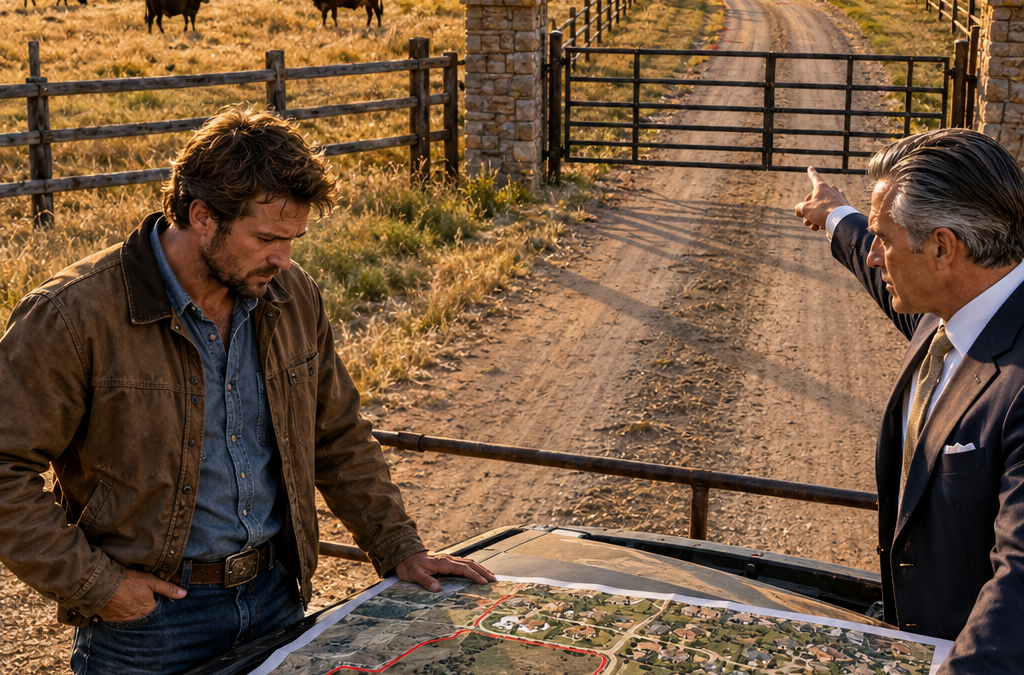
I looked down again.
The line representing the road seemed insignificant compared with the surrounding eight hundred and forty acres.
A narrow strip of ground.
A few hundred yards of pavement.
Yet it was the only road connecting the neighborhood to the county highway.
I didn’t realize then how important that detail would become.
I only knew that something on the map didn’t make sense.
And my grandfather had spent his life teaching me not to ignore things that didn’t make sense.
After the meeting, I drove directly toward Cedar Ridge Estates.
The afternoon was bright, and the road out of Ashford passed through miles of former farmland.
Every few miles, another subdivision appeared.
New houses replaced barns.
Shopping centers stood where cattle once grazed.
Land developers had been buying properties around town for years, turning empty fields into communities with impressive names and strict homeowner regulations.
Cedar Ridge was one of the most expensive.
Its entrance looked like the front gate of a private country club.
Two massive stone pillars supported black wrought-iron decorations. Carefully trimmed hedges bordered the median. A large metal sign displayed the neighborhood’s name in elegant lettering.
Beneath it was a smaller sign.
PRIVATE ROAD — HOA CONTROLLED ACCESS.
I slowed my truck.
That sign bothered me more than it should have.
I remembered the narrow strip on my grandfather’s map.
The road appeared to follow almost exactly the same route.
I drove through the entrance.
The pavement was smooth.
Large houses stood on either side, most with three-car garages, stone facades, and perfectly maintained landscaping.
A few homes had fountains near their entrances.
Others had decorative retaining walls and outdoor lighting designed to make them look like private estates.
It was hard to imagine that this development had once been part of my grandfather’s open ranchland.
I drove slowly.
I wasn’t looking for trouble.
I was trying to understand what I had inherited.
Near the eastern end of the main road, I noticed an older section of fencing partially hidden behind newer landscaping.
Most of the posts were weathered wood, completely different from the modern fencing used throughout the subdivision.
I pulled over.
Beyond the fence stood an old iron ranch gate.
Its hinges were rusted.
One side leaned slightly toward the ground.
Tall grass grew around the posts.
I climbed out and walked closer.
A faded metal sign was attached to the gate.
Most of the paint had disappeared, but I could still make out the lettering.
BENNETT RANCH.
I stopped breathing for a moment.
My grandfather’s name.
Right there.
Behind a neighborhood that claimed the surrounding road was private HOA property.
I touched the edge of the sign.
The metal was rough beneath my fingers.
I remembered seeing similar signs on the northern pastures when I was a boy.
Grandpa had installed them himself.
He liked plain lettering.
Nothing fancy.
Just the family name and enough information to make it clear which property someone was entering.
I looked back toward the road.
The new HOA signs stood in front of the neighborhood.
But nobody had bothered to remove this old one.
It was hidden behind shrubs, almost forgotten.
I wondered how many people had driven past without noticing it.
Then I heard an engine approaching.
A white luxury SUV slowed beside my truck.
The driver stopped and lowered the window.
A woman wearing a cream-colored blazer stared at me.
“Excuse me. What are you doing?”
I turned.
“Looking at the old gate.”
She glanced toward the sign.
“That’s not a public area.”
“I’m aware.”
“Then why are you standing there?”
I walked toward her vehicle.
“My name’s Jake Bennett. I just inherited the ranch behind this development.”
Her expression changed.
“Bennett?”
“Yes.”
She opened the door and stepped out.
She was a sharply dressed woman in her forties, with carefully styled blond hair and a leather handbag tucked beneath one arm.
“I’m Linda Whitmore,” she said. “Vice president of the Cedar Ridge Homeowners Association.”
I nodded.
“Nice to meet you.”
She didn’t return the courtesy.
“Are you conducting a survey?”
“Not yet. I’m examining the property.”
She looked toward my truck.
“You can’t simply drive through the neighborhood and inspect private facilities.”
I frowned.
“I’m not inspecting anyone’s house.”
“You’re standing beside HOA-maintained property.”
I pointed toward the gate.
“That sign has my grandfather’s name on it.”
She gave a dismissive laugh.
“That old thing? It’s been here forever.”
“Exactly.”
She folded her arms.
“It doesn’t mean anything. The HOA has controlled this road for decades.”
“Controlled it how?”
“We maintain it. We regulate it. We authorize access.”
“Do you own it?”
Her smile disappeared.
“The road belongs to the community.”
“According to what deed?”
She blinked.
“Excuse me?”
“Do you have a recorded deed showing the HOA owns this road?”
Her expression hardened.
“The association has used it for years.”
“That’s not what I asked.”
She took a step closer.
“Young man, I don’t think you understand how private communities operate.”
I almost laughed.
I was thirty-eight years old, and she was addressing me like a teenager trespassing in somebody’s backyard.
“I’m asking about ownership.”
“And I’m telling you the association has managed this road for decades.”
“Managing land doesn’t automatically make you the owner.”
She narrowed her eyes.
“You need to leave.”
I looked toward the old gate.
“I haven’t done anything illegal.”
“You’re interfering with community property.”
“By looking at my grandfather’s sign?”
Her face reddened.
“I’m contacting the president.”
“That’s fine.”
She took out her phone.
But instead of calling the HOA president, she dialed the police.
I heard her speak.
“Yes, I’d like to report a suspicious individual near our private entrance. He’s claiming ownership of community property and refusing to leave.”
I stared at her.
“Seriously?”
She turned away.
“He’s becoming confrontational.”
I shook my head.
I hadn’t raised my voice.
I hadn’t touched the gate beyond examining its old sign.
I hadn’t threatened anyone.
But in less than ten minutes, an HOA official had decided that my questions were dangerous enough to involve the police.
Linda ended the call.
“An officer is coming.”
“Good.”
She looked surprised.
“Good?”
“Yes. I’d rather have someone here who understands that property records matter.”
She smiled coldly.
“You may regret that.”
I returned to my truck, retrieved the copies Margaret had given me, and waited.
Fifteen minutes later, a patrol vehicle arrived.
The officer stepped out slowly, surveying the scene before approaching us.
He appeared to be in his early forties, with a calm expression and the deliberate movements of someone accustomed to walking into disagreements where both sides believed they were right.
His nameplate read REED.
“Afternoon,” he said. “Officer Marcus Reed. What’s going on?”
Linda immediately stepped forward.
“Officer, I’m Linda Whitmore, vice president of the Cedar Ridge HOA. This man has entered our private neighborhood and is claiming that our road belongs to him.”
Marcus looked at me.
“Sir?”
“My name’s Jake Bennett. I recently inherited my grandfather’s ranch. The estate records show that this area was historically inside our property boundary. I’m trying to verify the ownership of the access road.”
Linda interrupted.
“He’s questioning our right to control the entrance.”
Marcus held up one hand.
“Ma’am, I’ll hear both sides.”
She looked offended.
He turned back to me.
“Do you have documentation?”
“Yes.”
I unfolded the map across my truck’s hood.
Marcus stepped closer.
I showed him the historical survey, the location of the ranch gate, and the current subdivision road.
He studied the documents without rushing.
“These are estate records?”
“Yes. My attorney gave them to me this morning.”
“And you’re saying the road crosses the historical Bennett property?”
“That’s what the map shows. I’m trying to establish the current title.”
Marcus nodded.
Linda moved beside him.
“The neighborhood has been using that road for decades. We have entrance signs, maintenance records, and HOA regulations.”
Marcus looked at her.
“Do you have the recorded deed?”
She hesitated.
“The association has the appropriate records.”
“Do you have them here?”
“No.”
“All right.”
He stepped back from the truck.
“Here’s the situation. I can address threats, damage, or criminal conduct. But I can’t decide a disputed property boundary based on documents presented beside the road.”
I nodded.
“Understood.”
Marcus looked at Linda.
“Ma’am, if there’s a disagreement over ownership, that’s a civil matter. The county property records and, if necessary, the courts will determine the parties’ rights.”
Linda’s mouth tightened.
“But the HOA has controlled this road for decades.”
“That may be relevant to the legal dispute,” Marcus replied. “It doesn’t authorize me to declare ownership.”
She looked furious.
“Then you’re allowing him to interfere?”
Marcus glanced toward the gate.
“Has he damaged anything?”
“No.”
“Threatened anyone?”
“He’s demanding proof of ownership.”
Marcus paused.
“That’s not a criminal offense.”
I lowered my eyes, hiding a brief smile.
Linda looked as though she’d been slapped.
Marcus turned toward me.
“Mr. Bennett, I recommend you obtain the complete deed and easement history. Don’t block the road, remove signs, or interfere with residents while the matter is being reviewed.”
“I won’t.”
He looked toward Linda.
“And I recommend the association preserve any relevant documents and avoid escalating this into a confrontation.”
She gave a stiff nod.
But I could see that she wasn’t listening.
Marcus returned to his patrol vehicle.
Before leaving, he looked at me.
“Paperwork first, Mr. Bennett. That’s how you resolve something like this.”
I nodded.
“Thank you, Officer.”
He drove away.
Linda watched the patrol car disappear.
Then she turned toward me with a thin smile.
“You heard him. This is a civil matter.”
“I did.”
“Which means the police aren’t going to help you take our road.”
I folded the map.
“They didn’t say it was your road.”
Her smile faded.
“You’re making a mistake.”
“By checking the records?”
“By challenging the wrong people.”
I looked at the old gate.
“My grandfather owned this land long before Cedar Ridge existed.”
She stepped closer.
“And now Cedar Ridge exists. You need to accept that.”
I looked directly at her.
“Existence isn’t ownership.”
She stared at me.
Then she climbed into her SUV and drove away.
I stood beside the gate for a long moment.
The patrol officer hadn’t settled the dispute.
Linda clearly believed that meant she’d won.
But I understood something she apparently didn’t.
The police had explained exactly where the answer would be found.
Not in HOA rules.
Not in intimidation.
Not in a roadside argument.
In the recorded property documents.
And I intended to find every one of them.
The following morning, I drove to the Ashford County Records Office.
It was an old brick building near the courthouse, the kind of place where the hallways smelled faintly of paper, floor polish, and coffee that had been sitting on a warmer too long.
I arrived just after eight.
By eight-thirty, I was sitting across from a records clerk named Helen Parker.
She had short gray hair, rectangular glasses, and the patient expression of someone who had spent years helping people find documents they should have kept in the first place.
“I need the complete title history for the Bennett Ranch,” I explained. “And anything involving Cedar Ridge Estates or the entrance road.”
She typed the parcel information into her computer.
“How far back?”
“As far as the records go.”
She raised an eyebrow.
“That’s a lot of history.”
“I have a feeling I’m going to need it.”
She studied the screen.
Then she looked at the old survey I’d brought.
“Your grandfather kept this?”
“Yes.”
“Good man. A lot of people throw these things away.”
She began pulling records.
Deeds.
Subdivision plats.
Recorded easements.
Historical surveys.
Parcel divisions.
Transfer documents.
Some were available electronically.
Others required searching older books or archived images.
I spent the first two hours comparing names and dates.
My grandfather’s name appeared repeatedly.
So did his father’s.
And his grandfather’s.
The Bennett family had held land in that area for generations.
Over time, the property had been surveyed, adjusted, and divided for various purposes.
Some parcels had been conveyed.
Others remained in the family.
The original historical boundary extended across land that later became part of Cedar Ridge.
That explained why the red line surrounded the neighborhood.
But it didn’t automatically mean every occupied lot still belonged to me.
I was beginning to understand why Margaret had warned me against relying on a single map.
Then Helen returned carrying a thick folder.
“I found something interesting.”
She placed it in front of me.
The label read BENNETT FAMILY ACCESS PARCEL — HISTORICAL RECORDS.
I opened it.
Inside was a separate deed describing a narrow strip of land between the county highway and the old southern ranch entrance.
The legal description followed a defined corridor.
Its boundaries matched the road I’d driven the previous afternoon.
The road used by Cedar Ridge.
The road Linda Whitmore had insisted belonged to the HOA.
I looked up.
“Helen, what is this?”
“A separately recorded property parcel.”
“Who owns it?”
She turned to the recorded ownership information.
The Bennett family name appeared in the chain of title.
I followed the transfers with my finger.
There was no recorded sale of the road parcel to Cedar Ridge Estates.
No deed conveying it to the HOA.
No recorded transfer making the association its fee owner.
Instead, the title history showed the parcel remaining in the Bennett family.
I read the description again.
Then again.
My pulse began to rise.
“Are you telling me my grandfather still owned this road?”
“The recorded documents show that the parcel remained under your family’s ownership. You’ll want a title attorney to confirm the current interest and review any rights granted to other parties.”
I nodded quickly.
“What rights?”
She opened another document.
“This.”
It was an old access agreement.
The paper had been scanned from a signed original.
The agreement had been executed years earlier between my grandfather and the entity responsible for the early development.
It allowed defined use of the road corridor for access, subject to specific conditions.
Maintenance responsibilities.
Permitted purposes.
Restrictions on alterations.
Requirements concerning the ranch gate and adjacent property.
And a defined term.
I stared at the expiration provision.
The original arrangement had not been written as a perpetual transfer of ownership.
It was a limited agreement with conditions and a stated period.
The stated term had ended years earlier.
I sat back.
For several seconds, I couldn’t speak.
Linda had told me the HOA owned the road because it had used it for decades.
But the records showed something very different.
The family had retained ownership.
The development had been granted access under a written arrangement.
And nobody appeared to have bothered establishing a properly updated agreement after its stated term ended.
That didn’t automatically tell me whether the homeowners possessed other enforceable access rights.
I understood that much.
But it did tell me that the HOA’s claim of outright ownership was unsupported by the documents in front of me.
I studied my grandfather’s signature.
Walter Bennett.
The familiar uneven lettering made my throat tighten.
I could almost see him sitting at the farmhouse kitchen table, carefully reading every page before signing.
He hadn’t simply handed the road away.
He had allowed people to use it under conditions.
He had protected the land while making room for the development.
And somewhere along the way, the HOA had begun treating permission as ownership.
I asked Helen for certified copies of the relevant documents.
Then I called Margaret.
“I found the road.”
She sounded confused.
“What do you mean?”
“The access parcel. It’s separately deeded. Grandpa kept ownership.”
There was a pause.
“Are you certain?”
“I’m holding the records.”
“Bring them to my office.”
“I also found an access agreement.”
“What kind?”
“Limited term. Conditions. No transfer of title.”
Her voice changed.
“Jake, don’t take any action until a property attorney reviews it.”
“I won’t.”
“Especially the road. Those homes need access.”
“I know.”
I looked down at my grandfather’s signature.
“I don’t want to trap anybody, Margaret. I just want them to stop pretending Grandpa gave away something he never sold.”
“I understand.”
When I left the records office, I carried more than a folder.
I carried the first solid explanation of what had happened.
And for the first time since seeing that red boundary line, I knew exactly where I needed to focus.
Not on threatening homeowners.
Not on claiming their houses.
On the road parcel the HOA had been using as though it belonged to them.
I hired a property attorney named Daniel Foster.
He was in his mid-forties, quiet, analytical, and almost annoyingly careful about the wording of every legal document.
He didn’t interrupt when I explained the situation.
He simply examined the records, took notes, and asked questions.
When I finished, he spread three documents across his desk.
The separate road deed.
The historical survey.
The access agreement.
“Jake,” he said, “the ownership record is favorable to you.”
I leaned forward.
“How favorable?”
“The recorded chain of title supports your family’s continued ownership of the road parcel. I haven’t found a conveyance transferring fee ownership to the homeowners association.”
I exhaled.
“And the old agreement?”
“That requires careful analysis. The stated term has expired, but we also need to examine whether any subsequent agreements, recorded easements, homeowner conveyances, or other legal rights affect continued access.”
“So I can’t just tell the HOA to get off my road.”
He looked at me.
“I wouldn’t recommend anything remotely like that.”
“I wasn’t planning to.”
“Good. Because these are occupied homes. Whatever the association did wrong, the residents’ access and safety must be protected.”
I nodded.
He pointed toward the property map.
“Also, we need to distinguish the historic eight-hundred-and-forty-acre holding from the present title interests. The subdivision lots have their own conveyance histories. We’re not going to claim ownership of people’s houses merely because an old boundary surrounds them.”
“That’s fine.”
“What concerns us immediately is the separately recorded road parcel and the association’s claim that it owns and controls it.”
I looked at the documents.
“Linda Whitmore called the police on me for asking about that.”
Daniel’s eyebrows rose.
“Did she?”
“Yes.”
“Did the officer determine ownership?”
“No. He said it was civil.”
“Then he handled that part correctly.”
I sat back.
“What do we do?”
Daniel tapped the old agreement.
“We send formal notice. We request the HOA’s supporting title documents. And we make clear that continued access needs to be addressed through a lawful arrangement.”
“Can they just ignore us?”
“They can try.”
I studied his expression.
He wasn’t smiling.
“Will they?”
“Based on what you’ve told me about their leadership, I wouldn’t be surprised.”
Three days later, Daniel sent the notice.
It went to the Cedar Ridge HOA, its registered agent, its property management office, and the legal representatives identified in its records.
The letter was direct.
It identified the separately deeded road parcel.
Referenced the recorded title history.
Explained that the HOA had not established ownership of the corridor.
Requested copies of any additional instruments supporting its claims.
And proposed discussions concerning a properly documented arrangement for continued neighborhood access.
It also made clear that I had no intention of obstructing residents or interfering with emergency services.
I thought that would help.
I thought a calm, carefully documented letter would finally make the association take the issue seriously.
Instead, it made Hoa Karen furious.
He came to my ranch four days later.
I heard his vehicle before I saw it.
A black luxury SUV rolled slowly down the gravel driveway and stopped beside my grandfather’s old barn.
The driver’s door opened.
Out stepped a man who looked as though he’d been designed specifically to impress people.
Hoa Karen was fifty years old, tall and broad-shouldered, with silver-streaked black hair combed smoothly back from his forehead.
His skin was carefully groomed.
His jaw was clean-shaven.
A navy suit fitted him perfectly, and his black leather shoes looked absurdly expensive against the dusty ranch gravel.
A gold watch flashed beneath his sleeve.
He carried a leather portfolio.
Everything about him was polished.
Except his expression.
He looked furious.
Linda Whitmore climbed out of the passenger side.
She stood slightly behind him, watching me with open satisfaction.
I was replacing a broken hinge on the barn door when they arrived.
I set down my wrench.
“Can I help you?”
Hoa Karen walked toward me without offering his hand.
“I’m Hoa Karen, president of the Cedar Ridge Homeowners Association.”
“I know who you are.”
“Then you know why I’m here.”
I glanced at Linda.
“I can guess.”
He opened his portfolio.
“My association has received an extremely inappropriate letter from your attorney.”
I folded my arms.
“What part?”
“The implication that you own our neighborhood access road.”
“That’s what the recorded deed shows.”
He smiled coldly.
“Let me explain something, Jake. Cedar Ridge is an established residential community. We have substantial property values, binding association rules, and decades of lawful operation.”
“None of that is a deed.”
His smile vanished.
Linda stepped forward.
“We already explained that the road belongs to the community.”
I looked at her.
“And I asked you to show me the recorded transfer.”
Hoa Karen raised one hand, silencing her.
Then he moved closer.
“Do you understand how much disruption your allegations could cause?”
“Do you understand how much trouble checking the deed before claiming ownership could have saved?”
He narrowed his eyes.
“I don’t appreciate your tone.”
“I don’t appreciate you coming onto my ranch to tell me what my family owns.”
For a moment, neither of us spoke.
Then Hoa Karen looked toward the old barn.
“This property is clearly sentimental to you.”
I stared at him.
“What?”
“Your grandfather’s ranch. Your family name. All this old infrastructure.”
He gestured toward the weathered boards.
“I understand nostalgia.”
My hands tightened.
“My grandfather maintained this ranch for fifty years.”
“And now the surrounding area is changing.”
“That doesn’t change the deed.”
He sighed.
“You’re thinking like a farmer. I’m asking you to think like a businessman.”
I felt anger rise.
“Then show me the business document that proves your association owns the road.”
He opened his portfolio.
For a moment, I thought he might actually produce it.
Instead, he pulled out a proposed agreement.
He handed it to me.
I scanned the first page.
It asked me to acknowledge the HOA’s exclusive authority over the road corridor and waive competing ownership claims.
There were provisions limiting future objections to association maintenance and access improvements.
I looked up.
“You want me to sign away my rights?”
He smiled.
“We’re offering a practical solution.”
“What are you offering in exchange?”
“An end to this unnecessary dispute.”
I laughed once.
“You came here asking me to surrender a recorded property interest for the privilege of not arguing with you?”
His face darkened.
“You’re being unreasonable.”
“No. I’m reading what you handed me.”
He stepped closer.
“Forty-eight families depend on that road. Are you prepared to explain to them why you’re putting their homes at risk?”
I held the document toward him.
“Your HOA is the one claiming private ownership it hasn’t proved. I’m offering to resolve access legally.”
“We already control access.”
“Then why do you need my signature?”
He stopped.
For the first time, his confidence slipped.
Only briefly.
Then he snatched the document from my hand.
“You are making a very serious mistake.”
I looked directly at him.
“You’re welcome to have your attorney contact mine.”
His jaw clenched.
“Don’t hide behind lawyers.”
I gestured toward his portfolio.
“You brought me a legal agreement.”
Linda stepped beside him.
“Mr. Karen, we’re wasting our time.”
He ignored her.
His eyes remained fixed on mine.
“I can make this extremely difficult for you.”
The threat was quiet.
Almost conversational.
I felt a cold sensation move through my chest.
He was standing in my grandfather’s yard, surrounded by land my family had protected for generations, threatening me because I wouldn’t sign away an access parcel.
I said, “Get off my property.”
His face flushed.
“Excuse me?”
“You heard me.”
He took one deliberate step closer.
“You do not give orders to me.”
“On this ranch, I absolutely can.”
The silence lasted several seconds.
Then he turned sharply.
“Linda. We’re leaving.”
They climbed into the SUV.
Before pulling away, he lowered his window.
“This isn’t over, Jake.”
I watched him.
“No. It isn’t.”
The SUV disappeared down the driveway.
I stood beside the barn long after the dust settled.
My grandfather’s wrench lay where I’d dropped it.
I picked it up.
The metal was cold.
And for the first time since inheriting the ranch, I understood why Grandpa had been so particular about preserving records.
A man like Hoa Karen didn’t need to steal land with a bulldozer.
He could try to take it with an impressive suit, a false claim of authority, and enough pressure to make the owner surrender voluntarily.
But I wasn’t going to sign.
Not then.
Not ever.
The HOA announced an emergency meeting the following week.
By then, Hoa Karen had already begun telling residents that an outsider was threatening their access road.
A neighbor from Cedar Ridge called me after hearing the announcement.
Her name was Rachel Morgan.
She lived near the subdivision entrance with her husband and two children.
“Mr. Bennett?”
“Speaking.”
“I hope you don’t mind me calling. I got your number from the county property records.”
“That’s fine.”
She hesitated.
“Mr. Karen says you’re trying to close our road.”
I closed my eyes.
“Did he?”
“He said you claim the entrance belongs to you and that you might prevent us from using it.”
“I’m not closing anything.”
“Then why is he saying that?”
“Because he doesn’t want to acknowledge what the deed says.”
There was silence.
Then she asked, “Do you really own the road?”
“The recorded title supports my family’s ownership. My attorney is working on a legal arrangement that protects residents’ access.”
She sounded relieved.
“So you’re not trying to trap us?”
“No.”
Her voice trembled slightly.
“My youngest son has asthma. We can’t be worrying about whether an ambulance could get through.”
That hit me harder than any threat Hoa Karen had made.
“I’m not going to block emergency access, Rachel.”
“Thank you.”
After hanging up, I stood in my kitchen staring at the phone.
Hoa Karen was doing exactly what he’d threatened.
Turning the neighborhood against me.
Using forty-eight families as leverage.
Making ordinary people afraid of a danger I had never created.
I called Daniel.
“He’s telling residents I’m going to close the road.”
Daniel sighed.
“I suspected he’d do that.”
“What can we do?”
“We’ll address it at the meeting. With documents.”
“And if he lies?”
“Then we’ll correct the record.”
I looked toward the ranch entrance.
“He wants the residents frightened enough to force me into signing.”
“Then don’t let him control the facts.”
The meeting took place on a Thursday evening.
Cedar Ridge’s clubhouse was exactly what I expected.
Tall windows.
Polished hardwood floors.
Crystal pendant lighting.
A long conference table beneath a framed photograph of the subdivision entrance.
Everything looked expensive.
And everything was arranged to make the board members appear important.
Hoa Karen sat at the head of the table.
His navy suit was immaculate.
His silver watch rested beside a leather folder.
Linda sat to his right.
Several board members occupied the remaining chairs.
More than sixty residents crowded into the room.
I sat near the back with Daniel.
The meeting began with Hoa Karen standing behind a microphone.
“Good evening, everyone. As many of you know, our community is facing an unfortunate external challenge.”
I folded my arms.
He continued.
“An individual claiming inheritance rights over historical ranch property has begun questioning the legal status of our main access road.”
Several residents turned toward me.
Hoa Karen let the silence grow.
“This road has served Cedar Ridge for decades. Our association has maintained it, funded repairs, regulated access, and protected the community.”
A man near the front raised his hand.
“Doesn’t that mean we own it?”
Hoa Karen smiled.
“That’s certainly been the association’s longstanding understanding.”
Daniel leaned toward me.
“Interesting choice of words.”
Hoa Karen continued.
“Unfortunately, Mr. Bennett and his attorney have suggested that this arrangement is somehow invalid.”
A murmur moved through the room.
One woman asked, “Can he shut us out?”
Hoa Karen looked solemn.
“That is precisely what concerns the board.”
I felt anger rising.
He knew I had promised not to obstruct access.
He had received that assurance in writing.
Yet he was standing before frightened homeowners and implying that I might trap them inside their neighborhood.
Daniel raised his hand.
Hoa Karen looked irritated.
“Yes?”
“Daniel Foster. Counsel for Jake Bennett. I’d appreciate the opportunity to correct several statements.”
The president hesitated.
Then waved toward the front.
“Briefly.”
Daniel carried his documents to the table.
He didn’t raise his voice.
He didn’t accuse anyone.
He simply opened the original records.
“First, my client has not threatened to close the road. He has repeatedly stated that residents must retain safe and uninterrupted access.”
Several people visibly relaxed.
“Second, the recorded documents distinguish between the original Bennett Ranch boundary, the subsequently developed residential parcels, and a separately deeded access-road parcel.”
He unfolded the survey.
The thick red line surrounded the historical ranch holding.
The modern neighborhood occupied land within that old boundary.
But Daniel carefully explained that the historic outline alone didn’t determine the present ownership of every house lot.
Then he highlighted the road.
“This corridor is separately recorded. The chain of title supports ownership by the Bennett family, not fee ownership by the HOA.”
The room went quiet.
Hoa Karen leaned forward.
“Objection. That’s a selective interpretation.”
Daniel looked at him.
“Please identify the recorded conveyance transferring the road parcel to your association.”
Hoa Karen’s jaw tightened.
“We have maintained it for decades.”
Daniel nodded.
“Maintenance is not, by itself, proof of ownership.”
Linda interrupted.
“The residents have always used that road.”
“Yes,” Daniel replied. “And we have located a recorded agreement explaining why.”
He placed the old access document on the table.
Several board members leaned forward.
Daniel continued.
“The agreement granted defined access rights under specified conditions and for a stated term. It did not convey ownership of the road to the HOA.”
One board member looked stunned.
“There’s an actual agreement?”
“Yes.”
“Why haven’t we seen it?”
Daniel looked toward Hoa Karen.
“That would be a question for the association’s records.”
The president’s face turned red.
He started to speak, but a man in the second row stood.
“Wait. I want to understand something.”
Daniel nodded.
The man pointed at the map.
“If those records are correct, does Jake own our access road?”
The room became completely silent.
Daniel placed one hand on the recorded deed.
“The title evidence supports that Jake inherited the road parcel. Any additional access rights must be addressed through the proper legal process, but ownership of the underlying parcel was not transferred to the HOA by the agreement we’ve found.”
Nobody moved.
I watched the information settle across the room.
Some people looked confused.
Others looked angry.
Several turned toward Hoa Karen.
A woman near the window spoke.
“So the HOA has been telling us this road belongs to the association, but it doesn’t?”
Hoa Karen straightened.
“Let’s not jump to conclusions.”
She frowned.
“You’ve been using that road to justify our entrance regulations and maintenance assessments.”
“Those obligations are part of our community management.”
“But who owns it?”
Hoa Karen looked toward Linda.
She looked down.
Daniel quietly slid the certified deed across the table.
The woman studied it.
Then she looked up.
“Why didn’t anybody check this?”
Nobody answered.
A few seconds later, Hoa Karen struck the table with his palm.
“Enough!”
Several people jumped.
He stood.
“I will not allow an outside landowner to come into this community and undermine years of responsible leadership.”
I rose slowly.
Daniel glanced at me but didn’t stop me.
“Mr. Karen, I didn’t come here to take anyone’s home.”
He pointed at me.
“You’ve created uncertainty for forty-eight families.”
“No. The uncertainty was already there. I discovered the paperwork.”
He stepped around the table.
“You think inherited land gives you authority over this neighborhood?”
“No.”
I looked toward the homeowners.
“I think inherited land gives me the responsibility to protect what my grandfather legally owned. That’s why I’m asking for a proper agreement instead of pretending the records don’t exist.”
Hoa Karen smiled coldly.
“So you admit you’re demanding control.”
I shook my head.
“I’m demanding that ownership be respected.”
He looked toward the residents.
“Do you see? He wants leverage.”
I felt my patience thinning.
Then I remembered Rachel’s frightened voice.
Her son with asthma.
The other families who had done nothing wrong.
I took a breath.
“Nobody here is losing access because of me.”
The room quieted.
I continued.
“I have no intention of blocking the road. I don’t want your houses. I don’t want your gates. I don’t want control over your neighborhood.”
I looked directly at Hoa Karen.
“But I will not sign a document falsely saying your HOA owns land it never purchased.”
His smile disappeared.
The silence that followed was different from the earlier confusion.
People were thinking.
For the first time, they could see the difference between protecting access and claiming ownership.
Daniel returned to the microphone.
“My client has a practical proposal.”
Hoa Karen folded his arms.
“What proposal?”
Daniel looked across the room.
“Rather than grant the HOA exclusive private control over the road, Jake is prepared to explore selling the road parcel to Ashford County through a properly documented transaction.”
Several residents exchanged surprised looks.
Daniel continued.
“If the county accepts the road into its public system, the corridor can remain open under public control. The association will no longer need to rely on disputed private ownership claims.”
A homeowner near the front raised her hand.
“You mean the road would become public?”
“Subject to county approval, engineering inspection, and the required transfer process, yes.”
“Would we still be able to drive to our homes?”
“Yes. Maintaining reliable access is the purpose of the proposal.”
She looked relieved.
Another resident asked, “Would the HOA still be able to close it whenever the board wanted?”
Daniel shook his head.
“Not as a privately controlled HOA road. Public-road decisions would fall under the county’s lawful authority.”
The room began filling with quiet conversation.
For the first time that evening, people seemed to be discussing a solution instead of defending themselves against a threat.
Hoa Karen looked furious.
He leaned toward the microphone.
“Absolutely not.”
The room quieted again.
He continued.
“The association has invested substantial money into maintaining that entrance. We have established security arrangements and architectural standards. We cannot simply hand control of our road to the county.”
Daniel looked at him.
“Your road?”
Hoa Karen stopped.
The two words seemed to catch in his throat.
Daniel continued.
“The ownership record is precisely what brought us here.”
One board member turned toward the president.
“Why wouldn’t county control be better for residents?”
Hoa Karen stared at him.
“Because this is a private community.”
The board member frowned.
“The houses would still be private. We’re talking about the access road.”
“Public access could affect our standards.”
A woman near the back stood.
“I care more about having a legal road to my house than whether you can put a private sign on it.”
Several people applauded.
Hoa Karen looked around the room.
I could see him losing control.
For years, he had treated the road as an extension of his personal authority.
He decided which signs could be installed.
Which contractors could enter.
What restrictions applied to the entrance.
And now the residents were considering a solution that would take those decisions out of his hands.
He looked toward me.
“This is about humiliating me.”
I shook my head.
“This is about resolving a property issue.”
His jaw tightened.
“You planned this.”
“No. Grandpa planned to keep ownership of his land. I just read the paperwork.”
He glared at me.
But he had no answer.
The meeting ended without the HOA agreeing to my proposal.
Hoa Karen refused to endorse it.
Linda supported him.
Several board members requested additional legal advice.
The homeowners left with more questions than they’d brought.
But something important had changed.
The road was no longer merely a symbol of HOA authority.
It was a separate property parcel with a recorded history.
And the residents finally knew it.
I expected Hoa Karen to accept that he needed to negotiate.
Instead, he made the process harder.
Two days after the meeting, the HOA’s attorneys sent Daniel a formal objection.
They argued that converting the road to public access could affect the community’s security, maintenance arrangements, and private development expectations.
They also raised questions about the historical agreement and whether additional rights had arisen through years of neighborhood use.
Daniel read the letter carefully.
Then he called me.
“They’re going to contest the county proposal.”
“Can they stop me from selling property I own?”
“They can raise legal objections or assert rights they believe exist. We need those claims examined. But they don’t acquire title merely by objecting.”
I looked out the window toward the ranch.
“What do you recommend?”
“Proceed through the county’s formal evaluation. Let its officials decide whether the road meets their standards and whether acquiring it serves the public interest.”
“And the HOA?”
“They’ll receive whatever notice and opportunity to participate the process requires.”
I nodded.
“Then let’s do it.”
The application process began.
Daniel contacted the county transportation department and submitted the relevant title information.
We provided the surveys, the access-road description, the historical agreement, and the proposed transfer terms.
The county didn’t accept the idea immediately.
Officials wanted to know whether the road was suitable for public ownership.
They needed to examine its condition.
Its drainage.
Its connections to the county highway.
Its width.
Its right-of-way boundaries.
Its maintenance obligations.
And whether any unresolved legal rights would prevent a clean transfer.
I quickly learned that selling a road to the county was nothing like selling an old truck.
There were inspections.
Title requirements.
Engineering reviews.
Administrative hearings.
Public-interest considerations.
And documents that had to be drafted carefully enough to prevent the same confusion from happening again.
At one point, a county engineer named Robert Hayes met me near the entrance.
He was a tall man wearing a faded work jacket and carrying a measuring wheel.
He studied the road.
“Interesting place.”
I smiled faintly.
“That’s one word for it.”
He looked toward the private entrance sign.
“How long has the HOA been treating this as its road?”
“Years.”
“And you’re the recorded parcel owner?”
“That’s what the title records show.”
He nodded.
“Well, ownership is one issue. Taking this into the county system is another. We need to make sure we’re not inheriting a road that requires more repairs than the county can reasonably accept.”
“I understand.”
He pointed toward a drainage structure.
“That culvert will need a closer look.”
Then toward the pavement.
“We’ll test the road condition and review its construction records. We’ll also need the right-of-way description confirmed.”
I nodded.
“Whatever needs to be done properly.”
Robert looked at me.
“You’re not trying to close the road?”
“No.”
“Good. Because the families here need dependable access regardless of who’s arguing over the title.”
I looked down the street.
“That’s why I want the county involved.”
He studied me for a moment.
Then nodded.
“Fair enough.”
The inspection took several weeks.
Engineers checked the pavement.
Drainage structures were evaluated.
Survey information was reviewed.
The road’s connection to the highway was examined.
The county’s legal staff studied the proposed conveyance.
Any necessary adjustments and conditions were documented.
Throughout the process, the neighborhood continued using the road normally.
I never installed a gate.
Never placed a barrier.
Never threatened to stop residents from coming or going.
Hoa Karen, however, continued trying to turn the review into a personal battle.
He sent letters warning that public control might undermine neighborhood security.
He told residents that the county would no longer allow the HOA to enforce its private access policies on the transferred road.
That part was true.
But he presented it as a catastrophe.
At another board meeting, he declared that Cedar Ridge could lose its exclusivity.
A homeowner finally asked him a question that seemed to stop him cold.
“Mr. Karen, are we paying you to protect our property rights or to protect your control over the entrance?”
He didn’t answer directly.
He talked about neighborhood identity.
Property values.
Prestige.
The importance of maintaining standards.
But the residents had already seen the deed.
They knew the road’s ownership history.
And they understood that my proposal didn’t threaten their houses.
It threatened the HOA’s ability to treat the access road as private property it didn’t own.
One afternoon, I received another call from Rachel Morgan.
“Jake, did you hear about the latest HOA notice?”
“No.”
“They’re telling people the county might let strangers use our entrance.”
I sighed.
“A public road is generally open to lawful public travel.”
“I know. But Karen makes it sound like we’re about to lose our homes.”
“Are people believing him?”
“Some. Not as many as before.”
I leaned against the kitchen counter.
“That’s something.”
She was quiet.
Then she said, “I think he’s scared.”
“Of what?”
“Losing the right to tell everyone what they can do.”
I thought about Hoa Karen’s perfectly polished shoes and the way he had stood in my barnyard insisting that I sign his agreement.
“Maybe.”
Rachel continued.
“People are starting to ask why the HOA never found the original deed.”
I looked toward the filing cabinet where my grandfather’s papers were stored.
“That’s the question I’ve been asking from the beginning.”
The weeks passed.
I used the time to begin restoring the ranch.
The old barn needed serious attention.
Several roof panels were loose.
One support beam had water damage.
The southern fence line had collapsed in two places.
I spent mornings working on the property and afternoons answering calls from Daniel or reviewing documents.
Some days, the legal process felt endless.
I wondered whether Hoa Karen would find some technical objection that delayed everything.
I wondered whether the county would decide the road was too expensive to maintain.
I wondered whether the old access agreement would lead to another year of litigation.
Most of all, I wondered what my grandfather would think.
One evening, I found an old letter tucked inside his desk.
It wasn’t part of the official property folder.
It was handwritten on yellow legal paper.
The date was from years before his death.
He had written it to the original development representative.
Most of the letter concerned maintenance responsibilities and access conditions.
But one sentence made me stop.
I have no intention of keeping families from reaching their homes, but permission to use my land should never be confused with ownership of it.
I read it three times.
Then I sat down.
That was Grandpa.
Stubborn.
Careful.
Fair.
He hadn’t opposed families having homes.
He hadn’t opposed the town growing.
He had simply wanted the legal boundaries respected.
For a while, I sat in his old chair holding the letter.
I missed him terribly.
Not because I needed somebody to tell me what to do.
But because I finally understood how much responsibility he’d quietly carried.
The ranch hadn’t remained in the family by accident.
He had protected it through records, agreements, maintenance, and decisions that probably seemed boring to everyone else.
Now those decisions were protecting me.
I placed the letter in a protective sleeve beside the deed.
And the following morning, I called Daniel.
“Whatever happens, I want the families to keep access.”
He paused.
“I know.”
“No threats. No shortcuts. We do this properly.”
“That’s what we’ve been doing.”
I looked toward the southern hills.
“I think that’s what Grandpa would have wanted.”
Several weeks later, the county completed its technical review.
Robert Hayes called me personally.
“The road has passed the required engineering assessment, subject to the conditions addressed in our report.”
I gripped the phone.
“So the county will take it?”
“Not yet. The engineering side is only part of the process. The legal review and formal approval still have to be completed.”
I exhaled.
“Understood.”
“But the physical condition isn’t preventing the proposed acquisition.”
That was the first genuinely encouraging news I’d received in weeks.
The road was suitable for the county’s intended purpose.
The drainage and right-of-way questions had been addressed.
The remaining issues were legal and administrative.
Daniel prepared the final documentation.
The county’s legal staff reviewed the title.
The old access arrangement was considered as part of the transaction.
The proposed conveyance was structured to preserve lawful access while eliminating uncertainty over who owned and controlled the road.
Hoa Karen submitted one final objection.
He argued that public acquisition would diminish the HOA’s exclusive authority over the entrance.
That objection was revealing.
He was no longer seriously claiming to possess a recorded deed transferring the road to Cedar Ridge.
He was arguing that losing control would be bad for his organization.
The county reviewed the objection.
It considered the relevant property records, access requirements, and public-interest factors.
And then the official decision came.
The county approved the acquisition under the required conditions.
I was sitting in Daniel’s office when he told me.
For several seconds, I didn’t understand.
“Approved?”
He smiled.
“Approved.”
“The road?”
“Yes.”
I leaned back.
After months of uncertainty, conflict, legal reviews, and HOA threats, the answer was finally clear.
The county was prepared to complete the purchase and bring the road under public control.
The residents would retain access.
The ownership would be formally transferred.
The HOA would no longer be able to claim the road as its private property.
I stared at the documents.
“Grandpa would have liked this.”
Daniel smiled.
“I think he would have appreciated that you didn’t let anyone pressure you into signing away the parcel.”
I looked down at the recorded deed.
For the first time, I felt the weight of the dispute beginning to lift.
The closing took place after the remaining conditions had been satisfied.
I signed the official transfer documents.
The county representatives signed theirs.
The purchase was completed.
The deed was recorded.
And the separately owned road parcel passed from the Bennett family to Ashford County.
It was no longer an HOA-controlled private road.
It was public access under county authority.
I didn’t celebrate with champagne.
I didn’t call Hoa Karen.
I didn’t drive through Cedar Ridge waving documents at the residents.
I went home.
Made coffee.
Sat on my grandfather’s porch.
And listened to the wind moving through the trees.
The relief was almost difficult to describe.
For months, I’d felt as though I was defending something invisible.
A line on a survey.
A legal description.
An old agreement.
A principle that other people wanted me to abandon because honoring it was inconvenient.
Now that uncertainty had been replaced by a recorded transaction.
The road had a clear owner.
The residents had secure access.
And the HOA couldn’t rewrite the result with another board vote.
A few days later, I returned to Cedar Ridge.
County workers were replacing the old road signs.
I parked near the entrance and watched from a safe distance.
The decorative private-road sign had been removed as part of the approved changes.
The new sign identified the road under county control.
The workers checked its position and secured it.
Nothing about the moment was dramatic.
There were no crowds.
No television cameras.
No shouting.
Just a few county employees performing ordinary road work.
But I knew exactly what that small change represented.
The old HOA sign had claimed private control.
The new sign reflected the recorded public-road arrangement.
The difference was legal.
Permanent.
And impossible for Hoa Karen to dismiss as a misunderstanding.
I stood beside my truck as the workers finished.
Then I heard a familiar engine.
A black SUV approached from the county highway.
It slowed.
Then stopped.
Hoa Karen climbed out.
He wore a dark suit, as always, and his hair was carefully combed.
But his expression changed the moment he saw the new sign.
He walked toward it.
Stopped.
Read it.
Then turned toward me.
“What is this?”
I looked at the sign.
“The county’s road identification.”
His jaw tightened.
“Who authorized removing the private-road sign?”
“The county. Under the recorded transfer.”
He stared at me.
“You actually went through with it.”
“Yes.”
He looked back at the sign.
“The association has maintained this entrance for decades.”
“I know.”
“We paid for repairs.”
“I know.”
“We established access regulations.”
“I know.”
He turned sharply.
“Then how could you do this?”
I looked directly at him.
“Because maintaining a road isn’t the same as owning it.”
His face darkened.
“You’ve destroyed the character of this community.”
I glanced toward the houses.
The same elegant homes stood behind him.
The same lawns.
The same trees.
A woman was pushing a stroller along the sidewalk.
Two children were riding bicycles near a driveway.
Nothing about their lives had been destroyed.
“The houses are still here,” I said. “The families are still here. The road is open. Nothing has been taken away from them.”
He looked toward the county workers.
“The HOA no longer controls the entrance.”
“Correct.”
His voice dropped.
“You planned this to humiliate me.”
I shook my head.
“I planned it because you refused to acknowledge the property records.”
“You could have negotiated with us.”
“My attorney tried.”
He looked away.
I continued.
“You came to my ranch and demanded that I sign away my family’s rights. You threatened me when I refused. Then you told residents I wanted to trap them inside their neighborhood.”
His jaw tightened.
“That was never my intention.”
“Then you should have stopped saying it.”
The silence stretched.
A county truck passed slowly behind us.
Hoa Karen watched it go.
For the first time since I’d met him, he seemed genuinely uncertain about what to do next.
He couldn’t order the county employees to remove the sign.
He couldn’t threaten me with HOA fines over a parcel I had lawfully transferred.
He couldn’t claim the road belonged to Cedar Ridge.
And he couldn’t use the residents’ access as leverage anymore.
The property records had finally caught up with him.
He looked at me.
“You’ve made your point.”
I shook my head.
“This was never about making a point.”
“Then what was it about?”
I looked toward the distant ridge.
“Making sure the road belonged to whoever the law said owned it, and making sure the people living here could use it without being dragged into your argument.”
His expression hardened briefly.
Then he looked down.
For several seconds, I thought he might apologize.
Instead, he turned toward his SUV.
Before opening the door, he said, “The board will have questions.”
I nodded.
“They should.”
He climbed inside and drove away.
I watched his vehicle disappear into the neighborhood.
Then I looked at the new sign.
The road was public.
The dispute was over.
And I hadn’t needed to block a single car to make it happen.
The HOA held another meeting the following week.
This time, the purpose was straightforward.
The board needed to explain the new road arrangement to the homeowners.
The recorded transfer was presented.
County responsibility for the road was clarified.
Residents were told that normal access would continue.
The association could no longer treat the transferred roadway as privately owned HOA property or impose its former private-road controls where they conflicted with county authority.
Homeowners asked questions.
Would deliveries still arrive?
Yes.
Would emergency vehicles still have access?
Yes.
Could residents still drive to their homes?
Of course.
Would the county maintain the road under its public-road responsibilities?
That was now part of the approved arrangement.
The questions were ordinary.
Reasonable.
Nothing like the frightening scenarios Hoa Karen had described months earlier.
But the residents also wanted accountability.
One man asked why the HOA had never verified ownership before claiming exclusive control.
A woman asked why the old family access agreement hadn’t been disclosed.
Another homeowner wanted to know why the president had attempted to pressure me into signing away my rights.
Hoa Karen answered carefully.
He looked less comfortable than I’d ever seen him.
Linda Whitmore sat beside him, unusually quiet.
Eventually, Hoa Karen acknowledged that the association had relied too heavily on its history of maintaining and regulating the road without adequately examining the recorded title.
The board agreed that future property-related decisions would require proper documentation and independent review.
Residents demanded better oversight.
They wanted decisions based on actual legal authority rather than assumptions.
And the board had little choice but to listen.
The road was no longer a bargaining chip.
It was no longer something the HOA president could use to intimidate an outside landowner.
It was a public road serving the people who depended on it.
And everybody finally understood the difference.
A few days later, I was working near the southern pasture when a patrol vehicle stopped beside the fence.
Officer Marcus Reed stepped out.
He recognized me immediately.
“Mr. Bennett.”
I smiled.
“Officer Reed.”
He looked toward the distant subdivision.
“I drove past Cedar Ridge this morning.”
“Did you see the new sign?”
“I did.”
He gave a small smile.
“So you got the road issue resolved.”
“Yes. Sold the parcel to the county. Everything’s recorded.”
Marcus nodded.
“Good.”
I leaned against the fence.
“Remember when Linda Whitmore called you out because I was looking at Grandpa’s old gate?”
He chuckled.
“I remember.”
“She was pretty convinced you’d arrest me.”
Marcus shook his head.
“Property disputes can bring out some strong opinions.”
“That’s putting it mildly.”
He looked toward the road.
“You handled it the right way.”
I shrugged.
“Took longer than I expected.”
“Usually does.”
He paused.
“But you didn’t create a roadblock, didn’t threaten residents, and didn’t try to settle ownership in the street. You got the documents and followed the process.”
I looked toward the hills.
“That’s what Grandpa would’ve wanted.”
Marcus nodded.
“Sounds like he was a smart man.”
“He was.”
We talked for a few more minutes.
Then he returned to his patrol car.
As he pulled away, he lowered the window.
“Take care of that ranch, Jake.”
I smiled.
“Planning on it.”
After he left, I stood beside the fence for a while.
The legal dispute had consumed months of my life.
But the ranch still needed attention.
Fences didn’t repair themselves.
Barn roofs didn’t replace their own missing panels.
Fields didn’t clear fallen trees just because an attorney had won an argument.
I put away the legal folders and returned to the work I’d inherited.
Over the following months, I repaired the southern fence line.
Replaced broken posts.
Cleared old brush.
Rebuilt a section of the cattle gate.
And began restoring my grandfather’s barn.
The barn had been standing since long before I was born.
Its red paint had faded to a dull brown in places.
Several boards were warped.
The roof leaked near the eastern wall.
But the main structure was sound.
I hired a local carpenter to help with the larger repairs.
Together, we replaced damaged sections, reinforced the old doors, repaired the roof, and restored the siding.
I kept the original iron hinges wherever possible.
They were old.
Heavy.
And still worked.
Just like so many things my grandfather had believed were worth preserving.
One afternoon, while repairing the barn’s interior shelves, I found a small wooden box tucked behind a loose board.
Inside were photographs.
Grandpa standing beside the old ranch gate.
My father riding a horse across the southern pasture.
A picture of the farmhouse before the porch was rebuilt.
And one photograph of the access road before Cedar Ridge existed.
It was nothing more than a dirt track through open land.
My grandfather stood beside it wearing his usual work clothes.
He had one hand resting on the gatepost.
The Bennett Ranch sign was visible above him.
I sat down on an old wooden bench.
For a long moment, I studied the photograph.
The road had changed completely.
The town had grown.
The houses had appeared.
The HOA had spent years pretending the corridor belonged exclusively to its community.
But the recorded history had never vanished.
It had simply been forgotten by the people who found it inconvenient.
I placed the photograph in a new frame and hung it in the farmhouse.
Not as a trophy.
As a reminder.
That evening, I walked up the hill overlooking the southern portion of the ranch.
The sun was beginning to set.
Golden light stretched across the pasture.
The restored barn stood near the farmhouse.
New fence posts followed the old boundary.
Beyond the ridge, I could see the rooftops of Cedar Ridge Estates.
The neighborhood looked peaceful.
Cars moved along the county road.
Porch lights began glowing.
People were coming home from work.
Families were preparing dinner.
Children were riding bicycles along the sidewalks.
The road I’d spent months fighting over was doing exactly what it was supposed to do.
Connecting people to their homes.
I thought about the first day in Margaret Ellis’s office.
The thick red line.
The unexpected acreage.
The shock of seeing an entire modern neighborhood within the historical ranch boundary.
I remembered Linda Whitmore laughing when I questioned the road’s ownership.
Officer Marcus Reed explaining that police couldn’t settle a civil title dispute.
The hours inside the county records office.
The old family deed.
The access agreement.
The expiration date.
And the moment Daniel confirmed that the separate road parcel had never been transferred to the HOA.
I remembered Hoa Karen standing in my grandfather’s yard, demanding that I sign away my rights.
His polished suit.
His expensive watch.
His certainty that being HOA president made him more important than the documents in front of him.
He had wanted control.
That was what the entire dispute had come down to.
Not safety.
Not access.
Not the needs of forty-eight families.
Control.
He had convinced himself that because the HOA maintained a road, regulated its entrance, and displayed private signs, the association must own it.
When I questioned him, he didn’t investigate.
He threatened me.
When I produced records, he didn’t reconsider.
He frightened the residents.
When I offered a legal solution, he opposed it because the result would place the road beyond his authority.
But the records had outlasted his arguments.
I looked toward the county road.
It remained open.
Nobody was trapped.
Nobody had been forced to leave a home.
Nobody had needed to be threatened or punished.
The county had reviewed the engineering requirements, approved the acquisition, and recorded the transfer.
The homeowners had secure access.
The HOA had clear limits.
And my grandfather’s remaining ranchland was protected.
The resolution wasn’t dramatic in the way people often imagine victories.
There had been no bulldozers.
No locked gates.
No revenge.
No moment when I stood in the road and told forty-eight families they couldn’t pass.
There had been documents.
Surveys.
Attorneys.
Inspections.
Meetings.
Signatures.
And a final recorded deed.
That was enough.
I reached the top of the hill and stopped beneath an old oak tree.
From there, I could see nearly the entire ranch.
Eight hundred and forty acres of family history, with the property’s current boundaries and interests finally understood instead of guessed at.
The restored fields stretched beneath the evening sky.
The barn stood straight again.
The old fence line followed the contours of the hills.
And beyond the southern ridge, the neighborhood continued peacefully beside the county road.
I took the original survey from the folder I had carried with me.
The paper was worn.
The red boundary line was still visible.
It no longer frightened me.
Now I understood what it represented.
The original ranch.
The historical divisions.
The parcels that had been conveyed.
And the small but crucial strip of land my grandfather had kept in the family until the day he died.
I thought about what he would have said if he’d known the HOA president had spent decades claiming ownership of his road.
He probably would have laughed.
Then he would have taken out the deed.
Because Grandpa had never believed that a loud voice could change a legal boundary.
And he certainly wouldn’t have believed that a homeowners association could acquire ownership merely by behaving as though it already had it.
I folded the survey carefully.
For years, my grandfather had protected this property without recognition.
He paid attention to details other people ignored.
Kept records other people considered unimportant.
And made agreements that balanced his rights with the needs of those around him.
When I inherited the ranch, I thought he’d left me land.
But he’d left me something else, too.
A way of thinking.
A belief that ownership carried responsibilities.
That protecting what belonged to you didn’t require hurting innocent people.
And that real authority came from lawful rights, not the ability to intimidate someone into silence.
I watched the last sunlight settle over the southern pasture.
The road was no longer mine.
I’d chosen to sell it through the proper legal process.
And that was exactly the point.
It had been my family’s property to transfer lawfully, not the HOA’s property to claim through repetition and arrogance.
The decision had been mine.
The process had been documented.
The residents were protected.
And the law had settled what threats never could.
I started walking back toward the farmhouse.
Behind me, the neighborhood lights flickered on one by one.
Ahead, the restored barn glowed beneath the fading sky.
For the first time since my grandfather’s funeral, the ranch felt completely like home.
Not because every acre looked the way it had fifty years earlier.
Not because the town had stopped growing.
But because I finally understood what my grandfather had entrusted to me.
The HOA president had believed that decades of using my family’s road made it his to control.
He was wrong.
And when the truth finally came out, I didn’t need to shut the entrance, threaten the residents, or fight him in the street.
I only needed to find the records, establish the ownership, and make a decision he had no legal authority to prevent.
The neighborhood kept its road.
The county took responsibility for it.
The HOA lost its claim to private control.
And my grandfather’s ranch remained protected.
As I reached the porch, I looked back once toward the southern hills.
Then I understood the lesson he’d tried to teach me when I was a boy.
A person can draw a new map, erect an expensive gate, install a private-road sign, and spend decades acting like a piece of property belongs to them.
But none of those things changes the recorded truth.
And when the day comes that someone finally opens the old deed, all that borrowed authority can disappear with a single question.
Where is the document proving you own it?








