𝗙𝗨𝗟𝗟 𝗦𝗧𝗢𝗥𝗬 I Inherited 1,300 Acres and Found an Entire HOA Neighborhood Sitting Inside the Lines on My Grandfather’s Deed
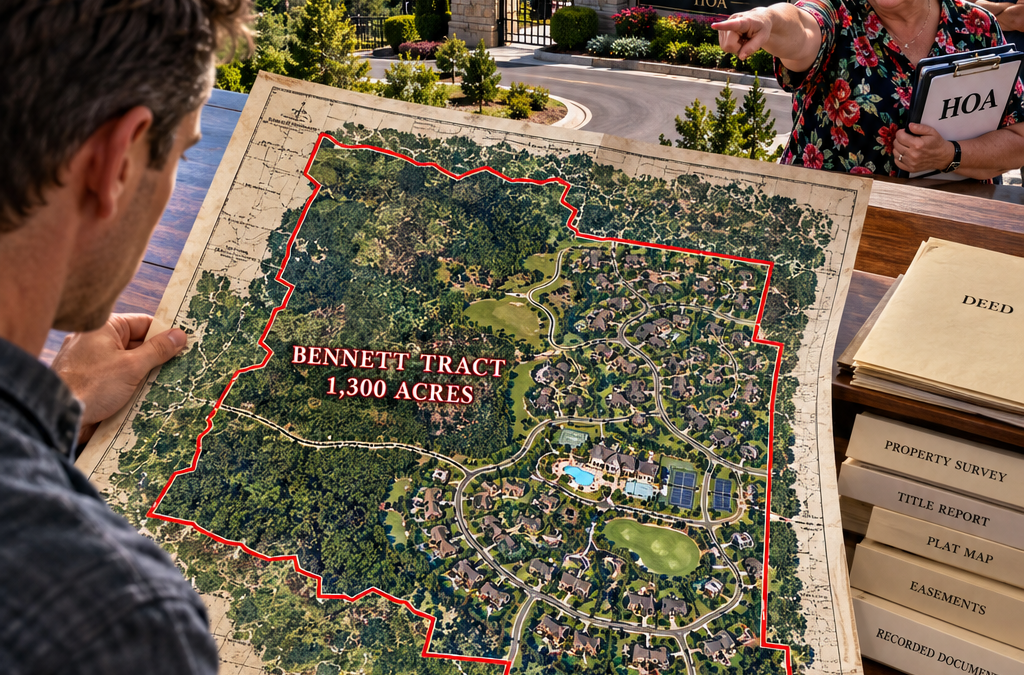
𝗙𝗨𝗟𝗟 𝗦𝗧𝗢𝗥𝗬
Then assumed I had misunderstood.
The boundary was irregular.
The subdivision sat near the eastern side.
A dense collection of curved streets and cul-de-sacs.
Maybe the map was showing a historic boundary rather than current ownership.
That would make sense.
Land gets subdivided.
Parcels get sold.
Deeds get recorded.
Grandpa had probably sold that section decades earlier.
I kept reading.
The title summary listed exclusions.
Recorded easements.
Rights-of-way.
Timber agreements.
But I could not find a clean conveyance transferring the subdivision parcel itself out of the original tract.
That didn’t mean one didn’t exist.
It meant I hadn’t found it.
The next morning, I drove there.
The development was called Briar Glen Estates.
I had passed its entrance before without thinking about it.
Stone columns.
Landscaping.
Black iron gates.
A guard booth.
A carved sign announcing the community name.
The entrance road curved through a strip of woods and disappeared between expensive homes.
I parked on the public shoulder outside the gate.
Then took out Grandpa’s old survey.
The road alignment bothered me immediately.
I had spent twenty years around site plans.
Road geometry becomes recognizable.
There was an old access line on the survey following almost exactly the same path as Briar Glen’s entrance road.
Not close.
Almost exact.
I walked along the shoulder, comparing trees, drainage, and bearings.
A voice interrupted me.
“Can I help you?”
I turned.
A woman in a red blazer stood several yards away.
Mid-fifties.
Hair cut neatly at the jaw.
Tablet in one hand.
She looked less like she’d come to help than like she’d come to establish jurisdiction.
“I’m fine.”
“You’re taking photographs of our entrance.”
“I was comparing a survey.”
“Our security staff noticed you.”
I glanced at the booth.
“That was fast.”
She didn’t smile.
“I’m Evelyn Carter. HOA president.”
“Michael Bennett.”
Her expression changed slightly.
“Bennett?”
“Yes.”
“Any relation to Arthur Bennett?”
“My grandfather.”
Now she looked interested.
“I see.”
“I inherited his property.”
“I’m sorry for your loss.”
“Thank you.”
She glanced at the folded survey.
“What exactly are you looking for?”
“The boundary.”
“Which boundary?”
“My property.”
Evelyn laughed.
Not cruelly.
More like I had said something strange.
“Your grandfather’s land is outside Briar Glen.”
“That’s what I always thought.”
“It is.”
I unfolded part of the survey.
“This road seems to cross the original Bennett parcel.”
She barely looked.
“Old maps are often inaccurate.”
“This one is recorded.”
“So are ours.”
“Good.”
I nodded.
“Then it should be easy to compare them.”
Her eyes narrowed slightly.
“Why?”
“Because the title records I received after my grandfather died show a much larger legal description than I expected.”
“How large?”
“Thirteen hundred acres.”
“Yes, everyone knows the Bennett land is extensive.”
“According to one map, Briar Glen is inside it.”
The smile vanished.
“That is not possible.”
“Maybe.”
“It’s not.”
“I’d still like to see the recorded deed conveying the underlying parcel to the association or developer.”
She crossed her arms.
“The HOA owns the community roads and common property.”
“Okay.”
I waited.
She waited too.
“Can you show me the recorded deed?”
Her expression became guarded.
“I don’t carry property records around with me.”
“I didn’t expect you to.”
“Then what exactly do you want?”
“Nothing today.”
I folded the survey.
“I’m trying to understand what I inherited.”
“You inherited forest.”
“Apparently more than I thought.”
Evelyn stepped closer.
“Mr. Bennett, Briar Glen has existed for decades.”
“I’m not questioning the houses.”
“Then what are you questioning?”
“The land underneath parts of them.”
That sentence changed the conversation.
She looked toward the guard booth.
Then back at me.
“You’re standing outside a private community making claims about property occupied by hundreds of families.”
“I’m standing on the public shoulder looking at a survey.”
“Do you intend to disrupt access?”
“No.”
“Challenge homeowners’ deeds?”
“I have no idea.”
“Then perhaps you should stop suggesting things you haven’t verified.”
That was fair enough.
I nodded.
“That’s exactly why I’m checking.”
She didn’t like that answer.
“Do not enter the community without authorization.”
“I wasn’t planning to.”
“And don’t interfere with the gate.”
“I’m not.”
She walked away.
I drove back to Grandpa’s cabin with more questions than I had started with.
That night, I spread everything across the dining table.
Modern tax map.
Historical survey.
Estate title report.
Grandpa’s handwritten notes.
Old legal descriptions.
A property dispute looks simple until you begin reading deeds.
Then language starts swallowing the world.
Beginning at an iron pin.
Thence north eighty-two degrees…
Along the centerline of…
Excepting therefrom…
Subject to…
Together with…
Reserving…
I read until midnight.
One legal description covered land much farther east than I expected.
Far enough to encompass Briar Glen.
Another document referenced access rights.
A third mentioned a development agreement but did not contain the full agreement itself.
I went to bed believing one thing clearly.
I needed a real property attorney.
The HOA letter arrived the next morning.
Certified.
Evelyn worked fast.
BRIAR GLEN ESTATES HOMEOWNERS ASSOCIATION
NOTICE TO CEASE INTERFERENCE WITH COMMUNITY PROPERTY
The letter accused me of inspecting the community entrance, questioning established property interests, and creating potential concern among residents.
It demanded that I refrain from interfering with association-owned roads, gates, and common areas.
I read it twice.
The strange part was that I hadn’t interfered with anything.
I had stood outside with paper.
The letter felt defensive.
That made me more curious.
I called James Miller.
James had represented my company on a commercial easement problem several years earlier.
Quiet man.
About fifty.
Never dramatic.
The kind of lawyer who could make an angry client calm simply by refusing to become angry with him.
He drove to the cabin that afternoon.
I handed him the HOA letter first.
He read it.
“Did you touch the gate?”
“No.”
“Enter their property?”
“No.”
“Threaten anyone?”
“No.”
“What did you say?”
I told him.
When I got to the question about the deed, he stopped me.
“Good question.”
“I thought so.”
“Not because it proves anything.”
“I know.”
He set the letter aside.
“Show me your records.”
We worked for three hours.
James compared parcel numbers.
Read deed chains.
Marked contradictions with yellow tabs.
Finally he leaned back.
“Michael.”
“What?”
“Who owns the underlying parcel?”
I stared at him.
“That’s what I’m asking you.”
“No.”
He tapped the records.
“That’s what these documents are asking.”
He explained.
A subdivision can contain several layers of property interests.
Individual homeowners may own their lots.
An HOA may own common areas.
Roads might be privately owned or held under easement.
Utilities might have separate rights.
A developer may have acquired development rights without acquiring every underlying fee interest.
Long-term use could create additional complications.
Nothing about Grandpa’s deed automatically meant I owned people’s houses.
Nothing about the HOA’s decades of operation automatically meant it owned every inch beneath its roads either.
“Do not walk into this assuming you’ve inherited a neighborhood,” James said.
“I don’t.”
“Good.”
“I inherited a problem.”
“That is much more likely.”
I laughed.
“Can they stop me from examining public records?”
“No.”
“Can they demand I stop questioning ownership?”
“They can demand anything on letterhead.”
He picked up the HOA notice.
“Whether it means anything is another matter.”
“What do we do?”
“We build the chain.”
“How far back?”
“Until it makes sense.”
The following morning, we went to the county recorder’s office.
James knew exactly what to request.
Not only current deeds.
Parent tracts.
Historic conveyances.
Recorded plats.
Easements.
Subdivision approvals.
Development agreements.
Road dedication documents.
Anything tied to Grandpa’s parcel or the early Briar Glen developer.
Boxes came out.
Microfilm.
Scanned records.
Old maps large enough to cover half a table.
One of the oldest maps showed the full Bennett tract.
Thirteen hundred acres.
Briar Glen’s modern footprint fell almost entirely within the eastern section of that historic boundary.
I stared.
“So I was right.”
James didn’t even look up.
“About historical boundaries.”
“But—”
“Do not celebrate maps before we finish reading deeds.”
“I wasn’t celebrating.”
“You had the face.”
“What face?”
“The client-found-something face.”
I sat down.
He was right.
We found an access agreement next.
Recorded years before the subdivision was fully built.
The agreement granted rights over a roadway corridor beginning at the public highway and extending into what would later become Briar Glen.
That explained the entrance.
At least partly.
I followed the legal description.
Then stopped.
“This ends.”
James leaned over.
“Where?”
I pointed.
The recorded access corridor extended only through a portion of the road system.
It did not describe every internal street.
It did not appear to convey fee title.
It was a right to use.
Not ownership.
“What does that mean?”
“It means exactly what the paper says.”
“Which is?”
“They had recorded access through this described corridor.”
“Only this corridor?”
“Based on this document.”
“What about the rest?”
“We keep looking.”
Another hour.
Then another.
We found Briar Glen’s original development agreement.
The wording was different from what Evelyn had told me.
The developer had represented that it had rights sufficient to construct and maintain certain access and infrastructure.
But several sections referred to underlying ownership remaining subject to prior title interests.
James read one paragraph three times.
“Interesting.”
“Good interesting?”
“No such thing.”
“What are you seeing?”
“This doesn’t say the association bought everything.”
“What does it say?”
“That certain common-use areas were to be operated and maintained by the association.”
“That’s not ownership.”
“Correct.”
“So they don’t own them.”
He looked at me.
“Don’t leap.”
“Right.”
“Operation is not ownership. But ownership could be elsewhere in another deed.”
“Somewhere we haven’t found.”
“Exactly.”
By late afternoon, we had enough contradictions to know the problem was real.
Not enough to know the solution.
James asked:
“Do you have the deed your grandfather actually received?”
“The original?”
“Yes.”
“There are copies here.”
“I want the original closing document if he kept it.”
I thought about Grandpa’s cabin.
Then remembered the metal box.
He kept it beneath an old workbench in the back room.
Fireproof.
Heavy.
I’d seen him open it maybe twice.
“Maybe.”
We drove back.
The key was taped beneath the workbench exactly where he had always kept it.
Inside the metal box:
Birth certificates.
Insurance policies.
My grandmother’s jewelry receipt.
Old stock certificates.
A will from 1989.
Then a folded deed in a protective sleeve.
Handwritten legal description.
Old seal.
Grandpa’s name.
James carried it to the table like it was fragile.
We compared the metes and bounds against the modern survey.
He used a scale.
Then mapping software.
Then the county parcel layer.
He stopped talking.
I knew enough about James to understand silence mattered.
“What?”
He leaned closer to the screen.
Then returned to the deed.
“This legal description is huge.”
“I know.”
“No. I mean it appears to carry the historic tract through the eastern boundary.”
“Through Briar Glen.”
“Yes.”
I sat down.
“How?”
“I don’t know yet.”
“How can hundreds of houses exist on land my grandfather still owned?”
“Careful.”
His voice sharpened.
“Do not say that.”
“But—”
“Individual homes may have perfectly valid deeds to their lots.”
“Inside his boundary?”
“Property history is not a coloring book. Overlapping descriptions, reserved interests, leases, easements, development rights, partial conveyances—these things happen.”
“So what did he own?”
James looked at the deed.
“That’s what we’re going to determine.”
That night I barely slept.
Not because I imagined evicting anybody.
I didn’t.
The idea was absurd.
Families lived there.
Mortgages existed.
Children went to school from those houses.
People had bought in good faith.
I wasn’t interested in becoming some cartoon land baron claiming a gated neighborhood because of one old deed.
What disturbed me was the opposite.
How had nobody told me?
How had Grandpa never explained?
Had he known?
Of course he’d known some of it.
He kept the deed.
He had negotiated something.
But what?
The next several weeks became a title archaeology project.
James hired a professional surveyor and title researcher.
We found documents in county files.
State archives.
Old developer records.
The pattern slowly emerged.
Decades earlier, the original Briar Glen developer had entered into agreements with Grandpa and another adjacent landholder.
Certain parcels were sold outright.
Others were not.
Rights were granted for construction.
Road access.
Utilities.
Drainage.
Temporary development use.
Some documents contemplated later conveyances.
Several were recorded cleanly.
Others were not followed through as expected.
The individual residential lots generally had their own title chain.
Those were not the core problem.
The confusing areas were the roads, entrance corridors, and some common land connecting them.
The HOA had spent years treating those areas as if operational control meant full underlying ownership.
The records did not support that assumption as cleanly as Evelyn believed.
James explained it to me one evening.
“Think of it like this. The homeowners aren’t sitting in your living room.”
“Good.”
“Their lots are largely separate.”
“Also good.”
“But the HOA’s road and common-area interests appear to depend on a patchwork of rights.”
“And some of that patchwork sits on my inherited parcel.”
“Potentially.”
“Potentially?”
“Until survey work and title opinions are final, you will keep hearing me say potentially.”
“Lawyers must love that word.”
“It pays well.”
I laughed.
Then became serious.
“What can they actually do?”
“Continue operating the roads for now.”
“Even if the underlying land is mine?”
“Existing recorded rights don’t disappear because ownership changes.”
“I understand.”
“And long-standing use may create additional arguments.”
“Prescriptive rights?”
“Possibly. Estoppel. Implied rights. Contract theories. There are many ways this gets expensive if anyone decides to act stupid.”
“So don’t act stupid.”
“That’s always my premium legal package.”
The HOA, unfortunately, was becoming more aggressive.
Evelyn sent a second letter.
Then their attorney sent one.
They characterized my questions as an attempt to destabilize established community rights.
That phrase bothered me.
I hadn’t threatened anything.
James wrote back.
His response was clinical.
Our client does not dispute the legitimate title interests of individual homeowners and has made no attempt to interfere with access or occupancy.
However, historical title review indicates unresolved questions concerning fee ownership and recorded use rights affecting certain association-controlled roads and common areas.
We request copies of all deeds and instruments upon which the association relies in claiming underlying ownership.
The HOA’s attorney responded with hundreds of pages.
James and I sat down expecting the missing deed.
It wasn’t there.
There were plats.
Maintenance agreements.
Insurance records.
Board resolutions.
Tax documents.
Developer correspondence.
But nothing cleanly conveying certain disputed underlying parcels to the HOA.
James looked at me.
“They may genuinely believe they own this.”
“They don’t?”
“I said may.”
I threw a pen at him.
He laughed.
“We need a meeting.”
Evelyn resisted at first.
Then agreed when James proposed both lawyers attend.
The meeting took place at the Briar Glen clubhouse.
First time I’d been inside the gate.
Security let us through after checking our names.
I drove slowly.
Hundreds of homes.
Landscaped medians.
Children riding bikes.
People walking dogs.
I remember thinking how surreal it was that a title problem could exist under something so established.
Nothing looked uncertain.
That’s the deceptive thing about property law.
A paved road looks owned.
A fence looks definitive.
A gate looks authoritative.
But asphalt doesn’t prove title.
Paper does.
Sometimes very old paper.
The clubhouse conference room was polished and cold.
Evelyn sat across from me.
Her attorney beside her.
His name was David Rhodes.
Older than James.
Silver hair.
Calm.
He had the expression of a man who understood the meeting might become unpleasant and intended to prevent it.
Evelyn began.
“We want to make one thing clear.”
James raised a hand.
“Let’s avoid speeches.”
Her face tightened.
David almost smiled.
James continued.
“No one here is challenging homeowners’ occupancy. No one is blocking roads. No one is threatening access.”
I nodded.
“Correct.”
David looked at me.
“Then what does Mr. Bennett want?”
“Clarity.”
Evelyn answered before I could.
“He’s claiming to own our neighborhood.”
“No.”
I looked at her.
“I have never said that.”
“You told me the subdivision was inside your property.”
“I told you the historical boundary was inside the deed I inherited.”
“Same thing.”
“No.”
James slid a binder forward.
“Not remotely the same thing.”
David opened it.
James had tabbed everything.
Grandpa’s original deed.
Historical survey.
Modern overlay.
Access agreement.
Development contract.
Recorded subdivision map.
Later transfers.
Then the gaps.
David read quietly.
Evelyn began talking about decades of HOA maintenance.
Road resurfacing.
Snow removal.
Landscaping.
Insurance.
James did not argue.
“All relevant.”
Evelyn looked surprised.
“We have maintained those roads for over thirty years.”
“That may support use rights and contractual obligations.”
“So this whole exercise is pointless.”
“No.”
David was still reading.
Then he stopped.
Went back one page.
Compared Grandpa’s deed to the recorded subdivision map.
His face changed.
Not dramatically.
But enough.
He looked at James.
“Do you have a certified copy?”
James slid it over.
“County-certified plus original available for inspection.”
David read the legal description again.
The room went silent.
Evelyn noticed.
“What?”
He didn’t answer immediately.
“David?”
He looked at her.
“We need additional title review.”
She frowned.
“You told me our records were clear.”
“I said the association’s operational rights were well documented.”
“Same thing.”
“No.”
He used almost the exact word James had used.
“Not the same thing.”
Evelyn looked from one attorney to the other.
Then at me.
I didn’t smile.
Didn’t gloat.
The records were complicated enough that I knew certainty could turn on me just as quickly.
David asked James:
“Are you asserting fee ownership of the entrance road?”
“We are asserting that the Bennett deed appears to retain an underlying fee interest subject to recorded access rights.”
“And internal roads?”
“Some sections remain unclear.”
“Common areas?”
“Some appear separately conveyed. Others don’t.”
David nodded slowly.
“This needs a full reconciliation.”
Evelyn seemed almost offended by complexity.
“The community has operated this way for decades.”
James replied:
“Duration does not make records unnecessary.”
“But families rely on these roads.”
“No one is proposing to close them.”
She turned to me.
“Then what do you want?”
That was the first time anyone had asked directly.
I looked at James.
He didn’t answer for me.
Good lawyer.
“My grandfather left me thirteen hundred acres.”
I said it slowly.
“I want to know what that means.”
Evelyn folded her arms.
“And once you know?”
“We make a lawful agreement.”
“What kind?”
“I don’t know yet.”
That answer seemed to unsettle her more than a threat would have.
She was prepared to resist a land grab.
She wasn’t prepared for patience.
The title investigation took another two months.
By then, residents had heard rumors.
Of course they had.
Someone posted online that I intended to charge every homeowner rent.
False.
Another claimed I was planning to close the gate.
False.
Someone else said I wanted millions in back payments.
Also false.
I told James I wanted to issue a statement.
He agreed, provided it was boring.
So we sent one.
The review concerns historical land ownership and recorded access rights affecting certain HOA-controlled infrastructure. It does not challenge ownership of individual homes, and there is no intention to restrict current access while the matter is being resolved.
I thought that would calm everyone.
It calmed maybe half.
Fear doesn’t always yield to facts once imagination takes over.
One evening, an older man appeared at the cabin.
He introduced himself as Thomas Reed.
Briar Glen resident.
“Can we talk?”
“Sure.”
He stood on the porch.
“My wife is scared we’re going to lose the house.”
“You’re not.”
“You don’t know that.”
“I do know I’m not trying to take it.”
He studied me.
“My deed is good?”
“I’m not your attorney.”
His face tightened.
“But based on what we’re reviewing, individual homeowner lots aren’t what this is about.”
“So what is it about?”
“The roads.”
“Roads?”
“And some common areas.”
He stared.
“That’s it?”
“That’s enough.”
He laughed nervously.
“Evelyn made it sound like you woke up owning three hundred houses.”
“That’s not true.”
“Why isn’t she saying that?”
“You’d have to ask her.”
Thomas looked toward the forest.
“Your grandfather knew about us?”
“I think so.”
“Why didn’t he ever say anything?”
“I wish I knew.”
That question followed me for weeks.
Then I found a clue.
Another letter in Grandpa’s metal box.
Not a deed.
Personal correspondence.
From the original developer.
The letter thanked Grandpa for allowing continued road and infrastructure use under an interim arrangement while final land transfers were being completed.
Final land transfers.
Apparently some were completed.
Some weren’t.
There were references to a future payment structure if specified parcels remained under Bennett ownership.
That line caught James immediately.
“This helps.”
“How?”
“It shows everyone understood continued use and ownership were separate questions.”
“Could Grandpa have collected money?”
“Maybe he did.”
We searched tax and bank history.
There had been payments decades earlier.
Then they stopped.
No obvious explanation.
Maybe Grandpa had waived them.
Maybe the developer dissolved.
Maybe obligations shifted when the HOA assumed maintenance.
Maybe everyone forgot.
Property history doesn’t always end with a dramatic legal mistake.
Sometimes people retire.
Companies close.
Files disappear.
Responsibilities blur.
And the next generation assumes the pavement answers the question.
James eventually produced what he called the least exciting life-changing memo I’d ever receive.
Forty-three pages.
Title reconciliation.
Survey exhibits.
Rights matrix.
Parcel-by-parcel analysis.
The conclusion was careful.
I did not own Briar Glen’s individual residential lots.
I did retain underlying fee interests in portions of land used by HOA-controlled roads and certain common areas, subject to recorded easements and long-established use rights.
Other areas had been conveyed outright and belonged to the association.
Still others required negotiated clarification because historic records were incomplete.
It was complicated.
Very complicated.
But one thing was clear.
The HOA’s statement that it simply “owned the community roads and surrounding common areas” was not fully supported by the record.
The next question was money.
I hated that part.
Not because I didn’t want compensation.
If someone uses land you own for roads, gates, drainage, landscaping, and community infrastructure, that use has value.
But I didn’t want the dispute turning into extortion.
James agreed.
“Don’t invent a number.”
“How do we calculate it?”
“Appraisal.”
We hired an independent land-use appraiser.
He examined comparable easements.
Private road arrangements.
Maintenance burdens.
Land value.
Scope of use.
Exclusivity.
Duration.
Restrictions imposed on me as underlying owner.
The number he produced was far higher than I expected.
Not because the HOA suddenly owed me the value of hundreds of houses.
It didn’t.
Because the use involved critical infrastructure serving an entire gated development.
The entrance road.
Internal circulation portions.
Utilities.
Landscaped common corridors.
Long-term exclusive practical use.
“What do we do with this?” I asked.
“Negotiate.”
“Retroactive payment?”
James looked at me.
“Do you want a war?”
“No.”
“Then start with the future.”
That was exactly what I wanted.
I wasn’t interested in punishing people for mistakes made before some residents were born.
I wanted the records fixed.
Rights defined.
Compensation fair.
No future owner—mine or theirs—should have to repeat this.
The second formal meeting was very different.
Evelyn still wore red.
But the confidence had changed.
David Rhodes had completed his own title review.
He didn’t dispute the central findings.
There were arguments over extent.
Valuation.
Maintenance obligations.
Insurance.
Indemnity.
Term.
Renewal rights.
Road improvements.
Who could widen what.
Emergency access.
Utilities.
Every word mattered.
At one point Evelyn said:
“We’ve never budgeted anything close to this.”
I said:
“I understand.”
“This annual payment is several times what the old arrangement ever contemplated.”
“That old arrangement disappeared decades ago.”
“Residents will pay for this.”
“They already pay for roads they use.”
“Not land under them.”
“Because everyone assumed the land was already yours.”
Her face tightened.
“You’re benefiting from a clerical mess.”
That bothered me.
I leaned forward.
“My grandfather owned this land before Briar Glen existed.”
“I’m not disputing that.”
“Then don’t call his deed a clerical mess.”
The room quieted.
I continued.
“I haven’t blocked one road.”
“No.”
“I haven’t threatened one homeowner.”
“No.”
“I haven’t demanded back rent.”
David glanced at Evelyn.
She said nothing.
“I came here because your association sent me a letter ordering me to stop questioning property it couldn’t prove it owned.”
That landed.
James touched my arm slightly.
Enough.
I sat back.
Negotiations continued.
Three weeks.
Then six.
The HOA commissioned its own valuation.
Lower, obviously.
We met in the middle.
The final land-use agreement ran nearly ninety pages.
It confirmed the HOA’s continuing access and operational rights over specifically mapped road and common-area corridors.
It confirmed my underlying ownership where applicable.
It protected homeowner access.
It established maintenance responsibilities.
Insurance.
Repair obligations.
Improvement procedures.
No unilateral expansion beyond the mapped corridors.
No interference with my remaining forest land.
Clear dispute-resolution procedure.
Recording requirements.
And an annual land-use payment.
The number was substantial.
Several times larger than the HOA had previously budgeted under whatever vague historical assumptions had existed.
Not enough to bankrupt the association.
Enough to force a budget change.
Evelyn hated it.
I could tell.
But even she understood that certainty had value.
Without an agreement, future disputes could be far more expensive.
On signing day, we met at David’s office.
James sat beside me.
Evelyn across.
The final documents were stacked neatly.
I signed first.
Michael Bennett.
Thirteen hundred acres suddenly felt less abstract beneath my hand.
Evelyn signed for the association.
Then she set down the pen.
For a moment, neither of us spoke.
Finally she said:
“When we first met, I thought you were trying to take the neighborhood.”
“I know.”
“And you thought I was hiding something.”
“I thought you were very certain about documents you wouldn’t show me.”
She almost smiled.
“Fair.”
I looked at the agreement.
“I never believed I owned your residents.”
“I know that now.”
“I inherited land.”
“Complicated land.”
“Apparently my grandfather didn’t believe in easy paperwork.”
That actually made her laugh.
Then she became serious.
“I wish he’d dealt with this.”
“So do I.”
“Do you think he knew?”
I had asked myself that a hundred times.
“Some of it.”
“Why wouldn’t he fix it?”
I looked out the office window.
“I think Grandpa cared more about keeping the forest than administrating old development rights.”
“That’s a very expensive form of disinterest.”
“Apparently.”
We shook hands.
No friendship.
No dramatic reconciliation.
Just an agreement.
That was enough.
The annual payment became the story residents cared about.
Numbers always travel faster than context.
At the next HOA meeting, the clubhouse was packed.
I didn’t attend.
I heard about it afterward.
Residents demanded explanations.
Why had the board believed it owned the roads?
Who reviewed title at development turnover?
Why were old agreements never reconciled?
How could fees increase because of a deed signed before most of them moved there?
All fair questions.
Evelyn had to answer them.
The board adjusted the budget.
Some planned beautification projects were delayed.
The HOA increased dues modestly and moved other money from reserves.
People complained.
Then life continued.
Roads stayed open.
Gates stayed.
No homeowner lost anything.
The agreement got recorded.
That was the part I cared about.
Recorded.
Not sitting in Grandpa’s metal box.
Not understood by one developer and forgotten by another.
Not buried in a lawyer’s file.
Recorded in a way the next person could find.
James handed me the stamped copy.
“Keep this somewhere better than under a workbench.”
“I was thinking metal box.”
He stared.
“Kidding.”
“You’re becoming difficult.”
“Expensive education.”
“You paid me to become difficult.”
“True.”
I went back to the cabin.
That evening, I drove the old forest road west.
Away from Briar Glen.
Deer crossed ahead of me.
The sun fell behind the ridge.
For months, the inheritance had become paper.
Parcel numbers.
Legal descriptions.
Negotiations.
Money.
I had almost forgotten why Grandpa loved the land.
I parked near the meadow.
Walked to the edge.
Thirteen hundred acres did not feel like power.
It felt like responsibility.
That surprised me.
When I first saw the subdivision inside the boundary, some primitive part of my brain reacted to scale.
All that land.
All those roads.
All that value.
But records had taught me something.
Ownership is rarely as simple as possession.
My deed could say the ground was mine while an easement gave someone else the legal right to cross it every day.
A road could look like HOA property while the underlying fee belonged elsewhere.
A homeowner could possess perfect title to a house surrounded by infrastructure governed through layered agreements created before they were born.
Land accumulates history.
Every generation writes another sentence on it.
Grandpa’s mistake, if I can call it that, was trusting old arrangements to remain understood.
They didn’t.
The HOA’s mistake was assuming use had become ownership merely because nobody challenged the assumption.
Mine would have been believing an old deed gave me absolute control over everything inside its lines.
James prevented that.
More than once.
A few months later, Thomas Reed—the resident who had come to my cabin frightened about his house—called.
“Can I come by?”
“Sure.”
He brought beer.
We sat on the porch.
“So it’s done?”
“Recorded last week.”
“My house is still mine?”
I laughed.
“Your house was always yours.”
“You know what I mean.”
“I do.”
He handed me a bottle.
“Evelyn explained the agreement.”
“How’d that go?”
“Three hours.”
“That sounds like Evelyn.”
Thomas smiled.
Then looked toward the woods.
“You’re getting paid for our roads now.”
“Yes.”
“Does that feel strange?”
“Very.”
“You going to buy a yacht?”
“Absolutely.”
He glanced at the old cabin.
“Before fixing the porch?”
“Priorities.”
He laughed.
Then became serious.
“I was mad at you.”
“I know.”
“I thought you were coming after us.”
“I know.”
“I’m sorry.”
“You were scared.”
“Still.”
“No harm.”
He nodded.
“Would you have closed the road if we refused?”
That question had crossed my mind during negotiations.
Not because I wanted to.
Because legal leverage exists whether you use it or not.
“I don’t know.”
He looked surprised.
“I probably would’ve gone to court.”
“Not blocked the gate?”
“No.”
“Why?”
“Because hundreds of people depended on that road before I understood the title, and they didn’t create the paperwork problem.”
Thomas sat quietly.
“That’s decent.”
“No.”
I shook my head.
“That’s practical.”
Maybe both.
Grandpa would’ve mocked me for getting philosophical.
He was a simpler man.
Know your line.
Keep your promises.
Don’t sell timber before checking the market.
Never lend tools you want back.
That kind of wisdom.
I wish he had been alive during the dispute.
I would have asked him everything.
Did he know Briar Glen sat partly within the deed?
Did he receive payments?
Why did they stop?
Did the developer promise a final transfer?
Did Grandpa refuse?
Was there an argument?
Or did life simply move on until everyone forgot?
I never got those answers.
That bothered me for a while.
Then less.
Not every mystery needs a villain.
Sometimes history is just unfinished administration.
People die.
Companies dissolve.
Documents sit in boxes.
New boards inherit assumptions.
Thirty years later, someone unfolds a deed and discovers that everyone has been living inside a sentence nobody reread.
A year after the agreement, Evelyn called.
I hadn’t spoken with her in months.
“We need to widen a drainage section near the entrance.”
“Okay.”
“It’s inside the mapped corridor.”
“Then follow the agreement.”
“We are.”
That made me smile.
“What do you need from me?”
“Written acknowledgment.”
“Send the plan.”
She did.
Survey.
Engineering notes.
Exact area.
No drama.
I signed acknowledgment.
Construction happened.
Nobody threatened anyone.
That’s what good paperwork looks like.
Boring.
Clear.
Useful.
The HOA payment arrives every year.
Direct deposit.
The first time it hit my account, I stared at the number.
Not because I had forgotten it.
Because money makes abstract rights physical.
Grandpa’s land had quietly carried a road used by hundreds of families.
Now that relationship had a documented value.
I set most of the money aside for taxes, forest management, erosion control, road maintenance, and conservation work on the western acreage.
That felt appropriate.
The land paying for the land.
I repaired the cabin roof.
Rebuilt part of the old trail.
Hired a forester to thin an unhealthy section of timber.
Started a small conservation agreement around the spring.
Nothing glamorous.
No yacht.
Thomas still asks.
Briar Glen kept growing in value.
Luxury homes changed hands.
Children grew up.
New residents moved in who knew nothing about the dispute until they read the HOA disclosure packet.
That was another provision I insisted on.
Future buyers would be told.
Not frightened.
Informed.
Certain road and common-area corridors operate under recorded land-use rights over underlying Bennett ownership interests.
Plain enough.
James called that sentence the most expensive thirty words he’d ever written.
I told him his invoices suggested otherwise.
Five years later, I stood again outside the Briar Glen entrance with Grandpa’s old survey.
Not because anything was wrong.
A young surveyor was updating monument locations.
Evelyn happened to drive by.
She stopped.
Got out.
Red blazer again.
Maybe she owned thirty.
“Inspecting my gate?”
She smiled when she said it.
I looked at her.
“Your gate?”
She laughed.
“Fine. Our gate on your underlying land subject to recorded association rights.”
“Much better.”
“You lawyers ruined normal speech.”
“James did most of it.”
We stood beside the road.
Cars entered.
Security arm lifted.
Dropped.
Lifted again.
Evelyn looked toward the neighborhood.
“You know, I still hate explaining that annual payment.”
“I know.”
“But I sleep better knowing the documents are clean.”
“So do I.”
She glanced at the survey.
“What are you doing with the rest of the thirteen hundred acres?”
“Mostly leaving it alone.”
“Developers call you?”
“Constantly.”
“Everyone has a price.”
I looked at her.
She realized where the phrase had landed.
Then laughed softly.
“Bad choice of words.”
“Maybe.”
“Do you?”
“Have a price?”
She nodded.
I looked toward the forest.
“Probably.”
“Really?”
“Everyone says no until the right question comes along.”
“What question?”
“I don’t know yet.”
That was honest.
Grandpa spent his life protecting land.
I didn’t believe honoring him required freezing thirteen hundred acres forever.
But I also knew the title now.
Every line.
Every easement.
Every right.
Anyone who wanted to buy from me would negotiate with someone who understood exactly what was being sold.
That was the inheritance Grandpa truly left.
Not just land.
The obligation to know what the paper meant.
The old metal box still sits in the cabin.
I replaced the lock.
Inside it is Grandpa’s original deed.
Not the only copy anymore.
Certified copies exist.
Digital scans.
Recorded references.
James insisted on redundancy.
But I keep the original.
Sometimes I unfold it.
The handwriting is fading.
The legal description is dense.
No drawing of houses.
No gate.
No curved streets.
Nothing indicating what would eventually rise across the eastern tract.
Just bearings.
Distances.
Monuments.
Thirteen hundred acres described in language written before Briar Glen existed.
That piece of paper caused months of fear.
Arguments.
Legal bills.
Negotiations.
A new annual payment nobody had budgeted.
But it also fixed something that had been drifting unresolved for decades.
That matters more.
People tell the story now in exaggerated versions.
A man inherits an HOA.
A grandson discovers he owns hundreds of homes.
A neighborhood suddenly has to pay rent.
None of those versions is accurate.
I never owned the people.
Never owned their lives.
Never challenged their houses.
What I inherited was land layered beneath decades of agreements nobody fully understood anymore.
Some rights belonged to me.
Some belonged to the HOA.
Some had been granted long before I arrived.
The solution wasn’t conquest.
It was definition.
That distinction matters.
Property disputes become dangerous when people reduce them to one sentence.
My deed says this.
We’ve used it for thirty years.
The road is inside our gates.
The land is inside my boundary.
All can be true at once.
The work begins after the simple statements stop.
Who owns the fee?
Who holds the easement?
What does the easement allow?
Who maintains?
Who insures?
Who can expand?
Who pays?
What happens next?
Those questions saved us from a much uglier fight.
James once told me:
“Land law is mostly people discovering that lines have footnotes.”
I wrote that down.
Grandpa would’ve hated it.
Too clever.
But true.
When I was a boy, I thought the boundary was where Grandpa pointed.
Past that ridge.
Down to the creek.
Until the timber changes.
Now I know a boundary can run beneath pavement, behind gates, through landscaped medians, alongside houses, and across legal rights created by people long dead.
I also know owning land doesn’t mean being able to ignore everyone whose life has become attached to it.
That was probably the most important lesson.
The first morning I saw Briar Glen on the map, I felt invaded.
That emotion embarrassed me later.
Hundreds of people had homes there.
They weren’t invaders.
They bought houses in good faith.
Paid dues.
Raised children.
Maintained roads.
They inherited assumptions just as surely as I inherited Grandpa’s deed.
Evelyn made the same emotional mistake in reverse.
When I questioned the road, she felt I was attacking the community.
I wasn’t.
But fear makes boundaries feel personal.
It took both of us months to understand that paperwork wasn’t choosing sides.
It was describing relationships.
The final agreement is not romantic.
Nobody frames ninety pages of easement language.
But maybe they should.
It turned uncertainty into stability.
Residents know access cannot be casually withdrawn.
I know the HOA cannot expand onto additional land without consent.
They maintain what they use.
I receive compensation.
Future boards can’t pretend they own what they don’t.
Future Bennett heirs can’t pretend the HOA has no rights where it does.
Everyone knows.
That is worth more than the annual payment.
A few weeks ago, I took my nephew to the cabin.
He’s eleven.
Same age I was during some of my best summers with Grandpa.
We walked the western trail.
He asked:
“How big is this place?”
I almost said thirteen hundred acres.
Then I heard Grandpa’s voice.
I pointed.
“Past that ridge.”
My nephew frowned.
“How far?”
“Down to the creek.”
“That’s not an answer.”
I smiled.
“Until the timber changes.”
He rolled his eyes.
Exactly the way I once had.
Then he asked:
“Is that neighborhood yours too?”
Kids hear everything.
“No.”
“But Dad said it was inside your land.”
“Parts of the land under some roads belong to us.”
“So it is yours.”
“No.”
He looked confused.
I laughed.
“Someday I’ll explain easements.”
“Sounds boring.”
“It is.”
“Then don’t.”
Fair.
We kept walking.
At the top of the ridge, you can see part of Briar Glen through the trees.
Roofs.
A piece of the entrance road.
The clubhouse in the distance.
When I was young, Grandpa avoided taking me there.
Now I don’t.
It’s part of the story.
Not a mistake to hide.
Not a neighborhood sitting illegally in the middle of my inheritance.
A complicated piece of land history that finally got put into words.
I stood there with my nephew.
Forest behind us.
Subdivision below.
Both connected to the same old deed.
And I understood something about Grandpa I hadn’t before.
Maybe he didn’t explain because, to him, Briar Glen was never the important part.
The forest was.
The cabin.
The meadow.
The creek.
The things he touched every day.
The legal rights beneath distant roads may have been something he considered paperwork somebody else would eventually sort out.
That somebody became me.
I wish he’d left instructions.
He didn’t.
Instead, he left a metal box.
An original deed.
And thirteen hundred acres asking to be understood.
So I understood them.
Eventually.
Not perfectly.
But enough.
If there is one thing I would tell anyone buying or inheriting land, it is not to trust appearances.
A fence is not a deed.
A road is not a deed.
A gate is not a deed.
Thirty years of assumptions are not a deed.
And even a deed is not the whole answer until you read the easements attached to it.
Know what you own.
Know what others have the right to use.
Know what was promised before you arrived.
Because property doesn’t forget agreements just because people do.
Briar Glen had spent decades believing the land question was settled.
I spent forty-two years believing Grandpa’s thirteen hundred acres were mostly forest.
Both of us were wrong.
The truth sat in county records, in an old development agreement, and in a handwritten deed inside a metal box beneath a cabin workbench.
Once we finally put all of those pieces on the same table, the argument became much less dramatic.
The neighborhood stayed.
The roads stayed.
The gates stayed.
My land stayed mine where the record said it was mine.
The HOA kept the rights it could actually prove.
And the rights nobody had properly defined were finally replaced with a written agreement that neither side had to guess about again.
Sometimes the biggest property battles aren’t won by taking land.
They’re resolved by finally understanding it.
And when I look at Grandpa’s original deed now, I no longer see a neighborhood trapped inside thirteen hundred acres.
I see what was really there all along.
A boundary.
A history.
A web of promises.
And one old piece of paper that finally forced everyone to stop assuming and start reading.
𝗧𝗛𝗘 𝗘𝗡𝗗
I Inherited 1,300 Acres and Found an Entire HOA Neighborhood Sitting Inside the Lines on My Grandfather’s Deed
The first time I unfolded my grandfather’s complete property map, I thought I was looking at it wrong because an entire gated neighborhood—hundreds of homes, private roads, a clubhouse, and acres of common land—appeared to be sitting inside the boundaries of the land I had just inherited.
By the time the HOA president stood across from me insisting they owned every road beneath those houses, I had already learned enough to know that the most dangerous sentence in any property dispute is, “That’s how everyone has always understood it.”
My grandfather never described his land in acres.
Not when I was a child.
If I asked how big it was, he would point.
“Past that ridge.”
Or:
“Down to the creek.”
Sometimes he’d say:
“Until the timber changes.”
Those answers frustrated me when I was eight.
I wanted a number.
A clean answer.
He had one, of course.
Thirteen hundred acres.
But to him, acreage was paperwork.
The real property was the forest itself.
The old logging road.
A stone cabin beside a spring-fed pond.
The ridge where deer crossed at dusk.
The open meadow where he taught me to shoot cans off fence posts when I was twelve.
The place smelled different from anywhere else I knew.
Pine.
Wet leaves.
Wood smoke in winter.
I spent portions of nearly every summer there growing up.
My parents lived several hours away, but Grandpa liked having me.
At least I think he did.
He wasn’t a sentimental man.
He’d say:
“You’re useful enough.”
Then hand me a shovel.
His name was Arthur Bennett.
He acquired the property over decades.
Some through family.
Some through purchases from neighboring timber owners.
Some through transactions I never understood until much later.
When I was young, I assumed all thirteen hundred acres were uninterrupted forest.
Why wouldn’t I?
That’s what Grandpa showed me.
He never drove me toward the eastern edge where the land gradually approached development.
We stayed around the cabin and the western timber.
Once, when I was maybe fourteen, I remember hearing construction equipment somewhere beyond a ridge.
I asked him what it was.
“Houses.”
“On your land?”
“No.”
That was all he said.
I believed him.
Years passed.
I went to college.
Built a career managing commercial construction projects.
Married.
Divorced.
Moved twice.
Grandpa got older.
The summers became occasional weekends.
Then phone calls.
By the time he died, I was forty-two.
He left me the land.
Not because I was the only grandchild.
I wasn’t.
My sister inherited financial assets.
My cousin received another smaller property.
But Grandpa knew I was the one who still returned to the cabin.
The will described the inheritance simply enough.
“All remaining real property associated with the Bennett tract, approximately 1,300 acres, together with improvements and appurtenant rights.”
Approximately.
That word turned out to hide an entire neighborhood.
The first month after probate was paperwork.
Taxes.
Insurance.
Estate records.
Timber-management contracts.
Utility easements.
Old leases.
Maps.
My attorney at the time sent me digital title reports, but I also received several boxes of original documents from Grandpa’s home.
I expected to find familiar things.
The cabin.
Forest roads.
Water rights.
Boundary surveys.
What I did not expect was a modern aerial map showing hundreds of roofs inside an outline labeled BENNETT TRACT.
I stared at it for several minutes.
Then assumed I had misunderstood.
The boundary was irregular.
The subdivision sat near the eastern side.
A dense collection of curved streets and cul-de-sacs.
Maybe the map was showing a historic boundary rather than current ownership.
That would make sense.
Land gets subdivided.
Parcels get sold.
Deeds get recorded.
Grandpa had probably sold that section decades earlier.
I kept reading.
The title summary listed exclusions.
Recorded easements.
Rights-of-way.
Timber agreements.
But I could not find a clean conveyance transferring the subdivision parcel itself out of the original tract.
That didn’t mean one didn’t exist.
It meant I hadn’t found it.
The next morning, I drove there.
The development was called Briar Glen Estates.
I had passed its entrance before without thinking about it.
Stone columns.
Landscaping.
Black iron gates.
A guard booth.
A carved sign announcing the community name.
The entrance road curved through a strip of woods and disappeared between expensive homes.
I parked on the public shoulder outside the gate.
Then took out Grandpa’s old survey.
The road alignment bothered me immediately.
I had spent twenty years around site plans.
Road geometry becomes recognizable.
There was an old access line on the survey following almost exactly the same path as Briar Glen’s entrance road.
Not close.
Almost exact.
I walked along the shoulder, comparing trees, drainage, and bearings.
A voice interrupted me.
“Can I help you?”
I turned.
A woman in a red blazer stood several yards away.
Mid-fifties.
Hair cut neatly at the jaw.
Tablet in one hand.
She looked less like she’d come to help than like she’d come to establish jurisdiction.
“I’m fine.”
“You’re taking photographs of our entrance.”
“I was comparing a survey.”
“Our security staff noticed you.”
I glanced at the booth.
“That was fast.”
She didn’t smile.
“I’m Evelyn Carter. HOA president.”
“Michael Bennett.”
Her expression changed slightly.
“Bennett?”
“Yes.”
“Any relation to Arthur Bennett?”
“My grandfather.”
Now she looked interested.
“I see.”
“I inherited his property.”
“I’m sorry for your loss.”
“Thank you.”
She glanced at the folded survey.
“What exactly are you looking for?”
“The boundary.”
“Which boundary?”
“My property.”
Evelyn laughed.
Not cruelly.
More like I had said something strange.
“Your grandfather’s land is outside Briar Glen.”
“That’s what I always thought.”
“It is.”
I unfolded part of the survey.
“This road seems to cross the original Bennett parcel.”
She barely looked.
“Old maps are often inaccurate.”
“This one is recorded.”
“So are ours.”
“Good.”
I nodded.
“Then it should be easy to compare them.”
Her eyes narrowed slightly.
“Why?”
“Because the title records I received after my grandfather died show a much larger legal description than I expected.”
“How large?”
“Thirteen hundred acres.”
“Yes, everyone knows the Bennett land is extensive.”
“According to one map, Briar Glen is inside it.”
The smile vanished.
“That is not possible.”
“Maybe.”
“It’s not.”
“I’d still like to see the recorded deed conveying the underlying parcel to the association or developer.”
She crossed her arms.
“The HOA owns the community roads and common property.”
“Okay.”
I waited.
She waited too.
“Can you show me the recorded deed?”
Her expression became guarded.
“I don’t carry property records around with me.”
“I didn’t expect you to.”
“Then what exactly do you want?”
“Nothing today.”
I folded the survey.
“I’m trying to understand what I inherited.”
“You inherited forest.”
“Apparently more than I thought.”
Evelyn stepped closer.
“Mr. Bennett, Briar Glen has existed for decades.”
“I’m not questioning the houses.”
“Then what are you questioning?”
“The land underneath parts of them.”
That sentence changed the conversation.
She looked toward the guard booth.
Then back at me.
“You’re standing outside a private community making claims about property occupied by hundreds of families.”
“I’m standing on the public shoulder looking at a survey.”
“Do you intend to disrupt access?”
“No.”
“Challenge homeowners’ deeds?”
“I have no idea.”
“Then perhaps you should stop suggesting things you haven’t verified.”
That was fair enough.
I nodded.
“That’s exactly why I’m checking.”
She didn’t like that answer.
“Do not enter the community without authorization.”
“I wasn’t planning to.”
“And don’t interfere with the gate.”
“I’m not.”
She walked away.
I drove back to Grandpa’s cabin with more questions than I had started with.
That night, I spread everything across the dining table.
Modern tax map.
Historical survey.
Estate title report.
Grandpa’s handwritten notes.
Old legal descriptions.
A property dispute looks simple until you begin reading deeds.
Then language starts swallowing the world.
Beginning at an iron pin.
Thence north eighty-two degrees…
Along the centerline of…
Excepting therefrom…
Subject to…
Together with…
Reserving…
I read until midnight.
One legal description covered land much farther east than I expected.
Far enough to encompass Briar Glen.
Another document referenced access rights.
A third mentioned a development agreement but did not contain the full agreement itself.
I went to bed believing one thing clearly.
I needed a real property attorney.
The HOA letter arrived the next morning.
Certified.
Evelyn worked fast.
BRIAR GLEN ESTATES HOMEOWNERS ASSOCIATION
NOTICE TO CEASE INTERFERENCE WITH COMMUNITY PROPERTY
The letter accused me of inspecting the community entrance, questioning established property interests, and creating potential concern among residents.
It demanded that I refrain from interfering with association-owned roads, gates, and common areas.
I read it twice.
The strange part was that I hadn’t interfered with anything.
I had stood outside with paper.
The letter felt defensive.
That made me more curious.
I called James Miller.
James had represented my company on a commercial easement problem several years earlier.
Quiet man.
About fifty.
Never dramatic.
The kind of lawyer who could make an angry client calm simply by refusing to become angry with him.
He drove to the cabin that afternoon.
I handed him the HOA letter first.
He read it.
“Did you touch the gate?”
“No.”
“Enter their property?”
“No.”
“Threaten anyone?”
“No.”
“What did you say?”
I told him.
When I got to the question about the deed, he stopped me.
“Good question.”
“I thought so.”
“Not because it proves anything.”
“I know.”
He set the letter aside.
“Show me your records.”
We worked for three hours.
James compared parcel numbers.
Read deed chains.
Marked contradictions with yellow tabs.
Finally he leaned back.
“Michael.”
“What?”
“Who owns the underlying parcel?”
I stared at him.
“That’s what I’m asking you.”
“No.”
He tapped the records.
“That’s what these documents are asking.”
He explained.
A subdivision can contain several layers of property interests.
Individual homeowners may own their lots.
An HOA may own common areas.
Roads might be privately owned or held under easement.
Utilities might have separate rights.
A developer may have acquired development rights without acquiring every underlying fee interest.
Long-term use could create additional complications.
Nothing about Grandpa’s deed automatically meant I owned people’s houses.
Nothing about the HOA’s decades of operation automatically meant it owned every inch beneath its roads either.
“Do not walk into this assuming you’ve inherited a neighborhood,” James said.
“I don’t.”
“Good.”
“I inherited a problem.”
“That is much more likely.”
I laughed.
“Can they stop me from examining public records?”
“No.”
“Can they demand I stop questioning ownership?”
“They can demand anything on letterhead.”
He picked up the HOA notice.
“Whether it means anything is another matter.”
“What do we do?”
“We build the chain.”
“How far back?”
“Until it makes sense.”
The following morning, we went to the county recorder’s office.
James knew exactly what to request.
Not only current deeds.
Parent tracts.
Historic conveyances.
Recorded plats.
Easements.
Subdivision approvals.
Development agreements.
Road dedication documents.
Anything tied to Grandpa’s parcel or the early Briar Glen developer.
Boxes came out.
Microfilm.
Scanned records.
Old maps large enough to cover half a table.
One of the oldest maps showed the full Bennett tract.
Thirteen hundred acres.
Briar Glen’s modern footprint fell almost entirely within the eastern section of that historic boundary.
I stared.
“So I was right.”
James didn’t even look up.
“About historical boundaries.”
“But—”
“Do not celebrate maps before we finish reading deeds.”
“I wasn’t celebrating.”
“You had the face.”
“What face?”
“The client-found-something face.”
I sat down.
He was right.
We found an access agreement next.
Recorded years before the subdivision was fully built.
The agreement granted rights over a roadway corridor beginning at the public highway and extending into what would later become Briar Glen.
That explained the entrance.
At least partly.
I followed the legal description.
Then stopped.
“This ends.”
James leaned over.
“Where?”
I pointed.
The recorded access corridor extended only through a portion of the road system.
It did not describe every internal street.
It did not appear to convey fee title.
It was a right to use.
Not ownership.
“What does that mean?”
“It means exactly what the paper says.”
“Which is?”
“They had recorded access through this described corridor.”
“Only this corridor?”
“Based on this document.”
“What about the rest?”
“We keep looking.”
Another hour.
Then another.
We found Briar Glen’s original development agreement.
The wording was different from what Evelyn had told me.
The developer had represented that it had rights sufficient to construct and maintain certain access and infrastructure.
But several sections referred to underlying ownership remaining subject to prior title interests.
James read one paragraph three times.
“Interesting.”
“Good interesting?”
“No such thing.”
“What are you seeing?”
“This doesn’t say the association bought everything.”
“What does it say?”
“That certain common-use areas were to be operated and maintained by the association.”
“That’s not ownership.”
“Correct.”
“So they don’t own them.”
He looked at me.
“Don’t leap.”
“Right.”
“Operation is not ownership. But ownership could be elsewhere in another deed.”
“Somewhere we haven’t found.”
“Exactly.”
By late afternoon, we had enough contradictions to know the problem was real.
Not enough to know the solution.
James asked:
“Do you have the deed your grandfather actually received?”
“The original?”
“Yes.”
“There are copies here.”
“I want the original closing document if he kept it.”
I thought about Grandpa’s cabin.
Then remembered the metal box.
He kept it beneath an old workbench in the back room.
Fireproof.
Heavy.
I’d seen him open it maybe twice.
“Maybe.”
We drove back.
The key was taped beneath the workbench exactly where he had always kept it.
Inside the metal box:
Birth certificates.
Insurance policies.
My grandmother’s jewelry receipt.
Old stock certificates.
A will from 1989.
Then a folded deed in a protective sleeve.
Handwritten legal description.
Old seal.
Grandpa’s name.
James carried it to the table like it was fragile.
We compared the metes and bounds against the modern survey.
He used a scale.
Then mapping software.
Then the county parcel layer.
He stopped talking.
I knew enough about James to understand silence mattered.
“What?”
He leaned closer to the screen.
Then returned to the deed.
“This legal description is huge.”
“I know.”
“No. I mean it appears to carry the historic tract through the eastern boundary.”
“Through Briar Glen.”
“Yes.”
I sat down.
“How?”
“I don’t know yet.”
“How can hundreds of houses exist on land my grandfather still owned?”
“Careful.”
His voice sharpened.
“Do not say that.”
“But—”
“Individual homes may have perfectly valid deeds to their lots.”
“Inside his boundary?”
“Property history is not a coloring book. Overlapping descriptions, reserved interests, leases, easements, development rights, partial conveyances—these things happen.”
“So what did he own?”
James looked at the deed.
“That’s what we’re going to determine.”
That night I barely slept.
Not because I imagined evicting anybody.
I didn’t.
The idea was absurd.
Families lived there.
Mortgages existed.
Children went to school from those houses.
People had bought in good faith.
I wasn’t interested in becoming some cartoon land baron claiming a gated neighborhood because of one old deed.
What disturbed me was the opposite.
How had nobody told me?
How had Grandpa never explained?
Had he known?
Of course he’d known some of it.
He kept the deed.
He had negotiated something.
But what?
The next several weeks became a title archaeology project.
James hired a professional surveyor and title researcher.
We found documents in county files.
State archives.
Old developer records.
The pattern slowly emerged.
Decades earlier, the original Briar Glen developer had entered into agreements with Grandpa and another adjacent landholder.
Certain parcels were sold outright.
Others were not.
Rights were granted for construction.
Road access.
Utilities.
Drainage.
Temporary development use.
Some documents contemplated later conveyances.
Several were recorded cleanly.
Others were not followed through as expected.
The individual residential lots generally had their own title chain.
Those were not the core problem.
The confusing areas were the roads, entrance corridors, and some common land connecting them.
The HOA had spent years treating those areas as if operational control meant full underlying ownership.
The records did not support that assumption as cleanly as Evelyn believed.
James explained it to me one evening.
“Think of it like this. The homeowners aren’t sitting in your living room.”
“Good.”
“Their lots are largely separate.”
“Also good.”
“But the HOA’s road and common-area interests appear to depend on a patchwork of rights.”
“And some of that patchwork sits on my inherited parcel.”
“Potentially.”
“Potentially?”
“Until survey work and title opinions are final, you will keep hearing me say potentially.”
“Lawyers must love that word.”
“It pays well.”
I laughed.
Then became serious.
“What can they actually do?”
“Continue operating the roads for now.”
“Even if the underlying land is mine?”
“Existing recorded rights don’t disappear because ownership changes.”
“I understand.”
“And long-standing use may create additional arguments.”
“Prescriptive rights?”
“Possibly. Estoppel. Implied rights. Contract theories. There are many ways this gets expensive if anyone decides to act stupid.”
“So don’t act stupid.”
“That’s always my premium legal package.”
The HOA, unfortunately, was becoming more aggressive.
Evelyn sent a second letter.
Then their attorney sent one.
They characterized my questions as an attempt to destabilize established community rights.
That phrase bothered me.
I hadn’t threatened anything.
James wrote back.
His response was clinical.
Our client does not dispute the legitimate title interests of individual homeowners and has made no attempt to interfere with access or occupancy.
However, historical title review indicates unresolved questions concerning fee ownership and recorded use rights affecting certain association-controlled roads and common areas.
We request copies of all deeds and instruments upon which the association relies in claiming underlying ownership.
The HOA’s attorney responded with hundreds of pages.
James and I sat down expecting the missing deed.
It wasn’t there.
There were plats.
Maintenance agreements.
Insurance records.
Board resolutions.
Tax documents.
Developer correspondence.
But nothing cleanly conveying certain disputed underlying parcels to the HOA.
James looked at me.
“They may genuinely believe they own this.”
“They don’t?”
“I said may.”
I threw a pen at him.
He laughed.
“We need a meeting.”
Evelyn resisted at first.
Then agreed when James proposed both lawyers attend.
The meeting took place at the Briar Glen clubhouse.
First time I’d been inside the gate.
Security let us through after checking our names.
I drove slowly.
Hundreds of homes.
Landscaped medians.
Children riding bikes.
People walking dogs.
I remember thinking how surreal it was that a title problem could exist under something so established.
Nothing looked uncertain.
That’s the deceptive thing about property law.
A paved road looks owned.
A fence looks definitive.
A gate looks authoritative.
But asphalt doesn’t prove title.
Paper does.
Sometimes very old paper.
The clubhouse conference room was polished and cold.
Evelyn sat across from me.
Her attorney beside her.
His name was David Rhodes.
Older than James.
Silver hair.
Calm.
He had the expression of a man who understood the meeting might become unpleasant and intended to prevent it.
Evelyn began.
“We want to make one thing clear.”
James raised a hand.
“Let’s avoid speeches.”
Her face tightened.
David almost smiled.
James continued.
“No one here is challenging homeowners’ occupancy. No one is blocking roads. No one is threatening access.”
I nodded.
“Correct.”
David looked at me.
“Then what does Mr. Bennett want?”
“Clarity.”
Evelyn answered before I could.
“He’s claiming to own our neighborhood.”
“No.”
I looked at her.
“I have never said that.”
“You told me the subdivision was inside your property.”
“I told you the historical boundary was inside the deed I inherited.”
“Same thing.”
“No.”
James slid a binder forward.
“Not remotely the same thing.”
David opened it.
James had tabbed everything.
Grandpa’s original deed.
Historical survey.
Modern overlay.
Access agreement.
Development contract.
Recorded subdivision map.
Later transfers.
Then the gaps.
David read quietly.
Evelyn began talking about decades of HOA maintenance.
Road resurfacing.
Snow removal.
Landscaping.
Insurance.
James did not argue.
“All relevant.”
Evelyn looked surprised.
“We have maintained those roads for over thirty years.”
“That may support use rights and contractual obligations.”
“So this whole exercise is pointless.”
“No.”
David was still reading.
Then he stopped.
Went back one page.
Compared Grandpa’s deed to the recorded subdivision map.
His face changed.
Not dramatically.
But enough.
He looked at James.
“Do you have a certified copy?”
James slid it over.
“County-certified plus original available for inspection.”
David read the legal description again.
The room went silent.
Evelyn noticed.
“What?”
He didn’t answer immediately.
“David?”
He looked at her.
“We need additional title review.”
She frowned.
“You told me our records were clear.”
“I said the association’s operational rights were well documented.”
“Same thing.”
“No.”
He used almost the exact word James had used.
“Not the same thing.”
Evelyn looked from one attorney to the other.
Then at me.
I didn’t smile.
Didn’t gloat.
The records were complicated enough that I knew certainty could turn on me just as quickly.
David asked James:
“Are you asserting fee ownership of the entrance road?”
“We are asserting that the Bennett deed appears to retain an underlying fee interest subject to recorded access rights.”
“And internal roads?”
“Some sections remain unclear.”
“Common areas?”
“Some appear separately conveyed. Others don’t.”
David nodded slowly.
“This needs a full reconciliation.”
Evelyn seemed almost offended by complexity.
“The community has operated this way for decades.”
James replied:
“Duration does not make records unnecessary.”
“But families rely on these roads.”
“No one is proposing to close them.”
She turned to me.
“Then what do you want?”
That was the first time anyone had asked directly.
I looked at James.
He didn’t answer for me.
Good lawyer.
“My grandfather left me thirteen hundred acres.”
I said it slowly.
“I want to know what that means.”
Evelyn folded her arms.
“And once you know?”
“We make a lawful agreement.”
“What kind?”
“I don’t know yet.”
That answer seemed to unsettle her more than a threat would have.
She was prepared to resist a land grab.
She wasn’t prepared for patience.
The title investigation took another two months.
By then, residents had heard rumors.
Of course they had.
Someone posted online that I intended to charge every homeowner rent.
False.
Another claimed I was planning to close the gate.
False.
Someone else said I wanted millions in back payments.
Also false.
I told James I wanted to issue a statement.
He agreed, provided it was boring.
So we sent one.
The review concerns historical land ownership and recorded access rights affecting certain HOA-controlled infrastructure. It does not challenge ownership of individual homes, and there is no intention to restrict current access while the matter is being resolved.
I thought that would calm everyone.
It calmed maybe half.
Fear doesn’t always yield to facts once imagination takes over.
One evening, an older man appeared at the cabin.
He introduced himself as Thomas Reed.
Briar Glen resident.
“Can we talk?”
“Sure.”
He stood on the porch.
“My wife is scared we’re going to lose the house.”
“You’re not.”
“You don’t know that.”
“I do know I’m not trying to take it.”
He studied me.
“My deed is good?”
“I’m not your attorney.”
His face tightened.
“But based on what we’re reviewing, individual homeowner lots aren’t what this is about.”
“So what is it about?”
“The roads.”
“Roads?”
“And some common areas.”
He stared.
“That’s it?”
“That’s enough.”
He laughed nervously.
“Evelyn made it sound like you woke up owning three hundred houses.”
“That’s not true.”
“Why isn’t she saying that?”
“You’d have to ask her.”
Thomas looked toward the forest.
“Your grandfather knew about us?”
“I think so.”
“Why didn’t he ever say anything?”
“I wish I knew.”
That question followed me for weeks.
Then I found a clue.
Another letter in Grandpa’s metal box.
Not a deed.
Personal correspondence.
From the original developer.
The letter thanked Grandpa for allowing continued road and infrastructure use under an interim arrangement while final land transfers were being completed.
Final land transfers.
Apparently some were completed.
Some weren’t.
There were references to a future payment structure if specified parcels remained under Bennett ownership.
That line caught James immediately.
“This helps.”
“How?”
“It shows everyone understood continued use and ownership were separate questions.”
“Could Grandpa have collected money?”
“Maybe he did.”
We searched tax and bank history.
There had been payments decades earlier.
Then they stopped.
No obvious explanation.
Maybe Grandpa had waived them.
Maybe the developer dissolved.
Maybe obligations shifted when the HOA assumed maintenance.
Maybe everyone forgot.
Property history doesn’t always end with a dramatic legal mistake.
Sometimes people retire.
Companies close.
Files disappear.
Responsibilities blur.
And the next generation assumes the pavement answers the question.
James eventually produced what he called the least exciting life-changing memo I’d ever receive.
Forty-three pages.
Title reconciliation.
Survey exhibits.
Rights matrix.
Parcel-by-parcel analysis.
The conclusion was careful.
I did not own Briar Glen’s individual residential lots.
I did retain underlying fee interests in portions of land used by HOA-controlled roads and certain common areas, subject to recorded easements and long-established use rights.
Other areas had been conveyed outright and belonged to the association.
Still others required negotiated clarification because historic records were incomplete.
It was complicated.
Very complicated.
But one thing was clear.
The HOA’s statement that it simply “owned the community roads and surrounding common areas” was not fully supported by the record.
The next question was money.
I hated that part.
Not because I didn’t want compensation.
If someone uses land you own for roads, gates, drainage, landscaping, and community infrastructure, that use has value.
But I didn’t want the dispute turning into extortion.
James agreed.
“Don’t invent a number.”
“How do we calculate it?”
“Appraisal.”
We hired an independent land-use appraiser.
He examined comparable easements.
Private road arrangements.
Maintenance burdens.
Land value.
Scope of use.
Exclusivity.
Duration.
Restrictions imposed on me as underlying owner.
The number he produced was far higher than I expected.
Not because the HOA suddenly owed me the value of hundreds of houses.
It didn’t.
Because the use involved critical infrastructure serving an entire gated development.
The entrance road.
Internal circulation portions.
Utilities.
Landscaped common corridors.
Long-term exclusive practical use.
“What do we do with this?” I asked.
“Negotiate.”
“Retroactive payment?”
James looked at me.
“Do you want a war?”
“No.”
“Then start with the future.”
That was exactly what I wanted.
I wasn’t interested in punishing people for mistakes made before some residents were born.
I wanted the records fixed.
Rights defined.
Compensation fair.
No future owner—mine or theirs—should have to repeat this.
The second formal meeting was very different.
Evelyn still wore red.
But the confidence had changed.
David Rhodes had completed his own title review.
He didn’t dispute the central findings.
There were arguments over extent.
Valuation.
Maintenance obligations.
Insurance.
Indemnity.
Term.
Renewal rights.
Road improvements.
Who could widen what.
Emergency access.
Utilities.
Every word mattered.
At one point Evelyn said:
“We’ve never budgeted anything close to this.”
I said:
“I understand.”
“This annual payment is several times what the old arrangement ever contemplated.”
“That old arrangement disappeared decades ago.”
“Residents will pay for this.”
“They already pay for roads they use.”
“Not land under them.”
“Because everyone assumed the land was already yours.”
Her face tightened.
“You’re benefiting from a clerical mess.”
That bothered me.
I leaned forward.
“My grandfather owned this land before Briar Glen existed.”
“I’m not disputing that.”
“Then don’t call his deed a clerical mess.”
The room quieted.
I continued.
“I haven’t blocked one road.”
“No.”
“I haven’t threatened one homeowner.”
“No.”
“I haven’t demanded back rent.”
David glanced at Evelyn.
She said nothing.
“I came here because your association sent me a letter ordering me to stop questioning property it couldn’t prove it owned.”
That landed.
James touched my arm slightly.
Enough.
I sat back.
Negotiations continued.
Three weeks.
Then six.
The HOA commissioned its own valuation.
Lower, obviously.
We met in the middle.
The final land-use agreement ran nearly ninety pages.
It confirmed the HOA’s continuing access and operational rights over specifically mapped road and common-area corridors.
It confirmed my underlying ownership where applicable.
It protected homeowner access.
It established maintenance responsibilities.
Insurance.
Repair obligations.
Improvement procedures.
No unilateral expansion beyond the mapped corridors.
No interference with my remaining forest land.
Clear dispute-resolution procedure.
Recording requirements.
And an annual land-use payment.
The number was substantial.
Several times larger than the HOA had previously budgeted under whatever vague historical assumptions had existed.
Not enough to bankrupt the association.
Enough to force a budget change.
Evelyn hated it.
I could tell.
But even she understood that certainty had value.
Without an agreement, future disputes could be far more expensive.
On signing day, we met at David’s office.
James sat beside me.
Evelyn across.
The final documents were stacked neatly.
I signed first.
Michael Bennett.
Thirteen hundred acres suddenly felt less abstract beneath my hand.
Evelyn signed for the association.
Then she set down the pen.
For a moment, neither of us spoke.
Finally she said:
“When we first met, I thought you were trying to take the neighborhood.”
“I know.”
“And you thought I was hiding something.”
“I thought you were very certain about documents you wouldn’t show me.”
She almost smiled.
“Fair.”
I looked at the agreement.
“I never believed I owned your residents.”
“I know that now.”
“I inherited land.”
“Complicated land.”
“Apparently my grandfather didn’t believe in easy paperwork.”
That actually made her laugh.
Then she became serious.
“I wish he’d dealt with this.”
“So do I.”
“Do you think he knew?”
I had asked myself that a hundred times.
“Some of it.”
“Why wouldn’t he fix it?”
I looked out the office window.
“I think Grandpa cared more about keeping the forest than administrating old development rights.”
“That’s a very expensive form of disinterest.”
“Apparently.”
We shook hands.
No friendship.
No dramatic reconciliation.
Just an agreement.
That was enough.
The annual payment became the story residents cared about.
Numbers always travel faster than context.
At the next HOA meeting, the clubhouse was packed.
I didn’t attend.
I heard about it afterward.
Residents demanded explanations.
Why had the board believed it owned the roads?
Who reviewed title at development turnover?
Why were old agreements never reconciled?
How could fees increase because of a deed signed before most of them moved there?
All fair questions.
Evelyn had to answer them.
The board adjusted the budget.
Some planned beautification projects were delayed.
The HOA increased dues modestly and moved other money from reserves.
People complained.
Then life continued.
Roads stayed open.
Gates stayed.
No homeowner lost anything.
The agreement got recorded.
That was the part I cared about.
Recorded.
Not sitting in Grandpa’s metal box.
Not understood by one developer and forgotten by another.
Not buried in a lawyer’s file.
Recorded in a way the next person could find.
James handed me the stamped copy.
“Keep this somewhere better than under a workbench.”
“I was thinking metal box.”
He stared.
“Kidding.”
“You’re becoming difficult.”
“Expensive education.”
“You paid me to become difficult.”
“True.”
I went back to the cabin.
That evening, I drove the old forest road west.
Away from Briar Glen.
Deer crossed ahead of me.
The sun fell behind the ridge.
For months, the inheritance had become paper.
Parcel numbers.
Legal descriptions.
Negotiations.
Money.
I had almost forgotten why Grandpa loved the land.
I parked near the meadow.
Walked to the edge.
Thirteen hundred acres did not feel like power.
It felt like responsibility.
That surprised me.
When I first saw the subdivision inside the boundary, some primitive part of my brain reacted to scale.
All that land.
All those roads.
All that value.
But records had taught me something.
Ownership is rarely as simple as possession.
My deed could say the ground was mine while an easement gave someone else the legal right to cross it every day.
A road could look like HOA property while the underlying fee belonged elsewhere.
A homeowner could possess perfect title to a house surrounded by infrastructure governed through layered agreements created before they were born.
Land accumulates history.
Every generation writes another sentence on it.
Grandpa’s mistake, if I can call it that, was trusting old arrangements to remain understood.
They didn’t.
The HOA’s mistake was assuming use had become ownership merely because nobody challenged the assumption.
Mine would have been believing an old deed gave me absolute control over everything inside its lines.
James prevented that.
More than once.
A few months later, Thomas Reed—the resident who had come to my cabin frightened about his house—called.
“Can I come by?”
“Sure.”
He brought beer.
We sat on the porch.
“So it’s done?”
“Recorded last week.”
“My house is still mine?”
I laughed.
“Your house was always yours.”
“You know what I mean.”
“I do.”
He handed me a bottle.
“Evelyn explained the agreement.”
“How’d that go?”
“Three hours.”
“That sounds like Evelyn.”
Thomas smiled.
Then looked toward the woods.
“You’re getting paid for our roads now.”
“Yes.”
“Does that feel strange?”
“Very.”
“You going to buy a yacht?”
“Absolutely.”
He glanced at the old cabin.
“Before fixing the porch?”
“Priorities.”
He laughed.
Then became serious.
“I was mad at you.”
“I know.”
“I thought you were coming after us.”
“I know.”
“I’m sorry.”
“You were scared.”
“Still.”
“No harm.”
He nodded.
“Would you have closed the road if we refused?”
That question had crossed my mind during negotiations.
Not because I wanted to.
Because legal leverage exists whether you use it or not.
“I don’t know.”
He looked surprised.
“I probably would’ve gone to court.”
“Not blocked the gate?”
“No.”
“Why?”
“Because hundreds of people depended on that road before I understood the title, and they didn’t create the paperwork problem.”
Thomas sat quietly.
“That’s decent.”
“No.”
I shook my head.
“That’s practical.”
Maybe both.
Grandpa would’ve mocked me for getting philosophical.
He was a simpler man.
Know your line.
Keep your promises.
Don’t sell timber before checking the market.
Never lend tools you want back.
That kind of wisdom.
I wish he had been alive during the dispute.
I would have asked him everything.
Did he know Briar Glen sat partly within the deed?
Did he receive payments?
Why did they stop?
Did the developer promise a final transfer?
Did Grandpa refuse?
Was there an argument?
Or did life simply move on until everyone forgot?
I never got those answers.
That bothered me for a while.
Then less.
Not every mystery needs a villain.
Sometimes history is just unfinished administration.
People die.
Companies dissolve.
Documents sit in boxes.
New boards inherit assumptions.
Thirty years later, someone unfolds a deed and discovers that everyone has been living inside a sentence nobody reread.
A year after the agreement, Evelyn called.
I hadn’t spoken with her in months.
“We need to widen a drainage section near the entrance.”
“Okay.”
“It’s inside the mapped corridor.”
“Then follow the agreement.”
“We are.”
That made me smile.
“What do you need from me?”
“Written acknowledgment.”
“Send the plan.”
She did.
Survey.
Engineering notes.
Exact area.
No drama.
I signed acknowledgment.
Construction happened.
Nobody threatened anyone.
That’s what good paperwork looks like.
Boring.
Clear.
Useful.
The HOA payment arrives every year.
Direct deposit.
The first time it hit my account, I stared at the number.
Not because I had forgotten it.
Because money makes abstract rights physical.
Grandpa’s land had quietly carried a road used by hundreds of families.
Now that relationship had a documented value.
I set most of the money aside for taxes, forest management, erosion control, road maintenance, and conservation work on the western acreage.
That felt appropriate.
The land paying for the land.
I repaired the cabin roof.
Rebuilt part of the old trail.
Hired a forester to thin an unhealthy section of timber.
Started a small conservation agreement around the spring.
Nothing glamorous.
No yacht.
Thomas still asks.
Briar Glen kept growing in value.
Luxury homes changed hands.
Children grew up.
New residents moved in who knew nothing about the dispute until they read the HOA disclosure packet.
That was another provision I insisted on.
Future buyers would be told.
Not frightened.
Informed.
Certain road and common-area corridors operate under recorded land-use rights over underlying Bennett ownership interests.
Plain enough.
James called that sentence the most expensive thirty words he’d ever written.
I told him his invoices suggested otherwise.
Five years later, I stood again outside the Briar Glen entrance with Grandpa’s old survey.
Not because anything was wrong.
A young surveyor was updating monument locations.
Evelyn happened to drive by.
She stopped.
Got out.
Red blazer again.
Maybe she owned thirty.
“Inspecting my gate?”
She smiled when she said it.
I looked at her.
“Your gate?”
She laughed.
“Fine. Our gate on your underlying land subject to recorded association rights.”
“Much better.”
“You lawyers ruined normal speech.”
“James did most of it.”
We stood beside the road.
Cars entered.
Security arm lifted.
Dropped.
Lifted again.
Evelyn looked toward the neighborhood.
“You know, I still hate explaining that annual payment.”
“I know.”
“But I sleep better knowing the documents are clean.”
“So do I.”
She glanced at the survey.
“What are you doing with the rest of the thirteen hundred acres?”
“Mostly leaving it alone.”
“Developers call you?”
“Constantly.”
“Everyone has a price.”
I looked at her.
She realized where the phrase had landed.
Then laughed softly.
“Bad choice of words.”
“Maybe.”
“Do you?”
“Have a price?”
She nodded.
I looked toward the forest.
“Probably.”
“Really?”
“Everyone says no until the right question comes along.”
“What question?”
“I don’t know yet.”
That was honest.
Grandpa spent his life protecting land.
I didn’t believe honoring him required freezing thirteen hundred acres forever.
But I also knew the title now.
Every line.
Every easement.
Every right.
Anyone who wanted to buy from me would negotiate with someone who understood exactly what was being sold.
That was the inheritance Grandpa truly left.
Not just land.
The obligation to know what the paper meant.
The old metal box still sits in the cabin.
I replaced the lock.
Inside it is Grandpa’s original deed.
Not the only copy anymore.
Certified copies exist.
Digital scans.
Recorded references.
James insisted on redundancy.
But I keep the original.
Sometimes I unfold it.
The handwriting is fading.
The legal description is dense.
No drawing of houses.
No gate.
No curved streets.
Nothing indicating what would eventually rise across the eastern tract.
Just bearings.
Distances.
Monuments.
Thirteen hundred acres described in language written before Briar Glen existed.
That piece of paper caused months of fear.
Arguments.
Legal bills.
Negotiations.
A new annual payment nobody had budgeted.
But it also fixed something that had been drifting unresolved for decades.
That matters more.
People tell the story now in exaggerated versions.
A man inherits an HOA.
A grandson discovers he owns hundreds of homes.
A neighborhood suddenly has to pay rent.
None of those versions is accurate.
I never owned the people.
Never owned their lives.
Never challenged their houses.
What I inherited was land layered beneath decades of agreements nobody fully understood anymore.
Some rights belonged to me.
Some belonged to the HOA.
Some had been granted long before I arrived.
The solution wasn’t conquest.
It was definition.
That distinction matters.
Property disputes become dangerous when people reduce them to one sentence.
My deed says this.
We’ve used it for thirty years.
The road is inside our gates.
The land is inside my boundary.
All can be true at once.
The work begins after the simple statements stop.
Who owns the fee?
Who holds the easement?
What does the easement allow?
Who maintains?
Who insures?
Who can expand?
Who pays?
What happens next?
Those questions saved us from a much uglier fight.
James once told me:
“Land law is mostly people discovering that lines have footnotes.”
I wrote that down.
Grandpa would’ve hated it.
Too clever.
But true.
When I was a boy, I thought the boundary was where Grandpa pointed.
Past that ridge.
Down to the creek.
Until the timber changes.
Now I know a boundary can run beneath pavement, behind gates, through landscaped medians, alongside houses, and across legal rights created by people long dead.
I also know owning land doesn’t mean being able to ignore everyone whose life has become attached to it.
That was probably the most important lesson.
The first morning I saw Briar Glen on the map, I felt invaded.
That emotion embarrassed me later.
Hundreds of people had homes there.
They weren’t invaders.
They bought houses in good faith.
Paid dues.
Raised children.
Maintained roads.
They inherited assumptions just as surely as I inherited Grandpa’s deed.
Evelyn made the same emotional mistake in reverse.
When I questioned the road, she felt I was attacking the community.
I wasn’t.
But fear makes boundaries feel personal.
It took both of us months to understand that paperwork wasn’t choosing sides.
It was describing relationships.
The final agreement is not romantic.
Nobody frames ninety pages of easement language.
But maybe they should.
It turned uncertainty into stability.
Residents know access cannot be casually withdrawn.
I know the HOA cannot expand onto additional land without consent.
They maintain what they use.
I receive compensation.
Future boards can’t pretend they own what they don’t.
Future Bennett heirs can’t pretend the HOA has no rights where it does.
Everyone knows.
That is worth more than the annual payment.
A few weeks ago, I took my nephew to the cabin.
He’s eleven.
Same age I was during some of my best summers with Grandpa.
We walked the western trail.
He asked:
“How big is this place?”
I almost said thirteen hundred acres.
Then I heard Grandpa’s voice.
I pointed.
“Past that ridge.”
My nephew frowned.
“How far?”
“Down to the creek.”
“That’s not an answer.”
I smiled.
“Until the timber changes.”
He rolled his eyes.
Exactly the way I once had.
Then he asked:
“Is that neighborhood yours too?”
Kids hear everything.
“No.”
“But Dad said it was inside your land.”
“Parts of the land under some roads belong to us.”
“So it is yours.”
“No.”
He looked confused.
I laughed.
“Someday I’ll explain easements.”
“Sounds boring.”
“It is.”
“Then don’t.”
Fair.
We kept walking.
At the top of the ridge, you can see part of Briar Glen through the trees.
Roofs.
A piece of the entrance road.
The clubhouse in the distance.
When I was young, Grandpa avoided taking me there.
Now I don’t.
It’s part of the story.
Not a mistake to hide.
Not a neighborhood sitting illegally in the middle of my inheritance.
A complicated piece of land history that finally got put into words.
I stood there with my nephew.
Forest behind us.
Subdivision below.
Both connected to the same old deed.
And I understood something about Grandpa I hadn’t before.
Maybe he didn’t explain because, to him, Briar Glen was never the important part.
The forest was.
The cabin.
The meadow.
The creek.
The things he touched every day.
The legal rights beneath distant roads may have been something he considered paperwork somebody else would eventually sort out.
That somebody became me.
I wish he’d left instructions.
He didn’t.
Instead, he left a metal box.
An original deed.
And thirteen hundred acres asking to be understood.
So I understood them.
Eventually.
Not perfectly.
But enough.
If there is one thing I would tell anyone buying or inheriting land, it is not to trust appearances.
A fence is not a deed.
A road is not a deed.
A gate is not a deed.
Thirty years of assumptions are not a deed.
And even a deed is not the whole answer until you read the easements attached to it.
Know what you own.
Know what others have the right to use.
Know what was promised before you arrived.
Because property doesn’t forget agreements just because people do.
Briar Glen had spent decades believing the land question was settled.
I spent forty-two years believing Grandpa’s thirteen hundred acres were mostly forest.
Both of us were wrong.
The truth sat in county records, in an old development agreement, and in a handwritten deed inside a metal box beneath a cabin workbench.
Once we finally put all of those pieces on the same table, the argument became much less dramatic.
The neighborhood stayed.
The roads stayed.
The gates stayed.
My land stayed mine where the record said it was mine.
The HOA kept the rights it could actually prove.
And the rights nobody had properly defined were finally replaced with a written agreement that neither side had to guess about again.
Sometimes the biggest property battles aren’t won by taking land.
They’re resolved by finally understanding it.
And when I look at Grandpa’s original deed now, I no longer see a neighborhood trapped inside thirteen hundred acres.
I see what was really there all along.
A boundary.
A history.
A web of promises.
And one old piece of paper that finally forced everyone to stop assuming and start reading.