𝗙𝗨𝗟𝗟 𝗦𝗧𝗢𝗥𝗬 I Had Thirty-Five Minutes to Reach the Shelter When I Saw an Old Man on His Knees in the Rain
𝗙𝗨𝗟𝗟 𝗦𝗧𝗢𝗥𝗬
His eyebrows rose.
“Again?”
“Second time.”
“That’s good.”
“Acceptance isn’t the problem.”
He knew what was coming.
“Money.”
“Money.”
Financial aid covered tuition.
Not books.
Not food.
Not housing deposits.
Not the thousands of small expenses people with families never think about because someone has always absorbed them.
It is difficult to explain homelessness to people who imagine it is only the absence of a roof.
It is also the absence of an address for forms.
A quiet table for homework.
A refrigerator.
A place where your documents stay dry.
A person who can lend you forty dollars until Friday.
A phone number that still works next month.
A room you are allowed to remain in when you get the flu.
I had been accepted to community college twice.
Both times, the mathematics of survival had rejected me.
“You’re going someday,” Nikki said.
“That’s the plan.”
“What are you studying?”
“Social work.”
He snorted.
“You want to spend your whole life helping people with no money?”
“Apparently I have professional experience.”
That got a laugh.
My interest in social work came from eleven years in foster care.
Six families.
Six houses.
Six versions of being temporary.
Some placements were bad.
Some were not.
The worst part was not always cruelty.
Sometimes it was almost belonging.
A bedroom.
A favorite cereal.
A woman who remembered your school project.
A man who taught you to change a bicycle tire.
Then a meeting happened.
A decision was made.
A bag was packed.
A different house.
A different family.
Start again.
My last foster placement ended on a Tuesday shortly after my eighteenth birthday.
The woman I lived with stood in her kitchen holding a folder.
“You’re eighteen now.”
I waited.
“We’ve completed our obligation.”
Our obligation.
Those words stayed with me.
I packed everything I owned into one backpack.
No graduation party.
No transition plan worth mentioning.
No person saying, Call me if you need anything.
I walked out.
For three weeks, I paid forty dollars a night at a motel until my savings disappeared.
Then came a church basement.
A park bench.
A shelter.
Another shelter.
Women’s Hope whenever I could secure a bed.
That had been fourteen months earlier.
I was still preparing for school anyway.
Every afternoon I could manage it, I sat in the public library reading textbooks.
Child psychology.
Social policy.
Trauma.
Foster-care reform.
I told myself I was studying for a door that had not opened yet.
Around two that afternoon, I left Nikki’s.
The sky was already darkening.
Rain had begun in thin cold needles.
Women’s Hope started filling beds around six thirty.
If I arrived late, there were no guarantees.
I had four and a half hours.
Plenty of time.
I planned to spend two hours in the library, then walk back.
That was the life I knew.
Everything calculated backward from whether I could sleep indoors.
I studied until the library lights seemed too bright for my tired eyes.
When I came outside, the rain had become steady.
My hoodie was damp within five minutes.
I checked the time.
If I moved quickly, I could reach the shelter with about thirty-five minutes to spare.
I turned south.
Then, at Madison, I stopped.
I still cannot explain why I turned my head.
Maybe movement caught my eye.
Maybe a pill bottle rolling along the sidewalk.
Maybe some part of me recognized the posture of a person who needed someone to stop.
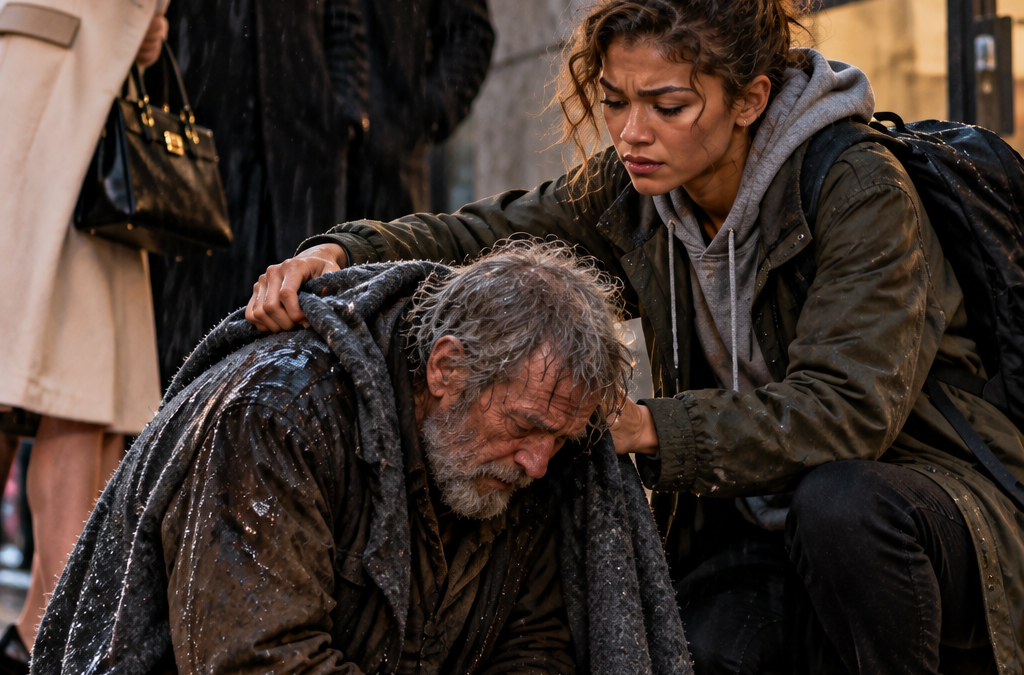
An elderly man was on his knees in the rain.
Two bags had split open beside him.
Papers were plastered to the pavement.
Small medicine bottles rolled through puddles.
A wrist brace lay near the curb.
He was trying to pick things up.
His fingers would not cooperate.
I watched him reach for one bottle.
Miss.
Try again.
The bottle slipped from his hand.
People walked around him.
A man in a dark suit stepped over a prescription bottle.
Two women changed course to avoid him.
A mother pulled her son closer.
Twenty feet away, a hotel employee stood under an awning.
The old man said something to him.
The employee shook his head.
Then turned away.
I checked the time again.
Thirty-five minutes.
If I stopped for ten minutes, I might still make it.
Fifteen would be close.
Twenty probably meant no bed.
My cough had become worse.
My hoodie was already soaked.
Temperatures were expected to fall that night.
I knew exactly what sleeping outdoors in wet clothes could mean.
I had done it before.
I took two steps toward the shelter.
Then stopped.
The old man reached for another bottle.
His hand shook so violently he could not close his fingers around it.
A security officer approached him.
For a second, I felt relief.
Finally.
Someone.
Instead, I heard the officer say, “Sir, you need to move along.”
The old man looked up.
“I dropped my things.”
“There’s a shelter two blocks east.”
“I don’t need a shelter. I need help picking these up.”
“You’re blocking the sidewalk.”
That decided it.
I turned around.
Later, people asked me why.
Some wanted a beautiful answer.
A speech about humanity.
Faith.
Destiny.
I never had one.
The truth was simpler.
I knew what it felt like when people looked at you and saw a problem instead of a person.
And I could not knowingly give that feeling to someone else.
I crossed the sidewalk.
“Sir?”
He looked up.
His face was soaked.
Rain.
Maybe tears.
I couldn’t tell.
“Are you hurt?”
“I dropped everything.”
His voice was controlled, but beneath it I heard panic.
“My hands won’t—”
He lifted them.
They trembled.
“Okay.”
I knelt.
“I’ve got it.”
I started collecting the bottles.
One by one.
Wiping each label carefully with my sleeve.
Checking that the caps were still secure.
I picked up the brace.
Gathered wet pages.
Some were already ruined.
Others I slid between dry folders inside his leather briefcase.
He watched me work.
“You don’t have to—”
“I know.”
A prescription bottle had rolled nearly into the gutter.
I grabbed it before the water carried it farther.
The label was damp.
“This one needs to stay dry.”
I opened my backpack.
Inside was the waterproof pouch where I kept my notebook.
The only thing I owned that I treated as irreplaceable.
I removed the notebook.
Rain hit the cover immediately.
Then I placed his medication inside the pouch and zipped it closed.
The old man noticed.
“You put your notebook out in the rain.”
“It’s paper.”
“What if it gets ruined?”
“I can dry paper.”
I held up the sealed pouch.
“You need these.”
His expression changed.
I could not identify it then.
Now I think it was shame.
Not shame at needing help.
Shame because a stranger with almost nothing was protecting his medicine while people who had far more had kept walking.
I packed his things.
Then lifted both bags.
One shoulder carried his canvas medical bag.
The other carried his briefcase.
My backpack remained behind them.
I leaned forward beneath the weight.
He looked embarrassed.
“I can carry one.”
“No.”
“I’m not completely helpless.”
“I didn’t say you were.”
“I can take the briefcase.”
“Your hands are shaking.”
“I noticed.”
“So you focus on standing.”
I held out my hand.
He stared at it.
Then took it.
His fingers trembled against mine.
I braced my feet.
“Slow.”
He pushed himself upward.
One knee cracked loudly.
He nearly lost balance.
I caught his elbow.
“Easy.”
“I’m fine.”
“That makes two bad liars today.”
For the first time, he smiled.
Barely.
But it was there.
“There’s a café two blocks away,” I said. “My friend owns it. We can get you warm.”
“I have somewhere to go.”
“So do I.”
I regretted saying it immediately because he looked at me.
“Then you should go.”
I looked at the rain.
Then at his shaking hands.
“I’m already late.”
That was not true yet.
But I think some part of me had already accepted what this decision would cost.
We started walking.
Slowly.
I matched his pace.
At the first curb, he stumbled.
I caught him again.
“Sorry.”
“Stop apologizing.”
“I’m slowing you down.”
“I walk too fast anyway.”
Another lie.
I walked fast because every minute mattered when you did not have anywhere permanent to be.
But I didn’t want him feeling like a burden.
There are humiliations worse than physical weakness.
One is knowing someone resents you for needing them.
I would not give him that.
We reached Nikki’s soaked through.
Nikki looked up.
“Willow?”
His eyes moved to the old man.
“What happened?”
“Rain.”
“No kidding.”
“He needs somewhere warm.”
Nikki pointed toward the corner booth.
“Sit.”
I helped the man out of his coat.
It was heavy wool.
Good quality.
Even soaked, I could tell it was expensive.
I hung it near the window.
Nikki brought coffee.
The old man wrapped both hands around the mug.
The trembling made small waves across the surface.
I sat opposite him.
When he lifted the coffee, some spilled.
I reached across.
Held the bottom of the mug.
He looked at my hands around his.
“You don’t have to keep doing that.”
“I know.”
“You say that a lot.”
“You keep telling me what I don’t have to do.”
He almost smiled again.
Nikki placed two coffees on our bill.
I reached into my pocket.
Five dollars.
The last cash I had.
Everything from that day after buying a small bottle of cold medicine.
I put it on the counter.
Nikki stared at me.
“Willow.”
“For both.”
“Put that away.”
“Both coffees.”
“Willow Bennett—”
“For both.”
His jaw tightened.
He knew me well enough to know arguing would create a scene.
He took the bill.
Later, he quietly placed it back near my mug.
I didn’t notice.
The old man did.
“What’s your name?” he asked.
“Willow.”
“Willow what?”
“Bennett.”
He reached into his coat.
From an inside pocket, he removed a small leather notebook.
Dark brown.
Gold clasp.
Then a heavy metal pen.
Even I could tell the pen cost more than everything I owned.
He wrote my name.
Willow Bennett.
Carefully.
“What are you doing?”
“Remembering.”
“My name?”
“Yes.”
“Why?”
He closed the notebook.
“Because I think I should.”
I shrugged.
“That’s a lot of effort for the girl who carried your wet paperwork.”
He studied me.
“You think that’s all you did?”
“At the moment, yes.”
Rain hammered against the café windows.
Through the glass, I could see the bright gold sign of a luxury hotel at the end of the block.
CALLAWAY GRAND.
I had walked past it hundreds of times.
Rooms there probably cost more for one night than I earned in a month.
The man followed my gaze.
“Nice place?” he asked.
“I wouldn’t know.”
“You’ve never been inside?”
I laughed.
“I don’t think I’m their target customer.”
He looked toward the sign for a long time.
I did not know then that his name was Henry Callaway.
I did not know that the hotel belonged to him.
I did not know that buildings throughout Chicago carried his money through their foundations.
I did not know he had spent fifty years building a business empire valued in the tens of billions.
I also did not know what had happened to him earlier that afternoon.
Henry told me much of it later.
He had gone alone to a private neurologist.
Seventy-two years old.
A man who had signed contracts with steady hands for half a century.
A man who had sat across from presidents.
A man who could move hundreds of millions of dollars with a phone call.
That afternoon, a neurologist looked at him and said two words.
Parkinson’s disease.
Early stage.
Treatable.
Manageable.
Those words meant nothing to Henry.
All he could see were his hands trembling in his lap.
He had not told his son.
His assistant.
His board.
Nobody.
He left the clinic alone because control had always been his religion.
Then his driver became trapped behind an accident on I-90.
His phone died.
The rain came.
His medical bag split.
And a man who had spent five decades believing money could solve almost every practical problem found himself on his knees unable to pick up his own medicine.
He later told me that was frightening.
But not as frightening as what happened next.
People saw him.
And kept walking.
An employee from his own hotel refused to leave his post.
A security officer told him to move along.
A mother pulled her son away.
That was the hour when Henry Callaway discovered what the world looked like when nobody recognized Henry Callaway.
I knew none of that in Nikki’s.
To me, he was simply a wet old man whose coffee needed steadying.
We talked for more than an hour.
He asked about Nikki.
About my job.
About why I walked instead of taking the bus.
I was suspicious at first.
People sometimes ask homeless people questions as entertainment.
Like poverty is a documentary they get to watch before returning home.
Henry did not ask like that.
He listened.
That made me keep answering.
“Three hours every morning?” he asked.
“Usually.”
“For fifteen dollars?”
“And food.”
“That’s legal?”
“Probably not.”
Nikki shouted from behind the counter.
“I heard that.”
I laughed.
Henry did too.
Then he asked, “Where do you live?”
The question changed the air.
I looked at my coffee.
“Wherever I get a bed.”
His expression softened.
“A shelter?”
“Most nights.”
“For how long?”
“Fourteen months.”
He said nothing.
I disliked pity.
I had learned to recognize it instantly.
But what I saw in Henry did not feel like pity.
It looked more like he was taking information apart and rebuilding his understanding of me.
“You have family?”
“Not really.”
“Parents?”
“My mother died when I was young.”
“Father?”
“I don’t know.”
“I’m sorry.”
“Don’t be. You didn’t do it.”
He smiled faintly.
“Foster care?”
I nodded.
“Eleven years.”
“How many homes?”
“Six.”
He looked down.
I immediately regretted telling him.
Not because it embarrassed me.
Because I could see that he was imagining a child moving six times.
“Last family?”
“My placement ended when I turned eighteen.”
“They just…”
“Yes.”
I saved him from finishing.
“They were done.”
He stared at the table.
I changed the subject.
“You should take your medicine.”
He blinked.
“What?”
“The bottle.”
I reached into my waterproof pouch.
“Label says two tablets with food.”
“I haven’t eaten.”
“Nikki.”
He appeared from nowhere.
“What?”
“Bread?”
Nikki looked at Henry.
“Soup too.”
“I’m fine with—”
“You’re outnumbered,” I told him.
Nikki returned with bread and soup.
No charge.
I shook two pills onto a napkin.
Henry watched me.
“You’ve done this before.”
“My last foster mother had tremors.”
“Parkinson’s?”
“No. Different condition.”
“You knew how to read the schedule.”
“I spent a lot of nights setting out pills.”
“What happened to her?”
“She died.”
“I’m sorry.”
“Then they moved me.”
I said it flatly.
By then I had learned how to tell painful facts without reopening them.
Henry ate half the bread.
Took the medicine.
Then he opened his briefcase.
He removed a hundred-dollar bill.
“Take this.”
I stared at it.
“For what?”
“Tonight.”
“No.”
“For helping me.”
“No.”
“A cab, food, whatever you need.”
I pushed it back.
His eyebrows rose.
“Willow.”
“No.”
“You gave me your last five dollars.”
I looked at him sharply.
“How do you know it was my last?”
“You counted your pocket twice before putting it on the counter.”
I sighed.
“You notice too much.”
“So take this.”
“No.”
“Why?”
“Because then it becomes a transaction.”
“It doesn’t have to.”
“For me it does.”
I slid the bill back across the table.
“I didn’t help you because I thought you could pay me.”
“That doesn’t mean I can’t help you.”
“Maybe. But not because I picked up your medicine.”
He stared at me.
For several seconds, I thought he was angry.
Then he returned the bill to his wallet.
“You’re extremely stubborn.”
“That’s what Ruth says.”
“Ruth?”
“Runs the shelter.”
He glanced at the wall clock.
His face changed.
It was 8:45.
“What time does the shelter close?”
I said nothing.
“Willow.”
“Beds usually fill around seven thirty.”
His mouth opened.
Then closed.
“You knew that.”
“Of course.”
“When we came here?”
“Yes.”
“You knew you would lose your bed.”
“I knew it was possible.”
“You’ve been sitting here for two hours.”
“You needed someone.”
“And now where are you going to sleep?”
I shrugged.
“I’ll figure it out.”
His face twisted.
For a moment, he looked older than seventy-two.
“You gave up a bed for me.”
“Please don’t make it dramatic.”
“It is dramatic.”
“I’ve slept outside before.”
“That doesn’t make it acceptable.”
“No.”
I looked through the window.
“But it makes it survivable.”
Henry reached for his handkerchief.
White silk.
Three embroidered initials.
H.R.C.
He pressed it against his eyes.
I pretended not to notice.
That was when I started wondering who he really was.
Not because of money.
The coat.
The pen.
The handkerchief.
His manner.
He spoke like a person who was accustomed to being obeyed but had temporarily forgotten how to issue instructions.
Still, rich people got lost too.
Rich people got sick.
None of it changed anything.
Around nine, he asked me a strange question.
“If you could change one thing about the world, what would it be?”
“Only one?”
“One.”
I thought.
Not long.
“I’d stop kids from aging out of foster care with nowhere to go.”
His eyes sharpened.
“Why that?”
“Because eighteen isn’t magic.”
I leaned back.
“One day you’re a kid the state says needs protection. The next day you’re eighteen and suddenly everyone acts like you’ve become an adult with money, housing, references, transportation and a family.”
He opened his leather notebook.
I kept talking.
“You don’t even need to make people rich. Just give them time.”
He began writing.
“Somewhere stable to live. Help finding work. Somebody checking whether they’re alive six months later.”
His pen moved.
“School support.”
He continued writing.
“Mentors.”
More writing.
“Why are you writing this down?”
He looked up.
“Because I don’t want to forget it.”
Nikki was watching from behind the counter.
I returned my mug.
He leaned closer.
“Willow.”
“What?”
“That man.”
“Yes?”
“You know who he is?”
“No.”
Nikki opened his mouth.
Then looked toward the window.
His face changed.
Outside, three black SUVs pulled to the curb.
One.
Two.
Three.
I laughed nervously.
“Either somebody important is here or we’re being arrested.”
Nikki did not laugh.
I turned.
Henry had closed his notebook.
He straightened his shirt cuff.
“I believe that’s for me.”
The café door opened.
Cold air rushed inside.
A woman in a dark suit entered first.
Two men followed.
The woman scanned the room.
Then saw Henry.
Her professional expression broke.
“Mr. Callaway.”
My stomach tightened.
She hurried toward us.
“Thank God.”
Henry stood slowly.
“We’ve been looking for you for three hours.”
“I’m fine, Sandra.”
“Your phone died. Your driver couldn’t get through. We traced your last confirmed location to the clinic and—”
She stopped.
Looked at me.
At his wet coat.
At the bags I had carried.
The coffee mugs.
“Sir, are you hurt?”
“No.”
He nodded toward me.
“This young woman took care of me.”
The name echoed in my head.
Callaway.
I turned toward the window.
The glowing hotel sign.
CALLAWAY GRAND.
Then the handkerchief.
H.R.C.
I looked at him.
“Henry Callaway.”
His expression was almost apologetic.
“Yes.”
“The Henry Callaway?”
“I suppose.”
“You own that hotel.”
“Yes.”
I pointed vaguely toward the windows.
“This block?”
“Much of it.”
I sat down slowly.
Nikki’s mouth hung open behind the counter.
I felt ridiculous.
Then irritated.
Then embarrassed for feeling ridiculous.
I looked at Henry.
“I gave you my last five dollars.”
He nodded.
“For coffee.”
“Yes.”
“You could buy this café.”
Nikki called out, “Don’t encourage him.”
That broke the tension for half a second.
Then Henry leaned toward me.
“Willow, listen.”
His hands still trembled.
“In the last three hours, I passed buildings I own.”
I said nothing.
“I stood outside a hotel with my name twenty feet high on the front.”
He looked toward the windows.
“I was wearing a coat worth more than many people’s monthly rent.”
His voice lowered.
“None of it mattered.”
He looked directly at me.
“Because no one knew who I was.”
I could hear rain hitting the glass.
“My own employee saw me.”
He swallowed.
“A security officer saw me.”
“Other people saw me.”
His eyes shone.
“They saw an old man on his knees and decided I was not important enough to inconvenience themselves for.”
I looked down.
“You stopped.”
“You needed help.”
“Exactly.”
His voice broke slightly.
“You didn’t help Henry Callaway.”
“No.”
“You helped a frightened old man with shaking hands.”
The café door opened again.
A man entered wearing the uniform of the Callaway Grand.
I recognized him immediately.
He had been standing beneath the awning.
The man who said he could not leave his post.
He saw Henry.
His face emptied of color.
“Mr. Callaway.”
Henry turned.
The man froze.
“Craig.”
“Sir, I…”
His eyes moved to me.
Back to Henry.
“I didn’t know.”
Henry’s voice became very quiet.
“You didn’t know what?”
“That it was you.”
Henry nodded slowly.
“Yes.”
Craig seemed relieved that Henry understood.
Then Henry continued.
“That is exactly the problem.”
Craig’s face fell.
“You didn’t need to know my name.”
“Sir, I was working.”
“I asked for help.”
“I couldn’t leave my post.”
“You were standing twenty feet away.”
Craig looked down.
Henry said, “You saw an elderly man on his knees in freezing rain and decided your job required you to ignore him.”
“I’m sorry.”
“Would you be sorry if Sandra hadn’t walked through that door?”
Craig could not answer.
Through the café window, I saw the security officer who had told Henry to move along.
He noticed the SUVs.
Looked inside.
Recognized Henry.
Then turned around and walked quickly away.
Henry watched him go.
There was no satisfaction in his expression.
Only disappointment.
I stood.
“Mr. Callaway.”
He turned back toward me.
“I need you to understand something too.”
“All right.”
“If you were nobody, I still would have stopped.”
He nodded.
“If tomorrow I found out you had no money and no hotel and no company, I wouldn’t change anything I did.”
His eyes filled.
“I know.”
“Good.”
I picked up my backpack.
“Then we’re clear.”
He almost laughed.
“Sit down.”
“Why?”
“Because I need to tell you something.”
“I’ve already missed the shelter.”
“Sit down anyway.”
Sandra opened a leather folio.
I became nervous.
People with folios usually mean paperwork, and paperwork had rarely brought me good things.
Henry sat opposite me.
“Let me finish before you say no.”
“That sounds dangerous.”
“It probably is.”
Sandra almost smiled.
Henry placed his business card on the table.
Black.
Gold lettering.
Henry R. Callaway.
Chairman, Callaway Capital Group.
He pushed it toward me.
“Monday morning. Nine o’clock. That address.”
“What happens Monday?”
“You meet Sandra.”
“For what?”
“First, education.”
I stared.
“What?”
“Full scholarship.”
“No.”
“You promised to let me finish.”
“I did not promise anything.”
His eyebrow rose.
“Then humor an old man.”
I folded my arms.
“Fine.”
“Four years. Tuition, books, housing, living expenses.”
I stopped breathing normally.
“Any accredited university that accepts you.”
“Mr. Callaway—”
“If you choose social work, study social work. If you change direction, that’s your choice.”
I shook my head.
“This is insane.”
“Probably.”
Sandra kept writing.
“Second, housing.”
My entire body tightened.
“Effective immediately, an apartment will be available to you in one of my buildings.”
“No.”
“Furnished.”
“I can’t—”
“No rent while you are in school.”
I stared at him.
“Tonight, Sandra will take you there.”
My throat closed.
“You are not sleeping outside tonight.”
I looked away.
The café blurred.
I blinked hard.
Henry continued before I could stop him.
“Third, employment.”
I laughed once because the alternative was crying.
“Of course there’s a third.”
“A paid internship with our community development division. Twenty hours a week around your class schedule.”
“Why?”
“Because you understand something most people in my business spend their careers trying to learn from reports.”
“What?”
“What instability actually costs.”
I swallowed.
“You’ll learn development, financing, housing policy, municipal partnerships. And you’ll tell us when we’re being idiots.”
“That might become full-time.”
“Good.”
Sandra turned a page.
Then Henry stopped.
His expression changed.
“This last one is not for you.”
I wiped my eyes angrily.
“Then who?”
“People like you.”
My hands went still.
“I am establishing a foundation.”
The room seemed to quiet around him.
“Ten million dollars in initial funding.”
I stared.
“The mission will be transitional support for young adults aging out of foster care.”
I could not speak.
“Housing.”
Sandra wrote.
“Education grants.”
More writing.
“Employment training.”
My vision blurred again.
“Mentorship.”
My breath caught.
“The things you said people need.”
I whispered, “Stop.”
Henry stopped immediately.
I covered my face.
For fourteen months, I had refused to cry in places where other people could see me.
I had cried in bathroom stalls.
Beneath blankets.
On park benches after dark.
But I had become skilled at holding myself together in public.
That skill failed.
A tear slid down my cheek.
Then another.
I wiped them away.
“This is too much.”
“No.”
“I carried two bags.”
“No.”
“You don’t know me.”
“I know enough.”
“You don’t.”
My voice shook.
“What if I disappoint you?”
Henry looked almost offended.
“This isn’t a prize for perfect behavior.”
I stared at him.
“It’s an opportunity.”
He leaned forward.
“What you do with it will belong to you.”
“I can’t accept a life because I bought someone coffee.”
“You are not.”
“Then why?”
His trembling hand reached across the table.
He placed it over mine.
“You reminded me of something I had almost stopped believing.”
“What?”
“That kindness still exists when there is no audience.”
His fingers trembled.
I turned my hand over.
Held his steady.
The same way I had held the coffee.
Nikki stood behind the counter crying openly.
He did not even pretend otherwise.
Henry looked at him.
“Sir,” Nikki said, wiping his face with a towel. “She’s worth the trouble.”
“I’m beginning to understand that.”
Then Henry turned toward Craig.
“You’re suspended effective tonight pending review.”
Craig’s face collapsed.
“Sir, please. I have two children.”
I looked at Henry sharply.
Craig continued.
“I made a mistake.”
Henry said, “Yes.”
“I need that job.”
Henry was silent.
I thought about foster homes.
About mistakes.
About how permanent one wrong decision could become when nobody offered you a path back.
I spoke.
“Mr. Callaway.”
He looked at me.
“Don’t make the foundation only about rescuing perfect people.”
His eyes narrowed thoughtfully.
“What do you mean?”
“Everybody talks about second chances.”
I glanced at Craig.
“Make sure you actually believe in them.”
Craig looked at me, stunned.
Henry leaned back.
Then nodded.
“The foundation will include second-chance employment.”
Sandra wrote it down.
Henry looked at Craig.
“That does not mean there are no consequences.”
“I understand.”
“You will leave tonight.”
Craig lowered his head.
“But if you decide you want to become better than the man who walked past me today, there will eventually be a process for proving it.”
Craig’s eyes reddened.
“Thank you.”
“Don’t thank me.”
Henry glanced at me.
“Thank her.”
Craig looked at me.
I didn’t say anything.
I wasn’t ready.
Outside, the rain had softened.
Sandra closed the folio.
Henry stood.
Then held out his hand.
“Thank you, Willow Bennett.”
I took it.
“For what?”
“For stopping.”
I held his trembling hand.
“Thank you for seeing me.”
He frowned.
“What do you mean?”
I looked toward the dark window.
“Most people don’t.”
That night, I rode through Chicago in the back of one of Henry Callaway’s black SUVs.
I pressed my forehead against the glass.
The city looked different when you were warm.
That thought made me feel guilty.
Then angry that warmth had ever felt like something I needed to earn.
Sandra sat beside me.
We stopped outside a residential tower overlooking Lake Michigan.
I assumed we were picking something up.
Then Sandra gave me a key.
“Fourteenth floor.”
I stared at her.
“What?”
“Apartment 1407.”
We rode up.
The door opened into a one-bedroom apartment.
Small by Henry Callaway standards, I suppose.
Impossible by mine.
A living room.
A kitchen.
Bathroom.
Bedroom.
Furniture.
Heat.
A refrigerator.
Windows overlooking the lake.
I walked through every room three times.
Opened closets.
Turned faucets on and off.
Checked behind doors.
I kept expecting someone to say there had been a mistake.
Sandra stood quietly near the entrance.
Finally, I asked, “Who else lives here?”
“No one.”
“Who is this really for?”
“You.”
“For how long?”
“As Henry said, while you’re in school.”
I stared at the bedroom.
“Can I lock the door?”
Sandra’s expression softened.
“Yes.”
“From the inside?”
“Yes.”
“And nobody comes in?”
“Not without your permission.”
That was the sentence that broke me.
Not the scholarship.
Not the foundation.
Not the money.
Nobody comes in without your permission.
I sat on the living-room floor.
And cried.
Forty minutes.
Maybe longer.
Sandra stayed.
She did not touch me.
Did not tell me to stop.
Did not say everything was okay now.
She simply sat in a chair while I cried out fourteen months of fear.
When I finally stopped, she gave me a box of tissues.
“You all right?”
“No.”
She nodded.
“Reasonable.”
I laughed through the tears.
Then I remembered my notebook.
The cover was damp but intact.
I opened to a blank page.
November 22.
I wrote:
Helped an old man in the rain.
He gave me a home.
I stared at the sentence.
Then added:
I don’t understand today yet.
The story became public three days later.
There had been security cameras inside Nikki’s Café.
A customer talked to a local reporter.
Footage showed me entering with Henry’s bags.
The five-dollar bill.
The SUVs.
Sandra arriving.
Within days, millions of people knew my name.
They called me “the homeless teenager who saved a billionaire.”
I hated that headline.
I had not saved Henry.
I picked up medicine.
Helped him walk.
Made sure he ate before taking pills.
Stayed with him.
Those were ordinary acts.
They should have been ordinary.
The disturbing part was not that I had done something extraordinary.
It was that so many other people had done nothing.
Networks called.
Reporters waited outside Nikki’s.
I refused most interviews.
I had spent years invisible.
I did not suddenly want to become public property.
Henry respected that.
In January, I enrolled at the University of Illinois Chicago.
Social work.
Full scholarship.
The first morning, I stood outside the classroom for almost five minutes because I was afraid to enter.
Not because I thought I could not do the work.
Because I was waiting for someone to tell me there had been an administrative mistake.
Nobody did.
I took a seat.
Opened my notebook.
And began.
I kept the old backpack.
Sandra offered to buy me a new one.
I refused.
That backpack had carried everything I owned.
It deserved retirement on my terms.
The Willow Bennett Foundation formally launched in March.
I fought Henry over the name.
“I don’t want my name on it.”
“You inspired it.”
“Call it something else.”
“Such as?”
I had no answer.
Henry smiled.
“Then we’re done.”
Our first Bennett House opened on Chicago’s South Side.
Fifty transitional beds for young adults ages eighteen to twenty-four leaving foster care or unstable placements.
But beds were only the beginning.
Every resident received a case manager.
Employment assistance.
Education planning.
Mental-health referrals.
A mentor.
Help obtaining IDs and bank accounts.
Transportation support.
A person who noticed if they disappeared.
At the ribbon cutting, someone handed me enormous ceremonial scissors.
I gave them back.
“Do you have kitchen scissors?”
The organizer thought I was joking.
I wasn’t.
We cut the ribbon with the same kind of scissors Ruth used at the shelter.
It felt more honest.
By the end of the first year, three Bennett Houses were operating.
Chicago.
Detroit.
Atlanta.
Two hundred eighteen young adults had received housing or services.
Most were connected to employment, training or school within six months.
Waiting lists still stretched for months.
At one board meeting, Henry slammed a report onto the table.
“We’re failing.”
I stared at him.
“We housed two hundred people.”
“Three hundred are waiting.”
“That isn’t failure.”
“It is to the three hundred.”
He tripled the expansion budget.
That was Henry.
Once he understood a problem, impatience became his preferred form of philanthropy.
His Parkinson’s progressed.
Slowly at first.
Then noticeably.
His handwriting became uneven.
Some mornings were better than others.
I learned not to grab his arm unless he asked.
He taught me something important about helping.
Help is not taking over.
It is making room for someone to keep as much independence as possible.
Nikki’s Café changed too.
Henry funded a renovation.
New kitchen.
New equipment.
Repaired booths.
Nikki refused to change the sign.
“You’re a billionaire,” he told Henry. “Doesn’t mean you know branding.”
Henry accepted defeat.
The faded hand-painted NIKKI’S remained outside.
Nikki hired five new employees.
Three came through Bennett House.
Then there was Craig.
For three months after losing his hotel position, he stayed unemployed.
I did not know much about his life until he applied to volunteer at Bennett House.
His application landed on my desk.
I almost rejected it without an interview.
Then I remembered what I had told Henry.
Do not make the foundation only about rescuing perfect people.
So I called Craig in.
He sat across from me.
No hotel uniform.
No polished name tag.
Just a nervous man in a borrowed-looking shirt.
“Why are you here?” I asked.
He looked at me.
“Because I can’t stop seeing that sidewalk.”
I waited.
“I saw Mr. Callaway on his knees.”
His voice cracked.
“I knew he needed help.”
“Why didn’t you?”
“I told myself I couldn’t leave my post.”
“You could have called someone.”
“Yes.”
“You could have brought him under the awning.”
“Yes.”
“You could have picked up one bottle.”
“Yes.”
“But you didn’t.”
“No.”
He lowered his eyes.
“I decided he wasn’t my problem.”
For a long time, neither of us spoke.
Then he said, “I don’t want to be that person anymore.”
I believed him.
Not completely.
But enough to allow him the chance to prove it.
We hired him at the front desk.
Full time.
Six months later, he was one of the most patient employees in the building.
Every new resident who entered terrified received the same greeting.
“Come in. You’re safe here.”
I sometimes wondered whether he knew how much those words mattered.
I think he did.
The security officer who had told Henry to move along was investigated by his employer.
He went through mandatory outreach training.
At first, according to people who knew him, he resented every minute.
Months later, he requested transfer to a homeless outreach assignment.
I heard he told another officer, “I keep thinking about the girl who stopped when I didn’t.”
The woman who had pulled her child away from Henry remained anonymous publicly.
But later the foundation received a fifty-thousand-dollar donation with no name attached.
I would never have known where it came from if her son had not eventually mentioned that his mother began volunteering at a food bank.
People changed in different ways.
Some loudly.
Some privately.
I learned not to demand that every transformation happen where I could see it.
Two years passed.
I was twenty-one.
Second year of college.
Twelve credit hours that semester.
Twenty hours a week at Callaway Capital’s community development division.
Real work.
Not a ceremonial internship.
They made me read zoning reports.
Affordable-housing financing structures.
Municipal bond proposals.
Community impact assessments.
I sat in meetings where people discussed neighborhoods as if they were numbers.
When I thought someone had forgotten the human beings inside those numbers, I said so.
At first, executives looked surprised.
Eventually, they started asking what I thought before I volunteered it.
One November evening, I left the Callaway Capital building at six thirty.
Cold rain fell across Chicago.
Almost exactly the weather from two years earlier.
I wore a real coat.
Warm.
Fitted.
Paid for with my own internship salary.
Buying it had felt absurdly significant.
My first coat that had never belonged to someone else.
My first coat not pulled from a donation bin.
I still carried the same backpack.
And the same notebook.
Some things I did not want success to erase.
I turned onto Madison.
Three blocks later, I saw an elderly woman sitting on the steps of a closed storefront.
Her grocery bag had torn.
Cans.
Boxes.
A jar of pasta sauce.
Everything scattered across wet concrete.
Her fingers looked stiff from the cold.
People passed.
One.
Two.
Five.
A man in a suit stepped over a can of soup.
I stopped.
No calculation.
No shelter deadline anymore.
No last five dollars.
No risk to me.
That made the moment less dramatic than what had happened with Henry.
But maybe more important.
Because there was no billionaire reveal waiting.
No three SUVs.
No foundation.
No life-changing reward.
Just a woman.
In the rain.
I knelt.
“Ma’am, let me help.”
She looked startled.
“Oh, honey, you don’t have to.”
I smiled.
“I know.”
I started gathering groceries.
“I want to.”
Her bag was ruined.
I used a reusable tote from my backpack.
Helped her stand.
Called a cab.
When it arrived, I paid.
She tried to argue.
I ignored her.
“What’s your address?”
She told the driver.
Before closing the door, she touched my arm.
“Your mother raised you right.”
For a second, I could not answer.
Then I smiled.
“I think a lot of people did.”
The cab pulled away.
Rain tapped against my coat.
I opened my notebook.
November 22.
Exactly two years.
I wrote:
Helped a woman in the rain.
Then beneath it:
Still stopping.
I closed the notebook.
What I did not know was that forty floors above the street, Henry was standing near the windows of his corner office.
He had seen me.
Sandra was with him.
His Parkinson’s had advanced by then.
Writing had become difficult.
Walking took more concentration.
His hands trembled constantly.
But he could still see the sidewalk.
He could still recognize me from forty floors up by the old backpack I refused to replace.
He told me about the moment later.
“She stopped,” he said.
I laughed.
“Of course I stopped.”
“I know.”
“Then why are you surprised?”
“I’m not surprised.”
He looked toward the framed photograph on his desk.
It was a still image taken from Nikki’s old security camera.
A nineteen-year-old girl kneeling in the rain beside an elderly man.
Two bags scattered between them.
I hated the picture at first.
Then I understood why Henry kept it.
Beneath the frame, in handwriting that had become shaky and uneven, he had written:
November 22.
She stopped when no one was watching.
I stood beside him.
“You know the headlines got it wrong.”
“They usually do.”
“They said I helped you because you were a billionaire.”
“They did.”
“I didn’t.”
“I know.”
“They said you changed my life.”
Henry turned toward me.
“Didn’t I?”
“Yes.”
I thought about it.
“But that’s not the whole story.”
“What is?”
I looked at his trembling hands.
“You gave me opportunities.”
He waited.
“But I think that night changed you too.”
A slow smile appeared.
“That’s an expensive observation.”
“You can afford it.”
He laughed.
Then coughed.
I looked out over Chicago.
Cars moved below.
People hurried through rain.
Thousands of strangers carrying private disasters nobody else could see.
“When I was homeless,” I said, “I thought being seen would solve everything.”
Henry listened.
“Then people started recognizing me everywhere.”
“And?”
“It turns out recognition isn’t the same thing.”
“No.”
“What mattered that night wasn’t that you eventually learned my name.”
I looked at him.
“It was that I stopped before I knew yours.”
Henry nodded.
“That is why the foundation exists.”
We stood there quietly.
My life had changed almost beyond recognition.
I had a home.
Education.
Work.
People who called if I disappeared.
A future with actual choices inside it.
But I sometimes thought about the thirty-five minutes I had left that evening.
Thirty-five minutes to reach Women’s Hope.
A warm bed waiting if I moved fast enough.
An old man kneeling in the rain.
For years, survival had taught me to protect every resource.
Every dollar.
Every meal.
Every minute.
That evening I ignored survival for three seconds.
I chose inconvenience.
Risk.
Compassion.
People often told me I was rewarded for kindness.
I never liked the phrase.
Kindness is not kindness if it only makes sense because a reward appears later.
If Henry had been poor, I would have lost my bed.
Spent the night somewhere miserable.
Woken sick.
Gone to Nikki’s the next morning.
And nobody would have known.
That version of the story matters just as much.
Maybe more.
Because most kindness never becomes a headline.
Most people you help will never build you a foundation.
Most doors you hold open lead nowhere for you.
Most strangers you stop for cannot repay you.
That is why the choice means something.
Henry had money.
I had five dollars.
But on that sidewalk, wealth had become strangely irrelevant.
He needed what I had.
Time.
Hands steady enough to gather medicine.
A willingness to kneel.
I needed things too.
A bed.
Warmth.
Safety.
And for a few minutes, I chose his need over mine.
Two years later, the choice no longer seemed heroic.
It seemed obvious.
That surprised me.
Because life had given me many reasons to become harder.
Six foster homes.
An eighteenth birthday that ended with a packed backpack.
Shelters.
Park benches.
Rejection.
Hunger.
Cold.
Any of those things could have taught me that everyone was responsible only for themselves.
Sometimes they almost did.
But bitterness is expensive when you already have very little.
It takes energy.
It occupies space.
I could not afford it.
So I kept the notebook.
One good thing every day.
Not because the world had earned my optimism.
Because I wanted to decide what kind of person I became while surviving it.
Henry once asked me whether I believed that one night had been destiny.
I told him no.
He looked disappointed.
“You don’t believe in destiny?”
“I believe in decisions.”
“What’s the difference?”
“Destiny makes it sound like I had to turn left.”
I smiled.
“I didn’t.”
I could have walked right.
I could have reached the shelter.
I could have slept warm.
No one would have blamed me.
“That’s why it matters that I turned left.”
Henry thought about that for a while.
Then nodded.
“Fair enough.”
Years later, that remained the way I understood it.
There had been no guarantee.
No cosmic bargain.
No promise that generosity would come back multiplied.
There had been rain.
A deadline.
An old man.
And three seconds.
Three seconds in which I could become someone who walked past.
Or someone who stopped.
I stopped.
Everything after that was extraordinary.
The apartment.
College.
The internship.
Bennett House.
Henry.
Sandra.
Nikki.
All of it.
But the decision itself was ordinary.
That is what I never wanted people to forget.
Kindness is rarely dramatic while you are doing it.
Usually it looks inconvenient.
Awkward.
Small.
Picking something up.
Making a phone call.
Waiting five extra minutes.
Giving somebody the seat.
Looking at the person everyone else is pretending not to see.
Sometimes it costs five dollars.
Sometimes a night’s sleep.
Sometimes nothing except the discomfort of admitting another person’s pain has become your concern.
That November night, I thought I was giving an old man three hours.
What I was really doing was refusing to let the world make both of us invisible at the same time.
Henry saw me afterward.
Really saw me.
Not as a homeless girl.
Not as a charity case.
Not as a symbol.
As Willow.
And because he did, I was eventually able to help build places where hundreds of young people could experience the same thing.
A door opening.
A key placed in their hand.
A person saying:
You can stay.
You are safe.
Nobody is throwing you out tomorrow.
Years after my first night in that apartment, I still sometimes woke before dawn expecting the shelter lights to snap on.
For a few confused seconds, I would think I needed to strip the bed.
Fold the blanket.
Leave before six.
Then I would remember where I was.
My room.
My key.
My door.
My life.
On those mornings, I usually got up anyway.
Made coffee.
Opened the old notebook.
Read the entry from November 22.
Helped an old man in the rain.
He gave me a home.
I don’t understand today yet.
I understand it now.
The home was never the whole gift.
The real gift was learning that the worst things that happen to you do not have to decide what you give back to the world.
I had been abandoned.
I did not have to abandon.
I had been ignored.
I did not have to ignore.
I had been treated as temporary.
I did not have to treat anyone else as disposable.
That choice was mine long before Henry Callaway knew my name.
And long after everything else from that night changed, it remained mine.
The rain still falls in Chicago every November.
People still hurry.
Someone still drops something.
Someone still sits cold on a step.
Someone still assumes another person will stop.
Sometimes another person does.
Sometimes they don’t.
I cannot control all of that.
I learned long ago that I cannot fix every broken system or rescue every person.
But whenever I can, I still stop.
Not because Henry might be watching from forty floors above.
Not because a camera might be recording.
Not because kindness once changed my life.
I stop because I remember exactly what it felt like to believe nobody was coming.
And if I can make one person feel, even for five minutes, that someone did come after all, then I know what to do.
I kneel.
I pick up what fell.
And I stay until they can stand again.








