𝗙𝗨𝗟𝗟 𝗦𝗧𝗢𝗥𝗬 I Had One Sandwich to Last the Night When I Found a Stranger Shaking on the 40th Floor—By Dawn, Someone Was Looking for Me
𝗣𝗔𝗥𝗧 𝟮
There are bosses you challenge.
There are bosses you survive.
Dennis was the second kind.
The person who made surviving him easier was Ruth Bellamy.
Ruth was sixty.
Broad shoulders.
Warm eyes.
Hands strong enough to open any jar in America.
She cleaned floors twenty through twenty-nine.
We shared the basement break room around two in the morning.
Ruth knew things.
Real things.
How to strip wax from marble.
How to get coffee out of expensive carpet.
How to clean glass so well wealthy people walked into it.
How to tell when somebody was about to faint.
How to make cornbread so good that I once considered stealing her pan.
She also had diabetes.
One night I watched her hands start trembling.
“You okay?”
“Sugar.”
She calmly pulled orange juice from her bag.
I hovered.
“You need me to call somebody?”
“No, baby.”
She drank.
“Watch.”
I watched.
Her hands settled.
Color returned.
“First sign for me is the shaking.”
She held up her fingers.
“Then pale face.”
I nodded.
“You see somebody like that, get sugar into them.”
“Candy?”
“Candy. Juice. Crackers. Anything.”
I remembered.
I had no idea how important that would become.
Most nights, Ruth and I split food.
She brought cornbread.
I brought sandwiches.
Turkey and cheese if money was okay.
Peanut butter if it was not.
We talked about everything.
Her grandson in the Marines.
My landlord.
Lily’s school drawings.
Dennis.
Never for too long.
Walls had ears when rent depended on a job.
One night Ruth said:
“You know what I like about you?”
“My charm?”
“No.”
“Rude.”
“Your stubbornness.”
I smiled.
“You keep getting hit and getting back up.”
She pointed a piece of cornbread at me.
“Lily is lucky.”
I smiled then.
Later, alone inside the elevator heading back to the fortieth floor, I pressed my forehead against the cold steel wall and closed my eyes.
Because Ruth was right.
I kept getting up.
What she did not understand was how badly I wanted to stay down sometimes.
I was tired beyond sleep.
Tired in the bones.
Tired of calculating milk against laundry.
Medicine against groceries.
Rent against electricity.
Tired of watching people in offices throw away catered lunches while I wrapped half a sandwich for the next night.
Tired of telling Lily:
“Someday.”
Someday we would have a yard.
Someday she could have a dog.
Someday I would work during daylight.
Someday I would come to every school performance.
Someday things would stop being so hard.
Every night before work, I sang her the same song.
“You are my sunshine…”
She liked to interrupt the final line.
Then she would ask:
“Auntie?”
“Yes?”
“Are we still getting a house with a yard?”
“Someday.”
“You promise?”
And I always said it.
“I promise.”
I had no evidence.
Love makes people promise futures they cannot yet afford.
Then came the hospital call.
Thursday afternoon.
I was folding Lily’s school clothes when my phone rang.
Greenfield Elementary.
I answered immediately.
“Ms. Quinn, this is Nurse Delgado.”
Everything in me tightened.
“Lily had an episode during recess.”
I was already reaching for my shoes.
“We’ve called an ambulance.”
“What happened?”
“She’s conscious.”
That was all I heard.
I ran.
Fourteen minutes to Mercy General.
I barely remembered the drive afterward.
I left the car badly parked.
Ran through the emergency entrance.
Pediatric wing.
Blue curtain.
There she was.
Small body beneath a white blanket.
Oxygen mask.
Purple tint around her lips.
“Auntie.”
I grabbed her hand.
“I’m here.”
Her fingers curled around mine.
“I’m here, baby.”
Dr. Harrison Cole came twenty minutes later.
Tall.
Calm.
The kind of physician whose stillness makes fear worse because you know he has already chosen his words carefully.
He asked me to step into a consultation room.
Opened a folder.
“Ms. Quinn.”
I hated hearing my name like that.
“We need to talk about timing.”
My stomach dropped.
“Lily’s shunting has increased.”
I stared.
“Her pulmonary pressure is rising.”
“What does that mean?”
“It means we have less time than we hoped.”
“How much?”
He took off his glasses.
“Three months.”
Everything inside me stopped.
“She needs the repair within three months.”
“Or?”
He did not want to answer.
That told me enough.
“Or what?”
“Continued pressure can create irreversible pulmonary damage.”
I looked through the glass toward the emergency department.
“And then?”
“Then even repairing the defect may not reverse everything.”
The fluorescent light buzzed.
I remember that stupid sound.
A faint electrical vibration over our heads while somebody explained my niece might be running out of time.
He slid the estimate toward me.
Eighty-five thousand dollars.
I knew the number.
Still, seeing Lily Quinn printed above it made me sick.
“Insurance?”
“About thirty-one thousand.”
“So fifty-four.”
“Approximately.”
“I have twelve.”
His expression softened.
“We have assistance programs.”
“How long?”
“I’ll connect you to financial counseling tomorrow.”
Tomorrow.
Everything became tomorrow.
Tomorrow I would find money.
Tomorrow I would fix it.
Tomorrow I would save her.
That night, I sat outside Lily’s hospital room for almost an hour while she slept.
A janitor mopped nearby.
He looked exhausted.
I wondered if anybody knew his name.
The next morning, I called banks.
Denied.
Another lender.
Denied.
Another.
Denied.
My credit was not terrible.
It simply was not strong enough for fifty-four thousand dollars.
I started a fundraiser online.
I hated every word I typed.
Help my niece.
Urgent heart surgery.
Six-year-old Lily.
I rewrote it four times because every version sounded like I was begging strangers to care whether she lived.
In the end, I posted it.
One week later, we had twenty-one hundred dollars.
Three hundred came from Ruth.
When I saw her name, I called immediately.
“You cannot give me three hundred dollars.”
“I just did.”
“Ruth.”
“You want me to take it back?”
“Yes.”
“No.”
“You need your insulin.”
“I have insulin.”
“Your rent.”
“Paid.”
“Your grandson—”
“Whitney.”
Her voice hardened.
“Take the money.”
I cried after we hung up.
Then I went back to work.
Because sadness did not pay hospital bills.
I did not tell Dennis.
I did not tell coworkers.
I cleaned.
One night Ruth found me inside the supply closet on thirty-five.
I sat on an upside-down bucket with my face pressed into a cleaning rag because it was the only thing nearby that would catch tears.
She closed the door.
Sat on the floor beside me.
No questions.
Put one arm around me.
That was Ruth.
“You keep going,” she whispered.
“I don’t know if I can.”
“You can.”
“I’m so tired.”
“I know.”
“I don’t know how to save her.”
Ruth held me tighter.
“God sees you when nobody else does.”
I did not answer.
I wanted to believe her.
Two nights later, on the coldest Tuesday of the year, I found the man on the fortieth floor.
It was nineteen degrees outside.
Inside the building, heat hummed behind walls, but the executive hallway still felt cold.
I clocked in at ten.
Loaded my cart.
Disinfectant.
Trash bags.
Mop.
Bucket.
Squeegee held together with tape because Dennis would not approve a replacement.
I had not eaten before work.
Lily’s medication refill cost twenty-two dollars that morning.
That twenty-two dollars had been grocery money.
I made one turkey sandwich before leaving.
Bread.
Three thin slices of turkey.
One slice of cheese.
Lily drew a yellow sun on the paper towel I wrapped it in.
“For your lunch.”
“It’s dinner.”
“It’s nighttime lunch.”
“Fair.”
That sandwich had to last until morning.
By 1:30, I reached forty.
The executive floor.
Thicker carpet.
Heavier doors.
Real paintings.
I had cleaned around the same paintings for four years without ever really looking at them.
The people on forty existed in another universe.
Their conference table probably cost more than I earned in two years.
Their wastebaskets filled with reports printed once and discarded.
Their kitchen refrigerator held sparkling water brands I could not pronounce.
I did not resent them.
Mostly.
I simply did my work.
Mop.
Dust.
Trash.
Glass.
Repeat.
Then I saw him.
An older white man.
Seventy, maybe.
Sitting alone on a leather bench between the CEO’s office and boardroom.
Gray slacks.
Blue shirt.
No jacket.
No tie.
His head leaned against the wall.
At first, I assumed an executive had stayed late.
I kept pushing the cart.
Then I saw his hands.
Shaking.
I stopped.
“Sir?”
No response.
I moved closer.
“Sir.”
His head turned slowly.
His eyes found me, then drifted away.
“I’m fine.”
He was not.
I heard Ruth.
Hands first.
Then pale.
His face looked like wax.
I knelt.
“When did you eat?”
“What?”
“When did you last eat something?”
He frowned as though the question required mathematics.
“This morning.”
“What time?”
“I don’t know.”
“Today?”
His eyes closed.
“Maybe yesterday.”
My stomach cramped.
I looked toward my cart.
Then back at him.
There was no vending machine on forty.
Executive kitchen had coffee, bottled water, maybe alcohol.
No food that I knew of.
My bag hung from the cart handle.
Inside was the sandwich.
My only food.
I stood.
“Stay here.”
A ridiculous instruction.
He was barely moving.
I opened my bag.
Pulled out the sandwich.
Looked at Lily’s yellow sun.
My stomach hurt.
I had eaten almost nothing all day.
There were twelve hours between that morning and the next time I could reliably buy food.
I thought about keeping it.
I am not proud of that thought.
But I did.
For three seconds.
Maybe four.
Then I tore the sandwich in half.
Wrapped my half again.
Carried his half over.
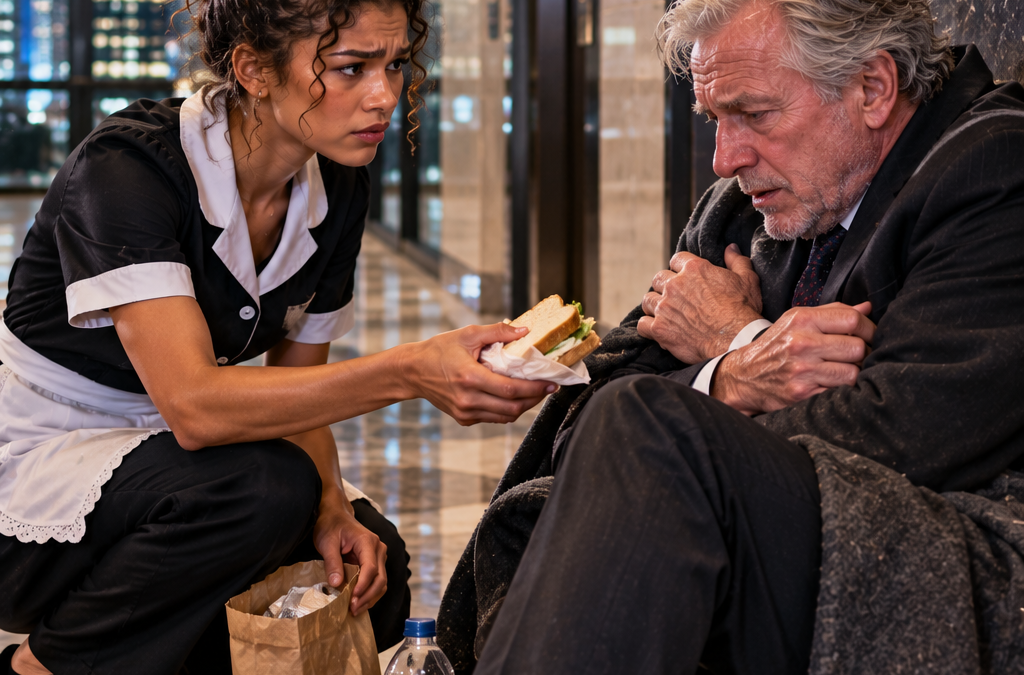
“Eat.”
He stared at it.
“No.”
“Yes.”
“That’s yours.”
“I know.”
“You’re working all night.”
“I know.”
“I can’t.”
“You can.”
I held it closer.
“And you will.”
He almost smiled.
Weakly.
He took it.
His fingers shook so badly that turkey slipped toward the edge of the bread.
I steadied his hand.
“Slow.”
He took a bite.
Chewed.
Another.
I handed him my water bottle.
He could barely keep it level.
I held the bottom.
He drank.
We sat there nearly twenty minutes.
Me on the edge of the bench.
Him beside me.
Gradually his breathing settled.
His hands slowed.
A little color came back.
“What’s your name?”
“Whitney.”
“Whitney…”
“Quinn.”
He nodded.
“You work here?”
“Every night.”
“This floor?”
“Thirty through forty-five.”
He looked around.
“You clean this hallway.”
“Unfortunately.”
That earned the faintest smile.
He looked at the sandwich half in his hand.
“My wife used to make these.”
“Turkey?”
“Same cheese.”
“Very sophisticated woman.”
He laughed once.
Then his face changed.
“She died.”
My smile disappeared.
“Three weeks ago.”
I said nothing.
People rush to fill grief with words because silence makes them uncomfortable.
I had learned after Danielle died that most condolence sentences are written for the person saying them.
So I sat.
Our shoulders almost touched.
Air system humming.
Clock ticking somewhere inside the boardroom.
Eventually he said:
“The house is too quiet.”
I looked down.
“I know what that feels like.”
“You lost someone?”
“My sister.”
He nodded.
“Recently?”
“Three years.”
“Does it get easier?”
I thought about Lily asleep at home.
“Different.”
He looked at me.
“That’s not what I asked.”
“It’s the truest answer I have.”
He seemed to accept that.
When he finished eating, I stood.
“You need real food.”
“I suppose.”
“And probably a doctor if this happens again.”
He smiled.
“Yes, ma’am.”
“Don’t skip meals.”
“Yes, ma’am.”
“I’m serious.”
“So are you always this bossy?”
“Only with people making stupid choices.”
He laughed properly then.
I picked up my mop.
“Go home.”
He looked down the hallway.
“I will.”
I started pushing the cart.
At the corner, I turned back.
He was holding the paper towel.
The yellow sun Lily had drawn.
He folded it carefully.
Put it into his shirt pocket.
I smiled to myself.
Then went back to work.
I never asked his name.
Why would I?
He was an old man who needed food.
That was all.
I finished the floor.
Ate my remaining half sandwich around three.
Standing in a supply room because Dennis cut break short again.
At six, I caught the bus home.
My stomach was empty.
My feet hurt.
I leaned against the window and watched the city wake up.
When I reached our apartment, Lily was asleep on the couch.
Television on.
A bowl of dry cereal on the table.
She had gotten hungry and fed herself.
She was six.
That sight hurt.
I lifted her carefully.
Carried her to bed.
Tucked the blanket beneath her chin.
“We’re going to be okay.”
I whispered it because I needed one of us to believe me.
Later I called Ruth.
“You awake?”
“I’m sixty. I’m always awake.”
“Something weird happened.”
“Dennis weird?”
“No.”
“Ghost weird?”
I laughed.
“Old man weird.”
I told her.
Fortieth floor.
Shaking hands.
Sandwich.
Dead wife.
Ruth went quiet.
“Fortieth?”
“Yes.”
“After midnight?”
“Yes.”
“Honey.”
“What?”
“Nobody is on forty after midnight except ghosts and billionaires.”
“He wasn’t a billionaire.”
“How do you know?”
“He looked sad.”
Ruth laughed.
“You think rich people can’t be sad?”
“No.”
“Sometimes the loneliest people have the biggest houses.”
I thought about him.
“Maybe.”
“You did good.”
“It was half a sandwich.”
“It was your half to give.”
That was Ruth.
I hung up.
Then forgot about the old man.
Or tried to.
I had hospital calls.
Work.
Lily.
Fifty-four thousand dollars.
He was a small thing inside a very large problem.
I did not know his name was Arthur Peton.
Founder of Peton Holdings.
The man whose name was carved into the building.
The face in the framed portrait I dusted every Tuesday without ever looking closely.
He owned sixteen commercial buildings.
His company was worth billions.
He had started with one hardware store in 1979.
I knew none of it.
Arthur later told me what happened after I left.
He sat on that bench another hour.
Then entered his office.
His wife, Eleanor, had died three weeks earlier.
Cancer.
The penthouse apartment they shared for forty years had become unbearable.
Every room reminded him of her.
So he began staying at work later.
Then later.
That Tuesday, grief and not eating finally caught up with him.
Three people passed him during those forty-three minutes.
Two security guards.
One maintenance technician.
One guard looked directly at him.
None stopped.
Maybe they assumed he wanted privacy.
Maybe they were afraid to bother someone who looked important.
Maybe they simply did not want to get involved.
Then I came through pushing a cleaning cart.
Arthur told me he had begun believing people no longer noticed each other.
Eleanor had believed the opposite.
She carried granola bars in her purse for homeless people.
Stopped for stranded drivers.
Knew janitors by name.
Remembered security guards’ children.
Three weeks after her death, Arthur had started thinking maybe her kindness had been naïve.
Then I split my dinner.
The next morning at 6:30, he called Graham Walsh.
His executive assistant.
“Find Whitney.”
Graham asked:
“Whitney who?”
“Night cleaning crew. Last name starts with Q.”
“What is this regarding?”
Arthur said:
“Nothing you need to know yet.”
Graham found me.
Whitney Quinn.
Age thirty-two.
Four years employed.
No disciplinary history.
Perfect attendance.
Legal guardian of Lily Quinn.
Both parents deceased.
Then Arthur asked about company insurance.
That led to Lily.
VSD.
Surgery.
Eighty-five thousand.
Insurance shortfall.
Fundraiser.
The tin box.
When Graham told him about the fifty-four-thousand-dollar gap, Arthur turned toward the window.
He later said he heard Eleanor’s voice in his mind.
Not supernatural.
Memory.
She used to tell him:
“You always know what the right thing is. You just spend too long negotiating with yourself before doing it.”
Arthur told Graham:
“Make some calls.”
“What kind?”
“The kind that fixes things.”
I knew none of that.
I returned to work.
On forty, a cushion had appeared on the leather bench.
A water cooler stood near the elevators.
Executive kitchen had a basket of granola bars.
I assumed someone in management had finally noticed employees were human.
Two weeks passed.
My savings reached twelve thousand five hundred ten dollars.
The fundraiser barely moved.
Then the hospital letter arrived.
Thursday afternoon.
White envelope.
Mercy General logo.
I almost left it unopened because hospital mail usually meant bills.
I opened it anyway.
PRE-SURGICAL CONSULTATION.
LILY QUINN.
NOVEMBER 14.
PETON MEMORIAL CARDIAC CENTER.
I read it three times.
Lily sat on the floor coloring.
“Auntie?”
I looked at her.
“Did you do this?”
“Do what?”
I nearly laughed from panic.
“Nothing.”
I went into the bathroom.
Closed the door.
Called surgical scheduling.
“Mercy General, this is Andrea.”
“My name is Whitney Quinn. I got a consultation letter for my niece.”
Keyboard.
“Lily Quinn?”
“Yes.”
“November fourteenth.”
“Yes.”
“I didn’t schedule it.”
Pause.
Then:
“Ms. Quinn, Lily’s procedure has been fully funded.”
I sat down on the bathtub.
“What?”
“An anonymous donor covered the complete surgical package.”
My hand tightened around the phone.
“Complete?”
“Pre-op. Surgery. Anesthesia. ICU. Recovery. Twelve months follow-up.”
“How much?”
“Eighty-five thousand.”
My vision blurred.
“No.”
“Excuse me?”
“I mean… who?”
“The donor requested anonymity.”
“Can you tell me anything?”
“No, ma’am.”
“Was this the fundraiser?”
“I don’t have that information.”
After we hung up, I checked the fundraiser.
Still twenty-one hundred.
I sat on the bathroom floor.
The faucet dripped.
Lily hummed in the next room.
And I cried into both hands without making a sound.
That night I called Ruth.
“Somebody paid for Lily’s surgery.”
Silence.
“All of it.”
Ruth inhaled sharply.
“Lord.”
“Eighty-five thousand.”
“Oh, baby.”
“I don’t understand.”
“You don’t need to understand tonight.”
“What if it’s a mistake?”
“It’s not.”
“How do you know?”
“Because I’m choosing faith over your anxiety.”
I laughed through tears.
The following morning, the lobby receptionist stopped me.
“Ms. Quinn?”
I turned.
“Mr. Walsh from the executive office wants you on forty at nine.”
My stomach dropped.
“Why?”
“He didn’t say.”
I spent the elevator ride building disasters.
Dennis reported me.
I broke some executive-floor rule.
Maybe I had violated security by helping the old man.
Maybe he had complained.
Maybe I had handled a medical emergency incorrectly.
The doors opened.
A man in a navy suit waited.
“Ms. Quinn?”
“Yes.”
“Graham Walsh.”
His handshake was professional.
“Follow me.”
We passed the bench.
New cushion.
Water cooler.
Granola bars.
He stopped at the enormous oak door I had cleaned around for years.
Knocked once.
Opened it.
The office was huge.
Glass.
City view.
Mahogany desk.
And behind it stood the man from the bench.
Charcoal suit.
Silver tie.
Healthy color.
I stared.
Then saw the portrait behind him.
Same face.
Older in the photograph but unmistakable.
Brass plate beneath it:
ARTHUR J. PETON
FOUNDER AND CHAIRMAN
My knees softened.
I grabbed the chair.
“You.”
He smiled.
“Me.”
“You own…”
I pointed uselessly around.
“This?”
“The building, yes.”
I looked at the portrait again.
“I clean that every Tuesday.”
“I’m flattered.”
“You’re Arthur Peton.”
“That’s what they tell me.”
I felt sick.
Not because he was rich.
Because I remembered ordering him to eat a sandwich.
“You told me not to skip meals.”
He smiled.
“You were correct.”
“I told you to go home.”
“Also correct.”
I covered my face.
“Oh my God.”
“Please sit.”
I sat on the edge of the leather chair.
Could not relax.
Arthur opened a desk drawer.
Removed something folded.
Placed it between us.
Paper towel.
Yellow crayon sun.
I stared.
“You kept that.”
“I have.”
“Why?”
He looked at it.
“Because I needed to remember what happened.”
His voice changed.
“I checked security footage.”
My stomach tightened.
“You were on that bench forty-three minutes before I came.”
“Yes.”
“Three people passed.”
“Yes.”
He looked directly at me.
“Three.”
I said nothing.
“One maintenance technician.”
Pause.
“Two security officers.”
His hands folded.
“One looked directly at me.”
I looked toward the window.
“Nobody stopped.”
“No.”
“I’m sure they thought—”
Arthur shook his head.
“Don’t rescue them from the choice.”
That silenced me.
“You stopped.”
“You looked sick.”
“Exactly.”
He picked up the paper towel.
“You did not know my name.”
“No.”
“You did not know I owned this building.”
“Obviously.”
“You had no reason to believe helping me would benefit you.”
I shifted.
“It was half a sandwich.”
“No.”
He said it firmly.
“It was half of the only food you had.”
I looked at Graham.
Then Arthur.
“How do you know that?”
Arthur opened a folder.
Thick.
My name.
My life inside paper.
“I asked Graham to understand your circumstances.”
My face heated.
“You investigated me.”
“Yes.”
“That feels creepy.”
Graham almost smiled.
Arthur nodded.
“Fair criticism.”
I crossed my arms.
“What do you know?”
“Lily.”
Everything in me changed.
“What about Lily?”
“Her heart condition.”
I stared.
“The surgery.”
My throat tightened.
“The insurance gap.”
I already knew.
I did not want him to say it.
“The fundraiser.”
My eyes filled.
“The hospital letter.”
My mouth opened.
He nodded.
“You.”
“Yes.”
“You paid it.”
“I did.”
I stood.
Too fast.
The room tilted.
“No.”
Arthur stood too.
“Whitney—”
“You cannot do that.”
“It’s done.”
“I gave you half a sandwich.”
“I know.”
“That is not worth eighty-five thousand dollars.”
“No.”
His answer surprised me.
“No, it isn’t.”
I stared.
“Then why?”
He looked toward a photograph on the desk.
A woman with silver hair.
Warm smile.
Eleanor.
“My wife helped establish the cardiac center eleven years ago.”
He touched the photograph.
“She believed money was most useful when it removed fear from someone who did not deserve to carry it.”
I looked down.
“Arthur…”
“Let me finish.”
I sat again.
He opened another folder.
“Three things.”
I looked at him.
“First.”
He tapped the hospital paperwork.
“Lily’s surgery is covered.”
I swallowed.
“Completely.”
“You already did that.”
“Yes.”
“You can’t take it back.”
“No.”
Something inside me loosened.
Not fully.
Enough that I could breathe.
“Second.”
He turned another page.
“I established the Eleanor Peton Education Fund this week.”
I frowned.
“Lily will be the first beneficiary.”
“What?”
“Tuition.”
I shook my head.
“Elementary education support.”
“No.”
“Tutoring.”
“Arthur.”
“College.”
“Stop.”
“Whatever educational expenses are necessary.”
I stood again.
“This is insane.”
He waited.
“You don’t know us.”
“I know enough.”
“No, you know a file.”
“I know you gave a stranger food while you were hungry.”
I wiped my eyes.
“That does not mean Lily gets college.”
Arthur leaned back.
“Eleanor would disagree.”
I laughed through tears.
“You keep using your dead wife against me.”
That surprised him.
Then he laughed too.
“She would appreciate that accusation.”
I sat.
“Third.”
He became more formal.
“Peton Holdings operates twelve commercial properties in the city.”
“Yes.”
“Cleaning operations are inconsistent.”
“I could have told you that.”
“I’m learning.”
“Dennis refuses supply requests.”
Arthur glanced toward Graham.
Graham wrote something.
I immediately regretted speaking.
“I wasn’t—”
“No.”
Arthur lifted a hand.
“Continue.”
I looked between them.
“We reuse equipment too long.”
“Good.”
“Break coverage is terrible.”
Graham wrote.
“Training depends on whoever happens to be experienced.”
Arthur nodded.
“Exactly.”
Then he leaned forward.
“I’m creating a facilities operations manager position.”
I stared.
“You would oversee all twelve properties.”
I laughed.
Not politely.
“You are kidding.”
“No.”
“I clean floors.”
“You understand cleaning operations.”
“That is not the same thing.”
“Two hundred fourteen employees.”
My stomach tightened.
“Budgets.”
I shook my head.
“Scheduling.”
“No.”
“Hiring.”
“Arthur.”
“Equipment procurement.”
“I have never managed two hundred people.”
“You have raised a child through a medical crisis while working nights.”
“That is not management.”
Graham spoke for the first time.
“It is more operational management than many résumés I’ve reviewed.”
I looked at him.
“Whose side are you on?”
“Payroll’s.”
Arthur smiled.
“Salary would be four times your current wage.”
I stopped breathing.
“Full benefits.”
Nothing.
“Pension.”
My hands trembled.
“This is too much.”
Arthur picked up the yellow-sun paper towel again.
“My wife once told me something.”
I waited.
“We were young.”
He smiled toward the photograph.
“Poor.”
“We ate turkey sandwiches constantly.”
“That explains the emotional reaction.”
He nodded.
“I complained once.”
“What did she say?”
Arthur’s voice softened.
“Anyone can be generous when the plate is full.”
I looked at him.
“The people worth knowing are the ones who share when theirs is nearly empty.”
My eyes burned.
He held up the paper towel.
“You shared from an empty plate.”
That was when I broke.
Not when he said surgery.
Not college.
Not salary.
That sentence.
Because the hardest part of being poor was not the lack of money.
It was how invisible effort became.
Nobody saw the calculation behind a sandwich.
Nobody saw twenty-two dollars moved from groceries to medicine.
Nobody saw the half meal saved for 2:00 a.m.
Nobody saw what it cost to give something small.
Arthur did.
I covered my face.
Cried in the billionaire’s office.
Graham quietly left.
Arthur did not come around the desk.
Did not touch me.
He let me cry.
Eventually I said:
“I don’t know how to do that job.”
“You’ll learn.”
“What if I fail?”
“Then you fail honestly and learn again.”
“I didn’t go to college.”
“Not relevant.”
“It will be relevant when people reporting to me have degrees.”
“Some will.”
“They’ll resent me.”
“Some might.”
“You’re terrible at reassuring people.”
“I built a company. Different skill set.”
I laughed.
Then wiped my face.
“Can I think about it?”
“Yes.”
“For how long?”
“Twenty-four hours.”
“That’s not thinking time.”
“It’s executive thinking time.”
I accepted the next morning.
Not because I suddenly believed I deserved everything.
Because Lily had taught me something.
Sometimes fear wears the costume of humility.
Sometimes saying “I’m not qualified” means “I’m terrified people will discover I’m still the woman scrubbing their offices.”
I decided to learn.
Before any of that, Lily had surgery.
November 14.
Hospital gown with blue stars.
Her hand inside mine.
She looked far too calm.
“Auntie?”
“Yes?”
“Will it hurt?”
“Not while you’re asleep.”
“What about after?”
I hated lying.
“Probably a little.”
She nodded.
“Will you be there?”
“When you wake up.”
“Promise?”
“Promise.”
Ruth sat in the waiting room with me.
She took her first sick day in eleven years.
Brought cornbread.
Sweet tea.
Did not move for hours.
The surgery lasted four hours and thirty-eight minutes.
Every minute was a year.
I walked.
Sat.
Stood.
Prayed.
Read the same paragraph of a magazine sixteen times.
At some point, Ruth grabbed my hand.
“You’re going to wear a trench into the floor.”
“I can’t sit.”
“Then walk.”
Dr. Cole finally entered.
Scrubs.
Mask down.
I read his face before he spoke.
“It went well.”
My knees stopped working.
Ruth caught me.
“The defect is repaired.”
I cried into her shoulder.
Lily spent six days recovering.
I slept in a chair.
Arthur sent flowers.
White lilies.
Card:
From a friend who owes you half a sandwich. — A.P.
Lily read it.
“Who is A.P.?”
“A friend.”
“The old man?”
I stared.
“How do you know about the old man?”
“You talk in your sleep.”
I laughed.
“Maybe.”
“Is he rich?”
“Very.”
“How rich?”
“Go to sleep.”
When Lily came home, everything changed slowly.
That mattered.
No miracle erased recovery.
She hurt.
Got tired.
Needed medication.
Had a scar.
Cried when bandages changed.
But week by week, her color improved.
Her breathing changed.
Then one afternoon, months later, she ran across a playground.
Ran.
I stood near the fence and watched.
No stopping.
No hand on chest.
No blue lips.
She ran until she reached the far side.
Turned.
Waved.
“Auntie!”
I covered my mouth.
Cried in public.
Did not care.
Six months after the surgery, I walked through Peton Holdings Tower’s front entrance at eight in the morning.
Not service entrance.
Not loading dock.
Front.
Navy blazer.
Pressed slacks.
Badge:
WHITNEY QUINN
FACILITIES OPERATIONS MANAGER
The badge felt like it belonged to someone else.
For the first three weeks, I expected security to stop me.
Nobody did.
My first priority was night shift.
Of course.
I visited every property.
Twelve buildings.
Usually after midnight.
No warning.
I sat with cleaning crews.
Asked names.
Then listened.
Who had childcare problems?
Who had bad knees?
Which buildings lacked working break-room refrigerators?
Which supervisors abused timekeeping?
Which equipment kept breaking?
Which chemical caused rashes?
What did they need?
The answers were embarrassingly basic.
Water.
Food access.
Reliable equipment.
Respectful scheduling.
Someone to call.
I created Night Shift Care.
Every building received a station.
Water cooler.
First-aid kit.
Snacks.
Emergency supplies.
And a card.
YOU MATTER HERE.
My phone number was at the bottom.
Graham objected.
“You cannot put your direct number in twelve buildings.”
“Why?”
“You’ll never sleep.”
“I didn’t sleep before.”
“That is not an argument.”
“Put it there.”
He did.
For the first month, people barely called.
They assumed the number was fake.
Then one cleaner called because her son had been hospitalized and she feared being fired.
Another because a supervisor refused to replace gloves.
Another because his rent was overdue after his wife lost work.
I learned quickly that snacks were not enough.
Arthur established the Eleanor Kindness Fund.
Two million dollars of his own money.
Emergency medical expenses.
Housing instability.
Family crises.
Forty-three families received support in the first six months.
Then one hundred.
Arthur refused to put his own name on it.
Only Eleanor’s.
Dennis Hargrove did not survive long in his old position.
Not because I asked for revenge.
I didn’t.
Arthur reviewed his practices.
Break deductions.
Equipment refusals.
Complaints.
Dennis was reassigned to a warehouse facility in New Jersey.
When word spread, night crews did not celebrate.
They exhaled.
That told me everything.
The local news eventually found the story.
Half sandwich.
Billionaire founder.
Sick child.
New job.
They wanted a fairy tale.
I resisted interviews.
Then Arthur said:
“You should tell the part they’re missing.”
“What part?”
“That kindness isn’t valuable because it gets rewarded.”
I agreed to one conference.
Corporate responsibility.
My first stage.
Microphone clipped to my jacket.
Hands shaking.
I looked at an audience full of executives.
“I’m not special.”
People smiled politely.
“I mean that.”
They stopped smiling.
“I didn’t help Arthur because I saw some extraordinary destiny.”
I looked toward him.
He sat in the third row.
“I saw an old man shaking.”
“That was it.”
I paused.
“The difficult part of kindness isn’t generosity.”
People watched.
“It’s noticing.”
That became the line reporters repeated.
But I meant something specific.
People had passed Arthur.
Not villains.
Probably tired employees.
Distracted.
Afraid.
Maybe thinking somebody else would handle it.
The world does not run out of kindness because everyone becomes cruel.
Sometimes it runs out because everyone becomes busy.
That frightened me more.
One year later, I walked the fortieth floor again on a Tuesday night.
I did not have to.
I had an office on eight.
Desk.
Computer.
Nameplate.
Normal hours.
But some Tuesdays, I went back.
The hallway still looked nearly identical.
Same paintings.
Same carpet.
Same boardroom.
Same leather bench.
Except Arthur had installed a plaque.
ELEANOR’S BENCH
WHERE KINDNESS SAT DOWN
The first time I read it, I cried.
Then told him it was sentimental.
He said:
“I’m old. I’m allowed.”
That Tuesday, I sat on the bench.
My bag beside me.
Turkey sandwich wrapped in paper towel.
Actually two sandwiches.
One for me.
One extra.
I carried an extra often now.
Not because I expected another billionaire.
Because that had never been the lesson.
My phone rang.
Arthur.
“You’re on the bench.”
“How do you know?”
“It’s Tuesday.”
“You’re creepy.”
“You’ve mentioned.”
We talked about work.
New building.
Graham’s retirement.
The fund helping its hundredth family.
Lily’s report card.
Arthur asked:
“She still drawing suns?”
“On everything.”
“Good.”
His grief had changed over the year.
Eleanor remained inside every conversation.
But the pain no longer swallowed him.
Before hanging up, he said:
“Thank you, Whitney.”
I gave my usual answer.
“It was a sandwich.”
“No.”
I smiled.
“I know.”
After we hung up, I sat alone.
Forty floors above the city.
For a while, I thought about the version of my life that almost happened.
No Arthur.
No surgery money.
No promotion.
I did not like thinking about it.
Because it made the story sound as if kindness works like an investment.
Give half a sandwich.
Receive eighty-five thousand dollars.
That is not what happened.
If Arthur had been a retired schoolteacher with no money, giving him food would still have been the correct thing.
I might have gone home hungry.
Lily’s surgery would still have been unfunded.
Dennis would still have docked my breaks.
Nobody would have filmed anything.
No news story.
No new job.
The act would not have become less valuable.
That is what I eventually understood.
Arthur did not make the choice meaningful.
He only made it visible.
I had spent years believing nobody saw me.
Cleaning glass after midnight.
Stretching meals.
Saving ten-dollar bills.
Caring for Lily.
Standing in hospital hallways.
Working while terrified.
Maybe nobody important saw.
But Ruth did.
Lily did.
And I was learning that those definitions of important had been backward.
Ruth saw me before Arthur.
Lily needed me before any executive did.
My worth had not started in the chairman’s office.
That mattered.
Arthur and I became friends.
A strange friendship.
Thirty-eight years between us.
A billionaire founder.
A former night cleaner.
He hated when reporters described me as the woman who saved him.
“I had low blood sugar, Whitney. You did not pull me from a burning airplane.”
“You were dramatic enough.”
“I was grieving.”
“Still dramatic.”
He smiled more after the first year.
He visited Lily.
She gave him a drawing.
Stick figure running under an enormous yellow sun.
He framed it in his office beside expensive art and photographs of Eleanor.
I once asked:
“You know that picture is worth maybe four cents.”
Arthur said:
“Then the market is wrong.”
Lily adored him.
Mostly because he let her eat dessert before dinner.
I objected.
He ignored me.
One afternoon, she asked him:
“Are you my grandpa now?”
The room went quiet.
Arthur looked at me.
I looked away.
He crouched.
“I can be your Arthur.”
Lily considered that.
“Okay.”
Then hugged him.
I saw his eyes close.
Some losses never get replaced.
But sometimes love builds another room beside grief.
That was what happened with Arthur and Lily.
With me too.
The Eleanor Fund expanded.
Night Shift Care became permanent.
Other companies asked about it.
Ruth eventually retired.
Not immediately.
She refused.
“I’m not leaving because your fancy title says I can.”
“Nobody said that.”
“You were thinking it.”
“I was.”
She worked another year.
On her final night, I organized dinner in the basement break room.
No executives.
No cameras.
Just cleaners.
Cornbread.
Turkey sandwiches.
Cake.
Arthur came downstairs.
Ruth pointed at him.
“You.”
He stopped.
“Yes, ma’am?”
“You eat tonight?”
Everyone laughed.
Arthur nodded seriously.
“Yes.”
“Good.”
She hugged him.
Then me.
Whispered:
“Told you somebody saw.”
I cried again.
I had become embarrassingly easy to make cry.
Years passed.
Lily grew.
The scar across her chest faded from red to pale.
She became the fastest runner in her second-grade class.
Then third.
Our house with the yard eventually happened.
Not because Arthur bought it.
He offered.
I refused.
I bought it myself after several years in operations.
Small place.
Two bedrooms.
Patchy grass.
Fence leaning slightly left.
Lily stood in the backyard the first day and screamed:
“You promised!”
I laughed.
“I did.”
We got a dog six months later.
Terrible decision.
Lily named him Sunshine.
Of course.
He destroyed two shoes, one couch cushion, and part of the garden.
Arthur loved him.
I did not.
That is what I said publicly.
Privately, Sunshine slept beside my bed.
Sometimes at night, after Lily was asleep, I would think about the old apartment.
Fourth-floor walk-up.
Tin box under the sink.
Twelve thousand dollars.
Hospital estimate.
One sandwich.
Life felt impossibly distant.
But I kept the tin box.
It sits in my closet.
Inside are a few things.
Old hospital bill.
Lily’s medication label.
The first badge from Peton.
A copy of Arthur’s card.
Ruth’s retirement note.
And a paper towel with a yellow sun.
Not the original.
Arthur kept that one.
Lily drew me another.
Same crooked rays.
Same smiling face.
On the back she wrote:
FOR AUNTIE.
ALWAYS SHARE.
I laughed when she gave it to me.
Then cried.
Naturally.
The older I got, the less I believed life changed because of one dramatic moment.
The sandwich did not magically solve everything.
What changed us was a chain.
Ruth teaching me what shaking hands meant.
Lily drawing a sun.
Me stopping.
Arthur remembering Eleanor.
Graham making calls.
Doctors doing their work.
Arthur looking at a corporation and realizing he had ignored the people keeping it clean.
Me getting an opportunity.
Then using it to see others.
One choice touching another.
That feels truer than miracles.
The world likes simple stories.
Poor cleaner helps billionaire.
Billionaire rewards cleaner.
Everyone cries.
End.
But what stays with me is not the money.
It is Arthur sitting forty-three minutes in a hallway with his own name on the building.
People passed him because they saw a man who looked like he belonged there and assumed he must be fine.
I stopped because he did not look fine.
That is it.
That is the whole beginning.
Notice.
Ask.
Stay.
Years later, whenever a new manager joined facilities, I told them about the bench.
Not who Arthur was.
Just what happened.
Then I asked:
“If someone sits in your hallway for forty-three minutes, whose responsibility are they?”
Most said:
“Security.”
I shook my head.
“Wrong.”
“Medical?”
“Wrong.”
“Supervisor?”
“Wrong.”
Eventually someone would say:
“Mine?”
I smiled.
“Now you understand.”
Organizations teach people to shrink responsibility.
Not my department.
Not my floor.
Not my job.
Not my problem.
Kindness expands it.
Someone is in front of me.
That makes them mine for this moment.
Not forever.
Not to rescue.
Just enough to stop.
Ask.
Notice.
One Tuesday, many years after that first night, Arthur and I sat on Eleanor’s bench together.
He had gotten slower.
His hair was nearly white.
His company was no longer his daily responsibility.
Lily was twelve.
He held two turkey sandwiches.
He handed me one.
“Full sandwich?”
“I’m wealthy.”
“Showing off.”
“Yes.”
We ate.
For a while, neither spoke.
Then Arthur asked:
“Do you ever regret stopping?”
I looked at him.
“Seriously?”
“Yes.”
“No.”
“Even if none of this happened?”
I understood what he meant.
No surgery funded.
No promotion.
No house.
No fund.
No changed policies.
Just a hungry cleaner and a stranger.
I thought.
Then shook my head.
“No.”
“Why?”
“Because you needed help.”
He smiled.
“That simple?”
“Yes.”
Arthur looked toward Eleanor’s plaque.
“She would have liked that answer.”
“I know.”
“You never met her.”
“No.”
“But I’ve heard about her for ten years.”
He laughed.
Fair.
Then he reached into his jacket.
Pulled out the original paper towel.
The yellow sun was faded.
Fold lines soft from age.
“You still carry that?”
“Not every day.”
He looked at it.
“Most Tuesdays.”
I stared.
“That is ridiculous.”
“It saved my life.”
“You had low blood sugar.”
“No.”
His voice quieted.
I looked at him.
Arthur continued.
“I mean before that.”
I waited.
“When Eleanor died, I did not want to die.”
He chose his words carefully.
“But I did not particularly care whether tomorrow came.”
My chest tightened.
“Arthur.”
“I was surrounded by thousands of employees and felt completely alone.”
He touched the paper towel.
“You stopped.”
Tears burned my eyes.
“Not because of the sandwich.”
He looked at me.
“Because somebody noticed.”
There it was.
The thing beneath everything.
Not money.
Not food.
Not buildings.
Being seen.
I took his hand.
His skin had become thinner.
“Then I’m glad I was late cleaning conference room thirty-nine.”
He smiled.
“Dennis would have docked you.”
“He probably did.”
We laughed.
The hallway hummed.
Same sound.
Same bench.
Different lives.
When I think about that night now, I do not picture the limousine people later wrote about.
Or Arthur’s office.
Or the eighty-five-thousand-dollar surgery.
I picture my hand hovering over the sandwich.
Three seconds.
Hungry.
Tired.
Scared about Lily.
Thinking:
I need this.
Then looking at a stranger and thinking:
So does he.
I tore it in half.
Not heroically.
Not beautifully.
I was annoyed.
My stomach hurt.
I hoped he would eat quickly so I could finish cleaning.
That is another thing nobody tells you.
Goodness does not always feel noble while you are doing it.
Sometimes it feels inconvenient.
Sometimes you are tired.
Sometimes you resent the cost.
You can still choose it.
That matters to me.
Because if kindness required pure hearts, unlimited patience and full stomachs, most of us would never qualify.
I was not full.
I was not rested.
I was not hopeful.
I stopped anyway.
Years later, Night Shift Care kept sandwiches in every Peton building.
Turkey.
Peanut butter.
Vegetarian.
Granola bars.
Fruit.
Water.
I insisted nobody ask why someone took food.
No forms.
No employee numbers.
No proof of hardship.
Just food.
Dennis would have hated that.
Ruth loved it.
Arthur funded it.
Lily decorated the first cards with yellow suns.
And every card said:
TAKE WHAT YOU NEED.
That became my favorite sentence in the company.
Not “work harder.”
Not “excellence.”
Not “productivity.”
Take what you need.
Because people give better when they are not empty.
And sometimes, when they are empty anyway, extraordinary things happen.
But they should not have to.
That was the lesson Arthur and I built into the company.
Do not depend on heroic sacrifice from exhausted people.
Build systems that feed them before they need to split the last sandwich.
That mattered more than the fairy tale.
The night I found Arthur, I thought I was the person helping him.
In one way, I was.
In another, both of us were sitting on that bench hungry.
He needed food.
I needed proof that the life I was living could still open somewhere.
Neither of us knew what the other carried.
We only knew what we could see.
A shaking hand.
A sandwich.
A yellow sun.
Sometimes that is enough.
Whenever Lily asks me about the story now, she always corrects one detail.
“You say you gave him half your sandwich.”
“I did.”
“No.”
“What?”
“You gave him my sun too.”
I smile.
“You drew another.”
“Still.”
She is right.
That little sun ended up inside a billionaire’s pocket because a six-year-old had doodled on her aunt’s dinner wrapper before school.
Arthur kept it because it reminded him somebody noticed.
I kept its memory because it reminded me I had something to give even when I believed I had almost nothing.
That was what changed us.
Not wealth.
Not luck.
Not destiny.
A decision made in a quiet hallway while nobody else was watching.
I saw a man fading.
I stopped.
And for the rest of my life, whenever I could, I tried to build places where people would stop for each other before forty-three minutes had passed.








