𝗙𝗨𝗟𝗟 𝗦𝗧𝗢𝗥𝗬 I Had Eight Dollars Left When I Opened My Door to a Freezing Stranger, and I Had No Idea Who Was Hunting Him
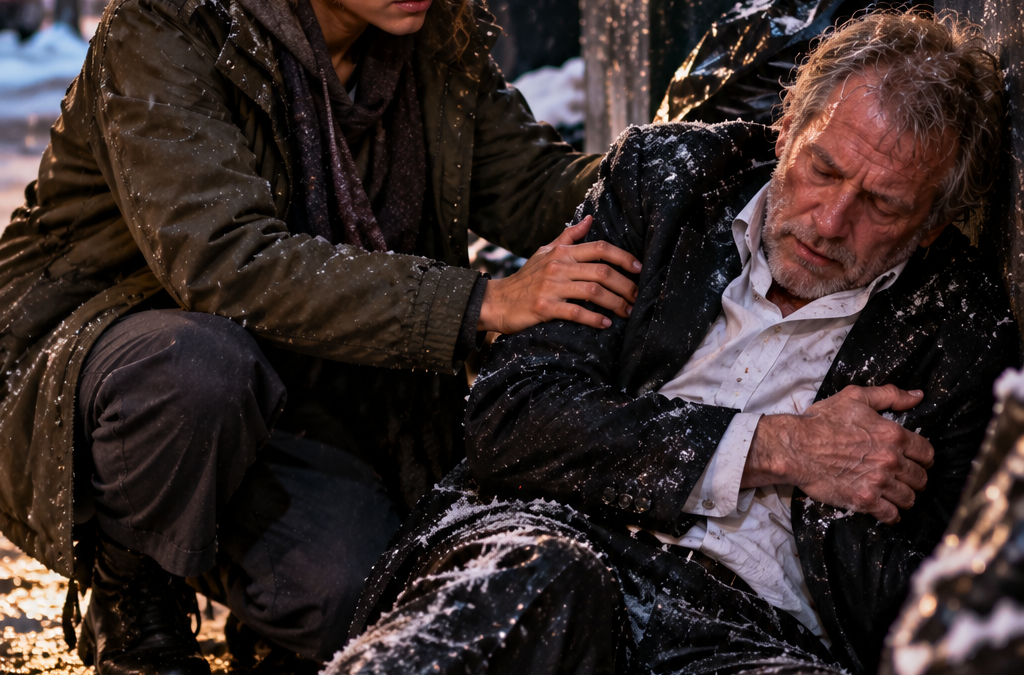
𝗙𝗨𝗟𝗟 𝗦𝗧𝗢𝗥𝗬
I unlocked the door.
Pulled him inside.
Then dragged him to the couch.
Three blankets.
That was everything I had.
One from my bed.
One from Elijah’s.
One from the hall closet.
I layered all three over him.
Then I stood there staring.
“Hattie Holloway,” I whispered to myself. “What are you doing?”
The answer was already lying on my couch.
Keeping somebody alive.
I went to the kitchen.
One can of chicken noodle soup.
Ninety-nine cents from the corner store.
I had planned to split it with Elijah after school the next day.
I opened it.
Added a little water.
Heated it slowly.
When I returned, the man’s eyes were open.
He flinched.
Tried to sit.
“Easy.”
He looked around wildly.
“Where—”
“You’re safe.”
He stared at me.
“My name is Hattie. You’re in my house.”
His eyes moved toward the hallway.
“There’s nobody here who’s going to hurt you.”
His breathing was shallow.
He looked at the bowl.
Then at me.
“What’s your name?”
He hesitated.
“Doug.”
“Just Doug?”
A weak nod.
I didn’t push.
“All right, Doug. Eat.”
His hands shook so badly the spoon hit the bowl.
Soup spilled onto the blanket.
He whispered, “Sorry.”
“It’s a blanket.”
He tried again.
The first spoonful reached his mouth.
Then something happened to his face.
His eyes filled.
He kept eating.
Tears ran silently down both cheeks.
No sobbing.
No sound.
Just a man holding a spoon in trembling fingers and crying into cheap chicken soup.
I looked away.
Not because I didn’t want to see.
Because I understood that sometimes dignity means pretending not to notice when another person needs privacy even though you’re sitting three feet away.
I stayed there.
Quiet.
Present.
A few minutes later, I heard small feet in the hallway.
Elijah appeared wearing dinosaur pajamas.
His hair stood up on one side.
“Mama?”
“Baby, why are you awake?”
“Who’s that?”
Doug froze.
I held out a hand toward Elijah.
“He’s just somebody who needs help tonight.”
Elijah looked at him.
Doug looked back.
Neither spoke.
Then my son raised one hand and gave a tiny wave.
Doug’s mouth tightened.
Elijah turned around and shuffled back toward his room.
When I looked at Doug again, there were fresh tears in his eyes.
“Thank you,” he whispered.
I carried the empty bowl to the sink.
“Kindness isn’t a trade, Doug.”
He watched me.
“It’s a seed.”
I rinsed the bowl.
“Now get some sleep.”
I believed that would be the end of it.
One night.
One stranger.
One decision.
I had no idea that the man sleeping beneath my blankets had once managed millions of dollars.
No idea powerful people knew his name.
No idea somebody had spent more than a year making sure the world believed he was a criminal.
And I certainly didn’t know that before morning, Doug would touch something hidden inside the lining of his clothes as if he were checking whether the last piece of his old life was still there.
Morning light made my house tell the truth.
The overdue electric bill sat on the counter with red letters across the top.
My kitchen faucet dripped every six seconds.
I knew because I had counted.
The handle was wrapped in duct tape.
Elijah’s sneakers were by the door, the sole of the left one separating despite the superglue I had used two nights earlier.
We were surviving.
There is a difference between living and surviving.
People who have never had to make that distinction rarely understand how much work surviving takes.
I opened the refrigerator.
Three eggs.
I cracked all three into a pan.
Scrambled them.
Split them between two plates.
Then I looked at Doug.
He was sitting upright on the couch.
Hands folded.
Shoulders curved inward.
Trying to occupy as little of my living room as possible.
I scraped the eggs back together.
Made three portions.
His eyes followed me.
“I should leave.”
“No.”
“I’ve already taken too much.”
“It’s nine degrees outside.”
“I’ll find somewhere.”
“Sit down and eat your eggs.”
“Hattie—”
I gave him the look.
Every mother has one.
Elijah called mine the Don’t Even Try It Face.
Doug stopped talking.
He ate.
I had a weekend catering job that morning.
Before leaving, I dropped Elijah next door with Miss Vivian Price.
Vivian was sixty-two and had lived beside us since before Elijah could walk.
She watched him whenever my schedule got bad.
I had tried paying her once.
She handed the money back.
“Baby, rich people pay for community because they ain’t got none.”
That was Vivian.
I kissed Elijah.
Then I stood in the doorway.
Doug was still on the couch.
I hated leaving a stranger alone in my house.
That was the truth.
Kindness does not erase common sense.
But the man I had pulled from the snow looked more frightened of touching anything than I was of what he might do.
“There’s soup in the cabinet.”
He nodded.
“Don’t answer the door.”
Another nod.
“And if you steal my television, you’ll be disappointed. It doesn’t work right anyway.”
For the first time, something like humor touched his face.
“I won’t steal your television.”
“Good.”
I left.
Doug told me later what he did while I was gone.
He walked through the house slowly.
Not snooping.
Just looking.
He noticed things I had stopped noticing.
The peeling paint around the bathroom door.
The taped faucet.
The stack of unpaid bills.
Elijah’s school drawings held to the refrigerator with magnets.
Then he saw the photograph of Mama Denise.
I kept it in the hallway.
She was wearing her cleaning uniform in the picture, smiling with a tiredness I recognized more every year.
Beneath the frame, I had taped a line she wrote before she died.
Be the door someone needs even when yours is barely hanging on.
Doug read it three times.
Then he went under my sink.
Found an old wrench.
Plumber’s tape.
Tools left by the previous tenant.
When I came home, the faucet wasn’t dripping.
That was the first thing I noticed.
Silence.
I turned the handle.
Water.
Turned it off.
Nothing.
No drop.
No sound.
Then I saw the clean dishes.
Swept floor.
Folded blankets.
Military straight.
Doug sat on the couch.
Hands folded again.
I leaned against the kitchen doorway.
“Who are you?”
He looked up.
“Doug.”
“Don’t do that.”
His face tightened.
“You fixed plumbing.”
“I used to fix things.”
“What kind of things?”
He looked toward Elijah’s drawings.
“Bigger ones.”
I sat across from him.
“Who are you really?”
A long silence.
Then:
“Nobody now.”
“That’s not what I asked.”
His mouth opened.
Closed.
Finally he said, “I can’t tell you yet.”
“Why?”
“It’s safer.”
“For who?”
“You.”
That got my attention.
“And your son.”
I stared at him.
“What are you mixed up in?”
He looked exhausted again.
Not physically.
Some wounds sleep deeper than the body.
“If I tell you too early, you could become part of it.”
“I dragged you off frozen concrete. I’m already part of something.”
He almost smiled.
Not quite.
“I’m sorry.”
I stood.
“Soup or eggs?”
He looked confused.
“What?”
“You said you can’t tell me.”
“I can’t.”
“Then I’m not going to drag it out of you.”
I opened the cabinet.
“So. Soup or eggs?”
“Whatever you have.”
“Soup.”
He stayed.
Not because we discussed it.
We never did.
The next morning, he shoveled the sidewalk.
The morning after that, he walked Elijah to the bus stop.
By the third day, he had fixed a cabinet hinge that had annoyed me for two years.
He and Elijah started playing checkers after dinner.
The first game, Doug lost.
Elijah stared at the board.
“You let me win.”
“No.”
“Yes, you did.”
“I made tactical errors.”
“Play for real.”
Doug laughed.
The sound surprised all three of us.
It was the first real laugh I had heard from him.
Something began changing inside the house.
Small.
Quiet.
Doug still slept on the couch.
Still asked permission before touching anything.
Still apologized when he ate.
But he started existing instead of merely occupying space.
One night, after Elijah went to bed, Doug joined me on the porch.
We drank instant coffee.
The wind had eased.
Snow covered the parked cars.
For a long time, neither of us spoke.
I had learned not to rush people toward confessions.
Eventually, silence becomes safe enough for truth.
Doug stared into his cup.
“I used to work in finance.”
I waited.
“I was an executive.”
“How executive?”
He gave a sad laugh.
“Very.”
“That still isn’t an answer.”
“I managed accounts worth hundreds of millions.”
I looked at his worn shirt.
“Okay.”
He glanced at me.
“That’s all?”
“What do you want me to do? Faint?”
For the first time, he smiled without forcing it.
Then the smile disappeared.
“My partner stole money.”
“How much?”
“Forty million.”
I lowered the coffee.
“That’s a lot of missing zeroes.”
“He moved it through shell companies and offshore accounts.”
“And you?”
“I didn’t know.”
“Until?”
“Until the auditors came.”
His face tightened.
“But he knew they were coming before I did.”
I understood where the story was heading.
“He blamed you.”
“Everything pointed to me.”
“Everything?”
“Documents. Signatures. Ledgers.”
“Forged?”
“Some. Others were real documents altered later.”
He rubbed his hands together.
“We had been partners eleven years. I trusted him completely.”
His voice became quieter.
“I was arrested in my office.”
I imagined that.
Men in suits.
Handcuffs.
People watching.
“By noon my face was everywhere.”
His eyes fixed on the street.
“My brother held a press conference that evening.”
“Your brother?”
Doug said nothing.
I waited.
“His name is Raymond Caldwell.”
I knew the name.
Everybody in Ohio knew the name.
“Senator Caldwell?”
Doug nodded.
I stared.
“The senator is your brother?”
“Older brother.”
I sat back.
That explained the secrecy.
“And he defended you?”
Doug laughed once.
There was no humor in it.
“He said he had no association with me.”
I said nothing.
“He called me a disgrace to the family name.”
His voice cracked.
“I watched from a holding cell.”
That hurt me in a way I hadn’t expected.
Maybe because I had brothers.
Maybe because family rejection is a special violence.
“I was eventually released when part of the government’s evidence became unusable.”
“Charges dismissed?”
“Technically.”
“But people still thought you did it.”
“Everyone.”
“What happened to your money?”
“Frozen.”
“House?”
“Lost.”
“Wife?”
“Left.”
“Friends?”
He looked at me.
“What friends?”
I took a slow breath.
“How long have you been homeless?”
“Fourteen months.”
I closed my eyes briefly.
Fourteen months.
Sleeping outside.
Shelters.
Alleys.
A former CFO.
A senator’s brother.
Reduced to a man whose name meant nothing when I found him by my dumpster.
“Did you do it?”
Doug looked at me immediately.
“No.”
No hesitation.
No speech.
No manipulation.
Just no.
I studied his face.
I had spent years cleaning rooms after people left.
You learn something about messes.
Most people hide the obvious ones.
The important mess is what remains underneath.
I couldn’t prove Doug’s innocence.
But I believed he believed what he was telling me.
“Okay.”
His eyes filled.
“Okay?”
“I believe you.”
“Just like that?”
“Don’t make me regret it.”
He turned away.
I pretended not to see him cry.
The next afternoon, I worked a catering shift at the Ritz-Carlton.
Finance reception.
Big money.
Men who said “liquidity” while holding champagne.
Women whose shoes cost more than my car.
I carried a silver tray through the room.
Invisible.
I was good at invisible.
That’s when I heard the name.
“Carter sends his regards.”
I kept walking.
Then another voice.
“Whitfield Capital is going to have one hell of a quarter.”
I nearly dropped the tray.
Whitfield.
I didn’t know why the name mattered until I got home.
Doug was reading one of Elijah’s library books about space.
I took off my coat.
“Whitfield Capital.”
The book slid slightly in his hands.
His face went white.
I knew.
“Who is Carter Whitfield?”
“Hattie—”
“Who?”
He closed the book.
“Sit down.”
“I’m already tired, Doug.”
“Please.”
I sat.
Then he told me everything.
His full name was Douglas R. Caldwell.
He had been chief financial officer of Whitfield Capital Group.
The firm managed pension accounts.
Retirement funds.
Money belonging to teachers.
Firefighters.
Factory workers.
Nurses.
People who could not afford for forty million dollars to disappear.
Carter Whitfield had been Doug’s partner.
Public face of the company.
Charismatic.
Connected.
The kind of man politicians invited to fundraisers and newspapers called visionary.
According to Doug, Carter had been siphoning money for years.
Not from rich speculators.
From ordinary people’s futures.
When auditors got close, Carter prepared his escape.
Doug became the target.
Every road led to him.
“Why didn’t you prove it?”
“I tried.”
“With what?”
“They seized everything.”
“Everything?”
Doug hesitated.
Then he looked toward Elijah’s room.
“I kept one thing.”
My heartbeat changed.
“What?”
“The original ledgers.”
“Where?”
“On a flash drive.”
“You have it?”
“No.”
“Where is it?”
“I mailed it to myself before the arrest.”
“A post office box?”
“Yes.”
“Still there?”
“I don’t know.”
I stood up.
“Let’s go.”
“No.”
“Why?”
“Carter is dangerous.”
“So are forty million stolen dollars.”
“Hattie.”
“Where is the box?”
He stared at me.
“If Carter knows it exists—”
“He already destroyed you.”
“He can destroy you too.”
I thought about my electric bill.
My catering job.
My cleaning job.
My son.
He was right.
Then I thought about my mother.
Be the door.
“Address.”
The next morning, I borrowed Miss Vivian’s Honda Civic.
Cracked windshield.
Heat that worked on faith.
We drove across town.
Doug barely spoke.
At the post office, he gave the clerk his expired identification.
She almost refused.
He begged.
Eventually, she slid a box key across the counter.
Inside the box was one padded envelope.
Dusty.
Sealed.
Doug held it like something alive.
In the car, he tore it open.
Black flash drive.
No label.
I had bought a cheap phone adapter from a dollar store.
He plugged it in.
Folders appeared.
Spreadsheets.
Account numbers.
Wire transfers.
Dates.
Amounts.
Routing information.
Doug scrolled.
His hands began shaking.
“This is it.”
“You’re sure?”
“I built these files.”
He enlarged one column.
“This account didn’t exist in the version prosecutors used.”
Another.
“This transfer was changed.”
Then another.
“Carter moved this.”
He looked at me.
“Hattie, this is enough to reopen everything.”
“Then we give it to somebody.”
That was when we discovered how hard truth can be to deliver when nobody important expects it from you.
Legal aid said financial fraud at that level was outside their scope.
A news tip line never called back.
Another attorney wanted a retainer neither of us could imagine paying.
Doug became quieter after every rejection.
By the second day, I recognized the posture from the night I found him.
Shrinking again.
“No.”
He looked at me.
“What?”
“You don’t get to disappear on my couch after we found the proof.”
“Nobody cares.”
“Somebody does.”
“Who?”
“I don’t know yet.”
I pulled out my phone.
Investigative journalist Cleveland financial fraud.
I searched.
Scanned.
Clicked.
Then found Julian Torres.
Cleveland Plain Dealer.
Corporate corruption investigations.
Awards.
Public records work.
Financial crime series.
I called.
“Torres.”
“My name is Hattie Holloway.”
Silence.
“I’m nobody important.”
He sighed slightly.
“But I have financial records tied to Whitfield Capital that may show Carter Whitfield stole forty million dollars and framed his CFO.”
Silence changed.
“Who are you?”
“Like I said. Nobody.”
“Where did you get the records?”
“I know the man they blamed.”
Longer pause.
“Can you meet?”
The diner Julian chose had cracked vinyl booths and coffee that could probably remove paint.
Perfect.
He arrived with a laptop.
Recorder.
Suspicion.
I liked that.
People who believed too quickly made me nervous.
Doug sat beside me.
I slid over the drive.
Julian opened the first file.
Then another.
His posture changed.
He leaned closer.
Scrolled faster.
“Where did this come from?”
Doug answered.
“I created those spreadsheets.”
Julian looked up.
“Douglas Caldwell?”
Doug nodded.
Recognition flashed.
Julian closed the laptop.
“If these are authentic, this is federal.”
“They’re authentic.”
“I still have to verify them.”
“Do it.”
“I’ll need forensic accounting.”
“Do it.”
“Independent confirmation.”
“Whatever you need.”
Julian looked at me.
“Who else knows?”
“Nobody.”
“Keep it that way.”
He pushed the flash drive back toward Doug.
“No.”
Doug shook his head.
“You keep the copy.”
Julian frowned.
“Copy?”
Doug pulled out another small drive.
“I learned something about having one copy.”
Julian almost smiled.
“Good.”
For one week, we waited.
Life became strangely normal.
Doug taught Elijah chess.
My son learned frighteningly fast.
I took extra catering shifts.
We ate cheap.
Laughed sometimes.
For the first time since I had found him, Doug looked like he believed he might have a future.
Then Elijah asked him one night:
“Are you going to stay?”
The room froze.
Doug looked at me.
I pretended to wash a plate.
“I’m going to try to deserve to,” he said.
Elijah nodded.
“Okay.”
Children accept complicated truths better than adults sometimes.
I wiped my eyes with the dish towel where nobody could see.
Then the first envelope arrived.
Eviction notice.
Thirty days.
I stood in my kitchen reading it twice.
We had lived there four years.
I had never skipped rent.
Late twice.
Never missed.
I went straight to Miss Vivian.
She opened the door before I knocked a second time.
She looked terrible.
“You got one too?”
My stomach dropped.
“The building sold.”
“To who?”
She handed me a letter.
Greystone Holdings LLC.
The name meant nothing to me.
Not yet.
Two days later, my catering supervisor stopped me before I could clock in.
“Hattie, I’m sorry.”
My stomach already knew.
“We’re restructuring.”
“You scheduled me three events last week.”
“I know.”
“Any complaints?”
“No.”
“Write-ups?”
“No.”
“So what’s the problem?”
“It’s a business decision.”
“Whose?”
She looked away.
That told me enough.
I went home.
Checked my bank.
ACCOUNT RESTRICTED.
I called.
Forty minutes on hold.
A representative told me suspicious transaction activity had triggered review.
“What suspicious activity?”
“I don’t have access to the specific flag.”
“How long?”
“Possibly sixty days.”
“Lady, I have a child.”
“I understand your frustration.”
“No, you don’t.”
I hung up.
Eviction.
Job.
Bank.
Three cuts.
Clean.
Precise.
Professional.
Doug came into the kitchen and found me staring at the phone.
“What happened?”
I told him.
His face turned gray.
“He found us.”
“Who?”
“Carter.”
“How do you know?”
“Because this is what he does.”
Doug stood.
Started gathering his few things.
“What are you doing?”
“I’m leaving.”
“No.”
“If I’m gone—”
“No.”
“Hattie, he’ll keep coming.”
“Sit down.”
“I brought this into your house.”
“Doug.”
“I could get Elijah hurt.”
“Sit.”
Something in my voice stopped him.
He sat.
“You walk out now, what happens?”
“He may leave you alone.”
“And the evidence?”
“Julian has it.”
“What happens to you?”
He didn’t answer.
“You disappear again.”
“Hattie—”
“Carter gets exactly what he wants.”
Silence.
“And forty million dollars stays stolen.”
I sat across from him.
“Teachers. Nurses. Firefighters.”
He lowered his head.
“You think I dragged you off my porch so you could quit as soon as somebody scared us?”
“You could lose everything.”
I laughed once.
Not because it was funny.
I gestured around the kitchen.
“Job gone.”
“Money frozen.”
“Home going.”
I leaned forward.
“What exactly do you think I have left to lose?”
“Elijah.”
That landed hard.
I looked toward his bedroom.
Doug was right.
My anger immediately cooled.
Every decision now had to pass through one question.
Does this put my son in danger?
I sat back.
“We don’t do anything reckless.”
Doug nodded.
“But we don’t disappear either.”
“What do you want to do?”
I pulled out a page from Elijah’s school notebook.
“Your brother.”
Doug stared.
“No.”
“I’m writing him.”
“He won’t answer.”
“Maybe.”
“He disowned me on television.”
“I remember.”
“Hattie—”
“He’s never heard from me.”
That night, I wrote Senator Raymond Caldwell a letter.
Not typed.
Handwritten.
I told him who I was.
Told him I found his brother freezing.
Told him Doug had eaten soup at my kitchen table.
Told him about the flash drive.
Carter.
The eviction.
My frozen account.
I wrote one sentence twice before deciding to leave it exactly as it was.
The only reason your brother is alive is because a stranger did what his family would not.
I mailed it.
Six days passed.
Nothing.
I called the senator’s district office.
A staffer answered.
“Senator Caldwell’s office.”
“My name is Hattie Holloway. I sent a letter about Douglas Caldwell.”
Pause.
“The senator has no comment on that matter.”
“I’m not asking for a comment.”
“I can take a message.”
“Tell him his brother is alive.”
Silence.
“Tell him he’s innocent.”
More silence.
“And tell the senator the only reason Douglas Caldwell is still breathing is because a stranger opened her door while his own brother was protecting his reputation.”
The line disconnected.
I stared at my phone.
Then I made up my mind.
There are doors people close because they think you will stay outside.
Sometimes you need another entrance.
The senator was scheduled to attend a gala at the Ritz the following Saturday.
Carter Whitfield too.
The same catering company had fired me.
But I still had my uniform.
I called Julian.
“I’m going to the gala.”
“Hattie.”
“Senator Caldwell will be there.”
“So will Carter.”
“Exactly.”
“That is not a reason.”
“It’s the only room where neither of them can hang up on me.”
Julian exhaled.
“You’re talking about walking into a private fundraiser after you’ve been terminated.”
“I’m talking about putting evidence into a senator’s hands in front of three hundred witnesses.”
“Hattie, Carter has already bought your building.”
“Good.”
“Good?”
“He doesn’t know what I look like.”
Julian went quiet.
That was true.
I had been invisible my whole working life.
Invisible to executives.
Invisible to guests.
Invisible to people who talked about billion-dollar decisions while handing me empty glasses.
For once, invisibility could work for me.
“What do you need?” Julian asked.
“Everything you’ve verified.”
His answer changed immediately.
“I’ve verified enough.”
My heartbeat picked up.
“How much?”
“The ledgers appear authentic.”
I closed my eyes.
“Independent forensic comparison shows extensive alterations in the records used against Doug.”
“And Greystone?”
“It’s connected.”
“To Carter?”
“Through two LLC layers.”
“Can you prove it?”
“Yes.”
I breathed.
“Then print it.”
Over the next five days, Julian built a sixty-page package.
Timeline.
Financial analysis.
Corporate registrations.
Shell companies.
Transfers.
Side-by-side ledger comparisons.
I studied every page.
I wasn’t a lawyer.
Wasn’t a financial expert.
But I had spent my life learning things because nobody was going to make space for me until I could do the work.
I learned.
Late at night, after Elijah slept, Doug sat across from me answering questions.
“What does beneficial owner mean?”
“The person who ultimately controls the company.”
“Why use three LLCs?”
“Distance.”
“From what?”
“Liability. Public records. The money.”
“What is this routing number?”
“Offshore intermediary account.”
“What makes the altered ledger obvious?”
“The timestamps.”
I circled them.
“What else?”
“Formula patterns.”
I circled those too.
By Friday, I could explain the fraud in plain English.
That mattered.
People hide lies behind complexity.
Truth is strongest when you can remove the fog.
The night before the gala, Doug sat across from me.
“You don’t have to do this.”
“I know.”
“This isn’t your fight.”
I closed the folder.
“My mother cleaned houses thirty-one years.”
Doug waited.
“She never had money.”
I looked at Mama’s photograph.
“Never had a title.”
“Never had anyone important returning her calls.”
I touched the words taped beneath the frame.
“But people remembered her.”
“Why?”
“Because she showed up.”
Doug said nothing.
“Even when people didn’t deserve it.”
I picked up the manila folder.
“This is me showing up.”
Saturday evening, I ironed my catering shirt.
Polished my black shoes.
Pinned back my hair.
In the bathroom mirror, I looked exactly like what everyone at the Ritz would expect to ignore.
A Black woman in a server uniform.
Tired eyes.
Cheap shoes.
No jewelry.
No visible power.
I smiled at my reflection.
Good.
The ballroom was enormous.
Crystal chandeliers.
White linen.
Flowers that probably had individual insurance policies.
Champagne stacked in towers.
Men in custom tuxedos.
Women in gowns that caught every light.
I entered through the service corridor carrying a tray.
Nobody stopped me.
That was the first advantage.
Inside, I worked.
Passed appetizers.
Refilled water.
Collected glasses.
All while watching.
Carter Whitfield sat at table six.
I recognized him from the photographs Julian had shown me.
Tan.
Silver at the temples.
Expensive suit.
Confident smile.
Men leaned toward him when he spoke.
He laughed easily.
Like somebody who had never once considered that the floor beneath him might open.
I kept moving.
Then I found the senator.
Raymond Caldwell sat near the head table.
Silver hair.
Navy suit.
American flag pin.
His wife Patricia beside him.
Two aides behind.
On television, he always looked controlled.
Even friendly.
In person, he had Doug’s eyes.
That surprised me.
Same shape.
Same habit of lowering them briefly before speaking.
Family leaves fingerprints in places money cannot erase.
I touched the folder hidden beneath my apron.
Waited.
Speeches began.
Community.
Opportunity.
Public service.
Responsibility.
Beautiful words.
Cheap words, depending on who said them.
Carter applauded.
Senator Caldwell nodded at the right moments.
I thought about Doug sleeping behind churches.
The speeches ended.
Guests stood.
The room loosened.
My chance.
I picked up a water pitcher.
Walked toward the senator.
Ten feet away, one aide stepped forward.
“Ma’am, this table is private.”
I kept walking.
“Senator Caldwell.”
The senator looked up.
The aide extended a hand.
“Ma’am.”
“My name is Hattie Holloway.”
The senator’s face did not change.
“I wrote you about your brother.”
Everything changed.
The aide reached for my arm.
The senator raised his hand.
“Stop.”
He looked at me.
“I’m listening.”
I put down the pitcher.
Reached beneath my apron.
The aide tensed.
I pulled out the folder.
Set it on the table.
Then opened it.
Doug’s photograph was on top.
I had taken it the night I found him.
I almost didn’t include it.
It felt private.
Cruel, even.
But Julian told me something.
Evidence tells people what happened.
Images make them feel the cost.
The photograph showed Doug curled on my porch.
Lips purple.
Clothes hanging loose.
Eyes closed.
A man barely alive.
The senator picked it up.
His hands began shaking.
His wife leaned closer.
“Raymond.”
Her hand covered her mouth.
“Is that—”
He didn’t answer.
I did.
“Your brother.”
The senator looked up at me.
“Where did you get this?”
“My porch.”
His face changed.
“I found him January fifteenth.”
I kept my voice calm.
“Four degrees.”
The conversation around us began disappearing.
People were listening.
“I work as a janitor.”
More faces turned.
“I clean office buildings downtown.”
The senator didn’t take his eyes off me.
“I had eight dollars in my bank account that night.”
His wife started crying.
“My son was asleep inside.”
I pointed toward the photograph.
“Your brother was dying beside my trash cans.”
Raymond closed his eyes.
“I brought him in.”
I turned the page.
“Fed him the last can of soup in my kitchen.”
Another page.
“Then I found out why he was homeless.”
I laid out Julian’s analysis.
“Carter Whitfield framed him.”
The senator’s eyes sharpened.
“What?”
“Forty million dollars.”
I placed the original ledger summary beside the altered version.
“These are the original records.”
Another page.
“These are the ones used against Doug.”
The senator leaned down.
His wife read with him.
I continued.
“This shell company purchased my duplex less than a week after we started asking questions.”
Greystone Holdings.
Corporate chain.
Whitfield connection.
“Then I lost my catering job.”
Page.
“My bank account was frozen.”
Page.
“This man didn’t just destroy your brother.”
I looked across the ballroom.
Carter had stopped laughing.
He was standing now.
Watching us.
“He came after me too.”
The senator followed my eyes.
Carter’s face lost color.
I turned back.
“I’m not a lawyer.”
My voice carried farther now because the ballroom had gone quiet.
“I’m not a journalist.”
I saw Julian near the service entrance.
Recorder running.
“I’m just the woman who opened her door.”
Three hundred people were listening.
I pushed the photograph toward Raymond Caldwell.
“So I’m asking you something nobody in your office would let me ask.”
His eyes rose.
“Are you going to keep pretending your brother doesn’t exist?”
Silence.
“Or are you finally going to look at what happened to him?”
Raymond stood slowly.
He still held the photograph.
“Where is Doug?”
“At my house.”
His mouth tightened.
“Doing what?”
“Playing chess with my son.”
That broke him.
His face collapsed.
Not dramatically.
Just a man losing the ability to hold himself together.
His wife touched his arm.
He looked down at the photograph again.
“My God.”
Across the room, Carter started moving toward us.
“Senator.”
Raymond turned.
Carter raised both hands.
“Whatever she’s telling you—”
“Stop.”
Carter froze.
“This is clearly some kind of setup.”
Raymond looked at the documents.
“Is Greystone Holdings yours?”
Carter’s eyes flicked toward me.
“Senator, this isn’t the place.”
“Answer me.”
“These are complex business structures.”
“Is it yours?”
Carter adjusted his jacket.
“One of our affiliates may have exposure—”
Raymond laughed once.
A terrible sound.
“Exposure?”
He held up Doug’s photograph.
“Do you know what this is?”
Carter said nothing.
“This is my brother.”
His voice cracked.
“My brother.”
Carter’s face tightened.
“You disowned him.”
That sentence hit hard.
Raymond went still.
Carter had made a mistake.
He saw it too late.
“Yes,” Raymond said quietly.
“I did.”
The senator stepped around the table.
For a moment, I thought he might strike him.
He didn’t.
He stopped several feet away.
“But I didn’t steal from him.”
Carter backed up.
“You need counsel before making accusations.”
Julian appeared beside us.
“Good advice.”
Carter looked at him.
Recognition.
Then fear.
“Julian Torres.”
Julian held up his recorder.
“Everything since she approached the table is on the record.”
Carter’s jaw clenched.
I watched him look around.
Cameras.
Phones.
Donors.
Politicians.
People who, thirty minutes earlier, would have accepted his handshake without hesitation.
Power only looks absolute when nobody challenges it in public.
Raymond held the photograph against his chest.
Then looked at me.
“Thank you.”
I shook my head.
“Don’t thank me yet.”
His brows tightened.
“Go see your brother.”
That was the only thing that mattered.
Julian’s story went live the next morning.
Front page.
Then national outlets picked it up.
Original financial records contradicted evidence used against Douglas Caldwell.
Shell company tied to Carter Whitfield purchased home of woman assisting Caldwell.
Questions reopened in forty-million-dollar pension fraud case.
By that afternoon, federal investigators announced review.
Within seventy-two hours, accounts linked to Carter and several entities were frozen.
His lawyers began resigning.
Subpoenas followed.
The story grew faster than I could absorb it.
My eviction notice was rescinded.
My bank account unlocked.
My catering supervisor called.
Twice.
I didn’t answer.
The third time she left a voicemail offering my position back.
I deleted it.
Some doors are not worth reopening.
Six weeks later, Doug was formally cleared.
Not because anyone finally decided to be generous.
Because evidence proved what he had been saying.
Carter Whitfield had altered records.
Moved funds.
Created false trails.
Doug’s name had been used as cover.
The same news stations that once showed his mug shot now displayed words like exonerated.
I watched one report beside him.
He turned off the television.
“What’s wrong?”
“They say it like they gave me my life back.”
I understood.
“Did they?”
He looked at me.
“No.”
You can clear a name.
That does not restore fourteen months.
It does not return a marriage.
A reputation.
Cold nights.
The moment a brother looks into a camera and says you no longer belong to him.
Three days after the gala, a black town car pulled in front of my duplex.
Everybody noticed.
Cars like that didn’t come to our block.
Miss Vivian opened her curtain.
Children stopped riding bikes.
I stood in the kitchen.
Doug saw the car through the window.
His face changed.
“You okay?”
He didn’t answer.
Senator Raymond Caldwell got out alone.
No security.
No aides.
No cameras.
Just a man in a dark coat.
He stood at the bottom of my porch steps for almost a minute.
Then walked up.
Knocked.
Doug didn’t move.
The second knock came quieter.
I touched his arm.
“You don’t have to open it.”
He looked at me.
“I know.”
Then he did.
The brothers stared at each other.
Same eyes.
Different lives.
Raymond spoke first.
“I should have looked for you.”
Doug said nothing.
“I should have called.”
Still nothing.
“I should have believed you.”
Doug’s jaw tightened.
Raymond looked down.
“I was scared.”
Doug’s voice came rough.
“So was I.”
“I thought if I defended you before we knew everything—”
“You knew me.”
Raymond closed his eyes.
“You knew your polls.”
That landed.
The senator nodded.
“Yes.”
Fourteen months lived in the silence between them.
Then Raymond said, “I’m sorry.”
Doug breathed out slowly.
“You left me alone.”
“I know.”
“I watched you disown me on a television bolted to a jail wall.”
Raymond’s face broke.
“I know.”
“No, you don’t.”
Doug’s voice rose.
“You went home.”
The whole house seemed to shrink.
“You ate dinner.”
“You slept in a bed.”
“You answered phones.”
“You had people protecting your name.”
Raymond was crying now.
Doug pointed toward the sidewalk.
“I slept out there.”
Raymond nodded.
“I know.”
“No.”
Doug’s anger softened into something worse.
“You know now.”
That was the difference.
The senator looked toward me.
Then inside.
At my patched kitchen.
Elijah’s drawings.
The couch.
The blankets.
Everything strangers had given his brother because family hadn’t.
“I don’t deserve forgiveness,” Raymond said.
Doug looked at him.
“No.”
“I know.”
Another silence.
Then Doug’s shoulders lowered.
“But you’re here now.”
Raymond looked up.
“I’m here now.”
Doug stepped forward.
So did Raymond.
They held each other in my doorway.
Not beautifully.
Not neatly.
Two grown men crying into each other’s coats.
Elijah appeared beside me.
“Mama?”
“Yeah?”
“Is that the brother?”
“That’s him.”
“He crying?”
“Yes.”
“Doug crying too.”
“I know.”
“Are they okay?”
I crouched beside my son.
“They might be.”
“When?”
I smiled.
“Sometimes people need a while to find their way home.”
Elijah considered that.
Then went to the kitchen.
He pulled out the chessboard.
Set it on the table.
Three chairs.
He called toward the door.
“You guys play?”
Doug laughed.
A real laugh.
Raymond wiped his face.
“I don’t know how.”
Elijah grinned.
“That’s okay.”
He pulled out a chair.
“I’ll teach you.”
Six months later, my life looked different.
Not perfect.
Different.
I no longer cleaned offices at midnight.
Senator Caldwell’s office helped create a community housing advocacy position through an existing nonprofit housing initiative.
I almost refused.
I didn’t want charity.
Raymond understood.
“It isn’t charity.”
He pushed the job description across the table.
“It’s work.”
The role involved helping tenants facing predatory evictions.
Tracking shell-company purchases.
Connecting families with legal resources.
Showing people how paperwork could be used against them.
Everything Carter had tried to do to me.
Everything I wished someone had helped me understand before it happened.
I took the job.
The salary was more money than I had ever made.
The first paycheck frightened me.
I checked the number three times.
Then I bought Elijah new shoes without waiting for the old ones to completely separate.
I stood in the store holding the receipt and cried.
Quietly.
Because sometimes stability doesn’t arrive dramatically.
Sometimes it looks like buying your child sneakers without calculating which utility bill will have to wait.
Doug found work too.
A nonprofit serving homeless families needed somebody to manage its finances.
At first, the board hesitated because of his history.
Then Julian published the full exoneration records.
They hired him.
He moved into a small apartment.
Clean.
One bedroom.
Nothing fancy.
The first night, I helped him unpack.
He stood in the kitchen staring at the refrigerator.
“What?”
“I haven’t had my own refrigerator in over a year.”
I didn’t know what to say.
So I opened it.
“Then you better put food in it.”
He laughed.
Every Sunday, Doug came to dinner.
Every single one.
Elijah still played chess with him.
And somehow, despite Doug insisting he was trying his hardest, my son kept winning.
Carter Whitfield was indicted on dozens of fraud-related charges.
The number eventually grew to sixty-three counts across financial fraud, conspiracy and associated offenses.
Forty million dollars.
Retirement funds.
False records.
Shell entities.
Witness intimidation allegations followed.
His photograph appeared on television.
No custom gala lighting.
No champagne.
Just a courthouse entrance.
He looked smaller than I remembered.
I felt nothing.
That surprised me.
I expected satisfaction.
Maybe anger.
But mostly I felt tired.
Men like Carter rely on everybody else believing power is permanent.
It isn’t.
Power is rented.
Character is owned.
That was something my mother would have understood.
One afternoon, almost a year after the night I found Doug, I stood in the community center where I worked.
We were opening a tenant-assistance office.
A photographer asked us to gather near the ribbon.
Me.
Elijah.
Doug.
Raymond.
The senator had become a regular visitor to our house.
Not because everything was healed.
It wasn’t.
Some wounds do not vanish because somebody apologizes.
But he showed up.
That mattered.
He and Doug talked.
Sometimes argued.
Sometimes sat quietly.
They were rebuilding something.
Slowly.
Honestly.
The photographer raised the camera.
“Closer.”
We moved together.
“Smile.”
The flash went off.
A week later, I printed the photograph.
I put it on my refrigerator beside Elijah’s old drawing.
The big house.
The pool.
Me and him.
His dream from the voicemail I had listened to while mopping the fourteenth floor.
We still didn’t have a big house.
No pool.
I didn’t care.
Our kitchen faucet didn’t leak anymore.
The electric bill was current.
Food was in the refrigerator.
My son had shoes that fit.
There were people around my table who knew how close they had come to losing each other.
Under the new photograph, I wrote Mama’s words.
Be the door someone needs, even when yours is barely hanging on.
For a long time, people treated me like the hero of what happened.
I never liked that.
I wasn’t a hero when I found Doug.
I was tired.
Cold.
Broke.
Scared.
I almost kept walking.
That mattered.
Because kindness doesn’t mean fear isn’t present.
It means fear doesn’t always get the final vote.
I didn’t open my door because I knew Doug was innocent.
I didn’t know his last name.
I didn’t know about the senator.
I didn’t know about forty million dollars.
I didn’t know a reporter would care.
I didn’t know one day I would walk through the Ritz carrying enough evidence to shake an entire ballroom.
I knew only one thing.
A man was freezing.
I had a warm room.
That’s where the story really began.
Not with the money.
Not with Carter.
Not with the gala.
Not with Senator Caldwell.
With a door.
I have thought about that night hundreds of times.
There were so many reasons to leave Doug outside.
Good reasons.
Responsible reasons.
I was a mother.
I was poor.
I was alone.
He was a stranger.
Nobody would have blamed me for calling someone and continuing inside.
Maybe I wouldn’t have blamed myself either.
But I would have remembered.
I know that now.
I would have remembered the man curled beneath the streetlight.
I would have wondered what happened after I closed the door.
Instead, I learned his name.
Douglas R. Caldwell.
But by the time that name meant anything, it was already irrelevant.
He mattered before I knew it.
He mattered as Doug.
He mattered when his lips were purple.
When his hands shook.
When all he owned fit inside his pockets.
When powerful people had decided his reputation was worth less than theirs.
That is the part of the story I refuse to let anyone misunderstand.
I did not save a senator’s brother.
I saved a freezing man.
Those are not the same thing.
If Doug had turned out to be nobody famous, I would still have made the soup.
If no reporter had answered the phone, I would still have believed him when I saw the truth in his eyes.
If no gala had happened, I would still have let Elijah play chess with him.
His connection to power did not make my decision right.
His humanity did.
And Raymond eventually understood that too.
One Sunday, months later, he stood in my kitchen washing dishes after dinner.
A United States senator washing my chipped plates.
Mama would have loved that.
He looked at me.
“Hattie.”
“What?”
“I keep thinking about something.”
“That’s dangerous.”
He smiled.
Then became serious.
“You had nothing.”
I looked around.
“I had things.”
“You know what I mean.”
I did.
He rinsed a plate.
“You opened your door.”
I leaned against the counter.
“You didn’t.”
His hands stopped.
“No.”
“You had every resource in the world.”
He nodded.
“And I chose fear.”
I didn’t rescue him from the truth.
“You did.”
He dried the plate.
“I don’t know how to live with that.”
“Then don’t live around it.”
He looked at me.
“Live differently.”
That became the closest thing I ever gave him to forgiveness.
Maybe forgiveness isn’t a sentence somebody gives you.
Maybe it’s work.
Show up.
Call.
Listen.
Admit what you did without asking the person you hurt to make the admission comfortable.
Raymond started doing that.
Doug noticed.
One evening, I heard them outside on the porch.
Doug said, “You don’t have to keep apologizing.”
Raymond answered, “I know.”
“Then why do you?”
“Because I’m not finished being sorry.”
They sat together for almost an hour.
I left them alone.
Some doors need to stay open without anyone standing in them.
Elijah is older now.
He barely remembers the night Doug first slept on our couch.
What he remembers is chess.
Sunday dinners.
Uncle Doug fixing things.
Senator Raymond letting him make jokes about politicians.
He once asked me why I helped Doug.
I gave him the same answer I had always given myself.
“He was cold.”
Elijah frowned.
“That’s it?”
“That’s enough.”
Children expect complicated reasons because adults teach them simple goodness must have hidden motives.
Sometimes it doesn’t.
Sometimes somebody is hungry.
You feed them.
Somebody is cold.
You open the door.
Somebody has been silenced.
You listen.
Somebody has power.
You ask what they are doing with it.
My mother never had much money.
By most measurements used by the world, she was ordinary.
No title.
No office.
No article.
No staff.
But she gave me a sentence powerful enough to survive her.
Be the door someone needs even when yours is barely hanging on.
That sentence took me from a frozen sidewalk to a senator’s table.
It carried me through eviction notices.
Frozen accounts.
Lost work.
Fear.
Rooms where people looked through me.
It reminded me that people who seem powerless are often only invisible.
And invisible is not the same as weak.
Carter never understood that.
He knew how to fight executives.
Lawyers.
Auditors.
Politicians.
He knew how to move money through companies nobody could see.
How to destroy reputations with documents.
How to buy property and pressure employers.
What he didn’t understand was me.
A janitor.
A mother.
A woman who had spent years listening while powerful people forgot I was in the room.
He thought my invisibility meant I had no influence.
But invisible people hear things.
We remember.
We learn where doors are.
We know which conversations happen after important people stop performing for each other.
Nobody guarded the service entrance from me because nobody imagined a woman carrying water could be carrying evidence too.
That was Carter’s mistake.
He thought power always looked powerful.
It doesn’t.
Sometimes power is sixty pages in a manila folder.
Sometimes it is a reporter with a recorder.
Sometimes it is a child setting out a third chess chair.
Sometimes it is a woman with eight dollars deciding a stranger will not freeze outside her home.
The night I found Doug, my door was barely hanging on.
Mama had been right.
That was exactly when it mattered most that I opened it.








