FULL ENDING I Grabbed a Billionaire’s Sleeve Before He Boarded the Train—and Everyone in the Station Decided I Was the Threat
𝗣𝗔𝗥𝗧 𝟮
I looked at him.
He smiled slightly.
“Remember that.”
I put my earbud back in and continued mopping.
The next morning, between jobs, I went to the county assistance office.
Another plastic chair.
Another number.
Another fluorescent ceiling.
I had already submitted Pearl’s Medicaid renewal twice.
When my number was called, I handed the clerk my folder.
She typed for several minutes.
Then she said, “Your grandmother’s renewal was denied.”
My stomach tightened.
“Why?”
“Documentation error.”
“What error?”
She scrolled.
“Missing signature. Page six.”
I opened my copy.
The signature line was blank.
I must have missed it.
“Can she sign it now?”
“You can resubmit.”
“How long?”
“Six to eight weeks.”
I gripped the counter.
“She needs insulin today.”
The clerk looked at me then.
Not cruelly.
That almost made it worse.
“I’m sorry.”
“What am I supposed to do for six to eight weeks?”
“I don’t know, ma’am.”
“She could be in the hospital by then.”
“I understand.”
There was that word again.
Understand.
People said it when they couldn’t help you.
I walked outside and sat on a metal bench.
I stared at my hands.
They were cracked from cleaning chemicals.
A small burn crossed one finger from a coffee pot at the diner.
I closed them into fists.
Opened them.
Closed them again.
I was twenty-six years old and had spent nine years trying to keep one promise.
I made it to my father when I was seventeen.
Take care of Nana.
That was all he had asked.
Then he died in a railroad accident.
Operator error, the report said.
His mistake.
His fault.
A train engineer with almost twenty years of experience had made one mistake, and that one mistake killed him.
That was what I had believed for nine years.
Whenever life became unbearable, I thought about him.
Don’t make excuses.
Work harder.
Pay attention.
Keep going.
He made a mistake. You don’t have to.
I drove back to the diner.
Worked dinner.
Then went straight to Grand Union for the overnight shift.
At 2:37 Thursday morning, I was mopping the corridor beside the maintenance bay near Platform 3.
I remember the exact time because I had just looked at the clock and calculated how long I had until I could sit down.
Then I heard metal strike metal.
Clink.
Pause.
Clink.
It wasn’t random.
Someone was using a tool.
I took my headphones off.
The sound came again.
The maintenance bay should have been empty.
The overnight inspection team had already cleared that section.
I leaned my mop against the wall and walked toward the entrance.
Slowly.
There was a concrete pillar beside the bay.
I stayed behind it and looked around the edge.
Two men were beside the Express 615.
That train left for Washington every morning.
Neither man wore a proper Grand Union maintenance uniform.
They had work clothes, but the uniforms were too clean.
No stitched names.
No department patches.
Nothing.
One man was underneath the train.
He had a wrench on part of the coupling and brake assembly.
The other stood nearby with a phone against his ear.
I couldn’t hear everything.
Then I heard a name.
“Coleman won’t make it past Wilmington.”
My entire body went cold.
The man on the phone listened.
Then said, “Harland said clean job. No traces.”
My fingers tightened around the concrete pillar.
I should have backed away slowly.
Instead my elbow hit the mop.
The handle slipped.
It struck a metal railing.
The clang exploded through the bay.
Both men froze.
The one beneath the train slid out.
The other stopped talking.
I pressed myself flat behind the pillar.
Footsteps.
For ten seconds I couldn’t breathe.
Then twenty.
A service door opened.
Closed.
Silence.
I waited.
Nothing.
When I finally stepped out, they were gone.
My legs were trembling.
I didn’t know trains.
I didn’t know brake systems.
But I knew what sabotage looked like.
I ran.
Craig was inside the security office with his feet on a desk, looking at his phone.
“Craig.”
He didn’t look up.
“Craig, I need to report something.”
“What now?”
“Two men were in the maintenance bay.”
That got half his attention.
“They were underneath the Express 615. They were working on the brakes or the coupling.”
He lowered his phone.
“You’re a janitor, Brooks.”
“I know what my job is.”
“Then do it.”
“I’m serious.”
“So am I.”
“I heard them talking.”
Craig sighed.
“What exactly do you think you heard?”
“They said Coleman won’t make it past Wilmington.”
He stared at me.
“And they mentioned somebody named Harland.”
“Harlon? Harland? Whatever. You sure you didn’t hear something on those headphones you’re always wearing?”
“My headphones were off.”
“Maybe you saw maintenance.”
“They weren’t maintenance.”
“And you know that because?”
“No patches. No names. Wrong uniforms.”
Craig stood.
He walked toward me until only a few inches separated us.
“I don’t have time for one of your dramas tonight.”
“This isn’t drama.”
“Your section isn’t even finished.”
“Someone could die.”
His eyes narrowed.
“If you keep this up, management is going to hear you’re wandering into restricted areas, making accusations about people you can’t identify.”
“I wasn’t wandering.”
“One more incident and you’ll be gone by sunrise.”
My throat tightened.
He knew exactly what that threat meant.
He knew about Pearl.
He knew I was living paycheck to paycheck.
Maybe he didn’t know we slept in the Civic, but he knew I needed both jobs.
“Craig, please.”
“Conversation over.”
The younger security guard at the desk glanced at me and smirked.
Craig sat down.
Picked up his phone.
Dismissed me.
I walked out.
In the locker room, the clock read 3:28 a.m.
I sat on the wooden bench.
If I pushed harder, Craig would fire me.
No station job meant no car insurance.
No insurance meant eventually losing the Civic.
The Civic was our bedroom.
No money meant no insulin.
No insulin meant Pearl getting sicker.
I covered my face with both hands.
Maybe I had misunderstood.
Maybe the men were workers.
Maybe “Coleman” was something else.
Maybe I was about to destroy the little stability we had because I had overheard half a conversation in the dark.
Then I saw that wrench in my mind.
The spotless uniforms.
Coleman won’t make it past Wilmington.
Clean job.
No traces.
I took out my phone and scrolled through my contacts.
There was nobody to call.
Nobody important.
Nobody with authority.
I had no plan.
But I knew one thing.
The morning train left from Platform 3.
If I could find Coleman, whoever he was, I could warn him myself.
I stayed at the station until my shift ended.
Then I drove to the parking structure, sat in the Civic for two hours, and watched the VIP entrance.
Pearl was back at the Walmart lot.
I had left her sleeping because I couldn’t risk bringing her into whatever this was.
At 5:48 a.m., Grand Union was already waking up.
Coffee carts rolled into place.
Announcements began.
Commuters poured through the doors.
I hadn’t slept.
My uniform was wrinkled.
My hair was pulled back badly.
I probably smelled like industrial cleaner and exhaustion.
At 5:52, a black SUV stopped outside the VIP entrance.
Two private security men stepped out.
Then Walter Coleman.
I recognized him because half the station seemed to recognize him.
Silver hair.
Charcoal overcoat.
Straight posture.
Sixty-eight years old.
Walter Coleman, founder of Coleman Industries.
I would later learn Forbes estimated his fortune at more than four billion dollars.
At that moment, all I saw was the name.
Coleman.
Beside him walked a little boy.
About ten.
School blazer.
Backpack.
Holding Walter’s hand.
Caleb Coleman.
Walter’s grandson.
His only close family after his daughter died from cancer.
They headed toward Platform 3.
My stomach dropped.
The departure board read:
EXPRESS 615 — WASHINGTON.
I stepped out from behind the pillar.
“Sir!”
He kept walking.
The station was loud.
“Mr. Coleman!”
Nothing.
I started running.
“Sir, wait!”
I caught them at the platform ramp.
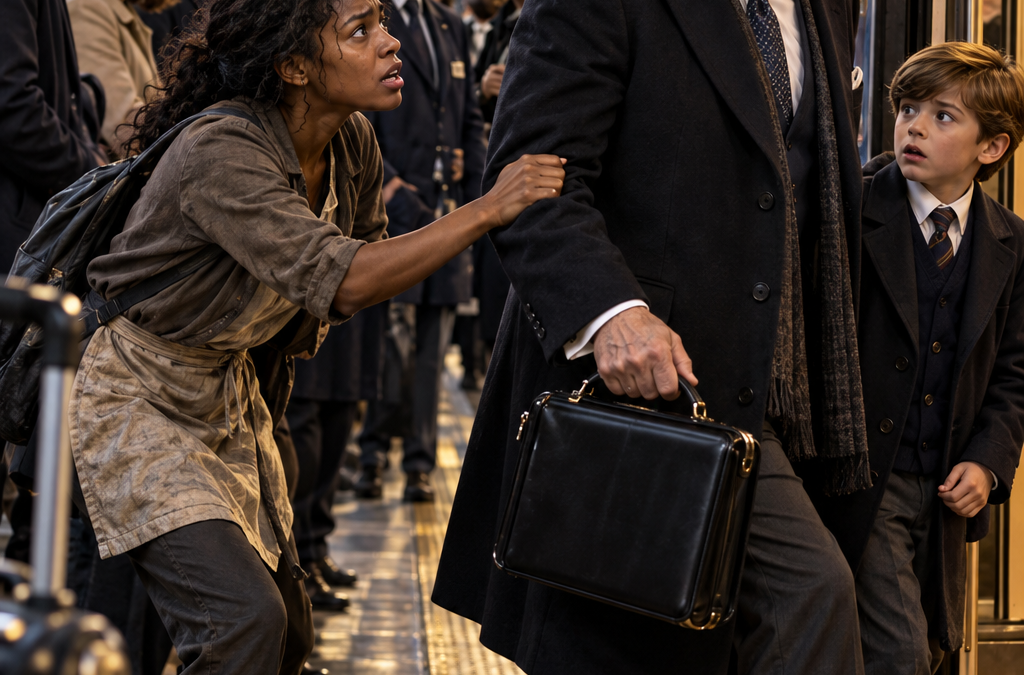
I reached out and grabbed the sleeve of Walter’s coat.
“Please don’t get on that train.”
Everything happened at once.
One bodyguard turned.
Another grabbed my arm.
Walter looked down at my hand.
“Ma’am, step back.”
“Someone tampered with the train.”
The guard pushed me.
I stumbled.
“The brakes. I saw two men last night.”
“Step back.”
“Please listen to me!”
Then Craig appeared.
Of course he did.
He walked into the middle of the scene carrying his clipboard like proof that he belonged and I didn’t.
“I know her,” he told Walter’s security.
My heart sank.
“She’s cleaning staff. She was acting erratically last night.”
“That’s not true.”
Craig looked at me.
“I warned you, Brooks.”
He grabbed the collar of my uniform.
Hard.
“You’re fired.”
“Craig—”
“Get your things and get out.”
He yanked me backward.
My balance went.
I fell to one knee on the marble.
People stopped.
Phones appeared.
That’s how fast humiliation becomes entertainment.
A woman in a designer coat raised her phone.
“Look at this.”
Someone laughed.
“A homeless woman is harassing passengers.”
“I’m not—”
“Call the police.”
Another voice.
“She’s probably on something.”
“These people always cause trouble.”
Every sentence landed like a stone.
I looked around at a ring of strangers filming me.
My collar was twisted.
My knee hurt.
My job was gone.
Pearl was sitting alone in a car with no insulin.
And the only thing that mattered was that Walter Coleman was still standing beside a train somebody had sabotaged.
I looked directly at him.
“That train is not safe.”
The crowd kept murmuring.
“I saw them underneath it.”
Craig reached for me again.
I raised my voice.
“They said your name.”
That stopped Walter.
“They said Coleman won’t make it past Wilmington.”
His face changed.
Barely.
But I saw it.
Then a small voice cut through the noise.
“Grandpa.”
Caleb was looking at me.
“She’s crying.”
I didn’t realize I was.
Walter looked down at his grandson.
Then at me.
He raised one hand.
His guards stopped.
Craig stopped.
Even the people filming seemed to quiet.
Walter walked toward me.
Then, to my shock, he knelt on the marble floor.
A billionaire in a four-thousand-dollar coat put one knee on the same floor I had just been dragged across.
“What’s your name?”
“Briana Brooks.”
“What did you see?”
I swallowed.
“Two men. Around 2:40 this morning. Maintenance bay by Platform 3. Neither had real station patches. One was underneath the Express 615 with a wrench. The other was on the phone.”
“What did he say?”
“‘Coleman won’t make it past Wilmington.'”
Walter stared at me.
“And?”
“He said Harland ordered a clean job. No traces.”
Walter became very still.
“Harland?”
“I think that was the name.”
He stood.
Turned to his security chief.
“Reynolds.”
“Sir.”
“We’re not boarding.”
Craig stepped forward.
“Mr. Coleman, with respect, I’ve already handled this. She’s a janitor. She doesn’t understand—”
Walter turned his head.
“I wasn’t talking to you.”
Craig stopped.
I had never seen his face lose color that fast.
“Reynolds, contact Transit Authority. Now.”
Walter’s security spread across the platform.
I stayed on the floor.
Nobody helped me up.
That part stayed with me.
They had stopped laughing.
They weren’t apologizing.
They were simply waiting to find out whether I had been worth believing.
At 6:15, the Express 615 left Grand Union.
Walter and Caleb did not board.
I watched the train disappear beyond the platform.
At 6:22, Walter checked his watch.
At 6:35, Reynolds was on the phone with Transit Dispatch.
At 6:48, I was sitting near the security office while Craig argued with two station police officers.
At 6:51, every departure screen in Grand Union turned red.
The alert flashed across them.
EXPRESS 615 DERAILMENT OUTSIDE WILMINGTON.
BRAKE SYSTEM FAILURE.
MULTIPLE CARS OFF TRACK.
EMERGENCY RESPONSE UNDERWAY.
For three seconds, the entire station stopped breathing.
Then people screamed.
Phones rang.
Travelers ran toward the information counters.
A woman collapsed against her husband.
Walter stood beneath the departure board.
He didn’t move.
Caleb was beside Reynolds.
Alive.
Walter looked at his grandson.
Then across the concourse.
At me.
I was sitting on a bench with handcuffs around my wrists.
Craig had called the police before the derailment report came in.
He had told them I was disruptive.
Possibly unstable.
A threat to passengers.
I sat there with my eyes closed.
Tears ran down my face.
Not because I was sad.
Because Caleb wasn’t on that train.
Walter walked across the station.
The crowd parted.
He stopped in front of the officer beside me.
“Take those off.”
The officer hesitated.
“Sir, she’s detained because—”
“Take them off.”
The cuffs opened.
I rubbed the red marks around my wrists.
Walter crouched in front of me.
“Briana Brooks.”
I looked at him.
“You saved my grandson’s life.”
Something inside me released.
One breath.
Long.
Shaking.
I think I had been holding it since 2:40 that morning.
Within an hour, police had me in an interview room.
I described everything.
Height.
Build.
Uniforms.
The wrench.
The service door.
The phone call.
Every detail.
Years of cleaning rooms had trained me to notice what other people didn’t.
A chair moved six inches.
A stain where there hadn’t been one.
A lock left open.
A cabinet touched by the wrong hands.
The maintenance bay’s main security camera had been wiped.
That made everyone take me more seriously.
Then technicians found an old backup server in an IT closet.
Eleven seconds survived.
Two figures.
The underside of the train.
A wrench catching the light.
Timestamp 2:41 a.m.
I had been right.
Craig found Reynolds later.
I was told he tried to explain himself.
“I was going to investigate.”
Reynolds apparently stared at him.
“Mr. Coleman has your name.”
Craig went white.
“I suggest you get a lawyer.”
While all that happened, somebody took me to the first-class lounge.
Leather chairs.
Bottled water.
Quiet.
I had cleaned rooms like that.
I had never sat in one.
A woman from Walter’s staff brought coffee.
“Can I get you anything else, Ms. Brooks?”
Ms. Brooks.
I almost looked behind me.
“I need to call my grandmother.”
They handed me a phone.
Pearl answered on the fourth ring.
“Nana?”
“Baby, where are you?”
“I’m okay.”
“Your voice don’t sound okay.”
“Some people are coming to help you. Don’t be scared.”
“Help me how?”
“I’ll explain.”
“What did you do, Briana?”
I closed my eyes.
“Something Daddy would’ve done.”
By that evening, Pearl was sleeping in a real bed.
Walter’s staff paid for a room at a Holiday Inn near the station.
It wasn’t luxurious.
To us, it felt impossible.
Clean sheets.
A shower.
Heat.
A mattress.
A courier delivered insulin, test strips, and a blood-pressure monitor.
No forms.
No missing signatures.
No six-to-eight-week processing window.
Pearl sat on the bed holding the insulin box.
“Who are these people?”
“Someone I helped.”
“That’s all?”
“That’s all.”
She studied me.
Then nodded.
Within minutes she fell asleep.
I tucked the blanket around her shoulders the way my father used to.
Tight on the left.
Loose on the right.
A tiny habit I hadn’t realized I remembered.
That evening, Walter asked me to meet him at Coleman Industries’ Philadelphia office.
We ate takeout in a conference room.
No cameras.
No fancy restaurant.
Just two people sitting across from each other with paper napkins between us.
Walter watched me push food around my plate.
“Most people would’ve walked away.”
I looked up.
“From what?”
“From me.”
“I didn’t know who you were.”
“Exactly.”
He leaned back.
“Especially after what that security supervisor did to you.”
“Most people didn’t hear what I heard.”
“That’s not what I’m asking.”
I waited.
“You had every reason to protect yourself. You had no money. You needed your job. You were being humiliated in public. Why keep pushing?”
I stared into my coffee.
“Because if it were me getting on that train, I’d want somebody to tell me.”
Walter didn’t answer for several seconds.
Then he asked, “Your father worked rail?”
My hands stopped.
“How do you know?”
“I didn’t. I’m guessing.”
“Why?”
“You described the train like somebody comfortable around rail equipment.”
I looked toward the window.
“My dad was an engineer.”
“Was?”
“He died nine years ago.”
Walter’s expression softened.
“Rail accident?”
I nodded.
“Operator error.”
“I’m sorry.”
“Don’t be.”
I looked at him.
“Just don’t waste what I gave you.”
The next attack didn’t come with a wrench.
It came through television screens.
Douglas Harland learned my name Thursday morning.
He had helped Walter build Coleman Industries twenty-two years earlier.
Rail logistics.
Infrastructure.
Government contracts.
He was the man behind the systems Walter trusted.
I didn’t know any of that yet.
I also didn’t know Harland had spent years siphoning money through shell companies, bribing safety officials, and cutting maintenance costs to inflate profits.
What I knew was that by noon, the story had changed.
A television in the hotel room showed a blurry image of me being restrained at Grand Union.
The headline beneath it read:
TROUBLED HOMELESS WOMAN CLAIMS SHE PREDICTED TRAIN DISASTER.
I stopped breathing.
The reporter described me as having “a history of erratic behavior.”
They mentioned our eviction.
They mentioned an emergency-room visit from months earlier.
I had collapsed from exhaustion after working back-to-back shifts.
On television, it became a psychiatric episode.
By three that afternoon, video clips were everywhere.
One showed Craig dragging me.
But somebody had cut away the context.
New captions said I had attacked Walter Coleman.
Thousands of comments followed.
Scammer.
Liar.
Probably involved.
Looking for money.
I sat on the edge of the hotel bed and read them.
That was a mistake.
I had spent most of my life invisible.
Invisible at work.
Invisible in government offices.
Invisible in lines.
Invisible behind a mop.
Now millions of people could see me, and somehow that felt worse.
Pearl slept in the other bed.
I lowered the television.
Called Walter’s office.
Voicemail.
For a few minutes I thought about leaving.
Packing everything into the Civic.
Driving south.
Finding another diner.
Another cleaning job.
Another parking lot.
Being invisible suddenly sounded safe.
Then I saw the wallpaper on my phone.
My father.
James Brooks.
Railroad uniform.
Big smile.
He had told me one thing again and again when I was growing up.
If you see something wrong, you say something.
Even if people don’t like hearing it.
I put the phone down.
I stayed.
Friday morning, somebody knocked on the hotel door.
Courier.
He handed me a thick envelope.
Douglas Harland was suing me for defamation.
Six pages.
Malicious statements.
Financial damages.
Fabricated allegations.
Public harm.
Words chosen to make someone with thirty-one dollars feel smaller than the paper she was holding.
The lawsuit cited a preliminary Transit Authority report stating investigators had found no credible evidence of deliberate sabotage.
I read that sentence three times.
No credible evidence.
I had seen the men.
There was video.
The train had derailed.
Yet on paper, somehow, reality was already being rewritten.
Then Craig Lawson appeared on television.
He wore a suit.
He looked calm.
Responsible.
“I dealt with Ms. Brooks that night,” he told the anchor. “She was agitated and irrational. I tried to manage the situation professionally.”
My hands started shaking.
“I had no choice but to report her.”
He never mentioned threatening my job.
Never mentioned grabbing my collar.
Never mentioned refusing to investigate.
When asked whether he had seen any evidence the train was compromised, he shook his head.
“None whatsoever.”
He said it smoothly.
“I followed protocol.”
I turned off the television.
Walter arrived at the hotel that afternoon.
I was packing.
“Where are you going?”
“Home.”
“You told me you don’t have one.”
I shoved clothes into a bag.
“Exactly.”
“Briana.”
I turned.
“I’m being called a liar on national television.”
“I know.”
“Your people aren’t answering me.”
“We’ve been dealing with—”
“That’s nice.”
My voice broke.
“I have a lawsuit from a billionaire’s partner sitting on that table. The police aren’t telling me anything. The Transit Authority says I imagined sabotage. My former supervisor is on television calling me crazy.”
Walter said nothing.
“Your word doesn’t pay for a lawyer.”
His expression hardened.
“Then I’ll get you one.”
The next morning I met Eileen Porter.
She was five-foot-four, wore reading glasses on a chain, and looked like somebody who would remind you to return a library book.
She was also one of the most feared whistleblower attorneys on the East Coast.
She entered the hotel conference room, opened a legal pad, and said, “Start from the mop.”
No pity.
No speech.
I liked her immediately.
I told her everything.
The maintenance bay.
Craig.
Walter.
The handcuffs.
The derailment.
The television stories.
The lawsuit.
She wrote for almost an hour.
When I finished, she placed her pen down.
“Harland’s trying to bury you.”
“I figured that out.”
“He has three advantages. Money, access, and time.”
“Great.”
“We have one.”
“What?”
“You told the truth.”
I almost laughed.
“That hasn’t exactly been working.”
“It will if we prove it faster than he can erase it.”
Walter gave her whatever resources she asked for.
Reynolds.
Private investigators.
A forensic accountant named Greta Sullivan.
They started Saturday.
By Sunday afternoon, the first real crack appeared.
Harland’s personal finances were spotless.
Too spotless.
Greta traced money through layers of corporate entities until she found Ridgeline Consulting.
No employees.
No physical office.
No real clients.
Five days before the derailment, Ridgeline had wired large payments to two men.
Both had convictions connected to industrial sabotage.
Both matched the descriptions I had given police.
Then Reynolds found something in the maintenance logs.
The official Platform 3 inspection showed the Express 615 had passed inspection at 11 p.m. Wednesday.
But the server backups showed the log had been edited at 4:15 Thursday morning.
After I saw the men.
After I reported them.
Before the train left.
Someone had rewritten the record.
And there were those eleven seconds of video.
Grainy.
Dark.
But real.
Eileen spread everything across the conference table Sunday night.
Wire transfers.
Maintenance records.
Security stills.
I thought we finally had enough.
Then Eileen asked Greta to search every major rail incident involving Coleman Industries infrastructure over the previous fifteen years.
Sixty-three incidents.
Most meant nothing.
Storm damage.
Signal failures.
Routine mechanical problems.
Then Greta found one from nine years earlier.
One casualty.
Train engineer.
Operator error.
Closed in six weeks.
The engineer’s name was James Brooks.
My father.
I wasn’t in the room when they found it.
Walter told me later he read the report standing beside a window and didn’t speak for almost a minute.
The investigating official had been Gregory Nolan.
The same Gregory Nolan who wrote the preliminary report saying the Express 615 derailment involved mechanical failure and no evidence of sabotage.
Greta traced the money.
Nolan had been receiving quarterly payments for years through a company connected to Ridgeline Consulting.
Douglas Harland’s network.
Walter called my room Sunday evening.
“Briana, I need to see you.”
Something in his voice scared me.
“What’s wrong?”
“I need you to sit down when I tell you.”
We met in the hotel conference room.
No staff.
No Reynolds.
No Eileen.
Just Walter and me.
A file sat on the table.
He didn’t touch it.
“Your father’s death wasn’t an accident.”
For a moment, the sentence didn’t mean anything.
The words reached me individually.
Father.
Death.
Accident.
But my mind refused to put them together.
“What?”
“The investigation was handled by Gregory Nolan.”
I stared at him.
“The same official connected to Harland.”
Walter nodded.
“The equipment failed because maintenance and safety standards had been compromised. Your father wasn’t responsible.”
I looked at the file.
Didn’t open it.
“The report said operator error.”
“The report was false.”
My hands went flat on the table.
“Nine years.”
Walter waited.
“I spent nine years believing that.”
“I know.”
“No.”
I looked at him.
“No, you don’t.”
He didn’t argue.
“Every time somebody treated me like garbage, I told myself to work harder.”
My throat tightened.
“Every time Craig called me replaceable, I thought about Daddy. I thought, he made one mistake and it cost him everything. So don’t make mistakes. Don’t complain. Pay attention.”
Walter lowered his eyes.
“I thought he killed himself.”
My voice cracked.
“I thought his mistake killed him.”
I pressed both palms harder against the table.
“And they did that to him.”
Silence.
“They killed him, and then they made us believe it was his fault.”
Walter said quietly, “Yes.”
Something broke in me.
Not loudly.
I didn’t throw anything.
I didn’t scream.
I just bent forward until my forehead almost touched the table.
Nine years of grief changed shape inside me.
The father I had mourned as a flawed man was suddenly somebody else.
A victim.
A man whose name had been used to protect the people responsible for his death.
I finally opened the file.
JAMES BROOKS.
Operator error.
Cause of incident.
Official finding.
I ran my finger over the words.
“What happens now?”
Walter’s answer came slowly.
“That’s your decision.”
I looked up.
“I can guarantee medical care for your grandmother. Housing. Legal protection. Whatever you need.”
“I don’t want charity.”
“I’m not offering charity.”
“Then what?”
“Choice.”
He leaned forward.
“If we go public, Douglas will fight. He’ll attack your history, your finances, your family. He’s already started.”
“He already called me crazy.”
“It will get worse.”
I looked down at my father’s name.
“Can we clear him?”
“Yes.”
“Publicly?”
“Yes.”
“Everybody who heard he caused that accident will know he didn’t?”
“Yes.”
I closed the file.
“Then I want his name back.”
Walter nodded.
“We go public.”
“You’re going to expose your own partner?”
His face changed.
Hard.
“Douglas stopped being my partner when he tried to kill my grandson.”
Monday morning, Walter called an emergency board meeting at Coleman Industries.
Twelve directors.
Legal counsel.
Outside the building, news trucks lined the street.
Harland arrived at 9:58 wearing a gray suit and burgundy tie.
Calm.
Confident.
He poured coffee.
Sat down.
He still believed he had control.
At 10:01, Walter stood.
Reynolds dimmed the lights.
First slide.
Ridgeline Consulting.
Wire transfers to two convicted industrial saboteurs.
Five days before the Express 615 derailment.
Walter spoke without raising his voice.
“This company is controlled through entities connected to Douglas Harland.”
Harland stopped lifting his coffee.
Second slide.
Maintenance records.
Original beside altered.
Edit timestamp.
4:15 a.m.
Third slide.
Eleven seconds of video.
Two men beneath the Express 615.
Wrench visible.
2:41 a.m.
Harland set his coffee down.
“This is circumstantial.”
Walter looked at him.
“I’m not finished.”
Fourth slide.
My father’s photograph.
James Brooks.
Railroad engineer.
Fatal accident.
Nine years earlier.
Operator error.
Gregory Nolan.
Payments.
Falsified reports.
Walter told the room who my father was.
Then he told them who I was.
“The woman Douglas’s people attempted to discredit publicly is James Brooks’s daughter.”
Harland’s right hand began to shake.
He hid it beneath the table.
“This is a setup.”
Walter stared at him.
“No.”
“This woman is manipulating you.”
“Her name is Briana Brooks.”
“Walter—”
“You killed her father.”
Harland went silent.
“Then you tried to kill me and my grandson.”
Walter turned toward the board.
“I am requesting the immediate removal of Douglas Harland as co-founder and board member. All evidence has been referred to the FBI, the Department of Transportation, and the Philadelphia District Attorney.”
For several seconds, no one spoke.
Then Victor Sloan raised his hand.
“I move to approve.”
The vote was unanimous.
Harland stood.
Buttoned his jacket.
Turned toward the door.
Reynolds stepped aside.
Two federal agents were waiting outside.
That afternoon, Walter held a press conference.
He asked me to stand beside him.
Not behind him.
Beside him.
My knees felt weak under the lights.
Dozens of cameras faced us.
Four days earlier, those cameras would have terrified me.
Now I thought about my father.
Walter stepped to the microphone.
“This is Briana Brooks.”
Flashes erupted.
“Four days ago, she prevented me and my grandson from boarding the Express 615.”
He described the warning.
The ridicule.
Craig.
The handcuffs.
Then he told them about James Brooks.
“My father,” I whispered.
Walter looked at me.
Then continued.
“James Brooks did not cause the accident that killed him nine years ago. Evidence indicates his death was covered up by the same network responsible for the attempted sabotage of the Express 615.”
The room erupted.
Reporters shouted.
Walter raised his hand.
Then he stepped aside.
I hadn’t planned to speak.
But the microphones were there.
The cameras were there.
And for the first time in nine years, my father deserved my voice more than I feared theirs.
I stepped forward.
“My dad taught me something.”
My hands were shaking.
“If you see something wrong, you say something.”
I looked straight at the cameras.
“Even if nobody listens.”
My voice steadied.
“Even if saying it costs you something.”
I swallowed.
“He lived that way.”
I thought of the report.
Operator error.
“He died because there were people around him who didn’t.”
The room was silent.
“I didn’t stop Mr. Coleman because I thought I’d get anything out of it. I didn’t even know who he was when I saw that train.”
I looked toward Walter.
“I just knew if I stayed quiet and somebody died, I would have to live with that.”
My eyes burned.
“My family has already lived with that kind of loss.”
I took a breath.
“I wasn’t going to let another family live with it if I could stop it.”
Then I stepped away.
Walter rested a hand on my shoulder.
By Monday evening, Douglas Harland was in federal custody.
The charges included conspiracy to commit murder, fraud, obstruction of justice, and involuntary manslaughter related to my father’s death.
Gregory Nolan was arrested at his home in New Jersey.
Craig Lawson was fired and later charged with obstruction for suppressing my safety report.
I watched his old television interview once more.
“I followed protocol.”
Then I turned it off.
Sandra Whitfield—the woman who had filmed me at the station and laughed while I was being dragged away—deleted her social media accounts after she was identified in news coverage.
The video of me on my knees at Grand Union was watched more than fourteen million times in a day.
Now the comments were different.
Hero.
Brave.
She saved them.
I’m ashamed nobody helped her.
I stopped reading those too.
Praise from strangers couldn’t erase what their contempt had felt like when they believed I had nothing.
Three months later, I carried the last cardboard box into a two-bedroom apartment in West Philadelphia.
It wasn’t a mansion.
It wasn’t luxury.
It was ours.
A walk-up on a tree-lined street.
Fire escape outside.
Window facing east.
The first morning there, sunlight crossed the floor before I opened my eyes.
I had forgotten what waking up in daylight felt like.
Pearl had an armchair beside the window.
Secondhand.
We found it at a thrift shop on Walnut Street.
She loved it.
Her insulin sat on the side table beside her testing kit.
Full medical coverage.
Regular appointments.
A doctor who knew her name.
No more sleeping in clinic chairs waiting to learn whether medicine had run out.
Pearl ran her hand over the armrest.
“Your daddy’s smiling somewhere.”
I was unpacking photographs.
I found my favorite one.
James Brooks in his railroad uniform, standing beside a locomotive.
Grinning.
I placed it on the mantel.
Stepped back.
For nine years, that picture had hurt.
Now it still hurt.
But differently.
“Yeah,” I said.
“I think he is.”
Two weeks later, Walter launched the James Brooks Rail Safety Foundation.
The foundation focused on three things.
Whistleblower protection for transit workers.
Independent safety audits.
Scholarships for children of railroad employees.
Walter asked me to become community director.
At first, I thought he meant some ceremonial position.
A photograph.
A title.
Something that looked good on a press release.
He didn’t.
I had an office.
A salary.
A team of four.
Real authority.
A direct line to Walter’s office.
My first week, I sat behind my desk staring at my own name on the door.
BRIANA BROOKS.
COMMUNITY DIRECTOR.
I thought about Craig saying, You’re replaceable.
I thought about the clerk saying, Six to eight weeks.
I thought about that woman at the station holding her phone while I knelt on the marble.
None of them had known what my life would become.
Neither had I.
At the foundation’s launch, two hundred people filled the room.
Rail workers.
Journalists.
City officials.
Families.
Walter stood at the podium.
“I’ve built companies,” he said. “I’ve negotiated contracts worth billions.”
Then he looked at me in the front row.
“But the bravest thing I have ever witnessed was a twenty-six-year-old woman with almost nothing left to lose standing in a train station at six in the morning and telling the truth to a man who nearly didn’t listen.”
I lowered my eyes.
Walter paused.
“I nearly didn’t listen.”
When I looked back up, he was still watching me.
“Most of us don’t. That’s the uncomfortable part.”
A week later, Caleb visited my office.
He brought a book about trains tucked under one arm.
“My grandpa says you’re why he’s alive.”
I smiled.
I knelt so we were eye level.
“Do you know something?”
“What?”
“You’re the reason he listened.”
Caleb frowned.
“Me?”
“You saw me crying.”
He thought about it.
“I told Grandpa.”
“You did.”
“So…”
His face brightened.
“We saved each other.”
I laughed.
“Yeah.”
I held out my hand.
“I think we did.”
The legal cases took longer than the headlines.
They always do.
Douglas Harland was eventually sentenced to eighteen years in federal prison for conspiracy, fraud, obstruction, and involuntary manslaughter connected to my father’s death.
Gregory Nolan pleaded guilty to twelve counts involving falsified safety reports.
Craig Lawson lost the ability to work in security in Pennsylvania.
The Commonwealth later passed the James Brooks Transit Safety Act, requiring stronger independent safety audits and whistleblower protections for public rail employees.
The day the legislation passed, I took Pearl to the cemetery.
We stood at my father’s grave.
I brought a copy of the corrected accident finding.
Not operator error.
Not his fault.
I knelt and placed it against the stone.
“Sorry it took nine years, Daddy.”
Pearl put one hand on my shoulder.
“It didn’t take you nine years.”
I looked up at her.
“What?”
“It took them nine years.”
Her eyes were wet.
“You were seventeen.”
She squeezed my shoulder.
“You were a child carrying grown people’s lies.”
I looked back at his name.
For years, I had measured myself against a mistake he had never made.
I had punished myself for being tired.
For struggling.
For needing help.
As if perfection were the only way to avoid becoming what everyone said he had been.
I rested my fingertips against the cold stone.
“You didn’t mess up.”
Saying it aloud mattered.
“You didn’t mess up.”
Pearl cried beside me.
So did I.
We stayed until the sun began to drop.
Life afterward was quieter than the news made it sound.
Pearl started volunteering at a community center on Tuesdays.
She taught teenagers to knit.
Her health improved.
Walter called most Sundays.
Sometimes about foundation work.
Sometimes because Caleb had a question.
Sometimes because I think almost dying had made him less interested in pretending business was the only thing worth talking about.
Caleb sent me books.
Mostly trains.
Sometimes mysteries.
I read them because he always asked whether I had.
And most mornings, I walked through Grand Union Station on my way to the foundation office.
I could have taken another route.
For a while, I considered it.
Grand Union contained too many versions of me.
The woman with the mop.
The woman Craig threatened.
The woman hiding behind a pillar.
The woman on her knees.
The woman in handcuffs.
The woman nobody believed.
But avoiding that station would have given the worst morning of my life ownership over a place that belonged to thousands of people, including me.
So I walked through it.
Past Platform 3.
Past the departures board.
Past the railing where I had tried to catch myself when Craig pulled me backward.
Sometimes I touched that railing.
Just once.
Not every day.
Only when I needed to remember.
I remembered what it had felt like to have thirty-one dollars and forty cents.
To be scared my grandmother would die because I couldn’t afford insulin.
To know telling the truth might cost me the last job keeping us alive.
I remembered standing in that maintenance bay hearing strangers discuss murder like they were discussing a delivery schedule.
I remembered Craig looking at me and deciding my uniform made me less credible than his clipboard.
I remembered dozens of people lifting phones instead of hands when I fell.
And I remembered one ten-year-old boy saying four words.
Grandpa, she’s crying.
Four words.
That was enough to make Walter stop.
Then Walter listened.
And because he listened, Caleb lived.
Because Caleb lived, Harland’s crime was investigated.
Because that crime was investigated, my father’s case reopened.
Because my father’s case reopened, James Brooks got his name back.
People sometimes asked me when my life changed.
They expected me to say it changed when Walter helped Pearl.
Or when Harland was arrested.
Or when I got the apartment.
Or when I became director of the foundation.
Those things changed my circumstances.
My life changed earlier.
At 3:28 in the morning, sitting alone on a wooden bench in the Grand Union locker room.
I had a choice.
I could keep quiet.
Keep my job.
Go back to the car.
Try to find eighty-two dollars for insulin.
Protect the tiny, fragile life Pearl and I were barely holding together.
Or I could walk back into that station and warn a stranger who might laugh at me.
I knew what silence could buy me.
Maybe another paycheck.
Maybe another week.
I also knew what it might cost someone else.
So I went back.
I didn’t know Walter was a billionaire.
I didn’t know Caleb would notice my tears.
I didn’t know Douglas Harland existed.
I didn’t know my father’s name was buried inside the same corruption I had accidentally stumbled into.
I didn’t know there would be federal agents, cameras, a foundation, an apartment, a new law, or anything else.
I only knew something was wrong.
And my father had taught me what to do when something was wrong.
You say something.
That morning, after touching the railing, I continued toward the main doors.
Commuters moved around me.
Coffee in their hands.
Phones against their ears.
Announcements echoed overhead.
Platform 3 appeared on the departure board.
A train arrived.
Another left.
Life continued.
Outside, the sun was coming up between the buildings.
I stepped onto the sidewalk and turned toward my office.
For the first time in years, I didn’t feel like I was trying to outrun my father’s death.
I was carrying his name forward.
And it was finally his again.
𝗧𝗛𝗘 𝗘𝗡𝗗
I Grabbed a Billionaire’s Sleeve Before He Boarded the Train—and Everyone in the Station Decided I Was the Threat
I had $31.40 to my name, a sick grandmother sleeping in the back of an old Honda, and a supervisor who had already warned me that one more problem would cost me my job. Still, when I saw Walter Coleman walking toward Platform 3 with his ten-year-old grandson, I ran after him because I knew something had been done to that train—and nobody with the power to stop it had believed a word I said.
Forty-eight hours earlier, I woke up in the back seat of a 2009 Honda Civic parked behind a Walmart in West Philadelphia.
Condensation covered the windows so heavily I could barely see the gray morning outside. My neck hurt from sleeping upright. My right foot had gone numb sometime during the night, and the wool blanket over my legs had slipped onto the floor.
For a few seconds, I didn’t remember where I was.
Then I heard my grandmother shivering.
“Nana?”
Pearl was in the passenger seat, reclined as far as it would go. She had wrapped another blanket around her shoulders, but her hands were still trembling.
“You okay?”
She smiled without looking at me.
“Just cold, baby.”
She always called me baby when she was trying to keep me from worrying.
“I’m fine.”
She wasn’t.
My grandmother had diabetes. She needed insulin. She had needed it the day before.
I climbed into the front seat and reached under the driver’s side, where I kept a mason jar wrapped in an old grocery bag. I poured the contents into my lap.
Crumpled ones.
A ten.
A five.
Loose quarters.
Nickels.
Pennies.
I counted it twice.
Thirty-one dollars and forty cents.
Insulin was eighty-two dollars.
Pearl watched me.
“Keep that for food.”
“We need your medicine.”
“I’ll manage.”
“No.”
“Briana—”
“We’ll figure it out.”
I forced a smile.
“We always do.”
That had become the sentence holding our lives together.
We’ll figure it out.
We said it when we got evicted.
We said it the first night we slept in the Honda.
We said it when Pearl’s Medicaid renewal got tangled in paperwork.
We said it when I started taking double shifts and still couldn’t get ahead.
We said it when there was no answer left except to say something hopeful enough to survive another day.
I started the car.
The heater coughed cold air for almost a minute before becoming warm.
Pearl rubbed her hands together.
I drove us to the Mercy Street Free Clinic on the east side.
There was already a line wrapped halfway around the building when we arrived.
Mothers with children.
Old men with canes.
A teenager pressing a bloodstained rag against his hand.
People holding folders full of paperwork like those papers might somehow make pain move faster.
I signed Pearl in.
Then we sat under fluorescent lights for three hours.
Every few minutes I checked the clock.
I worked at the Silver Spoon Diner that afternoon. If I missed the lunch rush, my manager would dock my shift.
But every time I looked at Pearl, none of that mattered.
Her skin looked pale.
She kept licking dry lips.
I knew enough about blood sugar to be scared.
We were four names from the front when a nurse stepped through the door.
She looked exhausted before she even spoke.
“We’re out of insulin for today.”
I stared at her.
“What?”
“Our supply is gone. We should have another shipment Thursday.”
“Thursday is two days from now.”
“I’m sorry.”
“My grandmother needs it every day.”
The nurse’s eyes moved toward Pearl, then back to me.
“I understand.”
“No, you don’t.”
My voice came out sharper than I intended.
Pearl touched my wrist.
“Briana.”
I closed my mouth.
The nurse wasn’t the enemy.
She was another tired person trapped inside a system built from lines, forms, shortages, and apologies.
“Is there anywhere else?”
She gave me two numbers.
I called both from the parking lot.
One clinic wasn’t taking new patients.
The other required proof of residency.
We didn’t have an address anymore.
I helped Pearl back into the Civic and buckled her seat belt.
She started humming as I drove.
An old church hymn.
Something she used to sing when I was a child and thunderstorms shook the windows.
At a red light, I reached across and took her hand.
I didn’t let go until the light turned green.
By noon I was wearing my diner uniform and carrying four plates down my left arm while balancing coffee in my right hand.
The Silver Spoon on Broad Street wasn’t elegant.
Vinyl booths.
Chrome stools.
A pie case that had been there since before I was born.
Lunch rush meant eight tables at once because our busboy had quit.
I kept moving.
Refill coffee.
Take order.
Clear plates.
Smile.
A man in a polo shirt snapped his fingers at me from across the room.
Not once.
Three times.
“Hey.”
I turned.
“My coffee’s cold.”
“Yes, sir. I’ll bring you a fresh one.”
“You should’ve noticed.”
“I’m sorry.”
I smiled.
He never used my name.
Most people didn’t.
That evening, after eight hours, I stood in the service hallway counting my tips.
Six dollars and fifty cents.
I stared at the money in my palm.
Then I laughed once because the alternative was crying.
That night I went to my second job at Grand Union Station.
The station paid just enough to keep the Civic insured and Pearl’s prescriptions partially filled.
At one in the morning, Grand Union became a different place.
During the day, it was noise, luggage, perfume, announcements, people moving with purpose.
At night, it belonged to janitors, security guards, maintenance workers, rats in the service tunnels, and fluorescent lights that buzzed in empty corridors.
I knew that building better than most executives knew their own offices.
I knew which restroom sink leaked.
Which tile near Platform 5 shifted under your shoe.
Which light outside the maintenance bay flickered exactly three times before staying on.
Which vending machine would give you two bags of chips if you hit the button hard enough.
I put my headphones in and started mopping.
Near Platform 2, Craig Lawson found me.
Craig was my supervisor.
Mid-forties.
Security department.
Clipboard permanently attached to one hand.
He had the kind of small authority some men treat like royalty.
“Brooks.”
I pulled one earbud out.
“Yeah?”
He looked at his watch.
“You were two minutes late.”
“I was getting my grandmother settled. She needed—”
“Not my problem.”
“I know. I’m sorry.”
“Two minutes docked.”
I stared at him.
“You’re docking two minutes?”
“Policy.”
There was something almost pleasurable in the way he said it.
I nodded.
“Okay.”
He stepped closer.
“You’re replaceable, Brooks.”
I looked at him.
He smiled slightly.
“Remember that.”
I put my earbud back in and continued mopping.
The next morning, between jobs, I went to the county assistance office.
Another plastic chair.
Another number.
Another fluorescent ceiling.
I had already submitted Pearl’s Medicaid renewal twice.
When my number was called, I handed the clerk my folder.
She typed for several minutes.
Then she said, “Your grandmother’s renewal was denied.”
My stomach tightened.
“Why?”
“Documentation error.”
“What error?”
She scrolled.
“Missing signature. Page six.”
I opened my copy.
The signature line was blank.
I must have missed it.
“Can she sign it now?”
“You can resubmit.”
“How long?”
“Six to eight weeks.”
I gripped the counter.
“She needs insulin today.”
The clerk looked at me then.
Not cruelly.
That almost made it worse.
“I’m sorry.”
“What am I supposed to do for six to eight weeks?”
“I don’t know, ma’am.”
“She could be in the hospital by then.”
“I understand.”
There was that word again.
Understand.
People said it when they couldn’t help you.
I walked outside and sat on a metal bench.
I stared at my hands.
They were cracked from cleaning chemicals.
A small burn crossed one finger from a coffee pot at the diner.
I closed them into fists.
Opened them.
Closed them again.
I was twenty-six years old and had spent nine years trying to keep one promise.
I made it to my father when I was seventeen.
Take care of Nana.
That was all he had asked.
Then he died in a railroad accident.
Operator error, the report said.
His mistake.
His fault.
A train engineer with almost twenty years of experience had made one mistake, and that one mistake killed him.
That was what I had believed for nine years.
Whenever life became unbearable, I thought about him.
Don’t make excuses.
Work harder.
Pay attention.
Keep going.
He made a mistake. You don’t have to.
I drove back to the diner.
Worked dinner.
Then went straight to Grand Union for the overnight shift.
At 2:37 Thursday morning, I was mopping the corridor beside the maintenance bay near Platform 3.
I remember the exact time because I had just looked at the clock and calculated how long I had until I could sit down.
Then I heard metal strike metal.
Clink.
Pause.
Clink.
It wasn’t random.
Someone was using a tool.
I took my headphones off.
The sound came again.
The maintenance bay should have been empty.
The overnight inspection team had already cleared that section.
I leaned my mop against the wall and walked toward the entrance.
Slowly.
There was a concrete pillar beside the bay.
I stayed behind it and looked around the edge.
Two men were beside the Express 615.
That train left for Washington every morning.
Neither man wore a proper Grand Union maintenance uniform.
They had work clothes, but the uniforms were too clean.
No stitched names.
No department patches.
Nothing.
One man was underneath the train.
He had a wrench on part of the coupling and brake assembly.
The other stood nearby with a phone against his ear.
I couldn’t hear everything.
Then I heard a name.
“Coleman won’t make it past Wilmington.”
My entire body went cold.
The man on the phone listened.
Then said, “Harland said clean job. No traces.”
My fingers tightened around the concrete pillar.
I should have backed away slowly.
Instead my elbow hit the mop.
The handle slipped.
It struck a metal railing.
The clang exploded through the bay.
Both men froze.
The one beneath the train slid out.
The other stopped talking.
I pressed myself flat behind the pillar.
Footsteps.
For ten seconds I couldn’t breathe.
Then twenty.
A service door opened.
Closed.
Silence.
I waited.
Nothing.
When I finally stepped out, they were gone.
My legs were trembling.
I didn’t know trains.
I didn’t know brake systems.
But I knew what sabotage looked like.
I ran.
Craig was inside the security office with his feet on a desk, looking at his phone.
“Craig.”
He didn’t look up.
“Craig, I need to report something.”
“What now?”
“Two men were in the maintenance bay.”
That got half his attention.
“They were underneath the Express 615. They were working on the brakes or the coupling.”
He lowered his phone.
“You’re a janitor, Brooks.”
“I know what my job is.”
“Then do it.”
“I’m serious.”
“So am I.”
“I heard them talking.”
Craig sighed.
“What exactly do you think you heard?”
“They said Coleman won’t make it past Wilmington.”
He stared at me.
“And they mentioned somebody named Harland.”
“Harlon? Harland? Whatever. You sure you didn’t hear something on those headphones you’re always wearing?”
“My headphones were off.”
“Maybe you saw maintenance.”
“They weren’t maintenance.”
“And you know that because?”
“No patches. No names. Wrong uniforms.”
Craig stood.
He walked toward me until only a few inches separated us.
“I don’t have time for one of your dramas tonight.”
“This isn’t drama.”
“Your section isn’t even finished.”
“Someone could die.”
His eyes narrowed.
“If you keep this up, management is going to hear you’re wandering into restricted areas, making accusations about people you can’t identify.”
“I wasn’t wandering.”
“One more incident and you’ll be gone by sunrise.”
My throat tightened.
He knew exactly what that threat meant.
He knew about Pearl.
He knew I was living paycheck to paycheck.
Maybe he didn’t know we slept in the Civic, but he knew I needed both jobs.
“Craig, please.”
“Conversation over.”
The younger security guard at the desk glanced at me and smirked.
Craig sat down.
Picked up his phone.
Dismissed me.
I walked out.
In the locker room, the clock read 3:28 a.m.
I sat on the wooden bench.
If I pushed harder, Craig would fire me.
No station job meant no car insurance.
No insurance meant eventually losing the Civic.
The Civic was our bedroom.
No money meant no insulin.
No insulin meant Pearl getting sicker.
I covered my face with both hands.
Maybe I had misunderstood.
Maybe the men were workers.
Maybe “Coleman” was something else.
Maybe I was about to destroy the little stability we had because I had overheard half a conversation in the dark.
Then I saw that wrench in my mind.
The spotless uniforms.
Coleman won’t make it past Wilmington.
Clean job.
No traces.
I took out my phone and scrolled through my contacts.
There was nobody to call.
Nobody important.
Nobody with authority.
I had no plan.
But I knew one thing.
The morning train left from Platform 3.
If I could find Coleman, whoever he was, I could warn him myself.
I stayed at the station until my shift ended.
Then I drove to the parking structure, sat in the Civic for two hours, and watched the VIP entrance.
Pearl was back at the Walmart lot.
I had left her sleeping because I couldn’t risk bringing her into whatever this was.
At 5:48 a.m., Grand Union was already waking up.
Coffee carts rolled into place.
Announcements began.
Commuters poured through the doors.
I hadn’t slept.
My uniform was wrinkled.
My hair was pulled back badly.
I probably smelled like industrial cleaner and exhaustion.
At 5:52, a black SUV stopped outside the VIP entrance.
Two private security men stepped out.
Then Walter Coleman.
I recognized him because half the station seemed to recognize him.
Silver hair.
Charcoal overcoat.
Straight posture.
Sixty-eight years old.
Walter Coleman, founder of Coleman Industries.
I would later learn Forbes estimated his fortune at more than four billion dollars.
At that moment, all I saw was the name.
Coleman.
Beside him walked a little boy.
About ten.
School blazer.
Backpack.
Holding Walter’s hand.
Caleb Coleman.
Walter’s grandson.
His only close family after his daughter died from cancer.
They headed toward Platform 3.
My stomach dropped.
The departure board read:
EXPRESS 615 — WASHINGTON.
I stepped out from behind the pillar.
“Sir!”
He kept walking.
The station was loud.
“Mr. Coleman!”
Nothing.
I started running.
“Sir, wait!”
I caught them at the platform ramp.
I reached out and grabbed the sleeve of Walter’s coat.
“Please don’t get on that train.”
Everything happened at once.
One bodyguard turned.
Another grabbed my arm.
Walter looked down at my hand.
“Ma’am, step back.”
“Someone tampered with the train.”
The guard pushed me.
I stumbled.
“The brakes. I saw two men last night.”
“Step back.”
“Please listen to me!”
Then Craig appeared.
Of course he did.
He walked into the middle of the scene carrying his clipboard like proof that he belonged and I didn’t.
“I know her,” he told Walter’s security.
My heart sank.
“She’s cleaning staff. She was acting erratically last night.”
“That’s not true.”
Craig looked at me.
“I warned you, Brooks.”
He grabbed the collar of my uniform.
Hard.
“You’re fired.”
“Craig—”
“Get your things and get out.”
He yanked me backward.
My balance went.
I fell to one knee on the marble.
People stopped.
Phones appeared.
That’s how fast humiliation becomes entertainment.
A woman in a designer coat raised her phone.
“Look at this.”
Someone laughed.
“A homeless woman is harassing passengers.”
“I’m not—”
“Call the police.”
Another voice.
“She’s probably on something.”
“These people always cause trouble.”
Every sentence landed like a stone.
I looked around at a ring of strangers filming me.
My collar was twisted.
My knee hurt.
My job was gone.
Pearl was sitting alone in a car with no insulin.
And the only thing that mattered was that Walter Coleman was still standing beside a train somebody had sabotaged.
I looked directly at him.
“That train is not safe.”
The crowd kept murmuring.
“I saw them underneath it.”
Craig reached for me again.
I raised my voice.
“They said your name.”
That stopped Walter.
“They said Coleman won’t make it past Wilmington.”
His face changed.
Barely.
But I saw it.
Then a small voice cut through the noise.
“Grandpa.”
Caleb was looking at me.
“She’s crying.”
I didn’t realize I was.
Walter looked down at his grandson.
Then at me.
He raised one hand.
His guards stopped.
Craig stopped.
Even the people filming seemed to quiet.
Walter walked toward me.
Then, to my shock, he knelt on the marble floor.
A billionaire in a four-thousand-dollar coat put one knee on the same floor I had just been dragged across.
“What’s your name?”
“Briana Brooks.”
“What did you see?”
I swallowed.
“Two men. Around 2:40 this morning. Maintenance bay by Platform 3. Neither had real station patches. One was underneath the Express 615 with a wrench. The other was on the phone.”
“What did he say?”
“‘Coleman won’t make it past Wilmington.'”
Walter stared at me.
“And?”
“He said Harland ordered a clean job. No traces.”
Walter became very still.
“Harland?”
“I think that was the name.”
He stood.
Turned to his security chief.
“Reynolds.”
“Sir.”
“We’re not boarding.”
Craig stepped forward.
“Mr. Coleman, with respect, I’ve already handled this. She’s a janitor. She doesn’t understand—”
Walter turned his head.
“I wasn’t talking to you.”
Craig stopped.
I had never seen his face lose color that fast.
“Reynolds, contact Transit Authority. Now.”
Walter’s security spread across the platform.
I stayed on the floor.
Nobody helped me up.
That part stayed with me.
They had stopped laughing.
They weren’t apologizing.
They were simply waiting to find out whether I had been worth believing.
At 6:15, the Express 615 left Grand Union.
Walter and Caleb did not board.
I watched the train disappear beyond the platform.
At 6:22, Walter checked his watch.
At 6:35, Reynolds was on the phone with Transit Dispatch.
At 6:48, I was sitting near the security office while Craig argued with two station police officers.
At 6:51, every departure screen in Grand Union turned red.
The alert flashed across them.
EXPRESS 615 DERAILMENT OUTSIDE WILMINGTON.
BRAKE SYSTEM FAILURE.
MULTIPLE CARS OFF TRACK.
EMERGENCY RESPONSE UNDERWAY.
For three seconds, the entire station stopped breathing.
Then people screamed.
Phones rang.
Travelers ran toward the information counters.
A woman collapsed against her husband.
Walter stood beneath the departure board.
He didn’t move.
Caleb was beside Reynolds.
Alive.
Walter looked at his grandson.
Then across the concourse.
At me.
I was sitting on a bench with handcuffs around my wrists.
Craig had called the police before the derailment report came in.
He had told them I was disruptive.
Possibly unstable.
A threat to passengers.
I sat there with my eyes closed.
Tears ran down my face.
Not because I was sad.
Because Caleb wasn’t on that train.
Walter walked across the station.
The crowd parted.
He stopped in front of the officer beside me.
“Take those off.”
The officer hesitated.
“Sir, she’s detained because—”
“Take them off.”
The cuffs opened.
I rubbed the red marks around my wrists.
Walter crouched in front of me.
“Briana Brooks.”
I looked at him.
“You saved my grandson’s life.”
Something inside me released.
One breath.
Long.
Shaking.
I think I had been holding it since 2:40 that morning.
Within an hour, police had me in an interview room.
I described everything.
Height.
Build.
Uniforms.
The wrench.
The service door.
The phone call.
Every detail.
Years of cleaning rooms had trained me to notice what other people didn’t.
A chair moved six inches.
A stain where there hadn’t been one.
A lock left open.
A cabinet touched by the wrong hands.
The maintenance bay’s main security camera had been wiped.
That made everyone take me more seriously.
Then technicians found an old backup server in an IT closet.
Eleven seconds survived.
Two figures.
The underside of the train.
A wrench catching the light.
Timestamp 2:41 a.m.
I had been right.
Craig found Reynolds later.
I was told he tried to explain himself.
“I was going to investigate.”
Reynolds apparently stared at him.
“Mr. Coleman has your name.”
Craig went white.
“I suggest you get a lawyer.”
While all that happened, somebody took me to the first-class lounge.
Leather chairs.
Bottled water.
Quiet.
I had cleaned rooms like that.
I had never sat in one.
A woman from Walter’s staff brought coffee.
“Can I get you anything else, Ms. Brooks?”
Ms. Brooks.
I almost looked behind me.
“I need to call my grandmother.”
They handed me a phone.
Pearl answered on the fourth ring.
“Nana?”
“Baby, where are you?”
“I’m okay.”
“Your voice don’t sound okay.”
“Some people are coming to help you. Don’t be scared.”
“Help me how?”
“I’ll explain.”
“What did you do, Briana?”
I closed my eyes.
“Something Daddy would’ve done.”
By that evening, Pearl was sleeping in a real bed.
Walter’s staff paid for a room at a Holiday Inn near the station.
It wasn’t luxurious.
To us, it felt impossible.
Clean sheets.
A shower.
Heat.
A mattress.
A courier delivered insulin, test strips, and a blood-pressure monitor.
No forms.
No missing signatures.
No six-to-eight-week processing window.
Pearl sat on the bed holding the insulin box.
“Who are these people?”
“Someone I helped.”
“That’s all?”
“That’s all.”
She studied me.
Then nodded.
Within minutes she fell asleep.
I tucked the blanket around her shoulders the way my father used to.
Tight on the left.
Loose on the right.
A tiny habit I hadn’t realized I remembered.
That evening, Walter asked me to meet him at Coleman Industries’ Philadelphia office.
We ate takeout in a conference room.
No cameras.
No fancy restaurant.
Just two people sitting across from each other with paper napkins between us.
Walter watched me push food around my plate.
“Most people would’ve walked away.”
I looked up.
“From what?”
“From me.”
“I didn’t know who you were.”
“Exactly.”
He leaned back.
“Especially after what that security supervisor did to you.”
“Most people didn’t hear what I heard.”
“That’s not what I’m asking.”
I waited.
“You had every reason to protect yourself. You had no money. You needed your job. You were being humiliated in public. Why keep pushing?”
I stared into my coffee.
“Because if it were me getting on that train, I’d want somebody to tell me.”
Walter didn’t answer for several seconds.
Then he asked, “Your father worked rail?”
My hands stopped.
“How do you know?”
“I didn’t. I’m guessing.”
“Why?”
“You described the train like somebody comfortable around rail equipment.”
I looked toward the window.
“My dad was an engineer.”
“Was?”
“He died nine years ago.”
Walter’s expression softened.
“Rail accident?”
I nodded.
“Operator error.”
“I’m sorry.”
“Don’t be.”
I looked at him.
“Just don’t waste what I gave you.”
The next attack didn’t come with a wrench.
It came through television screens.
Douglas Harland learned my name Thursday morning.
He had helped Walter build Coleman Industries twenty-two years earlier.
Rail logistics.
Infrastructure.
Government contracts.
He was the man behind the systems Walter trusted.
I didn’t know any of that yet.
I also didn’t know Harland had spent years siphoning money through shell companies, bribing safety officials, and cutting maintenance costs to inflate profits.
What I knew was that by noon, the story had changed.
A television in the hotel room showed a blurry image of me being restrained at Grand Union.
The headline beneath it read:
TROUBLED HOMELESS WOMAN CLAIMS SHE PREDICTED TRAIN DISASTER.
I stopped breathing.
The reporter described me as having “a history of erratic behavior.”
They mentioned our eviction.
They mentioned an emergency-room visit from months earlier.
I had collapsed from exhaustion after working back-to-back shifts.
On television, it became a psychiatric episode.
By three that afternoon, video clips were everywhere.
One showed Craig dragging me.
But somebody had cut away the context.
New captions said I had attacked Walter Coleman.
Thousands of comments followed.
Scammer.
Liar.
Probably involved.
Looking for money.
I sat on the edge of the hotel bed and read them.
That was a mistake.
I had spent most of my life invisible.
Invisible at work.
Invisible in government offices.
Invisible in lines.
Invisible behind a mop.
Now millions of people could see me, and somehow that felt worse.
Pearl slept in the other bed.
I lowered the television.
Called Walter’s office.
Voicemail.
For a few minutes I thought about leaving.
Packing everything into the Civic.
Driving south.
Finding another diner.
Another cleaning job.
Another parking lot.
Being invisible suddenly sounded safe.
Then I saw the wallpaper on my phone.
My father.
James Brooks.
Railroad uniform.
Big smile.
He had told me one thing again and again when I was growing up.
If you see something wrong, you say something.
Even if people don’t like hearing it.
I put the phone down.
I stayed.
Friday morning, somebody knocked on the hotel door.
Courier.
He handed me a thick envelope.
Douglas Harland was suing me for defamation.
Six pages.
Malicious statements.
Financial damages.
Fabricated allegations.
Public harm.
Words chosen to make someone with thirty-one dollars feel smaller than the paper she was holding.
The lawsuit cited a preliminary Transit Authority report stating investigators had found no credible evidence of deliberate sabotage.
I read that sentence three times.
No credible evidence.
I had seen the men.
There was video.
The train had derailed.
Yet on paper, somehow, reality was already being rewritten.
Then Craig Lawson appeared on television.
He wore a suit.
He looked calm.
Responsible.
“I dealt with Ms. Brooks that night,” he told the anchor. “She was agitated and irrational. I tried to manage the situation professionally.”
My hands started shaking.
“I had no choice but to report her.”
He never mentioned threatening my job.
Never mentioned grabbing my collar.
Never mentioned refusing to investigate.
When asked whether he had seen any evidence the train was compromised, he shook his head.
“None whatsoever.”
He said it smoothly.
“I followed protocol.”
I turned off the television.
Walter arrived at the hotel that afternoon.
I was packing.
“Where are you going?”
“Home.”
“You told me you don’t have one.”
I shoved clothes into a bag.
“Exactly.”
“Briana.”
I turned.
“I’m being called a liar on national television.”
“I know.”
“Your people aren’t answering me.”
“We’ve been dealing with—”
“That’s nice.”
My voice broke.
“I have a lawsuit from a billionaire’s partner sitting on that table. The police aren’t telling me anything. The Transit Authority says I imagined sabotage. My former supervisor is on television calling me crazy.”
Walter said nothing.
“Your word doesn’t pay for a lawyer.”
His expression hardened.
“Then I’ll get you one.”
The next morning I met Eileen Porter.
She was five-foot-four, wore reading glasses on a chain, and looked like somebody who would remind you to return a library book.
She was also one of the most feared whistleblower attorneys on the East Coast.
She entered the hotel conference room, opened a legal pad, and said, “Start from the mop.”
No pity.
No speech.
I liked her immediately.
I told her everything.
The maintenance bay.
Craig.
Walter.
The handcuffs.
The derailment.
The television stories.
The lawsuit.
She wrote for almost an hour.
When I finished, she placed her pen down.
“Harland’s trying to bury you.”
“I figured that out.”
“He has three advantages. Money, access, and time.”
“Great.”
“We have one.”
“What?”
“You told the truth.”
I almost laughed.
“That hasn’t exactly been working.”
“It will if we prove it faster than he can erase it.”
Walter gave her whatever resources she asked for.
Reynolds.
Private investigators.
A forensic accountant named Greta Sullivan.
They started Saturday.
By Sunday afternoon, the first real crack appeared.
Harland’s personal finances were spotless.
Too spotless.
Greta traced money through layers of corporate entities until she found Ridgeline Consulting.
No employees.
No physical office.
No real clients.
Five days before the derailment, Ridgeline had wired large payments to two men.
Both had convictions connected to industrial sabotage.
Both matched the descriptions I had given police.
Then Reynolds found something in the maintenance logs.
The official Platform 3 inspection showed the Express 615 had passed inspection at 11 p.m. Wednesday.
But the server backups showed the log had been edited at 4:15 Thursday morning.
After I saw the men.
After I reported them.
Before the train left.
Someone had rewritten the record.
And there were those eleven seconds of video.
Grainy.
Dark.
But real.
Eileen spread everything across the conference table Sunday night.
Wire transfers.
Maintenance records.
Security stills.
I thought we finally had enough.
Then Eileen asked Greta to search every major rail incident involving Coleman Industries infrastructure over the previous fifteen years.
Sixty-three incidents.
Most meant nothing.
Storm damage.
Signal failures.
Routine mechanical problems.
Then Greta found one from nine years earlier.
One casualty.
Train engineer.
Operator error.
Closed in six weeks.
The engineer’s name was James Brooks.
My father.
I wasn’t in the room when they found it.
Walter told me later he read the report standing beside a window and didn’t speak for almost a minute.
The investigating official had been Gregory Nolan.
The same Gregory Nolan who wrote the preliminary report saying the Express 615 derailment involved mechanical failure and no evidence of sabotage.
Greta traced the money.
Nolan had been receiving quarterly payments for years through a company connected to Ridgeline Consulting.
Douglas Harland’s network.
Walter called my room Sunday evening.
“Briana, I need to see you.”
Something in his voice scared me.
“What’s wrong?”
“I need you to sit down when I tell you.”
We met in the hotel conference room.
No staff.
No Reynolds.
No Eileen.
Just Walter and me.
A file sat on the table.
He didn’t touch it.
“Your father’s death wasn’t an accident.”
For a moment, the sentence didn’t mean anything.
The words reached me individually.
Father.
Death.
Accident.
But my mind refused to put them together.
“What?”
“The investigation was handled by Gregory Nolan.”
I stared at him.
“The same official connected to Harland.”
Walter nodded.
“The equipment failed because maintenance and safety standards had been compromised. Your father wasn’t responsible.”
I looked at the file.
Didn’t open it.
“The report said operator error.”
“The report was false.”
My hands went flat on the table.
“Nine years.”
Walter waited.
“I spent nine years believing that.”
“I know.”
“No.”
I looked at him.
“No, you don’t.”
He didn’t argue.
“Every time somebody treated me like garbage, I told myself to work harder.”
My throat tightened.
“Every time Craig called me replaceable, I thought about Daddy. I thought, he made one mistake and it cost him everything. So don’t make mistakes. Don’t complain. Pay attention.”
Walter lowered his eyes.
“I thought he killed himself.”
My voice cracked.
“I thought his mistake killed him.”
I pressed both palms harder against the table.
“And they did that to him.”
Silence.
“They killed him, and then they made us believe it was his fault.”
Walter said quietly, “Yes.”
Something broke in me.
Not loudly.
I didn’t throw anything.
I didn’t scream.
I just bent forward until my forehead almost touched the table.
Nine years of grief changed shape inside me.
The father I had mourned as a flawed man was suddenly somebody else.
A victim.
A man whose name had been used to protect the people responsible for his death.
I finally opened the file.
JAMES BROOKS.
Operator error.
Cause of incident.
Official finding.
I ran my finger over the words.
“What happens now?”
Walter’s answer came slowly.
“That’s your decision.”
I looked up.
“I can guarantee medical care for your grandmother. Housing. Legal protection. Whatever you need.”
“I don’t want charity.”
“I’m not offering charity.”
“Then what?”
“Choice.”
He leaned forward.
“If we go public, Douglas will fight. He’ll attack your history, your finances, your family. He’s already started.”
“He already called me crazy.”
“It will get worse.”
I looked down at my father’s name.
“Can we clear him?”
“Yes.”
“Publicly?”
“Yes.”
“Everybody who heard he caused that accident will know he didn’t?”
“Yes.”
I closed the file.
“Then I want his name back.”
Walter nodded.
“We go public.”
“You’re going to expose your own partner?”
His face changed.
Hard.
“Douglas stopped being my partner when he tried to kill my grandson.”
Monday morning, Walter called an emergency board meeting at Coleman Industries.
Twelve directors.
Legal counsel.
Outside the building, news trucks lined the street.
Harland arrived at 9:58 wearing a gray suit and burgundy tie.
Calm.
Confident.
He poured coffee.
Sat down.
He still believed he had control.
At 10:01, Walter stood.
Reynolds dimmed the lights.
First slide.
Ridgeline Consulting.
Wire transfers to two convicted industrial saboteurs.
Five days before the Express 615 derailment.
Walter spoke without raising his voice.
“This company is controlled through entities connected to Douglas Harland.”
Harland stopped lifting his coffee.
Second slide.
Maintenance records.
Original beside altered.
Edit timestamp.
4:15 a.m.
Third slide.
Eleven seconds of video.
Two men beneath the Express 615.
Wrench visible.
2:41 a.m.
Harland set his coffee down.
“This is circumstantial.”
Walter looked at him.
“I’m not finished.”
Fourth slide.
My father’s photograph.
James Brooks.
Railroad engineer.
Fatal accident.
Nine years earlier.
Operator error.
Gregory Nolan.
Payments.
Falsified reports.
Walter told the room who my father was.
Then he told them who I was.
“The woman Douglas’s people attempted to discredit publicly is James Brooks’s daughter.”
Harland’s right hand began to shake.
He hid it beneath the table.
“This is a setup.”
Walter stared at him.
“No.”
“This woman is manipulating you.”
“Her name is Briana Brooks.”
“Walter—”
“You killed her father.”
Harland went silent.
“Then you tried to kill me and my grandson.”
Walter turned toward the board.
“I am requesting the immediate removal of Douglas Harland as co-founder and board member. All evidence has been referred to the FBI, the Department of Transportation, and the Philadelphia District Attorney.”
For several seconds, no one spoke.
Then Victor Sloan raised his hand.
“I move to approve.”
The vote was unanimous.
Harland stood.
Buttoned his jacket.
Turned toward the door.
Reynolds stepped aside.
Two federal agents were waiting outside.
That afternoon, Walter held a press conference.
He asked me to stand beside him.
Not behind him.
Beside him.
My knees felt weak under the lights.
Dozens of cameras faced us.
Four days earlier, those cameras would have terrified me.
Now I thought about my father.
Walter stepped to the microphone.
“This is Briana Brooks.”
Flashes erupted.
“Four days ago, she prevented me and my grandson from boarding the Express 615.”
He described the warning.
The ridicule.
Craig.
The handcuffs.
Then he told them about James Brooks.
“My father,” I whispered.
Walter looked at me.
Then continued.
“James Brooks did not cause the accident that killed him nine years ago. Evidence indicates his death was covered up by the same network responsible for the attempted sabotage of the Express 615.”
The room erupted.
Reporters shouted.
Walter raised his hand.
Then he stepped aside.
I hadn’t planned to speak.
But the microphones were there.
The cameras were there.
And for the first time in nine years, my father deserved my voice more than I feared theirs.
I stepped forward.
“My dad taught me something.”
My hands were shaking.
“If you see something wrong, you say something.”
I looked straight at the cameras.
“Even if nobody listens.”
My voice steadied.
“Even if saying it costs you something.”
I swallowed.
“He lived that way.”
I thought of the report.
Operator error.
“He died because there were people around him who didn’t.”
The room was silent.
“I didn’t stop Mr. Coleman because I thought I’d get anything out of it. I didn’t even know who he was when I saw that train.”
I looked toward Walter.
“I just knew if I stayed quiet and somebody died, I would have to live with that.”
My eyes burned.
“My family has already lived with that kind of loss.”
I took a breath.
“I wasn’t going to let another family live with it if I could stop it.”
Then I stepped away.
Walter rested a hand on my shoulder.
By Monday evening, Douglas Harland was in federal custody.
The charges included conspiracy to commit murder, fraud, obstruction of justice, and involuntary manslaughter related to my father’s death.
Gregory Nolan was arrested at his home in New Jersey.
Craig Lawson was fired and later charged with obstruction for suppressing my safety report.
I watched his old television interview once more.
“I followed protocol.”
Then I turned it off.
Sandra Whitfield—the woman who had filmed me at the station and laughed while I was being dragged away—deleted her social media accounts after she was identified in news coverage.
The video of me on my knees at Grand Union was watched more than fourteen million times in a day.
Now the comments were different.
Hero.
Brave.
She saved them.
I’m ashamed nobody helped her.
I stopped reading those too.
Praise from strangers couldn’t erase what their contempt had felt like when they believed I had nothing.
Three months later, I carried the last cardboard box into a two-bedroom apartment in West Philadelphia.
It wasn’t a mansion.
It wasn’t luxury.
It was ours.
A walk-up on a tree-lined street.
Fire escape outside.
Window facing east.
The first morning there, sunlight crossed the floor before I opened my eyes.
I had forgotten what waking up in daylight felt like.
Pearl had an armchair beside the window.
Secondhand.
We found it at a thrift shop on Walnut Street.
She loved it.
Her insulin sat on the side table beside her testing kit.
Full medical coverage.
Regular appointments.
A doctor who knew her name.
No more sleeping in clinic chairs waiting to learn whether medicine had run out.
Pearl ran her hand over the armrest.
“Your daddy’s smiling somewhere.”
I was unpacking photographs.
I found my favorite one.
James Brooks in his railroad uniform, standing beside a locomotive.
Grinning.
I placed it on the mantel.
Stepped back.
For nine years, that picture had hurt.
Now it still hurt.
But differently.
“Yeah,” I said.
“I think he is.”
Two weeks later, Walter launched the James Brooks Rail Safety Foundation.
The foundation focused on three things.
Whistleblower protection for transit workers.
Independent safety audits.
Scholarships for children of railroad employees.
Walter asked me to become community director.
At first, I thought he meant some ceremonial position.
A photograph.
A title.
Something that looked good on a press release.
He didn’t.
I had an office.
A salary.
A team of four.
Real authority.
A direct line to Walter’s office.
My first week, I sat behind my desk staring at my own name on the door.
BRIANA BROOKS.
COMMUNITY DIRECTOR.
I thought about Craig saying, You’re replaceable.
I thought about the clerk saying, Six to eight weeks.
I thought about that woman at the station holding her phone while I knelt on the marble.
None of them had known what my life would become.
Neither had I.
At the foundation’s launch, two hundred people filled the room.
Rail workers.
Journalists.
City officials.
Families.
Walter stood at the podium.
“I’ve built companies,” he said. “I’ve negotiated contracts worth billions.”
Then he looked at me in the front row.
“But the bravest thing I have ever witnessed was a twenty-six-year-old woman with almost nothing left to lose standing in a train station at six in the morning and telling the truth to a man who nearly didn’t listen.”
I lowered my eyes.
Walter paused.
“I nearly didn’t listen.”
When I looked back up, he was still watching me.
“Most of us don’t. That’s the uncomfortable part.”
A week later, Caleb visited my office.
He brought a book about trains tucked under one arm.
“My grandpa says you’re why he’s alive.”
I smiled.
I knelt so we were eye level.
“Do you know something?”
“What?”
“You’re the reason he listened.”
Caleb frowned.
“Me?”
“You saw me crying.”
He thought about it.
“I told Grandpa.”
“You did.”
“So…”
His face brightened.
“We saved each other.”
I laughed.
“Yeah.”
I held out my hand.
“I think we did.”
The legal cases took longer than the headlines.
They always do.
Douglas Harland was eventually sentenced to eighteen years in federal prison for conspiracy, fraud, obstruction, and involuntary manslaughter connected to my father’s death.
Gregory Nolan pleaded guilty to twelve counts involving falsified safety reports.
Craig Lawson lost the ability to work in security in Pennsylvania.
The Commonwealth later passed the James Brooks Transit Safety Act, requiring stronger independent safety audits and whistleblower protections for public rail employees.
The day the legislation passed, I took Pearl to the cemetery.
We stood at my father’s grave.
I brought a copy of the corrected accident finding.
Not operator error.
Not his fault.
I knelt and placed it against the stone.
“Sorry it took nine years, Daddy.”
Pearl put one hand on my shoulder.
“It didn’t take you nine years.”
I looked up at her.
“What?”
“It took them nine years.”
Her eyes were wet.
“You were seventeen.”
She squeezed my shoulder.
“You were a child carrying grown people’s lies.”
I looked back at his name.
For years, I had measured myself against a mistake he had never made.
I had punished myself for being tired.
For struggling.
For needing help.
As if perfection were the only way to avoid becoming what everyone said he had been.
I rested my fingertips against the cold stone.
“You didn’t mess up.”
Saying it aloud mattered.
“You didn’t mess up.”
Pearl cried beside me.
So did I.
We stayed until the sun began to drop.
Life afterward was quieter than the news made it sound.
Pearl started volunteering at a community center on Tuesdays.
She taught teenagers to knit.
Her health improved.
Walter called most Sundays.
Sometimes about foundation work.
Sometimes because Caleb had a question.
Sometimes because I think almost dying had made him less interested in pretending business was the only thing worth talking about.
Caleb sent me books.
Mostly trains.
Sometimes mysteries.
I read them because he always asked whether I had.
And most mornings, I walked through Grand Union Station on my way to the foundation office.
I could have taken another route.
For a while, I considered it.
Grand Union contained too many versions of me.
The woman with the mop.
The woman Craig threatened.
The woman hiding behind a pillar.
The woman on her knees.
The woman in handcuffs.
The woman nobody believed.
But avoiding that station would have given the worst morning of my life ownership over a place that belonged to thousands of people, including me.
So I walked through it.
Past Platform 3.
Past the departures board.
Past the railing where I had tried to catch myself when Craig pulled me backward.
Sometimes I touched that railing.
Just once.
Not every day.
Only when I needed to remember.
I remembered what it had felt like to have thirty-one dollars and forty cents.
To be scared my grandmother would die because I couldn’t afford insulin.
To know telling the truth might cost me the last job keeping us alive.
I remembered standing in that maintenance bay hearing strangers discuss murder like they were discussing a delivery schedule.
I remembered Craig looking at me and deciding my uniform made me less credible than his clipboard.
I remembered dozens of people lifting phones instead of hands when I fell.
And I remembered one ten-year-old boy saying four words.
Grandpa, she’s crying.
Four words.
That was enough to make Walter stop.
Then Walter listened.
And because he listened, Caleb lived.
Because Caleb lived, Harland’s crime was investigated.
Because that crime was investigated, my father’s case reopened.
Because my father’s case reopened, James Brooks got his name back.
People sometimes asked me when my life changed.
They expected me to say it changed when Walter helped Pearl.
Or when Harland was arrested.
Or when I got the apartment.
Or when I became director of the foundation.
Those things changed my circumstances.
My life changed earlier.
At 3:28 in the morning, sitting alone on a wooden bench in the Grand Union locker room.
I had a choice.
I could keep quiet.
Keep my job.
Go back to the car.
Try to find eighty-two dollars for insulin.
Protect the tiny, fragile life Pearl and I were barely holding together.
Or I could walk back into that station and warn a stranger who might laugh at me.
I knew what silence could buy me.
Maybe another paycheck.
Maybe another week.
I also knew what it might cost someone else.
So I went back.
I didn’t know Walter was a billionaire.
I didn’t know Caleb would notice my tears.
I didn’t know Douglas Harland existed.
I didn’t know my father’s name was buried inside the same corruption I had accidentally stumbled into.
I didn’t know there would be federal agents, cameras, a foundation, an apartment, a new law, or anything else.
I only knew something was wrong.
And my father had taught me what to do when something was wrong.
You say something.
That morning, after touching the railing, I continued toward the main doors.
Commuters moved around me.
Coffee in their hands.
Phones against their ears.
Announcements echoed overhead.
Platform 3 appeared on the departure board.
A train arrived.
Another left.
Life continued.
Outside, the sun was coming up between the buildings.
I stepped onto the sidewalk and turned toward my office.
For the first time in years, I didn’t feel like I was trying to outrun my father’s death.
I was carrying his name forward.
And it was finally his again.








