𝗙𝗨𝗟𝗟 𝗦𝗧𝗢𝗥𝗬 I Found Nearly 50 Houses on My Grandfather’s Ranch, and the HOA President Threatened to Block the Only Road Out If I Challenged Him
𝗙𝗨𝗟𝗟 𝗦𝗧𝗢𝗥𝗬
The view made no sense.
I knew there had been construction beyond the ridge, but I had assumed it was taking place on land already owned by the development company.
The houses looked much closer to my interior fence line than they should have been.
Much closer.
I walked toward a break in the trees and looked down at the paved road.
There was an old stone marker near the edge of the ridge.
My grandfather had shown it to me years earlier.
It marked a surveyed point along one of the historical boundary lines.
I walked toward it, brushed leaves from the weathered stone, and checked my location against the ranch map stored on my phone.
Then I looked at the houses again.
A cold feeling settled in my stomach.
They were on the wrong side.
I didn’t jump to conclusions.
A stone marker could be misunderstood. Maps could be displayed incorrectly. Old fences didn’t always follow legal boundaries.
But I knew my grandfather’s records.
And I knew that ridge.
I returned to my truck and drove back to the ranch house.
In the office, beneath a shelf full of equipment manuals and tax records, stood the same steel filing cabinet my grandfather had used.
The bottom drawer held the property documents.
I removed a thick folder, carried it to the kitchen table, and unfolded the original survey.
The paper had yellowed around the edges.
The surveyor’s measurements were written in careful lettering. Boundary calls followed old fence lines, recorded monuments, and natural features that had been part of the ranch for generations.
My grandfather had marked several locations in pencil.
One of them was the stone marker on the southern ridge.
I traced the property line from that point toward the highway.
Then I compared it with current county parcel information.
The subdivision should have been beyond the boundary.
But the portion I had seen wasn’t.
The recorded line ran south of the homes.
Far south.
I checked again.
Then a third time.
I stood up and walked around the kitchen because I could no longer sit still.
If those documents were correct, somebody had built almost fifty houses on my grandfather’s ranch.
And nobody had asked me for permission.
I made coffee I didn’t drink.
Then I drove toward Cedar Vale Estates.
The subdivision entrance stood off a recently widened county road. Two stone pillars framed a landscaped median, and a polished metal sign displayed the neighborhood’s name.
Below it, in smaller letters, were the words PRIVATE COMMUNITY.
I slowed down.
The entrance road curved between rows of freshly planted maples.
Everything looked new.
The pavement.
The sidewalks.
The drainage grates.
The driveways.
Even the street signs still shone.
It was the sort of development marketed to young families who wanted quiet streets, large kitchens, and easy access to town.
Children’s bicycles rested beside several garages.
A golden retriever watched me from behind a living room window.
A woman in running clothes pushed a stroller along the sidewalk.
These weren’t empty model homes.
People lived here.
I drove slowly, following the road deeper into the neighborhood.
The farther I went, the more uneasy I became.
The road bent north.
Toward my ranch.
I recognized the slope of the land, the shape of the ridge, and the distant line of oak trees.
Then I came to a wide intersection where a newly paved street passed directly over an area my grandfather had once used as a cattle access route.
I stopped my truck.
I looked at the survey again.
The road beneath my tires was inside my recorded property boundary.
The houses on both sides appeared to be, too.
I counted forty-eight homes within the area that concerned me.
Every one had been constructed, sold, or occupied as though the developer unquestionably owned the ground beneath it.
I sat there with both hands on the steering wheel.
I wasn’t thinking about money.
I wasn’t thinking about lawsuits.
I was thinking about the people inside those houses.
They had probably signed stacks of documents.
Paid deposits.
Taken out mortgages.
Moved furniture.
Planted flowers.
Hung photographs on walls.
They believed they had purchased legitimate homes.
And now I was sitting on a road that appeared to cross my ranch, wondering how many different people had failed to check the same property line.
A black SUV pulled up behind me.
I saw it in the rearview mirror.
The vehicle stopped close enough that I couldn’t comfortably back up.
The driver’s door opened.
A tall man climbed out.
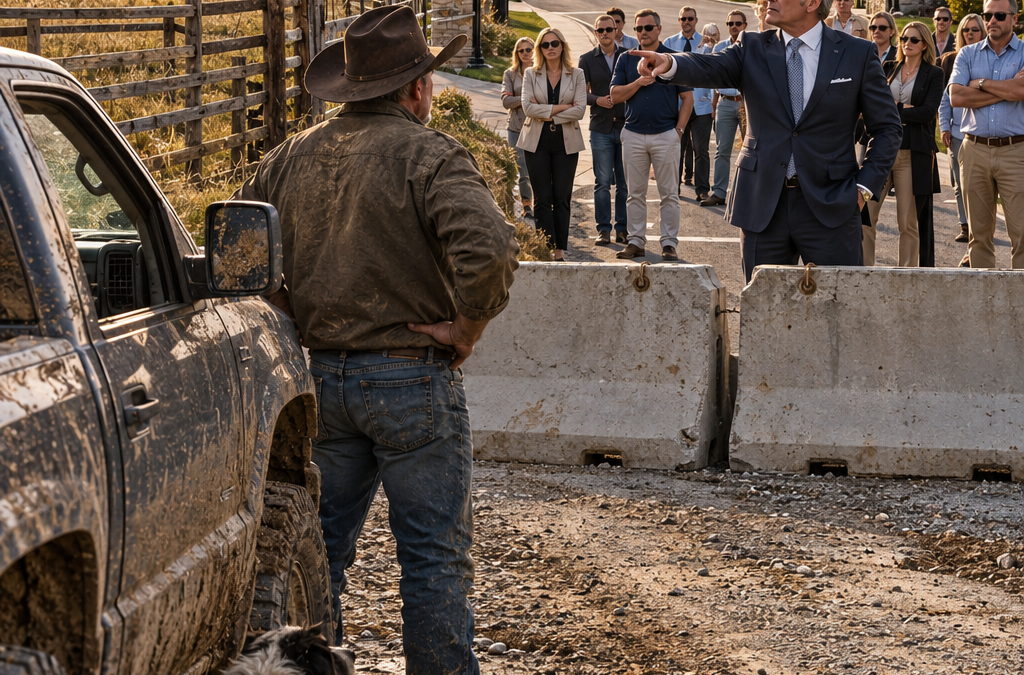
He wore a dark navy suit, polished black leather shoes, and a silver watch that flashed in the sunlight.
His hair was dark, swept neatly back from a high forehead, with carefully maintained silver at the temples.
He looked around fifty.
His jaw was clean-shaven, his posture rigid, and his expression carried the easy superiority of someone accustomed to having people step aside for him.
He approached my driver’s window.
I lowered it.
“Can I help you?” I asked.
He smiled without warmth.
“That’s what I was about to ask you.”
I glanced at his vehicle.
“Is something wrong?”
“You’re parked in the middle of a private residential roadway.”
“I’m checking a boundary.”
His smile faded.
“A boundary?”
“Yes.”
He glanced at the paper on my passenger seat.
“Are you with a contractor?”
“No.”
“Then what exactly are you doing here?”
I opened the door and stepped out.
“My name is Jake. I own the ranch north of this development.”
His expression changed immediately.
Not surprise.
Recognition.
He looked at me as though he’d been expecting this conversation.
“Hoa Karen,” he said, offering his hand. “President of the Cedar Vale Homeowners Association.”
I shook it briefly.
His grip was firm, almost theatrical.
“I’ve heard about your ranch.”
“Have you?”
“Of course. It’s a significant piece of property. Frankly, I’m surprised more of it hasn’t been developed.”
“I haven’t offered it for development.”
He gave a small laugh.
“Times change.”
I looked down the street.
“Apparently.”
His eyes followed mine.
“Beautiful community, isn’t it?”
“The houses are nice.”
“Forty-eight residences in this section. Excellent buyers. Strong property values. The association has worked very hard to maintain our standards.”
I turned toward him.
“Who owns the land underneath them?”
His smile disappeared.
“Excuse me?”
“Who owns the land this section was built on?”
He straightened.
“The development was professionally planned and approved.”
“That wasn’t my question.”
He studied me for a moment.
Then he folded his arms.
“Cedar Vale controls the internal roadways and common areas.”
“According to what document?”
“The subdivision plan.”
I opened my grandfather’s survey across the hood of my truck.
“This is the original recorded survey of my ranch.”
He glanced down.
I pointed to the southern boundary.
“Here’s the property line. Here’s the old cattle access corridor. This road runs across it.”
Hoa Karen barely looked at the measurements.
“Those are old documents.”
“That doesn’t make them invalid.”
“Modern developments operate under updated plats and approvals.”
“Then show me the deed transferring this land.”
He lifted his chin.
“The HOA owns and maintains the road.”
“Maintenance isn’t ownership.”
His jaw tightened.
“The association has responsibility for everything inside this neighborhood.”
I pointed at the pavement beneath us.
“That doesn’t explain why this road appears on my family’s property.”
He looked down at the survey again.
For one brief moment, I saw uncertainty cross his face.
His eyes moved between the boundary line and the houses behind us.
Then he straightened and gave me a cold smile.
“You’re misinterpreting the paperwork.”
“Maybe. That’s why I’m checking.”
“Well, I’d suggest you hire someone qualified before making accusations.”
“I intend to.”
“Good.”
He took a step closer.
“Because I won’t have people entering this community and frightening homeowners with imaginary property disputes.”
I looked directly at him.
“I’m not here to frighten anyone.”
“Then don’t create trouble.”
“I haven’t created anything.”
He glanced toward the houses.
“Forty-eight families live here, Jake. Remember that before you start talking about taking land away from them.”
I felt something tighten inside me.
“I haven’t said a word to those families.”
“Not yet.”
He said it like a warning.
I folded the survey.
“I’m going to get an independent survey.”
“Do whatever you think is necessary.”
He stepped toward his SUV.
Then turned.
“But understand something. This road belongs to the association. You have no authority to interfere with it.”
I held up my grandfather’s survey.
“We’ll see what the records say.”
He smiled.
“Records are only useful when people understand them.”
Then he climbed into his SUV and drove away.
I stood beside my truck, looking at the houses.
For the first time, I had the uncomfortable feeling that the problem wasn’t simply a survey mistake.
Hoa Karen had recognized my ranch.
He had recognized what I was asking.
And instead of showing me a deed, he’d tried to intimidate me into leaving.
I drove home with my grandfather’s survey on the passenger seat.
That afternoon, I called a licensed land surveyor named Thomas Bell.
Thomas was in his late fifties, with a gray beard, broad shoulders, and a habit of listening quietly before asking exactly the question that mattered.
He had worked throughout the county for more than thirty years.
When I explained what I’d found, he didn’t sound surprised.
“How many houses?”
“Forty-eight in the section I’m concerned about.”
A pause.
“Forty-eight?”
“Yes.”
“Jake, are you sure you’re reading the boundary correctly?”
“That’s why I’m hiring you.”
“Fair enough.”
I gave him the parcel information and described the stone marker.
He asked me to send the old survey, deed, and any newer county records I could obtain.
Then he said something that made my stomach drop.
“If those houses really are inside your property, this is not going to be a small dispute.”
“I figured that.”
“No. I mean it’s going to involve developers, title companies, lenders, homeowners, the HOA, and probably several lawyers.”
I looked out the window toward the southern hills.
“I just want to know where my property ends.”
“Then we’ll start there.”
Thomas arrived two days later with his equipment and an assistant.
I met them at the southern pasture gate.
He spread the old survey across the hood of his truck.
Then he compared it with the current property records and his preliminary research.
He pointed toward the wooded ridge.
“We’ll recover the existing monuments first. Then we’ll verify the measurements and establish the recorded boundary.”
“How long?”
“As long as it takes to get it right.”
I liked him immediately.
We spent the morning walking through brush, crossing old cattle trails, and locating survey evidence.
Thomas worked carefully.
He checked measurements.
Compared records.
Returned to several points to verify his findings.
By early afternoon, we reached the ridge above Cedar Vale.
He set up his equipment near the old stone marker.
I stood beside him, watching the houses below.
“Well?” I asked.
He didn’t answer immediately.
He took another measurement.
Then another.
Finally, he looked toward the subdivision.
“Jake, I’m going to finish the full survey before I give you my final opinion.”
My stomach tightened.
“But?”
He lowered the instrument.
“But your grandfather’s survey isn’t looking wrong.”
The next two days were miserable.
Thomas and his assistant continued their work.
They established fresh survey stakes along the recorded boundary, placing markers where legally appropriate and documenting their locations.
As the line progressed, its relationship to the subdivision became impossible to ignore.
The boundary passed through the developed area.
It ran across landscaped yards.
Behind garages.
Near driveways.
Across parts of the internal road system.
The recorded ranch boundary didn’t stop at Cedar Vale’s decorative entrance sign.
It continued straight through the neighborhood.
I stood near one of the new survey stakes while Thomas checked his final measurements.
A little boy riding a bicycle slowed down to look at the fluorescent ribbon.
“What’s that for?” he asked.
I glanced toward the nearby house.
“Someone’s checking the property lines.”
He looked confused.
“My dad says our fence is the property line.”
I felt a sharp ache in my chest.
“Sometimes fences and property lines aren’t the same thing.”
He shrugged and rode away.
I watched him disappear around the corner.
That was when the true weight of the situation began to settle on me.
These weren’t empty lots.
They were homes.
People had built entire lives around the belief that the development had been properly authorized.
And whatever had happened before those houses were built, the homeowners themselves might know nothing about it.
I didn’t want to punish them.
I didn’t want to frighten their children.
But I couldn’t pretend the land wasn’t mine simply because someone had poured concrete on it.
When Thomas completed the survey, he met me in my kitchen.
He laid out the new drawing beside my grandfather’s original.
The two records were remarkably consistent.
He pointed at the boundary.
“This is the recorded line.”
Then he pointed toward the subdivision.
“And this is where the homes and roadways are located.”
I stared at the map.
“All forty-eight?”
“The developed area you’ve identified falls within the boundary described in your ranch records. The occupied lots and roadway improvements will need a full title review, but the survey evidence is clear.”
I sat down.
For a moment, the room seemed strangely quiet.
“You’re certain?”
“Yes.”
I ran my hand across my face.
“My grandfather was right.”
Thomas looked at the old paper.
“He kept good records.”
I laughed once.
It wasn’t really laughter.
It was disbelief.
For three years, I had believed that ridge was untouched ranchland.
Now I was looking at a survey showing an entire neighborhood inside it.
Thomas rolled up his equipment notes.
“Jake, listen to me carefully. Don’t remove anything. Don’t move fences or block roads. Don’t confront homeowners about their individual deeds. Get an attorney and have the title history examined.”
I nodded.
“I wasn’t planning on throwing anybody out.”
“Good. Because the people who bought those houses may be just as surprised as you are.”
After he left, I sat alone at the kitchen table.
The original survey lay beside the new one.
I traced the road with my finger.
One road.
It entered the subdivision from the county highway, curved between the houses, and connected all forty-eight homes to the outside world.
The new survey showed that a significant portion crossed my recorded ranch property.
And I began to understand why Hoa Karen had been so quick to claim it.
The road wasn’t merely decorative pavement.
It was the neighborhood’s lifeline.
Without it, every homeowner would have a problem.
And without a valid access arrangement, the HOA had a problem it couldn’t solve with a board vote.
I called an attorney the following morning.
Her name was Rebecca Shaw.
She practiced property and land-use law and had a reputation for being patient with difficult documents and impatient with people who ignored them.
I brought both surveys to her office.
She studied them for nearly an hour.
Then she removed her glasses.
“Has the HOA produced a deed?”
“No.”
“Any recorded easement?”
“Nothing I’ve seen.”
“Any document showing your grandfather sold this section?”
“No.”
“Did he ever sign a development agreement?”
“Not that I know of.”
She leaned back.
“Then we need a complete title search. We also need copies of the subdivision plat, the developer’s conveyances, and the recorded instruments relied upon when these homes were sold.”
I looked at the map.
“Can they claim the road just because they’ve been using it?”
“Long-term use can raise legal questions depending on the circumstances and state law. But use and maintenance aren’t the same as recorded ownership. We need the full facts before deciding what rights anyone has.”
I nodded.
“What about the families?”
She looked at me.
“What about them?”
“They bought houses. They probably have mortgages. Some have kids. I don’t want them to lose everything because somebody made a mistake.”
Her expression softened.
“That’s an important distinction. You can protect your property without treating innocent homeowners as your enemies.”
I looked down at my grandfather’s survey.
“I want the truth established.”
“Then we’ll establish it.”
“And the road?”
“We’ll address the access issue carefully. Whatever the ownership dispute, nobody should create a dangerous obstruction.”
I didn’t realize how important those words would become.
Not yet.
Because while we were checking deeds, Hoa Karen was preparing his own answer.
And his answer involved concrete barriers.
The HOA called an emergency meeting two days after Thomas finished marking the boundary.
I found out about it when a woman from Cedar Vale knocked on my farmhouse door.
She looked to be in her early forties, with tired eyes and a worried expression. She introduced herself as Melissa Ortiz and explained that she lived near the far end of the subdivision with her husband and two children.
“Mr. Karen says you’re trying to claim our neighborhood,” she said.
I stared at her.
“He said that?”
“At the last board discussion. He told people you’re putting survey stakes around private homes and threatening to interfere with access.”
I felt anger rising.
“I haven’t threatened anyone.”
She looked uncertain.
“Then what’s happening?”
I invited her onto the porch and showed her the survey.
At first, she didn’t understand what she was seeing.
Then I pointed to the recorded boundary.
“This is my grandfather’s ranch. The property passed to me when he died.”
I traced the line toward Cedar Vale.
“These are the houses built inside that recorded boundary.”
She leaned closer.
“That’s our street.”
“Yes.”
She looked at the drawing again.
“You’re saying our house is on your ranch?”
“I’m saying the property records and independent survey show a serious ownership problem. My attorney is investigating the title history now.”
Her face went pale.
“We bought that house eighteen months ago.”
“I’m sorry.”
“We had everything inspected. The bank approved the mortgage. We signed all the paperwork.”
“I believe you.”
She looked toward the southern ridge.
“My husband and I saved for nine years.”
Her voice broke slightly.
“We have two kids. We thought we were buying our forever home.”
I felt something twist inside my chest.
This was exactly what I’d feared.
The people living in those houses weren’t faceless strangers.
They had worked for what they believed they owned.
And now they were being forced into a dispute they hadn’t created.
“Melissa,” I said, “I’m not coming into your house or demanding that you leave. I’m trying to establish what happened before the development was built.”
She looked at me.
“Mr. Karen said you wanted the road closed.”
“No. I haven’t blocked anything. I don’t intend to.”
She exhaled shakily.
“Then why would he say that?”
I looked toward the ridge.
“That’s a question you should ask him.”
She stayed another few minutes.
Before leaving, she took a photograph of the survey with my permission.
“I think people need to see this,” she said.
“I agree. But tell them to get their own legal advice, too. Their deeds and title policies matter.”
She nodded.
Then she walked back to her car.
I watched her drive away and felt something I hadn’t expected.
Guilt.
I knew I hadn’t caused the problem.
I hadn’t drawn the subdivision.
I hadn’t sold those lots.
I hadn’t given anyone permission to build on the ranch.
But the thought of forty-eight families learning their homes stood on disputed land made my stomach hurt.
I wanted the records corrected.
I wanted the property protected.
But I didn’t want children waking up afraid that somebody would take away their bedrooms.
That was the weakness Hoa Karen intended to exploit.
At the emergency board meeting that evening, he made it clear.
Rebecca attended with me.
The clubhouse was modern and expensive, with stone floors, recessed lighting, and framed photographs of the neighborhood’s grand opening.
Hoa Karen stood at the head of the conference table.
He wore a slate-gray suit and a perfectly folded white pocket square.
His hair was flawless.
His expression wasn’t.
He had seen the survey stakes.
He knew the records had become a problem.
But he still looked determined to win.
“Jake,” he said as we entered. “I see you’ve brought legal representation.”
Rebecca smiled politely.
“Rebecca Shaw. Counsel for Mr. Jake.”
Hoa Karen gave a shallow nod.
“Excellent. Perhaps we can put an end to this unfortunate misunderstanding.”
She placed a folder on the table.
“That depends on whether the association is prepared to examine the evidence.”
He gestured toward the chairs.
“Let’s begin.”
There were six board members seated around the table.
A development representative sat near the far wall.
Several residents, including Melissa, had been allowed to observe.
Hoa Karen opened with a speech about community stability.
He described Cedar Vale as a model residential development.
He praised its property values.
He talked about families, investment, and the importance of protecting homeowners from unnecessary disruption.
Then he pointed toward me.
“Unfortunately, an adjoining ranch owner has begun challenging established community boundaries.”
I leaned forward.
“I’m not adjoining the affected area, Mr. Karen. According to the recorded documents, the development is inside my property.”
His eyes narrowed.
“We’re not going to argue over terminology.”
Rebecca opened her folder.
“Then let’s discuss the legal descriptions.”
She placed the original ranch survey beside Thomas Bell’s independent survey.
“These documents establish the recorded boundary. The current county parcel records are consistent with that boundary.”
One board member leaned closer.
“Those stakes through Juniper Lane were placed by a licensed surveyor?”
“Yes.”
“And they follow this line?”
“Correct.”
He stared at the drawing.
“That puts the houses inside the ranch.”
Rebecca nodded.
“It raises a substantial title problem affecting the developed parcels.”
Another board member looked at Hoa Karen.
“Was there a land purchase agreement with Jake’s grandfather?”
Hoa Karen shifted in his chair.
“The development was approved years ago.”
“That’s not what I asked.”
His jaw tightened.
“Professional developers handled the property acquisition.”
Rebecca spoke calmly.
“Then we need those acquisition documents.”
The development representative cleared his throat.
“We’re reviewing the original title package.”
I turned toward him.
“You should have reviewed it before selling forty-eight houses.”
His eyes dropped.
Hoa Karen slammed his palm against the table.
“Enough. This community cannot be held hostage over paperwork.”
Rebecca didn’t raise her voice.
“A deed is not a minor administrative detail.”
He pointed toward the survey.
“This neighborhood exists. People live here. Roads have been constructed. Utilities have been installed. You cannot simply erase an entire subdivision because of an old ranch map.”
I felt the anger I’d been holding back rise into my throat.
“Nobody is trying to erase families.”
“That’s precisely what your actions threaten.”
“No. Your refusal to produce ownership records is what threatens them.”
His face darkened.
“You have no authority to interfere with Cedar Vale.”
I looked directly at him.
“And you have no authority to decide my ranch belongs to your HOA.”
For several seconds, nobody spoke.
Then Rebecca slid another document across the table.
“This is a formal request that no additional construction or alterations be undertaken in the disputed area until ownership and access rights are resolved.”
Hoa Karen examined it.
His expression became cold.
“You expect us to stop maintaining our own neighborhood?”
“Routine safe operation and unauthorized new construction are different matters.”
He gave a dismissive laugh.
“The association will continue managing its property.”
Rebecca leaned forward.
“Mr. Karen, the association’s ownership of the disputed road has not been established.”
He looked at her.
“The road belongs to Cedar Vale.”
“Where is the recorded instrument proving that?”
He opened his mouth.
Then stopped.
For one brief moment, the entire room waited.
Finally, he said, “The board will review the issue.”
I looked around the table.
Several members were visibly uncomfortable.
One was staring at the survey.
Another had taken out his phone, apparently checking something.
Hoa Karen noticed.
He closed the meeting abruptly.
“We’ve heard enough. No further discussion until our attorneys complete their review.”
Rebecca gathered her documents.
Before we left, Hoa Karen stepped in front of me.
His smile had vanished.
“Stay out of our neighborhood.”
I stopped.
“I have every intention of following the law.”
“You’ve made people nervous.”
“Then stop lying to them.”
His eyes flashed.
“You’re going to regret turning this into a public confrontation.”
I stepped closer.
“You made it public when you built houses on land you didn’t own.”
He didn’t move.
Neither did I.
Finally, Rebecca touched my arm.
“Jake. We’re leaving.”
I turned away.
Behind us, Hoa Karen said, “You cannot interfere with that road.”
I stopped at the doorway.
“I haven’t touched your road.”
Then I looked back.
“But if the records are correct, you haven’t established ownership of it, either.”
I left him standing beneath the clubhouse lights.
The next morning, I heard heavy equipment near the southern access corridor.
At first, I thought the HOA had finally arranged a proper inspection.
Then I drove toward Cedar Vale and saw three construction trucks parked along Juniper Lane.
Workers were unloading concrete barriers.
A compact loader sat beside the road.
Fresh orange markings had been sprayed across the pavement.
Hoa Karen stood near the intersection holding his clipboard.
I pulled over and climbed out.
“What is this?”
He turned.
His expression brightened with the kind of satisfaction I’d come to recognize.
“Neighborhood entrance improvements.”
I looked at the barriers.
“You’re changing the road?”
“We’re securing the community.”
“While the ownership is being reviewed?”
“Routine HOA maintenance.”
I looked toward the nearest worker.
He was guiding a heavy concrete barrier into position.
The structure extended several feet into the roadway.
Another barrier sat beside it.
“You’re narrowing the only access road.”
Hoa Karen adjusted his cuff.
“Traffic control.”
“Where’s the approved plan?”
“The association authorized it.”
I almost laughed.
There it was again.
The same answer.
As though repeating the word authorized could change the boundary beneath his shoes.
I took out my phone and began photographing the work.
Hoa Karen’s expression hardened.
“Stop recording my contractors.”
“They’re working across my recorded property.”
“That is disputed.”
“Then why are you altering it before the dispute is resolved?”
He stepped closer.
“Because I’m not allowing you to use that road as leverage.”
I stared at him.
“I haven’t blocked the road.”
“Not yet.”
He lowered his voice.
“You think you’ve discovered something that gives you power over this community.”
“I discovered that your subdivision crosses my property line.”
“And I intend to make certain you can’t use that fact to intimidate residents.”
I looked at the concrete barrier being lowered onto the pavement.
“You’re the one putting obstacles in their road.”
His smile returned.
“Temporary security measures.”
“Security against what?”
He leaned toward me.
“Against interference.”
I felt cold despite the morning sun.
He wasn’t trying to fix the boundary problem.
He was trying to turn it into a contest of control.
And he intended to win by physically changing the road before anyone could stop him.
I approached the construction supervisor.
“Has the county approved this lane restriction?”
The man glanced toward Hoa Karen.
“We were hired to install traffic barriers.”
“Do you have a traffic-control permit?”
“I’d have to check with the office.”
“Please do. This is the only practical road serving the houses beyond here.”
He frowned.
“Only road?”
“Yes.”
He looked toward the subdivision.
Then back at the barriers.
I could see him reconsidering the job.
Hoa Karen walked over.
“Is there a problem?”
The supervisor said, “The gentleman says this is the only exit.”
“It is the controlled entrance to our community,” Hoa Karen replied.
“Are we maintaining emergency access?”
“Of course.”
But he didn’t explain how.
By noon, the open roadway had been reduced to a narrow passage.
By afternoon, more barriers had appeared along the disputed boundary.
A temporary steel gate frame was being positioned near the entrance.
I photographed the entire installation.
Then I called Rebecca.
She listened carefully.
“Did you touch anything?”
“No.”
“Good. Don’t.”
“Rebecca, they’re changing the only practical exit.”
“Send me the photographs.”
I did.
She called back less than ten minutes later.
“This is serious. I’m contacting the county transportation and public safety offices.”
“Can they stop it?”
“They can examine whether the obstruction violates access requirements. We’re also notifying the HOA’s counsel that further alterations in the disputed corridor are unacceptable.”
I looked toward the workers.
“They’re still moving barriers.”
“Document it. Do not put yourself in front of the equipment.”
I rubbed my forehead.
“What if they close it completely?”
“Then emergency access becomes an immediate issue. But we are not going to solve this by you moving barriers yourself.”
I knew she was right.
Still, it was hard standing there watching the road narrow.
Every instinct told me to stop them.
To walk over and demand that they remove the concrete.
To stand in front of the loader.
But I had already seen how Hoa Karen twisted ordinary objections into accusations.
If I physically interfered, he would use it.
He would tell the homeowners I had threatened workers.
He would tell the authorities I had disrupted traffic.
He would portray himself as the man protecting the neighborhood from an angry ranch owner.
I wasn’t going to give him that opportunity.
So I watched.
I photographed.
I recorded the workers, equipment, barriers, and road conditions.
And I kept my hands to myself.
That evening, I returned home with a headache so severe that I could barely think.
I spread the property documents across the dining table.
My grandfather’s original survey.
Thomas Bell’s updated drawing.
The deed.
County parcel records.
Historical access descriptions.
The recorded subdivision materials Rebecca had obtained.
I followed the road again.
From the county highway.
Through the subdivision entrance.
Past the first row of houses.
Along Juniper Lane.
To the farthest residential lots.
There was no second practical exit.
No rear connecting street.
No alternate road capable of carrying ordinary neighborhood traffic.
The only other tracks near the property were old ranch maintenance routes, rough and unsuitable for general public access.
And those routes weren’t part of the subdivision’s approved street network.
Every resident depended on Juniper Lane.
School buses.
Delivery trucks.
Garbage collection.
Moving vans.
Fire engines.
Ambulances.
Families driving to work.
Children being taken to school.
All of them.
I sat back in my chair.
The survey showed the road crossing land still recorded under my ranch’s ownership.
The title search had found no recorded HOA conveyance establishing ownership of that corridor.
There could be separate questions about access rights, easements, and what protections the homeowners possessed.
Rebecca had explained that.
But one fact was beyond dispute.
Hoa Karen was putting barriers across a road he hadn’t established the right to control.
And the people who would suffer weren’t the people he was arguing with.
They were the families living behind those barriers.
I looked at the clock.
Almost midnight.
I thought about my grandfather.
He had always believed disputes should be handled with patience until patience became an excuse for doing nothing.
I could almost hear him telling me to stop staring at the papers and think about the people.
I picked up the phone.
I sent Rebecca one final message explaining that the road had no practical alternative.
Then I went to bed.
I barely slept.
At six-thirty the next morning, Melissa called.
“Jake?”
Her voice was shaking.
“What’s wrong?”
“The road.”
I sat upright.
“What about it?”
“It’s blocked.”
I was already reaching for my jeans.
“Completely?”
“There’s a steel gate across the entrance. Concrete barriers on both sides. Nobody can get through.”
I felt my stomach drop.
“Are people trapped inside?”
“Yes. My husband tried to leave for work. There are cars backed up all the way to our street.”
“Has anyone called the county?”
“Several people. Mr. Karen is here telling everyone it’s temporary.”
I grabbed my keys.
“I’m on my way.”
I drove toward Cedar Vale faster than I normally would have.
When I reached the county highway, I saw a line of vehicles stretching back toward the subdivision entrance.
Some drivers were standing outside their cars.
Others were turning around in narrow spaces between parked vehicles.
A delivery truck sat at the edge of the roadway with its hazard lights flashing.
Beyond it stood the barriers.
Concrete blocks formed a staggered wall across the entrance.
A temporary steel gate blocked the remaining passage.
Several large signs had been attached to the fencing.
PRIVATE HOA ACCESS.
AUTHORIZED ENTRY ONLY.
TEMPORARY ROAD CLOSURE.
The signs were new.
The road wasn’t.
I parked safely beside the shoulder and walked toward the crowd.
Melissa spotted me immediately.
“Jake!”
She pushed through several residents.
“My husband has been sitting here for forty minutes.”
I looked toward the barriers.
“Who closed it?”
She pointed.
Hoa Karen stood beside his SUV, speaking to two security workers.
He wore a black overcoat over his suit.
His hair was immaculate.
His expression was smug.
He looked like a man admiring a completed project.
I walked directly toward him.
“Open the road.”
He turned.
“Good morning, Jake.”
“Open it.”
His smile widened.
“You’re upset.”
“People can’t get out.”
“The entrance is temporarily secured.”
“Secured against what? Residents trying to go to work?”
He folded his arms.
“We’re controlling access while the boundary dispute is reviewed.”
I stared at him.
“You closed the only practical exit.”
“We have the right to protect community property.”
“You haven’t established ownership of this road.”
He stepped closer.
“And you haven’t established the right to interfere with our community.”
I pointed toward the line of cars.
“Those people live here.”
“Exactly. Which is why I’m protecting them.”
A man behind me shouted, “Protecting us from what?”
Hoa Karen ignored him.
He looked directly at me.
“You’ve been placing survey markers throughout the neighborhood and telling people their homes are on your ranch. You’ve created confusion. Until this matter is resolved, the HOA is exercising control over its facilities.”
I felt a terrible realization settle over me.
He wasn’t simply trying to keep outsiders away.
He was using the road to punish me for challenging him.
And he was using the residents as leverage.
“You want me to withdraw my survey,” I said.
His expression barely changed.
“I want you to stop interfering.”
“You want me to sign something saying the road belongs to the HOA.”
“That would be a constructive beginning.”
I looked at the barriers.
Then at the families waiting behind them.
He had created a crisis and was offering to end it if I surrendered my property claim.
For one brief moment, I felt the temptation.
Not because I believed him.
Because I could see the people waiting.
A mother stood beside a sedan holding a crying toddler.
An elderly man leaned on a cane near the gate.
A contractor was arguing into his phone about a missed appointment.
Every minute the road stayed closed, the pressure grew.
And Hoa Karen wanted all of that pressure directed at me.
I looked back at him.
“No.”
His smile disappeared.
“What?”
“I’m not signing away my property because you blocked a road.”
He narrowed his eyes.
“Then don’t complain about the consequences.”
I stepped toward him.
“The consequences belong to the person who placed those barriers.”
He opened his mouth.
Before he could answer, Melissa pushed forward.
“Mr. Karen, my daughter has a medical appointment this morning.”
He glanced at her.
“We’re working through the access arrangements.”
“How?”
“Mrs. Ortiz, this is an administrative matter.”
“My daughter doesn’t need an administrative matter. She needs to get to her doctor.”
Several residents began shouting.
“Take the gate down!”
“Why didn’t you warn us?”
“Where’s the emergency access?”
“What happens if somebody needs an ambulance?”
Hoa Karen raised his hands.
“Everyone needs to calm down.”
But nobody was calming down.
A man in a work uniform stepped forward.
“I’ve lived here eighteen months. I’ve never seen this road closed. Who gave you the right to trap us?”
Hoa Karen’s face reddened.
“The association authorized the work.”
The man stared at him.
“That’s not an answer.”
Another resident pointed toward me.
“Karen says this guy owns the road. Is that true?”
I took a breath.
“According to my grandfather’s recorded deed, the county property records, and an independent survey, this roadway crosses my ranch.”
People fell silent.
I continued.
“But I haven’t closed it. I haven’t ordered any barriers. And I haven’t tried to stop anyone from going home.”
I held up a copy of Thomas Bell’s survey.
“This is the recorded boundary.”
Melissa stepped beside me.
“I’ve seen it.”
She looked at the crowd.
“He showed me the documents before all this started.”
A man came closer.
“Can we look?”
I spread the survey across the hood of my truck.
Residents gathered around.
I pointed to the line.
“Here’s the ranch boundary. Here’s Juniper Lane. These are the houses.”
A woman leaned over the drawing.
“That’s my street.”
“Yes.”
She followed the line with her finger.
“It goes through our yards.”
“That’s what the survey shows.”
The man beside her looked stunned.
“How did they build houses there?”
“That’s what the title investigation is trying to establish.”
He looked toward Hoa Karen.
“Did the HOA know?”
Hoa Karen stepped forward.
“This is exactly the kind of misinformation I’ve been warning you about.”
I turned.
“Then show them the deed.”
His face tightened.
“The association’s records are being reviewed.”
“Show them the recorded ownership document.”
He said nothing.
The man beside me looked at him.
“Do you have one?”
Hoa Karen glared.
“This is not the appropriate place to conduct a title hearing.”
The man pointed at the gate.
“Then open the road so we can leave.”
A murmur of agreement moved through the crowd.
Hoa Karen looked toward the security workers.
For the first time, he seemed uncertain.
He had expected the homeowners to blame me.
Instead, they were beginning to understand that he had created the immediate danger.
I picked up my phone.
Rebecca had sent a message.
County inspectors and public safety representatives were on their way.
I looked toward the gate.
“Mr. Karen, remove the barriers before somebody gets hurt.”
He folded his arms.
“The HOA will not be bullied.”
I stared at him.
“Nobody is bullying you. We’re asking you to stop blocking your own residents.”
His face went red.
Then he said something I would never forget.
“If you want this road open so badly, perhaps you should take responsibility for it.”
I felt a chill.
He wanted me to touch the barriers.
To move them.
To accept responsibility for the closure.
To give him a chance to claim I had interfered with HOA property.
I shook my head.
“No. Your contractors put them there. Your contractors can remove them under the proper direction.”
His eyes narrowed.
“Then we’re at an impasse.”
I looked at the residents.
“No,” I said. “We’re waiting for the county.”
The officials arrived shortly afterward.
Two county vehicles pulled onto the shoulder, followed by a fire department inspection truck.
The crowd parted as the officials approached the gate.
The lead county inspector introduced himself as Daniel Mercer.
He was a serious-looking man with short gray hair and a weathered face.
He took one look at the barriers.
“Who ordered this road closed?”
Hoa Karen stepped forward.
“I did. On behalf of the association.”
Daniel looked at the gate.
“Is this the only practical vehicular access?”
“Temporarily, yes,” Hoa Karen said.
Daniel turned toward the residents.
“Is there another approved street connection?”
Several people answered at once.
“No.”
“Nothing.”
“That’s the only way out.”
The fire inspector examined the width of the remaining passage.
Then he looked toward the houses beyond the gate.
“Emergency vehicles can’t access this development through that opening.”
Hoa Karen adjusted his tie.
“The barriers are temporary.”
The fire inspector looked at him.
“Temporary obstructions can still block emergency access.”
Hoa Karen’s expression hardened.
“The HOA is securing private property.”
Daniel spoke.
“Let’s establish whose property we’re discussing.”
He asked to see the recorded survey information.
Rebecca arrived moments later carrying a folder.
Thomas Bell came with her.
I had never been so relieved to see two people.
Rebecca walked straight toward Daniel.
“I’m representing the ranch owner. These are the recorded boundary documents and the independent survey.”
Thomas unfolded the drawing.
Daniel examined it.
Then he reviewed the county records available to him.
He asked Thomas to identify the original monuments and the newly established survey line.
They walked several yards along the road, comparing the map with the physical markers.
I followed at a distance.
Hoa Karen followed too.
He looked increasingly uncomfortable.
Daniel stopped beside one of the stakes.
“This corresponds to the recorded ranch boundary?”
Thomas nodded.
“Yes. We recovered the controlling monuments and verified the boundary against the recorded legal description.”
Daniel studied the map again.
“And the roadway?”
“Crosses the ranch parcel.”
Daniel turned toward Hoa Karen.
“Do you have a recorded deed or easement establishing the association’s ownership or control of this corridor?”
Hoa Karen opened his clipboard.
“The subdivision was approved.”
Daniel looked at him.
“That’s not what I asked.”
Hoa Karen’s jaw tightened.
“The road has been maintained by the HOA since construction.”
“Maintenance doesn’t establish fee ownership.”
“The community relies on it.”
“That establishes why access is important. It doesn’t establish your ownership.”
Rebecca stepped forward.
“The title review has not identified a conveyance transferring this corridor to the association.”
Daniel nodded.
“The county records are consistent with the ranch boundary shown here. A final determination of competing private title claims belongs in the appropriate legal process, but the recorded documents do not support the HOA’s claim that it owns this road simply because the development uses it.”
Hoa Karen stared at him.
For the first time, the man who had arrived wearing a thousand-dollar suit looked genuinely frightened.
Daniel glanced toward the barriers.
“And regardless of the title dispute, obstructing the community’s only practical emergency access creates an immediate safety problem.”
The fire inspector agreed.
“This obstruction needs to be removed. Emergency access must be restored.”
Hoa Karen looked between them.
“But we’re protecting the neighborhood.”
Daniel’s voice sharpened.
“Mr. Karen, you’re preventing residents from entering and leaving it.”
The crowd went silent.
Hoa Karen opened his mouth.
Closed it.
Then tried again.
“This ranch owner has been threatening the stability of our community.”
I stepped forward.
“I haven’t touched the road.”
Daniel looked at me.
“Did you authorize these barriers?”
“No.”
“Did you order the closure?”
“No.”
“Have you prevented residents from using the entrance?”
“No. I’ve repeatedly asked for it to remain open.”
Daniel turned back toward Hoa Karen.
“Then why are you claiming he’s responsible for this obstruction?”
Hoa Karen had no answer.
His polished confidence finally collapsed.
He looked at the barriers.
Then at the residents.
Then at the survey in Thomas Bell’s hands.
Everything he had tried to control was now working against him.
The road was on my recorded property.
The barriers were his decision.
The residents were trapped.
And the county officials were standing there documenting the consequences.
Daniel spoke again.
“The road needs to be reopened immediately through the proper safety procedures. The property dispute can be resolved separately.”
The fire inspector began coordinating safe removal of the obstruction.
The contractors were contacted.
The gate was unlocked.
Workers returned with equipment to take down the barriers.
And nobody asked Hoa Karen for another opinion.
I stood beside my truck while the first concrete block was lifted away.
The sound of metal chains tightening around the barrier seemed louder than it should have.
Residents watched from the sidewalk.
Some were angry.
Some looked exhausted.
Others simply appeared relieved.
Melissa stood beside me.
“I thought he was going to keep us here until you gave up.”
I looked toward Hoa Karen.
“So did I.”
She crossed her arms.
“What kind of person does that?”
I considered the question.
Then I said, “Someone who thinks winning matters more than being right.”
The first lane reopened.
Then the second barrier was moved.
The fire inspector checked the passage.
Workers secured the remaining equipment.
Once the responsible officials confirmed the entrance was safe for traffic, residents began leaving in an orderly line.
No one cheered.
People were too tired for that.
But the relief was visible.
One by one, vehicles moved past the empty space where the steel gate had stood.
Melissa’s husband drove through and lowered his window.
“Thank you,” he said.
I shook my head.
“Thank the people who removed the barriers.”
He looked back toward Hoa Karen.
“Believe me, I know who not to thank.”
Then he drove away.
I watched the cars leave.
For a moment, I felt something close to victory.
Then I looked down at the survey.
The road was open.
But the larger problem remained.
Forty-eight houses still stood within my recorded ranch boundary.
Families still had deeds and mortgages to sort out.
The HOA still lacked a properly established ownership basis for the road.
And I still needed to protect the land my grandfather had left me.
Rebecca approached.
“That was the right outcome for today.”
I nodded.
“But it’s not finished.”
“No.”
She looked toward the open road.
“Now we need a legal access arrangement that protects everyone.”
I studied the pavement.
“Can we do that without giving the HOA the whole corridor?”
“Potentially. A properly drafted and recorded easement can establish access rights without transferring ownership of the underlying land.”
“And the houses?”
“Those title issues require their own resolutions. We shouldn’t pretend a roadway agreement automatically fixes every parcel.”
I looked at the homes beyond the intersection.
“I don’t want those families living under a cloud forever.”
“Then we’ll negotiate carefully. And we’ll make sure the documents are correct this time.”
I took a long breath.
“All right.”
A few minutes later, Hoa Karen approached.
His face was pale.
His jacket hung open, and his tie had slipped slightly to one side.
He looked at Rebecca.
“I assume you’re satisfied.”
She remained calm.
“The emergency obstruction has been removed. The underlying legal issues still require resolution.”
He turned toward me.
“You’ve embarrassed this association.”
I felt a sudden flash of anger.
Even now, he couldn’t help himself.
“You closed a road used by forty-eight families.”
“Because of your claims.”
“Because you wanted to force me to surrender them.”
His eyes narrowed.
“You don’t understand the pressure I’m under.”
I looked at the houses.
Then back at him.
“I understand pressure better than you think.”
He scoffed.
“Do you?”
“Yes. I know what it feels like to discover that nearly fifty homes have been built on land your grandfather spent his life protecting. I know what it feels like to be told you have no right to question it. And I know what it feels like to stand in front of terrified families because somebody else decided their road would make a useful bargaining chip.”
His expression changed.
For a second, I thought he might finally understand.
Then he looked away.
“The board will discuss the matter.”
Rebecca stepped forward.
“The board should retain independent counsel and participate in a proper access and title review.”
He gave a stiff nod.
Then walked away.
I watched him leave.
I had expected to feel satisfaction seeing him finally silenced.
Instead, I felt exhausted.
My grandfather’s ranch hadn’t changed on paper.
The boundaries were still where they’d always been.
But I had learned that a recorded line could become the center of an enormous conflict when people decided it was inconvenient.
The negotiations began the following week.
This time, Hoa Karen didn’t control the room.
The HOA board retained independent legal advice.
The affected homeowners were informed that the recorded boundary issue required formal examination.
The developer and title companies were brought into the process.
The county’s records were reviewed again.
Thomas Bell’s survey was compared with the subdivision plat, recorded deeds, and relevant title documents.
It was complicated.
Painfully complicated.
Every house represented a separate set of records.
Every lender had an interest.
Every homeowner had expectations.
The road crossed land that remained identified in my ranch’s title history.
And the legal rights necessary to support the development had not been documented the way they should have been.
Rebecca explained the difference between the issues again and again.
The houses required a title resolution.
The road required a lawful access arrangement.
The HOA’s landscaping and maintenance authority did not automatically settle either question.
Those distinctions mattered.
I insisted on one thing from the beginning.
No more unauthorized construction on my remaining ranch property.
No moving survey stakes.
No new roads.
No fences extending beyond agreed boundaries.
No pretending that an HOA drawing had more authority than recorded legal documents.
Rebecca put those conditions into the negotiations.
And this time, the association had little room to argue.
The county inspection had already established the seriousness of the access issue.
The survey had established the recorded boundary location.
The residents had seen the evidence.
Hoa Karen could no longer rely on private conversations and intimidation to control the story.
At one meeting, a board member asked whether we would consider granting permanent access over the road.
I looked at Rebecca.
She nodded for me to answer.
“Yes,” I said. “But it has to be done properly.”
The board member leaned forward.
“What would that mean?”
“A surveyed corridor. Written terms. Defined maintenance responsibilities. Recorded access rights. Emergency access protections. No expansion beyond the agreed area without authorization.”
Another member asked, “Would the HOA own the road?”
“No,” I said. “Not simply because it uses it. Ownership and access are different things.”
Rebecca explained the proposed arrangement.
The road could remain part of the underlying ranch property while the appropriate parties received legally defined rights to use and maintain it.
Those rights would be recorded.
They would identify the exact corridor.
They would protect necessary access.
And they would prevent the association from making unilateral changes that endangered residents or interfered with my remaining land.
It wasn’t a gift.
It wasn’t a surrender.
It was a lawful arrangement that acknowledged reality without erasing ownership.
The title issues affecting the homes were handled through a separate negotiated process involving the necessary parties, recorded corrections, and appropriate compensation for the affected property interests.
I refused to let the HOA solve its mistake by quietly taking more ranchland.
But I also refused to make innocent homeowners pay for decisions they hadn’t made.
It took months.
There were arguments.
Delays.
Revised documents.
More surveys.
More meetings than I ever wanted to attend.
Yet for the first time, the people involved were working from the actual records rather than assuming a subdivision map could create ownership.
Eventually, the necessary agreements were finalized and recorded.
The occupied parcels were addressed through the formal title-resolution process.
The road’s permanent access arrangement was established with defined rights and responsibilities.
My remaining ranch boundaries were protected.
The residents’ access was secured.
And no one was left depending on an informal promise from the HOA president.
Permanent boundary markers were installed.
Not decorative signs.
Not painted wooden stakes that could be pulled out and moved.
Proper survey monuments placed and documented by qualified professionals.
Thomas Bell supervised the final boundary work.
I stood with him near the ridge as he checked the last marker.
He looked at his notes.
“That’s it.”
I stared at the small metal monument set into the ground.
“Hard to believe all this started with one old survey.”
Thomas smiled faintly.
“Your grandfather’s survey was the reason we knew where to start.”
I looked toward the houses.
“And now?”
“Now everyone has the correct information.”
He tapped the marker.
“No more guessing.”
I let out a breath I felt I’d been holding for months.
The road remained open.
Vehicles moved freely through the neighborhood.
Delivery trucks came and went.
School buses followed their routes.
Emergency access was protected.
Residents could use their homes without wondering whether their HOA president would decide to close the entrance again.
Cedar Vale looked much the same from the outside.
The same houses.
The same sidewalks.
The same ornamental trees.
But behind the appearance of normal life, something fundamental had changed.
The HOA had been forced to recognize that its authority stopped where the law stopped.
And its president had been forced to explain what happened.
The homeowners demanded a full account of the road closure and the failures that led to the property dispute.
They wanted to know why the development had proceeded without the necessary title questions being resolved.
They wanted to know why the association had ordered construction work across a disputed boundary.
And most of all, they wanted to know why their president had blocked their only practical exit instead of seeking a lawful agreement.
Hoa Karen attended the final public meeting in a dark suit.
His hair was still perfectly styled.
His shoes still shone.
But the old arrogance was gone from his voice.
He stood before the homeowners and acknowledged that the association had acted without adequately verifying its authority over the disputed property and access corridor.
He also acknowledged that closing the road had been a serious mistake.
No one applauded him.
The residents listened.
They had spent months learning how much damage a confident man could cause when he refused to admit uncertainty.
The board committed to stricter review of property records, independent professional advice, and better oversight of infrastructure and access decisions.
Hoa Karen’s authority over major property decisions was no longer treated as unquestionable.
Future work affecting boundaries or essential access required documented review rather than his personal approval.
It wasn’t the dramatic punishment some people wanted.
But it was real accountability.
And it was exactly the kind of change the neighborhood had needed.
A few weeks later, Melissa invited me over for coffee.
I almost declined.
I still felt strange driving through a neighborhood that had appeared on my family’s land without my knowledge.
But she insisted.
When I arrived, her children were playing in the front yard.
Her husband was working on a flower bed beside the driveway.
The house looked peaceful.
Normal.
Exactly the way a family home should.
Melissa handed me a cup of coffee and pointed toward the road.
“You know, when all this started, I thought you were trying to take our houses.”
I nodded.
“I know.”
“Karen made it sound like you were some angry rancher who wanted the whole neighborhood torn down.”
I looked toward the street.
“That was never what I wanted.”
She smiled.
“I understand that now.”
We sat quietly for a moment.
Then she said, “My husband and I spent years saving for this place. When I first saw that survey, I was terrified.”
“I’m sorry you had to go through that.”
She shook her head.
“You didn’t cause it.”
I looked at her.
“Still, I know it was hard.”
She nodded.
“It was.”
Then she glanced toward the children.
“But at least they don’t have to worry about getting trapped behind a gate again.”
I followed her gaze.
Her son was riding his bicycle along the sidewalk.
Her daughter was drawing something with colored chalk near the driveway.
For a moment, I thought about the morning I’d first seen the rooftops from the ridge.
I’d looked at those houses and seen a violation of my grandfather’s property.
Now I could see the people living inside them.
Both things had been true.
That was what made the situation so difficult.
Protecting the ranch had never required me to hate the families.
And protecting the families had never required me to surrender the truth.
When I left Melissa’s house, I drove slowly along Juniper Lane.
The road looked ordinary.
Fresh pavement.
Clean sidewalks.
Cars parked in driveways.
A delivery van pulling away from a porch.
Nothing suggested that a few months earlier, concrete barriers had cut off the only practical route out.
Near the southern boundary, I saw one of the permanent survey markers.
I pulled over and stepped out.
The marker was set beside a strip of grass.
Its position matched the recorded boundary.
Beyond it, the ranch rose toward the wooded ridge.
I stood there looking across the land.
For years, I had believed this section was untouched.
Then I discovered forty-eight houses where I thought there was nothing but pasture and trees.
The discovery had frightened me more than I wanted to admit.
Not because I was afraid of Hoa Karen.
I was afraid of what the situation meant.
A man could inherit a ranch, pay its taxes, maintain its fences, preserve its records, and still wake up one morning to find that somebody else had built a neighborhood on it.
And when he questioned what happened, the people responsible could accuse him of causing trouble.
I thought about how close I’d come to letting anger control my decisions.
There had been moments when I wanted to close the road myself.
Moments when I wanted to move every fence post and demand that the homeowners leave.
Moments when I wondered whether legal documents meant anything if a development company could simply build first and force everyone to negotiate later.
But every time the frustration became unbearable, I remembered my grandfather.
He’d spent his life teaching me that land ownership came with responsibility.
Not just the right to say no.
The responsibility to know what belonged to you, to protect it, and to avoid hurting people unnecessarily.
He wouldn’t have admired Hoa Karen’s behavior.
But he wouldn’t have admired me endangering forty-eight families just to prove a point, either.
I climbed back into my truck and drove through the reopened entrance.
No gate.
No concrete barriers.
No security worker demanding permission.
Just a road whose legal status had finally been addressed through proper documentation.
That evening, I walked out onto the ridge behind the ranch house.
The sun was beginning to set.
Long shadows stretched across the pastures.
The cattle were grazing near the western fence.
Beyond the trees, the roofs of Cedar Vale caught the last orange light of the day.
I could still see the neighborhood.
It wasn’t going to disappear.
But the uncertainty surrounding it had been resolved through recorded agreements, corrected property documentation, and permanent boundary markers.
The remaining ranchland was protected.
The residents had lawful access.
And the HOA could no longer pretend it owned property simply because its president said so.
I took my grandfather’s old survey from the folder I’d carried with me.
The paper was worn.
Some of the folds had begun to weaken.
His pencil marks were still visible beside the southern boundary.
I ran my finger along the line.
For decades, it had stayed in exactly the same place.
The town had grown.
Roads had been paved.
Houses had been built.
Presidents had been elected to homeowners associations.
And men like Hoa Karen had convinced themselves that authority meant getting whatever they wanted.
But the boundary hadn’t moved.
Not until the affected interests were lawfully resolved through proper agreements.
I looked toward the neighborhood one last time.
Forty-eight homes had appeared where I believed there was open ranchland.
A powerful HOA president had tried to turn my discovery into a weapon against me.
He had narrowed the road.
Blocked the exit.
Threatened me.
And frightened the very residents he claimed to protect.
Yet in the end, there had been no need to turn the neighborhood into a war.
The records established the problem.
The county confirmed the documented boundary.
The safety officials required the access obstruction to be addressed.
And the legal process provided a solution that protected my remaining land without punishing families for a developer’s failures.
I folded the survey carefully.
The sun was almost gone.
Down below, a few porch lights began appearing along Juniper Lane.
Families were getting ready for dinner.
Children were being called inside.
Cars were returning from work.
Life was continuing.
I thought about the last thing my grandfather had told me before he died.
We had been sitting on the porch, looking across the ranch.
He’d grown quiet for a while.
Then he’d said, “Jake, people are always going to want something from this land. Sometimes they’ll offer you money. Sometimes they’ll offer you promises. And sometimes they’ll act like you’ve got no choice at all.”
I remembered asking him what I should do.
He’d smiled.
“Know what you own. Know what you’re willing to give. And never let somebody else decide either one for you.”
Standing on that ridge, I finally understood the full weight of those words.
Hoa Karen had believed that controlling a neighborhood meant controlling everything inside it.
He’d believed that a paved road belonged to whoever maintained it.
He’d believed that building houses could make recorded property boundaries irrelevant.
Most dangerously, he’d believed he could force me to surrender by putting innocent residents in the middle of our dispute.
But he’d overlooked the one thing that outlasted every argument.
The land records.
I put the survey back into its protective folder and started walking toward the ranch house.
The evening air was cool.
The cattle were quiet.
The old fences stood where they belonged.
And beyond the southern ridge, forty-eight families could drive home without wondering whether someone would block their only road.
That mattered to me as much as protecting the ranch itself.
Because the strongest kind of ownership wasn’t the power to make other people suffer.
It was the ability to stand on solid ground, know exactly where your rights began and ended, and refuse to let another person’s arrogance erase them.
My grandfather had understood that long before I did.
The HOA president learned it the expensive way.
And I learned that sometimes the hardest part of defending what belongs to you is making sure you don’t become the kind of man you’re fighting.
I looked back once toward the lights of Cedar Vale.
The neighborhood was still there.
The road was open.
The boundary markers were permanent.
And nobody could claim ignorance anymore.
Nearly fifty houses had been built inside my inherited ranch.
But no amount of asphalt, concrete, or HOA authority had been enough to rewrite the property records.
The truth had been there from the beginning.
All we had to do was make everyone face it.








