𝗙𝗨𝗟𝗟 𝗦𝗧𝗢𝗥𝗬 I Came Home to Find an HOA Auctioneer Selling My Ranch to a Crowd of Strangers
𝗙𝗨𝗟𝗟 𝗦𝗧𝗢𝗥𝗬
She sighed.
The sigh of somebody forced to explain an obvious rule to a difficult person.
“The association’s legal committee determined the ranch is connected to the community through the access agreement.”
“Connected isn’t owned.”
“It creates a property interest.”
“An easement.”
“A controlling interest.”
“No.”
“We’re not doing this now.”
“We are absolutely doing this now.”
The auctioneer had begun watching us.
So had several bidders.
I took one step closer.
“Show me the deed.”
Karen frowned.
“What?”
“The document giving Ridgeview ownership of this ranch.”
“We have association resolutions.”
“I didn’t ask for a resolution.”
“Grant—”
“Show me the deed.”
She opened the folder.
Started flipping through pages.
Board minutes.
Maps.
Violation notices.
A document labeled PROPERTY ACCESS ENFORCEMENT RESOLUTION.
Another called RANCH TRACT ADMINISTRATIVE CONTROL.
Impressive titles.
No deed.
I waited.
Karen flipped again.
Her speed slowed.
Then she closed the folder.
“The relevant ownership documents are with counsel.”
“Which counsel?”
“Association counsel.”
“Name?”
“You know our attorney.”
“I know three attorneys who have represented Ridgeview.”
She looked irritated.
“This is harassment.”
“No, Karen. You put my ranch up for auction while I was out of town.”
Her eyes hardened.
“Your ranch has been the subject of ongoing board action.”
“Internal board action cannot transfer ownership.”
“You’ve made your position clear.”
“I haven’t even started.”
A man carrying a bidder packet approached.
“Excuse me.”
Karen turned.
He looked at me.
“Are you saying you’re the owner?”
“Yes.”
Karen answered at the same time.
“He is involved in a title dispute.”
I looked at her.
“No, I’m not.”
The man frowned.
“Is there a lawsuit?”
“No.”
Karen said:
“There are association proceedings.”
I asked:
“Is there a recorded lis pendens?”
She stared.
The bidder looked between us.
“I’m not touching this.”
He folded his packet.
Walked away.
Karen’s face changed.
“Now you’re interfering with a lawful auction.”
“Good.”
“You need to leave.”
I looked around.
“My house is six hundred feet that way.”
“You’re disrupting a scheduled sale.”
“Of my property.”
“Until the ownership issue is resolved—”
“It is resolved.”
I took out my wallet.
Pulled my driver’s license.
Then my phone.
Opened the county property portal.
Parcel number.
Owner: Grant Mercer.
I held it toward her.
She barely looked.
“Online records can be incomplete.”
“Then show me your complete ones.”
She didn’t.
Instead, she reached for her phone.
“I warned you.”
“About what?”
“I will not allow you to disrupt this event.”
“Karen.”
She turned away.
Started dialing.
At first, I assumed she was calling the HOA attorney.
Then I heard:
“Yes, this is Karen Whitmore with Ridgeview Hills HOA.”
Pause.
“We have an unauthorized individual interfering with a scheduled property auction.”
I stared at her.
She was calling 911.
On me.
On my ranch.
I have been angry before.
Real anger.
The kind that makes your vision narrow.
That moment was different.
Something inside me became very quiet.
When people are acting irrationally, anger gives them options.
Calm removes them.
So I let Karen talk.
She gave the dispatcher my address.
Described me.
Said I was refusing to leave.
I didn’t interrupt.
Several bidders were openly listening now.
One woman lowered her paddle.
Another man started scrolling through something on his phone.
The auctioneer walked toward us.
His name badge said TOM BAXTER.
“What’s happening?”
Karen ended the call.
“This gentleman is contesting the sale.”
Tom looked at me.
“You’re Mr. Mercer?”
“Yes.”
He knew my name.
That bothered me.
“You’ve heard of me.”
His face tightened.
“The HOA represented that the property was subject to sale under association authority.”
“Did you run title?”
“We received documents.”
“Did you run title?”
He didn’t answer.
That was answer enough.
I said:
“Stop the auction.”
Karen stepped between us.
“No.”
Tom looked at her.
“Karen, if he is the record owner—”
“He has been noncompliant for years.”
I almost laughed again.
“Noncompliance isn’t ownership.”
She ignored me.
“The association has administrative authority over the property.”
Tom looked increasingly uncomfortable.
“Do you have counsel here?”
“Not yet.”
“Then I’m not opening bids until this is sorted.”
Karen stared.
“You have a contract.”
“A contract to auction property you’ve represented you have authority to sell.”
“We do.”
“Then prove it.”
For the first time, somebody other than me had asked her.
Karen didn’t like that.
She walked away, dialing another number.
I stood near the barn and watched the atmosphere shift.
People who had arrived excited were suddenly cautious.
Auctions depend on confidence.
Buyers need to believe the person selling something has the right to sell it.
Once that belief cracks, the entire event becomes theater.
One bidder asked me:
“How long have you owned it?”
“Fourteen years.”
“Any mortgage?”
“No.”
“Tax lien?”
“No.”
“Foreclosure?”
“No.”
“HOA lien?”
“Not valid.”
He raised an eyebrow.
“So why are they auctioning it?”
“That’s what I’m trying to find out.”
He folded his arms.
“I drove three hours for this.”
“I’m sorry.”
“Not your fault.”
That surprised me.
Then the sheriff’s vehicles arrived.
Two.
One stopped near the gate.
Another came farther down the drive.
Deputy Aaron Miles stepped out first.
The other was Deputy Jenkins.
Karen moved toward them immediately.
Predictable.
She began talking before Miles finished closing his door.
“Thank you. This man is disrupting a legally authorized auction and refusing to leave association-controlled property.”
Miles looked at me.
Then at the tents.
“Who is he?”
“Grant Mercer.”
“Owner?”
Karen hesitated.
“Former controlling owner.”
I stared at her.
Former.
That was new.
Miles heard it too.
“Former?”
She opened her folder.
“The HOA has assumed administrative control under a property-access resolution.”
Miles looked at me.
“Mr. Mercer?”
I handed over my ID.
Then said:
“My deed and county title records are in the house.”
“Can you get them?”
“Absolutely.”
Karen interrupted.
“The auction is already in progress.”
Tom Baxter called from behind her:
“No, it isn’t.”
Everyone looked at him.
He held up both hands.
“I’m not taking bids until law enforcement confirms who owns what.”
Karen glared.
Tom didn’t care anymore.
The money wasn’t worth the liability.
I walked to the house.
My front door was unlocked.
That bothered me.
I always locked it before travel.
Nothing inside looked disturbed.
Still, the thought that someone might have entered made my skin crawl.
I went to the office.
Pulled out the fireproof document case.
Original deed.
Title policy.
Recorded survey.
County tax statements.
Access agreement with Ridgeview’s predecessor developer.
Everything.
When I returned, more bidders had gathered around the deputies.
Miles accepted the deed.
Read the legal description.
Then compared it with the county parcel printout on his vehicle computer.
Same owner.
Same parcel.
Same boundaries.
Fourteen years.
No transfer.
No foreclosure.
No court order.
No recorded HOA deed.
No sale authorization.
He looked at Jenkins.
Then at Karen.
“Ms. Whitmore, where is your ownership document?”
“We don’t claim traditional fee ownership.”
That was a retreat.
Fifteen minutes earlier, she was auctioning the ranch.
Now:
Not traditional ownership.
Miles asked:
“What do you claim?”
“Administrative disposition authority.”
“Based on?”
She handed him the HOA resolution.
He read.
“This is a board resolution.”
“Correct.”
“Signed by your board.”
“Correct.”
“It says the association believes the ranch is subject to community enforcement because of an access agreement.”
“Exactly.”
Miles turned toward me.
“Access agreement?”
I handed it over.
“Page two.”
He read.
The document had been signed decades earlier between a prior owner of my ranch and the original Ridgeview developer.
It granted a limited nonexclusive right to use a twelve-foot gravel lane along the northern boundary.
Purpose:
Maintenance and access to the community utility pumping station.
Nothing about ownership.
Nothing about sale.
Nothing about residential control.
Nothing about HOA covenants.
Nothing about foreclosure.
Nothing about auctions.
Miles looked at Karen.
“This gives access to a lane.”
“It’s more complicated than that.”
“No, it’s pretty specific.”
“The HOA’s legal interpretation—”
“Where’s the court order adopting that interpretation?”
Silence.
“The recorded amendment?”
Nothing.
“The deed transfer?”
Nothing.
Karen became visibly irritated.
“This is a civil matter.”
Miles nodded.
“Yes.”
She looked relieved.
Then he continued.
“Which means you don’t get to call us to remove the record owner just because your board passed a resolution.”
Her face hardened.
“I called because he was disrupting the event.”
“On his property.”
“We dispute that.”
Miles held up my deed.
“The county doesn’t.”
That sentence traveled through the crowd.
People started talking.
A bidder raised his hand.
“This sale isn’t clear title?”
Tom Baxter answered before Karen could.
“The auction is suspended.”
Karen spun toward him.
“You cannot suspend it unilaterally.”
“I absolutely can.”
“We have an agreement.”
“Your agreement represented lawful authority to sell.”
“We have lawful authority.”
“Then come back with a court order and recorded title evidence.”
He pulled the microphone cable from the portable speaker.
That was the moment the auction actually died.
You could feel it.
Bidders started placing paddles on tables.
One woman asked for her registration deposit back.
Another man demanded a copy of whatever Karen had represented to the auction company.
The coffee station suddenly became the busiest part of the event because nobody knew what else to do.
Karen stood in the center of it.
Control leaving her one person at a time.
I should have felt victorious.
I didn’t.
I looked at the tents.
The catalog.
The strangers.
The photographs of my barn printed on glossy paper.
Someone had taken those photographs while I was gone.
Someone had walked my land.
Measured buildings.
Listed equipment.
Prepared marketing.
This had gone far beyond a misunderstanding at a board meeting.
My absence had been used operationally.
That thought bothered me more than Karen’s behavior in front of the deputies.
I asked Tom:
“When did the HOA hire you?”
“Three weeks ago.”
“I left town twelve days ago.”
He looked uncomfortable.
“They told us owner possession wasn’t an issue.”
“Who took the listing photographs?”
“Our field contractor.”
“Entered the property?”
“Under HOA authorization.”
I looked at Karen.
She looked away.
That was the moment my anger returned.
Not loudly.
But fully.
I said:
“Nobody authorized you to enter this ranch.”
Karen answered:
“The access agreement—”
“No.”
I walked toward her.
“The access agreement is for one lane to one pump station.”
“We believed—”
“You sent people through my barn.”
“We inspected assets relevant to the sale.”
“Whose assets?”
She didn’t answer.
“My tractor?”
“Grant—”
“The tack room?”
“This conversation is becoming hostile.”
“My house?”
She looked toward the deputies.
I stopped.
Took one breath.
Then another.
Deputy Miles said:
“Mr. Mercer, let us document what happened.”
He was right.
I stepped back.
The strongest thing I could do was stop giving Karen opportunities to change the subject from documents to emotion.
So we went through everything.
Auction catalog.
HOA resolution.
Access agreement.
Boundary map.
Board minutes Karen had brought.
There it was.
Over and over.
One phrase:
ASSOCIATION ACCESS INTEREST.
Somewhere between that phrase and the auction paperwork, “access interest” had turned into “administrative control.”
Then “administrative control” became “authority to dispose.”
Each step sounded official.
None had a legal instrument behind it.
I asked:
“Who drafted the resolution?”
Karen said:
“The board.”
“Who gave the legal opinion?”
“Our management consultant reviewed it.”
“Attorney?”
“No.”
“Title company?”
“No.”
“County?”
“No.”
“So nobody with authority over land title told you the HOA could sell my ranch.”
She stiffened.
“The board relied on longstanding use.”
“Of a twelve-foot lane.”
“That access is essential to the community.”
“Which is why I have never blocked it.”
“Your refusal to submit to HOA oversight created risk.”
“Risk doesn’t transfer my deed.”
A few bidders were still listening.
Karen realized it.
Her voice dropped.
“This isn’t productive.”
“No. The auction wasn’t productive.”
By sunset, most of the bidders were gone.
Tom’s crew began packing chairs.
One tent came down.
Then another.
The large auction sign near the driveway was removed.
I watched the man pull the stakes from my soil.
That image stayed with me.
Not because the sign mattered.
Because two hours earlier, it had declared my ranch available to strangers.
Now it lay flat in the back of a truck.
Authority can look remarkably temporary once people stop believing in it.
Deputy Miles completed his report.
He explained that he wasn’t deciding civil damages or HOA liability.
That would require attorneys.
But there was no basis for removing me.
No evidence the HOA owned the ranch.
No court order authorizing a sale.
No reason for the auction to continue.
He told Karen:
“If the association believes it has a claim, take it through the civil process.”
She nodded.
Barely.
“No more events here without documented owner permission.”
Another nod.
“Do you understand?”
“Yes.”
For the first time all afternoon, Karen’s voice was quiet.
When the last auction truck left, she remained near the barn.
Clipboard hanging at her side.
I walked toward her.
She looked exhausted.
“Grant.”
“What?”
“I did not intend to steal your ranch.”
The sentence stunned me.
“Then what exactly did you intend?”
“To resolve a property problem.”
“What problem?”
“The board has dealt with access conflicts for years.”
“I’ve never blocked access.”
“You’ve refused inspections.”
“Of my ranch.”
“You’ve refused HOA maintenance standards.”
“I’m not in the HOA.”
“You’ve challenged every community determination.”
“Because they don’t apply here.”
She looked toward the northern lane.
“That road serves forty-seven homes.”
“And you’ve always been allowed to use it.”
“At your discretion.”
“Under a recorded agreement.”
She shook her head.
“That’s too much dependence on one property owner.”
There it was.
Not ownership.
Fear of dependence.
The HOA needed something crossing my land.
Karen didn’t like that I owned the land beneath it.
So she converted limited access into imagined control.
I said:
“You wanted certainty.”
She looked at me.
“You wanted the HOA to control the land because you didn’t like needing an agreement.”
She didn’t deny it.
“You should’ve negotiated.”
“We tried.”
“No. You sent violation notices.”
“You ignored them.”
“They weren’t valid.”
“Then what would you have done?”
“Talked.”
“You hate the HOA.”
“I don’t care enough about the HOA to hate it.”
That surprised her.
“I care about my property.”
I pointed toward the lane.
“If Ridgeview needs a clearer access agreement, ask.”
She stared.
“After today, you’d still negotiate?”
“Access.”
I emphasized it.
“Not ownership.”
She looked down.
“I need to speak to counsel.”
“Good.”
“You’re going to sue us.”
“I haven’t decided.”
She nodded slowly.
Then walked to her vehicle.
No final threat.
No dramatic exit.
Just a woman leaving property she had tried to sell a few hours earlier.
That night, I checked everything.
House.
Barn.
Equipment shed.
Fences.
Tractor.
Tools.
Nothing obvious missing.
But people had been inside areas I never authorized them to enter.
The barn door showed fresh marks near the latch.
A storage cabinet had been opened.
The auction catalog included photographs taken inside the equipment building.
That meant somebody had entered it.
I photographed every sign of access.
Saved the auction materials.
Downloaded the online listing before it disappeared.
Took screenshots.
Wrote down names.
Auction company.
Deputies.
Bidders who had spoken to me.
Everything.
Then I called my attorney.
Rachel Ames.
She listened quietly.
When I finished, she said:
“Karen auctioned your ranch?”
“Tried.”
“While you were traveling.”
“Yes.”
“On the basis of the maintenance-lane agreement?”
“Apparently.”
There was a long silence.
“Grant?”
“Yeah?”
“Don’t talk to the HOA tomorrow.”
“Why?”
“Because tonight, this sounds ridiculous.”
“It is.”
“Ridiculous facts make people careless. I want to know exactly what they wrote before they realize how bad it looks.”
That is why I hire Rachel.
The next morning, the ranch looked almost normal.
No tents.
No bidder cars.
No speaker system.
The grass showed flattened rectangles where tables had stood.
Tire tracks near the barn.
A few paper cups left by the fence.
I collected them.
Walked to the entrance.
The place where the auction sign had stood looked strangely empty.
I went into town and had a simple sign printed.
PRIVATE PROPERTY
ENTRY BY OWNER PERMISSION ONLY
HOA ACCESS LIMITED TO RECORDED UTILITY EASEMENT
No threats.
No NO TRESPASSERS WILL BE PROSECUTED in giant red letters.
Just clarity.
I installed it beside the gate.
Then Rachel arrived.
We spent four hours going through documents.
She read the original access agreement.
Then Karen’s HOA resolution.
Then the auction contract.
She kept saying:
“No.”
Not emotionally.
Legally.
“No.”
Page.
“No.”
Another page.
“No.”
Finally she leaned back.
“They built an ownership theory by stacking language.”
“What does that mean?”
“The first document says access.”
She pointed.
“The next says access interest.”
Another.
“Then community property interest.”
Another.
“Then management authority.”
Another.
“Then disposition rights.”
“None of which exist in the recorded agreement.”
“Correct.”
“How does a board do that?”
“By nobody making them prove each step.”
That was the entire problem.
One phrase expanded slightly.
Then another.
Then another.
By the time the auctioneer saw the file, the HOA’s claim looked substantial because it had volume.
Thirty pages of internal documents.
But thirty pages based on the wrong premise do not become a deed through multiplication.
Rachel sent a preservation letter.
All HOA emails concerning my ranch.
Board minutes.
Legal communications that weren’t privileged or otherwise producible.
Auction contracts.
Photographs.
Management notes.
Access records.
She also sent notice that no HOA agent could enter beyond the limited recorded access lane.
Karen’s attorney responded two days later.
Finally, an actual property lawyer.
His tone was different.
He did not defend the auction.
He said the board had acted under a mistaken interpretation of its access rights and requested a meeting.
Mistaken interpretation.
Rachel read the phrase aloud.
“That’s doing a lot of work.”
I agreed.
We met the following week.
Karen attended.
Two board members.
HOA counsel.
Rachel.
Me.
No crowd.
No sheriff.
No tents.
Just a conference table.
Their lawyer began.
“The association acknowledges that the recorded access agreement does not convey fee title.”
Rachel said:
“Good.”
Karen stared at the table.
“He also acknowledges it does not authorize sale, foreclosure, or administrative disposition of the Mercer ranch.”
“Good.”
“We are prepared to formally rescind the board resolution.”
I looked at Karen.
She didn’t look up.
I asked:
“Why was an auction scheduled before title was verified?”
The attorney paused.
Karen answered.
“We believed the management consultant had verified it.”
Rachel asked:
“Name?”
Karen gave one.
“Licensed attorney?”
“No.”
“Title examiner?”
“No.”
“Surveyor?”
“No.”
“Real estate broker?”
“Consultant.”
“What qualification did he have to determine ownership?”
Karen didn’t answer.
Another board member did.
“He manages HOAs.”
Rachel nodded.
“Not land title.”
“No.”
The second board member, a man named Robert, spoke quietly.
“I voted for the resolution.”
I looked at him.
He continued.
“I thought counsel had approved it.”
Their attorney said:
“I did not.”
Robert’s face tightened.
Karen looked toward him.
He ignored her.
“She told us it had been reviewed.”
Karen finally looked up.
“Management reviewed it.”
“You said legal had cleared the access issue.”
“I said management believed legal authority existed.”
“That’s not what I heard.”
Their attorney stopped the argument.
“Regardless, the board is rescinding the resolution.”
I wasn’t interested in watching them destroy each other.
I wanted my ranch protected.
So Rachel laid out terms.
Written acknowledgment that I owned the property.
No HOA jurisdiction beyond the recorded access agreement.
Reimbursement for documented cleanup and legal costs related to the unauthorized auction.
Confirmation that the auction company and bidders would receive written notice that the sale had no legal effect.
Destruction or correction of marketing materials describing my ranch as HOA-controlled property.
No future entry outside the easement without permission.
And a revised access agreement.
That last part surprised Karen.
“Revised?”
I nodded.
“The original agreement is too easy for another board to misrepresent.”
Their attorney agreed before she could object.
We spent the next month drafting it.
The new document was painfully specific.
The HOA had a nonexclusive right to travel across one twelve-foot lane.
Only for utility-station maintenance, emergency access, and specifically listed service purposes.
No recreational use.
No event use.
No parking.
No storage.
No right to inspect the ranch.
No right to impose HOA rules.
No ownership interest.
No right to encumber.
No right to lease.
No right to sell.
No right to assign beyond the utility purpose without my written consent.
One clause stated explicitly:
Nothing in this agreement shall be construed as granting the association possession, control, governance authority, or disposition rights over any portion of the Mercer Ranch.
Rachel smiled when she drafted that one.
“Overkill?” I asked.
“After an auction?”
“Fair.”
Karen read every page.
This time, she had an attorney beside her.
Good.
I wanted no future claim that anyone misunderstood.
At the final meeting, she signed.
Then said:
“I owe you an apology.”
I looked at her.
Robert shifted in his chair.
Their attorney said nothing.
Karen continued.
“I believed the board had more authority than it did.”
“Yes.”
“I should have confirmed ownership before approving any sale action.”
“Yes.”
“The auction should never have happened.”
“No.”
“I am sorry.”
I believed she meant it.
Not completely.
Maybe part embarrassment.
Part legal advice.
Part genuine recognition.
People are rarely only one thing.
“Thank you.”
I didn’t need more.
The HOA sent written corrections to every registered bidder.
Tom Baxter called me personally.
“I should’ve pulled independent title.”
“Yes.”
“I relied on the seller’s representation.”
“That’s understandable.”
“Not enough.”
“No.”
He refunded all bidder deposits and removed the listing from every platform his company controlled.
He also revised his own company’s policy.
No real-property auction would be accepted from an HOA, estate representative, property manager, or similar entity without direct title verification.
That was a good outcome.
A mistake creating a better process is at least useful.
Ridgeview held an emergency election three months later.
Karen did not run again.
She resigned before her term ended.
No criminal case.
No spectacular collapse.
The evidence did not show she had tried to pocket auction money or secretly steal title.
What she had done was serious enough without turning it into something else.
She had allowed an HOA’s internal interpretation to expand far beyond the legal document underneath it.
Then she acted with confidence because nobody had forced the board to test that interpretation against the deed.
That could have caused enormous damage.
One bidder had been prepared to place a substantial deposit.
Another had already spoken with a lender.
Imagine the mess if somebody had “won.”
No legal title could have transferred cleanly.
Eventually the problem would have surfaced.
But not before attorneys.
Escrow disputes.
Claims.
Possible cloud on title.
Money tied up.
Maybe years of litigation.
We stopped it because I came home that afternoon.
That fact bothered me for a long time.
What if I had returned three days later?
What if my trip had lasted as originally planned?
Would they have conducted the sale?
Probably.
Would somebody have paid?
Possibly.
Would Karen have realized something was wrong before attempting to close?
I don’t know.
People like to say the system would’ve caught it.
Maybe.
Title companies exist for a reason.
Closing attorneys exist for a reason.
But systems catch mistakes at different stages.
Every later stage costs more.
That’s why the earlier question matters.
Do you actually own what you’re selling?
Nobody had asked it properly.
Until I walked onto the lawn carrying a travel bag.
For weeks afterward, I had trouble leaving the ranch.
Not literally.
I still went to town.
Work.
Dinner.
Errands.
But travel felt different.
Every time I drove away, I imagined returning to tents.
Ridiculous.
I knew the paperwork was fixed.
New sign.
New agreement.
Attorney letter.
Still, violation leaves residue.
Home feels safe partly because you assume the world recognizes it as yours.
Once someone treats that assumption as optional, you notice your vulnerability.
It took time to lose that feeling.
The ranch helped.
Ranches demand attention.
Fence wire doesn’t care about HOA drama.
Horses want feeding.
Irrigation line leaks.
Tractor battery dies.
Grass grows.
Ordinary work pulled me back.
One Saturday, I was repairing the gate when an SUV slowed near the entrance.
I stopped.
Watched.
The driver was an older Ridgeview resident.
He rolled down the window.
“Mr. Mercer?”
“Yes.”
“I wanted to apologize.”
“For what?”
“I registered for the auction.”
I put down the wrench.
“You didn’t know.”
“I should’ve checked.”
“You’re a bidder. That’s what auction companies are supposed to handle.”
He shook his head.
“I walked through your barn.”
That changed things.
“You did?”
“During preview day.”
“When?”
“The Saturday before the auction.”
I had been away.
He looked ashamed.
“They told us inspection was authorized.”
“What did you see?”
“Equipment. Tack. Storage. Nothing personal.”
It was all personal.
But I understood what he meant.
“I feel terrible.”
“Thank you for telling me.”
He reached into the passenger seat.
Handed me a card.
His name and phone number.
“If your attorney needs a witness to the preview, I’ll tell them exactly what happened.”
I took it.
“Thank you.”
He started to drive away.
Then stopped.
“Beautiful ranch.”
I looked at him.
“That’s why you wanted it?”
He gave a small embarrassed smile.
“Partly.”
Fair.
At least he was honest.
I gave his information to Rachel.
His statement helped establish how far the unauthorized activity had gone.
Preview tours.
Photographs.
Catalog descriptions.
The HOA hadn’t merely scheduled a mistaken legal procedure.
It had physically treated my property like inventory.
That made the final settlement stronger.
Ridgeview reimbursed cleanup, security improvements, legal expenses, and other documented costs.
I used part of the money to install cameras.
Not because I wanted a fortress.
Because I no longer wanted to depend on a neighbor calling if someone entered while I was away.
One camera faced the driveway.
One covered the barn.
One the equipment shed.
I hated them at first.
My father had never needed cameras.
But my father also lived in a time when nobody thought an HOA resolution could become an online auction catalog in three weeks.
The world changes.
You adapt.
A year later, I traveled again.
First overnight trip since the auction.
I checked the cameras six times from the hotel.
Nothing.
Ranch empty.
Second day, three times.
Third day, once.
When I drove home, there were no tents.
No signs.
No strangers.
Just cattle near the fence and dust on the driveway.
I laughed at myself.
Then parked.
Home.
The word felt normal again.
Ridgeview changed too.
The new president was Robert, the board member who admitted he had misunderstood Karen’s explanation.
He didn’t ask me to join.
Smart man.
He did request an annual meeting about the utility access lane.
We sat at my kitchen table.
One page.
Maintenance dates.
Contractor names.
Emergency contact.
That’s all.
The first year, Robert brought a thick binder.
I looked at it.
He laughed.
“Old habits.”
“Anything in there trying to sell my house?”
“Checked twice.”
Good.
We eventually had a functional relationship.
Not friendship.
Better than hostility.
One winter storm washed gravel out of the access lane.
The HOA paid for restoration because the new agreement placed maintenance responsibility on them for damage caused by their utility traffic.
They asked first before bringing machinery.
I said yes.
Crew arrived.
Fixed it.
Left.
No conflict.
That’s what legitimate authority looks like.
Specific.
Limited.
Predictable.
Nobody needs to perform dominance.
The ranch stayed mine.
The HOA got the access it actually needed.
Everybody benefited.
Sometimes I thought about how easily we could have reached that arrangement before the auction.
One meeting.
Two attorneys.
One revised easement.
Instead, Karen convinced herself that dependence was weakness.
She wanted control where clarity would have been enough.
That is the part people misunderstand about property disputes.
They think they’re always about greed.
Sometimes they’re about discomfort.
One person owns something another person needs to use.
That creates dependence.
Some people handle dependence through agreements.
Others try to erase it by pretending the thing is theirs.
Karen chose the second.
Once the board started saying “community interest,” the language expanded.
Community interest.
Control.
Disposition.
Auction.
Every word took one small step farther than the one before.
That is how overreach becomes normal.
Not one giant leap.
Incremental vocabulary.
Years after the event, I still have the auction catalog.
The cover shows an aerial photo of my ranch.
Beautiful photograph.
Probably taken with a drone.
Under it:
RIDGEVIEW RANCH OPPORTUNITY
LAKE-ADJACENT ACREAGE
MULTIPLE USE POTENTIAL
My name nowhere.
I keep it beside the corrected access agreement.
Two documents.
One tried to turn my home into an asset for strangers.
The other clearly states what the HOA may and may not do.
I don’t keep the catalog because I enjoy anger.
I keep it because it reminds me how respectable a false claim can look.
Glossy paper.
Professional photography.
Bid instructions.
Terms.
Deposit requirements.
Everything about it looked legitimate.
That is what made it dangerous.
Fraud isn’t always a man in a dark room forging a signature.
Sometimes nobody is deliberately trying to commit fraud.
Sometimes people build an entire professional process on a premise nobody verified.
The damage can still be enormous.
That is why title records exist outside internal organizations.
The HOA could pass any resolution it wanted.
It could declare the sky common property.
County records did not change.
My deed sat there quietly.
Same owner.
Same boundaries.
Same ranch.
That boring consistency protected me.
Karen’s paperwork was loud.
Mine was durable.
I learned not to confuse those things.
One afternoon, almost two years later, Karen drove past.
I hadn’t seen her in months.
She stopped near the gate.
I walked over.
She rolled down the window.
“Grant.”
“Karen.”
“How are you?”
“Good.”
She looked toward the new private-property sign.
Still there.
“I heard Robert finally got the utility schedule working.”
“He did.”
“Good.”
Silence.
Then:
“I drive past sometimes and still think about that day.”
“So do I.”
“I really believed we had authority.”
“I know.”
She looked embarrassed.
“That’s almost worse.”
I understood what she meant.
A deliberate thief knows she is crossing a line.
A person convinced the line doesn’t exist can do more damage because conscience never slows her.
She continued.
“I should have asked the county.”
“Yes.”
“I should’ve had an attorney read the easement.”
“Yes.”
“I should’ve called you.”
“Yes.”
She smiled faintly.
“You haven’t gotten more forgiving.”
“I forgave you.”
Her expression changed.
“Then why the yes?”
“Because forgiveness doesn’t make those statements false.”
She considered that.
“Fair.”
She looked toward the barn.
“I’m glad you kept it.”
“The ranch?”
“Yes.”
I laughed.
“I wasn’t planning to sell.”
“I know.”
“Eventually.”
“Eventually.”
She drove away.
That conversation gave me more closure than the settlement.
Maybe because there were no lawyers in the room.
No performance.
Two people acknowledging what actually happened.
I didn’t need her humiliated forever.
I needed the boundary remembered.
There is a difference.
I still travel.
Still leave the ranch.
Still come home expecting quiet.
Every time I turn into the driveway, I see the private-property sign.
Some days I barely notice.
That’s a good thing.
Signs shouldn’t feel dramatic forever.
Near the gate, the ground where the auction placard once stood has long since filled in.
No hole.
No scar.
Grass doesn’t remember.
I do.
But even memory changes.
At first, I remembered Karen’s clipboard.
The tents.
The bidders.
Police vehicles.
Now I remember the instant Deputy Miles looked at the deed and asked Karen:
“Where is your ownership document?”
That was the whole dispute in one question.
Not:
How many board members voted?
Not:
How long has the HOA used the lane?
Not:
How angry is Karen?
Not:
How many pages are in the HOA folder?
Where is your ownership document?
She didn’t have one.
Everything after that was cleanup.
That question has become a habit for me.
Not just with land.
Whenever somebody claims authority, I ask:
Where does it come from?
Sometimes the answer is obvious.
Contract.
Statute.
Deed.
Consent.
Sometimes the answer is:
We’ve always done it this way.
Those words deserve caution.
Tradition can explain behavior.
It cannot create unlimited rights.
Ridgeview had crossed part of my property for years.
Fine.
That didn’t mean Ridgeview owned my ranch.
The HOA had maintained a pumping station.
Fine.
That didn’t mean it could inspect my barn.
The board believed my land was important to the community.
Fine.
Importance is not title.
Those distinctions sound boring.
Until somebody ignores them.
Then boring distinctions become the difference between coming home to your own ranch and coming home to strangers bidding on it.
I sometimes think about the bidder who would have won.
There was one man Tom later told me had been prepared to go high.
Developer.
Wanted acreage near Ridgeview.
He might have stood under that tent and believed he had purchased a ranch.
Signed papers.
Transferred money.
Celebrated.
Then discovered the seller never owned it.
Imagine that phone call.
Imagine the title company.
The lawsuits.
The frozen funds.
The headlines.
All because somebody expanded “access” into “control” without stopping at the county recorder.
People call what happened a close call.
They’re right.
But not in the way they think.
I was never truly close to losing legal ownership that afternoon.
Karen couldn’t convey what she didn’t own.
The close call was chaos.
Clouded title.
Litigation.
Money.
Strangers believing competing stories.
The ranch caught inside paperwork generated by people who had no right to create it.
That can consume years even when you’re right.
Being legally correct does not make conflict cheap.
That is why early verification matters.
Now, if the HOA asks for anything beyond the access agreement, I don’t argue.
“Send it to Rachel.”
Usually nothing follows.
Not because I’m threatening anyone.
Because everyone knows the process.
That is healthier than relying on personalities.
Karen was powerful because too much depended on what she believed.
The new system requires documentation.
A good system should survive a bad leader.
That’s one of the few positive things that came from the auction.
Ridgeview adopted a rule requiring independent title review before asserting any property right beyond existing recorded covenants.
Their board minutes say it in dry language.
No one reading it ten years from now will know why.
Maybe that’s perfect.
Rules are supposed to outlive drama.
My ranch certainly did.
The barn is still there.
I replaced the roof last year.
Tractor still runs.
Usually.
The northern lane still leads to the pump station.
HOA maintenance trucks cross twice a month.
They stay within twelve feet.
No one wanders toward the barn.
No one takes photographs.
No tents.
No auction signs.
Most mornings, none of that history feels present.
I wake.
Make coffee.
Step outside.
Horses near the fence.
Sun over the pasture.
Ordinary.
That was what I thought I was coming home to that afternoon.
I didn’t appreciate ordinary enough before.
I do now.
Home should be boring in certain ways.
You should be able to leave and expect the same gate when you return.
The same barn.
The same ownership.
The same right to decide who stands on your land.
That stability isn’t dramatic.
It’s valuable precisely because you don’t have to think about it every day.
Karen disrupted that.
The deed restored it.
And the most important thing I learned was not that I needed more signs, stronger gates, or louder arguments.
I needed clarity.
My documents already told the truth.
The mistake was assuming everyone else had read them.
Now they have.
The county has always known who owns the ranch.
The HOA knows.
The board knows.
The auction company knows.
Every bidder received the correction.
Karen knows.
Most importantly, I know exactly where my rights begin and where Ridgeview’s end.
The last time I left town, I stood at the gate before driving away.
Looked back.
Nothing special.
House in the distance.
Barn.
Pasture.
Gravel lane.
I thought about the white tents.
Then I realized I couldn’t even remember exactly where the main auction table had stood.
Good.
Some memories deserve to fade.
I got into the truck.
Drove away.
Returned four days later.
The ranch was empty.
Quiet.
Exactly as I had left it.
I parked near the house.
Carried my bag inside.
Then walked back outside with coffee.
No bidder paddles.
No HOA signs.
No one telling me I was disrupting a sale.
Just wind across the pasture.
I stood there for a long time.
Ownership can look impressive in legal documents.
Stamped deeds.
Seals.
Surveys.
But the real meaning is much simpler.
It is knowing that when you come home, home is still yours.
Karen thought a board resolution could replace that.
The auction company trusted the resolution.
Bidders trusted the auction company.
For a few hours, an entire crowd stood on my land acting as though a chain of assumptions had become ownership.
Then somebody finally checked the deed.
That was all it took to begin unraveling everything.
One recorded document.
One legal description.
One owner.
Me.
And once that fact entered the conversation, the auction had nowhere left to go.
𝗧𝗛𝗘 𝗘𝗡𝗗
I Came Home to Find an HOA Auctioneer Selling My Ranch to a Crowd of Strangers
I had been gone less than two weeks when I came home and found tents, bidder paddles, and an auction sign planted beside the driveway of a ranch I had owned for years.
At the center of it all stood the HOA president, calmly preparing strangers to bid on my property as if my deed had somehow stopped mattering while I was away.
I knew something was wrong before I reached the gate.
At first, I couldn’t explain why.
The road looked normal.
The same fence ran along the eastern pasture.
The same cottonwoods leaned toward the creek.
The late-afternoon sun sat low enough to throw long shadows across the grass.
Nothing obvious had changed.
But there were too many vehicles ahead.
Pickup trucks.
SUVs.
A white box truck.
A catering van.
Two black sedans I didn’t recognize.
They lined both sides of the gravel shoulder near my entrance.
My first thought was that maybe one of my neighbors had organized some kind of community gathering.
Then I turned into my driveway.
And stopped.
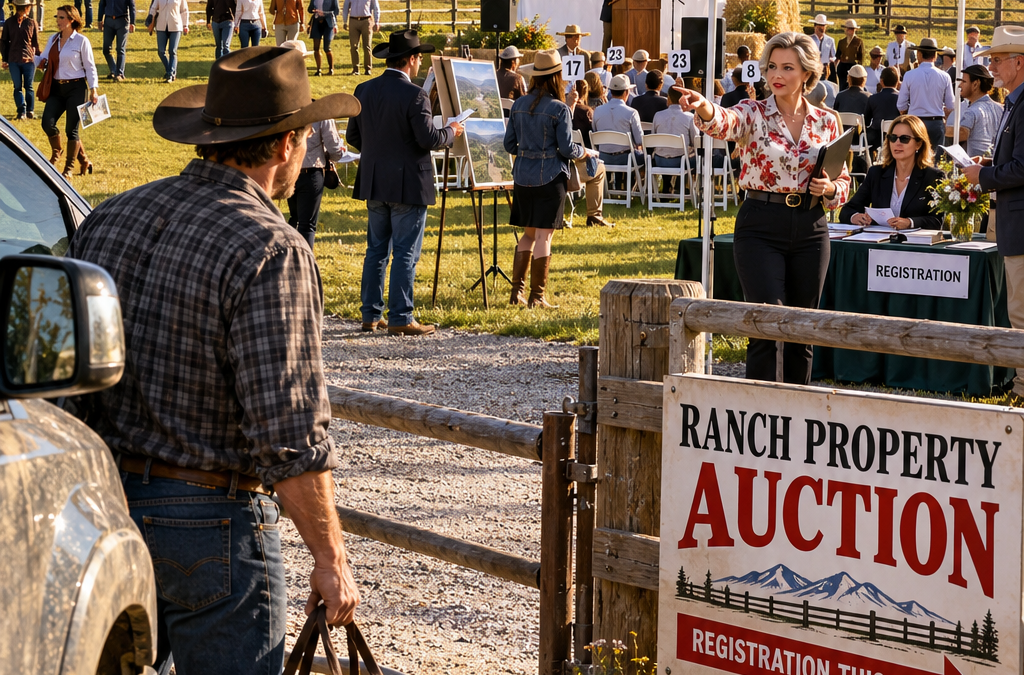
A large sign had been planted beside the fence.
RANCH PROPERTY AUCTION
REGISTRATION THIS WAY
Below it was a time.
A bidder number.
An auction-company logo.
My name was nowhere on the sign.
I sat behind the wheel staring at it.
For several seconds, my brain refused to accept the simplest explanation.
Maybe the sign had been placed on the wrong property.
Maybe an adjacent parcel was being sold.
Maybe the auction company had confused addresses.
Then I looked farther down the driveway.
White tents stood near my barn.
Rows of folding chairs had been arranged across the grass.
People carried folders and numbered paddles.
A portable table had been set up near the equipment shed.
Strangers were walking across my ranch like they were touring inventory.
One man stood beside my tractor examining the tires.
Another couple had wandered toward the horse fence.
Someone had opened the side gate near the barn.
That was when disbelief gave way to something colder.
I turned off the engine.
Checked my phone.
No missed calls from an attorney.
No county notices.
No messages from a lender.
No legal papers.
Nothing from the HOA except a routine newsletter I hadn’t opened.
I checked my calendar.
Nothing.
I knew what I owed.
Taxes current.
No mortgage default.
No liens I knew about.
No pending lawsuit.
No reason anyone on earth should have been conducting an auction on my ranch.
I grabbed my travel bag, got out, and walked down the driveway.
Nobody stopped me.
That almost made it worse.
People assumed I belonged there because everyone else did.
A woman at a folding table smiled.
“Registration?”
“No.”
She held out a clipboard.
“If you’re bidding, you’ll need—”
“I’m not bidding.”
She looked confused.
I continued walking.
The farther I went, the more organized the event became.
Printed property sheets.
Boundary maps.
Coffee station.
Auction catalog.
Someone had gone to real effort.
This wasn’t a mistake made that morning.
It had been planned.
Advertised.
Scheduled.
Strangers had driven here believing something I owned was available for purchase.
Then I saw Karen Whitmore.
President of the Ridgeview Hills Homeowners Association.
She stood beside the main tent wearing cream slacks, a navy blazer, and the expression of someone overseeing exactly what she intended.
Clipboard in one hand.
Phone in the other.
Karen and I had never liked each other.
That didn’t mean we had spent years at war.
Our relationship was simpler.
She believed proximity to the HOA gave her authority over my land.
I knew it didn’t.
My ranch predated Ridgeview Hills by decades.
The development began on former pastureland east of my property.
My parcel was never annexed.
Never subjected to their covenants.
Never signed into their association.
But one corner of the development relied on an old access arrangement across the northern edge of my land.
That limited agreement allowed maintenance vehicles to cross a narrow gravel lane to reach a utility pumping station.
Nothing more.
I had explained that distinction to Karen before.
Several times.
Apparently not well enough.
She was giving instructions to an auction employee when I approached.
“Karen.”
She looked over.
The color left her face for maybe half a second.
Then the expression disappeared.
Replaced by annoyance.
“What are you doing here?”
I actually laughed.
Not because anything was funny.
Because there are questions so absurd that your body reacts before your mind does.
“What am I doing here?”
She folded the clipboard against her chest.
“You weren’t expected back until next week.”
That sentence landed differently.
I stared at her.
“You knew I was gone?”
She recovered quickly.
“This event was scheduled around the available dates.”
“Available to who?”
“Dale, please.”
“My name isn’t Dale.”
She blinked.
Then shook her head.
“I’m dealing with a lot today.”
“My name is Grant Mercer.”
“I know your name.”
“Good. Then let’s try again.”
I gestured toward the tents.
“Why are you auctioning my ranch?”
A few people nearby turned.
Karen lowered her voice.
“This isn’t the place.”
“It’s exactly the place.”
“We can discuss this privately.”
“No.”
Her jaw tightened.
“Grant.”
“Why is there an auction on my property?”
She glanced toward the registration table.
Then toward the auctioneer.
“Ridgeview has authority to dispose of this parcel under the access and compliance provisions attached to the northern tract.”
For a moment, I simply studied her.
“Dispose of it?”
“Yes.”
“Meaning sell it.”
“Meaning resolve a long-standing property dispute.”
“What dispute?”
“You have repeatedly refused to recognize Ridgeview’s interest.”
“Because Ridgeview doesn’t own an interest.”
“That’s your interpretation.”
“No. That’s my deed.”
She sighed.
The sigh of somebody forced to explain an obvious rule to a difficult person.
“The association’s legal committee determined the ranch is connected to the community through the access agreement.”
“Connected isn’t owned.”
“It creates a property interest.”
“An easement.”
“A controlling interest.”
“No.”
“We’re not doing this now.”
“We are absolutely doing this now.”
The auctioneer had begun watching us.
So had several bidders.
I took one step closer.
“Show me the deed.”
Karen frowned.
“What?”
“The document giving Ridgeview ownership of this ranch.”
“We have association resolutions.”
“I didn’t ask for a resolution.”
“Grant—”
“Show me the deed.”
She opened the folder.
Started flipping through pages.
Board minutes.
Maps.
Violation notices.
A document labeled PROPERTY ACCESS ENFORCEMENT RESOLUTION.
Another called RANCH TRACT ADMINISTRATIVE CONTROL.
Impressive titles.
No deed.
I waited.
Karen flipped again.
Her speed slowed.
Then she closed the folder.
“The relevant ownership documents are with counsel.”
“Which counsel?”
“Association counsel.”
“Name?”
“You know our attorney.”
“I know three attorneys who have represented Ridgeview.”
She looked irritated.
“This is harassment.”
“No, Karen. You put my ranch up for auction while I was out of town.”
Her eyes hardened.
“Your ranch has been the subject of ongoing board action.”
“Internal board action cannot transfer ownership.”
“You’ve made your position clear.”
“I haven’t even started.”
A man carrying a bidder packet approached.
“Excuse me.”
Karen turned.
He looked at me.
“Are you saying you’re the owner?”
“Yes.”
Karen answered at the same time.
“He is involved in a title dispute.”
I looked at her.
“No, I’m not.”
The man frowned.
“Is there a lawsuit?”
“No.”
Karen said:
“There are association proceedings.”
I asked:
“Is there a recorded lis pendens?”
She stared.
The bidder looked between us.
“I’m not touching this.”
He folded his packet.
Walked away.
Karen’s face changed.
“Now you’re interfering with a lawful auction.”
“Good.”
“You need to leave.”
I looked around.
“My house is six hundred feet that way.”
“You’re disrupting a scheduled sale.”
“Of my property.”
“Until the ownership issue is resolved—”
“It is resolved.”
I took out my wallet.
Pulled my driver’s license.
Then my phone.
Opened the county property portal.
Parcel number.
Owner: Grant Mercer.
I held it toward her.
She barely looked.
“Online records can be incomplete.”
“Then show me your complete ones.”
She didn’t.
Instead, she reached for her phone.
“I warned you.”
“About what?”
“I will not allow you to disrupt this event.”
“Karen.”
She turned away.
Started dialing.
At first, I assumed she was calling the HOA attorney.
Then I heard:
“Yes, this is Karen Whitmore with Ridgeview Hills HOA.”
Pause.
“We have an unauthorized individual interfering with a scheduled property auction.”
I stared at her.
She was calling 911.
On me.
On my ranch.
I have been angry before.
Real anger.
The kind that makes your vision narrow.
That moment was different.
Something inside me became very quiet.
When people are acting irrationally, anger gives them options.
Calm removes them.
So I let Karen talk.
She gave the dispatcher my address.
Described me.
Said I was refusing to leave.
I didn’t interrupt.
Several bidders were openly listening now.
One woman lowered her paddle.
Another man started scrolling through something on his phone.
The auctioneer walked toward us.
His name badge said TOM BAXTER.
“What’s happening?”
Karen ended the call.
“This gentleman is contesting the sale.”
Tom looked at me.
“You’re Mr. Mercer?”
“Yes.”
He knew my name.
That bothered me.
“You’ve heard of me.”
His face tightened.
“The HOA represented that the property was subject to sale under association authority.”
“Did you run title?”
“We received documents.”
“Did you run title?”
He didn’t answer.
That was answer enough.
I said:
“Stop the auction.”
Karen stepped between us.
“No.”
Tom looked at her.
“Karen, if he is the record owner—”
“He has been noncompliant for years.”
I almost laughed again.
“Noncompliance isn’t ownership.”
She ignored me.
“The association has administrative authority over the property.”
Tom looked increasingly uncomfortable.
“Do you have counsel here?”
“Not yet.”
“Then I’m not opening bids until this is sorted.”
Karen stared.
“You have a contract.”
“A contract to auction property you’ve represented you have authority to sell.”
“We do.”
“Then prove it.”
For the first time, somebody other than me had asked her.
Karen didn’t like that.
She walked away, dialing another number.
I stood near the barn and watched the atmosphere shift.
People who had arrived excited were suddenly cautious.
Auctions depend on confidence.
Buyers need to believe the person selling something has the right to sell it.
Once that belief cracks, the entire event becomes theater.
One bidder asked me:
“How long have you owned it?”
“Fourteen years.”
“Any mortgage?”
“No.”
“Tax lien?”
“No.”
“Foreclosure?”
“No.”
“HOA lien?”
“Not valid.”
He raised an eyebrow.
“So why are they auctioning it?”
“That’s what I’m trying to find out.”
He folded his arms.
“I drove three hours for this.”
“I’m sorry.”
“Not your fault.”
That surprised me.
Then the sheriff’s vehicles arrived.
Two.
One stopped near the gate.
Another came farther down the drive.
Deputy Aaron Miles stepped out first.
The other was Deputy Jenkins.
Karen moved toward them immediately.
Predictable.
She began talking before Miles finished closing his door.
“Thank you. This man is disrupting a legally authorized auction and refusing to leave association-controlled property.”
Miles looked at me.
Then at the tents.
“Who is he?”
“Grant Mercer.”
“Owner?”
Karen hesitated.
“Former controlling owner.”
I stared at her.
Former.
That was new.
Miles heard it too.
“Former?”
She opened her folder.
“The HOA has assumed administrative control under a property-access resolution.”
Miles looked at me.
“Mr. Mercer?”
I handed over my ID.
Then said:
“My deed and county title records are in the house.”
“Can you get them?”
“Absolutely.”
Karen interrupted.
“The auction is already in progress.”
Tom Baxter called from behind her:
“No, it isn’t.”
Everyone looked at him.
He held up both hands.
“I’m not taking bids until law enforcement confirms who owns what.”
Karen glared.
Tom didn’t care anymore.
The money wasn’t worth the liability.
I walked to the house.
My front door was unlocked.
That bothered me.
I always locked it before travel.
Nothing inside looked disturbed.
Still, the thought that someone might have entered made my skin crawl.
I went to the office.
Pulled out the fireproof document case.
Original deed.
Title policy.
Recorded survey.
County tax statements.
Access agreement with Ridgeview’s predecessor developer.
Everything.
When I returned, more bidders had gathered around the deputies.
Miles accepted the deed.
Read the legal description.
Then compared it with the county parcel printout on his vehicle computer.
Same owner.
Same parcel.
Same boundaries.
Fourteen years.
No transfer.
No foreclosure.
No court order.
No recorded HOA deed.
No sale authorization.
He looked at Jenkins.
Then at Karen.
“Ms. Whitmore, where is your ownership document?”
“We don’t claim traditional fee ownership.”
That was a retreat.
Fifteen minutes earlier, she was auctioning the ranch.
Now:
Not traditional ownership.
Miles asked:
“What do you claim?”
“Administrative disposition authority.”
“Based on?”
She handed him the HOA resolution.
He read.
“This is a board resolution.”
“Correct.”
“Signed by your board.”
“Correct.”
“It says the association believes the ranch is subject to community enforcement because of an access agreement.”
“Exactly.”
Miles turned toward me.
“Access agreement?”
I handed it over.
“Page two.”
He read.
The document had been signed decades earlier between a prior owner of my ranch and the original Ridgeview developer.
It granted a limited nonexclusive right to use a twelve-foot gravel lane along the northern boundary.
Purpose:
Maintenance and access to the community utility pumping station.
Nothing about ownership.
Nothing about sale.
Nothing about residential control.
Nothing about HOA covenants.
Nothing about foreclosure.
Nothing about auctions.
Miles looked at Karen.
“This gives access to a lane.”
“It’s more complicated than that.”
“No, it’s pretty specific.”
“The HOA’s legal interpretation—”
“Where’s the court order adopting that interpretation?”
Silence.
“The recorded amendment?”
Nothing.
“The deed transfer?”
Nothing.
Karen became visibly irritated.
“This is a civil matter.”
Miles nodded.
“Yes.”
She looked relieved.
Then he continued.
“Which means you don’t get to call us to remove the record owner just because your board passed a resolution.”
Her face hardened.
“I called because he was disrupting the event.”
“On his property.”
“We dispute that.”
Miles held up my deed.
“The county doesn’t.”
That sentence traveled through the crowd.
People started talking.
A bidder raised his hand.
“This sale isn’t clear title?”
Tom Baxter answered before Karen could.
“The auction is suspended.”
Karen spun toward him.
“You cannot suspend it unilaterally.”
“I absolutely can.”
“We have an agreement.”
“Your agreement represented lawful authority to sell.”
“We have lawful authority.”
“Then come back with a court order and recorded title evidence.”
He pulled the microphone cable from the portable speaker.
That was the moment the auction actually died.
You could feel it.
Bidders started placing paddles on tables.
One woman asked for her registration deposit back.
Another man demanded a copy of whatever Karen had represented to the auction company.
The coffee station suddenly became the busiest part of the event because nobody knew what else to do.
Karen stood in the center of it.
Control leaving her one person at a time.
I should have felt victorious.
I didn’t.
I looked at the tents.
The catalog.
The strangers.
The photographs of my barn printed on glossy paper.
Someone had taken those photographs while I was gone.
Someone had walked my land.
Measured buildings.
Listed equipment.
Prepared marketing.
This had gone far beyond a misunderstanding at a board meeting.
My absence had been used operationally.
That thought bothered me more than Karen’s behavior in front of the deputies.
I asked Tom:
“When did the HOA hire you?”
“Three weeks ago.”
“I left town twelve days ago.”
He looked uncomfortable.
“They told us owner possession wasn’t an issue.”
“Who took the listing photographs?”
“Our field contractor.”
“Entered the property?”
“Under HOA authorization.”
I looked at Karen.
She looked away.
That was the moment my anger returned.
Not loudly.
But fully.
I said:
“Nobody authorized you to enter this ranch.”
Karen answered:
“The access agreement—”
“No.”
I walked toward her.
“The access agreement is for one lane to one pump station.”
“We believed—”
“You sent people through my barn.”
“We inspected assets relevant to the sale.”
“Whose assets?”
She didn’t answer.
“My tractor?”
“Grant—”
“The tack room?”
“This conversation is becoming hostile.”
“My house?”
She looked toward the deputies.
I stopped.
Took one breath.
Then another.
Deputy Miles said:
“Mr. Mercer, let us document what happened.”
He was right.
I stepped back.
The strongest thing I could do was stop giving Karen opportunities to change the subject from documents to emotion.
So we went through everything.
Auction catalog.
HOA resolution.
Access agreement.
Boundary map.
Board minutes Karen had brought.
There it was.
Over and over.
One phrase:
ASSOCIATION ACCESS INTEREST.
Somewhere between that phrase and the auction paperwork, “access interest” had turned into “administrative control.”
Then “administrative control” became “authority to dispose.”
Each step sounded official.
None had a legal instrument behind it.
I asked:
“Who drafted the resolution?”
Karen said:
“The board.”
“Who gave the legal opinion?”
“Our management consultant reviewed it.”
“Attorney?”
“No.”
“Title company?”
“No.”
“County?”
“No.”
“So nobody with authority over land title told you the HOA could sell my ranch.”
She stiffened.
“The board relied on longstanding use.”
“Of a twelve-foot lane.”
“That access is essential to the community.”
“Which is why I have never blocked it.”
“Your refusal to submit to HOA oversight created risk.”
“Risk doesn’t transfer my deed.”
A few bidders were still listening.
Karen realized it.
Her voice dropped.
“This isn’t productive.”
“No. The auction wasn’t productive.”
By sunset, most of the bidders were gone.
Tom’s crew began packing chairs.
One tent came down.
Then another.
The large auction sign near the driveway was removed.
I watched the man pull the stakes from my soil.
That image stayed with me.
Not because the sign mattered.
Because two hours earlier, it had declared my ranch available to strangers.
Now it lay flat in the back of a truck.
Authority can look remarkably temporary once people stop believing in it.
Deputy Miles completed his report.
He explained that he wasn’t deciding civil damages or HOA liability.
That would require attorneys.
But there was no basis for removing me.
No evidence the HOA owned the ranch.
No court order authorizing a sale.
No reason for the auction to continue.
He told Karen:
“If the association believes it has a claim, take it through the civil process.”
She nodded.
Barely.
“No more events here without documented owner permission.”
Another nod.
“Do you understand?”
“Yes.”
For the first time all afternoon, Karen’s voice was quiet.
When the last auction truck left, she remained near the barn.
Clipboard hanging at her side.
I walked toward her.
She looked exhausted.
“Grant.”
“What?”
“I did not intend to steal your ranch.”
The sentence stunned me.
“Then what exactly did you intend?”
“To resolve a property problem.”
“What problem?”
“The board has dealt with access conflicts for years.”
“I’ve never blocked access.”
“You’ve refused inspections.”
“Of my ranch.”
“You’ve refused HOA maintenance standards.”
“I’m not in the HOA.”
“You’ve challenged every community determination.”
“Because they don’t apply here.”
She looked toward the northern lane.
“That road serves forty-seven homes.”
“And you’ve always been allowed to use it.”
“At your discretion.”
“Under a recorded agreement.”
She shook her head.
“That’s too much dependence on one property owner.”
There it was.
Not ownership.
Fear of dependence.
The HOA needed something crossing my land.
Karen didn’t like that I owned the land beneath it.
So she converted limited access into imagined control.
I said:
“You wanted certainty.”
She looked at me.
“You wanted the HOA to control the land because you didn’t like needing an agreement.”
She didn’t deny it.
“You should’ve negotiated.”
“We tried.”
“No. You sent violation notices.”
“You ignored them.”
“They weren’t valid.”
“Then what would you have done?”
“Talked.”
“You hate the HOA.”
“I don’t care enough about the HOA to hate it.”
That surprised her.
“I care about my property.”
I pointed toward the lane.
“If Ridgeview needs a clearer access agreement, ask.”
She stared.
“After today, you’d still negotiate?”
“Access.”
I emphasized it.
“Not ownership.”
She looked down.
“I need to speak to counsel.”
“Good.”
“You’re going to sue us.”
“I haven’t decided.”
She nodded slowly.
Then walked to her vehicle.
No final threat.
No dramatic exit.
Just a woman leaving property she had tried to sell a few hours earlier.
That night, I checked everything.
House.
Barn.
Equipment shed.
Fences.
Tractor.
Tools.
Nothing obvious missing.
But people had been inside areas I never authorized them to enter.
The barn door showed fresh marks near the latch.
A storage cabinet had been opened.
The auction catalog included photographs taken inside the equipment building.
That meant somebody had entered it.
I photographed every sign of access.
Saved the auction materials.
Downloaded the online listing before it disappeared.
Took screenshots.
Wrote down names.
Auction company.
Deputies.
Bidders who had spoken to me.
Everything.
Then I called my attorney.
Rachel Ames.
She listened quietly.
When I finished, she said:
“Karen auctioned your ranch?”
“Tried.”
“While you were traveling.”
“Yes.”
“On the basis of the maintenance-lane agreement?”
“Apparently.”
There was a long silence.
“Grant?”
“Yeah?”
“Don’t talk to the HOA tomorrow.”
“Why?”
“Because tonight, this sounds ridiculous.”
“It is.”
“Ridiculous facts make people careless. I want to know exactly what they wrote before they realize how bad it looks.”
That is why I hire Rachel.
The next morning, the ranch looked almost normal.
No tents.
No bidder cars.
No speaker system.
The grass showed flattened rectangles where tables had stood.
Tire tracks near the barn.
A few paper cups left by the fence.
I collected them.
Walked to the entrance.
The place where the auction sign had stood looked strangely empty.
I went into town and had a simple sign printed.
PRIVATE PROPERTY
ENTRY BY OWNER PERMISSION ONLY
HOA ACCESS LIMITED TO RECORDED UTILITY EASEMENT
No threats.
No NO TRESPASSERS WILL BE PROSECUTED in giant red letters.
Just clarity.
I installed it beside the gate.
Then Rachel arrived.
We spent four hours going through documents.
She read the original access agreement.
Then Karen’s HOA resolution.
Then the auction contract.
She kept saying:
“No.”
Not emotionally.
Legally.
“No.”
Page.
“No.”
Another page.
“No.”
Finally she leaned back.
“They built an ownership theory by stacking language.”
“What does that mean?”
“The first document says access.”
She pointed.
“The next says access interest.”
Another.
“Then community property interest.”
Another.
“Then management authority.”
Another.
“Then disposition rights.”
“None of which exist in the recorded agreement.”
“Correct.”
“How does a board do that?”
“By nobody making them prove each step.”
That was the entire problem.
One phrase expanded slightly.
Then another.
Then another.
By the time the auctioneer saw the file, the HOA’s claim looked substantial because it had volume.
Thirty pages of internal documents.
But thirty pages based on the wrong premise do not become a deed through multiplication.
Rachel sent a preservation letter.
All HOA emails concerning my ranch.
Board minutes.
Legal communications that weren’t privileged or otherwise producible.
Auction contracts.
Photographs.
Management notes.
Access records.
She also sent notice that no HOA agent could enter beyond the limited recorded access lane.
Karen’s attorney responded two days later.
Finally, an actual property lawyer.
His tone was different.
He did not defend the auction.
He said the board had acted under a mistaken interpretation of its access rights and requested a meeting.
Mistaken interpretation.
Rachel read the phrase aloud.
“That’s doing a lot of work.”
I agreed.
We met the following week.
Karen attended.
Two board members.
HOA counsel.
Rachel.
Me.
No crowd.
No sheriff.
No tents.
Just a conference table.
Their lawyer began.
“The association acknowledges that the recorded access agreement does not convey fee title.”
Rachel said:
“Good.”
Karen stared at the table.
“He also acknowledges it does not authorize sale, foreclosure, or administrative disposition of the Mercer ranch.”
“Good.”
“We are prepared to formally rescind the board resolution.”
I looked at Karen.
She didn’t look up.
I asked:
“Why was an auction scheduled before title was verified?”
The attorney paused.
Karen answered.
“We believed the management consultant had verified it.”
Rachel asked:
“Name?”
Karen gave one.
“Licensed attorney?”
“No.”
“Title examiner?”
“No.”
“Surveyor?”
“No.”
“Real estate broker?”
“Consultant.”
“What qualification did he have to determine ownership?”
Karen didn’t answer.
Another board member did.
“He manages HOAs.”
Rachel nodded.
“Not land title.”
“No.”
The second board member, a man named Robert, spoke quietly.
“I voted for the resolution.”
I looked at him.
He continued.
“I thought counsel had approved it.”
Their attorney said:
“I did not.”
Robert’s face tightened.
Karen looked toward him.
He ignored her.
“She told us it had been reviewed.”
Karen finally looked up.
“Management reviewed it.”
“You said legal had cleared the access issue.”
“I said management believed legal authority existed.”
“That’s not what I heard.”
Their attorney stopped the argument.
“Regardless, the board is rescinding the resolution.”
I wasn’t interested in watching them destroy each other.
I wanted my ranch protected.
So Rachel laid out terms.
Written acknowledgment that I owned the property.
No HOA jurisdiction beyond the recorded access agreement.
Reimbursement for documented cleanup and legal costs related to the unauthorized auction.
Confirmation that the auction company and bidders would receive written notice that the sale had no legal effect.
Destruction or correction of marketing materials describing my ranch as HOA-controlled property.
No future entry outside the easement without permission.
And a revised access agreement.
That last part surprised Karen.
“Revised?”
I nodded.
“The original agreement is too easy for another board to misrepresent.”
Their attorney agreed before she could object.
We spent the next month drafting it.
The new document was painfully specific.
The HOA had a nonexclusive right to travel across one twelve-foot lane.
Only for utility-station maintenance, emergency access, and specifically listed service purposes.
No recreational use.
No event use.
No parking.
No storage.
No right to inspect the ranch.
No right to impose HOA rules.
No ownership interest.
No right to encumber.
No right to lease.
No right to sell.
No right to assign beyond the utility purpose without my written consent.
One clause stated explicitly:
Nothing in this agreement shall be construed as granting the association possession, control, governance authority, or disposition rights over any portion of the Mercer Ranch.
Rachel smiled when she drafted that one.
“Overkill?” I asked.
“After an auction?”
“Fair.”
Karen read every page.
This time, she had an attorney beside her.
Good.
I wanted no future claim that anyone misunderstood.
At the final meeting, she signed.
Then said:
“I owe you an apology.”
I looked at her.
Robert shifted in his chair.
Their attorney said nothing.
Karen continued.
“I believed the board had more authority than it did.”
“Yes.”
“I should have confirmed ownership before approving any sale action.”
“Yes.”
“The auction should never have happened.”
“No.”
“I am sorry.”
I believed she meant it.
Not completely.
Maybe part embarrassment.
Part legal advice.
Part genuine recognition.
People are rarely only one thing.
“Thank you.”
I didn’t need more.
The HOA sent written corrections to every registered bidder.
Tom Baxter called me personally.
“I should’ve pulled independent title.”
“Yes.”
“I relied on the seller’s representation.”
“That’s understandable.”
“Not enough.”
“No.”
He refunded all bidder deposits and removed the listing from every platform his company controlled.
He also revised his own company’s policy.
No real-property auction would be accepted from an HOA, estate representative, property manager, or similar entity without direct title verification.
That was a good outcome.
A mistake creating a better process is at least useful.
Ridgeview held an emergency election three months later.
Karen did not run again.
She resigned before her term ended.
No criminal case.
No spectacular collapse.
The evidence did not show she had tried to pocket auction money or secretly steal title.
What she had done was serious enough without turning it into something else.
She had allowed an HOA’s internal interpretation to expand far beyond the legal document underneath it.
Then she acted with confidence because nobody had forced the board to test that interpretation against the deed.
That could have caused enormous damage.
One bidder had been prepared to place a substantial deposit.
Another had already spoken with a lender.
Imagine the mess if somebody had “won.”
No legal title could have transferred cleanly.
Eventually the problem would have surfaced.
But not before attorneys.
Escrow disputes.
Claims.
Possible cloud on title.
Money tied up.
Maybe years of litigation.
We stopped it because I came home that afternoon.
That fact bothered me for a long time.
What if I had returned three days later?
What if my trip had lasted as originally planned?
Would they have conducted the sale?
Probably.
Would somebody have paid?
Possibly.
Would Karen have realized something was wrong before attempting to close?
I don’t know.
People like to say the system would’ve caught it.
Maybe.
Title companies exist for a reason.
Closing attorneys exist for a reason.
But systems catch mistakes at different stages.
Every later stage costs more.
That’s why the earlier question matters.
Do you actually own what you’re selling?
Nobody had asked it properly.
Until I walked onto the lawn carrying a travel bag.
For weeks afterward, I had trouble leaving the ranch.
Not literally.
I still went to town.
Work.
Dinner.
Errands.
But travel felt different.
Every time I drove away, I imagined returning to tents.
Ridiculous.
I knew the paperwork was fixed.
New sign.
New agreement.
Attorney letter.
Still, violation leaves residue.
Home feels safe partly because you assume the world recognizes it as yours.
Once someone treats that assumption as optional, you notice your vulnerability.
It took time to lose that feeling.
The ranch helped.
Ranches demand attention.
Fence wire doesn’t care about HOA drama.
Horses want feeding.
Irrigation line leaks.
Tractor battery dies.
Grass grows.
Ordinary work pulled me back.
One Saturday, I was repairing the gate when an SUV slowed near the entrance.
I stopped.
Watched.
The driver was an older Ridgeview resident.
He rolled down the window.
“Mr. Mercer?”
“Yes.”
“I wanted to apologize.”
“For what?”
“I registered for the auction.”
I put down the wrench.
“You didn’t know.”
“I should’ve checked.”
“You’re a bidder. That’s what auction companies are supposed to handle.”
He shook his head.
“I walked through your barn.”
That changed things.
“You did?”
“During preview day.”
“When?”
“The Saturday before the auction.”
I had been away.
He looked ashamed.
“They told us inspection was authorized.”
“What did you see?”
“Equipment. Tack. Storage. Nothing personal.”
It was all personal.
But I understood what he meant.
“I feel terrible.”
“Thank you for telling me.”
He reached into the passenger seat.
Handed me a card.
His name and phone number.
“If your attorney needs a witness to the preview, I’ll tell them exactly what happened.”
I took it.
“Thank you.”
He started to drive away.
Then stopped.
“Beautiful ranch.”
I looked at him.
“That’s why you wanted it?”
He gave a small embarrassed smile.
“Partly.”
Fair.
At least he was honest.
I gave his information to Rachel.
His statement helped establish how far the unauthorized activity had gone.
Preview tours.
Photographs.
Catalog descriptions.
The HOA hadn’t merely scheduled a mistaken legal procedure.
It had physically treated my property like inventory.
That made the final settlement stronger.
Ridgeview reimbursed cleanup, security improvements, legal expenses, and other documented costs.
I used part of the money to install cameras.
Not because I wanted a fortress.
Because I no longer wanted to depend on a neighbor calling if someone entered while I was away.
One camera faced the driveway.
One covered the barn.
One the equipment shed.
I hated them at first.
My father had never needed cameras.
But my father also lived in a time when nobody thought an HOA resolution could become an online auction catalog in three weeks.
The world changes.
You adapt.
A year later, I traveled again.
First overnight trip since the auction.
I checked the cameras six times from the hotel.
Nothing.
Ranch empty.
Second day, three times.
Third day, once.
When I drove home, there were no tents.
No signs.
No strangers.
Just cattle near the fence and dust on the driveway.
I laughed at myself.
Then parked.
Home.
The word felt normal again.
Ridgeview changed too.
The new president was Robert, the board member who admitted he had misunderstood Karen’s explanation.
He didn’t ask me to join.
Smart man.
He did request an annual meeting about the utility access lane.
We sat at my kitchen table.
One page.
Maintenance dates.
Contractor names.
Emergency contact.
That’s all.
The first year, Robert brought a thick binder.
I looked at it.
He laughed.
“Old habits.”
“Anything in there trying to sell my house?”
“Checked twice.”
Good.
We eventually had a functional relationship.
Not friendship.
Better than hostility.
One winter storm washed gravel out of the access lane.
The HOA paid for restoration because the new agreement placed maintenance responsibility on them for damage caused by their utility traffic.
They asked first before bringing machinery.
I said yes.
Crew arrived.
Fixed it.
Left.
No conflict.
That’s what legitimate authority looks like.
Specific.
Limited.
Predictable.
Nobody needs to perform dominance.
The ranch stayed mine.
The HOA got the access it actually needed.
Everybody benefited.
Sometimes I thought about how easily we could have reached that arrangement before the auction.
One meeting.
Two attorneys.
One revised easement.
Instead, Karen convinced herself that dependence was weakness.
She wanted control where clarity would have been enough.
That is the part people misunderstand about property disputes.
They think they’re always about greed.
Sometimes they’re about discomfort.
One person owns something another person needs to use.
That creates dependence.
Some people handle dependence through agreements.
Others try to erase it by pretending the thing is theirs.
Karen chose the second.
Once the board started saying “community interest,” the language expanded.
Community interest.
Control.
Disposition.
Auction.
Every word took one small step farther than the one before.
That is how overreach becomes normal.
Not one giant leap.
Incremental vocabulary.
Years after the event, I still have the auction catalog.
The cover shows an aerial photo of my ranch.
Beautiful photograph.
Probably taken with a drone.
Under it:
RIDGEVIEW RANCH OPPORTUNITY
LAKE-ADJACENT ACREAGE
MULTIPLE USE POTENTIAL
My name nowhere.
I keep it beside the corrected access agreement.
Two documents.
One tried to turn my home into an asset for strangers.
The other clearly states what the HOA may and may not do.
I don’t keep the catalog because I enjoy anger.
I keep it because it reminds me how respectable a false claim can look.
Glossy paper.
Professional photography.
Bid instructions.
Terms.
Deposit requirements.
Everything about it looked legitimate.
That is what made it dangerous.
Fraud isn’t always a man in a dark room forging a signature.
Sometimes nobody is deliberately trying to commit fraud.
Sometimes people build an entire professional process on a premise nobody verified.
The damage can still be enormous.
That is why title records exist outside internal organizations.
The HOA could pass any resolution it wanted.
It could declare the sky common property.
County records did not change.
My deed sat there quietly.
Same owner.
Same boundaries.
Same ranch.
That boring consistency protected me.
Karen’s paperwork was loud.
Mine was durable.
I learned not to confuse those things.
One afternoon, almost two years later, Karen drove past.
I hadn’t seen her in months.
She stopped near the gate.
I walked over.
She rolled down the window.
“Grant.”
“Karen.”
“How are you?”
“Good.”
She looked toward the new private-property sign.
Still there.
“I heard Robert finally got the utility schedule working.”
“He did.”
“Good.”
Silence.
Then:
“I drive past sometimes and still think about that day.”
“So do I.”
“I really believed we had authority.”
“I know.”
She looked embarrassed.
“That’s almost worse.”
I understood what she meant.
A deliberate thief knows she is crossing a line.
A person convinced the line doesn’t exist can do more damage because conscience never slows her.
She continued.
“I should have asked the county.”
“Yes.”
“I should’ve had an attorney read the easement.”
“Yes.”
“I should’ve called you.”
“Yes.”
She smiled faintly.
“You haven’t gotten more forgiving.”
“I forgave you.”
Her expression changed.
“Then why the yes?”
“Because forgiveness doesn’t make those statements false.”
She considered that.
“Fair.”
She looked toward the barn.
“I’m glad you kept it.”
“The ranch?”
“Yes.”
I laughed.
“I wasn’t planning to sell.”
“I know.”
“Eventually.”
“Eventually.”
She drove away.
That conversation gave me more closure than the settlement.
Maybe because there were no lawyers in the room.
No performance.
Two people acknowledging what actually happened.
I didn’t need her humiliated forever.
I needed the boundary remembered.
There is a difference.
I still travel.
Still leave the ranch.
Still come home expecting quiet.
Every time I turn into the driveway, I see the private-property sign.
Some days I barely notice.
That’s a good thing.
Signs shouldn’t feel dramatic forever.
Near the gate, the ground where the auction placard once stood has long since filled in.
No hole.
No scar.
Grass doesn’t remember.
I do.
But even memory changes.
At first, I remembered Karen’s clipboard.
The tents.
The bidders.
Police vehicles.
Now I remember the instant Deputy Miles looked at the deed and asked Karen:
“Where is your ownership document?”
That was the whole dispute in one question.
Not:
How many board members voted?
Not:
How long has the HOA used the lane?
Not:
How angry is Karen?
Not:
How many pages are in the HOA folder?
Where is your ownership document?
She didn’t have one.
Everything after that was cleanup.
That question has become a habit for me.
Not just with land.
Whenever somebody claims authority, I ask:
Where does it come from?
Sometimes the answer is obvious.
Contract.
Statute.
Deed.
Consent.
Sometimes the answer is:
We’ve always done it this way.
Those words deserve caution.
Tradition can explain behavior.
It cannot create unlimited rights.
Ridgeview had crossed part of my property for years.
Fine.
That didn’t mean Ridgeview owned my ranch.
The HOA had maintained a pumping station.
Fine.
That didn’t mean it could inspect my barn.
The board believed my land was important to the community.
Fine.
Importance is not title.
Those distinctions sound boring.
Until somebody ignores them.
Then boring distinctions become the difference between coming home to your own ranch and coming home to strangers bidding on it.
I sometimes think about the bidder who would have won.
There was one man Tom later told me had been prepared to go high.
Developer.
Wanted acreage near Ridgeview.
He might have stood under that tent and believed he had purchased a ranch.
Signed papers.
Transferred money.
Celebrated.
Then discovered the seller never owned it.
Imagine that phone call.
Imagine the title company.
The lawsuits.
The frozen funds.
The headlines.
All because somebody expanded “access” into “control” without stopping at the county recorder.
People call what happened a close call.
They’re right.
But not in the way they think.
I was never truly close to losing legal ownership that afternoon.
Karen couldn’t convey what she didn’t own.
The close call was chaos.
Clouded title.
Litigation.
Money.
Strangers believing competing stories.
The ranch caught inside paperwork generated by people who had no right to create it.
That can consume years even when you’re right.
Being legally correct does not make conflict cheap.
That is why early verification matters.
Now, if the HOA asks for anything beyond the access agreement, I don’t argue.
“Send it to Rachel.”
Usually nothing follows.
Not because I’m threatening anyone.
Because everyone knows the process.
That is healthier than relying on personalities.
Karen was powerful because too much depended on what she believed.
The new system requires documentation.
A good system should survive a bad leader.
That’s one of the few positive things that came from the auction.
Ridgeview adopted a rule requiring independent title review before asserting any property right beyond existing recorded covenants.
Their board minutes say it in dry language.
No one reading it ten years from now will know why.
Maybe that’s perfect.
Rules are supposed to outlive drama.
My ranch certainly did.
The barn is still there.
I replaced the roof last year.
Tractor still runs.
Usually.
The northern lane still leads to the pump station.
HOA maintenance trucks cross twice a month.
They stay within twelve feet.
No one wanders toward the barn.
No one takes photographs.
No tents.
No auction signs.
Most mornings, none of that history feels present.
I wake.
Make coffee.
Step outside.
Horses near the fence.
Sun over the pasture.
Ordinary.
That was what I thought I was coming home to that afternoon.
I didn’t appreciate ordinary enough before.
I do now.
Home should be boring in certain ways.
You should be able to leave and expect the same gate when you return.
The same barn.
The same ownership.
The same right to decide who stands on your land.
That stability isn’t dramatic.
It’s valuable precisely because you don’t have to think about it every day.
Karen disrupted that.
The deed restored it.
And the most important thing I learned was not that I needed more signs, stronger gates, or louder arguments.
I needed clarity.
My documents already told the truth.
The mistake was assuming everyone else had read them.
Now they have.
The county has always known who owns the ranch.
The HOA knows.
The board knows.
The auction company knows.
Every bidder received the correction.
Karen knows.
Most importantly, I know exactly where my rights begin and where Ridgeview’s end.
The last time I left town, I stood at the gate before driving away.
Looked back.
Nothing special.
House in the distance.
Barn.
Pasture.
Gravel lane.
I thought about the white tents.
Then I realized I couldn’t even remember exactly where the main auction table had stood.
Good.
Some memories deserve to fade.
I got into the truck.
Drove away.
Returned four days later.
The ranch was empty.
Quiet.
Exactly as I had left it.
I parked near the house.
Carried my bag inside.
Then walked back outside with coffee.
No bidder paddles.
No HOA signs.
No one telling me I was disrupting a sale.
Just wind across the pasture.
I stood there for a long time.
Ownership can look impressive in legal documents.
Stamped deeds.
Seals.
Surveys.
But the real meaning is much simpler.
It is knowing that when you come home, home is still yours.
Karen thought a board resolution could replace that.
The auction company trusted the resolution.
Bidders trusted the auction company.
For a few hours, an entire crowd stood on my land acting as though a chain of assumptions had become ownership.
Then somebody finally checked the deed.
That was all it took to begin unraveling everything.
One recorded document.
One legal description.
One owner.
Me.
And once that fact entered the conversation, the auction had nowhere left to go.








