𝗙𝗨𝗟𝗟 𝗦𝗧𝗢𝗥𝗬 HOA Karen Secretly Hooked Her Luxury Community Project to My Farm’s Electricity—Then Threatened Me When I Demanded to Know Who Was Paying the Bill
𝗙𝗨𝗟𝗟 𝗦𝗧𝗢𝗥𝗬
I usually ignored it.
I had enough responsibilities without arguing with someone whose idea of authority came from a volunteer title and an oversized clipboard.
But Karen had a particular talent for turning ordinary disagreements into contests of obedience.
And six months before the meter incident, she found a new reason to demonstrate it.
The utility company had identified a significant problem affecting electrical infrastructure serving the HOA’s planned construction area.
The repair estimate was close to nine thousand dollars.
That wasn’t a small expense.
The work involved correcting the existing service arrangement so the community project could rely on a proper permanent electrical supply.
The utility company made the problem clear.
There was an issue requiring repair.
The permanent solution would cost approximately nine thousand dollars.
And the association needed to authorize and fund the work.
I learned about it because the project was near my property boundary and might affect the surrounding service infrastructure.
At the time, I didn’t consider the matter particularly controversial.
Electrical systems require maintenance.
Sometimes repairs are expensive.
If a neighborhood wants to build and operate equipment that consumes electricity, it needs an appropriate electrical service.
That seemed obvious to me.
But Karen viewed the estimate differently.
She was determined to finish the HOA’s community improvement project without adding another major expense to the budget.
The development had already committed substantial money to construction.
Residents had been promised improved amenities, better lighting, and a more attractive common area.
Karen had made the project a centerpiece of her presidency.
She talked about it constantly.
At meetings.
At neighborhood gatherings.
In community announcements.
She described the improvements as proof that her leadership was making the development more prestigious.
The repair estimate threatened to complicate that story.
Nine thousand dollars wasn’t enough to bankrupt the association, but it was enough to provoke questions.
Why hadn’t the electrical work been anticipated?
Why wasn’t it included in the original budget?
Who was responsible for the oversight?
Karen hated questions that made her look unprepared.
So when the utility company’s recommendation reached the board, she dismissed it.
I attended the meeting because the project bordered my farm.
The room was filled with homeowners.
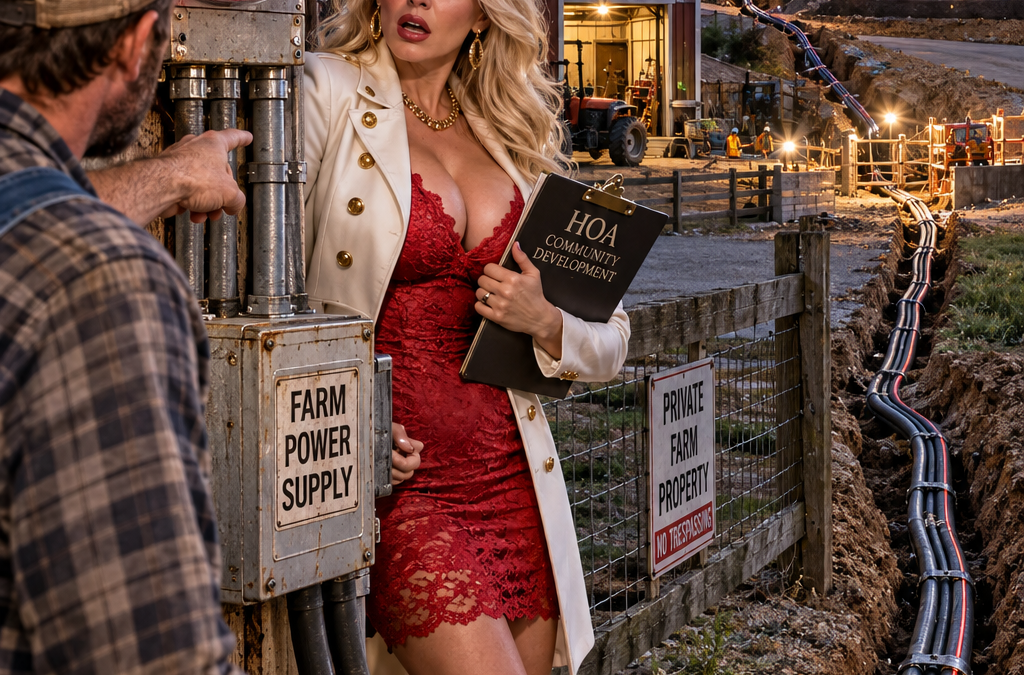
Karen stood at the front wearing her familiar red lace dress under a fitted cream blazer, her blonde hair styled in loose curls.
She smiled warmly while discussing the project’s progress.
Then the treasurer mentioned the utility repair estimate.
Karen’s expression tightened.
“We are not spending nine thousand dollars on something that can wait.”
One board member looked uncertain.
“The utility company says the permanent service needs work.”
Karen waved a hand.
“Utility companies always recommend the most expensive option.”
A few people chuckled.
She smiled, pleased with herself.
“We need to be responsible with association funds. We’ve already invested heavily in this improvement.”
Someone asked whether the repair was necessary for the project to operate.
Karen glanced toward the contractor seated near the back.
“We have temporary arrangements available.”
The contractor didn’t say much.
I noticed that.
I also noticed that Karen moved quickly to the next agenda item.
I raised my hand.
“Can someone explain what temporary arrangement you’re talking about?”
Karen’s smile changed.
“Oh. Our neighboring farmer has a question.”
I ignored the remark.
“If the electrical service requires repair, what supplies the equipment until the repair is completed?”
She tilted her head.
“That is a technical matter being handled by qualified professionals.”
“Then why are you rejecting the permanent repair?”
“Because the board is entitled to prioritize expenses.”
“Sure. But what happens if the temporary service isn’t adequate?”
Karen sighed loudly.
“Do we really need to turn every maintenance decision into a lecture?”
A few residents looked toward me.
I felt the familiar irritation rise.
“I’m asking how the equipment is going to be powered.”
She folded her arms.
“That issue has been addressed.”
“How?”
“The contractor has a plan.”
I waited.
She smiled again.
“Next question.”
I considered pressing the issue.
Then I looked around the room.
Most residents were ready to move on.
The repair involved association infrastructure, and I had no reason to believe my own account would be affected.
So I let it go.
That was the last time I heard anything about the nine-thousand-dollar repair for several months.
I assumed the HOA would eventually authorize the work when the project reached the appropriate stage.
I thought the temporary arrangement was exactly what its name implied.
Temporary.
Something professionally installed, properly accounted for, and removed when no longer needed.
I had no idea my electric meter would become part of it.
The HOA construction continued.
Trucks arrived.
Workers installed equipment.
Crews ran conduit, placed lighting fixtures, and finished the community improvements.
The activity wasn’t unusual for a project of that size.
I saw workers along the boundary occasionally, but they remained outside my active farm areas.
I didn’t interfere.
I had my own work to do.
Planting schedules.
Barn maintenance.
Equipment repairs.
Invoices.
Early mornings.
Long days.
I wasn’t interested in monitoring every decision made by the HOA contractor.
And because nobody asked me to provide electricity, I never imagined the project had any legitimate reason to connect to my service.
Then my utility bill began looking strange.
At first, the increase wasn’t dramatic enough to trigger immediate alarm.
Farm consumption varies.
Weather changes.
Equipment use changes.
Some weeks are busier than others.
I noticed the bill was higher than expected, but I assumed there was an ordinary explanation.
Perhaps something had run longer than I remembered.
Perhaps seasonal loads were increasing.
Perhaps the previous reading had been estimated.
I made a note to check.
Then the next statement arrived.
The consumption was higher again.
I sat at the farmhouse kitchen table comparing the new bill with earlier months.
It didn’t fit.
I hadn’t added any major equipment.
The barn wasn’t operating longer hours.
The workshop wasn’t running a new machine.
Nothing about the farm explained the change.
I looked through my operating records.
The increase had started around the period when the HOA construction was underway.
At first, I didn’t connect the two.
Why would I?
The community’s electrical equipment was supposed to be on its own service.
My farm was a separate property.
No one had asked permission to use my meter.
And I had never agreed to pay for neighborhood improvements.
I checked my equipment.
Looked for anything that might have been left operating.
Walked through the barn.
Checked the workshop.
Examined the usual electrical loads.
Nothing seemed unusual.
The mystery bothered me.
Then one morning, I decided to test it more directly.
I shut down everything I could safely take offline.
I left essential systems alone, but the major controllable loads weren’t operating.
The workshop tools were off.
The barn lights were mostly off.
Equipment that didn’t need electricity that morning wasn’t drawing it.
Then I walked to the meter.
I stood in front of the display and watched.
The numbers kept climbing.
I waited.
They kept climbing.
I checked again.
Still moving.
Not at the tiny rate I might expect from ordinary standby loads.
At a rate that made no sense for the condition of my property.
I felt a slow tightening in my chest.
Something was wrong.
I wasn’t imagining the bills.
Electricity was flowing somewhere.
And I couldn’t account for it.
I went inside and retrieved my notebook.
I recorded the reading.
Waited.
Recorded another.
Then I compared the interval against what I knew was operating.
The difference was enough to convince me I needed professional help.
I was reaching for my phone when I heard a vehicle pull into the driveway.
Karen.
Of all people.
She stepped out of her SUV wearing her red lace dress, gold jewelry, and expensive heels.
She looked perfectly composed.
She always did when she believed she was arriving with the upper hand.
Her hair was immaculate.
Her makeup was flawless.
And her clipboard was already in her hand.
“Good morning,” she called.
I stared at her.
“Karen?”
She smiled.
“I thought I’d stop by and check on a little infrastructure matter.”
I looked toward the meter.
Then back at her.
“What infrastructure matter?”
She hesitated.
“Just making sure everything near the property boundary is functioning normally.”
My suspicion sharpened.
“Why?”
“Because responsible community leadership requires attention to detail.”
She walked toward the side of the farmhouse without waiting for an invitation.
I followed.
She headed directly toward the meter.
Not the barn.
Not the driveway.
Not the boundary fence.
The meter.
She knew exactly where she was going.
That was the first thing I noticed.
The second was how quickly she changed expression when she saw the readout.
The smug smile faded.
Her eyes fixed on the numbers.
Then she glanced toward the HOA property.
I watched her carefully.
“Karen, do you know something about this?”
She straightened.
“About what?”
“The electricity.”
“I’m sure your farm uses quite a lot.”
“Not with most of the equipment shut down.”
She shrugged.
“Farming is expensive.”
I felt my jaw tighten.
“That isn’t an explanation.”
She smiled coldly.
“Neither is accusing your neighbors of wrongdoing.”
“I haven’t accused anyone.”
“Then stop behaving as if you have.”
I pointed to the meter.
“Why is my service showing this much consumption?”
She looked at the display again.
For a moment, she didn’t speak.
Then she said, “There may be a temporary connection related to the HOA project.”
I stared at her.
“What?”
“It’s nothing serious.”
“A temporary connection to what?”
“The community improvements.”
I felt my stomach drop.
“Through my meter?”
She lifted her chin.
“You’re misunderstanding the arrangement.”
“Then explain it.”
Her eyes narrowed.
“Don’t speak to me like that.”
“Karen, I’m standing at my electric meter asking why the HOA is connected to it.”
She crossed her arms.
“It’s temporary.”
“How long?”
“The contractor is managing it.”
“How long has it been there?”
She looked away.
I stepped closer to the meter.
“How long has my account been paying for your project?”
That was when she became visibly angry.
“Your tone is completely inappropriate.”
“My tone isn’t the issue.”
“You’re making this into something it isn’t.”
“Then tell me what it is.”
She exhaled sharply.
“The HOA needed temporary power while the permanent service work was being addressed.”
I stared at her.
“The repair you refused to approve?”
Her expression hardened.
“That decision was made by the board.”
“And you connected the project to my electricity instead?”
“I didn’t personally connect anything.”
“Did you authorize it?”
“The contractor handled the technical details.”
I shook my head.
“That’s not what I asked.”
She leaned toward me.
“Let me make something perfectly clear. The community project is not going to be delayed because you suddenly decide to create problems.”
I felt anger rise through my exhaustion.
“I’m not delaying anything. I’m asking why you’re using electricity I’m paying for.”
Her voice turned sharp.
“You should be grateful the project benefits the entire area.”
I looked at her in disbelief.
“Grateful?”
“Property values improve when surrounding communities invest in their infrastructure.”
“Then the HOA should pay for its infrastructure.”
Her face flushed.
“You’re being selfish.”
I stared at the meter.
The numbers continued climbing.
Then I looked back at her.
“You need to leave.”
She blinked.
“Excuse me?”
“I’m calling the utility company. Until they inspect this, I’m not discussing it with you.”
Her expression changed.
“That’s unnecessary.”
“Not to me.”
“You’re overreacting.”
“Then the inspection should prove that.”
She took a step forward.
“Do you realize how much disruption you could cause if you interfere with a community electrical project?”
I held her gaze.
“Do you realize how much electricity your community project may have taken through my account?”
For a moment, she looked furious enough to scream.
Then she forced another smile.
“Fine. Call whoever you want.”
She turned toward her SUV.
But before leaving, she looked back.
“You would be wise not to make accusations you can’t prove.”
I watched her drive away.
Then I picked up my phone.
I called the utility company.
I explained the situation carefully.
Unusual meter consumption.
Major farm equipment shut down.
An HOA project next door.
The HOA president admitting there might be a temporary connection.
I asked for a professional inspection.
The representative listened and arranged for a technician to visit that afternoon.
His name was Mike.
I met him beside the farmhouse when he arrived.
Mike was practical, calm, and clearly accustomed to customers who had already spent hours trying to diagnose electrical problems themselves.
He carried testing equipment and reviewed the service information before beginning.
“So you’re seeing unexpected consumption?” he asked.
“Yes.”
“And you’ve checked your major equipment?”
“I’ve shut down everything I safely can.”
He nodded.
“Let’s see what the system tells us.”
I appreciated that immediately.
No assumptions.
No accusations.
No dramatic declarations.
Just a technician doing his job.
I showed him my readings.
He compared them with the available utility data.
Then he began examining the service configuration.
I stayed nearby but out of his way.
Electrical equipment isn’t something to approach recklessly, especially when the source of a problem is unknown.
Mike followed the appropriate procedures and used his instruments to determine where the load was going.
The first measurements confirmed that the usage wasn’t explained by the active equipment I’d identified on the farm.
Then he traced the relevant conduit path.
We moved along the side of the farmhouse toward the area nearest the HOA property.
The conduit continued toward the boundary.
Mike examined the installation.
Then another connection point.
His expression became more serious.
“Did you authorize temporary service for the construction next door?”
“No.”
He looked at me.
“Nothing in writing?”
“Nothing. I was never asked.”
He nodded slowly.
“All right.”
We continued.
At the next junction box, he stopped.
He examined the enclosure and verified the conditions before opening it according to the proper procedures.
I watched him work.
Then his expression changed.
He looked inside.
Checked the circuits.
Consulted his equipment.
And said quietly, “Well, that explains a lot.”
My pulse quickened.
“What did you find?”
“Several circuits associated with the temporary supply.”
“Whose circuits?”
He looked toward the HOA construction area.
“Let’s identify them properly.”
The inspection continued.
Security lighting circuits were drawing power.
Construction equipment was connected.
Other loads associated with the community project were being supplied through the temporary arrangement.
It was all right there.
Not a mysterious electrical fault somewhere in the farmhouse.
Not an imaginary increase in consumption.
Not equipment I’d forgotten to turn off.
The HOA project was drawing electricity through a configuration that placed the usage on my farm meter.
I stared toward the neighboring construction area.
For weeks, I’d been paying for electrical demand that wasn’t mine.
The security lights illuminating the association’s project.
The equipment contractors used to finish construction.
The temporary supply that was supposed to exist only until the permanent service was repaired.
All of it had been recorded through my account.
Mike remained careful.
He didn’t make accusations about who had decided what.
He documented the installation.
Recorded the relevant meter information.
And began gathering the utility records needed to establish how the connection had been authorized.
Then Karen appeared again.
I heard her before I saw her.
“What is going on here?”
She marched toward us from the HOA side, her heels clicking against the pavement.
Her red lace dress stood out against the utility boxes and unfinished construction area.
She looked at Mike.
Then at me.
Then at the open junction box.
Her face tightened.
“Who authorized you to open that?”
Mike remained calm.
“Ma’am, I’m a utility technician inspecting a reported service issue.”
Karen lifted her chin.
“I’m the president of the homeowners association.”
He nodded.
“All right.”
She seemed irritated that he didn’t react more strongly.
“This equipment is part of an approved community project.”
“We’re verifying the service arrangement.”
“Then there is no problem.”
Mike looked at his notes.
“There’s a billing and connection question we need to resolve.”
Karen’s eyes moved toward me.
I folded my arms.
“Tell him what you told me this morning.”
She stared.
“What?”
“About the temporary connection.”
Her smile vanished.
Mike looked up.
“Mrs. Parker, did the association authorize this temporary electrical supply?”
“Of course.”
“Who authorized it?”
“The contractor.”
Mike nodded.
“Do you have the associated work order?”
She hesitated.
“The paperwork is handled through the association.”
He continued calmly.
“We need to identify the party responsible for the load and the account used.”
Karen became visibly irritated.
“You’re making this unnecessarily complicated.”
Mike looked at her.
“Ma’am, electrical service and billing have to be correctly assigned.”
I watched her expression harden.
“Everything was approved.”
“Then we’ll verify the authorization.”
She pointed toward the HOA project.
“We have expensive community equipment relying on that power. I don’t want anyone shutting things down because one farmer doesn’t understand his meter.”
My face grew hot.
I took a breath.
“Karen, the meter is recording electricity I’m paying for.”
She turned toward me.
“And I’ve already explained that the arrangement is temporary.”
I looked at Mike.
“Does temporary mean free?”
He didn’t smile.
“No. Electricity consumed has to be accounted for.”
Karen’s face flushed.
She raised her voice.
“That isn’t what I meant.”
“Then what did you mean?” I asked.
She ignored me.
Instead, she focused on Mike.
“I expect professional courtesy. This association has legal representation, and our contractor has been working from approved plans.”
Mike nodded.
“Then the records should help clarify the situation.”
For the first time, Karen had encountered someone she couldn’t intimidate with a title.
Mike wasn’t interested in HOA politics.
He wasn’t a resident afraid of fines.
He wasn’t a board member worried about losing influence.
He was a technician examining a service connection.
And the measurements were telling him exactly where the electricity was going.
He contacted the utility office and requested the original work order.
We waited while the relevant records were retrieved.
Karen stood a few feet away, pretending to check her phone.
But she kept glancing toward us.
I could see the tension in her posture.
She knew the paperwork mattered.
A few minutes later, Mike reviewed the work-order information.
He looked at the original repair request.
Then at the temporary service details.
“The permanent repair was estimated at approximately nine thousand dollars,” he said.
I nodded.
“That’s what the HOA rejected six months ago.”
Karen immediately interrupted.
“We didn’t reject it. We deferred it.”
I turned toward her.
“Because you said it cost too much.”
“We made a responsible budget decision.”
Mike continued reading.
“The permanent repair has not been completed.”
I stared at him.
“Not at all?”
“According to these records, no.”
Karen crossed her arms.
“It was scheduled for a later phase.”
Mike looked at the temporary connection information.
“The project was permitted to use a temporary arrangement pending the permanent service correction.”
I nodded slowly.
“And?”
“The temporary connection remained active.”
“For how long?”
He checked the dates.
“Long enough to account for the period of increased consumption you’ve been seeing.”
My stomach tightened.
Weeks.
The HOA had been using temporary power for weeks after the connection should have been addressed.
My meter had continued recording the load.
And nobody had told me.
Mike compared the service readings against the utility records.
The timing matched the construction activity.
The usage profile matched the equipment and lighting connected to the HOA project.
The original work order showed the permanent repair had never been performed.
The temporary supply existed because the HOA had wanted to continue construction without paying for the necessary permanent correction.
And my account had become the source through which that electricity was recorded.
I looked at Karen.
She was staring at the paperwork.
“How long did you know?” I asked.
She didn’t answer.
“Karen.”
She looked up sharply.
“This is not the place to discuss board business.”
“It’s my meter.”
“The association had a temporary arrangement.”
“That I never authorized.”
She swallowed.
“The contractor followed the plan.”
I stared at her.
“Whose plan?”
Her eyes narrowed.
“Don’t start.”
“Whose plan, Karen?”
Mike interrupted gently.
“We’ll need to review the authorization documents before reaching conclusions about who approved each part of the arrangement.”
I nodded.
He was right.
I didn’t want to make assumptions.
But I also wasn’t going to let Karen pretend the readings meant nothing.
Mike documented the findings and explained that the utility would need to address the configuration through the proper service procedures.
He also made clear that unauthorized adjustments by anyone else could create serious safety problems.
I agreed.
I wasn’t touching the wiring.
I wasn’t cutting cables.
I wasn’t shutting off the HOA project myself.
The utility professionals would handle the electrical correction.
What I wanted was an accurate record.
And an answer to one simple question.
Why had my account been used without my consent?
Karen left before the inspection was finished.
She didn’t say goodbye.
She didn’t apologize.
She simply announced that the HOA’s attorney would be contacting me.
I watched her walk away.
Then I turned to Mike.
“Is this as bad as it looks?”
He chose his words carefully.
“The configuration needs to be corrected, and the billing responsibility needs to be reviewed.”
I nodded.
“Can you document everything?”
“That’s what we’re doing.”
I felt a rush of relief.
Not because the problem was resolved.
But because someone independent had finally confirmed that I wasn’t imagining it.
There was a physical electrical connection.
There were measurable loads.
There were utility records.
And the evidence didn’t depend on Karen’s willingness to tell the truth.
That night, I sat at the kitchen table with the preliminary findings and my earlier utility bills.
I arranged them chronologically.
The original repair estimate.
The HOA’s decision to defer it.
The start of construction.
The temporary service arrangement.
The rising meter readings.
The technician’s inspection.
The connected security lights.
The construction equipment.
Every piece fit together.
What had seemed like an unexplained jump in farm electricity consumption was becoming a clear timeline.
The HOA had avoided paying for a nine-thousand-dollar repair.
Instead, a temporary connection had been established.
The connection remained in place.
And electricity for the community project had been passing through my service.
I kept returning to the same question.
How could anyone think that was acceptable?
Even if the contractor had installed the connection, somebody had to authorize the work.
Somebody had to know the permanent repair was unfinished.
Somebody had to decide that the project would continue drawing power.
And someone should have checked which account was being billed.
The more I thought about it, the angrier I became.
I had spent weeks examining my own equipment.
Wondering whether something on the farm was malfunctioning.
Worrying about the rising cost.
Checking systems that were working perfectly well.
All while the HOA enjoyed security lighting and ongoing construction powered through my account.
Karen had even walked up to my meter and acted as though I was unreasonable for asking questions.
That was the part that stayed with me.
The audacity.
Not simply making a mistake.
But treating the person paying the bill as the problem for discovering it.
The following morning, I received an email from the HOA.
Linda—Karen’s office administrator—had sent it on behalf of the board.
The message stated that the association was investigating a possible technical misunderstanding involving temporary electrical service.
It requested that I avoid discussing the matter publicly until the HOA had completed its review.
I read it twice.
Then I looked at the attached note from Karen.
Please refrain from making inflammatory accusations that could damage the association’s reputation.
I stared at those words.
Inflammatory accusations.
The utility technician had physically traced the load.
The meter readings matched the construction.
The permanent repair remained undone.
And Karen was worried about the HOA’s reputation.
I didn’t respond emotionally.
I saved the email.
Then I replied that I expected the electrical configuration to be corrected by qualified professionals and wanted a complete accounting of the unauthorized usage through my service.
I also requested copies of any documents showing that I’d approved use of my meter.
I knew what my answer would be.
I hadn’t signed anything.
I hadn’t been asked.
I hadn’t agreed.
But I wanted the association to confront that fact in writing.
Karen called later that afternoon.
I let the phone ring twice before answering.
“Hello?”
“It’s Karen.”
“I know.”
She inhaled sharply.
“I don’t appreciate your attitude.”
I closed my eyes.
“What do you want?”
“We need to discuss this electrical issue like adults.”
“That’s what I’ve been trying to do.”
“You’ve turned a routine temporary arrangement into a major accusation against the board.”
“Because it’s been recorded through my account.”
“That was a technical matter.”
“Then the technical records should explain it.”
She sighed.
“You farmers think everything is so simple.”
I felt my jaw tighten.
“Karen, electricity isn’t free just because the HOA wants it.”
“Don’t insult me.”
“I’m not insulting you.”
“You’ve been making me look dishonest.”
I sat down.
“Did you authorize the temporary connection?”
There was a pause.
“The contractor handled the installation.”
“Did you approve the project plan?”
“That’s board business.”
“Did you sign the authorization?”
Her voice sharpened.
“You are not entitled to interrogate me.”
I looked at the growing stack of documents.
“I’m entitled to know why your project was connected through my meter.”
She became quiet.
Then her tone softened.
“Look, perhaps we can work something out.”
I waited.
“The arrangement is temporary. It won’t be needed forever.”
“How much longer?”
“That depends on the construction schedule.”
“The permanent repair has already been delayed for six months.”
“You’re exaggerating.”
“Mike pulled the original work order.”
Another silence.
Then she said, “You have no idea what it takes to manage a community project.”
I leaned forward.
“Then stop making me pay for one.”
Her voice turned icy.
“You are going to regret turning this into a public spectacle.”
I stared at the phone.
“Karen, you’re threatening me because I don’t want to pay for your electricity?”
“I’m explaining that unnecessary conflict has consequences.”
I took a slow breath.
“Then communicate through the utility company and your attorney.”
I ended the call.
My hands were shaking.
It wasn’t fear of Karen herself.
It was the exhaustion of dealing with someone who couldn’t acknowledge even the simplest wrongdoing without turning it into an attack on her authority.
By the next afternoon, word had begun spreading through the neighborhood.
I hadn’t made a public announcement.
But utility trucks near the HOA construction area attracted attention.
Residents noticed technicians examining service equipment.
Contractors were asking questions.
And Karen had apparently begun telling people that a neighboring farmer was threatening to interrupt essential community lighting.
That wasn’t true.
I’d specifically insisted that qualified professionals handle every electrical change.
I wanted the problem corrected safely.
I wasn’t asking anyone to plunge the neighborhood into darkness.
But Karen’s version made me sound like a hostile outsider trying to sabotage the improvements residents had paid for.
A man from the development approached me near the property line.
“Are you the one trying to shut off the project lights?”
I stared at him.
“No.”
“Karen says you’re demanding they disconnect everything.”
“I’m demanding that the HOA stop using electricity billed to my farm.”
He frowned.
“What?”
I explained the meter readings and utility inspection.
His expression changed.
“Wait. You mean the community lights are on your bill?”
“That’s what the utility inspection showed.”
He looked toward the construction area.
“Why would they do that?”
“That’s what I’m trying to find out.”
He stood quietly for a moment.
Then he shook his head.
“That doesn’t sound right.”
“No,” I said. “It doesn’t.”
He walked away looking troubled.
I suspected the conversation would spread.
And part of me was glad.
Not because I wanted to embarrass the neighborhood.
But because homeowners deserved to know how their project was being powered.
Their dues paid for the HOA’s operations.
My farm meter wasn’t supposed to be a hidden reserve account for community electricity.
The real turning point came when the association’s attorney arrived.
He drove to the farmhouse accompanied by Karen.
She stepped out first.
Red lace dress.
White blazer.
Perfect hair.
Clipboard.
Her familiar expression of superiority was back.
But it looked forced.
The attorney carried a thick folder.
He introduced himself politely and explained that the association wanted to review the utility findings and clarify the authorization documents.
I invited them to sit at the kitchen table.
Karen looked around the farmhouse as though searching for something to criticize.
Then she sat across from me.
“Let’s try to keep this professional,” she said.
I looked at her.
“That would be a welcome change.”
Her eyes flashed.
The attorney intervened before she could respond.
“We’d like to understand exactly what the utility inspection established.”
I placed my meter readings on the table.
Then the technician’s documented observations.
Then the utility records that had been provided.
The attorney studied them carefully.
He didn’t interrupt.
Karen tried twice.
The first time, he asked her to let me finish.
The second time, he raised one hand and continued reading.
I watched her face.
She wasn’t accustomed to anyone telling her to wait.
I explained the farm’s ordinary electrical usage.
The equipment I’d shut down.
The unexpected load.
The conduit.
The junction box.
The security lights.
The construction equipment.
The original utility work order.
Then I showed the record indicating that the permanent repair had never been completed.
The attorney leaned back.
“Was there a documented temporary service authorization?”
“Mike said the project had one.”
Karen immediately spoke.
“There. You see? Authorized.”
I looked at her.
“Authorized for the project isn’t the same as authorized to bill my account.”
The attorney nodded slowly.
“That’s the distinction we need to examine.”
Karen’s expression tightened.
He opened his folder.
Inside were copies of HOA construction documents.
Project approvals.
Contractor correspondence.
Electrical plans.
Temporary service paperwork.
I watched him move through the pages.
Then he stopped.
His expression changed.
“Mrs. Parker,” he said quietly, “could you look at this?”
Karen leaned forward.
“What?”
He turned a document toward her.
I could see the project authorization heading.
Below it was a description of the temporary electrical supply.
The arrangement was connected to the HOA construction project.
It identified the need for temporary service pending the permanent repair.
And at the bottom was Karen’s signature.
I stared at the page.
There it was.
Not a contractor’s signature.
Not a vague verbal understanding.
Karen Parker.
The HOA president.
The woman who’d spent days insisting the contractor had handled everything.
The woman who’d threatened me for asking questions.
The woman who’d looked at my meter and pretended she didn’t know why the numbers were climbing.
She had signed the authorization herself.
The attorney examined the document carefully.
Then asked a simple question.
“Where is the property owner’s consent to use the farm account?”
Karen didn’t answer.
He turned another page.
Then another.
I watched him search.
There was no permission agreement.
No authorization signed by me.
No document showing I’d agreed to supply electricity to the HOA.
The file described the temporary connection.
It described the project.
It identified the responsible association representative.
But nowhere did it establish my consent to have the community’s usage recorded through my service.
The attorney looked up.
“Jake, did you authorize this arrangement?”
“No.”
“At any point?”
“No.”
“Verbal approval?”
“None.”
“Written approval?”
“Absolutely not.”
Karen shifted in her chair.
“This is being blown out of proportion.”
The attorney looked at her.
“Mrs. Parker, the authorization is signed by you.”
“I signed dozens of project documents.”
“Did you review this one?”
She hesitated.
“The contractor prepared it.”
“Did you authorize the temporary service?”
“I approved the project moving forward.”
I leaned toward her.
“After refusing the nine-thousand-dollar repair.”
Her expression hardened.
“That expense was deferred for sound financial reasons.”
I stared at her.
“Sound financial reasons?”
She lifted her chin.
“Yes.”
“You saved the HOA money by putting its electricity on my bill.”
“That’s not what happened.”
I pointed toward the records.
“Then tell us what happened.”
She looked at the attorney.
He remained silent.
Then she looked back at me.
“The temporary connection was necessary.”
“Necessary for whom?”
“For the community.”
“And who was paying?”
She didn’t answer.
I felt the frustration of the previous weeks rise into my throat.
“The HOA wanted its project completed. The permanent repair was expensive. So you kept the temporary connection operating and let my meter record the power.”
Karen’s face flushed.
“I will not sit here and be called a thief.”
I took a slow breath.
“I’m asking you to acknowledge that I never gave permission.”
She folded her arms.
“You’ve made your position very clear.”
“Then answer the question.”
The attorney spoke quietly.
“Mrs. Parker, we need to determine whether the account holder authorized the connection. That is a material issue.”
She turned on him.
“Are you taking his side?”
He remained composed.
“I’m reviewing the documents.”
“I hired you to protect the association.”
“And protecting the association requires understanding its legal and financial obligations.”
Karen stared at him.
For a moment, the room was completely silent.
Then she pushed back her chair.
“This is ridiculous.”
I watched her stand.
She looked down at me.
“You have no appreciation for what we’ve done to improve this community.”
I remained seated.
“I appreciate people paying their own bills.”
Her eyes narrowed.
“You’re enjoying humiliating me.”
I shook my head.
“No. I’m tired of being told I’m unreasonable for asking why someone else is using my electricity.”
Her face reddened.
She grabbed her clipboard.
“I’m not discussing this anymore.”
The attorney looked up.
“Mrs. Parker, we still need to address the corrective work.”
She turned toward him.
“Then address it.”
She marched out of the farmhouse.
A moment later, her SUV door slammed.
The attorney remained seated.
He looked at the documents spread across my table.
Then he said, “The association will need to coordinate with the utility to correct this service arrangement.”
I nodded.
“That’s all I’ve been asking.”
He glanced toward the authorization.
“And there will need to be a review of the billing responsibility.”
“Good.”
I paused.
“Can we agree on one thing?”
He looked up.
“I never gave the HOA permission to use my meter.”
He studied the paperwork.
“I haven’t seen any document establishing that you did.”
That was the first time since the problem began that someone representing the association acknowledged the central issue without trying to insult me, threaten me, or change the subject.
The attorney collected his documents.
We discussed the need for utility professionals to handle the correction safely.
Then he left.
I sat at the kitchen table for several minutes after the door closed.
The farmhouse was quiet.
Outside, the barn stood in the afternoon sun.
My notebook lay open beside the meter readings.
I thought about how close Karen had come to making me believe this was simply a technical misunderstanding.
Maybe someone had connected the wrong circuit accidentally.
Maybe the usage was temporary.
Maybe the contractor had misunderstood an instruction.
Those possibilities still mattered when assigning responsibility.
But the documents established something that couldn’t be ignored.
Karen had approved the temporary project service.
The permanent repair had remained undone.
And nobody had obtained permission to bill the HOA’s electrical use through my farm account.
For weeks, the association had benefited.
I had paid.
And Karen had acted as though my objections were an offense against her leadership.
The next morning, the utility company returned.
I was outside before the technicians arrived.
I had already reviewed the service correction plan with the appropriate people.
No one was going to improvise with live wiring.
No one was going to cut cables recklessly.
The work had to be done safely, with the correct procedures and proper documentation.
Mike was part of the crew.
He greeted me with a nod.
“Morning.”
“Morning.”
“Ready to get this sorted out?”
“More than ready.”
He smiled faintly.
Then returned to work.
The technicians reviewed the existing configuration.
They verified the relevant circuits.
They confirmed the HOA loads that needed to be separated from my farm service.
Then they performed the necessary electrical work under controlled conditions.
The association’s project would no longer be supplied through my meter.
The correction was documented.
The temporary connection was formally removed from my service.
And the parties responsible for the HOA equipment would need to arrange appropriate power through the correct account and infrastructure.
I watched from a safe distance.
There was no dramatic explosion.
No shower of sparks.
No confrontation with workers.
No reckless attempt to take revenge.
Just professionals correcting a configuration that should never have been allowed to continue without the account holder’s permission.
At one point, Karen appeared near the property line.
She stood beside her SUV, arms folded, watching the utility crew.
The red lace dress was visible beneath her jacket.
Her expression was rigid.
She didn’t approach me.
I didn’t approach her.
For once, there was nothing useful left to argue about.
The records had been examined.
The connection had been traced.
The authorization had been located.
And the utility was correcting the service.
When the work was complete, Mike explained the changes.
The HOA load had been separated from my farm account.
The relevant configuration had been corrected.
The documentation would support the necessary billing review.
The association would be responsible for arranging and paying for the electrical service its project required.
I looked toward the meter.
“Can we check it now?”
Mike nodded.
“Let’s verify the readings.”
We examined the display under the new conditions.
The difference was immediate.
The unexplained demand was gone.
The consumption reflected the normal equipment operating on my property.
I stood there watching.
It was such a small thing.
Numbers on a digital meter.
But I felt an enormous wave of relief.
For weeks, those numbers had represented an expense I couldn’t explain and a problem I couldn’t control.
Now they made sense again.
Mike finished documenting the work.
“Everything on your side is operating as expected under the conditions we’ve checked.”
I shook his hand.
“Thank you.”
He nodded.
“Glad we could identify it.”
After the trucks left, I stood beside the farmhouse for a long time.
The meter was quiet in the way it should have been.
No mystery.
No hidden community load.
No construction equipment drawing electricity through my account.
For the first time in weeks, I felt that my farm’s electrical service belonged to my farm again.
But I knew the wider issue wasn’t finished.
The HOA still needed to approve the permanent repair it had avoided.
And the homeowners deserved an explanation.
A few weeks later, the association held a board meeting.
By then, the story had spread throughout the neighborhood.
Dozens of residents attended.
Some were angry.
Others were confused.
Several had questions about whether the temporary supply had affected the association’s financial records.
A few wanted to know why the nine-thousand-dollar repair had been deferred in the first place.
I attended because the issue had directly affected my property.
The clubhouse was crowded.
People stood along the walls.
The board table was covered with documents.
Karen sat at the front wearing her red lace dress beneath a dark blazer.
Her blonde hair was arranged perfectly.
But she no longer looked relaxed.
She kept glancing toward the audience.
For months, she’d treated the community improvement project as evidence of her successful leadership.
Now the same project had become a source of uncomfortable questions.
The board secretary opened the meeting.
Then the utility service issue was introduced.
Karen leaned toward the microphone.
“I want to make it clear that this association has acted in good faith throughout the construction process.”
A man near the back raised his hand.
“Then why was the project connected through the farm’s electric meter?”
Karen’s expression tightened.
“The temporary service arrangement was handled by the contractor.”
Another homeowner stood.
“But you approved it.”
Karen looked toward the board attorney.
He adjusted his papers.
“The association’s authorization documents are part of the review.”
A woman in the front row shook her head.
“Did Jake give permission?”
The room became quiet.
Karen folded her arms.
“This is a complex technical matter.”
The woman remained standing.
“That wasn’t my question.”
I watched Karen’s face redden.
Then the woman asked again.
“Did the property owner agree to pay for our community electricity?”
The attorney answered carefully.
“The records reviewed did not establish authorization from the farm account holder.”
A murmur moved through the room.
Karen reached for the microphone.
“That does not mean the contractor acted maliciously.”
I remained seated.
Nobody had asked whether the contractor was malicious.
They had asked whether the account holder had consented.
The distinction was simple.
And Karen kept trying to avoid it.
Another resident raised his hand.
“Why didn’t we pay for the permanent repair when the utility recommended it?”
Karen sighed.
“The board was managing expenses responsibly.”
He frowned.
“By using somebody else’s electricity?”
She snapped.
“That is an unfair characterization.”
The man didn’t sit down.
“Then explain it fairly.”
A few homeowners nodded.
I looked around the room.
The change was remarkable.
At the earlier meeting, Karen had dismissed the nine-thousand-dollar estimate and most residents had accepted her explanation.
Now they had seen what happened when the repair was delayed.
The temporary supply had remained in place.
The project’s load had passed through an account that wasn’t the HOA’s.
And the supposed savings had created a dispute that could have been avoided.
One of the board members cleared his throat.
“We should have authorized the permanent work months ago.”
Karen turned sharply.
“That’s easy to say now.”
He continued.
“The utility told us what needed to be repaired.”
Karen’s eyes narrowed.
“The budget was already committed.”
“Then we should have adjusted the budget.”
She stared at him.
He looked uncomfortable but kept speaking.
“We can’t operate community equipment by relying on somebody else’s service without permission.”
The room became silent.
Then several residents began nodding.
Karen looked around.
For the first time, she seemed to realize the board wasn’t going to automatically defend every decision she’d made.
Another homeowner spoke.
“We pay assessments so the HOA can maintain its own infrastructure.”
A woman beside him added, “If the project needs electricity, we should be paying for it.”
Someone near the back called out, “And if the permanent repair costs nine thousand dollars, approve the repair.”
Karen struck the table with her hand.
“Everyone needs to calm down.”
No one was shouting.
That was what made her reaction so revealing.
She wasn’t trying to calm a hostile room.
She was trying to stop people asking questions.
The board attorney spoke.
“The permanent repair needs to be addressed through the utility company’s requirements. The association also needs to complete the billing review.”
Karen looked furious.
I finally stood.
Several people turned toward me.
I hadn’t planned a speech.
I didn’t need one.
“I want to make something clear,” I said.
The room quieted.
“I’ve never objected to the neighborhood having security lights.”
I looked around.
“I’ve never objected to the construction project. If residents want improvements and the HOA approves them properly, that’s their business.”
Karen watched me coldly.
I continued.
“What I objected to was discovering that those improvements were using electricity through my meter without my permission.”
A few residents nodded.
“I noticed the bills increasing. I checked the farm. I shut down equipment. The readings still didn’t make sense.”
I looked toward the board.
“Then I called the utility company, and Mike traced the load to your project.”
Karen reached for the microphone.
“You’re leaving out important context.”
I held her gaze.
“Then let me finish.”
Her eyes widened.
For a moment, I thought she’d interrupt anyway.
But the board secretary gestured for me to continue.
I took a breath.
“The utility company warned about a nine-thousand-dollar repair six months ago. The board decided it was too expensive.”
I looked toward the homeowners.
“That’s a budget decision. It doesn’t give anyone permission to transfer the electrical costs to my account.”
The room was quiet.
“The temporary supply was supposed to bridge the gap until permanent repairs were made. But the repair never happened. The connection stayed active. And my meter kept recording the usage.”
I paused.
“I don’t care who gets credit for the community project. I don’t care how nice the lights look. I care about paying for my own electricity, not yours.”
A man near the front nodded.
“That’s fair.”
Another resident said, “Absolutely.”
I looked at Karen.
“I asked you how long the connection had been there. You told me to watch my tone.”
Her face reddened.
“I did not—”
“You told me the arrangement was temporary. You blamed the contractor. Then we found your signature on the project authorization.”
The room became still.
Karen stared at me.
I didn’t raise my voice.
“All I wanted was for the association to correct the connection and pay for its own power.”
I sat down.
For a moment, nobody spoke.
Then the board secretary thanked me.
The discussion continued.
The permanent repair estimate was reviewed.
The utility requirements were explained.
The need for a proper independent service arrangement was no longer treated as an unnecessary luxury.
It was recognized as work that should have been addressed from the beginning.
The board finally approved the repair.
The permanent service work was scheduled.
The HOA accepted responsibility for arranging its own electrical supply and paying the charges associated with its equipment.
The temporary connection through my farm account had already been removed by the utility professionals.
Now the association had a formal plan to complete the work it had refused months earlier.
The decision passed.
Karen sat at the front table looking as though she’d swallowed something bitter.
She didn’t apologize.
I hadn’t expected her to.
People like Karen rarely admitted they’d been wrong simply because evidence proved it.
They preferred to describe their mistakes as misunderstandings.
Complications.
Administrative oversights.
Anything except the obvious.
But I no longer needed her apology to know what had happened.
The records established it.
The work orders established it.
The meter readings established it.
And the utility correction had ended it.
After the meeting, a few residents approached me.
One man shook my hand.
“I’m sorry. We didn’t know the electricity was coming through your account.”
I nodded.
“I figured most of you didn’t.”
A woman looked embarrassed.
“Karen kept saying the contractor had everything under control.”
I glanced toward the board table.
“Sometimes it’s worth asking what that actually means.”
She nodded.
Another resident asked whether the farm had experienced any damage.
I explained that the central issue had been the unauthorized electrical use and billing, and that the utility was reviewing the records.
I wasn’t interested in turning every conversation into another argument.
The important correction had been made.
And the HOA was finally handling the costs of its own project.
Over the following weeks, the permanent service work moved forward.
The nine-thousand-dollar repair that Karen had dismissed months earlier was scheduled through the proper channels.
The association’s electrical equipment was placed on the appropriate service arrangement.
The temporary connection was no longer using my farm account.
The utility company’s records documented the correction.
I continued monitoring my meter.
Not obsessively.
Just carefully.
I wanted to make sure the unexpected load didn’t return.
It didn’t.
The readings settled back into the range I expected for the farm’s actual operations.
My bills made sense again.
The barn equipment consumed electricity when it was running.
The workshop tools drew power when I used them.
The farmhouse used its ordinary share.
Nothing mysterious.
Nothing unexplained.
And nothing belonging to the HOA quietly accumulating against my account.
I remember the first morning I checked the meter after the correction had been fully established.
The weather was cool.
The sun was just beginning to reach the side of the barn.
I stood beside the service panel holding my coffee.
I checked the display.
Waited.
Checked again.
The numbers reflected the modest load I expected.
I felt myself smile.
It was a strange thing to feel happy about.
An electric meter behaving normally.
But after weeks of watching unexplained consumption climb, ordinary readings felt like a victory.
Not because I’d defeated the entire homeowners association.
Not because Karen had been publicly humiliated.
Not because I’d won some grand battle over neighborhood politics.
Because the electricity I paid for was finally serving the property I owned.
I went inside and put the paperwork away.
The original repair estimate.
The utility technician’s findings.
The project authorization.
Karen’s signature.
The HOA attorney’s correspondence.
The records of the corrected connection.
I kept copies of everything.
I’d learned that much.
When someone insists a questionable arrangement is perfectly legitimate, it’s useful to have documents that show exactly what happened.
But I no longer needed the file spread across my kitchen table.
I had farming to do.
Equipment to maintain.
Orders to prepare.
And a life that didn’t revolve around Karen Parker’s ability to avoid responsibility.
Every now and then, I saw her driving through the neighborhood.
She still wore expensive clothes.
Still carried herself like the most important person in the room.
Still seemed to believe that becoming HOA president had given her some special authority over everyone else.
But she stopped approaching my meter.
She stopped describing my questions as harassment.
And she had nothing left to say about the association using my electricity.
The connection was gone.
The permanent repair had been approved.
The HOA was paying for its own power.
One afternoon, I saw the completed community project illuminated by its security lights.
The fixtures looked good.
The landscaping was neatly maintained.
Residents walked along the common area as the sun began setting.
Children played nearby.
Nobody appeared to be thinking about the electrical service.
And that was how it should have been.
Ordinary infrastructure is supposed to work without becoming somebody else’s financial problem.
I didn’t resent the lights.
I didn’t resent the people enjoying the improvements.
I didn’t resent the fact that the HOA had decided to build something nice.
I resented the assumption that my farm could quietly absorb the cost because someone on the board didn’t want to approve a repair.
That distinction mattered.
Karen had tried to make the dispute about my attitude.
My supposed hostility.
My failure to appreciate community improvements.
But the real problem had never been complicated.
An electrical account belongs to the customer responsible for it.
A temporary arrangement doesn’t erase the need for permission.
A project authorization doesn’t automatically authorize using a neighboring property’s meter.
And deferring a nine-thousand-dollar repair doesn’t mean the electricity needed to finish the project becomes free.
Those were the facts.
Everything else was noise.
Sometimes I think about the moment Karen first saw the meter readings.
She had arrived so confident.
Hair perfect.
Red lace dress immaculate.
Clipboard held like a badge of office.
She’d expected to control the conversation.
Then I pointed at the numbers.
And the expression on her face changed.
Because the meter didn’t care that she was HOA president.
It didn’t care about her designer clothes, her expensive projects, or the speeches she gave at board meetings.
It simply recorded the electricity passing through the service.
Every bit of it.
For weeks, those readings told a story nobody had bothered to explain to me.
Mike followed the equipment and established where the load was going.
The documents established what had been authorized.
The missing signature established what had not.
And the utility crew corrected the configuration without anyone doing something reckless.
That was what finally resolved the dispute.
Not a screaming match.
Not a threat.
Not an attempt to sabotage the neighboring project.
Just measurements, paperwork, professional inspections, and a refusal to accept an expense that wasn’t mine.
I watched the lights glow across the HOA property that evening.
Then I turned back toward the farmhouse.
The barn stood behind it, familiar and quiet.
My equipment was where I’d left it.
The fields stretched beyond the fence.
And the meter beside my house was finally recording only the electricity my property used.
I went inside feeling lighter than I had in months.
I had never wanted control over the HOA’s project.
I had only wanted control over my own utility service.
Karen had made that seem like an outrageous demand.
But in the end, the solution was exactly as simple as it should have been.
The association repaired its own infrastructure.
The association paid for its own electricity.
And my farm stopped carrying a bill nobody had ever asked me to accept.
Sometimes the strongest answer to a person who believes her title makes her untouchable isn’t an argument.
It’s asking her to explain the numbers.
Because no matter how powerful Karen Parker imagined herself to be, she couldn’t order an electric meter to stop telling the truth.








