𝗙𝗨𝗟𝗟 𝗦𝗧𝗢𝗥𝗬 HOA Karen Locked My Family’s Private Ranch Bridge and Ordered Security to Keep Me Out—She Never Expected What I Would Do Before Sunrise
𝗙𝗨𝗟𝗟 𝗦𝗧𝗢𝗥𝗬
She had no idea that by the following morning, the one thing she needed beneath that gate might no longer be there.
My family had owned the ranch long before the neighboring subdivision existed.
When my grandfather first worked the property, the area was mostly pastureland and woods.
There weren’t any decorative stone entrances.
No manicured neighborhood roads.
No HOA security patrols.
Just farms, creeks, cattle fences, and families who understood that land required work.
A narrow creek cut through the middle of our property.
It wasn’t especially wide, but its banks were steep enough in places to make crossing inconvenient.
During dry weather, the water moved quietly over the stones.
After heavy rain, the current became stronger and the banks turned slippery.
My grandfather needed a reliable crossing so equipment could reach the lower pasture.
He helped build a practical bridge.
It wasn’t meant to impress anyone.
Heavy supports.
A sturdy deck.
Simple railings.
Enough strength for the agricultural traffic the structure was designed to carry.
My father maintained it for years.
Whenever the decking needed attention, he repaired it.
When the protective finish wore away, he renewed it.
He checked the supports, watched for erosion, and made sure the crossing remained suitable for the equipment we used.
Eventually, that responsibility became mine.
I knew the bridge almost as well as I knew the farmhouse.
I remembered riding beside my father while he crossed it with a trailer.
I remembered standing in the creek as a boy, looking up through the timber framing.
I remembered helping replace worn sections of the decking when I was old enough to hold tools properly.
My grandfather used to call it the little bridge that kept the ranch together.
He wasn’t exaggerating.
It connected the main ranch road to the lower pasture.
Without it, reaching that section of the property with farm equipment became a serious problem.
The bridge mattered because the land beyond the creek mattered.
And that land belonged to us.
When developers began constructing the subdivision next door, I didn’t object.
They’d purchased neighboring acreage.
They were entitled to build houses on land they owned.
For years, our properties existed beside each other without much trouble.
The new homes looked out toward the hills.
Residents enjoyed the countryside.
Some stopped to take photographs of the creek and trees.
Occasionally, someone asked about the ranch.
Most people were polite.
I didn’t mind having neighbors.
But as the development expanded, its roads moved closer to my property boundary.
One paved street ended near the old ranch access area.
At first, I assumed it was simply the endpoint of the subdivision’s internal road system.
Then crews began improving the approach toward my bridge.
I noticed fresh pavement.
Grading work.
New curbing.
Landscaping.
A road extension that seemed to point directly toward the crossing.
I stopped one afternoon and asked a worker what they were doing.
He told me they were preparing an improved neighborhood entrance.
I frowned.
“Entrance to what?”
He gestured toward the bridge.
“That crossing.”
I looked at him.
“That’s my private ranch bridge.”
He appeared surprised.
“I’m just working from the plans.”
“Whose plans?”
“The HOA’s.”
I took a slow breath.
“Has anybody shown you permission from the property owner?”
He shook his head.
“I don’t handle that side of the job.”
I understood.
He was a worker completing a project he’d been assigned.
I wasn’t interested in arguing with someone who hadn’t made the decision.
But the conversation troubled me.
I began paying closer attention to the work.
The HOA paved a road toward the bridge.
It added landscaping.
Workers treated the crossing as though it were a future entrance to the subdivision.
I never authorized any of it.
I never signed a document giving residents access across my ranch.
I never granted an easement.
And I never agreed that the association could control the bridge.
I thought perhaps the developer had made a mistake.
Or that the HOA was preparing an entrance it couldn’t legally open until an agreement was reached.
I expected somebody to contact me.
Nobody did.
Instead, the construction continued.
That was my first warning.
The second was Linda Whitfield.
She became increasingly interested in the crossing.
Linda had a way of treating the entire countryside as an unfinished part of her development.
If she could see a road, she seemed to believe the HOA should control it.
If she could see a gate, she wanted authority over who opened it.
And if a piece of private land stood between the subdivision and something she wanted, she spoke as though the owner was merely a temporary inconvenience.
I’d encountered her before.
She’d complained about ranch equipment moving near the neighborhood.
She’d questioned why agricultural vehicles needed access along roads that predated the subdivision.
Once, she’d told me that working ranches should eventually adapt to the expectations of nearby homeowners.
I asked what she meant.
She smiled.
“Progress.”
I remember looking at her for several seconds.
Then saying, “Progress doesn’t mean your HOA gets to take my land.”
Her smile disappeared.
She didn’t like that answer.
Linda was used to people apologizing when she became angry.
She was used to controlling the agenda at meetings.
Used to signing enforcement letters.
Used to threatening fines and legal expenses.
She seemed genuinely confused whenever somebody told her she lacked authority.
Over my ranch, she had none.
But she apparently believed she could create some by spending enough money.
The road toward the bridge was her first step.
The gate was the second.
And by the time I discovered what she’d done, she was already behaving as though the crossing belonged to the association.
The morning I found the gate, I’d planned to inspect fencing beyond the creek.
I loaded tools into my truck.
Checked the weather.
Then drove toward the bridge.
The road curved past a line of old trees before descending toward the water.
I knew every turn.
Every pothole.
Every place where branches needed trimming.
But when I came around the final bend, I slammed on the brakes.
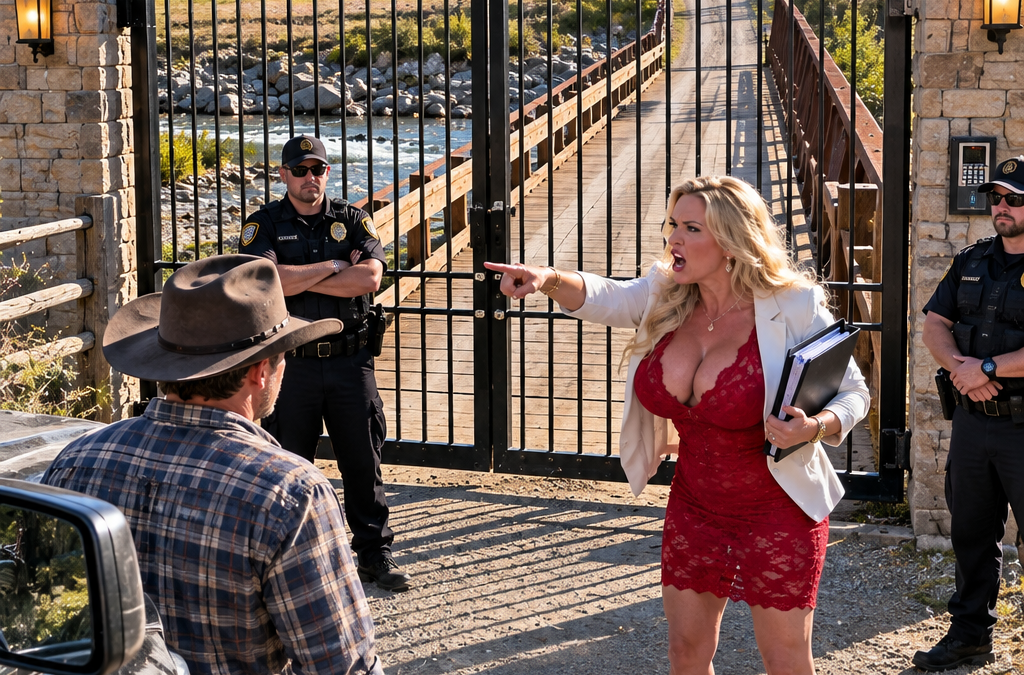
A massive black iron gate stood across the entrance.
At first, I thought I’d reached the wrong road.
The installation looked completely out of place.
Two new stone pillars stood beside the old crossing.
Decorative metalwork stretched between them.
A commercial electronic access unit sat beside the gate.
There was a keypad.
A card reader.
A security camera.
Even professionally installed lighting near the pillars.
Someone had spent serious money making my old ranch bridge look like the entrance to an exclusive gated community.
I stepped out.
For a moment, I simply stared.
The old wooden structure was still visible behind the ironwork.
I could hear the creek.
The same water.
The same banks.
The same crossing.
But I couldn’t drive across it.
I walked toward the lock.
A small indicator light glowed on the electronic unit.
The gate was secured.
I checked for a manual release accessible from my side.
Nothing intended for my use.
No key.
No code.
No notice asking for permission.
No explanation.
Just a locked barrier across a bridge my family owned.
I felt my stomach tighten.
This wasn’t an accidental placement of a temporary construction fence.
It was a permanent-looking security installation.
Planned.
Purchased.
Contracted.
Installed.
And activated.
Someone had gone through all that work without asking me.
Then Linda arrived.
Her SUV came down the newly paved neighborhood approach and stopped near the bridge.
She stepped out with the satisfied smile of someone who’d been waiting to admire her own handiwork.
“Well,” she said, “I see you’ve noticed the improvement.”
I turned.
“Who put this here?”
She smiled.
“The association.”
“Who authorized it?”
“The board.”
“Did you ask me?”
Her smile narrowed.
“Why would we?”
I stared at her.
“Because this is my bridge.”
She sighed.
“Oh, not that again.”
I felt anger rise.
“Linda, it’s not an argument. It’s ownership.”
She folded her arms.
“The HOA paid for the entrance improvements.”
“So?”
“So the HOA controls the access.”
I looked at the stone pillars.
Then at the electronic lock.
“Paying for a gate doesn’t make you the owner of the bridge behind it.”
She laughed.
“You really don’t understand property development.”
I took a slow breath.
“Then explain it.”
She smiled with exaggerated patience.
“The association invested money improving this corridor. We paved the approach. Installed security infrastructure. Established a controlled entrance. Those investments give us responsibility for managing the access point.”
I stared at her.
“Responsibility isn’t ownership.”
“Don’t split hairs.”
“That’s not splitting hairs. That’s the entire issue.”
Her face hardened.
“You are being intentionally difficult.”
I looked toward the bridge.
“I need to cross to my lower pasture.”
She lifted her chin.
“Then you’ll need proper authorization.”
I went still.
“From whom?”
“The HOA.”
I couldn’t believe it.
“You’re telling me I need the HOA’s permission to use my family bridge?”
“That’s what controlled access means.”
I stared at her.
“Linda, I own the crossing.”
She stepped closer.
“And we own the security infrastructure.”
“Then remove it.”
Her eyes widened.
“Excuse me?”
“Remove your gate from my property.”
She laughed viciously.
“Absolutely not.”
I held her gaze.
“I’m not asking you to manage it. I’m telling you it doesn’t belong here.”
She raised her voice.
“The gate stays.”
I pointed to the lock.
“Then give me access.”
“No.”
I blinked.
“What?”
“Not until the association determines that your use complies with our security policies.”
My jaw tightened.
“What security policies?”
She gestured toward my truck.
“For starters, agricultural vehicles may not meet the requirements for this entrance.”
I looked at her.
“It’s a ranch bridge.”
“Now it’s a controlled community access point.”
I felt my face grow hot.
“And you’re banning ranch equipment?”
She smiled.
“We’re protecting our investment.”
I looked beyond the gate.
The lower pasture was visible through the trees.
I needed to inspect fencing and reach equipment beyond the creek.
Linda had effectively blocked my route.
And she was treating that as something I should be grateful for.
I took a slow breath.
“Open the gate.”
She didn’t move.
“Linda.”
She looked toward the security guards who’d arrived nearby.
“Make sure he doesn’t touch the access system.”
One guard stepped closer.
“Ma’am, is there a problem?”
Linda pointed toward me.
“This gentleman is refusing to acknowledge association authority.”
I looked at the guard.
“I own the bridge.”
The man glanced toward the old crossing.
Then back at Linda.
She immediately spoke over him.
“You do not need to discuss property law with him. Your job is to enforce the access policy.”
I stared at her.
“You’ve actually hired people to keep me off my own property.”
Her smile returned.
“Security is expensive. But worth it.”
I felt something cold settle inside me.
She wasn’t confused.
She wasn’t asking questions.
She wasn’t trying to negotiate.
She was enjoying the fact that I couldn’t cross.
And she wanted me to understand that she had the power to make it happen.
I stepped back.
Not because I accepted her claim.
Because I wasn’t going to let her turn the dispute into a physical confrontation.
I looked at the guards.
“I’ll be returning with the property records.”
Linda laughed.
“Bring whatever makes you feel better.”
Then she added, “The gate will still be locked.”
I drove back to the farmhouse.
The entire way, I kept thinking about the bridge.
My father had maintained that crossing for years.
He’d worried about flood damage and worn decking.
Never once had he imagined a neighboring homeowners association would build a luxury security gate across it and deny the ranch owner access.
At home, I went straight to my office.
I opened the filing cabinet.
Pulled out the deed.
Then the recorded survey.
Then the documents describing the ranch boundaries and creek crossing.
I spread everything across my desk.
The legal descriptions were clear.
The creek ran through my property.
The bridge was entirely within the ranch parcel.
The land beneath the crossing belonged to me.
The approaches on my side belonged to me.
There was no recorded transfer giving the HOA ownership.
No document establishing that Linda could lock the crossing.
No agreement granting the association control over access.
I checked again.
Then again.
I wanted to be certain.
Because once Karen became involved, every disagreement turned into a battle over paperwork.
She loved producing official-looking documents.
But I had learned that a document could look impressive without giving the person holding it any legal authority.
A colorful community plan wasn’t a deed.
An HOA enforcement notice wasn’t an easement.
And a receipt for an expensive security gate wasn’t proof of ownership.
That night, I sat alone at the kitchen table with the ranch records spread in front of me.
I could still hear Linda’s voice.
The gate stays.
You’ll need authorization.
Make sure he doesn’t touch the lock.
The arrogance of it kept replaying in my mind.
She’d locked my bridge.
Then acted as though the problem was my refusal to submit.
I looked at the old survey.
The boundary crossed directly beneath the bridge.
The recorded line was unmistakable.
Linda’s gate stood on a private structure.
That was the fact everything depended on.
I could argue with her for months.
I could demand a key.
I could send letters.
I could attend HOA meetings where she’d interrupt me and declare the matter settled.
But none of those conversations would change the legal location of the bridge.
And none would force Karen to accept something she didn’t want to acknowledge.
The next morning, I took the old survey to the crossing.
The gate was still locked.
A security guard stood nearby.
I parked on firm ground and walked toward him.
“Morning.”
He nodded.
“Morning, sir.”
“Is Linda here?”
“She’s expected.”
I held up the survey.
“I need to show her something.”
He looked uncomfortable.
“She instructed us not to allow anyone to tamper with the gate.”
“I’m not touching the gate.”
He glanced toward the bridge.
“Understood.”
I waited.
Karen arrived about twenty minutes later.
She stepped out of her SUV wearing expensive sunglasses and carrying her usual binder.
She looked irritated before she even reached me.
“I thought I made myself clear yesterday.”
I held out the survey.
“Read this.”
She stared at it.
“What is it?”
“The recorded boundary.”
She rolled her eyes.
“Oh, for heaven’s sake.”
I unfolded the document.
“Here’s the creek.”
I pointed to the line.
“Here’s the bridge.”
Then I pointed to the parcel boundary.
“And here’s the property line running beneath it.”
She barely glanced down.
“The HOA has already reviewed this issue.”
“Then you know the crossing is on my land.”
She looked toward the guard.
“Is he interfering with the gate?”
“No, ma’am.”
I felt my anger rise.
“Linda, look at the survey.”
She sighed dramatically.
“I am not going to spend my morning examining some ancient farm drawing.”
“It’s a recorded boundary survey.”
“That doesn’t impress me.”
“It should.”
She stepped closer.
“I’ve already explained this. The HOA invested money in improving this access corridor.”
“And that doesn’t transfer ownership.”
She pointed toward the electronic lock.
“We installed the security system.”
“On my bridge.”
“We paid for the stone pillars.”
“Beside my crossing.”
“We paved the road.”
“Toward land you don’t own.”
Her face reddened.
“STOP INTERRUPTING ME!”
I went silent.
She straightened her blazer.
Then continued in a calmer, more poisonous tone.
“You ranch people seem to think that because your families owned land years ago, nobody else can ever make progress.”
I stared at her.
“My family still owns this land.”
She smiled thinly.
“Ownership isn’t the only consideration.”
“It is when you’re trying to control a private bridge.”
Her eyes narrowed.
“You’re not getting through that gate without association approval.”
I looked at the guard.
He looked away.
Then I turned back to Karen.
“Are you instructing security to physically prevent me from using the bridge?”
She lifted her chin.
“I’m instructing them to protect association property.”
I pointed toward the survey.
“You haven’t established that the association owns it.”
She laughed.
“You’re welcome to complain to your lawyer.”
I felt a rush of anger.
“Karen, I need access to my pasture.”
“Then perhaps you should have thought about that before becoming so difficult.”
I stared at her.
She smiled.
“You could have approached this politely. You could have requested access. Instead, you came here issuing demands.”
I couldn’t believe what I was hearing.
She’d locked my bridge without permission.
And now she was blaming me for refusing to ask nicely for a key.
“You’re telling me this is punishment?”
Her smile disappeared.
“Don’t put words in my mouth.”
“You just said I should have thought about access before being difficult.”
She crossed her arms.
“I’m saying cooperation has benefits.”
I looked at her.
“And refusing to cooperate gets my property locked?”
She stepped closer.
“Let me make something perfectly clear. You are not going to bully me into surrendering control of a gate the association paid for.”
For a moment, I couldn’t speak.
Then I said quietly, “You can keep your gate.”
She blinked.
“What?”
I looked beyond the iron bars.
At the old bridge.
At the creek.
At the supports my family had maintained for decades.
Then I looked back at her.
“You can keep every dollar of security equipment you installed.”
She smiled triumphantly.
“Good. Then we’re finally making progress.”
I didn’t answer.
Because I had just realized that the argument I’d been having with her was the wrong argument.
Linda thought the only question was who controlled the gate.
She wanted me to beg for a code.
She wanted the HOA to decide when I could cross.
She wanted my private ranch entrance to become something she could open or close depending on whether she approved of my behavior.
But there was a more fundamental question.
What if I no longer wanted that bridge to remain connected to the road she’d built?
What if I decided the old structure had reached the end of its usefulness under the circumstances?
What if I chose to remove my own bridge rather than spend months fighting over an electronic lock someone had installed without permission?
The thought was enormous.
And uncomfortable.
Because the bridge mattered to me.
Removing it would complicate access to the lower pasture.
It would mean losing a crossing my family had used for generations.
But keeping it now meant leaving a private structure beneath a gate Karen claimed the authority to control.
I wasn’t ready to make that choice without considering the consequences.
So I said nothing more.
Karen mistook my silence for surrender.
She turned toward the guards.
“Continue enforcing the restriction.”
Then she looked at me.
“Perhaps next time you’ll learn to respect association decisions.”
I folded the survey.
Walked to my truck.
And drove away.
Behind me, the gate remained locked.
Linda stood beside it with a satisfied smile.
She thought she’d won.
That evening, I walked along the creek on my side of the ranch.
I didn’t approach the HOA gate.
I didn’t try to bypass the security system.
I simply followed the water and studied the bridge from the land I owned.
The old structure looked almost painfully familiar.
The timber deck.
The supports.
The places where my father had reinforced worn sections.
The creek moving beneath it.
For years, I’d thought of the bridge as permanent.
Not because the materials would last forever.
But because it was part of the ranch.
A fixed point in my life.
Something I expected to maintain for as long as I owned the land.
Now the neighboring HOA had turned it into a weapon against me.
The new paved road led straight toward it.
The stone pillars framed it.
The electronic gate stood at the entrance.
The security guards were there because Karen had decided that access to the bridge was hers to control.
I could have tried to negotiate for a key.
But I already knew how Karen would use that.
Today, she’d demand proof of authorization.
Tomorrow, she’d require compliance with some invented access policy.
Next month, she’d threaten to deactivate the code because I’d offended her at a meeting.
She wasn’t interested in sharing a crossing.
She was interested in establishing obedience.
I sat on a fallen log near the creek.
For a long time, I watched the water pass beneath the bridge.
I thought about my grandfather.
About the first time my father let me drive a tractor across.
About the work that had gone into keeping the structure usable.
Then I thought about Linda smiling while ordering security to stop me.
Something became clear.
I didn’t have to let her use my attachment to the bridge against me.
The land was mine.
The bridge was mine.
And the decision about whether that privately owned structure remained in place was not something the HOA could make simply because it had installed an expensive gate.
If I was going to remove it, though, I needed to do it properly.
The crossing stood over running water.
Its supports and materials had to be handled safely.
The work couldn’t damage neighboring property or leave the creek obstructed.
And I had no intention of creating an environmental or safety problem just to prove a point.
I considered the necessary equipment, the condition of the old structure, and the arrangements required for a controlled removal.
I reviewed the ownership records and made sure the work would remain within the applicable permissions and requirements.
Then I made my decision.
I would take my bridge apart.
Not Linda’s electronic lock.
Not the HOA’s stone pillars.
Not its expensive security equipment.
My bridge.
The structure beneath the gate.
The very thing Karen had assumed would remain there forever, giving her new road somewhere to go.
I understood the sacrifice.
The lower pasture would no longer have its familiar crossing.
I’d have to address future access separately, on terms that respected the property and the creek.
But that was my problem to solve as the landowner.
I wasn’t going to preserve a bridge indefinitely so an HOA president could use it to control me.
Late that night, I looked at the old survey one last time.
The line beneath the bridge was as clear as ever.
The structure belonged to my ranch.
The next morning, that fact would matter in a way Linda had never imagined.
Before sunrise, I brought heavy equipment toward the crossing.
The sky was still dark.
A thin mist hung above the creek.
The ranch road was quiet.
There were no HOA residents standing nearby.
No board members.
No spectators.
Just the equipment, the old bridge, and the steady sound of water moving between the banks.
The excavator rolled slowly toward the work area.
Its tracks pressed into the ground as it approached the crossing.
I stopped where I could see the bridge and the new black iron gate beyond it.
The stone pillars looked almost theatrical in the early light.
Decorative.
Expensive.
Completely out of character with the old ranch.
I thought about Karen’s words.
The gate stays.
She could keep the gate.
That was the point.
I wasn’t there to argue with her security system.
I wasn’t there to break her lock.
I was there to remove my own bridge.
The work began carefully.
The old structure had to be separated in a controlled sequence, with the materials lifted clear rather than allowed to fall into the creek.
The water below continued moving between the banks.
The equipment worked within the prepared area.
As the first section was removed, I felt something tighten in my chest.
A familiar part of the ranch was disappearing.
I remembered my father standing on that decking.
Remembered him leaning against the railing while he explained where water tended to undermine the bank.
Remembered the sound of tractor tires crossing the old boards.
For a moment, I almost stopped.
Not because I doubted the property rights.
Because removing something connected to your family’s history isn’t easy.
Even when somebody else has made keeping it unbearable.
I stepped closer to the safe observation area.
The excavator lifted another section.
The old bridge began separating from its supports.
The creek remained below, flowing through the crossing.
The black gate stood ahead, unchanged.
Its electronic lock was still installed.
Its decorative ironwork still looked imposing.
But the structure it had been intended to control was coming apart.
I watched the work continue.
Piece by piece.
Carefully.
Deliberately.
The first substantial section of the deck was removed.
Then another.
The old crossing began losing its familiar shape.
The beams that had carried ranch traffic for decades were lifted away.
Materials were placed where they could be handled and removed properly.
Nothing was being thrown carelessly into the creek.
No one was trying to collapse the entire structure in one reckless motion.
The work was controlled.
But the result was dramatic.
The bridge was disappearing.
By the time the eastern sky began turning pale, the opening across the creek was obvious.
Where a continuous deck had once connected the banks, there was now empty space.
The water flowed beneath.
The gap widened as the remaining portions of the crossing were removed.
I stood quietly.
The sound of the machinery filled the valley.
I felt anger.
Sadness.
Relief.
And something that surprised me.
A sense of control.
Karen had spent money to make me feel powerless.
She’d installed a gate.
Ordered security to stop me.
Told me I needed association approval to use my own bridge.
She’d assumed I would spend the next several months begging for access to something my family owned.
Instead, I had made a decision about my property without asking her permission.
As the final structural portions were removed, the creek crossing ceased to exist as a bridge.
The water ran freely through the old gap.
The newly installed gate still stood between its expensive stone pillars.
But it no longer guarded a usable crossing.
It faced empty air and the creek below.
I looked at it for a long time.
The sight was almost absurd.
A beautiful electronic security gate.
An expensive access system.
Two impressive stone pillars.
And absolutely no bridge for vehicles to cross.
By morning, the old structure had been completely removed.
The equipment finished the planned work around the crossing and the remaining materials were cleared from the immediate area.
I stood on my side of the creek as the sun rose over the trees.
The ranch was quiet except for the machinery winding down and the sound of water.
The bridge my family had used for decades was gone.
I wasn’t celebrating.
Not yet.
I knew the cost of that decision.
But I also knew I’d rather deal with the inconvenience of a missing private bridge than accept the idea that Linda’s HOA could seize control of it by attaching an electronic lock.
I looked toward the subdivision approach.
The new paved road led directly to the decorative gate.
The gate led nowhere.
And Linda hadn’t arrived yet.
She showed up shortly after sunrise.
I heard her SUV before I saw it.
The vehicle came quickly down the paved approach.
Then slowed.
Then stopped.
For several seconds, nothing happened.
Linda remained behind the wheel.
Through the windshield, I could see her staring.
First at the gate.
Then at the empty space.
Then at the creek.
Her expression changed so suddenly that I almost didn’t recognize her.
The confident smile disappeared.
Her mouth fell open.
She leaned forward, apparently trying to make sense of what she was seeing.
Then the door flew open.
“WHAT THE HELL?”
Her scream echoed across the water.
She stepped out, stared at the gap, and hurried toward the safety barrier.
“WHERE IS THE BRIDGE?”
I stood on my side of the creek.
“Morning, Linda.”
She turned toward me.
Her face was already bright red.
“WHAT HAVE YOU DONE?”
I looked toward the empty crossing.
“I removed my bridge.”
She stared.
Then laughed sharply.
“No.”
I didn’t answer.
She looked at the creek again.
Then at the gate.
Then back at me.
“YOU CAN’T DO THAT!”
I took a slow breath.
“I owned the structure.”
She pointed toward the gap.
“THAT WAS OUR ACCESS!”
“No. It was my private bridge.”
Her expression twisted.
She stepped closer to the barrier.
“You destroyed an HOA entrance!”
I looked at the black iron gate.
“Your gate is still there.”
“THE BRIDGE IS GONE!”
“Yes.”
“HOW IS ANYONE SUPPOSED TO CROSS?”
I stared at her.
“That’s a question you probably should have considered before claiming ownership of a bridge you didn’t buy.”
For a moment, she looked stunned.
Then she exploded.
“You vindictive son of a bitch!”
I didn’t respond.
She pointed toward the excavator.
“You did this deliberately!”
“Of course I did.”
Her eyes widened.
I continued.
“I made a decision about a structure on my property.”
She leaned forward.
“You wanted to humiliate me!”
I looked at her.
“Linda, I asked you to remove your gate.”
She shook her head violently.
“You could have asked for a security code!”
I almost laughed.
“Yesterday, you refused to give me access.”
“Because you were being unreasonable!”
“To my own bridge.”
She threw up her hands.
“YOU’RE MISSING THE POINT!”
I looked at the stone pillars.
“No, Linda. I think the point is finally obvious.”
She stared at the gap.
I continued.
“You built a road toward land you didn’t own. Installed a gate on a private crossing. Ordered guards to keep the owner out. Then told me the HOA controlled access because it paid for improvements.”
She opened her mouth.
I didn’t let her interrupt.
“But paying for a gate didn’t give you ownership of the bridge beneath it.”
She went silent.
Only briefly.
Then she pulled out her phone.
“I’m calling our attorney.”
I nodded.
“That’s probably a good idea.”
She looked furious.
“You think this is funny?”
“No.”
“You’ve destroyed community infrastructure!”
“I removed private property.”
“The bridge was essential to our access plan!”
I looked at her.
“Then your access plan depended on something your HOA didn’t own.”
Her eyes narrowed.
She started making the call.
I watched her pace beside the expensive pillars.
Every few seconds, she glanced toward the creek as though the bridge might somehow reappear.
Her voice rose.
Then rose again.
I heard phrases like emergency, destruction of property, HOA asset, and immediate legal action.
She told the person on the phone that I had sabotaged the community’s entrance.
She demanded an attorney come immediately.
Then she looked at me and smiled with sudden hostility.
“You’re finished.”
I didn’t move.
“The association will sue you for every dollar of damage.”
I nodded toward the empty crossing.
“Make sure the attorney brings a deed.”
Her smile disappeared.
She turned away, furious.
The HOA lawyer arrived less than an hour later.
He drove to the entrance in a dark sedan and stepped out carrying a thick folder.
He looked professional.
Tired.
And visibly confused by the sight in front of him.
His eyes moved from the black iron gate to the empty gap where the bridge had been.
Then down toward the creek.
He stopped walking.
For a moment, he said nothing.
Linda rushed toward him.
“Finally!”
He looked at her.
“Mrs. Whitfield.”
She pointed toward me.
“HE DESTROYED OUR BRIDGE!”
The lawyer glanced at the crossing.
Then toward the equipment on my side.
“Let’s establish exactly what happened.”
Linda threw up her hands.
“What happened is obvious!”
He remained calm.
“Who owned the bridge?”
Her expression changed.
“What?”
“The structure that was removed. Who owned it?”
She lifted her chin.
“The HOA invested heavily in the entire entrance.”
He paused.
“That’s not what I asked.”
I almost smiled.
I’d been asking Linda the same question for days.
Now her own attorney was asking it.
And she still couldn’t answer.
She folded her arms.
“The association controls the access corridor.”
The lawyer looked toward me.
“Do you have the property records?”
“Yes.”
I held up the folder I’d brought from the farmhouse.
He walked toward the safe area where we could review the documents.
Linda followed.
She looked irritated.
“Why are you listening to him?”
The attorney remained composed.
“Because ownership is central to the dispute.”
She scoffed.
“The HOA paid for the road.”
He glanced toward her.
“Road improvements and bridge ownership may be separate matters.”
I placed the deed on the table we’d set up beside the work area.
Then the survey.
Then the parcel map.
The lawyer began reading.
He looked at the property description.
Then at the boundary line.
Then toward the creek.
I pointed to the relevant section.
“This is the ranch parcel.”
He nodded.
“All right.”
“This is the crossing.”
He studied the map.
“And the recorded boundary passes directly beneath it.”
He examined the survey more closely.
Then asked whether there were recorded easements granting the HOA ownership or access rights over the bridge.
I shook my head.
“Not in the records.”
Linda interrupted.
“The association paved the road to the entrance.”
The lawyer continued examining the documents.
She tried again.
“We installed the security gate.”
He nodded without looking up.
“Understood.”
“And the stone pillars.”
He turned another page.
I watched her face grow irritated.
Finally, she snapped.
“Are you going to do something?”
The attorney looked up.
“I’m reviewing the title information.”
She pointed toward the missing bridge.
“HE DESTROYED OUR PROPERTY!”
I took a slow breath.
“Then please show us the recorded document proving the HOA owned the bridge.”
The lawyer looked toward Linda.
“Do we have a deed or recorded agreement establishing that ownership?”
Her mouth opened.
Then closed.
She glanced at her binder.
“The development plans show an access route.”
He held out one hand.
“May I see them?”
She reluctantly handed him the HOA map.
He compared it with my survey.
For several seconds, nobody spoke.
The lawyer studied the documents.
Then looked toward the old crossing.
Then back at the papers.
His expression changed.
“This is not the same thing.”
Linda blinked.
“What?”
“The development plan depicts the proposed access arrangement. But the recorded survey places the bridge on the ranch parcel.”
She shook her head.
“No.”
He continued.
“I don’t see a conveyance transferring the bridge to the HOA.”
Linda’s face reddened.
“The HOA controls the entrance!”
The lawyer looked at her.
“Mrs. Whitfield, control of an electronic gate does not establish ownership of the structure it was placed upon.”
I stood quietly.
The words settled into the morning air.
Linda stared at him.
Then she looked toward me.
Then back at her attorney.
“But we paid for the improvements.”
He nodded.
“That may be relevant to the association’s investment in its own infrastructure.”
She smiled triumphantly.
“Exactly.”
He continued.
“It doesn’t, by itself, transfer title to the privately owned bridge.”
Her smile vanished.
I felt something loosen in my chest.
For days, Linda had treated the installation costs as proof that the HOA controlled the crossing.
Now her own attorney was explaining the distinction.
She couldn’t simply build something expensive around another person’s property and declare ownership of everything connected to it.
The lawyer turned another page.
Then asked, “Was permission obtained from the ranch owner before the gate was installed?”
Linda hesitated.
“The board authorized it.”
“Did the owner consent?”
She looked offended.
“We didn’t believe his consent was necessary.”
The attorney became quiet.
He glanced at the survey again.
Then back at Linda.
“That is a problem.”
For the first time, she looked genuinely frightened.
Not embarrassed.
Not merely angry.
Frightened.
She stared at him.
“What do you mean?”
He held up the documents.
“The association appears to have installed a gate on a privately owned crossing without establishing the necessary ownership or access rights.”
She shook her head.
“No. The community needed that entrance.”
“That doesn’t resolve the ownership issue.”
She looked toward the creek.
“But the bridge is gone.”
“Yes.”
“And that means we have no access.”
The attorney paused.
“Your access claim still needs a legal foundation.”
I watched Linda struggle to understand.
She had spent serious money making the entrance look permanent.
The paving.
The pillars.
The security system.
The iron gate.
She’d assumed that once everything was installed, I’d have no practical choice but to accept HOA control.
But she’d never secured the one thing the entire project depended on.
A lawful right to use the bridge.
Now that bridge was gone.
And her attorney was telling her that the HOA’s expensive gate didn’t give it control over the private structure that had once stood behind it.
Linda pointed toward the creek.
“Then make him rebuild it!”
The attorney looked at her.
“On what legal basis?”
She stared.
“He destroyed our access!”
He responded carefully.
“Ownership and access are separate legal questions.”
Her face reddened.
“I don’t care about technicalities!”
He looked at her.
“They aren’t technicalities.”
Silence.
He continued.
“The ranch owner appears to have held title to the bridge. The association’s installation of a gate does not establish a right to compel him to maintain that structure for the HOA’s use.”
I stood quietly.
The attorney wasn’t declaring that every aspect of bridge removal was automatically beyond legal scrutiny.
There were still applicable obligations concerning the creek, the work, and the removal process.
But the critical ownership issue was finally being acknowledged.
Karen didn’t own the bridge.
The HOA hadn’t proved it had a right to control the crossing.
And the existence of its expensive gate didn’t change either fact.
Linda looked toward me.
“You planned this.”
I held her gaze.
“I told you the bridge was mine.”
She shook her head.
“You knew removing it would make our gate useless.”
“Yes.”
Her eyes widened.
I continued.
“And you knew locking it would prevent me from reaching my pasture.”
For a moment, neither of us spoke.
Then I said, “The difference is that I owned the bridge.”
Linda looked at the attorney.
“Are you seriously going to let him get away with this?”
He took a breath.
“We need to address the association’s installation and the property boundary.”
She stared at him.
“What does that mean?”
“It means the gate and stone structures need to be evaluated in light of the recorded ownership and any valid access rights.”
I pointed toward the pillars.
“The HOA installed those on my property without permission.”
The attorney looked toward the survey.
Then at the physical location.
He nodded slowly.
“That’s part of the issue we need to resolve.”
Linda’s expression became almost desperate.
“No. We are not removing the gate.”
I looked at her.
“Linda, there’s no bridge behind it.”
She spun toward me.
“STOP TALKING!”
I didn’t raise my voice.
“Then stop pretending you own the crossing.”
She glared at me.
I continued.
“You told me the gate would stay locked no matter what the deed said. You ordered security to stop me from removing it.”
She folded her arms.
“Because it’s HOA property.”
“The gate may be yours. The land beneath it isn’t.”
Her lips tightened.
I looked toward the attorney.
“I want the HOA’s gate and stone obstruction removed from my ranch.”
He nodded.
“That request needs to be addressed.”
Linda stared at him.
Then at the documents.
For the first time since I’d met her, she seemed to realize that her usual tactics weren’t working.
She couldn’t issue a fine large enough to make the bridge return.
She couldn’t order the creek to become a road.
She couldn’t threaten the survey into changing.
And she couldn’t make her own attorney pretend an HOA development map was the same as a recorded deed.
The lawyer requested a brief private discussion with Linda.
They walked toward her SUV.
I stayed near the work area.
From a distance, I could see her waving her arms.
Pointing toward the gate.
Pointing toward me.
Pointing toward the creek.
The attorney remained mostly still.
Occasionally, he opened the folder and showed her another page.
She shook her head repeatedly.
At one point, she turned away in frustration.
Then came back.
The conversation continued.
I didn’t need to hear the words.
Her body language said enough.
She was being told something she didn’t want to accept.
The HOA had spent money on a security entrance without securing control of the crossing.
The ranch owner had documented ownership of the bridge.
And the association now had an expensive iron gate guarding nothing.
Eventually, they returned.
Linda’s face was flushed.
Her attorney spoke first.
“The association will need to arrange removal of the gate and the related stone obstruction from the private property.”
For a moment, I didn’t respond.
Then I nodded.
“That’s what I’ve been asking.”
Linda stared at the ground.
The attorney continued.
“We’ll coordinate the work so the site is cleared properly and the property boundary is respected.”
I looked at him.
“And the HOA will stop claiming control over this crossing?”
He nodded.
“The association’s records and access arrangements need to reflect the recorded property rights.”
Karen looked up sharply.
“We are not giving up our right to improve the community.”
Her attorney turned toward her.
“Community improvements have to remain within the rights the association actually possesses.”
She stared at him.
Then looked toward the gate.
I could see the anger in her face.
But for once, she didn’t have another order that would change the situation.
The gate was still standing.
The lock still worked.
The stone pillars still looked expensive.
But they were now a useless obstruction at the edge of a creek where the HOA had no proven right to demand a bridge.
Linda had come to my ranch believing she could control my crossing by controlling its entrance.
Now she was being told that her association had to remove the entrance equipment and clear the property.
I felt a strange mix of relief and sadness.
Relief because the ownership question was finally being respected.
Sadness because the bridge my family had used for decades was gone.
That mattered.
I wasn’t going to pretend otherwise.
The missing bridge meant real inconvenience for the ranch.
I’d have to make decisions about future access to the lower pasture.
Those decisions would take planning, money, and work.
But they would be mine to make within the proper legal and safety requirements.
I wouldn’t be negotiating with Linda every morning over whether I was allowed to cross my own creek.
And I wouldn’t be preserving a family structure solely so the HOA could claim the right to lock it.
The attorney gathered the documents.
Linda remained beside the gate.
She looked at the black ironwork for a long time.
Then she turned toward me.
“I hope you’re happy.”
I studied her.
“No.”
That seemed to surprise her.
I continued.
“I’m not happy that my family’s bridge is gone.”
Her eyes narrowed.
“Then why did you do it?”
I looked toward the creek.
“Because you made the bridge into something it was never supposed to be.”
She folded her arms.
“You could have cooperated.”
I shook my head.
“I asked you to remove the gate.”
“You could have applied for access.”
“To my property?”
She looked away.
I continued.
“Linda, you wanted the HOA to decide when I could use my own bridge. You installed a lock and ordered security to keep me out.”
She said nothing.
“Then you refused to even look at the recorded survey.”
Her jaw tightened.
I glanced at the empty crossing.
“I didn’t want to spend the rest of my life begging your association for permission to reach my pasture.”
She looked at me.
Her expression was still hard.
Still resentful.
But the smug confidence was gone.
I said one final thing.
“You built a gate without checking what you actually owned.”
For several seconds, she remained silent.
Then she turned and walked toward her SUV.
No final speech.
No triumphant threat.
No demand that I apologize.
Just the sound of her heels against the pavement.
She climbed inside.
Started the engine.
And drove away.
I watched her disappear around the curve.
Then I looked back toward the creek.
The HOA attorney was still reviewing the survey near the work area.
He approached me before leaving.
“We’ll coordinate removal of the association’s structures.”
I nodded.
“Thank you.”
He glanced toward the empty crossing.
“I wish this had been addressed before installation.”
I looked at him.
“So do I.”
He closed his folder.
Then left.
The work to remove the HOA’s gate and stone obstruction was arranged.
The association had to clear the equipment it had installed on private property and address the boundary properly.
The expensive iron gate no longer had any useful purpose at that location.
Its security system had been designed to control access over a bridge the HOA didn’t own.
Without the bridge, the gate guarded an empty crossing.
The stone pillars looked absurd standing beside the creek.
The association arranged for its equipment and obstructions to be removed.
The work was handled carefully so the surrounding property wasn’t unnecessarily damaged.
By the next morning, the last of the association’s entrance installation was being cleared from the ranch boundary.
The black iron gate was gone from the crossing.
The electronic security equipment had been removed.
The decorative stone obstruction was no longer occupying the entrance.
The creek ran freely between its banks.
And the place where my family’s bridge had once stood was finally free of the HOA’s unauthorized security system.
I walked to the crossing just after sunrise.
The air was cool.
A thin mist hovered above the water.
The trees along the creek were still.
For a long time, I simply stood there.
The old bridge was gone.
So was Linda’s gate.
I could see the opposite bank.
The lower pasture beyond it.
The trees and fields my family had maintained for generations.
The gap between the banks felt larger than I remembered.
I thought about my grandfather.
He’d built that bridge because the ranch needed it.
My father had kept it useful because the crossing mattered.
I’d maintained it for the same reason.
And now I’d chosen to remove it because a neighboring association had tried to turn it into a checkpoint.
There was no pretending that the decision had been painless.
It hadn’t.
I’d lost a piece of the ranch’s history.
And I’d created a practical problem that would need to be addressed before the lower pasture could be used as conveniently as before.
But I’d also stopped something that could have become permanent.
Linda had wanted a foothold on my property.
First a paved road.
Then stone pillars.
Then an electronic gate.
Then guards.
Then rules about who could cross.
If I’d accepted that arrangement, the HOA would have continued treating my bridge as part of its private infrastructure.
And every future disagreement could have become another excuse to restrict my access.
I wasn’t willing to let that happen.
I looked down at the survey folded in my hand.
The recorded boundary hadn’t changed.
The land still belonged to the ranch.
The creek still ran through my property.
And the bridge had never belonged to the HOA.
The only thing that had changed was the existence of the structure itself.
Linda had believed installing an expensive lock would give her control over something she didn’t own.
She’d mistaken the ability to block a crossing for the legal right to possess it.
When I asked her to remove the gate, she’d laughed.
When I showed her the survey, she’d refused to read it.
When I demanded access, she’d ordered security to stop me.
She’d spent money creating a problem that would have cost nothing to avoid.
All she needed to do was check the deed.
Ask permission.
Respect the boundary.
Instead, she’d built an elaborate entrance around a private bridge and acted as though the ranch owner no longer mattered.
The result was an expensive gate without a crossing.
A paved road that stopped at the creek.
And an HOA attorney forced to explain that ownership and access weren’t the same thing.
I thought about the expression on Linda’s face when she first saw the empty gap.
She’d arrived ready to issue more orders.
Then she’d looked through the iron bars and discovered that the bridge she intended to control was gone.
For the first time, her title hadn’t helped her.
Her security guards couldn’t restore it.
Her association map couldn’t restore it.
Her expensive lock couldn’t restore it.
And even her lawyer couldn’t turn the crossing into HOA property simply because the association had spent money around it.
The bridge had been mine.
The decision to remove it had been mine.
And the future of that section of the ranch would be decided through my property rights and the applicable requirements, not Karen’s personal wishes.
I stood beside the creek until the sun rose higher.
Then I turned toward the farmhouse.
There was plenty of work waiting.
There always was.
Ranching doesn’t stop because an HOA president has a spectacular public embarrassment.
The fences still needed maintenance.
The equipment still needed attention.
The lower pasture would need a new long-term access plan.
And the creek crossing would have to be managed responsibly.
But those were real ranch problems.
Problems I understood.
Problems I could solve without handing control of my property to someone who’d never owned it.
As I walked back along the road, I looked once more toward the place where the stone pillars had stood.
The HOA’s expensive entrance was gone.
Its gate was gone.
Its electronic lock was gone.
The crossing was no longer being treated as a community checkpoint.
And the recorded boundary was finally respected.
Linda had arrived believing she could claim a private bridge simply by installing a gate across it.
She’d ordered me to stay away.
Told security to stop me.
And insisted the HOA’s investment gave her control.
But she never considered that the bridge beneath her expensive security system belonged to someone who could make his own decisions about it.
In the end, she got exactly what she’d insisted on keeping.
Control of her gate.
Only there was no bridge left for that gate to control.
I reached the farmhouse and looked toward the distant creek.
The ranch was quiet again.
Not exactly as it had been before.
Some things had changed permanently.
But the land was still mine.
And nobody was standing at the crossing pretending a homeowners association owned it.
Linda had spent money trying to lock me out of my own property.
I had lost an old bridge proving she couldn’t claim it.
Neither outcome was cheap.
But only one of us had the legal right to decide what belonged on that crossing.
And by the time the HOA finally read the property records, there was no bridge left for them to argue over.
They had built a gate to control my bridge. They never imagined I’d decide I didn’t need their gate—or that bridge—at all.








