𝗙𝗨𝗟𝗟 𝗦𝗧𝗢𝗥𝗬 HOA Karen Led Five Luxury SUVs Onto My Private Pasture and Ordered Them to Keep Driving—Even After I Warned Her What Was Ahead
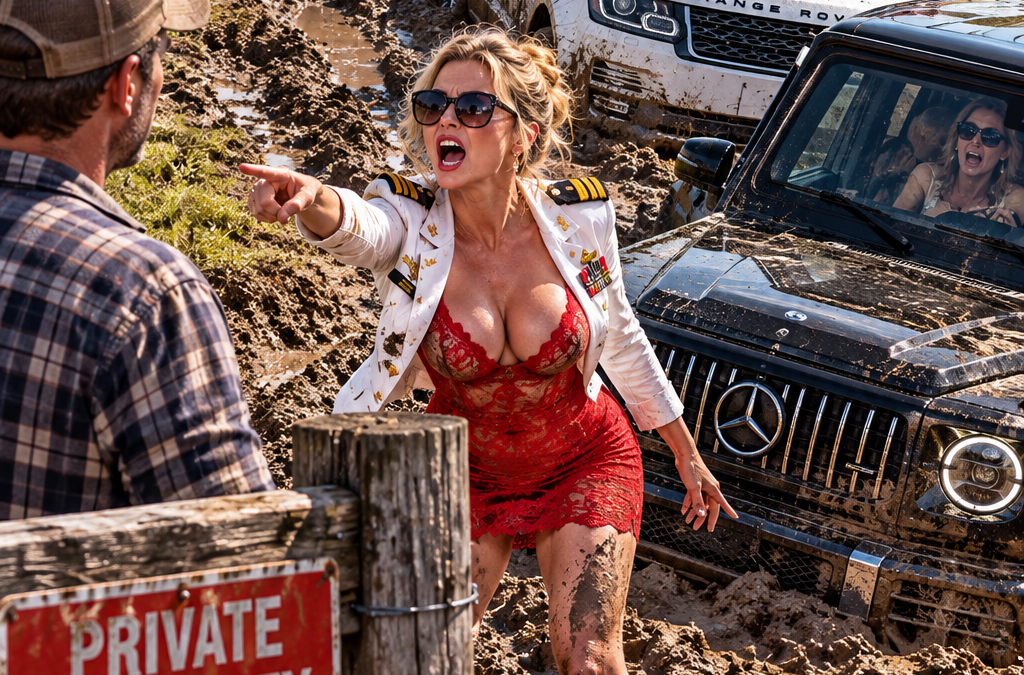
𝗙𝗨𝗟𝗟 𝗦𝗧𝗢𝗥𝗬
That distinction mattered.
The subdivision ended at the recorded property boundary.
My land began on the other side.
I didn’t pay HOA assessments.
I didn’t vote in its elections.
And I certainly hadn’t agreed to place my family’s pasture under the control of its president.
For a while, nobody seemed confused about that.
Residents walked past the fence.
Some admired the open grass.
A few asked whether I kept livestock there.
Children sometimes stopped to look at the field through the rails.
Everything was peaceful.
Then Linda became HOA president.
She was the kind of woman who seemed to mistake attention for respect.
Forty years old, blonde, strikingly attractive, and always impeccably dressed, Linda knew how to make an entrance.
She favored fitted red lace dresses with low necklines, emphasizing her curvy figure and very full bust. Her expensive jewelry glittered in the sun, and she often wore high heels even when walking on gravel or uneven ground.
She could be charming.
Especially when she wanted someone to agree with her.
But the moment anyone questioned her, the charm disappeared.
Her voice became sharp.
Her expression turned cold.
And she behaved as though disagreement was a personal act of rebellion.
I’d encountered her several times near the property boundary.
At first, she merely complained that my pasture didn’t match the carefully landscaped appearance of the subdivision.
“It’s very plain,” she told me once.
I looked across the grass.
“It’s a pasture.”
She smiled condescendingly.
“Well, that may be acceptable to farmers, but we’re trying to create a premium residential environment.”
I stared at her.
“My land isn’t part of your development.”
Her smile tightened.
“Everything visible from the neighborhood affects property values.”
“That doesn’t make it HOA property.”
She gave a little laugh.
“You really don’t understand how community planning works.”
I let the conversation end there.
I wasn’t interested in arguing about a field my family had maintained longer than she’d lived in the area.
But Linda didn’t seem capable of accepting that some things were outside her control.
She occasionally arrived near the fence with other residents.
She pointed out the shape of the pasture.
Discussed landscaping.
Made comments about how much more attractive the area could become if someone developed it.
Once, she suggested the HOA might eventually need access for neighborhood activities.
I told her any proposed use of my property would require my permission.
She gave me a strange look.
“You’re making this unnecessarily complicated.”
“No. I’m explaining that it’s private land.”
She smiled.
“Private property doesn’t mean you get to ignore the needs of the community.”
I remember that sentence clearly.
At the time, it sounded like the usual nonsense from someone who enjoyed having a title.
I didn’t realize how far she was willing to take that belief.
The day everything happened had been preceded by several days of heavy rain.
Not a violent storm.
Just steady rainfall that soaked into the ground and lingered.
The upper pasture had begun drying.
But the lower portion was still saturated.
I’d checked it that morning.
The surface looked green and relatively normal.
But when I pressed my boot into the softest area, water rose around the sole.
I knew immediately that heavy vehicles needed to stay away.
I had no reason to think anyone would attempt to drive through it.
The property was fenced.
The entrance was marked.
And I hadn’t authorized any visitors.
By early afternoon, the rain had stopped.
Clouds were beginning to break.
I was near the equipment shed checking a gate latch when I heard the first engine.
Then another.
And another.
I looked toward the pasture entrance.
A black luxury SUV was approaching.
Behind it came a white Range Rover.
Then a silver Mercedes.
Then a dark Porsche SUV.
Then a large BMW.
Five expensive vehicles.
Moving together.
At first, I assumed they were headed toward the subdivision.
Then the lead vehicle turned off the road.
Toward my pasture.
I straightened.
“What the hell?”
The black SUV slowed near the entrance.
I could see the driver through the windshield.
Blonde hair.
Oversized sunglasses.
Red lace dress.
Linda Carter.
Of course.
She was smiling.
The kind of smile people wear when they’re about to do something they’ve already decided they’re entitled to do.
The other vehicles followed her.
I started walking toward them.
“Hey!”
Linda didn’t stop.
She guided her SUV through the farm access and onto the grass.
The other vehicles followed.
One after another.
Their tires pressed deep marks into the damp turf.
I waved both arms.
“STOP!”
Linda finally braked.
Her window lowered.
“Well, hello!”
She sounded delighted.
I walked toward the driver’s side.
“What are you doing?”
She smiled brightly.
“Taking a little drive.”
“On my pasture?”
“Don’t be dramatic.”
I looked behind her.
Four vehicles were already entering the field.
Their heavy tires were leaving visible tracks.
“Linda, turn around.”
She removed her sunglasses.
“Excuse me?”
“This is private property.”
She sighed.
“Oh, here we go.”
I stared at her.
“What do you mean, here we go?”
“Every time the HOA tries to do something positive, you act as though we’re committing some terrible offense.”
I looked toward the other vehicles.
One driver had rolled down his window.
Another was laughing.
“You’re not supposed to be in here,” I said.
Linda leaned her elbow on the window.
“I’m president of the homeowners association.”
“And?”
She blinked.
“And this entire area contributes to our community.”
“That doesn’t give you permission to drive across my land.”
She smiled coldly.
“You’re being unnecessarily territorial.”
I couldn’t believe her.
“It’s literally my territory.”
One of her friends laughed.
Linda glanced back at him, apparently pleased.
Then she turned toward me.
“Look, we’re not going to stand here arguing. We’re simply enjoying the countryside.”
“Then enjoy it from the public road.”
Her expression hardened.
“Don’t tell me where I can drive.”
I pointed toward the sign.
“PRIVATE PROPERTY. NO UNAUTHORIZED VEHICLES.”
The words were large enough to read from the entrance.
Linda glanced at the sign.
Then shrugged.
“Those signs are meant to discourage strangers.”
I stared at her.
“You’re not authorized.”
Her smile disappeared.
“Do you understand how insulting that sounds?”
“What?”
“Calling the president of the neighboring HOA unauthorized.”
I took a breath.
“Linda, your HOA has nothing to do with this pasture.”
She leaned forward.
“I am responsible for the entire neighborhood.”
“Not my land.”
She gave me a sharp, humorless laugh.
“You can keep repeating that if it makes you feel important.”
I felt my face grow hot.
“Turn the vehicles around.”
Linda looked at me for several seconds.
Then she smiled.
Not warmly.
Not pleasantly.
It was the smile of someone who’d just decided she enjoyed making another person angry.
She turned toward the convoy.
“EVERYBODY KEEP GOING!”
My stomach dropped.
“Linda!”
She waved at her friends.
“Come on! He’s just trying to intimidate us!”
The SUV began moving.
I stepped aside rather than stand in front of a moving vehicle.
The other drivers followed.
Five luxury vehicles rolled farther into my pasture.
And Linda was laughing.
I stood there stunned.
I’d warned her.
I’d pointed to the sign.
I’d told her the land was private.
I’d explicitly instructed the group to leave.
She hadn’t misunderstood.
She’d looked me in the eye and decided my ownership didn’t matter.
Then she’d ordered her friends to continue.
I started after them.
The first thing I noticed was the damage.
The tires were cutting deep tracks through the softened grass.
Five heavy SUVs driving in a line produced a wide trail of compressed turf and exposed mud.
They weren’t following a maintained farm track anymore.
Linda had steered directly across the open pasture.
I could see the tire marks growing deeper as they moved downhill.
I shouted again.
“STOP DRIVING!”
She didn’t.
The convoy continued toward the lower section.
Toward the wettest ground.
My chest tightened.
I knew exactly what was ahead.
The lower pasture held water for days after heavy rain.
The soil there was soft even in reasonably dry weather.
After the rainfall we’d just had, it was completely unsuitable for a line of heavy luxury vehicles.
I began jogging along the firmer side of the field.
“LINDA! TURN AROUND!”
She glanced toward me through her open window.
Then looked forward again.
Her friends were still following.
One of them leaned out and shouted something I couldn’t hear over the engines.
Another laughed.
I felt a terrible certainty settle over me.
They thought this was funny.
They thought they were proving that I couldn’t stop them.
And they had no idea what they were driving into.
I stopped near a slight rise and shouted one final warning.
“THE GROUND IS WET DOWN THERE!”
Linda raised a hand without looking back.
It might have been a wave.
It might have been a dismissive gesture.
Either way, she kept going.
The lead SUV reached the lowest section.
I watched its front tires roll across the grass.
For a moment, nothing happened.
Then the vehicle slowed.
The front end dipped.
The engine revved.
And the SUV sank.
It happened so quickly that the driver barely had time to react.
One second, Linda’s expensive vehicle was moving forward.
The next, the front tires were disappearing into saturated soil.
The suspension compressed.
The wheels spun.
Mud sprayed backward.
Then the vehicle stopped.
Completely.
I heard Linda scream.
“WHAT IS THIS?”
She pressed the accelerator again.
The engine roared.
The tires spun faster.
The SUV rocked slightly.
Then settled deeper.
I started down the slope.
“STOP SPINNING THE TIRES!”
Linda ignored me.
“COME ON!”
The SUV didn’t move.
Behind her, the white Range Rover tried to steer around.
Its driver apparently believed the grass beside Linda’s vehicle would be firmer.
It wasn’t.
The front tires crossed into the same soft area.
The vehicle lurched.
The driver accelerated.
Then the Range Rover sank beside the first SUV.
I stopped walking.
“Oh, you’ve got to be kidding me.”
Two vehicles.
Both trapped.
Both getting deeper every time someone touched the accelerator.
Linda threw open her door.
She stepped out.
Her expensive heel sank into the mud.
She gasped.
Then pulled her foot free, leaving a dark smear across the red lace dress.
“THIS IS UNBELIEVABLE!”
I stared at her.
“Stop trying to drive.”
She looked toward me.
“WHAT DID YOU DO TO THE GROUND?”
I almost laughed.
“It’s wet!”
She pointed at the pasture.
“THIS IS SABOTAGE!”
Behind her, the silver Mercedes attempted to stop.
But its tires were already on softened ground.
The driver braked.
The vehicle slid slightly sideways.
Then lost traction.
The engine revved.
Mud sprayed.
And the third SUV became stuck.
Three vehicles.
Within minutes.
The remaining two drivers finally understood the danger.
They stopped moving forward.
But they were already far from the entrance, surrounded by heavily damaged grass and softening tire tracks.
One vehicle sat awkwardly near a muddy rut.
The other had stopped on ground that looked firm but was beginning to deform beneath its weight.
Nobody was laughing anymore.
The entire group had gone silent except for the idling engines and Linda’s shouting.
I stood on the rise looking across the pasture.
Five luxury vehicles were scattered over the field.
Three were visibly trapped.
Two were afraid to move.
And Linda Carter was standing in the mud, screaming at her friends as though they had somehow betrayed her.
“WHY DID YOU FOLLOW ME?”
One of the drivers leaned out of his window.
“Because you told us to!”
“YOU SHOULD HAVE BEEN WATCHING WHERE YOU WERE GOING!”
I stared at her.
Unbelievable.
She’d personally led the convoy onto my land.
She’d ordered everyone to ignore my warning.
And now she was blaming the people who’d followed her.
One woman climbed carefully out of the Range Rover.
Her shoes sank into the mud.
“Linda, you said this was HOA access land.”
Linda snapped toward her.
“It is!”
I raised my voice.
“No. It isn’t.”
The woman looked at me.
Then toward the entrance.
“Whose land is this?”
“Mine.”
Her expression changed.
Linda pointed at me.
“Don’t listen to him!”
I felt my jaw tighten.
“You’re standing on my family’s private pasture.”
Linda threw up her hands.
“He thinks every blade of grass belongs to him!”
I looked around.
“Here? It does.”
One of her friends muttered something under his breath.
Linda heard it.
“What?”
He shook his head.
“Nothing.”
She pointed toward the stuck vehicles.
“Somebody call a tow truck!”
The man hesitated.
“Shouldn’t we stop trying to move them first?”
“DO SOMETHING!”
I took a breath.
“Everyone needs to stop accelerating. You’re digging the tires deeper.”
Linda spun toward me.
“Nobody asked you!”
I stared at her.
“I’m trying to keep the damage from getting worse.”
She laughed bitterly.
“The damage? What about our vehicles?”
I looked at the torn grass.
“What about my pasture?”
Her face reddened.
“Are you seriously complaining about grass right now?”
I felt anger rise sharply.
“That grass is part of my livelihood.”
She rolled her eyes.
“Oh, please.”
I pointed toward the ruts.
“You’ve driven five heavy vehicles across saturated ground after I told you to leave.”
Linda stepped closer.
Mud clung to her shoes.
“You knew what would happen.”
“Yes.”
“Then why didn’t you stop us?”
I stared at her.
I genuinely couldn’t believe what she’d said.
“I tried.”
Her eyes narrowed.
“You should have done more.”
For several seconds, I couldn’t speak.
Then I laughed.
A short, disbelieving sound.
“Linda, you drove past me while I was yelling for you to turn around.”
She folded her arms.
“You should have placed better warnings.”
I pointed toward the entrance.
“There’s a sign.”
“That sign doesn’t mention mud.”
“It says private property.”
She stared at me.
Then lifted her chin.
“That isn’t sufficient.”
I shook my head.
“You’re unbelievable.”
Her expression turned vicious.
“Watch your mouth.”
I looked at her.
“You’re trespassing on my property.”
She stepped toward me.
“Don’t you dare use that word.”
“What word?”
“Trespassing.”
I held her gaze.
“Then stop doing it.”
For a moment, I thought she might slap me.
Instead, she turned toward her friends.
“Don’t worry. The HOA will handle this.”
One of the drivers looked alarmed.
“What does that mean?”
Linda lifted her chin.
“It means we have legal authority here.”
I stared at her.
She still believed a title could solve everything.
Even now.
Even standing ankle-deep in mud beside three immobilized luxury vehicles.
I looked toward the lowest part of the pasture.
The damage was getting worse.
Every attempt to accelerate had churned more soil.
The tire ruts were filling with muddy water.
I could see sections of grass torn loose and folded back.
This wasn’t a cosmetic inconvenience.
It was land damage.
Restoring the pasture would require more than waiting for the tire tracks to disappear.
The compacted and disturbed soil would need attention.
The ruts would have to be assessed.
Drainage patterns would need to be protected.
Grass would have to be restored.
And every additional heavy vehicle crossing the wet area risked making the problem worse.
I looked at the group.
“Nobody else drives forward.”
Linda scoffed.
“You don’t give orders here.”
I pointed toward the stuck SUVs.
“Apparently somebody needs to.”
One of her friends looked at the mud around his tires.
“He’s right. We’re not going anywhere.”
Linda turned on him.
“Don’t start taking his side.”
“I’m not taking sides. My car is stuck.”
Another woman pulled out her phone.
“I’m calling a tow company.”
Linda looked relieved.
“Good. Tell them to bring a large truck.”
I shook my head.
“They need to know it’s wet pasture.”
She glared at me.
“Stop interfering.”
“If they drive a heavy tow truck into the same area, it’ll get stuck too.”
Linda laughed.
“Now you’re an expert on towing?”
“I’m familiar with the ground.”
“Then why didn’t you make it safe?”
I stared at her.
“Because it’s a pasture, Linda. Not a parking lot.”
One of her friends looked away, trying not to smile.
Linda noticed.
“Is something funny?”
The man shook his head.
“No.”
“Then start helping!”
He looked at the mud.
“Helping how?”
She pointed toward her SUV.
“Push it!”
I couldn’t believe it.
A heavy luxury SUV sunk deep into saturated ground, and she wanted a few people in expensive clothes to push it free.
I shook my head.
“Don’t stand behind the tires while somebody’s accelerating.”
The man stopped.
Linda turned toward me.
“Again with your orders.”
I looked at him.
“Let the recovery professionals handle it.”
He nodded quickly.
That seemed to make Linda even angrier.
She wasn’t accustomed to being ignored.
And she clearly hated that her friends were beginning to listen to the owner of the land instead of the HOA president.
The first tow company said it would send a recovery truck.
While we waited, another driver called someone on the HOA board.
I heard him explaining the situation.
Five vehicles.
Private pasture.
Saturated ground.
Several stuck.
The person on the other end apparently asked why they’d been driving across the field in the first place.
The driver looked toward Linda.
Then away.
“Linda said we could.”
He listened.
His expression changed.
“No, I don’t think she checked with the owner.”
I looked at Linda.
She was pacing near the edge of the mud, trying to avoid getting her dress dirty.
Every few steps, she stopped to yell at someone.
“Why is the tow truck taking so long?”
“Can’t you call somebody else?”
“This is ridiculous!”
At one point, she looked toward me.
“You’d better be prepared to compensate us.”
I stared at her.
“For what?”
“For the damage to our vehicles.”
I took a slow breath.
“Linda, you chose to drive onto private land.”
“The field is unsafe.”
“It’s a wet pasture.”
“You should have maintained it better.”
I looked at the standing water in the ruts.
“It’s maintained for pasture use.”
She crossed her arms.
“Then why does it look like this?”
“Because five expensive SUVs just tore through it.”
Her eyes flashed.
“You’re being deliberately insulting.”
I pointed toward the entrance.
“You ignored the sign.”
She pointed back.
“You should have warned us.”
“I did.”
She opened her mouth.
Then closed it.
For a moment, I thought the facts might finally reach her.
Instead, she said, “This isn’t over.”
I almost laughed.
“No, Linda. There are still five vehicles to get out.”
The first recovery truck arrived about an hour later.
I watched it turn into the entrance and stop on firm ground.
The driver climbed down.
He was a broad-shouldered man wearing work boots and a reflective jacket.
He looked across the pasture.
Then whistled softly.
“Well.”
Linda hurried toward him.
“Finally!”
He looked at her.
“Are you the person who called?”
“Yes. We have several vehicles that need to be removed immediately.”
He studied the field.
“Several?”
“Five.”
He stared at her.
“Five vehicles?”
She folded her arms.
“Do you have a problem with that?”
He looked back toward the mud.
“I have a problem with that ground.”
Linda’s face tightened.
“Well, that’s why you’re here.”
The driver didn’t answer immediately.
He walked several steps toward the edge of the pasture.
Then stopped.
He examined the tire tracks.
The slope.
The standing water.
The distance to the first stuck SUV.
I could see him assessing the safest recovery approach.
Then he turned toward Linda.
“I’m not driving my truck straight into that.”
She stared at him.
“Excuse me?”
“That lower section is saturated.”
“So?”
“So I’d rather not become vehicle number six.”
One of Linda’s friends laughed nervously.
Linda glared at him.
Then turned back toward the driver.
“I am paying you to get these vehicles out.”
“And I’m going to assess how to do that safely.”
She stepped closer.
“I need this handled immediately.”
The driver remained calm.
“Ma’am, rushing is how equipment gets damaged.”
She pointed toward her SUV.
“That car cost more than some people’s houses!”
The driver looked at it.
Then at the mud.
“Well, then I expect you want it recovered carefully.”
For the first time all afternoon, Linda had no immediate comeback.
I approached the driver.
“This is my land.”
He looked at me.
“All right.”
“I can explain where the ground stays firm.”
He nodded.
“That would help.”
Linda immediately stepped between us.
“Absolutely not.”
I stared at her.
“What?”
“You’re not going to interfere with my recovery.”
The driver looked from Linda to me.
“I’m going to need permission from the property owner to work across the land.”
Linda smiled triumphantly.
“I’m the HOA president.”
The driver blinked.
“Okay.”
She gestured toward the field.
“So proceed.”
He looked at me.
“Are you the owner?”
“Yes.”
He nodded.
“Then I’ll coordinate access with you.”
Linda’s smile vanished.
Her expression became almost comical.
“Did you hear what I said?”
The driver remained polite.
“Yes, ma’am.”
“Then why are you talking to him?”
“Because he owns the property we’re working on.”
I looked at Linda.
For a moment, her face showed pure disbelief.
She seemed genuinely unable to understand why a professional recovery operator wasn’t impressed by her title.
The driver continued.
“I need to avoid making the damage worse. If we can use firm ground, staged equipment, and a controlled recovery route, that’s what we’ll do.”
I nodded.
“I can show you the firmer approach.”
Linda threw up her hands.
“This is unbelievable!”
I looked at her.
“No. What’s unbelievable is that you still think my field belongs to the HOA.”
She glared at me.
Then walked away.
The recovery driver and I examined the situation.
I explained the layout of the pasture.
The upper ground.
The slope.
The drainage area.
The section that held water after rain.
He studied the positions of the vehicles and discussed how his crew could recover them without creating unnecessary additional damage.
The plan required care.
There was no simple way to send another heavy truck across the lower field.
The first vehicles had already churned the soil.
Repeated driving would deepen the ruts.
The recovery crew needed to work from firmer ground and bring the stranded vehicles back along controlled paths.
While additional equipment was arranged, I walked along the edge of the damaged area.
The extent of the destruction made my stomach tighten.
The entrance grass was compressed.
Long tire tracks cut across the upper slope.
Near the wet section, the ruts were deep and uneven.
Some had filled with muddy water.
Other sections of turf had been ripped apart by spinning tires.
The first SUV had gouged two long channels as Linda tried to force it forward.
The Range Rover had cut a second set of ruts while attempting to drive around her.
The Mercedes had slid sideways, tearing a wide scar through the grass.
And the remaining two vehicles had damaged more ground while trying to stop and reposition.
I crouched beside one of the ruts.
The soil was churned into a thick mixture of mud and torn grass.
I pressed my hand against the edge.
It collapsed.
I closed my eyes.
This was going to be expensive.
Not necessarily because one tire mark was difficult to repair.
Because the damage extended across a large portion of the pasture.
The soil structure had been disturbed.
The surface had been compacted and gouged.
And it had happened in the wettest part of the field, where careless work could create lasting problems.
I could already picture the restoration.
Assess the ruts.
Wait for suitable conditions.
Repair the surface.
Address compaction where needed.
Reseed damaged areas.
Protect the drainage.
Then wait for the grass to establish again.
It would take time.
Money.
And patience.
All because Linda Carter wanted to prove she could drive wherever she pleased.
I stood.
She was watching me from several yards away.
“What are you doing?”
“Looking at the damage.”
She scoffed.
“It’s grass.”
I stared at her.
“Grass?”
“Yes. It grows back.”
I took a slow breath.
“Do you understand what happens when five heavy vehicles tear through saturated soil?”
She rolled her eyes.
“Please spare me the farming lecture.”
“This is my property.”
“And our vehicles are worth far more than your precious grass.”
I looked at her.
For a moment, I didn’t say anything.
Then I asked, “Why did you come here?”
Her expression changed.
“What?”
“Why bring five vehicles onto my pasture?”
She lifted her chin.
“We wanted to enjoy the area.”
“Without permission.”
“We were exploring.”
“On posted private land.”
She crossed her arms.
“The HOA has authority over the entire neighborhood.”
I felt my anger rise again.
“This pasture isn’t in your HOA.”
“That’s your interpretation.”
“No. That’s what the property records say.”
She smiled bitterly.
“Of course you’d say that.”
I looked toward the entrance.
The private property sign stood exactly where it had always stood.
The fence was still there.
The recorded boundary hadn’t changed.
Nothing about the land’s ownership was ambiguous.
Only Linda’s willingness to acknowledge it.
I walked toward my truck.
Retrieved a folder from the cab.
And returned.
Linda watched me suspiciously.
“What’s that?”
“Property records.”
She laughed.
“Oh, wonderful. More paperwork.”
I opened the folder.
“This is the recorded property description.”
I showed her the boundary map.
“This is the pasture.”
Then I pointed toward the subdivision boundary.
“And this is where HOA-controlled property ends.”
Linda barely looked.
“The association has broad community authority.”
I held the document steady.
“Show me where it says you own this field.”
She folded her arms.
“You’re not qualified to interpret association jurisdiction.”
I stared at her.
“Are you?”
Her eyes narrowed.
“Excuse me?”
“Do you have a deed showing this land belongs to the HOA?”
She hesitated.
Then reached into her purse.
She pulled out a small folder containing HOA documents.
I watched as she opened it with exaggerated confidence.
“Here.”
She presented a section of the association’s governing paperwork.
It described maintenance responsibilities and use restrictions affecting property within the subdivision.
I read the relevant portion.
Then looked at her.
“This applies to HOA common areas.”
“Exactly.”
“This pasture isn’t a common area.”
She pointed at the page.
“It gives the board authority over neighborhood land.”
I opened my own survey beside it.
“Not land outside the recorded HOA boundary.”
Her eyes moved between the documents.
For a moment, she said nothing.
I continued.
“You don’t have a property transfer.”
She swallowed.
“No.”
“You don’t have a recorded easement permitting recreational vehicle access.”
Her jaw tightened.
“The association has broad discretion.”
“And you don’t have my permission.”
Silence.
Her friends were standing nearby now.
One of them leaned forward to look at the survey.
He studied the boundary line.
Then looked toward the subdivision.
“Linda, is that really his property?”
She glared at him.
“Of course he claims that.”
The man pointed at the map.
“But the boundary is right there.”
Another woman stepped closer.
“Linda, you told us the HOA had access.”
Linda snapped toward her.
“We do!”
I looked at the woman.
“Not through my pasture.”
She stared at me.
Then back at Linda.
“Why didn’t you tell us it was private?”
Linda’s face flushed.
“Because I wasn’t going to let one unreasonable landowner dictate where the community can go.”
The words hung in the air.
One of her friends stared at her.
“You knew?”
Linda blinked.
“What?”
“You knew he didn’t want us here?”
She lifted her chin.
“He was being difficult.”
The man looked toward the stuck vehicles.
Then toward the tire tracks.
“Linda, you told us we were allowed to drive here.”
She snapped.
“Stop acting like children.”
Nobody answered.
For the first time, I saw something shift among the group.
They were beginning to understand that they hadn’t merely made a bad driving decision.
They’d trusted a woman who claimed authority she couldn’t prove.
They had followed her onto posted private property.
Ignored the landowner’s warning.
And driven five expensive vehicles into ground they knew nothing about.
Now they were facing a costly recovery.
Linda was still trying to make it everyone’s fault except hers.
One woman looked at me.
“I’m sorry.”
Linda spun around.
“Don’t apologize to him!”
The woman stared at her.
“Why not?”
“Because he’s responsible for this!”
I felt my jaw tighten.
“No, Linda.”
She turned toward me.
“You don’t get to—”
“You brought them here.”
Her eyes widened.
I continued.
“You ignored the fence.”
She opened her mouth.
“You ignored the sign.”
Her cheeks reddened.
“You ignored me when I told you to turn around.”
Her hands tightened into fists.
“And when I warned you about the wet ground, you told everyone to keep driving.”
The group fell silent.
I looked around at the five vehicles.
“Now you’re stuck. And my pasture is damaged.”
Linda glared at me.
I kept my voice level.
“You can be angry all you want. But you don’t get to pretend nobody warned you.”
For several seconds, nobody spoke.
Then the recovery driver approached.
“We’re ready to begin.”
Linda immediately turned toward him.
“Finally.”
He looked at the group.
“We’re going to move one vehicle at a time.”
She folded her arms.
“How long is that going to take?”
“As long as it takes to do it safely.”
“I have plans this evening.”
The driver stared at her.
Then looked toward the mud.
“Well, those plans may need to change.”
One of her friends covered his mouth.
I wasn’t sure whether he was hiding a laugh or a sigh.
Linda noticed.
“What?”
He shook his head.
“Nothing.”
The recovery crew prepared the first vehicle.
They used the appropriate equipment to work from firmer ground.
The driver explained the procedure and made sure everyone stayed clear of the recovery area.
I watched from a safe distance.
Linda kept trying to approach.
The crew asked her to remain outside the work zone.
She looked outraged.
“I’m the owner!”
“Of the vehicle, ma’am. We still need a clear area.”
She crossed her arms.
“This is taking forever.”
The driver didn’t answer.
The recovery began slowly.
The lines tightened.
The stuck SUV shifted.
For a moment, nothing happened.
Then the mud released part of its grip.
The vehicle moved backward a few inches.
Then another few inches.
The tires began emerging from the deepest ruts.
Everyone watched silently.
Even Linda stopped talking.
The SUV moved again.
Slowly.
Carefully.
Until it finally reached firmer ground.
The first vehicle was free.
Linda immediately stepped forward.
“Good. Now get the others.”
The recovery driver looked at her.
“We will.”
She gestured toward her muddy dress.
“And somebody is paying for this.”
He glanced toward the damaged pasture.
“That’s something you’ll need to work out with the responsible parties.”
Linda turned toward me.
Her eyes narrowed.
I didn’t move.
She wanted an argument.
I wasn’t giving her one.
The recovery crew repositioned.
There were still four vehicles to bring back.
The Range Rover came next.
It had sunk deeply near the first SUV.
The recovery required another careful approach.
The crew inspected the route.
Prepared the equipment.
Then slowly brought it free.
The driver climbed out afterward looking shaken.
He stared at the mud on the tires.
Then at the long ruts leading toward the entrance.
“I can’t believe we did this.”
Linda turned toward him.
“You followed too closely.”
He looked at her.
“You told me to stay behind you.”
“That doesn’t mean you stop using common sense.”
He stared.
Then laughed bitterly.
“Unbelievable.”
He walked away before she could answer.
The third vehicle was more complicated.
It had lost traction sideways.
Its position required careful recovery to avoid dragging it into deeper ground or damaging the surrounding area unnecessarily.
The crew took their time.
Linda complained repeatedly.
The workers ignored the pressure.
They checked the equipment.
Adjusted the recovery plan.
And continued.
I watched the sun begin moving lower in the sky.
The shadows stretched across the pasture.
The air cooled slightly.
The excitement that had accompanied the convoy’s arrival was long gone.
Linda’s friends no longer acted like a group enjoying a rebellious afternoon.
They looked tired.
Embarrassed.
Worried about repair bills.
And increasingly angry with the woman who’d led them there.
At one point, Linda approached me again.
Her heels were covered in mud.
The hem of her red dress was stained.
Her makeup still looked carefully maintained, but the expression beneath it had become exhausted and bitter.
“This could have been avoided.”
I looked at her.
“Yes.”
She blinked.
Then smiled faintly, apparently expecting agreement.
“Exactly.”
I nodded toward the entrance.
“If you’d turned around when I told you.”
Her smile vanished.
“You’re impossible.”
I looked toward the recovery crew.
“Linda, I didn’t invite you here.”
She stepped closer.
“You could have been more cooperative.”
“How?”
“By helping us instead of standing around judging everyone.”
I stared at her.
“I warned you. I explained the ground conditions. I showed the recovery crew where the firm access was. And I’ve allowed them to work across my property to remove your vehicles.”
She folded her arms.
“That’s the least you could do.”
I felt my jaw tighten.
“No. The least I could do is stand here and let you figure out how to get out of a field you were never supposed to enter.”
For a moment, she looked genuinely stunned.
Then she said quietly, “You have no idea who you’re dealing with.”
I turned toward her.
“I know exactly who I’m dealing with.”
Her eyes narrowed.
“A woman who thinks being HOA president means she can ignore private property signs.”
She opened her mouth.
I continued.
“A woman who ordered five expensive vehicles across wet ground after the owner told her to stop.”
Her face reddened.
“And a woman who’d rather blame everyone else than admit she made a mistake.”
For several seconds, neither of us spoke.
Then she whispered, “You’ll regret humiliating me.”
I looked at her mud-covered shoes.
Then toward the convoy.
“Linda, I didn’t humiliate you.”
Her eyes flashed.
“You did that yourself.”
She turned and walked away.
I watched her struggle back toward the firmer grass.
For the first time all afternoon, I felt some of the anger in my chest begin to settle.
Not because the damage was fixed.
It wasn’t.
Not because Linda had apologized.
She hadn’t.
But because the truth was finally visible to everyone involved.
No amount of HOA paperwork could move the property boundary.
No title could make the wet ground solid.
And no angry speech could pull an SUV out of the mud.
The recovery crew continued.
By late afternoon, the third vehicle had been brought back to firm ground.
The remaining two had stopped before sinking as deeply, but neither driver wanted to risk trying to cross the damaged field under their own power.
The recovery crew assessed their positions and brought them back using the controlled route.
One at a time.
Slowly.
Carefully.
Without unnecessary additional damage.
The process was exhausting.
Every movement had to account for the saturated soil.
The damaged ruts.
The weight of the vehicles.
The need to keep the recovery equipment stable.
I stayed nearby to identify the established firmer areas and ensure the work didn’t expand unnecessarily into undamaged sections of the pasture.
The drivers stood together watching.
Nobody joked anymore.
Nobody laughed about the signs.
Nobody claimed the HOA president had authority over the land.
They simply wanted their vehicles out.
As the fourth SUV reached firm ground, one of the women approached me.
She looked embarrassed.
“I really am sorry.”
I nodded.
“Thank you.”
She glanced toward Linda.
“She told us the HOA was allowed to use this land.”
I looked at her.
“I know.”
“We thought you were just being difficult.”
I took a slow breath.
“The sign was there.”
She nodded.
“I should have paid attention.”
I appreciated that more than she probably realized.
An apology didn’t restore the damaged grass.
But it was a start.
It meant at least one person understood the difference between making a mistake and refusing to acknowledge it.
The fifth vehicle took additional time.
Its driver had stopped when the others began sinking, but the route behind it had already been damaged.
The crew needed to make sure the SUV could return without cutting another set of deep tracks through the wet ground.
The sun was dropping toward the horizon when the final vehicle finally reached the entrance.
The recovery driver stepped back and inspected the area.
Then he nodded.
“That’s all five.”
I let out a long breath.
Linda had stopped complaining.
She stood beside her recovered SUV with her arms crossed, staring at the mud covering its tires and lower panels.
The other drivers looked equally exhausted.
The recovery crew began packing equipment.
The pasture was finally empty of vehicles.
But the damage remained.
I walked a short distance into the field.
The afternoon light made the ruts look even deeper.
Five sets of heavy tire tracks cut across the grass.
The lower section had been churned into muddy channels.
There were places where the turf had been torn away.
Other areas were compressed and uneven.
The open pasture my family had maintained so carefully looked like a construction site after a careless crew had driven through it in the rain.
I felt a lump form in my throat.
Not because grass was precious in some sentimental way.
Because I’d spent years caring for that land.
And someone who knew nothing about it had treated it as disposable.
I heard footsteps behind me.
Linda.
I didn’t turn immediately.
She stopped several feet away.
“Well,” she said.
I looked back.
She gestured toward the vehicles.
“At least they’re out.”
I stared at her.
“Yes.”
She looked at the pasture.
Then shrugged.
“The grass will recover.”
I felt anger rise again.
“Some of it will.”
She folded her arms.
“Then what’s the problem?”
I turned fully toward her.
“The damage to the soil.”
She rolled her eyes.
“Oh, for heaven’s sake.”
“The ruts.”
She sighed.
“The grass.”
“The restoration work.”
Her expression hardened.
“You’re not going to try to charge us for this, are you?”
I looked at her.
“You drove five vehicles across my private pasture.”
She laughed bitterly.
“It was an accident.”
“No.”
Her smile disappeared.
I continued.
“Getting stuck may have been an accident. Driving onto my land after I told you to leave was a decision.”
She stared at me.
For once, she had no easy answer.
I pointed toward the entrance.
“The sign was there when you arrived.”
She looked away.
“The fence was there.”
She tightened her jaw.
“I told you to turn around.”
She said nothing.
“And you told your friends to keep driving.”
Linda’s face reddened.
I took a slow breath.
“That’s what happened.”
She looked toward the other drivers.
They were standing near their vehicles.
Several were watching us.
For the first time, she seemed aware that her usual performance might not work.
There was no HOA meeting to control.
No gavel to strike.
No board majority to hide behind.
Just a damaged pasture, five muddy SUVs, and several witnesses who’d heard her give the order.
She straightened her shoulders.
“The association will review this.”
I stared at her.
“Linda, the HOA has no authority over this land.”
She opened her mouth.
Then closed it.
I continued.
“I’ve shown you the deed and boundary records. You didn’t have permission to enter. You need to leave.”
Her eyes narrowed.
“You are unbelievably rude.”
I held her gaze.
“I’ve been a lot more patient than you deserved today.”
For a moment, I thought she might argue again.
Instead, she turned sharply.
“Fine.”
She marched toward her SUV.
Then stopped.
Looked back.
And pointed toward me.
“This isn’t over.”
I looked across the ruined grass.
“No, Linda. I still have a pasture to restore.”
She stared at me.
Then climbed into her vehicle.
One by one, the drivers started their engines.
The convoy that had arrived so confidently earlier that afternoon now looked completely different.
Their vehicles were filthy.
Their clothes were muddy.
Their expressions were exhausted.
Nobody was laughing.
Nobody was waving.
Nobody was boasting about HOA authority.
They simply drove away along the proper access route.
Slowly.
Carefully.
As though they’d finally learned that not every stretch of grass was a road.
I stood beside the entrance and watched the last SUV disappear.
Then I closed the gate.
The pasture became quiet again.
But it wasn’t the same quiet I’d enjoyed that morning.
There were no engines.
No shouting.
No spinning tires.
Yet the damage was everywhere.
I walked back across the upper section.
I stopped at the first rut.
Then the second.
Then the long muddy scar where the convoy had begun sliding toward the lower ground.
I photographed everything.
The entrance.
The tire tracks.
The damaged turf.
The deep ruts.
The water collecting in the channels.
I took wide photographs showing the full path across the pasture.
Then closer images showing the condition of the soil.
I noted where the vehicles had stopped and where the recovery equipment had worked.
I wasn’t going to guess about the cost of restoration.
I needed a proper assessment.
The field would have to dry enough for repairs to be performed without creating more damage.
The soil needed to be evaluated.
The damaged ground would need to be restored using methods appropriate for the pasture.
And I intended to keep records of everything.
For years, I’d treated that field carefully because I knew how easily careless work could damage it.
Linda had managed to undo a great deal of that care in one afternoon.
As I stood there, I remembered the first time my grandfather showed me the lower pasture after a rainstorm.
I’d been young.
Impatient.
Convinced that if a tractor was powerful enough, it could drive almost anywhere.
He’d taken me to the edge of the wet ground.
Then pushed the heel of his boot into the soil.
Water rose around it.
“See that?” he’d asked.
I’d nodded.
“Looks solid until you put weight on it.”
He’d smiled.
“Land doesn’t care how much your machine costs.”
I looked toward the deep tire marks Linda’s convoy had left.
He would have laughed at the absurdity.
Then probably shaken his head at the damage.
The expensive vehicles had been impressive on the paved road.
Polished paint.
Large wheels.
Powerful engines.
Comfortable interiors.
But once their tires reached saturated ground, none of those things mattered.
The pasture responded to weight, pressure, and soil conditions.
Not price tags.
And certainly not HOA titles.
I stood for a while listening to the evening birds.
The sun was almost gone.
A cool breeze moved across the grass.
Beyond the damaged area, the rest of the pasture was still peaceful.
I looked toward the entrance.
The private property sign stood where it always had.
The fence marked the boundary.
Nothing about ownership had changed.
Linda had arrived believing the neighborhood association gave her the right to treat my pasture as an extension of its common land.
She’d ignored my warning.
Ignored the sign.
Ignored the conditions.
And ordered her friends forward because turning around would have meant admitting I had the right to tell her no.
That decision had put five expensive vehicles into an extremely costly situation.
The recovery crews had done their work.
The drivers had finally left.
But Linda’s arrogance had created a problem that would remain long after the mud dried on her tires.
I walked toward the house.
My boots were heavy with damp soil.
I stopped at the gate and looked back one last time.
The ruts were ugly.
The damage made me angry.
And I knew restoring the land would take time and money.
But something important had been settled that afternoon.
Not through a courtroom.
Not through an HOA vote.
Not through an argument about who had the more impressive title.
It had been settled when Linda’s own friends looked at the property records and realized she’d led them onto land she didn’t own.
It had been settled when the tow driver refused to treat her presidency as permission to enter my pasture.
And it had been settled when the recovery crew took instructions about the land from its owner rather than the woman demanding immediate obedience.
Linda could threaten.
She could complain.
She could wave her HOA documents.
But she couldn’t change the property boundary.
She couldn’t make wet ground solid.
And she couldn’t force five heavy vehicles to drive out of a mud hole simply by announcing she was in charge.
I closed the gate behind me.
The latch clicked into place.
Then I looked at the sign.
PRIVATE PROPERTY. NO UNAUTHORIZED VEHICLES.
It was the same sign Linda had chosen to ignore.
It hadn’t changed.
The fence hadn’t changed.
The land hadn’t changed.
Only the people who’d driven across it had finally learned what those words meant.
I went inside and placed my photographs and notes on the kitchen table.
There would be restoration work ahead.
There might be arguments about responsibility.
And I had no doubt Linda would spend plenty of time trying to explain why none of it was her fault.
But I knew what had happened.
I’d seen it.
Her friends had seen it.
The recovery crew had seen it.
Five luxury vehicles had crossed a clearly marked private boundary because an HOA president decided her authority mattered more than someone else’s property rights.
Then the wet ground had stopped them.
By sunset, every vehicle was gone.
The pasture was damaged.
But it was still mine.
And for all her expensive clothes, her furious threats, and her determination to control everyone around her, Linda Carter had finally encountered something she couldn’t intimidate.
A boundary that didn’t move just because she demanded it.
I turned off the kitchen light and looked through the window toward the darkening field.
Tomorrow, I’d begin the long process of making the pasture whole again.
Tonight, I was simply grateful that nobody had been hurt, that the vehicles were gone, and that the land was quiet.
Linda had arrived with five expensive SUVs and absolute confidence that nobody could tell her where to go.
She left covered in mud, facing an expensive recovery, and surrounded by friends who finally understood she’d led them somewhere she had no right to be.
My pasture would recover.
The grass would grow again.
The soil would be restored.
But I doubted Linda would ever forget the afternoon she ordered five vehicles across my private land and discovered that being HOA president didn’t give her the power to command the ground beneath her feet.








