𝗙𝗨𝗟𝗟 𝗦𝗧𝗢𝗥𝗬 HOA Karen Brought Three Police Cruisers to Tear Down My Ranch Gate—Then the Sheriff Asked Who Actually Owned the Land
𝗙𝗨𝗟𝗟 𝗦𝗧𝗢𝗥𝗬
The land records had been clear from the beginning.
For years, nobody had any reason to question them.
Then Karen became HOA president.
She was forty years old, blonde, immaculately dressed, and determined to make everybody recognize her authority.
Karen had the kind of appearance that immediately drew attention.
She favored fitted dresses, especially a red lace one with a plunging neckline that accentuated her curvy figure and very full bust. Her long blonde hair was usually styled in glossy waves, and she wore expensive jewelry even during ordinary neighborhood errands.
She could be charming when she wanted something.
I’d seen her smile sweetly at contractors, compliment board members, and flatter residents who supported her projects.
But once someone disagreed with her, the friendliness vanished.
Her voice became sharp.
Her expression hardened.
And she behaved as though questioning the HOA president was the same as challenging the law.
She loved official-looking paperwork.
Violation notices.
Architectural review forms.
Meeting agendas.
Enforcement letters.
She carried a thick binder almost everywhere.
It gave her something to hold up whenever she wanted to intimidate someone.
Most homeowners avoided arguing with her.
They worried about fines.
They worried about legal expenses.
They worried that Karen would turn a small disagreement into months of unpleasant correspondence.
I didn’t have those concerns at first.
My ranch wasn’t part of her HOA.
I had no reason to attend its meetings or obey its neighborhood appearance rules.
As far as I was concerned, Karen was simply the president of a private association next door.
Then she started showing an unusual interest in my entrance.
The first conversation happened beside the gate.
I was checking a hinge when her black SUV stopped along the roadside.
She stepped out wearing her favorite red lace dress beneath a fitted white blazer.
“Good morning,” she announced.
I looked up.
“Morning.”
She approached the gate.
Her heels clicked against the pavement until she reached the gravel shoulder.
Then she stopped and examined the lock.
“That’s quite an obstruction you’ve got here.”
I frowned.
“It’s a ranch gate.”
She smiled.
“Yes, I can see that.”
I waited.
She looked down the road behind the gate.
“Where does this driveway lead?”
“Into my ranch.”
“Does it connect to the lower pasture road?”
“Yes.”
She nodded thoughtfully.
“Interesting.”
I tightened the last hinge bolt.
“What do you need?”
She turned toward me.
“The HOA has been reviewing traffic circulation around the development.”
I looked at her.
“Okay.”
“We’ve identified certain access limitations.”
“Such as?”
She pointed toward the gate.
“This.”
I stared at her.
“My gate?”
“Residents need convenient access through this area.”
I almost laughed.
“To what?”
“The surrounding land.”
“That’s my ranch.”
Karen sighed.
“You’re taking a very narrow view of community planning.”
I straightened.
“Karen, people can’t drive through my property just because it would be convenient.”
Her smile tightened.
“The HOA may have rights you’re not aware of.”
“Then show me the recorded documents.”
She looked offended.
“Are you always this difficult?”
“I’m asking what gives the HOA access.”
She lifted her chin.
“Our governing documents address community transportation and access.”
“Your governing documents don’t transfer ownership of my land.”
For a moment, her expression changed.
Then she smiled again.
“Well, we’ll review that.”
I nodded.
“Good idea.”
She stepped closer.
“Meanwhile, I suggest you reconsider the gate.”
I stared at her.
“Why?”
“Because the association doesn’t appreciate unnecessary obstacles.”
I looked toward the ranch road.
“That gate isn’t going anywhere.”
Karen’s eyes narrowed.
“We’ll see.”
She walked back to her SUV.
I watched her drive away.
Then I returned to the hinge.
At the time, I assumed she’d check the county records, discover the obvious boundary, and drop the matter.
I didn’t realize she’d already decided that the gate had to go.
Or that she considered legal ownership an inconvenience to be overcome rather than a fact to be respected.
The next contact came in writing.
An official HOA enforcement notice arrived at my mailbox.
It declared that my gate obstructed a designated community access route.
The letter demanded immediate corrective action.
It warned that continued noncompliance could lead to additional enforcement measures.
And it was signed by Karen Carter’s office.
I read it twice.
Then looked toward the gate.
A designated community access route?
On a ranch road my family had controlled for generations?
I opened the property file in my office.
The deed was exactly where I kept it.
So was the county parcel map.
The boundary line ran around the ranch entrance.
The entire gate stood within my property.
I checked the recorded easements.
Nothing granted the HOA the right Karen was claiming.
I compared the subdivision boundary with my parcel.
The lines didn’t overlap.
There was no ambiguity.
The HOA’s letter was making a claim that the recorded land documents didn’t support.
I wrote a response.
Short.
Professional.
Direct.
I explained that the gate was located on private ranch property.
I stated that I had found no recorded easement authorizing community access.
I asked the HOA to identify the specific instrument it believed granted such rights.
And I made clear that I did not consent to removal of the gate.
I sent the response.
Then continued working.
Karen replied several days later.
She didn’t provide a deed.
She didn’t provide an easement.
She sent another enforcement letter.
This one was more aggressive.
It claimed the HOA had reviewed the matter and determined that my gate constituted an unauthorized obstruction.
The board demanded that I remove it voluntarily.
Otherwise, the association would pursue removal through its enforcement procedures.
I stared at the page.
Then called the number on the letter.
Karen answered.
“President Carter’s office.”
“It’s me.”
There was a pause.
Then her voice changed.
“Oh. The ranch owner.”
I ignored the remark.
“I received your latest letter.”
“Good.”
“It still doesn’t identify any recorded right to use my entrance.”
She sighed.
“Are we really going to go through this again?”
“Apparently.”
“Jake—”
“My name isn’t Jake.”
She went silent.
I continued.
“You don’t own the gate.”
“That is your opinion.”
“No. It’s what the deed says.”
Karen laughed.
“Deeds are only one part of a property’s legal framework.”
“Then provide the other part.”
She became irritated.
“The board isn’t obligated to educate you on every aspect of community law.”
“I’m asking for a document.”
“And I’m telling you the association has authority.”
“Over its own property.”
She snapped.
“You don’t get to decide the limits of HOA jurisdiction.”
I took a breath.
“Neither do you. The recorded boundaries do.”
For several seconds, she said nothing.
Then her voice lowered.
“You are making a very serious mistake.”
I looked out the office window.
The ranch gate stood in the distance.
“Karen, I’m not removing it.”
“Then don’t complain when we take action.”
She hung up.
I sat at my desk staring at the phone.
I knew she’d threaten me again.
Maybe send another letter.
Maybe have a lawyer contact me.
But I still didn’t expect what happened next.
I certainly didn’t expect three sheriff’s vehicles.
The morning they arrived was cool and clear.
I had been awake since before sunrise.
The animals had been checked.
The barn doors were open.
I was preparing to drive equipment toward the lower pasture when I heard vehicles approaching from the road.
At first, I thought it was a feed delivery.
Then I saw the flashing lights.
One sheriff’s cruiser pulled onto the roadside.
A second stopped behind it.
Then a third.
My stomach tightened.
I set down the tool I was carrying and walked toward the entrance.
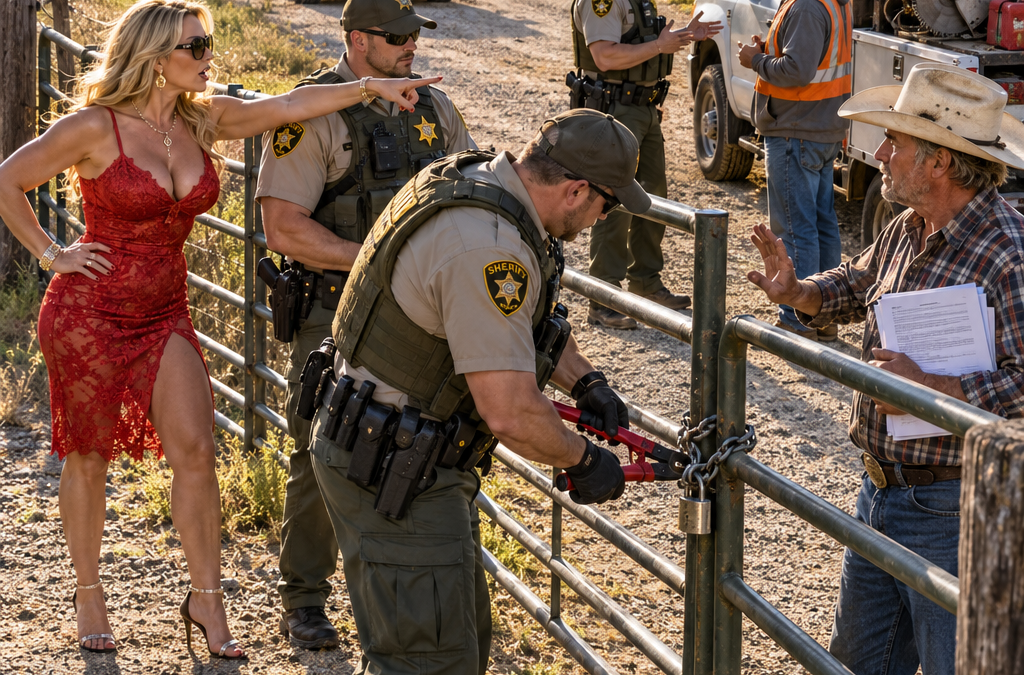
Through the gate, I could see deputies stepping from their vehicles.
A contractor’s work truck was parked nearby.
Two men stood beside it.
One was examining a set of cutting tools.
And Karen stood in the middle of the scene, pointing toward my lock.
I stopped.
For a moment, I couldn’t process what I was seeing.
Then Karen noticed me.
Her face brightened.
“There he is!”
She raised her hand toward the deputies.
“That’s the owner who’s refusing to comply.”
I walked to the gate.
“What exactly is going on?”
Karen stepped forward.
“Enforcement.”
I looked at her.
“Enforcement of what?”
“The HOA has ordered this obstruction removed.”
I stared at the contractor’s tools.
“You’re here to cut down my gate?”
She smiled.
“If you won’t remove it yourself, somebody has to.”
One deputy approached.
“Sir, we’ve received a complaint alleging this gate obstructs a community access route.”
I looked at him.
“This is private ranch property.”
Karen interrupted.
“That is disputed.”
I turned toward her.
“No. It isn’t.”
Her eyes narrowed.
The deputy raised one hand.
“Let’s establish the facts before anything happens.”
I appreciated that.
But the sight of the contractor standing beside cutting equipment made my heart pound.
I’d spent years maintaining this entrance.
My father had installed it.
The steel posts were still solid.
The lock functioned properly.
And now a woman who didn’t own the land had brought a crew to remove it.
Karen stepped toward the deputy.
“I’ve already provided the association’s enforcement order.”
He nodded.
“I’ve seen the complaint.”
“Then proceed.”
“Ma’am, we need to determine whether there’s legal authority to remove private property.”
Her expression hardened.
“You’re not understanding the urgency.”
I looked at the deputy.
“I have my deed and county map.”
Karen scoffed.
“Oh, wonderful. More excuses.”
I ignored her.
“I can get the records.”
The deputy nodded.
“Please do.”
I walked back toward the house.
As I went, I heard Karen raising her voice behind me.
“Don’t let him delay this!”
I stopped and turned.
“Karen, I’ll be back with the documents.”
She crossed her arms.
“You’d better be.”
I looked at the contractor.
He had begun moving equipment closer to the gate.
“Nobody cuts anything while I’m gone.”
The deputy held up a hand.
“Work needs to remain on hold while we verify ownership.”
Karen let out an irritated sigh.
I continued toward the house.
My hands were shaking.
Not from fear of the deputies.
From anger at the sheer arrogance of the situation.
Karen had apparently persuaded a contractor to arrive with removal equipment and involved law enforcement before confirming that the HOA had any legal right to the gate.
I reached my office.
Opened the filing cabinet.
And retrieved the property folder.
The documents were organized.
Deed.
Parcel map.
Recorded survey.
Easement information.
Older boundary records.
I knew where everything was because I’d maintained those records carefully for years.
My father had taught me to preserve property documents.
He’d said that fences and gates could rot, but the legal description of the land mattered long after the original posts were gone.
I had never been more grateful for that advice.
I took the folder and walked back toward the entrance.
Karen was still talking.
Loudly.
She stood beside the gate with her hands on her hips.
“The board has already voted. We are not going to let one stubborn rancher hold up the entire neighborhood.”
The deputy nearest her looked tired.
“Ma’am, a board vote does not automatically establish ownership.”
Karen waved her binder.
“We have regulations.”
I stepped forward.
“And I have the deed.”
The deputy turned toward me.
I opened the folder.
“This is the recorded property description.”
I handed him the document.
He began reading.
Karen leaned forward.
“That document doesn’t address the HOA’s access rights.”
The deputy looked up.
“Ma’am, please let me examine it.”
Her expression changed.
I almost smiled.
She wasn’t accustomed to being interrupted.
The deputy continued reading.
He looked at the property description.
Then at the recorded map.
Then toward the gate.
He frowned slightly.
“According to this, the gate appears to be within the ranch parcel.”
I nodded.
“It is.”
Karen stepped forward.
“That doesn’t mean it’s legal.”
The deputy turned toward her.
“Do you have documents establishing HOA ownership or an access easement over this portion?”
She blinked.
“Of course.”
I looked at her.
“Then show them.”
Karen opened her binder dramatically.
She flipped through several pages.
Then pulled out an official-looking HOA enforcement letter.
“Here.”
The deputy read it.
Then looked up.
“Ma’am, this is an association notice.”
“Yes.”
“It isn’t a deed.”
Her smile disappeared.
“It’s an enforcement order.”
“It doesn’t establish ownership.”
Karen’s cheeks reddened.
“The board has authority over community access routes.”
The deputy looked at the map.
“Where is the recorded access route?”
She opened her mouth.
Then closed it.
I watched her struggle.
For months, she’d been able to make declarations and expect people to accept them.
Now someone was asking her to identify actual property rights.
And she didn’t have the answer.
She pointed toward the gate.
“It’s right there!”
The deputy looked at her.
“That is a physical entrance to private property.”
Karen raised her voice.
“It is also an HOA access corridor!”
I felt my jaw tighten.
“There’s no recorded corridor.”
She turned toward me.
“Shut up.”
The deputy looked up sharply.
“Ma’am.”
Karen stared at him.
“What?”
“Let’s keep this civil.”
She gave an offended little laugh.
“I’m the person requesting enforcement.”
“Understood. But we still need lawful authority.”
Her face flushed.
She looked toward the other deputies.
“Are you all seriously going to stand here and let him defy an official HOA order?”
Nobody answered immediately.
Then one deputy said, “We need to verify whether the association has the right it claims.”
Karen folded her arms.
“This is unbelievable.”
I looked down at my deed.
Then toward the gate.
The lock was still intact.
For the moment.
But Karen was far from finished.
She reached for another document.
A colorful community map.
It showed the subdivision’s internal roads, common areas, and what appeared to be an access corridor extending toward my ranch entrance.
Karen held it up triumphantly.
“There!”
The deputy examined it.
I leaned closer.
Something was wrong.
The map depicted a route that didn’t match the county parcel boundaries.
A line had been drawn where my ranch entrance stood.
It made the access appear to connect through my property.
But the official county records showed no such corridor.
I felt a slow, cold certainty settle over me.
Karen wasn’t merely interpreting a legitimate HOA boundary incorrectly.
She was relying on a community map that portrayed an access right the county records didn’t recognize.
I looked toward the deputy.
“That isn’t the county parcel map.”
Karen snapped toward me.
“It’s the association’s approved plan.”
“Approved by whom?”
“The board.”
I stared at her.
“The board can’t vote a road across my land.”
Her eyes flashed.
“You are not qualified to interpret our planning documents.”
I took a breath.
“I don’t need to interpret them. They don’t match the recorded property boundaries.”
The deputy compared the two maps.
He looked concerned.
Karen moved closer.
“You’re letting him confuse you.”
The deputy held the HOA map beside my county document.
“Ma’am, these show different boundaries.”
Karen’s jaw tightened.
“That’s because one is a community planning map.”
“Does the HOA have a recorded easement corresponding to the access corridor shown here?”
She hesitated.
Then said, “The association has always understood this to be an access route.”
I stared at her.
“Understood?”
She turned toward me.
“Don’t start.”
I stepped closer to the gate.
“Karen, you brought three police vehicles and a demolition crew to my ranch because the HOA ‘understood’ it owned my entrance?”
Her face reddened.
“You’ve been obstructing community access for months.”
“To land you don’t own.”
She pointed at me.
“I can have your behavior documented.”
I almost laughed.
“Please do.”
The deputy began to speak.
But before he could finish, another vehicle approached from the road.
A sheriff’s SUV.
It slowed near the gate.
Then stopped behind the cruisers.
The driver’s door opened.
And Sheriff Tom Reynolds stepped out.
I’d known Sheriff Reynolds by reputation for years.
He was calm.
Experienced.
Not the kind of man who enjoyed unnecessary confrontation.
He walked toward the gate with the unhurried confidence of someone who’d spent a career dealing with people who believed raising their voices could change the facts.
He looked at the contractor’s truck.
Then the deputies.
Then the locked gate.
Finally, his eyes settled on Karen.
“What’s going on?”
Karen immediately brightened.
“Sheriff! Thank goodness you’re here.”
She hurried toward him.
“We’ve been trying to remove this unauthorized obstruction, but the property owner is refusing to cooperate.”
The sheriff glanced toward me.
Then back at her.
“Who authorized the removal?”
Karen smiled.
“The homeowners association.”
He waited.
She continued.
“I’m the president. The board has determined that this gate blocks our access route.”
Sheriff Reynolds looked toward the contractor.
“Who hired you?”
The contractor shifted.
“The HOA, sir.”
The sheriff nodded.
Then turned back toward Karen.
“Who authorized you to remove this gate?”
Karen lifted her binder.
“We issued a formal enforcement notice.”
The sheriff didn’t touch it.
“That wasn’t my question.”
Her smile tightened.
“We followed association procedures.”
“Do you own the gate?”
She blinked.
“What?”
“Does the HOA own the gate?”
Her cheeks reddened.
“The gate is obstructing our access.”
“That’s a different question.”
I watched her.
For the first time that morning, she looked uncertain.
Then she recovered.
“We are acting on behalf of the entire community.”
Sheriff Reynolds nodded slowly.
“And who owns the land beneath this gate?”
I raised my hand slightly.
“I do, Sheriff.”
He looked toward me.
“Do you have the deed?”
“Right here.”
I handed him the document.
He examined it carefully.
Then asked for the county parcel map.
I provided that too.
He studied the recorded boundary.
Looked toward the entrance.
Then asked one of the deputies to show him the HOA’s map.
Karen stepped forward eagerly.
“This explains everything.”
She unfolded the colored community plan.
The sheriff looked at it.
Then at the county map.
Then back at the HOA document.
He said nothing for several seconds.
Karen began talking again.
“The association has been attempting to resolve this for months. Our residents need unrestricted access, and this landowner refuses to acknowledge the board’s authority.”
Sheriff Reynolds raised one hand.
Karen stopped.
He looked at the HOA map.
“Where did this come from?”
She blinked.
“Our association records.”
“Who prepared it?”
“The planning committee.”
“Was it recorded with the county?”
She hesitated.
“It’s an official HOA document.”
The sheriff looked up.
“That doesn’t answer the question.”
Karen’s expression hardened.
“The HOA has the right to maintain its own access corridors.”
He tapped the map.
“This corridor isn’t on the county parcel survey.”
She stared at him.
“That doesn’t mean it doesn’t exist.”
He looked at her.
“Do you have a recorded instrument creating it?”
Silence.
Karen opened her binder.
Flipped through several pages.
Then stopped.
I watched her eyes move across the documents.
She was searching.
Desperately.
But the right she claimed wasn’t there.
Sheriff Reynolds waited.
Finally, Karen said, “The board has always treated this as community access.”
He slowly folded the HOA map.
Then placed it beside the county document.
“Mrs. Carter, the fact that your association has treated something as its property doesn’t establish that it owns it.”
Her cheeks flushed.
She opened her mouth.
He continued.
“The recorded boundary places this entrance within the ranch parcel.”
Karen stepped forward.
“That gate blocks an essential route.”
The sheriff looked toward my driveway.
“To what?”
“Our community.”
“Show me the recorded access right.”
She pointed at the HOA map.
“I just did.”
“No. You showed me a planning document depicting a route that isn’t established on the county survey.”
I felt my heartbeat slow.
For the first time all morning, the conversation was no longer about Karen’s demands.
It was about the recorded facts.
And those facts didn’t support her.
Sheriff Reynolds turned toward the deputies.
“Nobody is removing this gate.”
Karen stared at him.
“What?”
He repeated himself.
“The gate stays.”
Her face reddened.
“Sheriff, you can’t be serious.”
He looked at the contractor’s tools.
“Stop any removal work. This is private property, and we have not been shown lawful authority to alter the gate.”
The deputy nearest the lock stepped away.
Another directed the contractor to leave his equipment where it was while the matter was clarified.
I let out a breath I hadn’t realized I was holding.
Karen, however, looked as though she might explode.
“I AM THE HOA PRESIDENT!”
Her voice echoed along the road.
Sheriff Reynolds remained calm.
“I understand your position.”
“No, you clearly don’t!”
She pointed toward me.
“That man has been deliberately blocking community access!”
The sheriff looked at her.
“Then let your attorney handle it.”
Karen went silent.
Only for a moment.
Then she shook her head violently.
“No. Absolutely not.”
The sheriff’s expression hardened slightly.
“Mrs. Carter.”
“We have already spent weeks dealing with this stubborn rancher. The board issued an order. We hired a contractor. We arranged enforcement.”
He looked at her.
“None of that establishes ownership.”
She threw up her hands.
“Are you telling me an HOA can’t enforce its own rules?”
“I’m telling you that an HOA letter does not give your contractor permission to destroy someone else’s gate.”
Karen stared at him.
Then pointed directly at me.
“He is making a fool of this entire department!”
I felt anger rise.
“Karen, you’ve been given the deed.”
She snapped toward me.
“YOU KEEP YOUR MOUTH SHUT!”
Sheriff Reynolds turned his head.
“Mrs. Carter, that’s enough.”
She stared at him.
Her lips parted.
Then closed.
I watched her swallow.
She clearly wasn’t used to anyone speaking to her that way.
Especially in front of people she’d brought along to witness her victory.
The sheriff looked back at me.
“Do you have any older boundary records?”
I nodded.
“Yes, sir.”
Karen let out a bitter laugh.
“Oh, now we’re going to dig through ancient paperwork?”
I looked at her.
“As a matter of fact, yes.”
The sheriff waited.
I opened the final section of my folder.
Inside was an older recorded survey.
It predated the neighboring HOA.
It predated the subdivision’s later community maps.
And it showed the exact same ranch entrance within the same property boundaries.
I unfolded it.
The paper was older than the copies I’d been using.
But the survey information was clear.
The boundary line ran around the entrance.
The road beyond the gate was part of the ranch.
The recorded location had not changed.
I handed it to Sheriff Reynolds.
He examined the document.
Then compared it with the more recent county parcel map.
The lines matched.
The ranch entrance remained in the same legal position.
Karen stepped closer.
“What is that?”
I looked at her.
“An older recorded survey.”
She stared at the paper.
“How old?”
I held her gaze.
“Older than your HOA.”
For the first time that morning, she had nothing to say.
The sheriff continued examining the two records.
Then he looked toward Karen.
“This survey shows the same boundary.”
She swallowed.
He continued.
“The later county map reflects the same property line.”
Karen’s eyes moved between the documents.
Her expression changed from anger to uncertainty.
Then to something much closer to panic.
Because the older survey made one thing impossible to ignore.
My gate hadn’t been moved into the HOA’s supposed corridor.
It hadn’t appeared after the subdivision was developed.
It had occupied the same private ranch entrance long before the association existed.
The HOA’s map had depicted access where the recorded land records did not.
And Karen had tried to enforce that depiction as though it were ownership.
One of the deputies stepped closer.
“Sheriff, do we need to document the discrepancy?”
“Yes.”
Karen immediately interrupted.
“Why?”
The sheriff looked at her.
“Because your association’s access map does not correspond to the recorded property boundaries.”
Her face reddened.
“That’s a technicality.”
I stared at her.
“A technicality?”
She turned toward me.
“Don’t start celebrating.”
I took a slow breath.
“Karen, you’re standing at my gate with a crew you hired to tear it down, and you still think property ownership is a technicality?”
Her eyes flashed.
“The neighborhood needs access.”
“Then the neighborhood can use roads it has the legal right to use.”
She pointed toward the ranch.
“This is the most convenient route.”
“Convenience doesn’t create ownership.”
Sheriff Reynolds looked toward the contractor.
“Let’s talk about the work order.”
The contractor stepped forward.
He was a broad-shouldered man in work boots and a faded company shirt.
He looked uncomfortable.
The sheriff asked who had hired his crew.
“The homeowners association.”
“Who specifically requested removal?”
The contractor glanced toward Karen.
She stared back at him.
He swallowed.
“Mrs. Carter.”
Karen immediately stepped forward.
“The board authorized the project.”
The sheriff looked at the contractor.
“Did anyone show you a deed proving the HOA owned the gate?”
The man hesitated.
Then shook his head.
“No, sir.”
“Any recorded easement?”
“No.”
“Any court order authorizing removal?”
The contractor looked toward Karen again.
“No, sir.”
Karen’s face tightened.
The sheriff continued.
“What were you given?”
“An HOA enforcement letter and a community map.”
“Did you verify the property boundary?”
The contractor lowered his eyes.
“No. We assumed the paperwork was legitimate.”
Karen snapped.
“Because it is legitimate!”
The contractor looked at her.
“Ma’am, you told us the gate belonged to the HOA.”
I turned toward her.
She went still.
The contractor continued.
“You said the property owner was refusing to comply with removal of association equipment.”
I stared at Karen.
“Association equipment?”
Her eyes narrowed.
“Don’t twist the situation.”
I looked toward the gate.
“My father installed that.”
Karen folded her arms.
“The board had reason to believe—”
I interrupted.
“Did you tell the contractor the HOA owned my gate?”
She stared at me.
Then looked toward the sheriff.
“This is becoming a hostile interrogation.”
Sheriff Reynolds remained calm.
“We’re establishing who authorized removal and what information was provided.”
Karen let out an offended laugh.
“I’ve done nothing wrong.”
The sheriff looked at the contractor.
“Your crew needs to leave the property. No cutting, dismantling, or removal.”
The man nodded immediately.
“Understood.”
He turned toward his workers.
“Pack it up.”
Karen spun around.
“ABSOLUTELY NOT!”
The contractor stopped.
She marched toward him.
“I hired you to do a job!”
He looked at the sheriff.
Then back at her.
“Ma’am, we’re not cutting a gate after the sheriff has told us the ownership claim isn’t established.”
Her face flushed.
“I’ll have your company reported.”
He nodded.
“That’s your right.”
“I’ll make sure you never get another HOA contract in this county!”
He stared at her for a moment.
Then said, “I’d rather lose a contract than remove someone else’s gate without authority.”
I almost smiled.
Karen looked as though she might scream.
Instead, she turned toward Sheriff Reynolds.
“This is outrageous. You’re allowing a private landowner to obstruct community progress!”
The sheriff looked at her.
“Mrs. Carter, the crew is leaving.”
She opened her mouth.
He continued.
“And the gate is staying.”
The silence that followed was remarkable.
The deputies stepped away from the entrance.
The contractor’s workers began loading their tools.
The cutting equipment went back into the truck.
The gate remained locked.
Untouched.
Exactly where it had stood when Karen arrived.
For the first time that morning, I began to believe the situation was actually ending.
But Karen still wasn’t ready to surrender.
She marched back toward me.
“Open it.”
I stared at her.
“What?”
“The gate.”
I looked toward the sheriff.
Then back at Karen.
“Why?”
She lifted her chin.
“Because I’m demanding access on behalf of the association.”
I couldn’t believe it.
The deputies had just reviewed my deed.
The sheriff had compared the maps.
The contractor had admitted nobody verified ownership.
The removal had been stopped.
And Karen was still ordering me to open the gate.
“No,” I said.
Her face changed.
“Excuse me?”
“The gate stays closed.”
She stepped closer.
“You are deliberately provoking me.”
“I’m protecting my ranch.”
“The community needs unrestricted access.”
“To land it doesn’t own?”
She raised her voice.
“You don’t get to deny residents something they’ve been promised!”
I looked at her.
“Then whoever promised it should explain why they were promising access through private property.”
Her eyes widened.
I continued.
“I never agreed to open my ranch to subdivision traffic.”
“You are unbelievably selfish.”
I felt anger rise.
“Karen, you’re demanding the right to send strangers past my cattle, barns, equipment, and home.”
She folded her arms.
“Residents would be expected to behave appropriately.”
“That’s not your decision to make.”
Her lips tightened.
She looked at Sheriff Reynolds.
“Are you hearing this?”
He nodded.
“I am.”
“Then do something!”
He looked toward the gate.
“The owner has declined to open his private entrance. Without evidence of an enforceable access right, that’s his decision.”
Karen stared at him.
Then she turned toward me.
“Fine.”
Her voice became low and vicious.
“I’ll take you to court.”
I nodded.
“You’re free to consult your attorney.”
She leaned forward.
“And when I’m finished, you’ll regret ever challenging me.”
I looked at her.
“Then make sure your attorney reads the county survey first.”
Her face reddened.
For several seconds, she stood there trembling with anger.
Then she turned away.
I thought that was the end.
But Sheriff Reynolds still had questions.
He asked to review Karen’s remaining paperwork.
She protested.
He explained that because the association had requested removal of a privately owned gate based on a disputed access claim, he needed to understand precisely what documents had been presented.
Karen reluctantly handed over the folder.
The sheriff examined it page by page.
Several papers referenced an HOA access corridor.
Others described community transportation planning.
One document included a diagram showing the proposed route near my entrance.
Another referred to board discussions about unrestricted access.
But none established ownership of the gate.
None showed a recorded easement across my ranch.
None showed a valid transfer of land.
None showed a court order requiring removal.
And none changed the county parcel boundary.
I watched Karen as the sheriff reviewed each page.
At first, she stood with her arms crossed.
Then she began shifting her weight.
Then she stopped making comments.
The more documents he examined, the clearer the problem became.
Karen had built her entire enforcement effort on an assumption.
The HOA wanted access.
Its internal map depicted access.
The board had issued an enforcement letter demanding access.
Therefore, in Karen’s mind, access must exist.
But none of those steps established a legal property right.
The sheriff closed the folder.
“Mrs. Carter, these documents don’t establish the authority you’ve claimed.”
Karen swallowed.
“The association has been relying on those records for months.”
He looked at her.
“Then the association needs to review its records.”
She stared at him.
“That’s your official position?”
“My position is that I have not been shown legal authority to remove this gate.”
Her cheeks reddened again.
The sheriff continued.
“If you believe an easement or property right exists, have your attorney establish that through the appropriate process. But nobody is taking down this gate today.”
I stood quietly.
For the first time, I didn’t feel the need to argue.
The documents were doing the work.
And Karen couldn’t bully them into saying something else.
The contractor’s crew finished packing.
The cutting tools were secured.
The workers climbed into their truck.
Before leaving, the contractor approached me.
He looked embarrassed.
“Sir, I’m sorry about all this.”
I nodded.
“I appreciate that.”
He glanced toward Karen.
“We were told the HOA owned the gate.”
“I figured.”
“We should have verified it.”
“Yes.”
He lowered his eyes.
“That’s on us.”
I appreciated the honesty.
He hadn’t tried to blame me.
He hadn’t demanded I apologize for stopping the work.
He’d simply acknowledged that his crew had accepted information without independently verifying the property rights involved.
That was more than Karen had done all morning.
The contractor returned to his truck.
A moment later, the engine started.
The crew drove away.
I watched the vehicle disappear down the road.
One problem down.
Three sheriff’s vehicles still sat near the entrance.
The deputies continued documenting their observations.
Sheriff Reynolds spoke with them briefly.
Then he approached me.
“Do you have copies of these records you can retain?”
I nodded.
“Yes, sir.”
“Keep them organized.”
“I will.”
He glanced toward the gate.
“And if the association contacts you again about removal, direct them to the appropriate legal process. Don’t get into a physical confrontation over the entrance.”
I nodded.
“Understood.”
He looked at the lock.
“Your gate isn’t being removed today.”
I felt a rush of relief.
“Thank you, Sheriff.”
He nodded.
“Property claims need to be established by the actual records.”
I looked toward Karen.
She stood beside her SUV, arms crossed, refusing to look at us.
Her carefully prepared victory had collapsed.
The contractor was gone.
The tools were gone.
The deputies had stepped away from the gate.
And the sheriff had made clear that the HOA’s paperwork did not establish ownership.
Karen had brought law enforcement to my ranch expecting them to enforce her demands.
Instead, she’d forced everyone present to examine the property boundary she’d been trying to ignore.
I walked toward my truck and retrieved one final document.
It was a formal notice I’d prepared concerning the association’s repeated ownership claims.
The notice demanded that the HOA cease representing my ranch entrance as community property without lawful support.
It identified the recorded parcel boundary.
It rejected the claimed access corridor.
And it called for the association to correct its records and stop asserting ownership over the gate.
I returned to Karen.
She saw the paper in my hand.
Her expression tightened.
“What now?”
I held it out.
“This is for the HOA.”
She stared at it.
“I’m not interested.”
“It’s a formal notice concerning the ownership claims you’ve been making.”
She laughed bitterly.
“Oh, so now you’re issuing enforcement letters?”
I kept my voice even.
“I’m demanding that your association stop claiming my entrance belongs to it.”
Her eyes narrowed.
“You don’t get to make demands of this board.”
I looked toward the gate.
“You’re welcome to have your attorney review it.”
For a moment, she didn’t move.
Then she snatched the paper from my hand.
She looked at the first page.
Her eyes moved across the heading.
Then toward the recorded parcel reference.
Then back to the gate.
The steel posts stood exactly where they’d always stood.
The lock was intact.
The road behind it remained closed to unauthorized traffic.
Karen looked at the document again.
I watched her expression change.
She had finally run out of people to order around.
The deputies weren’t removing the gate.
The contractor wouldn’t touch it.
The sheriff had rejected her claim of authority.
And the recorded documents were unchanged.
She folded the notice sharply.
“This isn’t over.”
I looked at her.
“Then have your attorney contact me.”
She lifted her chin.
“I intend to.”
I nodded.
“Good.”
She stared at me.
I continued.
“Because an attorney can explain the difference between an HOA map and a recorded property right.”
Her cheeks flushed.
She opened her mouth.
Then closed it.
For once, she didn’t have a useful insult prepared.
She turned sharply and walked to her SUV.
The heels of her shoes clicked against the pavement.
She climbed inside and slammed the door.
I watched her sit behind the wheel for several seconds.
Then she started the engine and drove away.
The sheriff remained until the scene was cleared.
One by one, the deputies returned to their vehicles.
The emergency lights went off.
The cruisers departed.
Sheriff Reynolds left last.
When his SUV disappeared down the road, silence settled over the ranch entrance.
I stood in front of the gate.
The lock was still there.
The steel leaves were still aligned.
The hinges were still solid.
Nothing had been cut.
Nothing had been removed.
And for the first time since I’d seen those flashing lights, I could breathe normally again.
I walked closer.
Placed my hand on the cold metal.
And looked down the private road beyond it.
My ranch.
My home.
My father’s gate.
All still exactly where they belonged.
But the consequences of Karen’s mistake were only beginning to unfold.
That evening, the HOA held an emergency board meeting.
I didn’t need to be inside the room to know what the central question would be.
Karen had ordered the removal of a ranch gate based on an association map that didn’t match the county’s recorded boundaries.
She’d hired a contractor.
Brought deputies into the dispute.
Demanded unrestricted access.
And attempted to have a private entrance dismantled without producing proof that the HOA owned it.
Now the board had to explain how that happened.
I later learned that the official county parcel map was projected onto the clubhouse wall.
The board compared it with the association’s internal access diagram.
The difference was unmistakable.
The HOA map depicted a corridor crossing toward my ranch entrance.
The county survey did not.
The recorded boundary ran around the gate and the private road.
There was no recognized access route granting subdivision residents the unrestricted use Karen had demanded.
I could imagine the room falling silent when those lines appeared side by side.
Karen had spent months describing the gate as an illegal obstruction.
She’d told residents the HOA had authority to remove it.
She’d acted as though I was the person refusing to respect community rules.
But the official property records showed that the association was asserting control over land it didn’t own.
The board now faced a question much more serious than whether one ranch gate should remain locked.
It had to determine why its records showed a community access route that the county’s land records didn’t recognize.
Had someone misunderstood the boundary?
Had a planning diagram been treated as a legal conveyance?
Had the HOA relied on an internal map without checking the recorded deeds?
Those were questions the board needed to answer.
And unlike Karen’s threats, they couldn’t be resolved simply by declaring the matter closed.
The association eventually corrected its records.
The supposed access corridor across my ranch was removed from the inaccurate materials.
The official boundary information was recognized.
And the HOA stopped claiming ownership of my gate.
That was the outcome I’d wanted from the beginning.
Not a public fight.
Not a confrontation with police vehicles.
Not a contractor arriving with cutting equipment.
Just recognition of where the property line actually ran.
There was no reason the matter ever needed to reach the point it did.
Karen could have checked the county parcel map before sending her first letter.
She could have asked whether a recorded easement existed.
She could have spoken with the association’s attorney before hiring a demolition crew.
She could have respected the documents I offered.
Instead, she decided that her title made the question of ownership irrelevant.
She treated the gate as an obstacle to her authority.
And because I refused to remove it, she escalated.
First an HOA notice.
Then a demand.
Then threats.
Then an attempt to enforce a nonexistent access claim through law enforcement and a contractor.
At every stage, she had an opportunity to reconsider.
And at every stage, she chose more pressure.
I thought about that often in the days after the confrontation.
My father had never installed the gate to make a political statement.
He installed it because a working ranch needs a secure entrance.
It protected livestock.
Equipment.
Buildings.
And the people living on the property.
It stood entirely within our recorded boundaries.
There was nothing controversial about it until Karen decided that the HOA needed access.
Even then, the proper process wasn’t complicated.
If an association believes it has a recorded right to cross private land, it can produce the instrument establishing that right.
If it wants new access, it can ask the property owner to negotiate.
If there’s a genuine boundary dispute, it can be resolved through legal records and appropriate proceedings.
What it cannot do is vote itself ownership of something that belongs to someone else.
Karen had confused an association decision with a property right.
And she’d nearly destroyed my gate trying to prove her authority.
I began keeping even more careful records after that morning.
The deed went back into its folder.
The county map was filed beside it.
The older survey remained protected.
I preserved the HOA letters, the formal notice, and the documents connected to the attempted removal.
Not because I expected another confrontation.
Because I had learned how dangerous an unsupported claim could become when someone in authority refused to verify it.
An official-looking letter could frighten an uninformed homeowner.
A community map could appear convincing.
A contractor might assume the person paying for the work had checked ownership.
And even law enforcement could be called to a dispute that should have been settled by reading the recorded documents first.
The important moment had come when one deputy paused and asked who owned the property.
That simple question changed everything.
Karen had arrived expecting obedience.
She hadn’t expected anyone to examine the basis of her demand.
She certainly hadn’t expected Sheriff Tom Reynolds to compare the HOA map with the county survey.
And she had no answer when he asked who authorized removal of a gate the association didn’t own.
I thought about the contractor too.
He’d been ready to work.
He had equipment.
A crew.
A job order.
But when asked whether anyone had shown him proof of ownership, he admitted they hadn’t.
He’d assumed the paperwork was legitimate.
That assumption could have cost me a gate.
It could have damaged the entrance.
It could have created an entirely unnecessary conflict over property that had never belonged to the HOA.
Instead, the work stopped before any damage was done.
I was grateful for that.
I didn’t need Karen punished in some spectacular way to understand what had happened.
I needed my property respected.
And in the end, it was.
A few days after the board corrected its records, I walked down to the gate just before sunset.
The sky was beginning to turn orange.
The fields stretched out behind me.
A light breeze moved through the grass.
Somewhere near the barn, I could hear the low sounds of livestock settling for the evening.
The ranch was peaceful again.
I inspected the gate as I often did.
Checked the hinges.
Looked at the posts.
Tested the lock.
Everything worked.
The same steel gate that had stood there for years still opened and closed exactly as my father intended.
I rested one hand against it.
For a moment, I remembered him standing beside that entrance.
His boots dusty.
His hands rough from years of work.
His voice reminding me to close the gate properly.
I smiled faintly.
He would have been furious about Karen’s attempted removal.
But I think he would have been proud of how the dispute ended.
No shouting match.
No damaged property.
No physical confrontation.
Just the records he had always insisted we keep.
I looked toward the subdivision.
Beyond the trees, I could see the roofs of the neighboring houses.
Families lived there.
People who wanted quiet streets, safe homes, and a pleasant place to raise children.
I had no problem with them.
I never had.
My disagreement wasn’t with the idea of a homeowners association.
It was with a president who believed that representing the neighborhood made her more important than the rights of everyone outside it.
Karen had acted as though an HOA boundary could expand whenever she wanted something.
She’d pointed to an access corridor on a community map and treated it as permission to cut through private ranch land.
But the county survey had existed long before her presidency.
And the older recorded survey had established the same entrance location before the HOA was even formed.
Those documents hadn’t changed because Karen held a meeting.
They hadn’t changed when she issued an enforcement letter.
They hadn’t changed when she hired a contractor.
And they certainly hadn’t changed when three police vehicles arrived at my gate.
The truth had been sitting in the records the entire time.
All anyone needed to do was read them.
I unlocked the gate.
Pulled one steel leaf open.
Walked through.
Then closed it behind me.
The latch settled into place with its familiar metallic sound.
I secured the lock and checked it once.
Then I turned toward the house.
There was still work to do before dark.
Animals to check.
Equipment to put away.
A few ordinary chores that had nothing to do with HOA maps, legal arguments, or angry presidents.
And I was grateful for every one of them.
Because ordinary life on the ranch was what Karen had interrupted.
She’d tried to turn my family’s property into community access simply because it suited her plans.
She’d tried to make a private gate look illegal.
She’d used an HOA enforcement letter to demand something the association had no proven right to take.
Then she’d brought law enforcement and a contractor to make her demand seem final.
But when Sheriff Reynolds examined the actual records, the entire argument collapsed.
The contractor packed up.
The deputies left the entrance untouched.
The HOA corrected its maps.
And my gate remained exactly where it had always been.
I reached the porch and looked back one last time.
The evening sun caught the upper edge of the steel gate.
Beyond it, the public road stretched toward the subdivision.
On this side were the barns, pastures, and private ranch road my family had maintained for generations.
The boundary between those places was clear.
It had always been clear.
Karen just hadn’t wanted to acknowledge it.
I went inside as the sun disappeared behind the hills.
The ranch was quiet.
The gate was locked.
And for the first time since those three cruisers appeared outside my entrance, I knew the association had finally accepted what the county records had said all along.
My land was not community property.
My gate was not HOA equipment.
And no president, no matter how arrogant or determined, could turn an unsupported claim into ownership simply by putting it on official-looking paper.
Karen came to my ranch expecting to watch my gate torn down.
Instead, she watched the sheriff stop the removal, her contractor load his equipment, and the deputies leave without touching a single hinge.
By sunset, the gate was still standing.
And the only thing that had been taken apart was Karen’s claim that she owned it.








