𝗙𝗨𝗟𝗟 𝗦𝗧𝗢𝗥𝗬 For Eight Months, I Fed the Same Old Man on My Walk Home, Until One Night He Stood Up and Said My Full Name
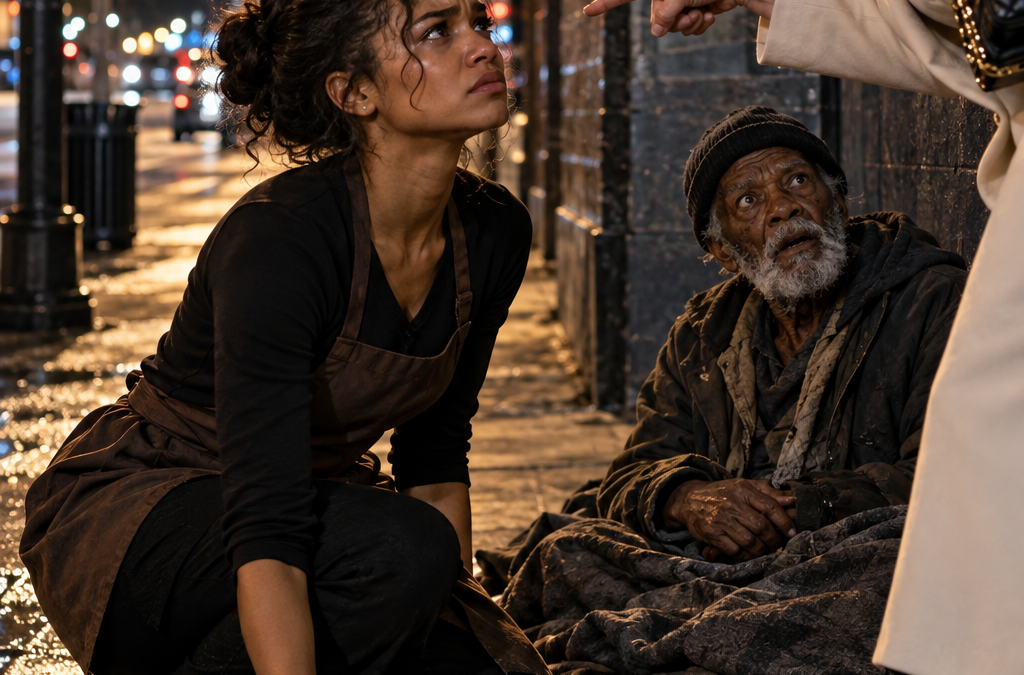
𝗙𝗨𝗟𝗟 𝗦𝗧𝗢𝗥𝗬
The kitchen was hot before sunrise and brutal by noon.
Orders came in waves.
Metal pans clanged.
The head cook shouted ticket numbers.
Grease popped.
Steam rolled out of industrial sinks.
I kept moving.
At $9.25 an hour, you did not get paid to think about your feet hurting.
You just learned to stop listening to them.
My lunch break was fifteen minutes.
I usually sat on an overturned milk crate in the alley and looked at my phone calculator.
Rent: $680.
Electricity.
Bus passes.
Food.
Lily’s school needs.
Laundry.
There was always another number.
There was never enough space between them.
At 3:15, I clocked out.
Then I had forty-five minutes to reach Lily’s after-school program.
Every day she ran toward me as if I had been away at war.
“Mama!”
Her backpack bounced against her shoulders.
I would crouch.
She would crash into me.
And for three seconds, sometimes four, my day made sense.
Then we walked to Mrs. Dolores Graham’s apartment.
Mrs. Graham lived two floors above us and had been a teacher for more than forty years.
She was seventy-one, widowed, and watched Lily in the evenings without charging me.
I tried to pay her.
Once.
She pushed the money back into my hand.
“Baby, if I take this, neither of us will sleep tonight.”
So I repaid her with food whenever I could.
Soup.
Cornbread.
A plate from Magnolia if Ruth allowed leftovers to leave the kitchen.
By 4:30, I was on another bus.
My second job was cleaning offices at the Ridgeway Commerce Building.
Four floors of glass doors, gray carpet, polished desks and people whose family vacations were displayed in frames that cost more than Lily’s winter coat.
My section was the third floor.
I vacuumed.
Emptied trash.
Wiped keyboards.
Scrubbed toilets.
Straightened chairs.
Sometimes I found takeout containers with enough untouched food inside to feed Lily and me for two days.
I never took them.
Not because I was above it.
Because those offices had cameras, and when you are a poor Black woman working alone after business hours, you learn very early that some mistakes are allowed to be accidents for other people and crimes for you.
So I emptied the food into the trash.
Wiped the desk.
Moved on.
My shift ended at 9:30.
That was when the quietest part of my day began.
The walk home.
Every night, I got off the bus several blocks from my apartment.
And every night I passed the corner of Beale and Third.
That was where I first saw him.
Eight months earlier.
An old white man.
Seventies, I guessed.
Thin.
Gray coat.
No sign.
No cup.
No outstretched palm.
He just sat against a brick wall and watched people move around him as if he had become part of the building.
The first night, I almost walked past.
My feet were throbbing.
I was hungry.
I had leftovers waiting at home.
Then he looked up.
Something in his face reminded me of my grandfather.
Not exactly.
My grandfather had been darker, heavier, louder.
But the eyes were the same.
Tired eyes.
Proud eyes.
The eyes of somebody who would rather sit hungry than ask a stranger to notice.
I walked home.
He stayed in my mind.
I heated the rice and beans I had saved.
Then I divided them.
Half for me.
Half for him.
I put his half in a plastic container and walked back.
He was still there.
I held the food out.
“Here.”
He looked at the container.
Then at me.
“I don’t have money.”
“I didn’t ask for any.”
His eyebrows lifted.
“You selling something?”
“No.”
“Church?”
“No.”
“What do you want?”
That question hurt me more than it should have.
Because he genuinely seemed unable to imagine someone giving him food without wanting something in return.
“I want you to eat.”
He took the container carefully.
“Thank you.”
That was night one.
On night two, he was still there.
So was I.
By night thirty, I didn’t ask anymore.
I put the container beside him.
He nodded.
By night sixty, he knew my name.
By night one hundred, he asked how Lily was, even though he had never met her.
By night two hundred, he took one bite of my beans and said, very seriously, “These would be significantly improved by hot sauce.”
I stared at him.
He kept a straight face.
Then I snorted.
He smiled.
That was the first time I heard him laugh.
I never told anyone about him.
Not Ruth.
Not Mrs. Graham.
Not even Lily.
I wasn’t hiding it.
It just felt private.
The world made everything into a transaction.
I didn’t want this to become one.
He was hungry.
I had some food.
That was enough.
Then winter came.
Memphis cold is different when you don’t own enough clothing for it.
Cold finds the gaps.
Sleeves.
Shoes.
Window frames.
The crack beneath the front door.
I began sleeping in socks.
I put two sweaters on Lily before school.
At night I ran the heater.
At five in the morning, I turned it off.
Thirty extra dollars on the electric bill could destroy an entire week’s budget.
The old man looked worse as the temperature dropped.
His coat was too thin.
His hands became red and cracked.
His lips split.
Then came the cough.
Deep.
Wet.
The kind that seemed to come from somewhere far beneath his chest.
“Come on,” I told him one night. “You need a shelter.”
“No.”
“You’re going to freeze.”
“I’ve had worse.”
“That is a terrible answer.”
The corner of his mouth moved.
“Still an answer.”
I started bringing more.
Soup.
Hot water.
Socks from the dollar store.
Hand warmers when I could afford them.
And one night, without thinking long enough to talk myself out of it, I gave him my mother’s blue scarf.
It was one of the few things I had left that belonged to her.
I wrapped it around his neck.
He touched the fabric.
“You shouldn’t give this away.”
“How do you know I’m giving it away?”
“You keep touching it like it means something.”
I pulled my hands back.
“It’s a scarf.”
He looked at me.
I hated that he could see through me.
“My mother gave it to me.”
His hand stopped.
Then he began unwinding it.
“No.”
I caught his wrists.
“Leave it.”
“Alana.”
“She would hate knowing it was sitting in my closet while somebody froze.”
His eyes softened.
“Your mother sounds like she raised you badly for your own financial interests.”
That made me laugh.
“She definitely did.”
He kept the scarf.
Two weeks later, on a Thursday night, I turned the corner and his spot was empty.
I stopped.
Cardboard.
Blanket.
No man.
I looked farther down the street.
Nothing.
I checked behind the bus shelter.
Nothing.
Then the alley.
I found him between a hardware store and an old print shop.
He was lying on his side.
For one second, I thought he was dead.
I dropped everything.
“Hey.”
No response.
I knelt beside him.
“Hey. Look at me.”
His eyes opened halfway.
“I’m fine.”
“You’re lying.”
His face was gray.
His fingers looked blue.
But when I touched his forehead, he was burning.
“You have a fever.”
“I’ve had fevers before.”
“Congratulations.”
I pulled off my jacket and covered him.
Cold hit me instantly.
It felt like someone had opened a freezer around my entire body.
I looked at my phone.
9:45.
Mrs. Graham usually went to bed at ten.
Lily was waiting.
My shift at Magnolia began in less than eight hours.
Ruth had already warned me about being late.
One more time, she had said.
One more.
I looked at the old man.
His breathing had become shallow.
The calculation should have been simple.
My child.
My job.
My rent.
My survival.
But there are moments when numbers stop being useful.
I called Mrs. Graham.
Four rings.
Five.
“Hello?”
“Mrs. Graham, I’m sorry.”
“Alana?”
“Can Lily stay with you tonight?”
A pause.
“Something wrong?”
I looked down.
The old man’s body was trembling now.
“I think so.”
“Go do what you need to do.”
“I’ll explain—”
“You don’t have to. I have Lily.”
That was it.
No interrogation.
No guilt.
“I love you.”
“I know, baby.”
I hung up.
Then I ran.
There was a pharmacy two blocks away that stayed open until ten.
I reached it with minutes left.
Cold medicine.
Water.
Thermal blanket.
Nineteen dollars.
I stood at the register staring at the total.
Nineteen dollars.
Lily had been asking for shoes.
Purple laces.
She had stopped directly in front of the same store window for two weeks.
“Mama, look.”
“I see them.”
“Aren’t they pretty?”
“They are.”
“When my shoes break, can I get those?”
Her current shoes were already splitting near one toe.
I had set aside twenty-two dollars.
I closed my eyes.
Then paid.
When I returned to the alley, the old man had barely moved.
I wrapped him in the thermal blanket.
Put my folded jacket beneath his head.
Held the medicine to his lips.
“Drink.”
His eyes opened.
“You came back.”
“Drink.”
“Alana.”
“Small sips.”
He obeyed.
Afterward, his hand settled over mine.
Weak.
Cold.
“Why?”
I knew what he meant.
Why stay?
Why spend the money?
Why give him the coat?
Why choose him when my own life was already underwater?
I had no beautiful answer.
“You were sick.”
He stared at me.
“So?”
“So I wasn’t leaving you.”
For the next hour, I sat beside him.
His breathing gradually steadied.
At 11:30, I called Magnolia and left Ruth a voicemail.
“I might be late tomorrow. I’m sorry. I’ll make it up.”
I knew exactly what those words might cost.
A shift.
Maybe the job.
I stayed anyway.
Midnight passed.
Then one.
Then two.
My fingers hurt so badly that eventually they stopped hurting.
That scared me.
I tucked my hands beneath my arms.
Around three, his fever began to break.
I felt his forehead.
Cooler.
His breathing deepened.
For the first time all night, his face relaxed.
I leaned back against the brick wall.
Just for a minute.
That was what I told myself.
I woke at 5:15.
My eyelashes felt stiff.
The thermal blanket was around my shoulders.
The old man was sitting beside me.
He had covered me.
“You stayed,” he said.
His voice was stronger.
“You needed someone to stay.”
He looked at me for a long time.
There was something strange in his expression.
Not gratitude exactly.
Something deeper.
Something almost painful.
I stood.
My legs barely worked.
“I’ll bring soup tonight.”
“You don’t have to.”
“I know.”
“Alana.”
“I’ll bring soup.”
Then I put my jacket on and left.
I reached Magnolia forty minutes late.
Ruth was standing beside the back door.
Arms crossed.
My stomach dropped.
“This is your fourth time.”
“I know.”
“I told you what would happen.”
“I know.”
She looked at me.
Really looked.
The dirty pants.
The exhausted face.
The coat.
“What happened?”
“I was helping someone.”
“That specific answer tells me absolutely nothing.”
“Someone got sick.”
“Family?”
“No.”
Her eyes narrowed.
“A stranger?”
I hesitated.
“Kind of.”
Ruth closed her eyes.
For several seconds she said nothing.
Then she opened the door.
“Clock in.”
I blinked.
“What?”
“Before I change my mind.”
“Ruth—”
“And eat something.”
“I’m okay.”
“You look like death with a ponytail.”
That was Ruth’s version of compassion.
I nearly cried.
Instead, I clocked in.
I worked the entire shift.
That evening, there was a container waiting near the back of the refrigerator.
Chicken broth.
Carrots.
Celery.
A piece of bread.
Ruth never mentioned it.
Neither did I.
I carried it to the old man.
His color had improved.
He wore my mother’s scarf wrapped twice around his neck.
“You lost pay because of me.”
“Half a day.”
“Still.”
I sat beside him.
He ate.
I didn’t.
I had given him my dinner portion again.
He noticed.
“You’re not eating.”
“I ate at work.”
It was a lie.
His eyes stayed on me.
Then he looked away.
“You remind me of someone.”
“Who?”
His spoon stopped.
“Someone I lost.”
I waited.
He didn’t continue.
So I didn’t ask.
Over the next two weeks, I became ridiculous.
At least that was how I described it to myself.
A two-dollar wool hat.
Hand warmers.
A tarp I found behind a hardware store, scrubbed in our bathtub and carried six blocks.
Each purchase came from somewhere else.
Bus money.
Food money.
Lily’s supplies.
I knew it was irresponsible.
That word followed poor people everywhere.
Irresponsible.
As if kindness became a moral failure when your bank balance was low.
Then one evening, Lily came with me.
Mrs. Graham had a doctor’s appointment.
No sitter.
So I held Lily’s hand and walked toward the corner.
She saw him immediately.
“Is that the man?”
I stopped.
“How do you know?”
“You always make extra food.”
Children notice everything.
“Yes.”
She pulled her hand away and ran toward him.
“Lily!”
She opened her backpack.
Inside was a folded sheet of construction paper.
She handed it to him.
“This is for you.”
He stared at the page.
A yellow house.
Red door.
Green grass.
Blue sky.
Two stick figures outside.
“What is it?” he asked.
Lily looked concerned that an adult could be this slow.
“A house.”
“I see.”
“So you have one.”
The old man’s face changed.
His jaw tightened.
His eyes filled.
My chest hurt.
He folded the picture carefully.
Once.
Then again.
He placed it inside his coat against his heart.
“Thank you.”
He was looking at Lily.
But somehow the words felt directed at me too.
That night, after Lily fell asleep, I sat at the kitchen table with my budget notebook.
Rent.
Electric overdue.
Groceries short.
School supplies.
Shoes.
I counted the dinners I had skipped that month.
Eleven.
That frightened me.
Then I turned to a clean page.
Tomorrow:
Extra soup.
Bread.
Check his cough.
I closed the notebook.
There are things I wish I could tell that version of myself.
I wish I could tell her she was exhausted enough to collapse.
That she did not have to save everybody.
That she was allowed to need help too.
But I also know she would not have listened.
Two nights later, I reached the corner and stopped.
The old man was standing.
In eight months, I had almost never seen him stand for long.
But that night his back was straight.
His shoulders were square.
He looked taller than I expected.
“You’re feeling better.”
“Because of you.”
I handed him food.
He didn’t open it.
Instead, he reached inside his coat and removed a white envelope.
It was perfectly clean.
That bothered me immediately.
Everything he owned was worn.
That envelope looked as though it had been removed from a bank counter ten minutes earlier.
“I need you to take this.”
“What?”
“Open it.”
I did.
Cashier’s check.
Ten thousand dollars.
Payable to:
Alana Marie Owens.
My middle name.
I stared at it.
Then at him.
Then back at the check.
“No.”
“Alana—”
“No.”
“You haven’t even—”
“I know what ten thousand dollars is.”
“You need it.”
Something hardened inside me.
“Where did you get my full name?”
He said nothing.
I held out the envelope.
“Take it.”
“You can keep it.”
“No.”
“It’s legitimate.”
“I didn’t ask whether it was legitimate.”
I pushed it against his chest.
“I asked where you got my name.”
He watched me.
“I can’t explain everything tonight.”
“Then I can’t take this.”
“Why?”
I almost laughed.
“Why?”
I gestured toward the container in his hand.
“I brought you food because you were hungry.”
“I know.”
“I gave you my coat because you were freezing.”
“I know.”
“I stayed because you were sick.”
His expression softened.
“I know.”
“Then don’t turn it into something else.”
“It isn’t.”
“It feels like it.”
“Alana—”
“No.”
I took a breath.
Ten thousand dollars.
Fifteen months of rent.
Shoes.
Electricity.
Groceries.
A real bed for Lily.
A repair for my phone.
One month without calculating every bus trip.
I wanted it.
God, I wanted it.
And because I wanted it, refusing hurt.
“I didn’t help you so that one day you could pay me back.”
“I know.”
“That is exactly why I want you to have it.”
“And that is exactly why I can’t.”
His eyes filled.
I turned away.
“Eat your dinner.”
Then I walked home with my hands shaking inside my pockets.
I barely slept.
How did a homeless man have ten thousand dollars?
How did he know my full name?
The questions pulled old details into a new shape.
His vocabulary.
Words like restructuring.
Quarterly.
Lease terms.
Once, when I complained about Lily’s school eliminating art classes, he said, “That sounds like a board-level allocation decision. Parents should challenge the budget at the next meeting.”
Then he immediately changed the subject.
His hands.
Dirty, yes.
Cracked from cold.
But not the hands of someone who had worked outdoors for decades.
And his left wrist.
A pale band where a watch had once protected the skin from the sun.
Then there was the SUV.
Black.
Tinted windows.
I had noticed it weeks earlier.
Always down the block.
Always there when I arrived.
Usually gone after I left.
I had decided it meant nothing.
Two days after the check, I told the old man one of my oldest dreams.
A restaurant.
Small.
Nothing fancy.
My grandmother’s recipes.
Fried chicken.
Greens.
Mac and cheese.
Rice and beans.
A place where nobody was rushed out of their seat.
He listened carefully.
Then said, “Location will matter as much as food. Foot traffic, lease structure, anchor businesses, parking and operating margins.”
I stared at him.
“You sound like a businessman.”
Something flickered across his face.
“I used to read a lot.”
That night, I knew.
Not what the truth was.
Only that the story he had allowed me to believe was incomplete.
The answer came on a Tuesday.
I approached the corner carrying another container.
The cardboard was gone.
Blanket gone.
Tarp folded neatly against the wall.
And the old man was standing beneath the streetlight.
Except he no longer looked homeless.
Dark wool coat.
Pressed white shirt.
Clean trousers.
Polished brown shoes.
His beard had been trimmed.
His hair was combed.
I stopped ten feet away.
For a second, I genuinely wondered whether I had mistaken another person for him.
Then he spoke.
“Alana.”
Same voice.
Different weight.
“What happened to you?”
“Nothing happened to me.”
He stepped forward.
“Something happened because of you.”
He took a business card from his coat.
Heavy paper.
Embossed lettering.
I read it.
Walter Harding.
Founder and Chairman.
Harding Enterprises.
I looked at him.
Then back at the card.
“I don’t understand.”
“My name is Walter Harding.”
“Walter.”
It was the first time I had heard his name.
“I founded Harding Enterprises in 1989.”
I stared.
He continued.
“Commercial property. Development. Investments.”
My eyes returned to the card.
I knew the Harding name.
Most people in Memphis did.
Buildings.
Shopping centers.
Office towers.
“You’re telling me you own Harding Enterprises?”
“Yes.”
“How much are you worth?”
He hesitated.
“Enough that the exact number is not useful to this conversation.”
My stomach dropped.
“How much?”
“Roughly two-point-three billion in assets associated with the company.”
I took one step backward.
Then another.
The black SUV rolled toward the curb.
The rear door opened.
A man in his forties stepped out wearing a gray suit.
He walked toward us.
“Ms. Owens.”
I looked at Walter.
“What is this?”
“This is Grant Patterson. He has worked with me for twenty years.”
Grant held out his hand.
“It’s a privilege to finally meet you.”
I did not take it.
“Finally?”
The word came out sharp.
Grant lowered his hand.
I looked at the SUV.
Then at Walter.
Then everything clicked.
“You were watching me.”
“Grant was watching me.”
“That is not better.”
“It was for my safety.”
“For eight months?”
“Yes.”
My face became hot.
“You sat out here pretending to have nothing while somebody watched from a luxury SUV?”
“I wasn’t pretending.”
“You are a billionaire.”
“Yes.”
“You let me buy medicine for you.”
His face fell.
“Yes.”
“With my daughter’s shoe money.”
“I did not know that until afterward.”
“But you knew I was poor.”
“Yes.”
“You watched me bring you food.”
“I did.”
“Every night?”
His voice dropped.
“Yes.”
I wanted to slap him.
I wanted to cry.
Instead I asked the simplest question.
“Why?”
Walter looked toward the street.
For a while, he said nothing.
Then his shoulders lowered.
“Three years ago, my son died.”
Everything in me stopped.
“James.”
Walter swallowed.
“He was thirty-one.”
Cars moved behind us.
“He was driving on I-40. A tire failed.”
He spoke carefully, like each sentence had been repeated so many times that emotion had been polished off the surface.
“He died before I reached the hospital.”
My anger did not disappear.
But it moved.
Walter continued.
“After James died, I went back to work because I didn’t know what else to do. I worked twelve hours a day. Then fifteen. I stopped going home whenever possible.”
He looked at his hands.
“My business partner decided grief made me weak.”
“What did he do?”
“Tried to remove me.”
The corner of Walter’s mouth twitched.
“Board votes. Lawsuits. Documents filed behind my back. Men I had made wealthy suddenly behaved as if they had never known me.”
“Did he succeed?”
“No.”
“But?”
“I won the company.”
He looked at me.
“And discovered I did not care anymore.”
I said nothing.
“I had a thirty-thousand-square-foot house.”
His voice grew bitter.
“Empty rooms. Staff. Cars. Security. Art on walls I had never chosen myself.”
He looked toward his old place against the brick wall.
“One night, I left.”
“You became homeless on purpose?”
“No.”
The answer came immediately.
“I left on purpose.”
He let that distinction sit between us.
“What happened afterward was less deliberate.”
Grant looked away.
Walter continued.
“I stayed in hotels first. Then stopped. Shelters. Parks. Streets.”
“Why didn’t your family stop you?”
“There wasn’t much family left.”
“What about Grant?”
“He tried.”
Grant gave the smallest nod.
Walter almost smiled.
“I made him a compromise. I would go where I wanted. He could remain close enough to prevent me from dying.”
“That explains the SUV.”
“Yes.”
“But not me.”
Walter looked directly at me.
“You were never supposed to become part of it.”
I folded my arms.
“Then why did you let me?”
“Because the first night you handed me food, I assumed you wanted something.”
I remembered his question.
Church?
Selling something?
“What?”
“I didn’t know.”
“Money from a man who looked homeless?”
“I had spent forty years around people who found very creative ways to want things.”
His voice softened.
“Then you came back the next night.”
I looked down.
“And the next.”
He counted quietly.
“Two hundred and forty-three nights.”
My head lifted.
“You counted?”
“Every one.”
My eyes burned.
Walter removed something from his coat.
Lily’s drawing.
The yellow house.
Red door.
Two people.
It was wrinkled now along the folds but otherwise protected.
“Your daughter gave me this because she thought I didn’t have a home.”
His voice broke.
“She had one piece of paper and some crayons.”
He held it carefully.
“And she gave me a house.”
My anger cracked.
Not completely.
But enough.
Walter continued.
“You gave me your mother’s scarf.”
I swallowed.
“Your coat.”
Silence.
“Your night.”
I looked away.
“You used money you needed for your child.”
“I didn’t know who you were.”
“I know.”
“That matters.”
“It is the only reason any of this matters.”
I faced him.
“What does that mean?”
“The check.”
“I told you I don’t want it.”
“I know.”
“Then what?”
Walter folded Lily’s picture.
Carefully.
“I want to help you build the life you keep postponing so everyone else can survive.”
I almost laughed.
“You don’t know my life.”
“I know you wake before five.”
My body stiffened.
“Grant.”
Walter raised one hand.
“Not inside your apartment. Nothing invasive.”
“That sentence is not comforting.”
“I know you work at Magnolia. Then clean Ridgeway. I know you take the bus. I know you have a daughter.”
“You know too much.”
“Yes.”
The honesty disarmed me more than an excuse would have.
“I also know you told me you wanted a restaurant.”
I shook my head.
“That was a dream.”
“Why?”
“Because dreams cost money.”
“I have money.”
“That doesn’t make my dream yours.”
Walter smiled faintly.
“That is exactly what I was hoping you’d say.”
The next morning, Grant called.
“Mr. Harding would like to meet with you.”
“Why?”
“To make you an offer.”
“I already refused an offer.”
“This is different.”
“Where?”
“Harding Enterprises.”
I looked at my work shoes beside the door.
“I have a shift.”
“We can arrange—”
“No. I’ll come after.”
“I can send a car.”
“I’ll take the bus.”
There was a pause.
“Of course.”
I wore the only dress I owned.
Black.
Bought for my mother’s funeral.
I ironed it on the kitchen counter over a folded towel because I didn’t own an ironing board.
Mrs. Graham loaned me flats.
Lily watched from the bed.
“You look fancy.”
“I look nervous.”
“No.”
She tilted her head.
“You look like the ladies on TV who tell people what to do.”
I laughed.
“That is not helping.”
She wrapped both arms around my waist.
“You can do it.”
“Do what?”
“I don’t know.”
That made me laugh harder.
The Harding Enterprises building stood downtown, fourteen floors of glass and steel.
I almost turned around in the lobby.
Marble floor.
Security desk.
Huge arrangement of white flowers.
People walking quickly in clothes that looked tailored.
I approached the guard.
“I’m here to see Walter Harding.”
He glanced at me.
“Do you have an appointment?”
“Yes.”
“Name?”
“Alana Owens.”
His entire posture changed.
“Ms. Owens.”
That scared me more.
Grant appeared thirty seconds later.
“Right this way.”
The elevator opened onto the fourteenth floor.
Framed photographs lined the hallway.
Ribbon cuttings.
Skyscrapers.
Groundbreakings.
Walter shaking hands with governors, executives and men whose faces I recognized from television.
At the end was a corner office overlooking Memphis.
Walter stood when I entered.
Same eyes.
Same man.
But nothing else matched the person I had known on Beale and Third.
He gestured toward a chair.
“Please.”
I sat.
He remained standing for a moment.
“I want you to understand one thing before we begin.”
“What?”
“You can say no.”
“I’m good at that.”
He smiled.
“Yes.”
“You learned.”
“I did.”
He sat.
“Three things.”
He pushed a folder toward me.
I opened it.
ALANA’S KITCHEN.
I looked up.
“What is this?”
“A restaurant.”
“I can read.”
“Then we’re off to an excellent start.”
“Walter.”
His smile disappeared.
“Two thousand two hundred square feet in Cooper-Young.”
I stared at the address.
I knew the street.
Restaurants.
Weekend crowds.
Foot traffic.
People with disposable income.
“Fully funded build-out,” he continued. “Equipment. Licensing. Initial inventory. One year of operating rent. Insurance. Payroll reserve for six employees.”
I closed the folder.
“No.”
“Read the ownership section.”
“I don’t need—”
“Read it.”
I opened it again.
My name.
One hundred percent.
I looked at him.
“You own none of it?”
“No.”
“Then what are you?”
“Investor.”
“What do you get?”
“The privilege of watching you complain about margins.”
“I’m serious.”
“So am I.”
“People don’t give away restaurants.”
“I am not giving you a restaurant.”
“It looks exactly like that.”
“I am funding a business owned by someone I believe will run it well.”
“I have never run a business.”
“You have managed two jobs, a child and a household while living on almost no margin for error.”
“That is not the same.”
“No.”
He leaned forward.
“It is harder.”
I stared at the folder.
He pushed a second one toward me.
I did not touch it.
“What now?”
“Lily.”
My fingers moved before I could stop them.
Education trust.
School.
College.
Books.
Housing if needed.
My vision blurred.
“No.”
“Alana.”
“No.”
“Listen.”
“I cannot let you buy my daughter’s life.”
“I am not buying anything.”
“This is too much.”
“That phrase has no meaning to me anymore.”
“It has meaning to me.”
Walter became quiet.
I looked at the numbers.
Lily would never choose between tuition and rent.
Never work two jobs just to reach a classroom.
Never hear me say, “Maybe next year,” because money had closed another door.
I covered my mouth.
“What’s the third thing?”
Walter did not hand me another folder.
Instead, he leaned forward.
“Kindness Kitchen.”
“What?”
“Every day, four to six.”
I waited.
“Fifty meals.”
“For who?”
“Anyone.”
I frowned.
“Meaning?”
“Meaning they walk in.”
He spread his hands.
“They sit.”
“They eat.”
“Free?”
“Yes.”
“What forms?”
“None.”
“Proof of income?”
“No.”
“ID?”
“No.”
“How do we know who needs it?”
“We don’t.”
That answer hit me.
Walter continued.
“Same tables as everyone else. Same plates. Same service.”
“Who pays?”
“The Harding Foundation.”
“For how long?”
“As long as the restaurant operates.”
I couldn’t speak.
Walter looked at me.
“You fed me when you believed I had nothing.”
His voice softened.
“I want to help you feed people who truly do.”
I looked past him.
On the wall behind his desk was a frame.
Lily’s drawing.
Yellow house.
Red door.
Two people standing outside.
He had framed it beside a photograph of a young man.
James, I assumed.
Walter followed my eyes.
“That is the most valuable thing in this office.”
“Don’t say that.”
“I mean it.”
“It’s crayon.”
“Yes.”
“She made it at school.”
“I know.”
“Probably in ten minutes.”
His smile was sad.
“She gave me a home.”
I looked at James’s photograph.
Then back at Walter.
“Why me?”
He frowned.
“There are people who went to business school.”
“Yes.”
“Chefs.”
“Yes.”
“People with plans.”
“Yes.”
“Why me?”
Walter’s expression hardened.
Not at me.
At something remembered.
“I spent forty years around educated people with plans.”
He looked at James’s photograph.
“Some of them took my money. Some tried to take my company.”
Then at Lily’s drawing.
“Not one sat with me on frozen concrete and asked whether I had eaten.”
My chin began trembling.
I pressed my lips together.
Walter waited.
I looked at the restaurant folder.
Then the education trust.
Then Lily’s yellow house.
“Okay.”
Walter did not move.
“Okay?”
“One condition.”
His eyebrow rose.
“The first Kindness Kitchen meal.”
“Yes?”
“I cook it.”
“Obviously.”
“Rice and beans.”
For the first time since I met him, Walter smiled without sadness hiding somewhere behind it.
“I wouldn’t have allowed anything else.”
The build-out took four months.
I did not suddenly become relaxed because money was available.
If anything, I became worse.
I questioned every invoice.
Every chair.
Every stove.
Every dollar.
Grant walked me through lease language until my head hurt.
He explained payroll.
Insurance.
Taxes.
Permits.
Amortization.
I made him explain amortization three times.
On the fourth, he said, “Perhaps we revisit this tomorrow.”
“No. Again.”
He sighed.
Then explained it again.
Ruth arrived during week three.
She stood in the unfinished kitchen.
Hands on hips.
“Fryer’s wrong.”
I stared at her.
“Hello to you too.”
“Two feet left.”
“Why?”
“Because if you leave it there, you’ll reach across heat every time you need seasoning.”
She looked at the contractor.
“Move it.”
He looked at me.
I shrugged.
“Move it.”
Ruth returned the next week.
Then again.
By month two, she had a clipboard.
She insisted she was not helping.
She was “preventing stupidity.”
Mrs. Graham sewed my opening-day apron by hand.
Lily chose the wall color.
Warm yellow.
Like her drawing.
I bought secondhand wooden tables because I wanted the room to feel like somebody’s grandmother’s kitchen.
Solid.
Mismatched.
Comfortable.
Walter honored his promise.
He did not interfere.
Every Saturday, though, he came by.
Usually alone.
He sat on an upside-down bucket.
Sometimes Lily joined him.
They would draw.
Or eat peanuts.
Or argue about whether dinosaurs could have been pets.
Opening day arrived in April.
I woke at 3:40 a.m.
I had barely slept.
Lily found me sitting at the kitchen table.
“You scared?”
“Yes.”
She climbed into my lap.
“What if nobody comes?”
“They will.”
“How do you know?”
She shrugged.
“Food smells good.”
It was difficult to argue with that logic.
By seven, people were already outside.
By noon, the line curved around the block.
I stood behind the counter wearing the white apron Mrs. Graham had embroidered.
ALANA.
My grandmother’s fried chicken.
Collard greens with smoked turkey.
Mac and cheese.
Cornbread.
Sweet tea.
The food I understood before I understood anything about business.
At the opening ceremony, someone gave Lily enormous ceremonial scissors.
She almost dropped them.
Walter helped her hold one handle.
She pushed him away.
“I can do it.”
He immediately released them.
I laughed.
“That child is definitely yours,” he said.
At four o’clock, I removed the CLOSED sign from a small board near the door.
KINDNESS KITCHEN
4:00–6:00 P.M.
FREE MEALS.
EVERYONE WELCOME.
NO QUESTIONS.
There was no speech.
No cameras.
No ribbon.
I didn’t want one.
The first person entered ten minutes later.
A woman around sixty.
Two plastic bags.
Shoes held together with tape.
She stopped just inside.
“Is this where…”
Her voice faded.
“Yes.”
I walked toward her.
“You can sit anywhere.”
She looked around.
“Anywhere?”
“Anywhere.”
She chose a table near the window.
I carried her plate myself.
Chicken.
Greens.
Cornbread.
She stared at it.
“How much?”
“Nothing.”
Her eyes narrowed.
“For real?”
“For real.”
She touched the cloth napkin.
“Same food?”
“Same food.”
A tear rolled down her cheek.
She wiped it quickly.
“Thank you, baby.”
I shook my head.
“Thank you for coming.”
Then I walked into the kitchen and cried beside the freezer where nobody could see me.
During the first week, we served more than three hundred free meals.
The first month became chaos.
A local station heard about the program.
Then newspapers.
Then food writers.
The story people wanted was simple.
Single mother feeds homeless man.
Homeless man is billionaire.
Billionaire changes her life.
It made a good headline.
It was also not the part that mattered most to me.
The world wanted Walter’s money to be the miracle.
It wasn’t.
The miracle had happened much earlier.
A lonely old man had allowed another human being to matter to him again.
A tired woman who thought she had nothing had discovered she still had something to give.
A six-year-old child had drawn a house for a stranger.
After the news spread, other restaurants in the neighborhood started free meal programs.
A school organized a kindness week.
People donated coats.
Food.
Time.
One day I found a stack of anonymous bus passes taped beside our door with a note:
For whoever needs to get home.
I kept thinking about that.
Kindness did something money couldn’t.
It reproduced itself.
Walter came every Saturday.
Same table.
Near the window.
Same order.
Rice and beans.
The staff called him Mr. Saturday.
Most of them had no idea exactly who he was.
I liked it that way.
One year after opening, I locked the restaurant at 9:15 on a Saturday night.
The kitchen was clean.
Chairs stacked.
The last Kindness Kitchen guest had left an hour earlier.
A young father with two boys.
The boys ate three plates of mac and cheese between them.
Their father thanked us four times.
I stepped outside.
Cool air touched my face.
Not winter cold.
Nothing like the night in the alley.
I stood for a moment enjoying it.
Then I started walking.
Without thinking, my feet carried me toward Beale and Third.
Walter’s old corner had changed.
Fresh concrete.
A bench.
A planter someone watered regularly.
No cardboard.
No blanket.
No old man.
I looked at the spot and saw every version of myself that had once stood there.
Tired.
Broke.
Hungry.
Carrying rice and beans.
Then movement farther down the sidewalk caught my attention.
A young woman.
Early twenties.
Braids pulled back.
Work uniform.
She was kneeling beside an elderly man who sat against a wall.
She handed him a container.
He accepted it with both hands.
She said something.
I couldn’t hear what.
Then she stood and continued walking.
I stayed where I was.
My chest tightened.
For one second, I was twenty-nine again.
Forty-three dollars in my account.
Lily needing shoes.
Electricity overdue.
No restaurant.
No Walter Harding.
No idea what waited ahead.
Just a hungry man.
And food in my hands.
I smiled.
The next morning, Walter came for breakfast.
He had begun coming Sundays too.
He claimed he needed to “inspect quality.”
Nobody believed him.
Lily was already sitting at his table.
Seven years old now.
Crayons everywhere.
Walter sat beside her.
“What are you drawing?”
“A house.”
Again.
This one was enormous.
Windows everywhere.
Long table outside.
People surrounding it.
Walter pointed.
“Who are these?”
“Everybody.”
“Everybody who?”
She frowned.
“Everybody everybody.”
“Ah.”
“It’s a house for everyone.”
Walter picked up a red crayon.
He drew a door.
Lily studied it.
Then looked at him with deep disappointment.
“You’re not good at drawing.”
Walter nodded.
“I’ve been told.”
“That door is crooked.”
“I see.”
“I can teach you.”
“I would appreciate that.”
She took his hand.
Moved the crayon.
I stood behind the counter and watched them.
A billionaire who once slept on cardboard.
A little girl who had once given him a paper house because she believed he did not have one.
Sunlight came through the window and stretched across the table.
Walter looked up.
Our eyes met.
Neither of us said anything.
We didn’t need to.
People sometimes ask me when my life changed.
They expect me to say it happened the night Walter revealed who he was.
Or when he offered me the restaurant.
Or when I signed the papers.
Or when Alana’s Kitchen opened.
They are wrong.
My life changed much earlier.
It changed the first night I walked past an old man, reached my apartment, looked at my own dinner and realized I could divide it into two containers.
Nothing dramatic happened.
No music played.
No one watched.
At least I didn’t think anyone did.
I was exhausted.
My bank account was nearly empty.
My daughter needed things I could barely provide.
And none of those facts made the man on the corner less hungry.
So I went back.
For a long time, I believed Walter was the person I had saved.
I know better now.
The truth is that we found each other at a moment when both of us were disappearing in different ways.
Walter had money but no reason to care about tomorrow.
I had reasons everywhere—Lily, rent, work, survival—but almost no room left to believe tomorrow could become something better.
He needed somebody to see a human being beneath the torn coat.
I needed somebody to see something in me beyond a uniform, a late bill and an exhausted face.
Neither of us knew it at the time.
That may be why it mattered.
Nothing was negotiated.
Nothing was promised.
There was just a sidewalk.
A plastic container.
An old man.
A tired mother.
And the same question night after night.
Have you eaten yet?
Years later, I can still feel the cold from that December alley.
I remember the concrete beneath my legs.
The numbness in my fingers.
The fear that I might lose my job.
I remember spending Lily’s shoe money and hating myself for it on the walk back from the pharmacy.
I remember looking at Walter’s blue fingers and deciding I could hate myself tomorrow.
I remember waking with frost on my eyelashes and finding the blanket around my own shoulders because at some point the man I had been protecting had become strong enough to protect me.
I remember the ten-thousand-dollar check.
And I remember refusing it.
People have asked whether I regret that.
I don’t.
Had I accepted it, maybe nothing important would have changed.
Maybe Walter would still have helped us.
Maybe the restaurant would still exist.
But I needed him to understand something first.
My kindness was not for sale.
Neither was my dignity.
I could be broke and still have both.
I think Walter needed to learn that as badly as I needed to learn that accepting help did not make me weak.
That was harder for me.
Much harder.
I had spent years believing survival meant carrying everything myself.
Bills.
Fear.
Parenthood.
Work.
Grief.
Dreams.
You learn to stop asking because hearing no becomes more painful than struggling alone.
Then Walter placed three folders in front of me and forced me to consider another possibility.
Sometimes accepting kindness is not taking advantage of someone.
Sometimes it is allowing them to give meaning to what they have.
Walter could not give his son another life.
He could not buy back those lost years.
He could not erase the betrayal that followed.
What he could do was build something from the wreckage.
So could I.
That became the real foundation of Alana’s Kitchen.
Not his money.
Not my recipes.
Not even the restaurant itself.
It was the idea that dignity should move in both directions.
The person serving and the person receiving should be able to look each other in the eye.
No forms.
No explanations.
No table in the back.
No disposable plates for one group and linen for another.
If you entered hungry, you sat down.
You ate.
That was enough.
On difficult nights, when the bills piled up or an employee quit or a freezer broke and I wondered whether I had made a terrible mistake believing I could run a restaurant, I would look toward the framed drawing near the register.
Walter eventually gave it back to us.
Not the original.
He kept that.
He made a copy.
Yellow house.
Red door.
Two people.
Lily’s uneven crayon lines.
Beneath it was a small handwritten sentence.
A home is wherever someone notices you are missing.
Walter wrote that.
I understood why.
That Thursday night, when his corner had been empty, I noticed.
And I went looking.
For most of my life, I had thought wealth meant having enough that you never needed anyone.
Walter taught me the opposite.
The richest man I had ever known had once sat on a sidewalk surrounded by billions he no longer cared about because the person he loved was gone.
What saved him was not another asset.
It was being missed.
It was someone turning a corner, seeing an empty piece of cardboard and thinking:
Where is he?
Sometimes that is all a human being is asking the world.
Not to solve everything.
Not to make us rich.
Not even to understand us completely.
Just notice when we’re missing.
I still ask the same question at Alana’s Kitchen.
Sometimes to paying customers.
Sometimes during Kindness Kitchen hours.
Sometimes to Walter when he comes in pretending he only wants coffee.
Sometimes to Lily when she gets too busy drawing to touch her dinner.
“Have you eaten yet?”
Three ordinary words.
I used to think they were about food.
Now I know they can mean much more.
I see you.
You matter.
You do not have to disappear tonight.
And once upon a time, on a cold corner in Memphis, those three words were all I had to give.
They turned out to be enough.








