𝗙𝗨𝗟𝗟 𝗦𝗧𝗢𝗥𝗬 For 18 Days, a Wealthy Customer Humiliated Me Behind My Own Café Counter—She Had No Idea Whose Name Was on the Purchase Agreement
𝗣𝗔𝗥𝗧 𝟮
“I want to know what happens when nobody thinks leadership is watching.”
So I applied.
Real name.
Simplified résumé.
No Bloom Collective.
No CEO.
Just enough food-service experience from college to make the application plausible.
Samuel Watts interviewed me.
Fifty-four.
Store manager.
Thin smile.
Soft hands.
A man who used politeness the way other people used walls.
He asked if I could handle demanding customers.
“Yes.”
“Upper East Side clientele can be particular.”
“How particular?”
He smiled.
“You’ll learn.”
That sentence stayed with me.
He hired me.
By day three, I understood why turnover was high.
Samuel wasn’t openly cruel.
He was something more damaging.
He was professionally submissive upward and quietly punitive downward.
If a customer raised their voice, Samuel apologized before learning what happened.
If a barista objected, he reminded them customers had options.
If an employee complained, Samuel reduced their schedule “until things cooled down.”
Nothing in writing.
Nothing dramatic.
Nothing easy to prove.
Just a system teaching workers that keeping wealthy customers comfortable mattered more than keeping staff safe.
The baristas were mostly young.
Jess was twenty-two.
Fast.
Smart.
Too funny for 6:30 in the morning.
Malik was twenty-four and studying accounting at night.
Rosa had two children and knew every regular’s order from memory.
None of them knew who I was.
They liked me because I showed up on time, didn’t complain, and could steam milk without turning it into bath foam.
On my fourth day, Jess watched me handle three simultaneous orders.
“You’re weirdly calm.”
“Am I?”
“Normal new people panic.”
“I panic internally.”
She laughed.
“What’s your secret?”
“Good sleep.”
That was a lie.
I had taken a Tokyo call at four that morning from my bathroom so my voice wouldn’t echo into the bedroom.
By 6:30, the café transformed.
Espresso grinders.
Steam wands.
Croissants warming.
Sunlight turning the Italian marble counter gold.
Hartwell looked expensive without feeling gaudy.
Floor-to-ceiling windows.
Brass fixtures.
Ceramic cups.
People paid twelve dollars for a breakfast they could eat elsewhere for six because Hartwell sold the feeling that they belonged somewhere selective.
At exactly eight, a black SUV stopped outside.
Jess saw it first.
“Oh, God.”
“What?”
She lowered her voice.
“Candace.”
“Who’s Candace?”
Jess stared at me as if I had asked who the president was.
“You’ll see.”
The door opened.
Red-soled heels hit the pavement.
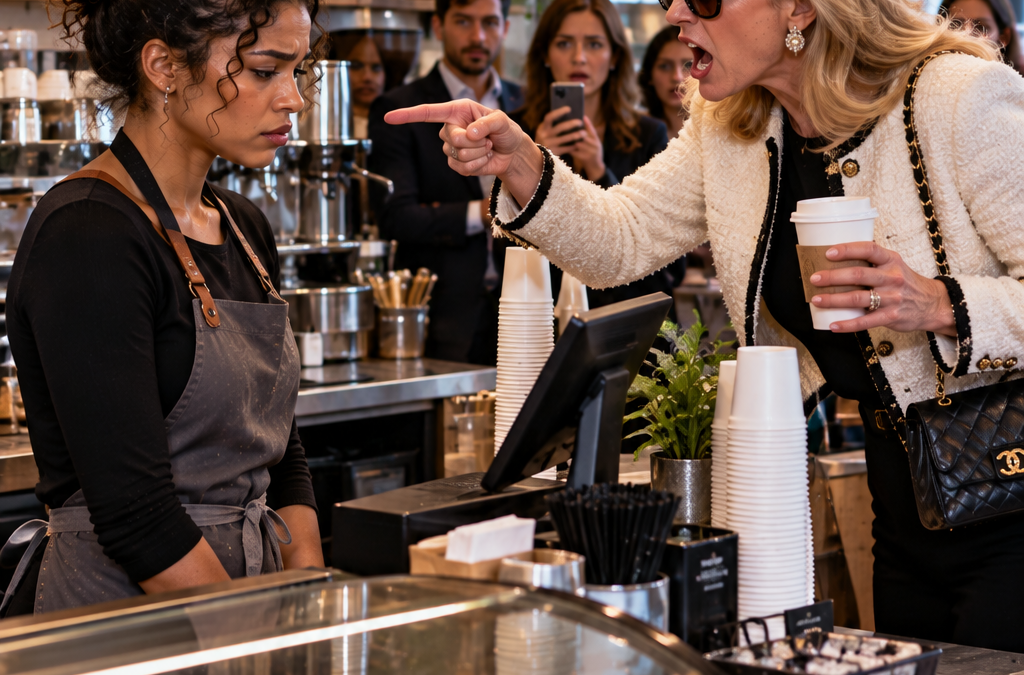
Candace Thornton entered.
White.
Early forties.
Fur coat despite weather that did not require one.
Oversized sunglasses she kept on indoors.
Perfume arrived several seconds before the rest of her.
She ignored the line.
Four customers.
Walked straight past them.
Nobody objected.
She placed both hands on the marble.
“I’ll have my usual.”
I smiled.
“Good morning. What can I—”
“I said my usual.”
Jess leaned toward me.
“Oat milk latte. Extra hot. Two vanilla. Light foam. Ceramic.”
I nodded.
Candace looked me over.
Slowly.
“You’re new.”
“Yes, ma’am.”
“How new?”
“Six days.”
She frowned.
“They’ve never had someone like you at this counter before.”
I looked up.
“Someone like me?”
Her mouth curved.
“Don’t play dumb.”
I could feel Jess go still.
Samuel was arranging pastries several feet away.
Close enough to hear.
He did not turn around.
I made the latte.
Perfect temperature.
Light foam.
Ceramic cup.
I placed it down.
“Here you are.”
Candace looked at my hand.
Then at the cup.
Then at me.
“Did you wash your hands?”
“Yes.”
“Recently?”
“Yes.”
She picked up the latte.
Took a sip.
Her face tightened.
“Bitter.”
“I can remake it.”
“Obviously.”
I poured it out.
Same beans.
Same milk.
Same two pumps.
Same temperature.
I served the second.
Candace sipped.
This time she looked directly into my eyes.
Then tilted the whole latte into the trash.
Slowly.
The liquid splashed against the liner.
Jess stopped moving.
Candace put down the empty cup.
“Still wrong.”
Then she left.
No tip.
No thank you.
Samuel waited until the door closed.
Then he approached me.
“Don’t take it personally.”
I looked at him.
“Does she do that often?”
“She spends a lot here.”
“That wasn’t what I asked.”
He smiled.
“Some customers require more patience.”
I wrote that sentence down later.
At home that night, I sat cross-legged on my bed with the laptop open.
DAY SIX.
CUSTOMER CT.
REPEAT HOSTILITY DIRECTED AT ME.
RACIAL CODING IN LANGUAGE.
MANAGER PRESENT.
NO INTERVENTION.
NO DOCUMENTATION.
I sent it to Terrence.
Thirty seconds later:
COME HOME.
No.
YOU’VE SEEN ENOUGH.
Not yet.
WHAT EXACTLY ARE YOU WAITING FOR?
Pattern confirmation.
EDEN, SHE POURED A LATTE INTO A TRASH CAN TO HUMILIATE YOU.
And Samuel’s response was to tell me not to take it personally.
Terrence stopped replying.
Day eight was worse.
The morning rush stretched out the door.
Candace arrived at eight.
Cut the line again.
No one objected.
She stood in front of me.
“You’re still here.”
“Good morning.”
“I thought you’d be gone by now.”
“Would you like your usual?”
She removed her sunglasses.
“Most of your kind don’t last long in places like this.”
My jaw tightened.
Only once.
Then relaxed.
“Your usual?”
“Are your hands clean?”
“Yes.”
“I mean clean.”
“I washed and sanitized before returning to the register.”
“I saw you touch a garbage bin.”
“I changed gloves and washed after.”
Her lip curled.
“You expect me to believe that?”
“Health protocol requires it.”
“I didn’t ask for a lecture.”
A businessman at the nearest table looked up.
Our eyes met briefly.
He heard everything.
I knew because his expression changed.
Then he looked back at his laptop.
Samuel stood beside the pastry case.
Croissants already perfectly arranged.
He rearranged them anyway.
I made the drink.
Candace accepted it.
No complaint this time.
She turned and left.
Jess came close after the rush.
“What is wrong with her?”
“I’m not sure.”
“Samuel needs to ban her.”
“Has anyone asked?”
Jess laughed without humor.
“From here?”
“Yes.”
“He’d ban us before her.”
That went into my report too.
Day eight.
CUSTOMER USED EXPLICIT PHRASE “YOUR KIND.”
MANAGER WITHIN AUDIBLE RANGE.
NO INTERVENTION.
BYSTANDER HEARD INCIDENT, DISENGAGED.
STAFF BELIEF: CUSTOMER MORE PROTECTED THAN EMPLOYEE.
That last line mattered most.
Culture is what employees believe will happen before they test the rules.
Day ten, Candace brought a friend.
Blonde.
Cashmere wrap.
Uncomfortable smile.
They stood together at the counter.
Candace didn’t speak to me.
She spoke about me.
“See?”
Her friend looked confused.
“This is what I deal with every morning.”
I started their drinks.
“They put this girl at the counter and expect me to pretend everything is fine.”
Her friend shifted.
“Candace.”
“No, look at her.”
My hands kept moving.
Grind.
Tamp.
Pull.
Steam.
“Does she look like she belongs in a place like this serving people like us?”
The friend stared at her phone.
Silence.
Candace leaned closer.
Still loud enough for me to hear.
“It’s like a social experiment.”
I poured milk.
“Put a Black girl in an Upper East Side café and wait to see how long regular customers keep coming.”
My stomach clenched.
Not because the words were new.
I had heard variations my whole life.
Boardrooms.
Hotels.
Retail stores.
The pain was in the room.
Twelve customers.
One manager.
Three other employees.
Everyone heard.
Nobody interrupted.
I placed the drinks on the counter.
“Your order.”
Candace took hers.
Started walking.
Then turned.
“Oh, sweetie.”
I looked up.
“You missed a spot.”
She pointed toward a perfectly clean stretch of marble.
“Maybe concentrate on cleaning instead of listening to conversations that don’t concern you.”
Her friend gave a small embarrassed laugh.
They left.
Twenty minutes later, I stood alone in the storage-room bathroom.
Hands gripping the edge of the sink.
I stared into the cloudy mirror.
I wasn’t angry at Candace.
Not yet.
I was angry at everyone who had trained her.
Not intentionally.
Through silence.
Each time nobody challenged her, she learned.
Each time Samuel pulled an employee away rather than confronting the customer, she learned.
Each time another customer lowered their eyes, she learned.
The room was teaching Candace there was no cost.
I opened my phone.
DAY TEN.
ESCALATION.
CT REFERRED TO RACE DIRECTLY.
COMPANION PRESENT.
NO CUSTOMER INTERVENTION.
MANAGER DID NOT APPEAR DESPITE AUDIBLE COMMENTS.
BYSTANDER PASSIVITY APPEARS NORMALIZED.
I stared at that sentence.
Normalized.
That was the real problem.
Cruelty was not exceptional in this location.
It had become part of the operating environment.
Day twelve, Candace arrived angry before she even saw me.
Her eyes were swollen.
She checked her phone three times while walking to the counter.
Later, I learned the reason.
The man financing most of her lifestyle, Gerald Ashford, had attended a charity gala the night before.
With his wife.
Photographs were everywhere.
Gerald smiling.
His wife beside him.
Candace had apparently believed promises that did not survive photographers.
I knew none of that then.
I only saw a woman looking for somewhere to put humiliation.
She found me.
“Hey.”
I looked up.
“Good morning.”
“Don’t good morning me.”
“What can I get you?”
“You made me sick.”
I paused.
“Excuse me?”
“Last week.”
Her voice rose.
“You gave me regular milk.”
“No, ma’am.”
“What?”
“I used oat milk.”
“You’re calling me a liar?”
“I remember preparing the drink.”
“I was sick for two days.”
“I’m sorry you were unwell.”
“Sorry doesn’t fix incompetence.”
The café quieted.
Then she leaned closer.
“Maybe you shouldn’t handle food.”
I felt Jess move beside me.
Candace continued.
“Have you even been tested?”
I stared.
She smiled.
“You don’t exactly come from the cleanest background.”
Everything stopped.
A spoon touched a saucer.
Then silence.
A woman near the door pulled her stroller closer.
Samuel came out from the back.
Finally.
For one second, I thought:
This is it.
He heard that.
Nobody can pretend now.
Samuel walked to the counter.
Not toward Candace.
Toward me.
“Eden.”
I looked at him.
“Why don’t you take a break?”
I said nothing.
“I’ll cover.”
Candace folded her arms.
Samuel smiled at her.
“Sorry about that, Ms. Thornton.”
Sorry.
To her.
I untied my apron.
Walked to the storage room.
Sat on a plastic chair beside a mop bucket.
My hands shook then.
Not because Candace frightened me.
Because the complaints we had acquired with the company were becoming real people in my head.
Former employee wrote that management removed her from floor after customer used racial slur.
Closed.
Insufficient evidence.
Another said:
Manager reduced shifts after she objected to harassment from regular customer.
Closed.
Scheduling decision.
I understood how those reports had been buried.
You didn’t need to falsify anything.
You only needed to rename it.
Harassment became difficult customer.
Retaliation became scheduling.
Fear became turnover.
Discrimination became service recovery.
I texted Terrence.
MANAGER RESPONSE CONFIRMED. REMOVED STAFF MEMBER TO PROTECT AGGRESSIVE CUSTOMER. EXACT MATCH WITH PRIOR COMPLAINT PATTERN. FULL LEADERSHIP RESTRUCTURE LIKELY REQUIRED.
His response:
SAY THE WORD. LEGAL CAN SEND THE MEMO TONIGHT.
I stared.
Not yet.
EDEN.
I need them to show me everything.
WHAT ELSE IS LEFT?
I didn’t know.
That was the point.
Day fourteen, Candace brought an audience.
Two women.
White.
Designer coats.
Perfect hair.
They took the table closest to the counter.
Candace stayed standing.
“Watch this.”
One woman laughed.
The other didn’t.
Candace looked at me.
“My usual.”
“Oat milk latte, extra hot, two vanilla, light foam, ceramic.”
“Did I ask you to recite it?”
“No, ma’am.”
“Then make it.”
I turned.
I heard every word behind me.
“She’s been here two weeks and still can’t make coffee.”
One friend said:
“Maybe she just doesn’t like you.”
Candace laughed.
“Please. They hire these people for quotas.”
Jess stopped arranging pastries.
Her head turned toward Samuel.
Waiting.
He looked down.
I made the latte.
Candace sipped.
Grimaced theatrically.
“This tastes like you made it with your feet.”
One friend laughed.
I took the cup.
Made another.
No complaint.
No argument.
Not because I accepted what she said.
Because I was observing.
Second drink.
She sipped.
“Mediocre.”
Then walked away.
Afterward, Jess cornered Samuel.
I pretended to clean nearby.
“You’re not going to say anything?”
Samuel frowned.
“About?”
I nearly turned around.
Jess stared.
“Candace.”
“She is a customer.”
“She is racist.”
“Jess.”
“What?”
“Lower your voice.”
“Why?”
“Because I need you focused on work.”
“She’s humiliating Eden every day.”
Samuel sighed.
“Eden seems capable of handling herself.”
That sentence went into my report.
When a system wants to avoid responsibility, it often praises the victim’s resilience.
She’s strong.
She can handle it.
She’s tough.
All ways of saying:
Therefore I don’t have to act.
Day fifteen, I was wiping a spill near the base of the counter when I noticed Candace’s phone.
Camera pointed at me.
She took a picture.
I looked up.
She didn’t hide it.
Showed her friend.
They laughed.
I said nothing.
That evening, Terrence called rather than texted.
“I’m sending a car.”
“No.”
“Eden.”
“What happened?”
“Candace posted the photo.”
My stomach tightened.
“Where?”
“Private Instagram.”
“What did she write?”
Silence.
“Terrence.”
He sighed.
“I’m quoting exactly.”
I waited.
“‘The help doing what the help does best. At least she knows her place.’”
I closed my eyes.
“Screenshot?”
“Saved.”
“Original metadata?”
“We have username and timestamp.”
“Good.”
“Good?”
“Yes.”
“What is wrong with you?”
“Nothing.”
“Come out.”
“Three more days.”
“No.”
“I need three.”
“For what?”
I stood and walked toward my kitchen window.
Brooklyn lights.
Cars.
People moving.
“I want to see what Samuel does when she gets worse.”
“He has already done nothing.”
“I know.”
“Then what are you testing?”
“Whether there is a line.”
Terrence went quiet.
“Eden.”
“Yes?”
“What happens if there isn’t?”
I looked at my reflection.
“Then I need to know that too.”
He exhaled.
“Three days.”
“Three.”
“Not four.”
“Agreed.”
Day seventeen.
Candace came alone.
No smile.
No order.
She simply stood in front of me.
“You know what fascinates me?”
I waited.
“How someone like you can stand there pretending this is normal.”
“Would you like to order?”
“Don’t interrupt.”
I remained still.
“You put on that apron and suddenly you think you’re equal to everyone on this side of the counter.”
My hands rested flat on the marble.
“You aren’t.”
Silence around us.
“You’re serving me.”
She leaned forward.
“Because that’s where you belong.”
I looked at her.
“And deep down, sweetheart, you know it.”
Two tables away, a mother covered her daughter’s ears.
The child watched anyway.
Children understand cruelty before vocabulary.
I said:
“Would you like your usual?”
Candace slammed her palm onto the counter.
Several people jumped.
“Are you deaf?”
Samuel appeared.
I watched him approach.
Again, part of me hoped.
He looked at Candace.
“Is everything all right, Ms. Thornton?”
“No.”
She pointed at me.
“Your employee has an attitude problem.”
Samuel nodded.
“She’s rude.”
Another nod.
“Dismissive.”
Samuel’s face tightened politely.
“She makes me uncomfortable every time I come here.”
Then Samuel turned to me.
“Eden.”
I held his eyes.
“Maybe take the back for a while.”
Three seconds.
I looked for anything in him.
Embarrassment.
Regret.
Courage.
Nothing strong enough to beat fear of losing revenue.
I untied the apron.
Went to the storage room.
Texted Terrence.
DAY 17. MANAGER SIDED WITH AGGRESSOR AGAIN. PATTERN UNBROKEN.
He answered:
ONE MORE DAY.
I typed:
Yes.
Day eighteen.
I knew it was my last shift before I even left Brooklyn.
I woke earlier than usual.
Sat at my kitchen table.
Opened the acquisition agreement.
Hartwell & Company Holdings.
Purchaser:
Bloom Collective.
Authorized signature:
Eden Underwood.
My name sat on page forty-three.
The café wasn’t technically “mine” in the childish sense people later used.
Bloom owned the chain.
I controlled Bloom.
That distinction mattered legally.
It mattered very little emotionally.
I closed the agreement.
Took the subway.
Clocked in.
At eight sharp, Candace arrived.
Alone.
Smiling.
That smile bothered me.
She ordered.
I made her latte.
Oat milk.
Extra hot.
Two vanilla.
Light foam.
Ceramic.
Perfect.
I placed it down.
Candace lifted the cup.
Inspected the foam.
Smelled it.
Held it near the light.
Took a tiny sip.
I watched her.
She looked into my eyes.
Then tipped the cup.
Coffee poured over my hands.
For one second, I didn’t understand.
Heat.
Wet.
Then pain.
The latte wasn’t hot enough to cause severe burns.
But it hurt.
Liquid ran between my fingers.
Across my wrists.
Down my apron.
Through my shirt.
Onto my stomach.
My shoes.
The floor.
Candace kept pouring.
Slowly.
Deliberately.
Until the cup was empty.
Fourteen people watched.
A man in the far corner raised his phone.
Samuel stood beside the espresso machine.
His mouth opened.
Closed.
He looked down.
Candace placed the empty ceramic cup on the counter.
Click.
“Oops.”
Coffee dripped from my fingers.
She smiled.
“Guess your hands are dirty again.”
Something inside me became very quiet.
I looked at my hands.
Then at Samuel.
He still said nothing.
I looked around the café.
Fourteen customers.
Jess.
Malik.
Rosa.
Everybody frozen.
The man filming.
No voice.
No movement.
Then I understood.
This was the line.
And even here, Samuel would not cross it.
I reached behind myself.
Untied the apron.
Folded it.
Placed it on the counter.
Candace watched.
“What are you doing?”
I looked at her.
“I think I’ve seen enough.”
She smiled, believing she had won.
Maybe she thought I was quitting.
In a way, I was.
I picked up my bag.
Walked out through the front door.
Not the employee entrance.
The front.
The morning air hit my face.
Cold.
Clean.
My hands still stung.
Behind the glass, nobody moved.
I stood on Madison Avenue and called Terrence.
He answered before the first ring completed.
“I’m done.”
His voice sharpened.
“Are you hurt?”
“Minor burn.”
“I’m sending—”
“Listen.”
“What?”
“Samuel goes.”
“Agreed.”
“Regional operations review.”
“Already drafting.”
“Every complaint reopened.”
“Yes.”
“Customer-abuse policy rewritten chain-wide.”
“Yes.”
“Direct anonymous reporting to corporate.”
“Done.”
“Bystander training.”
“For managers?”
“Everyone.”
Pause.
“Security footage preserved?”
“Legal is notifying seller’s transition counsel now.”
“And the customer who poured the coffee?”
“We handle separately.”
I looked at my hands.
“Not yet.”
“Eden.”
“I want the restructuring announced before anyone knows why.”
Terrence understood.
“You don’t want it to look like revenge.”
“It isn’t revenge.”
I looked back through the café window.
Candace was using napkins to wipe her phone.
Samuel was speaking to Jess.
“What is it?”
“Correction.”
Fourteen days later, Forbes hit newsstands.
The cover photograph showed me in a black blazer.
Arms crossed.
No jewelry.
Minimal makeup.
Headline:
THE QUIET DISRUPTOR.
The profile had been planned months earlier.
The timing wasn’t.
Naomi Griffin, the journalist, had followed Bloom’s expansion for almost a year.
During our final interview she asked:
“What did you do after the Hartwell acquisition?”
I hesitated.
Then told her.
Everything.
Eighteen days.
Barista.
Upper East Side.
The complaints.
Samuel.
Candace.
Naomi stared.
“You’re serious?”
“Yes.”
“You personally worked there?”
“Yes.”
“Does anyone know?”
“Not yet.”
That changed the article.
Eight pages.
Bloom’s founding.
The twelve hundred dollars.
The secondhand laptop.
The supply chain.
Retail partnerships.
Our most recent financing round.
Then Hartwell.
Naomi quoted me:
“I don’t buy companies from a boardroom. I needed to stand where the employees stood.”
She asked about the harassment.
I refused to name Candace.
“This is not about making one customer famous.”
“What is it about?”
“A manager removing a Black employee from the floor to protect the comfort of the person abusing her.”
I paused.
“That told me what was broken.”
The article went live at six.
By noon, it had been shared hundreds of thousands of times.
Employees across service industries began discussing it.
Then somebody found Candace’s Instagram screenshot.
I still don’t know who released it first.
But once it appeared, control disappeared.
Left side:
Me on my knees wiping the café floor.
THE HELP DOING WHAT THE HELP DOES BEST. AT LEAST SHE KNOWS HER PLACE.
Right side:
Forbes cover.
EDEN UNDERWOOD.
CEO.
FOUNDER.
The internet loves reversal.
It loves hidden power.
People wrote:
SHE MOCKED THE OWNER.
SHE DIDN’T KNOW THE BARISTA WAS WORTH $200 MILLION.
WORST CUSTOMER MISTAKE EVER.
I hated those headlines.
They missed the point.
Candace did not become wrong because I was wealthy.
She was wrong when she believed I wasn’t.
By afternoon, her name was public.
So was Gerald Ashford’s connection to her.
I had no involvement in that.
People online investigate strangers with frightening speed.
Candace was at brunch when one of her friends showed her the Forbes cover.
Later, during discovery, we obtained messages from that afternoon.
OH MY GOD.
CANDACE THAT’S HER.
CALL ME NOW.
YOUR POST IS EVERYWHERE.
Then Gerald called her.
I never heard the call.
Candace described it later under oath.
He told her his PR team had connected her name to his.
He said they were finished.
The apartment belonged to him.
The vehicle was leased through his company.
The cards were extensions of his accounts.
Within seventy-two hours, the life Candace had presented as permanent disappeared.
People later called that justice.
I didn’t.
Gerald Ashford had participated in a different kind of power imbalance with Candace.
Whatever their arrangement was, I had no interest in celebrating a man cutting off a financially dependent woman because she became embarrassing.
Her conduct toward me remained indefensible.
So did the urge people had to turn her suffering into entertainment.
Those are separate truths.
Our own problems were enough.
Former Hartwell employees began contacting Naomi.
Three had worked at the flagship.
They described the same management pattern.
Abusive customers.
Samuel apologizing to them.
Employees removed from the floor.
Hours cut.
Complaints ignored.
One former barista told Naomi:
“You learn fast. If the customer has enough money, you are the problem.”
That sentence hurt more than anything Candace had said.
Because it described a system.
Hartwell’s old ownership had issued bland statements before Bloom formally took public control.
Deep commitment.
Safe environment.
Values.
Meaningless language.
We did not repeat it.
Bloom released one statement.
Short.
Hartwell & Company is now under new ownership. We have substantiated serious failures at the Upper East Side location involving employee protection, complaint handling and management accountability. Corrective action is underway across all twelve locations.
Samuel was terminated.
I signed the letter.
Not personally for drama.
Because authority should be documented.
CAUSE:
Sustained failure to protect employee welfare.
Failure to document recurring harassment.
Retaliatory management practices.
Prioritization of customer revenue over employee physical and psychological safety.
The flagship closed for two weeks.
We paid employees for every scheduled shift during closure.
That part mattered.
“Why pay them while closed?” one board member asked.
“Because they didn’t break it.”
No one argued after that.
We rewrote policy.
Not a vague dignity statement.
Procedures.
A customer using discriminatory or threatening language received one warning if appropriate.
Severe conduct meant immediate removal.
Physical aggression meant police contact and permanent ban.
Employees could report directly to corporate without manager approval.
Managers were evaluated partly on retention and complaint response, not only sales.
Every employee received bystander-intervention training.
Including executives.
Especially executives.
Then came the legal question.
Candace had photographed me without permission, posted the image with a degrading caption, repeatedly harassed me and finally poured hot coffee on me.
My attorneys recommended action.
I resisted.
Terrence noticed.
“Why?”
“Because the optics are disgusting.”
“Meaning?”
“CEO sues customer.”
“She assaulted you.”
“Yes.”
“You have video.”
“Yes.”
“You documented eighteen days.”
“Yes.”
“So?”
“I don’t want this to become rich woman destroys another woman.”
Terrence leaned back.
“Eden.”
“What?”
“She targeted you because she believed you had no power.”
“I know.”
“Then use the legal system like anyone else.”
That sentence changed my thinking.
Not use money to crush her.
Use process.
So we filed.
Harassment.
Defamation.
Privacy-related claims tied to the photograph and publication.
The final coffee incident became central evidence.
The man recording from the corner contacted our lawyers.
Fifty-three seconds.
Clear audio.
Clear image.
Candace tipping the cup.
Coffee running over my hands.
“Guess your hands are dirty again.”
Samuel standing behind me.
Fourteen silent people.
The video spread after becoming part of public reporting.
Millions watched.
I didn’t.
Once was enough.
Discovery turned the case from my word into chronology.
Candace’s phone contained messages.
Morning entertainment at the café.
The Black girl who thinks she can make coffee.
A group-chat message sent before the Instagram post:
WATCH ME PUT THIS ONE IN HER PLACE.
Another:
SHE LOOKED LIKE SHE WAS ABOUT TO CRY TODAY. BEST MONDAY I’VE HAD IN MONTHS.
When my attorney showed me that one, I stared for a long time.
I hadn’t been close to crying that day.
But that’s what she wanted.
The cruelty wasn’t accidental.
She wanted evidence that she had reached me.
That changed something in me.
Until then, I had thought Candace was careless.
Entitled.
Racist.
Angry.
The messages showed intention.
She treated humiliation as entertainment.
Samuel’s deposition was worse in a different way.
My attorney asked:
“Were you aware Ms. Thornton repeatedly made discriminatory remarks?”
“Yes.”
“Did you document them?”
“No.”
“Why?”
“I didn’t believe documentation was necessary.”
“Did employees complain?”
“Informally.”
“Did you take action?”
“I separated parties when necessary.”
“Separated parties?”
“I sometimes reassigned the employee.”
“Why not remove Ms. Thornton?”
Samuel paused.
Then gave the answer I already knew.
“She spent a lot of money.”
My attorney waited.
“How much money makes racial harassment acceptable?”
Samuel’s lawyer objected.
The question still existed.
Our daily reports became evidence too.
Eighteen entries.
Time-stamped.
Sent to Terrence contemporaneously.
Clinical language.
No dramatic adjectives.
Day six.
Day eight.
Day ten.
Day twelve.
Day fourteen.
Day fifteen.
Day seventeen.
Day eighteen.
Candace’s defense weakened.
Settlement became the practical conclusion.
I had three conditions.
The apology could not say if anyone was hurt.
Could not say that isn’t who I am.
Could not blame personal stress.
Could not mention not knowing who I was.
My attorneys drafted guidelines.
Candace wrote the actual statement under review.
She named me.
She acknowledged racial hostility.
She acknowledged intentional humiliation.
She acknowledged pouring the coffee.
No excuses.
The financial settlement was significant.
Not enough to ruin her life.
Enough to make the case real.
Part was paid over time.
She agreed to complete a certified anti-discrimination education program and court-monitored compliance requirements.
She was permanently banned from all Hartwell locations.
Then we settled the company’s separate exposure related to management failure.
That money went largely toward affected workers, legal costs and employee-support programs.
I did one interview afterward.
Naomi Griffin.
Same journalist.
No stage.
No studio audience.
White room.
Two chairs.
Glass of water.
She asked:
“Why did you stay eighteen days?”
I thought carefully.
“I didn’t go in to catch anyone.”
“What did you go in for?”
“To understand.”
“And did you?”
“Yes.”
“What did you learn?”
“That abusive people rarely operate alone.”
Naomi waited.
“They operate inside environments.”
“What kind?”
“Environments that reward silence.”
I looked at her.
“Candace was cruel. She owns that.”
“But?”
“But she walked into the same room eighteen days in a row and learned something.”
“What?”
“That nobody would stop her.”
Naomi became quiet.
“She learned Samuel cared more about her spending than his employees.”
I continued.
“She learned customers would look away.”
“She learned coworkers were scared.”
“She learned I could be removed from the floor before she would be removed from the café.”
I folded my hands.
“So she escalated.”
Naomi asked:
“Did anyone surprise you?”
“Yes.”
“Who?”
“The man who recorded the final incident.”
“Because he recorded?”
“Because eventually somebody decided seeing wasn’t enough.”
Naomi nodded.
“Was the settlement justice?”
“No.”
She looked surprised.
“What is justice?”
“The next barista.”
I didn’t need to think about that answer.
“The next employee who gets screamed at.”
I leaned forward.
“And her manager walks over to the customer.”
“What does the manager say?”
“You need to leave.”
That was all.
“That’s justice.”
Six months later, Hartwell looked different.
Not perfect.
Different.
Employee turnover at the flagship dropped sharply.
Complaint reporting increased first.
Some board members panicked.
“Reports are up.”
“Good.”
They stared at me.
“People trust the system enough to use it.”
Months later, serious incidents fell.
Managers intervened faster.
Employees reported feeling safer.
That is what improvement often looks like.
First, numbers get uglier because truth becomes easier to tell.
Then they improve.
We opened a new Brooklyn flagship three blocks from my apartment.
The board wanted my name attached to it.
I refused.
Hartwell Brooklyn.
That was enough.
I also created the Diane Underwood Foundation.
Named after my grandmother.
Diane raised me for several years while my mother worked.
North Carolina porch.
Plastic lawn chairs.
Sweet tea.
She once told me:
“The world will build a ceiling above your head before you’ve decided how tall you want to stand.”
I was sixteen.
I asked:
“What do I do?”
She shrugged.
“Know the ceiling ain’t the sky.”
I carried that sentence everywhere.
The foundation funded legal support for service workers facing documented workplace harassment and discrimination.
Not only racial cases.
Sexual harassment.
Disability discrimination.
Retaliation.
Wage-related abuse tied to coercion.
In the first six months, we assisted hundreds of workers through partner organizations.
The sentence we heard most often was:
I didn’t think anyone would believe me.
That became the sentence I hated most.
Candace left Manhattan.
I didn’t follow her life.
Reporters did.
She completed the required program.
Paid settlement installments.
Several friends disappeared.
Social circles closed.
Some people wrote gleeful articles about her losing access to expensive restaurants.
I disliked those too.
Humiliation was not the cure for humiliation.
I wanted accountability.
Not sport.
Samuel left hospitality.
Last report I heard placed him at a warehouse operation in New Jersey.
I never contacted him.
I hoped he learned something.
I don’t know whether he did.
Hartwell changed.
The first page of the new employee handbook said:
THE DIGNITY OF OUR STAFF IS NOT NEGOTIABLE.
That line was mine.
But slogans don’t protect people.
Systems do.
So underneath the line came twelve pages of procedures.
Definitions.
Escalation standards.
Documentation requirements.
Manager responsibilities.
No-retaliation provisions.
Independent reporting channels.
Every policy had an owner.
Every complaint had a deadline.
Every unresolved case escalated automatically.
I had learned a long time ago that values without process are decoration.
At the Upper East Side café, employees placed a framed copy of my Forbes cover behind the counter.
I told them to remove it.
Jess called me.
“Seriously?”
“Yes.”
“Why?”
“Because I don’t want employees needing my face on a wall to remember they have rights.”
Silence.
Then she laughed.
“Fine.”
“What did you replace it with?”
“A sign.”
“What sign?”
“You’ll hate it.”
I visited the next morning.
Behind the counter was a simple black frame.
Inside:
IF A CUSTOMER ABUSES YOU, GET A MANAGER.
IF THE MANAGER DOES NOTHING, CALL CORPORATE.
IF CORPORATE DOES NOTHING, CALL EDEN.
I stared.
Jess grinned.
“You hate it.”
“I absolutely hate it.”
“Are we removing it?”
I looked at her.
“No.”
She smiled.
“Thought so.”
I still made my own coffee.
French press.
Black.
No milk.
No sugar.
People called that symbolic after the story.
It wasn’t.
I had always drunk it that way.
Sometimes a cup of coffee is just coffee.
That lesson applied elsewhere too.
People desperately wanted my eighteen days at Hartwell to be a parable about a secretly powerful woman teaching an arrogant rich woman a lesson.
It wasn’t.
I did not wake up each morning thinking:
Wait until she discovers who I am.
Most mornings, I thought:
How many employees have lived through this without an exit?
That was the difference.
I had somewhere to go.
I could stop at any moment.
One text to Terrence.
One phone call.
One revelation.
I was financially secure.
Legally protected.
Connected.
Most baristas were not.
Jess needed rent.
Malik needed tuition.
Rosa needed childcare.
That meant the same insult cost them more than it cost me.
I wanted our policies built around that reality.
Power changes the price of confrontation.
Telling someone to “just speak up” is easy when losing a job won’t threaten your housing.
That was why I stopped praising my own silence as strength.
Some readers said:
Eden was so patient.
Eden was so composed.
Eden never gave Candace the satisfaction.
The truth?
I had privilege Candace couldn’t see.
That made composure easier.
I knew Terrence was watching my reports.
I knew legal counsel existed.
I knew the company belonged to us.
A twenty-two-year-old barista with no savings does not have that security.
My responsibility was not to prove I could endure what they endured.
It was to build a company where they wouldn’t need to.
I told our managers that during training.
A regional supervisor asked:
“What if a customer claims discrimination policies are being weaponized against them?”
“Investigate.”
“What if the employee is wrong?”
“Correct the employee.”
“What if the customer is wrong?”
“Correct the customer.”
“What if the customer spends fifty thousand dollars a year?”
I looked at him.
“Then they can spend fifty thousand somewhere else.”
No one laughed.
“Revenue is not moral authority.”
I repeated that often.
One year after the acquisition, I returned to the flagship at eight in the morning.
Not undercover.
No announcement.
I wore jeans.
Coat.
Hair tied back.
The café was crowded.
Jess had become assistant manager.
Samuel’s replacement was a woman named Priya Shah.
Former restaurant operations director.
Direct.
Calm.
I ordered at the register.
The new barista recognized me.
Her eyes widened.
“Ms. Underwood?”
“Eden.”
She looked terrified.
“Sorry.”
“Don’t apologize.”
I ordered coffee.
Then sat near the window.
Ten minutes later, a customer complained loudly that his croissant was cold.
The barista offered to replace it.
He called her incompetent.
Priya approached immediately.
“Sir, we’ll replace your food.”
He kept going.
“That’s fine. But you cannot speak to our staff that way.”
He stared.
“Excuse me?”
“You’re welcome to stay if you can communicate respectfully.”
“I spend hundreds here.”
“I hope you continue to.”
Her voice remained calm.
“But not while abusing employees.”
He looked around.
Nobody came to rescue him.
He muttered something.
Sat down.
The barista breathed again.
I looked at my coffee.
That mattered more to me than the Forbes cover ever had.
Afterward, Priya noticed me.
She came over.
“How’d I do?”
“You already know.”
“I’m asking anyway.”
“You protected the employee without humiliating the customer.”
She smiled.
“Training works.”
“Culture works.”
She nodded.
Then asked:
“Do you ever miss working behind the counter?”
“No.”
She laughed.
“Immediate answer.”
“I respect the work.”
“That’s different.”
“Yes.”
I looked toward the espresso machine.
“I miss knowing exactly what the job feels like.”
That was true.
Leadership creates distance automatically.
Private calendars.
Assistants.
Conference rooms.
Executive dashboards.
Information arrives cleaned.
Summarized.
Organized.
By the time bad news reaches a CEO, ten people have adjusted the language.
Customer screamed racial abuse becomes difficult interaction.
Manager failed to act becomes coaching opportunity.
Employee quit becomes voluntary attrition.
That is why I still visit operations without entourage.
Not disguised.
I never repeated the undercover experiment.
Once was enough.
But I talk to employees without their managers whenever possible.
I ask:
“What makes your shift harder than it should be?”
That question reveals more than:
“How are things going?”
People answer “fine” when you ask broad questions.
Specific questions create openings.
What are you afraid to report?
Which rule doesn’t work?
Who gets protected here?
When did you last think about quitting?
I learned to ask those.
Years later, my grandmother’s sentence still sits inside the first page of my notebook.
The ceiling isn’t the sky.
I think about Candace sometimes.
Not often.
Usually when people ask if I forgave her.
I never know how to answer because forgiveness means different things to different people.
I do not spend my days angry at her.
I do not want her life destroyed.
I do not want her humiliated forever.
I also do not excuse what she did.
Those facts can exist together.
I hope the woman who finished two hundred hours of mandated education was not the same woman who walked into Hartwell on day six.
I have no way to know.
Change does not require my observation.
What I know is that I changed too.
Before Hartwell, I believed culture problems were usually management problems.
Afterward, I understood bystanders as part of culture.
Not equally responsible.
That matters.
Candace caused the harm.
Samuel enabled it professionally.
The customers who looked away were not morally identical to either of them.
But silence still had an effect.
Each silent morning made the next morning easier for her.
That’s why bystander training became mandatory.
Not because I expect every customer to become a hero.
I don’t.
I don’t want strangers starting dangerous confrontations.
Sometimes intervention means telling a manager.
Sometimes recording safely.
Sometimes checking on the employee afterward.
Sometimes saying one sentence.
“That isn’t okay.”
Small actions change social permission.
Candace had eighteen days of permission.
Until she didn’t.
I remember day eighteen with strange clarity.
The coffee wasn’t the worst moment.
The worst came seconds before.
When she began tipping the cup, I saw Samuel.
He knew.
Before the liquid touched me, he understood what she was doing.
And he froze.
That fraction of a second told me why three employees had quit.
They didn’t believe help would come.
For employees, that belief matters almost as much as the incident itself.
A workplace becomes unsafe long before someone gets physically hurt.
It becomes unsafe when workers know management will calculate their dignity against revenue.
Samuel made that calculation every day.
Candace simply understood the exchange rate.
One afternoon, Terrence came into my office with the old reports.
The ones from before acquisition.
He put them down.
“Want to see something depressing?”
“No.”
He opened one anyway.
Former barista.
Complaint.
Customer told her people from her country should not handle food.
Manager response:
Employee moved to back-of-house duties for remainder of shift to de-escalate situation.
Terrence pointed.
“Sounds familiar.”
I read the next.
Employee reported regular customer touching hair and asking inappropriate racial questions.
Manager response:
Informal coaching provided to employee on customer engagement strategies.
I stared.
“They coached her?”
“Apparently.”
Another.
Employee reported verbal harassment.
Resolution:
No further action after schedule adjustment.
“Whose schedule?”
“Employee.”
I leaned back.
There it was.
The whole system existed before Candace met me.
She was not an anomaly.
She was a predictable outcome.
“What do we do with these?”
Terrence asked.
“All reopened?”
“Yes.”
“Even former employees?”
“Yes.”
“Some are years old.”
“Contact them.”
“For what?”
“To tell them we reread what happened.”
He nodded.
“And?”
“Apologize where the company failed.”
Terrence was quiet.
“Legal will hate that.”
“Legal can draft accurately.”
“You know apologies can create exposure.”
“Failures already create exposure.”
He smiled slightly.
“You really did learn too much behind that counter.”
“Apparently.”
We contacted former staff.
Some never answered.
Some said thank you.
One woman cried.
Another said:
“Please don’t call me again.”
We respected that.
An apology is not a demand for reconciliation.
It’s an acknowledgment.
That distinction became important to me.
The company established a worker-assistance fund partly because of those cases.
Counseling.
Emergency legal referrals.
Temporary scheduling support for employees dealing with harassment-related stress.
Not glamorous.
Useful.
Bloom continued growing.
Series B closed at fifty million.
New markets.
New stores.
More press.
Investors loved the undercover story.
Some wanted me to make it part of the brand.
I refused.
One proposed campaign showed me wearing the old Hartwell apron beside the line:
FROM BARISTA TO BILLIONAIRE BOSS.
I stared at the mockup.
“Absolutely not.”
The marketing director looked disappointed.
“It’s powerful.”
“It’s false.”
“You did work as a barista.”
“For eighteen days.”
“People connect with it.”
“Real baristas work years.”
I pushed the mockup back.
“I don’t get to cosplay their labor for brand equity.”
The room went quiet.
We killed the campaign.
That decision received no headlines.
Good.
Not every ethical choice needs applause.
My old apron remained folded in a box in my apartment.
Coffee stain still faintly visible.
I kept it.
Not as a trophy.
A reminder.
Near it was the first leather notebook from Bloom’s founding days.
Two objects from different chapters.
Both taught me similar things.
When I started Bloom, people underestimated me because I was young.
Then because I was Black.
Then because I was a woman.
Later, after success, some overestimated me because of valuation.
Both forms of judgment are lazy.
The woman behind the café counter and the woman on Forbes were identical.
Same brain.
Same company ownership.
Same history.
Same flaws.
Same dignity.
The magazine didn’t transform me.
It transformed other people’s behavior.
That should bother us.
I remember returning to the café after the Forbes story.
A regular recognized me.
He had been present on day eight.
The businessman who heard Candace ask whether my hands were clean.
He approached my table.
“Ms. Underwood?”
“Yes?”
“I owe you an apology.”
I waited.
“I was there.”
“I remember.”
His face tightened.
“You saw me?”
“Yes.”
He looked embarrassed.
“I heard what she said.”
“I know.”
“I should’ve said something.”
“Yes.”
He seemed surprised I didn’t rescue him from the discomfort.
“I’ve thought about it.”
I nodded.
“I was afraid of making a scene.”
“That makes sense.”
He looked relieved.
Then I continued.
“But a scene was already happening.”
His face changed.
“I just happened to be the only person required to stand inside it.”
He looked down.
“I’m sorry.”
“Thank you.”
He left.
That conversation stayed with me.
Most bystanders do not believe they are choosing cruelty.
They believe they are choosing peace.
Avoiding conflict.
Minding their business.
Not escalating.
Sometimes those are reasonable instincts.
But there are moments when neutrality does not reduce conflict.
It isolates the target.
I never expected anyone in that café to fight Candace.
I would not have wanted that.
One sentence would’ve mattered.
“That’s inappropriate.”
“Leave her alone.”
“Manager, are you hearing this?”
Anything.
The silence made her larger.
That lesson influenced the foundation too.
We began funding workplace-bystander programs alongside legal representation.
One trainer told me:
“People don’t intervene because they think intervention has to be dramatic.”
Exactly.
It doesn’t.
Sometimes courage is one sentence spoken at normal volume.
Years after Hartwell, a young employee approached me at a Bloom event.
She worked in distribution.
“Can I tell you something?”
“Of course.”
“My supervisor made a comment last year.”
“What kind?”
“About my hijab.”
I waited.
“A coworker said, ‘That’s not okay.’”
She smiled.
“Just that.”
“What happened?”
“The supervisor apologized.”
“And?”
“Never did it again.”
She looked at me.
“I think about your café story whenever people say one person can’t change a room.”
That stayed with me more than any magazine profile.
My grandmother died before Bloom became large.
She never saw the Forbes cover.
I think she would’ve made fun of it.
Probably asked why I looked so serious.
But she would have understood the Hartwell lesson.
Diane Underwood had cleaned houses when she was young.
She knew what uniforms did to other people’s imaginations.
Once, when I was thirteen, a woman handed Grandma a grocery list and said:
“Pick these up on your way tomorrow.”
Grandma replied:
“I don’t do shopping.”
The woman stared.
“But you’re the housekeeper.”
“I clean your house.”
Same calm.
“I’m not your wife.”
I laughed until Grandma made me stop.
On the drive home, she said:
“People will keep expanding your job if you let them decide who you are.”
I understood that sentence much later.
Candace looked at my apron and expanded it into identity.
Servant.
Inferior.
Dirty.
Disposable.
The apron said none of those things.
It said barista.
Nothing more.
People assign meaning to uniforms because hierarchy is convenient.
Suit means intelligence.
Apron means service.
Fur coat means importance.
But clothes are descriptions of a moment, not measurements of a human being.
That was why I eventually stopped telling the Hartwell story as a secret-CEO reveal.
I tell it differently now.
A woman walked into a café every morning and abused an employee.
That should have been enough.
No Forbes cover required.
No acquisition agreement.
No valuation.
No twist.
If respect depends on discovering that the person you insulted can punish you, you are not respectful.
You are cautious.
Those are not the same.
I still go to the Brooklyn Hartwell sometimes.
Early.
6:45.
I sit near the window.
Nobody gives me special service anymore.
I asked them not to.
Once, a new employee charged me for oat milk even though I hadn’t ordered oat milk.
She panicked after realizing who I was.
“I can refund it.”
“It’s seventy-five cents.”
“I’m so sorry.”
“Keep it.”
She looked horrified.
“Seriously?”
“Yes.”
Then I smiled.
“Just don’t pour it on me.”
She stared.
Then laughed so hard she had to step away from the register.
I laughed too.
That was when I realized the memory had changed.
Not disappeared.
Changed.
Trauma is a word people use carefully, sometimes too broadly.
I don’t know if I would call Hartwell trauma.
I had endured worse things.
But I remembered the heat on my hands for a long time.
The smell of vanilla.
The ceramic click.
Sometimes, while making coffee at home, steam hit my fingers and brought the moment back.
Then one morning, it didn’t.
That felt like healing.
Quiet.
No ceremony.
The world moved on.
Candace moved on somewhere.
Samuel moved on.
Hartwell moved on.
I did too.
But the policy stayed.
The reporting line stayed.
The foundation stayed.
The employees who found courage stayed.
That is what I wanted from the beginning.
Not punishment as spectacle.
Structural memory.
Companies forget unless you build memory into them.
People leave.
Managers change.
Headlines fade.
So policies have to hold lessons after emotions disappear.
Every new Hartwell manager reads the case study from the Upper East Side.
Names removed except mine, because I chose to include it.
They study the failure sequence.
Complaint.
No response.
Escalation.
Staff removal.
Retaliation.
Normalization.
Physical aggression.
Then we ask:
“At which point could leadership have prevented day eighteen?”
The correct answer is not day seventeen.
It’s day one.
First insult.
First documented pattern.
First moment a manager decides revenue matters more than standards.
Culture is built early.
So is damage.
The mug Candace used on day eighteen survived.
Someone on staff had placed it aside after I left.
Months later, Jess found it in storage.
She called.
“Do you want this?”
“What?”
“The cup.”
I knew immediately.
“No.”
“You sure?”
“Yes.”
“What should I do?”
I looked out my office window.
“Wash it.”
“And?”
“Put it back in service.”
Silence.
“That’s it?”
“It’s a cup.”
Jess laughed.
“You’re very disappointing sometimes.”
“Occupational hazard.”
I didn’t want a shrine.
No broken objects.
No dramatic display.
Just systems that worked.
That is how I think about power now.
Power is not proving you can destroy someone who underestimated you.
Power is being able to redesign the environment so the next person doesn’t need your title to survive it.
I could have fired Samuel on day six.
I could have banned Candace day one.
I could have walked out on day eight.
I could have announced who I was every morning.
Maybe I should have ended it sooner.
I still question that.
Some days I think eighteen days was too long.
That I let people behave badly because I wanted complete evidence.
Terrence certainly thinks so.
He has told me repeatedly.
“You got your answer by day ten.”
“Probably.”
“Day twelve at the latest.”
“Yes.”
“You stayed until someone poured coffee on you.”
“I know.”
“That was stupid.”
“Yes.”
He’s right.
I don’t romanticize that decision.
Leadership does not require personally absorbing harm to validate other people’s reports.
That lesson became part of the change too.
Believe patterns before they become catastrophes.
We had three complaints before acquisition.
That should have been enough to investigate deeply.
I didn’t need eighteen days.
I know that now.
Maybe the most important thing Hartwell taught me was not about Candace.
It was about my own instinct to require excessive proof.
Founders are trained to validate.
Test.
Observe.
Confirm.
Useful in business.
Dangerous when applied carelessly to people reporting harm.
Sometimes leaders demand so much evidence that employees have to get hurt twice.
Once by the conduct.
Then again by disbelief.
I promised myself I would not repeat that.
So when someone reports a problem now, we investigate without assuming guilt and without treating the reporter like a prosecutor responsible for proving a case before we begin.
Fairness runs both directions.
So does skepticism.
You can protect due process without turning every complaint into a cross-examination.
That balance is hard.
It is also leadership.
The final time I saw the old Upper East Side location before renovation, the café was empty.
Chairs upside down.
Machines off.
No customers.
No staff.
Construction crew coming Monday.
I walked behind the counter.
Stood exactly where I had stood eighteen mornings.
The marble looked smaller without people.
I touched the edge.
For weeks, that counter had divided the room.
Customer side.
Worker side.
Power side.
Service side.
Candace believed the difference was moral.
It wasn’t.
It was twelve inches of stone.
I walked around it.
From one side to the other.
Nothing about me changed.
That was the whole story.
Nothing about me changed when I put on the apron.
Nothing changed when Forbes photographed me.
Nothing changed when Candace discovered my name.
Nothing changed when the settlement was signed.
Other people’s information changed.
Their behavior changed.
Their calculations changed.
My worth didn’t.
That was the lesson I wanted Hartwell to keep after the headlines vanished.
So on the first page of the manager handbook, beneath the line about dignity, I added one more sentence later.
Treat every employee as though nobody powerful will ever arrive to rescue them.
Because most of the time, nobody will.
A good system should not depend on a secret CEO behind the counter.
It should work for Jess.
Malik.
Rosa.
For the teenager on her first shift.
For the immigrant whose English isn’t perfect.
For the single mother who cannot afford to lose hours.
For the employee who freezes when insulted.
For the one who speaks up.
For the one who cannot.
That is what I was trying to build.
Not a company where everyone knew my face.
A company where nobody needed it.








