𝗙𝗨𝗟𝗟 𝗦𝗧𝗢𝗥𝗬 Every Morning at 6:42, My Retired K9 Waited for Someone I Couldn’t See
𝗙𝗨𝗟𝗟 𝗦𝗧𝗢𝗥𝗬
That was the most truthful answer I could give.
The department considered retiring Duke immediately.
But he was only six, physically strong once his paw healed, and still highly capable.
The K9 supervisor asked if I would work with him.
I nearly refused.
Not because I didn’t love Duke.
Because I did.
Because taking Gabe’s dog felt too much like stepping into the life of a man I couldn’t replace.
But the first time I visited Duke after the funeral, he recognized me.
He stood slowly.
Walked across the kennel.
And pressed his head against my chest.
I knelt.
For a long moment, neither of us moved.
“Hey, buddy,” I whispered.
His tail moved once.
I buried my face in his fur.
“I miss him too.”
That afternoon, I told the chief I would take him.
Duke and I completed the required transition training. Over time, we became a dependable team.
He learned my commands.
I learned his signals.
And we spent four more years working together.
I never pretended to be Gabe.
I never tried to erase him.
But eventually, Duke began sleeping peacefully again.
He worked with enthusiasm.
He protected me without hesitation.
Sometimes, when he tilted his head a certain way, I could almost hear Gabe laughing.
The years passed.
We survived difficult calls and miserable weather.
We found people who needed saving.
We returned home when others did not.
And gradually, I convinced myself that Duke had moved forward.
Maybe even healed.
I wanted to believe the same thing about myself.
Then retirement came.
And suddenly, every morning, he wanted to go back to the station.
At first, everyone found it charming.
Officers brought treats.
Someone took a photograph of him sitting outside the entrance and taped it to the break room refrigerator.
Underneath, Tyler wrote:
Retired, but still supervising.
Duke became something of a station mascot.
Even the chief, Rebecca Shaw, smiled whenever she saw him.
“Somebody should tell that dog he’s earned a vacation.”
I laughed along.
But the visits began troubling me.
Duke didn’t behave like a dog eager to work.
He showed no excitement when patrol cars left the lot.
He ignored officers putting on their equipment.
When someone brought out an old training tug, he looked at it briefly and turned away.
He wasn’t interested in the familiar games.
He wasn’t even particularly interested in going inside.
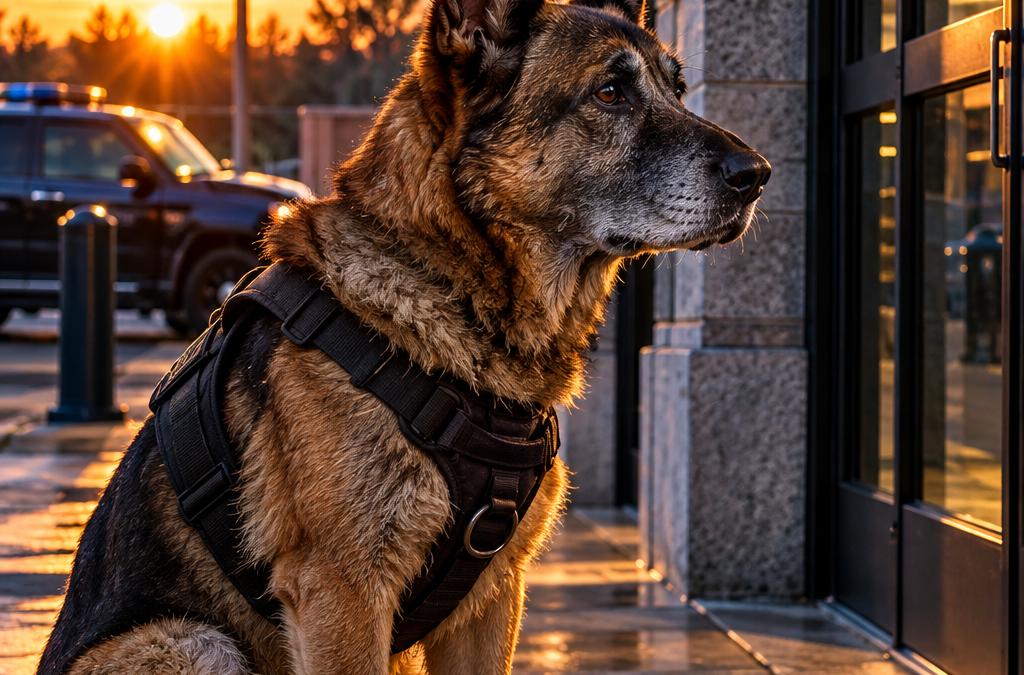
He wanted to sit near the west entrance.
And watch the parking lot.
One morning, I deliberately parked on the opposite side of the building.
Duke immediately pulled toward the west entrance.
Another morning, I brought him through the main lobby.
He walked past the reception desk, past three officers he knew, and straight toward the glass door leading to the parking area.
There, he stopped.
I crouched beside him.
“What are you looking for?”
He stared through the glass.
I followed his gaze.
There was nothing unusual outside.
A few parked cars.
An empty sidewalk.
A flag moving in the wind.
I looked back at Duke.
His expression was so intent that I felt foolish speaking to him as though he could answer.
“Come on, buddy. There’s nobody there.”
He stayed where he was.
That sentence haunted me later.
There’s nobody there.
I had said it without understanding how cruelly accurate it was.
December brought snow.
Duke still insisted on going.
On mornings when the pavement was icy, I walked slowly beside him with one hand on his harness.
He no longer wore the heavy tactical gear from his working days.
Instead, I had bought a soft support harness designed for senior dogs.
He tolerated it.
Barely.
At the station, he sat on the cold concrete while snow gathered along the edges of his fur.
I tried placing a blanket beneath him.
He accepted that.
I tried moving the blanket beneath the covered awning, where he’d be warmer.
He refused.
He dragged himself back to the same spot.
Finally, I stopped fighting him.
I stood beside him with my coffee cooling in my hands.
Sometimes I talked about ordinary things.
The weather.
The truck needing an oil change.
The neighbor’s cat getting into my garage.
Duke listened, but his attention remained elsewhere.
At 6:42, he watched the road.
Every morning.
Without fail.
There were days when I wondered if the time was coincidence.
Maybe that was when traffic picked up.
Maybe someone had once given him breakfast around then.
Maybe there was a sound I couldn’t hear.
Police work teaches you to look for practical explanations before emotional ones.
I tried everything.
I changed our breakfast schedule.
I drove different routes.
I brought him to the station later in the morning.
On those days, Duke became restless and distressed.
He paced around the house.
Scratched at the front door.
Whined at the truck.
Once, when I refused to take him, he lay beside the garage door for nearly four hours.
That frightened me.
I’d seen working dogs struggle with retirement before. Some developed anxiety without regular stimulation. Others became destructive or withdrawn.
I called Dr. Hannah Kim, the veterinarian who had treated Duke throughout his final years of service.
She examined him carefully.
His arthritis had progressed, but his blood work looked reasonably good for his age.
When I described his behavior, she listened without interrupting.
“Does he seem anxious during the visits?” she asked.
“Not exactly.”
“Excited?”
“Not really.”
“Then what?”
I searched for the right word.
“Hopeful.”
She looked at me.
“Hopeful?”
I rubbed my forehead.
“I know how that sounds.”
“No,” she said quietly. “I understand what you mean.”
She placed a hand on Duke’s back.
“Dogs can form very strong associations with places, routines, and people. Sometimes those associations last much longer than we expect.”
“So he misses work.”
“Maybe.”
She hesitated.
“Or maybe the place means something else to him.”
I should have asked her to explain.
Instead, I took Duke home and convinced myself she was making a general observation.
The holidays came.
I decorated the house because I always had, even though there was nobody living there besides me and Duke.
My marriage had ended several years earlier.
My daughter lived in Colorado with her husband and children.
She called often, but the house had a way of becoming terribly quiet after the phone stopped ringing.
Duke filled that silence.
He slept near my chair.
Followed me into the kitchen.
Waited outside the bathroom door as though I might somehow disappear down the drain.
He had become the last living connection to the most important years of my life.
And perhaps that was why I refused to think too deeply about his daily trips.
I told myself we were doing something good.
Giving an old working dog a familiar routine.
Letting him spend his retirement close to the people he loved.
On Christmas Eve, I took him to the station before sunrise.
The sky was dark blue.
Snow lay against the curb.
Colored lights had been wrapped around the small tree outside the entrance.
Duke settled onto his blanket.
I stood beside him with a thermos.
At 6:42, a dark sedan turned into the parking lot.
Duke rose so quickly that his rear legs slipped.
I caught him by the harness.
“Easy!”
He stared at the car.
His tail moved.
Once.
Twice.
The sedan stopped.
A middle-aged man stepped out carrying a bakery box.
He wasn’t wearing a police uniform.
He wasn’t anyone Duke knew.
The man walked toward the entrance.
Duke leaned forward.
Then stopped.
His body seemed to lose its strength.
He sat again, slowly.
The man passed us and smiled.
“Merry Christmas.”
“Merry Christmas,” I answered.
But I was looking down at Duke.
I’d seen something in his eyes that morning.
Not the disappointment of a dog denied a treat.
Not the frustration of an animal wanting to chase a car.
Something closer to recognition collapsing into confusion.
I knelt and wrapped my arms around him.
“Who is it, buddy?”
He pressed his head against my shoulder.
“Who are you waiting for?”
For the first time, the question frightened me.
In January, Chief Shaw called me into her office.
She closed the door.
That was never a good sign.
“Tom, sit down.”
I remained standing.
“If this is about Duke—”
“It is.”
I sighed.
She folded her hands on the desk.
“Several officers have raised concerns.”
“About what?”
“The morning visits.”
“He’s not hurting anybody.”
“I know.”
“He’s on a leash. He stays outside. I clean up after him. What’s the problem?”
“Nobody thinks he’s a problem.”
“Then why are we having this conversation?”
Rebecca leaned back.
“Because he’s an elderly dog sitting outside in freezing temperatures every morning. Because you’ve been adjusting your entire schedule around him. And because the parking lot isn’t a safe place for a dog who can’t move quickly anymore.”
I wanted to argue.
But she wasn’t wrong.
“He’s happier when we go,” I said.
“Are you sure?”
That question irritated me more than it should have.
“Of course I’m sure.”
Rebecca studied my face.
“Tom, you’ve been carrying a lot for a long time.”
I looked toward the window.
“Don’t.”
“I’m not trying to psychoanalyze you.”
“Then don’t.”
She became quiet.
For several seconds, I could hear the low murmur of radios from the hallway.
Then she said, “Gabe would have hated seeing you beat yourself up like this.”
The name struck me harder than I expected.
I turned back.
“What does Gabe have to do with Duke sitting outside?”
Rebecca didn’t answer immediately.
“I don’t know,” she admitted.
Neither did I.
And that was the problem.
I left her office angry.
Not at her, exactly.
At the helplessness I felt whenever somebody mentioned Gabe.
Five years had passed.
Five years of birthdays he hadn’t celebrated.
Five years of anniversaries Nora had spent without him.
Five years of Ellie growing taller in photographs while her father’s face remained the same age.
People talked about time healing wounds.
I had never found that particularly accurate.
Time taught you how to live around the wound.
It taught you where not to press.
It taught you how to smile when someone spoke a name that still hurt.
But healing?
I wasn’t sure.
That afternoon, I sat alone at my kitchen table while Duke slept beside the fireplace.
I opened an old photograph on my phone.
Gabe standing beside his patrol vehicle.
Duke sitting at attention near his left boot.
Both looking directly at the camera.
Gabe had one hand resting on Duke’s head.
I stared at it for a long time.
Then I looked at the sleeping dog.
And wondered whether grief had ever really left either of us.
The following Monday, I reached the station later than usual.
A snowplow had blocked my street, and I’d spent twenty minutes digging the truck out.
It was 7:03 when we arrived.
Duke was frantic.
Not aggressive.
Not uncontrollable.
Just desperately determined.
He pulled me toward the west entrance with more strength than I’d felt from him in months.
When we reached his usual spot, he stopped.
Sniffed the concrete.
Looked toward the road.
Then turned in a tight circle.
He repeated the movement three times.
I crouched.
“What’s wrong?”
He gave a short whine.
Then looked at the building.
I had never seen him behave that way.
Usually, if we arrived late, he simply settled into position.
But that morning, he seemed unsettled by the fact that something had already passed.
As though we had missed an appointment.
I suddenly remembered a detail from earlier visits.
6:42.
Not 6:30.
Not 7:00.
Always 6:42.
I pulled out my phone and began searching through the photographs I’d taken over the previous months.
There were dozens.
Duke in the rain.
Duke on his blanket.
Duke beside Tyler.
Duke watching the road.
Several included timestamps.
6:41.
6:43.
6:42.
I felt a strange tightening in my chest.
Why that time?
I spent the next two days trying to answer the question.
I looked through old shift schedules.
Checked the station’s morning briefing times.
Asked dispatchers about regular deliveries and shift changes.
Nothing matched perfectly.
Then, on Wednesday afternoon, I ran into Helen Mercer.
Helen had worked the department’s front desk for thirty-two years before retiring. She knew every officer who had passed through the building, every scandal people pretended to forget, and every family tragedy the department had quietly carried.
She had returned to deliver homemade cookies to the dispatchers.
When she saw Duke lying beside my desk, she smiled.
“Well, look at you.”
Duke lifted his head.
Helen crouched and scratched the fur behind his ears.
“Still handsome.”
“He knows,” I said.
She laughed.
Then her expression changed.
“Does he still go to the west entrance every morning?”
I looked up.
“How did you know?”
“Tyler mentioned it.”
“Apparently the entire department is discussing my dog’s social life.”
Helen ignored the joke.
“What time does he go?”
“Usually around six-thirty.”
“And when does he leave?”
“Whenever I can convince him.”
She studied Duke.
Then asked a question that made my stomach turn.
“Does he start looking toward the parking lot at about six-forty?”
I stared at her.
“Six-forty-two.”
Helen’s hand stopped moving.
For several seconds, she said nothing.
Then she whispered, “Oh, Duke.”
Something in her voice made me stand.
“Helen?”
She lowered herself into the chair beside my desk.
“Tom, do you remember how Gabe used to come into the station?”
I frowned.
“What do you mean?”
“Before he was killed. His morning routine.”
“He came through the west entrance.”
“Every day?”
“Most days.”
Helen nodded.
“And when he worked nights?”
I shrugged.
“He’d come in, drop off his equipment, complain about the coffee.”
She gave me a sad smile.
“You’re remembering the wrong part.”
I waited.
Helen looked at Duke.
“Gabe used to leave Duke with me when he had to go upstairs for reports. Sometimes the dog would get restless, so I’d sit with him near the west door.”
I felt myself becoming very still.
“Gabe would come back through that entrance after moving his car or getting breakfast. Almost always at the same time.”
She looked toward the wall clock.
“Six-forty-two.”
I heard the hum of the overhead lights.
Somebody laughed in the hallway.
A printer started running.
Ordinary sounds.
But my entire world seemed to narrow around Helen’s words.
“Why six-forty-two?” I asked.
“Gabe had this ridiculous little routine. He said his daughter was born at six-forty-two in the morning, and that minute was lucky.”
I swallowed.
Ellie.
I’d forgotten.
“Every morning he could, he’d come through that door at exactly six-forty-two, give Duke two taps on the chest, and say—”
Helen stopped.
Her eyes filled.
I could barely speak.
“Say what?”
She looked down at Duke.
“‘Ready, partner? Let’s go home.'”
For a moment, I couldn’t breathe.
I knew those words.
Of course I knew them.
Gabe had said them a thousand times.
Before leaving the station.
After long shifts.
Whenever Duke had finished a difficult assignment.
Ready, partner? Let’s go home.
I sat down slowly.
Duke rested his chin on my knee.
Helen wiped her eyes.
“That dog used to light up the second he heard Gabe coming.”
I stared at the floor.
“But Gabe’s been gone five years.”
“I know.”
“And Duke worked with me for four years afterward.”
“I know that too.”
“So why now?”
Helen took a breath.
“Maybe because while he was working, he always had somewhere else he needed to be.”
She looked toward the sleeping dog.
“Now he doesn’t.”
I didn’t answer.
Because something terrible and beautiful had just occurred to me.
We had assumed Duke wanted his old job back.
But perhaps the work had only distracted him from the one person he had never stopped searching for.
That evening, I went into my garage.
I hadn’t opened Gabe’s old equipment box in years.
The department had returned several belongings to Nora after his funeral, but she had asked me to keep a few items associated with Duke.
His spare leash.
A training notebook.
A cracked leather ball.
An old photograph.
I carried the box into the living room.
Duke lifted his head from his bed.
The moment I opened the lid, he stood.
I pulled out Gabe’s worn leather leash.
Duke approached.
He sniffed it.
Then sniffed it again.
His ears rose.
For a moment, he looked younger.
He took the end of the leash gently in his mouth.
I froze.
Duke hadn’t done that in years.
Not since his first weeks with me, when he sometimes carried Gabe’s belongings around the kennel.
He backed away and brought the leash to his bed.
There, he lay down with it between his front paws.
I sat on the floor beside him.
The house was quiet except for the ticking clock above the fireplace.
“Is that what this is about?” I whispered.
Duke looked at me.
“Are you still looking for him?”
He lowered his head onto the leash.
I covered my face with both hands.
I had attended Gabe’s funeral.
I had stood beside his family.
I had watched his casket disappear beneath the flag.
I had seen his name engraved on the memorial wall.
But Duke hadn’t understood any of those things the way we did.
He had known Gabe’s voice.
His scent.
His footsteps.
The sound of his car.
The hand that scratched behind his ears.
And then, one day, those things had stopped.
Without explanation.
Without a goodbye he could understand.
I thought about the veterinarian asking whether Duke understood that his handler had died.
I had said I didn’t know.
Now I wondered if that had been the wrong question.
Maybe Duke didn’t need to understand death to experience loss.
Maybe all he understood was that someone he loved had disappeared.
And every morning, at the same familiar door, he hoped the disappearance might finally end.
I didn’t sleep much that night.
At 5:45, Duke came to my bedroom.
I was already awake.
He stood beside the bed, holding Gabe’s old leash in his mouth.
The sight nearly broke me.
I sat up.
“Okay, buddy.”
My voice trembled.
“We’ll go.”
That morning, I didn’t put on his new leash.
I took the old one from his mouth and clipped it carefully to his collar.
He stood very still.
Then we walked to the truck.
When we reached the station, the sky was pale gray.
The parking lot was nearly empty.
I helped Duke down.
He moved toward the west entrance and settled into his place.
I sat beside him on the cold concrete.
Not standing this time.
Not checking my watch.
Just sitting.
At 6:40, I rubbed his back.
At 6:41, I heard a car approaching.
At 6:42, Duke stood.
The car passed.
Duke remained standing for several seconds.
Then slowly sat again.
I placed my hand against his chest.
“He’s not coming, buddy.”
The words came out in a whisper.
My throat tightened.
“I’m sorry.”
Duke leaned into me.
I had spent years telling myself that what happened to Gabe wasn’t my fault.
Every counselor said it.
Every officer who had been there said it.
Even Nora had told me once, through tears, that there was nothing I could have done.
But grief doesn’t always listen to facts.
Some part of me had continued to believe that if I’d driven faster, turned down the right street, or arrived just a few minutes earlier, Gabe might still be alive.
And now, sitting beside his old dog, I realized I had never allowed myself to fully confront what we’d lost.
Not just an officer.
Not just a friend.
A father who never saw his daughter grow up.
A husband whose wife still kept his photograph on the nightstand.
A man who had promised to repair his fishing boat and never got the chance.
And a dog’s entire world.
I put my arm around Duke.
“We both waited a long time, didn’t we?”
He rested his head against my shoulder.
For the first time since his retirement, I didn’t try to make him leave early.
We stayed until the sun rose above the buildings.
That afternoon, I called Nora Morales.
I hadn’t spoken to her in almost a year.
Not because we’d argued.
Because grief had gradually made our conversations difficult.
At first, I’d visited every week.
Then every month.
Then birthdays and holidays.
Eventually, I began telling myself that she needed space.
The truth was less noble.
Seeing Ellie grow older without Gabe hurt.
Seeing Nora smile at family gatherings made me feel relieved and guilty at the same time.
I wasn’t sure where I belonged in the life that had continued without my best friend.
When Nora answered, her voice was cautious.
“Tom?”
“Hey, Nora.”
“Is everything okay?”
“Yeah. Everything’s okay.”
I hesitated.
“How’s Ellie?”
“Good. Busy. She’s fifteen now, which apparently means I’m embarrassing simply by existing.”
I smiled.
“Gabe would’ve enjoyed that.”
“He absolutely would.”
A pause followed.
Then Nora asked, “What’s going on?”
I looked toward Duke sleeping beside the fireplace.
“It’s about Duke.”
Her voice softened.
“Is he sick?”
“Not exactly.”
I took a breath.
“I think he’s been waiting for Gabe.”
Silence.
For so long that I checked whether the call had disconnected.
“Nora?”
“I’m here.”
I explained everything.
The morning visits.
The west entrance.
The time.
Helen’s memory.
The old leash.
As I spoke, I heard Nora’s breathing change.
Finally, she whispered, “Six-forty-two.”
“Yeah.”
She was quiet again.
Then she said, “Tom, do you remember the video Gabe made for Ellie?”
I frowned.
“What video?”
“She was little. Maybe four. She was obsessed with seeing Duke do tricks.”
I remembered Gabe constantly filming the dog for his daughter.
“He made dozens of those.”
“There’s one from the station. He sent it to me before going out on patrol.”
She hesitated.
“I haven’t watched it in years.”
“Do you still have it?”
“I think so.”
An hour later, she sent me the file.
I sat at the kitchen table and pressed play.
The video was only forty-seven seconds long.
The quality was poor.
The camera shook.
But there was Gabe.
Alive.
Laughing.
Wearing his dark blue uniform.
He stood inside the station near the west entrance while Duke sat patiently beside the door.
“Hey, Ellie girl,” Gabe said to the camera. “Look who’s waiting for me.”
He turned the phone toward Duke.
Duke’s ears lifted.
“Show her how patient you are, buddy.”
Gabe stepped outside.
The camera followed the sidewalk and the empty parking spaces.
Then Gabe walked back toward the door.
Duke was still sitting.
Waiting.
Gabe laughed.
“Good boy.”
He crouched and tapped Duke twice on the chest.
“Ready, partner? Let’s go home.”
Duke sprang to his feet.
The video ended with Gabe laughing again.
I replayed it.
Then again.
Then again.
On the fourth viewing, I noticed something in the background.
A clock mounted above the reception window.
6:42.
I lowered the phone.
My hands were shaking.
I had finally seen what Duke was waiting for.
Not a patrol car.
Not a call.
Not a job.
He was waiting for Gabe to come through that door.
To tap him twice on the chest.
To tell him it was time to go home.
I sat there for a long time.
Then I called Nora back.
She answered immediately.
“Did you watch it?”
“Yeah.”
I tried to say more.
Couldn’t.
Nora began crying.
Not loudly.
Just the exhausted, quiet crying of someone whose heart had been forced open without warning.
“He loved that dog so much,” she whispered.
“I know.”
“Sometimes I thought Duke was the only one who understood how tired Gabe was.”
I wiped my eyes.
“He understood more than we did.”
Nora took a shaky breath.
“Do you think he’s really waiting for him?”
“I can’t prove what he’s thinking.”
I looked toward Duke.
“But I know what he does every morning.”
There was another silence.
Then Nora said, “I need to tell you something.”
My stomach tightened.
“What?”
“After Gabe died, I couldn’t bear to see Duke.”
I closed my eyes.
“I understand.”
“No, Tom. I was ashamed of it.”
“Nora—”
“Every time I saw him, I remembered Gabe walking through our front door. Duke would run ahead of him, and Ellie would scream because she knew Daddy was home.”
Her voice broke.
“I couldn’t look at that dog without hearing my husband’s laugh.”
I listened.
“I wanted you to take him because I knew you’d love him. But part of me felt like I was abandoning him too.”
“You didn’t abandon him.”
“I know that now.”
She took another breath.
“I just wish I’d known how much he was hurting.”
I looked down at Gabe’s old leash.
“Me too.”
The next morning, Nora came to the station.
She brought Ellie.
I hadn’t seen Gabe’s daughter in nearly two years.
The last time, she’d been a thin, awkward middle-schooler with braces and a ponytail.
Now she was taller than her mother.
She had Gabe’s dark eyes and the same little crease between her eyebrows when she was trying not to cry.
When she saw Duke, she stopped walking.
“Oh, my God.”
Duke looked up.
Ellie approached slowly.
“Hey, old man.”
His ears moved.
She knelt in front of him.
“Do you remember me?”
He sniffed her hands.
Then her jacket.
His tail began moving.
Ellie’s face crumpled.
“You do.”
She wrapped her arms around his neck.
Duke rested his head against her shoulder.
Nora stood beside me, one hand covering her mouth.
For several moments, nobody spoke.
Then Ellie pulled back.
“Mom used to say he was Dad’s shadow.”
“He was,” I answered.
She scratched Duke’s chest.
“Why does he come here?”
I looked at Nora.
She nodded.
So I told Ellie.
Not the shortened version adults often give children when they’re afraid the truth will hurt too much.
I told her about the morning routine.
The door.
The time.
The video.
The way Duke watched every passing vehicle.
Ellie listened without interrupting.
When I finished, she looked toward the entrance.
Then down at Duke.
“He’s waiting for my dad?”
I swallowed.
“That’s what I believe.”
Her eyes filled.
“But Dad isn’t coming.”
“No.”
The word hurt.
Even after five years.
Ellie lowered her forehead against Duke’s.
“He doesn’t know.”
I crouched beside her.
“We don’t know exactly what he understands.”
She shook her head.
“Then how do we tell him?”
I didn’t have an answer.
I had faced armed suspects.
Delivered death notifications.
Walked into burning buildings.
But I had no idea how to explain to a fifteen-year-old girl that some kinds of love continue searching long after hope becomes impossible.
Nora knelt beside her daughter.
“Maybe we can’t.”
Ellie began crying.
Duke leaned closer.
She held him tightly.
“I miss him too,” she whispered.
Something changed in that moment.
Not in Duke.
In us.
For years, we’d treated Gabe’s death as something we had to survive privately.
We spoke his name carefully.
Avoided certain photographs.
Changed the subject when memories became painful.
We thought protecting each other meant not reopening old wounds.
But as I watched Nora and Ellie holding Duke beside that station door, I understood how much love we had been keeping locked away.
Duke hadn’t hidden his grief.
He had brought it to the same place every morning.
And sat there in plain sight.
The following weeks were different.
Nora and Ellie began visiting regularly.
Sometimes they arrived before Duke.
Sometimes they brought breakfast.
Ellie would sit beside him and talk about school, her friends, and the father she remembered in fragments.
She told him about getting her driver’s permit.
About joining the school choir.
About a boy who had asked her to the winter dance.
“Don’t tell Dad about that last part,” she whispered one morning.
Then her face changed.
She looked at me.
“I forgot.”
I shook my head.
“No, sweetheart.”
She lowered her eyes.
I sat beside her.
“You don’t have to stop talking to him just because he isn’t here.”
Ellie leaned against my shoulder.
For a few minutes, I felt the old familiar ache.
But it wasn’t unbearable.
Not that morning.
Not with Duke between us and Nora smiling through tears beside the door.
One Friday, Ellie brought a small notebook.
She had started writing down memories of Gabe.
Things her mother told her.
Stories officers remembered.
Details she was afraid of losing.
“Will you tell me about him?” she asked.
I looked at the notebook.
“What do you want to know?”
“Everything.”
I laughed softly.
“That’s going to take a while.”
“I have time.”
So I told her about the academy.
About Gabe falling into a creek during a training exercise.
About the time he showed up to a formal dinner with two different shoes because he had dressed in the dark.
About how he once drove twenty miles back to a gas station because he’d seen a little boy crying beside a vending machine and couldn’t stop wondering whether the child was all right.
Ellie laughed.
Really laughed.
Then she wiped her eyes.
“That sounds like him.”
“It does.”
She wrote everything down.
By spring, the notebook was almost full.
The station became warmer as the weather changed.
Flowers appeared near the front walkway.
Officers left the doors open during mild mornings.
And Duke kept coming.
His body was slowing.
But his determination remained.
He no longer climbed into the truck without help.
Some mornings, he needed several minutes to stand.
I began carrying a folding ramp.
He hated it at first.
Then accepted it with the dignity of an aging veteran who understood that arguing would only delay his plans.
At the station, he settled on his blanket.
Watched the road.
Waited.
The officers stopped joking about his retirement.
Tyler was the first to ask what was really happening.
I told him.
He stood silently for a long time.
Then he looked toward the west entrance.
“I never met Officer Morales,” he said.
“No. He died before you joined.”
“My training sergeant talked about him.”
“Good things, I hope.”
Tyler nodded.
“He said Morales was the kind of cop everyone wanted beside them when things went bad.”
I looked at Duke.
“He was.”
Tyler crouched and rubbed the dog’s shoulder.
“Guess some partners don’t forget.”
“No,” I said.
“Some don’t.”
A few days later, someone placed a small sign inside the entrance.
It wasn’t official.
Just a piece of paper taped near the window.
It read:
Please give Duke and his family a little space during his morning visit.
Nobody took it down.
I began receiving messages from retired officers.
Some sent photographs of Gabe and Duke.
Others shared stories I’d forgotten.
One former dispatcher remembered Gabe bringing extra food to a homeless veteran during a blizzard.
A retired patrolman sent a picture of Gabe asleep in a chair with Duke’s head resting on his boots.
Even Chief Shaw stopped by one morning.
She watched Duke for several minutes.
Then said quietly, “I owe you an apology.”
I looked at her.
“For what?”
“I thought bringing him here every day was keeping him from moving on.”
I smiled sadly.
“Maybe I did too.”
She folded her arms.
“Now I’m wondering whether moving on was ever the point.”
We stood together as Duke watched a vehicle turn into the lot.
At 6:42, his ears lifted.
The vehicle parked.
An officer climbed out.
Duke waited.
Then settled again.
Rebecca looked away.
“God,” she whispered.
“I know.”
It was during the first week of June that Duke collapsed.
We were in the backyard.
He had been sniffing around the old maple tree, investigating a patch of ground where a squirrel had apparently committed some unforgivable offense.
I was watering the flowers when I heard a soft thud.
I turned.
Duke was lying on his side.
At first, I thought he’d simply slipped.
Then I saw his legs trembling.
“Duke?”
I dropped the hose.
He tried to stand.
Couldn’t.
I ran to him and knelt in the grass.
“Hey. Hey, buddy. Look at me.”
His eyes were open.
He was breathing rapidly.
I slid my arms beneath him.
“Come on. I’ve got you.”
He weighed almost sixty-five pounds, but fear made him feel weightless.
I carried him to the truck.
The drive to the emergency veterinary clinic took fourteen minutes.
I remember every red light.
Every turn.
Every moment I looked toward the passenger seat and saw Duke lying quietly on the blanket.
“Stay with me,” I kept saying.
The words sounded horribly familiar.
I had spoken them in another vehicle years before.
To another partner.
I gripped the steering wheel harder.
“Please.”
Dr. Kim met us at the clinic.
They rushed Duke into an examination room.
I waited in the hallway.
I had spent enough time in hospitals to know that the silence outside a treatment room can be worse than almost anything happening inside it.
After what felt like hours, Dr. Kim came out.
Her expression told me she didn’t have good news.
“Tom, let’s sit down.”
I remained standing.
“Just tell me.”
She folded her hands.
“His ultrasound shows a mass on his spleen. There’s also evidence of internal bleeding.”
I stared at her.
“What kind of mass?”
“We can’t confirm the exact type without further testing, but I’m very concerned about a malignant tumor.”
“Can you operate?”
“Sometimes surgery is an option.”
“Then do it.”
She hesitated.
“Tom.”
“No. Don’t say it like that.”
She looked at me with quiet compassion.
“Duke is almost thirteen. He has significant arthritis, and his heart isn’t as strong as it once was. Even if we remove the spleen, there’s a serious possibility the cancer has already spread.”
I shook my head.
“How long?”
“We can’t know precisely.”
“How long, Hannah?”
She took a breath.
“Possibly weeks. It could be less.”
I felt the room tilt.
“No.”
“I’m sorry.”
I sat down because my legs would no longer hold me.
Duke had survived years of dangerous police work.
He’d been kicked by suspects.
Cut by glass.
Knocked down during an arrest.
Exposed to smoke.
Dragged through freezing water.
And now something inside his own body was killing him.
Something I couldn’t track.
Couldn’t arrest.
Couldn’t stop.
“He’s not in pain right now?” I asked.
“We’ve stabilized him. He’s comfortable.”
I stared at my hands.
They were shaking.
Dr. Kim sat beside me.
“We can discuss treatment options, but we also need to consider what the remaining time will feel like for him.”
“I don’t want him to suffer.”
“I know.”
I covered my eyes.
“I promised Gabe I’d take care of him.”
Her voice softened.
“Then that’s still what you’re doing.”
I went into the examination room.
Duke lay on a thick blanket.
An IV line was attached to his front leg.
When he saw me, his tail moved.
Just once.
That small movement nearly undid me.
I sat beside him and placed my forehead against his.
“Hey, partner.”
He breathed against my cheek.
I rubbed his ears.
“You’re supposed to be the tough one.”
His eyes stayed on mine.
I wanted to ask him to fight.
To give me one more year.
One more summer.
One more ordinary morning in my kitchen.
But I had spent enough time with dying people to recognize the selfishness hidden inside certain prayers.
Sometimes please stay really means I don’t know how to live without you.
I didn’t want my fear to become his suffering.
So I whispered the only promise I could make.
“I’m going to take care of you, Duke. All the way to the end.”
We brought him home two days later with medication and a plan focused on comfort.
Dr. Kim warned me that another bleeding episode could happen suddenly.
I listened carefully.
Asked questions.
Wrote everything down.
Then I drove home and cried in the driveway before taking Duke inside.
I called Nora that evening.
She arrived with Ellie less than an hour later.
Ellie went straight to Duke’s bed.
She knelt beside him.
“No,” she whispered.
Duke lifted his head.
She stroked his face.
“Not you too.”
Nora stood behind her, tears streaming down her cheeks.
I couldn’t look at either of them.
It felt like April all over again.
Another life ending.
Another family about to lose someone they loved.
Ellie turned toward me.
“Can they fix it?”
I swallowed.
“Not in a way that gives us much time.”
She shook her head.
“That’s not fair.”
“No.”
“He’s a good dog.”
“I know.”
“He didn’t do anything wrong.”
My voice broke.
“I know, sweetheart.”
She wrapped her arms around Duke.
“Then why?”
There are questions grief asks that no answer can satisfy.
That was one of them.
I sat down beside her.
We stayed on the floor together until the room grew dark.
Over the next several days, Duke rested more.
He ate small meals.
Slept beside the fireplace.
Accepted gentle visits from a few officers who had known him during his career.
I stopped taking him to the station.
At first, he seemed too tired to notice.
Then, on the fourth morning, I woke to the sound of his nails scraping against the hallway floor.
I sat up.
Duke was standing beside my bedroom door.
Unsteady.
Breathing harder than usual.
In his mouth was Gabe’s old leash.
My heart sank.
“Buddy.”
He looked toward the garage.
I checked the clock.
5:45.
I knelt in front of him.
“You can’t go today.”
He whined.
I stroked his head.
“You’re sick, Duke.”
He tried to walk past me.
His hind legs weakened.
I caught him before he fell.
“Easy.”
He looked at me with those deep brown eyes.
Eyes that had watched suspects, searched woods, protected strangers, and waited through thousands of ordinary days.
I wanted him to understand.
I wanted to explain that his body was failing and that the world would not stop because he still had somewhere he believed he needed to be.
But he only knew that morning had come.
And he had an appointment.
I sat on the hallway floor with him.
He rested his head against my chest.
For almost an hour, I held him.
Then I called Chief Shaw.
“Rebecca?”
“Tom?”
“I need to ask you something.”
“Anything.”
I looked down at Duke.
“He wants to come back.”
She didn’t ask where.
She knew.
I continued.
“I don’t know how many mornings he has left.”
Rebecca was silent.
Then she said, “Bring him.”
I swallowed.
“I don’t want a crowd. He’s weak.”
“I understand.”
“Just one last visit.”
“Tom.”
“Yeah?”
Her voice softened.
“Let us take care of our own.”
I didn’t realize until that moment how badly I needed to hear those words.
I helped Duke into the truck.
I placed a thick blanket beneath him and arranged the seat so he could lie comfortably.
He kept Gabe’s leash beside his front paws.
The sky was still dark when we left.
I drove slowly.
No sirens.
No radio.
No rushing through intersections.
Just an old man and an old dog traveling a road we had taken together hundreds of times.
As we approached the station, Duke lifted his head.
I watched his ears move.
His breathing changed.
For the first time in several days, there was something unmistakably bright in his eyes.
We turned into the parking lot at 6:31.
And I stopped.
Officers were standing along the sidewalk.
Not dozens.
Not a crowd of strangers.
Just the people who had worked with Duke.
The people who had known Gabe.
The people who understood why this morning mattered.
They wore their uniforms.
Some had small black bands across their badges.
Nobody spoke.
Chief Shaw approached my truck.
She opened Duke’s door.
“Morning, Sergeant.”
I nodded.
Then she looked at Duke.
“Morning, Officer Duke.”
His tail moved.
She smiled through tears.
“Good to see you, partner.”
I helped him onto the ramp.
He descended carefully.
His legs trembled when he reached the pavement.
I supported him with the harness.
Nobody rushed us.
Nobody tried to touch him.
The officers stood quietly while Duke made his way toward the west entrance.
He stopped at his usual place.
But something was different.
His old blanket was already there.
Beside it sat a small wooden bench.
And attached to the wall was a covered plaque.
I looked at Rebecca.
“What is this?”
She shook her head.
“Something we should have done a long time ago.”
Before I could ask another question, I heard a familiar voice.
“Tom.”
Nora stood near the entrance.
Ellie was beside her.
In Ellie’s hands was a small wooden box.
She approached Duke and knelt.
“Hey, sweetheart.”
Duke leaned toward her.
She scratched behind his ears.
Then she looked up at me.
“Mom said it was okay.”
She opened the box.
Inside was Gabe’s old silver badge.
His nameplate.
And a photograph I’d never seen.
It showed Gabe sitting on the station steps with Duke beside him.
Gabe was laughing.
Duke was looking up at him with complete devotion.
Ellie held the photograph close to Duke.
“Look who I brought.”
My throat tightened.
Duke sniffed the frame.
Then looked toward the parking lot.
Ellie wiped her cheeks.
“I know.”
She placed the photograph beside his blanket.
At 6:38, Chief Shaw stepped forward.
She didn’t use a microphone.
There were no reporters.
No speeches prepared for public attention.
Just a small group gathered around an old police dog.
“Five years ago,” Rebecca began, “this department lost Officer Gabriel Morales.”
She paused.
“Gabriel was a good officer. More importantly, he was a good man.”
I looked at Nora.
She held Ellie’s hand.
“Many of us remember him for the lives he saved. Some remember his terrible jokes. Others remember the way he made difficult days easier.”
A few officers smiled.
“But Duke remembers him in a way we are only beginning to understand.”
Rebecca looked down at the dog.
“For years, Duke served this community with courage. He protected officers, found people who were lost, and gave everything he had to the work.”
Her voice grew softer.
“After retirement, he kept coming back to this door. We thought he was waiting for another assignment.”
She paused.
“We were wrong.”
I closed my eyes.
“He was honoring a bond that mattered more to him than any badge.”
Rebecca stepped toward the covered plaque.
“We cannot give Duke the reunion he’s been waiting for. But we can make sure that what brought him here is never forgotten.”
She pulled away the cloth.
Beneath it was a bronze memorial.
Two names were engraved across the top.
OFFICER GABRIEL MORALES
K9 DUKE
Below them were the words:
Partners in service. Bound by loyalty. Remembered with love.
At the bottom was a final inscription.
For those who wait, and for those who never stop loving.
I put my hand over my mouth.
I hadn’t known they were doing this.
Nora began crying.
Ellie held her mother.
Duke sat quietly beside the entrance.
He didn’t understand the plaque.
He didn’t understand why everyone was looking at him.
But he understood the people.
The gentle voices.
The familiar hands.
The love surrounding him.
And perhaps, in his own way, he understood that this morning was different.
Rebecca looked at her watch.
6:41.
She nodded toward the entrance.
Helen Mercer stepped forward.
I hadn’t known she was coming.
She carried a small portable speaker.
She looked at me first.
“Tom, Nora gave us permission.”
I frowned.
Then I understood.
The video.
Gabe’s voice.
My chest tightened.
“Helen—”
She waited.
I looked at Nora.
Nora nodded.
Her eyes were full of tears, but there was something peaceful in her expression.
“It’s okay,” she whispered.
Helen pressed play.
The speaker crackled softly.
Then a voice rose into the morning air.
A voice I hadn’t heard outside a recording in five years.
“Hey, Ellie girl. Look who’s waiting for me.”
Duke’s ears shot upright.
Every muscle in his body seemed to awaken.
He lifted his head.
The officers went completely still.
Gabe laughed through the speaker.
“Show her how patient you are, buddy.”
Duke struggled to stand.
I supported him.
He turned toward the entrance.
His eyes searched.
The recording continued.
“Good boy.”
Then came the words.
The words that had followed Duke through every long year of service.
The words he’d waited to hear at that door.
“Ready, partner? Let’s go home.”
Duke took one step forward.
Then another.
His tail moved slowly.
He looked toward the doorway.
For a heartbeat, nobody breathed.
I knew Gabe wasn’t there.
I knew a recording couldn’t undo death.
I knew there was no way to tell what Duke remembered in that moment.
But I saw him lift his head.
I saw his ears turn toward the familiar voice.
And I saw the old dog who had searched for so long stand a little taller than he had in weeks.
The recording ended.
Silence settled over the parking lot.
Duke remained standing.
Waiting.
Then his legs began to shake.
I knelt and held him.
“Easy, buddy.”
He leaned against me.
I placed my hand gently against his chest.
Tapped twice.
The way Gabe always had.
My voice trembled.
“Ready, partner?”
Duke looked into my eyes.
I swallowed hard.
“Let’s go home.”
For several seconds, he didn’t move.
Then he lowered his head against my shoulder.
The officers stood silently.
Some were crying.
Tyler removed his hat.
Nora covered her face.
Ellie knelt beside us.
And for the first time since his retirement, Duke didn’t turn back toward the parking lot when I guided him away from the entrance.
He followed me.
Slowly.
Trustingly.
Toward the truck.
I can’t tell you whether he understood that Gabe was gone.
I can’t claim that those words brought him peace in the way they brought peace to us.
But I know what I witnessed.
An old dog who had spent his mornings watching the road finally allowed himself to walk away.
And I will never forget the feeling of his head resting against my hand as we drove home.
Duke slept almost the entire afternoon.
Nora and Ellie stayed with us.
We sat in the living room, sharing memories while the sunlight moved across the floor.
Ellie read passages from her notebook.
Nora told stories about Gabe cooking pancakes shaped like animals.
I remembered the time he tried to teach Duke to bring him a bottle of water from the refrigerator and ended up with six bottles scattered across the kitchen floor.
We laughed.
We cried.
Sometimes we did both in the same breath.
Duke slept nearby.
Occasionally, his ears moved when someone said Gabe’s name.
I couldn’t help wondering what memories lived inside his dreams.
The next day, Duke ate a little chicken and rested in the garden.
The day after that, he struggled to stand.
I called Dr. Kim.
She examined him at home.
Her face became serious.
“The bleeding may be starting again,” she said gently.
I looked at Duke.
He was lying on his bed, breathing faster than normal.
“Can we make him comfortable?”
“Yes.”
“For how long?”
She hesitated.
“Tom, I think we need to talk about whether it’s time.”
I had known those words were coming.
That didn’t make hearing them easier.
I sat beside Duke.
He lifted his head.
His tail moved weakly.
I stroked his face.
For years, he had trusted me with his life.
He had run toward danger because I asked him to.
He had followed commands without hesitation.
He had protected me when he could have protected himself.
Now he needed me to make the decision he couldn’t make.
The one that would hurt me more than anything but spare him unnecessary suffering.
I called Nora.
She came with Ellie.
Chief Shaw stopped by briefly and sat beside Duke for several minutes.
She thanked him for his service.
Then she hugged me.
I didn’t try to pretend I was fine.
That evening, I moved Duke’s bed closer to the open patio doors.
He liked the smell of the garden.
The breeze carried freshly cut grass and the distant sound of children playing.
Ellie sat on one side of him.
Nora sat on the other.
I knelt near his head.
Dr. Kim prepared everything quietly.
Before we began, Ellie asked if she could say something.
“Of course,” I whispered.
She leaned close to Duke.
“When I was little, Dad told me you were the bravest dog in the world.”
Duke looked at her.
She smiled through tears.
“He said you were smarter than most people, including Uncle Tom.”
I laughed softly.
“That sounds like him.”
Ellie swallowed.
“I used to think being brave meant not being scared.”
Her voice trembled.
“But I think maybe it means loving somebody even when you know losing them is going to hurt.”
She kissed Duke’s forehead.
“You were really brave.”
Nora rested a hand on her daughter’s shoulder.
Then she bent close to Duke.
“Thank you for loving him,” she whispered.
I felt tears running down my face.
Nora continued.
“Thank you for being there when I couldn’t.”
Duke closed his eyes briefly.
Then opened them again.
I took his old leather leash from the table.
The same one Gabe had used.
The same one Duke had carried to me on those early mornings.
I placed it gently beside him.
“Hey, partner.”
His eyes settled on mine.
My voice broke.
“You did good.”
I rubbed the graying fur along his cheek.
“You did everything we ever asked.”
He breathed slowly.
“You found the lost ones. You kept us safe. You stayed when things got hard.”
I swallowed.
“And you never forgot him.”
His head rested against my palm.
I bent down until my forehead touched his.
“But you don’t have to wait anymore.”
Dr. Kim gave us a few quiet moments.
I looked into Duke’s eyes one final time.
“Ready, partner?”
My voice was barely audible.
“Let’s go home.”
He died peacefully with my hand against his chest.
He was almost thirteen years old.
And for the first time in months, the next morning came without the sound of his paws outside my bedroom door.
I woke at 5:45 anyway.
For several seconds, I lay still.
Waiting.
Then I remembered.
The silence was unbearable.
His bed was empty.
His food bowl untouched.
The leash hung beside the back door.
I made coffee because I didn’t know what else to do.
I stood in the kitchen holding the mug, staring at the place where Duke usually waited.
At 6:10, I picked up my keys.
I didn’t plan to go to the station.
I simply couldn’t remain inside that quiet house.
I drove the familiar streets.
Turned at the familiar intersection.
Pulled into the familiar parking lot.
And parked near the west entrance.
The blanket was gone.
The sidewalk was empty.
I sat in the truck for several minutes.
Then I got out.
The bronze plaque caught the early sunlight.
Gabe’s name.
Duke’s name.
Side by side.
I walked toward the spot where Duke had sat every morning.
Then I did something I hadn’t done since childhood.
I sat on the concrete and cried.
Not quietly.
Not carefully.
I cried for Gabe.
For Duke.
For every morning I’d misunderstood.
For the years I’d spent pretending I wasn’t still hurting.
For every person and animal I’d loved who had left a space no one else could fill.
I don’t know how long I stayed there.
Eventually, someone sat beside me.
It was Tyler.
He didn’t say anything.
He simply placed a paper cup of coffee next to my knee.
Then he sat with me.
A few minutes later, Chief Shaw joined us.
Then Helen.
Then two officers from the night shift.
Nobody gave a speech.
Nobody told me to be strong.
They just stayed.
And I remembered what Gabe had said years earlier while sitting with Duke after a difficult call.
He doesn’t need me to explain why I’m upset. He just stays.
That was the gift Duke had given us.
Not only loyalty.
Presence.
The willingness to remain beside someone even when there was nothing left to fix.
Two weeks later, the Ashford Police Department held a formal memorial service honoring both Gabriel Morales and K9 Duke.
The ceremony took place outside the west entrance.
Families came.
Retired officers returned.
Local residents brought photographs, flowers, and handwritten notes.
A K9 unit from a neighboring county stood in formation.
Duke’s ashes rested in a small wooden urn beside Gabe’s photograph.
His collar and badge were displayed in a glass case.
Nora and Ellie sat in the front row.
I stood at the podium with a speech I’d written and rewritten at least twenty times.
When I looked at the crowd, the words disappeared.
For a moment, I was simply an old cop standing in front of people who had come to honor a dog.
Then I saw Ellie.
She gave me a small nod.
I took a breath.
“Most of us think loyalty means staying beside someone when they need you.”
I paused.
“But Duke taught me that sometimes loyalty means remembering someone long after the world has moved on.”
The crowd was silent.
“For years, I brought him to this station believing he missed his work. I thought he wanted another shift, another assignment, another chance to put on his harness.”
I looked toward the west entrance.
“But Duke wasn’t asking for another job.”
My voice tightened.
“He was waiting for a friend.”
Nora began crying softly.
I continued.
“I don’t know exactly what Duke understood about death. And I won’t pretend to know what he believed would happen every morning at six-forty-two.”
I rested my hands against the podium.
“But I know he never forgot the person who taught him what partnership meant.”
I looked toward the glass case.
“And I know that loving someone doesn’t always end when their life does.”
I took a breath.
“Gabriel Morales gave his life protecting a child. Duke spent his life protecting people too. Their stories deserve to be remembered, not because they’re extraordinary in ways the rest of us can never understand, but because they show us the quiet courage of being faithful to someone else.”
I hesitated.
“Sometimes that courage looks like running toward danger.”
My eyes filled.
“And sometimes it looks like an old dog sitting patiently beside a door.”
I stepped away from the podium before my voice completely failed.
Ellie took my place.
She carried her notebook.
For a moment, she stared at the pages.
Then she closed it.
“I was nine when my dad died,” she said.
Her voice was soft but steady.
“People told me stories about him all the time. They said he was brave. They said he was kind. They said he loved his family.”
She glanced toward Nora.
“I believed them.”
A small smile appeared.
“But after a while, I started worrying that I was forgetting him.”
She swallowed.
“His voice. His laugh. The way he walked through the door.”
The crowd remained completely silent.
“Then Duke started waiting for him.”
She looked toward the entrance.
“And everyone thought it was sad.”
Tears ran down her cheeks.
“It was sad.”
She nodded.
“But it also reminded me of something.”
She looked at the photograph of her father.
“Just because someone isn’t here anymore doesn’t mean the love they gave us has disappeared.”
Her voice broke.
“Duke remembered.”
She wiped her face.
“And now I know I can too.”
When she stepped away, Nora embraced her.
I turned my face because I couldn’t bear to watch without crying.
At the end of the ceremony, Chief Shaw approached the memorial.
Two uniformed officers stood beside the plaque.
One carried Gabe’s old patrol cap.
The other carried Duke’s working harness.
They placed both items beneath the bronze inscription.
Then the dispatcher spoke over the radio.
Her voice was clear.
Steady.
Professional.
“All units, stand by for final call.”
The crowd grew still.
“Officer Gabriel Morales. End of watch, April seventeenth.”
A pause.
“K9 Duke. Faithful service completed.”
Another pause.
“Your watch has ended. Your service will not be forgotten.”
The radio clicked.
And for a few seconds, the only sound was the wind moving through the trees.
Then one of the K9 handlers gave a quiet command.
The dogs in formation sat beside their officers.
Not because they understood the words.
But because they trusted the people standing next to them.
I watched them and thought about all the mornings Duke had spent in that same place.
Waiting.
Hoping.
Refusing to leave until I asked him.
I wondered what Gabe would have thought if he could have seen the ceremony.
He probably would have made a joke.
Something inappropriate about Duke getting more attention than he ever did.
Then he would have crouched beside his dog, scratched his ears, and told him he was a good boy.
That was Gabe.
And that was Duke.
After the memorial, Nora approached me carrying a small envelope.
“Ellie and I found something.”
She handed it to me.
Inside was a photograph from years earlier.
Gabe was standing outside the west entrance with Duke beside him.
The morning sun shone behind them.
On the back, in Gabe’s handwriting, were six words.
Best partner a man could ask for.
I stared at the photograph.
Nora touched my arm.
“He meant it.”
“I know.”
She smiled sadly.
“And I think Duke knew it too.”
That evening, I returned home to a house that still felt painfully empty.
I placed the photograph on the mantel beside Duke’s collar.
Then I sat in my chair.
For the first time since his death, I didn’t turn on the television to fill the silence.
I simply sat.
Remembering.
I thought about the first day Gabe introduced me to a restless young Belgian Malinois.
I thought about the years we spent working together.
I thought about Duke sleeping beside my fireplace, chasing squirrels in the yard, and carrying an old leather leash down the hallway before sunrise.
And I thought about his final visit to the station.
The moment Gabe’s voice came through the speaker.
The way Duke lifted his head.
The way he’d leaned into me when I tapped his chest twice.
I had once believed that love was measured by what we could hold on to.
Now I understood that sometimes it was measured by what remained after everything else was gone.
In the months that followed, the memorial outside the station became a quiet place where officers and their families stopped before difficult shifts.
Some touched the plaque.
Some left flowers.
One officer placed a photograph of his own retired K9 beside it after the dog passed away.
Another left a small note thanking Gabe for once helping his family during an emergency.
Ellie came often.
Sometimes she brought her notebook.
Sometimes she sat on the wooden bench and listened to music.
Nora told me the visits helped her daughter feel close to her father.
They helped me too.
Eventually, the department installed a permanent bench beneath the memorial.
Not directly where Duke had waited.
That spot remained open.
Instead, the bench stood a few feet to the side, facing the parking lot.
On its backrest were engraved the words:
No one waits alone.
I visited whenever I could.
Sometimes before work.
Sometimes after a difficult day.
Sometimes simply because I missed my dog.
I would sit there with a cup of coffee, watching officers come and go, remembering a time when Gabe and I were young enough to believe we had endless years ahead of us.
I still wake up early.
Old habits don’t disappear easily.
Some mornings, I reach toward the side of the bed before remembering that Duke is no longer there.
I still have his stuffed duck.
He never played with it.
Not once.
But I keep it beside his photograph anyway.
And his leash still hangs near the back door.
I haven’t been able to put it away.
Perhaps someday I will.
Perhaps I won’t.
Grief doesn’t follow a schedule.
Neither does love.
A year after Duke’s death, I arrived at the station just before sunrise.
It was a cold morning.
The kind that reminded me of those first November visits.
I parked near the west entrance and walked toward the memorial.
The sky was turning gold behind the buildings.
For a moment, I could almost see Duke sitting there.
Ears upright.
Back straight.
Watching the road.
I sat on the bench.
At 6:42, a patrol car entered the lot.
A young officer stepped out, carrying two cups of coffee.
He recognized me and smiled.
“Morning, Sergeant.”
“Morning.”
He handed me one of the cups.
“Thought you might want this.”
I looked at the coffee.
Two cups.
Just like Gabe used to buy.
I laughed softly.
“Thanks.”
The officer glanced toward the memorial.
“He must’ve been one hell of a dog.”
I looked at Duke’s name engraved beneath Gabe’s.
“He was.”
The officer nodded.
Then walked inside.
I stayed where I was.
Watching the light spread across the sidewalk.
For the first time in years, the empty parking space didn’t feel like a reminder of someone who wasn’t coming back.
It felt like a place where love had left its mark.
I took a sip of coffee.
Then looked toward the door.
“Morning, Gabe,” I whispered.
I rested my hand against Duke’s name.
“Morning, buddy.”
The wind moved gently through the trees.
Somewhere inside the station, a radio came alive.
Another shift was beginning.
Another day of people heading out into the world, hoping to return safely to the ones who loved them.
I stayed for a few more minutes.
Then I stood.
Before leaving, I touched the bronze plaque once more.
For five years, I’d believed the most painful thing about losing Gabe was knowing I would never see him again.
For two years after Duke retired, I’d believed the most difficult part of caring for him was watching him struggle to leave his work behind.
I had been wrong about both.
The hardest thing was realizing how much love could exist in a place that looked empty.
And the most beautiful thing was learning that I didn’t have to carry that love alone.
Duke had spent his final mornings waiting for the man who once told him, every day, that it was time to go home.
I couldn’t bring Gabe back.
I couldn’t give Duke the reunion he wanted.
But I could give him a final morning surrounded by people who remembered.
A familiar voice.
A gentle hand against his chest.
And the comfort of knowing, in whatever way an old dog can know, that he was loved.
I turned toward my truck.
The sun had finally risen.
And as I walked away from the station, I could almost hear Gabe’s laughter carried on the morning air.
For once, the memory didn’t hurt quite so much.
I smiled.
“Come on, boys,” I whispered.
“Let’s go home.”








