𝗙𝗨𝗟𝗟 𝗦𝗧𝗢𝗥𝗬 At My Son’s Wedding, the Bride Looked at My Skin, My Dress, and Decided I Had No Right to Stand Near Her Family
𝗙𝗨𝗟𝗟 𝗦𝗧𝗢𝗥𝗬
His finger moved.
Then stopped.
I watched recognition fail.
That did not surprise me.
He looked up.
“And your relationship to the couple?”
“I’m the groom’s mother.”
His eyebrows lifted.
Just slightly.
The movement lasted less than a second.
But I saw it.
“Of course, ma’am.”
He smiled too quickly.
“Right this way.”
I walked past him.
I had been mistaken for staff in hotels where I owned substantial interests.
Asked whether I was lost in buildings where I chaired meetings.
Once, at a charity event where I had donated more money than the next ten donors combined, a woman handed me her empty champagne glass without looking at my face.
Money never made those moments stop.
It only made them more revealing.
The ballroom was magnificent.
Crystal chandeliers.
White roses.
Hydrangeas.
Gold-rimmed plates.
A string quartet near the terrace doors.
Everything whispered old money with the practiced confidence of people who hated being accused of talking about money.
I found the seating display.
MONTGOMERY.
Table 14.
I followed the room numbers.
Table one sat at the front.
Extra flowers.
Gold trim.
Ashford relatives.
Table fourteen was beside the kitchen.
Plain white cloth.
Fewer flowers.
The service doors swung open every few seconds behind it.
Heat spilled through.
So did the sound of pans.
I looked at the card again.
Table 14.
My son’s wedding.
I had been allotted ten guests.
Ten.
Ethan mentioned the limitation several weeks earlier.
He had tried to make it sound like a venue issue.
I knew better.
I also knew he was asking me not to fight about it.
So I hadn’t.
I sat.
A woman beside me introduced herself.
“How do you know the couple?”
“I’m Ethan’s mother.”
Her smile faltered.
“Oh.”
She looked toward the front.
“I thought family was up there.”
“So did I.”
Her expression turned sympathetic.
That almost hurt more.
The ceremony began at noon.
We moved outside.
Three hundred chairs faced an arch surrounded by white flowers.
I was seated near the back.
Ethan stood at the altar.
Tall.
Handsome.
Light brown skin glowing in the sun.
Raymond’s shoulders.
My eyes.
His hands trembled.
His best man Derek touched his shoulder.
Then Ethan searched the crowd.
He found me.
Even from the back, he found me.
I placed one hand over my heart.
He smiled.
That was enough.
The music changed.
Victoria appeared on her father’s arm.
She was beautiful.
I would never lie about that.
Her gown shimmered.
The veil floated behind her.
Bradley Ashford walked stiffly beside her.
I knew who Bradley was.
I had known for months.
His real-estate company had submitted an investment proposal to Montgomery Capital.
Thirty-eight million dollars.
His CFO had been courting my team.
The numbers were troubling.
Liquidity pressure.
Overleveraged assets.
Short refinancing windows.
But there were pieces of the portfolio worth considering.
The proposal was still under review.
I had never mentioned it to Ethan.
Business and family were separate.
At least I believed they should be.
Victoria came down the aisle.
Everyone watched her.
I watched my son.
His face softened.
For one moment, all my concerns disappeared.
I saw the boy with flour on his face.
I saw Raymond standing beside me thirty-five years earlier in a little Bronx church with twenty-eight guests and flowers we had arranged ourselves.
Pastor James Wilson stood at the altar.
He had baptized Ethan.
Buried Raymond.
Known me twenty years.
His voice carried.
“Love is not merely feeling.”
The guests quieted.
“It is a decision.”
His eyes swept the crowd.
“A decision to see the person in front of you fully.”
For one brief second, his gaze met mine.
“Without condition.”
I saw Diane Ashford shift in her seat.
Pastor Wilson continued.
“Love does not measure skin.”
Another shift.
“Status.”
Bradley glanced at his program.
“Income.”
I nearly smiled.
“Love asks whether you will choose to honor another human being even when doing so is difficult.”
Victoria smiled at Ethan.
They exchanged vows.
Rings.
Promises.
The applause rose.
My son kissed his wife.
I clapped harder than anyone around me.
I meant it.
I wanted his marriage to succeed.
I wanted every suspicion I had about Victoria to be wrong.
During cocktail hour, I stood near a pillar with water.
I had barely taken a sip when Ethan crossed the terrace.
“Mama.”
He hugged me.
I closed my eyes against his shoulder.
“You look beautiful.”
“You look like your father.”
He pulled back.
“That good?”
“That stubborn.”
He laughed.
Then took my hand.
“Come meet Victoria properly.”
My stomach tightened.
I let him lead me.
Victoria stood surrounded by bridesmaids.
Champagne.
Laughter.
Golden light.
A photographer moved around them.
“Victoria.”
Ethan touched her elbow.
“This is my mom.”
She turned.
Her smile was ready.
Then she saw me.
The smile remained.
But only technically.
Her eyes moved over my face.
My skin.
My dress.
Pearls.
Shoes.
Then Ethan.
Then me.
“Oh.”
One word.
Still enough.
“I didn’t realize.”
She stopped.
I extended my hand.
“It’s lovely to finally meet you.”
She looked at it.
Then touched my fingers lightly.
“Charming.”
Not lovely to meet you too.
Not Ethan talks about you.
Nothing.
Then she turned back to her bridesmaids.
Conversation over.
Ethan stood frozen.
I felt tension rise through his hand.
I squeezed it.
“Go be with your bride.”
“Mama—”
“I’m fine.”
He wasn’t convinced.
Neither was I.
Then Diane Ashford arrived.
She took Victoria by the elbow and moved three steps away.
Not enough.
Perhaps she assumed women like me didn’t hear quiet cruelty because we had spent our lives pretending not to.
“You didn’t tell me his mother was one of them.”
I kept my face still.
Victoria whispered:
“I didn’t know.”
“Bradley will be furious.”
“Mother.”
“How could you not ask?”
“His father was white. I assumed.”
Diane’s voice became sharper.
“Look at her. Department-store dress. Sitting at a half-million-dollar wedding.”
I felt Raymond’s ring against my chest.
“This is humiliating.”
Victoria looked toward me.
I looked away before she caught me listening.
“Keep her out of the photographs,” Diane said.
“Already handled.”
I walked back to table fourteen.
Slowly.
No rush.
No scene.
My mother taught me long ago that walking away and being driven away were not the same thing.
I sat.
The cocktail hour continued.
Nobody knew anything had happened.
That’s how cruelty survives in beautiful places.
Music keeps playing.
Glasses keep filling.
People keep smiling.
Dinner began at seven.
My seat had no name card.
Every other person at the table had one.
Mine was blank.
I touched the empty card once.
Then left it alone.
The kitchen doors opened.
Heat hit my shoulders.
Soup arrived.
Across the ballroom, Victoria laughed.
Photographers circled table one.
I watched one of them begin moving toward our side.
Then the wedding planner stopped him.
Whispered.
The photographer glanced toward me.
Changed direction.
That hurt.
Not because I needed photographs.
Because someone had issued instructions to erase me from my son’s wedding album.
Between courses, Ethan appeared.
He crouched beside me.
“This is wrong.”
“No.”
“Yes.”
He looked behind him.
“You should be with us.”
“Ethan.”
“You’re beside the kitchen.”
“I’m aware.”
“I’m fixing it.”
I touched his face.
“Not tonight.”
“Mama—”
“It is your wedding.”
“That doesn’t mean—”
“Go sit beside your wife.”
His eyes filled.
“I’m sorry.”
“Don’t apologize for a seating chart.”
We both knew it was not about a seating chart.
He kissed my forehead.
Then walked away.
Victoria intercepted him before he reached the dance floor.
I couldn’t hear every word at first.
Then her voice sharpened.
“The chart was finalized weeks ago.”
Ethan said something.
Victoria leaned closer.
“It is my day.”
His shoulders stiffened.
“Do not make a scene.”
He stared at her.
Something moved behind his eyes.
Then he nodded.
That was the moment I became afraid for him.
Not because he had obeyed.
Because I recognized the habit.
Swallowing.
Absorbing.
Waiting for a better time.
I had done that myself in my first years of business.
Every racist joke I pretended not to hear because I needed the contract.
Every meeting where a man repeated my idea and received credit.
Every client who asked whether my male associate was the actual decision-maker.
You swallow enough, eventually you forget you are choking.
The toasts began.
Derek stood.
He made everyone laugh.
Then his expression softened.
“I also want to thank Grace Montgomery.”
My name carried across the room.
I looked up.
“For raising the best man I know.”
Applause.
Not enormous.
But genuine.
I mouthed thank you.
Then Diane stood.
She welcomed Ethan into “our family.”
Praised his education.
His manners.
The fact that he was “clearly raised with good values.”
Clearly.
That word sat differently after what I had heard.
Not once did she mention me.
I looked at Raymond’s ring.
Then at my son.
He looked toward me.
He knew.
The dancing began.
I had had enough.
Not rage.
Not revenge.
Exhaustion.
I decided to leave quietly.
I would call Ethan tomorrow.
Tell him the wedding was beautiful.
Tell him Victoria looked lovely.
Mothers sometimes lie to preserve a child’s happiness.
But before leaving, I wanted to give him his father’s watch.
Nothing more.
I opened my clutch.
The velvet box rested inside.
I held it in my palm.
Raymond should have been there.
That grief was older than everything else in the room.
Older than Victoria.
Older than money.
I stood.
Walked toward table one.
Ten feet away, Victoria saw me.
Her laughter stopped.
“Excuse me.”
Her voice carried.
Several guests turned.
“Where do you think you’re going?”
I stopped.
“I wanted to leave something for Ethan.”
She stood.
“What?”
“His father’s watch.”
I held up the box.
“I’m leaving. I only wanted to put it beside his plate.”
“You were not invited to this table.”
My chest tightened.
“Victoria.”
“This is the family table.”
“I am his family.”
Her face hardened.
“I don’t care what you think you are to Ethan.”
The room around us began quieting.
“You were given a seat.”
I looked at her.
“Beside the kitchen.”
“You should have stayed there.”
I heard someone gasp.
Diane stood behind her daughter.
Arms crossed.
No objection.
I could see Bradley farther back.
He stared into his drink.
“Please,” I said.
That word cost me.
“It’s his father’s watch.”
I opened the box.
The old Omega caught the chandelier light.
“Just let me give it to him.”
Victoria stared at my hands.
Then she slapped the box away.
It flew.
Hit marble.
The watch came out.
Skidded across the floor.
The sound of glass cracking reached me even through the music.
Everything inside me stopped.
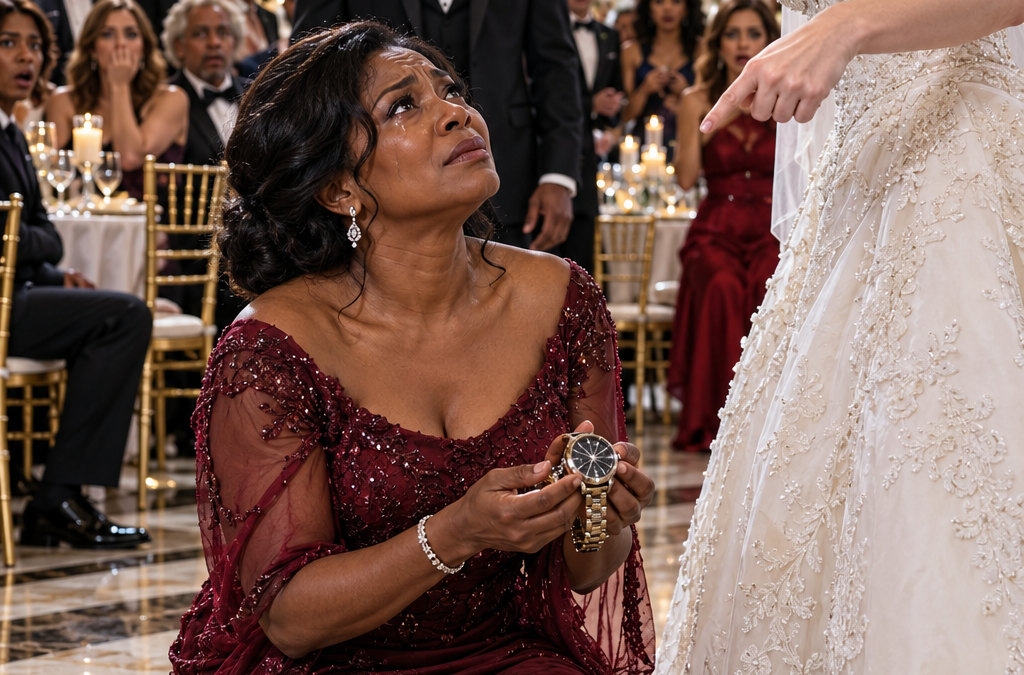
I dropped to my knees.
“Raymond.”
I didn’t mean to say his name.
It came out anyway.
I picked up the watch.
A crack ran across the face.
The strap had twisted.
I held it against my chest.
For one second, the ballroom disappeared.
I was back in the hospital.
Clear plastic bag.
His wallet.
His watch.
His ring.
A nurse saying, “I’m sorry.”
Then Victoria’s voice returned.
“Pick up your little trinket and leave.”
I looked up.
I must have had something in my face she hated.
Maybe dignity.
Maybe disbelief.
Maybe the simple refusal to collapse the way she expected.
She raised her hand.
The slap landed across my face.
Hard.
My head turned.
One pearl earring flew.
The ballroom became silent.
Not quiet.
Silent.
Three hundred people stopped moving.
My cheek burned.
I tasted blood where my teeth caught the inside of my mouth.
Victoria stood over me.
“Get out.”
I steadied myself.
“Are you deaf?”
I looked at her.
“Or just pathetic?”
I rose slowly.
The broken watch remained in my hand.
My eyes were dry.
I had cried enough in hospitals.
At gravesides.
Alone after Raymond died.
I would not give Victoria that part of me.
When I spoke, my voice surprised even me.
“You are going to regret this.”
She laughed.
“Regret putting you in your place?”
Diane smiled behind her.
“Your place is through those kitchen doors.”
Then Ethan moved.
He had been six feet away.
Frozen.
I saw his face as he came toward me.
Not anger first.
Shame.
That hurt.
He knelt.
Took my hands.
Helped me stand.
Picked up my pearl earring.
Placed it in my palm.
Then he faced his wife.
“Do you know who you just hit?”
Victoria rolled her eyes.
“Some woman from Harlem who refuses to understand boundaries.”
Ethan stared at her.
“Some woman from Harlem?”
His voice was low.
“Victoria, this is Grace Montgomery.”
She blinked.
“My mother.”
“I know that.”
“No. You don’t.”
The room held still.
“She founded Montgomery Capital Group.”
Victoria’s face changed.
“She chairs it.”
I looked down.
I didn’t want the reveal.
I hated it instantly.
“She manages more than four billion dollars.”
Someone at a nearby table inhaled loudly.
Victoria stared at me.
Then Derek lifted his phone.
He had pulled up an article.
My photograph.
My company.
Magazine profiles.
The number.
He turned the screen toward her.
Her champagne glass tilted.
Wine spilled down her dress.
She didn’t notice.
Diane went pale.
Bradley looked as if someone had removed all the blood from his body.
That was when I understood.
He knew exactly who I was.
Or rather, he knew the company.
Montgomery Capital.
The investor his firm had been courting for months.
I looked at him.
His eyes met mine.
Fear.
Pure.
Immediate.
“Mr. Ashford.”
He swallowed.
“Grace—”
“You submitted an investment proposal to my firm.”
Victoria looked between us.
Bradley whispered:
“Thirty-eight million.”
“Yes.”
I held Raymond’s broken watch.
“My team was still reviewing it.”
“Mrs. Montgomery, please.”
“The review is over.”
His face collapsed.
“Grace, we can discuss—”
“No.”
I looked toward Victoria.
“She made the culture of your family quite clear.”
“Please.”
“The proposal is dead.”
A tremor went through the room.
People love money more loudly than they love dignity.
That was becoming obvious.
I hated that too.
Victoria finally found her voice.
“I didn’t know.”
I turned to her.
“What?”
“I didn’t know who you were.”
There it was.
The defense.
The truth.
“You didn’t know I was wealthy?”
She opened her mouth.
“That is what you mean, isn’t it?”
“No, I—”
“You believed I was poor.”
Silence.
“You believed I was beneath you.”
Her mascara had begun smudging.
“You believed I had no power.”
“I made a mistake.”
“No.”
My cheek throbbed.
“A mistake is getting someone’s name wrong.”
I lifted the watch.
“You made decisions.”
She began crying.
“I was stressed.”
“Your stress did not put your hand across my face.”
I let that settle.
“Your beliefs did.”
Then I called my attorney.
“Patricia.”
“Grace? Are you all right?”
“I need you at the country club.”
“What happened?”
“I was assaulted.”
Silence.
Then her voice changed.
“I’m on my way.”
“And bring security.”
“I’ll be there.”
I ended the call.
Ethan stood beside me.
Then, without a word, he pulled off his wedding ring.
Victoria stared.
“Ethan.”
He placed it on the table.
Click.
The smallest sound in the room.
“This marriage is over.”
She lunged toward him.
“Don’t.”
He stepped away.
“Ethan, please.”
“No.”
“You can’t mean that.”
“I watched you hit my mother.”
“She threatened me.”
“No.”
“She came at my table—”
“She brought me my father’s watch.”
Victoria’s face twisted.
“You never told me who she was.”
Ethan went completely still.
“What?”
“If you had told me—”
He almost laughed.
“You mean rich?”
“No.”
“Black?”
She said nothing.
He looked as if something inside him had finally broken beyond repair.
“I’ve spent two years explaining you away.”
Her face changed.
“Those neighborhoods.”
“Ethan—”
“Diversity hires.”
“That was a joke.”
“The comments about our kids.”
Diane stepped forward.
“That’s enough.”
Ethan turned on her.
“No.”
His voice cracked.
“It’s finally enough.”
Diane recoiled.
“You’ve been poisoning this relationship from the beginning.”
“I was protecting my daughter.”
“From what?”
Silence.
“Me?”
Diane’s mouth tightened.
“My mother?”
No answer.
Patricia arrived within minutes.
Gray suit.
Briefcase.
Behind her came Daniel Moore, the head of my private security team.
I disliked having security in social settings.
That evening, I was grateful.
Patricia saw my face.
Her expression hardened.
“Who?”
I pointed at Victoria.
Patricia nodded once.
Then became a machine.
Witness names.
Phone numbers.
Videos.
Statements.
Venue staff.
Camera locations.
She did not raise her voice.
Competence rarely needs volume.
Victoria stood near the dance floor repeating:
“This is a misunderstanding.”
Nobody believed her.
The venue manager approached me.
“Mrs. Montgomery, we’ve contacted police.”
“Thank you.”
“We have cameras.”
“How many?”
“Three angles, I believe.”
“Preserve everything.”
“Already done.”
Patricia nodded approvingly.
Fifteen minutes later, Greenwich police entered.
They spoke to me first.
Photographed my cheek.
The damaged watch.
My earring.
Took statements.
Then approached Victoria.
“Ma’am, we need you to come with us.”
She stared.
“I’m the bride.”
The officer remained expressionless.
“We understand.”
“This is my wedding.”
“Ma’am.”
“Do you know who my father is?”
Bradley closed his eyes.
The officer said:
“At the moment, your father’s identity isn’t relevant.”
I almost appreciated the irony.
Diane pushed forward.
“This was a family disagreement.”
“No,” Patricia said.
Everybody looked at her.
“It was an assault.”
The officer nodded.
“We have multiple videos.”
Victoria looked around.
Hundreds of people.
Every camera now aimed at her.
Earlier, those cameras had been carefully directed away from me.
Now they couldn’t stop.
She was escorted through the front entrance.
Still wearing the gown.
One officer on each side.
The crowd watched.
I felt no satisfaction.
Only fatigue.
Bradley approached me as I prepared to leave.
“Grace.”
“Mrs. Montgomery.”
He corrected himself.
“Mrs. Montgomery.”
His voice shook.
“Please.”
I waited.
“We can resolve this privately.”
“No.”
“Everything can be settled.”
I looked at him.
“Can it?”
“Name your price.”
That almost made me pity him.
Almost.
I opened my hand.
The broken watch lay across my palm.
“There isn’t enough money in your family to purchase what your daughter broke tonight.”
He stared at the cracked glass.
I wasn’t speaking about the watch.
He understood.
Ethan drove home with me.
Neither of us spoke for the first twenty minutes.
Then he said:
“Why didn’t you tell me about the Ashford proposal?”
“It wasn’t relevant.”
“Mama.”
“It wasn’t.”
“They needed you.”
“I wasn’t marrying them.”
He looked out the window.
“I was.”
“Yes.”
His voice broke.
“I should’ve stopped this earlier.”
I kept my eyes on the road.
“You should have spoken earlier.”
He nodded.
“I know.”
“You knew the comments bothered you.”
“Yes.”
“You knew what she said about people.”
“Yes.”
“And you kept hoping marriage would change her.”
He wiped his face.
“Yes.”
I took his hand at the next red light.
“Love can help people grow.”
He looked at me.
“But love is not a substitute for character.”
He nodded.
“I’m sorry.”
“I know.”
“For the table.”
“I know.”
“The photographs.”
“I know.”
“For standing there when she—”
His voice failed.
I squeezed his hand.
“Learn from that one.”
He looked at me.
“If someone you love is being harmed, silence isn’t neutrality.”
The light turned green.
I released his hand.
“It becomes permission.”
The first wedding video appeared online before midnight.
Forty-five seconds.
Victoria slapping the velvet box.
The watch sliding.
Me kneeling.
The second slap.
By morning, millions had watched.
The headlines made me uncomfortable.
BRIDE SLAPS GROOM’S BLACK BILLIONAIRE MOTHER.
BRIDE DIDN’T KNOW WHO SHE HIT.
THIRTY-EIGHT-MILLION-DOLLAR MISTAKE.
Every headline got the lesson slightly wrong.
As if hitting a billionaire were uniquely dangerous.
As if Victoria’s mistake was failing to research my net worth.
She should have been horrified by what she did if I cleaned hotel rooms.
If I lived on public assistance.
If I had taken a bus to the wedding wearing borrowed shoes.
Money did not create my dignity.
It merely made consequences arrive faster.
Ethan filed for annulment the next day.
He did not call Victoria.
He did not answer her calls.
He came to Harlem.
For several nights, he slept in his childhood bedroom.
A thirty-two-year-old architect beneath a shelf still holding trophies from middle school.
Grief is rarely dignified.
Sometimes healing begins in the room where you were fourteen.
Three days later, I sat in Patricia’s office.
She placed a thick folder on the conference table.
“Criminal case is moving.”
I nodded.
“The district attorney has the videos.”
“And civil?”
“We have grounds.”
“For what?”
“Assault. Intentional infliction of emotional distress. Potential racial-harassment claims depending on evidence.”
“Settlement?”
“They called.”
“No.”
“I expected that.”
“I want discovery.”
Patricia studied me.
“You know what that means.”
“Yes.”
“Phones.”
“Yes.”
“Emails.”
“Yes.”
“Private messages.”
“Yes.”
“They will fight.”
“Let them.”
I wasn’t seeking revenge.
At least, I told myself that.
But I wanted the public version of Victoria to meet the private version.
Discovery made that happen.
Her text history with Diane was devastating.
Eleven months before the wedding:
Ethan says his mother lives in Harlem. I’m praying she’s not what I think she is.
Diane responded:
If she is, keep her away from the important guests.
Six months before:
What if our children come out too dark?
I read that message twice.
Then handed the page back to Patricia.
Another:
Make sure Ethan doesn’t bring his culture into our home.
Another:
His mother wants the family table. I told Caroline to put her in the back.
Diane:
Good girl.
There it was.
The seating chart.
The photographs.
The erasure.
None of it had been improvised.
The slap was the eruption.
The contempt had existed long before.
Those texts eventually reached reporters.
I still don’t know exactly how.
Once public, they destroyed whatever defense remained.
Victoria could no longer claim stress.
Diane could no longer claim misunderstanding.
People saw eighteen months of deliberate prejudice in their own words.
Civil-rights organizations responded.
Commentators discussed the case.
Some talked about me as if I represented every Black woman who had ever been underestimated.
I refused that burden.
I represented myself.
Other women had their own stories.
They did not need mine to validate them.
Meanwhile, Bradley’s business problems accelerated.
Montgomery Capital formally rejected the thirty-eight-million-dollar proposal.
That alone did not destroy Ashford Real Estate.
It was already unstable.
But confidence is oxygen in leveraged businesses.
Once lenders smell fear, rooms become smaller.
Once investors see governance problems, they stop returning calls.
And I did exactly what I told Bradley I would do.
When colleagues asked why Montgomery withdrew, I told the truth.
I did not blacklist him.
Did not fabricate concerns.
I explained that due diligence raised questions about governance, culture and family control.
Then the public scandal supplied the rest.
Investors withdrew.
One refinancing deal collapsed.
Then another.
Four months later, Ashford Real Estate filed for Chapter 11 protection.
The Greenwich estate went onto the market.
Photographs appeared online.
Italian stone driveway.
Six bedrooms.
Chandeliers.
Pool.
A home once used to measure other people’s worth reduced to square footage and asking price.
Diane lost her charity position.
The board vote was unanimous.
I heard she called members individually.
Reminded them of money raised.
Galas organized.
Connections made.
It changed nothing.
Power is sometimes less permanent than the people holding it understand.
The criminal trial began in October.
I testified.
Black dress.
Raymond’s ring around my neck.
No other jewelry.
The prosecutor played the videos.
Every angle.
The first strike.
The watch.
The second slap.
The words.
Your place is behind those kitchen doors.
I watched the jury.
Some looked at Victoria.
Others at me.
One woman cried.
When I took the stand, the prosecutor asked why I approached table one.
“To give my son his father’s watch.”
“Why that day?”
“Because his father should have been there.”
My voice almost broke.
I stopped.
The prosecutor waited.
“Raymond wore it every day of our marriage.”
I touched the ring at my neck.
“He wore it when Ethan was born.”
I looked toward Ethan in the gallery.
“When my husband died, the hospital gave me his personal belongings.”
I swallowed.
“I wanted our son to have something his father had carried through his whole life.”
The courtroom was silent.
“What happened to the watch?”
“She knocked it from my hand.”
“Then?”
“I went to pick it up.”
“And then?”
“She struck me.”
The defense argued it was a heat-of-the-moment incident.
Wedding stress.
Emotional overload.
No racial motive.
Then the prosecution displayed the texts.
One after another.
The courtroom saw what prejudice looks like when it believes itself private.
The jury deliberated three hours.
Guilty.
The final sentence included probation, community service, fines and required programming, enhanced by the finding that racial hostility had materially shaped the offense.
Some people were angry the punishment wasn’t harsher.
Others thought it was excessive.
I had no interest in becoming a sentencing commentator.
A court had done its job.
That was enough.
The civil judgment came later.
Significant money.
I donated every dollar.
Not because money was dirty.
Because I wanted it to become something Raymond would recognize.
We created the Raymond Montgomery Scholarship Fund.
Full tuition for first-generation Black college students.
At the announcement, reporters expected me to discuss Victoria.
I didn’t.
“My husband believed education was a door.”
Cameras flashed.
“This fund will keep that door open.”
A reporter shouted:
“Mrs. Montgomery, do you forgive Victoria Ashford?”
I stopped.
That question irritated me.
Not because forgiveness was impossible.
Because people are always in a hurry to ask the injured person when she intends to make everyone else comfortable.
“I haven’t decided what forgiveness means in this case.”
The reporter blinked.
“And I don’t believe I’m required to decide on anybody else’s schedule.”
Then I left.
My Buick was parked at the curb.
Same car.
I drove home.
One year after the wedding, I still lived in the brownstone.
The neighborhood hadn’t become glamorous because reporters discovered my address.
Children still bounced basketballs against the brick wall.
The deli owner still yelled at delivery drivers.
Gospel still played from my kitchen radio.
But there were new photographs.
One showed the first class of Raymond Montgomery scholars.
Caps.
Gowns.
Young people whose parents had never attended college.
Another showed Ethan in a hard hat.
His architecture firm had broken ground on a community center in Harlem.
Library downstairs.
Mentorship space upstairs.
Rooftop garden.
He had named the project Raymond House.
I cried when he told me.
Ethan called every morning now.
Sometimes about nothing.
Traffic.
Coffee.
A difficult client.
I understood what he was doing.
He had learned how quickly silence becomes distance.
He never spoke to Victoria again.
I never encouraged him to.
Never discouraged him either.
That relationship belonged to them.
But one afternoon, nearly ten months after the wedding, Ethan sat in my kitchen holding his father’s repaired watch.
I had intended to give it to him again.
He kept refusing.
“It belongs to you.”
“No.”
“Mama.”
“I carried it long enough.”
He turned it over.
The crystal had been repaired.
The leather replaced.
One scratch remained on the metal casing.
The jeweler had offered to polish it out.
I refused.
Ethan ran his thumb over it.
“You kept this.”
“Yes.”
“Why?”
“Because repair isn’t the same as pretending nothing happened.”
He looked at me.
“Some marks deserve to remain visible.”
He put the watch on.
The strap fit.
For one second, his wrist looked exactly like Raymond’s.
I looked away.
“Mama?”
“Give me a minute.”
He laughed softly.
Then came around the table and held me.
Victoria eventually completed her community-service hours.
I heard she showed up on time.
Did what she was told.
Spoke little.
Her lawyer released an apology.
Carefully drafted.
Regret.
Reflection.
Growth.
The usual language.
Maybe she meant some of it.
I don’t know.
Change is possible.
I believe that.
But change cannot be proven by press release.
It has to become behavior over time.
Diane and Bradley sold the estate.
Bradley eventually accepted an executive position at another firm.
Not chairman.
Not owner.
An employee.
Diane disappeared from most public boards.
Their name, once associated with wealth and society pages, became attached to the wedding video.
I took no pleasure in that.
But I also refused to pretend their losses were caused by me.
People sometimes said:
“Grace destroyed them.”
No.
I did not make Victoria slap me.
I did not write her texts.
I did not build Bradley’s company on unstable financing.
I did not teach Diane that racism was acceptable as long as it remained private.
Consequences are not the same as revenge.
That distinction mattered.
I never watched the wedding video.
Not once.
I didn’t need to.
Cameras captured the slap.
They did not capture the part that stayed with me.
The cracked sound of Raymond’s watch sliding over marble.
The feeling of my knees touching the floor.
The sudden understanding that my son had been living beside that prejudice for two years.
The expression on Ethan’s face when Victoria said “some woman from Harlem.”
The moment three hundred people finally saw me only after learning what I was worth financially.
That last part hurt in ways the slap never could.
Before Ethan said Montgomery Capital, I was a nuisance.
After he said four billion dollars, I became Mrs. Montgomery.
People approached me after police left.
Guests who had ignored table fourteen.
Some apologized.
Some said they had always thought the seating was wrong.
Some insisted they had been about to intervene.
Perhaps they were telling the truth.
Maybe not.
One woman touched my arm and whispered:
“I had no idea who you were.”
I looked at her.
“That was never the problem.”
She didn’t understand.
Most people didn’t.
The story spread because the rich bride had assaulted a richer mother-in-law.
People enjoyed the reversal.
The hidden billionaire.
The revelation.
The collapsing empire.
But if that is all someone understands, they have missed everything.
Victoria should not have respected me because I managed billions.
She should not have respected me because Forbes once put my photograph on a cover.
She should not have respected me because her father’s company wanted my money.
She should have respected me because I walked into the room as a human being.
As a mother.
As a widow.
As an invited guest.
Even none of those titles were necessary.
Human being should have been sufficient.
That is what I eventually tried to explain to Ethan.
One Sunday morning, we sat on my front steps drinking coffee.
He wore Raymond’s watch.
“Can I ask you something?” he said.
“You’re going to anyway.”
He smiled.
“Why didn’t you tell Victoria who you were when she started treating you badly?”
I thought about it.
“What would that have changed?”
“She would’ve stopped.”
“Exactly.”
He frowned.
“You wanted to see?”
“No.”
I looked down the block.
“I already saw.”
“Then why?”
“Because I shouldn’t have needed credentials to receive decency.”
He looked at the watch.
“She would’ve treated you differently.”
“Yes.”
“Doesn’t that matter?”
“It matters very much.”
I turned to him.
“Just not in the way you mean.”
He waited.
“If a person’s respect appears only after discovering your status, you haven’t learned that they respect you.”
“What did you learn?”
“That they respect consequences.”
He nodded slowly.
Then his expression became painful.
“I did that too.”
“What?”
“I kept making excuses because her behavior wasn’t aimed at me.”
I said nothing.
“She’d say something about Black people and then tell me I was different.”
I closed my eyes.
“I should’ve heard what that meant.”
“Yes.”
He looked surprised at the directness.
I had never believed love required lying.
“You should have.”
He nodded.
“I know.”
I touched his hand.
“But now you do.”
That was the line between guilt and growth.
What happens next.
Ethan changed.
Not theatrically.
No public crusade.
No speeches.
He simply stopped tolerating things he once ignored.
When somebody made a joke in a meeting, he responded.
When clients made assumptions about his staff, he corrected them.
When his firm recruited, he looked carefully at who kept getting overlooked.
He learned that silence had consequences too.
That made me prouder than any building he designed.
The scholarship fund grew.
Other donors joined.
The first students became the second class.
Then a third.
One young woman from the Bronx studied biomedical engineering.
A young man from Queens entered law school.
A girl from Harlem who had worked evenings at a grocery store called me after earning admission to Columbia.
She cried.
I cried too.
Raymond’s watch had become something larger than a damaged object.
The civil money had become tuition.
The worst moment of one wedding had opened doors in places Victoria would never see.
That did not make what happened good.
People often rush toward redemption stories because they make suffering easier to digest.
I reject that.
The slap was wrong.
The racism was wrong.
My son suffered.
I suffered.
Nothing that came afterward was necessary to justify that pain.
We simply chose not to waste it.
There is a difference.
On the first anniversary of the wedding, I woke again before my alarm.
5:30.
Same brownstone.
Same gospel station.
Same stovetop coffee.
I walked into the kitchen.
Raymond’s mug sat where it always had.
For a moment, I imagined him leaning against the counter.
He would have hated the wedding.
Not the flowers.
Not the venue.
He would have complained about spending half a million dollars on anything involving chicken breast and chairs.
I smiled.
Then I imagined what he would have done after Victoria hit me.
That made me smile disappear.
Raymond had been a gentle man.
But no one confused gentle with weak.
I touched his ring.
“Your boy did all right eventually,” I whispered.
My phone rang.
Ethan.
“Morning, Mama.”
“Morning, baby.”
“You okay?”
He remembered the date.
“Yes.”
“You sure?”
“No.”
He was quiet.
“But I will be.”
“I was thinking about Dad.”
“So was I.”
He paused.
“I’m wearing the watch.”
I smiled.
“Good.”
“I still see the scratch.”
“You’re supposed to.”
He laughed softly.
“I figured you’d say that.”
After we hung up, I went to the window.
The street was waking.
Delivery truck.
Woman walking a dog.
Two children arguing over a scooter.
Ordinary life.
That’s what survived.
Not the gala.
Not the headlines.
Not the Ashford estate.
Ordinary life.
Family.
Work.
Morning coffee.
A son calling his mother.
Young people walking through educational doors Raymond once dreamed should be open.
I thought again about Victoria’s first look at me.
She had looked at my brown skin.
Navy dress.
Pearls.
Old Buick.
And decided those details told her everything.
That was her real failure.
Not ignorance of my wealth.
Ignorance of my humanity.
People asked for years what I felt when Ethan announced who I was.
Was I satisfied?
Vindicated?
Powerful?
No.
I felt sad.
Because the room changed.
I watched it happen.
People sat straighter.
Faces softened.
Guests who had ignored me suddenly looked horrified.
My value seemed to rise in their eyes with every zero attached to my company.
But I was the same woman.
I had not become more worthy between the slap and the revelation.
Nothing about me had changed.
Only what they knew.
That taught me something money never had.
There are people who believe respect is an investment.
They give it according to expected return.
Important person?
Respect.
Useful person?
Respect.
Powerful person?
Respect.
Poor woman?
Maybe not.
Service worker?
Maybe not.
Someone from Harlem?
Depends.
That isn’t respect.
That’s strategy.
Real respect does not need a résumé.
It doesn’t check a bank balance.
It does not wait for Forbes.
It does not ask whether the person standing in front of you might someday be able to hurt you.
It begins before any of that.
Raymond understood that.
Maybe because we had started with nothing.
Maybe because he spent years repairing elevators before we had money.
He once told Ethan when our son was twelve:
“The janitor knows whether you’re a good man before your boss does.”
Ethan laughed at the time.
Years later, he told me he finally understood.
So did I.
The most important person at that wedding was never the richest one.
It was the person each guest believed had the least power.
How they treated that person revealed them.
Victoria failed.
Diane failed.
Bradley failed when he stayed silent.
Ethan failed for too long.
Several guests failed.
Then some of them changed.
That matters too.
Nobody becomes permanently fixed at their worst moment unless they choose to remain there.
I don’t know whether Victoria changed.
I hope she did.
Not for me.
For whoever stands in front of her next.
Someone whose name she doesn’t recognize.
Someone wearing the wrong dress.
Driving the wrong car.
Coming from the wrong neighborhood.
Someone who cannot destroy her financially.
That will be the real test.
Not an apology to Grace Montgomery.
Kindness toward someone she believes cannot reward her.
I still wear Raymond’s ring.
Ethan wears the watch.
The scratch remains.
I asked him once if he wanted it polished out.
He shook his head.
“No.”
“Why?”
He turned his wrist.
“Because you were right.”
“About?”
“Repair doesn’t mean erasing.”
I smiled.
My son had finally learned something his father understood instinctively.
Scars do not always need hiding.
Some are evidence.
The wedding became a scar.
A visible line through our family history.
Before it, Ethan believed love could survive unchallenged contempt.
After it, he knew silence could feed what love should confront.
Before it, I believed I could absorb humiliation indefinitely if doing so protected my son.
After it, I understood that sometimes protecting someone means refusing to make cruelty comfortable for them.
Before it, the Ashfords believed status could insulate them from consequences.
Afterward, they learned that beautiful rooms do not make ugly behavior disappear.
And before that day, three hundred guests attended a wedding expecting to witness two people become a family.
Instead, they witnessed what happens when one family decides another human being is beneath them.
I was Grace Montgomery before anyone knew what Montgomery Capital was.
I was Grace Montgomery sitting beside the kitchen.
I was Grace Montgomery when the photographer was told not to include me.
I was Grace Montgomery when Diane whispered one of them.
I was Grace Montgomery kneeling on marble with a broken watch against my chest.
And I was Grace Montgomery when Ethan finally said my name loudly enough for the whole room to understand.
The money never changed that.
It simply exposed how many people believed it should.
𝗧𝗛𝗘 𝗘𝗡𝗗
At My Son’s Wedding, the Bride Looked at My Skin, My Dress, and Decided I Had No Right to Stand Near Her Family
The first time Victoria Ashford looked at me, I watched her decide exactly what kind of woman I was before I had finished introducing myself.
By the time I was kneeling on the ballroom floor with my dead husband’s broken watch in my hands, three hundred people had finally stopped pretending they couldn’t see what she thought of me.
I woke at 5:30 on the morning of my son’s wedding without needing the alarm.
Forty years of getting up before the world had built a clock inside me that batteries could not improve.
For a few seconds, I stayed on the edge of the bed and listened to the brownstone.
Pipes settling.
A bus sighing at the corner.
Somebody’s radio beginning faintly through a neighboring wall.
My house had sounded almost exactly the same for thirty-two years.
That was one reason I never left.
People assumed wealth made you hungry for newer things.
Bigger things.
Higher floors.
Better addresses.
I could have bought an apartment overlooking Central Park.
A house in the Hamptons.
Probably several houses.
Instead, I remained in Harlem in the brownstone Raymond and I had bought when the kitchen cabinets leaned slightly to the left and the boiler sounded like someone throwing rocks into a metal drum.
Raymond had fixed both.
He had fixed almost everything.
That was who he was.
His coffee mug still sat on the second shelf in my kitchen.
His winter coat still hung at the end of the entry closet.
His wedding ring was around my neck on a thin gold chain.
I had worn it every day since we buried him.
That morning, I stepped into the kitchen and turned on the little radio by the window.
Gospel filled the room.
Low.
Familiar.
Steady.
I made coffee in the same stovetop pot Raymond had complained took too long.
On the refrigerator was a photograph of Ethan at seven.
Gap between his front teeth.
Flour on his cheeks.
Standing on a chair while pretending to help me make pancakes.
In the photograph, Raymond’s hand was visible at the edge of the frame.
Just his hand.
I stared at that more than I stared at Ethan sometimes.
Today, that little boy was getting married.
My phone buzzed.
Ethan.
I answered immediately.
“Morning, baby.”
He laughed.
“Mama, you know I’m thirty-two, right?”
“You’ll be my baby when you’re eighty.”
“Fair enough.”
His voice carried nerves beneath the humor.
“How are you feeling?” I asked.
“Like I might throw up.”
“Good.”
“Good?”
“It means you understand this matters.”
He became quiet.
Then:
“Mama?”
“Yes?”
“Thank you.”
“For what?”
“For everything.”
I looked at Raymond’s mug.
“Your father did half.”
“You know what I mean.”
I did.
“I love you, Ethan.”
“I love you too.”
“I’ll see you there.”
He hesitated.
Something almost came through the phone.
Then he only said:
“Okay.”
After we hung up, I stood in the kitchen longer than necessary.
I had learned to pay attention to hesitation.
Boardrooms teach you that.
People reveal themselves most clearly in the half-second before they decide what version of the truth to tell.
Ethan had been swallowing something.
I knew it.
I also knew today was not the day I intended to pry it out of him.
I went upstairs and opened my closet.
No gowns.
No clothing designed to announce a bank account.
I chose a navy dress.
Elegant.
Simple.
Below the knee.
Pearl earrings Raymond had given me on our twentieth anniversary.
His ring stayed at my throat.
Then I opened the small safe inside my closet.
At the back sat a velvet box.
Inside was Raymond’s watch.
A 1978 Omega Seamaster.
Scratched crystal.
Worn brown leather strap.
Not the most expensive watch I owned.
Not even close.
But it was the only one that mattered.
Raymond had worn it when we married.
He had worn it when Ethan was born.
He wore it when he took Ethan to kindergarten.
When he taught him to ride a bike.
When we signed the first lease that eventually became Montgomery Capital’s first real property acquisition.
He wore it the last morning of his life.
A heart attack took him at fifty-eight.
No warning.
He drank coffee.
Kissed me.
Left.
Never came home.
The hospital returned the watch in a clear plastic bag.
I had held it against my chest that night until the leather warmed against my skin.
Today, I wanted Ethan to have it.
I put the box into my clutch.
Then I dressed.
By eleven, I was driving north toward Greenwich.
Not in a limousine.
Not in one of the black cars my office maintained for meetings.
My silver Buick.
Twelve years old.
Perfectly reliable.
Raymond had owned one like it when we were young, and I had never lost the affection.
The wedding venue was a private country club forty minutes outside Greenwich.
Iron gates.
Stone pillars.
Oak trees lining a drive so carefully maintained the grass looked combed.
White silk ribbons hung from branches.
June light moved through them.
Everything was beautiful.
Everything was intentional.
I parked.
Smoothed my dress.
Took one breath.
Then walked toward the entrance.
A young man in a black vest held a clipboard.
He looked at me.
Then at my car.
Then at me again.
“Catering entrance is around back, ma’am.”
There are humiliations that shock you.
Others simply exhaust you.
This one belonged to the second category.
“I’m not catering.”
His face changed.
“Oh.”
“I’m a guest.”
“Of course.”
He checked the clipboard.
“Name?”
“Grace Montgomery.”
His finger moved.
Then stopped.
I watched recognition fail.
That did not surprise me.
He looked up.
“And your relationship to the couple?”
“I’m the groom’s mother.”
His eyebrows lifted.
Just slightly.
The movement lasted less than a second.
But I saw it.
“Of course, ma’am.”
He smiled too quickly.
“Right this way.”
I walked past him.
I had been mistaken for staff in hotels where I owned substantial interests.
Asked whether I was lost in buildings where I chaired meetings.
Once, at a charity event where I had donated more money than the next ten donors combined, a woman handed me her empty champagne glass without looking at my face.
Money never made those moments stop.
It only made them more revealing.
The ballroom was magnificent.
Crystal chandeliers.
White roses.
Hydrangeas.
Gold-rimmed plates.
A string quartet near the terrace doors.
Everything whispered old money with the practiced confidence of people who hated being accused of talking about money.
I found the seating display.
MONTGOMERY.
Table 14.
I followed the room numbers.
Table one sat at the front.
Extra flowers.
Gold trim.
Ashford relatives.
Table fourteen was beside the kitchen.
Plain white cloth.
Fewer flowers.
The service doors swung open every few seconds behind it.
Heat spilled through.
So did the sound of pans.
I looked at the card again.
Table 14.
My son’s wedding.
I had been allotted ten guests.
Ten.
Ethan mentioned the limitation several weeks earlier.
He had tried to make it sound like a venue issue.
I knew better.
I also knew he was asking me not to fight about it.
So I hadn’t.
I sat.
A woman beside me introduced herself.
“How do you know the couple?”
“I’m Ethan’s mother.”
Her smile faltered.
“Oh.”
She looked toward the front.
“I thought family was up there.”
“So did I.”
Her expression turned sympathetic.
That almost hurt more.
The ceremony began at noon.
We moved outside.
Three hundred chairs faced an arch surrounded by white flowers.
I was seated near the back.
Ethan stood at the altar.
Tall.
Handsome.
Light brown skin glowing in the sun.
Raymond’s shoulders.
My eyes.
His hands trembled.
His best man Derek touched his shoulder.
Then Ethan searched the crowd.
He found me.
Even from the back, he found me.
I placed one hand over my heart.
He smiled.
That was enough.
The music changed.
Victoria appeared on her father’s arm.
She was beautiful.
I would never lie about that.
Her gown shimmered.
The veil floated behind her.
Bradley Ashford walked stiffly beside her.
I knew who Bradley was.
I had known for months.
His real-estate company had submitted an investment proposal to Montgomery Capital.
Thirty-eight million dollars.
His CFO had been courting my team.
The numbers were troubling.
Liquidity pressure.
Overleveraged assets.
Short refinancing windows.
But there were pieces of the portfolio worth considering.
The proposal was still under review.
I had never mentioned it to Ethan.
Business and family were separate.
At least I believed they should be.
Victoria came down the aisle.
Everyone watched her.
I watched my son.
His face softened.
For one moment, all my concerns disappeared.
I saw the boy with flour on his face.
I saw Raymond standing beside me thirty-five years earlier in a little Bronx church with twenty-eight guests and flowers we had arranged ourselves.
Pastor James Wilson stood at the altar.
He had baptized Ethan.
Buried Raymond.
Known me twenty years.
His voice carried.
“Love is not merely feeling.”
The guests quieted.
“It is a decision.”
His eyes swept the crowd.
“A decision to see the person in front of you fully.”
For one brief second, his gaze met mine.
“Without condition.”
I saw Diane Ashford shift in her seat.
Pastor Wilson continued.
“Love does not measure skin.”
Another shift.
“Status.”
Bradley glanced at his program.
“Income.”
I nearly smiled.
“Love asks whether you will choose to honor another human being even when doing so is difficult.”
Victoria smiled at Ethan.
They exchanged vows.
Rings.
Promises.
The applause rose.
My son kissed his wife.
I clapped harder than anyone around me.
I meant it.
I wanted his marriage to succeed.
I wanted every suspicion I had about Victoria to be wrong.
During cocktail hour, I stood near a pillar with water.
I had barely taken a sip when Ethan crossed the terrace.
“Mama.”
He hugged me.
I closed my eyes against his shoulder.
“You look beautiful.”
“You look like your father.”
He pulled back.
“That good?”
“That stubborn.”
He laughed.
Then took my hand.
“Come meet Victoria properly.”
My stomach tightened.
I let him lead me.
Victoria stood surrounded by bridesmaids.
Champagne.
Laughter.
Golden light.
A photographer moved around them.
“Victoria.”
Ethan touched her elbow.
“This is my mom.”
She turned.
Her smile was ready.
Then she saw me.
The smile remained.
But only technically.
Her eyes moved over my face.
My skin.
My dress.
Pearls.
Shoes.
Then Ethan.
Then me.
“Oh.”
One word.
Still enough.
“I didn’t realize.”
She stopped.
I extended my hand.
“It’s lovely to finally meet you.”
She looked at it.
Then touched my fingers lightly.
“Charming.”
Not lovely to meet you too.
Not Ethan talks about you.
Nothing.
Then she turned back to her bridesmaids.
Conversation over.
Ethan stood frozen.
I felt tension rise through his hand.
I squeezed it.
“Go be with your bride.”
“Mama—”
“I’m fine.”
He wasn’t convinced.
Neither was I.
Then Diane Ashford arrived.
She took Victoria by the elbow and moved three steps away.
Not enough.
Perhaps she assumed women like me didn’t hear quiet cruelty because we had spent our lives pretending not to.
“You didn’t tell me his mother was one of them.”
I kept my face still.
Victoria whispered:
“I didn’t know.”
“Bradley will be furious.”
“Mother.”
“How could you not ask?”
“His father was white. I assumed.”
Diane’s voice became sharper.
“Look at her. Department-store dress. Sitting at a half-million-dollar wedding.”
I felt Raymond’s ring against my chest.
“This is humiliating.”
Victoria looked toward me.
I looked away before she caught me listening.
“Keep her out of the photographs,” Diane said.
“Already handled.”
I walked back to table fourteen.
Slowly.
No rush.
No scene.
My mother taught me long ago that walking away and being driven away were not the same thing.
I sat.
The cocktail hour continued.
Nobody knew anything had happened.
That’s how cruelty survives in beautiful places.
Music keeps playing.
Glasses keep filling.
People keep smiling.
Dinner began at seven.
My seat had no name card.
Every other person at the table had one.
Mine was blank.
I touched the empty card once.
Then left it alone.
The kitchen doors opened.
Heat hit my shoulders.
Soup arrived.
Across the ballroom, Victoria laughed.
Photographers circled table one.
I watched one of them begin moving toward our side.
Then the wedding planner stopped him.
Whispered.
The photographer glanced toward me.
Changed direction.
That hurt.
Not because I needed photographs.
Because someone had issued instructions to erase me from my son’s wedding album.
Between courses, Ethan appeared.
He crouched beside me.
“This is wrong.”
“No.”
“Yes.”
He looked behind him.
“You should be with us.”
“Ethan.”
“You’re beside the kitchen.”
“I’m aware.”
“I’m fixing it.”
I touched his face.
“Not tonight.”
“Mama—”
“It is your wedding.”
“That doesn’t mean—”
“Go sit beside your wife.”
His eyes filled.
“I’m sorry.”
“Don’t apologize for a seating chart.”
We both knew it was not about a seating chart.
He kissed my forehead.
Then walked away.
Victoria intercepted him before he reached the dance floor.
I couldn’t hear every word at first.
Then her voice sharpened.
“The chart was finalized weeks ago.”
Ethan said something.
Victoria leaned closer.
“It is my day.”
His shoulders stiffened.
“Do not make a scene.”
He stared at her.
Something moved behind his eyes.
Then he nodded.
That was the moment I became afraid for him.
Not because he had obeyed.
Because I recognized the habit.
Swallowing.
Absorbing.
Waiting for a better time.
I had done that myself in my first years of business.
Every racist joke I pretended not to hear because I needed the contract.
Every meeting where a man repeated my idea and received credit.
Every client who asked whether my male associate was the actual decision-maker.
You swallow enough, eventually you forget you are choking.
The toasts began.
Derek stood.
He made everyone laugh.
Then his expression softened.
“I also want to thank Grace Montgomery.”
My name carried across the room.
I looked up.
“For raising the best man I know.”
Applause.
Not enormous.
But genuine.
I mouthed thank you.
Then Diane stood.
She welcomed Ethan into “our family.”
Praised his education.
His manners.
The fact that he was “clearly raised with good values.”
Clearly.
That word sat differently after what I had heard.
Not once did she mention me.
I looked at Raymond’s ring.
Then at my son.
He looked toward me.
He knew.
The dancing began.
I had had enough.
Not rage.
Not revenge.
Exhaustion.
I decided to leave quietly.
I would call Ethan tomorrow.
Tell him the wedding was beautiful.
Tell him Victoria looked lovely.
Mothers sometimes lie to preserve a child’s happiness.
But before leaving, I wanted to give him his father’s watch.
Nothing more.
I opened my clutch.
The velvet box rested inside.
I held it in my palm.
Raymond should have been there.
That grief was older than everything else in the room.
Older than Victoria.
Older than money.
I stood.
Walked toward table one.
Ten feet away, Victoria saw me.
Her laughter stopped.
“Excuse me.”
Her voice carried.
Several guests turned.
“Where do you think you’re going?”
I stopped.
“I wanted to leave something for Ethan.”
She stood.
“What?”
“His father’s watch.”
I held up the box.
“I’m leaving. I only wanted to put it beside his plate.”
“You were not invited to this table.”
My chest tightened.
“Victoria.”
“This is the family table.”
“I am his family.”
Her face hardened.
“I don’t care what you think you are to Ethan.”
The room around us began quieting.
“You were given a seat.”
I looked at her.
“Beside the kitchen.”
“You should have stayed there.”
I heard someone gasp.
Diane stood behind her daughter.
Arms crossed.
No objection.
I could see Bradley farther back.
He stared into his drink.
“Please,” I said.
That word cost me.
“It’s his father’s watch.”
I opened the box.
The old Omega caught the chandelier light.
“Just let me give it to him.”
Victoria stared at my hands.
Then she slapped the box away.
It flew.
Hit marble.
The watch came out.
Skidded across the floor.
The sound of glass cracking reached me even through the music.
Everything inside me stopped.
I dropped to my knees.
“Raymond.”
I didn’t mean to say his name.
It came out anyway.
I picked up the watch.
A crack ran across the face.
The strap had twisted.
I held it against my chest.
For one second, the ballroom disappeared.
I was back in the hospital.
Clear plastic bag.
His wallet.
His watch.
His ring.
A nurse saying, “I’m sorry.”
Then Victoria’s voice returned.
“Pick up your little trinket and leave.”
I looked up.
I must have had something in my face she hated.
Maybe dignity.
Maybe disbelief.
Maybe the simple refusal to collapse the way she expected.
She raised her hand.
The slap landed across my face.
Hard.
My head turned.
One pearl earring flew.
The ballroom became silent.
Not quiet.
Silent.
Three hundred people stopped moving.
My cheek burned.
I tasted blood where my teeth caught the inside of my mouth.
Victoria stood over me.
“Get out.”
I steadied myself.
“Are you deaf?”
I looked at her.
“Or just pathetic?”
I rose slowly.
The broken watch remained in my hand.
My eyes were dry.
I had cried enough in hospitals.
At gravesides.
Alone after Raymond died.
I would not give Victoria that part of me.
When I spoke, my voice surprised even me.
“You are going to regret this.”
She laughed.
“Regret putting you in your place?”
Diane smiled behind her.
“Your place is through those kitchen doors.”
Then Ethan moved.
He had been six feet away.
Frozen.
I saw his face as he came toward me.
Not anger first.
Shame.
That hurt.
He knelt.
Took my hands.
Helped me stand.
Picked up my pearl earring.
Placed it in my palm.
Then he faced his wife.
“Do you know who you just hit?”
Victoria rolled her eyes.
“Some woman from Harlem who refuses to understand boundaries.”
Ethan stared at her.
“Some woman from Harlem?”
His voice was low.
“Victoria, this is Grace Montgomery.”
She blinked.
“My mother.”
“I know that.”
“No. You don’t.”
The room held still.
“She founded Montgomery Capital Group.”
Victoria’s face changed.
“She chairs it.”
I looked down.
I didn’t want the reveal.
I hated it instantly.
“She manages more than four billion dollars.”
Someone at a nearby table inhaled loudly.
Victoria stared at me.
Then Derek lifted his phone.
He had pulled up an article.
My photograph.
My company.
Magazine profiles.
The number.
He turned the screen toward her.
Her champagne glass tilted.
Wine spilled down her dress.
She didn’t notice.
Diane went pale.
Bradley looked as if someone had removed all the blood from his body.
That was when I understood.
He knew exactly who I was.
Or rather, he knew the company.
Montgomery Capital.
The investor his firm had been courting for months.
I looked at him.
His eyes met mine.
Fear.
Pure.
Immediate.
“Mr. Ashford.”
He swallowed.
“Grace—”
“You submitted an investment proposal to my firm.”
Victoria looked between us.
Bradley whispered:
“Thirty-eight million.”
“Yes.”
I held Raymond’s broken watch.
“My team was still reviewing it.”
“Mrs. Montgomery, please.”
“The review is over.”
His face collapsed.
“Grace, we can discuss—”
“No.”
I looked toward Victoria.
“She made the culture of your family quite clear.”
“Please.”
“The proposal is dead.”
A tremor went through the room.
People love money more loudly than they love dignity.
That was becoming obvious.
I hated that too.
Victoria finally found her voice.
“I didn’t know.”
I turned to her.
“What?”
“I didn’t know who you were.”
There it was.
The defense.
The truth.
“You didn’t know I was wealthy?”
She opened her mouth.
“That is what you mean, isn’t it?”
“No, I—”
“You believed I was poor.”
Silence.
“You believed I was beneath you.”
Her mascara had begun smudging.
“You believed I had no power.”
“I made a mistake.”
“No.”
My cheek throbbed.
“A mistake is getting someone’s name wrong.”
I lifted the watch.
“You made decisions.”
She began crying.
“I was stressed.”
“Your stress did not put your hand across my face.”
I let that settle.
“Your beliefs did.”
Then I called my attorney.
“Patricia.”
“Grace? Are you all right?”
“I need you at the country club.”
“What happened?”
“I was assaulted.”
Silence.
Then her voice changed.
“I’m on my way.”
“And bring security.”
“I’ll be there.”
I ended the call.
Ethan stood beside me.
Then, without a word, he pulled off his wedding ring.
Victoria stared.
“Ethan.”
He placed it on the table.
Click.
The smallest sound in the room.
“This marriage is over.”
She lunged toward him.
“Don’t.”
He stepped away.
“Ethan, please.”
“No.”
“You can’t mean that.”
“I watched you hit my mother.”
“She threatened me.”
“No.”
“She came at my table—”
“She brought me my father’s watch.”
Victoria’s face twisted.
“You never told me who she was.”
Ethan went completely still.
“What?”
“If you had told me—”
He almost laughed.
“You mean rich?”
“No.”
“Black?”
She said nothing.
He looked as if something inside him had finally broken beyond repair.
“I’ve spent two years explaining you away.”
Her face changed.
“Those neighborhoods.”
“Ethan—”
“Diversity hires.”
“That was a joke.”
“The comments about our kids.”
Diane stepped forward.
“That’s enough.”
Ethan turned on her.
“No.”
His voice cracked.
“It’s finally enough.”
Diane recoiled.
“You’ve been poisoning this relationship from the beginning.”
“I was protecting my daughter.”
“From what?”
Silence.
“Me?”
Diane’s mouth tightened.
“My mother?”
No answer.
Patricia arrived within minutes.
Gray suit.
Briefcase.
Behind her came Daniel Moore, the head of my private security team.
I disliked having security in social settings.
That evening, I was grateful.
Patricia saw my face.
Her expression hardened.
“Who?”
I pointed at Victoria.
Patricia nodded once.
Then became a machine.
Witness names.
Phone numbers.
Videos.
Statements.
Venue staff.
Camera locations.
She did not raise her voice.
Competence rarely needs volume.
Victoria stood near the dance floor repeating:
“This is a misunderstanding.”
Nobody believed her.
The venue manager approached me.
“Mrs. Montgomery, we’ve contacted police.”
“Thank you.”
“We have cameras.”
“How many?”
“Three angles, I believe.”
“Preserve everything.”
“Already done.”
Patricia nodded approvingly.
Fifteen minutes later, Greenwich police entered.
They spoke to me first.
Photographed my cheek.
The damaged watch.
My earring.
Took statements.
Then approached Victoria.
“Ma’am, we need you to come with us.”
She stared.
“I’m the bride.”
The officer remained expressionless.
“We understand.”
“This is my wedding.”
“Ma’am.”
“Do you know who my father is?”
Bradley closed his eyes.
The officer said:
“At the moment, your father’s identity isn’t relevant.”
I almost appreciated the irony.
Diane pushed forward.
“This was a family disagreement.”
“No,” Patricia said.
Everybody looked at her.
“It was an assault.”
The officer nodded.
“We have multiple videos.”
Victoria looked around.
Hundreds of people.
Every camera now aimed at her.
Earlier, those cameras had been carefully directed away from me.
Now they couldn’t stop.
She was escorted through the front entrance.
Still wearing the gown.
One officer on each side.
The crowd watched.
I felt no satisfaction.
Only fatigue.
Bradley approached me as I prepared to leave.
“Grace.”
“Mrs. Montgomery.”
He corrected himself.
“Mrs. Montgomery.”
His voice shook.
“Please.”
I waited.
“We can resolve this privately.”
“No.”
“Everything can be settled.”
I looked at him.
“Can it?”
“Name your price.”
That almost made me pity him.
Almost.
I opened my hand.
The broken watch lay across my palm.
“There isn’t enough money in your family to purchase what your daughter broke tonight.”
He stared at the cracked glass.
I wasn’t speaking about the watch.
He understood.
Ethan drove home with me.
Neither of us spoke for the first twenty minutes.
Then he said:
“Why didn’t you tell me about the Ashford proposal?”
“It wasn’t relevant.”
“Mama.”
“It wasn’t.”
“They needed you.”
“I wasn’t marrying them.”
He looked out the window.
“I was.”
“Yes.”
His voice broke.
“I should’ve stopped this earlier.”
I kept my eyes on the road.
“You should have spoken earlier.”
He nodded.
“I know.”
“You knew the comments bothered you.”
“Yes.”
“You knew what she said about people.”
“Yes.”
“And you kept hoping marriage would change her.”
He wiped his face.
“Yes.”
I took his hand at the next red light.
“Love can help people grow.”
He looked at me.
“But love is not a substitute for character.”
He nodded.
“I’m sorry.”
“I know.”
“For the table.”
“I know.”
“The photographs.”
“I know.”
“For standing there when she—”
His voice failed.
I squeezed his hand.
“Learn from that one.”
He looked at me.
“If someone you love is being harmed, silence isn’t neutrality.”
The light turned green.
I released his hand.
“It becomes permission.”
The first wedding video appeared online before midnight.
Forty-five seconds.
Victoria slapping the velvet box.
The watch sliding.
Me kneeling.
The second slap.
By morning, millions had watched.
The headlines made me uncomfortable.
BRIDE SLAPS GROOM’S BLACK BILLIONAIRE MOTHER.
BRIDE DIDN’T KNOW WHO SHE HIT.
THIRTY-EIGHT-MILLION-DOLLAR MISTAKE.
Every headline got the lesson slightly wrong.
As if hitting a billionaire were uniquely dangerous.
As if Victoria’s mistake was failing to research my net worth.
She should have been horrified by what she did if I cleaned hotel rooms.
If I lived on public assistance.
If I had taken a bus to the wedding wearing borrowed shoes.
Money did not create my dignity.
It merely made consequences arrive faster.
Ethan filed for annulment the next day.
He did not call Victoria.
He did not answer her calls.
He came to Harlem.
For several nights, he slept in his childhood bedroom.
A thirty-two-year-old architect beneath a shelf still holding trophies from middle school.
Grief is rarely dignified.
Sometimes healing begins in the room where you were fourteen.
Three days later, I sat in Patricia’s office.
She placed a thick folder on the conference table.
“Criminal case is moving.”
I nodded.
“The district attorney has the videos.”
“And civil?”
“We have grounds.”
“For what?”
“Assault. Intentional infliction of emotional distress. Potential racial-harassment claims depending on evidence.”
“Settlement?”
“They called.”
“No.”
“I expected that.”
“I want discovery.”
Patricia studied me.
“You know what that means.”
“Yes.”
“Phones.”
“Yes.”
“Emails.”
“Yes.”
“Private messages.”
“Yes.”
“They will fight.”
“Let them.”
I wasn’t seeking revenge.
At least, I told myself that.
But I wanted the public version of Victoria to meet the private version.
Discovery made that happen.
Her text history with Diane was devastating.
Eleven months before the wedding:
Ethan says his mother lives in Harlem. I’m praying she’s not what I think she is.
Diane responded:
If she is, keep her away from the important guests.
Six months before:
What if our children come out too dark?
I read that message twice.
Then handed the page back to Patricia.
Another:
Make sure Ethan doesn’t bring his culture into our home.
Another:
His mother wants the family table. I told Caroline to put her in the back.
Diane:
Good girl.
There it was.
The seating chart.
The photographs.
The erasure.
None of it had been improvised.
The slap was the eruption.
The contempt had existed long before.
Those texts eventually reached reporters.
I still don’t know exactly how.
Once public, they destroyed whatever defense remained.
Victoria could no longer claim stress.
Diane could no longer claim misunderstanding.
People saw eighteen months of deliberate prejudice in their own words.
Civil-rights organizations responded.
Commentators discussed the case.
Some talked about me as if I represented every Black woman who had ever been underestimated.
I refused that burden.
I represented myself.
Other women had their own stories.
They did not need mine to validate them.
Meanwhile, Bradley’s business problems accelerated.
Montgomery Capital formally rejected the thirty-eight-million-dollar proposal.
That alone did not destroy Ashford Real Estate.
It was already unstable.
But confidence is oxygen in leveraged businesses.
Once lenders smell fear, rooms become smaller.
Once investors see governance problems, they stop returning calls.
And I did exactly what I told Bradley I would do.
When colleagues asked why Montgomery withdrew, I told the truth.
I did not blacklist him.
Did not fabricate concerns.
I explained that due diligence raised questions about governance, culture and family control.
Then the public scandal supplied the rest.
Investors withdrew.
One refinancing deal collapsed.
Then another.
Four months later, Ashford Real Estate filed for Chapter 11 protection.
The Greenwich estate went onto the market.
Photographs appeared online.
Italian stone driveway.
Six bedrooms.
Chandeliers.
Pool.
A home once used to measure other people’s worth reduced to square footage and asking price.
Diane lost her charity position.
The board vote was unanimous.
I heard she called members individually.
Reminded them of money raised.
Galas organized.
Connections made.
It changed nothing.
Power is sometimes less permanent than the people holding it understand.
The criminal trial began in October.
I testified.
Black dress.
Raymond’s ring around my neck.
No other jewelry.
The prosecutor played the videos.
Every angle.
The first strike.
The watch.
The second slap.
The words.
Your place is behind those kitchen doors.
I watched the jury.
Some looked at Victoria.
Others at me.
One woman cried.
When I took the stand, the prosecutor asked why I approached table one.
“To give my son his father’s watch.”
“Why that day?”
“Because his father should have been there.”
My voice almost broke.
I stopped.
The prosecutor waited.
“Raymond wore it every day of our marriage.”
I touched the ring at my neck.
“He wore it when Ethan was born.”
I looked toward Ethan in the gallery.
“When my husband died, the hospital gave me his personal belongings.”
I swallowed.
“I wanted our son to have something his father had carried through his whole life.”
The courtroom was silent.
“What happened to the watch?”
“She knocked it from my hand.”
“Then?”
“I went to pick it up.”
“And then?”
“She struck me.”
The defense argued it was a heat-of-the-moment incident.
Wedding stress.
Emotional overload.
No racial motive.
Then the prosecution displayed the texts.
One after another.
The courtroom saw what prejudice looks like when it believes itself private.
The jury deliberated three hours.
Guilty.
The final sentence included probation, community service, fines and required programming, enhanced by the finding that racial hostility had materially shaped the offense.
Some people were angry the punishment wasn’t harsher.
Others thought it was excessive.
I had no interest in becoming a sentencing commentator.
A court had done its job.
That was enough.
The civil judgment came later.
Significant money.
I donated every dollar.
Not because money was dirty.
Because I wanted it to become something Raymond would recognize.
We created the Raymond Montgomery Scholarship Fund.
Full tuition for first-generation Black college students.
At the announcement, reporters expected me to discuss Victoria.
I didn’t.
“My husband believed education was a door.”
Cameras flashed.
“This fund will keep that door open.”
A reporter shouted:
“Mrs. Montgomery, do you forgive Victoria Ashford?”
I stopped.
That question irritated me.
Not because forgiveness was impossible.
Because people are always in a hurry to ask the injured person when she intends to make everyone else comfortable.
“I haven’t decided what forgiveness means in this case.”
The reporter blinked.
“And I don’t believe I’m required to decide on anybody else’s schedule.”
Then I left.
My Buick was parked at the curb.
Same car.
I drove home.
One year after the wedding, I still lived in the brownstone.
The neighborhood hadn’t become glamorous because reporters discovered my address.
Children still bounced basketballs against the brick wall.
The deli owner still yelled at delivery drivers.
Gospel still played from my kitchen radio.
But there were new photographs.
One showed the first class of Raymond Montgomery scholars.
Caps.
Gowns.
Young people whose parents had never attended college.
Another showed Ethan in a hard hat.
His architecture firm had broken ground on a community center in Harlem.
Library downstairs.
Mentorship space upstairs.
Rooftop garden.
He had named the project Raymond House.
I cried when he told me.
Ethan called every morning now.
Sometimes about nothing.
Traffic.
Coffee.
A difficult client.
I understood what he was doing.
He had learned how quickly silence becomes distance.
He never spoke to Victoria again.
I never encouraged him to.
Never discouraged him either.
That relationship belonged to them.
But one afternoon, nearly ten months after the wedding, Ethan sat in my kitchen holding his father’s repaired watch.
I had intended to give it to him again.
He kept refusing.
“It belongs to you.”
“No.”
“Mama.”
“I carried it long enough.”
He turned it over.
The crystal had been repaired.
The leather replaced.
One scratch remained on the metal casing.
The jeweler had offered to polish it out.
I refused.
Ethan ran his thumb over it.
“You kept this.”
“Yes.”
“Why?”
“Because repair isn’t the same as pretending nothing happened.”
He looked at me.
“Some marks deserve to remain visible.”
He put the watch on.
The strap fit.
For one second, his wrist looked exactly like Raymond’s.
I looked away.
“Mama?”
“Give me a minute.”
He laughed softly.
Then came around the table and held me.
Victoria eventually completed her community-service hours.
I heard she showed up on time.
Did what she was told.
Spoke little.
Her lawyer released an apology.
Carefully drafted.
Regret.
Reflection.
Growth.
The usual language.
Maybe she meant some of it.
I don’t know.
Change is possible.
I believe that.
But change cannot be proven by press release.
It has to become behavior over time.
Diane and Bradley sold the estate.
Bradley eventually accepted an executive position at another firm.
Not chairman.
Not owner.
An employee.
Diane disappeared from most public boards.
Their name, once associated with wealth and society pages, became attached to the wedding video.
I took no pleasure in that.
But I also refused to pretend their losses were caused by me.
People sometimes said:
“Grace destroyed them.”
No.
I did not make Victoria slap me.
I did not write her texts.
I did not build Bradley’s company on unstable financing.
I did not teach Diane that racism was acceptable as long as it remained private.
Consequences are not the same as revenge.
That distinction mattered.
I never watched the wedding video.
Not once.
I didn’t need to.
Cameras captured the slap.
They did not capture the part that stayed with me.
The cracked sound of Raymond’s watch sliding over marble.
The feeling of my knees touching the floor.
The sudden understanding that my son had been living beside that prejudice for two years.
The expression on Ethan’s face when Victoria said “some woman from Harlem.”
The moment three hundred people finally saw me only after learning what I was worth financially.
That last part hurt in ways the slap never could.
Before Ethan said Montgomery Capital, I was a nuisance.
After he said four billion dollars, I became Mrs. Montgomery.
People approached me after police left.
Guests who had ignored table fourteen.
Some apologized.
Some said they had always thought the seating was wrong.
Some insisted they had been about to intervene.
Perhaps they were telling the truth.
Maybe not.
One woman touched my arm and whispered:
“I had no idea who you were.”
I looked at her.
“That was never the problem.”
She didn’t understand.
Most people didn’t.
The story spread because the rich bride had assaulted a richer mother-in-law.
People enjoyed the reversal.
The hidden billionaire.
The revelation.
The collapsing empire.
But if that is all someone understands, they have missed everything.
Victoria should not have respected me because I managed billions.
She should not have respected me because Forbes once put my photograph on a cover.
She should not have respected me because her father’s company wanted my money.
She should have respected me because I walked into the room as a human being.
As a mother.
As a widow.
As an invited guest.
Even none of those titles were necessary.
Human being should have been sufficient.
That is what I eventually tried to explain to Ethan.
One Sunday morning, we sat on my front steps drinking coffee.
He wore Raymond’s watch.
“Can I ask you something?” he said.
“You’re going to anyway.”
He smiled.
“Why didn’t you tell Victoria who you were when she started treating you badly?”
I thought about it.
“What would that have changed?”
“She would’ve stopped.”
“Exactly.”
He frowned.
“You wanted to see?”
“No.”
I looked down the block.
“I already saw.”
“Then why?”
“Because I shouldn’t have needed credentials to receive decency.”
He looked at the watch.
“She would’ve treated you differently.”
“Yes.”
“Doesn’t that matter?”
“It matters very much.”
I turned to him.
“Just not in the way you mean.”
He waited.
“If a person’s respect appears only after discovering your status, you haven’t learned that they respect you.”
“What did you learn?”
“That they respect consequences.”
He nodded slowly.
Then his expression became painful.
“I did that too.”
“What?”
“I kept making excuses because her behavior wasn’t aimed at me.”
I said nothing.
“She’d say something about Black people and then tell me I was different.”
I closed my eyes.
“I should’ve heard what that meant.”
“Yes.”
He looked surprised at the directness.
I had never believed love required lying.
“You should have.”
He nodded.
“I know.”
I touched his hand.
“But now you do.”
That was the line between guilt and growth.
What happens next.
Ethan changed.
Not theatrically.
No public crusade.
No speeches.
He simply stopped tolerating things he once ignored.
When somebody made a joke in a meeting, he responded.
When clients made assumptions about his staff, he corrected them.
When his firm recruited, he looked carefully at who kept getting overlooked.
He learned that silence had consequences too.
That made me prouder than any building he designed.
The scholarship fund grew.
Other donors joined.
The first students became the second class.
Then a third.
One young woman from the Bronx studied biomedical engineering.
A young man from Queens entered law school.
A girl from Harlem who had worked evenings at a grocery store called me after earning admission to Columbia.
She cried.
I cried too.
Raymond’s watch had become something larger than a damaged object.
The civil money had become tuition.
The worst moment of one wedding had opened doors in places Victoria would never see.
That did not make what happened good.
People often rush toward redemption stories because they make suffering easier to digest.
I reject that.
The slap was wrong.
The racism was wrong.
My son suffered.
I suffered.
Nothing that came afterward was necessary to justify that pain.
We simply chose not to waste it.
There is a difference.
On the first anniversary of the wedding, I woke again before my alarm.
5:30.
Same brownstone.
Same gospel station.
Same stovetop coffee.
I walked into the kitchen.
Raymond’s mug sat where it always had.
For a moment, I imagined him leaning against the counter.
He would have hated the wedding.
Not the flowers.
Not the venue.
He would have complained about spending half a million dollars on anything involving chicken breast and chairs.
I smiled.
Then I imagined what he would have done after Victoria hit me.
That made me smile disappear.
Raymond had been a gentle man.
But no one confused gentle with weak.
I touched his ring.
“Your boy did all right eventually,” I whispered.
My phone rang.
Ethan.
“Morning, Mama.”
“Morning, baby.”
“You okay?”
He remembered the date.
“Yes.”
“You sure?”
“No.”
He was quiet.
“But I will be.”
“I was thinking about Dad.”
“So was I.”
He paused.
“I’m wearing the watch.”
I smiled.
“Good.”
“I still see the scratch.”
“You’re supposed to.”
He laughed softly.
“I figured you’d say that.”
After we hung up, I went to the window.
The street was waking.
Delivery truck.
Woman walking a dog.
Two children arguing over a scooter.
Ordinary life.
That’s what survived.
Not the gala.
Not the headlines.
Not the Ashford estate.
Ordinary life.
Family.
Work.
Morning coffee.
A son calling his mother.
Young people walking through educational doors Raymond once dreamed should be open.
I thought again about Victoria’s first look at me.
She had looked at my brown skin.
Navy dress.
Pearls.
Old Buick.
And decided those details told her everything.
That was her real failure.
Not ignorance of my wealth.
Ignorance of my humanity.
People asked for years what I felt when Ethan announced who I was.
Was I satisfied?
Vindicated?
Powerful?
No.
I felt sad.
Because the room changed.
I watched it happen.
People sat straighter.
Faces softened.
Guests who had ignored me suddenly looked horrified.
My value seemed to rise in their eyes with every zero attached to my company.
But I was the same woman.
I had not become more worthy between the slap and the revelation.
Nothing about me had changed.
Only what they knew.
That taught me something money never had.
There are people who believe respect is an investment.
They give it according to expected return.
Important person?
Respect.
Useful person?
Respect.
Powerful person?
Respect.
Poor woman?
Maybe not.
Service worker?
Maybe not.
Someone from Harlem?
Depends.
That isn’t respect.
That’s strategy.
Real respect does not need a résumé.
It doesn’t check a bank balance.
It does not wait for Forbes.
It does not ask whether the person standing in front of you might someday be able to hurt you.
It begins before any of that.
Raymond understood that.
Maybe because we had started with nothing.
Maybe because he spent years repairing elevators before we had money.
He once told Ethan when our son was twelve:
“The janitor knows whether you’re a good man before your boss does.”
Ethan laughed at the time.
Years later, he told me he finally understood.
So did I.
The most important person at that wedding was never the richest one.
It was the person each guest believed had the least power.
How they treated that person revealed them.
Victoria failed.
Diane failed.
Bradley failed when he stayed silent.
Ethan failed for too long.
Several guests failed.
Then some of them changed.
That matters too.
Nobody becomes permanently fixed at their worst moment unless they choose to remain there.
I don’t know whether Victoria changed.
I hope she did.
Not for me.
For whoever stands in front of her next.
Someone whose name she doesn’t recognize.
Someone wearing the wrong dress.
Driving the wrong car.
Coming from the wrong neighborhood.
Someone who cannot destroy her financially.
That will be the real test.
Not an apology to Grace Montgomery.
Kindness toward someone she believes cannot reward her.
I still wear Raymond’s ring.
Ethan wears the watch.
The scratch remains.
I asked him once if he wanted it polished out.
He shook his head.
“No.”
“Why?”
He turned his wrist.
“Because you were right.”
“About?”
“Repair doesn’t mean erasing.”
I smiled.
My son had finally learned something his father understood instinctively.
Scars do not always need hiding.
Some are evidence.
The wedding became a scar.
A visible line through our family history.
Before it, Ethan believed love could survive unchallenged contempt.
After it, he knew silence could feed what love should confront.
Before it, I believed I could absorb humiliation indefinitely if doing so protected my son.
After it, I understood that sometimes protecting someone means refusing to make cruelty comfortable for them.
Before it, the Ashfords believed status could insulate them from consequences.
Afterward, they learned that beautiful rooms do not make ugly behavior disappear.
And before that day, three hundred guests attended a wedding expecting to witness two people become a family.
Instead, they witnessed what happens when one family decides another human being is beneath them.
I was Grace Montgomery before anyone knew what Montgomery Capital was.
I was Grace Montgomery sitting beside the kitchen.
I was Grace Montgomery when the photographer was told not to include me.
I was Grace Montgomery when Diane whispered one of them.
I was Grace Montgomery kneeling on marble with a broken watch against my chest.
And I was Grace Montgomery when Ethan finally said my name loudly enough for the whole room to understand.
The money never changed that.
It simply exposed how many people believed it should.








