𝗙𝗨𝗟𝗟 𝗦𝗧𝗢𝗥𝗬 A Wealthy Customer Ordered Me Back Into a Deadly Blizzard for a Free Pizza and Threatened to Destroy My Job When I Refused
𝗙𝗨𝗟𝗟 𝗦𝗧𝗢𝗥𝗬
Then the forecast changed.
By midafternoon, heavy clouds covered the western ridge.
Around four, the sky turned a dull gray that made the mountains look almost black.
By five, thick snowflakes were falling past Ridgeway’s front windows.
The radio above the prep counter kept interrupting the music with weather updates.
A winter storm warning.
Reduced visibility.
Dangerous road conditions.
Closures near the mountain pass.
County plows being deployed.
I was standing beside the delivery rack checking my phone when our manager called us into the back hallway.
Marcus Bell was fifty-one, broad-shouldered, with a graying beard and reading glasses he usually kept hooked into the collar of his shirt.
He had managed Ridgeway for more than a decade.
Marcus wasn’t the kind of boss who gave motivational speeches.
He preferred clear instructions.
At 5:15, he gathered the four delivery drivers.
“Listen carefully,” he said. “This storm is going to get worse.”
Nobody argued.
We could see that through the windows.
“If visibility gets bad enough that you can’t see the road markings, you pull over.”
He looked at each of us.
“You call the store. You wait for conditions to improve. If a road is closed, you do not try to get around the closure.”
Noah Reed, our most experienced driver, nodded.
Marcus continued.
“If a customer gets angry, let them get angry. We’ll handle it.”
He paused.
“I’m not having somebody die in a ditch over a pepperoni pizza.”
Nobody laughed.
We knew he meant it.
Noah had been driving for Ridgeway for eight years.
He was thirty-eight, lean, quiet, and knew the mountain roads better than anybody I had ever met.
As we walked back toward the front, he leaned closer.
“Watch Aspen Ridge Road tonight.”
“Why?”
“Past the water tower. That stretch drifts over first.”
I nodded.
“If it gets ugly, don’t follow the main road all the way. Cut through the old county lot and come up the back route.”
“Got it.”
He looked toward the snow.
“Seriously, Ethan. Don’t try to be a hero.”
I smiled.
“Wasn’t planning on it.”
At the time, I thought it was ordinary advice from an experienced coworker.
I didn’t realize that before the night ended, Noah would help establish why I had been delayed and provide an observation that would become important to the investigation.
The phones started ringing around 5:30.
And they barely stopped.
Tessa Nolan was working the front counter and handling dispatch.
At twenty-seven, she could answer a phone, enter an order, check a delivery ticket, and remind the kitchen about missing garlic knots without appearing to lose track of anything.
She wore her hair pulled back beneath a Ridgeway cap.
A pen was almost always tucked between her fingers.
Tessa repeated every order back to the customer.
Every topping.
Every address.
Every special request.
She said people were much less likely to argue about mistakes if you made sure there weren’t any before the pizza went into the oven.
At 5:41, a familiar name appeared on her screen.
Valerie Hargrove.
I didn’t hear the entire call.
But I recognized the name when Tessa read it aloud.
Everybody at Ridgeway knew Valerie.
She was forty-four and owned an interior design boutique on Main Street called Hargrove Home.
The shop sold imported candles, decorative pillows, expensive furniture, and the kind of handmade ceramic bowls that cost more than my weekly grocery budget.
Valerie dressed beautifully.
She drove an expensive SUV.
She seemed to know every influential person in town.
And she had been ordering from Ridgeway for approximately six years.
When she was pleased, she sometimes tipped twenty or thirty dollars.
When she wasn’t pleased, the entire restaurant heard about it.
She had a particular talent for making an ordinary customer-service problem feel like a threat to the business.
That evening, she ordered a large pepperoni-and-mushroom pizza with extra cheese, along with garlic knots.
She told Tessa she needed the food delivered no later than 6:30.
Apparently, she was expecting guests.
Tessa looked through the front window at the snow.
“Ma’am, I need to let you know that we’re experiencing significant weather delays.”
She listened.
Then repeated herself.
“We’ll do our best, but I can’t guarantee delivery by a particular time.”
Another pause.
Tessa’s expression tightened.
“Yes, ma’am. I understand you paid for delivery. But the county has issued a travel advisory, and our drivers are moving carefully.”
I could hear Valerie’s voice rising through the phone.
Not the words.
Just the sharp, impatient rhythm.
Tessa remained calm.
“I understand. I’ll note that you’ve been advised about possible delays.”
She entered the order.
Then typed a short message into the system.
Customer advised of weather delays.
I barely noticed.
It was the sort of note that appeared on difficult-weather orders all the time.
Only later did I understand how important those five words would become.
At 5:55, Valerie called again.
I didn’t learn about that call until much later.
At the time, Tessa simply answered another ringing phone while the kitchen worked through the growing stack of tickets.
Valerie asked whether a driver could return to the restaurant and bring a new pizza if her order arrived insufficiently hot.
Tessa explained that replacements required management approval.
Valerie answered, “Good to know.”
Then she hung up.
I knew nothing about that conversation when her pizza came out of the oven.
It was 6:05.
The kitchen boxed it, added the garlic knots, and marked the order ready.
I was preparing to leave when Marcus stopped every driver.
A county road department employee had reported that a snowplow had slid sideways near Aspen Ridge Road and Old Mill.
Traffic was being restricted.
Marcus wasn’t sending anybody toward that stretch until he knew whether it was passable.
Valerie’s pizza remained sealed in its heated delivery bag.
I checked the road updates while we waited.
Outside, snow was falling so heavily that the streetlights looked like pale circles suspended in white fog.
Nine minutes passed.
At 6:14, Marcus received confirmation that one lane had reopened.
The route was still dangerous, but there was a way through using the longer approach.
He handed me Valerie’s ticket.
“Aspen Ridge. Take your time.”
I nodded.
“Got it.”
“And Ethan?”
I turned.
“If it gets worse, stop. I mean it.”
“Understood.”
I picked up the heated bag and headed outside.
The cold struck me immediately.
Wind drove snow beneath my jacket collar.
I loaded the order into my car, cleared the windshield again, and started toward Aspen Ridge.
Normally, the trip took about twelve minutes.
That night, I barely made it out of the downtown area before realizing twelve minutes wasn’t remotely possible.
The snow was coming sideways.
Visibility changed with every gust.
Sometimes I could see a hundred feet.
Other times, my headlights illuminated nothing but swirling white.
The road markings disappeared beneath drifting snow.
I kept both hands on the steering wheel.
My shoulders tightened.
I couldn’t relax enough to lean back against the seat.
The heater blew warm air against my feet, but my hands remained cold.
Near the water tower, the wind became violent.
Snow swept across the open fields in long horizontal sheets.
A pickup truck ahead of me suddenly stopped.
I hit the brakes carefully.
My tires gripped.
I stopped several car lengths behind him.
For almost four minutes, neither vehicle moved.
The pickup’s hazard lights flashed through the snow.
I could barely distinguish the road from the shoulder.
I watched the taillights ahead and tried to keep my breathing slow.
I imagined sliding into the ditch.
I imagined being stranded while the storm grew worse.
Then I thought about the pizza bag on the passenger seat.
Somebody was going to be angry because their food was late.
The absurdity almost made me laugh.
But I didn’t.
I was too frightened.
When the snow cleared slightly, the pickup moved.
I followed cautiously.
Near the intersection Noah had warned me about, I saw the flashing amber lights of a plow.
The road ahead looked almost erased.
I remembered his advice.
I turned through the old county lot and followed the back route toward Aspen Ridge.
It added distance.
But it kept me away from the worst drifting.
Several times, I slowed to barely more than walking speed.
I didn’t try to compensate for the delay.
No tip was worth losing control on an icy curve.
No complaint was worth hitting another vehicle.
And no pizza was worth the possibility that my parents would receive a phone call telling them I had died because somebody wanted dinner on time.
It was 6:53 when I finally reached Valerie’s house.
Thirty-nine minutes after leaving Ridgeway.
The house was enormous.
Two stories.
Cedar siding.
Tall windows glowing with warm yellow light.
A wide driveway curved toward a covered entrance.
Every light on the ground floor seemed to be on.
The porch light shone brightly through the blowing snow.
I parked where I wouldn’t block the driveway.
Then I checked the order.
The heated bag was still closed.
The pizza box inside was warm.
I pulled my knit hat lower over my ears, grabbed the bag, and stepped outside.
The wind nearly took my breath away.
I lowered my head and hurried toward the porch.
Snow collected on my shoulders.
My jeans were wet around the knees by the time I reached the door.
I rang the bell.
Somewhere inside, a soft chime sounded.
I waited.
Nothing.
I rang again.
Still nothing.
I shifted the bag against my chest.
The wind pushed snow beneath the porch roof.
I glanced toward the windows.
Warm light.
A furnished living room.
A large decorative lamp.
The vague outline of a hallway.
Someone was home.
I knocked.
“Ridgeway Pizza!”
No answer.
I waited another minute.
Then I called the phone number listed on the ticket.
It rang.
And rang.
And went to voicemail.
I lowered the phone.
For several seconds, I stood there wondering whether I had the wrong house.
But the address matched.
The cars in the driveway matched what I expected.
And the order system placed me at the correct location.
I rang the bell again.
My fingertips were starting to ache.
My toes felt numb.
I could feel snow melting inside the collar of my jacket.
At one point, a shadow moved behind the frosted glass beside the door.
I leaned closer.
“Hello?”
The shadow paused.
Then disappeared.
I thought perhaps somebody had walked through the hallway without realizing I was outside.
Maybe the bell was broken.
Maybe the music was too loud.
Maybe they were entertaining guests.
I tried not to assume anything.
But the minutes kept passing.
My phone showed that I had been there far longer than a normal delivery required.
I considered calling Marcus.
Before I could, the lock finally turned.
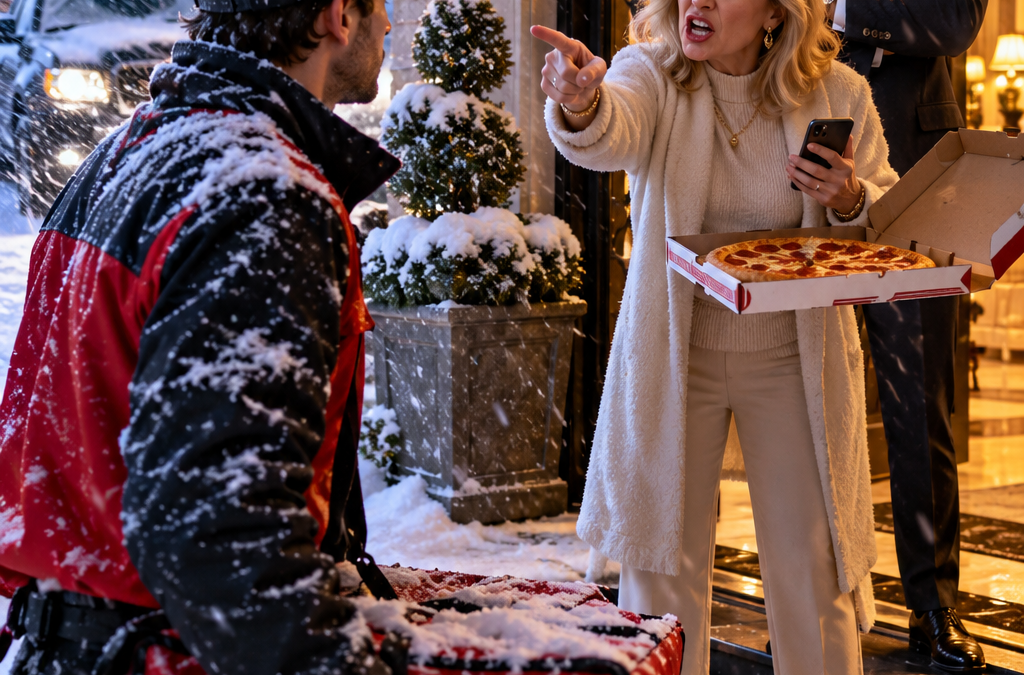
The door opened halfway.
Valerie Hargrove stood in the entrance.
She wore a cream-colored sweater and dark fitted pants.
Her hair was perfectly arranged.
She held a phone in one hand.
Warm air rolled out past her, carrying the scent of an expensive candle.
She didn’t apologize for making me wait.
She didn’t ask whether the roads were safe.
She looked at the delivery bag.
“Finally.”
I forced a polite smile.
“Good evening, Ms. Hargrove. Large pepperoni and mushroom with extra cheese, plus garlic knots.”
I lifted the bag.
“Sorry for the delay. The weather is extremely dangerous tonight.”
She stared at me.
“I told the girl on the phone I needed this by six-thirty.”
“Yes, ma’am. I understand. We had a road closure, and traffic was barely moving.”
She held out her hand.
I opened the insulated bag and passed her the pizza box.
Heat came through the cardboard even through my gloves.
She took it.
Then, rather than carrying it inside, she opened the lid right there in the doorway.
Steam rose into the cold air.
She pressed two fingers into the middle of the pizza.
I watched the cheese shift beneath her touch.
Then her expression changed.
“This is cold.”
I blinked.
“Ma’am?”
“The pizza is cold.”
I looked at the visible steam.
“I’m sorry about the delay, but it has been kept in a heated bag the entire trip.”
She stared at me.
“Are you arguing with me?”
“No. I’m explaining—”
“I know what a cold pizza feels like.”
Her tone sharpened.
“I ordered dinner for six-thirty. It’s after seven.”
I glanced at my phone.
She was right about the time.
But nothing else.
The pizza was plainly warm.
And the storm had been severe enough to stop traffic entirely.
“I understand you’re disappointed,” I said. “The drive usually takes twelve minutes, but tonight it took almost forty.”
She looked at me as though the explanation offended her.
“That’s not my problem.”
I took a breath.
“No, ma’am. But we warned customers that delivery times couldn’t be guaranteed.”
Her eyes narrowed.
“I paid for delivery.”
“Yes.”
“Then I expect delivery.”
I didn’t know how to answer that without repeating myself.
She shifted the box against her arm.
“Here’s what’s going to happen.”
I remained silent.
“You’re going back to the restaurant.”
I felt my stomach tighten.
“Ma’am—”
“You’re going to have them make a fresh pizza. Then you’re bringing it back here.”
I looked toward the driveway.
Snow was still blowing so hard that I could barely see my car.
“And I’m not paying twice,” she added. “The first one was unacceptable.”
I tried to keep my voice steady.
“I’m sorry, but I can’t do that.”
Her face went still.
“What did you say?”
“I can’t authorize a free replacement or make another trip on my own. If you’d like to report a problem, my manager can review the order and determine whether a refund or credit is appropriate.”
She stared.
For a moment, I thought she hadn’t heard me.
Then she laughed.
It was a short, brittle sound.
“You people really don’t understand customer service anymore.”
I swallowed.
“Ma’am, the roads are dangerous.”
“Then perhaps you shouldn’t have taken a job that requires driving.”
The words stung.
Not because they were clever.
Because she said them so casually.
As though I had never considered the risks of my work.
As though I enjoyed standing outside her house in freezing wind.
As though I had chosen the storm personally to inconvenience her.
“I’ve been doing this carefully all evening,” I said.
She leaned closer.
“Carefully?”
“Yes.”
“You arrived more than half an hour late.”
“The county had a plow incident. We had to wait for the road department to clear a route.”
She rolled her eyes.
“Excuses.”
I felt anger rising.
I wanted to tell her about the pickup stopped in the road.
The drifting snow.
The plow lights.
The freezing drive.
But she wasn’t listening.
She had already decided that none of it mattered.
“I can make sure Marcus receives your complaint tonight,” I said.
Her expression hardened.
“I’ve ordered from Ridgeway for six years.”
“I know.”
“I’ve spent plenty of money there.”
“Yes, ma’am.”
“I tip your drivers twenty or thirty dollars when they do their jobs properly.”
I nodded.
She lifted her chin.
“And I know Frank Delaney personally.”
There it was.
The name of the owner.
The implied connection.
The reminder that she had influence beyond anything I could match.
She watched my face.
I tried not to react.
She continued.
“I can write a one-star review tonight. I can tell everybody in North Ridge how this restaurant treats loyal customers.”
“I’m sorry you’re unhappy.”
She gave another humorless laugh.
“You keep saying that, but you aren’t fixing anything.”
“I’ve explained what I’m authorized to do.”
She looked me up and down.
My wet jacket.
My knit hat.
My worn boots.
The empty bag in my hands.
Then she asked quietly, “Do you want to keep your job?”
Everything inside me went cold.
I thought about my father’s physical therapy.
The propane bill.
My rent.
The money I had already promised my parents for the following month.
I had spent years trying to make sure they didn’t have to worry about asking me for help.
And now a woman standing in a warm doorway was threatening all of that over a pizza that was still steaming in her hands.
I wanted to tell her she couldn’t do that.
But of course she could.
She could call.
She could complain.
She could write a review.
She could use her standing in town to create pressure.
Whether anyone believed her was another matter.
But pressure alone could damage a working person’s life.
I forced myself to breathe.
“I want to do my job correctly, ma’am.”
“Then do it.”
“Part of doing my job is following our safety and replacement policies.”
Her eyes widened with anger.
“Are you seriously refusing me?”
“I’m asking you to contact the manager if you want a replacement approved.”
She shook her head slowly.
“I don’t need some delivery boy telling me how to handle a complaint.”
I felt my face burn.
I could have argued.
I could have called her every name that came into my head.
I could have demanded she acknowledge the storm.
But all of those reactions would have given her exactly what she wanted.
A reason to claim I was aggressive.
So I stayed calm.
“Again, I’m sorry you’re unhappy. I’ll report the complaint as soon as I return.”
She stared at me.
I zipped the empty delivery bag.
“I hope you have a safe evening.”
Then I turned.
The snow struck my face immediately.
I had barely started down the driveway when she delivered the threat that changed everything.
“Then I’ll tell them you left the pizza on my doorstep.”
I turned back.
She was still holding the box.
“That’s not what happened.”
She smiled faintly.
“I’ll tell them you drove away without handing it to me.”
I stared.
She wasn’t claiming the pizza was cold anymore.
She was threatening to invent an entirely different delivery.
One in which I abandoned her order outside during a blizzard.
A version that could make me look careless, dishonest, and cruel.
I wanted to go back to the porch and argue.
Instead, I looked at the pizza box in her hands.
Then at her phone.
Then at the open door.
I knew what had happened.
And she knew what had happened.
I couldn’t force her to tell the truth.
So I walked away.
By the time I reached my car, my hands were shaking badly enough that I struggled to get the key into the ignition.
I turned on the heater.
Warm air began blowing against my legs.
I sat there for several seconds with my eyes closed.
Then I called Marcus.
He answered on the second ring.
“Ridgeway.”
“Marcus, it’s Ethan. I need to tell you something about Valerie’s delivery.”
“Hold on.”
I heard another line ringing.
“Give me fifteen seconds.”
The phone went quiet.
I stared through the windshield.
Snow was piling along the edges.
Then Marcus returned.
His voice had changed.
“Ethan.”
“Yeah?”
“I’ve got Valerie Hargrove on the other line.”
My stomach tightened.
“She says you left her pizza on the porch and drove away.”
For a second, I couldn’t speak.
He continued.
“Get back here safely. Come straight to my office when you arrive.”
“Marcus, that’s not—”
“I know you have something to tell me. We’ll talk when you’re back.”
He disconnected.
I sat motionless.
Valerie hadn’t even waited for me to leave her driveway before beginning the story she’d threatened to tell.
I looked toward her house.
The front door was closed.
Warm light shone through the windows.
Somewhere inside, she was holding the food I had personally handed her.
And on another phone line, she was telling my manager I had abandoned her in the snow.
I wanted to scream.
Instead, I put the car in gear and drove carefully back toward town.
The return trip was nearly as bad.
I passed the drifting stretch near the water tower again.
The wind had grown stronger.
Snow accumulated around the road signs.
At one point, I pulled over because I could no longer see where the pavement ended.
I sat with my hazard lights flashing until the gusts weakened.
For several minutes, I watched snow collect along the windshield and thought about what might be waiting for me at Ridgeway.
A written warning.
A suspension.
Termination.
I imagined calling my father.
Explaining that I had lost my second job because a customer wanted a free pizza.
He would tell me not to worry.
Then he would try to return to work before his back was ready.
That possibility frightened me more than the weather.
When I finally reached Ridgeway, I parked behind the building and hurried inside.
The restaurant was chaotic.
Phones ringing.
Tickets printing.
Drivers returning late.
Customers waiting near the counter.
Snow melting from jackets onto the floor.
Marcus was standing outside his office when he saw me.
“Ethan. Come in.”
I followed him.
The office was barely large enough for two chairs, a desk, and an old computer.
Stacks of invoices filled a shelf.
A yellow legal pad lay open beside the keyboard.
Marcus closed the door.
“Sit down.”
I sat.
He pulled his chair around the desk.
“Tell me exactly what happened.”
I looked at his face.
He didn’t appear angry.
But he didn’t look reassuring either.
He looked tired.
And careful.
I realized he was trying not to decide what he believed before hearing both sides.
I began at 6:14.
The delayed departure.
The snowplow incident.
The stopped pickup.
The back route.
My arrival at 6:53.
The unanswered doorbell.
The phone call to voicemail.
The long wait on the porch.
The handoff.
The steaming pizza.
The replacement demand.
The threat.
I explained everything in order.
Marcus listened without interrupting.
When I finished, he rubbed his beard.
“She told me something very different.”
“I know.”
He looked at his legal pad.
“She says you never rang the bell.”
“I rang it three times.”
“She says you left the order outside.”
“I handed it directly to her.”
“She says she came onto the porch in her socks and found the pizza sitting in the snow.”
I stared at him.
“Marcus, she opened the box in front of me. She put her fingers into the cheese.”
He looked down again.
“She says you became aggressive when she asked for a replacement.”
“I didn’t raise my voice.”
He exhaled.
“She also says she felt unsafe.”
That word landed hard.
Unsafe.
I had stood in a blizzard being threatened by someone who could afford to treat my paycheck like a bargaining chip.
And now she was presenting herself as the frightened person.
I looked at Marcus.
“Please don’t just believe me because I work here.”
He raised his eyes.
I continued.
“Check the records.”
He leaned back.
“What records?”
“Everything. When the pizza was ready. When I left. The road hold. My arrival time. The delivery confirmation. My phone calls. Whatever the handheld recorded.”
Marcus watched me carefully.
I swallowed.
“If I’m telling the truth, the timeline will support it.”
He remained silent for several seconds.
Then he nodded.
“All right.”
Relief moved through me.
Not much.
But enough to breathe.
“I’m not suspending you tonight,” he said.
I closed my eyes briefly.
“Thank you.”
“Don’t thank me yet.”
I looked up.
“This is serious, Ethan. Valerie is a longtime customer. She knows Frank. She’s already made clear that she expects disciplinary action.”
I nodded.
“She threatened to get me fired.”
Marcus studied me.
“That’s part of what we’re going to examine.”
He opened the office door and called for Tessa.
She arrived with her headset still around her neck.
“What’s up?”
“Pull Valerie Hargrove’s order history from tonight.”
Tessa sat at the computer.
Her fingers moved quickly.
The order appeared.
Large pepperoni and mushroom.
Extra cheese.
Garlic knots.
Placed at 5:41.
Ready at 6:05.
Dispatched at 6:14.
Tessa pointed to the screen.
“There’s the hold.”
Marcus leaned forward.
She opened the dispatch note.
County plow incident.
Drivers held pending road status.
Nine-minute delay.
Marcus nodded.
“I authorized that.”
“Exactly,” Tessa said.
She scrolled.
“And here’s the customer warning.”
Customer advised of weather delays.
I looked at the words.
For the first time all night, I felt grateful for a sentence someone had typed without realizing it might become evidence.
Marcus took off his glasses.
“All right. What about delivery?”
Tessa opened another screen.
The handheld system recorded location updates while drivers were on active routes.
It showed my route.
The slow movement.
The detour.
The stop behind traffic.
Then my arrival at Valerie’s address.
6:53.
The device remained at the location until the delivery was confirmed at 7:02.
Marcus frowned.
“Nine minutes.”
Tessa nodded.
“That’s how long he was there.”
I leaned forward.
“That’s how long I stood on the porch.”
Marcus looked at me.
“She says you left the pizza outside and drove away.”
“Then how did she confirm the delivery?”
Tessa clicked another screen.
The handheld device recorded a customer confirmation at the door.
I remembered Valerie tapping it while balancing the pizza box.
Marcus stared at the entry.
It didn’t prove everything.
It didn’t establish the words spoken.
But it made her version much harder to reconcile with the evidence.
He looked at me.
“Why would she say you never handed her the pizza if she confirmed it on the device?”
I shook my head.
“I can’t tell you why she did it. I can only tell you what happened.”
Marcus nodded slowly.
“That’s fair.”
He looked back toward the screen.
“I think there’s a piece of this we’re missing.”
Before anybody could respond, the back door slammed.
Heavy footsteps approached.
Noah appeared in the office doorway, shaking snow off his jacket.
He looked exhausted.
Then he saw me.
“Ethan. Thank God.”
I frowned.
“What?”
“I saw you out near the water tower earlier. That road was awful.”
Marcus turned.
“You saw him?”
Noah nodded.
“Yeah. Behind a pickup. Nobody was moving.”
I looked at Marcus.
“That’s the stop I told you about.”
Noah pulled off his gloves.
“Couldn’t see ten feet through the drifting. I was coming back from farther up Aspen Ridge.”
Then he added something that made all three of us look at him.
“I passed the Hargrove house before Ethan got there.”
Marcus pulled out another chair.
“Sit down.”
Noah sat.
“Tell us exactly what you saw.”
He explained that around 6:40, he had been crawling along Aspen Ridge Road at roughly fifteen miles an hour.
He had stopped briefly near Old Mill because snow had completely obscured the shoulder.
When visibility improved, he continued.
He saw my headlights behind the stopped pickup.
Then he passed Valerie’s house.
Every ground-floor light was on.
The porch light was shining brightly.
And a woman in a light-colored sweater was standing near the front door looking toward the road.
“Could you identify her?” Marcus asked.
Noah shook his head.
“Not clearly. Too much snow. But she was standing at that house, on that porch, with something in her hand. Looked like a phone.”
“Are you sure about the time?”
“About six-forty. Maybe a minute either way.”
Marcus wrote it down.
Noah continued.
“I don’t know what happened when Ethan arrived. I wasn’t there. I’m just telling you what I saw.”
I appreciated that.
He wasn’t trying to make the story bigger.
He wasn’t guessing about Valerie’s intentions.
He was simply giving us another observation.
But the detail changed how I remembered the delivery.
I thought about the bright porch light.
The shadow behind the frosted glass.
The unanswered bell.
The phone in Valerie’s hand.
Had she known I was outside the entire time?
I didn’t say it aloud.
I couldn’t prove it.
Marcus seemed to understand what I was thinking.
“Let’s stick to what we know,” he said.
He turned to Tessa.
“Can the handheld show how long Ethan remained at the location?”
She nodded.
“Yes. It logs GPS positions every thirty seconds.”
She opened the route map.
A crooked blue line crossed North Ridge, slowed near the water tower, turned through the county lot, and ended at Valerie’s driveway.
Then it remained there.
From 6:53 until 7:02.
Nine minutes.
Tessa pointed.
“Most residential handoffs take a minute or two.”
Marcus studied the screen.
“Nine minutes is a long time.”
I looked down.
“Especially when you’re standing outside in that storm.”
He nodded.
Then he picked up the phone.
“I’m calling her.”
My pulse quickened.
Marcus placed the call on speaker.
Valerie answered quickly.
“Marcus?”
“Ms. Hargrove. I’m reviewing your complaint and need to clarify something.”
“I already told you what happened.”
“I understand. What time did you receive your pizza?”
“Nearly seven-fifteen.”
Marcus didn’t react.
“Seven-fifteen?”
“Yes. Your driver left it outside, and I didn’t know it was there until I checked.”
I stared at the phone.
The lie came so easily.
Marcus glanced at Tessa’s screen.
“All right. Then I have a question about the delivery confirmation.”
Silence.
“Our system shows the order was confirmed on the driver’s handheld device at 7:02. That confirmation requires customer interaction at the door.”
For three seconds, nobody spoke.
Then Valerie said, “He shoved that device at me.”
Marcus remained calm.
“You’re saying you confirmed the delivery?”
“Only because he wouldn’t leave until I did.”
I looked at Tessa.
Her eyebrows rose.
Valerie continued.
“I didn’t want to stand outside arguing with him.”
Marcus paused.
“Earlier, you said you didn’t know the pizza had arrived until after he left it outside.”
Her voice sharpened.
“Are you accusing me of lying?”
“No, ma’am. I’m trying to understand the sequence.”
“I have already told you your driver was rude and aggressive.”
“I understand that’s your complaint.”
“He made me feel unsafe.”
Marcus took a breath.
“Thank you. I’ll continue reviewing the information and get back to you.”
She began speaking again.
“Marcus, I expect—”
He ended the call after politely confirming that he had heard her concerns.
The room became silent.
I looked at the delivery confirmation.
Then at Marcus.
Valerie’s story had changed in the space of one question.
But I didn’t feel victorious.
I felt frightened.
Because she hadn’t admitted she was wrong.
She had simply invented a new explanation.
And I knew that a person willing to do that could keep inventing explanations until someone became too exhausted to challenge her.
Marcus seemed to recognize it too.
He pushed a blank legal pad toward me.
“Write everything down.”
I took it.
“Tonight?”
“Right now. While it’s fresh.”
He leaned closer.
“Only what you remember. Times, words, actions. No guesses about motives.”
I nodded.
“And Ethan?”
“Yeah?”
“Don’t post anything online. Don’t call her. Don’t respond if she contacts you.”
“Understood.”
I went to the break table.
The room was quiet except for the refrigerator hum and distant kitchen noise.
I poured a cup of burnt coffee.
Then I began writing.
I documented the entire shift.
The weather briefing at 5:15.
The order’s dispatch time.
The plow hold.
The traffic stop.
The detour.
My arrival at 6:53.
The unanswered bell.
The voicemail.
The shadow behind the glass.
The door opening.
The pizza handoff.
The replacement demand.
The threat.
I wrote down Valerie’s words as accurately as I could remember them.
I didn’t describe her as evil.
I didn’t speculate that she had planned everything.
I didn’t claim to know what was happening inside the house while I waited.
I simply wrote what I knew.
When I finished, my hand ached.
It was a little after nine.
Tessa approached the table.
She looked troubled.
“Ethan?”
I glanced up.
“Yeah?”
“There’s something I forgot.”
I set down the pen.
“What?”
“Valerie called a second time before the pizza was ready.”
I frowned.
“When?”
“Around five-fifty-five.”
“What did she want?”
Tessa sat across from me.
“She asked whether the driver could come back and swap the pizza if it wasn’t hot enough.”
I stared.
“Before it was even cooked?”
Tessa nodded.
“I told her replacements required manager approval.”
“What did she say?”
“Good to know.”
The words settled between us.
I thought about Valerie pressing her fingers into the steaming cheese.
Her immediate demand for a free replacement.
Her refusal to speak with Marcus.
Her threat to invent a different delivery.
And now I learned she had asked about replacements before the pizza even came out of the oven.
I looked at Tessa.
“Why would she ask that?”
Tessa shook her head.
“I don’t know.”
Neither of us said what we were thinking.
But I could feel the possibility forming.
What if the late delivery hadn’t created Valerie’s complaint?
What if she had been preparing to make one regardless?
I didn’t write that conclusion into my statement.
It was still speculation.
But it made my stomach turn.
Before I finished my coffee, Tessa returned with her phone.
“You’re not going to like this.”
She showed me the screen.
Valerie had posted a public review of Ridgeway Pizza.
One star.
The review was long.
She claimed the restaurant had sent a careless driver into dangerous weather.
She said he had abandoned her pizza on the porch.
She described him as rude and aggressive.
She claimed he had made her feel unsafe.
Then she suggested that other women living alone on the edge of town might be treated the same way.
I stared at that sentence.
It was carefully written.
Designed to frighten people.
Designed to make the accusation feel larger than a disagreement over pizza.
Valerie wasn’t alone in that house.
I didn’t know it yet, but her husband had been inside.
And she knew that.
Still, the review presented her as a frightened woman abandoned by an aggressive delivery driver during a dangerous storm.
I handed the phone back.
For a moment, I couldn’t speak.
Tessa looked at me.
“Are you okay?”
I shook my head.
“No.”
She sat beside me.
“Marcus is looking into it.”
“I know.”
But I also knew what the review could do.
North Ridge was a small town.
People talked.
Frank had spent thirty years building Ridgeway’s reputation.
One angry customer with social connections could create real pressure.
And under that pressure, firing one part-time driver might seem easier than defending him.
I went home after my shift and barely slept.
Every time I closed my eyes, I saw Valerie standing in her doorway.
Her cream-colored sweater.
The pizza box.
The snow.
That cold little smile.
I guess we’ll see who they believe.
The next morning, I called my father.
I hadn’t planned to tell him everything.
But he heard something in my voice.
“You all right, son?”
“Yeah.”
He paused.
“That didn’t sound like a yes.”
I looked toward my kitchen window.
“It’s been a rough couple of shifts.”
“Weather?”
“Partly.”
I told him there had been a customer complaint.
That management was investigating.
That I might have trouble at the restaurant.
He listened quietly.
Then asked, “Did you do anything wrong?”
“No.”
“Then tell the truth and let them check it.”
I swallowed.
“Sometimes that isn’t enough.”
Dad was silent for a moment.
Then he said, “It has to start somewhere.”
I closed my eyes.
He continued.
“Don’t worry about us.”
Of course.
I knew he would say that.
“Dad—”
“We’ll manage.”
I stared at the unpaid bills stacked beside my refrigerator.
I knew what we’ll manage meant in my parents’ house.
It meant turning the thermostat down.
Delaying appointments.
Stretching groceries.
Pretending things were fine.
“I don’t want you skipping therapy,” I said.
He sighed.
“Ethan.”
“I’m serious.”
“Then let your boss finish checking what happened before you start imagining the worst.”
I nodded.
Even though he couldn’t see me.
“All right.”
After we hung up, I sat quietly for several minutes.
Then I went to my daytime job at the supply yard.
I spent eight hours loading lumber while my mind remained trapped on Valerie’s porch.
By noon, she had called Ridgeway four times.
Each call brought new demands.
A full refund.
A replacement pizza.
A public apology.
A written acknowledgment that the restaurant had mistreated her.
And finally, confirmation that I would no longer be employed.
Marcus told me about the calls later.
He looked exhausted.
The storm had knocked out power on the northern side of town overnight.
Dozens of deliveries had been delayed or canceled.
Customers were angry.
The phone had barely stopped ringing.
Frank Delaney had already heard about Valerie’s review from someone he knew at the bank.
The pressure was real.
I could see it in Marcus’s face.
He sat across from me in his office, turning a pen between his fingers.
“She’s not letting this go.”
I looked down.
“I figured.”
“She wants you fired.”
I felt the words land in my chest.
Marcus continued.
“I haven’t made any disciplinary decision.”
I nodded.
“But Frank is asking questions now.”
I stared at him.
I could imagine how easy it would be.
One employee gone.
One apology issued.
One free pizza delivered.
The angry customer quiet again.
I was a part-time driver.
Valerie was a longtime customer with influence.
The calculation seemed obvious.
Marcus looked at me.
“Ethan, I’m not going to make a decision based on who complains the loudest.”
I swallowed.
“Thank you.”
He shook his head.
“Don’t thank me. This should be how it works.”
Then he made a decision that changed the direction of the entire situation.
He called Valerie and told her to put her complete complaint in writing.
Every detail.
Every accusation.
Every requested remedy.
He explained that the restaurant would compare her written account with the order records, delivery data, and statements from everyone involved.
And management would respond in writing when the review was complete.
Valerie agreed immediately.
I think she believed it was another chance to make her accusations sound official.
That afternoon, the email arrived.
It was long.
Carefully written.
Full of formal language about customer expectations, employee misconduct, and unacceptable service standards.
She repeated that I had abandoned her order.
That I had behaved aggressively.
That she had been forced to retrieve the pizza.
Then she included a detail I will never forget.
She wrote that she had stood on her front porch in freezing wind for nearly ten minutes waiting for the delivery.
Marcus printed the complaint.
He handed it to me.
I read that sentence once.
Then again.
Then a third time.
“Marcus?”
He looked up.
“Yeah?”
“She says she stood outside for nearly ten minutes.”
“I see that.”
“My device shows I was there from 6:53 until 7:02.”
He nodded slowly.
“Nine minutes.”
“Exactly.”
I placed the page on the desk.
“If she was outside for almost ten minutes, how could she not know I was there?”
Marcus looked at the document.
Then at the delivery record.
“And if she meant she was outside earlier, that would be consistent with what Noah saw around six-forty.”
I nodded.
The contradiction was clear.
But something still troubled me.
Why had she left me standing outside?
Why had she ignored the bell?
Why had she opened the door only after several minutes?
I had no way to know.
And I didn’t want to invent an answer.
But her own written complaint had made her earlier story more difficult to believe.
Still, she kept escalating.
She continued threatening reviews.
She demanded punishment.
She implied Ridgeway’s reputation would suffer if management refused to side with her.
And I continued going to work wondering whether each shift might be my last.
The breakthrough came Saturday morning.
I was at home when Marcus called.
“Ethan, can you come by the restaurant?”
My stomach tightened.
“Did something happen?”
“Yes.”
I held my breath.
“Am I in trouble?”
He paused.
“No. Somebody called with information about Thursday.”
I grabbed my jacket.
“I’ll be there.”
When I arrived, Marcus was sitting at his desk with a fresh set of notes.
Tessa stood beside him.
He motioned toward the chair.
“A woman named Linda Whitaker called this morning.”
I frowned.
“Who?”
“She lives across the road from Valerie.”
I sat down slowly.
Marcus continued.
“She’s sixty-three. Retired school librarian. Says she was watching the storm from her window Thursday night.”
I stared.
“She saw me?”
“She says she did.”
He explained that Linda had read Valerie’s public review.
Something about it bothered her.
She didn’t know Valerie particularly well.
They exchanged occasional greetings, but they weren’t close.
Linda had no relationship with me.
She wasn’t calling because she liked one person more than another.
She was calling because what she had witnessed didn’t match the story being told publicly.
Marcus read from his notes.
Linda had been sitting near her front window with a cup of tea.
She often watched the road during heavy storms because the stretch near her house could become dangerous.
A little before 6:45, she saw a woman in a light-colored sweater step onto Valerie’s porch and look toward town.
Then the woman went inside.
About ten minutes later, a small car arrived.
A man in a knit hat walked up the driveway carrying a delivery bag.
That was me.
Linda watched me stand at the front door.
Ring.
Knock.
Wait.
Shift my weight in the snow.
Then ring again.
She saw movement behind the glass beside Valerie’s door.
More than once.
She remembered wondering why nobody was letting the delivery driver inside or at least opening the door to accept the food.
I felt a strange pressure behind my eyes.
For two days, I had been replaying that wait and wondering whether I was losing my mind.
Now a complete stranger was describing it.
Exactly.
Marcus continued.
Linda had watched Valerie open the door.
She saw the pizza box pass directly from my hands to Valerie’s.
She saw us speak briefly.
Then she watched me walk back toward my car.
I stopped once and turned.
Then continued.
Valerie closed the door before I drove away.
Linda couldn’t hear the conversation.
She didn’t know about the replacement demand.
She didn’t hear the threat.
But she knew one thing with certainty.
I had not abandoned the pizza on the porch.
I stared at Marcus.
“She saw the handoff?”
He nodded.
“Clearly enough to describe it.”
I looked down.
My hands were trembling.
For the first time since Thursday, someone outside the restaurant had confirmed the central fact of my account.
Not a friend.
Not a coworker.
Not someone who owed me loyalty.
A neighbor who had watched from across the road.
Marcus told me Linda had agreed to provide a short written statement.
I let out a breath I hadn’t realized I was holding.
Tessa smiled faintly.
“Looks like the truth finally found somebody else who saw it.”
I tried to smile back.
But my throat was too tight.
Marcus wasn’t finished.
After speaking with Linda, he had gone back through Valerie’s customer history.
Not just the Thursday order.
The entire account.
Six years of purchases.
Complaints.
Credits.
Refunds.
Replacement orders.
He had never examined it as a complete pattern before.
Neither had anyone else.
Valerie was a regular customer.
Sometimes demanding.
Sometimes generous with tips.
When she complained, managers usually tried to smooth things over.
That was how Ridgeway operated.
People were given the benefit of the doubt.
Mistakes were corrected.
Goodwill mattered.
But when Marcus placed the records side by side, something uncomfortable emerged.
Over the previous several months, Valerie had made more than a dozen complaints.
Most involved pizza temperature.
More than half had resulted in a refund, credit, or free replacement.
Two other drivers had documented occasions when she demanded they personally return to the restaurant for another pizza.
The earlier incidents hadn’t produced enough evidence to establish intentional wrongdoing.
Each had been handled as an isolated customer complaint.
But now Marcus could see the repetition.
He showed me one older order.
Valerie herself had entered a note in the online form.
It stated that if a delivery arrived during bad weather, she expected the restaurant to send a hot replacement at no charge.
I stared at the screen.
For years, she had been treating refunds and free replacements as something she could demand rather than something management could approve after reviewing a legitimate problem.
And nobody had connected the incidents.
Not the managers.
Not the drivers.
Not the owner.
Everyone had been dealing with one complaint at a time.
I looked at Marcus.
“How much has she gotten?”
“I don’t have the complete total yet.”
He rubbed his face.
“But more than I realized.”
He leaned back.
“You know what’s bothering me?”
“What?”
“We helped create this.”
I frowned.
He gestured toward the records.
“Every time she complained, somebody decided it was easier to give her something than investigate. Sometimes that was me.”
I remained silent.
“We thought we were taking care of a loyal customer.”
He looked toward the screen.
“Instead, we taught her that enough pressure would eventually produce a free meal.”
I thought about Valerie standing in her doorway.
Telling me she tipped drivers twenty or thirty dollars.
Threatening to call Frank.
Threatening my job.
She had learned that the most effective person to pressure was often the person with the least authority.
The driver.
The employee standing outside.
The one who couldn’t approve a refund but could be frightened into promising something.
The one whose paycheck mattered more to him than the food mattered to her.
I looked at Marcus.
“I don’t want this to end with just clearing my name.”
He studied me.
“What do you mean?”
“Suppose you prove she lied and everything goes away.”
“That’s the goal, isn’t it?”
“Part of it.”
I paused.
“What happens to Noah the next time she complains? Or another driver? Or Tessa when somebody starts threatening reviews because she won’t promise an impossible delivery time?”
Marcus didn’t answer.
I continued.
“I don’t want anyone else sitting in their car shaking because some customer thinks she can get them fired for saying no.”
He nodded slowly.
“Fair.”
“I want something in writing. A policy everybody can follow. One that protects us when we do the right thing.”
Marcus looked at the records again.
Then at me.
“I’ll bring it up with Frank.”
That Monday, we reviewed Valerie’s account in greater detail.
Marcus, Tessa, and I sat in the office during the quiet stretch before the dinner rush.
We didn’t investigate Valerie’s personal life.
We didn’t contact her customers.
We didn’t search for rumors about her business.
We reviewed Ridgeway’s own records.
Nothing more.
Her orders were often placed during busy evening periods.
Many carried requests for extra-hot baking.
A remarkable number were followed by complaints that the food had arrived lukewarm or cold.
Some resulted in coupons.
Others in refunds.
Several in free replacement pizzas.
The records didn’t prove that every complaint had been false.
But together, they established a troubling pattern of repeated demands and preferential treatment.
The Thursday incident stood apart because of the threat.
She had tried to force a driver back into dangerous weather.
Then she had accused him of misconduct after he refused.
We had the dispatch records.
The route data.
The customer confirmation.
The contradictory phone statements.
Her written complaint.
Noah’s observations.
Linda’s independent account.
And my contemporaneous written statement.
For the first time, the restaurant possessed a detailed record of what had happened rather than competing accusations alone.
Marcus called Valerie that evening.
Tessa and I were present.
The call was on speaker.
Valerie answered in an irritated voice.
“Marcus, I hope you’re calling to tell me this has finally been resolved.”
“It has been reviewed,” he said.
“Good.”
He took a breath.
“We’ve examined the order timeline, the road-delay records, the delivery confirmation, the driver statement, and the witness accounts.”
She was silent.
He continued.
“The available evidence does not support your claim that Ethan abandoned the pizza on your porch.”
Her voice sharpened immediately.
“Excuse me?”
“The delivery was confirmed at your door. We have an independent witness who observed the handoff.”
She gave a hard laugh.
“So now you’re accusing me of lying?”
“I’m explaining the results of our review.”
“Your employee was rude.”
“We also reviewed the delivery policy and the weather conditions.”
“He refused to correct his mistake.”
“Drivers are not authorized to approve free replacement deliveries, especially during dangerous weather.”
She inhaled sharply.
“I’ve been ordering from Ridgeway for six years.”
“I know.”
“I know Frank personally.”
“I understand.”
“And you’re taking the word of some delivery driver over mine?”
Marcus glanced toward me.
Then answered carefully.
“I’m relying on the records and witness statements.”
Valerie laughed again.
“A neighbor spying through a window doesn’t know anything about the temperature of my pizza.”
“That’s true,” Marcus said. “The witness spoke only about the handoff she observed.”
The response seemed to frustrate her.
He wasn’t exaggerating the evidence.
And that made it harder for her to attack.
Marcus continued.
“We’ve also reviewed your history of replacement requests and temperature complaints.”
A pause.
“What does that have to do with anything?”
“It shows that similar complaints have repeatedly resulted in credits or replacement food.”
“Because your restaurant keeps making mistakes.”
“We’ll evaluate legitimate complaints. But no driver will be sent back to your home for a free replacement based solely on a temperature allegation, and future credits would require manager review.”
Her voice rose.
“Unbelievable.”
Marcus waited.
Then she changed tactics.
“If you don’t make this right, I’ll tell everybody in North Ridge.”
He remained silent.
“I’ll tell every customer. Every person who walks into my store. Every family that ever orders from you.”
I watched Marcus.
His expression didn’t change.
Valerie continued.
“Frank Delaney will be lucky to have a business left by spring.”
The room was completely quiet.
Marcus let her finish.
Then he said, “Threatening staff or attempting to force employees to violate safety policies is not acceptable.”
She laughed.
“What exactly are you going to do?”
“Management will review whether we can continue serving you under the same policy we apply to customers who threaten or abuse employees.”
A long pause followed.
Then Valerie laughed again.
“You would never dare lose a customer like me.”
The call ended.
I stared at the phone.
For a moment, nobody spoke.
Then Marcus exhaled.
“Well.”
Tessa shook her head.
“She really thinks she can do whatever she wants.”
I looked toward the delivery rack outside the office.
Pizzas were coming out of the oven.
Drivers were taking orders.
The restaurant kept moving.
It struck me that my entire life had nearly been disrupted because one person believed threatening the lowest-paid employee was an effective way to get what she wanted.
And for years, it apparently had been.
The next stage of the investigation involved Frank Delaney.
He was in his late sixties.
He had opened Ridgeway with a single oven, a few tables, and a loan that took years to repay.
Frank was proud of his business.
He also understood how difficult it was to keep a small restaurant alive in a mountain town.
He didn’t like losing customers.
Especially customers who had been spending money there for years.
But Marcus wanted him to see the complete record.
They met on Wednesday morning before opening.
The office door remained closed for nearly two hours.
I wasn’t there.
Marcus later explained what they discussed.
They reviewed every documented complaint.
Every refund.
Every replacement.
Every contradictory statement from Thursday.
The weather warning.
The route data.
The independent witness account.
The threats.
Then they calculated what Valerie’s credits, refunds, and replacement orders had cost the restaurant over the previous two years.
The total exceeded one thousand dollars.
A thousand dollars.
Spread across numerous incidents.
Approved by different managers.
Hidden in the ordinary flow of customer-service decisions.
It wasn’t a financial disaster by itself.
But it showed how much Valerie had received simply because each complaint had been treated in isolation.
Nobody had examined the cumulative pattern.
Frank sat with the records for a long time.
Then he made his decision.
He would refund Valerie’s Thursday order in full.
Not because her accusations were supported.
Because he wanted to close the financial issue cleanly.
But she would no longer be permitted to order from Ridgeway.
Delivery.
Pickup.
Dining service.
All of it.
The decision would be permanent under the restaurant’s policy concerning threats and abusive conduct toward employees.
Frank and Marcus prepared a short formal letter.
No insults.
No accusations beyond what management had documented.
No emotional language.
Just a clear decision.
The restaurant was ending its business relationship with Valerie Hargrove.
The letter went by email and certified mail.
When Marcus told me, I stared at him.
“You’re banning her?”
He nodded.
“Frank made the decision.”
“Because of what happened to me?”
“Because of the documented pattern and the way she’s treated our staff.”
I sat back.
For days, I had been afraid Ridgeway would sacrifice me to keep Valerie happy.
Instead, management was choosing to protect the people who worked there.
I felt an enormous wave of relief.
Then something closer to disbelief.
“She’s going to be furious.”
Marcus gave a tired smile.
“I expect so.”
He was right.
Valerie called the restaurant that evening.
Tessa answered.
Valerie threatened to destroy the business.
She said Frank would regret believing a delivery boy.
She repeated that she had influence in North Ridge.
She demanded that the decision be reversed.
Tessa listened calmly.
Then she documented the time and content of the call.
Marcus contacted Valerie afterward.
He didn’t argue.
He informed her that the decision had been reviewed and was final.
He explained that Ridgeway had retained the records supporting its actions.
And if questions arose, management was prepared to explain its decision accurately.
That was it.
No shouting.
No police.
No courtroom.
No public confrontation.
The restaurant simply stopped accepting her business.
I think that bothered Valerie more than any argument could have.
For years, she had believed her spending power made her untouchable.
Now the restaurant was telling her there were limits.
Not because she had complained.
Customers had every right to complain about genuine problems.
But because she had used a complaint to threaten an employee and tried to make the business punish him for refusing an unsafe, unauthorized demand.
The following day, Marcus received another call.
This one came from Valerie’s husband.
Daniel Hargrove.
I hadn’t met him.
I didn’t even know he’d been home on the night of the storm.
Marcus later explained the conversation.
Daniel sounded embarrassed.
He said Valerie had told him the driver had been rude and abandoned the food outside.
He wanted to hear the restaurant’s side before deciding what to think.
Marcus explained the timeline.
The weather delays.
The handheld confirmation.
The witness account.
The contradictory statements.
The review.
He didn’t insult Valerie.
He didn’t speculate about her motives.
He simply described the evidence.
Daniel listened quietly.
Then he said something that settled the last lingering doubt I had about that night.
He had been in the kitchen when I arrived.
He remembered hearing the doorbell ring.
More than once.
He had asked Valerie whether she was going to answer it.
And she had told him to let the delivery guy wait.
I remember the way Marcus looked when he repeated those words to me.
Not triumphant.
Disappointed.
Because Daniel’s account meant Valerie had known I was outside.
She had heard the bell.
Her husband had heard it.
And she had deliberately left me standing there in the storm.
I thought about the nine minutes.
The wind.
The numb fingers.
The snow pushing beneath the porch roof.
The shape moving behind the frosted glass.
For days, I’d wondered whether she’d somehow missed me.
Now I had my answer.
She hadn’t.
Daniel apologized.
He said he wouldn’t contest the restaurant’s decision.
When Marcus finished telling me, I sat silently.
I couldn’t understand why someone would do that.
Why leave another person standing in dangerous weather?
Why wait until the food was handed over and then pretend it had never been delivered?
Why threaten a stranger’s employment over a free pizza?
I still don’t know everything that was going through Valerie’s mind.
I probably never will.
But I know what she did.
And I know how close she came to making me pay for it.
The following Friday, Marcus asked me to come into his office before my shift.
Even after everything, my stomach tightened when he closed the door.
He motioned toward the chair.
“Ethan, I want to make something clear.”
I nodded.
“There will be no suspension.”
I exhaled.
“No disciplinary action.”
My shoulders dropped.
“And nothing negative in your employee file.”
I looked at him.
“Thank you.”
He shook his head.
“There’s something else.”
I waited.
Marcus removed his glasses.
“I’m sorry.”
I stared.
“For what?”
“For letting you carry the uncertainty as long as you did.”
I started to speak.
He raised a hand.
“Let me finish.”
I nodded.
“I wanted to be fair. I didn’t want to decide anything before checking the records. But I should have told you sooner that the evidence was supporting your account.”
I looked down.
He continued.
“You came back from a dangerous delivery, reported what happened, and then spent days worrying about losing your job because someone threatened you.”
I swallowed.
“I know you were following procedure,” he said. “And I should have made it clearer that you weren’t standing alone.”
The words hit harder than I expected.
For a week, I had been carrying a fear I couldn’t explain to anyone without sounding dramatic.
It wasn’t just fear of losing money.
It was fear of being powerless.
Of doing everything correctly and discovering that the truth mattered less than who had influence.
I looked at Marcus.
“I don’t need a big apology.”
He waited.
“I just need to know the next person won’t have to go through the same thing.”
He nodded.
“That’s what Frank and I have been working on.”
He opened a binder on his desk.
Inside was a revised set of delivery and customer-complaint procedures.
Beginning that week, whenever the county issued a weather advisory, phone staff would clearly inform customers that delivery times could not be guaranteed.
Drivers would be authorized to stop, delay, or return when conditions became dangerous.
No employee would be required to make a second trip through hazardous weather because someone complained about food temperature.
Replacement requests would go through management.
And most importantly, accusations against employees would be reviewed against the available order data, route records, and statements before discipline was considered.
I read the policy carefully.
It wasn’t perfect.
No policy could prevent every unfair complaint.
But it meant a driver standing in a doorway wouldn’t have to decide between breaking the rules and losing his job.
He could follow the procedure.
And management would have to examine the facts.
I looked up.
“This is good.”
Marcus nodded.
“It should have been in writing already.”
He closed the binder.
“Sometimes it takes a bad situation to show you where the system isn’t protecting people.”
I thought about Valerie.
Then about Noah.
Tessa.
The younger drivers.
The next person who would have to carry food through a storm while somebody waited in a warm house.
I felt something loosen inside my chest.
For the first time since that Thursday, I wasn’t just relieved that I still had a job.
I was relieved that the experience had changed something.
My employee file eventually included a note confirming that I had followed procedure throughout the delivery.
The weather delay had been justified.
The route was documented.
The handoff was confirmed.
And the complaint had not been supported by the evidence.
Valerie’s customer account was closed.
Ridgeway would no longer take her orders.
The decision was permanent.
I didn’t celebrate her losing access to a pizza restaurant.
That wasn’t what mattered.
What mattered was that she couldn’t keep threatening the people who brought food to her door.
And she couldn’t keep treating the restaurant’s willingness to correct genuine mistakes as an unlimited invitation to demand free meals.
Life slowly returned to normal.
I kept working at the building supply yard.
I kept driving for Ridgeway four nights a week.
My father continued physical therapy.
His back gradually improved.
The propane bill got paid.
My rent stayed current.
The small, ordinary pieces of life that had seemed so fragile during that week began settling back into place.
Marcus occasionally handed me the difficult delivery routes.
Not because he wanted to punish me.
Because he knew I would stop when conditions became unsafe.
He trusted my judgment.
That meant more to me than I expected.
A few weeks after Valerie was banned, another storm moved through North Ridge.
It wasn’t as severe as the February whiteout.
But snow covered the roads, and the temperature dropped quickly after sunset.
I was assigned a delivery to a small house on the south side of town.
One large cheese pizza.
Nothing complicated.
The drive was slow but manageable.
I parked near the curb and carried the insulated bag toward the porch.
Before I could ring the bell, the front door opened.
An older man stood there wearing slippers and a worn cardigan.
He smiled.
“Evening.”
“Good evening, sir. Ridgeway Pizza.”
I handed him the box.
He took it carefully.
Then looked past me at the falling snow.
“Thank you for driving out here in this.”
That was all.
No dramatic speech.
No extraordinary tip.
No promise to call the owner and praise me.
Just a simple acknowledgment that getting dinner to his door had required another person to go outside in weather he was fortunate enough to avoid.
I smiled.
“You’re welcome. Stay warm.”
“You too, son.”
He closed the door.
I walked back to my car.
Snow settled quietly on the windshield.
The heater was already running.
I placed the empty delivery bag on the passenger seat and sat behind the wheel.
For a moment, I thought about Valerie Hargrove.
Her huge house.
Her steaming pizza.
The cold doorway.
The threat.
Then I thought about the man who had just thanked me.
Two customers.
Two deliveries.
Two completely different ways of seeing the person standing on the porch.
One had treated my safety and livelihood as tools she could use to get what she wanted.
The other had simply recognized that a human being had gone out into the cold to bring him dinner.
I started the engine.
The streets were quiet.
Snow drifted beneath the streetlights.
I drove back toward Ridgeway feeling lighter than I had in weeks.
I used to think dignity was something you had to defend with a loud voice.
That if someone humiliated you, the only way to protect yourself was to humiliate them back.
But that winter taught me something different.
I didn’t win by shouting at Valerie.
I didn’t win by threatening her business.
I didn’t win by posting accusations online or trying to gather strangers to my side.
I protected myself by keeping calm when she wanted me angry.
By reporting what happened immediately.
By writing down the details before memory could blur them.
By asking management to examine facts rather than influence.
And by refusing to let the loudest person in the conversation become the person who defined the truth.
The records mattered.
The time stamps mattered.
The weather warning mattered.
Noah’s careful observations mattered.
Tessa’s notes mattered.
Linda Whitaker’s willingness to speak up mattered.
And Marcus’s decision to investigate rather than take the easiest route mattered more than almost anything.
Because I could have told the truth perfectly and still lost my job if nobody had bothered checking it.
That’s the part I remember most clearly.
Fairness isn’t automatic.
It requires people willing to do the inconvenient work of finding out what actually happened.
Marcus could have fired me and moved on.
Frank could have decided Valerie’s business was worth more than a driver’s reputation.
Tessa could have ignored the strange second phone call.
Noah could have kept quiet about what he saw through the storm.
Linda could have read that review, shaken her head, and decided it wasn’t her problem.
Every one of them had a chance to choose silence.
Instead, they helped establish the truth.
Not through grand gestures.
Through ordinary decisions.
A saved note.
A careful timeline.
An honest witness statement.
A manager willing to ask one more question.
An owner willing to draw a boundary.
I thought about that often during the weeks that followed.
Customers have every right to expect reasonable service.
They have the right to complain when food is wrong, late, or poorly prepared.
A good business should listen.
But there is a difference between making a complaint and using a complaint as a weapon.
There is a difference between asking for a correction and threatening someone’s livelihood.
And there is a difference between expecting good service and demanding that another person risk his life because your dinner arrived twenty minutes later than you wanted.
Valerie crossed those lines.
She didn’t lose her privileges because she disliked a pizza.
She lost them because she tried to force an employee to violate policy, threatened his job when he refused, and provided accusations that contradicted the available evidence.
The restaurant eventually stopped rewarding that behavior.
More importantly, it changed the rules so the next employee wouldn’t have to face the same pressure without protection.
I still drive deliveries.
I still work long days.
I still worry about my parents.
Some months remain tight.
Some nights I’m exhausted before my second shift even begins.
And every winter, the storms return to North Ridge.
The wind still howls across the open fields.
Snow still swallows the road markings.
Sometimes a delivery that should take twelve minutes takes forty.
When that happens, I hear Marcus’s voice from the hallway on that Thursday evening.
No pizza is worth losing a driver in a ditch.
And I remember that I don’t have to prove my dedication by doing something dangerous.
I have to do my job responsibly.
That’s enough.
I never expected one pizza delivery to teach me so much about power.
Not the kind that comes from owning a business, wearing expensive clothes, or knowing influential people.
The quieter kind.
The power to tell the truth when lying would be easier.
The power to remain composed when someone is trying to provoke you.
The power to say no when the demand is unreasonable.
And the power to create a workplace where ordinary employees aren’t forced to choose between their safety and their paycheck.
Valerie Hargrove believed the woman standing inside the warm house had all the leverage.
For a few frightening days, I believed that too.
But she overlooked something.
A story can be repeated loudly enough to frighten people.
It can be polished, exaggerated, and delivered with complete confidence.
It can come from someone wealthy, connected, and accustomed to being obeyed.
But none of those things make it true.
The truth was that I drove carefully through a dangerous storm.
I reached her house.
I waited on her porch.
I handed her the pizza.
She accepted it.
And when she demanded that I put myself at risk to bring her another one, I followed the rules and refused.
Everything that happened afterward began with her attempt to punish me for that refusal.
For a while, I was afraid her version would become the only version anyone heard.
It didn’t.
Because enough people cared to check.
That winter, I almost lost a job my family depended on because one customer believed she could buy obedience and manufacture consequences when she didn’t get it.
Instead, I kept my job, my reputation, and the knowledge that I had acted responsibly when someone tried to make me afraid.
And the thing that stays with me most isn’t Valerie’s expensive house or the threatening review she posted.
It’s the older man standing in his doorway a few weeks later, looking out at the snow and thanking me for making the drive.
He had no idea what those simple words meant.
He didn’t know about Valerie.
He didn’t know about the investigation.
He didn’t know how close I had come to losing the income that helped keep my father’s recovery on track.
He was simply being decent.
And after everything that had happened, that decency reminded me why I had never been ashamed of the work.
I wasn’t just carrying pizza.
I was doing a job that mattered to the people who depended on me.
My parents.
My coworkers.
The customers who appreciated the effort.
I drove through the snow that night knowing something I hadn’t fully understood before.
I didn’t need Valerie Hargrove’s approval to have dignity.
I didn’t need her money to determine my worth.
And I didn’t need to surrender my safety or my integrity to prove that I deserved my job.
The truth had been there all along.
It simply needed people willing to stand beside it.








