FULL ENDING A Police Sergeant Dragged Me Off My $40,000 Ducati and Put His Knee on My Back Because He Decided I Couldn’t Possibly Own It
𝗣𝗔𝗥𝗧 𝟮
That morning, he was about to find out.
I saw the patrol car in my mirror.
Then the lights came on.
Blue.
Red.
Blue again.
For a moment, I assumed Anderson was heading somewhere else.
I checked my speedometer.
Thirty-one.
Then I realized he was staying directly behind me.
I signaled right.
Pulled onto a residential side street.
Stopped beside the curb.
Killed the engine.
Removed my helmet.
Placed it carefully on the fuel tank.
Then I put both hands where they could be seen.
That sequence was instinctive.
Not because I was afraid of the police.
Because I had read too many reports about what happened when an officer claimed he could not see someone’s hands.
The cruiser stopped about fifteen feet behind me.
Lights kept flashing.
A sprinkler clicked rhythmically across the lawn of a small white house.
A dog barked.
Someone moved behind a curtain.
I waited.
Anderson did not get out immediately.
When he finally opened his door, he took his time.
Adjusted his duty belt.
Touched his holster.
Put a piece of gum in his mouth.
Then walked toward me.
Dawson followed several steps behind.
Anderson said nothing until he was standing beside the Ducati.
No greeting.
No identification.
No explanation.
His eyes moved from the motorcycle to my boots, my jacket, my face.
Then back to the motorcycle.
“You know why I pulled you over?”
“No, Sergeant.”
“You were speeding.”
“I was traveling thirty-one in a thirty-five.”
He looked at me.
“That’s not what my radar said.”
“Then I’d like to see the radar reading, please.”
Something changed in his face.
Small.
But immediate.
I had spent years watching witnesses on the stand.
You learn to see the moment somebody realizes the conversation is not going to follow the script they prepared.
Anderson expected apology.
Maybe nervousness.
Maybe submission.
Instead, he had received a calm request for evidence.
He stepped closer.
“License and registration.”
“Certainly.”
I moved slowly.
“I’m reaching into my left jacket pocket for my wallet.”
His eyes followed my hand.
I removed my license.
Then I opened the Ducati’s compartment.
“I’m reaching for the registration.”
I handed both to him.
He snatched them from my hand without acknowledging me and returned to the cruiser.
Dawson stayed near the motorcycle.
He avoided my eyes.
I sat still.
Three minutes passed.
Five.
Eight.
The morning grew warmer.
I could hear birds above me.
A mockingbird somewhere in the oak branches.
I already knew what Anderson was doing.
He was searching.
Warrants.
Suspensions.
Outstanding tickets.
Flags.
Anything that could turn a questionable stop into a legitimate one after the fact.
He would find nothing.
My driving record was clean.
My criminal record was nonexistent.
My registration was current.
My insurance was current.
I had renewed the motorcycle registration eight weeks earlier.
When Anderson finally returned, his expression told me he had found nothing.
That should have ended the stop.
Instead, it seemed to make him angrier.
“Registration doesn’t match.”
I looked at him.
“Excuse me?”
“The motorcycle doesn’t match what’s in the system.”
He held my registration card.
“Possible stolen vehicle.”
For the first time, I felt something cold move through my stomach.
“That’s not possible.”
“That’s what the system says.”
“I renewed it eight weeks ago. The registration in your hand is valid.”
“System says otherwise.”
“I have the renewal confirmation on my phone. I can show—”
“Did I tell you to reach for your phone?”
His voice cracked across the street.
Dawson flinched.
I immediately returned both hands to the handlebars.
“I’m not reaching for anything.”
“Good.”
“I’m offering to resolve what you’re calling a discrepancy.”
“The only thing you’re going to do is get off that bike.”
I looked at him.
“On what grounds?”
There it was.
The question that changed the entire encounter.
Anderson’s neck flushed.
His jaw tightened.
“On the grounds that I told you to.”
“I’m asking for the legal basis of the order.”
“You don’t need one.”
“With respect, Sergeant, I do.”
He stepped closer.
“You have a right to do what I tell you.”
His voice dropped.
“That’s the only right you need right now.”
I had read sentences like that in transcripts.
Seen them quoted in complaints.
Language that sounds unbelievable until you hear someone say it without hesitation.
I slowly dismounted.
Placed both feet on the pavement.
Hands visible.
Back straight.
“What now?”
He stared at me.
“You’ve got an attitude problem.”
“I don’t have an attitude problem.”
“Oh, no?”
“I’m exercising my constitutional rights.”
He turned toward Dawson.
“You hear this?”
Dawson said nothing.
“She’s exercising her rights.”
Anderson laughed.
Dawson did not.
His body camera was recording.
I could see the small green light.
Anderson moved closer until his shadow covered me.
“I think this bike is stolen.”
“It isn’t.”
“I think your registration is fraudulent.”
“It isn’t.”
“And I think that mouth of yours is about to get you put on the ground.”
I held his eyes.
“I believe you know the allegations you’re making are false.”
That was when I understood what he was doing.
He wasn’t investigating anymore.
He was constructing.
A justification.
Layer by layer.
A stolen motorcycle.
Suspicious registration.
Noncompliance.
Attitude.
Each allegation existed to support the next escalation.
I had seen the pattern in case files.
First the officer creates a narrative.
Then the narrative justifies the detention.
The detention creates opportunities to manufacture resistance.
Resistance justifies force.
And when the report is written later, everything runs backward until the victim becomes the reason the officer had no choice.
I had analyzed that architecture from the bench.
Now I was standing inside it.
Across the street, a door opened.
An older Black man stepped onto his porch.
He froze when he saw me.
I recognized him a second later.
Gerald Hawkins.
Retired federal courthouse bailiff.
Sixty-eight years old.
He had worked security in our courthouse before retiring.
We had spoken dozens of times over the years.
His eyes widened.
A teenage girl stepped into the doorway behind him holding a phone.
Briana.
His granddaughter.
She raised the camera.
Two houses farther down, a woman in a bathrobe stepped onto her front steps.
A man walking a dog stopped at the corner.
The street was waking.
And watching.
Anderson either did not notice or did not care.
He pulled blue latex gloves from his pocket.
Snapped them over his hands.
“Tell you what,” he said. “Let’s see what else you’re hiding.”
He approached the motorcycle.
“I do not consent to a search.”
He ignored me.
“You have no probable cause.”
He opened the rear compartment.
“No probable cause?”
He laughed.
“You’re nervous.”
“I’m not nervous.”
“You’re shaking.”
“I’m not.”
“That’s enough for me.”
“Nervousness alone is not probable cause for a warrantless search.”
He began pulling things out.
Water bottle.
Onto the pavement.
Phone charger.
Onto the pavement.
Tire-pressure gauge.
He opened the pouch, looked inside, tossed it aside.
I said, “Sergeant, I am clearly stating that I do not consent to this search.”
He looked over his shoulder.
“You watch too much television.”
“This has nothing to do with television.”
“Sweetheart, this isn’t a courtroom.”
He turned back toward the Ducati.
“This is my street.”
His hand passed directly over my federal courthouse identification.
The lanyard was face down, caught against the compartment lining.
He shoved it aside without turning it over.
For one strange second, I almost told him what it was.
Almost.
Not because I thought my title should save me.
Because some part of me still believed knowing who I was might pull him back from whatever line he was approaching.
Then another thought stopped me.
What if I weren’t a federal judge?
What if I were a nurse?
A teacher?
A cashier?
A college student?
A mother going to work?
Would I deserve less protection?
Less restraint?
Less law?
I stayed silent.
Anderson found nothing.
No drugs.
No weapon.
Nothing illegal.
He slammed the compartment shut.
I watched frustration move across his face.
He had searched me without consent and found exactly what an honest officer should have been relieved to find.
Nothing.
But relief would have required him to admit that his suspicion had been wrong.
Anderson seemed constitutionally incapable of doing that.
He moved directly in front of me.
“You people always have something to hide.”
The words landed differently from everything before them.
Until then, there had been enough ambiguity for him to tell himself another story.
Not anymore.
“What people?”
He smiled.
He didn’t answer.
Instead I said, “I want your badge number and your supervisor’s name.”
His face changed instantly.
“My badge number?”
“Yes.”
“You want my badge number?”
“Yes, Sergeant.”
He stepped toward me.
“Who the hell do you think you’re talking to?”
“A public servant who is required to identify himself.”
He repeated the phrase.
“Public servant.”
Like it offended him.
Then his hand shot out.
He grabbed my wrist.
Hard.
I barely had time to react before he twisted my arm and drove me sideways against the Ducati.
The motorcycle rocked on its stand.
My palms struck the seat.
The leather was hot from the morning sun.
“Don’t you ever talk to me like you’re somebody.”
His fingers dug deeper into my wrist.
“You understand?”
Behind him, Dawson moved.
“Sarge.”
Anderson ignored him.
“Sarge, maybe we should let her go.”
I heard genuine fear in Dawson’s voice.
“The registration came back clean.”
Anderson turned his head slightly.
“Dawson.”
“There’s nothing in the compartment.”
“I said back up.”
Dawson stopped.
Anderson looked at me again.
“This one thinks she’s special.”
He tightened his grip.
“Thinks she can throw legal words around like she’s some kind of lawyer.”
I almost laughed.
Not because anything was funny.
Because the absurdity had become unbearable.
Anderson mistook the movement.
“What’s funny?”
“Nothing.”
“You think I’m funny?”
“No.”
“Let me show you how the real world works.”
He kicked my feet apart.
One hand went to the back of my neck.
And then he drove me toward the pavement.
My cheek struck first.
Then my shoulder.
My palms scraped across asphalt.
For a fraction of a second, pain erased thought completely.
The pavement was warmer than I expected.
Rough.
Dust and grit pressed into the side of my face.
I smelled hot tar, old oil, dirt.
Then he pulled my arms behind me.
One cuff closed around my wrist.
Click.
The second followed.
Click.
He tightened them.
Too much.
Metal bit into my skin.
“Sergeant.”
“Shut up.”
“The cuffs are unnecessarily tight.”
“Maybe you should have thought about that before resisting.”
“I did not resist.”
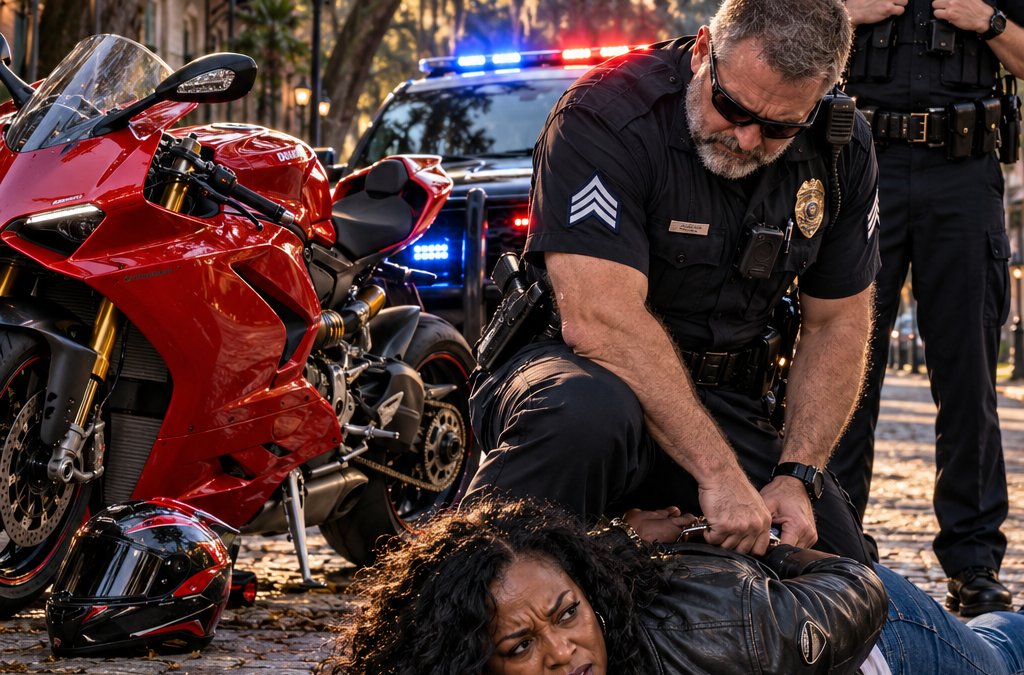
His knee came down on my back.
My breath left me.
Not because he had lost balance.
Not because I was fighting.
Not because I was trying to stand.
I was lying still.
Cuffed.
He settled his weight onto me.
“There.”
He leaned closer.
“That’s better.”
I turned my face enough to breathe.
A tiny piece of broken glass glittered in the road two feet from my eyes.
An ant moved along a crack in the asphalt.
I remember that ant.
Of all things.
I remember thinking how absurdly normal the world looked from six inches above the pavement.
“This is unlawful detention,” I said.
His knee pressed harder.
“I have committed no crime.”
He bent down until his mouth was close to my ear.
“You’ll find out what crime when I decide what crime.”
I felt the gum moving in his mouth.
“Do you understand?”
I said nothing.
“I decide.”
His breath smelled like coffee.
“Not you.”
Another push.
“Not your little Constitution.”
Pain spread across my ribs.
“I’m the law on this street.”
His voice lowered.
“Judge, jury, everything in between.”
He had no idea.
That was the terrible part.
He did not know I was a judge.
He believed I was nobody.
And that was exactly why every word mattered.
I closed my eyes.
Not because I surrendered.
Because control was the only thing left that belonged completely to me.
One breath.
Two.
Three.
Across the street, Briana was recording.
I learned later that her hands were shaking violently.
The video was almost perfectly steady.
Gerald had disappeared back into his house.
He was making a phone call.
Not to the local police.
To the United States Marshals Service.
“This is Gerald Hawkins,” he said. “Retired bailiff, Southern District courthouse.”
Then he gave the location.
“I’m watching a Savannah officer assault Judge Helena Powell.”
He read Anderson’s badge number.
“I need federal marshals.”
The woman in the bathrobe crossed toward us.
“She didn’t do anything!”
Anderson pointed at her.
“Back up!”
She stopped but did not leave.
“Why are you doing this?”
“I said back up before I arrest you too.”
People remained where they were.
Phones rose.
Anderson keyed his radio.
“Dispatch, Unit Fourteen. Noncompliant suspect. Possible stolen vehicle. Suspect resisted lawful commands. Requesting backup.”
I listened to him manufacture the report while his knee remained on my body.
Dawson stood four feet away.
He knew.
I could see it when I opened my eyes.
His face was pale.
His body camera blinked steadily.
He had been an officer for five months.
I later learned his mother had sat in the front row when he took his oath.
Protect.
Serve.
Uphold the Constitution.
All the easy words people say while standing safely indoors.
Now the oath required something from him.
He looked at Anderson.
Looked at me.
Looked at the people filming.
Then stared at the ground.
He did nothing.
That silence stayed with me longer than Anderson’s insults.
Bad people are dangerous.
Good people who become passive around bad people can make them unstoppable.
My phone buzzed inside the motorcycle.
Once.
Again.
Again.
Terrence.
Anderson glanced toward the compartment.
“Boyfriend calling?”
I said nothing.
“Too bad.”
What he did not know was that Terrence could see my location.
We shared it for practical reasons.
He had noticed that I had stopped on a street where I had no reason to be stopped.
Fifteen minutes.
No movement.
No response.
By the time he called the third time, he was already driving toward me.
But Gerald’s call was going to reach me first.
Several minutes passed.
Anderson appeared restless.
I think he wanted me to cry.
To beg.
To give him something that confirmed the image of me he had created.
I didn’t.
Eventually, he walked back toward the Ducati.
He opened the compartment again.
This time he dug deeper.
His fingers caught the lanyard.
He pulled it free.
At first, he barely looked at it.
Then he flipped it over.
I watched his face from the pavement.
I saw the exact moment his world changed.
The gold federal seal.
My photograph.
UNITED STATES DISTRICT COURT.
SOUTHERN DISTRICT OF GEORGIA.
JUDGE HELENA POWELL.
His chewing stopped.
The hand holding the badge froze.
Dawson leaned closer.
Read it.
Then read it again.
“Oh, God.”
Anderson said nothing.
Dawson whispered, “Sarge.”
His voice cracked.
“That’s the judge.”
Anderson turned.
“What?”
“That’s Judge Powell.”
Then came the sentence that made everything worse for them.
“The judge on our case.”
Anderson looked at me.
Really looked at me.
Perhaps for the first time.
The calm he had interpreted as arrogance.
The legal language he had mocked.
The questions he had treated as insubordination.
The woman he had called nobody.
Suddenly all of it had context.
His face drained white.
The lanyard hung from his hand.
I turned my head enough to look directly at him.
“Now you know my name.”
He opened his mouth.
Nothing came out.
“You’ve called me sweetheart.”
His lips moved.
“You called me nobody.”
He took a step backward.
“You called me a mistake of creation.”
“Your Honor, I—”
“My name is Judge Helena Powell.”
His hand dropped slightly.
“And the civil-rights case currently sitting in my chambers includes your badge number.”
He looked as if somebody had struck him.
“This was a misunderstanding.”
“No.”
“I didn’t know—”
“That is exactly the problem.”
His eyes widened.
“There was nothing routine about what you just did.”
Anderson rushed toward me with the handcuff key.
His fingers shook so badly he dropped it.
Once.
Then again.
He knelt.
Unlocked the cuffs.
Then reached to help me stand.
I pulled my arm away.
“No.”
I stood by myself.
Slowly.
My knees trembled once, but held.
I brushed gravel from my jacket.
Touched my cheek.
My fingertips came away dirty.
There was blood on one of them.
Anderson was three feet away.
His badge suddenly seemed very small.
Dawson had backed away.
Briana was still filming.
Nobody on that street spoke.
Then we heard sirens.
Not ordinary patrol sirens.
Two black SUVs came around the corner hard.
Federal plates.
Doors opened almost simultaneously.
Chief Federal Marshal Raymond Caldwell stepped from the lead vehicle.
Sixty-one years old.
Gray hair.
More than thirty years in federal law enforcement.
I knew Raymond well.
He took one look at me.
Scraped cheek.
Dirty jacket.
Marks already darkening around both wrists.
Then he looked at Anderson.
“Sergeant.”
His voice was perfectly controlled.
“Step away from the judge.”
Anderson stepped backward.
His hands lifted.
Palms visible.
The same position he had ordered from me.
Raymond walked directly to me.
“Your Honor, are you injured?”
For the first time that morning, something inside me shifted.
Not enough to collapse.
Just enough for me to realize how much strength I had been spending on remaining still.
“I’m standing, Ray.”
My voice almost broke.
“That’s enough right now.”
He nodded.
Then he turned.
Anderson immediately began talking.
“Marshal, this was a routine stop. The registration flagged. She wasn’t complying. I had no idea who—”
“The registration is valid.”
Anderson stopped.
“I ran it myself.”
Raymond moved toward him.
“Current. Clean. Registered to Helena R. Powell.”
He stopped a few feet away.
“So don’t start lying now.”
“She was uncooperative.”
“She asked why she was stopped.”
“She refused orders.”
“She asked for the legal basis.”
“She was confrontational.”
“She asked for your badge number.”
Anderson’s mouth opened.
Raymond continued.
“She cited the law.”
Another step.
“That is not resistance.”
His voice hardened.
“That is the Constitution you swore to uphold.”
Anderson looked toward Captain Dawson for help and seemed to remember Dawson was twenty-four, terrified, and barely breathing.
Raymond extended his hand.
“Badge and weapon.”
Anderson stared at him.
“Marshal, surely we can handle this at the station.”
“Badge.”
Silence.
“Weapon.”
Still nothing.
“Ten seconds, Sergeant.”
Raymond’s eyes did not move.
“Or I put you in handcuffs on this sidewalk in front of every camera here.”
Anderson slowly unclipped his badge.
Eighteen years.
Three commendations.
Fourteen dismissed complaints.
All of it reduced to a piece of metal shaking between his fingers.
He put it in Raymond’s hand.
Then removed his sidearm.
Cleared it.
Placed it on the hood of the cruiser.
Dawson did the same without being asked.
His badge.
His gun.
Silence.
Fifteen minutes later, Captain Lloyd Simmons arrived.
He got out of his SUV looking angry rather than concerned.
“Marshal Caldwell.”
Raymond did not answer.
“This is a departmental matter.”
That got his attention.
Raymond turned.
“Your officer detained a sitting federal judge without legal basis.”
Simmons glanced toward me.
“Conducted a warrantless search.”
Anderson stared at the pavement.
“Used excessive force.”
No one spoke.
“Then transmitted materially false information over department radio.”
Simmons’s expression changed.
“This is not simply an internal matter.”
“Surely our office—”
“No.”
Raymond pointed toward the body cameras.
“Both cameras and the dash recording are now under federal preservation order.”
Simmons went still.
“If one second disappears, if any file is altered, corrupted, misplaced, overwritten, or mysteriously lost, I will treat that as a separate federal matter.”
“Yes, Marshal.”
Federal deputies removed the body cameras.
They were still recording.
Everything had been captured.
The search.
The invented registration problem.
Anderson telling me people like me always had something to hide.
His threat.
His hand on my wrist.
The arrest.
The pressure on my back.
His statement that I was a mistake of creation.
His radio report.
Every word.
Time-stamped.
Preserved.
Raymond pointed toward one of the SUVs.
“Sergeant Anderson, you’re coming with us.”
Anderson looked up.
“Am I under arrest?”
“You are being detained for federal questioning.”
Raymond paused.
“What happens after that depends on what the evidence establishes.”
A marshal opened the rear door.
Anderson climbed inside.
The door closed.
Heavy.
Final.
I stood beside the Ducati watching the vehicle that carried him away.
A federal officer offered me medical attention.
I accepted a small bandage for my cheek.
I refused an ambulance.
Maybe that was stubborn.
Maybe it was shock.
I just wanted to stand.
Then I called Terrence.
He answered instantly.
“Helena.”
I heard the fear before he said anything else.
“Where are you? What happened?”
“I’m okay.”
Silence.
The kind of silence only married people understand.
Not empty.
Full of all the words neither person can manage yet.
“Helena.”
“I’m okay, Terrence.”
I looked upward.
Spanish moss drifted under the oak branches.
That same mockingbird was still somewhere above us.
The world had continued.
Cars moved at the far intersection.
Sprinklers clicked.
The sun climbed.
Everything looked ordinary.
Nothing felt ordinary anymore.
Briana posted her video at 9:47 that morning.
No edits.
No commentary.
No dramatic music.
Four minutes and thirty-eight seconds.
By noon, hundreds of thousands of people had watched it.
By evening, millions.
By midnight, national networks were running the footage.
I avoided television.
Terrence didn’t.
He sat in our living room watching the same moment repeat until eventually I took the remote from his hand and turned the screen off.
“Stop.”
His jaw tightened.
“I need to see what he did.”
“No.”
“He put his knee—”
“I know what he did.”
He looked at me.
I sat beside him.
“I was there.”
His face broke.
Just for a second.
Terrence had spent decades learning how to deal with danger by moving toward it.
This was different.
There was nowhere for him to go.
Nothing he could fight.
Nothing he could undo.
He touched the bruises around my wrist.
“I should’ve been there.”
I pulled my hand back gently.
“No.”
“Helena—”
“No.”
I looked directly at him.
“This is not going to become your guilt.”
His eyes filled.
“He did that to you.”
“Yes.”
“And I wasn’t there.”
“That doesn’t make it yours.”
Forty-eight hours later, authorities released the body-camera footage under court order.
It was worse than Briana’s video.
Her recording showed the event from across the street.
The body camera put the viewer inside it.
Anderson’s breathing.
The sound of his gum.
The cuffs.
My voice.
His voice.
Every insult.
Every lie.
The audio removed every defense based on misunderstanding.
People could hear me calmly stating that I did not consent.
They could hear me asking the legal basis for the stop.
They could hear Dawson tell Anderson the registration was clean.
They could hear Anderson continue anyway.
And then the country heard him call me a mistake of creation.
That sentence followed me everywhere.
I hated it.
Not because it hurt me personally anymore.
Because thousands of people began treating it as the moment that made the story serious.
It wasn’t.
The story was serious before anyone knew I was a federal judge.
The illegal stop was serious.
The fabricated suspicion was serious.
The warrantless search was serious.
The handcuffs were serious.
The knee was serious.
The fourteen people who had complained about Anderson before me had also been serious.
My title did not turn misconduct into misconduct.
It merely made the system unable to ignore it.
Reporter Gloria Stanton connected the most explosive piece publicly.
Brett Anderson was not simply a Savannah police sergeant.
He was a named defendant in Crawford v. Savannah Chatham Metropolitan Police Department.
The federal civil-rights case assigned to me.
The officer accused in a case about racial profiling and excessive force had stopped, searched, handcuffed, and assaulted the judge presiding over that case.
The absurdity was so complete that people treated it like poetic justice.
I did not.
There was nothing poetic about lying on asphalt wondering how much more pressure someone could put on your ribs before you stopped being able to breathe.
Three days after the incident, I recused myself from Crawford.
I had no choice.
I was now a witness to conduct directly related to the allegations before the court.
My public statement was deliberately short.
I refused interviews.
Refused television appearances.
Refused to let the story become entertainment.
My final sentence said:
The law must remain impartial even when, especially when, it has been personally violated.
Then I returned to work.
The Department of Justice opened a pattern-or-practice investigation into the Savannah Chatham Metropolitan Police Department within two weeks.
Not merely into Anderson.
The department.
Internal discipline.
Traffic stops.
Use-of-force reports.
Complaint review.
Supervisory decisions.
Everything.
Investigators opened Anderson’s personnel file.
Fourteen complaints.
Every one from a Black motorist.
Different years.
Different streets.
Different circumstances.
Same pattern.
Questionable stop.
Escalation.
Claimed probable cause.
Force.
Report written afterward to justify what happened.
And every one had been dismissed.
The same supervisor had approved those dismissals.
Captain Lloyd Simmons.
Fourteen times, someone had accused Anderson of abuse.
Fourteen times, the system had concluded there was nothing worth pursuing.
Simmons was placed on administrative leave.
Six weeks after my traffic stop, a federal grand jury convened.
The indictment came back in less than a day.
Brett Anderson faced multiple federal charges, including deprivation of civil rights under color of law, unlawful detention, false reporting, and charges connected to the assault.
Dawson cooperated.
His agreement spared him prison in exchange for complete testimony.
I read his testimony afterward.
He described breakfast at Waffle House that morning.
Anderson angry about the lawsuit.
Calling it a witch hunt.
Complaining about a diversity judge.
Then the Ducati passing.
Me riding it.
A Black woman on an expensive motorcycle.
According to Dawson, Anderson had watched me pass and said:
“Since when do they ride bikes like that?”
That sentence explained the stop better than any police report ever could.
Dawson admitted the registration discrepancy had been fabricated.
Admitted Anderson found nothing during the search.
Admitted he knew the force was unnecessary.
Then prosecutors asked the question everyone wanted answered.
Why didn’t you stop him?
According to the transcript, Dawson sat silent for eleven seconds.
Then said:
“Because I was afraid of him.”
Another pause.
“And I’m not proud of that.”
I believed him.
That didn’t absolve him.
Fear explains silence.
It does not erase what silence allows.
The trial lasted nine days.
Anderson’s attorneys argued officer discretion.
Rapid decision-making.
A potentially uncertain roadside encounter.
They suggested my legal knowledge had made me confrontational.
They suggested Anderson could not have known whether the motorcycle was stolen.
They suggested tense encounters look different when replayed slowly in a courtroom.
The prosecution answered with four minutes of video.
Unedited.
No narrator.
No commentary.
No dramatic reconstruction.
Just Anderson and me.
The jury watched him invent a registration problem.
Watched me offer proof.
Watched him prevent me from retrieving it.
Watched the illegal search.
Watched the physical escalation.
Heard Dawson warning him.
Heard me state repeatedly that I was complying.
Then heard Anderson call me a mistake of creation.
One juror closed her eyes.
Another stared at him.
Anderson did not testify.
The jury deliberated approximately six hours.
Guilty.
All counts.
I did not attend sentencing.
I had spent enough of my life looking at Brett Anderson.
Another federal judge imposed twelve years in prison.
No parole eligibility for ten.
Captain Simmons faced his own prosecution.
The evidence showed years of suppressed complaints and failures to investigate misconduct.
His trial lasted five days.
He was convicted.
Six years.
The city entered a federal consent decree within ninety days.
Mandatory body-camera requirements.
Independent civilian oversight.
New complaint procedures.
Retraining.
External auditing.
Review of historic excessive-force allegations.
The Crawford litigation eventually ended in a landmark settlement.
The department had spent years insisting there was no pattern.
Now an entire federal oversight structure existed because the pattern could no longer be denied.
Dawson lost his badge.
The cooperation agreement kept him out of prison.
Outside the courthouse, he gave a short statement.
He said he should have intervened.
He said silence had been a decision.
He said he had made the wrong one.
Some people praised him for admitting it.
Others said the admission came too late.
Both things could be true.
Six months passed before I rode alone again.
Terrence never pressured me.
He never told me to stop riding.
That mattered.
After what happened, everyone around me had advice.
Sell the Ducati.
Carry identification visibly.
Ride with security.
Never ride alone.
Change routes.
Get another hobby.
Terrence never said any of it.
He understood that fear could become another kind of prison if you allowed it to make every decision afterward.
Three weeks after the incident, however, a midnight-blue Harley appeared in our garage.
I walked downstairs one morning and found Terrence polishing the tank.
I crossed my arms.
“When did you start riding motorcycles?”
He didn’t look at me.
“Recently.”
“That’s not an answer.”
“It is technically an answer.”
I stared at the Harley.
“You hate motorcycles.”
“I hated your motorcycle.”
“And now?”
“Now I dislike motorcycles with nuance.”
I laughed for the first time in days.
He looked at me then.
There was no joke in his eyes.
I understood.
He wasn’t trying to stop me from riding.
He was giving himself a way to ride with me.
Six months after Anderson forced me onto that street, Terrence and I returned to Victory Drive.
Saturday morning.
Almost the same hour.
Same oak canopy.
Same Spanish moss.
Same humid air.
I rode the red Ducati.
He followed on the Harley.
We did not discuss the significance of the route.
We did not need to.
When we passed the street where Anderson had stopped me, my hands tightened on the grips.
My breathing changed.
For a fraction of a second, I was back on the pavement.
Heat against my cheek.
Metal around my wrists.
A knee between my shoulder blades.
Then Terrence’s motorcycle appeared in my mirror.
Steady.
Not crowding me.
Not trying to lead.
Just there.
I kept riding.
Eventually, I returned fully to the bench.
Same courtroom.
Same black robe.
Same clerk calling everyone to rise.
But I was not exactly the same judge.
Before the stop, I understood abuse of authority intellectually.
Legally.
Structurally.
I understood standards of review.
Qualified immunity.
Probable cause.
Reasonable suspicion.
Use-of-force doctrine.
Civil-rights statutes.
After the stop, those doctrines had weight.
Temperature.
Smell.
They sounded like a handcuff ratcheting one click tighter.
They felt like pavement against skin.
The law had always been personal for the people appearing before me.
Now I understood that differently.
The riding jacket Anderson had damaged hung on the back of my chamber door.
The left shoulder was torn.
The elbow scuffed.
There was still dust embedded deep in the leather.
I could have replaced it.
I could have had it professionally restored.
I did neither.
One afternoon, Diane Crawford asked me why I kept it.
I looked at the jacket for a long moment.
Then I said, “Because the robe doesn’t protect you from the world.”
She waited.
I touched the edge of my judicial robe.
“It means you have a greater obligation to protect the world when you can.”
I looked back at the riding jacket.
“That reminds me of both.”
Briana received a scholarship from the Southern Civil Rights Foundation.
I wrote her recommendation personally.
I thought often about that girl.
Fifteen years old when she stepped into a doorway and saw something adults around her were struggling to process.
Her hands shook.
She kept filming.
Courage rarely looks clean while it is happening.
Sometimes courage is terrified.
Sometimes it is uncertain.
Sometimes its hands tremble so badly that the person displaying it cannot even recognize it in themselves.
But the camera stays up.
Gerald received a courthouse commendation.
Afterward, he tried to dismiss what he had done.
“I just made a phone call, Your Honor.”
I took his hand.
“No.”
He looked at me.
“You made the phone call that mattered.”
He smiled awkwardly.
“I knew who you were.”
“I know.”
“That’s why I called the marshals.”
I squeezed his hand.
“I understand.”
But both of us knew the harder truth.
Somebody shouldn’t have to recognize a federal judge before deciding a woman deserves help.
That was the lesson I carried longest.
People later described what happened to Anderson as karma.
Some called it justice.
Some used words like downfall, destruction, humiliation.
I rarely thought about him in those terms.
For eighteen years, Brett Anderson possessed extraordinary authority.
A badge.
A firearm.
The power to detain.
The ability to place people in handcuffs.
The presumption that courts and supervisors would initially trust his account of an encounter.
The morning he stopped me, he believed that authority meant his perception automatically became reality.
He looked at a Black woman riding an expensive Ducati and decided the motorcycle did not belong to her.
Everything afterward grew from that first assumption.
The stop.
The invented discrepancy.
The search.
The accusation.
The force.
He did not become a different man when he learned I was a federal judge.
He simply discovered that the woman he had decided was powerless possessed a title powerful enough to make other institutions pay attention.
That distinction mattered to me.
Because if I had been exactly who Anderson assumed I was—poor, unknown, frightened, without legal training—his actions would not have become less wrong.
They might simply have become easier to bury.
Fourteen other complaints suggested exactly that.
Anderson ultimately received twelve years in federal prison.
No badge.
No gun.
Nobody calling him Sergeant.
Captain Simmons received six.
Dawson lost the career he had barely begun.
The department entered federal oversight.
Policies changed.
Complaint systems changed.
Training changed.
Nothing about those consequences gave me back the Saturday morning I had expected.
Nothing erased those minutes on the asphalt.
Accountability does not work that way.
It is not time travel.
It is not revenge.
It is the decision that what happened will carry a cost large enough to discourage the next person who believes power makes him immune from consequence.
Some stories end with forgiveness.
Mine did not.
I did not hate Brett Anderson.
Hatred would have required me to keep carrying him.
I simply believed he should answer for what he chose to do.
And he did.
One Saturday morning months later, I rolled the Ducati out of the garage before sunrise.
Terrence was already waiting beside his Harley.
He looked at my jacket.
The damaged one.
“You’re wearing that?”
“Yes.”
“You have three new jackets.”
“I know.”
He shook his head.
“You’re stubborn.”
“You married me.”
“That was before I had all the evidence.”
I smiled.
He started his motorcycle.
I pulled on my helmet.
The sky over Savannah was turning pale blue.
We rode east.
At the first long stretch of open road, I let the Ducati accelerate.
Wind pressed against my shoulders.
The engine climbed cleanly through the gears.
Terrence stayed behind me.
For several miles, I thought about nothing.
No court cases.
No Anderson.
No television footage.
No scars.
Just the road.
Then we passed beneath a canopy of live oaks.
Morning sunlight flickered between the branches.
For one second, blue light reflected in my mirror.
My chest tightened.
I looked again.
Not police lights.
Sunlight bouncing from a storefront window.
I exhaled.
Kept going.
That was when I finally understood something I had been trying to articulate since the morning Anderson stopped me.
The robe had never made me worthy of dignity.
The title had never made my rights more real.
The federal seal in my motorcycle had not transformed me from nobody into somebody.
I had been somebody before Anderson knew my name.
I had been somebody while my face was against the pavement.
I had been somebody when he searched my motorcycle without permission.
I had been somebody when he decided I could not possibly own it.
The tragedy was not that Brett Anderson assaulted a federal judge.
The tragedy was that he believed there were women he could treat that way safely.
I could not change the first minutes of that morning.
But I had watched Gerald make the call.
I had watched Briana refuse to lower her camera.
I had heard a stranger in a bathrobe shout from the curb when an armed officer told everyone to stay back.
I had watched institutions that had ignored complaints finally be forced to examine themselves.
Those choices did not erase what happened.
They prevented it from disappearing.
That mattered.
I leaned the Ducati into a long curve.
Terrence followed.
The Savannah air was warm again.
Spanish moss moved gently above the road.
And for the first time since Anderson put his knee into my back, I no longer felt like I was riding away from that morning.
I was simply riding forward.
𝗧𝗛𝗘 𝗘𝗡𝗗
A Police Sergeant Dragged Me Off My $40,000 Ducati and Put His Knee on My Back Because He Decided I Couldn’t Possibly Own It
The moment Sergeant Brett Anderson shoved my face toward the pavement, I understood that this had stopped being a traffic stop and become something far more dangerous.
What frightened me most wasn’t the gun on his hip or the handcuffs cutting into my wrists—it was the certainty in his voice when he told me that out there on his street, my rights existed only if he allowed them to.
Three hours earlier, I had been standing barefoot in front of my bathroom mirror wondering whether it was going to rain.
It was 6:15 on a Saturday morning in Savannah, Georgia.
The city was still waking.
Spanish moss hung from the live oaks along East Gaston Street, barely moving in the heavy morning air. Sprinklers clicked across lawns. Somewhere down the block, a delivery truck groaned through an intersection, then faded away.
I wore no makeup.
No jewelry.
No black robe.
Nothing that would have told a stranger who I was.
Behind me on the wall hung framed degrees from Howard University and Yale Law School, along with a photograph from the day I received my federal judicial appointment.
Beside them was something more important.
A folded American flag in a triangular case.
It belonged to my husband, Terrence.
Twenty-two years of military service.
Two deployments that nearly broke him.
One retirement ceremony during which I had watched a colonel who almost never showed emotion stare at that flag with tears running freely down his face.
On weekdays, my world was the United States District Court for the Southern District of Georgia.
I wore a black robe.
Attorneys stood when I entered.
I heard federal criminal cases, constitutional disputes, civil-rights claims, motions that could change the course of somebody’s life with a signature.
People called me Your Honor.
On Saturday mornings, none of that came with me.
Saturday mornings belonged to the motorcycle.
My cherry-red Ducati Panigale sat beneath a cover in the garage.
Terrence called it my midlife crisis.
I called it the only place in my life where nobody was asking me to make a decision for them.
I had bought it shortly after my Senate confirmation.
Forty thousand dollars.
Far more than I had ever imagined spending on a motorcycle.
I knew that.
I also knew I had worked most of my adult life for the privilege of having one completely impractical thing that existed solely because it made me happy.
I pulled on jeans, a white T-shirt, and my black riding jacket.
No courthouse insignia.
No federal credentials clipped visibly to my clothing.
My identification stayed inside the motorcycle’s rear compartment with my phone charger, sunglasses, and a few other things.
Later, I would think about that decision more times than I could count.
Not because I regretted it.
Because it taught me exactly how much of the respect I received every weekday belonged to the robe instead of the woman wearing it.
I rolled the Ducati into the driveway.
The engine fired with a deep mechanical growl that echoed against the brick walls.
I smiled inside my helmet.
Then I pulled into the street.
I rode slowly through the historic district.
Past Forsyth Park.
Past cafés just beginning to open.
Past runners moving under oak branches while the smell of coffee and cut grass mixed with the humid Georgia air.
I headed toward Thunderbolt and Victory Drive, where the streets opened up and the traffic thinned.
I stopped once for fuel.
The attendant looked about nineteen.
“Nice bike,” he said.
“Thank you.”
He never recognized me.
Nobody did.
That was the point.
I wanted one morning where I could disappear.
Back at the courthouse, sitting on a table in my chambers, was a file almost four inches thick.
Crawford v. Savannah Chatham Metropolitan Police Department.
It was one of the most serious civil-rights cases assigned to me during my time on the federal bench.
The allegations went far beyond a single officer or traffic stop.
The plaintiffs alleged a pattern of racially motivated vehicle stops.
Fabricated probable cause.
Excessive force.
False reports.
Complaints ignored or buried.
Multiple officers were named in the case.
There were body-camera recordings, dash-camera footage, internal disciplinary records, years of complaints, and thousands of pages of testimony.
I had spent weeks reviewing it.
One name appeared repeatedly.
Sergeant Brett Anderson.
I knew the name.
I knew his badge number.
I had never seen his face in person.
That mattered.
Because at approximately 6:40 that morning, while I was riding south on Victory Drive doing thirty-one miles per hour in a thirty-five-mile-per-hour zone, Brett Anderson saw me before I saw him.
He was sitting in a patrol vehicle with Officer Kyle Dawson.
Anderson had been with the department eighteen years.
Forty-six years old.
Three commendations.
Fourteen citizen complaints.
All fourteen filed by Black motorists.
All fourteen dismissed.
Dawson was twenty-four.
Recently out of the academy.
Barely experienced enough to know what kind of officer he wanted to become.
That morning, he was about to find out.
I saw the patrol car in my mirror.
Then the lights came on.
Blue.
Red.
Blue again.
For a moment, I assumed Anderson was heading somewhere else.
I checked my speedometer.
Thirty-one.
Then I realized he was staying directly behind me.
I signaled right.
Pulled onto a residential side street.
Stopped beside the curb.
Killed the engine.
Removed my helmet.
Placed it carefully on the fuel tank.
Then I put both hands where they could be seen.
That sequence was instinctive.
Not because I was afraid of the police.
Because I had read too many reports about what happened when an officer claimed he could not see someone’s hands.
The cruiser stopped about fifteen feet behind me.
Lights kept flashing.
A sprinkler clicked rhythmically across the lawn of a small white house.
A dog barked.
Someone moved behind a curtain.
I waited.
Anderson did not get out immediately.
When he finally opened his door, he took his time.
Adjusted his duty belt.
Touched his holster.
Put a piece of gum in his mouth.
Then walked toward me.
Dawson followed several steps behind.
Anderson said nothing until he was standing beside the Ducati.
No greeting.
No identification.
No explanation.
His eyes moved from the motorcycle to my boots, my jacket, my face.
Then back to the motorcycle.
“You know why I pulled you over?”
“No, Sergeant.”
“You were speeding.”
“I was traveling thirty-one in a thirty-five.”
He looked at me.
“That’s not what my radar said.”
“Then I’d like to see the radar reading, please.”
Something changed in his face.
Small.
But immediate.
I had spent years watching witnesses on the stand.
You learn to see the moment somebody realizes the conversation is not going to follow the script they prepared.
Anderson expected apology.
Maybe nervousness.
Maybe submission.
Instead, he had received a calm request for evidence.
He stepped closer.
“License and registration.”
“Certainly.”
I moved slowly.
“I’m reaching into my left jacket pocket for my wallet.”
His eyes followed my hand.
I removed my license.
Then I opened the Ducati’s compartment.
“I’m reaching for the registration.”
I handed both to him.
He snatched them from my hand without acknowledging me and returned to the cruiser.
Dawson stayed near the motorcycle.
He avoided my eyes.
I sat still.
Three minutes passed.
Five.
Eight.
The morning grew warmer.
I could hear birds above me.
A mockingbird somewhere in the oak branches.
I already knew what Anderson was doing.
He was searching.
Warrants.
Suspensions.
Outstanding tickets.
Flags.
Anything that could turn a questionable stop into a legitimate one after the fact.
He would find nothing.
My driving record was clean.
My criminal record was nonexistent.
My registration was current.
My insurance was current.
I had renewed the motorcycle registration eight weeks earlier.
When Anderson finally returned, his expression told me he had found nothing.
That should have ended the stop.
Instead, it seemed to make him angrier.
“Registration doesn’t match.”
I looked at him.
“Excuse me?”
“The motorcycle doesn’t match what’s in the system.”
He held my registration card.
“Possible stolen vehicle.”
For the first time, I felt something cold move through my stomach.
“That’s not possible.”
“That’s what the system says.”
“I renewed it eight weeks ago. The registration in your hand is valid.”
“System says otherwise.”
“I have the renewal confirmation on my phone. I can show—”
“Did I tell you to reach for your phone?”
His voice cracked across the street.
Dawson flinched.
I immediately returned both hands to the handlebars.
“I’m not reaching for anything.”
“Good.”
“I’m offering to resolve what you’re calling a discrepancy.”
“The only thing you’re going to do is get off that bike.”
I looked at him.
“On what grounds?”
There it was.
The question that changed the entire encounter.
Anderson’s neck flushed.
His jaw tightened.
“On the grounds that I told you to.”
“I’m asking for the legal basis of the order.”
“You don’t need one.”
“With respect, Sergeant, I do.”
He stepped closer.
“You have a right to do what I tell you.”
His voice dropped.
“That’s the only right you need right now.”
I had read sentences like that in transcripts.
Seen them quoted in complaints.
Language that sounds unbelievable until you hear someone say it without hesitation.
I slowly dismounted.
Placed both feet on the pavement.
Hands visible.
Back straight.
“What now?”
He stared at me.
“You’ve got an attitude problem.”
“I don’t have an attitude problem.”
“Oh, no?”
“I’m exercising my constitutional rights.”
He turned toward Dawson.
“You hear this?”
Dawson said nothing.
“She’s exercising her rights.”
Anderson laughed.
Dawson did not.
His body camera was recording.
I could see the small green light.
Anderson moved closer until his shadow covered me.
“I think this bike is stolen.”
“It isn’t.”
“I think your registration is fraudulent.”
“It isn’t.”
“And I think that mouth of yours is about to get you put on the ground.”
I held his eyes.
“I believe you know the allegations you’re making are false.”
That was when I understood what he was doing.
He wasn’t investigating anymore.
He was constructing.
A justification.
Layer by layer.
A stolen motorcycle.
Suspicious registration.
Noncompliance.
Attitude.
Each allegation existed to support the next escalation.
I had seen the pattern in case files.
First the officer creates a narrative.
Then the narrative justifies the detention.
The detention creates opportunities to manufacture resistance.
Resistance justifies force.
And when the report is written later, everything runs backward until the victim becomes the reason the officer had no choice.
I had analyzed that architecture from the bench.
Now I was standing inside it.
Across the street, a door opened.
An older Black man stepped onto his porch.
He froze when he saw me.
I recognized him a second later.
Gerald Hawkins.
Retired federal courthouse bailiff.
Sixty-eight years old.
He had worked security in our courthouse before retiring.
We had spoken dozens of times over the years.
His eyes widened.
A teenage girl stepped into the doorway behind him holding a phone.
Briana.
His granddaughter.
She raised the camera.
Two houses farther down, a woman in a bathrobe stepped onto her front steps.
A man walking a dog stopped at the corner.
The street was waking.
And watching.
Anderson either did not notice or did not care.
He pulled blue latex gloves from his pocket.
Snapped them over his hands.
“Tell you what,” he said. “Let’s see what else you’re hiding.”
He approached the motorcycle.
“I do not consent to a search.”
He ignored me.
“You have no probable cause.”
He opened the rear compartment.
“No probable cause?”
He laughed.
“You’re nervous.”
“I’m not nervous.”
“You’re shaking.”
“I’m not.”
“That’s enough for me.”
“Nervousness alone is not probable cause for a warrantless search.”
He began pulling things out.
Water bottle.
Onto the pavement.
Phone charger.
Onto the pavement.
Tire-pressure gauge.
He opened the pouch, looked inside, tossed it aside.
I said, “Sergeant, I am clearly stating that I do not consent to this search.”
He looked over his shoulder.
“You watch too much television.”
“This has nothing to do with television.”
“Sweetheart, this isn’t a courtroom.”
He turned back toward the Ducati.
“This is my street.”
His hand passed directly over my federal courthouse identification.
The lanyard was face down, caught against the compartment lining.
He shoved it aside without turning it over.
For one strange second, I almost told him what it was.
Almost.
Not because I thought my title should save me.
Because some part of me still believed knowing who I was might pull him back from whatever line he was approaching.
Then another thought stopped me.
What if I weren’t a federal judge?
What if I were a nurse?
A teacher?
A cashier?
A college student?
A mother going to work?
Would I deserve less protection?
Less restraint?
Less law?
I stayed silent.
Anderson found nothing.
No drugs.
No weapon.
Nothing illegal.
He slammed the compartment shut.
I watched frustration move across his face.
He had searched me without consent and found exactly what an honest officer should have been relieved to find.
Nothing.
But relief would have required him to admit that his suspicion had been wrong.
Anderson seemed constitutionally incapable of doing that.
He moved directly in front of me.
“You people always have something to hide.”
The words landed differently from everything before them.
Until then, there had been enough ambiguity for him to tell himself another story.
Not anymore.
“What people?”
He smiled.
He didn’t answer.
Instead I said, “I want your badge number and your supervisor’s name.”
His face changed instantly.
“My badge number?”
“Yes.”
“You want my badge number?”
“Yes, Sergeant.”
He stepped toward me.
“Who the hell do you think you’re talking to?”
“A public servant who is required to identify himself.”
He repeated the phrase.
“Public servant.”
Like it offended him.
Then his hand shot out.
He grabbed my wrist.
Hard.
I barely had time to react before he twisted my arm and drove me sideways against the Ducati.
The motorcycle rocked on its stand.
My palms struck the seat.
The leather was hot from the morning sun.
“Don’t you ever talk to me like you’re somebody.”
His fingers dug deeper into my wrist.
“You understand?”
Behind him, Dawson moved.
“Sarge.”
Anderson ignored him.
“Sarge, maybe we should let her go.”
I heard genuine fear in Dawson’s voice.
“The registration came back clean.”
Anderson turned his head slightly.
“Dawson.”
“There’s nothing in the compartment.”
“I said back up.”
Dawson stopped.
Anderson looked at me again.
“This one thinks she’s special.”
He tightened his grip.
“Thinks she can throw legal words around like she’s some kind of lawyer.”
I almost laughed.
Not because anything was funny.
Because the absurdity had become unbearable.
Anderson mistook the movement.
“What’s funny?”
“Nothing.”
“You think I’m funny?”
“No.”
“Let me show you how the real world works.”
He kicked my feet apart.
One hand went to the back of my neck.
And then he drove me toward the pavement.
My cheek struck first.
Then my shoulder.
My palms scraped across asphalt.
For a fraction of a second, pain erased thought completely.
The pavement was warmer than I expected.
Rough.
Dust and grit pressed into the side of my face.
I smelled hot tar, old oil, dirt.
Then he pulled my arms behind me.
One cuff closed around my wrist.
Click.
The second followed.
Click.
He tightened them.
Too much.
Metal bit into my skin.
“Sergeant.”
“Shut up.”
“The cuffs are unnecessarily tight.”
“Maybe you should have thought about that before resisting.”
“I did not resist.”
His knee came down on my back.
My breath left me.
Not because he had lost balance.
Not because I was fighting.
Not because I was trying to stand.
I was lying still.
Cuffed.
He settled his weight onto me.
“There.”
He leaned closer.
“That’s better.”
I turned my face enough to breathe.
A tiny piece of broken glass glittered in the road two feet from my eyes.
An ant moved along a crack in the asphalt.
I remember that ant.
Of all things.
I remember thinking how absurdly normal the world looked from six inches above the pavement.
“This is unlawful detention,” I said.
His knee pressed harder.
“I have committed no crime.”
He bent down until his mouth was close to my ear.
“You’ll find out what crime when I decide what crime.”
I felt the gum moving in his mouth.
“Do you understand?”
I said nothing.
“I decide.”
His breath smelled like coffee.
“Not you.”
Another push.
“Not your little Constitution.”
Pain spread across my ribs.
“I’m the law on this street.”
His voice lowered.
“Judge, jury, everything in between.”
He had no idea.
That was the terrible part.
He did not know I was a judge.
He believed I was nobody.
And that was exactly why every word mattered.
I closed my eyes.
Not because I surrendered.
Because control was the only thing left that belonged completely to me.
One breath.
Two.
Three.
Across the street, Briana was recording.
I learned later that her hands were shaking violently.
The video was almost perfectly steady.
Gerald had disappeared back into his house.
He was making a phone call.
Not to the local police.
To the United States Marshals Service.
“This is Gerald Hawkins,” he said. “Retired bailiff, Southern District courthouse.”
Then he gave the location.
“I’m watching a Savannah officer assault Judge Helena Powell.”
He read Anderson’s badge number.
“I need federal marshals.”
The woman in the bathrobe crossed toward us.
“She didn’t do anything!”
Anderson pointed at her.
“Back up!”
She stopped but did not leave.
“Why are you doing this?”
“I said back up before I arrest you too.”
People remained where they were.
Phones rose.
Anderson keyed his radio.
“Dispatch, Unit Fourteen. Noncompliant suspect. Possible stolen vehicle. Suspect resisted lawful commands. Requesting backup.”
I listened to him manufacture the report while his knee remained on my body.
Dawson stood four feet away.
He knew.
I could see it when I opened my eyes.
His face was pale.
His body camera blinked steadily.
He had been an officer for five months.
I later learned his mother had sat in the front row when he took his oath.
Protect.
Serve.
Uphold the Constitution.
All the easy words people say while standing safely indoors.
Now the oath required something from him.
He looked at Anderson.
Looked at me.
Looked at the people filming.
Then stared at the ground.
He did nothing.
That silence stayed with me longer than Anderson’s insults.
Bad people are dangerous.
Good people who become passive around bad people can make them unstoppable.
My phone buzzed inside the motorcycle.
Once.
Again.
Again.
Terrence.
Anderson glanced toward the compartment.
“Boyfriend calling?”
I said nothing.
“Too bad.”
What he did not know was that Terrence could see my location.
We shared it for practical reasons.
He had noticed that I had stopped on a street where I had no reason to be stopped.
Fifteen minutes.
No movement.
No response.
By the time he called the third time, he was already driving toward me.
But Gerald’s call was going to reach me first.
Several minutes passed.
Anderson appeared restless.
I think he wanted me to cry.
To beg.
To give him something that confirmed the image of me he had created.
I didn’t.
Eventually, he walked back toward the Ducati.
He opened the compartment again.
This time he dug deeper.
His fingers caught the lanyard.
He pulled it free.
At first, he barely looked at it.
Then he flipped it over.
I watched his face from the pavement.
I saw the exact moment his world changed.
The gold federal seal.
My photograph.
UNITED STATES DISTRICT COURT.
SOUTHERN DISTRICT OF GEORGIA.
JUDGE HELENA POWELL.
His chewing stopped.
The hand holding the badge froze.
Dawson leaned closer.
Read it.
Then read it again.
“Oh, God.”
Anderson said nothing.
Dawson whispered, “Sarge.”
His voice cracked.
“That’s the judge.”
Anderson turned.
“What?”
“That’s Judge Powell.”
Then came the sentence that made everything worse for them.
“The judge on our case.”
Anderson looked at me.
Really looked at me.
Perhaps for the first time.
The calm he had interpreted as arrogance.
The legal language he had mocked.
The questions he had treated as insubordination.
The woman he had called nobody.
Suddenly all of it had context.
His face drained white.
The lanyard hung from his hand.
I turned my head enough to look directly at him.
“Now you know my name.”
He opened his mouth.
Nothing came out.
“You’ve called me sweetheart.”
His lips moved.
“You called me nobody.”
He took a step backward.
“You called me a mistake of creation.”
“Your Honor, I—”
“My name is Judge Helena Powell.”
His hand dropped slightly.
“And the civil-rights case currently sitting in my chambers includes your badge number.”
He looked as if somebody had struck him.
“This was a misunderstanding.”
“No.”
“I didn’t know—”
“That is exactly the problem.”
His eyes widened.
“There was nothing routine about what you just did.”
Anderson rushed toward me with the handcuff key.
His fingers shook so badly he dropped it.
Once.
Then again.
He knelt.
Unlocked the cuffs.
Then reached to help me stand.
I pulled my arm away.
“No.”
I stood by myself.
Slowly.
My knees trembled once, but held.
I brushed gravel from my jacket.
Touched my cheek.
My fingertips came away dirty.
There was blood on one of them.
Anderson was three feet away.
His badge suddenly seemed very small.
Dawson had backed away.
Briana was still filming.
Nobody on that street spoke.
Then we heard sirens.
Not ordinary patrol sirens.
Two black SUVs came around the corner hard.
Federal plates.
Doors opened almost simultaneously.
Chief Federal Marshal Raymond Caldwell stepped from the lead vehicle.
Sixty-one years old.
Gray hair.
More than thirty years in federal law enforcement.
I knew Raymond well.
He took one look at me.
Scraped cheek.
Dirty jacket.
Marks already darkening around both wrists.
Then he looked at Anderson.
“Sergeant.”
His voice was perfectly controlled.
“Step away from the judge.”
Anderson stepped backward.
His hands lifted.
Palms visible.
The same position he had ordered from me.
Raymond walked directly to me.
“Your Honor, are you injured?”
For the first time that morning, something inside me shifted.
Not enough to collapse.
Just enough for me to realize how much strength I had been spending on remaining still.
“I’m standing, Ray.”
My voice almost broke.
“That’s enough right now.”
He nodded.
Then he turned.
Anderson immediately began talking.
“Marshal, this was a routine stop. The registration flagged. She wasn’t complying. I had no idea who—”
“The registration is valid.”
Anderson stopped.
“I ran it myself.”
Raymond moved toward him.
“Current. Clean. Registered to Helena R. Powell.”
He stopped a few feet away.
“So don’t start lying now.”
“She was uncooperative.”
“She asked why she was stopped.”
“She refused orders.”
“She asked for the legal basis.”
“She was confrontational.”
“She asked for your badge number.”
Anderson’s mouth opened.
Raymond continued.
“She cited the law.”
Another step.
“That is not resistance.”
His voice hardened.
“That is the Constitution you swore to uphold.”
Anderson looked toward Captain Dawson for help and seemed to remember Dawson was twenty-four, terrified, and barely breathing.
Raymond extended his hand.
“Badge and weapon.”
Anderson stared at him.
“Marshal, surely we can handle this at the station.”
“Badge.”
Silence.
“Weapon.”
Still nothing.
“Ten seconds, Sergeant.”
Raymond’s eyes did not move.
“Or I put you in handcuffs on this sidewalk in front of every camera here.”
Anderson slowly unclipped his badge.
Eighteen years.
Three commendations.
Fourteen dismissed complaints.
All of it reduced to a piece of metal shaking between his fingers.
He put it in Raymond’s hand.
Then removed his sidearm.
Cleared it.
Placed it on the hood of the cruiser.
Dawson did the same without being asked.
His badge.
His gun.
Silence.
Fifteen minutes later, Captain Lloyd Simmons arrived.
He got out of his SUV looking angry rather than concerned.
“Marshal Caldwell.”
Raymond did not answer.
“This is a departmental matter.”
That got his attention.
Raymond turned.
“Your officer detained a sitting federal judge without legal basis.”
Simmons glanced toward me.
“Conducted a warrantless search.”
Anderson stared at the pavement.
“Used excessive force.”
No one spoke.
“Then transmitted materially false information over department radio.”
Simmons’s expression changed.
“This is not simply an internal matter.”
“Surely our office—”
“No.”
Raymond pointed toward the body cameras.
“Both cameras and the dash recording are now under federal preservation order.”
Simmons went still.
“If one second disappears, if any file is altered, corrupted, misplaced, overwritten, or mysteriously lost, I will treat that as a separate federal matter.”
“Yes, Marshal.”
Federal deputies removed the body cameras.
They were still recording.
Everything had been captured.
The search.
The invented registration problem.
Anderson telling me people like me always had something to hide.
His threat.
His hand on my wrist.
The arrest.
The pressure on my back.
His statement that I was a mistake of creation.
His radio report.
Every word.
Time-stamped.
Preserved.
Raymond pointed toward one of the SUVs.
“Sergeant Anderson, you’re coming with us.”
Anderson looked up.
“Am I under arrest?”
“You are being detained for federal questioning.”
Raymond paused.
“What happens after that depends on what the evidence establishes.”
A marshal opened the rear door.
Anderson climbed inside.
The door closed.
Heavy.
Final.
I stood beside the Ducati watching the vehicle that carried him away.
A federal officer offered me medical attention.
I accepted a small bandage for my cheek.
I refused an ambulance.
Maybe that was stubborn.
Maybe it was shock.
I just wanted to stand.
Then I called Terrence.
He answered instantly.
“Helena.”
I heard the fear before he said anything else.
“Where are you? What happened?”
“I’m okay.”
Silence.
The kind of silence only married people understand.
Not empty.
Full of all the words neither person can manage yet.
“Helena.”
“I’m okay, Terrence.”
I looked upward.
Spanish moss drifted under the oak branches.
That same mockingbird was still somewhere above us.
The world had continued.
Cars moved at the far intersection.
Sprinklers clicked.
The sun climbed.
Everything looked ordinary.
Nothing felt ordinary anymore.
Briana posted her video at 9:47 that morning.
No edits.
No commentary.
No dramatic music.
Four minutes and thirty-eight seconds.
By noon, hundreds of thousands of people had watched it.
By evening, millions.
By midnight, national networks were running the footage.
I avoided television.
Terrence didn’t.
He sat in our living room watching the same moment repeat until eventually I took the remote from his hand and turned the screen off.
“Stop.”
His jaw tightened.
“I need to see what he did.”
“No.”
“He put his knee—”
“I know what he did.”
He looked at me.
I sat beside him.
“I was there.”
His face broke.
Just for a second.
Terrence had spent decades learning how to deal with danger by moving toward it.
This was different.
There was nowhere for him to go.
Nothing he could fight.
Nothing he could undo.
He touched the bruises around my wrist.
“I should’ve been there.”
I pulled my hand back gently.
“No.”
“Helena—”
“No.”
I looked directly at him.
“This is not going to become your guilt.”
His eyes filled.
“He did that to you.”
“Yes.”
“And I wasn’t there.”
“That doesn’t make it yours.”
Forty-eight hours later, authorities released the body-camera footage under court order.
It was worse than Briana’s video.
Her recording showed the event from across the street.
The body camera put the viewer inside it.
Anderson’s breathing.
The sound of his gum.
The cuffs.
My voice.
His voice.
Every insult.
Every lie.
The audio removed every defense based on misunderstanding.
People could hear me calmly stating that I did not consent.
They could hear me asking the legal basis for the stop.
They could hear Dawson tell Anderson the registration was clean.
They could hear Anderson continue anyway.
And then the country heard him call me a mistake of creation.
That sentence followed me everywhere.
I hated it.
Not because it hurt me personally anymore.
Because thousands of people began treating it as the moment that made the story serious.
It wasn’t.
The story was serious before anyone knew I was a federal judge.
The illegal stop was serious.
The fabricated suspicion was serious.
The warrantless search was serious.
The handcuffs were serious.
The knee was serious.
The fourteen people who had complained about Anderson before me had also been serious.
My title did not turn misconduct into misconduct.
It merely made the system unable to ignore it.
Reporter Gloria Stanton connected the most explosive piece publicly.
Brett Anderson was not simply a Savannah police sergeant.
He was a named defendant in Crawford v. Savannah Chatham Metropolitan Police Department.
The federal civil-rights case assigned to me.
The officer accused in a case about racial profiling and excessive force had stopped, searched, handcuffed, and assaulted the judge presiding over that case.
The absurdity was so complete that people treated it like poetic justice.
I did not.
There was nothing poetic about lying on asphalt wondering how much more pressure someone could put on your ribs before you stopped being able to breathe.
Three days after the incident, I recused myself from Crawford.
I had no choice.
I was now a witness to conduct directly related to the allegations before the court.
My public statement was deliberately short.
I refused interviews.
Refused television appearances.
Refused to let the story become entertainment.
My final sentence said:
The law must remain impartial even when, especially when, it has been personally violated.
Then I returned to work.
The Department of Justice opened a pattern-or-practice investigation into the Savannah Chatham Metropolitan Police Department within two weeks.
Not merely into Anderson.
The department.
Internal discipline.
Traffic stops.
Use-of-force reports.
Complaint review.
Supervisory decisions.
Everything.
Investigators opened Anderson’s personnel file.
Fourteen complaints.
Every one from a Black motorist.
Different years.
Different streets.
Different circumstances.
Same pattern.
Questionable stop.
Escalation.
Claimed probable cause.
Force.
Report written afterward to justify what happened.
And every one had been dismissed.
The same supervisor had approved those dismissals.
Captain Lloyd Simmons.
Fourteen times, someone had accused Anderson of abuse.
Fourteen times, the system had concluded there was nothing worth pursuing.
Simmons was placed on administrative leave.
Six weeks after my traffic stop, a federal grand jury convened.
The indictment came back in less than a day.
Brett Anderson faced multiple federal charges, including deprivation of civil rights under color of law, unlawful detention, false reporting, and charges connected to the assault.
Dawson cooperated.
His agreement spared him prison in exchange for complete testimony.
I read his testimony afterward.
He described breakfast at Waffle House that morning.
Anderson angry about the lawsuit.
Calling it a witch hunt.
Complaining about a diversity judge.
Then the Ducati passing.
Me riding it.
A Black woman on an expensive motorcycle.
According to Dawson, Anderson had watched me pass and said:
“Since when do they ride bikes like that?”
That sentence explained the stop better than any police report ever could.
Dawson admitted the registration discrepancy had been fabricated.
Admitted Anderson found nothing during the search.
Admitted he knew the force was unnecessary.
Then prosecutors asked the question everyone wanted answered.
Why didn’t you stop him?
According to the transcript, Dawson sat silent for eleven seconds.
Then said:
“Because I was afraid of him.”
Another pause.
“And I’m not proud of that.”
I believed him.
That didn’t absolve him.
Fear explains silence.
It does not erase what silence allows.
The trial lasted nine days.
Anderson’s attorneys argued officer discretion.
Rapid decision-making.
A potentially uncertain roadside encounter.
They suggested my legal knowledge had made me confrontational.
They suggested Anderson could not have known whether the motorcycle was stolen.
They suggested tense encounters look different when replayed slowly in a courtroom.
The prosecution answered with four minutes of video.
Unedited.
No narrator.
No commentary.
No dramatic reconstruction.
Just Anderson and me.
The jury watched him invent a registration problem.
Watched me offer proof.
Watched him prevent me from retrieving it.
Watched the illegal search.
Watched the physical escalation.
Heard Dawson warning him.
Heard me state repeatedly that I was complying.
Then heard Anderson call me a mistake of creation.
One juror closed her eyes.
Another stared at him.
Anderson did not testify.
The jury deliberated approximately six hours.
Guilty.
All counts.
I did not attend sentencing.
I had spent enough of my life looking at Brett Anderson.
Another federal judge imposed twelve years in prison.
No parole eligibility for ten.
Captain Simmons faced his own prosecution.
The evidence showed years of suppressed complaints and failures to investigate misconduct.
His trial lasted five days.
He was convicted.
Six years.
The city entered a federal consent decree within ninety days.
Mandatory body-camera requirements.
Independent civilian oversight.
New complaint procedures.
Retraining.
External auditing.
Review of historic excessive-force allegations.
The Crawford litigation eventually ended in a landmark settlement.
The department had spent years insisting there was no pattern.
Now an entire federal oversight structure existed because the pattern could no longer be denied.
Dawson lost his badge.
The cooperation agreement kept him out of prison.
Outside the courthouse, he gave a short statement.
He said he should have intervened.
He said silence had been a decision.
He said he had made the wrong one.
Some people praised him for admitting it.
Others said the admission came too late.
Both things could be true.
Six months passed before I rode alone again.
Terrence never pressured me.
He never told me to stop riding.
That mattered.
After what happened, everyone around me had advice.
Sell the Ducati.
Carry identification visibly.
Ride with security.
Never ride alone.
Change routes.
Get another hobby.
Terrence never said any of it.
He understood that fear could become another kind of prison if you allowed it to make every decision afterward.
Three weeks after the incident, however, a midnight-blue Harley appeared in our garage.
I walked downstairs one morning and found Terrence polishing the tank.
I crossed my arms.
“When did you start riding motorcycles?”
He didn’t look at me.
“Recently.”
“That’s not an answer.”
“It is technically an answer.”
I stared at the Harley.
“You hate motorcycles.”
“I hated your motorcycle.”
“And now?”
“Now I dislike motorcycles with nuance.”
I laughed for the first time in days.
He looked at me then.
There was no joke in his eyes.
I understood.
He wasn’t trying to stop me from riding.
He was giving himself a way to ride with me.
Six months after Anderson forced me onto that street, Terrence and I returned to Victory Drive.
Saturday morning.
Almost the same hour.
Same oak canopy.
Same Spanish moss.
Same humid air.
I rode the red Ducati.
He followed on the Harley.
We did not discuss the significance of the route.
We did not need to.
When we passed the street where Anderson had stopped me, my hands tightened on the grips.
My breathing changed.
For a fraction of a second, I was back on the pavement.
Heat against my cheek.
Metal around my wrists.
A knee between my shoulder blades.
Then Terrence’s motorcycle appeared in my mirror.
Steady.
Not crowding me.
Not trying to lead.
Just there.
I kept riding.
Eventually, I returned fully to the bench.
Same courtroom.
Same black robe.
Same clerk calling everyone to rise.
But I was not exactly the same judge.
Before the stop, I understood abuse of authority intellectually.
Legally.
Structurally.
I understood standards of review.
Qualified immunity.
Probable cause.
Reasonable suspicion.
Use-of-force doctrine.
Civil-rights statutes.
After the stop, those doctrines had weight.
Temperature.
Smell.
They sounded like a handcuff ratcheting one click tighter.
They felt like pavement against skin.
The law had always been personal for the people appearing before me.
Now I understood that differently.
The riding jacket Anderson had damaged hung on the back of my chamber door.
The left shoulder was torn.
The elbow scuffed.
There was still dust embedded deep in the leather.
I could have replaced it.
I could have had it professionally restored.
I did neither.
One afternoon, Diane Crawford asked me why I kept it.
I looked at the jacket for a long moment.
Then I said, “Because the robe doesn’t protect you from the world.”
She waited.
I touched the edge of my judicial robe.
“It means you have a greater obligation to protect the world when you can.”
I looked back at the riding jacket.
“That reminds me of both.”
Briana received a scholarship from the Southern Civil Rights Foundation.
I wrote her recommendation personally.
I thought often about that girl.
Fifteen years old when she stepped into a doorway and saw something adults around her were struggling to process.
Her hands shook.
She kept filming.
Courage rarely looks clean while it is happening.
Sometimes courage is terrified.
Sometimes it is uncertain.
Sometimes its hands tremble so badly that the person displaying it cannot even recognize it in themselves.
But the camera stays up.
Gerald received a courthouse commendation.
Afterward, he tried to dismiss what he had done.
“I just made a phone call, Your Honor.”
I took his hand.
“No.”
He looked at me.
“You made the phone call that mattered.”
He smiled awkwardly.
“I knew who you were.”
“I know.”
“That’s why I called the marshals.”
I squeezed his hand.
“I understand.”
But both of us knew the harder truth.
Somebody shouldn’t have to recognize a federal judge before deciding a woman deserves help.
That was the lesson I carried longest.
People later described what happened to Anderson as karma.
Some called it justice.
Some used words like downfall, destruction, humiliation.
I rarely thought about him in those terms.
For eighteen years, Brett Anderson possessed extraordinary authority.
A badge.
A firearm.
The power to detain.
The ability to place people in handcuffs.
The presumption that courts and supervisors would initially trust his account of an encounter.
The morning he stopped me, he believed that authority meant his perception automatically became reality.
He looked at a Black woman riding an expensive Ducati and decided the motorcycle did not belong to her.
Everything afterward grew from that first assumption.
The stop.
The invented discrepancy.
The search.
The accusation.
The force.
He did not become a different man when he learned I was a federal judge.
He simply discovered that the woman he had decided was powerless possessed a title powerful enough to make other institutions pay attention.
That distinction mattered to me.
Because if I had been exactly who Anderson assumed I was—poor, unknown, frightened, without legal training—his actions would not have become less wrong.
They might simply have become easier to bury.
Fourteen other complaints suggested exactly that.
Anderson ultimately received twelve years in federal prison.
No badge.
No gun.
Nobody calling him Sergeant.
Captain Simmons received six.
Dawson lost the career he had barely begun.
The department entered federal oversight.
Policies changed.
Complaint systems changed.
Training changed.
Nothing about those consequences gave me back the Saturday morning I had expected.
Nothing erased those minutes on the asphalt.
Accountability does not work that way.
It is not time travel.
It is not revenge.
It is the decision that what happened will carry a cost large enough to discourage the next person who believes power makes him immune from consequence.
Some stories end with forgiveness.
Mine did not.
I did not hate Brett Anderson.
Hatred would have required me to keep carrying him.
I simply believed he should answer for what he chose to do.
And he did.
One Saturday morning months later, I rolled the Ducati out of the garage before sunrise.
Terrence was already waiting beside his Harley.
He looked at my jacket.
The damaged one.
“You’re wearing that?”
“Yes.”
“You have three new jackets.”
“I know.”
He shook his head.
“You’re stubborn.”
“You married me.”
“That was before I had all the evidence.”
I smiled.
He started his motorcycle.
I pulled on my helmet.
The sky over Savannah was turning pale blue.
We rode east.
At the first long stretch of open road, I let the Ducati accelerate.
Wind pressed against my shoulders.
The engine climbed cleanly through the gears.
Terrence stayed behind me.
For several miles, I thought about nothing.
No court cases.
No Anderson.
No television footage.
No scars.
Just the road.
Then we passed beneath a canopy of live oaks.
Morning sunlight flickered between the branches.
For one second, blue light reflected in my mirror.
My chest tightened.
I looked again.
Not police lights.
Sunlight bouncing from a storefront window.
I exhaled.
Kept going.
That was when I finally understood something I had been trying to articulate since the morning Anderson stopped me.
The robe had never made me worthy of dignity.
The title had never made my rights more real.
The federal seal in my motorcycle had not transformed me from nobody into somebody.
I had been somebody before Anderson knew my name.
I had been somebody while my face was against the pavement.
I had been somebody when he searched my motorcycle without permission.
I had been somebody when he decided I could not possibly own it.
The tragedy was not that Brett Anderson assaulted a federal judge.
The tragedy was that he believed there were women he could treat that way safely.
I could not change the first minutes of that morning.
But I had watched Gerald make the call.
I had watched Briana refuse to lower her camera.
I had heard a stranger in a bathrobe shout from the curb when an armed officer told everyone to stay back.
I had watched institutions that had ignored complaints finally be forced to examine themselves.
Those choices did not erase what happened.
They prevented it from disappearing.
That mattered.
I leaned the Ducati into a long curve.
Terrence followed.
The Savannah air was warm again.
Spanish moss moved gently above the road.
And for the first time since Anderson put his knee into my back, I no longer felt like I was riding away from that morning.
I was simply riding forward.








