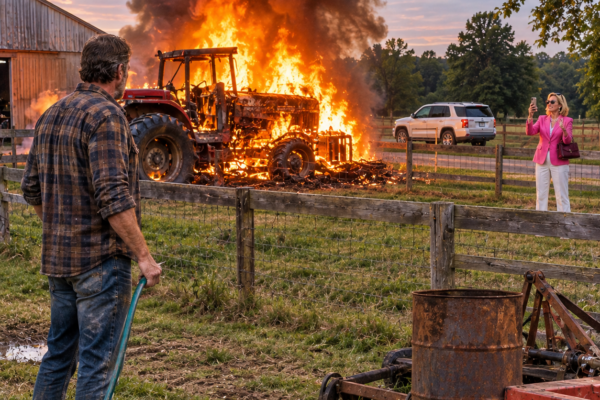
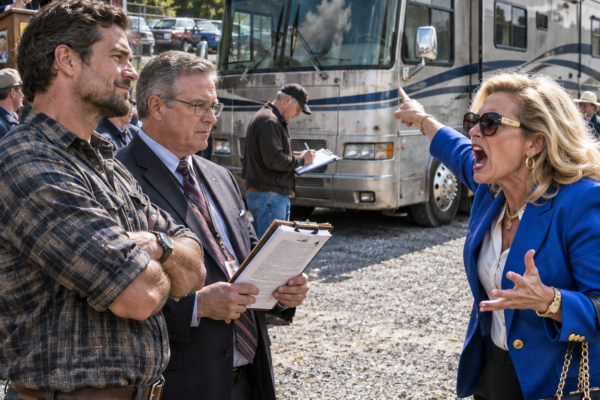
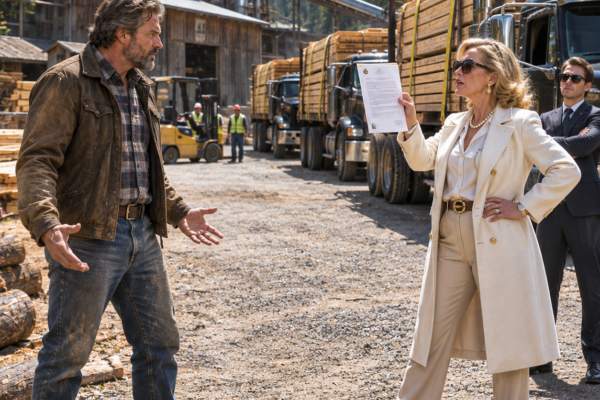
PART 2: HOA Karen Had My Family’s Bridge Chainsawed on My 50-Acre Farm—But My Land Was Never in Her HOA
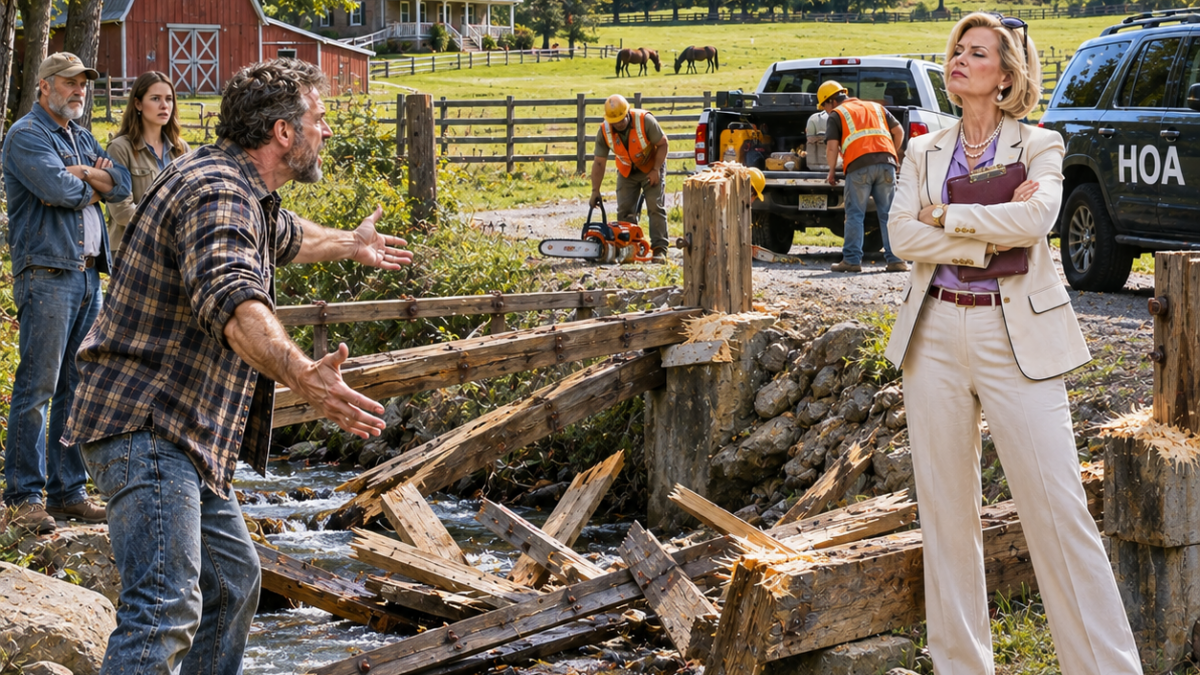
The morning I found my father’s hand-built bridge chainsawed into splinters and dumped into the creek on my fifty-acre farm, Karen Harris stood on the bank in a bright pink blazer with her arms folded, calmly supervising the destruction as though tearing apart my family’s property was just another HOA landscaping project.
The work crew she had hired started throwing saws into their trucks the second I came down the hill and yelled that I was calling the sheriff, but Karen never flinched—she simply told me the bridge had violated “community standards,” even though my farm had been here for generations, sat outside her subdivision, and had never belonged to her HOA for a single day.
What stopped me from losing my temper wasn’t her arrogance or even the wreckage in the water; it was the quiet certainty in her voice when she said the HOA had every right to remove anything on my land that its residents could see, because I suddenly understood she had done more than destroy a bridge—she had built an entire paper trail to convince other people she owned authority she had never possessed.
I grew up on that farm.
My great-grandfather bought the fifty acres when the nearest paved road was miles away. My grandfather rebuilt the barn after a storm, my dad cleared sections of pasture with an ancient tractor, and I inherited a property where every fence post seemed tied to somebody I had loved.
For most of my life, the place stayed simple.
Then developers built Oak Crest Meadows on the neighboring hill.
I didn’t care that the new houses were bigger than anything around us or that every mailbox matched. People could live however they wanted.
The problems started when their HOA decided I should live that way too.
The first letter complained about my cows making noise.
I actually laughed.
The second said cattle waste near my fence violated “community cleanliness standards.”
My fence had been standing there long before Oak Crest existed.
Then Karen Harris appeared at my gate.
She didn’t introduce herself.
She walked several feet onto my property, pointed toward my weathered barn, and said, “That needs to be repainted.”
I stared at her.
“Why?”
“It affects the aesthetics of our neighborhood.”
“This isn’t your neighborhood.”
Her mouth tightened.
“Everything visible from HOA property is an HOA concern.”
I should have realized then how seriously she believed that.
The letters kept coming.
My tractor was too rusty. My fencing lacked “visual uniformity.” My equipment shed needed repainting. My cattle wandered too close to the subdivision side.
I ignored every notice because I knew where the property line was, and I knew where her authority ended.
Then she discovered the bridge.
Dad and I had built it years earlier over the creek so we could reach the back pasture without wading through water after a storm. It wasn’t fancy—rough timber, sun-bleached rails, old bolts—but I could still remember him holding one end of a plank while I drove the screws, country music playing from a radio on the bank.
Karen hated it instantly.
“This will need to be removed,” she told me.
I laughed.
She didn’t.
“This isn’t a suggestion.”
“Then who exactly is ordering me?”
“The HOA.”
“I’m not in your HOA.”
She looked across the creek toward the subdivision.
“It’s visible from HOA property.”
“That doesn’t make it yours.”
Her smile became very small.
“We’ll see.”
A week later, strangers began appearing near the creek with a clipboard and reflective vest, photographing the bridge from different angles.
Then I received a final notice in red lettering calling it an “unsafe structure” and ordering removal.
I threw the letter into a drawer.
The next morning, chainsaws woke me before I finished my coffee.
By the time I reached the creek, one railing was already gone and two support beams had been cut through. Broken boards floated against the bank.
“What the hell are you doing?”
The workers looked at Karen.
Not me.
That told me everything.
“Removing an unauthorized structure,” she said.
“On my land?”
“For community safety.”
I pulled out my phone.
“I’m calling the sheriff.”
The crew reacted before Karen did.
Engines started. Doors slammed. Tires threw mud across the grass as both trucks raced toward the road.
Karen watched them leave, then turned back to me.
“You’re making this harder than it needs to be.”
I looked at the bridge Dad and I had built, now lying broken in the creek.
Then I looked down at the fresh mud beside my boot.
Something metallic was half-buried in the sawdust—a contractor identification badge stamped with a company name I recognized from town.
Karen saw me pick it up.
And for the first time that morning, her smile disappeared.
PART 2
I turned the badge over in my hand.
**RIDGELINE PROPERTY SERVICES.**
Employee number underneath.
A first name.
Logan.
Karen looked at it for maybe half a second before she recovered.
“That doesn’t prove anything.”
I raised my eyes.
“I didn’t say it did.”
“You were thinking it.”
“Interesting that you’re worried about what it proves.”
Her face tightened.
She folded her arms again, but it didn’t have the same confidence behind it anymore.
“You knew that bridge violated community safety standards.”
“No.”
“You received notices.”
“Notices from an HOA I don’t belong to.”
“You ignored every attempt to resolve this peacefully.”
I looked behind her at the remains floating in the water.
“You hired men with chainsaws to destroy something on my farm before sunrise, and you’re standing here lecturing me about peaceful resolution?”
“It was an unsafe structure.”
“It was inspected three years ago.”
That wasn’t entirely relevant legally, but I wanted to see her reaction.
Her expression barely moved.
“By whom?”
“A licensed contractor when I replaced the lower supports.”
“We weren’t consulted.”
That sentence was so absurd I almost laughed.
“Why would anyone consult you?”
“Because people in Oak Crest can see it.”
I stared at her.
It still seemed impossible that a grown woman could say those words sincerely.
“If I can see your house from my pasture, does that mean I can remove your porch?”
“That’s completely different.”
“How?”
“You’re being ridiculous.”
“No, Karen. I’m using your rule.”
She pointed at me.
“You have always been hostile toward the HOA.”
“I have never been in your HOA.”
“That doesn’t mean your behavior doesn’t affect us.”
“My cows affect you too. Are you planning to remove them?”
Her eyes flickered.
“Don’t be dramatic.”
That almost impressed me.
She had spent months trying to regulate cattle, fences, tractors, barns, and now a bridge on somebody else’s farm, but I was being dramatic.
My phone was still in my hand.
I raised it.
“Leave.”
Her mouth tightened.
“Excuse me?”
“Get off my property.”
“I was here on official HOA business.”
“You’re trespassing.”
“I had authorization.”
“From whom?”
“The board.”
“The board doesn’t own my farm.”
“Community interests give us authority to act when a neighboring property creates safety or aesthetic hazards.”
I had heard enough.
“Leave now.”
Something in my voice finally reached her.
The argument drained from her face for an instant.
Not fear exactly.
Calculation.
She stepped back.
Then another.
“You’ll thank me someday.”
“For what?”
“Removing that death trap before someone got hurt.”
“My father and I built that bridge.”
I hadn’t meant to say it.
The words came out on their own.
Karen glanced at the debris.
For one second, I waited for some human reaction.
Embarrassment.
Regret.
Anything.
Instead she said:
“Sentimental attachment doesn’t override safety.”
That did it.
Not rage.
Something colder.
I pointed toward the hill.
“Get off my land.”
She gave me one last look.
“This isn’t over.”
Then she walked away.
I watched until she crossed the fence line.
Only then did I look back at the bridge.
What remained of it.
Water slipped around broken planks.
One section of railing was wedged against a rock.
A support beam my dad and I had carried together twenty years earlier had been cut clean through and dropped into the creek.
I stood there longer than I care to admit.
When Dad and I built it, we’d started after breakfast on a Saturday in October.
I had expected a two-day job.
He told me one.
We argued about it.
Dad was the kind of man who believed any problem could be fixed with enough coffee, bolts, and stubbornness.
Mom showed up around noon with sandwiches wrapped in foil.
We ate sitting on the unfinished deck with our boots dangling over the creek.
Dad had looked down at the water and said, “When I’m dead, you’ll probably replace this thing with something fancy.”
I told him:
“When you’re dead, I’ll still be fixing your crooked railing.”
He laughed so hard he nearly dropped his sandwich.
The railing had never been perfectly straight.
I’d never corrected it.
Now it was broken in the water.
I crouched near the bank.
My hands shook.
That scared me because I wasn’t normally a man who shook.
I picked up my phone and started photographing everything.
Every cut.
Every board.
Tracks in the mud.
Fresh sawdust.
The worker badge.
Karen’s footprints.
Truck tire impressions.
The remains in the creek.
I took video too.
Not dramatic narration.
Just facts.
“North side support cut.”
“Railing section removed.”
“Debris in creek.”
“Vehicle tracks heading toward County Road 18.”
Then I went home.
Uploaded the videos.
Backed them up.
Emailed copies to myself.
Put the contractor badge in an envelope.
Then I made two calls.
The first was to the sheriff’s office.
The second was to Daniel Price.
Daniel had been my lawyer during a boundary dispute several years earlier when another neighbor accidentally put a fence twenty feet onto my pasture.
That case had ended with a survey and handshake.
Daniel preferred problems solved quietly.
But he was also the man I wanted beside me if quiet stopped working.
He answered on the second ring.
“Morning.”
“Daniel, somebody destroyed my bridge.”
Pause.
“What?”
“The Oak Crest HOA president hired a crew to come onto my farm and tear down the bridge over my creek.”
Another pause.
Longer.
“You’re not in Oak Crest.”
“No.”
“Your parcel isn’t subject to their covenants.”
“No.”
“Was the bridge on your land?”
“Completely.”
“Start over.”
I did.
Letters.
Complaints.
Karen.
Final notice.
Strangers photographing the bridge.
Chainsaws.
Workers fleeing.
Badge.
When I finished, Daniel exhaled.
“Send me everything.”
“Already backing it up.”
“Good.”
“What am I looking at?”
“Potentially civil property damage, trespass, maybe conversion depending on what happened to materials, possibly other claims. Criminal side is the sheriff’s decision.”
“She says the HOA authorized it.”
“Do you have that in writing?”
“Not the demolition specifically.”
“Any notice saying they’ll remove it?”
“I’d have to check.”
“Check.”
I walked to the desk where I’d thrown Karen’s final letter.
There it was.
**FINAL NOTICE REGARDING UNSAFE STRUCTURE**
I read the last paragraph more carefully than I had the first time.
Failure to comply, it said, could result in “remedial action undertaken by the association at the owner’s expense.”
My pulse picked up.
“Daniel.”
“Yes?”
“I have something.”
“Read it.”
I did.
He went quiet.
Then:
“Scan that.”
“You think it matters?”
“I think your HOA president may have announced her plan before carrying it out.”
I scanned it.
Emailed everything.
Daniel said:
“Do not contact her.”
“She was just here.”
“Then don’t contact her again. Don’t threaten her. Don’t post online. Don’t touch anything across the property line. Let law enforcement handle criminal questions and let me handle the civil demand.”
“I want the bridge rebuilt.”
“I know.”
“And I want them to pay.”
“I know.”
“I don’t want some apology letter.”
“Then preserve evidence and stop talking to Karen.”
That was Daniel.
No speeches.
No promises about destroying anybody in court.
Just process.
I needed that.
Around noon, a sheriff’s cruiser rolled up my drive.
Deputy Morris stepped out.
I’d known him casually for years.
Big guy.
Quiet.
Never seemed rushed.
“Morning.”
“Not really.”
“So I heard.”
I led him to the creek.
He stopped when he saw the wreckage.
“Damn.”
“Yeah.”
He walked along the bank without touching anything.
“Storm?”
“Chainsaws.”
“I can see that.”
I handed him my phone.
The video I’d started near the end of the demolition included Karen’s voice.
**Removing an unauthorized structure for the safety of the community.**
Morris played it again.
Then looked at me.
“That’s her?”
“Karen Harris. Oak Crest HOA president.”
“And the workers?”
“I found this.”
I gave him the envelope with the badge.
He examined it.
“Ridgeline Property Services.”
“You know them?”
“Know the name.”
He wrote it down.
“Karen says the HOA authorized the work.”
Morris looked toward Oak Crest.
“Your property ever annexed?”
“No.”
“Signed restrictive covenants?”
“No.”
“Any easement granting them maintenance rights?”
“No.”
“Public access?”
“No.”
He nodded.
“Survey?”
“In the house.”
We walked back.
I gave him the recorded plat.
The property line between my farm and Oak Crest was obvious.
The creek wasn’t even on the boundary where the bridge crossed.
It was well inside my parcel.
Morris ran a finger along the map.
“So there’s not even a plausible boundary dispute here.”
“Exactly.”
He sat back.
“We’ll make the report.”
“Criminal damage?”
“That’s potentially where this goes. I can’t promise charges. We’ll investigate who authorized what, who believed what, and what the contractor was told.”
“Fair.”
He looked toward the creek again.
“Any value estimate?”
“I don’t know yet.”
“Get one.”
“I already called my lawyer.”
Morris nodded.
“Good.”
Then he looked at me.
“And don’t do anything stupid.”
I almost laughed.
“Daniel said the same thing.”
“That means two people know you.”
After he left, I couldn’t stay inside.
I checked fences.
Moved hay.
Looked at cattle that did not care about homeowners associations.
Physical work helped.
Anger is easier when there’s something heavy to lift.
By afternoon, I drove into town for feed.
Old man Dalton at the store stopped me.
“Heard Oak Crest finally got into your pasture.”
“Who told you?”
“Town.”
That answered nothing and everything.
“They tore down my bridge.”
He shook his head slowly.
“Karen?”
“Karen.”
He spat into a trash can.
“Woman’s been trying to annex reality for three years.”
That was the most accurate description I’d heard.
At the hardware store, Tom, one of the clerks, leaned over the counter.
“They’re saying the HOA is cleaning up visual blight around the development.”
“My bridge was on my farm.”
“I know.”
“Did Karen tell you that?”
“No. One of their residents came in bragging about a ‘view revitalization project.’”
That phrase stuck.
View revitalization.
Suddenly the whole thing made sense.
The back row of Oak Crest homes sat on a hill.
Their decks overlooked my pasture and creek.
Karen didn’t care whether my bridge was dangerous.
She cared what people saw from expensive windows.
I drove home with that thought burning quietly.
At my gate, I noticed movement above the fence.
A drone.
Gray.
Small.
Hovering maybe thirty feet in the air.
The camera pointed directly toward my farm.
It moved when I moved.
I stared at it.
For one stupid second, I imagined throwing a rock.
Then I remembered Daniel.
Don’t do anything stupid.
I picked up a rock anyway.
Held it in my palm.
Then smiled toward the drone and set it back down.
The drone rose.
Turned.
Flew toward Oak Crest.
I photographed it before it disappeared.
That night, Daniel emailed me a draft demand letter.
It was far less emotional than I wanted.
That was probably why it was good.
It identified my parcel.
Confirmed no HOA membership.
Described the unauthorized entry.
Demanded preservation of HOA communications.
Required the association and Karen to stop entering my land.
Requested $5,000 to cover initial bridge replacement and cleanup estimates, subject to adjustment.
Seven days to respond.
I called him.
“Five thousand?”
“Preliminary.”
“I haven’t even gotten a full contractor estimate.”
“Correct. It’s a demand, not final damages. We’re reserving everything else.”
“What if they refuse?”
“We decide whether to file.”
“What if Karen comes back?”
“Call the sheriff.”
“You make revenge sound boring.”
“Good litigation usually is.”
I smiled despite myself.
“Send it.”
He did.
Karen responded before the HOA attorney did.
The next morning, an envelope was wedged into my gate.
No stamp.
No return address.
Her handwriting.
I opened it at the kitchen table.
The first sentence was:
**WE WILL NOT PAY YOU A SINGLE CENT.**
I actually laughed.
Not because it was funny.
Because I could hear her voice in the capitalization.
She called my bridge illegal.
Unsafe.
A threat to residents.
A violation of architectural harmony.
Then came the sentence that made me put down my coffee.
**Any future structure erected on your property that is visible from Oak Crest Meadows and fails to comply with community design standards may be removed without further warning.**
I read it again.
Then continued.
**The association reserves the right to conduct regular inspections of adjoining properties where resident welfare and property values may be affected.**
I photographed every page.
Sent them to Daniel.
His reply came three minutes later.
**Do not respond. This is useful.**
I called.
“Useful?”
“Very.”
“She just threatened to come back.”
“In writing.”
“So what do we do?”
“I am sending a copy to the HOA’s registered agent and their attorney, if they have one. I’m also adding it to the preservation demand.”
“You sound happy.”
“I wouldn’t say happy.”
“You sound happy.”
“I enjoy when opposing parties write down their bad decisions.”
That afternoon, I went back to the creek.
I hadn’t allowed anyone to clean yet because Morris wanted the scene preserved until photos and documentation were complete.
The water had pushed smaller pieces downstream.
I stepped carefully among the remains.
One board was split lengthwise.
Another still had the pencil mark Dad had made twenty years earlier.
I knew because he marked lumber with a carpenter’s pencil so hard it practically became engraving.
**NORTH RAIL**
The words were faded.
Still there.
I sat on the bank holding that board.
For the first time since the demolition, anger gave way to something else.
Grief.
Dad had been gone seven years.
Most days, I could think about him without feeling the absence like a physical thing.
That bridge had been different.
It was work we’d done side by side.
Not a photograph.
Not an old shirt.
Something that remained in the same place we’d left it.
Now a stranger had decided it was ugly and destroyed it.
I thought about replacing it exactly.
Same rough shape.
Same crooked railing.
Then I wondered whether that was possible.
You can rebuild lumber.
You cannot rebuild the Saturday.
I heard Ranger behind me.
My dog came down the hill and sat beside me.
I rubbed his head.
“Don’t worry.”
He looked at the water.
“We’ll build another one.”
The next morning, I called Ridgeline Property Services.
A woman answered.
“Ridgeline, this is Amy.”
“I’m calling about a crew you sent to Oak Crest this week.”
Silence.
“What address?”
I gave my farm address.
Another pause.
“Sir, I can’t discuss client information.”
“One of your employees left his identification badge on my property while your crew was cutting down my bridge.”
She became very still on the other end.
“I see.”
“The sheriff has the badge information.”
“Can you hold?”
She didn’t wait.
A man picked up two minutes later.
“Sir, this is Greg Walton, operations manager.”
“Your crew trespassed on my farm.”
“I understand there may have been a misunderstanding.”
“Your people ran when I said sheriff.”
“They were instructed to leave if there was a dispute.”
“Who hired you?”
“I can’t disclose client information without authorization.”
“Fine. Deputy Morris can ask.”
“Sir.”
I waited.
He sighed.
“We were told the property was controlled by Oak Crest Meadows.”
“By whom?”
“Ms. Harris.”
“Karen Harris?”
“Yes.”
“What exactly did she tell you?”
“That the HOA had responsibility for common-area view maintenance and the structure was on association-controlled land.”
I gripped the phone tighter.
“Did she show you anything?”
“A map.”
That word mattered.
“What kind of map?”
“Subdivision map. Parcel outline. I’m not sure.”
“Do you still have it?”
“Probably in the job file.”
“Preserve it.”
He went quiet.
“Excuse me?”
“My lawyer is sending your company a preservation notice. Do not destroy that file.”
His tone changed completely.
“Understood.”
“Did your crew know it was my farm?”
“They believed they were on land the HOA had authority to maintain.”
“And when I said sheriff?”
“They called me from the truck. I told them to leave immediately.”
“Why?”
“Because at that point I realized there was a title dispute we had not been told about.”
“There is no title dispute.”
“I understand that now.”
I asked for the employee’s name matching the badge.
He confirmed it.
Then he surprised me.
“Mr. —”
He hesitated.
“We should not have taken that job without verifying ownership.”
“No.”
“We’re contacting our insurer.”
“Good.”
“I am sorry.”
That apology mattered more than I expected.
Not enough to fix anything.
But at least one person understood what had happened.
I called Morris.
Then Daniel.
Daniel stopped me halfway through my explanation.
“Back up.”
“What?”
“They were shown a map?”
“Yes.”
“Get that in writing if you can, but do not pressure the contractor. I’ll contact them.”
“You think Karen altered something?”
“I think we don’t know yet.”
“She told them the HOA controlled my land.”
“I heard you.”
“That’s fraud.”
“Maybe.”
“Daniel.”
“Stop naming crimes. That’s what prosecutors are for.”
I hated when he was right.
By late afternoon, Morris returned.
He took the contractor information.
Listened to the call recording—I had told Greg I was documenting the conversation before we continued.
Morris nodded.
“This gives us somebody else to talk to.”
“Karen lied to them.”
“Looks that way.”
“You going to arrest her?”
He looked at me.
“Don’t turn into the town prosecutor.”
“I want consequences.”
“I know.”
He closed his notebook.
“Then don’t make me defend a sloppy investigation because you wanted it fast.”
That shut me up.
Before leaving, he looked toward Oak Crest.
“People who think they’re protected by authority usually start getting nervous when they realize authority is looking back.”
He was right.
That evening, Hank called.
Hank owned land south of mine.
Old hound dog.
Old truck.
The kind of neighbor who might not speak to you for two weeks but would appear with a tractor before you finished asking for help.
“You outside?”
“Why?”
“Look toward Oak Crest.”
I stepped onto the porch.
Several people stood near my fence.
HOA board members.
Three women.
Two men.
Binder.
Clipboards.
Nobody crossed.
“They’ve been there ten minutes,” Hank said.
“What are they doing?”
“Looking nervous.”
Karen wasn’t with them.
That interested me more than anything.
I walked halfway down my driveway.
Didn’t approach the boundary.
They noticed me.
Stopped talking.
One woman closed a binder.
Then the group dispersed.
Hank said through the phone:
“Looks like rats figuring out which part of the ship is wet.”
The next morning, another letter appeared.
This one was official HOA stationery.
Not Karen’s handwritten rage.
It cited “community safety measures.”
Defended removal of the bridge.
Threatened legal action if I interfered with future “protective inspections.”
I sent it to Daniel.
An hour later, he called.
“This one’s worse for the board.”
“Why?”
“Because it’s on association letterhead.”
“So they approved it?”
“Maybe. Or Karen used official letterhead without authorization. Either answer creates questions.”
“What happens now?”
“We file.”
That word settled something inside me.
“Against Karen?”
“Karen and the association, based on what we know now. Ridgeline may remain involved through insurance, but they appear to have been misled. We’ll sort that out.”
“For what?”
“Property damage. Trespass. Injunctive relief to stop entry. We’ll plead the facts and let evidence develop.”
“How long?”
“Longer than you want.”
I looked toward the creek.
“Do it.”
The complaint was filed two days later.
Not dramatic.
No press conference.
No sheriff escorting Karen away.
A clerk stamped papers.
A process server did his job.
Then we waited.
Karen did not.
Three nights later, Ranger started growling at the window.
Not barking.
Growling.
It was around nine.
I switched off the kitchen light and looked toward the pasture.
A flashlight moved near the far fence.
Then another.
I grabbed my own light.
Phone.
Boots.
Ranger came with me.
I didn’t bring a gun.
I had one on the farm, like plenty of farmers do.
But walking into a property dispute armed would have turned one problem into another.
I called Hank.
“Lights at my fence.”
“Want company?”
“Stay on your property. I’m checking.”
“Call Morris.”
“I will if they’re inside.”
I walked down the field.
Ranger stayed close.
As we approached, two figures became visible.
They were beyond the fence.
On my side.
One had a clipboard.
The other held a flashlight toward a survey stake.
“Evening.”
They jumped.
The clipboard nearly fell.
“What are you doing?”
The taller man said:
“We’re conducting an inspection.”
“Of my pasture?”
“HOA inspection.”
I laughed once.
“No.”
“We were instructed to document boundary conditions.”
“By Karen?”
Neither answered.
“Leave.”
“We have permission.”
“From the owner?”
He swallowed.
“From Oak Crest.”
“Then you don’t have permission.”
Ranger growled.
I put my hand on his collar.
“I’m not arguing. Walk back across the fence line.”
The shorter man said:
“We’re just following orders.”
“That stopped being a good excuse a long time ago.”
“We’re not trying to cause trouble.”
“You’re standing on land involved in an active lawsuit at nine at night with flashlights and a clipboard.”
He looked at his partner.
I raised my phone.
“You are being recorded. I am telling you to leave.”
They left.
Fast.
I called Morris before I reached the house.
He came out.
Photographed footprints.
Took my recording.
Asked for descriptions.
Then said:
“You need cameras.”
“I have wildlife cameras.”
“Point one toward the access route.”
I did.
The following morning, a note waited under my windshield wiper.
No letterhead.
No signature.
Only one sentence.
**YOU WILL REGRET ESCALATING THIS. YOU HAVE NO IDEA WHO YOU’RE DEALING WITH.**
I stared at it.
Then photographed it without touching.
Called Morris.
Called Daniel.
Daniel’s reaction surprised me.
“She’s panicking.”
“You sound pleased again.”
“People who have strong legal positions usually communicate through counsel after being sued.”
“What do people with weak positions do?”
“Put threatening notes on windshields.”
I didn’t laugh.
“Daniel, she’s getting reckless.”
His voice softened.
“I know.”
“Do I leave the farm?”
“No. But take reasonable precautions. Cameras. Lights. Don’t engage. If you feel threatened, call law enforcement.”
“I grew up here.”
“I know.”
“I hate that I’m checking the yard every time Ranger barks.”
“I know.”
For the first time since this started, I admitted something I hadn’t said out loud.
“She got inside my head.”
Daniel paused.
“That’s not weakness.”
“It feels like it.”
“You watched people destroy part of your property while she stood there. Then strangers came onto your farm at night. Feeling alert isn’t irrational.”
I looked through the kitchen window.
The barn.
Pasture.
Creek.
Farm.
My family’s place.
“I want this over.”
“It will end.”
“When?”
“I can’t promise that.”
I hated the answer.
But I trusted him because he didn’t lie.
Two days later, Millie at the diner slid coffee toward me and leaned across the counter.
“You hear what Karen filed?”
“No.”
“Injunction.”
I stopped.
“Against me?”
“She says you’re constructing dangerous structures and threatening Oak Crest.”
I laughed.
“What structure?”
“Don’t know.”
“The bridge she demolished?”
Millie shrugged.
“She says you’re hostile toward HOA safety personnel.”
“Those safety personnel trespassed at night.”
“I’m just telling you what people are saying.”
Daniel confirmed it that afternoon.
Karen had filed for temporary injunctive relief claiming I was interfering with HOA safety operations and threatening community welfare.
He was almost cheerful.
“Don’t enjoy this too much.”
“I’m not.”
“You are.”
“Her filing includes your survey.”
“Good.”
“It also includes one of the maps she gave the board.”
I sat straighter.
“The map Ridgeline mentioned?”
“Maybe.”
“Does it show my farm inside Oak Crest?”
“A strip of it.”
“How?”
“That’s what discovery is for.”
“County records don’t.”
“I know.”
“Can we compare them?”
“Already am.”
That evening Daniel emailed me two PDFs.
County-recorded plat.
Karen’s exhibit.
The difference was obvious even to me.
On the county plat, Oak Crest ended at the original line that had been there for generations.
On Karen’s version, a thick digital boundary had been drawn farther into my farm.
It captured the creek crossing.
My bridge.
A narrow strip of pasture.
I stared at the screen.
It wasn’t a small measurement mistake.
It was exactly the area Karen wanted to control.
I called Daniel.
“She altered it.”
“Looks that way.”
“Can you prove she did it?”
“Not yet.”
“But she filed it.”
“Yes.”
“With a court.”
“Yes.”
“What happens now?”
“Now I ask where it came from.”
Her injunction request failed.
The judge did not issue the emergency order she wanted.
Instead, the court set the boundary dispute and my request for injunctive relief on an expedited schedule.
That did not stop Karen from talking.
Oak Crest held a community meeting the following week.
I was not invited.
I wasn’t a member.
Hank’s niece lived there.
She recorded the meeting on her phone because by then half the neighborhood wanted a record of what Karen said.
I watched it at my kitchen table.
Karen stood in front of a room full of residents.
Pink blazer.
Pearls.
Binder.
Same posture she wore beside my destroyed bridge.
“Our association has a duty to protect property values,” she said.
A man asked:
“Why did you demolish something outside Oak Crest?”
“It was not outside our influence.”
“That’s not what he asked.”
Karen’s jaw tightened.
“The structure was visible from HOA property and directly affected residents.”
Someone else said:
“Visible doesn’t mean owned.”
Karen raised her hand.
“You’re oversimplifying.”
A woman in the second row asked:
“Did the board vote to demolish it?”
Silence.
Karen said:
“The board delegated emergency safety authority to the president.”
“When?”
Another silence.
She shuffled papers.
“The covenants permit decisive action where resident safety is threatened.”
“Was his bridge dangerous?”
“Yes.”
“According to what engineer?”
Karen’s face reddened.
“This isn’t a courtroom.”
Then came the sentence Daniel would replay later.
Karen leaned toward the microphone and said:
**“Oak Crest has jurisdiction over any adjoining property visible from the community when conditions on that property affect our standards.”**
People began talking at once.
One man laughed.
Another shouted:
“That isn’t law.”
A board member beside Karen looked toward her sharply.
Then another resident asked:
“So you think you can regulate his whole farm because we can see it?”
Karen answered:
“If necessary.”
I paused the video.
Rewound.
Played it again.
Then sent it to Daniel.
His response:
**Excellent. Preserve original source. Get the person who recorded it to keep the full file.**
I called Hank’s niece.
She agreed.
By then, town gossip had reached ridiculous levels.
People stopped me at the feed store.
Hardware store.
Gas station.
Everybody had an opinion.
Some wanted me to sue Karen for millions.
Some wanted the HOA dissolved.
One man suggested I build a thirty-foot pink bridge just to irritate her.
I didn’t.
Revenge feels clever when you’re angry.
It can look childish in daylight.
I wanted my bridge back.
My legal fees paid.
My land left alone.
And I wanted a judge to put into writing what Karen refused to understand:
Her authority stopped at her boundary.
Weeks passed.
Discovery began.
That’s when Karen’s position started collapsing.
Ridgeline Property Services produced its job file.
Invoice.
Emails.
Photos.
And the map.
The work order had been signed by Karen Harris as “Authorized Oak Crest Representative.”
The job description read:
**REMOVE UNSAFE PEDESTRIAN STRUCTURE WITHIN ASSOCIATION-CONTROLLED VIEW CORRIDOR.**
View corridor.
Daniel read the phrase aloud in his office.
“That’s not a property interest.”
“No.”
“Did they ask for proof she owned the land?”
“They asked for authorization.”
“And she gave them the map?”
“Yes.”
The attached map was identical to Karen’s court exhibit.
Daniel had a surveyor compare it with county records.
The underlying parcel map appeared to be real.
The added boundary line was not.
Someone had taken a legitimate survey image and drawn a new line over it.
Metadata from one version pointed to a PDF created from a home computer.
That by itself didn’t prove who edited it.
But then the HOA produced board emails.
One message from a board member to Karen said:
**Are you sure the creek section is ours? County GIS looks different.**
Karen replied:
**GIS is outdated. Use the corrected boundary I sent.**
Another board member asked:
**Do we need county confirmation before work?**
Karen answered:
**No. I have authority to correct safety issues visible from association property. Delays only encourage noncompliance.**
I read those messages three times.
“She knew somebody questioned it.”
Daniel nodded.
“She answered.”
“Does that prove fraud?”
“It proves she was warned of conflicting information and proceeded. We’ll let the court determine credibility.”
The board members began changing their position.
Not publicly at first.
Through attorneys.
Oak Crest’s insurance carrier hired separate counsel.
Karen obtained her own lawyer.
The association began arguing that Karen had exceeded her authority.
Karen argued the board knew what she was doing.
Suddenly nobody wanted to own the decision.
I told Daniel:
“They were all happy to send letters.”
“Organizations get very interested in procedure once money is attached.”
“Who’s paying me?”
“That’s what the case will determine.”
The criminal investigation moved more slowly.
Morris interviewed Ridgeline employees.
Board members.
Karen.
He never told me every detail, and I stopped asking.
One afternoon he came by for coffee.
“Anything I should know?”
“I can’t discuss an active investigation.”
“I figured.”
He drank.
Then said:
“Keep letting your lawyer work.”
“That’s all?”
“That’s a lot.”
That was as close as Morris came to reassurance.
The civil case moved toward a bench trial.
By then, the story had been going on for months.
The bridge wreckage had been removed from the creek under documentation and environmental guidance.
I saved what boards I could.
The rest was stacked near the barn.
Every time I passed that pile, I saw Dad.
That became harder than the lawsuit.
I could spend an hour with Daniel talking about exhibits and feel fine.
Then I’d see one rusty carriage bolt on an old plank and suddenly be back on that October afternoon with Dad holding a level and pretending not to notice the railing leaning half an inch.
One evening, I found Mom’s old thermos in the barn.
Same one she’d brought sandwiches and coffee in when we built the bridge.
I sat on an overturned bucket holding it.
Ranger lay beside me.
I realized I had been treating the lawsuit like rebuilding the bridge.
Measure.
Document.
Fix.
Win.
But some things weren’t problems to solve.
The bridge had been part of my father.
No judgment would replace that.
That thought changed what I wanted.
I still wanted Karen held accountable.
But I stopped fantasizing about humiliating her.
Humiliation wouldn’t rebuild anything.
A ruling might protect my farm.
Money might pay for lumber.
What I really needed came afterward.
The trial arrived in early fall.
The courthouse was small.
Brick exterior.
Old wood benches.
A hallway that smelled like paper and floor wax.
Daniel met me outside.
“You sleep?”
“No.”
“Good.”
“Good?”
“If you said yes, I’d know you were lying.”
Karen arrived fifteen minutes later.
Pink blazer.
Pearls.
Hair perfect.
She walked past without looking at me.
Behind her came several Oak Crest board members.
They looked miserable.
Ridgeline’s representative sat with its insurer’s attorney.
The company had reached a separate agreement to cooperate and resolve its portion subject to the court’s findings.
Daniel leaned toward me.
“Remember.”
“What?”
“Facts.”
“I know.”
“No speeches.”
“I know.”
“No reacting to her.”
“I know.”
“You’re saying that like you’re going to react.”
“I’ve been listening to you for months.”
“Then today’s the exam.”
When the judge entered, everybody stood.
Judge Evelyn Ramirez.
Late sixties.
Sharp voice.
Sharper eyes.
Daniel presented our case methodically.
Ownership records first.
Great-grandfather’s deed history.
Modern survey.
Recorded parcel boundaries.
HOA declaration showing Oak Crest stopped at its own subdivision.
No annexation.
No covenant.
No easement.
No maintenance agreement.
Then the bridge.
Photos before destruction.
Maintenance records.
Evidence that it had been entirely on my property.
The demolition video.
Karen’s own voice:
**Removing an unauthorized structure for the safety of the community.**
The courtroom stayed silent.
Then Ridgeline’s work order.
Their manager testified.
Daniel asked:
“Who hired your company?”
“Karen Harris.”
“What did she represent?”
“That she was HOA president and authorized removal.”
“Did she tell you the bridge belonged to another landowner?”
“No.”
“Did she say the owner disputed HOA authority?”
“No.”
“What were you told about the parcel?”
“That it was within an association-controlled corridor.”
“Did she provide a map?”
“Yes.”
The map appeared on the screen.
The false line.
My stomach tightened.
Daniel displayed the recorded county plat beside it.
The judge leaned forward.
“Those boundaries are different.”
“Yes, Your Honor.”
Karen’s lawyer stood.
“Objection to characterization as false. The origin of the alternate map remains disputed.”
Judge Ramirez nodded.
“Sustained as to characterization. Counsel, refer to it as the association map until foundation is established.”
Daniel did.
Next came the letters.
Barn complaint.
Cow-noise complaint.
Fence standards.
Bridge directive.
Final notice.
Karen’s handwritten refusal.
**Any future structure… may be removed without further warning.**
Then the official HOA letter threatening future inspections.
Then the recorded HOA meeting.
Karen’s voice filled the courtroom:
**Oak Crest has jurisdiction over any adjoining property visible from the community when conditions on that property affect our standards.**
Several board members looked down.
Daniel paused the video.
“Mr. —”
He turned toward me.
“When did you ever agree to that jurisdiction?”
“Never.”
“Were you ever a member?”
“No.”
“Did you pay dues?”
“No.”
“Sign covenants?”
“No.”
“Request services?”
“No.”
“Grant inspection rights?”
“No.”
“Give permission to remove the bridge?”
“No.”
Then Daniel asked the question I had been dreading.
“What did the bridge mean to you?”
Karen’s lawyer stood.
“Relevance to damages is limited.”
Judge Ramirez looked at Daniel.
“Briefly.”
I swallowed.
“My father and I built it.”
My voice sounded wrong in the room.
“When?”
“About twenty years ago.”
“Was your father living at the time it was destroyed?”
“No.”
“Why did you keep the old bridge rather than replace it?”
I looked at the judge, not Karen.
“Because he built it with me.”
The courtroom became quiet.
Daniel stopped there.
He knew better than to squeeze emotion until it became performance.
Karen’s lawyer cross-examined me.
He was professional.
Not cruel.
“Your bridge had weathered boards?”
“Yes.”
“Rust on some hardware?”
“Yes.”
“Were you aware people from Oak Crest sometimes walked near the creek?”
“I was aware some residents had historically crossed parts of my land before the development expanded.”
“Did you object every time?”
“No.”
“So members of the community had used the area?”
“With tolerance or permission. That doesn’t give them ownership.”
He nodded.
“Did you ever install a sign specifically banning Oak Crest residents?”
“Not before this.”
“So Ms. Harris may have believed the area was shared.”
“She might have believed the moon was shared. She still couldn’t cut down my bridge.”
Daniel touched my arm.
Facts.
I exhaled.
Karen’s lawyer said:
“No further questions.”
During a break Daniel whispered:
“The moon line was unnecessary.”
“I know.”
“It was funny.”
“Thank you.”
“Don’t do it again.”
Then Karen testified.
She walked to the witness stand with the confidence I’d seen dozens of times.
She described herself as HOA president responsible for resident safety.
She said multiple residents complained about the bridge.
She said it appeared deteriorated.
She said the view corridor had “historically fallen within community concern.”
Her attorney asked:
“Did you intend to harm the plaintiff?”
“No.”
“Did you believe you were acting lawfully?”
“Yes.”
“Why?”
“Because the bridge affected our residents, and because records provided to me showed the creek corridor fell within Oak Crest oversight.”
“Did you personally alter any county survey?”
“No.”
“Did you intentionally mislead Ridgeline Property Services?”
“No.”
“Did you believe the bridge presented a hazard?”
“Yes.”
Then Daniel stood.
His voice remained calm.
“Ms. Harris, are you a surveyor?”
“No.”
“Attorney?”
“No.”
“County land-use official?”
“No.”
“Engineer?”
“No.”
“Building inspector?”
“No.”
“Yet you determined my client’s bridge was legally removable?”
“I acted based on HOA authority.”
“Show me where that authority appears.”
Her lawyer objected.
The judge permitted the question if tied to admitted documents.
Daniel handed Karen the declaration.
“Please identify the section granting Oak Crest authority over non-member parcels.”
Karen flipped pages.
Seconds passed.
Then more.
“I don’t memorize every section.”
“I didn’t ask you to.”
She kept turning pages.
“There are provisions about adjacent impacts.”
“Which provision?”
She looked toward her attorney.
He couldn’t answer for her.
Daniel waited.
Finally:
“I don’t know the number.”
“Did you read the declaration before ordering demolition?”
“I knew our authority.”
“That wasn’t my question.”
Karen’s jaw tightened.
“Yes.”
“Then why can’t you identify it?”
“I don’t have every line memorized.”
Daniel switched exhibits.
“Let’s discuss the map.”
The association map appeared.
“Who gave you this?”
“I don’t remember.”
“You sent it to Ridgeline.”
“Yes.”
“You sent it to board members.”
“Apparently.”
“Your email says, ‘Use the corrected boundary I sent.’ Correct?”
“Yes.”
“What were you correcting?”
“The outdated GIS information.”
“Based on what source?”
She hesitated.
“Association records.”
“Which records?”
“I’d have to check.”
“Did you check the county recorder?”
“I didn’t need to.”
A board member behind her closed his eyes.
Daniel continued.
“Board member Henry Cole emailed you asking whether the creek was really inside HOA property.”
“Yes.”
“He told you county GIS showed otherwise.”
“GIS can be inaccurate.”
“True. So did you order a survey?”
“No.”
“Obtain a deed?”
“No.”
“Contact my client?”
“I had contacted him repeatedly.”
“About paint and cows.”
“About community standards.”
“Did you ask him whether Oak Crest owned his bridge?”
“He was hostile.”
“Did you ask?”
“No.”
“Did you call the county?”
“No.”
“Did you obtain title evidence?”
“No.”
“Yet you hired a contractor to destroy it.”
“I hired professionals to remove a hazard.”
“On land you did not verify belonged to you.”
“It was visible from our subdivision.”
There it was.
Again.
Daniel stopped.
Let the silence sit.
Then asked:
“Does visibility create ownership, Ms. Harris?”
“No.”
“Does visibility create an easement?”
“I don’t know.”
“Does visibility give you the right to enter private land?”
She looked angry now.
“We had a responsibility.”
“To whom?”
“My community.”
“Not to the property owner?”
“He refused to cooperate.”
“With what lawful request?”
She opened her mouth.
Nothing came.
Daniel changed direction.
“Why did you personally dislike the bridge?”
Her lawyer objected.
“Relevance.”
Daniel said:
“Bias and motive, Your Honor.”
Judge Ramirez considered.
“I’ll allow limited questioning.”
Daniel looked at Karen.
“Why did you want it gone?”
“Safety.”
“Only safety?”
“Yes.”
“You called it a visual disruption in three letters.”
“Appearance can reflect maintenance.”
“You wrote that it harmed ‘architectural harmony.’”
“That was one factor.”
“Your board minutes include a discussion of improving the view from the eastern homes, correct?”
Karen stiffened.
“I don’t remember.”
Daniel showed the minutes.
She looked.
“Yes.”
“And you described my client’s bridge as—”
Her lawyer stood.
“Document speaks for itself.”
The judge looked at Karen.
“Answer if you recall.”
Karen’s face reddened.
“An eyesore.”
“Why?”
“It was old.”
“Was it unsafe?”
“I believed so.”
“Did any engineer inspect it?”
“No.”
“County inspector?”
“No.”
“Licensed building professional?”
“No.”
“Did anyone fall from it?”
“Not that I know.”
“Any injury report?”
“No.”
“Any complaint by someone who had permission to use it?”
“I don’t know.”
Daniel took one step closer.
“So why did you order it demolished?”
Karen stared at him.
Then at me.
Months of letters.
Threats.
Meetings.
Court filings.
The entire invented system she’d built seemed to compress into one moment.
She snapped.
“Because it was ugly.”
Nobody moved.
Her lawyer closed his eyes.
The judge stared at her.
Karen realized what she’d said.
“I mean—”
Judge Ramirez raised one hand.
“Ms. Harris.”
“I also had safety concerns.”
“You just testified—”
“The appearance was evidence of deterioration.”
“Ms. Harris.”
Karen stopped.
The courtroom was so quiet I could hear the second hand on the wall clock.
Judge Ramirez leaned forward.
“Your court filing says this structure posed an imminent danger.”
“Yes.”
“You commissioned no inspection.”
“No.”
“You obtained no engineering report.”
“No.”
“You confirmed no ownership interest.”
“I relied on—”
“You instructed a contractor to enter land that county records identify as belonging to the plaintiff.”
Karen swallowed.
“The map—”
“We will get to the map.”
Her confidence finally cracked.
The judge turned to the Oak Crest board’s attorney.
“I want to know whether the board authorized this demolition.”
The attorney requested permission for a short recess.
The judge granted ten minutes.
When we returned, something had changed.
The board members were no longer sitting directly behind Karen.
They had moved.
Only a few feet.
But the distance said everything.
The association’s attorney called Henry Cole.
Henry had been on the board for six years.
He looked miserable.
“Did the board vote to demolish the bridge?”
“No.”
Karen’s head snapped toward him.
Her attorney objected to her reaction only with a touch on her arm.
Henry continued.
“We discussed concerns about the view and complaints that the bridge looked deteriorated.”
“Did you authorize entry onto the farm?”
“No.”
“Why did Ms. Harris believe she had authority?”
“She told us the creek corridor was inside an area Oak Crest could regulate.”
“Based on what?”
“The corrected map.”
The association map appeared again.
“Who gave you this?”
“Karen.”
Karen whispered:
“Henry.”
Judge Ramirez looked at her.
“Do not address the witness.”
Henry’s face flushed.
Daniel asked:
“Did you verify the map?”
“No.”
“Why?”
He looked down.
“Because Karen said she had.”
“Did anyone question it?”
“I did.”
“What happened?”
“She said county GIS was wrong.”
“Did you check the county recorder?”
“After the lawsuit.”
“And?”
“Our boundary never included his bridge.”
The judge’s expression hardened.
Another board member testified.
Then another.
One woman named Elaine Porter explained that Karen had presented the map at a closed board discussion and said the property line had been “historically recorded wrong.”
“Did she produce a surveyor’s report?” Daniel asked.
“No.”
“New deed?”
“No.”
“Boundary agreement?”
“No.”
“Why did you accept it?”
Elaine looked toward Karen.
“Because she always had documents.”
That sentence stayed with me.
Not because it excused them.
Because it explained how Karen had accumulated power.
She always had paper.
Letterhead.
Binders.
Maps.
Rules.
People saw documents and assumed authority.
Daniel displayed the county survey again.
The line had remained consistent through decades of recorded property records.
Judge Ramirez asked the surveyor directly:
“Is there any evidence this creek crossing was ever part of Oak Crest Meadows?”
“No, Your Honor.”
“Any recorded easement?”
“No.”
“Any annexation?”
“No.”
“Any basis you can identify for the altered line shown on the association map?”
“No.”
Karen shifted in her chair.
Her lawyer whispered something.
She shook her head.
Then the judge asked:
“Who created the association map?”
Nobody answered.
Karen’s attorney said:
“My client does not recall.”
Daniel produced the metadata report.
The PDF version had been exported from a file named:
**OakCrest_ViewCorrection_KH_Final**
KH.
Karen Harris.
Not proof alone.
But uncomfortable.
Daniel also had an email where Karen attached the file herself.
**Please use my corrected version. County map has not caught up.**
Judge Ramirez looked over her glasses.
“Ms. Harris, what was the county supposed to catch up to?”
Karen’s lips parted.
“I was told the boundary had been corrected.”
“By whom?”
“I don’t remember.”
“Surveyor?”
“I don’t remember.”
“County official?”
“I don’t remember.”
“Developer?”
“I don’t remember.”
The judge waited.
Then:
“Your answer is that you cannot identify a single person with legal authority who told you the boundary changed?”
Karen’s voice became very quiet.
“Yes.”
The case did not magically become a criminal fraud conviction that afternoon.
That wasn’t what the court was deciding.
But Karen’s credibility was gone.
By the time closing arguments began, even her own board had distanced itself from the demolition.
Daniel’s closing was simple.
“This case is not about whether a homeowner association may care about neighboring property. Anyone may care. Anyone may complain. Anyone may ask. This case is about what happens when concern becomes unauthorized control.”
He pointed toward the original plat.
“The plaintiff’s farm was never subject to Oak Crest’s declaration.”
Then toward the demolition photographs.
“Yet the defendants entered it.”
The letters.
“They threatened future entry.”
The work order.
“They hired others based on authority they did not have.”
The video.
“And after being confronted, Ms. Harris did not claim a surveying mistake. She claimed the bridge could be removed because it was visible.”
He paused.
“That belief is the entire case.”
Karen’s lawyer argued that she had acted in good faith based on disputed records and safety concerns.
He emphasized that the association had believed the corridor fell within its oversight.
He argued some damages were overstated.
He also pointed out the contractor had physically performed the demolition.
Daniel responded only where needed.
Then we waited.
Judge Ramirez returned with her ruling after a recess.
She found in my favor on the core claims.
Oak Crest and Karen were responsible for unauthorized entry and property destruction under the circumstances established at trial, with allocation handled through the parties and insurers.
The damage award, cleanup costs, and recoverable legal expenses came to a little over eight thousand dollars in the judgment before separate insurer arrangements.
More important to me, the court issued an order prohibiting Oak Crest and its agents from entering my property to enforce HOA standards without lawful permission or separate legal authority.
Karen could never again send “inspectors” onto my farm and pretend a clipboard made it legal.
Then Judge Ramirez addressed the map.
“This court is deeply concerned by the use of a boundary document inconsistent with recorded county records.”
Karen stared at the table.
“I am directing that the relevant materials be preserved and made available to appropriate authorities and to the association as it reviews its governance practices.”
The judge did not declare Karen guilty of some separate crime.
She didn’t need theatrics.
The meaning was obvious.
The court had noticed.
The board had noticed.
The county would notice.
Then Judge Ramirez looked directly at Karen.
“Ms. Harris, an HOA president is not a municipal official.”
Karen’s mouth tightened.
“Your association’s authority comes from law, recorded documents, and agreements binding its members. It does not expand because something outside the subdivision offends your preferences.”
Nobody moved.
“Visibility is not ownership.”
Those four words felt worth more than the money.
The gavel came down.
Case finished.
At least that part.
I stayed seated.
My legs felt strangely weak.
Months of tension had been stacked inside me so tightly that relief didn’t feel like happiness.
It felt like exhaustion.
Daniel closed his binder.
“You okay?”
“I think so.”
“You won.”
“I know.”
“You don’t look happy.”
I looked toward Karen.
She was gathering papers with shaking hands.
“I wanted my bridge back.”
Daniel nodded.
“I know.”
Karen approached before we left.
Her heels clicked across the floor.
“You ruined everything.”
I stared at her.
“No.”
“You turned my board against me.”
“I didn’t tell them what to testify.”
“You humiliated me in front of the entire county.”
“You destroyed my bridge.”
“It was one old bridge.”
The words hit harder than I expected.
I stood.
Daniel stepped closer.
I held up one hand.
No.
I looked at Karen.
“That ‘one old bridge’ was something my father and I built together before he died.”
For the first time, she didn’t immediately answer.
Then pride returned.
“I didn’t know.”
“You never asked.”
She looked away.
“You could have rebuilt it.”
“I will.”
“Then why destroy my life over it?”
I almost couldn’t believe the question.
“Karen, I didn’t destroy your life.”
“You sued me.”
“After you sent men with chainsaws onto my farm.”
“You could have handled it privately.”
“I tried privately for months. I told you I wasn’t in your HOA. I told you where your boundary ended.”
“You never respected the community.”
“And you never respected the boundary.”
Her jaw trembled.
“This isn’t over.”
Daniel finally stepped between us.
“Ms. Harris, considering the court’s order and pending review of your records, I strongly advise you not to threaten my client.”
Her eyes shifted toward him.
Then back to me.
She turned.
Walked away.
Her board members did not follow.
Outside, several Oak Crest residents stood near the courthouse steps.
No cheering.
No mob.
Just people waiting.
One man shook my hand.
A woman said:
“I’m sorry.”
Another said:
“She told us the bridge was on HOA land.”
I believed them.
That didn’t erase what happened.
But belief mattered.
That evening I was sitting on my porch with Ranger at my feet when three vehicles turned into the drive.
My shoulders tightened automatically.
Then I recognized Elaine.
Henry.
Another Oak Crest board member.
They stopped near the house.
Nobody walked past the porch until I waved.
Elaine held a folder.
“We came to apologize.”
“You already did in court.”
“That was testimony.”
She looked at Henry.
“This is personal.”
Henry removed his hat.
“We should have checked.”
“Yes.”
He nodded.
No excuses.
“We trusted Karen because she had been president so long.”
“You still had a responsibility.”
“We know.”
That answer softened something in me.
Elaine held out the folder.
“The board met this afternoon.”
“That was quick.”
“Emergency session.”
“What happened?”
“Karen was removed as president pending the governance investigation.”
I stared.
“Removed?”
“Yes.”
Henry continued.
“We’ve appointed an interim president. We’re hiring independent counsel. County records will be used for all future boundary matters. No officer gets to authorize work outside Oak Crest without written legal review.”
“That seems like something you should have already had.”
Elaine gave a tired smile.
“We’re learning expensive lessons.”
Then she said:
“We want to help rebuild your bridge.”
I looked at her.
“No.”
Her expression fell.
I added:
“Not because I’m angry.”
“Then why?”
“Because it’s my bridge.”
She nodded slowly.
“I understand.”
I looked toward the creek.
Then reconsidered.
“But.”
She waited.
“If individual people want to help as neighbors, not as the HOA, I’ll think about it.”
Henry smiled faintly.
“Fair.”
After they left, I walked to the creek.
The place where the bridge had stood looked empty.
Too wide.
For years I’d crossed without thinking.
Now every trip to the back pasture meant walking farther to the shallow crossing or taking the tractor around.
I stood on the bank.
The remains we’d salvaged were stacked nearby.
For months, the broken bridge had represented what Karen did.
That night I realized I was tired of giving her ownership of the memory.
The next morning, I called Charlie.
Retired structural engineer.
Two miles down the road.
He’d known Dad.
“Charlie, I need a bridge.”
There was a pause.
Then:
“About damn time.”
“You heard?”
“Everybody heard.”
“I want to rebuild.”
“Same size?”
“Better.”
He laughed.
“Now you’re talking.”
By noon, Charlie was at the creek with Hank and Tom from the hardware store.
Hank unrolled paper across the hood of his truck.
“I’ve got ideas.”
“You’re not an engineer.”
“No, but I own a pencil.”
Charlie pushed him aside.
“We’re doing this properly.”
The old bridge had been functional.
The new one could still be simple but stronger.
Reinforced supports.
Cedar decking.
Slight arch.
Handrails.
A small bench.
Charlie suggested solar lights along the railing.
I objected.
“Too fancy.”
Hank said:
“Your father would have loved lights.”
“My father distrusted anything powered by the sun unless it was corn.”
Tom laughed.
We spent two hours planning.
Something happened during those two hours.
I laughed without forcing it.
First time in months.
Hank noticed.
“Look at that.”
“What?”
“Farmer’s still alive.”
“Shut up.”
He slapped my shoulder.
“Karen knocked down one bridge and accidentally started a construction committee.”
“Don’t use the word committee.”
“Fair.”
The next week, rebuilding began.
Not instantly.
Permits and creek requirements still mattered.
Charlie handled the structural plan.
I confirmed everything with the county before putting one post in the ground.
There was a certain satisfaction in doing every step correctly.
Not because I needed Oak Crest’s permission.
Because I respected actual authority.
The first Saturday, twelve people showed up.
I had invited four.
Hank brought his son.
Tom brought two coworkers.
Charlie brought a retired carpenter named Wes.
Elaine arrived carrying coffee.
She stopped at the gate.
“Neighbor?”
I looked at her.
“Not HOA?”
She held up both hands.
“No clipboard.”
“Come on.”
She helped carry lumber.
Henry came later.
Then two Oak Crest residents I barely knew.
Nobody made speeches.
They worked.
For the first time since Oak Crest had been built, people from the subdivision stood on my farm without telling me what was wrong with it.
That alone felt like progress.
We saved several boards from Dad’s bridge.
Not enough for structural use.
Too damaged.
Charlie suggested making the bench seat from them.
I liked that.
We planed the boards carefully.
Removed splinters.
Kept the weathering.
One still had Dad’s faded **NORTH RAIL** mark underneath.
I left it.
That piece became the front edge of the bench.
Three days into construction, a black SUV stopped near the property line.
Every muscle in my body tightened.
Karen stepped out.
No pink blazer.
No folder.
No sunglasses.
Jeans.
Dark sweater.
She stood beside the vehicle.
Didn’t cross.
Didn’t shout.
Nobody approached her.
For several minutes she watched us work.
Charlie looked at me.
“You want me to call somebody?”
“No.”
“She bothering you?”
“No.”
Karen looked toward the rising bridge.
Then at the people working.
Some from Oak Crest.
That seemed to affect her most.
She had spent months telling them I was the enemy.
Now they were carrying boards beside me.
She looked directly at me once.
I couldn’t read her expression.
Anger.
Embarrassment.
Loss.
Maybe all three.
Then she got back into the SUV and left.
Hank watched the road.
“What was that?”
“I don’t know.”
“You think she’ll come back?”
“Not onto my land.”
The certainty surprised me.
For the first time, I believed it.
The county inquiry into Oak Crest continued.
I tried not to become obsessed with it.
That was their problem now.
Still, news traveled.
Especially through Hank.
“Hear about the mailbox?”
“What mailbox?”
“Karen spent nine hundred bucks.”
“On what?”
“Custom mailbox.”
I stared.
“For the HOA entrance?”
“Nope.”
“Her house?”
“Yep.”
“HOA money?”
“Apparently reimbursed as beautification.”
I rubbed my forehead.
“Hank, where are you getting this?”
“My cousin.”
“You have seventeen cousins.”
“That’s why I’m well informed.”
Later, Elaine confirmed there were financial discrepancies.
Not every rumor was accurate.
But the board had found personal expenses submitted as association beautification costs.
Decorative plants.
Consulting reimbursements.
Purchases without clear approval.
The custom mailbox was real.
Whether every expense was intentional misuse became a matter for the audit and lawyers.
I stayed out of it.
Karen had already taught me one lesson I didn’t want to forget:
Don’t claim authority you don’t have.
The board agreed to provide records to the county and its insurer.
Karen disputed some findings.
Other expenses she repaid.
The false boundary map remained part of the review.
I never learned whether anyone proved exactly when she edited it or whether someone else helped her.
What mattered to my case was simpler.
It was wrong.
She used it.
She ignored contradictory county information.
And people acted because they trusted her.
Oak Crest changed its bylaws and procedures.
Major property actions required board votes recorded in minutes.
Legal review became mandatory before any claim involving property outside the subdivision.
Financial reimbursements required documentation.
Residents could review meeting records more easily.
An independent committee reviewed fines.
I laughed when Elaine told me that last part.
“Committee?”
She smiled.
“A real one.”
“Dangerous.”
“Very.”
The bridge took eleven days of actual work spread across several weeks.
On the final morning, we installed the last railing section.
Charlie checked everything twice.
Then three times because retirement had apparently given him more time to doubt bolts.
Hank complained.
“It’s not carrying a train.”
Charlie glared.
“That’s why it’ll last.”
Tom installed the solar lights.
I pretended not to like them.
They looked good.
We built the bench from salvaged boards.
I ran my hand along the old wood.
Dad’s pencil mark sat underneath where most people would never see it.
I could.
That was enough.
When we finished, people stayed.
Someone brought hot dogs.
Hank’s wife brought lemonade.
Kids from Oak Crest ran across the bridge until Charlie yelled:
“One at a time!”
Then immediately admitted the bridge could carry all of them.
Elaine arrived holding a fern.
She looked embarrassed.
“Peace offering.”
I looked at it.
“Does it comply with Oak Crest landscaping standards?”
She laughed.
“Wrong side of the boundary.”
“Good answer.”
We planted it near the approach.
As dusk fell, the solar lights came on.
Warm little pools of light along the rail.
The creek reflected them.
The bridge wasn’t grand.
It wasn’t a tourist attraction.
It didn’t need to be.
It was ours.
Mine.
My father’s in a small way.
My neighbors’ in the labor they contributed.
Not ownership.
Something better.
Connection.
After everybody left, I sat on the bench.
Ranger curled beside my boots.
Water moved under the bridge.
For months I’d imagined the satisfying moment when Karen lost.
Court ruling.
Removal as president.
Audit.
Repayment.
Those things mattered.
But none felt as good as sitting there.
I thought about Dad.
How he’d tease me for building something nicer than necessary.
How he’d check Charlie’s measurements and pretend to find an error.
How he’d probably complain about the solar lights and then show them to every visitor.
I laughed quietly.
“Should’ve seen this one, Dad.”
Ranger lifted his head.
“Not you.”
He put it back down.
The story could have ended there.
For me, emotionally, maybe it did.
But the final piece came about a month later.
I was repairing fence near the Oak Crest side when I saw Karen walking along the subdivision road.
Not driving.
Walking.
She stopped near the boundary.
I kept working.
She stood there long enough that ignoring her became ridiculous.
“What?”
She looked at the bridge in the distance.
“You rebuilt it.”
“Yes.”
“It’s nicer.”
I rested my hands on the fence post.
“Thank you.”
She seemed surprised by the answer.
Then she looked toward the barn.
“I suppose you’re not repainting that either.”
I almost smiled.
“No.”
For a second, something close to the old Karen appeared.
Then disappeared.
She said:
“They removed me permanently.”
“I heard.”
“The audit made me repay expenses.”
“I heard that too.”
“You hear everything.”
“Small town.”
She nodded.
Neither of us spoke.
Then she said:
“I really thought the map was right.”
I watched her.
“Did you?”
Her face tightened.
“I thought the county was wrong.”
“That’s different.”
“Yes.”
She looked down.
“I kept thinking if I pushed hard enough, somebody would eventually confirm what I believed.”
I didn’t answer.
“That sounds insane now.”
“A little.”
She gave a short laugh.
Not happy.
Just tired.
“I still think the old bridge was ugly.”
I stared.
She looked up quickly.
“But I know that didn’t make it mine to remove.”
That was probably the closest Karen would ever come to a full apology.
I could have demanded more.
I didn’t.
“You scared people,” I said.
“I know.”
“You lied to that contractor.”
Her eyes dropped.
“I told them what I believed.”
“You told them the HOA controlled my land.”
“Yes.”
“That wasn’t true.”
“No.”
“You sent people onto my farm at night.”
Her face tightened.
“I asked them to verify markers.”
“At nine o’clock.”
“I know.”
“You threatened me.”
“I know.”
I waited.
She looked toward the bridge again.
“I don’t know how to fix any of that.”
“You don’t.”
She looked at me.
“Then what am I supposed to do?”
“Stop doing it.”
The simplicity of the answer seemed to hit her.
No grand redemption.
No speech.
No demand that I forgive her.
Just stop.
Stop crossing boundaries.
Stop inventing authority.
Stop mistaking confidence for law.
Stop turning preference into permission.
Karen nodded.
Then walked away.
She never came onto my farm again.
Months passed.
Oak Crest settled into a quieter rhythm.
Their new president, Elaine, came by once to ask about a drainage issue near the shared road.
She stood outside my gate.
Called first.
Asked permission.
That made me smile.
“Come in.”
She pointed toward the ditch.
“We think runoff from our hill might be crossing toward your lower field.”
“That’s because it is.”
“Can we fix it together?”
There it was.
A completely ordinary conversation between neighbors.
No directives.
No fake jurisdiction.
No pink letters.
We worked with the county and solved it.
That might have been the most satisfying consequence of everything Karen did.
Oak Crest learned how to be a neighbor.
Years later, the bridge still stood.
The cedar faded.
The solar lights eventually needed replacement.
One rail developed a slight lean.
I left it for longer than I should have because it reminded me of Dad.
Hank noticed.
“You going to fix that?”
“Eventually.”
“Charlie will have a stroke.”
“Don’t tell him.”
The fern Elaine planted spread wider every spring.
Kids from Oak Crest sometimes asked whether they could fish along the creek.
They asked.
That mattered.
If I was around, I usually said yes.
Sometimes no.
That mattered too.
Permission only means something when no is allowed.
One autumn afternoon, I crossed the bridge carrying fencing tools.
Halfway over, I stopped.
The creek ran clear underneath.
Leaves floated between the rocks.
I sat on the old-board bench.
Dad’s pencil mark was still visible beneath the edge.
**NORTH RAIL.**
Faded but readable.
I traced it with one finger.
When Karen destroyed the original bridge, I thought she had destroyed the memory attached to it.
She hadn’t.
She couldn’t.
The memory was never inside those particular planks.
It was in the Saturday Dad and I spent arguing about measurements.
Mom’s sandwiches.
The radio.
His crooked railing.
The way he laughed when I told him I’d still be repairing his work after he died.
One of the salvaged boards creaked beneath me.
I smiled.
He’d been right about one thing.
I had replaced it with something fancy.
Solar lights and everything.
Ranger was older by then.
Gray around the muzzle.
He walked slowly onto the bridge and lowered himself beside me.
I scratched behind his ears.
Across the hill, Oak Crest glowed in the late-afternoon sun.
Same houses.
Same matching mailboxes.
Different leadership.
Different relationship with the farm.
Nobody cared that my barn paint was peeling.
At least nobody sent me letters about it.
My cows still mooed.
The tractors were still rusty.
The fencing still failed whatever “visual uniformity” standard Karen had once invented.
Life continued.
I sat until the light began fading.
Then the bridge lights flickered on one by one.
Their reflections moved across the creek.
For a moment I remembered the morning I’d come down the hill and seen chainsaws.
Karen in pink.
Workers running.
Broken wood in the water.
That memory no longer made my hands shake.
It felt far away.
Not forgotten.
Finished.
I stood.
Ranger followed.
At the far end of the bridge, I looked back once.
Karen had tried to erase something because she didn’t like looking at it.
Instead, she forced a judge to draw the boundary she refused to respect, forced her own board to examine the authority they’d handed her, and brought half the neighborhood to my creek to help rebuild what she’d destroyed.
That was enough justice for me.
I didn’t need her humiliated forever.
I didn’t need the HOA destroyed.
I didn’t need revenge carved into a sign.
I needed my farm back.
My quiet.
My bridge.
And when I crossed that creek now, my father’s old wood beneath the bench and the new cedar under my boots, that was exactly what I had.
[END OF STORY]