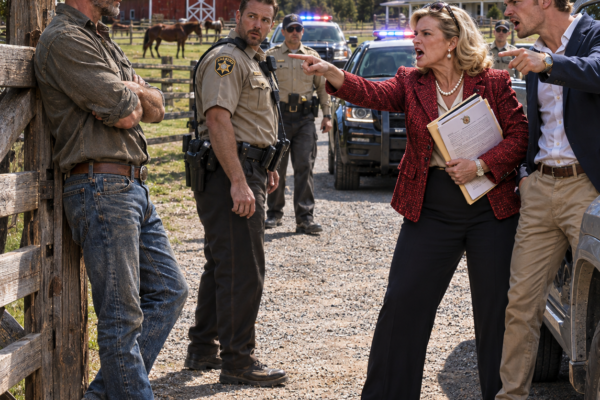
HOA Karen Sent 3 Trucks to Steal My Lumber—Then Tried to Seize My Entire 8,100-Acre Sawmill With a Fake Loan
HOA Karen Sent 3 Trucks to Steal My Lumber—Then Tried to Seize My Entire 8,100-Acre Sawmill With a Fake Loan
“GET OUT OF MY WAY, YOU STUBBORN BACKWOODS IDIOT! THIS LUMBER BELONGS TO OUR HOA, AND IF YOU TOUCH ONE OF MY TRUCKS, I’LL HAVE YOU ARRESTED AND TAKE THIS WHOLE DAMN SAWMILL!”
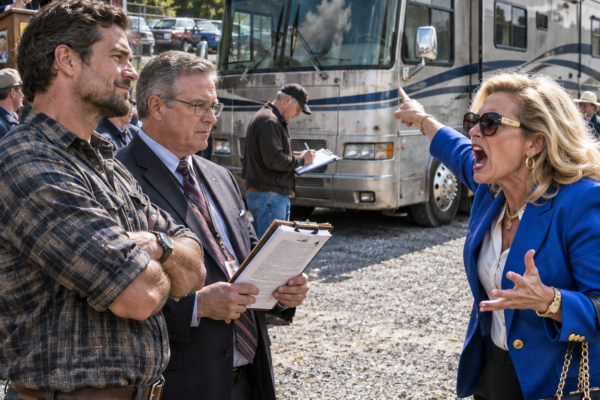
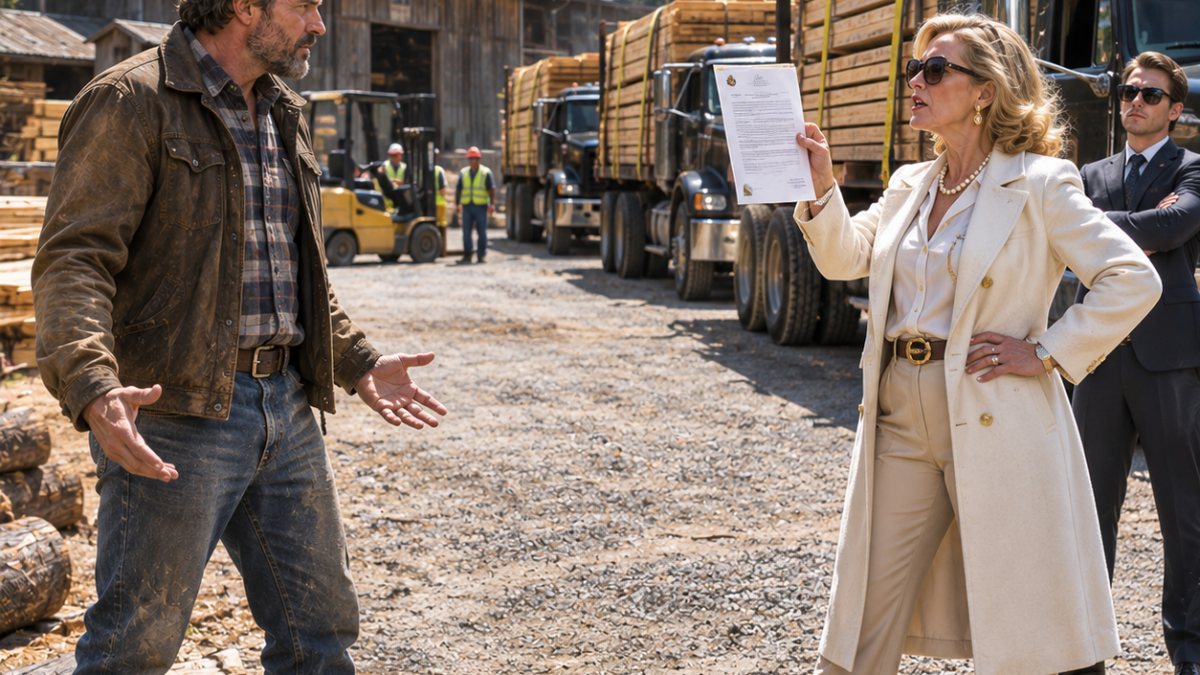
Cynthia Marlow stood in a spotless white coat beside three logging trucks loaded with nearly $60,000 worth of lumber stolen from my Montana sawmill, while her son ordered the drivers to leave and waved an agreement bearing a signature I had never written.
But when I turned the document over, I discovered that every board remaining in my warehouse had already been promised to her son’s construction company—and before I could confront her, a young employee screamed from inside a locked building where smoke was beginning to rise.
The first thing I saw when I drove into the sawmill yard was the tail end of a fully loaded logging truck moving toward the eastern service gate.
The second truck was backing away from the loading platform.
A third was still being filled by a forklift.
Fresh-cut pine and cedar boards were stacked high on the trailers, secured with heavy chains.
I recognized the lumber immediately.
I’d spent the previous afternoon checking those bundles against customer orders.
Every board belonged to my business.
Not one had been approved for shipment.
And standing beside the trucks was Cynthia Marlow, president of the Timber Ridge Estates Homeowners Association.
She had one hand resting on her expensive SUV and the other holding a leather folder.
When she spotted my pickup, she smiled.
Not nervously.
Not apologetically.
She smiled like a woman who had finally decided she didn’t need my permission anymore.
I stopped near the loading platform and got out.
“SHUT THOSE TRUCKS DOWN!”
The forklift operator stopped moving.
One driver looked toward Cynthia.
She raised her hand.
“Keep loading. We have a schedule.”
I walked toward her.
“Who authorized these shipments?”
“The Timber Ridge community allocation.”
“There is no community allocation.”
She sighed.
“Nathan, we’ve been through this.”
“Then you already know the answer. My lumber doesn’t leave this property without a paid order.”
Her smile tightened.
“Walter Price honored the neighborhood’s needs for decades.”
“Walter donated damaged scrap wood once. He didn’t give you permanent ownership of his sawmill.”
“That’s your interpretation.”
“No. That’s what Walter told me himself.”
Cynthia stepped closer.
“You bought this operation four months ago, and now you think you can cancel long-standing community arrangements?”
“I bought 8,100 acres, the equipment, the warehouses, and the business. I didn’t buy an obligation to supply your neighborhood for free.”
She opened her folder.
“Then perhaps this will change your attitude.”
She handed me a document titled COMMUNITY LUMBER SUPPLY AGREEMENT.
My name appeared at the top.
Nathan Brooks.
Below it was the sawmill’s address.
A list of materials.
PART2:
A section authorizing unlimited collections for Timber Ridge community improvements and approved development partners.
And near the bottom was my signature.
Or something close to it.
I stared at the page.
“Where did you get this?”
“From our legal department.”
“I never signed it.”
“That’s what you’re saying now.”
I checked the date.
Then checked it again.
The agreement claimed I’d signed three weeks before I purchased the property.
I looked up.
“Cynthia, I didn’t even own this sawmill on that date.”
For the first time, her smile faltered.
Only briefly.
Then she lifted her chin.
“Administrative errors don’t invalidate agreements.”
“A forged signature isn’t an administrative error.”
Her eyes hardened.
“Be careful what you accuse people of.”
Behind her, one truck started moving.
I turned toward the driver.
“Stop that vehicle. I’m reporting an unauthorized removal.”
Cynthia laughed.
“You can report anything you want.”
I had already called the sheriff’s office.
I wasn’t going to stand in front of a forty-ton truck or put my employees in danger to prove a point.
Then I noticed handwriting on the back of Cynthia’s document.
FINAL COLLECTION BEFORE SUNRISE.
ALL REMAINING INVENTORY TO MARLOW CONSTRUCTION STORAGE.
I felt my stomach tighten.
This wasn’t a dispute over a few donated boards.
Someone intended to empty my warehouses.
Then Nora Bennett, my bookkeeper, came running from the office.
Her face was white.
“Nathan! Lucas went into Warehouse Three, and somebody locked the loading door!”
Before I could answer, a heavy crash shook the building.
A scream followed.
Frank Lawson, my foreman, ran toward the warehouse.
“LUCAS!”
Another crash echoed from inside.
I hurried after him.
A thick chain had been wrapped around the main sliding door.
The padlock was new.
From inside, a young man shouted that his leg was trapped beneath a collapsed lumber rack.
Then a thin stream of black smoke began rising above the warehouse roof.
I turned toward Cynthia.
She was backing toward her SUV, speaking urgently into her phone.
And for the first time since buying the sawmill, I wasn’t thinking about how much money I might lose.
I was thinking about whether one of my workers was about to die.
Four months earlier, I had arrived in Pine Hollow, Montana, believing I’d finally found the place where I wanted to spend the rest of my life.
My name is Nathan Brooks.
I was forty-eight years old and had spent most of my adult life managing construction projects across the western United States.
I’d worked on roads, industrial buildings, housing developments, and heavy-equipment operations.
I’d learned that successful projects depended on good crews, careful planning, and honest contracts.
I’d also learned how quickly a business could collapse when somebody decided paperwork was less important than profit.
For years, I dreamed of owning land.
Not a mansion.
Not a vacation resort.
A place with forests, open skies, and a business I could build into something lasting.
Then I found the listing.
8,100 acres of Montana forest.
A working sawmill.
Several mountain streams.
Open meadows.
Logging roads.
Equipment buildings.
Lumber warehouses.
And an old farmhouse overlooking the valley.
The photographs looked beautiful.
The property itself was better.
The previous owner, Walter Price, was seventy-three.
His family had owned the land for more than fifty years.
His knees were giving him trouble, and he wanted to retire near his grandchildren.
But he wasn’t interested in selling to someone who would clear-cut the forest, strip the equipment, and disappear.
On my first visit, Walter spent three days showing me the property.
He drove me along logging roads, through managed stands of pine, and past areas where young trees had been planted to replace older harvested timber.
He showed me the streams protected by buffer zones.
He explained why certain slopes were never logged.
Then he took me through the sawmill.
The building shook with the sound of machinery.
Logs moved along conveyors.
Massive saws turned timber into dimensional boards.
Forklifts transported finished lumber toward the drying and storage areas.
Twenty-six employees worked there.
Machine operators.
Truck drivers.
Mechanics.
Warehouse workers.
Office staff.
Men and women whose families depended on the mill staying open.
Walter introduced me to Frank Lawson, the foreman.
Frank was fifty-nine, with gray hair, rough hands, and the steady expression of somebody who had spent thirty years solving problems before anyone else noticed them.
“You ever run a sawmill?” he asked.
“No. But I’ve managed construction and heavy equipment for decades.”
He looked toward the machinery.
“Knowing machines helps. Knowing people matters more.”
I liked him immediately.
Then I met Nora Bennett.
Thirty-six years old.
Bookkeeper.
Sharp enough to remember invoice numbers without looking them up.
She handled payroll, purchasing, shipping records, and customer accounts.
“Every load gets an approved order,” she explained. “Then the yard checks it against the shipping ticket. We don’t send material out just because somebody says they’re here to collect it.”
That sounded like exactly the system I wanted.
After inspections, negotiations, financing, and more paperwork than I cared to remember, I bought everything.
The 8,100 acres.
The sawmill.
The machinery.
The warehouses.
The farmhouse.
And the responsibility that came with all of it.
I wasn’t a billionaire buying a toy.
I’d invested my savings and taken on substantial financing.
The sawmill had to succeed.
On my first morning as owner, I gathered the crew.
Some employees looked nervous.
They’d heard rumors that the new buyer might close the operation and sell the equipment.
I told them that wasn’t my plan.
“I bought a working sawmill because I want it to keep working. If you’re willing to stay and do good work, I’m willing to build this business with you.”
Frank shook my hand afterward.
“You treat these people right,” he said, “and they’ll stand beside you.”
I didn’t realize how much I would eventually depend on those words.
For six weeks, life was almost perfect.
I woke before sunrise, drank coffee in the farmhouse kitchen, and walked to the mill while fog still filled the valley.
Some days I reviewed production schedules.
Other mornings I rode with Frank to inspect roads or harvesting areas.
I spent time learning from the workers instead of pretending I already knew everything.
It was exhausting.
But it was honest work.
One weekend, Frank introduced me to Ruth Miller.
Ruth was seventy-six and lived in a small cabin near the southern forest road.
Her late husband had worked at the mill for decades.
Walter had always allowed her to use a private access road to reach town.
I told her that arrangement would continue.
She arrived the following afternoon with an apple pie.
“I don’t want to be a burden,” she said.
“Using a road isn’t a burden, Ruth.”
Then she introduced me to her grandson, Ben.
Twelve years old.
Quiet.
Curious.
Absolutely fascinated by woodworking.
Ben wanted to build furniture someday.
With Frank supervising, we let him visit approved areas of the mill and take small scrap pieces home.
He made birdhouses and picture frames.
Sometimes the corners weren’t square.
Sometimes the nails went in crooked.
But he worked with a seriousness I admired.
I thought this was what owning a business should feel like.
Providing jobs.
Making useful products.
Helping neighbors.
Keeping something valuable alive.
Then Cynthia Marlow arrived.
Her black luxury SUV stopped outside the mill office one Tuesday morning.
She stepped out wearing a cream-colored coat, designer sunglasses, and shoes that didn’t belong anywhere near a lumber yard.
Frank politely directed her toward the marked visitor walkway.
She looked offended.
“I know where I’m going.”
He waited until she used the walkway anyway.
Cynthia introduced herself as president of Timber Ridge Estates, an expensive neighborhood bordering part of my eastern forest.
She said the HOA was planning community improvements.
A clubhouse deck.
Picnic shelters.
Walking bridges.
Decorative fencing.
Then she announced that she needed forty large bundles of lumber prepared for collection Friday morning.
I assumed she wanted a quote.
“Nora can work up pricing and delivery options,” I said.
Cynthia stared.
“Pricing?”
“Yes.”
She laughed.
“Walter always supported Timber Ridge.”
“That’s good. We’d be happy to work with you.”
“You don’t understand. We have an arrangement.”
“What arrangement?”
“The community receives lumber for approved improvements.”
I looked toward Nora.
She looked equally confused.
“Do you have a purchase order or written agreement?” I asked.
Cynthia’s expression changed.
“I shouldn’t have to explain neighborhood arrangements to someone who only just moved here.”
“I’m the new owner. I need to know what obligations the business has.”
She leaned forward.
“Some of the wealthiest families in this county live in Timber Ridge. Several own major construction companies.”
I nodded.
“Then they should understand why suppliers need to be paid.”
Her face reddened.
She warned that the HOA could complain about sawmill noise, truck traffic, and road access.
I explained that our operating permits were valid and our access routes were separate from the neighborhood’s private streets.
Cynthia stood.
“You’ll regret making enemies with Timber Ridge.”
I watched her leave.
Then Frank looked at me.
“Never seen anybody get that angry about receiving a price quote.”
That evening, I called Walter.
“Did you give Timber Ridge free lumber?”
He laughed.
“Once. Some damaged boards I couldn’t sell. They wanted to make garden beds.”
“Any ongoing arrangement?”
“Absolutely not.”
He explained that Cynthia had asked for additional free materials shortly before his retirement.
He refused.
She hadn’t taken it well.
“Keep your paperwork straight, Nathan,” Walter told me. “That woman likes making favors sound like legal obligations.”
I thanked him.
I assumed that would be the end.
Three days later, Nora walked into my office holding a shipping report.
“Nathan, did you authorize a donation to Timber Ridge yesterday?”
“No.”
She placed the report on my desk.
A truck had collected several bundles of finished pine boards.
The driver claimed Cynthia had spoken directly with me.
A newer yard employee believed him and helped load the shipment.
There was no approved order.
No payment.
Only a collection ticket with a vague signature.
The missing lumber was worth several thousand dollars.
I called the yard crew together.
The young worker apologized repeatedly.
I told him I understood how the mistake happened.
Confident people can make false claims sound legitimate.
But from that point forward, no load would leave without direct verification.
Then I called Cynthia.
“You collected lumber yesterday without paying.”
“It was our community allocation.”
“We have no such agreement.”
“Walter always provided materials.”
“He confirmed that he didn’t.”
She became angry.
“You’re charging homeowners for lumber they’re entitled to receive.”
“I’m charging customers for products my employees worked to produce.”
She threatened to tell the neighborhood I was greedy.
I told her she could share her opinion, but the invoice still needed to be paid.
She hung up.
A week later, expensive cedar boards disappeared.
Those boards had already been reserved for a local builder who’d paid a deposit.
A Timber Ridge truck had collected them early in the morning using a form that looked like one of ours.
The logo was correct.
The storage location was correct.
The collection number looked legitimate.
But Nora hadn’t created the paperwork.
I hadn’t approved it.
The customer was furious when his order wasn’t ready.
I apologized and rearranged our production schedule to replace it.
We absorbed the extra cost.
I wasn’t going to punish an honest customer because somebody else was stealing from us.
Nora reviewed previous records.
By the end of the week, she’d identified more than $20,000 in suspicious shipments.
Every one was linked to Timber Ridge or a related delivery address.
I hired attorney Rachel Sullivan, who had helped with my property purchase.
Rachel reviewed the invoices, shipping tickets, and camera footage.
“Send a formal demand,” she advised. “Preserve everything. And don’t accuse anyone of specific crimes until we know exactly who authorized each collection.”
I agreed.
The following morning, a letter arrived from Timber Ridge.
The HOA claimed my mill was too noisy.
That lumber trucks were damaging roads.
That dust was affecting residents.
Some complaints were dated before I purchased the property.
Others referred to roads our trucks didn’t even use.
I checked our permits and asked Frank to review dust-control procedures.
I wasn’t going to ignore legitimate environmental or noise concerns just because Cynthia was making the complaints.
But the accusations didn’t establish any HOA authority over our business.
Then Ruth told me Cynthia was spreading rumors that the sawmill was failing.
Workers were frightened.
Customers began asking whether their orders were safe.
I gathered the employees and their families for a barbecue near the farmhouse.
I explained that the business remained open.
We had a problem with unauthorized shipments.
We were fixing it.
Nobody was being laid off because of an HOA rumor.
Ben brought a birdhouse he’d made from scrap wood.
Several workers bought his projects just to encourage him.
That afternoon reminded me why keeping the mill open mattered.
Frank pulled me aside afterward.
“Something’s been bothering me,” he said.
“What?”
“Cynthia’s son owns a construction company.”
I looked at him.
“So?”
“Derek Marlowe. Building luxury homes beyond Timber Ridge.”
He glanced toward the warehouses.
“You think our missing lumber is really going to picnic shelters?”
I didn’t answer immediately.
It was possible.
But we needed proof.
Nora checked the destination addresses.
Several matched storage yards near Derek’s development.
On Monday, Cynthia returned with Derek.
He was in his early thirties, tall, polished, wearing an expensive watch and the same confident smile as his mother.
He placed a contract on my desk.
It required my sawmill to provide lumber free of charge to Timber Ridge and approved development companies for an entire year.
In exchange, the HOA would supposedly support our continued operations and discourage complaints.
I read the contract.
Then looked at Derek.
“You want a year’s worth of production for nothing?”
“Think of it as a strategic partnership.”
“Who’s paying my workers?”
He smiled.
“Your operation gets protection from neighborhood problems.”
I leaned back.
“Derek, I don’t pay protection money with lumber.”
Cynthia’s eyes narrowed.
“That’s an outrageous accusation.”
“Then don’t threaten my business unless I give you free products.”
Derek leaned forward.
“You’d be surprised how expensive it can become when wealthy neighbors decide a business is a nuisance.”
I stood.
“Meeting’s over.”
Cynthia grabbed her handbag.
“You’ll regret humiliating my son.”
They left.
That evening, Nora found large collection orders in our shipping system.
None had been approved.
The shipments were scheduled for a private yard associated with Derek’s company.
Several entries had been created after office hours.
We preserved the records and tightened security.
Two nights later, a storm passed through Pine Hollow.
Just after midnight, Frank called.
“Nathan, trucks are inside the east loading yard.”
I was already reaching for my boots.
“How many?”
“Three. They’re loading finished lumber.”
“Who let them in?”
“Somebody opened the old service gate.”
“Stop the loading. Don’t get in front of the trucks. I’m calling the sheriff.”
I drove toward the mill.
And that brought me to the scene where Cynthia stood beside three loaded trucks, waving a document with my forged-looking signature.
Only now, the situation had become much worse.
Lucas Grant was trapped inside Warehouse Three.
Smoke was rising.
And someone had chained the door from outside.
Frank was striking the padlock with a metal bar.
“LUCAS! CAN YOU HEAR ME?”
A weak voice answered.
“My leg! I’m stuck!”
Another crash sounded inside.
I caught Frank’s shoulder.
“Stop. The racks are unstable.”
“We have to get him out!”
“We will. But if that wall comes down, we’re both going with it.”
I called the dispatcher again.
Worker trapped.
Possible fire.
Locked warehouse.
Unstable lumber racks.
Nora began moving the other employees away from the building.
Cynthia was already stepping toward her SUV.
“Where are you going?” I demanded.
“I have nothing to do with your unsafe warehouse.”
I held up my phone.
An unknown number had just sent me a photograph.
A man in a dark jacket was fastening the chain around Warehouse Three.
Cynthia stood nearby.
The message beneath the image read:
SHE KNOWS EXACTLY WHO IS INSIDE.
I showed it to her.
Her expression barely changed.
“Photos can be misleading.”
Then she reached for her car door.
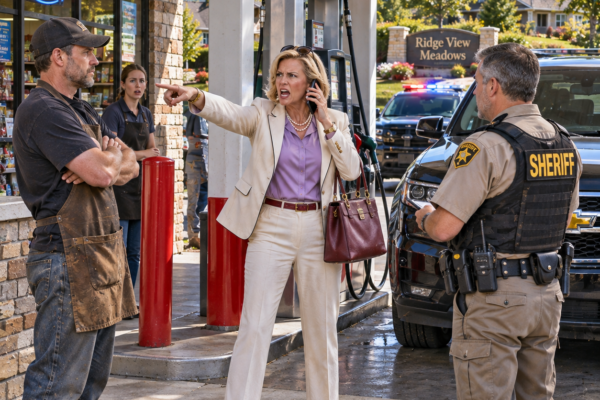
Two sheriff’s vehicles entered the yard.
A deputy approached Cynthia and instructed her to remain while officers investigated.
She started arguing immediately.
But I was no longer interested in her explanations.
Fire trucks arrived moments later.
Captain Samuel Reed studied the warehouse and ordered everyone to stand back.
Firefighters opened a smaller emergency entrance.
Two entered wearing protective gear.
Another crew dealt with smoke near the electrical equipment.
Frank stood beside me.
His hands were shaking.
“Lucas has a wife,” he whispered. “Little girl, too.”
“I know.”
“She’s six.”
I put a hand on his shoulder.
“We’re getting him out.”
Then a firefighter shouted from inside.
“WE FOUND HIM!”
The rescue team stabilized the fallen rack and worked to free Lucas’s leg.
Minutes stretched painfully.
Finally, two firefighters emerged carrying him on a stretcher.
His face was covered in dust.
His left leg was immobilized.
He was conscious.
When he saw me, he tried to apologize.
“Boss, I couldn’t stop the trucks.”
I leaned closer.
“Lucas, forget the lumber. You’re alive. That’s what matters.”
The ambulance took him to the hospital.
Firefighters contained the electrical fire before it spread through the large stacks of dry wood.
The warehouse was badly damaged, but most of it remained standing.
Deputy Aaron Collins took my statement.
I showed him the photograph, suspicious shipping forms, invoices, and documents Cynthia had displayed.
He told me other deputies were trying to locate the trucks that had left.
By sunrise, the mill was quiet.
Emergency tape surrounded Warehouse Three.
Workers stood in small groups near the office.
I gathered everyone.
“Lucas survived. He’s receiving treatment. The warehouse stays closed until it’s safe. We’ll adjust production and keep working.”
One mechanic asked whether people would lose their jobs.
“No. Not because someone broke into our operation.”
I knew the situation was financially serious.
But I wasn’t going to abandon twenty-six families after one terrible night.
That afternoon, I visited Lucas.
His wife, Megan, sat beside him holding his hand.
Their six-year-old daughter, Lily, was drawing near the window.
Doctors expected Lucas to recover, though his broken leg would require treatment and rehabilitation.
Megan was worried about household bills.
I explained that we’d help them navigate the workplace injury process and available support.
Lucas’s job would be waiting when he was medically ready.
Then Lily handed me a drawing.
The sawmill had a bright green roof.
Her father stood beside a giant tree.
At the bottom she’d written:
MY DADDY IS BRAVE.
I folded it carefully.
“Mind if I put this in my office?”
She smiled.
That picture stayed on my desk throughout everything that followed.
Back at the mill, Nora had worse financial news.
The missing lumber wasn’t worth $20,000 anymore.
After reviewing earlier shipments, she estimated nearly $60,000 had been removed without proper payment.
Most suspicious loads connected to Timber Ridge or Derek’s construction addresses.
Rachel examined the supposed supply agreement.
Then she found the date.
Three weeks before I purchased the sawmill.
Someone had created a document claiming I approved free shipments before I even owned the business.
We forwarded the evidence to investigators.
Walter arrived after hearing about Lucas.
He looked at the damaged warehouse and shook his head.
“I spent fifty years building a place where workers looked after each other. Nobody should get hurt because somebody wants free lumber.”
Then he told me something he hadn’t mentioned before.
Cynthia had once asked for permission to use an old logging road through his eastern forest.
Her son wanted to move construction traffic toward land beyond Timber Ridge.
Walter refused.
The road crossed young timber stands and an aging bridge over Pine Creek.
Heavy equipment could damage both.
He’d warned them clearly.
Now I understood that the stolen lumber might only be one part of the problem.
Cynthia and Derek wanted cheap materials.
They also wanted a road through my forest.
A road I had never agreed to provide.
A week later, another anonymous message arrived.
CHECK THE EASTERN FOREST BOUNDARY.
Attached was a photograph of survey stakes near the old logging road.
Frank and I drove out the next morning.
Orange ribbons marked trees that weren’t scheduled for harvesting.
Fresh tire tracks crossed the dirt road.
Gravel had been dumped near Pine Creek.
Large red marks appeared on several mature pines.
Someone was preparing a construction route.
Without my permission.
I photographed everything.
Rachel contacted a land surveyor and notified the sheriff’s office.
Then a man named Gregory Vance appeared at the mill with Cynthia and Derek.
He was an attorney representing the development.
He produced an agreement supposedly signed by Walter Price giving construction access through the eastern forest.
Walter had already denied granting those rights.
Gregory said the issue could be resolved through legal proceedings.
Derek interrupted.
“The road is getting built whether Nathan likes it or not.”
I looked toward him.
“Then you should probably build it on land you own.”
Gregory told Derek to stop talking.
They left.
I went to see Ruth that afternoon.
Her cabin sat near the old road.
Ben was working on another birdhouse when I arrived.
Ruth told me unfamiliar trucks had been passing in the evenings.
Several men had inspected the bridge.
She’d assumed they worked for me.
I explained they didn’t.
Her expression changed.
“Is the road safe?”
“Not for heavy construction equipment. I’m reporting everything.”
Ben looked toward the tall trees surrounding the cabin.
“Are they going to cut those down?”
“Not with my permission.”
He nodded, but he didn’t look reassured.
Neither did I.
The next Friday evening, Ruth called.
There were trucks near Pine Creek.
Chainsaws.
Bright work lights.
And one vehicle marked MARLOW CONSTRUCTION.
I called the sheriff’s office, then met Frank.
We drove along the safe main access road toward the eastern forest.
Before we reached the creek, I could hear machinery.
A bulldozer was pushing brush aside.
Fresh-cut logs were stacked near a steep hillside.
An excavator was moving toward the old wooden bridge.
Frank stared.
“That bridge won’t hold it.”
I called dispatch again and reported the danger.
Then I noticed men near Ruth’s cabin.
Her front gate had been chained.
I called her.
No answer.
I called again.
Ben picked up.
His voice was shaking.
“Mr. Brooks, some men told Grandma she had to leave.”
“Where is she?”
“She went outside to talk to them.”
“Stay away from the machinery and call 911 if you need help. I’m nearby.”
A cracking sound cut through the forest.
Frank turned.
“The bridge!”
The old wooden crossing bent beneath the excavator.
One side dropped.
Boards snapped.
Metal scraped against timber.
The machine tilted toward the creek.
The operator began screaming.
Then I heard another shout from Ruth’s direction.
Ben was running near the cabin.
Ruth lay beside a fallen fence.
Above the house, an enormous pile of freshly cut logs had been stacked on unstable ground.
The supports began shifting.
One timber rolled.
Then another.
Then a support beam snapped.
A long pine log broke free and thundered downhill.
It struck Ruth’s porch.
The impact shook the cabin.
A second log smashed through the fence.
Then the entire stack began moving.
Hundreds of tons of timber rolling toward a house where a child had just disappeared inside.
I called 911 and reported the collapse.
The dispatcher warned us to stay away from the moving logs.
Frank knew a safer trail along the western side of the hill.
We hurried toward Ruth’s cabin from that direction.
Another log struck the front wall.
Glass shattered.
Part of the porch roof collapsed.
“BEN!”
For several seconds, I heard nothing.
Then a small voice answered from behind the house.
“MR. BROOKS!”
Ben stood near an old stone cellar, crying and waving.
He’d gone inside to retrieve a box of photographs of his grandfather.
When the logs hit, he escaped through the back door.
Frank guided him toward a safe clearing.
Then Ben screamed for Ruth.
She was still beside the road.
Trying to crawl.
Dragging one leg.
The main timber pile had stopped moving, but the hillside remained unstable.
I moved along the clear side path.
A construction worker reached Ruth first.
Together, we helped her away from the damaged fence and onto firm ground.
She cried out when we touched her leg.
It was badly injured.
I told her not to stand.
Then another crash came from the cabin.
By the time firefighters arrived, Ruth’s home was almost destroyed.
The porch was gone.
One side of the roof had collapsed.
Huge logs lay across the flower garden her husband had planted decades earlier.
Captain Reed organized rescue crews.
Paramedics treated Ruth.
Other firefighters checked Ben.
A separate team secured the broken bridge and helped the excavator operator escape his tilted machine.
The operator, Travis Hill, had cuts on his arms but was alive.
He was shaking when he stepped onto solid ground.
“I told them that bridge wasn’t safe,” he said.
I looked toward the warning sign near the ruined crossing.
It had been there for years.
A warning that someone had decided didn’t matter.
Ruth was taken to the hospital with a broken leg and bruising.
Ben went with her.
Before the ambulance left, Ruth caught my hand.
“Everything Harold and I built is gone,” she whispered.
I didn’t know what to say.
The cabin could be rebuilt.
But the photographs, furniture, and little details of a life shared with someone now gone couldn’t simply be replaced.
I squeezed her hand.
“You and Ben aren’t facing this alone.”
The next morning, I visited them.
Ben sat beside Ruth’s hospital bed holding the small box of photographs he’d rescued.
He looked at me.
“Did I cause the logs to fall because I went inside?”
“No, Ben. The logs were already moving.”
“But I shouldn’t have gone back.”
“No. Your grandmother needs you alive more than she needs photographs.”
He started crying.
Ruth reached for his hand.
Then she told him that memories mattered, but people mattered more.
I stood beside the bed, wishing Cynthia and Derek could have heard her.
Instead, Cynthia was telling Timber Ridge homeowners that the bridge collapse proved my sawmill was unsafe and that the HOA needed more control over neighboring forest roads.
I wanted to call her immediately.
Rachel advised me not to.
“Let the evidence speak. We need the construction work orders, bridge inspection reports, and witness statements.”
We had all three.
Travis later confirmed that supervisors had ordered him across the bridge despite his concerns.
Workers said they’d questioned the way logs were stacked above Ruth’s cabin.
They’d been told to keep moving because investors expected the road to be ready.
The sheriff’s department investigated Derek’s involvement.
Meanwhile, I moved Ruth and Ben into a small guest house near my farmhouse.
Ruth protested.
She didn’t want charity.
I told her she’d spent decades supporting the sawmill community.
Now it was our turn.
Neighbors brought clothes, blankets, and furniture.
Frank built a ramp for her walker.
The mill workers organized a fundraiser.
Ben used scrap lumber to make birdhouses.
He sold them outside the office and raised more than $300 for Lucas’s family.
Watching that twelve-year-old give away money he’d earned himself made me proud.
Cynthia was taking expensive lumber because she believed she deserved it.
Ben was selling scrap wood to help somebody else.
The contrast couldn’t have been clearer.
Then Nora found proof of where some of the stolen lumber had gone.
Several shipments matched materials installed at Derek’s luxury housing sites.
Invoices showed his company charging customers full price for boards our mill had never been paid for.
A Timber Ridge homeowner named Thomas Bradley visited my office with another troubling discovery.
Residents had paid special assessments for community lumber and repairs.
But the HOA’s records showed large payments to businesses connected to Derek.
Some projects remained unfinished.
Others were using materials that had been taken from my mill without payment.
So the residents had paid.
My business hadn’t been paid.
And Derek’s companies appeared to be collecting money in the middle.
Rachel told me to keep the documents separate from speculation and let investigators follow the transactions.
I agreed.
Then an anonymous photograph showed a dark blue pickup near our rear office entrance after midnight.
The sender warned that fake orders were being created from inside the mill’s computer system.
Nora and a specialist reviewed the access records.
Someone had used the account of a former employee who retired before I bought the property.
The login should have been disabled months earlier.
It hadn’t been.
The account had been used to create false orders and change delivery information.
We secured the system and preserved the digital evidence.
Then Walter arrived carrying a dusty box of old records.
Inside were letters showing Cynthia had requested a permanent lumber-donation agreement.
Walter had rejected it in writing.
There was also correspondence about Derek’s proposed road.
Walter had refused that too.
For the first time in weeks, I felt we were getting ahead of the lies.
Then Derek filed a financial claim against my business.
He accused the sawmill of delaying his housing development and causing losses by refusing road access.
He even tried to hold us responsible for damage caused when his company’s equipment crossed our unsafe bridge without permission.
Rachel challenged the claim.
But legal expenses, repair bills, delayed deliveries, and missing inventory were putting pressure on the business.
I was worried about making payroll.
Then Nora brought me a bank statement.
More than $100,000 had been transferred from our business account to Pine Valley Financial Services.
I hadn’t authorized it.
The bank opened a fraud review.
Rachel found business connections between the receiving company and people involved in Derek’s development.
Before we could fully investigate, another message arrived.
It appeared to come from a lender.
My sawmill had supposedly defaulted on a multimillion-dollar loan secured by the entire property.
The 8,100 acres.
The sawmill.
The warehouses.
The equipment buildings.
Everything.
I had never taken out such a loan.
Rachel contacted the lender through an independently verified number.
A loan file existed.
Someone had submitted documents carrying my name.
At the county records office, we found a financial claim against the property.
The agreement was supposedly signed on the same day Lucas had been taken to the hospital.
I remembered that day clearly.
The damaged warehouse.
The emergency crews.
Megan crying beside Lucas’s bed.
Lily’s drawing.
I hadn’t been sitting in a lender’s office signing away my business.
Then Rachel turned another page.
The supposed lender had transferred its claim to a company named Marlow Timber Holdings.
I stared.
Marlow.
Cynthia.
Derek.
Someone had created a debt I never agreed to, then positioned a company connected to the people harassing me to claim rights against my entire business.
My phone rang.
Frank.
“Nathan, Cynthia and Derek are at the front gate.”
I stood.
“What?”
“They’ve brought private security. They’re telling workers the mill belongs to Marlow Timber Holdings.”
Rachel was already calling the sheriff.
Frank kept talking.
“They’re chaining the loading gates. Derek’s men are trying to take equipment keys.”
“Don’t confront them. Deputies are coming.”
Then I heard shouting.
A crash.
Nora’s voice in the background.
And Frank yelled one final warning.
“They’re bringing logging trucks into the eastern forest!”
The call broke.
A moment later, the sheriff’s office reported gunshots near the equipment yard.
And nobody could locate Frank.
I felt as if the floor had disappeared beneath me.
Rachel stopped me from rushing blindly into a dangerous scene.
We drove toward the mill while she stayed in contact with investigators.
Four sheriff’s vehicles were already outside the gate.
Their lights flashed against the Pine Hollow Sawmill sign.
Several private guards stood near black SUVs.
Cynthia was arguing with Deputy Aaron Collins.
Derek stood beside heavy-equipment trailers and unfamiliar workers.
I pulled over behind the patrol cars.
“Where’s Frank?”
Aaron raised one hand.
“Mr. Brooks, stay here. We’re securing the scene.”
“Were shots fired?”
“Yes. A private security guard fired twice into the ground during an argument. His weapon has been secured.”
“Was anyone hit?”
“No reported gunshot injuries.”
“Frank’s missing.”
“We’re checking the buildings.”
Then a young worker named Owen Parker came running toward the deputies.
Nineteen years old.
Dust on his face.
Hands shaking.
“Frank pushed me into the maintenance workshop when that guard fired,” he said. “Then he went back for another worker. Somebody locked the door.”
Aaron radioed his team.
Deputies and firefighters opened the chained workshop entrance.
Minutes later, two officers emerged supporting Frank.
He was limping.
Blood streaked his forehead.
I hurried toward him as paramedics brought a stretcher.
Frank managed a weak smile.
“Sorry, boss.”
“Don’t apologize.”
He’d been shoved against a metal railing.
His ankle was injured.
He’d struck his head and become trapped when the gates were secured.
I took his hand.
“The machines can be replaced. You can’t.”
Frank caught my sleeve.
“Derek told his men to remove the office computers before the deputies arrived.”
I passed the information to Aaron.
He said investigators would preserve the relevant evidence through proper procedures.
Then Sheriff Thomas Grant arrived.
Cynthia marched toward him holding a document.
“Sheriff, this is a lawful seizure! Nathan Brooks defaulted on a multimillion-dollar loan, and Marlow Timber Holdings now controls this property!”
Grant read the paper.
Then looked at her.
“Where did you obtain this order?”
“Our lawyers.”
“Did you receive it directly from the court?”
“Of course.”
The sheriff studied the signature.
Then turned toward one of his deputies.
“Confirm the court record.”
Cynthia folded her arms.
“You’re wasting time. We have legal ownership.”
A few minutes later, the deputy returned.
There was no record of the supposed emergency seizure order.
And the judge whose signature appeared on it had retired more than three years earlier.
Grant looked at Cynthia.
“Mrs. Marlow, this court order wasn’t issued by the court.”
Her expression changed.
Derek stepped forward.
“Clerical error.”
The sheriff shook his head.
“A disputed financial claim doesn’t authorize you to take over a sawmill, seize equipment, lock employees inside buildings, or enter private property by force.”
Derek’s face reddened.
“Are you taking his side because he’s a rich landowner?”
Grant looked toward me.
I said nothing.
The sheriff turned back to Derek.
“I’m asking for lawful authority. You’ve provided none.”
The unauthorized operation was stopped.
The trucks stayed in place.
Deputies documented the damaged gates, security guards’ conduct, suspicious paperwork, and attempts to remove equipment.
Cynthia pointed at me.
“You may have stopped us tonight, Nathan, but the loan is real! The bank will take everything!”
I looked at her.
“I never signed that loan.”
She laughed.
“The bank doesn’t care what you remember.”
Rachel stepped forward.
“Then a court can examine the evidence.”
That night, after the deputies secured the property, I walked through the yard with Nora.
Heavy chains still hung from the gates.
An office door had been damaged.
Several lumber stacks had been disturbed.
But the machines were still there.
Most importantly, nobody had been killed.
Nora stopped beside the shipping office.
“Nathan, can we make payroll Friday?”
For the first time since buying the property, I admitted something I’d been trying to hide.
“I’m scared, Nora.”
She looked at me.
I stared toward the dark forest.
“I put everything I had into this place. If that loan claim freezes our financing, and we can’t recover the missing money…”
I didn’t finish.
Nora rested a hand on my shoulder.
“Then we fight it the right way.”
The next morning, Rachel obtained an urgent court hearing.
She presented the suspicious loan documents, my purchase records, the false emergency order, and evidence of the attempted takeover.
The judge didn’t decide every financial question that day.
But temporary protection was granted against further unauthorized interference while the documents were examined.
That gave us room to breathe.
The bank’s fraud team traced the unauthorized transfer.
Someone had used old business credentials and false payment instructions.
Part of the money was recovered quickly.
The rest remained under investigation.
I arranged temporary financing against genuine customer orders so the workers could be paid.
When employees learned how serious the situation was, several offered to reduce their hours.
Others volunteered to help repair the warehouse after work.
I thanked them.
But I told them their families needed paychecks, too.
I wouldn’t ask them to absorb losses caused by someone else’s dishonesty unless there was absolutely no alternative.
Then the person behind the anonymous photographs finally came forward.
Her name was Allison Moore.
Twenty-nine years old.
A project assistant at Derek’s construction company.
She’d been supporting her younger brother since their parents died.
Derek had threatened employees who shared company information.
Allison had been frightened.
But she’d also seen suspicious invoices.
Lumber supposedly collected for Timber Ridge was delivered to Derek’s private construction sites.
Then customers were billed full price.
She had questioned the paperwork.
Derek told her the materials came through an agreement with Walter Price.
But Allison noticed inconsistent dates and changed approvals.
She began saving relevant messages and invoices she was lawfully able to retain.
Then she saw more.
Emails showing Cynthia knew the sawmill expected payment.
Instructions directing shipments to Derek’s building projects.
Messages about pressuring me to grant road access through the eastern forest.
And the name of a former computer contractor.
Raymond Pierce.
Raymond had once maintained the sawmill’s shipping software under Walter.
Derek had hired him again.
Allison said Raymond helped create false collection records and financial paperwork intended to make the sawmill appear deeply indebted.
The old employee account in our shipping system suddenly made sense.
Then Allison explained the photograph of the chained warehouse.
She’d been there delivering paperwork when she saw a man locking the loading door.
Cynthia stood nearby on her phone.
Allison took the picture.
She didn’t realize Lucas was trapped until she heard the shouting.
Later, when she learned he’d been injured, she couldn’t stay silent.
She began crying as she spoke.
“I should’ve said something sooner.”
I looked at her.
“You came forward now. That’s what matters.”
Rachel encouraged her to provide the evidence directly to investigators with appropriate legal advice.
The sheriff’s department followed up on the records.
The investigation expanded to include the missing lumber, false agreements, unauthorized computer access, bank transfers, loan documents, road damage, and attempted seizure.
The security guard who fired his weapon was investigated separately.
The dangerous logging operation near Pine Creek received its own scrutiny.
Then Timber Ridge homeowners began asking questions.
Patrick Foster, a resident who had supported Cynthia for years, contacted Nora.
He wanted to know whether the HOA had paid for lumber supposedly purchased for community improvements.
Nora checked the accounts.
Several shipments had never been paid for.
Patrick was stunned.
“We paid special assessments for those materials.”
He organized a meeting.
Homeowners reviewed financial statements.
Large payments had gone to businesses connected to Derek.
Some neighborhood projects remained unfinished.
Other materials had been collected from my mill without payment.
Residents demanded independent financial review.
Eventually, they removed Cynthia as HOA president under their association’s procedures.
I didn’t cheer.
Most of those homeowners had been paying fees and trusting their board.
They were victims of the same dishonesty, even if their losses were different from mine.
Patrick later visited the sawmill.
“We’d like to rebuild trust,” he said.
“Then start with honest books and fair contracts.”
He nodded.
“That’s the plan.”
The legal process continued for months.
Specialists examined the false loan papers.
Investigators traced the preparation and submission of the documents.
The court eventually determined that the disputed debt did not establish a valid claim against my property.
The improper financial claim was cleared from the land records.
My deed still showed me as the owner.
All 8,100 acres.
The working sawmill.
The warehouses.
The equipment buildings.
When Rachel called with that news, I sat at my farmhouse kitchen table for a long time.
I couldn’t speak.
For months, I’d worried that someone might turn forged paperwork into a reason to take everything I’d worked for.
Now the largest threat was finally gone.
I looked out toward the forest.
Tall pines moved in the morning wind.
Walter had trusted me to protect that land.
I had kept my promise.
Derek eventually admitted responsibility for his role in the fraudulent documents and lumber scheme through a plea agreement.
Cynthia admitted involvement in arranging unauthorized collections and misusing her HOA position.
Raymond Pierce faced charges connected to false records and computer access.
The security guard’s dangerous conduct was handled separately.
Restitution, settlements, and other legal proceedings addressed the financial and property losses.
Not every dollar came back immediately.
The warehouse still needed repairs.
The Pine Creek Bridge was destroyed.
Unauthorized logging had damaged valuable forest.
Ruth had lost her home.
Lucas had suffered a serious injury.
But Cynthia and Derek could no longer pretend they had done nothing wrong.
They couldn’t walk into my mill with a folder and demand free lumber.
They couldn’t claim the road belonged to them.
And they couldn’t use a false loan to take 8,100 acres.
By the following spring, the sawmill was recovering.
Warehouse Three had been repaired.
The loading gates were stronger.
Our computer system had new security controls.
Every shipment required verified approval.
Frank returned after his head and ankle injuries healed.
Lucas returned on lighter duties while continuing rehabilitation.
One afternoon, he brought Lily to the office.
She handed me another drawing.
This time, the warehouse stood beneath a bright blue sky.
Her father was beside Frank.
A giant smiling tree rose behind them.
At the bottom she had written:
GOOD PEOPLE HELP EACH OTHER.
I hung it beside her first drawing.
Whenever the business felt overwhelming, I looked at those pictures.
They reminded me that I hadn’t bought the mill simply to accumulate land and machinery.
I’d bought it to build something people could depend on.
Ruth’s future mattered just as much.
With available insurance support, legal recoveries, community donations, and help from the sawmill crew, we arranged to build her a smaller cabin on safer ground.
Far from the unstable logging road.
The new place had a wide porch.
A kitchen with sunlight in the mornings.
A flower garden.
And a sturdy ramp so she could enter while her leg continued healing.
Ben helped build part of the porch railing under supervision.
The day Ruth moved in, she stood beside the front door with her walker.
Then she began crying.
I put an arm around her shoulder.
“Is everything okay?”
She nodded.
“Harold would’ve loved this porch.”
I looked toward the young flowers Ben had planted.
“I think he would.”
She squeezed my hand.
“Thank you for not leaving us alone.”
I shook my head.
“You and Ben are part of this community.”
We closed the damaged Pine Creek Bridge until a proper replacement could be designed.
Forestry specialists helped us create a restoration plan for the unauthorized cutting areas.
Young pines were planted where trees had been removed.
Damaged soil was stabilized.
We protected the creek banks.
I didn’t want to pretend the forest would recover overnight.
Trees take decades to grow.
But responsible work could give the damaged land a future.
Walter visited one afternoon while we were planting seedlings.
He stood beside the road watching our crew.
“When I sold this place,” he said, “I worried the next owner might only see dollar signs.”
I looked at him.
“You took a chance on me.”
He nodded.
“Best decision I could’ve made.”
A few weeks later, Patrick Foster returned with two Timber Ridge board members.
They wanted to buy lumber.
Properly.
Nora prepared an estimate.
They reviewed the prices.
Discussed delivery schedules.
Signed an ordinary purchase order.
And paid the invoice.
I smiled as the paperwork was completed.
That was all Cynthia had needed to do from the beginning.
Ask.
Agree on a price.
Pay for what she received.
Instead, she’d turned a simple business transaction into months of theft, intimidation, damaged property, and ruined lives.
That summer, I organized a community gathering at the sawmill.
Employees brought their families.
Local customers attended.
Neighbors from Pine Hollow and Timber Ridge came.
Ruth baked pies.
Ben displayed birdhouses.
Lily decorated a table with drawings.
Walter sat with Frank, telling stories about the mill’s early years.
Nora organized a small display showing how we managed the forest, harvested selected timber, processed it into lumber, and replanted areas for future generations.
Near sunset, Frank asked me to speak.
I stood beside the picnic tables, looking at the people who had carried us through the worst year of my life.
“When I bought this property,” I began, “I thought 8,100 acres and a working sawmill were the biggest responsibility I’d ever take on.”
A few people smiled.
“I was wrong.”
I looked toward Lucas and Megan.
“Because the land doesn’t mean much if the people working on it aren’t safe.”
Then toward Ruth and Ben.
“And a business isn’t worth building if we forget the neighbors who helped make it possible.”
I paused.
“Cynthia Marlow believed this sawmill owed her free lumber because she was president of an HOA. Her son believed our forest existed to solve his development problems.”
I looked across the crowd.
“But every board leaving this mill represents real work. Someone harvested the tree. Someone operated the saw. Someone dried, stacked, inspected, and shipped the lumber. Those people deserve their wages.”
Several employees nodded.
“And every acre of this forest represents a responsibility to protect something that will outlast us.”
I looked toward Frank.
“We didn’t survive because we had the most money or the most powerful connections.”
Then toward Nora.
“We survived because people kept honest records.”
Toward Allison.
“Because somebody was brave enough to tell the truth.”
Toward the firefighters.
“Because people put themselves in danger to save a worker they didn’t know.”
And finally toward Ruth.
“Because when a home was destroyed, neighbors decided to help rebuild it.”
Nobody cheered immediately.
For a moment, the yard was quiet.
Then Frank started clapping.
Others joined him.
I didn’t feel victorious.
I felt grateful.
Later, when everyone had gone home, I walked alone toward the eastern forest.
The evening air smelled of pine.
In the distance, I could hear the last sawmill machines shutting down for the night.
I stopped beside a young tree Ben had helped plant near the creek.
The ground around it was still dark from watering.
Beyond it stood thousands of acres of forest.
Some mature.
Some newly planted.
Some still recovering from the damage Derek’s crews had caused.
Four months after buying the property, I’d believed I had found my dream.
Then Cynthia appeared and demanded forty bundles of free lumber.
When I refused, she started taking it anyway.
When I demanded payment, she threatened the mill.
When I tightened security, someone forged collection orders.
When that failed, they tried taking control of a road.
Then came the destroyed bridge, Ruth’s cabin, the fraudulent bank transfer, and the false loan against my entire property.
What began as stolen boards had nearly cost twenty-six people their livelihoods.
It had nearly cost Lucas his life.
It had destroyed Ruth’s home.
And it had threatened everything Walter spent fifty years building.
But the sawmill was still standing.
Lucas was recovering.
Frank was back at work.
Ruth had a safe home.
Ben was making furniture and birdhouses.
Nora’s records were more secure than ever.
And the forest was growing again.
I looked down at the young pine.
One day it would be tall enough to shade the road.
Years after I was gone, someone might harvest it and turn it into lumber for a home.
Or maybe it would remain standing for another generation.
Either way, I wanted whoever came after me to inherit something better than I had found.
Then my phone vibrated.
A message from Nora.
The next morning’s lumber orders had all been approved and paid.
I smiled.
Nothing dramatic.
Nothing mysterious.
Just an ordinary business running the way it should.
I started walking back toward the farmhouse.
Behind me, the wind moved through the trees.
Ahead of me, the sawmill lights glowed against the darkening Montana sky.
Cynthia Marlow had believed her HOA title entitled her to take lumber without paying.
When I refused, she tried to use forged documents, financial pressure, and her son’s connections to take the entire operation.
But the one thing she never understood was that my sawmill wasn’t merely a pile of boards, expensive machines, and thousands of acres of timber.
It was twenty-six jobs.
A community.
A promise to Walter.
A home for people like Ruth and Ben.
And a future we were still building together.
Cynthia tried to take everything without paying a dollar.
In the end, she lost her authority, her false claims collapsed, and the people she tried to frighten were still standing.
As I reached the farmhouse, I looked back one last time at the sawmill.
The business was mine.
The forest was protected.
The workers had their jobs.
And every customer who wanted our lumber would now have to do something Cynthia Marlow had refused to do from the very beginning.
Ask for a price.
Sign a real agreement.
And pay for what belonged to somebody else.