PART 2: HOA Karen Broke Into My House to Poison My Retired K9 — She Had No Idea What Ranger Had Already Detected
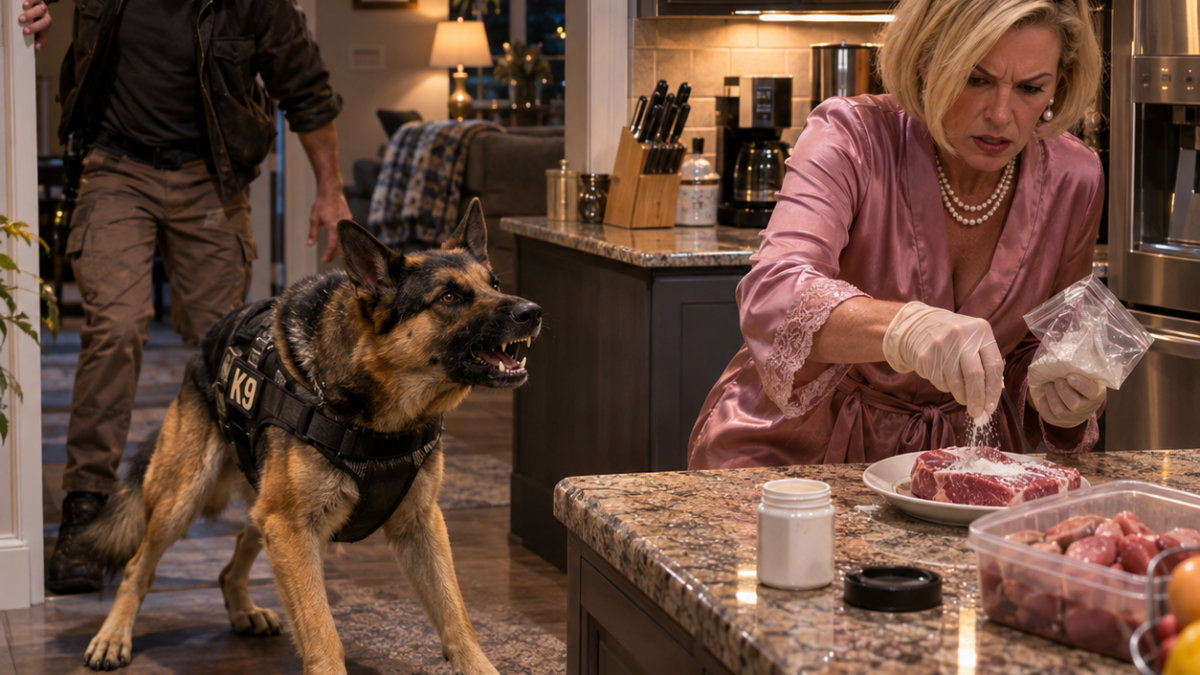
The first sound that woke me wasn’t breaking glass or a door slamming—it was Ranger’s growl, low and controlled, the same warning I had heard from him outside drug houses and dark warehouses years earlier, except this time my retired K9 partner was standing rigid in the hallway of our own home, staring toward the kitchen as the smell of something bitter and chemical drifted through the darkness.
When I eased around the corner, I saw a woman crouched beside my counter in a pink robe and rubber gloves, sprinkling something from a plastic bag over a raw piece of meat while Ranger held himself perfectly still between her and the rest of the house, and for several seconds my mind refused to accept that the person inside my kitchen was the same HOA president who had spent the past month trying to have him removed from the neighborhood.
What frightened me most wasn’t that Karen Jensen had finally crossed my property line, because I had already begun to suspect she was capable of that—it was the realization that Ranger had been reacting to something around her family for weeks, and whatever had brought her into my house that night was bigger than an argument over barking, fences, or HOA rules.
My name is Michael Harris.
For twenty-one years, I worked narcotics cases with the DEA, most of that time alongside trained detection dogs.
Ranger was my last partner.
Six years old when we retired, eighty pounds of German Shepherd with a dark saddle coat, amber eyes, and the ability to go from sleeping in sunlight to fully alert before I noticed anything unusual.
We had entered places together where men kept guns beside cereal boxes.
We had searched vehicles at two in the morning while people screamed at us from across parking lots.
We had spent nights in cheap motels where Ranger slept against the door because he never completely stopped working.
When retirement finally came, I promised him something simple.
No more raids.
No more kennels behind government buildings.
No more waiting in hot vehicles while I filled out paperwork.
Just a house.
A yard.
Quiet.
Oakridge Estates looked perfect for that.
Red-brick homes.
Trim lawns.
Maples along the sidewalks.
A small lake trail behind the subdivision.
The kind of place where people waved while taking out their trash.
I built Ranger a covered kennel in the backyard, though most nights he slept inside beside my bed.
That’s how Karen Jensen entered our lives.
She appeared on my third morning carrying a clipboard.
“Michael Harris?”
“That’s me.”
“Karen Jensen. HOA president.”
She looked past me.
Ranger sat beside the porch.
Her smile tightened.
“That’s a very large dog.”
“He knows.”
“Is he safe?”
Ranger yawned.
“Safer than most people I’ve worked with.”
She didn’t appreciate that.
Her eyes moved to the service K9 identification on his collar.
“We do have community standards concerning intimidating animals.”
“He’s retired federal K9.”
“That doesn’t necessarily exempt you from HOA rules.”
“I didn’t say it did.”
She pointed toward the kennel.
“That structure wasn’t submitted for architectural approval.”
And there it was.
Within a week, I received a $250 violation notice.
Then another complaint claiming Ranger created excessive noise.
He hadn’t barked once that day.
Then a warning that his presence near the fence made residents feel unsafe.
I started saving every letter.
Karen kept escalating.
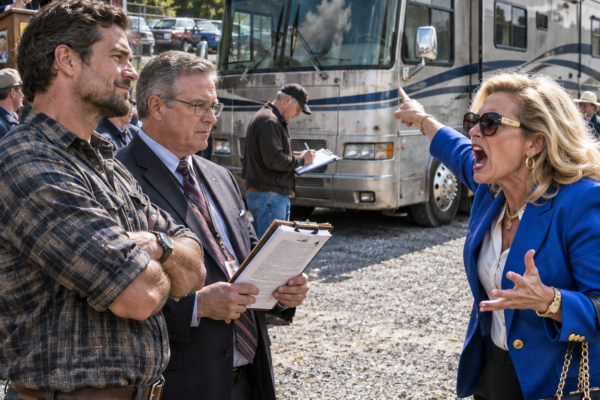
At an HOA meeting, she projected photographs of Ranger onto a screen and called him a “potential community liability.”
I walked over with Ranger at heel.
He sat beside my leg without moving.
“Karen,” I said, “you can dislike my kennel. You can complain about my porch light. But you are not going to manufacture a reason to take my dog.”
Her smile vanished.
“We’ll let animal control decide.”
Behind her stood her husband, Gary Jensen, owner of a small trucking company called Jensen Logistics, and Gary’s younger brother Ethan.
Ethan watched Ranger differently.
Not afraid.
Nervous.
Ranger noticed him too.
His ears came forward.
A few nights later, Ranger woke me with three short barks.
Outside, the air carried a sharp industrial smell from the Jensen property.
Two days after that, I found my backyard gate unlatched.
A hamburger patty lay in the grass.
Ranger had not touched it.
I bagged it.
A veterinarian I trusted sent it for testing.
The call came the next afternoon.
“Michael,” he said, “whatever you do, don’t let Ranger eat anything you didn’t prepare yourself.”
My hand tightened around the phone.
“Why?”
“There was a toxic chemical on that meat.”
That evening I installed additional cameras.
At 1:18 in the morning, a motion alert lit my phone.
Someone was crossing my backyard.
A pink shape moved through the night-vision image, carrying a plastic bag in one hand.
Then the figure lifted her head, and even through the grainy screen I knew exactly who was coming toward my back door.
PART 2
Karen Jensen stopped beneath the porch light.
For several seconds, all I could hear was the hum of the refrigerator and Ranger’s slow breathing beside me.
I had already muted my phone.
Every camera was recording.
Front yard.
Side gate.
Back porch.
Kitchen entrance.
The woman who had spent weeks accusing my dog of being dangerous was now standing inside my fenced yard after one in the morning.
Ranger looked at me.
I touched two fingers to his collar.
“Easy.”
He remained silent.
That’s what people misunderstand about trained dogs.
The barking isn’t the impressive part.
The impressive part is restraint.
Ranger knew how to wait.
Karen did not.
She moved toward the back door.
Her flashlight was wrapped in a piece of red cloth, dimming the beam.
She wore rubber gloves.
In her other hand was a plastic container.
I felt something cold settle behind my ribs.
This wasn’t somebody checking a fence.
This wasn’t an HOA stunt.
She knew exactly what she was doing.
The back door was locked.
Karen tried the handle once.
Then again.
She moved to the side.
I watched through the camera feed as she reached toward the old pet-access panel installed by the previous homeowner.
I’d sealed it months earlier from the outside, but apparently not well enough.
Karen worked at the edge.
The panel loosened.
My anger rose.
Ranger’s ears moved forward.
“Stay.”
He stayed.
Karen finally pushed enough of the panel aside to reach through and manipulate the interior latch.
The door opened three inches.
Then six.
Then she slipped inside.
I started recording on my phone too.
Not because the cameras needed backup.
Because after twenty years of investigations, redundancy becomes instinct.
Karen entered the kitchen.
The dim red flashlight moved across the counters.
Across Ranger’s water bowl.
Across the doorway.
Then she placed a raw steak on the floor.
She opened the bag.
Sprinkled something onto it.
I smelled it from the hallway.
Bitter.
Chemical.
Wrong.
Ranger smelled it long before I did.
His body went rigid.
A growl started so low I felt it before I heard it.
Karen froze.
The flashlight stopped moving.
Ranger stepped into the kitchen.
She turned.
The beam caught his face.
Her mouth opened.
For a split second, neither moved.
Then Ranger growled again.
Karen dropped the bag.
“No.”
Ranger took one controlled step forward.
Her voice rose.
“Get away!”
I stepped from the hallway.
“Ranger. Hold.”
He stopped.
Karen spun toward me.
Her face went completely white.
“Michael.”
I looked at the steak.
The powder.
The gloves.
Then at her.
“What are you doing in my house?”
“I—”
She looked toward the open back door.
“No.”
I kept my voice calm.
“Don’t run.”
That was exactly what she did.
She bolted.
Ranger looked at me.
I gave no release command.
He followed only to the threshold.
Karen hit the back porch, slipped on the wet step, caught herself against the railing, then ran across the yard.
Motion lights snapped on.
Mrs. Henderson’s porch light across the street came on too.
Karen reached my gate.
Fumbled with it.
Then climbed over instead.
Her robe caught on the top.
She tore it loose and disappeared toward her house.
I locked the door.
Then called 911.
Ranger never touched the steak.
He sat beside me while I waited for officers.
I looked at him.
“You knew.”
His ears flicked.
I thought about the hamburger.
The open gate.
The chemical smell.
The way he’d watched Gary’s trucks.
The way Ethan had stared at him.
This had never been about barking.
Not really.
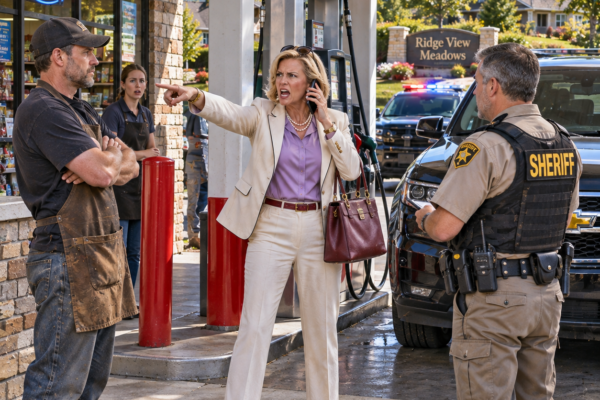
The first deputy arrived twelve minutes later.
Then another.
I showed them the cameras before I told the whole story.
That mattered.
People can argue with memory.
Video is less cooperative.
Deputy Collins watched Karen enter through the back door.
Watched her place the meat.
Watched the powder fall.
He looked at me.
“You know what that is?”
“No.”
“You touch it?”
“No.”
“Dog?”
“No.”
“Good.”
He called for evidence technicians.
Another deputy walked the yard.
Found the torn fabric from Karen’s robe on the gate.
Found a glove near the porch.
Mrs. Henderson came outside in slippers.
“I have camera footage too.”
Collins looked at her.
“From where?”
“My doorbell.”
She pointed.
“Caught the whole backyard run.”
I almost smiled.
Karen had spent months demanding neighborhood surveillance.
Now the neighborhood had surveilled her.
Collins asked where Karen lived.
I pointed across the street and two houses down.
“Pink robe?”
“Usually.”
He sighed.
“We’ll talk to her.”
“No.”
He looked at me.
“Excuse me?”
“Get another unit before you do.”
“Why?”
“Her husband and brother are around often. I don’t know what they’re involved in.”
Collins studied me.
“You think this is bigger?”
“I don’t know.”
That was the honest answer.
“But my dog has been alerting on odors coming from their property.”
“You’re former law enforcement?”
“Retired DEA.”
His expression changed.
“Handler?”
I nodded toward Ranger.
“Partner.”
Collins looked at him.
Ranger sat quietly beside my kitchen table.
“Explains the discipline.”
“Doesn’t explain why somebody tried to poison him.”
“No.”
Collins glanced toward the steak again.
“Maybe tonight does.”
Karen denied everything.
At first.
She told deputies she’d heard Ranger crying.
Then said she had smelled gas.
Then claimed she’d entered because my back door was already open.
The cameras destroyed all three versions.
When confronted with the footage, she changed direction.
She said the meat was a peace offering.
The deputy asked why a peace offering required gloves.
She said she had sensitive skin.
Why the plastic bag?
Seasoning.
Why after one in the morning?
She couldn’t sleep.
Why remove the pet-access panel?
No answer.
The deputies did not arrest her immediately.
That frustrated several neighbors who had gathered outside.
It didn’t frustrate me.
Real investigations move carefully when chemical evidence is involved.
They collected the steak.
The powder.
The glove.
The plastic bag.
My camera footage.
Mrs. Henderson’s video.
The damaged door panel.
Then they told Karen not to enter my property again.
By sunrise, everyone in Oakridge knew.
Not because I posted anything.
Mrs. Henderson apparently had three daughters.
That was enough.
At nine, an HOA email arrived.
**EMERGENCY COMMUNITY SAFETY NOTICE**
I opened it.
Karen had sent it.
She claimed she’d been “involved in a frightening incident with an aggressive animal” while responding to a possible welfare concern.
I read that sentence twice.
Ranger lay under the kitchen table chewing a rope toy.
A second paragraph announced an emergency review of “dangerous animal compliance.”
I laughed.
Not because it was funny.
Because arrogance sometimes becomes so complete that laughter is the body’s only alternative.
At ten fifteen, animal control arrived.
The officer’s name was Vanessa Ortiz.
She was calm.
Professional.
And clearly irritated that she’d been sent.
“We received a complaint that your dog cornered and attacked a resident.”
“Did the complaint mention the resident was inside my kitchen after one in the morning?”
Ortiz stopped writing.
“No.”
I showed her the video.
She watched it twice.
Then asked to see Ranger’s veterinary records and training history.
I provided both.
Ranger sat while she examined him.
She touched his shoulders.
Checked his collar.
Looked at his teeth.
He leaned into her hand.
Ortiz smiled.
“Terrifying.”
“Absolutely.”
She looked at me.
“We’re closing the aggressive-animal complaint.”
“Thank you.”
“And I’ll note that the complainant entered the dog’s residence.”
“Appreciated.”
She packed her clipboard.
At the door, she looked back.
“One thing.”
“Yes?”
“Don’t let this become an HOA argument.”
“It already is.”
“No.”
She shook her head.
“I mean don’t treat it like one.”
That was good advice.
After she left, I called Detective Laura Pike.
Laura and I had worked joint cases years earlier when she was assigned narcotics with the county sheriff.
She had the same voice she always did.
Tired.
Sharp.
Unimpressed.
“Harris.”
“Pike.”
“You retired.”
“So did good manners.”
“What happened?”
“My HOA president broke into my house last night and put a toxic substance on meat for Ranger.”
Silence.
Then:
“You sure?”
“I have video.”
“I’m coming.”
Laura arrived forty minutes later.
She hugged me once.
Then immediately crouched to greet Ranger.
“You old fraud.”
He wagged his tail.
“He likes you more than me.”
“He has taste.”
I made coffee.
She watched the footage.
Once.
Then again.
When it ended, she didn’t speak for several seconds.
“You had the earlier meat tested?”
“Yes.”
I handed her the report.
She read it.
“Definitely toxic.”
“Yes.”
“And this started after Ranger began alerting around the Jensen property.”
“Yes.”
“Tell me about the husband.”
“Gary. Jensen Logistics.”
“What kind of logistics?”
“Small freight company.”
“Warehouses?”
“One near the highway.”
“Brother?”
“Ethan Jensen.”
“History?”
“I haven’t checked.”
She looked at me.
“Good.”
I smiled.
“Retired means retired.”
“Keep it that way.”
“I called you.”
“That’s why I still like you.”
I told her about the trucks.
The odd hours.
The unmarked vans.
The smell.
The garage meeting I’d overheard through my open window.
Then I repeated the sentence Ethan had said.
**If that dog keeps sniffing around, we’ve got bigger problems.**
Laura’s pen stopped.
“You’re certain?”
“Yes.”
“That I care about.”
“Why?”
“Because motive matters.”
She closed her notebook.
“But don’t start pointing cameras into people’s windows.”
“I haven’t.”
“Don’t follow trucks.”
“I won’t.”
“Don’t send Ranger over the fence.”
I stared at her.
“You think I’m eighteen?”
“No. I think you’re a retired federal agent with too much time.”
“Fair.”
She stood.
“I’ll take the poisoning evidence through the proper channels. If there’s more, we’ll find it.”
Karen spent the rest of the day pretending nothing had happened.
She walked outside in sunglasses.
Checked her mail.
Talked loudly to a neighbor.
At noon, another HOA notice appeared on my door.
**VIOLATION 7D — AGGRESSIVE ANIMAL INCIDENT PENDING REVIEW.**
Attached was a screenshot from Mrs. Henderson’s video.
Ranger’s teeth visible.
Karen on the grass.
The frame had been cropped so tightly that the open gate and her torn robe were missing.
I took a picture.
Sent it to Laura.
She replied:
**Keep everything.**
Gary came home that evening.
He parked in the driveway.
Didn’t look toward me.
Ranger did.
He stood at the living-room window.
Nose lifted.
Then gave a low whine.
Something about Gary smelled familiar to him.
Not familiar like a person.
Familiar like work.
I closed the blinds.
That night, the Jensen garage stayed lit until almost two.
I didn’t watch them through binoculars.
Didn’t sneak closer.
Didn’t need to.
My own rear camera captured vehicles entering and leaving the public street.
Two vans.
One box truck.
Ethan carrying plain cartons.
Nothing illegal on its own.
But when Laura called the next morning, her tone had changed.
“We ran Jensen Logistics through normal case databases.”
“And?”
“Company’s been mentioned in two unrelated chemical-diversion investigations.”
I sat up.
“Charged?”
“No.”
“Gary?”
“No criminal convictions.”
“Ethan?”
“Some minor history.”
“Anything that gets you a warrant?”
“No.”
“So we’re where?”
“Watching.”
Ranger walked into the room.
His nails clicked on the hardwood.
Laura heard.
“Your dog there?”
“Always.”
“Tell him he’s not deputized.”
“He disagrees.”
“Of course.”
Two nights later, something changed.
At 1:56 a.m., Ranger stood beside my bed.
Not barking.
Staring.
I smelled it seconds later.
Sharp.
Industrial.
Then came a muffled bang from the Jensen property.
I went to the window.
A thin line of smoke pushed from beneath their garage door.
I called 911.
Fire trucks arrived before flames spread.
Gary ran outside shouting about cleaning products.
Karen stood on the lawn wrapped in a blanket.
Ethan was nowhere visible.
Firefighters opened the garage.
Then stopped.
One captain came back out.
Spoke to a police officer.
The officer called another unit.
I watched from my porch with Ranger beside me.
Laura arrived in an unmarked SUV fifteen minutes later.
She walked directly to me.
“What did you see?”
“Smoke.”
“Anything else?”
“No.”
“Good.”
“Why good?”
“Because the firefighters found containers that don’t match the explanation Gary gave.”
“What kind?”
“Not discussing that yet.”
“Fair.”
She looked toward the garage.
“Firefighters entered under emergency authority. What they observed is being documented. Investigators are preparing the next steps.”
Ranger sniffed toward the wind.
His ears flattened.
Laura noticed.
“He doesn’t like it.”
“He’s spent years around narcotics operations.”
“Could be residual odor.”
“Could be.”
She looked at me.
“Don’t say probable cause.”
“I wasn’t going to.”
“You were thinking it.”
“Maybe.”
She smiled.
“Let lawyers think about probable cause.”
The next morning, the Jensen property was partially secured.
Fire investigators had found hazardous chemical storage inconsistent with ordinary household use.
Nothing about that automatically proved drug manufacturing.
But combined with the poisoning investigation and Jensen Logistics’ prior mentions in diversion reports, it was enough to bring more attention.
Karen blamed me.
Naturally.
She stood at the end of my driveway.
The no-trespass warning kept her on the sidewalk.
“This is your fault.”
I leaned against the porch rail.
“What is?”
“The police.”
“I didn’t store chemicals in your garage.”
“You’ve been harassing my family since you moved here.”
I stared.
“You entered my house with poisoned meat.”
“I was trying to help.”
“You really need to stop saying that.”
“Ranger attacked me.”
“He never touched you.”
“He terrorized me.”
“You were inside his home.”
Her jaw tightened.
“This neighborhood existed peacefully before you.”
Mr. Henley—no relation to the last story’s Henley, just one of Oakridge’s older residents—was walking his dog nearby.
He slowed.
Karen saw him.
Raised her voice.
“Everyone has been afraid of that animal.”
Henley stopped.
“No, we haven’t.”
Karen turned.
“Excuse me?”
“My wife gives him biscuits.”
“Your wife shouldn’t encourage dangerous animals.”
“My wife likes him more than she likes you.”
I looked down.
Karen turned crimson.
Henley kept walking.
I almost felt bad.
Almost.
Karen leaned closer from the sidewalk.
“You think you’ve won.”
“This isn’t a game.”
“You’ll see.”
Her voice changed.
Low.
“You have no idea what you’re interfering with.”
There.
A sentence like that doesn’t prove a crime.
But it tells you the speaker believes there is something worth interfering with.
I didn’t respond.
Karen walked away.
I called Laura.
Repeated it exactly.
“Interesting,” she said.
“That’s all?”
“You want fireworks?”
“No.”
“Then keep being boring.”
“I’m excellent at boring.”
“You used to kick doors for a living.”
“Retirement changed me.”
“No, it didn’t.”
The search warrant came three days later.
Not because Ranger barked.
Not because I disliked the Jensens.
Because investigators connected documented hazardous materials, financial records, shipping irregularities, and evidence from the poisoning case.
That distinction mattered.
The sheriff’s office searched the Jensen residence.
A federal task force searched the Jensen Logistics warehouse under a separate warrant.
I stayed home.
Ranger stayed with me.
That was harder than I expected.
For years, a search meant gearing up.
Briefing.
Harness.
Lead.
Vehicle.
Work.
Now I sat on my porch drinking coffee while somebody else did it.
Ranger paced.
“Retired.”
He looked at me.
“Both of us.”
He whined.
“Don’t start.”
Hours passed.
Then Laura called.
“Michael.”
Her voice told me enough.
“You found something.”
“Yes.”
“How bad?”
“Bad enough.”
I closed my eyes.
“Gary?”
“Being interviewed.”
“Ethan?”
“Gone.”
“Karen?”
“Also being interviewed.”
“What did you find?”
“Evidence that Jensen Logistics was moving regulated chemical materials outside legitimate reporting channels.”
I waited.
“And?”
“Investigators also found controlled substances and records suggesting the company may have been supporting an illegal drug-distribution operation.”
I looked at Ranger.
He sat.
Watching me.
“The smell.”
“Likely connected.”
“Karen knew?”
“We don’t know yet.”
“Poison?”
“The substance used against Ranger appears connected to material accessible through their business.”
My hand tightened around the phone.
There are moments when anger isn’t hot.
It’s weight.
The idea that Karen had crossed my yard with something from her husband’s operation because my dog frightened them—
That was different.
“Michael.”
Laura’s voice softened.
“You there?”
“Yes.”
“Don’t go over there.”
“I won’t.”
“I mean it.”
“I won’t.”
Ranger rested his head on my knee.
I scratched behind his ears.
That afternoon, Karen was arrested.
Not for running a drug network.
The evidence wasn’t there for that.
She was arrested on charges related to unlawful entry, attempted poisoning of an animal, evidence tampering, and interference with the ongoing investigation.
The exact charges changed as prosecutors reviewed the case.
The headline didn’t.
**HOA PRESIDENT ARRESTED AFTER RETIRED K9 POISONING ATTEMPT.**
News trucks arrived.
I hated that.
Reporters stood at the subdivision entrance.
One knocked on my door.
I didn’t answer.
Another waited near the mailboxes.
Mrs. Henderson did.
She gave an interview long enough to qualify as a documentary.
The Ring-camera footage leaked online.
Karen in the robe.
The run.
Ranger stopping at the threshold.
The internet loved Ranger.
I didn’t.
Not the attention.
Ranger seemed indifferent.
He cared about breakfast.
The HOA board held an emergency meeting.
Karen obviously wasn’t there.
Gary had retained counsel.
Ethan was missing.
The vice president, Susan Miller, looked terrified.
“We are temporarily suspending enforcement actions initiated solely by President Jensen.”
Someone shouted:
“Temporarily?”
Susan raised her hands.
“We need counsel.”
Another resident:
“She broke into Michael’s house!”
Another:
“She tried to poison Ranger!”
Applause followed Ranger’s name.
That was bizarre.
I sat in the back.
Susan continued.
“We are also opening an independent audit of HOA financial records.”
That caught me.
“Why?”
Susan looked toward me.
“We discovered payments to Jensen Logistics.”
Murmurs.
“Legitimate?”
“We don’t know.”
“How much?”
She looked down.
“Over several years, approximately seventy-four thousand dollars.”
The room erupted.
Landscaping.
Chemical treatment.
Road maintenance.
Storage.
Some may have been legitimate.
Others weren’t obvious.
Susan raised her voice.
“We are not accusing anyone tonight. We are reviewing records.”
Good.
That was how you handle uncertainty.
Then Mrs. Henderson stood.
“Was Karen approving payments to her husband’s company?”
Silence.
Susan said:
“She disclosed a relationship on some contracts.”
“Some?”
That word did damage.
The audit began.
Meanwhile, Ethan stayed missing.
Three days.
Then four.
Investigators issued alerts.
I avoided speculation.
Ranger did not.
Every night, he returned to one section of my back fence.
Sniffed.
Pawed once.
Looked at me.
The Jensen property was under law-enforcement control by then.
I called Laura.
“Ranger keeps alerting near the northwest fence.”
“On your side?”
“Yes.”
“Don’t cross.”
“I know.”
She came with two investigators.
We stood in my yard.
Ranger walked the fence.
Stopped.
Sniffed.
Then sat.
His trained final response.
Laura looked at me.
“He still remembers.”
“He always remembers.”
She called the team handling the warrant area.
They searched the corresponding location on the Jensen side.
Not because Ranger alone gave them permission.
Because that area was already covered under the active search authority.
They found a buried metal container.
Inside were sealed packages.
The field team didn’t announce results.
Hours later, Laura confirmed controlled substances.
Large quantity.
Enough to transform the case.
“Gary knew?”
“We’re building that.”
“Ethan?”
“Likely handled storage.”
“Karen?”
“Still unclear.”
I looked toward their dark house.
“She knew enough to target Ranger.”
Laura nodded.
“That is becoming hard to deny.”
That evening, Gary was arrested on federal charges.
Ethan still hadn’t surfaced.
Karen requested another interview.
Laura told me about it later.
“She changed her story.”
“To what?”
“She says Gary told her Ranger could ruin everything.”
I sat down.
“What does that mean?”
“She claims she didn’t know the full scale of the operation at first.”
“You believe her?”
“I believe parts.”
“What parts?”
“Gary said the dog had to stop nosing around.”
I felt sick.
“She tried to kill him because her husband was nervous?”
“That’s what she’s admitting.”
“And the HOA complaints?”
Laura sighed.
“She said those were meant to create a paper trail.”
“For what?”
“To justify getting Ranger removed.”
There it was.
Months of notices.
Noise.
Aggression.
Safety.
Animal control.
The kennel.
It wasn’t random pettiness.
It was camouflage.
If Karen could turn Ranger into a documented nuisance, maybe she could pressure me to remove him.
If that failed—
Poison.
I looked at Ranger.
He was asleep beside the couch.
One paw twitching.
Maybe dreaming.
I remembered every time Karen had called him dangerous.
Every photo.
Every letter.
Every fake complaint.
She hadn’t feared his teeth.
She’d feared his nose.
“Michael?”
Laura was still on the phone.
“I’m here.”
“You okay?”
“No.”
“Good answer.”
The HOA audit found more.
Not proof that the association itself knowingly funded crime.
That would’ve been too simple.
Instead, it showed Karen had steered legitimate maintenance spending toward Jensen Logistics and related vendors without competitive bids.
Some invoices were inflated.
Some descriptions vague.
A few payments appeared to have no matching work.
The financial crimes team took over that portion.
Karen lost every remaining shred of HOA authority.
The board voted unanimously to remove her.
Then amended the bylaws.
No officer could approve a contract involving family.
No unilateral animal complaints.
No anonymous violation notices without supporting evidence.
No president-controlled enforcement database.
Open financial records.
Annual audit.
Susan called me afterward.
“We owe you an apology.”
“You don’t.”
“Yes.”
“The board isn’t Karen.”
“The board enabled Karen.”
I didn’t argue.
She continued.
“Also, all fines against you are void.”
“Good.”
“And we’re reimbursing the kennel penalty.”
“Better.”
“And animal-related notices against Ranger are removed.”
I looked at him.
He was licking peanut butter from a toy.
“He’ll be relieved.”
Susan laughed.
Then became quiet.
“Michael, some residents want to create a fund in his name.”
“For what?”
“Service-dog safety.”
I closed my eyes.
“No statue.”
“What?”
“If there’s a statue, I’m moving.”
She laughed.
“No statue.”
“Good.”
One problem remained.
Ethan.
Five days after Gary’s arrest, Laura called after midnight.
“We got a location hit connected to Ethan’s truck.”
“Where?”
“Near Oakridge.”
I stood.
Ranger stood with me.
“Michael.”
“I know.”
“Stay home.”
“I am home.”
“Keep the doors locked.”
“Already.”
“Units are heading in.”
I checked the exterior cameras.
Nothing.
Then Ranger moved toward the back window.
His ears went forward.
A low growl.
I looked at the screen.
Motion near the tree line behind the Jensen property.
Not my yard.
Across the narrow drainage corridor.
A figure.
I called Laura.
“Someone’s behind their tool shed.”
“Don’t go outside.”
“I’m not.”
“Can you identify?”
“No.”
The figure moved.
Stopped.
Began digging.
I zoomed the camera only enough to see shape.
Male.
Baseball cap.
Dark jacket.
Laura said:
“Units are ninety seconds.”
I put Ranger in a down-stay inside the hallway.
He hated it.
So did I.
But retirement meant not turning a dog into a weapon simply because instinct told me who was outside.
Blue lights appeared at the far end of the subdivision.
The figure saw them.
Ran.
Deputies intercepted him near the drainage easement.
Ethan.
He had returned looking for something buried near the shed.
Whatever he expected to recover was already gone.
He fought briefly.
Then surrendered.
No heroic tackle by Ranger.
No cinematic gunfight.
Just professionals doing their jobs.
I preferred it that way.
The next morning, Laura stopped by.
“You disappointed?”
“About what?”
“Ranger didn’t get to arrest anybody.”
“He’s retired.”
Ranger stared at her.
She laughed.
“He disagrees.”
“What did Ethan want?”
“Another container.”
“Drugs?”
“Evidence.”
She sat.
“He thought Gary had hidden records showing where payments went.”
“Did you find it?”
“Yes.”
“What was in it?”
“Ledgers. Burner phones. Storage keys.”
“That bad?”
“Worse.”
The records tied Jensen Logistics to a wider distribution network across three states.
Not some massive movie-style cartel.
A profitable regional operation hiding behind legitimate freight.
Chemical shipments moved with ordinary cargo.
Money washed through small contracts.
Some HOA payments had been convenient camouflage because nobody scrutinized them closely.
Karen wasn’t the mastermind.
Gary wasn’t either.
But all three Jensens had roles.
Gary handled transport.
Ethan handled storage and street-level connections.
Karen helped disguise money and, once Ranger’s behavior made them nervous, tried to neutralize what she believed was the biggest threat to secrecy.
My dog.
The realization made my stomach turn.
I had spent decades putting Ranger into danger with training, backup, protective equipment, and mission plans.
Then I retired him.
Brought him home.
Promised him safety.
And danger walked through my kitchen wearing slippers.
That guilt stayed with me.
Long after the arrests.
Long after the evidence tape came down.
For weeks, I checked Ranger’s food twice.
Walked the yard before letting him outside.
Woke at every sound.
One morning Laura found me inspecting the gate at six.
“You’re doing it again.”
“What?”
“Working.”
“Checking a latch.”
“Michael.”
I looked at her.
She leaned against her SUV.
“He survived.”
“I know.”
“You prevented it.”
“I know.”
“He did exactly what he was trained to do.”
“I know.”
“Then stop acting like you failed him.”
That hurt.
Mostly because she was right.
I looked toward Ranger.
He lay in the grass with his stomach in the sun.
Completely unconcerned.
“I promised him quiet.”
Laura smiled sadly.
“Dogs don’t understand promises like that.”
“Good.”
“They understand whether you’re there.”
I said nothing.
“He had you.”
That was the first thing that helped.
The criminal cases moved slowly.
Months.
Karen’s attorney argued she had acted under pressure from her husband.
Prosecutors agreed pressure mattered.
It did not erase choice.
The most damaging evidence wasn’t her HOA letters.
It wasn’t even the financial records.
It was the kitchen video.
At a pretrial hearing, prosecutors played it.
I was there because I had been subpoenaed.
Karen sat at the defense table.
The courtroom screen showed her crossing my yard.
Opening the door.
Placing the meat.
Applying the substance.
Ranger entering.
Stopping on command.
Karen running.
No soundtrack.
No commentary.
Just truth.
When the video ended, the courtroom stayed silent.
Her attorney stood.
“Mr. Harris, Ranger is trained to intimidate suspects, correct?”
“He was trained for controlled apprehension and detection.”
“He is capable of causing serious injury?”
“Yes.”
“So Mrs. Jensen had reason to fear him.”
“Once she was inside my house?”
The attorney paused.
“Yes or no.”
“She had reason to respect him.”
A few people shifted.
He continued.
“Your dog pursued her.”
“He followed to the threshold and stopped.”
“Isn’t it true he growled?”
“Yes.”
“Bared teeth?”
“Yes.”
“Barked?”
“Once.”
“So he displayed aggression.”
I looked at Karen.
Then at the attorney.
“He displayed warning behavior toward an intruder holding poisoned meat.”
Silence.
The attorney changed direction.
“Did Ranger bite Mrs. Jensen?”
“No.”
“Touch her?”
“No.”
“Knock her down?”
“No.”
“Then her injuries—”
“Came from falling while leaving.”
The prosecutor later asked one question.
“Mr. Harris, if Ranger had been uncontrolled, what would that video have looked like?”
The defense objected.
The judge sustained.
Good judge.
We didn’t need speculation.
The video already showed enough.
Gary and Ethan eventually pleaded guilty to federal charges related to trafficking, unlawful chemical handling, and conspiracy.
Karen entered a plea later.
Trespass.
Attempted poisoning.
Obstruction-related conduct.
Financial offenses connected to falsified transactions.
She did not receive a life sentence.
She did not disappear into some dramatic maximum-security prison.
Real justice was less theatrical.
She received years of incarceration and supervision, restitution, and a no-contact condition involving me and Ranger.
She permanently lost any position in Oakridge governance.
The Jensen home was sold during the fallout from the cases.
Jensen Logistics shut down.
Several assets were seized through the legal process.
The wider investigation continued without me.
Exactly as it should.
Oakridge took longer to recover.
At first, people overcorrected.
Nobody wanted rules.
The HOA nearly dissolved.
Susan asked me what I thought.
“About HOAs?”
“About ours.”
“I spent my career in federal bureaucracy. You’re asking the wrong man.”
She laughed.
“Seriously.”
I looked at the old binder on her table.
“Rules aren’t the problem.”
“Karen was.”
“Karen plus no oversight.”
Susan nodded.
“So we keep it?”
“If residents want it.”
“What would you change?”
“Make power boring.”
She frowned.
“Meaning?”
“Minutes.”
“Budgets.”
“Multiple signatures.”
“Appeals.”
“Term limits.”
“Records anyone can inspect.”
She smiled.
“You just described the least exciting HOA in America.”
“Perfect.”
That’s what they built.
Not perfectly.
But better.
No president could issue fines alone.
Animal complaints required evidence.
Contracts with relatives were prohibited.
Financials were posted monthly.
Board sessions had recorded votes.
Anonymous complaints could trigger inspection, but not punishment by themselves.
And there was one new line under animal policy:
**No animal may be designated dangerous solely because of breed, size, training history, or subjective appearance.**
Susan showed it to me.
“Ranger clause.”
“No.”
“Everyone calls it that.”
“Please stop.”
She laughed.
Ranger became famous anyway.
The sheriff’s office wanted to recognize him.
I resisted.
Laura ignored me.
At the ceremony, Ranger wore a clean leather collar and looked bored.
The sheriff talked about restraint.
Not attack.
That mattered to me.
“He detected danger,” the sheriff said, “but he did not become the danger.”
I looked down.
Ranger looked up.
That line got me.
The medal was small.
Brass.
Engraved with his name.
RANGER
**FOR SERVICE, DISCIPLINE, AND PROTECTION**
He tried to chew the ribbon later.
Heroism.
Mrs. Henderson started bringing homemade dog biscuits every Sunday.
The mail carrier carried jerky.
Children asked to pet him.
Parents who had once avoided our side of the street stopped by.
I had to become the person saying:
“One at a time.”
“Ask first.”
“Let him sniff.”
Ranger loved it.
Of course he did.
His reputation as a terrifying beast lasted exactly until the first six-year-old rubbed his belly.
One afternoon, a boy named Tyler asked:
“Did Ranger really catch bad guys?”
“Yes.”
“Did he bite them?”
“Sometimes.”
Tyler’s eyes widened.
“Cool.”
“Not cool.”
He looked disappointed.
“The cool part is knowing when not to.”
Tyler thought about that.
Then nodded.
Kids understand restraint faster than adults.
The fundraiser happened despite my objections.
Oakridge created a small program supporting retired service dogs and local working-dog veterinary care.
Susan wanted to name it after Ranger.
I refused.
The board voted.
I lost.
**RANGER FUND**
Simple.
No giant sign.
No statue.
I accepted defeat.
At the first fundraiser, someone auctioned a pink bathrobe.
I nearly left.
Susan stopped me.
“Too soon?”
“Always too soon.”
It sold for four hundred dollars.
The money paid for medication for a retired sheriff’s dog.
I stopped complaining.
Six months after Karen’s arrest, Laura came over one evening.
Ranger lay between us.
The neighborhood was quiet.
Not artificially quiet.
Living quiet.
A lawnmower somewhere.
Children laughing near the cul-de-sac.
Someone grilling.
Normal.
Laura handed me a folder.
“What?”
“Case closure summary for your part.”
“I don’t need it.”
“You’ll keep it.”
She knew me.
I opened it.
Photographs.
Evidence inventory.
Timeline.
My original hamburger sample.
Camera stills.
The HOA complaint.
The kitchen footage reference.
Then the financial connection.
At the bottom, Laura had written by hand:
**Ranger alerted before any human understood the pattern.**
I stared.
“Sentimental.”
“Shut up.”
I closed the folder.
“Thank you.”
She scratched Ranger’s ears.
“He’s getting gray.”
“I noticed.”
“How old now?”
“Seven.”
“Retirement suits him.”
“Food suits him.”
Ranger rolled onto his side.
Laura smiled.
“Any chance you’d bring him by the academy?”
“No.”
“For a demonstration?”
“No.”
“Kids?”
“No.”
“Veterans event?”
I sighed.
“Maybe.”
She smiled.
“Got you.”
Ranger did a few demonstrations.
Not drug searches.
Not operational work.
Controlled scent games.
Obedience.
Handler communication.
The academy recruits loved him.
He loved the attention.
I hated how naturally the old life returned.
One young deputy asked:
“How do you get a dog to trust you like that?”
I looked at Ranger.
“Years.”
He waited for more.
“There isn’t a trick.”
“What about training?”
“Training builds communication.”
“What builds trust?”
“Keeping your word.”
That answer surprised me as much as him.
Because I thought about the promise I’d made Ranger.
Quiet.
Safety.
A home.
I’d believed Karen breaking in meant I failed.
Maybe I hadn’t.
Maybe keeping your word doesn’t mean controlling the world.
It means what you do when the world breaks through the gate anyway.
I protected him.
He protected me.
That’s partnership.
A year after the case, Karen requested permission through her attorney to send me a letter.
I almost refused.
Then agreed.
The envelope arrived through legal channels.
No return address beyond the facility.
Her handwriting was smaller than I expected.
Michael,
I do not expect forgiveness.
I want to explain one thing, not excuse it.
When Gary first told me Ranger was reacting to the trucks, I did not believe him. I thought he was paranoid.
Then Ethan said your dog had worked narcotics.
I looked you up online and realized who you had been.
I became afraid.
Gary told me if the dog kept alerting, people might start asking questions.
I told myself I was protecting my husband.
Then I told myself I was protecting my home.
Then I told myself Ranger was dangerous.
By the time I entered your house, I had repeated the lie enough that part of me believed removing the dog was necessary.
It wasn’t.
I knew that before I crossed your yard.
I just didn’t stop.
I am sorry.
Especially to Ranger.
Karen.
I read it twice.
Then once more.
No dramatic threat.
No blame.
No “but.”
The best apology she was capable of.
I didn’t write back immediately.
For three days, the letter sat in my desk.
Then I wrote:
Karen,
Ranger is alive.
That matters more to me than anything you can write.
If you are truly sorry, use the years ahead to understand the difference between protecting people and protecting secrets.
Michael.
I sent it.
Never heard from her again.
Gary and Ethan’s cases moved through appeals and post-conviction motions.
I followed only enough to know the system was working.
I did not need every update.
That was part of retirement too.
Letting other people carry cases.
Letting other people guard doors.
Ranger aged.
Slowly at first.
Gray around his muzzle.
Longer naps.
Less interest in patrolling every fence.
He still noticed delivery vans.
Still raised his head when a truck idled too long.
But he stopped treating every strange scent like an assignment.
Good.
One autumn morning, we walked the lake trail.
The same path that had made Oakridge attractive when I bought the house.
Leaves floated on the water.
Ranger moved slower.
Not weak.
Deliberate.
At the far end, he stopped.
Sat.
Looked across the lake.
I sat beside him.
For years, silence with Ranger had meant readiness.
Waiting outside a warehouse.
Watching a highway.
Listening through darkness.
Now silence meant something else.
Nothing needed us.
That was beautiful.
“Good retirement?”
His ears moved.
“I know. Food could be better.”
He leaned against my leg.
I scratched his neck.
The brass medal clicked softly against his collar.
I remembered the night Karen entered the kitchen.
The growl.
The smell.
The raw meat.
For a long time, that memory could still make my pulse rise.
Now the sharp edges had worn down.
Not forgotten.
Just placed where it belonged.
Behind us.
Oakridge itself changed in smaller ways.
People stopped treating perfection as safety.
Lawns grew slightly uneven.
Kids left bikes near mailboxes.
Someone painted a front door dark green without asking first.
Susan approved the request afterward mostly because nobody cared.
The neighborhood looked less controlled.
More alive.
Mrs. Henderson started a community garden.
She assigned me tomatoes.
I killed them.
“You worked federal narcotics for twenty years and can’t grow tomatoes?”
“Tomatoes don’t respond to commands.”
“Neither do people.”
“Exactly.”
Ranger slept beside the garden while she lectured me about fertilizer.
A new family moved into the Jensen house after the legal process ended.
The Parkers.
Young couple.
Two children.
No knowledge of what had happened there until after closing.
They asked if it bothered me seeing another family in the house.
“No.”
“Really?”
“The house didn’t poison Ranger.”
That was enough.
They renovated the garage.
Removed old shelving.
Painted everything white.
Their daughter, Mia, became Ranger’s favorite human within a week.
She was five.
Carried treats in both pockets.
Ranger followed her along the fence.
Karen once stood in that yard plotting how to make him disappear.
Now a child from that same yard called him her “grandpa dog.”
Life has a strange sense of repair.
On Ranger’s ninth birthday, Oakridge held a small picnic.
I explicitly told them not to.
They ignored me.
Susan placed a steak on a plate.
I stared.
She froze.
“Oh.”
The entire table went quiet.
For one second nobody knew whether to laugh.
Then I did.
Hard.
Susan covered her face.
“I am so sorry.”
Mrs. Henderson was crying from laughter.
Even Laura, who had driven over, had to sit down.
Ranger stared at the steak.
Completely uninterested in symbolism.
I inspected it dramatically.
“Clear.”
Then gave him a piece.
Everyone applauded.
Ridiculous.
Perfect.
That was when I realized the memory no longer owned us.
Years earlier, the sight of raw meat on a plate could tighten my stomach.
Now it was food again.
Karen had lost that power.
Not because a judge sentenced her.
Because time and ordinary life had reclaimed the object she turned into a weapon.
That felt like a better kind of revenge.
Ranger lived to twelve.
Long for a German Shepherd who had worked as hard as he had.
His final year was quieter.
Arthritis.
Medication.
Short walks.
No stairs.
Mia Parker, now eight, visited every afternoon.
She would sit beside him and read children’s books.
Ranger had no opinion on plot.
He appreciated company.
One winter morning, he couldn’t stand.
I knew.
People who love dogs pretend they won’t know when the moment arrives.
You know.
Laura came.
Mrs. Henderson came.
Mia’s parents kept her home until we finished.
I sat on the floor with Ranger’s head in my lap.
His muzzle was almost entirely gray.
I rubbed the place behind his ear he’d always loved.
“You did enough.”
His eyes stayed on mine.
“More than enough.”
I thought about warehouses.
Highways.
Motel rooms.
A hundred nights when he had trusted me to lead him into darkness.
Then Oakridge.
The porch.
The kitchen.
The lake.
Children.
Retirement.
“You can stop working now.”
The veterinarian gave the medication.
Ranger relaxed.
One breath.
Then another.
Then quiet.
No growl.
No alert.
No assignment.
Just peace.
I cried harder than I had when I retired.
Harder than I had during the Jensen trial.
Harder than I expected I still could.
Laura sat beside me.
Didn’t say anything stupid.
That’s why we’ve stayed friends.
Afterward, Oakridge wanted a memorial.
I refused a statue again.
Susan said:
“You can’t keep winning this argument.”
“Watch me.”
We compromised.
A bench.
At the lake trail.
Small brass plate.
**RANGER
PARTNER • PROTECTOR • NEIGHBOR**
No mention of drugs.
No Karen.
No headlines.
Just who he had been to us.
Mia placed the first dog biscuit beneath it.
I let her.
A month later, I received one final letter connected to Karen.
Not from her.
From her attorney.
She had learned through public community posts that Ranger had died.
She asked permission to send condolences despite the old restrictions having ended.
I said yes.
Her note contained six words.
**He deserved the peace I threatened.**
That was all.
I kept that one.
Years passed.
Oakridge stopped being famous.
Good.
The reporters never returned.
The Jensen case became a story older residents told badly to new residents.
According to one version, Ranger personally discovered an underground cartel laboratory beneath Karen’s kitchen.
False.
Another said he tackled three armed men.
False.
Another claimed Karen tried to poison the entire neighborhood.
Also false.
Stories grow.
Whenever someone asked me, I told the simplest version.
“A woman made my dog her enemy because she was afraid of what he noticed.”
“What did he notice?”
“That her family was hiding something.”
“And she really broke into your house?”
“Yes.”
“What happened?”
“He warned her.”
“Did he attack?”
“No.”
That always disappointed them.
People like violence in stories.
I never did.
Ranger’s greatest moment wasn’t biting anyone.
It was not biting Karen.
He had every reason to see a threat.
Training told him restraint mattered more.
That’s the part I wanted remembered.
Years later, I sat on Ranger’s bench by the lake.
Mia was a teenager by then.
She came running the trail with headphones.
Stopped when she saw me.
“Mr. Harris?”
“Hey.”
She sat.
Looked at the plaque.
“I barely remember him standing.”
“That happens.”
“I remember his ears.”
“Those were impossible to forget.”
She smiled.
“Mom says he saved the neighborhood.”
I looked across the water.
“He helped.”
“That’s not the same.”
“No.”
“What saved it?”
I thought about Karen.
Gary.
Ethan.
Laura.
The deputies.
Firefighters.
Auditors.
Board members.
Mrs. Henderson’s camera.
Residents finally asking questions.
“People paying attention.”
Mia frowned.
“That’s boring.”
“Most things that work are.”
She laughed.
Then asked:
“Do you miss working with him?”
“Every day.”
“I meant DEA work.”
I looked at her.
“Oh.”
She smiled.
“Still no?”
“Definitely no.”
We sat quietly.
A dog barked somewhere behind the houses.
Not Ranger.
Just a dog.
For a second, instinct turned my head.
Then I smiled.
Old habits.
That evening, I walked home alone.
Oakridge porch lights came on one by one.
No Karen watching from behind curtains.
No poison in the yard.
No chemical smell.
No trucks moving at strange hours.
Just dinners.
Televisions.
Children.
Arguments about homework.
Someone burning food on a grill.
Life.
When I reached my house, I stopped at the old kennel.
I had never removed it.
The HOA once called it an unauthorized structure.
Now nobody cared.
Inside hung Ranger’s first retired collar.
Not the medal collar.
The plain one.
Scuffed.
Leather softened by years.
I took it down.
Held it.
Then carried it inside.
Above the fireplace sat the old HOA handbook Karen mailed me during our first week.
I had kept it for years as a joke.
That night, I removed it.
Threw it away.
I placed Ranger’s collar where the handbook had been.
That felt right.
The story was never really about Karen’s rules.
It wasn’t even about the drug case.
It was about trust.
Karen spent years believing control made her safe.
Gary believed secrecy made him safe.
Ethan believed intimidation made him safe.
They kept tightening their grip until they destroyed everything they were trying to protect.
Ranger never controlled anything.
He listened.
Smelled.
Waited.
Trusted.
Acted when necessary.
Stopped when told.
That was authority without ego.
Something humans struggle to learn.
I poured coffee.
Sat on the porch.
The house felt empty without him.
Probably always would.
But empty wasn’t the same as unsafe.
That distinction had taken me years to understand.
The night Karen entered my kitchen, I thought peace had failed.
I thought retirement had been a lie.
I thought danger could follow us anywhere.
Maybe all of that was partly true.
Danger can follow you.
People can hide ugly things behind perfect lawns.
Rules can be used as weapons.
Neighbors can smile while protecting secrets.
But peace was never a guarantee that nothing bad would happen.
Peace was knowing that when something did, you didn’t have to become as ugly as the person who brought it.
Ranger understood that before I did.
He warned.
He held.
He stopped.
And everything Karen lost after that—the presidency, the house, her freedom, the family secret she tried to protect—came from choices she had already made before Ranger ever growled at her.
I didn’t ruin her.
Ranger didn’t ruin her.
The camera didn’t ruin her.
Truth simply arrived before she was ready for it.
And all these years later, when people in Oakridge pass the lake and sit on that little bench, most of them don’t remember the pink robe or the police tape or the headlines anymore.
They remember a German Shepherd who used to lie in the sun near my porch.
A dog children trusted.
A dog officers respected.
A dog one frightened woman called dangerous because she needed everyone else to believe his instincts were the problem.
She was wrong.
Ranger had smelled the danger correctly from the beginning.
The rest of us just needed time to catch up.
[END OF STORY]