“CUT DOWN ALL TWELVE TREES—I WANT OUR MILLION-DOLLAR LAKE VIEW BACK!” HOA Karen Destroyed the Pines My Late Father Planted—Six Weeks Later, Her Luxury Neighborhood Was Staring at 120 Feet of Solid Steel
“CUT DOWN ALL TWELVE TREES—I WANT OUR MILLION-DOLLAR LAKE VIEW BACK!” HOA Karen Destroyed the Pines My Late Father Planted—Six Weeks Later, Her Luxury Neighborhood Was Staring at 120 Feet of Solid Steel
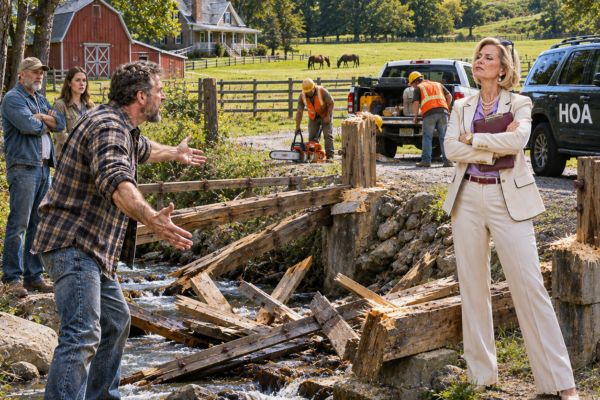
“THOSE TREES WERE BLOCKING OUR LAKE VIEW, JACK—YOU SHOULD BE THANKING ME!” HOA president Vanessa Caldwell declared as I stood beside twelve freshly cut stumps on the property my father had purchased nearly four decades earlier.
She had spent $12,000 of her neighbors’ money removing mature pine trees without my permission, ignoring both the recorded property boundary and an explicit warning from her own association’s attorney.
But six weeks later, when Vanessa came screaming toward my construction crew as the final panels of a twenty-foot-high steel building blocked the lake views of six luxury homes, I handed her a county permit dated six months before she destroyed my trees—and watched her realize exactly what she had done.
The first thing I noticed when I returned home that Monday afternoon was the sunlight.
There was too much of it.
For thirty years, the western edge of our equipment yard had been shaded by a magnificent row of mature pine trees.
Now sunlight poured across the gravel, illuminating machinery that had previously been hidden beneath their branches.
I slowed my truck.
Then I saw the stumps.
One.
Three.
Six.
Nine.
Twelve.
Every single pine my father had planted along that section of the property was gone.
A tree service truck stood near the boundary, and workers were loading the remaining branches.
Beside them stood Vanessa Caldwell, president of the Silver Ridge Homeowners Association, wearing her familiar red blazer and holding a leather folder.
She looked delighted.
I climbed out of my truck.
“Who authorized this?”
The foreman pointed toward Vanessa.
“She did.”
Vanessa folded her arms.
“The association has completed its shoreline view restoration.”
“On my property?”
“Your trees were affecting our residents.”
“Where’s my permission?”
She smiled.
“Jack, don’t turn this into another unnecessary argument. Your property finally has a beautiful view.”
I stared at the twelve stumps.
My father had been dead for four years.
I could never ask him to plant another tree.
I could never watch him standing beside those little saplings, explaining how large they would eventually become.
And this woman had destroyed them because six homeowners wanted to see more water through their living room windows.
I turned toward the foreman.
“I need your company’s information and the original work order.”
Vanessa stepped between us.
“You don’t need anything from him.”
The foreman glanced at her, then handed me his business card.
“Call our office, sir.”
“Thank you.”
Vanessa glared at him.
“The HOA is your customer!”
He looked toward the stumps.
“And apparently those were his trees.”
For a moment, nobody spoke.
Then Vanessa noticed something beyond the opening her contractors had created.
My welding shop.
The flatbed trailers.
Stacks of aluminum framing.
Dock sections.
Steel posts.
Equipment that had been concealed behind the pines for decades.
Her smile disappeared.
“What is all that?”
“My business.”
“It’s visible from Silver Ridge!”
“Now it is.”
She pointed toward the equipment yard.
“You need to install screening immediately!”
I laughed.
Not because anything was funny.
Because the absurdity of what she had just said was almost unbelievable.
“Vanessa, I had screening.”
She looked at the stumps.
Then she walked away.
I stood there for several minutes, fighting the temptation to do something foolish.
Instead, I made three telephone calls.
My attorney.
A certified arborist.
And the county planning office.
“Mr. Mercer,” the county planner said after retrieving my construction file, “your fabrication building is still approved under the original stamped plans.”
“Even if the trees have been removed?”
“Are you changing the dimensions, setbacks, drainage, or intended use?”
“No.”
“Then you can proceed according to the approved plans.”
I looked toward the cleared construction footprint.
For six months, I had postponed that project because I didn’t want to destroy my father’s trees.
Now there was nothing left to protect.
I called my contractor.
“How soon can you start?”
“Three weeks.”
“Can you make it two?”
He laughed.
“I’ll start making calls.”
Across the road, Vanessa’s neighbors were probably admiring the spectacular lake view she had obtained for them.
They had no idea that the twelve trees she destroyed had been the only thing preventing me from constructing a dark steel building measuring 120 feet long, forty feet deep, and twenty feet high.
And the county had approved it long before Vanessa Caldwell ever knocked on my door.
PART2
I spent the remainder of that afternoon documenting the damage.
The tree crew had already removed most of the branches, but the stumps remained. I photographed each one from several angles, recorded its location, and gathered copies of the photographs I had taken twelve days earlier.
Paul Hensley, my attorney, arrived just before five.
He parked beside the welding shop, stepped out of his truck, and stood looking at the western boundary.
“Good Lord, Jack.”
I handed him my phone.
“That’s what it looked like this morning.”
He studied the photograph of twelve healthy pines rising above a dense layer of lower branches.
Then he looked at the stumps.
“Did anybody contact you before doing this?”
“No.”
“Did you ever give them permission to remove even one tree?”
“No.”
“And you’ve still got the emails?”
“Every one.”
Paul nodded.
“Good. We’re going to need them.”
I showed him the contractor’s business card, the photographs of Vanessa standing beside the truck, and the information associated with the HOA’s earlier requests.
He listened carefully while I described the confrontation.
When I reached the part about Vanessa demanding that I install screening, Paul stopped writing.
“She told you to install screening?”
“After cutting down my screening.”
He removed his glasses.
“Well, that’s certainly an interesting position.”
I walked toward the largest stump.
“My father planted this one.”
Paul followed me.
I rested my hand against the rough edge.
“He used to complain that I didn’t water it enough. Said I’d regret it when the summer got hot and there wasn’t any shade.”
I smiled faintly.
“Thirty years later, I guess he was still right.”
Paul stood beside me without saying anything.
He had known my father, Daniel Mercer. In fact, Dad had been one of his earliest clients.
He understood that the damage couldn’t be measured exclusively in the market value of twelve trees.
Eventually, Paul put his notebook away.
“Jack, I know you’re angry. But I need you to be careful about everything you say and do from this point forward.”
“I know.”
“If the association tries to contact you directly about the damage, refer them to me. Don’t interfere with their property. Don’t make threats. And don’t let them turn this into a dispute about your conduct.”
I nodded.
“That’s why I called you.”
He looked toward the equipment yard.
“What did planning say about your shop?”
“That the original permit remains valid.”
Paul considered that.
“Were you seriously planning to relocate the building?”
“I’ve got the alternate engineering sketch.”
“Keep it.”
“Of course.”
“And keep every version of your construction plans. Every estimate. Every communication with the engineer about preserving those trees.”
I looked at him.
“You think she’ll accuse me of retaliation?”
Paul glanced toward Silver Ridge.
“Jack, she cut down twelve trees after being specifically told she had no permission. What do you think she’s going to say when a twenty-foot wall appears outside her neighbors’ windows?”
I understood.
Vanessa would claim I had built it to punish her.
She would tell people that I had suddenly decided to destroy their lake views.
She might even persuade them that my construction project was the real wrongdoing.
But the documents would tell an entirely different story.
And fortunately, I had something Vanessa couldn’t change.
Dates.
My father bought our twenty-seven acres on the northern shore of Lake Hartwell when I was fourteen.
Back then, the road was gravel, the nearest marina was several miles away, and most of the surrounding land belonged to people who had little interest in selling it.
Dad operated a small marine construction business.
Boat docks. Lifts. Retaining walls. Shoreline repairs.
There was nothing particularly glamorous about the work. He came home with sunburned arms, grease on his clothes, and more stories about broken equipment than anybody wanted to hear.
But he loved what he did.
On weekends, I helped him around the yard.
I learned how to carry lumber without dropping it on my feet, how to organize hardware so we didn’t spend twenty minutes searching for a missing fitting, and how to respect machinery that could seriously injure somebody who became careless.
Dad was patient with mistakes made by somebody who genuinely wanted to learn.
He was considerably less patient with arrogance.
One summer afternoon, I watched him straighten a crooked support on a dock frame.
“Looks fine to me,” I announced.
He looked up.
“You planning to be the one standing on it?”
“Sure.”
“With your mother?”
I hesitated.
He smiled.
“Then let’s make it better than fine.”
That was how Daniel Mercer taught me.
Not through speeches.
Through questions that made me consider who would eventually depend on my work.
By twenty-five, I could build a dock from a sketch. By thirty-five, I was running crews. At forty-two, Dad handed me responsibility for Mercer Marine Works.
The company grew, but it never became one of those businesses with impressive glass offices and a receptionist offering sparkling water.
Our equipment yard contained two work trucks, a flatbed, a compact excavator, welding equipment, aluminum frames, steel posts, pontoons, pallets of hardware, and the inevitable collection of unfinished projects.
To a person who understood marine construction, it was an efficient working yard.
To a luxury real estate agent, it probably looked like a personal tragedy.
Dad knew that.
That was why he planted the pines.
He wanted shade for the yard, protection from the wind, and a natural screen separating the business from neighboring properties.
“If people can’t see the mess,” he used to say, “they can’t complain about the mess.”
For thirty years, his philosophy worked beautifully.
The trees grew taller.
Their branches thickened.
Birds nested among them.
During the hottest part of summer, employees could stand beneath them and eat lunch without feeling as though they were being cooked alive.
They also softened some of the noise from the workshop.
By the time Silver Ridge was developed, the pines formed an established green boundary that had become as familiar to me as the roof of my own house.
Then somebody discovered how much money people would pay for a view of Lake Hartwell.
And suddenly, my father’s trees became a problem for people who hadn’t planted them, watered them, maintained them, or purchased the land beneath them.
Silver Ridge occupied higher ground west of my property.
The earliest houses were attractive but relatively modest. As development continued, the homes became larger and considerably more expensive.
The newest section contained six premium lake-view residences with stone facades, three-car garages, elaborate patios, outdoor kitchens, and enormous windows facing the water.
Together, those six houses represented approximately six million dollars in residential real estate.
The developers advertised beautiful lake views.
And the houses had them.
From the upper portions of their properties, residents could see Lake Hartwell beyond my trees. The pine canopy occupied part of the foreground, but the water remained visible.
Most homeowners appeared satisfied.
Some even told me they liked the trees because they couldn’t see the industrial activity on my property.
Then Vanessa became president of Silver Ridge.
Vanessa was fifty-three, impeccably dressed, and remarkably skilled at making an unreasonable demand sound like an ordinary administrative request.
She wore a red blazer to nearly every board meeting.
She carried a leather folder thick enough to suggest it contained important legal instruments, although I eventually learned that many of the documents inside it were simply copies of association policies.
Her first visit to my property began politely.
“Mr. Mercer?”
“Jack.”
“I’m Vanessa Caldwell, president of Silver Ridge.”
“I know.”
She opened the folder.
“We’ve received several homeowner concerns regarding the vegetation along your western boundary.”
I looked behind me.
“You mean the trees?”
“Yes.”
“What about them?”
“They’re interfering with protected view corridors.”
I wiped my hands on a shop towel.
“Protected by what?”
“Our architectural standards.”
I waited for her to continue.
She didn’t.
“Your architectural standards control my trees?”
“They protect community sightlines.”
“Inside Silver Ridge?”
“Correct.”
I pointed toward the boundary.
“This isn’t Silver Ridge.”
Vanessa removed a photograph from her folder. It had been taken through the large windows of one of the lake-view homes.
The pine canopy filled the bottom half of the image. Lake Hartwell stretched beyond it.
“You see the issue?” she asked.
“I see a lake.”
“The residents purchased these properties with certain expectations.”
“Then perhaps they should speak to whoever made those promises.”
She explained that the trees had grown substantially since some of the earlier development photographs were taken.
I nodded.
“Trees do that.”
Vanessa didn’t appreciate the observation.
“We’re requesting that you reduce the canopy.”
“No.”
“Not necessarily remove the trees.”
“No.”
“The association would cover the expense.”
“No.”
She closed her folder.
“Why are you being difficult?”
I looked directly at her.
“Because you’re standing on my property explaining why your association should decide what happens to my trees.”
“That’s an oversimplification.”
“It’s exactly what happened.”
She studied me for several seconds.
Then she returned to her white SUV.
I watched her drive away, believing the matter had been settled.
I had no idea that for Vanessa Caldwell, hearing the word no was apparently the beginning of a negotiation rather than its conclusion.
Two days later, an email arrived.
The subject line read Request for Vegetation Cooperation.
The message was considerably more formal than our conversation.
It described the importance of preserving the aesthetic character of Silver Ridge and requested that I participate in a cooperative maintenance initiative.
I replied with three sentences.
The trees are on my property.
My property is not part of Silver Ridge.
I do not consent to trimming, topping, or removal.
Martin Cole, the association’s treasurer, responded first.
He thanked me and said the board would confirm the boundary and any recorded rights before proceeding.
That was a reasonable response.
Twenty minutes later, Vanessa sent another message.
The association reserves all rights associated with historic maintenance and view preservation.
I read the sentence twice.
Then I forwarded the exchange to Paul.
He examined my deed, the recorded subdivision documents, and the relevant property history.
There was no scenic easement across my land.
No vegetation maintenance easement.
No recorded agreement authorizing Silver Ridge to remove trees from my property.
And my parcel wasn’t subject to its HOA covenants.
Paul prepared a letter explaining those findings.
He requested that Silver Ridge refrain from any activity affecting my trees without my written consent.
The association acknowledged receiving it.
For approximately one week, nothing happened.
Then Vanessa discovered that the same trees she previously described as an aesthetic inconvenience were supposedly dangerous.
First, she claimed they presented a fire hazard.
Then a storm hazard.
Then a drainage concern.
Finally, she suggested their root systems might threaten a retaining wall inside Silver Ridge.
A county arborist arrived after a complaint was submitted.
He introduced himself, explained why he was there, and asked whether he could inspect the trees.
“Absolutely,” I told him. “I’d appreciate it if you’d look at every one.”
He spent considerable time examining their condition.
When he finished, he told me they appeared healthy and stable, with no identified immediate hazard requiring removal.
“Could I get that in writing?”
He smiled.
“Already working on it.”
I sent the completed report to Silver Ridge.
Martin replied with a short thank-you.
Vanessa didn’t respond.
And for nearly a month, the western boundary remained peaceful.
At least, that’s what I thought.
The association’s internal conversations were considerably less peaceful.
I would eventually learn that while I was working on docks and boat lifts, Vanessa was persuading residents to allocate thousands of dollars toward removing the very screening they would soon desperately wish they still possessed.
Carol Bennett was standing beside her mailbox when I drove home one afternoon.
She waved, so I stopped.
Carol owned one of the six premium lake-view homes. She had always been pleasant to me, although we had never spoken for more than a few minutes at a time.
“Jack, can I ask you something?”
“Sure.”
She glanced toward the trees.
“Did you agree to have some of those removed?”
“No.”
Her expression changed.
“None of them?”
“None.”
She looked genuinely confused.
“Vanessa told us the association was negotiating a view restoration plan with you.”
“She approached me. I declined.”
Carol hesitated.
“We approved twelve thousand dollars for the work.”
I stared at her.
“Twelve thousand dollars?”
“Yes.”
“To work on my property?”
“She said we had maintenance rights.”
“You don’t.”
Carol looked toward the subdivision.
“Then why did we vote on it?”
“I’d like to know that myself.”
She became quiet.
I continued.
“Carol, I’m not accusing you of anything. But those trees belong to me. I’ve specifically told the association that I don’t consent to anyone trimming or removing them.”
She nodded.
“I understand.”
“Would you mind asking Martin exactly what the board authorized?”
“I will.”
Before returning to my truck, I asked whether the trees genuinely prevented her from enjoying the lake.
She looked toward her house.
“Honestly? I like the privacy they provide. My husband likes seeing more water, but we’ve never considered the trees a major problem.”
“Can you see my equipment yard from your patio?”
“Not really.”
I pointed toward the pines.
“That’s why they’re there.”
She smiled.
“That makes sense.”
I went home with a feeling I couldn’t quite shake.
Twelve thousand dollars was a substantial amount of money.
People didn’t usually approve expenditures that large for work they believed might never happen.
Somebody had persuaded the residents that the association possessed the right to proceed.
And despite Paul’s letter and the arborist’s report, the issue apparently remained active.
That evening, I walked the entire western boundary.
I photographed every tree.
Every accessible survey marker.
Every visible boundary reference.
I retrieved the latest survey from my safe and made additional copies of the relevant documentation.
I also checked the security cameras covering my work yard.
At the time, I felt slightly ridiculous.
I had spent decades living beside Lake Hartwell without believing I needed to create a photographic record proving that my trees existed.
But something about Carol’s confusion bothered me.
She was a reasonable person.
She wouldn’t ordinarily vote to spend association funds removing vegetation from somebody else’s property.
Vanessa had given her a reason to believe the work was legitimate.
I wanted to discover what that reason was before anything happened.
Unfortunately, the answer would arrive twelve days too late.
Martin invited me to the next HOA meeting.
He explained that the board intended to discuss the claimed maintenance rights and that my participation might help clarify the disagreement.
I agreed to attend.
Vanessa’s expression when I entered the clubhouse suggested Martin hadn’t consulted her.
“This is a members-only meeting.”
Martin pointed toward an empty chair.
“I invited Jack for the boundary discussion.”
“You invited him?”
“Yes.”
“Without consulting me?”
“I’m the treasurer, Vanessa. Not your assistant.”
Several residents laughed.
Vanessa didn’t.
I took the chair.
For the first twenty minutes, the meeting proceeded through ordinary business.
Landscaping expenses.
Maintenance schedules.
A discussion about replacing damaged entrance lighting.
Then Vanessa introduced the view restoration proposal.
She displayed a map on the projector.
A shaded strip extended along the edge of my parcel, encompassing the area occupied by my father’s trees.
Across the top were the words:
HISTORIC VIEW AND MAINTENANCE AREA.
I raised my hand.
“Where did that map come from?”
Vanessa glanced at me.
“Our management files.”
“Is it recorded with the county?”
“It reflects longstanding use.”
“That’s not what I asked.”
Martin looked toward her.
“I’ve already requested confirmation from management.”
She turned sharply.
“And?”
“They couldn’t identify a recorded easement.”
A resident near the front frowned.
“Does that mean we don’t have one?”
Vanessa immediately began discussing historical maintenance and the possibility of rights established through prior use.
Paul had explained that questions involving historical use could be complicated and depended on the actual circumstances. But nobody had provided evidence establishing the right Vanessa claimed.
I addressed the room.
“Who maintained my trees?”
Nobody answered.
I continued.
“My father planted them. Our business maintained them. We paid for pruning when it was necessary. We took care of storm damage.”
Vanessa pointed toward her map.
“Residents remember landscaping contractors working in this area.”
“On which side of the boundary?”
She looked irritated.
“The area has historically been treated as a shared visual corridor.”
I unfolded my survey.
“Here’s the recorded property line.”
Martin leaned closer.
I pointed toward the relevant locations.
“If branches extend across a boundary, that’s a separate issue to be addressed according to the applicable rules. It doesn’t give the association permission to enter my land and cut down the trees.”
Vanessa smiled.
“Nobody is proposing that.”
I studied her face.
“Good.”
A woman near Carol asked what would happen to the twelve-thousand-dollar budget.
Martin explained that the association should verify its rights before committing the money to work near the boundary.
Several residents agreed.
Vanessa gathered her papers.
“The board will continue evaluating the available options.”
I left the clubhouse believing I had made my position unmistakably clear.
I had spoken directly to the residents.
I had shown them the survey.
Their treasurer had acknowledged that management couldn’t locate a recorded easement.
And Vanessa herself had assured the room that nobody was proposing to remove trees from my property.
Twelve days later, I stood beside twelve stumps.
What made that meeting particularly important was that it had been documented.
The discussion appeared in the official minutes.
Martin had retained them.
And every person who attended could remember Vanessa’s assurance.
She would eventually have considerable difficulty explaining why she had made it.
The morning after the removal, the certified arborist arrived.
He examined the stumps, the remaining vegetation, photographs of the trees before they were cut, and the physical evidence available on site.
We walked the boundary together.
He documented the species, estimated ages, trunk diameters, condition, and functions of the removed trees.
They ranged from twenty-eight to thirty-six years old.
They had provided visual screening, shade, and some buffering of noise.
He explained the limitations involved in attempting to restore mature vegetation.
“We can estimate the costs of appropriate replacement and restoration,” he said. “But planting twelve young trees doesn’t immediately recreate what was here.”
I looked toward the six houses.
“How long would it take?”
“For new trees to provide comparable screening?”
“Yes.”
He shook his head.
“Years. Possibly decades, depending on the species and growing conditions.”
I knew that.
But hearing him say it made the loss feel more permanent.
I had been fourteen when my father purchased the land.
I was fifty-one now.
Even if we planted another row immediately, I might be an elderly man before it resembled the one Vanessa had destroyed.
The arborist finished his measurements and began preparing his report.
Before leaving, he glanced toward the equipment yard.
“These trees served a useful purpose.”
I nodded.
“My father knew exactly why he planted them.”
The tree company’s work order arrived later that afternoon.
I opened the email while sitting at my office desk.
The authorization identified Vanessa Caldwell, HOA president.
The scope of work was straightforward.
Remove twelve marked pine trees to restore lake view.
I stared at the words.
There was no reference to an emergency.
No mention of diseased trees.
No identified fire hazard.
No structural concern.
No drainage problem.
All those explanations Vanessa had previously offered disappeared when it came time to instruct the contractor.
She had wanted the lake view restored.
And she had written it down.
I forwarded the document to Paul.
He called almost immediately.
“Jack, that’s important.”
“I figured.”
“Preserve the original email and attachment.”
“Already done.”
He explained that he was sending Silver Ridge a formal preservation notice. The association needed to retain relevant correspondence, meeting minutes, maps, work orders, invoices, and communications with the contractor.
The notice also addressed attempts to alter descriptions of the work after the fact.
I looked toward the stumps.
“You think somebody will try to change what that invoice says?”
“I’m not making assumptions,” Paul answered. “I’m making sure everyone understands their obligations concerning the records.”
I appreciated the distinction.
By then, I had plenty of reasons to be suspicious of Vanessa.
But I wanted the facts to establish what she had done.
Not my anger.
Not speculation.
Actual evidence.
That evening, Martin called.
His voice sounded tired.
“Jack, I owe you an apology.”
“Were you involved in the removal?”
“No.”
“Did the board vote to cut down my trees?”
There was a pause.
“We approved funds for view corridor maintenance.”
“Did you authorize Vanessa to send workers across my property line?”
“No.”
“Did the board know she was planning to remove all twelve pines?”
“No.”
I sat back in my chair.
“Then keep those meeting minutes, Martin.”
“Already done.”
He sighed.
“I told her we needed to confirm the ownership and wait for legal advice.”
I became quiet.
“What did your attorney say?”
Martin hesitated.
“I’m going to make sure the relevant records are preserved and provided through the appropriate process.”
“Fair enough.”
He continued.
“I know an apology doesn’t bring your trees back.”
I looked through the office window.
“No. It doesn’t.”
After hanging up, I remained at my desk for several minutes.
The fabrication building plans were still rolled up on a shelf above my computer.
I took them down.
For months, I had been trying to find a way to construct that building without sacrificing my father’s trees.
Now the original location was clear.
And unlike the people who had removed the trees, I already possessed the professional drawings and government approval necessary to proceed with my project.
Mercer Marine Works needed the new fabrication building long before Vanessa became interested in my property.
Our projects had become larger.
Customers were requesting more substantial dock systems and increasingly complicated aluminum assemblies.
Working outdoors created scheduling problems. Rain delayed welding and assembly. Wind made handling large components more difficult. Materials sometimes needed to be moved repeatedly because we lacked enough protected workspace.
The existing shop was functional, but it had become too small for the volume of work we were handling.
I had been discussing an expansion with our engineer for more than a year.
The original proposal called for a steel-framed fabrication building measuring 120 feet long and forty feet deep, with a twenty-foot western elevation.
Inside, we would have two welding bays, material storage, overhead lifting equipment, and a covered assembly area large enough to build substantial dock sections.
It wasn’t designed as a wall.
It wasn’t designed to interfere with anybody’s view.
It was designed to help our employees do their jobs more safely and efficiently.
The proposed location near the western boundary worked well for several reasons.
Delivery trucks could reach it without awkward maneuvering.
The existing yard layout could remain largely unchanged.
The drainage arrangements were practical.
And the building complied with the applicable setbacks identified in the approved plans.
There was only one significant problem.
My father’s trees.
Although the proposed building itself met the applicable boundary requirements, excavation and foundation work could threaten the root systems of several pines.
I had asked the engineer to investigate an alternative location farther east.
He prepared a revised concept showing how the building could be shifted.
The alternative was possible, but it presented disadvantages.
More grading.
A longer electrical connection.
Less convenient movement of trucks and equipment.
Additional expense.
We hadn’t finalized the revised design or obtained approval for that alternative.
Still, I was willing to consider it because I wanted to preserve the trees.
I remembered explaining that decision to one of my employees.
“Boss, you’re going to spend all that extra money to save some pine trees?”
I nodded.
“That’s the idea.”
He looked toward the boundary.
“Must be pretty special trees.”
“They are.”
He smiled.
“Fair enough.”
After Vanessa destroyed them, the primary reason for considering the alternate location no longer existed.
I discussed the situation with the engineer.
We reviewed the original approved site plan and the changed physical conditions.
Then I called county planning to confirm whether proceeding exactly according to the stamped plans would require an amendment.
The planner asked whether we intended to modify the building’s dimensions.
“No.”
“The use?”
“No.”
“The drainage arrangements?”
“No.”
“The required setbacks?”
“No.”
He reviewed the file.
“Then proceed according to the approved plans.”
I thanked him.
And that was the beginning of the construction project Vanessa would later insist I had invented to punish her.
The problem with her accusation was that the paperwork told a remarkably consistent story.
The engineering concept existed before her first complaint.
The original permit had been issued six months before the trees were removed.
The alternate sketch exploring tree preservation had been prepared seven months earlier.
And the building’s commercial purpose was evident from the operations taking place on my property every working day.
If I had wanted to build something solely to annoy Vanessa, I could have considered dozens of absurd ideas.
Instead, I built exactly what my business already needed.
That distinction would become particularly important when she finally stood in front of forty angry homeowners and attempted to explain why their lake view had disappeared.
The contractor mobilized two weeks after the tree removal.
The first stage involved excavation and foundation work.
Trucks arrived.
Materials were delivered.
The equipment yard became busier than usual.
For the first few days, Silver Ridge appeared relatively unconcerned.
The residents still possessed the unobstructed view Vanessa had promised them.
Their enormous windows looked across my newly exposed equipment yard toward Lake Hartwell.
I wondered how many appreciated seeing our work trucks, stacked frames, and unfinished dock components in the foreground.
On the third day of construction, the first steel columns arrived.
Carol noticed them.
She walked toward the boundary while I was reviewing a delivery.
“Jack?”
“Morning.”
“What are you building?”
“A fabrication shop.”
She looked at the steel.
“It’s going to be a fairly substantial building, isn’t it?”
“One hundred twenty feet long.”
Carol stared.
“How tall?”
“Twenty feet on this side.”
She looked toward her house.
Then she looked at the steel columns again.
“Twenty feet?”
“That’s the approved elevation.”
She took a few seconds to consider what the building would look like from her patio.
“Vanessa is going to lose her mind.”
I smiled faintly.
“She can contact county planning.”
Carol looked at the open ground where the trees had stood.
“Were you always going to build it here?”
“This was the original location.”
“Before the trees were removed?”
“Yes.”
She appeared confused.
“I never heard anything about a building.”
“It’s been approved for months.”
Carol looked back toward Silver Ridge.
For a moment, neither of us spoke.
Then she asked the question I wished Vanessa had asked before commissioning the removal.
“Would the trees have hidden it?”
“Most of the western elevation, yes.”
Carol closed her eyes briefly.
“Oh, Jack.”
I nodded.
“Exactly.”
She thanked me for explaining the project and walked home.
I returned to work.
There was no need to make an announcement.
No need to post photographs in the Silver Ridge Facebook group.
No need to drive through the development telling people what their president had accomplished.
The building would become visible soon enough.
And every additional column would make the consequences of Vanessa’s decision a little more difficult to ignore.
By the end of the week, the steel frame was visible from all six lake-view homes.
Several homeowners began watching the construction from their patios.
One approached our contractor and asked whether the structure was temporary.
Another wanted to know whether the roof would be completed at its current height.
The contractor referred questions concerning the project to me.
I answered politely when people approached.
I explained that Mercer Marine Works was expanding its fabrication facilities and that the project was being constructed under existing county approval.
Most residents appeared disappointed, but they understood what I was saying.
Then the exterior panels arrived.
Dark charcoal steel.
Matte finish.
Practical, durable siding appropriate for an industrial fabrication building.
The material was neither reflective nor unusually decorative.
From inside my equipment yard, it looked like an attractive new workshop.
From Silver Ridge, it looked like a very large change to the landscape.
The first panels covered the lower portion of the western elevation.
Then additional panels were installed.
Eight feet.
Twelve.
Sixteen.
Twenty.
Across a length of 120 feet, the building gradually replaced the open view Vanessa had created.
I was operating our forklift near the material staging area when I heard shouting.
“STOP! YOU CAN’T PUT THAT THERE!”
I looked toward the road.
Vanessa was approaching rapidly, wearing her red blazer and carrying a stack of documents in one hand and her telephone in the other.
My contractor looked at me.
“Friend of yours?”
“Something like that.”
I secured the equipment and climbed down.
“Morning, Vanessa.”
She pointed toward the steel panels.
“This violates Silver Ridge’s architectural standards!”
“I’m not in Silver Ridge.”
“You’re blocking a protected lake view!”
“You haven’t established a recorded view easement.”
She shook her head.
“This is clearly retaliatory.”
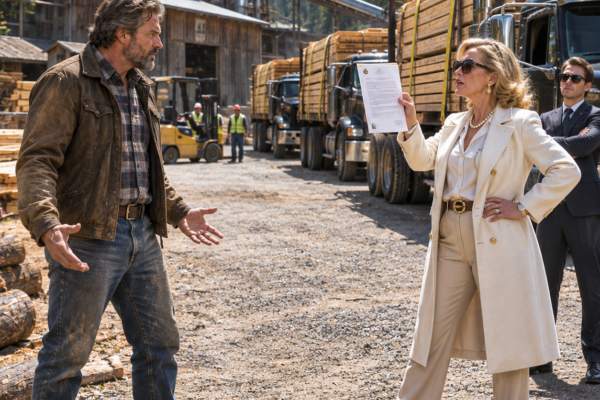
I walked toward my truck and retrieved a copy of the stamped county permit.
Vanessa stared at it.
“What is that?”
“Building permit.”
“I don’t care about your permit!”
“You probably should.”
She pointed toward the western elevation.
“You cannot construct a twenty-foot barrier just to punish our residents!”
“It’s not a barrier.”
“THAT IS A WALL!”
“Yes. It’s the exterior wall of a fabrication building.”
She looked at me with extraordinary frustration.
“You’re playing games.”
I handed her the first page of the permit.
“Look at the issue date.”
She glanced at it.
Then looked more carefully.
Then turned the page.
For several seconds, she appeared unable to reconcile what she was seeing with the accusation she had prepared.
“This was issued six months ago.”
“Yes.”
“You already had approval?”
“Yes.”
“You were already planning to build this?”
“Yes.”
She looked toward the building.
“And you never told us?”
I shrugged.
“Why would I notify your HOA about a properly approved construction project on property outside its jurisdiction?”
“Because it affects our homes!”
“So did my trees.”
She stared at me.
I continued.
“I was considering moving the building farther east. The engineer prepared an alternate location.”
Vanessa suddenly looked hopeful.
“Then move it!”
“I was considering doing that before the trees were removed.”
“Why?”
“To save them.”
Her expression changed.
I pointed toward the original construction footprint.
“The alternate design required more grading, a longer electrical connection, and less efficient truck access. I was willing to spend the additional money because I didn’t want to damage the root systems.”
Vanessa looked toward the places where the pines had stood.
Then she looked up at the dark steel.
“You’re saying that if we hadn’t removed the trees—”
“I might have relocated the building. But once the trees were gone, there was no longer a reason to incur the additional expense.”
She opened her mouth.
Nothing came out.
My contractor stood nearby, listening quietly.
Vanessa looked at the permit again.
Then she handed it back.
“We’ll stop this.”
“Contact planning.”
“I intend to!”
“Good.”
She turned toward the road.
I called after her.
“Vanessa?”
She stopped.
I pointed toward the building.
“You wanted the trees gone.”
For the first time since she had arrived, I smiled.
“Enjoy the view.”
She marched back toward her SUV.
I returned to the forklift.
My contractor shook his head.
“I take it she’s the reason we’re building at the original location.”
“Pretty much.”
He laughed.
“That’s an expensive way to discover what trees do.”
I thought about the stumps.
Then I looked toward the unfinished wall.
Vanessa had obtained her unobstructed view of Lake Hartwell for approximately two weeks.
What she hadn’t understood was that the trees had been blocking two different things.
The lower portion of her neighbors’ lake view.
And my business.
She had removed the screen without considering what would happen when the screen was gone.
Now she was looking directly at the consequences.
Vanessa began calling county departments before she reached home.
Planning.
Zoning.
Code enforcement.
The fire marshal.
Her complaints covered practically every aspect of the fabrication building.
Height.
Setbacks.
Drainage.
Commercial use.
Visual impact.
Emergency access.
Possible deviations from the permitted design.
I didn’t object to the relevant departments reviewing our work. We were building under approved plans, and independent inspections were an ordinary part of a substantial construction project.
But I resented the fact that Vanessa appeared to be using every available administrative process to interfere with our operations simply because she disliked the building.
Paul advised me to cooperate fully and retain copies of the findings.
“She’s entitled to make a complaint,” he said. “And you’re entitled to have it evaluated on the facts.”
I followed that advice.
The most dramatic complaint produced a visit from a county code officer named Reynolds.
Our crew was preparing to install the remaining exterior wall sections when his vehicle entered the yard.
He stepped out carrying a clipboard.
“Who’s responsible for the site?”
I approached him.
“I am.”
He explained that the county had received an allegation that the structure deviated from the approved height and setback requirements.
Until the relevant information could be checked, he requested that the construction activity in question pause.
My contractor looked at me.
“What do you want to do?”
“Stop.”
The drills went silent.
One worker climbed down.
Another returned a panel to the designated staging area.
The crew waited while Reynolds prepared to examine the site.
Across the road stood Vanessa Caldwell.
She was beside her white SUV, holding her telephone and smiling.
She looked like a woman who had just persuaded the county to order the demolition of an entire building.
I looked at my contractor.
“Everybody gets a break.”
He shrugged.
“Coffee sounds good.”
Reynolds reviewed the stamped construction documents.
He examined the relevant foundation locations and measurements.
He checked the approved setback information.
Then he examined the western elevation.
Vanessa approached from the public road.
“Officer, I’m glad you’re finally addressing this.”
Reynolds looked up.
“I’m conducting a review.”
She pointed toward the steel frame.
“The approved structure was never supposed to be twenty feet high along this boundary.”
He examined the drawing.
“It says twenty feet.”
“The owner changed the design after the vegetation was removed.”
I remained silent.
Reynolds checked another sheet.
“The permit was issued six months ago.”
Vanessa answered immediately.
“That doesn’t mean this specific elevation was approved.”
Reynolds pointed toward the relevant notation.
“Western elevation. Twenty feet.”
She stared at it.
Then she changed the subject.
“What about the setback?”
He reviewed his measurements.
“Compliant.”
“The buffer requirements?”
“Compliant.”
“Commercial construction beside expensive residential properties?”
He explained that the parcel had an established lawful commercial use and that the approved project related to that use.
Vanessa looked toward me.
“This is obviously retaliation.”
Reynolds closed his document folder.
“That’s not a code category.”
I looked down at my boots.
It took considerable effort not to laugh.
Reynolds turned toward my contractor.
“You can continue.”
My contractor nodded.
“Thank you.”
The equipment started again.
Workers returned to their positions.
Another steel panel was lifted into place.
Vanessa remained beside the road, staring at the building as the dark western elevation became more complete.
For approximately forty-five minutes, she had managed to interrupt the work.
She had apparently believed that interrupting it meant she had won.
Instead, the county had inspected the project and confirmed its compliance with the requirements she challenged.
Reynolds gave me a copy of the inspection findings.
No violation requiring further suspension.
No identified setback deviation.
Approved height confirmed.
I thanked him and carried the document into my office.
Paul received a copy that afternoon.
His response was brief.
“Excellent. Add it to the file.”
I looked toward Silver Ridge.
Vanessa’s SUV was gone.
The construction crew was working again.
And the president who wanted to prove that my building was illegal had just obtained another government record establishing that it wasn’t.
Over the following two weeks, her other complaints produced much the same result.
The relevant officials reviewed the building height.
The setbacks.
The drainage arrangements.
The permitted use.
The emergency access considerations.
The findings didn’t support the violations Vanessa alleged.
Still, she refused to reconsider her position.
Instead, she began communicating directly with Silver Ridge residents.
Carol forwarded me one of her emails.
The owner has exploited recent vegetation changes to construct an industrial barrier inconsistent with the historic character of our lakefront community.
I read the sentence several times.
Then I forwarded it to Paul.
His reply contained two words.
Keep it.
I printed a copy and placed it in the folder.
Vanessa’s reference to the historic character of the lakefront was particularly interesting.
My family’s marine construction business had operated beside Lake Hartwell for decades.
The trees she had removed predated the six luxury homes.
The building she objected to served an established commercial operation.
Yet she described the industrial use as though it had appeared unexpectedly in a neighborhood that previously contained nothing but expensive houses.
The truth was precisely the opposite.
Silver Ridge had been developed beside Mercer Marine Works.
Its builders had taken advantage of the beautiful surroundings, including the mature trees that screened our equipment yard.
And some of its newest residents had purchased homes with the reasonable expectation that they could enjoy the scenery.
What they couldn’t reasonably expect was that purchasing a house gave them control over every property visible through its windows.
I understood their disappointment.
If somebody spends nearly a million dollars on a house because they love looking toward a lake, discovering that the view has changed can be upsetting.
But their disappointment didn’t make my trees theirs.
And it didn’t eliminate my right to pursue a properly approved expansion of my business.
I hoped they would eventually understand that.
Unfortunately, Vanessa was still doing everything she could to convince them that I was the problem.
She would have been considerably more successful if her own emails hadn’t existed.
The claim concerning the trees moved into formal mediation.
Paul explained that obtaining the relevant records would help establish what the association had authorized, what its officers knew, and what representations had been made to the tree service company.
I wanted compensation for the documented loss and restoration work.
I also wanted written recognition of the actual boundary arrangements, so another association president couldn’t resurrect Vanessa’s historic maintenance argument five years later.
Paul understood.
“Getting paid for the damage matters,” he told me. “But preventing the same dispute from recurring matters, too.”
I agreed.
The insurance companies became involved.
Attorneys requested documents.
The association gathered its relevant records.
And eventually, the correspondence surrounding the tree removal began emerging.
The first important email came from Martin Cole, approximately three weeks before the cutting.
We do not have confirmation that the view corridor extends onto Mercer property.
Vanessa responded by claiming that the vegetation had historically been maintained as part of the community view.
Martin answered that historical maintenance did not establish ownership and that the association should wait for legal advice.
Two days later, Susan Blake, the HOA’s attorney, provided that advice.
The warning was direct.
The association should not authorize tree removal beyond its confirmed property boundary without the written consent of the owner.
There was no complicated language that required an expert to interpret.
No ambiguity concerning whether somebody could remove twelve mature pines from an adjoining parcel simply because a board wanted more attractive views.
Don’t authorize the work without establishing the boundary and obtaining permission.
That should have been the end of the matter.
Instead, five days later, Vanessa sent an email to the tree company.
She instructed its personnel to proceed with the twelve marked pines and attached HOA authorization.
No written consent from me.
No survey establishing control of the work area.
No approval from the association’s attorney.
The contractor responded with a question.
Please confirm Silver Ridge owns or controls the work area.
Vanessa answered with one word.
Confirmed.
I sat at my desk staring at that word.
Confirmed.
I thought about the foreman standing beside the truck on the day I returned home.
He had looked uncomfortable when I asked whether anybody had verified ownership.
He told me his customer had marked the work area.
Now I understood exactly what information his company had received.
Vanessa had been asked a clear question concerning its authority to carry out the work.
She had supplied a clear answer.
And that answer was contradicted by the documents in her possession and the instructions provided by her own attorney.
Paul called while I was reviewing the correspondence.
“What do you think?”
I looked toward the stumps.
“I think she knew.”
He became quiet.
“The records certainly raise serious problems with her claim that this was an innocent misunderstanding.”
I returned my attention to Martin’s email.
He had specifically told her to wait.
Susan had specifically told her not to authorize removal without permission.
The contractor had specifically asked whether Silver Ridge controlled the work area.
At three separate points, Vanessa had been given an opportunity to avoid destroying my trees.
She had disregarded all three.
And now she was telling residents that the fabrication building was an act of retaliation.
Paul allowed me a moment to collect myself.
Then he said, “The association needs to address this with its members.”
I nodded.
“They’re going to be furious.”
“Yes.”
I looked at the twelve locations marked on the arborist’s report.
“They should be.”
Martin called an emergency association meeting.
Approximately forty residents attended.
Many of them lived outside the six premium lake-view homes, and some had previously expressed little interest in the dispute.
They had assumed it concerned a few wealthy neighbors who wanted a better view.
Now they were hearing that association funds had been spent on potentially unauthorized work and that Silver Ridge faced a substantial claim for damage to private property.
Suddenly, everybody wanted to know what their president had approved.
I sat in the second row with Paul.
Carol was near the front.
Susan Blake, the association’s attorney, sat at the end of the board table.
Martin had brought the relevant correspondence, meeting records, and construction documents.
Vanessa arrived wearing her red blazer.
She placed her leather folder on the table and looked around the room.
“Thank you for attending. Tonight, we need to address the retaliatory industrial structure Mr. Mercer has erected beside our community.”
Martin interrupted her.
“No, Vanessa. Tonight we’re addressing the unauthorized removal of trees and the association’s potential liability.”
She looked at him.
“The issues are directly connected.”
“Yes,” Martin replied. “They are.”
Vanessa appeared relieved.
Then he continued.
“Because if the trees were still standing, most residents would barely be able to see the structure.”
The room became silent.
Carol raised her hand.
Vanessa sighed.
“Carol, we need to proceed in an orderly manner.”
“I want something entered into the meeting record.”
Martin nodded.
“Go ahead.”
Carol stood.
“I live directly across from Jack’s property. Before the trees were cut down, I couldn’t see his equipment yard from my patio.”
Another homeowner spoke.
“Neither could we.”
A third nodded.
“Same at our place.”
Vanessa looked toward them.
“The trees were obstructing the lake view these properties were marketed as having.”
Carol shook her head.
“We already had a lake view.”
“Not the view represented in the sales materials.”
A man near the back raised his voice.
“Then that’s a problem with whoever sold the houses!”
Several residents agreed.
Vanessa opened her folder.
“We have a responsibility to protect the value of every property in this community.”
Martin looked directly at her.
“We also have a responsibility not to spend association funds damaging property we don’t own.”
Applause broke out.
Vanessa’s expression hardened.
She waited until the room became quiet again.
Then she began discussing the association’s historic maintenance argument.
Martin turned on the projector.
The first email appeared behind the board table.
His warning concerning the absence of confirmed maintenance rights.
Then the response from the association’s attorney.
The instruction not to authorize removal outside the confirmed boundary without the property owner’s written consent.
I watched the residents read it.
One man removed his glasses.
Another leaned toward his wife and whispered something.
Vanessa stared at the screen.
“That’s part of a much broader discussion.”
Martin advanced to the next message.
Her instruction to the contractor to remove the twelve marked pines.
Then the contractor’s question.
Please confirm Silver Ridge owns or controls the work area.
Martin displayed Vanessa’s response.
Confirmed.
Nobody spoke.
The word remained on the screen.
I had spent weeks explaining to people that the association had no demonstrated right to cut my trees.
Vanessa had spent weeks describing the dispute as a complicated disagreement about historical use, community expectations, and the meaning of property boundaries.
Now forty people were looking at a question so simple that even a child could understand it.
Did you have the right to authorize this work?
She had said yes.
Susan Blake folded her hands.
“Mrs. Caldwell, I need to ask you some direct questions.”
Vanessa crossed her arms.
“Fine.”
“After receiving written advice not to authorize tree removal beyond the confirmed association boundary without owner consent, why did you represent to the contractor that Silver Ridge controlled Mr. Mercer’s land?”
Vanessa glanced toward Martin.
Then toward the residents.
“Our maintenance history supported the association’s position.”
Susan waited.
“Did you possess Mr. Mercer’s written permission?”
Vanessa shifted in her chair.
“No.”
“Did you identify a recorded scenic easement or vegetation easement permitting the work?”
“We believed the longstanding circumstances—”
“That wasn’t my question.”
Vanessa stopped.
Susan repeated it.
“Did you identify a recorded easement?”
“No.”
“Did the board specifically authorize you to represent to the contractor that Silver Ridge owned or controlled Mr. Mercer’s land?”
Vanessa looked at Martin.
He didn’t answer for her.
The other board members remained silent.
Finally, she said, “No.”
Susan nodded.
“Thank you.”
She made a note.
A woman sitting near Carol whispered, “Oh, my God.”
Another resident asked whether the association’s insurance would cover the claim.
A third wanted to know why the board hadn’t been informed of the contractor’s question.
Vanessa looked around the room.
Her familiar confidence was beginning to disappear.
Then she pointed toward me.
“AND WHAT ABOUT WHAT HE DID?”
People turned.
She continued.
“He built a twenty-foot industrial wall after our view restoration project was completed!”
Susan took a breath.
“The building permit predates the tree removal.”
“He didn’t have to build it there!”
For the first time that evening, I stood.
“No,” I said.
Everyone looked toward me.
Vanessa appeared surprised.
I continued.
“I didn’t.”
I handed Martin a copy of the alternate engineering sketch.
He placed it on the projector.
The drawing showed the fabrication building shifted farther east than the original approved location.
The tree line remained intact.
Additional grading areas were identified.
The proposed utility connection was longer.
The truck circulation arrangement was less convenient.
At the bottom of the drawing was a date.
Seven months before the trees were cut.
Martin looked at it.
“Jack, what exactly is this?”
“An alternative location I asked my engineer to investigate.”
“Why?”
“To preserve the trees.”
Several residents turned toward Vanessa.
I pointed toward the original western boundary.
“My father planted those pines. Some of the root systems would have been threatened by the excavation required for the original design. I wanted to see whether moving the building would allow us to keep them.”
Martin studied the drawings.
“This alternative would have cost you more money?”
“Yes.”
“And you were considering that expense voluntarily?”
“Yes.”
Carol stood again.
“So if our association hadn’t removed the trees, the building might have been farther away from our houses?”
“That’s correct.”
Vanessa immediately interrupted.
“Might have been! He said might!”
I looked at her.
“Yes, Vanessa. Might.”
She opened her mouth.
I continued.
“I’m not going to exaggerate just because the truth is inconvenient.”
The room became quiet.
“We hadn’t finalized or obtained approval for the alternate design. But I was seriously considering it because those trees mattered to me.”
I pointed toward the original approved plan.
“Once they were removed, the reason for considering the additional expense disappeared.”
Martin placed the original site plan beside the alternate sketch.
People could see both drawings simultaneously.
On one, the fabrication building occupied its approved western location.
On the other, it stood farther east, with the pines still providing a natural screen.
The difference was obvious.
For several seconds, Martin simply looked at the screen.
Then he slowly turned toward Vanessa.
“Let me make sure everybody understands this.”
She looked down.
“The association spent twelve thousand dollars removing trees that had been concealing an established business next door.”
Nobody answered.
“And by removing those trees, we eliminated the primary reason Jack was considering relocating his already permitted fabrication building.”
Vanessa shook her head.
“You’re making this sound as though we’re responsible for his construction decisions.”
Martin pointed toward the drawings.
“We’re responsible for our own decision to cut down his trees.”
Carol looked at the images.
Then she said something that captured the entire situation more clearly than any of the legal documents had managed to do.
“We traded trees for steel.”
The room erupted.
Residents began speaking simultaneously.
One man demanded to know how much the association would owe.
A woman complained that her family had trusted Vanessa’s assurances.
Another homeowner asked whether the board could recover any of the unauthorized expenditure.
Martin requested order.
But for Vanessa, the most devastating part of the evening had already occurred.
The residents understood.
They understood why the trees had existed.
They understood why my fabrication building was located where it was.
They understood that its approval predated their view restoration project.
And they understood that Vanessa’s decision had produced precisely the opposite of what she promised.
For two weeks, they had enjoyed more visible water.
Now they were looking at dark steel.
And every time they opened their curtains, they would see the consequences of a decision their president had insisted was necessary to protect their property values.
The vote concerning Vanessa’s presidency took place that evening.
The board had heard Susan’s assessment of the situation. Its members had reviewed the available correspondence and the information presented during the meeting.
Four directors voted to remove Vanessa from the presidency.
One voted against.
Vanessa herself.
She remained seated after Martin announced the result.
Her leather folder was closed.
The red blazer that had once made her seem so imposing suddenly looked like an ordinary piece of clothing.
Martin became interim president.
His first motion suspended discretionary landscaping activity along the association’s external boundaries until the relevant surveys, easements, and permissions could be verified.
His second authorized the association’s attorney and insurer to pursue an appropriate resolution of my tree claim.
Vanessa looked at him.
“This is surrender.”
Martin shook his head.
“No, Vanessa. It’s math.”
Several residents laughed.
Others simply looked relieved.
Martin explained that every additional dispute would create further costs. The association needed to understand its actual obligations, resolve the damage claim, and avoid exposing its members to unnecessary expenses.
It couldn’t recover the old trees by pretending their removal had been authorized.
It couldn’t make the fabrication building disappear by submitting the same unsuccessful complaints repeatedly.
And it certainly couldn’t improve its financial position by continuing to argue against the property records.
As the meeting ended, Carol approached me.
“Jack, I’m so sorry.”
I shook my head.
“You didn’t send the contractor.”
“No. But I voted for the money because I believed what Vanessa told us.”
She looked toward the empty projector screen.
“I should’ve asked more questions.”
I appreciated her honesty.
“Carol, people trust the individuals they elect. That’s normal.”
She nodded.
“But we should still pay attention.”
“Definitely.”
She looked toward the clubhouse windows.
From where we stood, the fabrication building wasn’t visible.
But I knew what she would see when she returned home.
“Do you hate us?” she asked suddenly.
The question surprised me.
“No.”
She swallowed.
“Some of the residents have been saying that you’re punishing the entire neighborhood.”
I shook my head.
“I’m building a workshop. That’s all.”
She looked at me for a moment.
Then she nodded.
“I know.”
Before leaving, I stopped beside Martin.
He looked exhausted.
“Sorry it took this long, Jack.”
I offered my hand.
“Let’s just get it resolved.”
He shook it.
“We will.”
Outside, Paul and I walked toward our vehicles.
The evening air was cool, and lights were beginning to come on inside the Silver Ridge houses.
Paul glanced toward the development.
“Feeling better?”
“A little.”
He smiled.
“That’s a fairly significant result.”
I looked toward the distant line of the new building.
“I’d still rather have my trees.”
He nodded.
“I know.”
And that was the part of the story nobody in the clubhouse could fully resolve.
Vanessa had lost her presidency.
The association had finally acknowledged what happened.
But twelve mature pines couldn’t be restored by a four-to-one vote.
The settlement took another two months.
There were meetings between attorneys, communications with the insurers, reviews of the arborist’s findings, and discussions about the financial obligations associated with restoring the affected property.
Nobody handed me a multimillion-dollar check.
Nobody purchased me a mansion.
Real property disputes rarely end with the extravagant financial outcomes people imagine when they first hear about them.
The tree company’s insurer paid part of the settlement. The association’s insurer covered part, subject to its policy terms. Silver Ridge absorbed legal and professional expenses that weren’t covered.
The final arrangements addressed the documented tree loss, restoration costs, surveying, and related expenses.
Paul reviewed the documents with me before I signed.
“Are you satisfied with the financial terms?”
I nodded.
“They’re reasonable.”
He turned to another page.
“And this is the acknowledgment concerning the association’s claimed property rights.”
I read it slowly.
Silver Ridge acknowledged that it possessed no vegetation easement, scenic view easement, or maintenance easement over the affected portion of my property.
There would be no future reliance on the internal map describing my land as a historic view and maintenance area.
The actual recorded boundaries would be respected.
Appropriate permanent boundary markers would be installed.
I looked at Paul.
“This is the important part.”
He smiled.
“I thought you might say that.”
The financial settlement compensated me for documented damage.
But that written acknowledgment addressed something that could otherwise have caused problems for years.
When the next president took office, the association wouldn’t be able to claim that the property arrangement was uncertain simply because somebody had found another old landscaping map.
The issue had been investigated.
The relevant documents had been reviewed.
And Silver Ridge had formally accepted the limits of its authority.
I signed.
Then I asked Paul whether we could discuss one more thing with Martin.
“What have you got in mind?”
“Trees.”
He looked at me.
“More trees?”
I nodded.
“I want some of the screening restored.”
Martin visited my property the following week.
He arrived without a clipboard, without a stack of violation notices, and without any explanation of why his association was entitled to control the appearance of my land.
I appreciated the change.
We walked beside the fabrication building.
The construction was nearly complete.
From the western side, the dark charcoal siding formed a clean, uninterrupted industrial elevation.
Martin looked up at it.
“That’s a substantial building.”
“It needed to be.”
He nodded.
“Carol says the inside is going to be impressive.”
“Hopefully.”
We continued toward the open ground north of the structure.
I showed him where new evergreens could be established without interfering with the workshop, its foundations, or the other requirements of the property.
Martin appeared surprised.
“You really want us to replace some of the screening?”
“Yes.”
“After everything that’s happened?”
“Especially after everything that’s happened.”
He looked toward the six houses.
“I thought you might prefer leaving the building completely exposed.”
I shook my head.
“Martin, I never wanted it to be exposed.”
He studied the proposed planting area.
“I guess that’s what some people still don’t understand.”
I smiled faintly.
“The trees weren’t an inconvenience to me. They were an inconvenience to Vanessa.”
We discussed appropriate native evergreen species and arrangements for establishing them where they could grow without creating conflicts with existing infrastructure.
The association agreed to the restoration.
A little later, the young trees arrived.
They looked painfully small.
I stood beside them as the planting work was completed, remembering the old photographs of my father beside the original saplings.
The new trees didn’t provide meaningful screening yet.
Their branches were nowhere near the height of the old pines.
But they were alive.
And eventually, they would become part of the landscape.
Carol came over after the planting.
She looked at the young evergreens.
“It’s strange seeing them this small.”
I nodded.
“The old ones started somewhere, too.”
She smiled sadly.
“I hope they grow quickly.”
“So do I.”
She looked toward the western elevation of the workshop.
Then she said, “I think I’ll plant a few trees near our patio.”
“That’s probably a good idea.”
She laughed.
“Imagine that. After all this, we’re paying to put trees back.”
I smiled.
“Your property. Your decision.”
Carol nodded.
“Exactly.”
The fabrication building was completed on schedule.
One hundred twenty feet long.
Forty feet deep.
Twenty feet high along its western elevation.
Dark charcoal steel.
Inside, it was everything Mercer Marine Works had needed for years.
The two welding bays gave our employees room to work without constantly rearranging equipment.
The overhead lifting equipment made handling substantial assemblies more practical.
Materials could be stored under cover.
Dock sections could be fabricated indoors instead of being repeatedly moved whenever the weather changed.
On our first full day of operating inside the completed shop, I stood near the entrance watching two employees position a large aluminum frame.
One of them looked toward me.
“Boss, why didn’t we do this five years ago?”
I laughed.
“Because five years ago, I wasn’t ready to pay for it.”
He looked around.
“Worth it.”
I nodded.
“It should be.”
Another employee approached carrying a cup of coffee.
“Pretty fancy for Mercer Marine Works.”
I smiled.
“Don’t get used to it. The coffee’s still terrible.”
He laughed and returned to his work.
As the morning continued, I began recognizing the practical improvements we had achieved.
Jobs that previously required considerable rearrangement could proceed more efficiently.
The new assembly space reduced conflicts between different activities in the old yard.
The employees appreciated being able to work indoors during bad weather.
And our customers benefited from a more dependable production schedule.
The building was fulfilling its intended purpose.
That was enormously satisfying.
It also made Vanessa’s continuing description of it as a retaliatory wall seem increasingly absurd.
Nobody standing inside that building would have mistaken it for a structure erected solely to block a view.
There were welders working.
Materials being delivered.
Dock sections being assembled.
Employees earning their wages.
A legitimate business doing the work it had existed to perform for decades.
I thought about Dad.
He would have loved seeing the new workspace.
He probably would have walked through every bay, examined every detail, and found at least three things he believed we should have done differently.
Then he would have stood beside me with a cup of coffee and quietly admired what we had built.
I wished he could have been there.
Especially on the afternoon when sunlight reached through the open workshop entrance and illuminated the first completed dock assembly.
It was a good day for Mercer Marine Works.
I would have liked to share it with him.
Silver Ridge took considerably longer to appreciate the new building.
At first, some residents complained every time they saw it.
Curtains appeared in windows that had previously been left uncovered.
Several homeowners began investigating landscaping options.
Carol planted three trees near her patio.
Another family installed a pergola.
Gradually, people adapted.
The lake was still there.
Their homes were still beautiful.
Their families could still enjoy the neighborhood.
Nobody had lost the ability to visit Lake Hartwell.
They simply couldn’t see as much water from certain windows as they had during the brief period between the destruction of my trees and the completion of the fabrication building.
And eventually, that disappointment became part of ordinary life rather than the subject of every neighborhood conversation.
Something interesting happened as Silver Ridge adjusted to its new leadership.
Martin began communicating more openly about association expenditures and maintenance arrangements.
Residents asked more questions.
The directors became more careful about approving work near external boundaries.
A project affecting somebody else’s property was no longer treated as something the association could authorize merely because a few homeowners considered it desirable.
People discovered that managing a neighborhood didn’t require winning every disagreement.
Sometimes it required acknowledging that another person had rights, interests, and responsibilities that differed from their own.
Vanessa remained on the board until the next election.
She attempted to regain support through a campaign email explaining that she had been punished for defending community standards.
Carol forwarded it to me.
I read the message, shook my head, and replied:
Which community standard covers cutting down trees you don’t own?
Carol responded with a laughing emoji.
That was about as close as I came to celebrating Vanessa’s political difficulties.
When the votes were counted, she lost badly.
The residents had apparently decided they preferred leadership that verified property rights before sending contractors across boundaries.
I couldn’t blame them.
They had learned an expensive lesson.
And unlike their former president, most appeared willing to remember it.
Approximately six months after the fabrication building was finished, a familiar white SUV stopped near the road.
I was loading aluminum railing sections when Vanessa stepped out.
She wasn’t wearing her red blazer.
There was no leather folder beneath her arm.
No board members accompanied her.
She walked toward one of the permanent boundary markers and stopped.
I finished what I was doing, then approached her.
“What do you need?”
She looked past me at the fabrication building.
“You really are leaving that there.”
I glanced toward it.
“It’s a building, Vanessa.”
“You know what I mean.”
“Yes.”
For a moment, she simply stood there.
Then she looked toward the newly planted evergreens.
“They’ll take years to grow.”
“Yes.”
“The old trees were taller than the houses.”
“They were.”
She studied the young branches.
I waited.
Finally, she spoke.
“I didn’t think the contractor would remove all twelve.”
I looked at her.
“The work order said twelve.”
“I know what it said.”
“Then what did you think twelve meant?”
She looked away.
I didn’t repeat the question.
There wasn’t much point.
After a while, she said, “The homeowners were pressuring me.”
“That doesn’t make the trees theirs.”
“I thought the HOA had maintenance rights.”
“Your attorney told you not to proceed without my permission.”
Her eyes returned to mine.
“You saw those emails?”
“Yes.”
She sighed.
“Of course you did.”
We stood quietly.
The sound of work drifted from the open fabrication shop.
A truck was moving slowly through the yard.
Somewhere farther east, a boat engine started on Lake Hartwell.
Vanessa looked toward the building again.
“Would you ever consider painting it?”
“It is painted.”
“You know what I mean. Something lighter.”
“No.”
“Green, perhaps?”
“No.”
She looked irritated.
“Why not?”
I glanced toward the dark charcoal siding.
“Because I like it.”
For half a second, something resembling amusement appeared on her face.
Then it disappeared.
“You enjoy this.”
I looked directly at her.
“No.”
She studied me.
I continued.
“If I could choose between what happened and still having those old trees, I’d have the trees.”
Vanessa appeared surprised.
I pointed toward the places where the last stumps had been ground away.
“My father planted them with his own hands. They were here before Silver Ridge. Before those million-dollar houses. Before anybody decided a view across my property was something they had purchased.”
She said nothing.
“When I started planning the workshop, I asked my engineer to investigate another location because I wanted to preserve them.”
“I know.”
“Then you came along and removed them anyway.”
Vanessa looked toward the lake.
I continued.
“You thought they were blocking something valuable.”
She nodded faintly.
I pointed toward the fabrication building.
“But they were also hiding something you didn’t want to see.”
For the first time since she had introduced herself to me, I believed Vanessa understood the entire situation.
Not merely the property boundary.
Not merely the attorney’s warning.
Not merely the financial settlement or the vote that cost her the presidency.
The irony.
The trees had been doing her neighborhood a favor.
She had destroyed them because she couldn’t appreciate the value of something she hadn’t created.
And now the thing those trees once concealed had become a permanent part of the view she fought so hard to obtain.
She looked toward the workshop one final time.
Then she returned to her SUV.
There was no apology.
No dramatic admission that she had been wrong about everything.
No sudden transformation into the kind of neighbor I wished she had been from the beginning.
She simply drove away.
I watched until the vehicle disappeared.
Then I returned to work.
I didn’t need her to say anything else.
The property records were clear.
The claim had been resolved.
The new trees had been planted.
The fabrication building was completed.
And the permanent boundary marker remained exactly where it belonged.
These days, I sometimes walk along the western side of the property before the workday begins.
The young evergreens are growing.
They’re still nowhere near the height of the old pines, but their branches are becoming fuller, and every year they provide a little more screening.
I hope someday somebody will stand beside them and appreciate the shade without knowing the entire story of how they came to be planted.
Perhaps one of my employees will eat lunch beneath them on a hot summer afternoon.
Perhaps a future homeowner in Silver Ridge will look across the boundary and be grateful that the equipment yard isn’t fully visible.
Perhaps the next generation will simply accept the trees as a familiar part of the landscape.
That’s what I want.
I don’t want the property to remain a monument to a disagreement.
I want it to remain a place where people work, trees grow, and the lake continues looking beautiful in the morning sunlight.
Sometimes, when I’m walking beside the new workshop, I think about what Dad would have said if he’d been there when the first steel panels went up.
He would have inspected the building.
Asked about the engineering.
Discussed the cost.
Probably complained about something completely unrelated to the dispute.
Then he would have looked toward the missing pines.
“Why didn’t you leave the trees, Jack?”
And I would have given him the only answer I could.
“I tried, Dad.”
I tried.
That was the part people usually missed when they heard the story.
They imagined I had become angry after Vanessa destroyed the trees and decided to construct the largest, ugliest obstruction I could possibly put on my land.
But that wasn’t what happened.
The fabrication building existed on paper before Vanessa ever approached me.
There were engineering drawings.
A legitimate commercial purpose.
Approved setbacks.
A stamped county permit.
And an alternate design I had requested because I cared enough about my father’s trees to consider spending additional money to protect them.
Vanessa made that decision unnecessary.
She wanted a clearer view of Lake Hartwell.
For approximately two weeks, she got exactly what she wanted.
Blue water.
Open sky.
No pine canopy.
Then the first steel column appeared.
Then another.
Then another.
Until the full western elevation of a building that had already been approved stood in front of the six houses whose residents had been promised a better lake view.
Vanessa tried to have the work stopped.
The county confirmed that it complied with the approved plans.
She tried to blame me for the situation.
Her own emails established that she had ignored warnings before authorizing the removal.
She tried to retain control of the association.
The directors removed her by a vote of four to one, and the homeowners subsequently rejected her at the election.
Her decisions cost Silver Ridge money, damaged the trust residents had placed in its leadership, and changed the scenery she claimed to protect.
But I didn’t destroy her neighborhood.
I didn’t take her property.
I didn’t hire contractors to interfere with anything belonging to her.
I built a fabrication shop on my own land.
There is a difference between revenge and consequence.
Revenge would have meant asking what I could build to make Vanessa Caldwell miserable.
Consequence meant proceeding with the project my business already needed after she eliminated the reason I had considered relocating it.
I never needed to invent a punishment.
The county had approved my plans six months earlier.
Twenty feet high.
One hundred twenty feet long.
Dark charcoal steel.
And as the new evergreens continue growing beside Mercer Marine Works, I hope the people who live across the road remember something my father understood more than thirty years ago.
Sometimes the thing obstructing your view is protecting you from something you would rather not see.
Vanessa Caldwell spent $12,000 to discover what was hiding behind my father’s trees—and now, every time she opens her curtains, she gets to enjoy the answer.