HOA Karen Parked Her 36-Foot RV on My Land for 8 Years—Then I Had It Legally Towed and Sold at Auction
HOA Karen Parked Her 36-Foot RV on My Land for 8 Years—Then I Had It Legally Towed and Sold at Auction
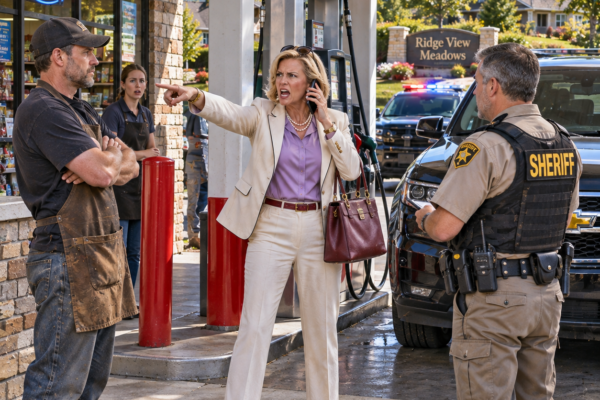
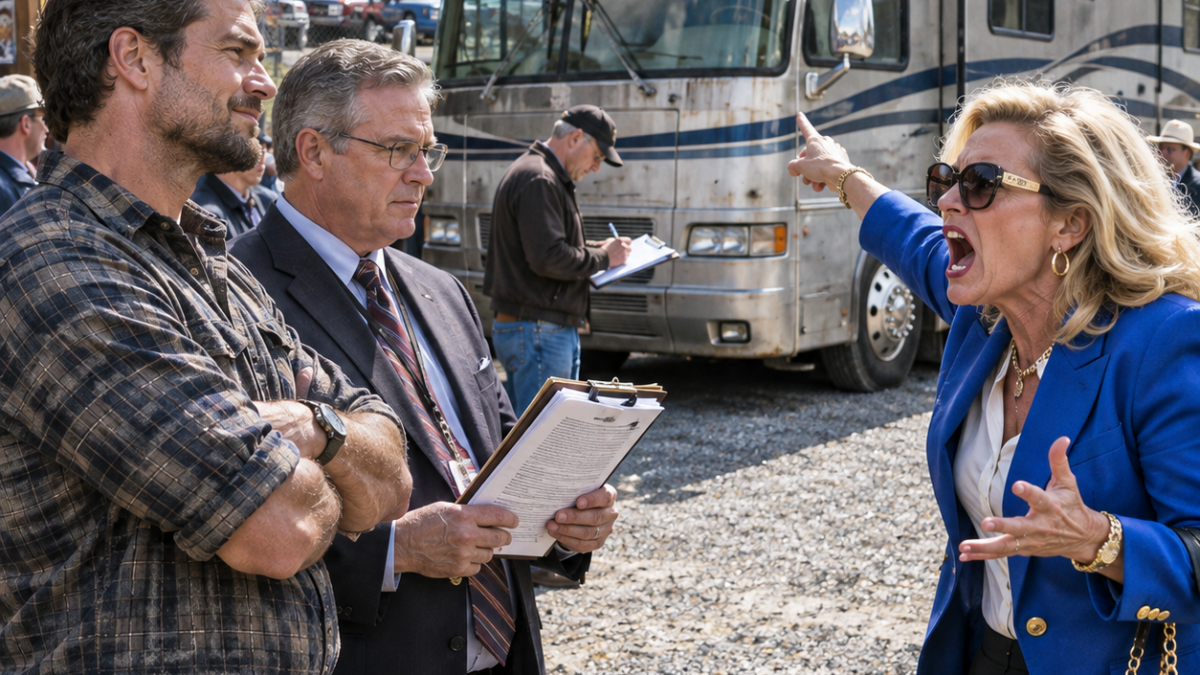
**“THAT’S MY RV, YOU FILTHY LITTLE CARPENTER! YOU CAN’T SELL IT, AND IF THAT AUCTIONEER DROPS HIS HAMMER, I’LL HAVE YOU ARRESTED FOR STEALING FROM THE HOA!” Beverly Shaw screamed across the crowded Ohio auction yard, her expensive sunglasses slipping down her face as the bidding continued on the thirty-six-foot motorhome she’d kept on my private property for eight years.**
**I had given her written permission to park there for thirty days, but she’d turned that favor into nearly a decade of unpaid storage, threatened to take my land, and even sent an excavator into my orchard—a decision that nearly crushed a ten-year-old girl beneath the RV.**
**Then, as the auctioneer prepared to announce the winning bidder, an elderly surveyor approached me with an old photograph of my father and whispered that Beverly had parked directly over something buried in the ground—and that the secret beneath those wheels was worth far more than the motorhome itself.**
The auctioneer raised his hammer.
“Going once!”
Beverly pushed through the crowd.
“STOP THIS AUCTION RIGHT NOW!”
“Going twice!”
She turned toward me.
“ADAM WALKER, YOU’RE GOING TO PAY FOR THIS!”
I stood beside my attorney, Claire Bennett, holding a folder containing eight years of letters, photographs, property records, and notices.
I didn’t answer.
There was nothing left to argue about.
For almost a decade, I’d begged Beverly to remove her enormous silver-and-blue RV from the gravel clearing beside my eastern fence.
I’d offered to help arrange a tow truck.
I’d given her extensions.
I’d sent letters.
I’d hired a lawyer.
She’d ignored every reasonable request.
Now the vehicle had been removed through the proper legal process and was being sold at an authorized public auction after the required notices and procedures.
Beverly had been given opportunities to deal with the situation before it reached this point.
She’d chosen threats instead.
The auctioneer looked toward the bidders.
A man near the front raised his hand.
Another answered.
The price climbed.
Beverly’s face turned crimson.
“THAT VEHICLE BELONGS TO ME!”
The auctioneer continued.
“Sold!”
The hammer fell.
Beverly screamed.
Her sunglasses slipped from her face and struck the pavement.
She pointed directly at me.
“THIEF! YOU STOLE MY MOTORHOME!”
I looked at Claire.
She calmly opened our folder.
PART2:
“The sale followed the authorized process, Beverly. You received the notices.”
“You’ll regret this!”
Claire didn’t raise her voice.
“The vehicle’s ownership, towing, storage, and auction proceeds are being handled through the applicable procedures. Adam isn’t simply selling your property and pocketing the money.”
Beverly stared at her.
Then at the winning bidder.
Then at the RV she’d treated like a permanent fixture on my land.
For the first time in eight years, she had no way to bully me into giving her another extension.
I thought that was the end.
Then an older man stepped beside me.
He carried a brown envelope.
“Mr. Walker?”
“Yes?”
“My name is Albert Finch. I worked with the survey crew that measured this property years ago.”
I turned toward him.
He removed an old photograph.
Three men stood beside a boundary marker near the gravel clearing.
My father was one of them.
Another was Beverly’s husband, Harold Shaw.
Albert pointed toward the photograph.
“Your father refused to let the developers build a road across that land.”
“I know.”
Albert shook his head.
“Then you need to see the other picture.”
He handed me a second photograph.
Beverly stood beside her RV, pointing toward the exact same location.
Several men held measuring equipment.
A development map rested on the hood of a truck.
Albert lowered his voice.
“She didn’t park there because she needed somewhere to store a motorhome.”
I stared at the picture.
“Then why?”
He looked toward Beverly.
“Because she knew what was underneath it.”
My stomach tightened.
And to understand why that mattered, you have to go back eight years, to the summer I made the mistake of believing a neighbor who asked for one small favor.
My name is Adam Walker.
I was forty-two when Beverly first arrived at my farmhouse outside Maple Creek, Ohio, about thirty minutes from Columbus.
My property covered fourteen acres.
A white farmhouse.
A wooden workshop.
An old apple orchard.
Several open fields.
A creek behind the western fence.
And a long gravel driveway connecting the house to County Road 16.
My father, George Walker, bought the land years before I inherited it.
He was a carpenter who could build almost anything with enough wood, patience, and coffee.
He repaired barns.
Made cabinets.
Helped neighbors replace broken stairs and fences.
When I was growing up, he taught me to measure twice, cut once, and never make a promise I didn’t intend to keep.
He also believed that if someone needed help and you could reasonably provide it, you should.
I tried to live the same way.
After years working as a building contractor and traveling between job sites, I returned to the farmhouse when Dad passed away.
I repaired the workshop.
Planted new apple trees.
Started making furniture for local customers.
It was a simpler life.
I liked waking up to birds instead of traffic.
My closest neighbor was Evelyn Miller.
She was seventy-five and lived in a small yellow cottage beyond my southern fence.
Evelyn had known my father for almost forty years.
Her husband had passed away, and I helped with repairs whenever she needed me.
She usually insisted she could manage.
Then she thanked me with homemade cookies.
Her granddaughter, Sophie, visited almost every weekend.
Sophie was ten, with curly brown hair and endless curiosity.
She loved my workshop.
I taught her how to measure boards, sand edges, and build birdhouses, always keeping her away from dangerous machinery.
She asked more questions than any apprentice I’d ever employed.
Life was peaceful.
Then Beverly Shaw arrived.
It was a Saturday morning.
I was repairing a fence when a black luxury SUV came down my driveway.
Beverly stepped out wearing a bright blue jacket, expensive sunglasses, and jewelry that flashed in the sunlight.
She looked around the property as though she were inspecting something she might eventually purchase.
“Are you Adam Walker?”
“Yes, ma’am.”
She smiled.
“I’m Beverly Shaw. President of the Briarwood Heights Homeowners Association.”
Briarwood Heights was a neighborhood of large houses east of my property.
I knew several families there.
Most were friendly.
“Nice to meet you,” I said.
“I’ve heard you’re the kind of man who helps his neighbors.”
I should have been suspicious of that introduction.
Instead, I smiled.
“I try.”
Beverly explained that she owned a luxury motorhome.
Thirty-six feet long.
Silver and blue.
Her driveway was being repaired, and Briarwood rules prohibited parking oversized recreational vehicles on neighborhood streets.
She needed somewhere to keep it temporarily.
Then she pointed toward the gravel clearing beside my eastern fence.
“Could I park it there for a few weeks?”
I looked toward the clearing.
Dad had once used it to store farm equipment.
I wasn’t using it much at the time.
“How long?”
“Thirty days. Maybe less.”
“Would it block the access road?”
“Absolutely not.”
“You’d remove it when your driveway is finished?”
“Of course.”
I thought about it.
Then agreed.
But I wanted the arrangement in writing.
Not because I distrusted Beverly.
Because my father had taught me that simple written agreements prevented complicated misunderstandings.
I wrote a short permission letter.
Temporary parking.
Thirty days.
No permanent access.
No transfer of property rights.
No structures or improvements.
She signed it.
Then smiled.
“Adam, you’re wonderful. You’ll never regret this.”
The RV arrived the next afternoon.
It was enormous.
Dark windows.
Large awning.
Storage compartments running along the sides.
A driver carefully backed it onto the gravel.
Beverly watched the entire process.
When it was parked, she thanked me again.
I assumed it would be gone in a month.
Thirty days passed.
The RV didn’t move.
I called her.
“Beverly, your parking arrangement has expired.”
“Oh, Adam, I’m so sorry. The driveway work is taking longer than expected.”
“How much longer?”
“Two weeks.”
I agreed.
Two weeks became another month.
Then another.
One time, she blamed drainage repairs.
Another time, mechanical problems.
Once, she claimed her husband had misplaced the keys while traveling.
I kept believing she would eventually remove it.
By the end of the first year, the RV was still there.
Grass grew around its tires.
Leaves collected beneath the wheels.
My gravel clearing was no longer available for my work trailer.
I called again.
“Beverly, I really need that space back.”
She laughed.
“The RV isn’t hurting anybody.”
“It’s occupying land I need.”
“Adam, good neighbors help each other.”
“I helped you for thirty days. It’s been a year.”
“Don’t be so dramatic.”
She promised it would be moved before winter.
Winter came.
The RV stayed.
Then spring.
Then another summer.
And I began understanding that Beverly didn’t consider our original agreement a promise.
She considered it an opportunity.
During the second year, Beverly became more involved in Briarwood Heights.
Her picture appeared in newsletters.
She organized landscaping projects and meetings about neighborhood improvements.
Whenever I asked about the RV, she said she was too busy serving the community to deal with it.
Then a letter arrived from the HOA office.
It thanked me for allowing Briarwood Heights to use part of my property for community storage.
I stared at the page.
Community storage?
I’d allowed Beverly to park her personal RV.
That was all.
I wrote back immediately.
The arrangement was temporary.
It concerned one privately owned motorhome.
It wasn’t an HOA storage agreement.
The next morning, Beverly called.
“WHY ARE YOU CAUSING TROUBLE FOR ME AT THE HOA OFFICE?”
I held the phone away from my ear.
“Because your association is describing my land as community property.”
“It’s just paperwork!”
“Then correct it.”
“You are being ridiculously difficult.”
“I want my parking space back.”
She became cold.
“Adam, I’ve lived in this area longer than you’ve lived at that farmhouse. I understand how things work.”
“Then you understand that a written thirty-day permission doesn’t last forever.”
She laughed.
“People who refuse to cooperate with the HOA sometimes discover how expensive life can become.”
I looked at my phone after she hung up.
The woman who’d begged for a temporary favor was now threatening me for asking her to keep her word.
Still, I tried avoiding a larger dispute.
Letters.
Messages.
Offers to help arrange transportation.
More promises.
More excuses.
The third year passed.
Then the fourth.
By the fifth year, delivery drivers assumed the RV belonged to me.
People asked whether I rented it to travelers.
Children riding bicycles stopped to stare at it.
I kept explaining that it wasn’t mine.
Then I began noticing strangers visiting.
Sometimes Beverly arrived with men carrying boxes.
Other times, people entered the RV with folders and stayed for an hour.
I didn’t know what they were doing.
I didn’t speculate.
But I disliked having strangers use my property without telling me why.
During the sixth year, I received an official-looking HOA violation notice.
The complaint?
An improperly stored recreational vehicle creating an eyesore near Briarwood Heights.
I actually laughed.
Beverly’s own RV.
On my land.
And her association was trying to fine me for it.
I called the office.
The assistant sounded embarrassed.
She admitted the notice had been issued under Beverly’s instructions.
Two days later, it disappeared from the records.
Beverly never apologized.
Instead, she sent an angry message accusing me of damaging her reputation.
That was when Evelyn became worried too.
She had noticed unfamiliar people visiting the RV at night.
Some carried large boxes.
Others appeared to be measuring the land.
“Adam,” she said one evening, “do you think she’s using that motorhome as an office?”
“I don’t know.”
“Then why are so many people coming and going?”
“I wish I knew.”
Sophie was fascinated by the vehicle.
She asked whether we could look inside.
I told her no.
“Why not?”
“Because it belongs to somebody else.”
She thought about that.
“But it’s on your land.”
“Exactly.”
I knelt beside her.
“Respect works both ways, Sophie. Beverly should respect my property. That doesn’t mean I get to ignore her ownership of the RV.”
She nodded.
I had no idea how important that distinction would become.
By the seventh year, I’d had enough.
I hired an attorney.
Claire Bennett.
She listened while I explained everything.
The original agreement.
Thirty days.
Eight years approaching.
The letters.
The excuses.
The HOA notice.
The threats.
Claire examined the documents.
Then said something important.
“Adam, owning the land doesn’t automatically make you the owner of Beverly’s vehicle.”
“I know.”
“You can’t simply sell it because she refuses to move.”
“I don’t want her money. I want my clearing back.”
“Then we’ll do it correctly.”
She explained that removal could involve specific notices, towing requirements, storage rules, and procedures for an unclaimed vehicle.
The exact process mattered.
If I skipped a step, Beverly could use my mistake against me.
So Claire prepared a formal demand.
The temporary permission was terminated.
Beverly needed to arrange removal.
If she refused, we’d pursue lawful remedies.
She received the letter.
Then called me during dinner.
“YOU’RE TRYING TO STEAL MY MOTORHOME!”
“No, Beverly. I’m asking you to remove it.”
“I’ve parked there for almost eight years!”
“That doesn’t make it yours to keep there.”
Her voice became strangely calm.
“Adam, you should think carefully before doing anything.”
“Why?”
“Time changes things.”
“What does that mean?”
“You might discover the ground beneath that RV doesn’t belong to you the way you think.”
Then she hung up.
I sat at the kitchen table staring at the phone.
For the first time, I began wondering whether the years of delay had been intentional.
Claire ordered updated property records.
We arranged a survey.
The results confirmed that the gravel clearing was inside my fourteen acres.
It wasn’t part of Briarwood Heights.
The HOA held no recorded ownership of the parking area.
Then Thomas Reed visited my workshop.
Thomas lived in Briarwood and had ordered a handmade dining table.
While checking its progress, he mentioned a new neighborhood entrance.
“Beverly wants another way onto County Road 16,” he said.
“Through where?”
“The eastern side.”
I stopped sanding.
“Near my property?”
Thomas hesitated.
“She mentioned the gravel clearing by your fence.”
“What did she say?”
“That Briarwood has been using it for years.”
I put down the sandpaper.
Suddenly, Beverly’s comment about time changing ownership made more sense.
The clearing sat beside an old access road.
Beyond it was woodland separating my property from Briarwood.
A new neighborhood entrance could connect directly to County Road 16.
And the RV occupied the most convenient starting point.
That evening, I walked toward the motorhome.
Eight years.
One vehicle.
The same location.
The same excuses.
Had Beverly been trying to make her presence on my land look permanent?
Claire warned me not to jump to conclusions.
But she sent another formal notice.
Then a white pickup appeared beside the RV.
Two workers unloaded posts and concrete.
I walked over.
“What are you building?”
One man held up a work order.
“Fence around the community storage area.”
“Community storage?”
“Yes, sir.”
“This is private property.”
He looked confused.
“Mrs. Shaw said the HOA owns it.”
“She’s wrong.”
I showed him the survey.
He apologized.
The workers stopped and loaded their equipment.
Less than an hour later, Beverly arrived.
She jumped out of her SUV and marched toward me.
“HOW DARE YOU INTERFERE WITH MY CONSTRUCTION CREW!”
“Your men were building a fence on my land.”
“This clearing has been used by Briarwood for nearly eight years!”
“Because I let you park your personal RV here temporarily.”
“That old agreement doesn’t matter anymore!”
“Then why did you sign it?”
She stepped closer.
“Listen carefully, Adam. Cooperate, and you’ll have a friendly relationship with the HOA.”
“And if I don’t?”
Her smile vanished.
“We have lawyers and surveyors who understand property rights far better than you do.”
I looked toward the motorhome.
“I want it removed.”
She shook her head.
“People who challenge me sometimes lose more than a parking space.”
Then she drove away.
That evening, Evelyn invited me for dinner.
Sophie showed me a wooden picture frame she’d made at school.
For a little while, I forgot about the RV.
Then Evelyn mentioned something strange.
She’d seen Beverly meeting with several men near the clearing.
They carried measuring equipment.
One had a large map.
“They were pointing toward the old access road,” Evelyn said.
“When?”
“This morning. But I remember seeing men like that years ago too.”
I asked her to tell Claire what she’d seen.
Two nights later, the trouble turned dangerous.
It was almost midnight when heavy machinery woke me.
I looked through my bedroom window.
Work lights illuminated the eastern clearing.
A large truck stood beside Beverly’s RV.
A small excavator had been unloaded near the drainage channel.
Workers were digging.
Others were placing stakes near my orchard.
Beverly stood beside her black SUV.
I called the sheriff’s office.
Then stepped onto the porch.
“STOP THAT WORK! YOU DON’T HAVE PERMISSION TO BUILD ON MY LAND!”
A worker turned.
He said the HOA had approved the project.
I told him the HOA didn’t own the property.
Beverly shouted back.
“WE’RE BUILDING THE ENTRANCE, ADAM! YOU’VE DELAYED THIS PROJECT LONG ENOUGH!”
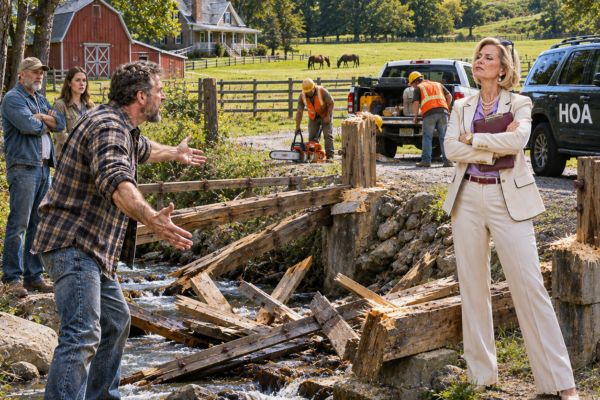
An excavator pushed toward my old fence.
Wood cracked.
I felt anger rise through my chest.
“STOP THAT MACHINE!”
The operator hesitated.
Beverly waved him forward.
Then the machine dug beside an old drainage channel.
The ground was wet from recent rain.
One track sank.
The excavator tilted.
The operator tried reversing.
Its bucket struck a stack of timber near the workshop fence.
Heavy beams shifted.
I heard Evelyn’s front door open.
Then I saw Sophie.
She’d heard the noise and walked outside to see what was happening.
She stood on the narrow path between her grandmother’s cottage and my workshop.
“SOPHIE! GO BACK INSIDE!”
She turned toward me.
Then a timber beam rolled.
It struck the gate beside the workshop.
The gate collapsed.
Sophie screamed and fell backward.
I ran toward her.
The excavator lurched again.
More wood began sliding.
Sophie tried standing.
Her foot was trapped beneath a broken board.
“ADAM!”
I reached her and pulled at the timber.
The excavator’s bucket struck the gravel beside Beverly’s RV.
One of the motorhome’s support legs bent.
Metal cracked.
The enormous vehicle shifted.
Beverly began screaming.
“MY RV! SOMEBODY SAVE MY RV!”
But I was watching Sophie.
She was crying.
Trying to pull her foot free.
I lifted the board.
Grabbed her beneath the arms.
And dragged her toward the stone wall beside my workshop.
Then I heard a terrible grinding sound.
The RV’s rear wheel dropped toward the drainage channel.
The thirty-six-foot motorhome started leaning.
Directly toward the path where we’d been standing.
I pulled Sophie around the workshop corner.
A second later, the RV crashed against the broken fence.
Glass shattered.
Wood snapped.
The ground shook.
Sophie screamed and covered her head.
I held her tightly until the movement stopped.
When I looked back, the motorhome rested at a dangerous angle near the workshop wall.
A few seconds earlier, Sophie and I had been directly in its path.
Evelyn came running.
She dropped beside her granddaughter and began crying.
I checked Sophie for injuries.
Scraped knee.
Bruised ankle.
She could move both legs.
But she was shaking so hard she could barely speak.
Then Beverly marched toward me.
She pointed at the damaged motorhome.
“YOU’RE GOING TO PAY FOR EVERY SCRATCH ON THAT VEHICLE!”
I stared at her.
“Your excavator nearly killed a child.”
“YOU SHOULD HAVE STAYED OUT OF THE WAY!”
I couldn’t believe what I was hearing.
She had ordered construction on land she didn’t own.
Ignored warnings.
Kept the crew working after I told them to stop.
And now she was threatening me because the vehicle she’d refused to move had been damaged.
Deputies arrived moments later.
Firefighters and an ambulance followed.
Deputy Michael Harris immediately ordered the equipment shut down.
Firefighters checked the unstable RV for fuel leaks and other hazards.
Paramedics examined Sophie.
Evelyn insisted on accompanying her to the hospital.
Before the ambulance left, Sophie reached for my hand.
“Thank you for not leaving me.”
My throat tightened.
“I wasn’t going to leave you, sweetheart.”
She nodded.
Then the ambulance doors closed.
I turned back toward the clearing.
Deputy Harris asked who had authorized the construction.
Beverly immediately claimed the work was an approved HOA project.
I showed him my deed, survey, and original temporary parking agreement.
He examined the paper Beverly signed eight years earlier.
Thirty days.
Temporary permission.
Her personal motorhome.
Beverly scoffed.
“That doesn’t matter anymore.”
Harris looked at her.
“Ma’am, this is evidence of how the arrangement began.”
Then he questioned the construction supervisor.
Kevin Foster.
Kevin admitted Beverly had hired his crew to prepare a second neighborhood entrance.
He’d been told the HOA controlled the clearing.
He hadn’t personally verified ownership.
When I told the workers to stop, Beverly threatened to cancel their contract if they refused to continue.
Another employee confirmed it.
Harris recorded their statements.
Then ordered the project halted.
The RV would require professional stabilization before anyone attempted to move it.
By dawn, the eastern side of my property looked like a disaster zone.
Broken fence.
Deep tracks.
Damaged timber.
Excavator marks through the orchard.
And a massive RV leaning toward my workshop.
I stood there exhausted.
For eight years, I’d tried to resolve one simple parking problem peacefully.
Now a little girl had nearly died because Beverly wanted a road through my land.
At the hospital, doctors confirmed Sophie hadn’t broken any bones.
Her ankle was badly bruised.
She needed rest.
But she would recover.
When Evelyn hugged me, I felt the fear I’d been holding finally begin to release.
Sophie was alive.
That mattered more than the RV.
More than my fence.
More than any property argument.
Claire met me at the workshop later that day.
She photographed everything.
Then explained we were dealing with two separate legal problems.
The damage from unauthorized construction.
And the lawful removal of Beverly’s motorhome.
“Can I have it towed now?” I asked.
“Not without completing the necessary process.”
“It’s leaning beside my workshop.”
“Which is why we need a qualified recovery company and proper authorization.”
I nodded.
I wanted that RV gone.
But I wasn’t about to give Beverly a legitimate claim that I’d stolen or damaged it.
Then Thomas arrived with news from Briarwood.
The HOA board hadn’t properly approved construction on my property.
Some members knew Beverly wanted a second entrance.
But they hadn’t authorized bulldozers near my orchard.
Residents were furious.
Especially after hearing about Sophie.
Several homeowners wanted the association’s finances reviewed.
Then Evelyn remembered something important.
She’d seen Beverly and men with measuring equipment near the clearing years earlier.
Around the third year after the RV arrived.
One man had used a measuring wheel.
Another carried old maps.
Beverly stood pointing toward the access road.
That made me wonder whether she’d been planning this far longer than I’d suspected.
The following morning, Beverly’s attorney sent a letter.
It claimed Briarwood had acquired long-term use rights over my gravel clearing.
It demanded that I stop any attempt to remove the RV while the dispute continued.
Claire reviewed it.
“A lawyer’s letter isn’t a court order, Adam.”
“Does Beverly have any claim?”
“She can make one. That doesn’t mean she’ll prove it.”
Then Claire asked me to search my father’s papers for anything concerning the eastern access road.
I spent the afternoon opening dusty boxes in his old study.
Property tax records.
Workshop receipts.
Photographs.
Furniture plans.
Then I found a small notebook.
One page described a disagreement involving a proposed neighborhood entrance.
Dad had written that he’d refused to grant permanent access because the route passed too close to the orchard and workshop.
Then I saw a name.
Harold Shaw.
Beverly’s husband.
I stared at it.
I’d met Harold only briefly.
He rarely attended neighborhood events.
But apparently he’d been involved in a development proposal long before Beverly ever asked to park her RV.
I called Claire.
She reminded me that a notebook wasn’t proof of a secret conspiracy.
But it was worth investigating.
Then another strange thing happened.
An envelope appeared beneath my truck’s windshield wiper.
Inside was an old photograph.
Beverly stood beside her RV with Harold and two men in business suits.
Behind them was a sign.
FUTURE BRIARWOOD HEIGHTS EAST ENTRANCE.
The picture appeared to have been taken years earlier.
I turned it over.
A handwritten message read:
CHECK THE OLD COUNTY SURVEY RECORDS. THEY CHANGED MORE THAN THE PARKING AGREEMENT.
I immediately contacted Claire.
She preserved the photograph and envelope.
Then we requested older survey records.
Susan Mitchell at the county records office helped locate them.
Two maps were particularly interesting.
The original showed the gravel clearing entirely within my father’s property.
A later drawing shifted the apparent boundary several feet inward.
Enough to make the proposed neighborhood entrance easier to fit on land Beverly claimed Briarwood controlled.
Claire arranged an independent survey.
Meanwhile, Beverly filed a civil claim asking the court to recognize long-term access rights.
She also sought to prevent removal of the RV while the dispute was reviewed.
The court had not decided ownership.
And I had no intention of pretending it had.
I kept the clearing secured.
Took photographs.
Maintained records.
And waited for the legal process.
Then Beverly appeared with contractors again.
Three dark SUVs.
Construction helmets.
Surveying equipment.
A representative named Lawrence Price told me they’d been hired to prepare an approved access project.
He showed me a document bearing what looked like an official court stamp.
According to him, the HOA had temporary authority to inspect and preserve the route.
Beverly smiled.
“THE COURT FINALLY RECOGNIZED OUR RIGHTS, ADAM! START MAKING PLANS TO MOVE YOUR WORKSHOP!”
I photographed the document and sent it to Claire.
She checked the actual court filing.
Then called back.
“Adam, that paper doesn’t match the order.”
“What do you mean?”
“The court hasn’t authorized construction or tree removal.”
I told Lawrence.
He immediately stopped his crew.
Beverly exploded.
“YOU’RE BEING PAID TO WORK, NOT LISTEN TO HIM!”
Lawrence remained calm.
“We need verified authorization.”
She threatened to hire someone else.
Then Deputy Harris arrived.
He examined the document and began verifying it.
Beverly’s phone rang.
She stepped away.
But I heard part of her conversation.
“You promised me nobody would find the original survey!”
She noticed me listening.
Then walked farther away.
When she returned, her face had changed.
She climbed into her SUV and drove off.
Lawrence approached me afterward.
“Mr. Walker, there’s something you need to see.”
He opened the project map.
The proposed road crossed my gravel clearing.
Then continued past the orchard and workshop.
Beyond it was another marked area.
FUTURE COMMERCIAL DEVELOPMENT.
The plan included land near Evelyn’s cottage.
Beverly wasn’t just trying to secure a second neighborhood entrance.
The road would open access to a much larger development.
Before I could absorb that, my phone rang.
Evelyn.
Her voice was trembling.
“Adam, there are men here saying I have to leave!”
I was already moving.
Then I heard shouting.
Breaking glass.
Evelyn screamed.
The call ended.
I looked toward her cottage.
A moving truck stood beside the driveway.
Two men were carrying furniture onto the porch.
Evelyn struggled to protect a small wooden box.
One man pushed it aside.
Photographs scattered across the gravel.
I ran toward her.
Deputy Harris followed.
Beverly’s SUV appeared again.
A second vehicle followed.
A man in a dark suit stepped out carrying a folder.
Beverly pointed toward Evelyn’s house.
“CLEAR THAT COTTAGE TOO! WE NEED THE ENTIRE ENTRANCE READY!”
The man held up a document.
NOTICE OF IMMEDIATE POSSESSION.
It claimed the HOA controlled the gravel clearing and part of the land beneath Evelyn’s home.
I felt my stomach drop.
Evelyn had lived there for decades.
Her husband had planted the garden.
Now Beverly was trying to force her out using paperwork nobody had properly verified.
Harris ordered the movers to stop.
The men looked confused.
They’d been told the property had changed ownership.
Harris explained that a disputed claim didn’t give them authority to remove an occupant.
One worker apologized and carried Evelyn’s chair back inside.
Then Harris examined the supposed possession notice.
It didn’t match any valid court order his department could confirm.
The property description also conflicted with existing county records.
Beverly began shouting again.
But Harris wouldn’t let the moving crew continue.
As Evelyn gathered her scattered photographs, one small envelope fell open.
Inside was an old picture of my father standing beside Harold Shaw.
On the back, in Dad’s handwriting, were five words.
HAROLD KNOWS WHERE IT’S BURIED.
I read them twice.
Then looked toward the RV.
For eight years, it had sat on the same gravel clearing.
A place Beverly had refused to surrender.
A place surveyors had visited repeatedly.
And now my father seemed to have left a message about something buried beneath it.
Evelyn sat on her porch while Sophie brought her water.
I showed her the photograph.
She became very quiet.
Then she explained that Dad had given it to her years earlier.
He’d been concerned about a disagreement involving Harold and the old property boundary.
At the time, she’d put it away.
When Beverly started talking about the new entrance, Evelyn remembered the box.
She’d only recently found the picture again.
“George said the original boundary could still be proved,” she told me.
“How?”
“Something the surveyor buried near the old drainage channel.”
I looked east.
Toward the RV.
Claire arranged a meeting with a licensed surveyor.
William Foster.
William had worked in the county for more than thirty years.
He studied Dad’s notebook, photographs, and the old maps.
Then told us he remembered the original development dispute.
Harold’s former company had wanted a second entrance into Briarwood Heights.
My father refused permanent access.
The project was abandoned.
William compared the older survey with the newer drawing Beverly was using.
He pointed to the drainage channel.
“The reference point appears to have been moved on the later drawing.”
“Moved physically?” I asked.
“Not necessarily. The recorded location is different.”
Claire leaned forward.
“Could that change make the proposed entrance appear to fit within HOA-controlled land?”
William nodded.
“Potentially.”
We arranged a proper field survey.
William located two old boundary markers consistent with Dad’s original records.
Then he examined the gravel beside the drainage channel.
One reference location had been buried under added gravel.
Part of the area was blocked by Beverly’s damaged RV.
William carefully documented everything.
The clearing remained within my recorded property.
The old markers supported my deed.
But he wanted to inspect the covered reference point once the vehicle could be lawfully moved.
Then Harold Shaw came to my farmhouse.
He arrived in an old gray sedan.
He looked tired.
Older than I remembered.
We sat at the picnic table outside the workshop.
He began with an apology.
“Adam, Beverly should’ve moved that motorhome years ago.”
“Yes.”
“I tried telling her.”
“Then why didn’t you do something?”
He looked down.
“We argued about it constantly.”
I waited.
He explained that his development company had once wanted an entrance across my father’s property.
Dad refused.
The project died.
Harold said Beverly never accepted that outcome.
When I inherited the farmhouse, she suggested asking for temporary RV parking on the clearing.
Harold warned her that permission to park wouldn’t give her ownership.
But Beverly believed years of visible use might help establish a permanent claim.
Then I showed him the photograph.
HAROLD KNOWS WHERE IT’S BURIED.
His face changed.
He explained that the original survey crew had placed a metal reference tube near the drainage channel.
Inside were measurements and correspondence confirming where the boundary had been established.
Dad wanted it preserved.
A stone cover protected the reference point.
Later, gravel was added over the area.
Harold helped supervise that work.
Then he said something that made my skin crawl.
“Beverly insisted the RV be parked directly over that location.”
I stared at him.
“Even though another part of the clearing was easier to reach?”
“Yes.”
“Did she know what was buried there?”
“She’d seen the old survey.”
Harold lowered his eyes.
“Adam, I’m sorry.”
I leaned back.
“For eight years, she kept that vehicle over evidence my father wanted preserved.”
“I warned her.”
“But you didn’t stop her.”
He didn’t answer.
Then he revealed something else.
Beverly was expecting a substantial payment if the second entrance became operational.
The project wasn’t just about better neighborhood traffic.
There was money involved.
A lot of it.
Harold agreed to give Claire a formal statement.
I appreciated that.
But I also told him his silence had helped put Evelyn and Sophie in danger.
He nodded.
“I know.”
The property case moved forward.
Claire presented the original thirty-day parking agreement.
My deed.
William’s survey findings.
The construction records.
Evidence of the attempted possession claim against Evelyn.
And the inconsistencies in Beverly’s documents.
Beverly’s lawyer argued the HOA had developed long-term use rights.
The judge asked what permanent access agreement supported that position.
There wasn’t one.
The court declined to treat the clearing as HOA property based merely on Beverly’s years of parking there.
The judge also questioned why the supposed possession paperwork didn’t match the actual court orders.
For the first time in years, I walked out of a courtroom believing the situation might finally end.
Claire reminded me we still needed to remove the RV lawfully.
Beverly had received notice that her parking permission was terminated.
But the damaged motorhome required careful recovery.
We couldn’t simply drag it away and hope for the best.
Then Thomas called.
Briarwood homeowners had demanded an emergency HOA meeting.
They’d learned association funds were being spent on a project involving land the HOA didn’t own.
Beverly had been telling residents that I was trying to steal her RV.
She blamed me for the excavation accident.
She claimed the court had treated Briarwood unfairly.
People were beginning to question her leadership.
Then Thomas mentioned something unusual.
Beverly had been speaking with a towing company.
For one hopeful moment, I thought she’d finally decided to remove the RV herself.
If she did it safely, the parking dispute could end without an auction.
But Beverly had another plan.
Just after midnight, I woke to the sound of a heavy engine.
Work lights illuminated the eastern clearing.
A tow truck stood beside the RV.
Another pickup was parked near the drainage channel.
Beverly’s SUV was beside the fence.
Workers were attaching cables to the damaged motorhome.
I immediately called the sheriff’s office.
Then stepped onto my porch.
“STOP! THAT VEHICLE IS UNSTABLE!”
Beverly turned.
“GET BACK INSIDE YOUR HOUSE, ADAM! THIS IS MY PROPERTY!”
“The RV is yours. The land isn’t.”
She waved toward the tow operator.
“KEEP PULLING!”
The cable tightened.
The motorhome shifted.
Loose gravel slid toward the drainage channel.
I could see the damaged support leg bending.
The recovery crew hadn’t properly stabilized the lower side.
“YOU’RE GOING TO ROLL IT AGAIN!” I shouted.
Beverly pointed at me.
“YOU DON’T GET TO TELL ME HOW TO MOVE MY OWN RV!”
Then Harold’s sedan appeared.
He climbed out looking terrified.
“BEVERLY, STOP!”
She turned toward him.
“Go home!”
Harold ignored her.
He hurried toward the tow operator.
“The ground beneath that vehicle hasn’t been checked!”
Then he pointed toward the drainage channel.
“THE ORIGINAL SURVEY REFERENCE IS UNDER THERE!”
Beverly froze.
For one second, she looked genuinely frightened.
Then the tow cable pulled tight.
The RV lurched forward.
One rear wheel dropped into soft ground.
A section of gravel collapsed.
Beneath it appeared an old concrete cover.
Harold pointed.
“That’s it!”
I stared.
The evidence Dad wanted preserved might finally be within reach.
But Beverly began screaming.
“KEEP PULLING!”
The tow operator hesitated.
Harold stepped closer.
“Stop the winch! The ground isn’t stable!”
I shouted for him to move back.
Then the RV shifted sideways.
Its rear end dropped farther toward the channel.
Concrete cracked.
Harold stumbled.
The old cover collapsed beneath him.
He disappeared.
For one terrible second, nobody moved.
Then I heard him scream.
“HELP!”
The RV continued leaning.
Directly toward the opening.
I grabbed my phone.
“911! WE HAVE A MAN TRAPPED UNDERGROUND AND A THIRTY-SIX-FOOT RV SLIDING TOWARD HIM!”
The tow operator, Steven Parker, shut down the equipment.
He ordered everyone away from the unstable vehicle.
Beverly screamed for him to keep moving it.
Steven refused.
Harold called from beneath the broken concrete.
I approached from the safer side.
“Harold! Can you hear me?”
“Yes!”
“Where are you?”
“Old drainage chamber!”
“Can you move?”
“My leg’s trapped!”
I could hear him coughing.
The RV made another terrible cracking sound.
Then Beverly grabbed a shovel.
Instead of moving toward the sound of her husband’s voice, she rushed toward a rusted metal container exposed beneath the broken cover.
I shouted.
“BEVERLY, GET AWAY FROM THERE!”
She ignored me.
Steven warned that more ground could collapse.
Beverly turned toward him.
“That container belongs to my family!”
Then she said something I would never forget.
“If they open it, everything I’ve built is finished!”
I stared at her.
Her husband was trapped beneath collapsing concrete.
The RV was shifting toward him.
And she was worried about old documents.
Deputies arrived minutes later.
Firefighters followed.
An ambulance came through the gate.
Deputy Michael Harris immediately moved everyone away from the unstable ground.
Captain Robert Jenkins examined the scene.
A heavy rescue truck arrived with equipment to support the motorhome.
Firefighters worked carefully.
Stabilized the RV.
Secured the opening.
Then entered the drainage chamber from a safer side.
Harold’s voice became weaker.
Every second felt endless.
Evelyn stood beside me holding Sophie’s hand.
The little girl was crying silently.
She’d nearly been crushed by this same RV weeks earlier.
Now Harold was trapped beneath it.
Finally, Captain Jenkins called out.
“We’ve got him!”
Two firefighters freed Harold’s leg.
They lifted him into a rescue basket.
When he emerged, his face was pale and covered in dirt.
Paramedics placed him on a stretcher.
His right leg was broken.
But he was alive.
As they prepared to take him to the ambulance, Harold reached toward me.
“Adam.”
I stepped closer.
“Save your strength.”
He shook his head.
“I’m sorry.”
I didn’t know what to say.
Then he looked toward Beverly.
His expression changed.
“She knew.”
“About the buried records?”
He nodded.
“She knew exactly why that RV was parked there.”
The ambulance doors closed.
Beverly stood beside Deputy Harris.
Still clutching the shovel.
Steven explained that Beverly had hired him for the late-night recovery and demanded he continue even after the ground started collapsing.
He also confirmed that I’d repeatedly warned everyone to stop.
Harris recorded the statements.
The buried container was preserved as potential evidence once the area was safe enough for recovery.
For the first time in eight years, it seemed the truth might finally be coming out from beneath that motorhome.
Two days later, Claire called.
“Adam, you need to come to my office.”
William Foster was already there.
Old maps covered the table.
Between them lay photographs of the recovered container.
Inside had been a sealed metal tube containing papers protected from much of the moisture.
Some documents were damaged.
Others remained readable.
Original survey measurements.
Boundary drawings.
Correspondence involving Dad and Harold Shaw.
William pointed toward the earliest recorded line.
“This supports your father’s boundary.”
Then Claire handed me a letter.
I recognized Dad’s handwriting immediately.
The letter explained that he had refused to grant Harold’s development company permanent access across the gravel clearing.
He had allowed surveyors to measure the area.
But he never agreed to a neighborhood road.
Never sold the clearing.
Never transferred ownership.
The final paragraph said he wanted the original boundary evidence preserved in case someone later tried changing the records.
I sat quietly reading those words.
For years, Beverly had made me question whether I was somehow misunderstanding the property my father had left me.
Now Dad’s own handwriting was in front of me.
He’d known somebody might challenge the boundary.
He’d prepared for it.
And Beverly had parked her RV directly over the place where that evidence was hidden.
William showed me the old survey drawing.
A circle marked the location of the buried reference tube.
It matched the parking spot.
The later map Beverly relied on placed the boundary somewhere else.
The difference was large enough to matter for the proposed entrance.
Claire warned that the documents needed proper authentication.
But together with the recorded deed, physical markers, and survey results, they strongly supported my ownership.
Then Harold asked to meet us.
He was recovering in a wheelchair.
His leg was still healing.
We met at his attorney’s office.
He looked embarrassed.
“I should’ve told you the truth years ago,” he said.
I didn’t answer.
Harold explained that his old development company had tried building the second entrance decades earlier.
My father refused.
The project was abandoned.
Beverly never accepted it.
When I returned to the farmhouse, she proposed asking for temporary RV parking.
Harold warned her that permission wouldn’t create property rights.
But she believed keeping the vehicle there for years could help make the clearing appear connected to Briarwood.
Later, she discussed the entrance with developers and promised they could obtain access.
He admitted helping with early planning documents.
Then claimed he refused when Beverly began discussing altered maps and questionable signatures.
He placed a folder on the table.
Emails.
Letters.
Project records.
One message from Beverly described the RV as useful for maintaining a visible presence on the land.
Another discussed a large payment if the entrance became available.
I stared at the records.
For eight years, I’d thought I was dealing with a selfish neighbor who didn’t want to move an oversized vehicle.
But Beverly had treated that parking spot as part of a development strategy.
One that could bring her substantial money.
I looked at Harold.
“Why are you finally telling me this?”
He stared at his injured leg.
Then answered quietly.
“When I was trapped under that concrete, I heard Beverly screaming about the documents.”
He swallowed.
“She didn’t ask if I was alive.”
Nobody spoke.
Harold continued.
“I realized we’d nearly killed a child. Then I nearly died myself. And all of it was over a road we never had the right to build.”
I felt some of my anger settle.
Not disappear.
Just become quieter.
I thanked him for cooperating.
But I also told him the truth.
His silence had hurt people.
Evelyn had been frightened in her own cottage.
Sophie had nearly died.
I’d spent years defending land that never belonged to Beverly or Briarwood.
Harold nodded.
“I know.”
The remaining property dispute moved through the courts.
Claire presented the original parking agreement, deed, survey evidence, recovered records, and Harold’s testimony.
Beverly’s attorneys continued arguing that years of use created permanent rights.
But the original permission letter mattered.
Her occupancy had begun with my consent.
It was temporary.
I’d repeatedly demanded removal.
And the recorded property records supported my ownership.
The court rejected the claim that Beverly or the HOA had acquired the clearing simply because her RV had remained there for eight years.
The questionable possession notices and altered property documents became part of further investigation.
Victor Lang, an attorney connected to the development discussions, provided information showing that one document used against Evelyn didn’t match the version his office had prepared.
The attempted eviction of a seventy-five-year-old woman had been based on paperwork that didn’t establish any lawful right to remove her.
Meanwhile, Briarwood residents began demanding answers.
Thomas Reed helped organize a financial review.
Homeowners learned association funds had been spent on surveys, legal work, and development planning involving land the HOA didn’t own.
Several residents were furious.
Others were embarrassed that they’d believed Beverly’s claims about me.
After following their voting procedures, they removed Beverly as HOA president.
The new board stopped pursuing the disputed entrance.
It arranged an independent review of the association’s finances.
And it made clear that Briarwood had no authority to claim my clearing merely because Beverly had parked her motorhome there.
When Thomas told me about the vote, I felt relief.
Not satisfaction at seeing her humiliated.
Relief that the neighborhood was finally questioning what had been done in its name.
Then Claire called with the news I’d been waiting eight years to hear.
We could proceed with the lawful removal process.
Beverly had received repeated notices.
The court had rejected her claim to own or permanently control the clearing.
The motorhome remained damaged and unsafe beside my workshop.
Claire coordinated with the proper authorities and a licensed recovery company.
The notices, vehicle records, recovery authorization, and documentation were handled through the applicable Ohio procedures.
Nothing improvised.
Nothing secret.
Nothing designed to punish Beverly.
I wanted my land back.
That was all.
The recovery crew arrived on a clear morning.
A heavy truck.
Support equipment.
Experienced workers.
They inspected the RV.
Stabilized the damaged side.
Lifted it carefully away from the drainage channel.
Then secured it for transport.
I stood near the workshop watching.
For eight years, the silver-and-blue motorhome had blocked my view across the gravel clearing.
It had become part of the landscape.
An unwanted part.
At last, the recovery trailer began moving.
The motorhome rolled through my gate.
Turned onto County Road 16.
And disappeared.
I stood there for a long time.
The clearing was empty.
No Beverly.
No strangers carrying boxes.
No HOA signs.
No construction crew.
Just gravel.
Old trees.
The drainage channel.
And the place where Dad used to park his equipment.
I hadn’t realized how much I’d missed seeing it.
But the process wasn’t finished.
The vehicle still belonged to Beverly, and the authorities responsible for the tow and storage had to handle it according to the required rules.
She was notified.
The deadlines and procedures were documented.
The RV remained unclaimed through the applicable process.
Eventually, it became eligible for authorized public auction.
Claire carefully reviewed the paperwork.
I wanted no surprises.
No accusations that I had simply taken Beverly’s property and sold it myself.
The proceeds would be handled according to the applicable towing, storage, and ownership requirements.
I wasn’t treating the motorhome as a personal payday.
Then the auction date arrived.
And Beverly showed up.
The woman who’d spent years threatening me walked into the auction yard wearing expensive sunglasses and carrying the same attitude she’d brought to my driveway eight years earlier.
The auctioneer began taking bids.
Beverly shouted.
Called me a thief.
Threatened arrests.
Demanded the sale stop.
But the authorized process continued.
And when the hammer fell, the RV was sold.
The winning bidder completed the required paperwork.
Beverly stood watching a stranger purchase the vehicle she had refused to remove for nearly a decade.
I didn’t cheer.
I didn’t laugh.
I simply looked at Claire.
“It’s over?”
“The vehicle portion is finished,” she said.
I exhaled.
Then Albert Finch approached.
The retired survey assistant.
The brown envelope.
The old photographs.
He showed me pictures of the original boundary work.
One showed my father standing beside Harold Shaw and a survey marker.
Another showed Beverly pointing toward the same location beside her motorhome.
Then Albert handed me a copy of a letter.
Dad had refused the proposed permanent entrance.
Albert said the development company had always known it needed a proper agreement to cross his property.
The problem had never been uncertainty about ownership.
The problem was that the developers wanted a convenient route.
And my father wouldn’t surrender it.
I stood in the auction yard reading his words.
The RV had been sold.
The land was safe.
And now a man who’d worked with the original survey crew was confirming what Dad had tried to preserve decades earlier.
Claire arranged for Albert’s records to be added to the evidence.
I thanked him.
He smiled.
“Your father was a good man, Adam.”
I looked toward the old photograph.
“I know.”
The investigations and civil claims continued after the auction.
Beverly faced legal consequences connected to the false property paperwork, unauthorized construction, and damage.
Some issues were resolved through court proceedings and settlements.
Others required further investigation.
The construction company’s records and Beverly’s communications became important evidence.
The civil claims for damage to my fence, orchard, and workshop were handled separately.
Repairs took time.
Not every expense was recovered immediately.
But the recorded boundaries were confirmed.
The clearing remained mine.
And the RV was gone.
A few months later, the eastern side of my property finally looked peaceful again.
Thomas and several neighbors helped rebuild the fence.
We repaired the orchard path.
Replaced the gate where Sophie had nearly been trapped.
And planted flowers near the workshop.
Evelyn brought homemade pies for everyone.
Sophie painted a small wooden sign.
PRIVATE PROPERTY — PLEASE RESPECT OUR HOME.
I placed it beside the driveway.
Then I built the storage shed I’d wanted for years.
Right on the gravel clearing where Beverly’s RV had stood.
It wasn’t fancy.
But it gave me room for my tools, completed furniture, and work trailer.
Every time I opened the doors, I remembered how long I’d spent working around a vehicle that shouldn’t have been there.
Eight years.
All because I kept hoping Beverly would eventually do the decent thing.
Evelyn and Sophie continued visiting on weekends.
Sophie’s injuries healed.
She remained cautious around large vehicles.
But she hadn’t lost her love of woodworking.
One afternoon, we were sanding a birdhouse when she asked me something.
“Mr. Adam?”
“Yeah?”
“Do you regret helping Beverly?”
I stopped sanding.
It was a good question.
I’d thought about it more than once.
Finally, I shook my head.
“No.”
She looked surprised.
“But she was mean to you.”
“Yes.”
“She took your parking space for eight years.”
“Yes.”
“And she almost got us hurt.”
I looked at her.
“That doesn’t mean helping someone was wrong. It means Beverly was wrong to take advantage of the help.”
Sophie considered that.
“So you would help another person?”
“Of course.”
“Even after everything?”
“Yes. But I’d make sure they respected the agreement.”
She smiled.
“Grandma says good people have to learn when to say no.”
“Your grandma’s a smart woman.”
Sophie returned to sanding.
I watched her work.
And I realized how much the experience had changed me.
My father taught me generosity.
Beverly taught me that generosity needed boundaries.
Those lessons didn’t contradict each other.
I could be kind without surrendering my property.
I could give someone temporary help without accepting permanent disrespect.
And I could protect my home without becoming cruel.
That evening, I walked toward the eastern fence.
The sun was setting behind the orchard.
The new storage shed stood on the cleared gravel.
No motorhome.
No construction lights.
No strangers measuring my land.
Just the quiet property Dad had worked so hard to maintain.
I thought about Harold.
His silence had allowed Beverly’s scheme to continue.
But when it mattered most, he chose to tell the truth.
I hoped his recovery gave him a chance to rebuild his life.
I didn’t want him harmed.
I didn’t need Beverly to suffer for me to feel that justice had been done.
The strongest memory from the entire ordeal wasn’t Beverly screaming at the auction.
It was Sophie crying beside the broken workshop gate while thirty-six feet of metal slid toward her.
It was Evelyn holding her granddaughter after almost losing her.
It was Harold calling for help beneath collapsing concrete.
Those moments reminded me that property disputes can become dangerous when people care more about winning than human lives.
Whenever someone asks about the HOA president who parked her RV on my land for eight years, I tell them how the story really began.
With a simple favor.
Beverly asked for thirty days.
I said yes.
She promised to keep her word.
Then thirty days became eight years.
She ignored letters.
Refused offers of help.
Used HOA paperwork to claim that temporary parking had somehow become permanent access.
Then tried building a road through my father’s property.
When the land records didn’t support her claim, she relied on altered maps and threats.
When construction began, Sophie nearly died.
When Beverly later tried moving the damaged RV secretly, her husband fell into the very underground opening where the original survey evidence had been preserved.
And when the truth finally emerged, the RV was removed through the proper legal process.
Then sold at an authorized public auction after the required procedures were completed.
But the real victory wasn’t the auctioneer’s hammer.
It was getting my land back.
It was knowing Evelyn could live peacefully in her cottage.
Knowing Sophie could walk to my workshop without being afraid of construction equipment.
And knowing my father’s property remained exactly where he’d intended it to remain.
One evening, after finishing work in the new storage shed, I found an old photograph of Dad standing beside the gravel clearing.
There was no RV in the picture.
Just a pickup truck.
A stack of lumber.
And my father smiling beside a fence he’d built himself.
I held the photograph for a long moment.
Then looked at the same clearing through the shed doorway.
For the first time in eight years, the view matched the memory.
I shut off the lights.
Locked the door.
And walked toward the farmhouse.
Behind me, the new shed stood on ground that had never belonged to Beverly Shaw.
Ahead of me, the porch light glowed beneath the same roof my father had cared for.
The RV was gone.
The boundary was secure.
The people I loved were safe.
And after eight years of excuses, threats, and legal battles, I could finally enjoy something I’d nearly forgotten.
Peace.
My father used to say that generosity was one of the finest things a person could offer.
But he also taught me that a promise should mean something.
Beverly broke hers.
I kept mine.
And in the end, **the thirty days of kindness I’d offered her never gave her the right to take eight years of my life—or a single inch of my father’s land.**