We Need a Tier-1 Sniper!” the SEAL Colonel Demanded—My General Father Laughed at Me… Until I Said the Call Sign He Was Never Cleared to Hear:
PART3:
He thought I was joking.
At 0942, the rear doors opened.
Nobody noticed immediately.
Then someone whispered.
A few heads turned.
Colonel Adrian Cole entered wearing a combat uniform darkened at the shoulders by rain.
Silver eagle.
Navy trident.
No entourage.
No smile.
Cole had the kind of presence that silenced rooms without asking permission.
He was forty-seven then, lean, weathered, and carried himself like a man who had spent most of his adult life measuring doorways, windows, hands, exits, and threats.
He walked straight down the center aisle.
The logistics colonel stopped talking.
My father turned.
Cole reached the front.
“General Hart.”
“Colonel.”
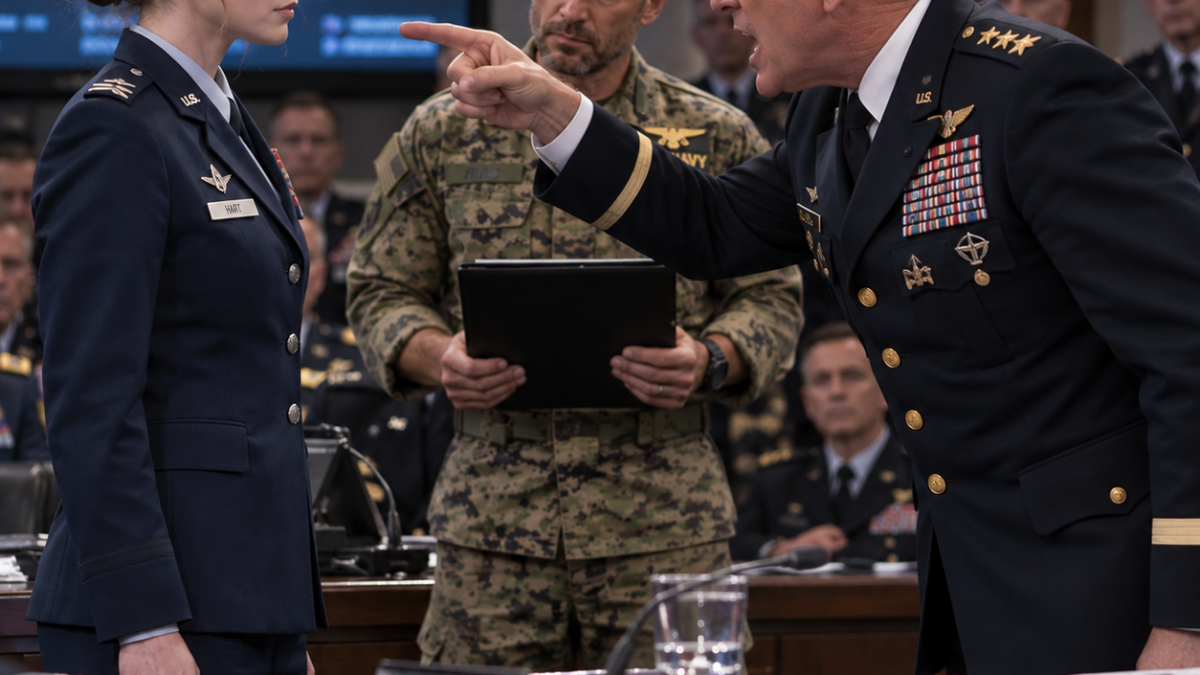
“I need a Tier-One sniper.”
The room went still.
My father’s eyebrows rose.
“You’re surrounded by qualified officers.”
“I don’t need qualified.”
Cole placed a black folder on the table.
“I need the best.”
My father glanced at several special operations representatives seated nearby.
“For what?”
Cole looked around the room.
“For an emergency extraction in Sector Raven.”
That changed the atmosphere immediately.
Sector Raven was a code designation.
Most people in the room knew only that it referred to a disputed mountainous region overseas where American personnel were not officially engaged in combat operations.
A few of us knew more.
Cole continued.
“A reconnaissance team missed two check-ins. We have reason to believe they discovered something they weren’t supposed to find. Rescue window is narrow. Terrain is bad. Air support may not be available. We need long-range overwatch with compartmented reconnaissance experience.”
My pulse slowed.
That always happened when something dangerous became real.
The world around me seemed to sharpen.
The tapping rain against the glass.
The faint hum of the ventilation system.
The pressure of my pen between my fingers.
Colonel Cole opened the black folder.
“I was told the asset is here.”
My father gave a short laugh.
“Whoever told you that needs to check their roster.”
Cole did not laugh.
His eyes moved across the room.
Then stopped on me.
“Major Hart.”
No one spoke.
“Report.”
My chair scraped the floor as I stood.
My father turned so quickly the movement almost looked like anger before he even understood why.
“Sit down, Evelyn.”
Every face in the auditorium shifted toward me.
I remained standing.
My father stared.
“I said sit down.”
Colonel Cole’s expression did not change.
Neither did mine.
Dad gave the room a strained smile.
“My daughter has misunderstood.”
A few officers glanced at one another.
“She’s logistics,” he continued. “Strategic sustainment. Fuel routes, inventory controls, transport scheduling.”
Cole closed the folder.
“I know what her cover assignment says.”
The word cover landed differently.
My father’s smile vanished.
“Excuse me?”
Cole looked at him.
“I didn’t come here to discuss her cover assignment.”
A murmur rolled through the auditorium.
My father straightened.
“Colonel, you’re speaking about an officer under my command.”
“No, sir.”
Cole’s voice remained calm.
“She’s temporarily assigned to your installation. She is not under your operational authority for the purpose I’m discussing.”
My father’s jaw tightened.
He looked at me.
I could see the confusion turning toward anger because anger was easier for him than uncertainty.
“Evelyn, sit down.”
I stepped into the aisle instead.
His face darkened.
“Do not embarrass me in front of this command.”
The words struck harder than I expected.
Not because they were loud.
Because I had heard versions of them my whole life.
Don’t make a scene.
Don’t pretend to be what you’re not.
Your brother has the instincts for this.
Stay in your lane.
Be realistic.
You’re too cautious.
You think too much.
Combat requires aggression.
Combat requires decisiveness.
Combat requires something you don’t have.
Colonel Cole said nothing.
He was giving me the decision.
I walked toward the front.
My father slapped his palm against the table.
“Enough.”
The sound cracked through the room.
“You will not turn this into some kind of performance.”
I stopped.
His finger pointed toward my uniform.
“You wear that rank because people have protected your career from mistakes.”
That one was new.
My stomach tightened.
He continued.
“You have never deployed in a combat role. You have never commanded under fire. You have never faced what men like your brother have faced.”
Nathan stood near the side wall.
His expression changed.
“Dad.”
My father ignored him.
“You do paperwork, Evelyn. Important paperwork, perhaps, but paperwork.”
The room had become painfully silent.
I looked at my father.
For a second, I was sixteen again.
Seventeen.
Twenty-one.
Twenty-eight.
Every version of me that had once wanted him to say, I was wrong about you.
I could have corrected him privately.
I could have protected his pride.
I had done that for years.
But Colonel Cole was not there for a family argument.
People were missing.
Lives were at risk.
So I took one final step forward.
Cole faced me.
“Major Hart.”
“Yes, sir.”
“State your call sign.”
My father shook his head.
“Colonel, this is inappropriate.”
Cole ignored him.
I kept my eyes on Dad.
“Wraith-Nine.”
Nothing happened for half a second.
Then everything happened.
The intelligence director’s pen stopped moving.
A special operations general seated near the aisle slowly stood.
Two civilians from the national security office turned toward each other.
A colonel in the back whispered something I could not hear.
Nathan stared at me.
My father frowned.
“Never heard of it.”
Cole looked at him.
“That’s because you weren’t cleared to.”
My father’s face changed.
I had seen him angry.
I had seen him grieving.
I had seen him exhausted.
I had never seen him stunned.
Cole opened the black folder again and removed a single sheet.
“Major Evelyn Hart. Special Reconnaissance Program Nine. Long-range interdiction specialist. Advanced surveillance certification. Joint special operations attachment. Forty-three classified operational actions.”
Dad looked at me.
His face had gone pale.
Cole continued.
“Sixteen confirmed combat engagements. Three hostage recovery operations. Two cross-border extractions. Recipient of the Intelligence Star under sealed citation.”
Someone behind me inhaled sharply.
I wished Cole would stop.
Not because I was ashamed.
Because this was never how I wanted my father to learn.
My work had never been about proving him wrong.
For years, that had been the one thing I protected myself from.
I did not want to become good at dangerous things just to win an argument with my father.
Colonel Cole looked down at the page.
“And primary overwatch operator for Operation Glass Harbor.”
My father’s eyes widened.
He knew that name.
Everyone at his level knew that name.
Operation Glass Harbor had been publicly described as a hostage recovery supported by allied forces.
The classified version was something else entirely.
A diplomatic team had been trapped in a collapsing coastal state after an attempted coup.
Three helicopters were damaged.
Enemy militia had surrounded the extraction route.
Fourteen Americans and six allied personnel escaped.
The sniper overwatch protecting them had become almost mythological inside certain communities because nobody knew the operator’s identity.
The call sign was known.
Wraith-9.
My father looked at me as though a stranger had stepped into my body.
“No.”
It was barely audible.
Cole folded the paper.
“Yes.”
Nathan pushed away from the wall.
“Ev?”
I turned.
He looked hurt.
Not angry.
Hurt.
“You were Glass Harbor?”
I nodded once.
His mouth opened.
Nothing came out.
My father recovered faster.
He always did.
“Why was I not informed?”
Cole’s eyes cooled.
“Because you weren’t cleared.”
“I am the regional joint commander.”
“And she was compartmented above regional need-to-know.”
“She’s my daughter.”
“That is not a clearance category.”
Several officers looked away.
My father’s voice dropped.
“She lied to me.”
I answered before Cole could.
“I followed lawful security protocols.”
His gaze snapped toward me.
“For three years?”
“For three years.”
“You sat at my table.”
“Yes.”
“You let me believe—”
“What you wanted to believe?”
The words escaped before I could stop them.
The room seemed to constrict.
Dad stared at me.
I kept my voice steady.
“You never asked whether there was more to my assignment. You told me what my career meant. Repeatedly.”
His jaw flexed.
“That does not excuse deception.”
“No, sir. My orders do.”
Nathan moved closer.
“Dad, not here.”
My father turned on him.
“You knew?”
Nathan’s eyebrows rose.
“No.”
He glanced at me again.
“Clearly I didn’t know anything.”
Colonel Cole stepped between us.
“We are wasting time.”
He looked at me.
“Wraith-9, briefing room three. Five minutes.”
“Yes, sir.”
He walked away.
I started after him.
My father’s voice followed me.
“Major Hart.”
I stopped.
He did not say Evelyn.
That hurt more than it should have.
“When this is over, you and I are going to have a conversation.”
I looked back.
“No, sir.”
His face hardened.
“We’re going to have the conversation we should have had years ago.”
Then I left.
Three years earlier, I had been selected for a program that technically did not exist.
It began with a shooting qualification I was not supposed to attend.
I was stationed at a desert training installation then, officially working airlift sustainment.
A range officer had called in sick.
A joint training team needed someone certified to supervise.
I filled in.
At lunch, one of the operators left a rifle on the bench and challenged a few of us to ring a steel target at distance.
It was stupid.
Informal.
The sort of thing that should have meant nothing.
Wind was gusting hard left to right.
Heat shimmer distorted the target.
Three experienced shooters missed.
I watched the mirage for ten seconds.
Asked for the rifle.
Adjusted.
Fired.
Hit.
Someone laughed.
“Lucky.”
So I fired again.
Hit.
Then again.
Hit.
A man standing behind the line asked, “Who taught you?”
“My grandfather.”
He had been a Marine marksman in Vietnam.
He taught Nathan and me both.
Nathan loved the noise.
I loved the waiting.
The man asked my name.
I gave it.
I forgot about him.
Two months later, I received orders to report for an evaluation course with no explanation.
The first week was surveillance.
The second was fieldcraft.
The third was mental stress.
Then came shooting.
Long distance.
Unstable positions.
Cold bore.
Low visibility.
Moving targets.
Unknown distance.
Wind estimation.
I finished first in observation.
Second in navigation.
Third in shooting.
Last in hand-to-hand.
The instructor read the results and said, “You’re not physically dominant.”
“No, sir.”
“You don’t move like an operator.”
“No, sir.”
“You don’t think like one either.”
I assumed I had failed.
Then he smiled.
“That’s why you’re staying.”
The program trained people for reconnaissance missions where appearance mattered less than invisibility.
Some operators came from special warfare.
Some from intelligence.
Some from aviation.
Very few from logistics.
My first commander, Colonel Daniel Reese, told me something on day one.
“Your greatest advantage is that nobody believes you belong in the room.”
He was right.
I could attend embassy receptions without being noticed.
I could walk through military headquarters carrying a folder and become invisible.
I understood supply chains, fuel consumption, vehicle movement, schedules, patterns, and the thousand boring details that revealed what an enemy intended to do long before they did it.
Then there was the rifle.
The weapon never made me feel powerful.
That is something movies get wrong.
The better I became, the less powerful I felt.
A long-range rifle makes you responsible for things most people never want to decide.
You see a human being through glass.
You watch them breathe.
You determine what threat they pose.
Then you decide whether another breath happens.
There is no glory in that.
There is only certainty.
Or there should be.
My first real combat deployment was the Korin Valley.
A reconnaissance helicopter had been forced down in hostile territory.
Seven Americans survived the crash.
Militia controlled the ridgeline above them.
A rescue element was moving in, but the crash team had maybe six minutes before they were overrun.
I was positioned 1,100 yards across the valley.
One rifle.
One spotter.
Bad angle.
Dust.
Crosswind.
My spotter, Sergeant Milo Grant, whispered, “Machine gun, upper ledge.”
“I see it.”
“You have him?”
“Not yet.”
The gunner moved behind a low wall.
Only part of his shoulder appeared.
Then disappeared.
Grant breathed beside me.
“Four minutes.”
I watched the dirt.
A torn cloth tied to a branch.
Smoke from a cooking fire below.
Mirage.
The gunner rose.
I fired.
The machine gun stopped.
Another man ran toward it.
Second shot.
He fell behind the wall.
A third fighter appeared on the left ridge.
Grant called distance.
I corrected.
Fired.
The crash survivors broke from cover.
For six minutes, the valley became mathematics.
Wind.
Distance.
Movement.
Time.
I do not remember feeling brave.
I remember being afraid my breathing was too loud.
The rescue team reached the survivors.
We left.
Later, Reese entered my tent with a file.
“Congratulations.”
“For what?”
“You have a call sign.”
I looked at him.
“That sounds ominous.”
“Team voted.”
“What did they choose?”
“Wraith.”
I groaned.
“That’s terrible.”
“Could’ve been Supply Queen.”
“Wraith is fine.”
“You’re Nine in the roster.”
So Wraith-9 was born.
The nickname spread farther than I ever expected.
Mostly because of missions no one could discuss.
By the time Colonel Cole requested me at Fort Halstead, I had worked beside his teams twice.
He trusted me.
That mattered.
Briefing room three smelled like coffee and wet uniforms.
Cole stood beside a digital map with five operators around the table.
I knew three.
Lieutenant Commander Sean Mercer.
Chief Petty Officer Luis Ramirez.
Petty Officer Ben Kline.
The other two were intelligence support.
Cole pointed to the map.
“Recon team disappeared here.”
A mountainous border region filled the screen.
“Objective Raven was surveillance only. Four-person team entered forty-eight hours ago. Last transmission indicated unexpected vehicle traffic near an abandoned research compound.”
A photo appeared.
Concrete buildings.
Security fencing.
Satellite dishes.
Cole continued.
“Six hours after that transmission, drone coverage detected armed movement and thermal signatures inconsistent with an abandoned site.”
“Who owns it?” I asked.
“Officially?”
“Yes.”
“Nobody.”
“Unofficially?”
“Working on it.”
He changed the image.
A grainy vehicle photo appeared.
My stomach tightened.
American-made tactical trucks.
No visible markings.
Mercer leaned forward.
“Those ours?”
“No.”
“Contractors?”
“Unknown.”
Cole looked at me.
“The team’s last burst transmission included one phrase.”
He typed it onto the screen.
HART GLASS.
I stared at the words.
“What does that mean?”
“That’s what we hoped you could tell us.”
I shook my head.
“Nothing.”
Cole watched me.
“Your father?”
“Maybe.”
Mercer cursed softly.
“Could be coincidence.”
“It could,” Cole said.
Nobody believed it.
Then the door opened.
Nathan entered.
My chest tightened.
“Why is he here?”
Cole looked irritated.
“I didn’t call him.”
Nathan held up a tablet.
“General Hart reassigned me to the quick reaction element.”
My father.
Of course.
Nathan glanced at the screen.
Then at me.
“Apparently I’m going.”
“No.”
He smiled faintly.
“Nice to see some things haven’t changed.”
“Nathan.”
“I’m qualified.”
“That isn’t the point.”
“What is?”
I looked at Cole.
“Can we talk outside?”
He nodded.
Nathan followed me into the hallway.
The second the door closed, he said, “So you’re a sniper.”
“Not exactly.”
“Forty-three classified actions?”
“Some weren’t shooting.”
“Glass Harbor?”
I lowered my voice.
“Nate.”
He laughed once without humor.
“I told everyone my sister planned fuel routes.”
“I did plan fuel routes.”
“You know what I mean.”
“Yes.”
He stared at me.
I saw something deeper than surprise.
A kind of betrayal.
“You let Dad treat you like that.”
“I couldn’t tell him.”
“You could have told me something.”
“No, I couldn’t.”
“I’m your brother.”
“And I was under oath.”
His eyes hardened.
“So you trusted strangers more than us.”
“That’s not how classification works.”
“It feels like it.”
I studied him.
“Are you angry because I lied, or because I turned out to be something you thought belonged to you?”
The question hit.
He stepped back.
“That’s unfair.”
“Maybe.”
He looked through the glass toward the briefing room.
“Dad built his whole life around me being the soldier.”
“I know.”
“He built mine around it too.”
That stopped me.
Nathan rubbed the back of his neck.
“You think being the favorite was easy?”
I said nothing.
He looked at me.
“You got to fail privately. I never did.”
I almost laughed.
Then I saw his face.
He meant it.
“If I lost a race, Dad wanted to know why. If I got a B, he wanted to know who got an A. If I came home hurt, he asked when I’d be cleared. If I said I was tired, he told me Hart men didn’t quit.”
“Nate—”
“I’m not saying what he did to you was right.”
His voice softened.
“I’m saying neither of us got the father we needed.”
For the first time in years, I saw my brother instead of my father’s favorite son.
Then the door opened.
Cole.
“We have a problem.”
We returned to the briefing room.
New satellite imagery filled the screen.
A convoy had left the compound.
Heading toward a mountain road.
One of the intelligence analysts enlarged a thermal image.
“Four vehicles. We believe the missing recon team may be inside vehicle three.”
Cole pointed to a narrow pass.
“Extraction opportunity here.”
I studied the terrain.
Steep cliffs.
Sparse vegetation.
Limited approaches.
“Overwatch?”
“North ridge.”
“Distance?”
“Eight hundred to thirteen hundred depending on target location.”
“Wind?”
“Unstable.”
“Air?”
“Restricted.”
“Why?”
The analyst hesitated.
Cole answered.
“Because someone above our pay grade delayed air authorization.”
That bothered me more than the terrain.
“Who?”
“We don’t know.”
Nathan looked at the map.
“When do we move?”
“Forty minutes.”
I turned toward Cole.
“Sir, one concern.”
“Go.”
“The phrase HART GLASS. If it refers to General Hart, then bringing Nathan could compromise the mission.”
Nathan’s face tightened.
Cole nodded.
“I considered that.”
“So?”
“So he’s not going.”
Nathan stepped forward.
“Colonel—”
“That’s final.”
“My brigade—”
“Doesn’t matter.”
Nathan looked at me.
“You did this.”
“No.”
“Bull.”
Cole’s voice sharpened.
“She raised a valid counterintelligence concern. I made the decision.”
Nathan walked out.
I watched him go.
A strange dread settled in my chest.
Thirty minutes later, we were preparing to depart when the base alarm sounded.
Not a drill tone.
Security lockdown.
Cole looked toward the door.
Mercer checked his radio.
“What happened?”
A security officer burst inside.
“Sir, Major Hart?”
“Yes?”
“Your brother’s missing.”
My blood turned cold.
“What?”
“Captain Hart left the secure area twelve minutes ago. Vehicle camera picked him up near the west gate.”
Cole swore.
“Stop all outbound traffic.”
“Already locked.”
The officer swallowed.
“Sir, one vehicle exited before lockdown.”
“What vehicle?”
“Command authorization.”
“Whose?”
The officer looked at me.
“General Hart’s.”
I ran.
My father’s office was two buildings away.
Cole followed.
I entered without knocking.
Dad stood behind his desk on the phone.
He saw my face.
“What?”
“Where is Nathan?”
His expression changed just slightly.
Too slightly.
I knew.
“What did you do?”
He ended the call.
“Lower your voice.”
“Where is he?”
“He volunteered for an independent support assignment.”
My stomach dropped.
“You sent him?”
“He is a qualified infantry officer.”
“To where?”
“That’s classified.”
I laughed once in disbelief.
“You don’t have clearance for Raven.”
His silence answered everything.
Cole entered behind me.
“General, did you access Operation Raven?”
Dad straightened.
“I accessed information relevant to personnel assigned from this installation.”
“You had no authorization.”
“I have authority over Captain Hart.”
“Not for this operation.”
My father looked at me.
“You were trying to exclude him.”
“Yes.”
“Because you still resent him.”
The accusation stunned me.
“This is not about childhood.”
“Everything with you is about childhood.”
I stepped toward his desk.
“My team disappeared after transmitting your name.”
His face froze.
There.
A reaction.
Tiny.
But real.
Cole saw it too.
“What do you know?” he asked.
“Nothing.”
I leaned closer.
“Dad.”
“Nothing.”
“HART GLASS.”
Color drained from his face.
He turned away.
Cole said, “General.”
My father walked to the window.
For several seconds, nobody spoke.
Then he said, “Glass was a procurement program.”
“What kind?”
“Early in my command.”
“How early?”
“Seventeen years ago.”
I felt the floor shift beneath me.
Seventeen years.
“Go on.”
He remained facing the window.
“We were testing next-generation battlefield surveillance systems. Optical tracking. Drone-linked targeting. Automated threat detection.”
Cole’s expression hardened.
“Who was we?”
“Defense research. Contractors. Joint acquisitions.”
“Names.”
Dad turned.
“It was canceled.”
“Names.”
One stood out when he finally gave them.
Vanguard Meridian Systems.
Cole looked at me.
I knew the company.
Everyone did.
Vanguard Meridian was one of the largest defense technology contractors in the country.
Dad continued.
“The Glass program failed testing. Accuracy problems. Target misidentification. Civilian risk. I recommended termination.”
“Then what?”
“It ended.”
I watched him.
“No.”
His eyes met mine.
“Something happened.”
Silence.
“What happened?”
My father sat.
Suddenly he looked older.
“There was a field test overseas.”
Nathan’s absence pressed against every word.
Dad rubbed his hands together.
“Autonomous tracking selected a vehicle as hostile.”
Cole said nothing.
Dad continued.
“It wasn’t.”
“How many?” I asked.
He looked at me.
“Seven.”
“Civilians?”
“Yes.”
I swallowed.
“Children?”
His eyes lowered.
“Two.”
The room went silent.
“What did you do?” Cole asked.
“I ordered the test suspended.”
“That’s not what she asked.”
My father looked up.
“What did you do after the civilians died?”
His mouth tightened.
“There was an investigation.”
“Public?”
“No.”
“Accountability?”
“The contractor blamed bad intelligence.”
“And you?”
“I signed the operational report.”
My chest tightened.
“What did it say?”
He looked at me.
“That hostile activity could not be ruled out.”
I stared at him.
“You knew.”
His voice cracked for the first time.
“I knew the system made the identification.”
“You covered it up.”
“I prevented a strategic program from becoming an international scandal.”
“Seven people died.”
“I know.”
“Two children.”
“I know.”
“No, you don’t.”
I heard my voice rising and forced it down.
“If you knew, you wouldn’t be talking about scandal.”
He stood.
“You were a cadet. You have no idea what the environment was.”
“Don’t.”
“There were alliances at stake. Intelligence programs. Congressional funding. Jobs. National security concerns.”
“You signed a lie.”
His face hardened again.
“I signed the report I was ordered to sign.”
That sentence changed something in me.
All my life, my father had lectured Nathan and me about integrity.
About responsibility.
About owning decisions.
About never hiding behind rank.
And now here he was.
I was ordered.
Cole stepped forward.
“General, what happened to Glass after cancellation?”
“I don’t know.”
“Yes, you do.”
“I suspected Vanguard continued portions of the research privately.”
“At this compound?”
“I never knew where.”
“Why did the recon team transmit HART GLASS?”
My father looked toward his desk.
A small framed photograph stood there.
Nathan and me as children.
My mother between us.
He whispered, “Because someone found the original files.”
A chill moved through me.
“Who?”
“An analyst contacted me six weeks ago.”
Cole’s head snapped up.
“What analyst?”
“Daniel Reese.”
I stopped breathing.
Colonel Reese.
My former commander.
The man who recruited me.
“What did he say?”
“He said Glass never ended.”
I felt sick.
“Where is Reese?”
Dad looked at me.
“Missing.”
The world narrowed.
“How long?”
“Three weeks.”
“You knew this?”
“Yes.”
“And you didn’t report it?”
“I did, through internal channels.”
“Which channels?”
He hesitated.
Cole understood immediately.
“Vanguard-linked channels.”
Dad said nothing.
I walked away before I did something I would regret.
My former commander was missing.
The recon team had found the Glass site.
Nathan had left using my father’s authorization.
This was not a rescue mission anymore.
It was a cover-up collapsing in real time.
Cole stepped into the hallway and started issuing orders.
I followed.
“Sir.”
He looked at me.
“I’m going.”
“No question.”
“My father?”
“Restricted.”
“Arrest?”
“Not yet.”
“He compromised the operation.”
“He also gave us information.”
“That doesn’t erase—”
“I know.”
Cole’s eyes held mine.
“Can you do this?”
I understood what he meant.
My father.
My brother.
Reese.
All inside my head now.
“I can.”
“If you can’t—”
“I can.”
He nodded.
“Then become Wraith.”
Three hours later, I was lying on a frozen ridge nine hundred yards above a mountain road.
Wind scraped over the rock.
My cheek rested against the rifle stock.
Sergeant Milo Grant was beside me again, older now, beard grayer, breathing steady as ever.
“Missed this?” he whispered.
“No.”
“Liar.”
Below us, Cole’s assault element waited concealed in a dry ravine.
The convoy approached from the east.
Four vehicles.
My scope moved slowly.
Driver.
Passenger.
Rear security.
Weapons visible.
Third vehicle had reinforced doors.
Possible prisoners.
Grant whispered distance.
“Eight sixty.”
“I have it.”
The lead truck entered the pass.
Then stopped.
Wrong.
Everything in me tightened.
“Cole, convoy halted.”
His voice came through my earpiece.
“Reason?”
“Unknown.”
A man exited vehicle one.
He raised binoculars.
Not toward the road.
Toward my ridge.
“Compromised.”
Gunfire erupted instantly.
Rounds struck rocks below us.
Grant rolled behind cover.
“Move!”
I slid left.
A bullet cracked overhead.
Cole’s team opened fire from the ravine.
The pass exploded into chaos.
Vehicle two accelerated.
Vehicle four reversed.
I acquired the gunner in the rear truck.
Fired.
He dropped.
Shifted.
Driver of vehicle two.
Fired.
The windshield fractured.
Truck swerved into the rock wall.
Cole’s voice.
“Third vehicle moving!”
The prisoner vehicle accelerated west.
“Nathan may be inside,” I said.
“I know.”
I tracked the tires.
Could disable.
Risk rollover.
No.
Driver visible through side mirror.
Bad angle.
Wind.
Movement.
Grant called.
“Twelve hundred.”
I exhaled.
Waited.
The road curved.
For half a second the driver’s profile appeared through the windshield.
I fired.
The truck drifted.
Slowed.
Stopped against the barrier.
Cole’s team moved.
Then a shape appeared in my scope behind the prisoner truck.
A man dragged someone from the rear door.
My heart stopped.
Nathan.
His hands were tied.
Blood on his face.
A rifle pressed against his neck.
The captor shouted something I could not hear.
Grant whispered.
“Shot?”
“No.”
The angle was terrible.
Nathan stood partly in front of the man.
Wind gusting.
Distance 1,240.
Cole’s team pinned behind cover.
The captor pulled Nathan backward.
Toward the cliffside.
My brother stumbled.
The man’s face appeared beside his.
Half a head.
Maybe less.
Grant said nothing.
He knew.
I slowed my breathing.
Dad’s voice flashed in my memory.
You think too much.
Combat requires instinct.
He had always been wrong.
Thinking was my instinct.
Wind dropped.
Nathan turned his head.
The captor shifted.
I fired.
The man disappeared backward.
Nathan fell.
For one terrible second I thought I had hit him.
Then he rolled behind the truck.
Cole’s team surged forward.
“Hostage secure!”
My eyes closed.
Just once.
Then opened again.
Because the mission was not over.
The compound sat four kilometers beyond the pass.
The surviving hostile personnel retreated there.
Cole’s team secured Nathan and two missing reconnaissance operators from the truck.
Two others remained unaccounted for.
Nathan refused evacuation.
Cole shouted at him.
Nathan shouted back.
Finally he got on the radio.
“Ev.”
I almost smiled.
“You alive?”
“Barely.”
“You’re welcome.”
His breathing sounded ragged.
“That was you?”
“No, Santa Claus.”
A weak laugh.
Then silence.
“Ev?”
“Yeah?”
“I’m sorry.”
“For what?”
“For thinking you were jealous of me.”
Gunfire echoed in the distance.
I scanned the ridge.
“Survive first. Therapy later.”
“Copy.”
We advanced after dark.
The abandoned research compound looked dead from the outside.
Inside, it was anything but.
Generators hummed underground.
Fiber lines ran between buildings.
Fresh tire marks crossed the courtyard.
The Glass program had not just survived.
It had evolved.
Cole’s team breached the main structure while Grant and I covered from an elevated position.
Inside, they found servers.
Drone control stations.
Target recognition software.
And prisoners.
One of them was Daniel Reese.
They brought him out just before midnight.
He had lost weight.
Gray beard.
Bruised face.
But when he saw me, he smiled.
“Supply Queen.”
I nearly cried.
Instead I hugged him.
He stiffened in surprise.
“You never hugged me before.”
“Don’t get used to it.”
Nathan sat nearby wrapped in a thermal blanket.
He watched us.
Reese noticed.
“Brother?”
“Yes.”
“Favorite?”
Nathan said, “Formerly.”
For the first time in hours, I laughed.
Then Reese’s smile faded.
“We have a problem.”
Cole crouched beside him.
“What?”
“Vanguard knows you’re here.”
“We figured.”
“No.”
Reese looked toward the compound.
“They know who she is.”
He pointed at me.
My stomach tightened.
“How?”
“Glass.”
I frowned.
“What about it?”
“The original system identified vehicles. People. Patterns.”
“Yes.”
“The current version builds threat profiles from data.”
Cole’s face changed.
“What data?”
“Military personnel files. Classified deployments. communications. Family relationships. Financial records. Medical files.”
Nathan whispered, “Jesus.”
Reese looked at me.
“They’ve been mapping special operators.”
“Why?”
“To predict intervention.”
Cole stared at the compound.
“To know who would be sent if the site was discovered.”
Reese nodded.
“They predicted you.”
Then he looked at me.
“And they predicted Wraith-9.”
A cold feeling settled over me.
“This convoy was bait.”
“Yes.”
Nathan’s face went pale.
“They took me because of her.”
Reese shook his head.
“No.”
He looked at Nathan.
“They took you because of your father.”
Silence.
“What does Dad have to do with the current program?” I asked.
Reese hesitated.
Too long.
“What?”
“He signed more than the report seventeen years ago.”
I stared at him.
“What did he sign?”
“A proprietary transfer authorization.”
My stomach dropped.
Reese continued.
“After the government canceled Glass, Vanguard wanted access to the core research. Your father approved transfer under a classified commercial development exemption.”
Nathan stood despite his injuries.
“No.”
“He told himself it would be restricted.”
Reese’s voice was tired.
“He told himself private development would fix the flaws.”
I remembered Dad’s words.
Jobs.
Funding.
National security.
“What did he get?”
Reese looked at me.
“What do you mean?”
“For approving it.”
Silence.
Nathan shook his head.
“Ev.”
“What did he get?”
Reese looked down.
“A board commitment after retirement.”
The words felt like a physical blow.
“No.”
“Nothing was officially signed. But Vanguard executives discussed bringing him in.”
I thought about my father’s house.
His lectures.
His insistence on honor.
His contempt for careerists.
His demand that Nathan and I never use the Hart name for advantage.
All while he had quietly protected a company responsible for civilian deaths and expected a future reward.
Nathan sat down hard.
“He sold it?”
“No,” Reese said. “I don’t think he thought of it that way.”
“That makes it worse,” I replied.
Reese met my eyes.
“He believed he was saving a technology that could protect soldiers.”
“And the dead civilians?”
“He carried that.”
“Not enough.”
“No.”
Reese did not defend him.
That mattered.
Cole’s radio crackled.
Mercer’s voice.
“Colonel, we found something.”
We entered the underground server room.
Rows of black equipment racks blinked beneath white lights.
An intelligence technician stood at a terminal.
“Sir, there are active target packages.”
“How many?”
“Hundreds.”
“American?”
“Yes.”
Names appeared.
Operators.
Intelligence officers.
Diplomats.
Scientists.
Judges.
Military commanders.
Then I saw mine.
HART, EVELYN M.
Beside it:
WRAITH-9.
Threat score: critical.
Recommended mitigation: family leverage.
My throat tightened.
Nathan stood behind me.
His own name appeared beneath mine.
HART, NATHAN R.
Leverage index: high.
He stared.
“They used me.”
“Yes.”
Another line appeared.
HART, RICHARD T.
Legacy source.
Control exposure.
My father had not been a partner anymore.
He had become a liability.
Reese leaned closer.
“They planned to kill him.”
The room went silent.
Cole looked at the technician.
“Can you confirm?”
“Threat package includes a staged cardiac event within thirty days.”
Nathan whispered, “Dad.”
I felt rage.
Not forgiveness.
Not yet.
But rage.
Because someone had taken my father’s worst mistake and built an empire from it.
Then decided to erase him.
Cole ordered the servers copied.
We had evidence now.
Enough to tear Vanguard Meridian apart.
But before the transfer finished, the compound lost power.
Emergency lights turned red.
Grant shouted from above.
“Aircraft!”
A helicopter swept over the ridge.
Unmarked.
Fast.
Mercer’s voice exploded over radio.
“Incoming!”
The first rocket hit the outer building.
Concrete shook.
Dust filled the corridor.
Cole yelled, “They’re sanitizing the site!”
Another explosion.
Server racks sparked.
Technicians ripped drives free.
I ran toward the stairwell.
Nathan grabbed my arm.
“Where are you going?”
“Roof.”
“That helicopter will tear you apart.”
“Then keep it busy.”
He stared.
Then smiled faintly.
“There she is.”
I climbed.
Outside, freezing wind hit my face.
The helicopter circled low beyond the compound.
Door gunner.
I dropped behind a concrete vent.
Bullets shredded the roof edge.
Grant crawled toward me.
“You have a plan?”
“Bad one.”
“My favorite kind.”
We moved to the western corner.
The helicopter banked.
Pilot partially visible.
Too fast.
Too dark.
Then I saw something under the fuselage.
External fuel line.
Small.
Exposed during turn.
Not a movie shot.
Not explosive magic.
But enough damage might force withdrawal.
“Range?”
Grant measured.
“Six eighty.”
Wind hard.
Helicopter moving.
I tracked.
Missed.
First shot sparked off metal.
Grant shouted correction.
I adjusted.
Second shot.
The aircraft jerked.
Fuel mist appeared behind it.
The helicopter climbed sharply and turned away.
Not destroyed.
Good.
I didn’t want it falling on us.
Cole’s team evacuated through the south tunnel.
We carried Reese between us.
Nathan helped despite his injuries.
At the extraction zone, allied helicopters finally arrived.
As we lifted away, the compound burned below.
I stared through the open door.
Reese sat opposite me.
“What are you thinking?” he asked.
“That my father knew.”
“Part of it.”
“He knew enough.”
“Yes.”
“He let me spend my whole life believing he was disappointed in me for not being brave enough.”
Reese watched me carefully.
“Maybe he needed you to be safe.”
I laughed bitterly.
“That’s generous.”
“Not necessarily.”
He leaned closer.
“Sometimes men who compromise their own courage become obsessed with proving it in their children.”
I looked toward Nathan.
He had fallen asleep against the bulkhead.
Reese followed my gaze.
“Your father built him into the warrior he wished he had been.”
“And me?”
Reese smiled sadly.
“You scared him.”
I frowned.
“Why?”
“Because you were harder to control.”
“That doesn’t make sense.”
“You didn’t need applause.”
He settled back.
“Men like Richard Hart understand ambition. They understand competition. They understand sons who want medals.”
His eyes met mine.
“They don’t always understand daughters who simply keep going.”
When we landed at Fort Halstead, military investigators were waiting.
So was my father.
He stood beyond the security line.
No general’s entourage.
No command staff.
Just a man in uniform.
Nathan exited first.
Dad moved toward him.
“Nathan.”
My brother stopped.
For years, I had watched him accept whatever our father gave.
Praise.
Pressure.
Expectations.
This time he did not move closer.
“You sent me into a compromised operation.”
Dad’s face tightened.
“I believed you could handle yourself.”
“That’s your answer?”
“I wanted you included.”
“Why?”
Dad glanced toward me.
Nathan saw it.
His expression hardened.
“Because she was going.”
“Nathan—”
“You couldn’t stand it.”
Dad said nothing.
“You couldn’t stand that she was the one they needed.”
“That is not true.”
“You sent me because you needed your son to still be the hero.”
My father looked stricken.
Nathan stepped closer.
“I nearly died because you couldn’t survive one room finding out she was better at something than me.”
“Don’t say that.”
“Why?”
Nathan’s voice cracked.
“Because it sounds ugly?”
Dad lowered his voice.
“I have always been proud of you.”
“That was the problem.”
Silence.
Nathan breathed hard.
“You were proud of me when I was what you wanted.”
My father’s eyes filled with something I had never seen directed at him.
Fear.
Nathan continued.
“You didn’t love my choices. You loved your reflection.”
Then he walked away.
Dad looked at me.
I could have enjoyed that moment.
A younger version of me would have dreamed about it.
The mighty General Hart exposed.
His favorite son rejecting him.
His overlooked daughter revealed as the secret operator.
Justice.
But standing there, I felt no triumph.
Only exhaustion.
He approached slowly.
“Evelyn.”
I looked at him.
“What happened in Raven?”
“You’ll be briefed by investigators.”
“I need to know if you’re all right.”
“I’m alive.”
“That isn’t what I asked.”
For once, he sounded like a father.
I hated how much I wanted to answer.
Instead I said, “Reese is alive.”
His face changed.
“Daniel?”
“Yes.”
He closed his eyes.
“Thank God.”
“He told us about the transfer authorization.”
My father opened his eyes.
There it was.
The wall returning.
“I can explain.”
“You’ll have that opportunity.”
“Evelyn.”
“No.”
I had spent my life letting him control the conversation.
Not now.
“You covered civilian deaths.”
His jaw tightened.
“You transferred a failed targeting program to Vanguard.”
“I believed the technology could be corrected.”
“You accepted the possibility of a board position.”
“I never took money.”
“You expected to.”
“That is not the same thing.”
I stared at him.
“Yes, Dad.”
My voice was quiet.
“It is.”
People nearby pretended not to listen.
He lowered his voice.
“I made one compromise.”
“One?”
“I was forty-five. I had a command. I had people above me demanding the program survive. People below me whose careers depended on it. Politicians threatening budgets. Contractors promising solutions. I thought I could control the damage.”
“And then?”
“Then the compromise controlled me.”
The honesty surprised me.
He looked older than he had that morning.
“I signed one report.”
His voice was rough.
“Then another document existed because of the first. Then a meeting had to stay quiet because of the document. Then a relationship had to be protected because of the meeting.”
He looked at me.
“That’s how it happens.”
I believed him.
Not as an excuse.
As a warning.
“You should have come forward.”
“Yes.”
“You should have told the truth when those civilians died.”
“Yes.”
“You should have reported Reese missing immediately.”
“Yes.”
Each answer seemed to cost him something.
Finally I asked the question I had carried since childhood.
“Why did you treat me like I was weak?”
His face tightened.
I expected denial.
Instead he looked away.
“Because you reminded me of your mother.”
That stopped me.
“What?”
“She saw through me.”
His voice dropped.
“Always.”
My mother.
Elena Hart.
She had been a school counselor, patient and warm and stronger than Dad ever understood.
“She knew about Glass?” I asked.
“Not details.”
“But she knew something.”
“She knew I had changed.”
His eyes became distant.
“After the field test, I stopped sleeping. I drank more. I was angry constantly. Your mother knew I was carrying something.”
He looked at me.
“You were seventeen.”
The Academy letter.
The kitchen.
His indifference.
“She kept telling me you had courage I didn’t understand.”
My throat tightened.
“Then why didn’t you listen?”
“Because I was afraid she was right.”
I almost laughed from disbelief.
Dad continued.
“Nathan was easy for me to understand. He was aggressive. Competitive. Physical. He wanted approval.”
His voice broke slightly.
“You didn’t.”
“That’s not true.”
I had wanted his approval desperately.
He shook his head.
“You wanted it when you were young. But every year you needed it less.”
He looked at me with tears standing in his eyes.
“And I punished you for that.”
The admission hurt more than denial would have.
“You called me cautious.”
“You were.”
“You said it like it was weakness.”
“I know.”
“You said I wasn’t built for combat.”
“I know.”
“You told two hundred officers I wore my rank because people protected me.”
His eyes dropped.
“I know.”
I felt my hands tremble.
“Do you understand what that did to me?”
“Yes.”
“No.”
My voice cracked.
“No, you don’t get to say yes that quickly.”
He nodded slowly.
“You’re right.”
So I told him.
I told him about being sixteen.
About the rifle competition.
About the Academy letter.
About watching him celebrate Nathan while my accomplishments became footnotes.
About calling home after my first deployment and listening to him speak for twenty minutes about Nathan’s Ranger graduation without once asking how I was.
About my mother telling me not to confuse being quiet with being small.
About the day she died and how I had stood beside her hospital bed after he left the room and promised I would stop begging people to see me.
My father cried.
Not dramatically.
No collapse.
Just silent tears on a face that had spent decades refusing weakness.
When I finished, he whispered, “I am sorry.”
I believed he meant it.
That did not fix anything.
“I know.”
Investigators approached.
He looked at them.
Then back at me.
“What happens now?”
“You tell the truth.”
He nodded.
“All of it?”
“All of it.”
He looked toward the building where Nathan had disappeared.
“Will either of you forgive me?”
I answered carefully.
“I don’t know.”
That hurt him.
It was also the truth.
“Do it anyway.”
He nodded.
Then he walked toward the investigators.
The scandal broke six weeks later.
Not publicly in full.
Programs like Glass rarely become simple headlines.
But enough emerged.
Vanguard Meridian executives were indicted for illegal weapons research, obstruction, conspiracy, unlawful surveillance, and other charges tied to classified procurement fraud.
Several senior officials resigned.
Two were arrested.
A congressional inquiry opened behind closed doors.
The families of the seven civilians killed in the original Glass field test received formal acknowledgment and compensation through diplomatic channels.
It was not justice.
Not completely.
Nothing brings back the dead.
But the lie was finally removed from their names.
My father gave investigators everything.
Emails.
Meeting notes.
Old memoranda.
Names.
Dates.
He did not minimize his role.
That surprised many people.
He resigned his command before the formal review was complete.
His retirement ceremony was canceled.
His fourth star recommendation vanished.
Several decorations were placed under administrative review.
He accepted all of it.
Nathan spent three weeks recovering.
I visited him at the military hospital.
He looked terrible.
“Wraith.”
I rolled my eyes.
“Don’t.”
He smiled.
“Wraith.”
“I will leave.”
He lifted both hands.
“Fine.”
I sat beside the bed.
For a while we said nothing.
Then he asked, “How many people know?”
“Know what?”
“About you.”
“Not many.”
“Can I brag?”
“No.”
“To anyone?”
“No.”
“What if I say my sister works logistics but in a suspicious tone?”
I laughed.
He became serious.
“I owe you an apology.”
“You already apologized in the middle of a firefight.”
“I was concussed.”
“Fair.”
He stared at the blanket.
“I liked being his favorite.”
I did not answer.
“I knew.”
His voice grew quieter.
“I knew he treated you differently.”
“Nate.”
“I could have said more.”
“You were a kid too.”
“Later I wasn’t.”
He looked at me.
“I let it continue because being the golden son felt good.”
That was the difference between Nathan and Dad.
Nathan could admit when something ugly benefited him.
“I resented you too,” I said.
He blinked.
“For what?”
“For getting what I wanted from him.”
His face softened.
“I didn’t know you wanted it.”
“Neither did I after a while.”
He reached out.
I took his hand.
“We’re a mess,” he said.
“Generationally.”
“Mom would hate this.”
“Mom would make soup.”
He laughed.
Then his eyes filled.
“I miss her.”
“So do I.”
Dad’s formal hearing happened four months later.
I was called to testify.
Not about our family.
About Glass.
About Raven.
About the classified program’s exploitation of military personnel data.
My father sat at the opposite table in dress uniform without command insignia.
He looked smaller.
Not physically.
Symbolically.
For thirty years, rank had amplified him.
Now he was simply Richard Hart.
At one point, counsel asked me whether General Hart’s actions had contributed to the danger posed to the Raven reconnaissance team.
“Yes.”
“Did they contribute to the abduction of Captain Nathan Hart?”
“Yes.”
“Did General Hart intend that outcome?”
“No.”
“Did intent remove the consequence?”
“No.”
My father looked at me.
I did not look away.
Afterward, he found me in the corridor.
“I deserved that.”
“It wasn’t punishment.”
“I know.”
He held a folder.
“What’s that?”
“Something your mother kept.”
My heart tightened.
He handed it to me.
Inside were letters.
Dozens.
Some old.
Some never sent.
My mother had written notes about Nathan and me through the years.
Birthday reflections.
School accomplishments.
Arguments.
Fears.
Things she wanted to remember.
I found one dated the week after my Academy appointment.
Richard still does not understand Evelyn. He sees hesitation where I see judgment. She is not afraid to act. She simply refuses to move before she understands where her feet will land. Someday that quality will save someone’s life.
I stopped reading.
Dad stood silently.
“She was right,” he said.
I swallowed.
“Yes.”
“About most things.”
“Yes.”
“I should have listened.”
“Yes.”
For the first time, the repeated agreement did not sound defensive.
He turned to leave.
“Dad.”
He stopped.
I rarely called him that anymore.
He looked back.
“I’m not ready to forgive everything.”
He nodded.
“I understand.”
“But I’m willing to see what happens next.”
His face changed.
A fragile kind of hope.
“That’s more than I deserve.”
“Probably.”
He almost smiled.
Then he walked away.
A year later, I left the Wraith program.
Not because of my father.
Not because I was afraid.
Because I had begun to understand something about myself.
For years, I had survived by disappearing.
It made me good at my work.
It also made hiding feel natural.
I had hidden my pain.
Hidden my anger.
Hidden my accomplishments.
Hidden my grief.
Hidden every part of myself that might force someone else to reconsider who they believed I was.
There is a cost to becoming invisible.
Eventually, you can disappear from yourself.
I accepted a position training reconnaissance officers in threat analysis and long-range operational planning.
Still classified.
Less shooting.
More teaching.
Colonel Cole called it retirement for cowards.
I told him to go to hell.
He sent flowers.
Nathan transferred out of infantry command after his recovery.
That shocked Dad more than anything.
He moved into joint personnel recovery planning.
When I asked why, he said, “Turns out getting kidnapped changes your interests.”
He married a trauma surgeon named Claire who had absolutely no patience for the Hart family mythology.
At their wedding, Dad sat alone for the first twenty minutes of the reception.
Then Nathan walked over.
I watched from across the room.
Dad stood.
Neither spoke.
Nathan hugged him.
Dad’s eyes closed.
It lasted three seconds.
Maybe four.
Healing rarely looks cinematic.
It happens in small moments.
An answered phone call.
A seat left open.
A birthday card signed Dad instead of General Hart.
An apology that is not followed by but.
Dad never returned to command.
He taught military ethics at a small graduate program for several years.
The irony was not lost on him.
His first lecture each semester began with the same sentence.
“Integrity is rarely lost in one decision.”
A student once asked him how he knew.
He answered, “Experience.”
He never told them more.
The last conversation we had about Wraith-9 happened on a cold evening three years after Raven.
Dad and I were sitting on the back porch of the house where Nathan and I grew up.
The old oak still stood.
The same tree Nathan had fallen from when we were children.
Dad handed me coffee.
“Do you ever miss it?”
“The work?”
“Yes.”
“Parts.”
“The rifle?”
I thought about it.
“No.”
He nodded.
“I’m glad.”
I smiled.
“You used to think that made me weak.”
“I used to think a lot of foolish things.”
We sat in silence.
Then he said, “Can I ask you something?”
“You’re going to anyway.”
He smiled.
“Glass Harbor.”
I looked at him.
“What about it?”
“How bad was it?”
I stared into the yard.
“Bad.”
“Were you afraid?”
“Yes.”
That surprised him.
“You were?”
“Of course.”
He looked almost confused.
I laughed softly.
“Dad, courage isn’t a medical condition where fear stops happening.”
He looked down at his coffee.
“I spent my whole life pretending it was.”
“I know.”
He nodded.
“Your mother understood that too.”
“Yes.”
The wind moved through the oak branches.
After a while, he said, “I was proud when Colonel Cole said your call sign.”
I looked at him.
“Eventually.”
He smiled sadly.
“No.”
He shook his head.
“Immediately.”
That surprised me.
“I was also humiliated. Angry. Confused. Threatened.”
“Sounds healthy.”
He laughed.
“But beneath all of it, for one second, I was proud.”
He looked at me.
“And then I realized I had missed almost the entire journey that made you who you were.”
His voice broke.
“That is one of the deepest regrets of my life.”
I did not tell him it was okay.
Some things should not be softened.
Instead I said, “You’re here now.”
He nodded.
“I am.”
The porch light clicked on behind us.
Nathan stepped through the door carrying a plate.
“Claire says if neither of you comes inside, she’s giving your pie away.”
Dad stood instantly.
“That woman is a tyrant.”
Nathan looked at me.
“Wraith?”
I pointed at him.
“Say it again and I’m shooting your dessert.”
Dad froze.
Then laughed.
Not the controlled public laugh generals use.
A real one.
Nathan laughed too.
I joined them.
For a moment, the house felt like it had when Mom was alive.
Not the same.
Never the same.
But warm.
Years earlier, I had believed justice would feel like my father finally discovering that he had underestimated me.
I imagined the satisfaction of watching him realize his quiet daughter had done things his celebrated son had never done.
I thought being revealed would heal the wound of being unseen.
It didn’t.
Applause cannot repair a childhood.
Rank cannot replace affection.
A classified medal cannot go backward in time and sit beside a seventeen-year-old girl holding an Academy appointment while her father says, “I’m proud of you.”
What healed me was something harder.
I stopped needing the past to change.
My father had failed me.
He had also changed.
Nathan had benefited from our father’s favoritism.
He had also found the courage to confront it.
I had been wronged.
I had also spent years hiding behind secrecy even when silence was no longer required in the places that mattered.
We were not heroes and villains inside our family.
We were people carrying wounds into one another.
Some inherited.
Some chosen.
Some denied until they nearly destroyed us.
The difference was what happened after the truth arrived.
My father did not get his command back.
He did not get his reputation restored.
He did not escape consequence because he apologized.
That mattered.
Forgiveness without accountability is often just permission wearing a kinder face.
But consequence did not mean he was beyond redemption either.
He spent the rest of his life trying to become the man he had once pretended he already was.
And I learned that strength did not require remaining angry forever.
The world eventually forgot the name Wraith-9.
That was fine with me.
Call signs are useful because they conceal people.
Mine had done its job.
But every once in a while, at a military conference or retirement ceremony, someone from the old community would see me across a room.
Their posture would change.
Their eyes would narrow slightly.
Then they would give the smallest nod.
Nothing dramatic.
Nothing anyone else noticed.
Just recognition.
I always returned it.
Then I went back to being Evelyn Hart.
Daughter.
Sister.
Officer.
Teacher.
Woman.
Not invisible.
Not hidden.
Not anyone’s disappointment.
And years after that rainy morning at Fort Halstead, I finally understood what my mother had tried to teach me on the backyard swing.
Strength does not always announce itself.
Sometimes it sits quietly in the fourth row while everyone looks past it.
Sometimes it survives humiliation without becoming cruel.
Sometimes it keeps a promise when nobody would ever know if you broke it.
Sometimes it tells the truth even when the truth destroys your career.
Sometimes it forgives without pretending nothing happened.
And sometimes the person everyone dismisses as a supply clerk rises from her chair, walks through a room full of people who never really saw her, looks directly at the man who spent a lifetime telling her what she could never become, and says two words that finally make silence louder than laughter.
Wraith-Nine.








