Undefeated Black Belt Challenged a Calm Truck Driver—Unaware He Once Led an Elite SEAL Team
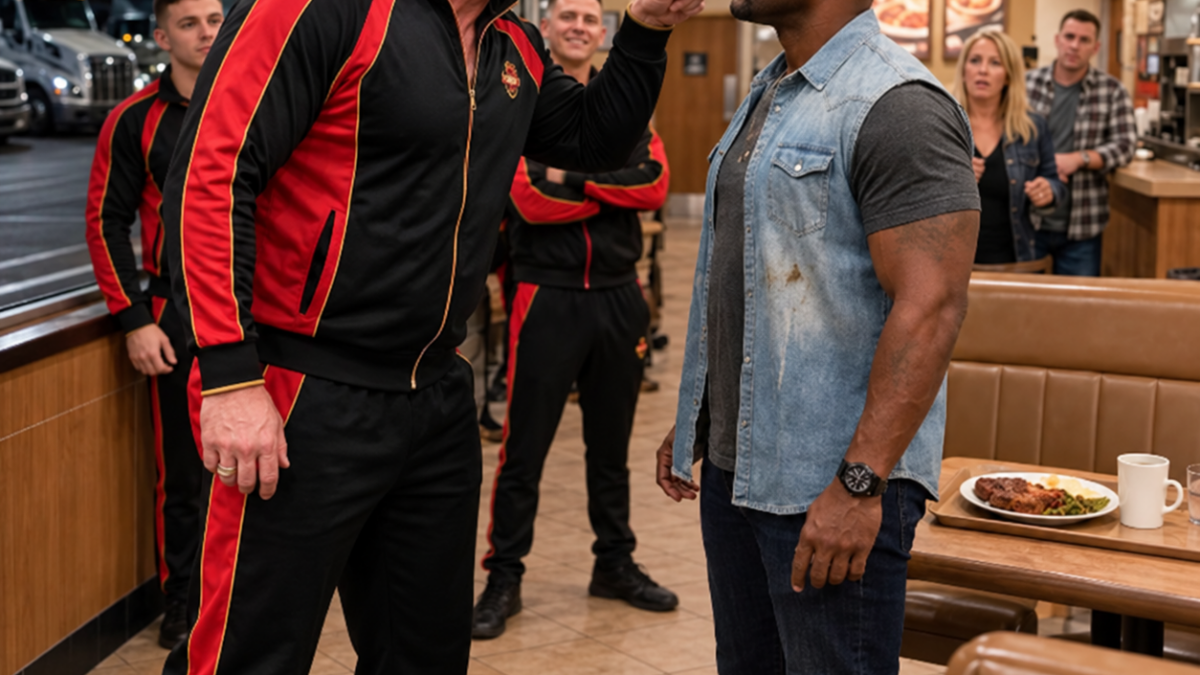
Undefeated Black Belt Challenged a Calm Truck Driver—Unaware He Once Led an Elite SEAL Team
The undefeated black belt thought my silence meant fear.
He slapped me in front of a crowded rest stop, ordered his students to hold my arms, and told everyone watching that a truck driver like me should have known his place.
What Brett Lawson did not know was that before I hauled steel pipe across state lines, I had spent fifteen years in the Navy—and the hands I kept lowered were the only reason he was still standing.
My name is Curtis Dawson.
Most people who meet me on the road just call me Dawson.
Truck drivers are like that. Last names. CB handles. Gas station nicknames. Short phrases exchanged over black coffee at two in the morning before everyone returns to whatever stretch of highway is waiting.
I was forty-three when the rest stop incident happened.
By then, I had driven for eleven years.
Three million miles.
Not one accident.
Not one late delivery.
Not one formal complaint.
That mattered to me.
After leaving the Navy, I wanted work with rules that made sense. Pick up the load. Secure it right. Check the straps. Watch the weather. Respect the weight behind you. Keep your log clean. Deliver on time.
The road could be lonely, but loneliness was not always bad.
Some men drink to quiet the past.
Some chase noise.
Some build new families fast because silence scares them.
I drove.
Long highways did not ask questions. They did not care who I used to be. They did not call me Senior Chief. They did not salute, pity, thank me, or ask whether I missed it.
They just stretched forward.
That was enough.
On the night everything changed, I walked into the Kentucky rest stop at 9:14 p.m. on a Tuesday.
I remember the time because I had been driving since four in the morning, seventeen hours across three states with forty thousand pounds of steel pipe secured on a flatbed behind me. My boots were cracked at the soles. My jacket smelled like engine grease, diesel, and highway dust. My shoulders ached from checking chains in cold wind.
Outside, my dog tags hung from the rearview mirror.
Not around my neck.
Not where people could see them.
I kept them there because old metal swinging gently against glass had become one of the few sounds that helped me sleep in a truck cab.
Inside, the rest stop glowed like a little city dropped in the middle of nowhere.
Fluorescent lights hummed over the food court. Glass walls reflected the parking lot, where eighteen-wheelers rested in long rows like sleeping giants. Families moved between burger counters and coffee kiosks. A couple of teenagers argued over fries. A tired mother bounced a baby against her shoulder. The air smelled like fried food, cleaner, stale coffee, and diesel drifting in every time the automatic doors opened.
Security cameras blinked in every corner.
Recording everything.
Stopping nothing.
I chose a booth near the window.
Habit.
I liked seeing my truck.
I liked seeing exits.
PART2:
Old training does not ask permission before it stays with you.
A young waitress named Nora brought a glass of water before I ordered. She looked maybe twenty-five, with tired eyes and the practiced alertness of someone who had worked enough night shifts to know when trouble had entered a room before anyone else admitted it.
“Long drive?” she asked.
“Long enough.”
My voice was low.
It usually is.
Men who know how loud the world can become do not raise their voices unless necessary.
Nora smiled faintly, then looked at the scar running from my right wrist to my elbow. Thin. Clean. Surgical, almost. Her eyes paused there for less than a second before moving away.
Good manners.
Or good instincts.
Either way, I appreciated it.
“What can I get you?” she asked.
“Meatloaf if you’ve got it. Black coffee.”
“You want gravy?”
“If it’s legal.”
She laughed once.
“I’ll risk it.”
I ate slowly when the plate came.
Cut the meatloaf into even pieces.
Chewed without rushing.
Checked the parking lot between bites.
PART3:
My hands looked like truck-driver hands by then—large, scarred across the knuckles, grease under the nails no matter how hard I scrubbed—but they still moved with the precision trained into them long before I ever strapped cargo to a trailer.
At the table across the food court, a different kind of energy was building.
Brett Lawson had won the state karate championship three hours earlier.
Fourth consecutive title.
Thirty-six official fights.
Thirty-six wins.
No losses.
Local papers called him The Wall.
His students believed it.
He believed it more.
Brett sat surrounded by eight young men from his dojo, all wearing matching black warm-up jackets with LAWSON COMBAT ACADEMY printed across the back. Empty beer bottles lined the table. A gold trophy sat beside a half-eaten plate of nachos.
He was thick-necked, wide-shouldered, and loud in the way some men become when they mistake volume for command. His forearms were roped with veins. His hair was still damp from a shower after the tournament. His smile said he had been praised all day and needed someone smaller to remind himself he was powerful.
At first, I ignored him.
That is another habit.
You do not engage every loud man in a public place.
Some storms pass if no one gives them shape.
But Brett wanted shape.
He wanted an audience.
And eventually his eyes found me.
I saw the moment happen.
His head turned.
His smile changed.
He looked me over.
Black man.
Alone.
Grease-stained jacket.
Work boots.
No friends at the table.
No family beside me.
No one visibly watching my back.
Brett leaned toward one of his students and said something. Two of them laughed.
Nora saw him stand.
Her hand tightened around the coffee pot.
That was when I knew he had done this before.
Brett crossed the food court in six steps and stopped beside my booth.
He did not sit.
He stood over me.
Champion posture.
Arms crossed.
Chin lifted.
“Sitting here means you want to challenge me, right?”
His voice was loud enough for everyone nearby to hear.
I looked up from my plate.
“I’m just having dinner, sir.”
“This is my area.”
“This is a rest stop.”
His students laughed behind him.
He mimicked my voice in a high-pitched whine.
“Just having dinner.”
More laughter.
Then he looked over his shoulder and said, “You hear that, boys? The truck driver thinks he belongs.”
The words were chosen carefully enough to be denied later.
Men like Brett often know how to keep one foot out of the fire.
I set my fork down.
“I don’t want trouble.”
“Trouble?”
He leaned close.
His breath smelled like beer and hot sauce.
“You walked into my space. You sat in my booth. That is trouble.”
“This isn’t your booth,” I said quietly. “I checked. There’s no name on it.”
The words were calm.
Almost gentle.
That was what made them land.
His neck flushed red.
A man who builds his identity around dominance cannot tolerate being corrected without fear.
He grabbed my collar and yanked me out of the booth.
My plate hit the floor.
Meatloaf and gravy splattered across white tile.
Nora flinched behind the counter.
“You think you’re funny?” Brett snarled.
His face was inches from mine.
“A greasy truck driver talking back to a four-time state champion.”
I said nothing.
My arms hung at my sides.
My breathing did not change.
That stillness made him angrier than any punch would have.
“You know what I see?” he said, jabbing a finger into my chest. “A nobody. A man who hauls freight because he never became anything. No title. No belt. No name worth remembering.”
He shoved me backward.
I stumbled.
Did not fall.
“I could break you in ten seconds,” he said. “And nobody in this building would care.”
He looked around the food court.
Families stared.
Teenagers lifted phones.
A security guard near the entrance looked away.
Nobody moved.
Nobody spoke.
Brett smiled.
He loved that silence.
To him, it meant he owned the room.
Nora stepped forward.
“Sir, please. He’s just a customer.”
Brett turned on her.
“Did I ask you?”
She froze.
His voice dropped.
“Get back behind that counter before I get you fired.”
Her eyes met mine for one brief second.
I gave her a small nod.
Step back.
I’ll be okay.
She stepped back.
Her hands shook.
Brett turned to me again.
“Last chance, truck driver. Walk out that door on your knees and maybe I’ll let you keep your teeth.”
I looked at the broken plate.
At the phones recording.
At Nora’s trembling hands.
At the young men behind Brett watching him like he was teaching them something worth learning.
“I’ll finish my dinner,” I said. “Then I’ll leave.”
Brett’s smile vanished.
The first slap came hard.
Open palm.
Side of my face.
The crack echoed across the food court like a gunshot.
Conversations stopped.
I did not fall.
I stood exactly where I was.
My cheek burned.
I blinked once.
Then I turned my face back to him.
Same expression.
Same breathing.
That was the first time I saw uncertainty flash across Brett Lawson’s face.
Not fear yet.
Just a small interruption in the story he had been telling himself.
“Hold him,” he snapped.
Four students moved immediately.
Two grabbed my arms from behind.
Two flanked my sides.
They pinned me against the booth, arms locked behind my back.
I did not resist.
Not because I was helpless.
Because I had been held before.
Because I knew struggling against people who want you to struggle only gives them the picture they came for.
Brett stepped close.
“See? No fight in you. No spine. Nothing.”
He slapped me again.
Harder.
My head turned left.
Heat spread across my cheekbone.
“Hit me back,” he whispered. “Come on. Give me a reason.”
I said nothing.
He turned toward the crowd.
“You all watching this? This is what a coward looks like. A truck driver who can’t even defend himself.”
Phones were everywhere now.
Screens glowing.
Somebody had started a live stream.
Brett noticed.
That made him worse.
He grabbed my jaw and forced me to look at him.
“You’re nothing,” he said slowly. “You sleep in parking lots. You eat alone. You drive because nobody anywhere is waiting for you.”
One of his students laughed nervously.
The others tightened their grip on my arms.
Behind the counter, Nora was on the phone.
Whispering fast.
I could hear just enough.
“Please send someone. He’s hurting him. No, the man isn’t fighting back.”
Brett dragged me toward the exit.
The students followed, still gripping my arms. My boots scraped the polished floor. The glass doors opened, and cold night air hit my face.
The parking lot was bright under overhead lamps.
Trucks and cars reflected the light in sharp angles.
A few travelers stopped along the sidewalk.
Brett shoved me onto the asphalt near the curb.
“Get up.”
I stood slowly and brushed gravel off my palms.
“I said get up faster.”
He kicked dirt toward my boots.
I stood straight.
Steady.
I looked at him the way a man looks at weather.
Something happening.
Something that would pass.
His students formed a circle.
Eight young men.
All trained fighters.
All watching their champion.
Someone propped a phone against a truck tire to film.
The live stream was climbing.
Brett cracked his neck.
Rolled his shoulders.
Dropped into a fighting stance.
“Here’s what’s going to happen,” he said. “I’m going to hit you. You’re going to fall. And everyone watching is going to see what happens when a nobody walks into the wrong rest stop.”
He threw a front kick.
It caught me in the ribs.
I folded slightly, took the force, stayed on my feet.
He followed with a spinning back fist.
I ducked.
The fist passed above my head.
Brett paused.
“Lucky,” he muttered.
He attacked again.
Jab.
Cross.
Low kick.
I blocked the jab.
Slipped the cross.
Checked the kick with my shin.
Clean.
Textbook.
The kind of defense that takes years to learn.
Brett stepped back.
For the first time, his smile flickered.
“Where’d you learn that?”
I did not answer.
He came harder.
Elbow strike.
Knee to the body.
Roundhouse kick aimed at my head.
I caught the leg midair.
Held it for one second.
Then released it and stepped back.
No counter.
No strike.
Just space.
The crowd had grown.
Twenty people.
Then thirty.
Some came out of the rest stop.
Others pulled over near the ramp.
Phones were everywhere.
The live stream crossed ten thousand viewers.
Brett’s face reddened.
Not from exhaustion.
Embarrassment.
He had thrown championship combinations, and the truck driver in a grease-stained jacket had blocked every one.
“You think you’re better than me?” he snapped.
I stayed quiet.
He swung wild.
A haymaker with everything behind it.
I stepped aside.
He hit air and stumbled.
When he turned, I was standing in the same place.
Same posture.
Same breathing.
His students looked at one another.
Something was wrong.
They could feel it.
Their undefeated champion was emptying his toolbox, and the man in front of him had not opened his.
Brett charged and drove me backward into the side of a parked truck. Metal boomed behind my shoulders. He pinned me there with his forearm across my throat.
“Fight me,” he hissed. “Stop standing there like a coward and fight me.”
I looked down at the forearm against my throat.
Then up at his face.
Something old shifted inside me.
Not rage.
Rage is too messy.
This was colder.
A door opening in a room I had kept locked for years.
“You sure?” I asked.
He pressed harder.
“I said fight.”
I wiped a thin line of blood from the corner of my mouth with the back of my hand.
Looked at it.
Then at him.
“As you wish.”
For the first time that night, I moved my hands into position.
Not fists.
Not a boxer’s guard.
Open palms.
Fingers relaxed.
Weight on the balls of my feet.
Knees soft.
Breathing slow.
Four counts in.
Four counts out.
It was not a stance any karate dojo in America would teach.
But any operator who had worked close quarters in bad places would recognize it.
The parking lot changed.
The crowd felt it.
Brett felt it too.
Some instinct beneath trophies, beer, ego, and performance whispered something his pride did not want to hear.
This man is not what you think he is.
Nobody was laughing now.
Brett attacked first.
Straight right.
Full speed.
The kind of punch that had ended fights.
I tilted my head two inches left.
His fist passed my ear.
I did not counter.
He reset.
Jab-cross combination.
I parried the jab, redirected the cross with my forearm, and stepped offline.
No wasted motion.
No panic.
Just geometry.
“Stand still,” Brett growled.
Roundhouse kick.
I absorbed it on my forearm and used his rotation to spin him off balance.
He stumbled.
Recovered.
Came again.
Low kick.
Checked.
Spinning back fist.
Duck.
Flying knee.
Sidestep.
He crashed into the empty space where I had been.
Now he was breathing hard.
Sweat ran down his temples.
I had not thrown a single strike.
“What the hell are you?” he panted.
I did not answer.
He rushed into a clinch and drove knees into my body.
One.
Two.
Three.
Each impact shook me.
My feet did not move.
My hands came up inside the clinch.
I broke his grip with a sharp upward motion that separated his arms like paper.
Then I tapped him twice on the chest.
Gently.
Like a teacher correcting a student.
“You’re open here,” I said.
His eyes widened.
That broke something in him.
Not physically.
Worse.
I had just told him where he was weak in the middle of a fight he thought he controlled.
He swung again.
Wild overhand right.
All rage.
No structure.
I caught the arm mid-flight.
Left hand around his wrist.
Right hand under the elbow.
One rotation.
His feet left the ground.
He turned in the air and hit the asphalt on his back with a sound like a car door slamming.
All the air left him.
The parking lot went silent.
Not quiet.
Silent.
The kind of silence that happens when reality breaks the story everyone was telling.
A four-time state champion had just been thrown by a man who still looked like he was waiting for coffee.
I stepped back.
Hands open.
Breathing unchanged.
Brett rolled onto his side, coughing. He pushed himself to one knee. His hands trembled. His ego was louder than his pain.
One of his students whispered, “Get up.”
Brett lunged from the ground, a desperate tackle toward my midsection.
I sprawled.
Drove his momentum down.
Took his back.
Wrapped one arm under his chin and applied the choke with textbook precision.
Not crushing.
Not punishing.
Controlled.
His hands clawed at my arm.
His legs thrashed.
I leaned close to his ear.
“Tap.”
He did not.
Pride would not let him.
I tightened enough to clarify the options.
He tapped.
Three quick slaps on the asphalt.
I released him instantly.
Stood.
Stepped back.
Said nothing.
Brett lay on the ground gasping at the overhead lights.
His students stared.
Nobody moved to help him.
Then three of them attacked.
One front kick.
I caught the foot and dumped him onto the pavement.
Second came with a hook.
I slipped inside, controlled the arm, and sent him spinning into a parked car.
Third tried a takedown.
I sprawled, locked the wrist, and pinned him face-down without injuring him.
Three students.
Six seconds.
All down.
The remaining five looked at each other.
Two raised their hands and backed away.
Three charged.
I moved through them like water through a broken fence.
Wrist locks.
Arm drags.
Trips.
Sweeps.
Every motion measured.
No broken bones.
No unnecessary damage.
Just enough force to end each threat and move to the next.
In under thirty seconds, all eight students were on the ground.
Some sitting.
Some lying flat.
All staring at the man in the grease-stained jacket who had not raised his voice once.
One student sat up slowly.
He looked at me.
Then at Brett.
Then at his own hands.
And he started laughing.
Quiet at first.
Then louder.
The kind of laugh that comes when everything you believed turns out to be a lie.
Nora stood in the doorway with both hands over her mouth, tears on her face.
“Are you okay?” she whispered.
I flexed my fingers, wiped blood from my lip, and looked toward the food court.
“I’m fine,” I said. “Can I get my coffee to go?”
Inside, a trucker in a red cap started clapping.
Then a teenage girl.
Then a mother holding a toddler.
Applause filled the rest stop.
It bounced off glass walls and polished floors like something trapped too long finally being let out.
By midnight, the video had millions of views.
By morning, more.
The headline spread everywhere.
MYSTERY TRUCK DRIVER TAKES DOWN UNDEFEATED KARATE CHAMPION.
For forty-eight hours, strangers online called me a hero.
Then Brett Lawson hired a lawyer.
The lawsuit hit the courthouse on Tuesday.
Assault and battery.
Intentional infliction of emotional distress.
Civil damages of $2.4 million.
Brett claimed a herniated disc, torn rotator cuff, and severe psychological trauma. His students filed supplemental complaints alleging unprovoked violence.
The story flipped overnight.
Brett’s attorney, Gerald Whitmore, was the kind of man cameras loved. Tall. Silver hair. Sympathetic eyebrows. A voice that made lies sound responsible.
He stood on the courthouse steps and said, “My client was conducting a peaceful martial arts demonstration when Mr. Dawson attacked without provocation.”
Peaceful demonstration.
That was what he called it.
He told reporters the viral video was edited.
He said it started after I attacked.
He said I used “military-grade combat techniques” against civilians.
That phrase did what he wanted.
Military-grade.
Not disciplined.
Not restrained.
Not defensive.
Dangerous.
Within hours, comment sections shifted.
Nobody fights like that unless he’s trained to kill.
Truck driver attacked first?
I knew something was off.
Typical.
My employer called at six in the morning.
My dispatcher, Ray, had always been straight with me.
That morning his voice was tight.
“Curtis, corporate pulled your route.”
I sat in my truck cab.
The engine was cold.
So was my coffee.
“I was defending myself, Ray.”
“I know that.”
“Then what are we talking about?”
“Insurance flagged you as a liability. Legal says suspended pending review.”
“That means fired.”
A long pause.
“You know how this works.”
I did.
The morning sun came through the windshield and lit dust across the dashboard. Above me, tucked behind the visor, was an old photograph of my unit.
Eight men in desert fatigues.
Arms around one another.
Squinting into hard light.
Three of them never came home.
I had survived two wars.
Carried wounded men through gunfire.
Made decisions in four seconds that most people would never face in a lifetime.
And now I sat in a parking lot, suspended by phone call because a man in a fake neck brace had better lawyers.
I hung up.
Pulled my dog tags from under my shirt.
Held them in my fist.
The metal warmed against my palm.
Names were engraved on them that no news camera would ever see.
My phone buzzed.
Nora.
Are you okay? I saw the lawsuit on TV.
I typed:
I’m fine.
I was not fine.
That evening, Brett appeared on local news inside his dojo. Neck brace. Sling. Trophies behind him. Face arranged in careful pain.
“I’ve dedicated my life to martial arts,” he said. “I teach children. I mentor young people. This man came into my community and attacked me for no reason.”
The reporter nodded sympathetically.
“What about the viral video?”
“That clip starts after he attacked us,” Brett said. “You don’t see him threatening my students. I stepped in to protect them.”
No one fact-checked it.
No one called Nora.
No one asked the rest stop for security footage.
By Friday, I had gone from America’s hero to America’s villain.
My bank account held $412.
My truck sat in a lot in Tennessee.
My apartment lease was up in thirty days.
Reporters appeared outside my building.
My landlord called.
“Curtis, I need you out by the end of the month.”
“I paid rent on time for six years.”
“I know, but this is bigger than rent.”
Bigger than rent.
That is what people say when they want to make cowardice sound administrative.
I packed my belongings into three cardboard boxes.
That was my life.
Three boxes, one duffel, and a truck I could no longer drive for work.
I parked at a rest stop outside Nashville.
Not the same one.
Quieter.
Emptier.
Slept in the driver’s seat with my jacket rolled as a pillow.
Ate gas station sandwiches.
Drank machine coffee that cost $1.50.
Showered at truck stops with tokens and exact change.
Eleven years.
Three million miles.
And I was back to sleeping under fluorescent lights.
Somewhere in Virginia, retired Navy Commander Frank Richardson watched the viral video for the ninth time.
I learned that later.
He kept pausing at the same point.
The stance.
Open palms.
Four-count breathing.
Choke applied with surgical restraint.
He picked up the phone and called a number he had not used in six years.
“This is Richardson,” he said. “I need a personnel file. Last name Dawson. First name Curtis. Service dates 2003 through 2018.”
A pause.
Then:
“Yeah. I think that’s him. I think that’s our guy.”
That phone call changed everything.
The courtroom was full.
Every seat taken.
Reporters lined the walls.
Three cameras waited outside because cameras were not allowed once proceedings began.
A sketch artist sat near the back.
Brett Lawson sat at the plaintiff’s table in a dark suit, neck brace back on, hands folded like a man in prayer. Gerald Whitmore sat beside him with a yellow legal pad covered in notes.
I sat alone at the defendant’s table.
No attorney.
No suit.
I wore the cleanest shirt I owned, a white button-down ironed by hand at a truck stop laundromat.
My hands rested flat on the table.
My breathing remained steady.
Judge Patricia Calloway entered.
Sixty-three.
Sharp eyes.
Known for running a tight courtroom.
Whitmore stood first.
He presented medical reports.
Photographs.
Statements from students who described me as a violent predator.
Then he played a forty-five-second clip from the viral video.
It began when I flipped Brett.
No insults.
No slaps.
No students holding my arms.
No dragging.
No front kick.
No context.
Just a truck driver throwing a man through the air.
“Your Honor,” Whitmore said, “this man is a trained killer walking among civilians. He used lethal force against my client, a respected martial arts instructor and mentor.”
I listened.
No reaction.
Judge Calloway turned toward me.
“Mr. Dawson, do you have legal representation?”
“No, Your Honor.”
“Do you wish to speak on your own behalf?”
I opened my mouth.
Then the courtroom doors opened.
A man walked in wearing a navy-blue suit and a small lapel pin—an eagle, an anchor, and a trident.
Anyone who recognized that pin understood its weight.
The man was six feet tall, gray-haired, military-short cut, posture straight enough to make younger men sit taller.
“Your Honor,” he said, “my name is Commander Frank Richardson, United States Navy, retired. I am here as a character witness for Mr. Dawson. I also have documents relevant to this case.”
Whitmore shot to his feet.
“Objection. This witness was not disclosed.”
Richardson did not look at him.
“I am not a witness for either party,” he said calmly. “I am a private citizen presenting evidence to the court. These documents were declassified forty-eight hours ago at my request.”
Judge Calloway studied him.
Then said, “Approach.”
Richardson walked to the bench and placed a sealed folder before her.
She opened it.
Read the first page.
Then the second.
Then the third.
Her eyebrows rose.
She looked at me.
“Mr. Dawson, is this accurate?”
“Yes, Your Honor.”
She read aloud.
“Curtis James Dawson. Enlisted United States Navy, 2003. Selected for Basic Underwater Demolition/SEAL training, 2004. Graduated top of his class. Assigned to SEAL Team Four. Three deployments. Afghanistan, Iraq, classified operations in two additional theaters.”
The courtroom went silent.
She continued.
“Commendations include the Bronze Star with Valor, the Navy Cross, and the Purple Heart. Served fifteen years. Honorably discharged in 2018 with the rank of Senior Chief Petty Officer.”
Whitmore’s pen stopped moving.
Every argument he had prepared began dissolving in real time.
Brett adjusted his neck brace.
Then adjusted it again.
Suddenly it looked exactly like what it was.
A costume.
Richardson spoke from where he stood.
“Your Honor, I was Curtis Dawson’s commanding officer for four years. I personally witnessed this man exercise restraint under conditions that would break most people. He is trained in more than a dozen combat systems. If he intended to harm Mr. Lawson, that fight would have ended in the first three seconds. The fact that no one suffered serious injury tells you everything about his restraint.”
Judge Calloway nodded slowly.
“Anything else?”
“Yes, Your Honor.”
Richardson held up a phone.
“There is a second video.”
The courtroom stirred.
Whitmore stood.
“Your Honor, we object—”
“Sit down, Mr. Whitmore.”
Richardson connected the phone to the courtroom display.
The video was from Nora’s personal phone.
It began twelve minutes before the viral clip.
It showed Brett walking to my booth.
The first insult.
The grab.
The plate hitting the floor.
The slap.
The students holding my arms.
The second slap.
The threats.
Dragging me outside.
The kick.
The circle.
Everything Brett had sworn never happened.
The video ran for nineteen minutes.
Nobody spoke.
Nobody moved.
Only Brett’s voice filled the courtroom, loud and ugly, calling me every name he could find while I stood there and took it.
When the video ended, Judge Calloway removed her glasses.
“Mr. Whitmore,” she said, “I am looking at nineteen minutes of footage that directly contradicts every statement in your filing.”
Whitmore said nothing.
“Your client claimed he was attacked without provocation. This video shows him initiating physical contact, assaulting Mr. Dawson repeatedly, and ordering his students to restrain him.”
Brett’s face had gone pale.
Not red now.
White.
The color of a man realizing he built his own trap and walked into it.
Judge Calloway continued.
“I am dismissing this case with prejudice. I am referring Mr. Lawson’s sworn statements to the district attorney for potential perjury charges. I am also issuing a formal finding that Mr. Dawson acted entirely in self-defense.”
The courtroom erupted.
She struck the bench once.
“Order.”
Silence returned.
Then she looked at me.
“Mr. Dawson served this country for fifteen years. He earned honors most people will never fully understand. And when attacked by a man far below his skill level, he used the minimum force necessary. He did not break bones. He did not cause permanent injury. He controlled every moment of that encounter.”
Her voice softened.
“Mr. Dawson, on behalf of this court, I want to thank you for your service. And I want to apologize for what you have endured since that night.”
I nodded once.
I did not smile.
Did not cry.
Just nodded.
The same way I had nodded when Nora stepped back.
The same way I had nodded when Ray said corporate pulled my route.
The same way a man acknowledges weather.
The world had done what it did.
I was still standing.
Richardson walked over and placed one hand on my shoulder.
I looked up at him.
For the first time in weeks, my eyes burned.
“Welcome back, Senior Chief,” he said quietly.
I pressed my lips together.
Swallowed once.
Nodded again.
Outside the courthouse, sunlight was blinding.
I stood on the steps and looked up at the sky.
I had not stood in sunlight like that in three weeks. I had been living in my truck, eating gas station food, sleeping in parking lots, waiting for a system that had already decided I was guilty.
Now the system had changed its mind.
But damage does not vanish because someone finally tells the truth.
The story broke everywhere.
Not Brett’s version.
The real one.
Full nineteen-minute video.
Court transcript.
Declassified service record.
Decorated Navy SEAL attacked at rest stop.
Truck driver was victim all along.
Hero used restraint in self-defense.
People called me a hero again.
I had been a hero the week before too.
That had not lasted.
Nora called three times.
I answered the third.
“Curtis, have you seen the news?”
“Some of it.”
“They’re calling you a hero again.”
“I was a hero last week.”
Silence.
Then she said, “It’s different now. People saw the whole video.”
I looked at my dog tags hanging from the rearview mirror.
“People see what they want to see, Nora. That hasn’t changed.”
But some things had changed.
The district attorney filed charges against Brett Lawson.
Perjury.
False report.
Fraud related to fabricated medical evidence.
The neck brace, sling, and injury claims collapsed under investigation. His own doctor confirmed he had not treated Brett for any injury related to the incident.
Brett’s dojo emptied within a week.
Parents pulled children first.
Then adult students.
Then the serious fighters who suddenly understood the difference between discipline and domination.
His championship record came under review after three former opponents came forward with allegations of intimidation.
Sponsors disappeared.
His gym lease was revoked for reputational damage.
Same phrase my landlord had used.
Funny how words travel differently depending on who is holding power when they are spoken.
Brett Lawson had walked into that rest stop believing he was untouchable.
Everything that followed traced back to one decision.
He picked a fight with a stranger eating dinner alone.
My trucking company called me next.
Not Ray.
The CEO.
Sandra Wells.
She had driven rigs for twenty years before moving into corporate.
“Mr. Dawson,” she said, “I owe you an apology. We should not have suspended you. We made a decision based on public pressure, and it was wrong.”
“I appreciate that, ma’am.”
“We want you back. Full reinstatement. Back pay for every day missed. Formal apology from the company.”
I sat in my truck holding the phone.
Outside, traffic moved through a fuel station.
“Mr. Dawson?”
“I’ll think about it.”
I did.
For two days.
Then I called her back.
“I’ll come back,” I said. “But I have a condition.”
“Name it.”
“I want the company to create a legal defense fund for drivers. Anyone who gets in trouble on the road and cannot afford a lawyer. Civil or criminal. On duty. Off duty at a stop. If they are alone, they need someone before public opinion buries them.”
Sandra was quiet.
I continued.
“I spent three weeks living in my truck because I could not fight a lawsuit. Nobody should go through that alone.”
She agreed that day.
The Curtis Dawson Driver Defense Fund launched within a month.
Within six months, it helped forty-three drivers.
Within a year, three other trucking companies copied the model.
Later, a civil rights attorney in Chicago partnered with the fund to expand coverage to people facing unjust charges after self-defense incidents.
That part mattered more to me than every headline.
Headlines forget.
Funds help.
Richardson visited me at a truck stop in Virginia a few months later.
We sat in a booth by the window drinking black coffee.
“You could have ended that fight in three seconds,” he said.
“I know.”
“Why didn’t you?”
I looked out at the highway.
Trucks rolled past, lights flickering through rain.
“Because that is not what they taught us.”
Richardson waited.
“They taught us to protect people,” I said. “Even the ones trying to hurt you.”
He nodded once.
Did not say anything else.
There was nothing else to say.
Six months later, I was back on the road.
Same truck.
Same routes.
Same rest stops.
I still ordered meatloaf when they had it.
Still tipped thirty percent.
Still sat alone in corner booths with paperback novels and black coffee.
But some things had changed.
The Kentucky rest stop where it happened installed a small bronze plaque near the entrance.
It read:
STRENGTH IS NOT MEASURED BY THE FIRST PUNCH THROWN.
IT IS MEASURED BY THE LAST ONE HELD BACK.
Nora became manager.
First thing she did was install new cameras in every corner of the building and parking lot.
Second thing she did was frame a printed screenshot from the night everything happened.
Not me throwing Brett.
Not him on the ground.
The picture was from after.
Me standing in the doorway, lip bleeding, asking for coffee to go.
She hung it behind the register.
Brett Lawson pleaded guilty to perjury and filing a false report. He received probation, community service, and a permanent mark on his record. His championships were revoked. His dojo closed.
The building became a daycare center.
One of Brett’s former students later posted a video from a different gym, a jiu-jitsu academy run by a retired Marine.
“I spent four years learning from the wrong teacher,” he said. “I thought strength meant domination. Curtis Dawson showed me what real strength looks like. It looks like a man who could destroy you choosing not to.”
The video got millions of views.
I never watched it.
I was somewhere on I-40 hauling construction steel toward Memphis. Otis Redding played on the radio. The sun was dropping behind the Appalachian ridgeline. My dog tags swung gently from the rearview mirror.
My phone buzzed.
Nora.
Meatloaf tonight. Your booth is open.
I smiled.
Save me a plate.
The highway stretched ahead, long and straight and endless.
The same road I had driven a thousand times.
But that evening it felt different.
For years, the road had been where I disappeared.
Now it felt like it was carrying me back to myself.
People still ask what I was thinking when Brett slapped me.
The honest answer?
I was thinking about Nora.
About the mother holding her child in the food court.
About the teenagers filming.
About the students learning from a man who mistook cruelty for strength.
About every time I had seen a situation turn deadly because someone could not control pride.
Mostly, I was thinking:
Do not become what he needs you to become.
Brett needed a monster.
His lawyer needed a monster.
The internet needed one too, for a while.
But I knew who I was.
A driver.
A veteran.
A man trained to end violence, not worship it.
A man who had spent years learning that real power is not proven by how much damage you can cause.
It is proven by how little damage you choose to cause when damage would be easy.
So when people ask what happened at that rest stop, I tell them this:
An undefeated black belt challenged a calm truck driver because he thought silence meant weakness.
He thought work boots meant ignorance.
He thought a grease-stained jacket meant nobody important was inside it.
He thought eight students, a crowd of phones, and one good lawyer would be enough to rewrite the truth.
He was wrong.
Because truth has a way of waiting.
Sometimes it waits in a waitress’s phone.
Sometimes in a sealed service record.
Sometimes in the hands of a retired commander who recognizes a stance on a viral video.
And sometimes it waits inside a man everyone underestimated until he finally raises his hands.
Not to start a fight.
To end one.








